

BLOG
Stories, articles, and updates from the Ranch community.
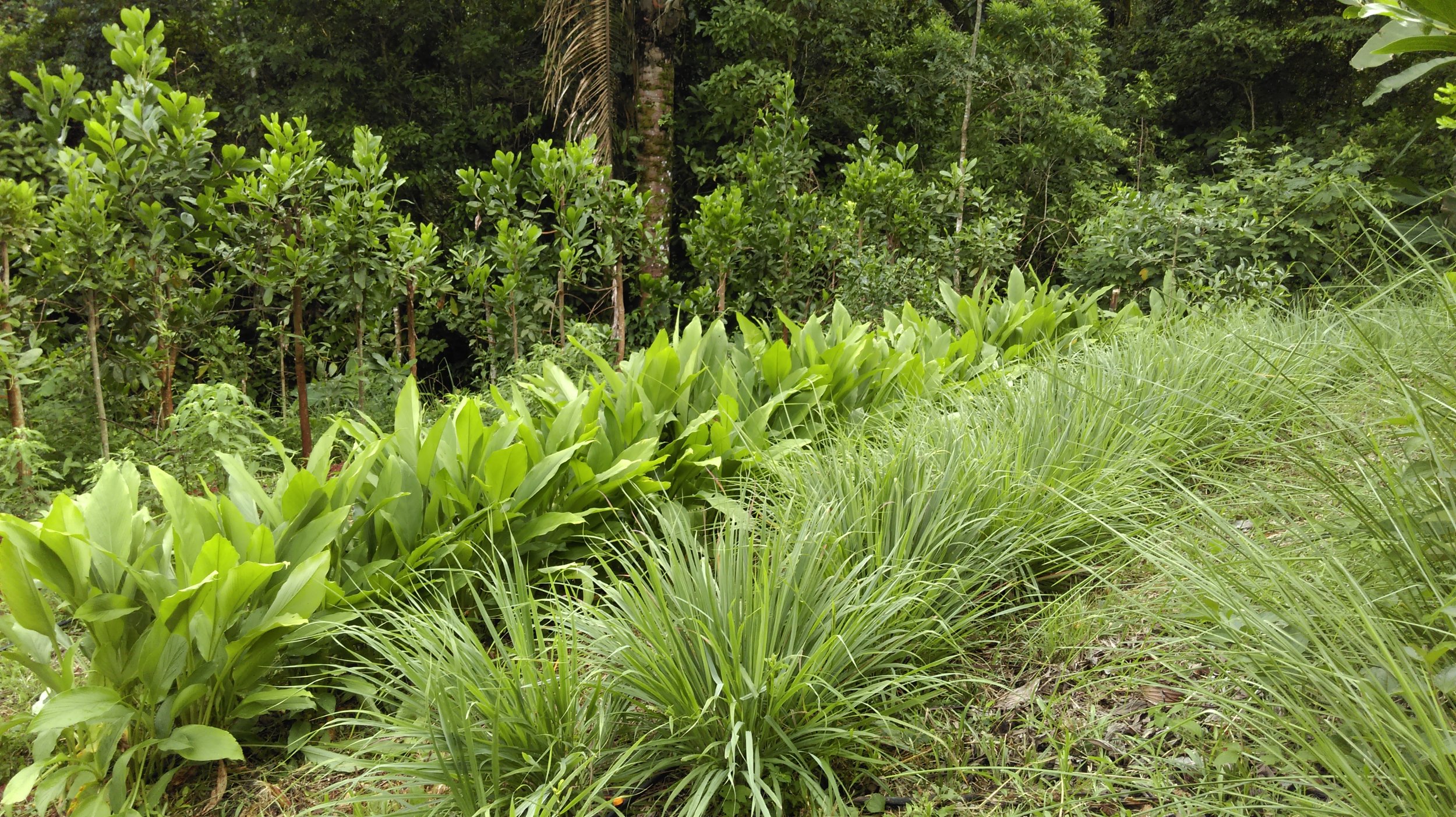
How to Optimize Your Syntropic Agroforestry Site
Syntropic agriculture is based on seeing evolutionary processes as driven by cooperation among members of the living system in a way that benefits the system as a whole. It aims to maximize of diversity and productivity.
By 2023 apprentice Seb W
Syntropic agroforestry is an agroforestry system developed by Ernst Götsch. Its philosophy lines up contrary to the Darwinian model of evolution, being driven by competition. It is based on seeing evolutionary processes as driven by cooperation among members of the living system in a way that benefits the system as a whole. It aims to maximize of diversity and productivity through aligning Stratification (space) and Succession (time) of its plants. Furthermore, it subdivides these plants into target and biomass species which allows for it to become self-sustainable over time. In its essence it means trying to mimic the real forest as close as possible.
What follows are factors to be integrated into your syntropic agroforestry site to optimize its potential outcome. If syntropic agroforestry is new to you, read What is Syntropic Farming first.

Image by Orchard of Flavours
Consortium of Plants for Syntropic Farming
Since every climate and microclimate offers different qualities, therefore being able to habitat different plants, just putting out a chart of plants won’t help a lot of you. Instead we want to explain at this point how you can write your own consortium. A consortium is basically an optimized garden guild which integrates the succession of its plants over time. Stratification still applies but it is now planned over time. To plan a good consortium you want to research a list of edible plants viable for your microclimate, their height at maturity as well as time until maturity. Based on that you can then categorize your plants into the different strata as well as time stages.
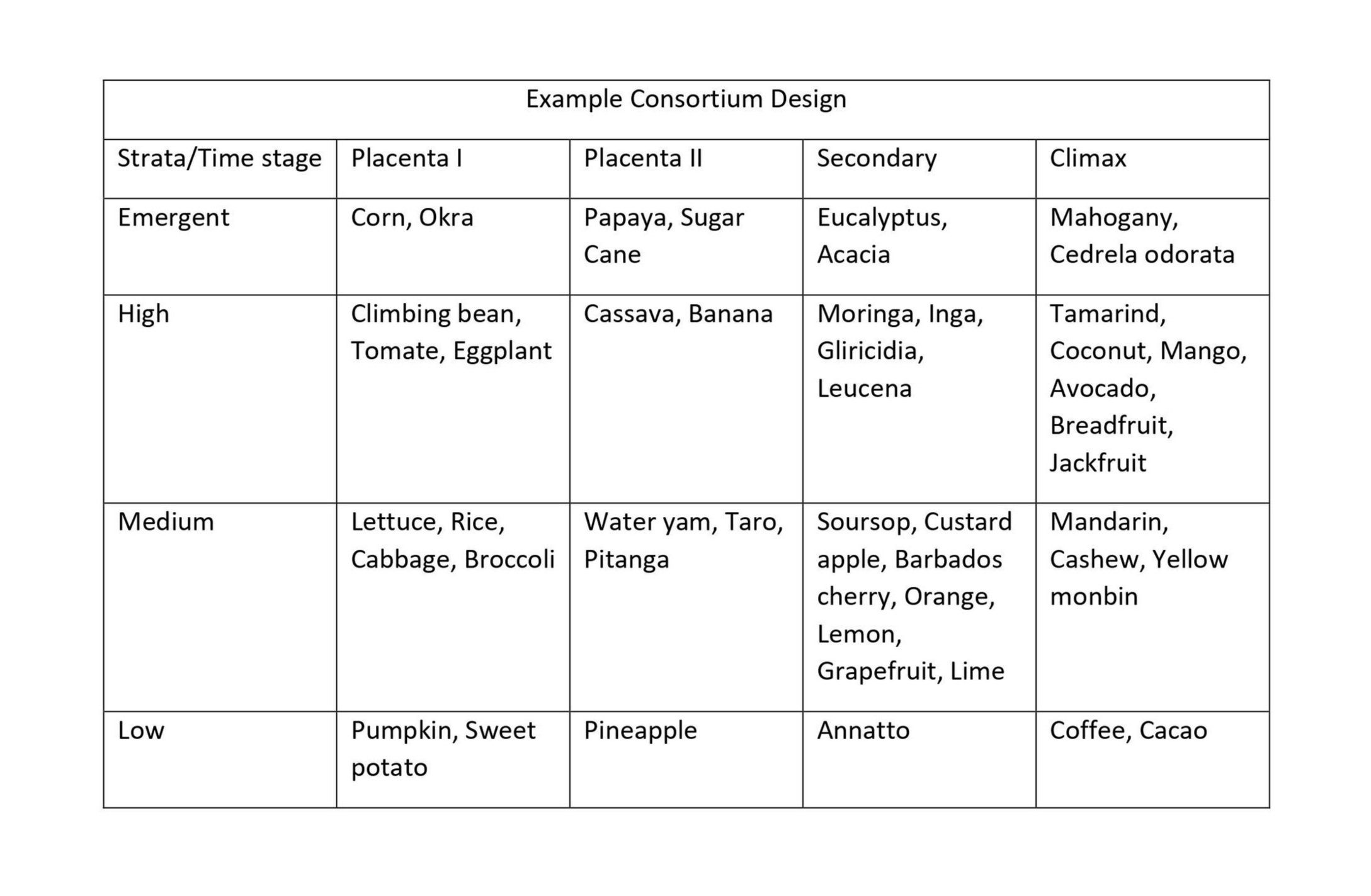
When planning a syntropic site we also want to keep in mind, that it will take at least 20 years until the climax stage is reached (if well managed). Within the first two years (until the end of placenta II) you can still add plants to the system though usually everything is planted in the beginning all at once. The only exception to that rule are climbers (exg. Vanilla or maracuja) as long as there is enough sunlight coming through to the ground.

Types of Plants to Plant
Whatever edible plants you want to grow, in syntropic agroforestry systems edible plants are not the only plants to be grown. Usually one aims to grow around 30% of plants just for biomass, of which again 30% are meant to be nitrogen fixers. Those biomass trees will then be cut down to chest level before the rainy season (or at the end of autumn in temperate climates). Applying this pruning technique will not only build good quality soil over time but also trigger a growth hormone release throughout the whole system pushing growth of everything within it. To attract native bird and insect species you should also consider adding some local plant species even though they might neither add to your table nor fix nitrogen.
Spacing Plants
To get a better understanding of how to finally design such a system, a spacing key is useful:
Tree line to tree line (wideness): 80cm first tree line – 50cm walkway – 70cm biomass plants (e.g.. Vetiver, Mexican sunflower, pigeon pea…) – 200cm filled with veggies – REPEAT
In the lines themselves the trees are planted super dense together.
Depending on size and needs one might combine walkway, biomass plants and/or the veggie area (veggies will only grow until end of placenta II due to shade coverage).

The minimum tree spacing key looks as follows:
Emergent to emergent tree: 12m
Emergent to high tree: 10m
Emergent to medium & low tree: 2m
Emergent to biomass tree: 0.5m
High to high tree: 9m
High to medium tree: 7.5m
High to low tree: 2m
High to biomass tree: 0.5m
Medium to medium tree: 6m
Medium to low tree: 3m
Medium to biomass tree: 0.5m
Low to low tree: 3m
Biomass to biomass tree: 0.5m
Ideally this spacing key is used on contour.
If you, like Ernst Götsch, are not a friend of tree lines, what Ernst recommends doing is: select an appropriate amount of diverse seeds, mix them all together, scatter them over your site and later decide which trees will stay and which won’t (negatives: some edible species vary heavily in flavour and consistency when grown from seed. Positives: way less work, good growing genetics only through natural selection, no row pattern).
Thoughts
Syntropic Agroforestry has received a lot of attention over the past few years. That being said, it is one of many different practices within the field of agroforestry practices and certainly has its negative sides. Contour is often times neglected in favor of north to south rows, invasive grasses instead of the mentioned vegetable rows will be a pain to manage over time, and proper spacing especially regarding tubers needs to be respected.
Hopefully this short how-to helps you get started on planning your own syntropic site to live more self-reliant.

Read These Past Blogs
Applied Permaculture Principles
Learn More
Join us for one of our annual workshops on farming, plants, permaculture and more!

Foundations for Success: 10 Considerations to Create a Healthy Project
After more than 20 years, we have been able to identify some trends that have led to our survival as a business and a community. The following advice is appropriate, and perhaps some of it even necessary, if you expect to live successfully in a communal work and living environment doing land-based work.
By Core Team Member Tim O’Hara
After more than 20 years, we have been able to identify some trends that have led to our survival as a business and a community. The following advice is appropriate, and perhaps some of it even necessary, if you expect to live successfully in a communal work and living environment doing land-based work.

Students in our annual Permaculture Design Course
Communal Continuity
It’s imperative to assemble a group of individuals that you can depend on, year after year. If the only people that are visiting your project are there for shorter or medium length stays, you will never feel as if you have a community to lean on during the harder stretches of running a project of this nature. Create realistic and concise agreements with one another and develop incentives that make everyone feel well taken care of.

Privacy
We learned the hard way that having your own private space is critical for long-term happiness. We decided to focus on building before planting in our early years. That has meant that our agroforestry spaces are a bit behind where you’d expect after 20 years of working in those spaces. But without privacy, it’s impossible to keep people around who are doing the important work in the orchards and other spaces. Create private spaces for everyone, with a focus on creating lovely, comfortable, healthy homes for your core team.
Collective Decision Making
Micromanaging is a recipe for burnout. Don’t fall into the trap. Develop trust with your partners and allow each leader to make decisions in their realm up to a certain value. Big decisions, that affect everyone, should be discussed by your entire team, but small decisions, like whether to buy 5 or 10 avocado trees, should be left to those managing the orchard spaces.

Balance and Rest
It’s imperative to figure this out before burning out. Burnout can be permanent, leading to the abandonment of your passions. Build into your day-to-day lives the time to run, breathe, nap, walk, draw, meditate and think. The work will never be done, so don’t try to do it all each day. It will be there waiting for you in the morning after a great night’s rest.

A Solid, Well-Taken Care of & Committed Core Team
We’ve got an amazing core team. But it took us longer than it should have to realize the importance of building a strong team at the center of our project. If we expect community members to stay committed, they need to have their needs met. And everyone has a unique set of needs. Create a compensation agreement that makes everyone feel valued.

Community Connection
Be an active member in your town. Demonstrate, over and over again, that your project exists to benefit everyone in your community, especially those most in need. Join your local woman’s group, offer free yoga classes once a week, develop a kids soccer camp, or create a language exchange.
Fair Share
Share what you have. It’s your easiest path to acceptance though far from the easiest practice to bring to fruition. It has taken a lot of time, energy and sacrifice to create Rancho Mastatal, and sometimes our knee-jerk reaction to “spreading the wealth” is instead to move to protect what we’ve created in the interest of stability and to prepare for future unforeseen issues. But true stability comes with sharing.

Communal Meals
This may be the hardest bit of advice to embrace for some. Sharing a meal takes more social energy, but weighed against the time you save on cleaning and cooking, it’s worth it. Communal meals encourage group debate, laughter, learning and the development of a strong social fabric. Humans have tended towards eating in front of screens or on the run. These trends lead to poor eating habits and encourage humans to disconnect from one another. To eat well today means a monumental and coordinated effort growing, processing and cooking food. Celebrate this activity each and every day and you will be rewarded in ways unexpected.
Make Time to Dream
We “talk shop” a lot around here. We love what we do and enjoy talking about what we’ve created and how we can improve it. It’s important for us to create spaces that allow for dreaming and scheming. Having the space to “zoom out” and move for a time away from the day-to-day allows for creative brainstorming that can lead to breakthroughs and new ideas that might otherwise never come to the surface. Dare to dream, and dream to create your ideal version of life.

Don’t Get in Over Your Head
This is much easier said than done. When you commit to a land based project, your to-do list immediately seems endless. There’s never enough time in the day to do everything that you need. Start small and work towards simple solutions whenever possible. Build and perfect one system at a time, as much as you can do that. Don’t add chickens, goats and fish in the same year but rather add one species and then see how that changes your life before adding another. We made the mistake of throwing too much at the wall early on in our development and when not everything stuck, it felt overwhelming picking up the pieces of many systems simultaneously.
We try to share our failures and successes frequently so that others can get to where we did in less time and with less effort. Please don’t hesitate to contact us with questions, comments, or suggestions and all the best in your journeys.
Check Out These Past Blogs About Permaculture and Community
How to Run a Permaculture Internship
Enriching Community Soil: 5 Simple Strategies That Support Sustainable Relationships

Salak: A Productive Understory Crop
The risks of cultivating this species are beautifully contrasted by the enjoyment and health benefits of the fruit it produces.
By 2022 apprentice AJ Nolan
Salak palm is a great option for an understory species for a permaculture tropical agroforestry system. The risks of cultivating this species are beautifully contrasted by the enjoyment and health benefits of the fruit it produces. You truly get what you pay for. The fruit can be eaten right off the palm and makes for a great snack after working in the orchards.
Salak palm is native to Indonesia and is often cultivated in analogous climates. Here at the Ranch, we have around 40 palms both male and female.

A bowl of freshly picked salak
How to Start Growing Salak
Propagation
In order to establish salak in your agroforestry spaces you’ll need to start with propagation. Salak can be started from seed and should be placed sideways and half buried in a well-drained potting mix.
Both males and females are needed for successful fruit production. There is no way to determine the gender of the palm until 3 years after planting, when they begin to flower. Having 3 female plants for every male plant has proved to be optimal for our orchard space of roughly 4000m2. Once the plants reach maturity and begin to flower you can then identify any excess males you may have. Replace them as needed to reach your ideal ratio (3 female : 1 male)
Planting
The best time to plant is at the start of the rainy season.
The soil around the palm should be heavily top-dressed with compost.
Each plant should be planted 2-3 meters apart and are best planted in the same area for safety reasons and pollination needs (more on pollination below).
Keeping in mind the spiked nature of salak, it is good practice to avoid planting where any fruit or nuts may fall from overstory species. The palm is best planted under a low-maintenance canopy of fruit and nut trees. The individuals that have done the best in our orchard spaces have been ones that receive about 50% shade.
Maintenance

Using the macana to help remove dead material
Maintenance of the salak palm is where your patience and physical fitness will be put to the test.
Once the plant reaches maturity, it is time to start pruning. Remove any dead material and any leaves that are blocking easy access and visibility to the flowers. It is recommended to remove any hijos that are growing on the mother plant. Hijos are competing with the mother plant for sunlight and nutrients so it is best to use them as mulch seeing as they inhibit fruit production. The mother plant can be identified by following the roots. The roots lead into the mother plant which is curved and looked to be in an upward dog position. Any other segment not attached to the roots, but are instead attached to the mother plant are known as hijos.
After pruning, we make donuts around the palm, using mulch from around the orchard space. Read this blog “5 Grow-Your-Own Mulch Plants for the Tropics”. We have moved away from using the salak prunings to mulch the trees with, as it makes for further maintenance and pollinating challenging. We pile the cuttings and let them decompose in a pile or burn them and add to the trees.

Helpful pruning tools
When it comes to pruning, always have both of your hands occupied so you don’t accidentally reach out and grab the spiky palm. For optimum pruning our tools are: a macana, machete, garrabato, loppers, and a pruning saw with a long blade or handle. Using a macana and a pruning saw is an effective way to pry the hijos off of the mother plant. This takes practice and it is best to have at least two people to pry the hijos away. Then, using a garrabato to move the fronds around, I use my machete to move the cuttings to the pile.
Unlike most tree species, salak’s growth pattern is not one of vertical extension. As salak continues to grow, it will shuffle along the ground (much like a snake) and will begin to hover, the roots acting as it’s foundation on the forest floor.
Pollinate
In addition to the efforts of pruning, you should also pollinate the female flowers with the male flower. The native pollinator can only be found in Indonesia so whilst native pollinators will give very low levels of production, if high yields are desired it is necessary to hand-pollinate (learn more about pollination here).
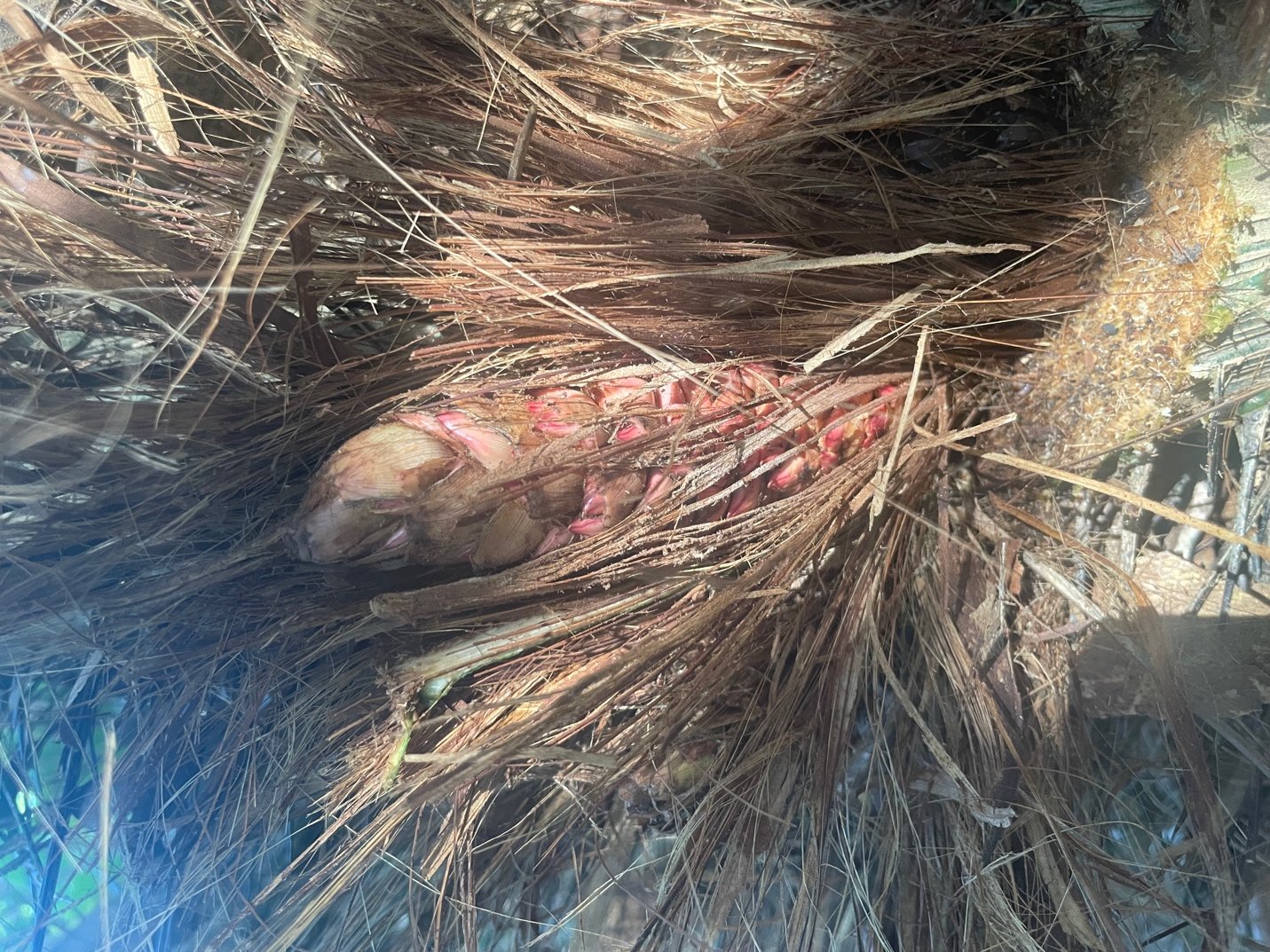
Female flower
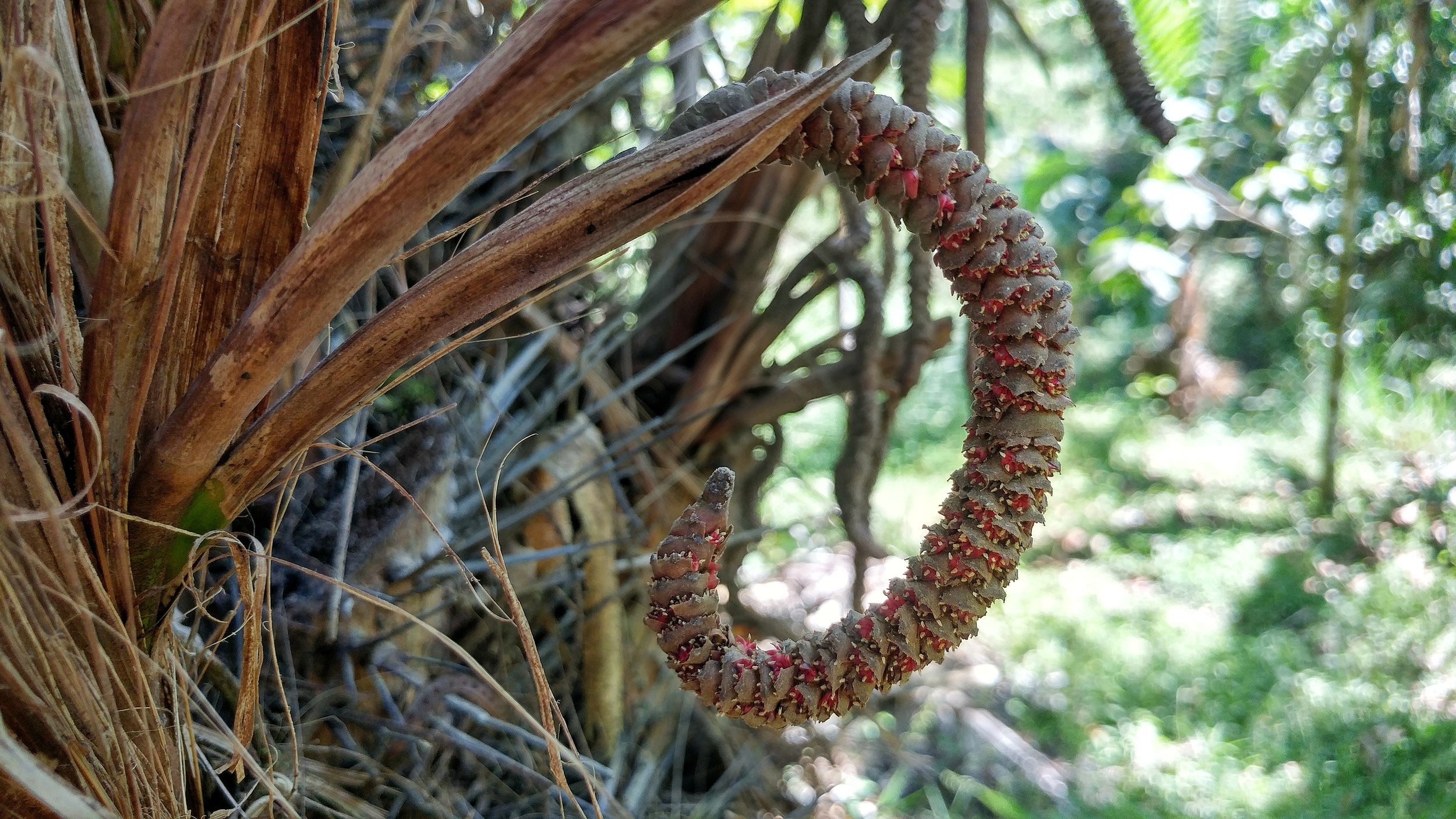
Male flower
Salak flowers all year round, so we have found it very useful to mark the females with red flags for easier management. This is because you only need to check to see if the female plants have any receptive flowers and then go and find a male flower if needed. The female flowers are cone-shaped and covered with a dense outer layer. The outer layer is shed over the course of a couple of months and the pink flower is revealed. The male flowers should be removed and brought to the female plant to dust the open flower. Within a few days the flower should harden up, which indicates a successful pollination.
Harvesting
Now comes the best part....harvesting! To determine if the fruit is ripe, take one off towards the base of the clump of fruits, after eating the flesh, see if the seed inside has changed from white to a brown color. If the seed is brownish and the taste is sweet and satisfying, you’ll know the time is right! If the seed is light brown or white and the fruit is astringent then you will know to leave the clump of fruits on the palm to mature further. Harvest when you can to avoid competition from pests but don’t be too indulgent because the fruit does not ripen off of the plant. After repeated successful harvests you will begin to be able to identify when the clumps are ready for harvest without needing to taste one first.
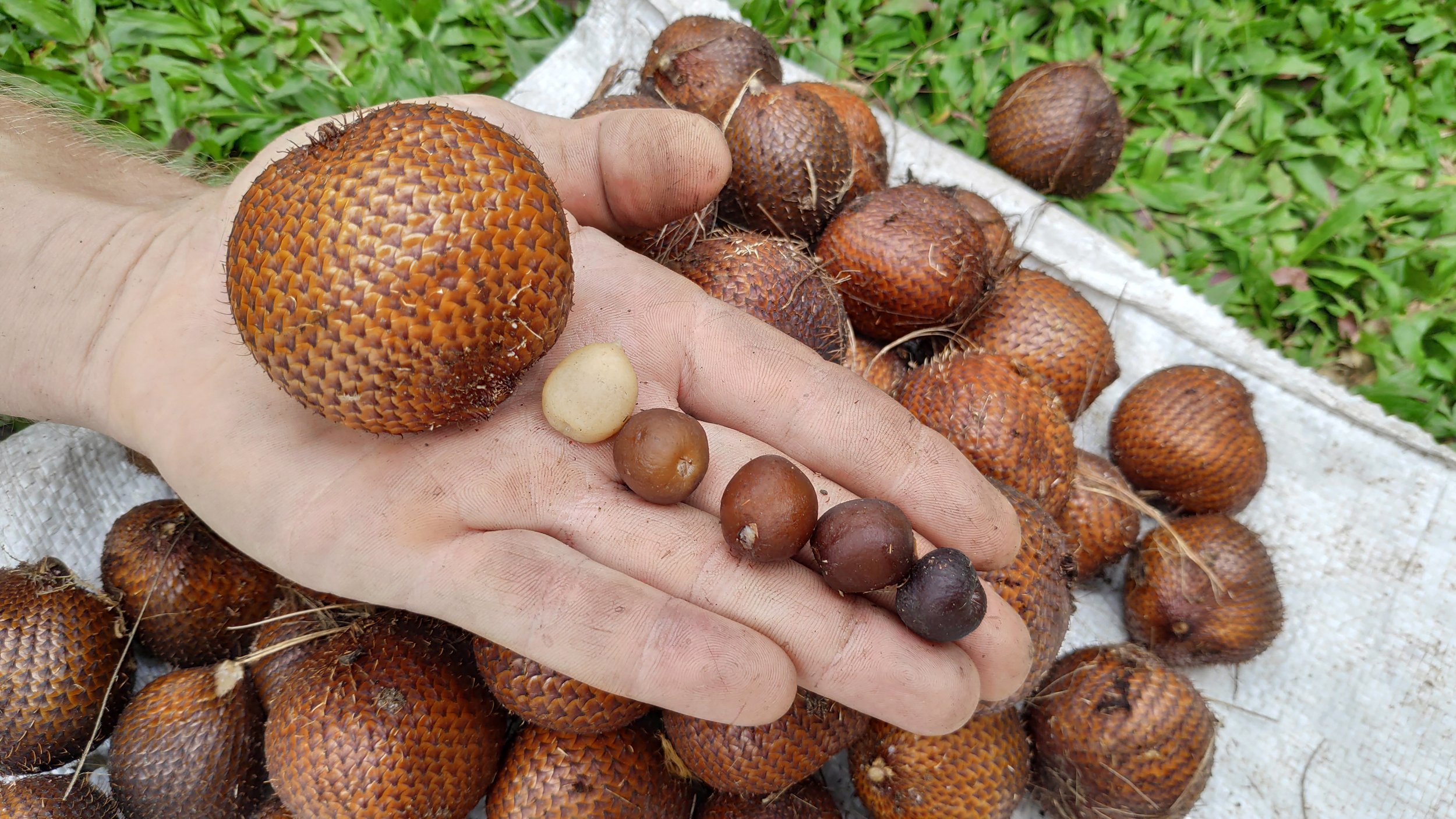
The different colors of the seeds to determine ripeness
Overview
Salak is a valuable companion in your agroforestry spaces, able to be planted underneath mature fruit trees. Like anything worth doing it involves work and dedication, but the rewards are well worth the effort and the work will not be in vain. The fruit is delicious and nutritious and maintenance is a great way to truly earn the fruits of your labor.
References :
El Arbol “Al servicio de Agricultor” Vol 2. Guia de Especies
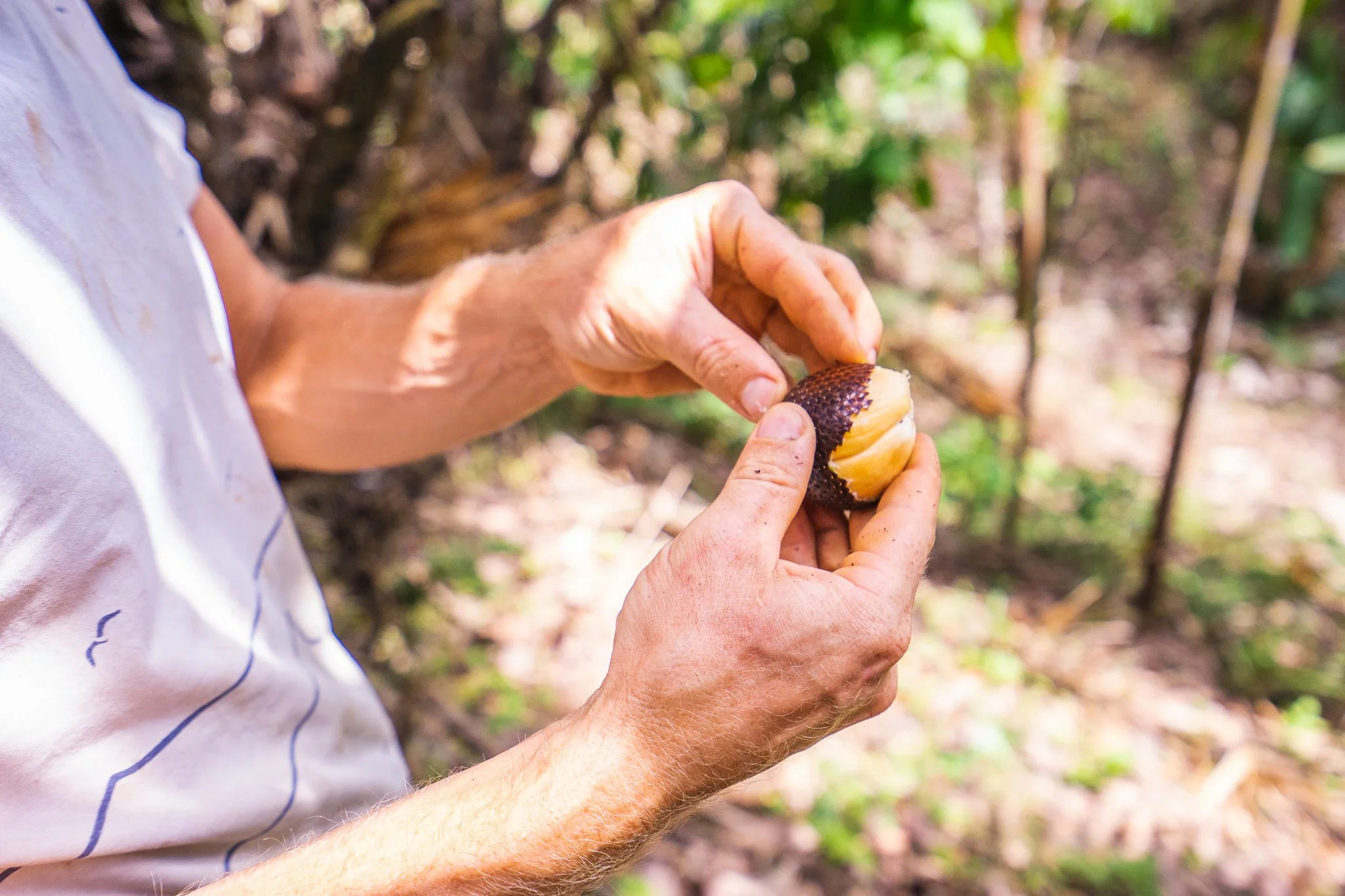
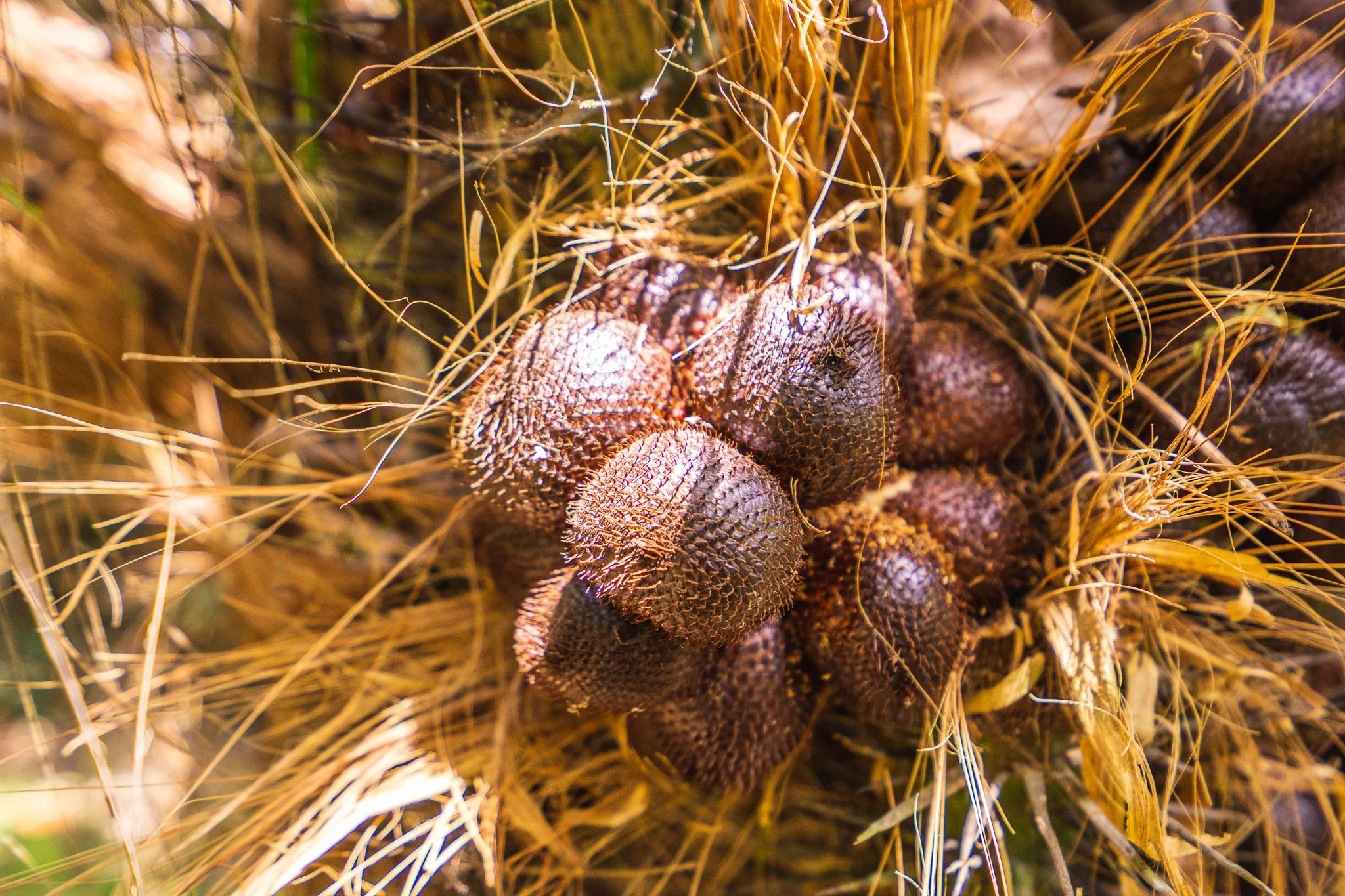
Check Out These Other Blogs About Salak & Permaculture
Salak Palm: A Guide for Tropical Permaculture
Ameding Calium-Deficient Soils - A Tropical Permaculturists Approach
LEARN MORE
Join us for one of our educational workshops about permaculture design, natural bulding, fermentation, and more. Check out our yearly workshops here.

Beyond Cacao: The Fruit(s) of the Gods
Like cacao, these trees produce a fruit filled with delicious pulp and seeds and have proven to be amazing additions to our culinary experiments. These pre-Colombian species are still grown on a relatively small scale and have retained significant genetic diversity. They provide hope for a more diverse tropical forest system and chocolate industry.
By 2021 Apprentice Cameron Conklin

Various forms of theobroma processing
You may have heard the term Theobroma (“theo” meaning “God” and “broma” meaning “fruit”) in reference to the genus of the cacao tree (Theobroma cacao) the incredible fruit that creates what we call chocolate. Here at the Ranch we love our cacao, but we also grow two other members of the Theobroma genus - cupuacu (Theobroma grandiflorum) and pataxte (Theobroma bicolor) who have stolen our hearts this year. Like cacao, these trees produce a fruit filled with delicious pulp and seeds and have proven to be amazing additions to our culinary experiments. These pre-Colombian species are still grown on a relatively small scale and have retained significant genetic diversity. They provide hope for a more diverse tropical forest system and chocolate industry.
A Short Description and History
The Cupuacu (Theobroma grandiflorum)

A cupuacu fruit
The cupuacu tree grows to an average height of 6-10 meters, maturing in 4 years. It has a large, brown, smooth oblong fruit (15-35 cm long), that falls to the ground when it is ready to be harvested. There are about 25 seeds per fruit protected by sweet, tangy pulp. Cupuacu is native to the Brazilian Amazon. Today it is still cultivated primarily in Brazil, but can be grown anywhere from southern Mexico to Peru. Right now, the cupuacu pulp is the most commonly used product from the fruit. The pulp is used for drinks, ice creams, pastries and other sweet treats common across Brazil. There is significantly more pulp in the cupuacu than cacao. To my surprise, the seeds are not as commonly commercialized, but there is a growing market. The seed is high in fat, about 48% (similar to 45% in cacao), which has created a budding market for industrialized cupuacu butter being used in cosmetics for skin care. Cupuacu butter has higher yields per fruit than cacao and its price is attractive for farmers. Processing accessibility seems to be the current limitation in production increase.
Yet the seed also makes for a creamy and delicious cupuacu chocolate or “cupulate” that creates light mocha-colored bars or drinks. From what I can see, there is an untapped market for an alternative chocolate product made from the cupuacu bean. The taste is tantalizing - fruity, earthy, and bright. It also has lower levels of alkaloids, theobromine, and caffeine than cacao but still retains high levels of vitamin C and anti-oxidants. The fat content makes for an extra creamy consistency. However it’s high oleic fat content is also one of its logistical downsides. It has a low melting point of 30 degrees Celsius (compared to 35 degrees for cacao) which can make transport difficult. Yet combining cacao and cupuacu together makes for a winning combination!
Here at the Ranch, we have used cupuacu for everything from making vinegars and wines, to bonbons and coconut cupuacu hot chocolate! It is truly a magical tropical fruit that I could see becoming much more popular across Central America soon.
The Pataxte
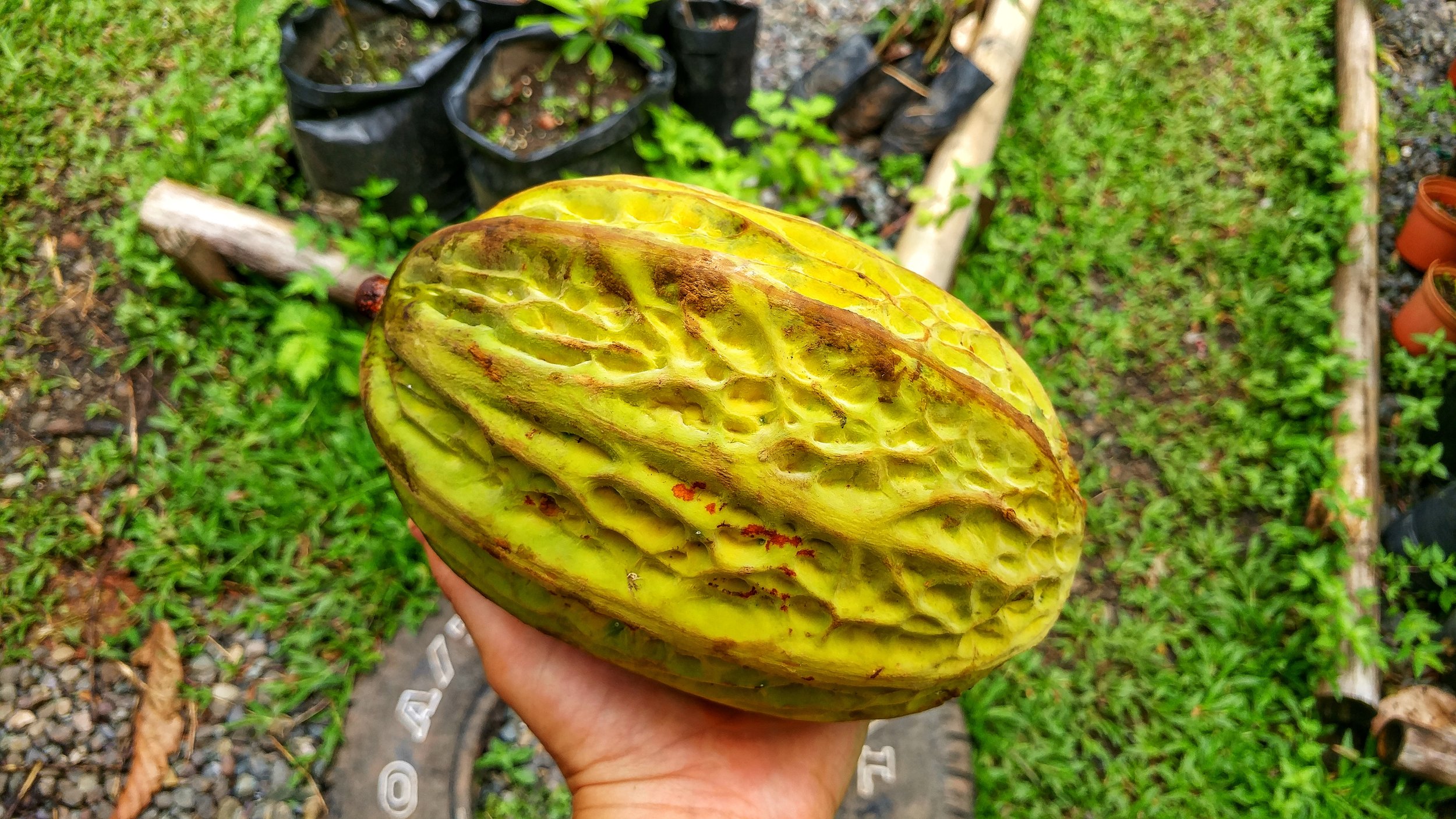
A pataxte fruit
The pataxte tree grows to an average height of 8-12 meters, maturing in 5 years. It has a large, yellow, round to oblong fruit with distinct ribs (12-30 cm long). Its pulp is tangy, and can sometimes give off the aroma of gasoline, but generally has a sweet taste. Here at the Ranch, the pataxte pulp flavor is defnintely more polarizing than cacao or cupuacu. There are about 40 seeds per fruit and the pods fall to the ground when ready to be harvested.
Similar to the history of cacao, the pataxte was developed into chocolate during the Aztec period and likely originates from the Amazon. Mesoamerican civilizations used pataxte in beverages similar to cacao. Pataxte is grown from Peru to Mexico, but today it is most commercially available in Mexico. Its seeds are used in combination with cacao to make chocolate bars or fried/roasted for savory dishes. In Oaxaca, there is a traditional beverage called the “popo” made of pataxte. Pataxte is also often used to create buttery foams on the top of traditional cacao and maize beverages in Maya culture.
Pataxte already has a history of being combined with cacao to make chocolate, but this relationship is still underutilized and certainly not pervasive in Costa Rica. Pataxte provides an incredible nutty, buttery, and sweet flavor to cacao. However, its fat content is much lower coming in at around 20%. This gives us the opposite problem of the cupuacu, making it difficult to create a creamy bar with just pataxte.
Sounds like a combination situation just might be the ticket! Here at the Ranch, we have combined pataxte with cacao and cupuacu to make bon bons, chocolate drinks and delicious chocolate sauce!
Seeing Chocolate in a New Light
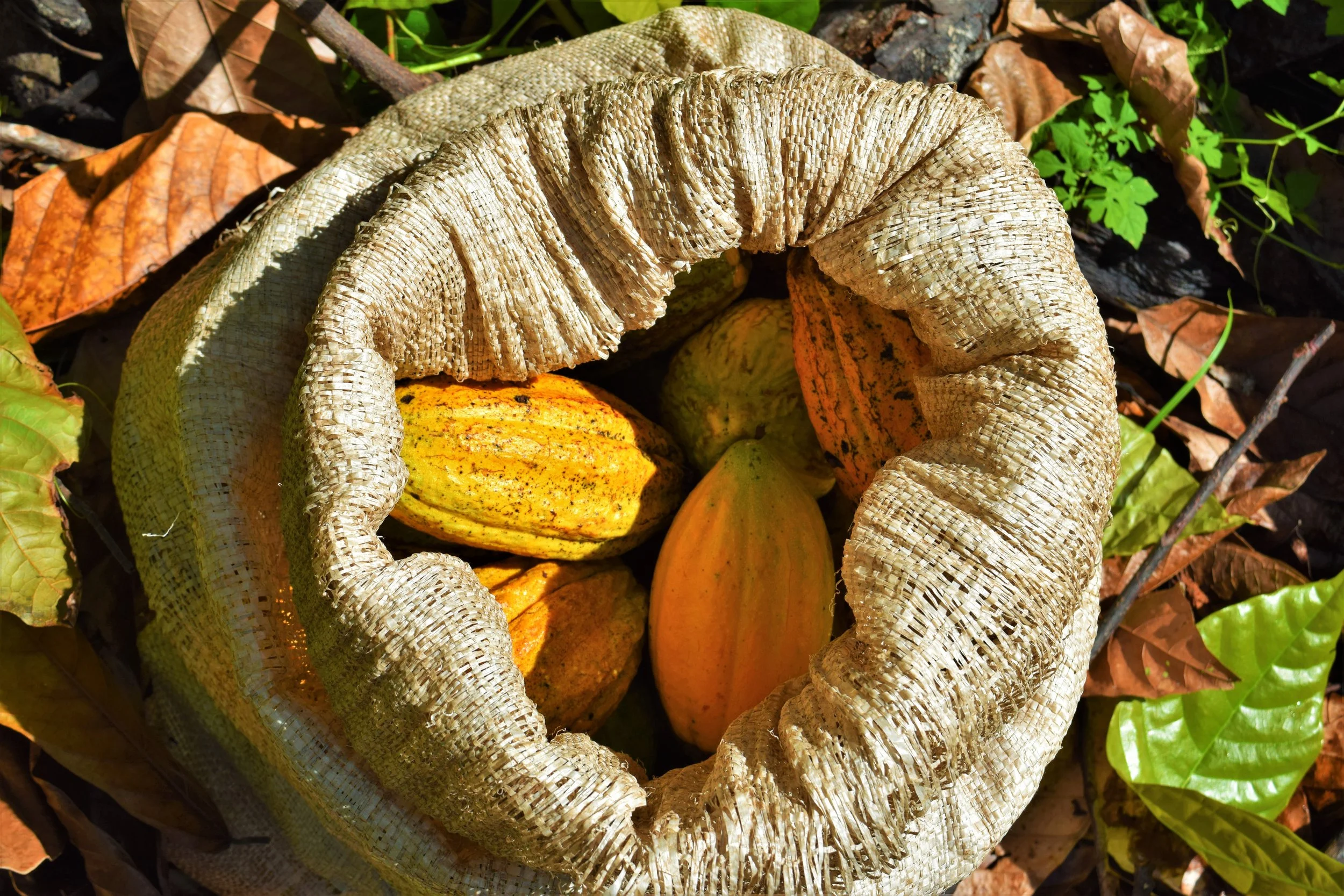
A small harvest of cacao fruits
A beautiful and important lesson I’ve learned this year is that chocolate is more than just dark, hard and bitter. Experimenting with cupuasu and pataxte has showed me that chocolate can be soft, creamy, nutty, floral, and taste like red wine. Expanding my interpretation of chocolate to encompass these other Theobroma varieties has inspired me to learn more about how to grow cacao, cupuacu, and pataxte in combination. This could create a more ecologically and economically diverse and stable chocolate farm for growers across Central America. It could also create more complex and unique chocolate products for everyone to enjoy!
The Fermentation Process
These Theobromas taste best when the seeds have been fermented, letting the sugars in the pulp seep into the seeds and enhance the flavor of the beans. A typical ferment needs a fairly large number of fruits (30+) to reach the desired temperature to initiate fermentation. Due to the somewhat sporadic and limited harvest of cacao, cupuacu, and pataxte we get from our agroforestry systems, we often find ourselves needing to ferment a small number of fruits at a time (under 10). To tackle this problem, we have done everything from warming jars of seeds in hot water baths to heating them in our compost piles!
The recipe below has wound up being one of our favorite ways to “ferment” the beans. It is a two for one process creating both tasty vinegar and beans with a rich flavor profile. As sometimes happens, we actually never intended to use this recipe to ferment beans, we just decided to give the beans a try after making the vinegar. Lucky for us (and for you!) we loved the way the beans tasted after going through this process.
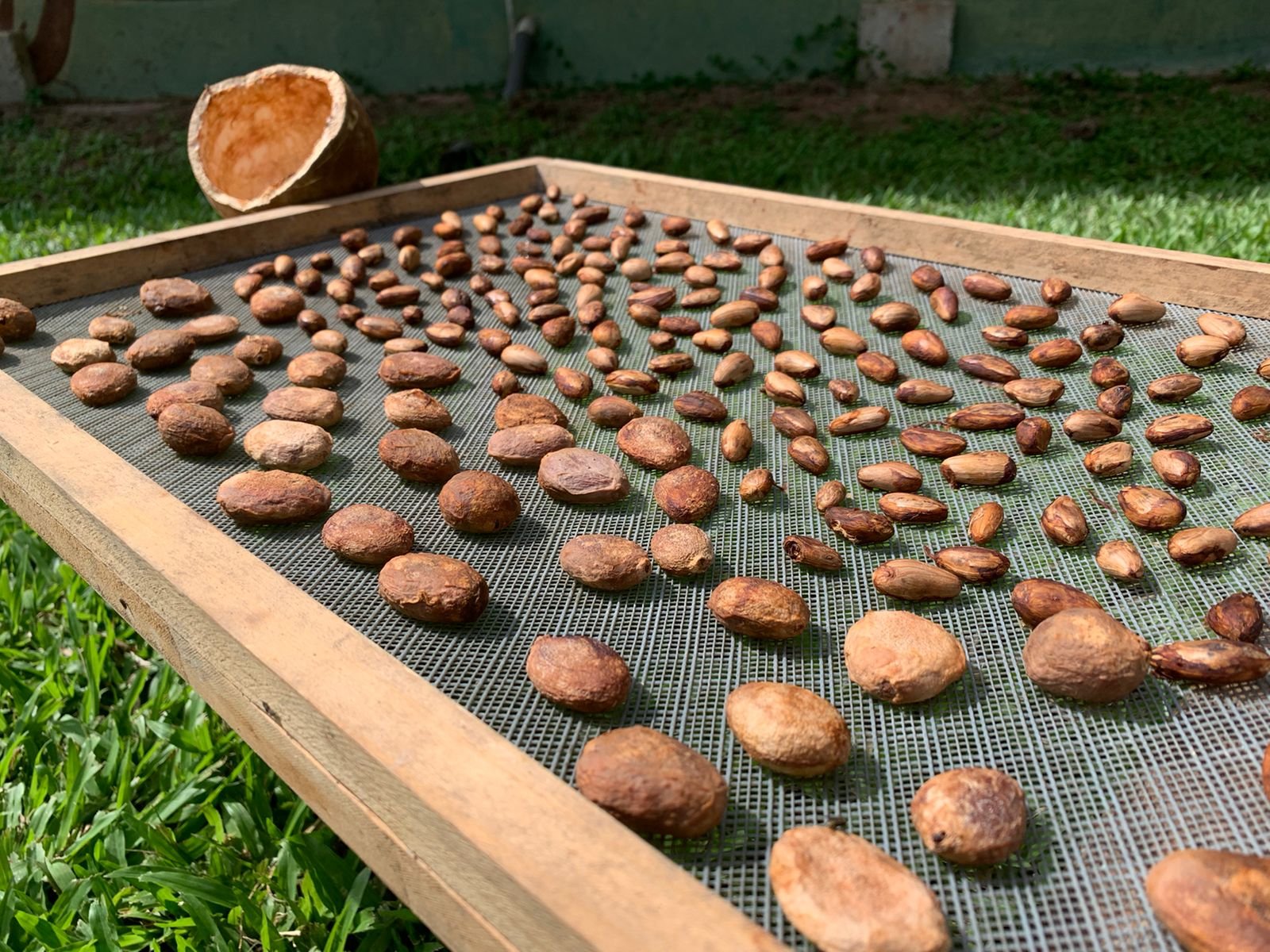
A mixture of Theobroma seeds that have been fermented and are drying in the sun
Recipe: Theobroma Vinegar Fermentation
Every so often, magic is created from a forgotten experiment. This recipe is just that, an experiment that was left on the back of the shelf only to be found again and turned into something delicious! This process actually produces two unique products, vinegar with notes of chocolate, red wine and nuts along with beans ready to be dried, roasted, and turned into chocolate!
When beginning with fresh pods:
Place seeds and pulp of cacao, cupuacu, and pataxte into a bucket. We have used as little as 4 fruits to as many as about 10 fruits for this process.
Fill with water, enough to cover all of the seeds and pulp sufficiently. Add more water if you would like to yield more vinegar. This is up to you!
Add 1/3 cup tapa dulce (our source of raw sugar) for every fruit in the ferment.
Leave open to oxygen but covered for bugs (we use a cheesecloth and string).
Stir once a day for 3 days.
On the third day, check the flavor of the ferment, adding more sugar if the solution has already lost significant sweetness.
Check the vinegar once a week for 3 more weeks, testing the solution to see how well the pulp has soaked off of the beans. Add more sugar if the vinegar flavor is weakening.
After about a month, check to taste - If the vinegar is tangy and the beans are relatively free of pulp (the cupuacu and pataxte will have more pulp than the cacao) then the vinegar ferment is ready.
Strain the vinegar and bottle, storing in an anaerobic environment for 6 months to age.
Wash the beans, removing any extra pulp you can, and lay out to dry in the sun.
These beans can then be used to make homemade chocolate bonbons, ground up and put in smoothies, or in the chocolate sauce recipe below.
recipe: Theobroma Chocolate Sauce
This creation is a delicacy here at the Ranch, made with three different members of the Theobroma family we grow: cacao, cupuacu, and pataxte. This sauce is a great accompaniment to almost anything sweet, but we particularly like it for drizzling over coconut macaroons (stay tuned for our upcoming recipe book). If you only have access to 1 or 2 of these beans, you can follow this same recipe and it will no doubt be delicious. The flavor profile will change as you change the ratios of the beans, so experiment as you have access to different quantities of each!
1/4 cup cacao beans
3/4 cup cupuacu beans
3/4 cup pataxte beans
1/4 cup tapa dulce
1 teaspoon vanilla extract
1/2 teaspoon sea salt
Water to taste
If beginning with fresh pods:
Ferment the beans following the “theobroma vinegar fermentation” recipe above.
Sun-dry or dry beans in a dehydrator (the skins should feel dry and no longer sticky).
Roast beans in a cast iron skillet on low for 15-20 minutes until flavors are released and shells look easy to peel.
Peel shells, separating beans out.
Grind beans all together using a heavy duty hand crank in order to release the fats, creating a paste.
On low heat, melt 1/4 cup tapa dulce (our local sugarcane), stirring in the paste. Slowly add water to create the consistency you are looking for. You can make this sauce as thick or thin as you’d like!
If you already have roasted nibs, you can skip steps 1-4 and continue with the recipe!
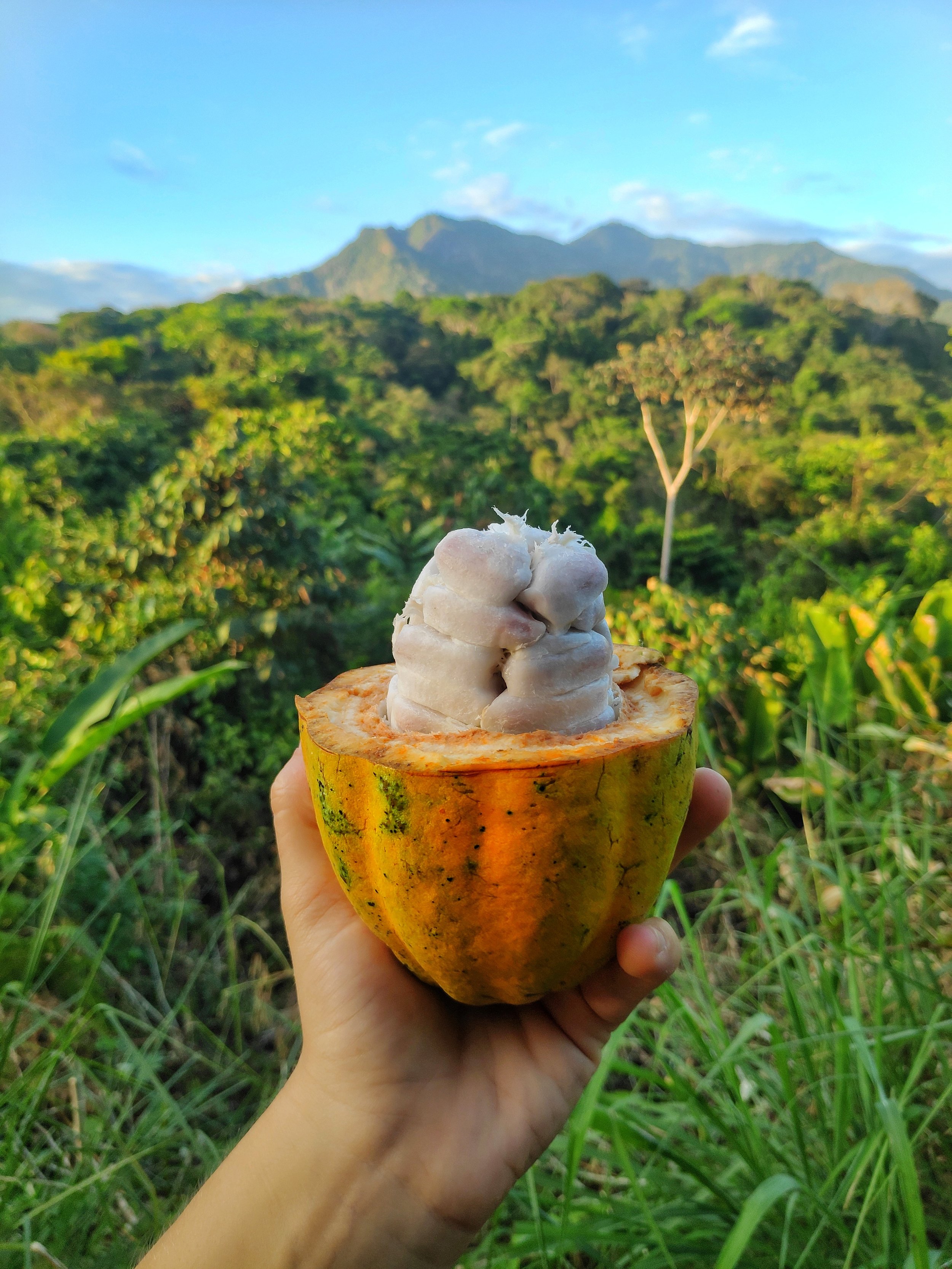
A cacao overlooking La Cangreja National Park
These magical and delicious fruits have some serious potential in the chocolate making market. We look forward to getting larger harvests and experimenting more with these incredible fruits.
Check out these past blogs
Farm to Table Chocolate Bonbons
Life of Spice: Farm to Table Cinnamon
How to Design, Plant, Maintain, and Feast from your Food Forest

Nitrogen Fixing Plants at Rancho Mastatal
A nitrogen fixing plant is a common term used to describe plants that have symbiotic relationship with microorganisms on their root nodules that allow them to fix nitrogen. These are the top ones we use here at the Rancho.
By Nic Donati, Core Team Member
What are Nitrogen Fixing Plants?
A nitrogen fixing plant is a common term used to describe plants that have a symbiotic relationship with microorganisms on their root nodules that allow them to fix nitrogen. The vast majority of these plants are in the Fabaceae family (the legume family), but there are other families of plants that have relationships with microorganisms that allow them to fix nitrogen. There are many trees and soft stemmed plants that have symbiotic relationships with microorganisms on their root nodules that allow them to fix nitrogen. We often in permaculture design refer to all of these as NFTs (Nitrogen Fixing Trees) for simplicity although some of the plants we are referring to are not actually trees.

Root nodules on a Poro sapling
What is Nitrogen fixation?
Nitrogen is essential to all life forms as it is used in the biosynthesis of all nitrogen containing organic compounds such as amino acids and proteins. Nitrogen makes up approximately 78% of the earth’s atmosphere, so it is in abundance, however in its gaseous form (N2) it is not readily available to plants as it cannot be easily metabolized by them. Nitrogen fixation is the process of converting N2 into a compound that can be readily metabolized by most organisms such as Ammonia (NH3).
Nitrogen fixation takes place naturally in the soil by microorganisms. Some species of plants are able to form symbiotic relationships with these microorganisms and we are interested in those plants in permaculture because of the role these species can play at increasing the fertility of our soil in a natural way. Permaculture adheres to the philosophy of working with nature rather than against it and capitalizing on these naturally occurring phenomena is a great practical application of this. We use them a lot at Rancho Mastatal in our food forests, alley cropping systems and our annual vegetable garden system.
Getting Nitrogen into the ground
Nitrogen is one of the most important nutrients for the growth and survival of plants and deficiencies in this key element will lead to problems in plant development. In recent decades this has been dealt with in conventional farming by applying chemical fertilizers. The application of these fertilizers, however, has led to huge environmental degradation. Organic growers may use naturally occurring nitrogen rich amendments like manure, blood and bone etc…. Either way it requires the addition of amendments to our soil. At Rancho Mastatal we absolutely use natural soil amendments, typically we apply dried cow manure, compost, vermicompost and other amendments that we have locally available or make ourselves, this requires a huge amount of work, collecting, hauling and applying them. We ideally want to generate all of the nutrition that our trees need right near our trees so that we don’t need a lot of resources to look after them. NFT’s present a wonderful opportunity to use the natural processes that are taking place in the soil to benefit the trees we are interested in being productive.
Agroforestry

An agroforestry system at the Rancho
Our warm, humid, tropical environment lends itself to the development of agroforestry systems. Our natural ecosystem is the rain forest and our goals as a tropical agro-forester is to create a forest environment utilizing tree species that have yields for human consumption. We typically think of these yields as food, but they could also be fodder for feeding animals, timber for building and branches for firewood amongst others, from now on we will refer to these as tree crops. We also need support species for our tree crops, which we may or may not directly use the yields of. NFTs are good examples of these support species as their roots and leaves are richer in nitrogen than other species. It means when we prune our nitrogen fixing tree and arrange its biomass around our tree crops; we are feeding the soil in multiple ways:
1. The leaves and branches around the tree break down over time and add organic material, and nutrients to the soil
2. Whilst they are breaking down, they are also protecting the soil from the harsh sun and rain.
3. The root die back that is created by pruning our NFT releases nutrients and helps aerate the local soil.
4. Even when not pruned the roots stabilize the local soil and the leaves provide protection and shade from sun and rain.
In our environment we use many different species of NFTs and we would like to share the 9 main species we use, what we use them for and why. Not all NFTs are created equal and some provide different functions than others. As I said earlier we also use the term NFT rather liberally as some of these species are actually not trees!
1. Black Wattle (Acacia mangium)
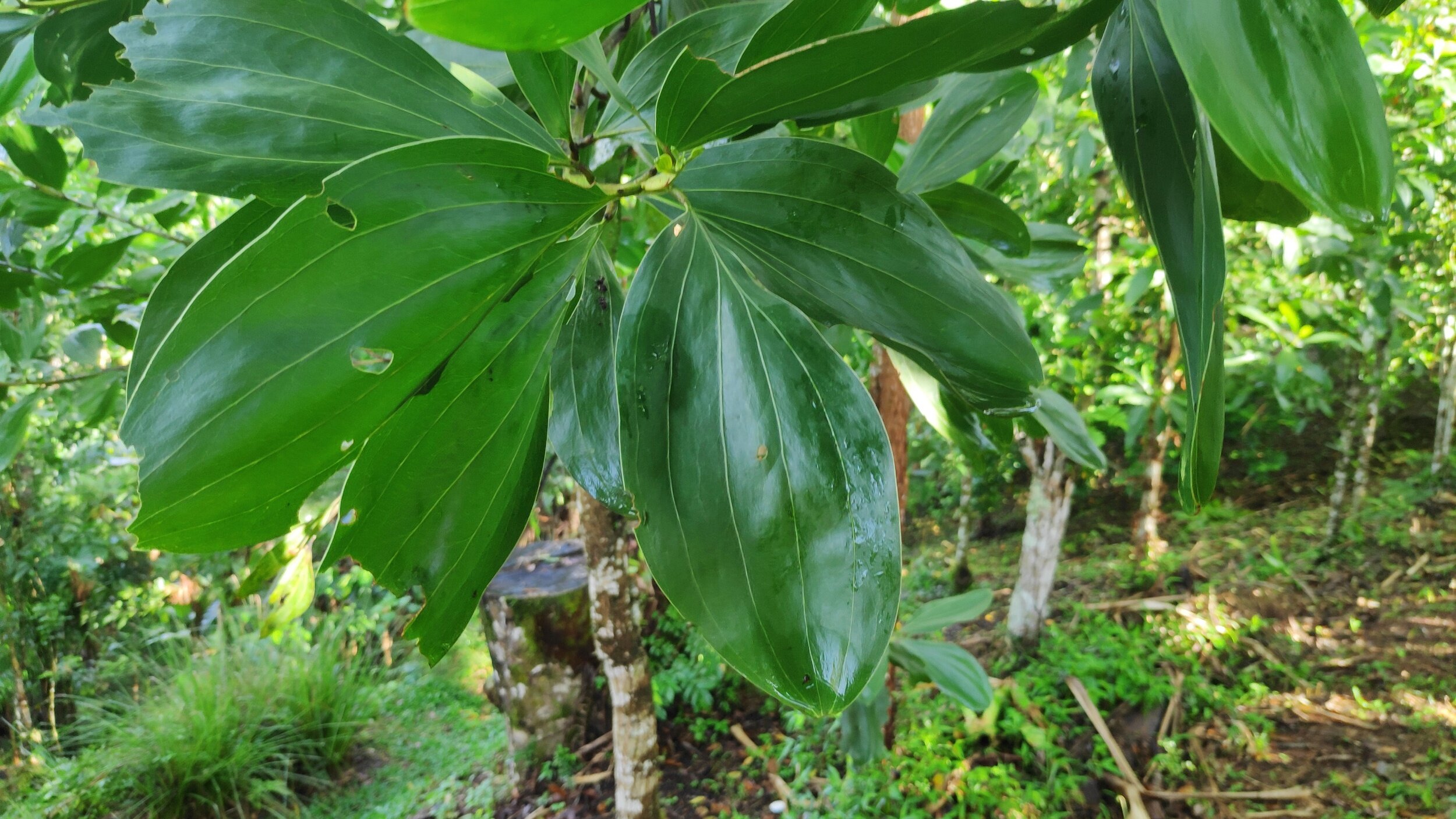
This is number one on the list as it is the most abundantly used NFT on our site. In recent years we have moved away from using it, as it can quickly get large and unwieldy, though there remains a significant number still on our site. It grows fast like most NFTs and handles pruning relatively well, but not great with a fair few dying each pruning season in comparison to some others on this list. It needs full sun and will naturally form a tall straight trunk. It is commonly used in other countries as a valued timber species. The interesting thing about this species is how it really doesn’t look too much like an NFT. Most species in the legume family have a very characteristic leaf pattern. Acacia mangium though does not have this characteristic leaf pattern and you would not think it was an NFT by looking at it. However its first emergent leaves do possess the familiar NFT leaf pattern and give away its family! It is not super easy to propagate from seed like some other NFTs and we have had no success with cuttings. We mainly used this species planted along contour lines when establishing new orchard spaces and since then have moved away from using it so much. We plant it at tight spacing and prune at the end of each dry season to provide biomass for our tree crops.
2. Cratylia argentea

This is the one species on the list that isn’t technically a tree, it is more of a climbing vine, and boy does it climb fast!!! It is an abundant source of nitrogen rich biomass, it handles pruning excellently and pretty much always bounces back. It grows very easily from seed and produces really beautiful, abundant purple flowers (great for pollinators) at the beginning of the dry season, which really facilitates the collection and storage of seeds. You have to be careful with this species as it loves to climb and it will quickly swamp tree crops if left to its own devices and can strangle and kill them. Its greatest characteristic is its speed of growth and abundant biomass, but this is also the feature which gives us a love hate relationship with this species! It loves full sun but will tolerate some shade. We are using this a lot to fill in gaps in our contour plantings of Acacia mangium where a tree has died.
3. Mountain immortelle (Erythrina poeppigiana)

Known locally as Poro, but be careful as there are several species that are known as Poro in Costa Rica. It does really well from cuttings which makes it an excellent choice as a living post for fences or a living post for trellises for climbing crops like passionfruit or dragonfruit. It has an attractive flower which is great for native pollinators and grows easily from seed. The one drawback of this species is it is typically spikey which can make it a little unfriendly to work with and to use as biomass.
4. Brazilian Fire Tree (Schizolobium parahyba)

Is by far the fastest growing NFT on the list along with Cratylia argentea, the main difference being them is it is a tree rather than a vine and it grows straight up…. Very quickly! It can grow up to 30m in 5 years, as you can imagine the wood is very light and spongy. It doesn’t produce a huge amount of foliage and creates a very light shade, it is supposed to keep its leaves during the dry season too as one of its major advantages, however in recent years it has dropped all it leaves so I will leave that one up to you. We typically grow this from seed and use it as a light shade for tree crops.
5. Quickstick (Gliricida sepium)

This species is known locally as Madero Negro, grows well from seed and has about a 50% chance of survival when planted from cutting. The mature tree is a low growing, typically not straight, that produces excellent high quality heartwood timber. The heartwood timber is known for its durability, rot resistance and is used a lot for foundations. It is also used a lot as a living fence post and the leaves can be used to deter fleas and kill rats. At the Ranch we typically use it as a living post for vanilla and black pepper. It tolerates shade, as in it will survive in shade, however don’t expect a lot of growth.
6. Ice Cream Bean (Inga Edulis)
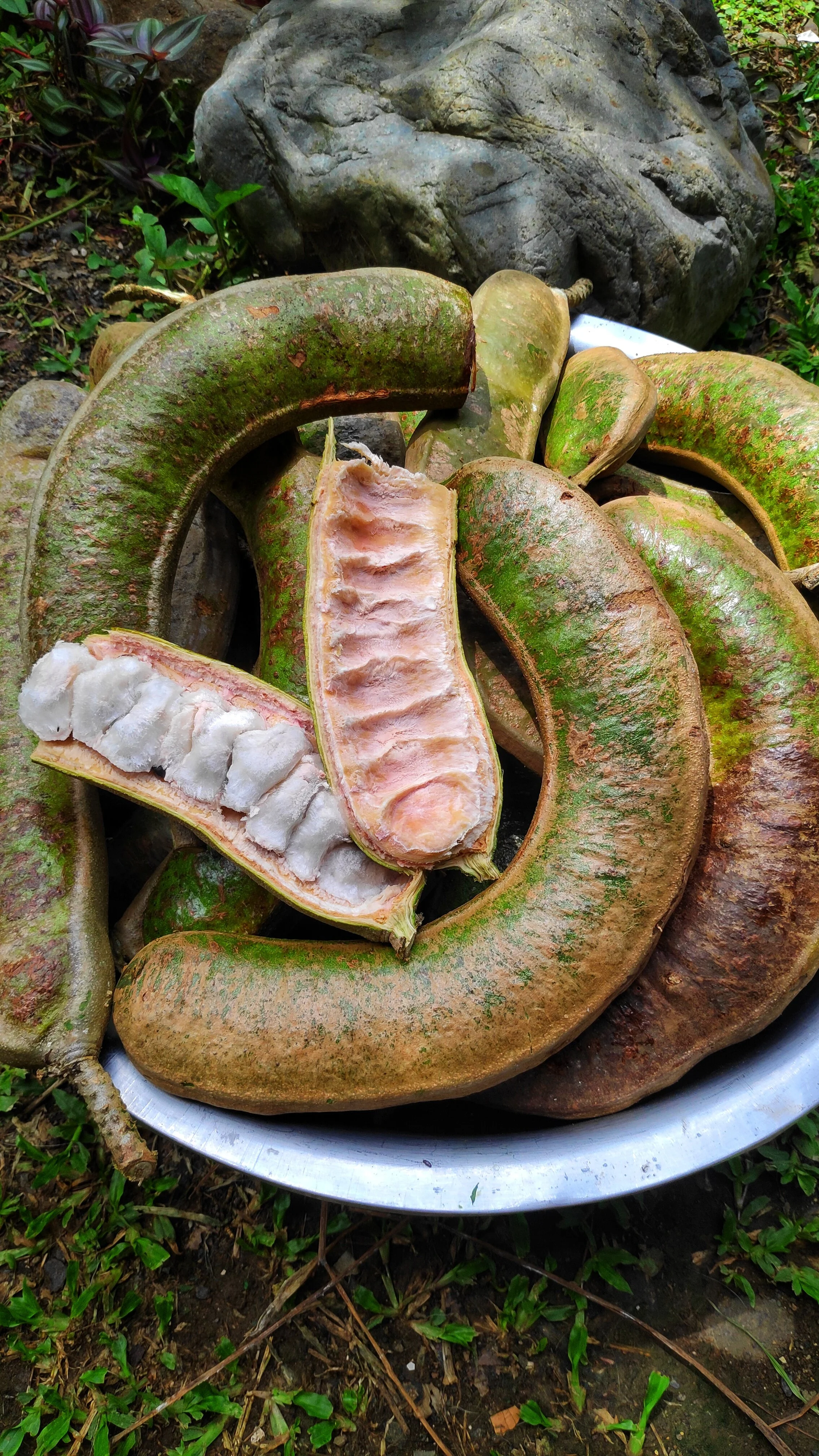
The fruit of the ice cream bean
This is one of the few NFTs that also produces an edible fruit in our environment. Locally the fruit is known as Guava or in English it is called Ice Cream Bean. There are often many wild forest varieties of this tree, some of which produce beautiful heartwood timber. Inga Edulis however produces useable timber, but it is prone to termite damage and should only be used for furniture and non structural elements. It produces huge and abundant leaves and reacts quite well to pruning, making it an excellent choice as an NFT. If you are continually pruning it though for biomass don’t expect to get any edible harvest from the tree. This will grow into a very large tree if left unmanaged.
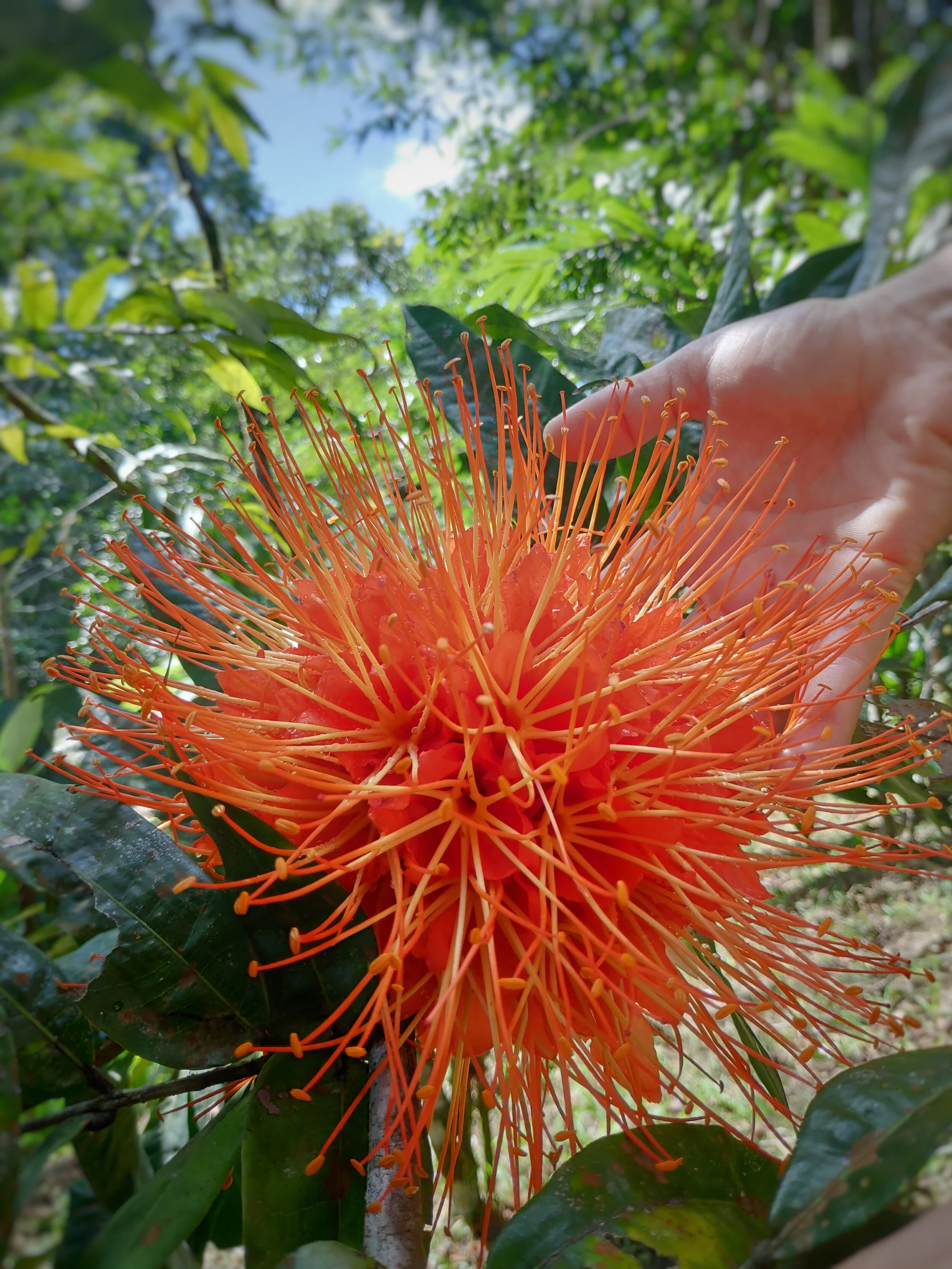
7. Venezuelan Rose (Brownea macrophylla)
This is primarily planted as an ornamental, that produces a very beautiful and striking flower at the end of the rainy season. It also tolerates shade quite well and will still produce some flowers. It can be frequently pruned but doing this will effect flowering. We struggled for many years to source this rare beauty!
8. Peanut Grass (Arachis pintoi)

Again not technically a tree but provides a formidable and fast growing ground cover. One of the important permaculture principles that we apply is covering all of our soil. Peanut grass is able to do this quickly and effectively even in very poor soils and can survive our harsh dry season and bounce back quickly once it starts raining again. It produces pretty yellow flowers and is very resistant to mowing or weed whacking. We try to use this as much as possible as a groundcover however it prefers full sun and whilst it will survive in shady areas does not really grow or spread quickly. It is most easily produced by cutting and has a very, very high success rate. Seeds can be purchased but really why would you bother? It is easier to plant via cutting.
9. Wild Hops (Flemingia macrophylla)
A bushy shrub that doesn’t get taller than a couple of meters on our site which is one of its biggest benefits! It is easy to propagate from seed and cuttings making it a great choice for our site. It seems to tolerate shade relatively well, but does prefer full sun. Its low bushy growth habit means it doesn’t swamp other plants like the Cratylia can, but it doesn’t produce nearly as much biomass. Although relatively small amount of biomass is produced in comparison to some of the other NFTs the leaves do take comparatively long to break down and provide excellent mulch. In comparison to the Schizlobium’s feathery leaves that break down incredibly quickly. We mainly start these in our bamboo planters either from seed or cuttings and use them to fill holes where other NFTs have died or not taken well.

Want to learn More?
These are the main NFTs we use at the Ranch. If you are interested in learning more about how to use Nitrogen Fixing Trees in your landscape why not join us for a Permaculture Design Course or Agroforestry workshop.
We also have some of these trees available seasonally in our nursery, so get in touch if you would like to buy some.
Happy planting!
Other blogs related to soil fertility
Improving Soils in the Humid Tropics
Making Microbes: Fungal vs Bacterial Soil Life

Life of Spice: Farm to Table Cinnamon
When cooking over a fire, I often imagine that I am a witch brewing a potion. As I stirred with a big wooden spoon, the cinnamon began to sizzle, wafting its wondrous fragrance into the air and taking me to another place.
By Dani, Apprentice 2020

Farm to table cinnamon sticks!
Local Cinnamon
One morning at the Rancho, I was toasting some cinnamon to try to spice up an orange kefir water concoction. When cooking over a fire, I often imagine that I am a witch brewing a potion. As I stirred with a big wooden spoon, the cinnamon began to sizzle, wafting its wondrous fragrance into the air and taking me to another place.
The scents of spices are fantastical, and I have always thought that the spice rack is a mystical, magical place of otherworldly ingredients. As I learn more about spices , that magic has not faded, but rather has revealed new perspectives. We grow cinnamon in the permaculture orchards at the Ranch, and using this magnificent spice from tree to table has made me appreciate it so much more.
The cinnamon in my potion that morning is about as local as you can get. As the cinnamon toasted, the aroma traveled into my nose, triggering my memory, as scents often do. I was captivated by the smell when someone walked into the food smithy and exclaimed, “It smells like Christmas!” I snapped out of my cinnamon induced daydream and concurred. Even though it was a hot February day in the tropics, with temperatures around 85 degrees Fahrenheit, I could almost taste the crisp cold air of Wisconsin. It took me home. To me, the scent of cinnamon evokes feelings of cold winter nights with Christmas cookies by the fire. It feels like cool fall air and spiced apple cider at the orchard. It tastes like pumpkin pie at the dinner table. Cinnamon is for days of wool socks and sweaters. It smells like home to me. It is cozy. It is comfortable. It’s nostalgic.
But I had never even seen a cinnamon tree until coming to the tropics. So how did I come to associate this tropical flavor with with cold cozy evenings in Wisconsin? How did it become the holiday flavor of a climate where it doesn’t grow?
Origin of the Spice
By definition, spices come from the aromatic parts of tropical plants: roots, flowers, seeds, or bark. Unless you live in the tropics, the likelihood of consuming local , farm to table spices is slim to none.
Cinnamon comes from the bark of an evergreen tree which is native to Sri Lanka (Ceylon), and in ancient times, it was one of the most sought after spices. Like pepper, it has thousands of years of history in the globalization of foods and was known in China as early as 2700 B.C. It is even mentioned in the old testament as well as in Sanskrit texts. The globalization of cinnamon is not new, and the magical qualities of cinnamon ignited ideas of paradise in the minds of many, causing them to set sail in search of the heavenly lands from where they believed the magical spice must have come.
Cinnamon has a powerful scent, so powerful that it played a part in progressing the sharing of cultures and globalization as we know it. Some wonderful new cuisines came out of the spice trade, but it was not without a cost; the spice trade was also linked to slavery and centuries of abuse towards the local producers. It is important to remember both the fascinating and dark histories of the foods we eat.
Today, Great Britain is the leading consumer of cinnamon, followed by the United States and Spain, all places where the spice does not grow. The word, cinnamon, comes from the Greek word for spice and the prefix ‘Chinese’. Cassia is another spice, closely related to cinnamon, and they are often sold interchangeably, though cassia has a more delicate taste. Most of the cinnamon sold in the United States is actually cassia. Cassia is native to Myanmar and northern India as well as some Indonesian islands. Records of this spice date back over 6,000 years, and it was grown around present-day Hanoi during the Han Dynasty.
Cinnamon and Cassia can be distinguished by their color, true cinnamon being tan and cassia being more of a darker reddish brown. I had no idea that most of the cinnamon I have consumed in my life was probably not even cinnamon
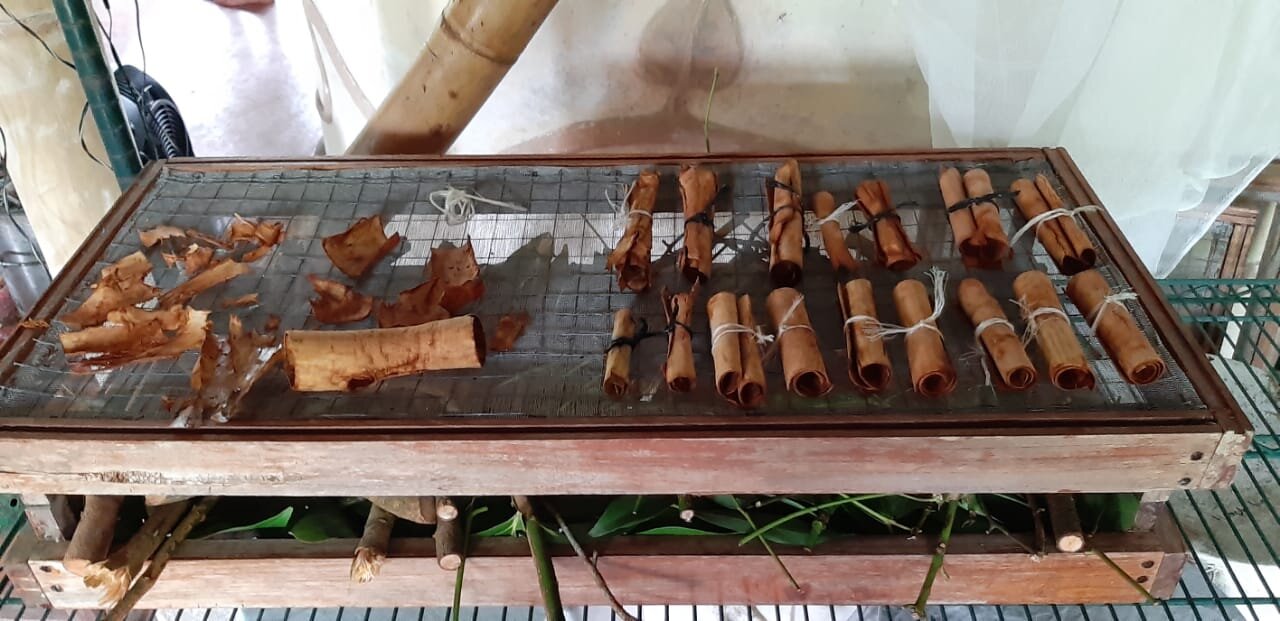
Cinnamon sticks rolled and drying
Permaculture Processing
The journey of cinnamon from the farm to our tables is neither short nor simple. After harvesting and processing cinnamon here at the Ranch, I would argue its processing is truly an art.
Ideally, cinnamon is grown to be long and straight to maximize yields. The offshoots should be pruned as they take energy away from the trunk, which is where the good stuff is. The darker bark is harvested to use as the spice. Once the tree reaches about 2 meters and the trunk is about 2-4 inches thick, it is ready to harvest. It’s good practice to chop the tree down to 10-15cm at a 30-degree angle for water and sun protection. After the tree is chopped, it will produce 2-6 new shoots, increasing the yield of the next harvest which will be ready in about 2 years. This practice can be continued for the lifespan of the tree. With a permaculture mindset, we harvested some cinnamon at the Ranch with hopes that in a few years, yields will increase with the new shoots. After chopping the tree, we took off the lateral branches and leaves. The wonderful cinnamon flavor is also contained in the stems at the base of the leaves so we saved and dried these for tasty tea. We then chopped it into smaller, more manageable pieces, and using a knife, we shaved off the outer bark. The next layer down is called the cambium, and that is the stuff you want in your carrot cake.
The cambium is the part of the tree between the outer bark and the heart wood and what we know as cinnamon. To separate it from the heart of the tree, we made an incision using a knife down the entire length of the piece. Then, we slowly began to peel it off using a spoon, trying to keep it is one piece. It was not easy, especially if there was a knot in the wood. Finally, we rolled the cinnamon cambiums and tied them, and put them to dry. Sometimes cinnamon is cut into quills of over three feet in length! Though I have always thought that cinnamon sticks were beautiful in form, after struggling with my three-inch piece, I realized there is a whole layer of beauty I had not seen. I was blind to the artists behind them, the growers and processors of this special tree.
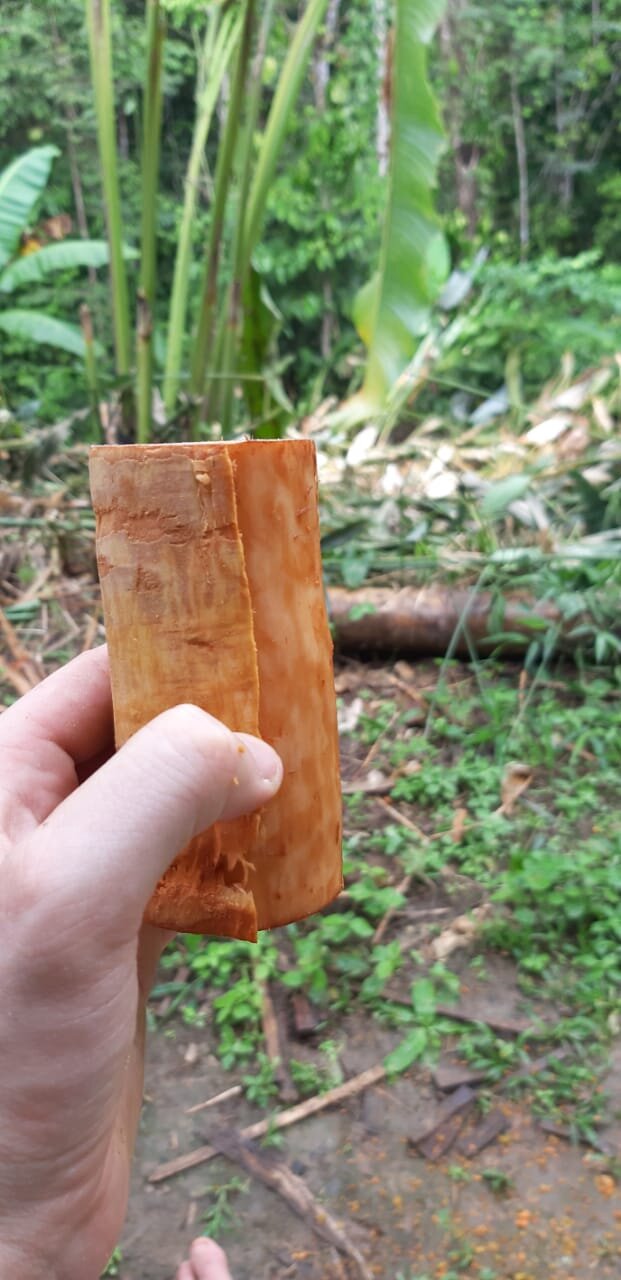
The outer bark shaved off, exposing the cambium layer
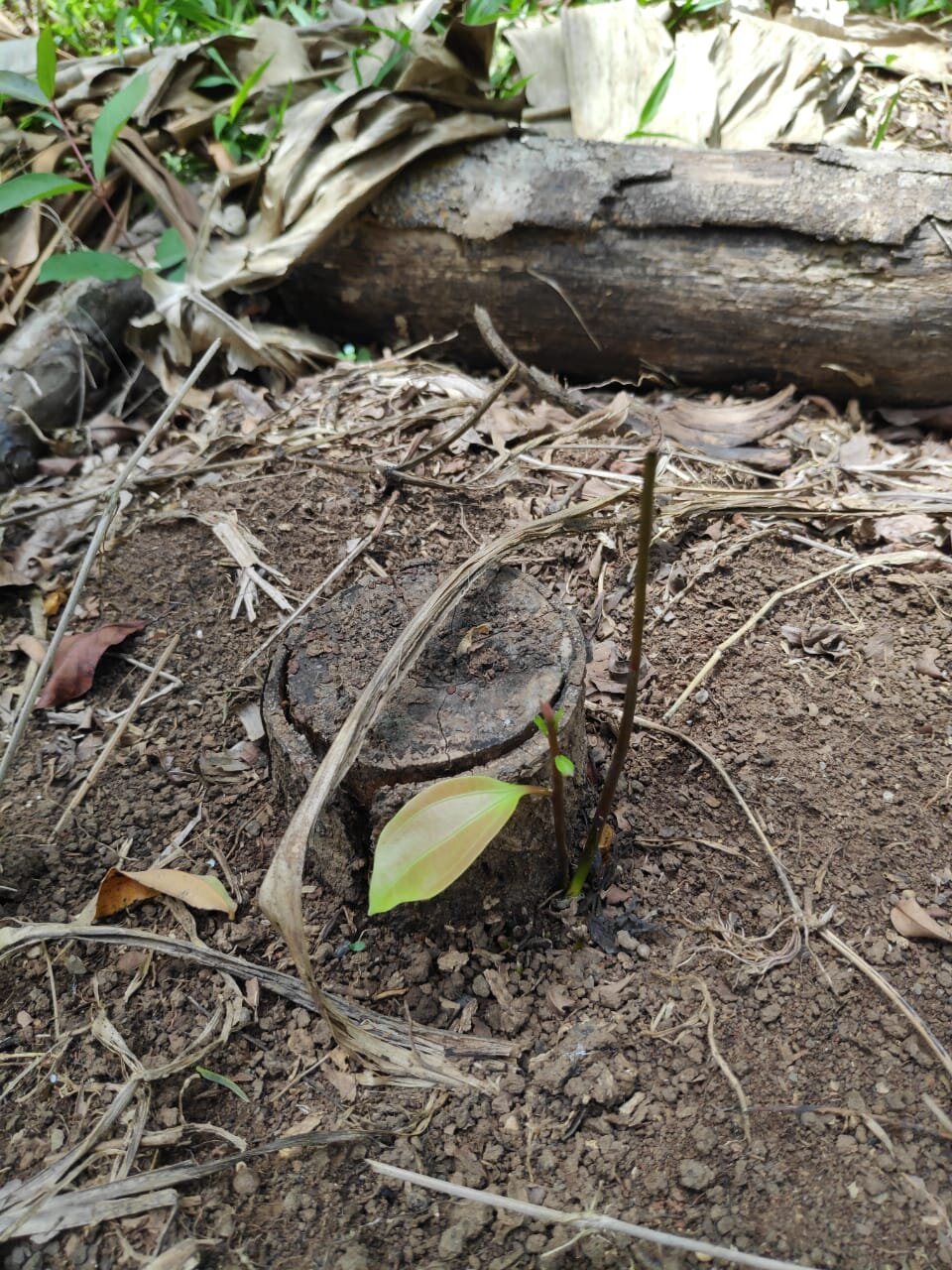
The new shoots coming up
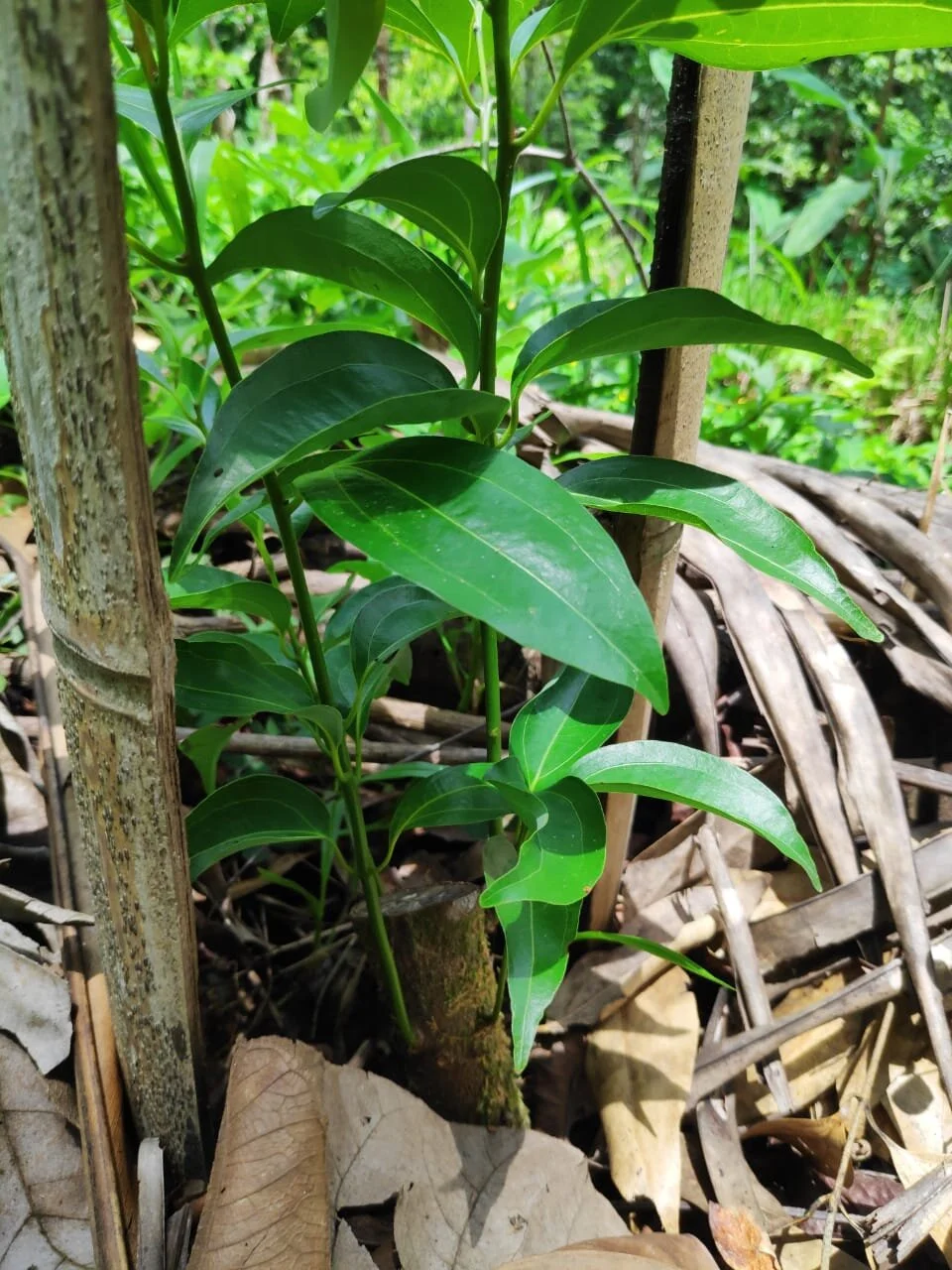
A healthy cinnamon tree re-growing
Conscious Consumption
There is so much in the food we eat: natural resources, back-breaking labor, rich traditions, culture, history, and beautiful artistry. It is important to consider where our food comes from, not only for our health, but for the well-being of those who grow and process our foods, and for the sake of our planet.
I think this is more difficult when it comes to spices. But these days, there are companies striving to produce fair trade spices through sustainable farming practices. Vermont-based Forestrade, started in Sumatra, demonstrated to local farmers how cinnamon can be grown without clearing huge sections of land that would endanger the surrounding national park. They now collaborate with 6,000 indigenous producers in Indonesia and Guatemala. Another example is a group of Hindu People on the mainly Buddhist island of Sri Lanka, the Salagama, who traditionally peeled the cinnamon bark from the trees. These people were devastated by the spice trade, controlled by the English, the Dutch, and the Portuguese. Today, the situation has changed, and they are able to sell their product to a fair trade association for 4o percent above the market rate.
These programs only work if we as consumers are aware of where our spices come from and are willing to pay a little more for our products. Through our consumption habits, we have the power to improve the lives of so many. I encourage everyone to enjoy cinnamon in their hot chocolate on a crisp cold evening, but as the aroma fills the room be mindful of how it got there. Spices truly are incredible, and I hope that while we are doing our best to eat local, we can be conscious of the magic contained in the spice rack.

Achiote to be made into paste

Fresh turmeric harvest

Farm to table peppercorns
Want to learn more?
Stay tuned for my next Life of Spice blog! And if you didn’t read my last blog about farm to table black pepper, read it here!
Want to learn more about growing your own foods and spices? Join us for our annual Permaculture Design Course or Agroforestry Skills Workshop, you can find more info on both these workshops here.
Check out these past articles about farm to table foods we are planting and processing here:
Sources and Further Reading
Heinerman’s Encyclopedia of Healing Herbs and Spices by John Heinerman
Spices – A Global History by Fred Czarra

10 Things You Didn't Know About the Banana
They are funny looking, absolutely delicious and have so many gifts – here’s why everyone should go bananas for the banana.
By Moanna, Apprentice 2020
They are funny looking, absolutely delicious and have so many gifts – here’s some interesting facts about the banana.
The banana with the permaculture lens on is an element that serves many more than just 10 things. Especially with the diversity of varieties that is grown here at Rancho Mastatal in Costa Rica, with 13 different types of both edible and ornamental bananas in our agroforestry systems. We are always looking at how to work with nature, and in case you already knew all of these amazing things about the banana, this blog shares how the banana can be used as a perennial staple and an easy farm to table crop.
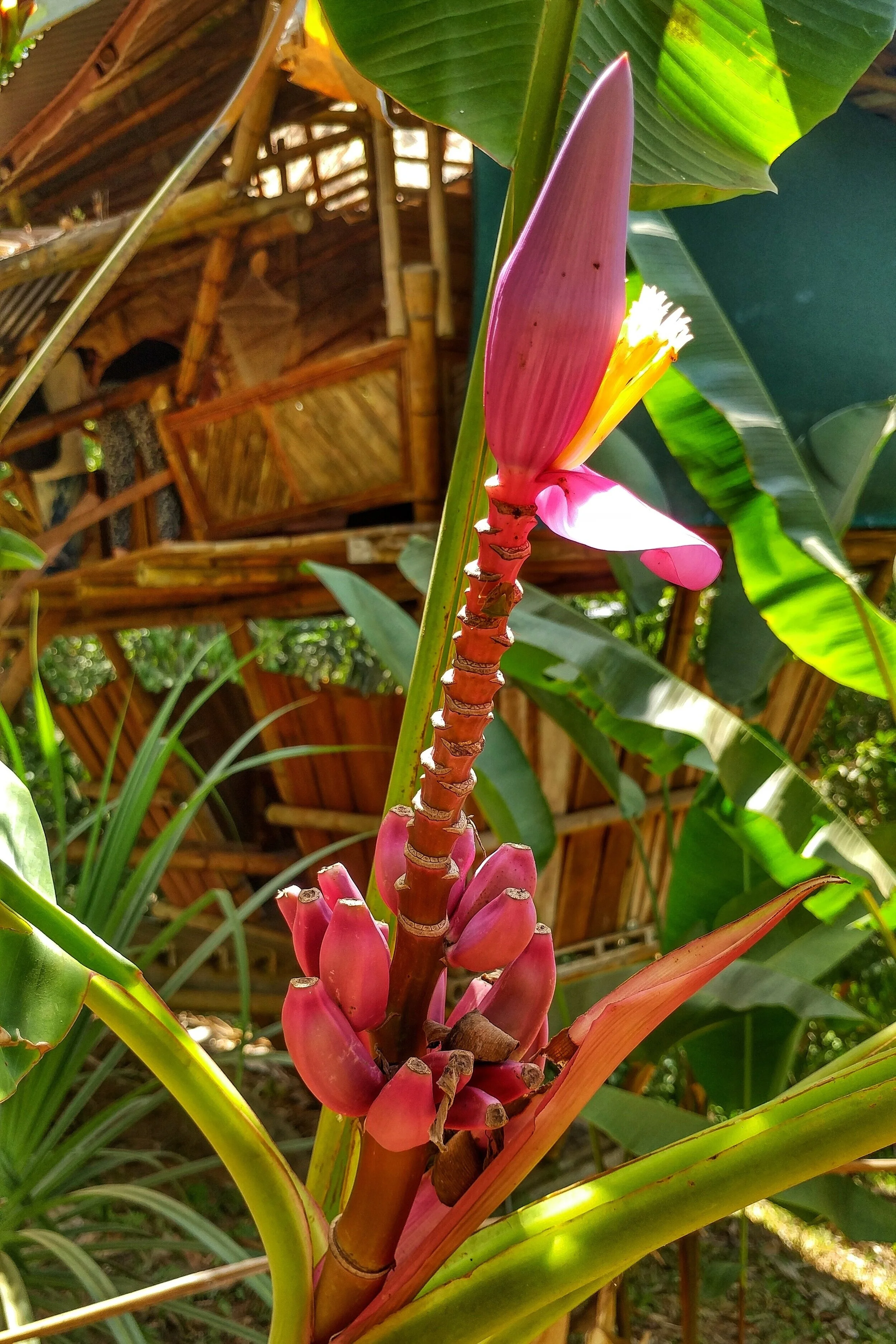
A pink ornamental banana in front of our guest, bamboo cabin, the Hooch
10 Amazing facts about Bananas
1) Bananas can be black, red and blue!
Red and blue, long and thin, fat and short, round or softly squared, there are more than 300 varieties of the Banana, which is in the Musa family. The classic yellow banana found in supermarkets is called the Cavendish, after a British dude who found a way to grow them in greenhouses in England, making it possible for Iceland to be one of the biggest exporters of bananas. Mostly people who leave Rancho Mastatal and who live outside of the tropics, stop eating bananas because the supermarket ones (grown in monocultures far away or in greenhouses) are just not worth eating anymore.

They can be very tiny too!
2) Bananas are not a tree, but a very big herb!
Bananas are such a majestic fruit, but they do not grow on trees as they have no woody trunk or bough. The “trunk” of the banana is rather a leafstalk, as it is a dense clump of leaves ready to curl out.
3) You can eat the flower.
Like so many wonders of the world, it is both beautiful and edible! Here at the Ranch we have cooked it into a picadillo: chopped fine and cooked down with a bit of oil, salt and farm to table pepper. It is delicious. Especially if you’re a lover of the consistency of artichoke or mushroom!
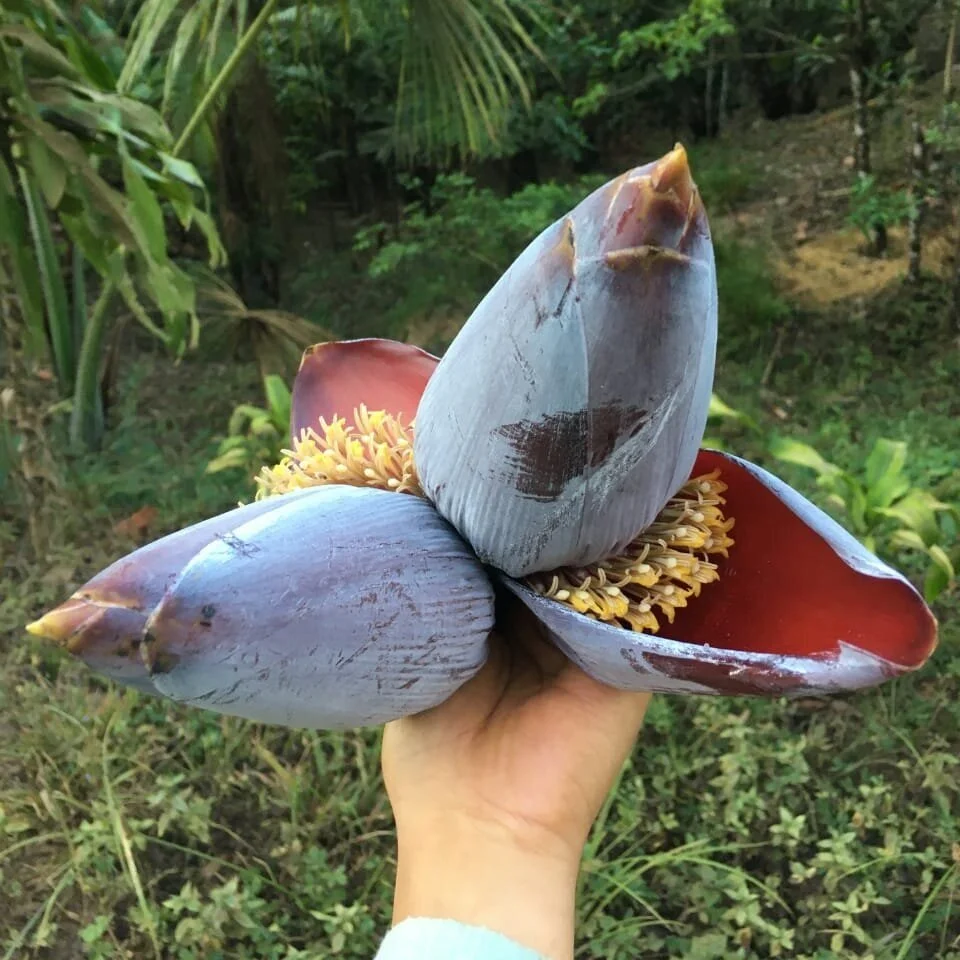
A banana flower
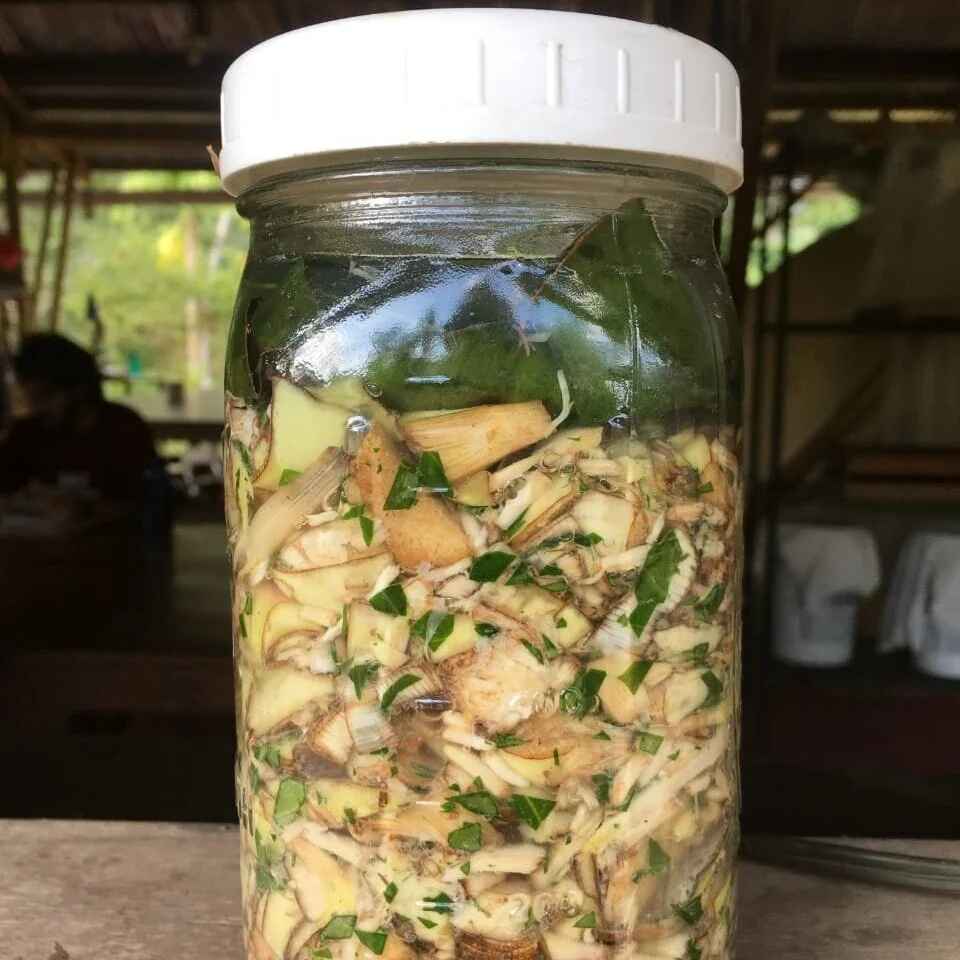
Lacto fermented banana flower
4) The “trunk” can be turned into weaving material.
Peel the skin of the “trunk” from top to bottom, dry the strips in the sun and you’ll have very strong fiber material to make baskets, mats or belts out of. Banana fibers can be woven into an attractive silk like fabric, which in Japan and Indochina are used for clothes and hats. In Tahiti the leaves and “trunk” of the fe’i variety is used as weaving material and turned into thongs, lashings and fans!
5) You can eat the trunk.
If you are actively managing your bananas you probably cut away younger ones in the clump, only keeping the three generations (grandmother, mother and daughter) growing. In south East Asia they eat the young “trunks” as commonly as lettuce! Very thinly sliced, and then soaked in water and vinegar for a while, they add it as a fresh garnish in their soups, or turn it into a salad adding herbs, fish-sauce and toasted peanuts.
6) Green bananas are a perennial staple.
They can be used in cooking like we use the potato, simply boil them in water – the whole thing with its skin – and do as you please! You can also cut them into smaller pieces to add to a delicious stew, blend them with herbs and fry them into fritters, grate them and make a green banana hash, slice them thin and dehydrate to make banana flour. We enjoy all these creative ways to use a local food as a staple in our diets.

Green bananas getting ready to be boiled
7) Banana skin helps reduce itching.
The plant itself flourishes in tropical, hot and damp environments, mostly filled with mosquitoes – fortunately the banana skin eases the itch. I’ve tried it, and it worked!
8) Dirt or ash helps remove its sticky juice.
Harvesting bananas gives off all kinds of juices, especially when you process the green banana and flower. You can clean the machete, knifes or cutting boards by rubbing dirt or ash on it. It may sound crazy but it works.
When harvesting, rub the stem in dirt; when processing/cooking them green, use as much banana leaves/paper to protect table and other material from the juice. But once you have it on a knife or cutting board, it helps to rub any kind of dirt or ash and then wash.
9) Once they are too ripe, you can turn them into wine or vinegar!
You can never have too many bananas. Well maybe you can have too many to eat out of hand, which happens to use often. That’s when we make homemade banana vinegar! The super ripe, falling off the bunch-juicy-black-kinda ripe, means loads of sugar, which is an opportunity for yeast to have a big feast, eating the sugars and making alcohol! Permaculture principle- produce no waste.
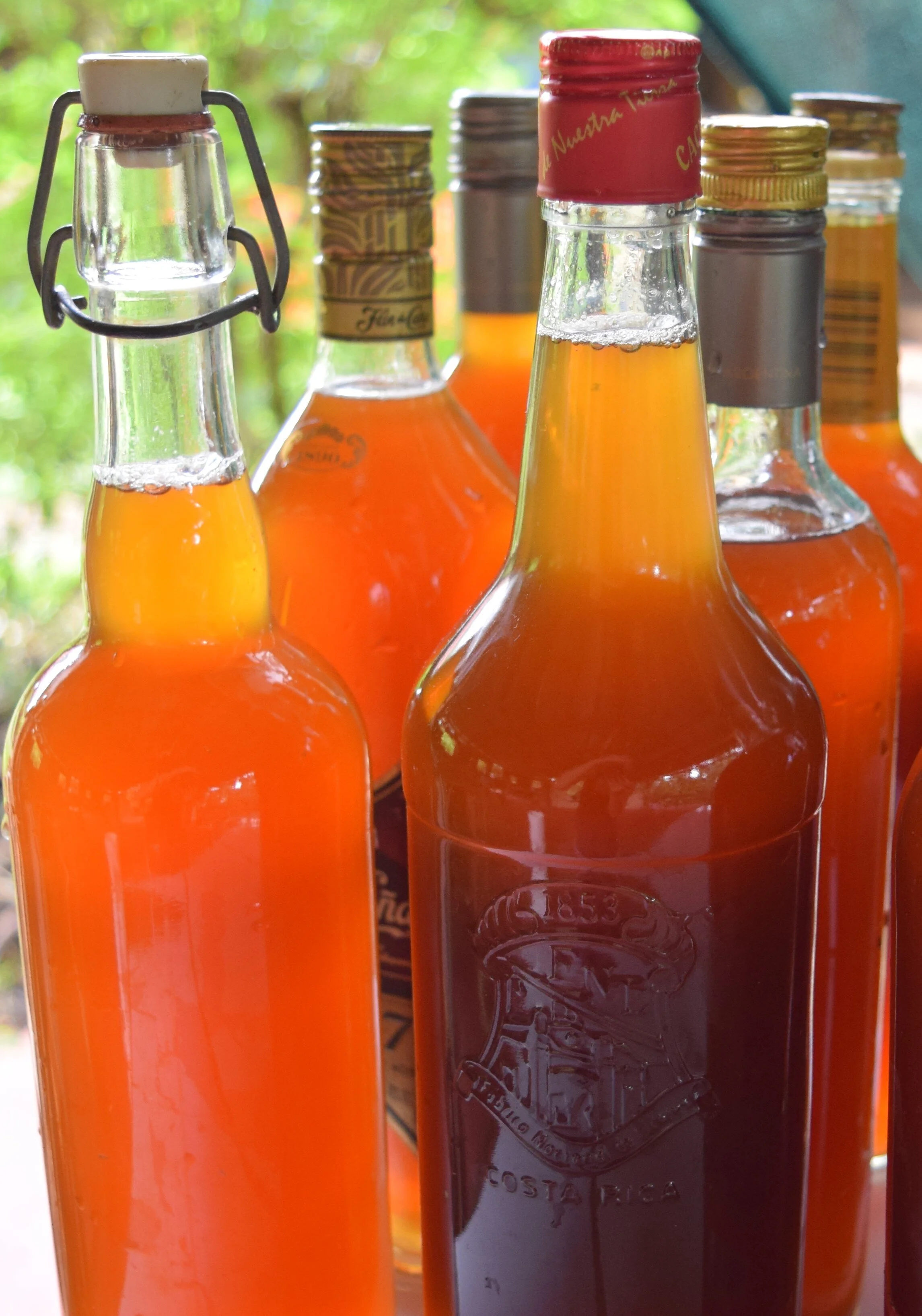
Aging banana vinegar
10) PACKED with potassium that reduces muscle spasms very efficiently.
After one month on the Ranch, where the average daily banana intake is about 3 to 5 bananas, many find that their muscle spasms has completely disappeared. Bananas also contain the neurotransmitters, dopamine and serotonin that lifts up the mood.
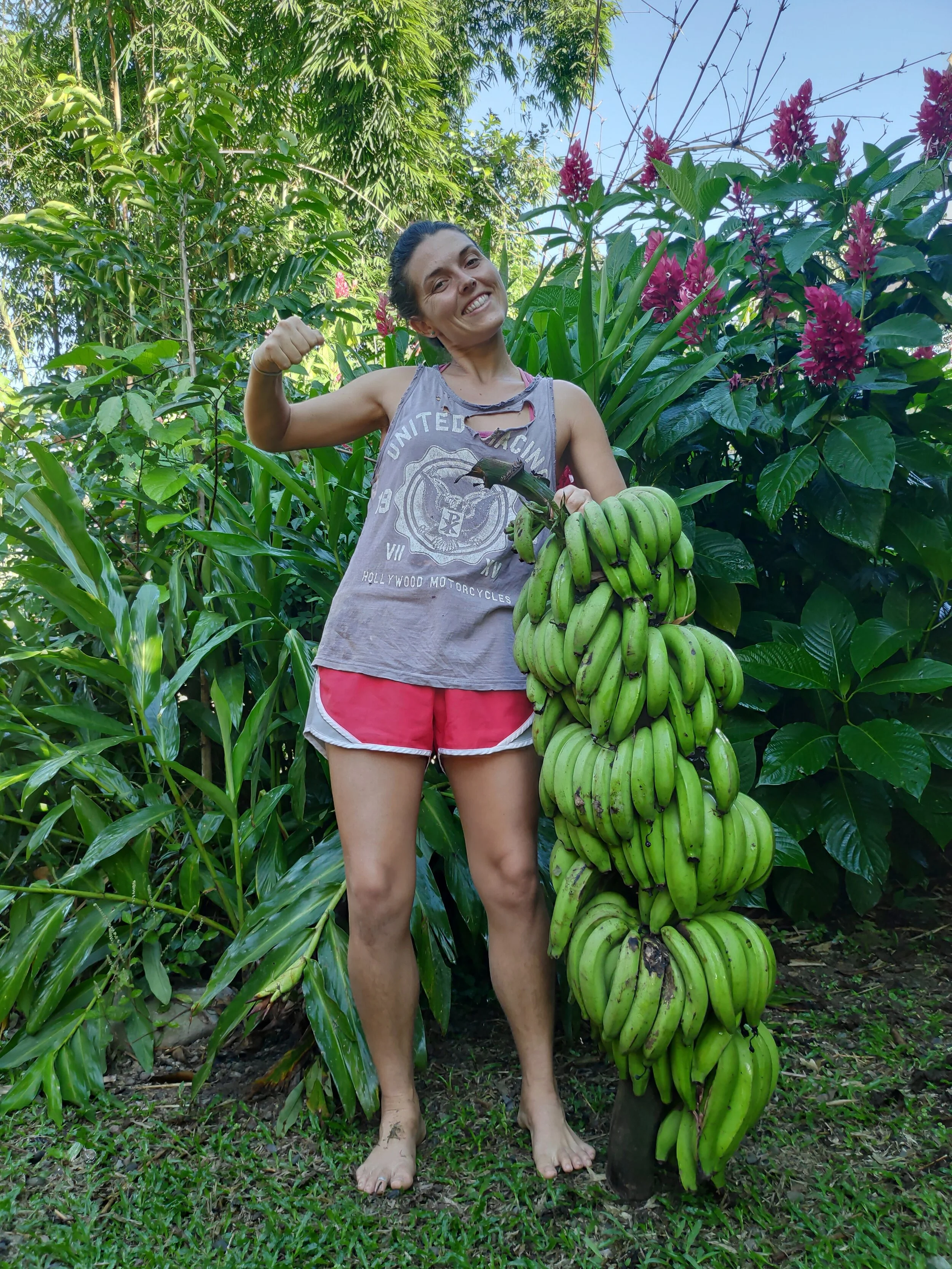
Bananas make you strong too!
Do you understand why we’re going bananas over the banana? May the awe and excitement that you felt going through this list make you want to go deeper into the world of bananas. They serve well in the tropical permaculture garden or agroforestry system, provide a variety of uses, and are a nutritious food to be used as a perennial staple.
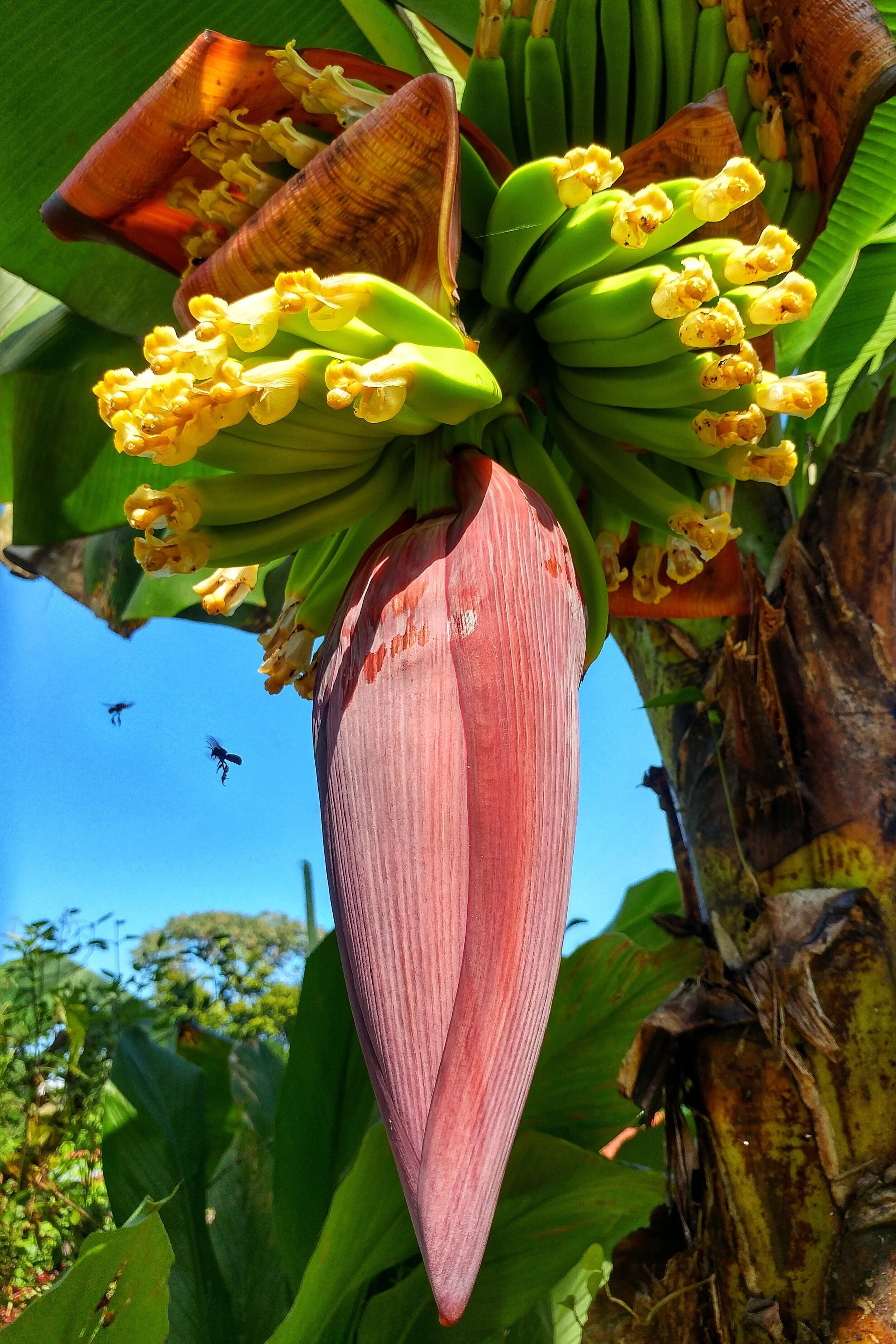
A bunch of bananas blossoming
Hope you’re as excited about bananas as we are! If you live in the right environment, go plant some, they’re super easy to plant and maintain!
want to learn more?
Join us for our upcoming Permaculture Design Course or Agroforestry Skills Course to learn about bananas and more! Learn more about all our upcoming educational workshops on our website here.
Check out these past blogs that are also about the banana

Improving Soils in the Humid Tropics of Costa Rica
In permaculture and agroforestry circles it’s common to hear the idea that we’re not growing plants so much as we’re cultivating rich, healthy soils in which plants will do their own growing.
By Anthony, Apprentice 2020
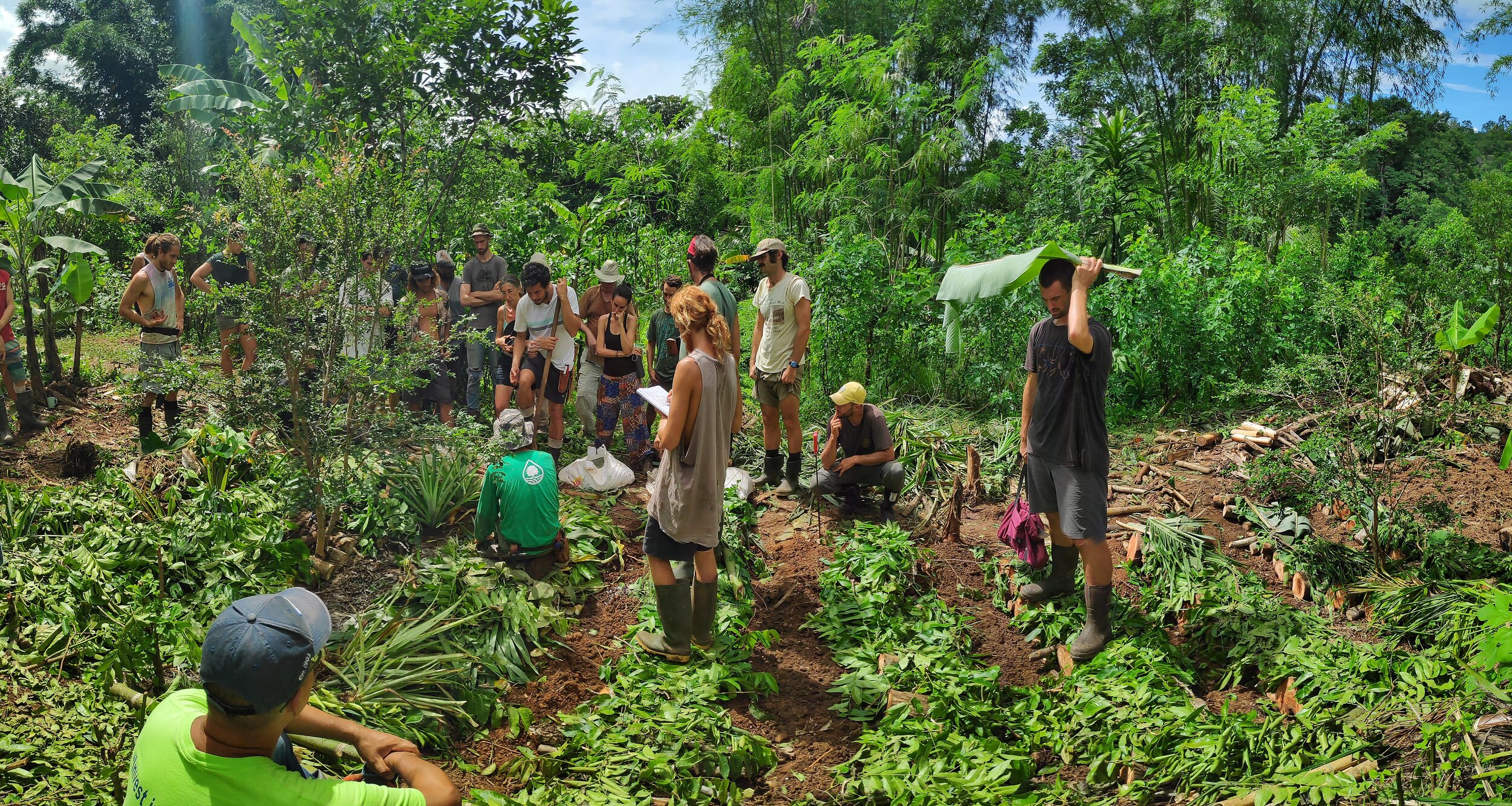
Syntropic farming workshop at Rancho Mastatal
In permaculture and agroforestry circles it’s common to hear the idea that we’re not growing plants so much as we’re cultivating rich, healthy soils in which plants will do their own growing. Yet, to this end changing the make-up of soils seems like a daunting job. So how can we go about the task of improving our soils in a simple and efficient way that corresponds with permaculture principles?
The challenge of Tropical Soils
Soils in humid Tropical America are generally found to be eroded and leached. In this region’s ecosystems, about 85% of nutrients are held in plants and animals, so the soils themselves are infertile. Only terraces, floodplains, and new volcanoes keep some soil fertility replenished if land is cultivated (Mollison, 2004). This yields soils that are high in clay content, poor in nutrient content, and often quite acidic. As we say here at the Rancho Mastatal, a permaculture farm in Costa Rica, it’s soil that’s great for natural building, yet not ideal for growing an abundance of food.
The goal with soils like ours is to improve soil texture, increase mineral and nutrient content, reduce soil acidity, enrich microbial life, and increase the quantity of organic matter held in the soil.
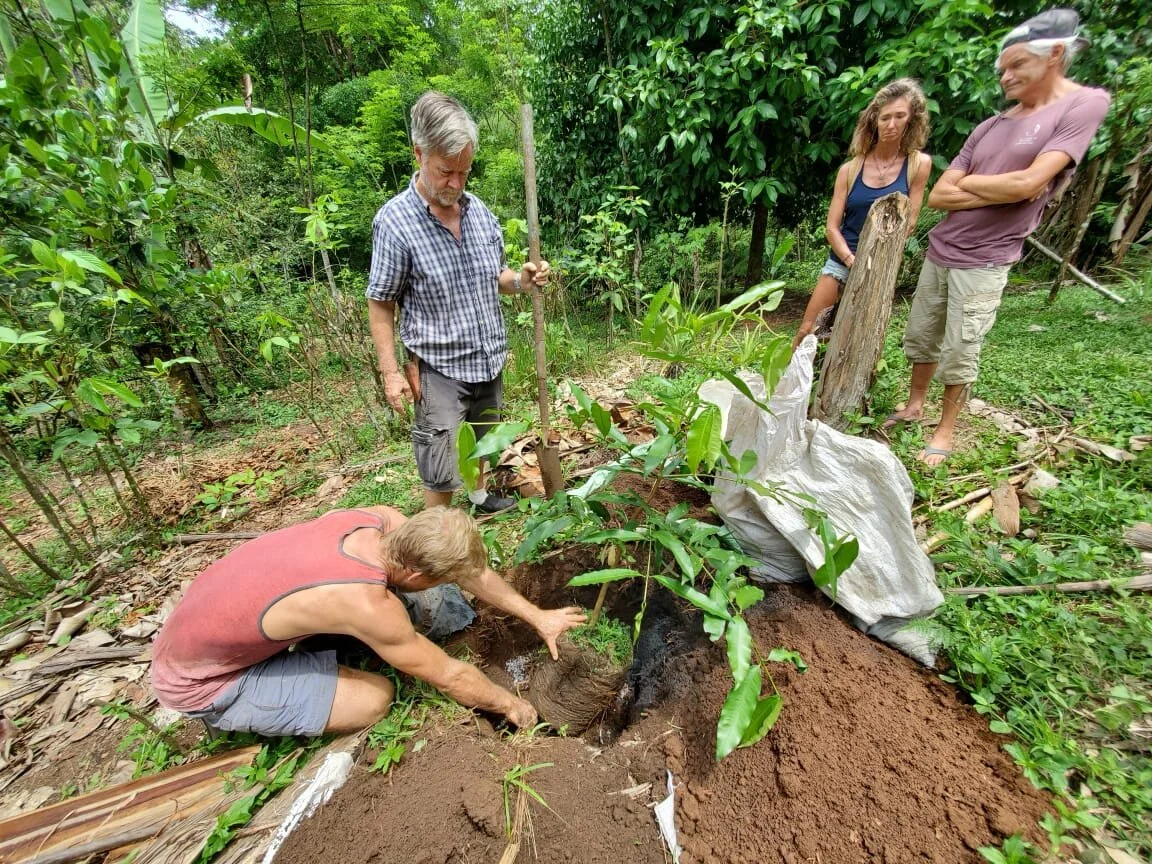
Planting a fruit tree during our annual Agroforestry Skills Workshop
Permaculture & Agroforestry based strategies
In a recent agroforestry workshop held at the Rancho Mastatal here in Costa Rica, a class that worked through concepts of a multi-strata, diverse style of permaculture, the holy trinity of soil amendments for the humid tropics was revealed. The three pillars of improving cultivated soils are
Biomass
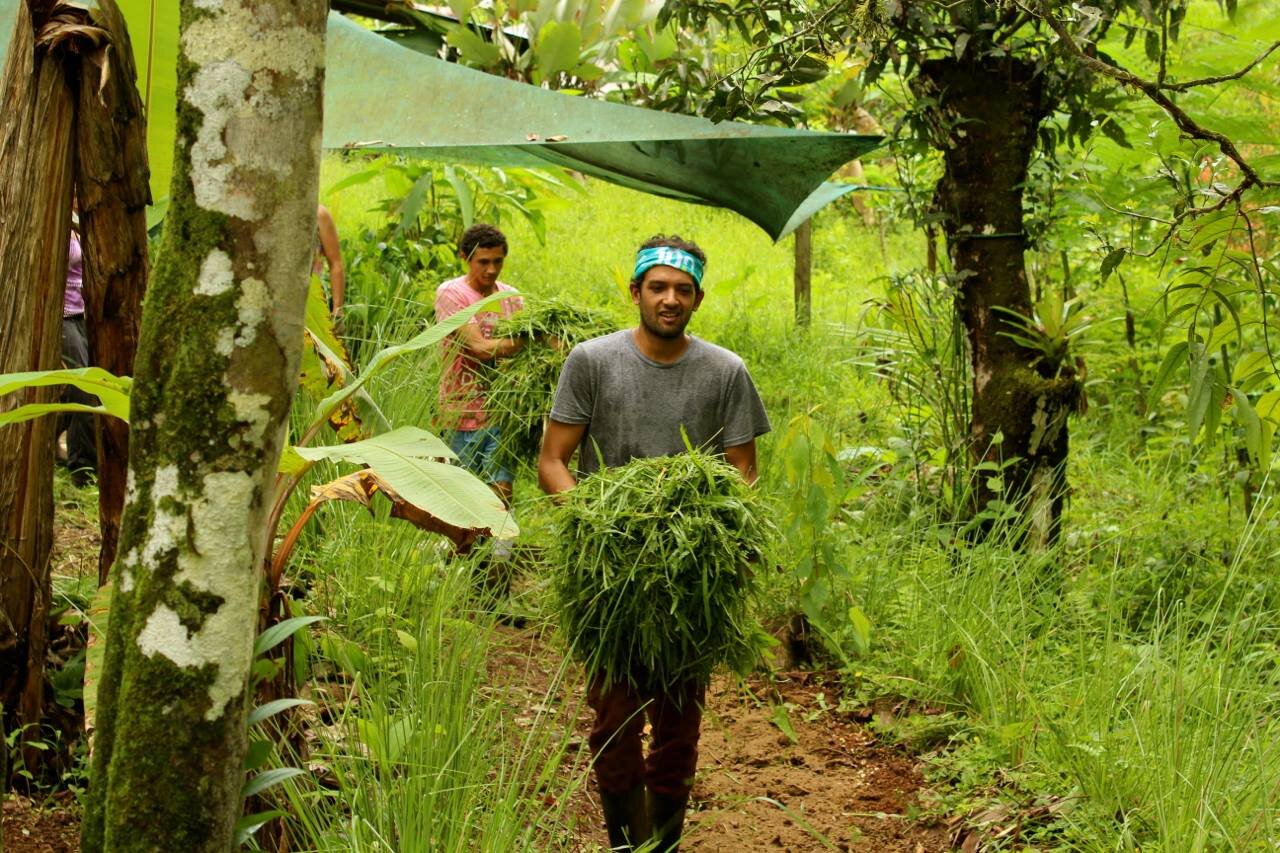
The strategy of biomass organized on contour (lines running perpendicular to the direction of the cultivated slope) is the most visible method used here at Rancho Mastatal to improve the soil’s structure and nutritional/mineral content, our ‘organic’ way of applying fertilizer. In the humid tropics, biomass tends to be available in great quantity, and can be used to build up the mentioned contours. Over time these will build to form terraces that greatly reduce soil loss related to erosion and leaching.
Mountain Microorganisms
Mountain microorganisms is a world of its own. Through the fermentation of leaf litter from nearby forests, we cultivate microorganisms which are then applied to our soils, the foliage of our plants, and our compost. We are reproducing healthy bacteria and yeast that, when used in our permaculture systems, will in turn help our plants absorb more nutritional benefit from our soils. To read in more depth about how to make Mountain Microorganisms read this article.
Biochar
Biochar will then provide a long-lasting refuge for these beneficial microorganisms. This is due to its incredibly high surface area within its structure. This special form of charcoal is extremely slow to break down and both directly provides nutrients and minerals to our soils as well as creating a positive feedback loop of topsoil production.
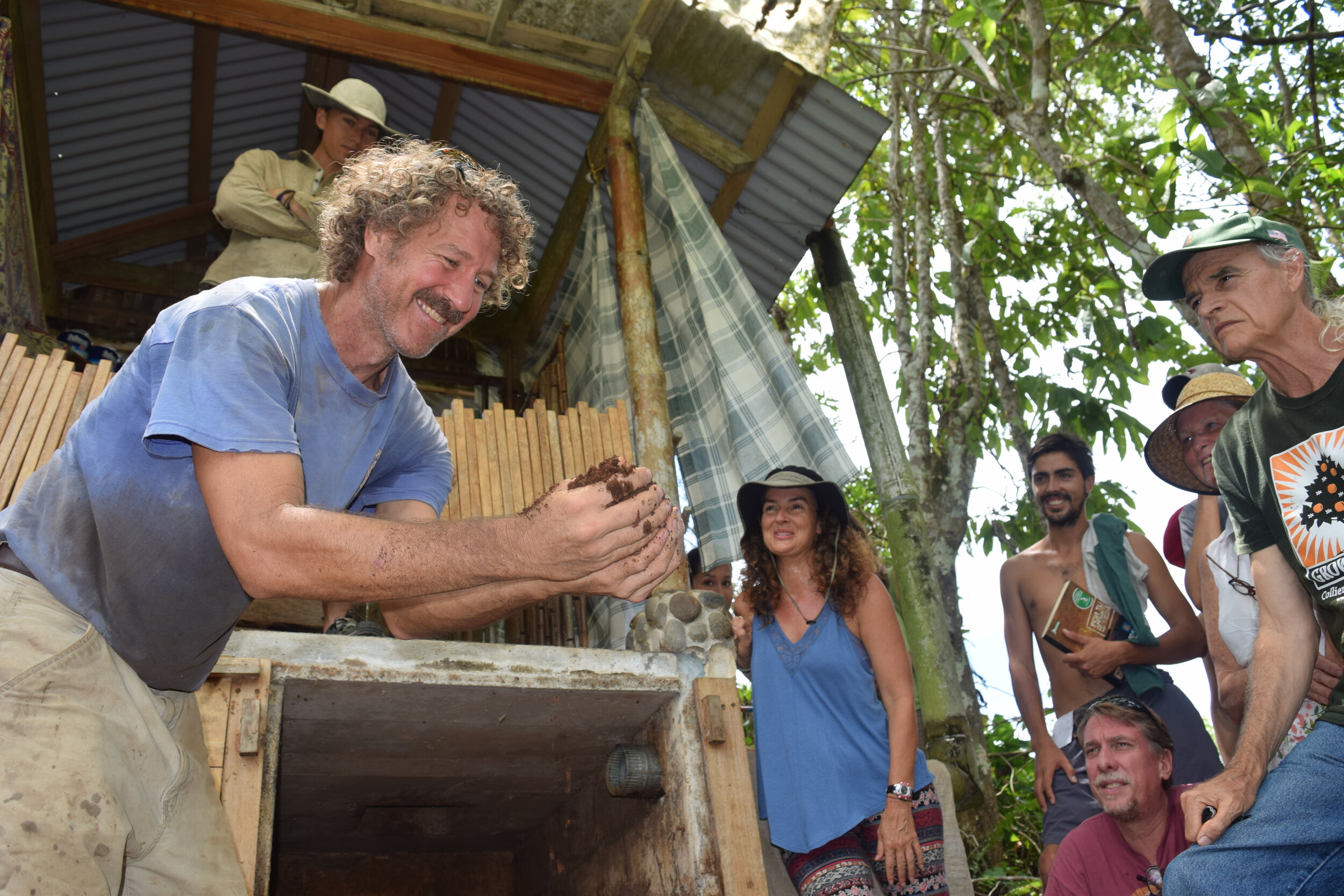
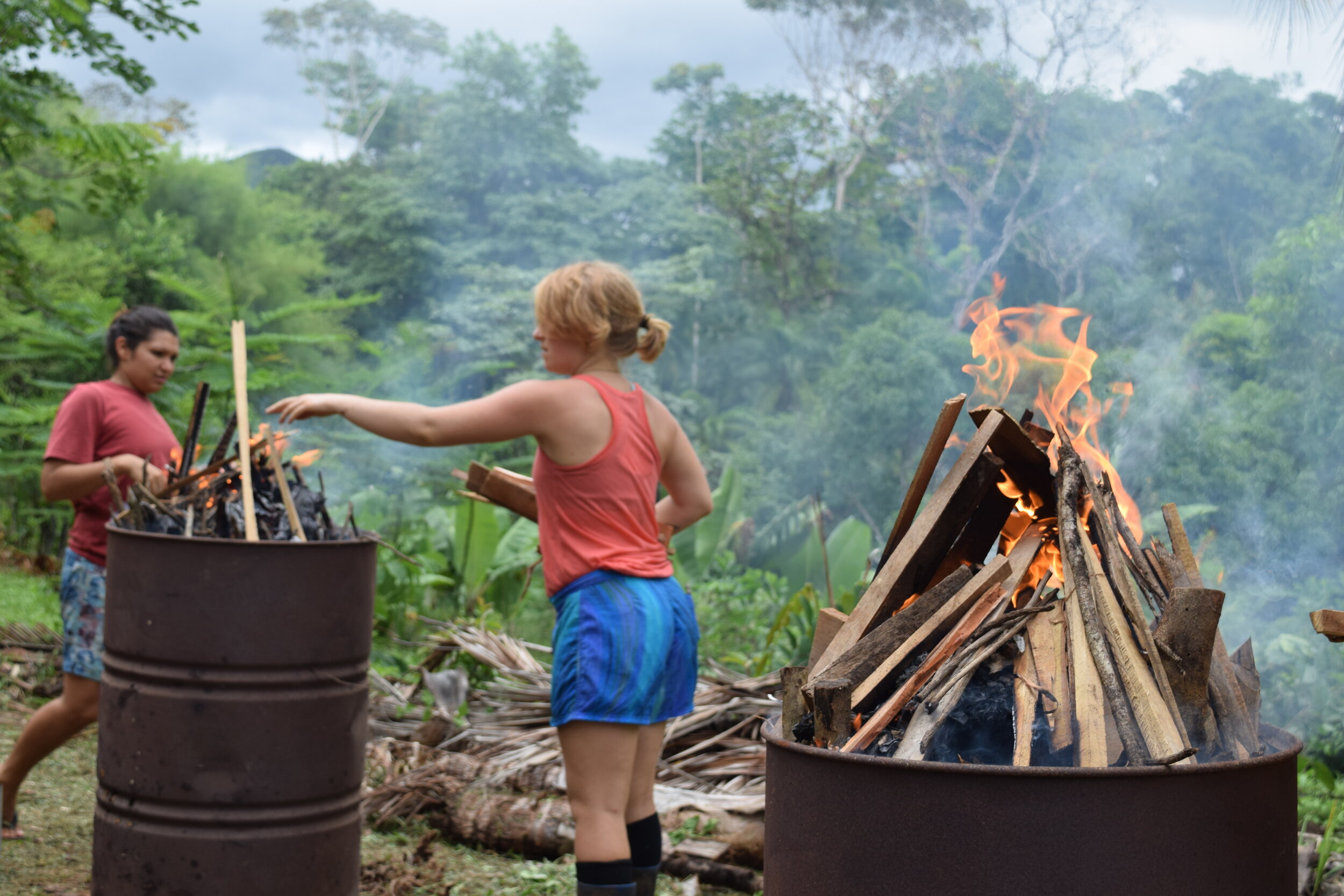
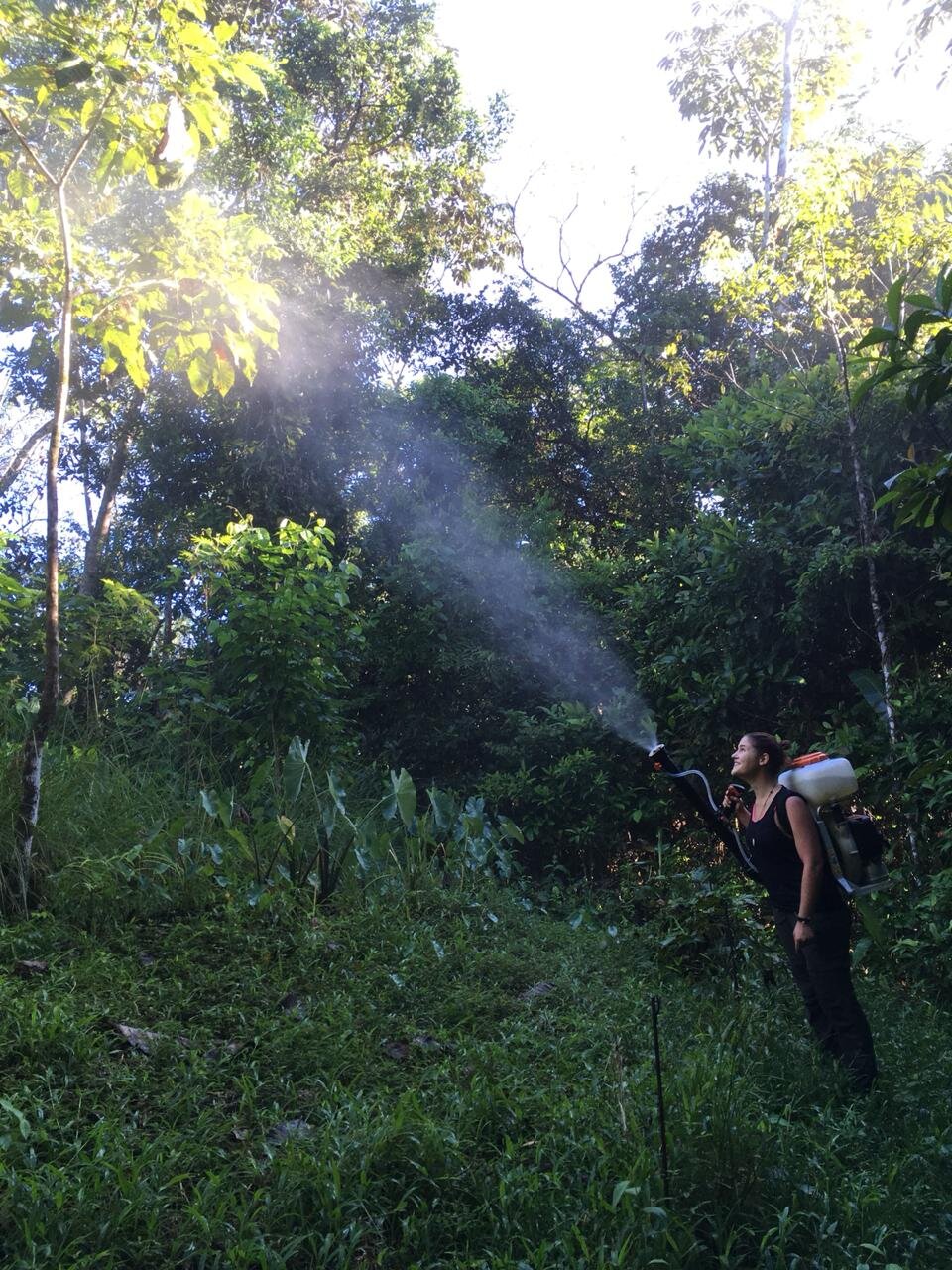
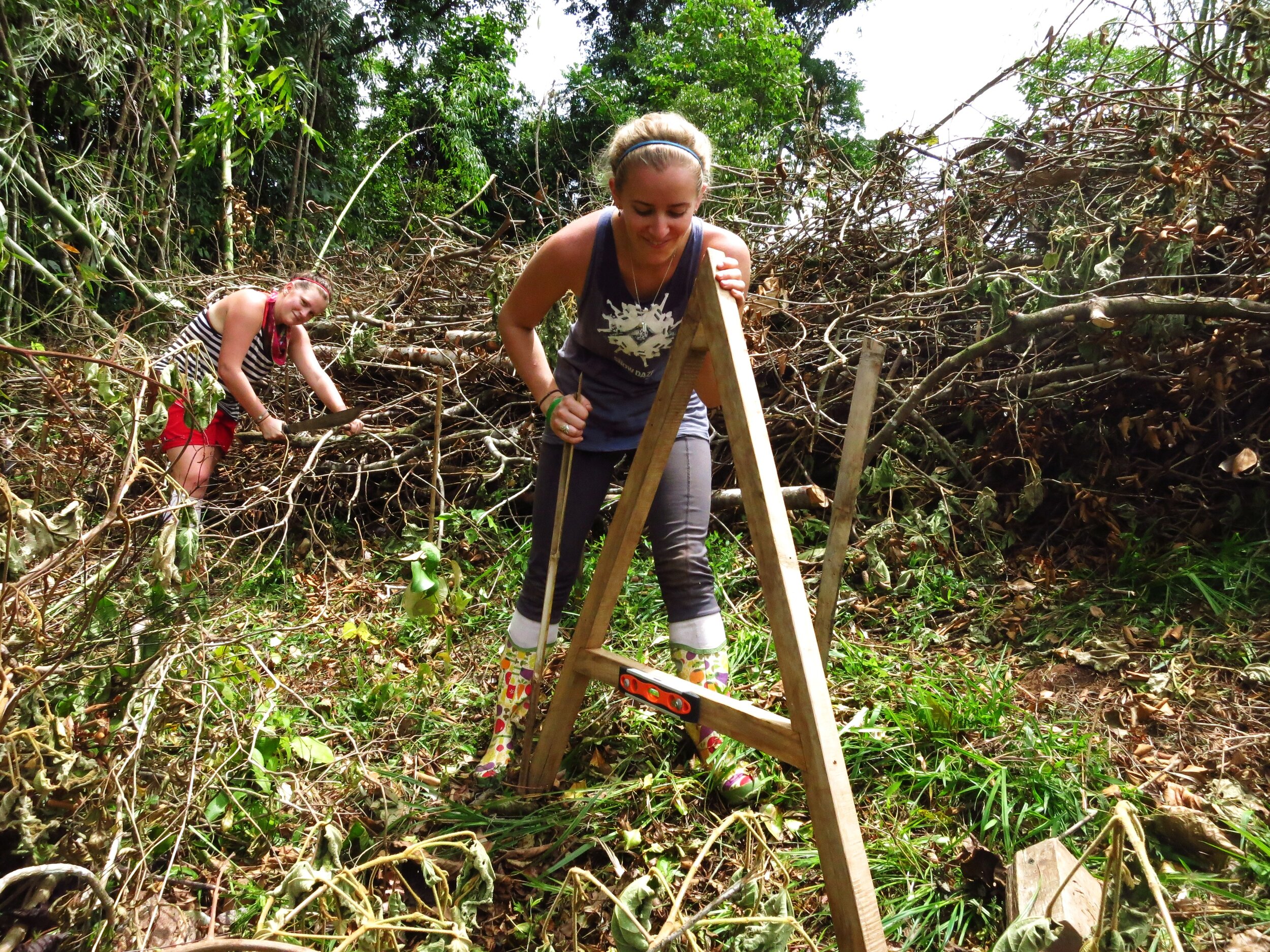
Many ways to develop tropical soils
There are other solid permaculture concepts for improving soils in the humid tropics that should be mentioned here. To deal with highly acidic soils, adding lime at regular temporal intervals is a useful strategy. We tend to avoid planting annuals while opting for perennials, by which we disturb the soil less and reduce potential erosion. Read our article about which perennial greens do well in the tropics here. Over time these plants will help build humus and topsoil. There are plenty of pro tips from the world of permaculture that you’ll find helpful, like adding shredded cane and bamboo species as a mulch for silica and calcium enrichment. This will in turn help to raise pH levels (lower acidity) of soils and reduce leaching and erosion. We add Humanure and effluent from our Biodigestors, this helps build our soil and use commonly wasted products to grow food!
Want to Learn More?
If you’re interested in agricultural concepts such as improving soils, make sure to check out Rancho Mastatal’s workshops, including:
Past Blogs on Soil and Permaculture in the Tropics
We have a lot of past blogs on this topic. Here are a few to read:
Applied Permaculture Principles

Our apprentices doing some chop and drop in the orchards

Applied Permaculture Principles
There are a lot of misconceptions about what Permaculture is, most people think of it as an agricultural system, typically some sort of food forest and whilst maybe it does make sense for you to have a food forest, maybe it doesn’t! The specifics of applying the principles will vary based on your environment, project , goals etc… but the principles will always remain the same. In permaculture there are 12 underlying principles that help guide us through the design and thinking process. We have highlighted below how we apply each of these principles at our site to help inform you how these principles can be applied in practice.
By Nic, Core team member
There are a lot of misconceptions about what Permaculture is. Most people think of it as an agricultural system, typically some sort of food forest and whilst maybe it does make sense for you to have a food forest, maybe it doesn’t! The specifics of applying the principles will vary based on your environment, project , goals etc… but the principles will always remain the same. In permaculture there are 12 underlying principles that help guide us through the design and thinking process. We have highlighted below how we apply each of these principles, many times in more than just one way, at our site. We hope this helps inform you how these principles can be applied in practice. If this article intrigues you, check out our annual Permaculture Design Course!
Permaculture Principle: #1 - Creatively Use and Respond to Change
This is an almost everyday occurrence here, with such a huge diversity of projects and systems at the Ranch. One of the big changes that many people experience here is the change in diet, coming to a tropical region we focus on locally available food sources. In this photo we showcase a typical meal of rice, beans, picadillo, salad and plantains and green papaya kimchi, all sourced from within 20 miles of the Ranch. Each year apprentices learn about how to creatively use these new food types, and learn from our experience of eating and preparing these food items for the last 19 years.

Yucca bammies, green papaya kimchi, fresh garden salad and a mango salsa…yummy!

Patacones, lacto fermented Jalapanos, pickled turmeric, green papaya kraut, dairy kefir sauce
Permaculture Principle: #2 - Observe & Interact
We love fermentation here at the Ranch we use it for so many things but as every ferment in every climate is slightly different it involves observation and interaction to fine tune your recipes. You have to pay close attention to each batch to make sure you get the perfect balance of flavors from the fermentation process, this timing varies throughout the year and depends a lot on the ambient temperature! Here we have some different pickles and ferments that we make from Green Papaya, Chayote and wing beans….Yummy!!!

Wing bean pickles

Chayote pickles
Permaculture Principle #3 - Catch & Store Energy
For the last 12 years we have been using two types of bio-digestors at the ranch to catch and store energy from human (and cow) poop. For those unfamiliar with the system, a large underground vessel is used to create an anaerobic environment where the feces is broken down, killing any pathogens and releasing Methane gas which we pipe up to our kitchen and use to cook on. The now safe effluent is used to passively feed, bananas, bamboo and cacao trees.
On the left a mosaic describes the closed loop system we employ at the Ranch and on the right the mosaic describes the open loop, linear system that is often found around the world when dealing with human feces.

Permaculture Principle #4 - Obtain a Yield
Jackfruit is one of the largest fruits in the world, it grows and begins to produce very quickly and is ideally suited to our tropical climate. In our agroforestry systems we have many jackfruit trees of different varities. Here is a typical harvest of Jackfruit when it is really pumping!! We love to eat Jackfruit green (when it is more like a starch) and have been lacto-fermenting it, a great way to store and add nutrition to this abundant fruit. We then use the jackfruit to make a hash, or as a replacement for the pasta in a lasagna or even a pizza topping… its just so versatile!!

Permaculture Principle #5- Self Regulate & Accept Feedback
Rancho Mastatal is an education center, community and lodge. We host a year long apprenticeship, 100’s of high school students and 100’s of guests throughout the year. We eat together, live together, play together and work together. Conflicts are inevitable and we have designed many systems to productively work through these. We encourage feedback sessions with our one year apprentices through group meetings and one on ones to accept feedback and make the necessary changes to make all of our experiences living together more enjoyable. Here we are all meeting in our wonderful meeting room, a round earthen structure.

Permaculture Principle #6 - Use & Value Renewables
Over our 20 years of existence we have always valued and used renewable energy sources, from our biodigestor, to our super-efficient wood burning cook stoves to our dry composting toilets, these are all ways to use and capture renewable energies. We have also installed 10+ small solar systems at the ranch to power cabins far from the grid and to help community members in Mastatal and nearby villages have power. We are lucky to live in a country that also values renewable energy sources. Costa Rica is powered by 95% renewable energy sources a magnificent achievement by world standards.

Bamboo, a fantastic renewable building material
Join us April 2021 for our Bamboo Management Class or our Bamboo Construction Course

Fuel efficient stoves
In these photos we are setting up scaffold to harvest bamboo to build with, installing a small PV system for a local community member to help them have lights in the evening, and cooking on our fuel efficient wood cook stove.

Installing some PV panels in the community
Permaculture Principle #7 - Produce No Waste
This principle is gaining a lot more traction in the modern convenient driven society, where single use plastics have become commonplace. With the slow realization that we cannot keep throwing stuff away, the principle of produce no waste seems more relevant than ever. Here at the Ranch we are a large consumer of food and goods, often feeding up to 50 people a day we go through a lot of food!! Over the years we have used our purchasing power to convince/encourage local farmers to reduce their packaging. Our vegetables are delivered in baskets, our tapa dulce is wrapped in cane leaves, our rice comes in rice sacks which we can re-use for storage of other goods such as sawdust for our composting toilets and we get our milk in gallon containers we wash and send back and forth with the dairy farmer. We are not perfect, and we definitely still produce waste but considering the average American produces 4.5lbs of garbage a day we are well below that!! As we have become more aware of this issue around the world, this is one of the simplest and most accessible ways to become a more responsible world citizen.
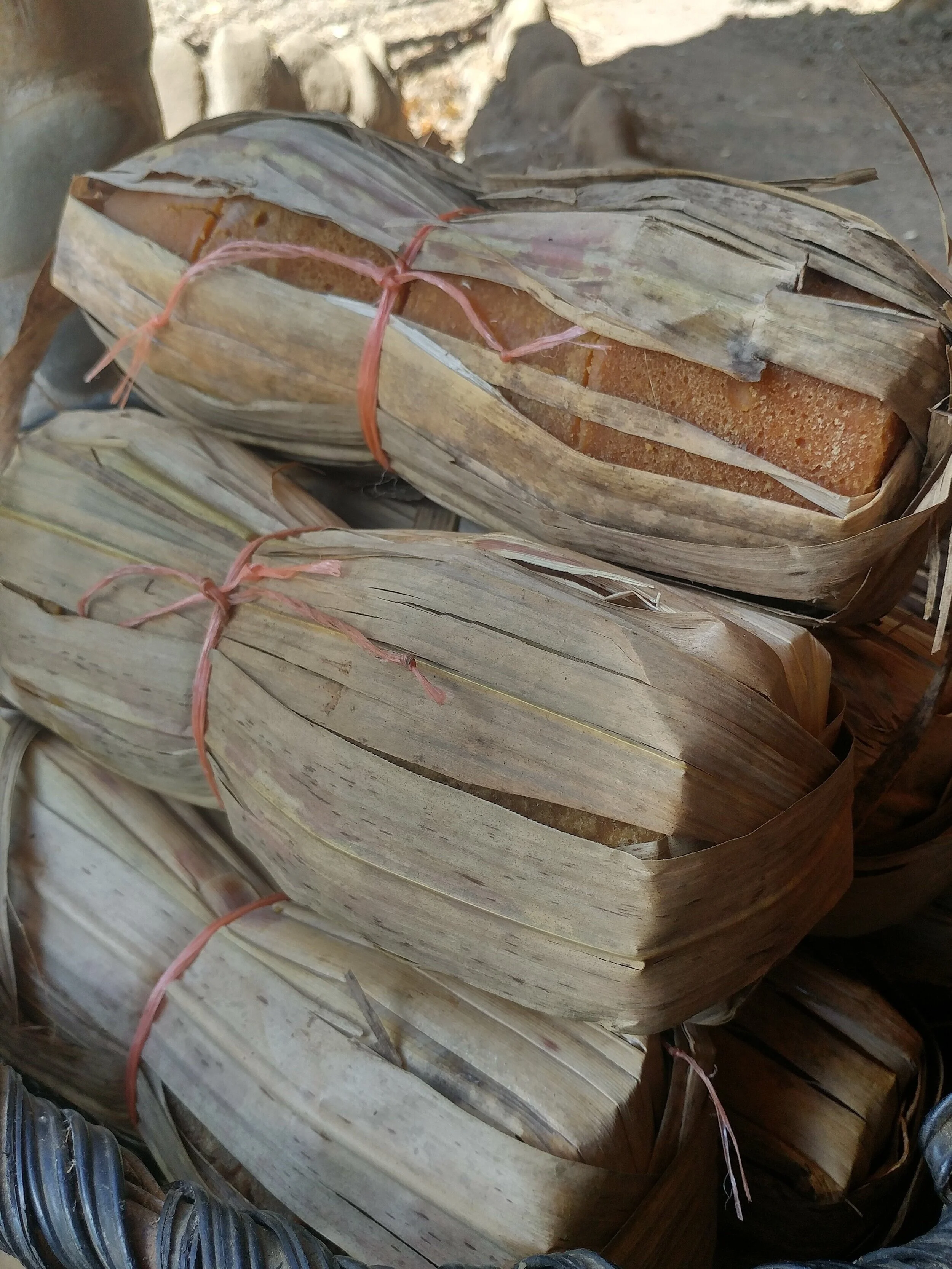
Our local sugar, tapa dulce

Sacks and baskets used to store food
Permaculture Principle #8 - Design from Pattern to Detail

Students in our annual PDC learning to use the A-frame

Nice lines of trees on contour
One of the biggest challenges in tropical climates is the huge amount of rainfall we receive, seeing the pattern of deforestation and eroded landscapes on our property we countered this by reforesting land using diverse perennial tree crops, which mimic the forest stratas, protecting the soil and producing food for us to eat. We dig swales & retention ponds, plant on contour and use deep rooted species, mulch heavily all to help slow down the flow of water and build healthier more productive soils.

Lydia, an apprentice, planting and properly mulching this new fruit tree
Permaculture Principle #9 - Integrate rather than segregate
One of the ways we do this is by integrating different species known as guilds. These plant guilds help support one another and diversify your site making them less prone to diseases and providing shade, fertility and structure. We grow our black pepper vines on a living post. This post produces some shade and the living post is also a nitrogen fixing tree. Nearby we have more nitrogen fixing trees and bananas to provide more shade, food and mulch to the black pepper. Stay tuned for our next blog on the Life of Spice: Black Pepper.

Permaculture Principle #10 - Use Small Slow Solutions
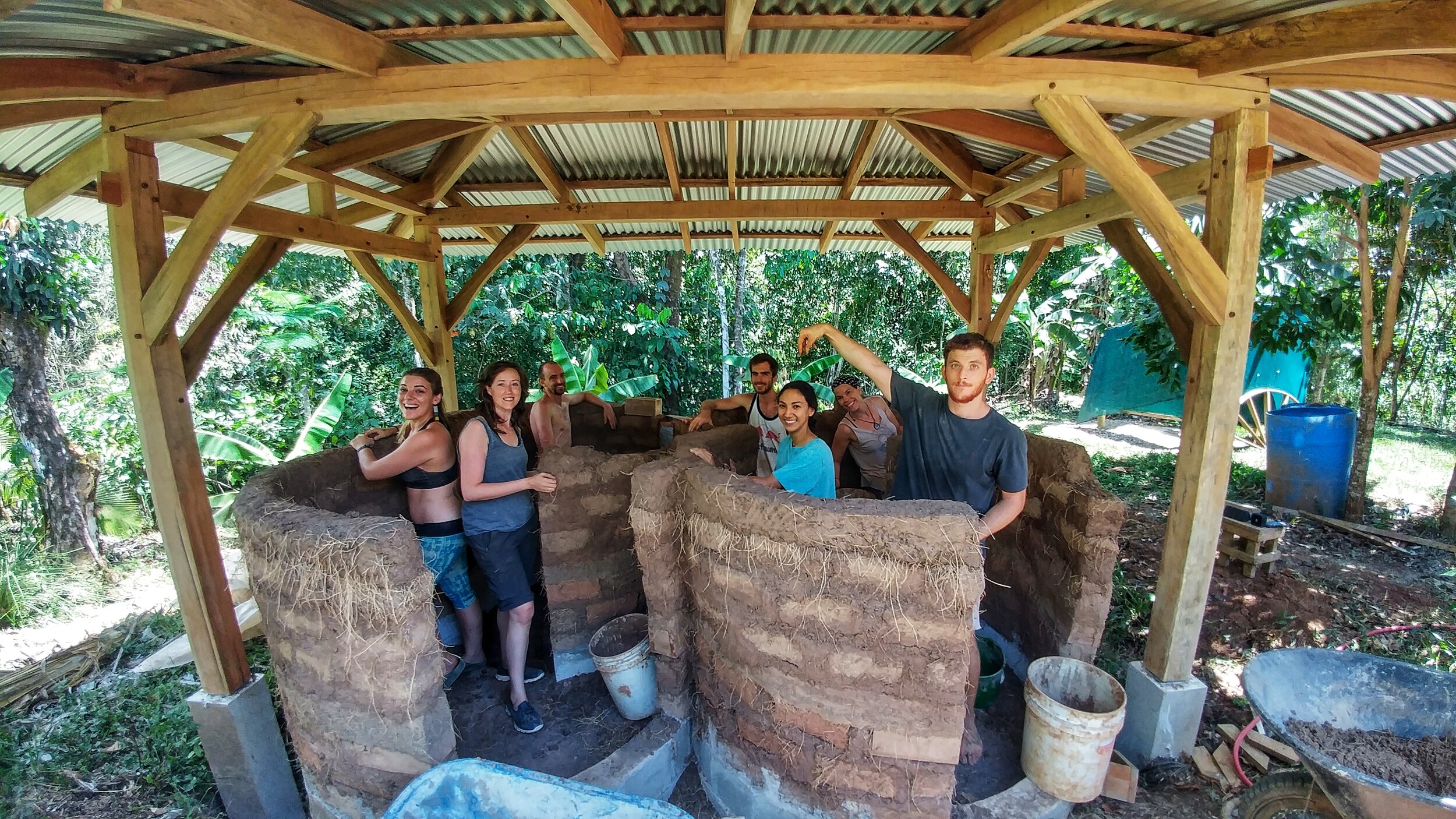
Apprentices building an adobe brick walled shower that’s under a timber framed structure
Everything that we build at the Ranch is by hand. People always ask us how long it takes to build things and it takes a long time to be honest. Our goals are to give people educational opportunities in the building process not just to make something as quickly as possible. We see the value in taking it slow and not using a lot of machinery to streamline our building process. We use our buildings to create beautiful healthy homes that are not only using local resources but help us make connections with people and build community. Check out this article on how we built this Tadelakt shower

Permaculture Principle #11 - Use & Value Diversity

Don Chepo winnowing his harvest of beans
For many people the idea of becoming self-sufficient is an appealing one. We look at things in a different way by using and valuing diversity we aim to create regional food security and value the food we grow equally to the food we can obtain from local farmers. By supporting our neighbors and friends we build community, financially support local farmers and get to eat fresh local produce everyday! Beans from Don Chepo, Tapa Dulce from Don Gerardo, Eggs from Doña Flor and Coffee from Jose Luis are just some examples.

Don Gerardo using his ox to press the sugar cane

Dona Flor feeding her chickens
Permaculture Principle #12 - Use Edges & Value the Marginal

Homemade banana vinegar
As we said before we love vinegar and fermentation at the Ranch. One of the simplest vinegar recipes we use is valuing the marginal, fruit scraps and peels make an excellent vinegar. We pack them into a bucket add water and let the natural yeasts convert the sugars into alcohol and then into vinegar. What is commonly treated as a waste product has now been converted into a sugar source for a vinegar which we can use to spice up some of our fresh garden salads! Read our latest blog on farm to table, homemade banana vinegar.

A variety of aging homemade vinegars
These are just some of the many examples of the way we implement the 12 permaculture principles here at the Ranch.
If you are interested in permaculture design and it’s principles join us for our annual 2 week, life changing Permaculture Design Course.
Timber Framing: A Real Application of Sustainable Forestry Management
The deforestation problem that constantly threatens our global forest resources is one that we can overcome. To accomplish this, though, we must again learn to give our forests real value. The main idea here is that our forests must be more economically valuable in their current state than they would be under competing land uses. If not, they will be deforested.
By Anthony, 2020 apprentice
The deforestation problem that constantly threatens our global forest resources is one that we can overcome. To accomplish this, though, we must again learn to give our forests real value. The main idea here is that our forests must be more economically valuable in their current state than they would be under competing land uses. If not, they will be deforested.
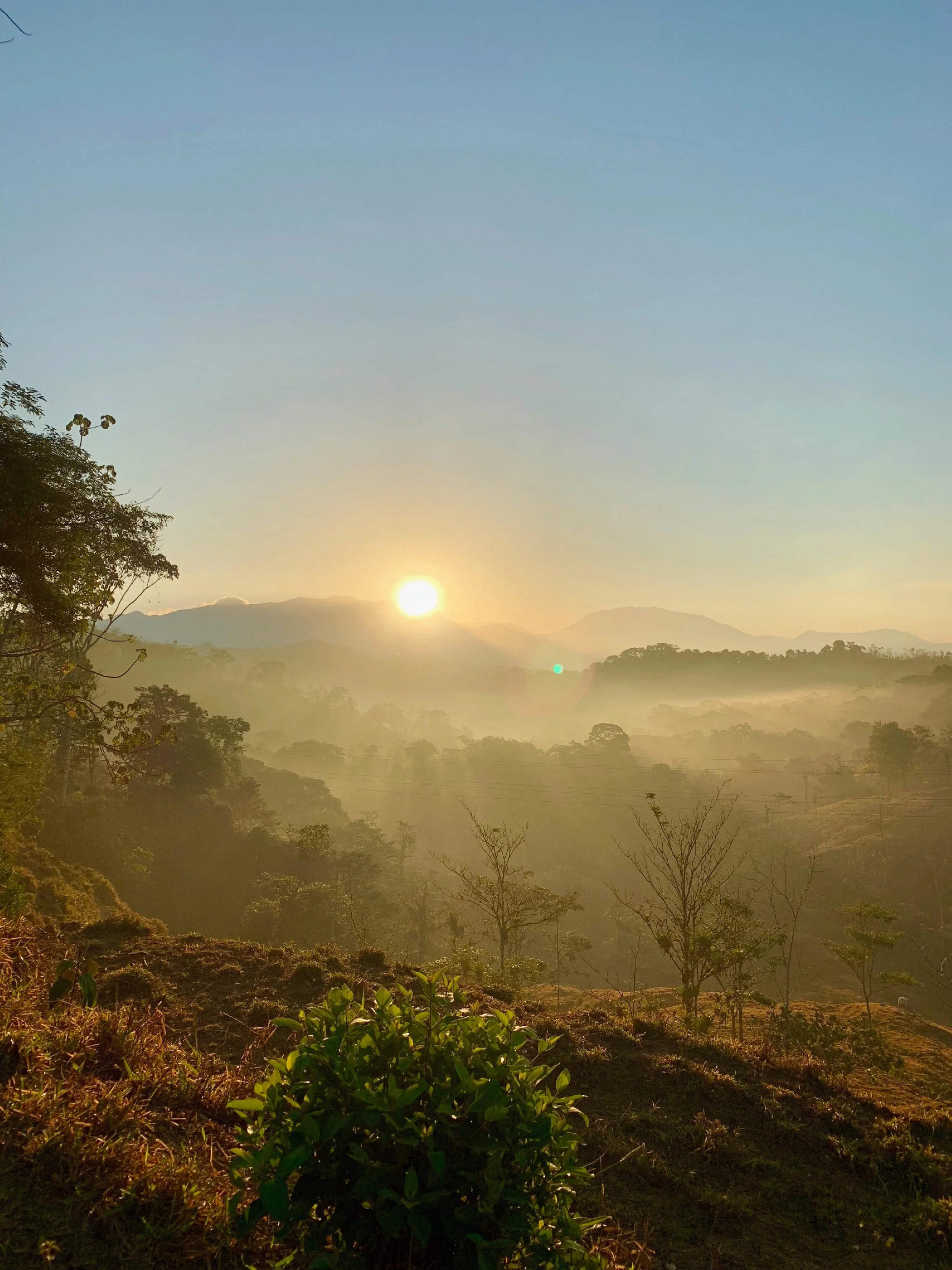
Cattle Pasture and Forest,
Latin America’s diverse and astoundingly beautiful forests are constantly under threat. Here, deforestation occurs when forest owners decide that they can earn more money doing something else with their land. Forests are routinely slashed and burned to make room for agricultural systems, cattle ranches, infrastructure, urbanizations, and mining, to name a few alternative land uses.
One real strategy to conserve our precious forests is sustainable forestry management, a practice that selectively and sustainably chooses trees to be harvested within a forest in order to use their timber for construction, furniture, tools, and artisanal products. When well planned and carried out respectfully, sustainable forest management gives way to increased biodiversity within a given forest, offers employment opportunities in rural communities, and, perhaps above all, makes a forest’s continued existence economically possible.
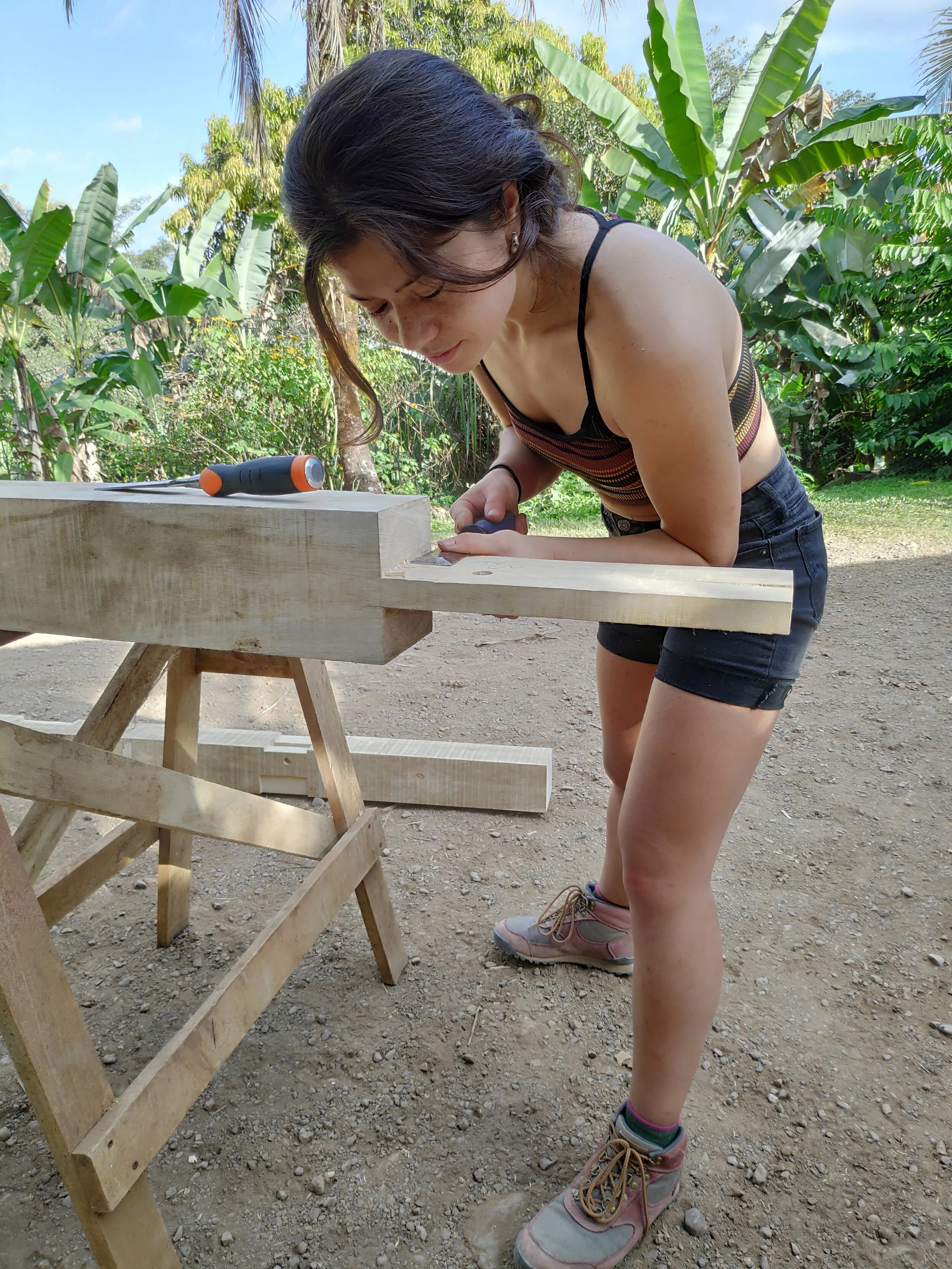
Timber Framing
Rancho Mastatal is putting this plan into action. This Costa Rican-based educational farm offers workshops in diverse areas with an emphasis on sustainable community living in the tropics. One of their flagship courses, ‘Introduction to Timber Framing’ leads workshop attendees through the process of building a simple and elegant timber frame home. Starting with the basics, such as tool sharpening and laying out a timber using the square-rule method, the workshop ends in climactic style on raising day when the students see their work come to fruition. After many days of focused, methodical work chiseling and sawing, the timber frame home is assembled in a swift group effort in a single morning. The workshop is an ideal combination of focused individual development and group camaraderie.


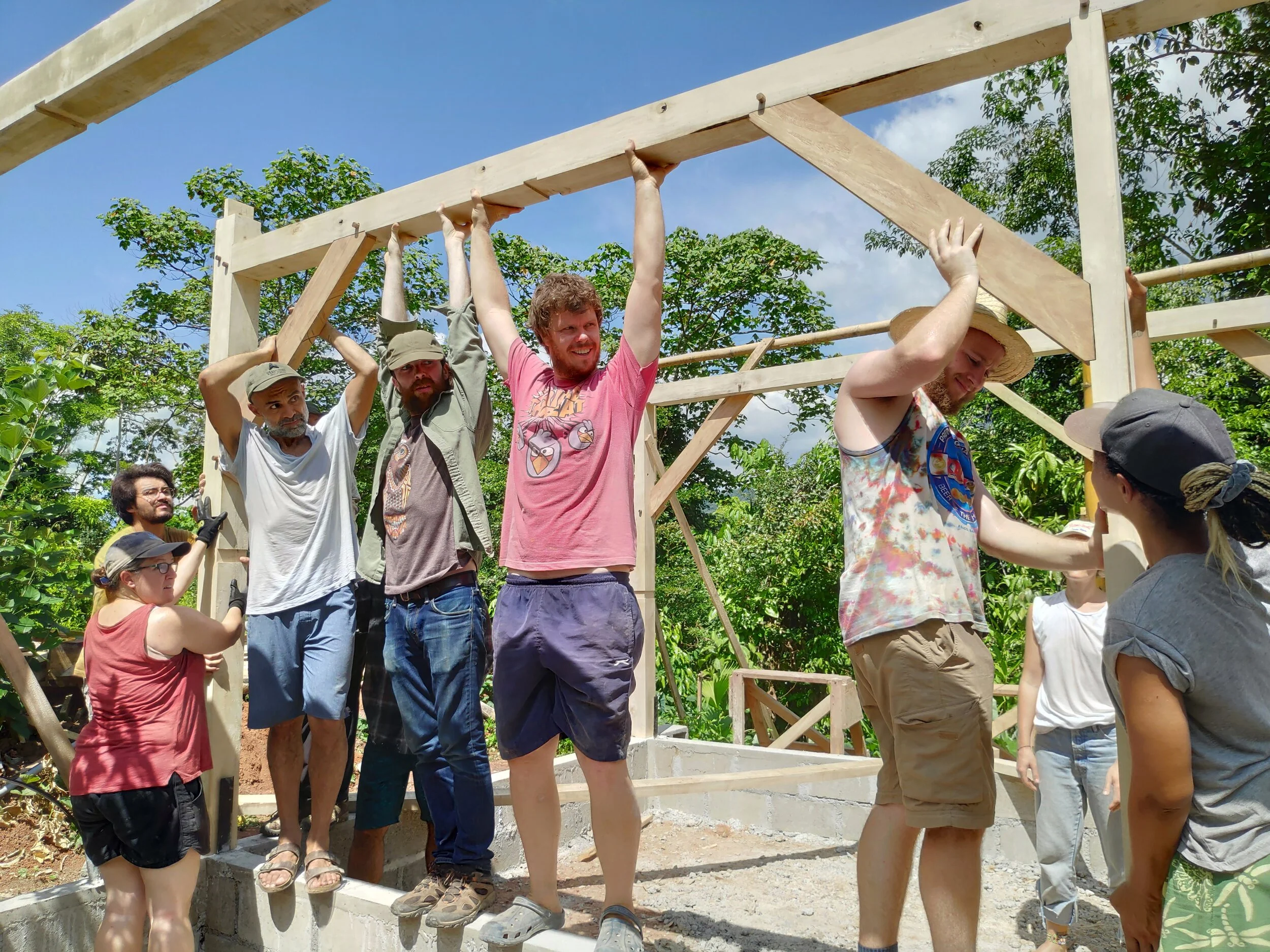
Sourcing sustainable wood
The timber used for the construction of Rancho Mastatal’s timber frames originates from two main sources, both of which are sustainably and carefully chosen: selectively-felled trees from managed secondary forests, and trees planted specifically to be harvested for their wood. Additionally, the national context of the timber frame workshops is significant. Rancho Mastatal exists in a nation aiming to be carbon neutral by the year 2021. So far, large-scale national strategies have been based on a renewable energy sector, yet little has been done for real improvement in the construction sector. Here Rancho Mastatal leads the way toward carbon neutrality while conserving tradition.
To be original, one returns to the origins. Sustainable forestry management and timber frame buildings are ancient traditions that must be practiced in order to be culturally conserved. By integrating these traditions into a business plan through its educational workshops, Rancho Mastatal and its core team aim to realize an originality apt for modern times.
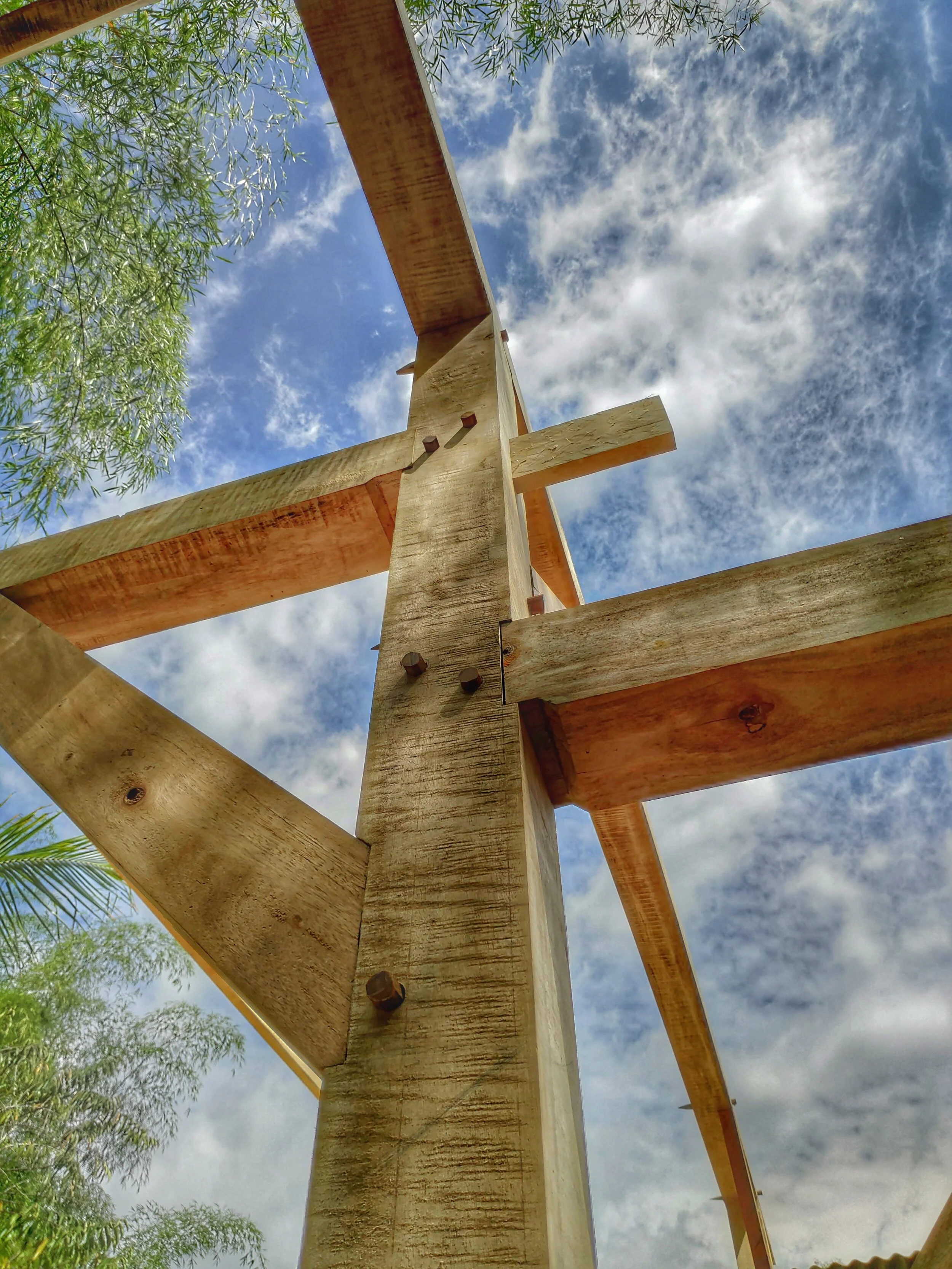
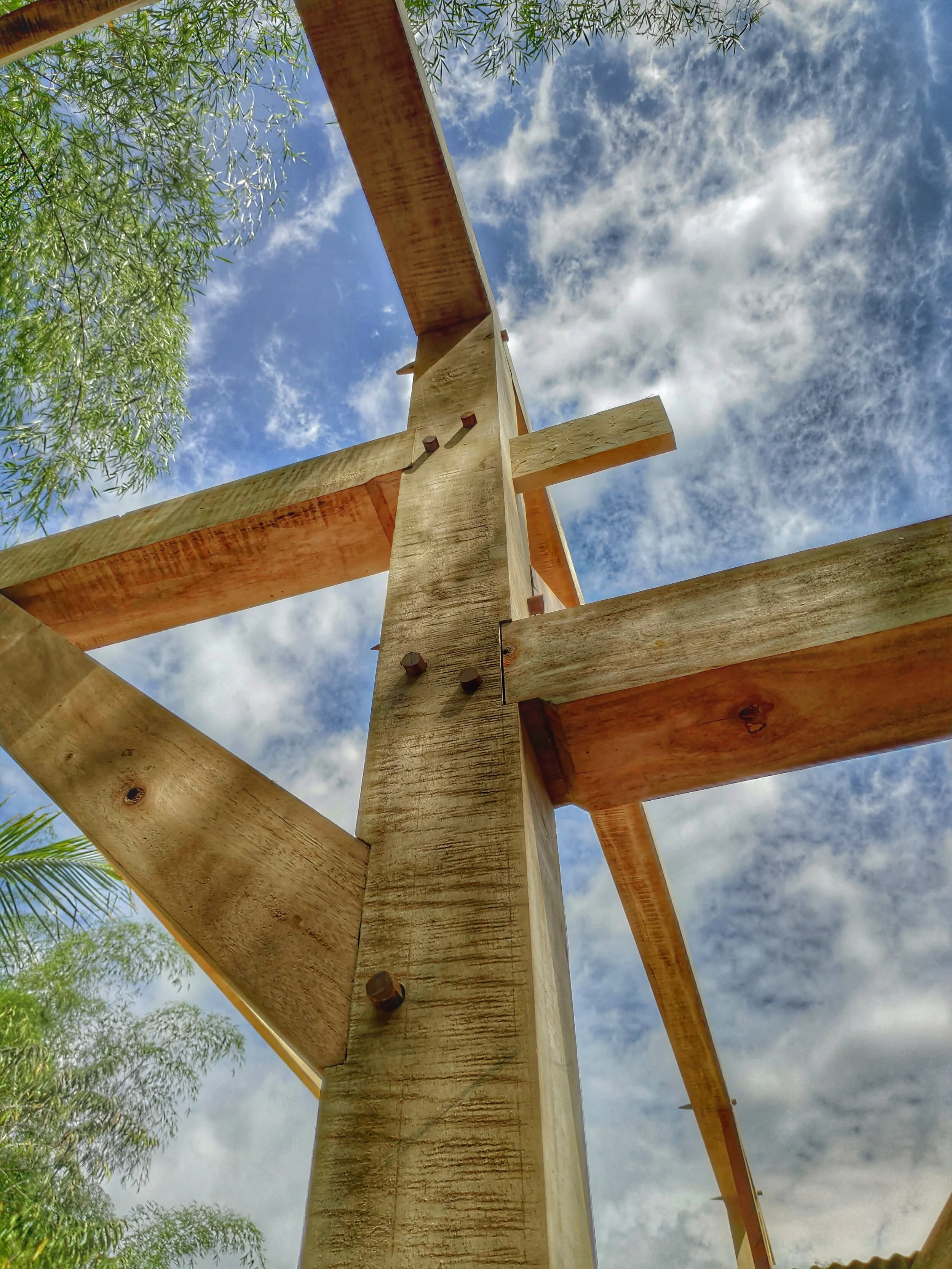
A nice display of the different joinery in one post
Stay tuned for the next blog Timber Framing Tips: The Things You Didn’t Know You Needed to Know.
Join us in 2021 for our Timber Framing Workshop to get hands on practice and instruction on this beautiful and traditional form of building.

The Wonders of Vanilla
Vanilla is the second most expensive spice in the world. Being sold between $600-1200 per kilo, that is more expensive than silver!
What makes it so precious?
by Diana D, 2019 Apprentice
Vanilla is the second most expensive spice in the world. Being sold for between $600-1200 per kilo, that is more expensive than silver!
What makes it so precious?
Vanilla comes from the largest family of flowering plants, the orchids, as well it is the only orchid that produces pods. Every stage of vanilla bean production needs to be completed by hand, making it one of the world's most labor intensive crops.
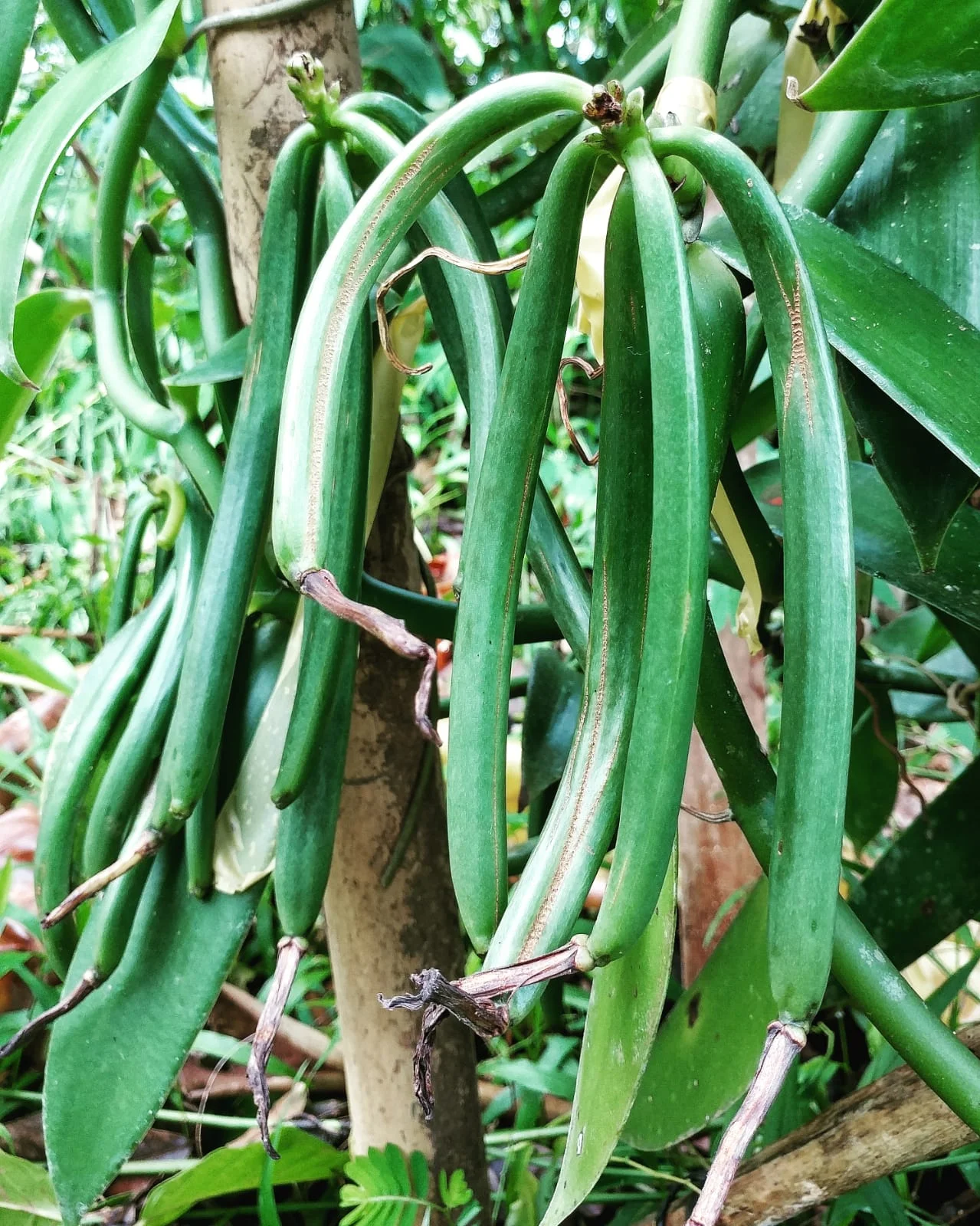
This orchid originated in Mexico, it's cultivation is being practiced from Mexico to India . Being producers and exporters to the world market these countries each produce up to 200 tons of vanilla annually. Madagascar is by far the largest producer of vanilla, accounting for over 80% of global production. Although the value of vanilla is very high this has had some unfortunate repercussions for vanilla farmers as crime and theft of their valuable product has increased. This has led to instability in the lives of the farmers. Natural disasters have also affected them deeply, wiping out entire crop yields for the year. With such a delicate and refined production system It could take up to 7 years to regenerate the vanilla and return to the same levels of production. As with any single crop production system, it is a high risk strategy to rely on one crop for all of your income. There is a growing awareness of these issue for vanilla farmers and some new more sustainable and resilient techniques are being adapted.

To learn more interesting facts about vanilla, its history, creating a sustainable way to grow vanilla and support the farmers read this great article. This article was written by the first company to have an integrated, sustainable, vanilla supply that began transforming the Malagasy vanilla business in 2006.
My interest in vanilla arose when I started to take care of it and pollinate it as part of my morning experiential learning tasks at Rancho Mastatal. The production of vanilla is a fascinating delicate and attentive process that if done successfully is extremely rewarding. I am able to experience the growth of the vanilla plant, the pollination of it's flowers , and after many stages of fermentation, curing and extraction we are able to enjoy the amazing product of this magnificent plant.
During my year long apprenticeship here in Costa Rica, I am able to immerse myself into the plant kingdom as well as learn the essential skills for self sufficient homesteading. I also get to apply and practice other skills such as carpentry and natural building which will allow me to lead a more sustainable lifestyle .
Vanilla is only one of the many fascinating things I have learned about here. I warmly invite you to come visit us in Rancho Mastatal in the rainforest of Costa Rica. There is so much to learn about how we can improve our lives within our communities and in harmony with nature. How we can all provide our own food and support our community with their projects.
What I have learnt from the vanilla plant is that I would love to grow it on my own land, it's prices are rising so why don't we grow it for ourselves? Let's take little steps to self sufficiency by growing our own food as much as possible and by supporting the companies that treat the farmers well.

Leon (2017 Apprentice) drying vanilla
I hope we keep growing vanilla and benefit from the heavenly smelling pods in our delicious deserts.
On that note I'm off to prepare a vanilla cocoa wine!
P.S This article contains the basic hooch recipe, check it out if you want to learn how to make delicious homemade hooch :)
Blessings,
Diana D

Salak Pollination
As apprentices at Rancho Mastatal, we take on a Plant Skill, where we each are responsible for a plant variety in our agroforestry system. When we began as apprentices many of us wanted to avoid the Salak palm, as it has splinter inducing spikes throughout the stem and leaves. Following my intention to dive into challenges this year, I decided to take being caretaker of the prickliest palm on the Ranch.
Salak Pollination - dangerous work, with a delicious pay off
By Amy Dodds, 2019 Apprentice
As apprentices at Rancho Mastatal, we take on a Plant Skill, where we each are responsible for a plant variety in our agro-forestry system. When we began as apprentices many of us wanted to avoid the Salak palm, as it has splinter inducing spikes throughout the stem and leaves. Following my intention to dive into challenges this year, I decided to take being caretaker of the prickliest palm on the Ranch.
This is a breakdown on my experience, playing Cupid by pollinating this spiky palm!

Salak palm, or Snake fruit palm, originated from Indonesia, South East Asia. The main reason for planting in an agro-forestry system is that is produces a crunchy fruit that tastes like a tropical apple, which you can eat immediately after peeling the snakelike skin. It does well in humid lowland tropical areas, so is perfect for our climate at the Ranch. It is best to plant in a forest as an under story crop, especially as the young palms require heavy shade. They have superficial roots and therefore needs to be watered regularly, making it thrive in rainy season. Interestingly, pollination is most effective by hand. This can done by insects but is much more productive with human intervention.
While it may appear a harsh plant, I have found the Salak palm to be a rewarding plant to interact with. So far it has meant that every few days I get to go into the lush and cool Fern Gully and practice being mindful in the forest. I have to be slow and calm when navigating the spikes and surrounding orb spiders. And I get the joy of sharing the tasty fruit with my friends!
The main task is pollinating the female flowers with the male pollen at least 3 times a week. I am essentially playing matchmaker in Mastatal’s forest. Salak plants are either male or female. At the Ranch we have 20 plants, with the ratio of 3 females to males in our orchards. The female palms are the fruit producers. Their flowers develop in a hard pointy sheath, which you open with clippers once it becomes more hairy. This allows you to see when they develop a deep pink colour, meaning they are ready to receive the pollen. You can tell the male stamen is ready when they also become pink with small yellow pollen granules. I clip the male stamen at the stem and carry it carefully to the female flower, shaking the male spike on the ripe pink open flowers. Within a few days the flower should harden. If it becomes soft and dry pollination is unsuccessful.
When the fruit is ready it should fall off easily from the bunch. Taste can help indicate if it is ready - unripe Salak has a dry astringent flavour, whereas a ripe fruit should taste juicy and sweet.
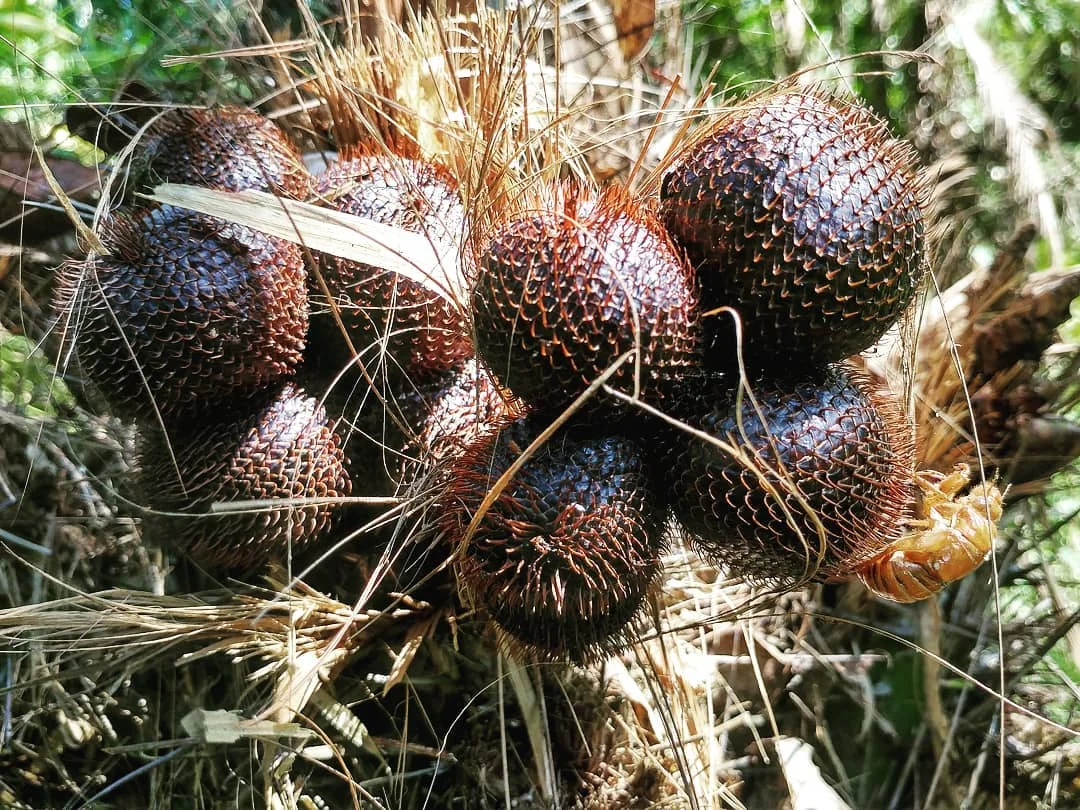
Included in the pruning process is clipping the suckers to prevent reproduction, pruning the leaves to keep only 4-5 mother leaves and removing any dead female and male flowers.
Other uses for Salak besides food production include using it as a hedge if you don't like neighbours or visitors. Or you can use it as an intimidating potted plant!
Overall this experience has been an important one to improve my permaculture skills of observation and interaction with this particular species. Plus it has become a mindfulness practice!
For more further reading on the propagation and care see our blog article on Salak.
Interested in tropical agro-forestry systems and their design, why not join us for our year long apprenticeship or check out some of our upcoming workshops

Using Mountain Microorganism to Create Organic Fertilizer
The need to cultivate a “living soil” that is full of microbes is something I hear frequently in the organic farming and permaculture world. As an apprentice at Rancho Mastatal this year, I have the unique opportunity to look further into the universe of these small and unseen allies. A way into this world was through the Ranch’s process of making organic fertilizer, one that harvests and inoculates the soil with Mountain Microorganisms (MM). This is similar to compost tea, where we create a fermented fertilizer with microorganisms such as manure.
By 2019 RM Apprentice Amy Dodds
The need to cultivate a “living soil” that is full of microbes is something I hear frequently in the organic farming and permaculture world. As an apprentice at Rancho Mastatal this year, I have the unique opportunity to look further into the universe of these small and unseen allies. A way into this world was through the Ranch’s process of making organic fertilizer, one that harvests and inoculates the soil with Mountain Microorganisms (MM). This is similar to compost tea, where we create a fermented fertilizer with microorganisms such as manure. MM differs from this by using forest soil and duff layer to create a fertilizer. You can create MM fertilizer anywhere in the world so long as there are forests in your area that has a healthy amount micro life!
In just the second week of our apprenticeship, the Ranch hosted guests from Ecogrecia, another local farm and research centre who are using MM. We were were privileged to get a demonstration of how we can cultivate our own indigenous microorganisms. I will detail this below so you can create your own MM fertilizer but first here’s a bit on the science.
There are many diverse living organisms that improve the soil ecosystem, these include invisible bacteria and fungi and visible worms and insects. A few of the benefits of fostering this micro-community include: aeration of the soil, making nutrients available, fix nitrogen and prevent pathogens. With this in mind we want to cultivate soil in our orchards that is full of microbial life.

Agro-forestry systems at Rancho Mastatal
Our main farming practice at the ranch is agro-forestry. This is essentially using trees with other crops to create an ecosystem that mimics the tropical rain forest environment of Costa Rica. Most forests need a fungal dominated ecology, while still needing bacterial organisms, for optimal soil. The “fungal to bacterial biomass ratio” needs to be 10 parts fungi to 1 part bacteria. Especially important is the mycorrhizal fungi that live closely with tree roots to allow the plant to take up nutrients and water. Therefore we want to harvest a fungal dominated fertilizer. In the past Rancho Mastatal has used manure fertilizers which work well for gardens and vegetables but are less tailored for forest soils, due to their high bacterial rate. This is where Mountain Microorganisms come in!
Mountain microorganisms was originally a Japanese practice that take forest leafs and soil from native forest within the land you are growing in to create an anaerobic ferment (without oxygen). I see this is as beautifully symbiotic as we are inoculating the soil with indigenous microbes from the local environment. We essentially take the mother culture which contains the diversity and variability perfectly suited for your local forest.
Mountain microorganism fertilizer is a better process for our agro-forestry systems, than say compost tea made from manure, due to the high fungal microbes available in our mother culture. Rancho Mastatal has been using the MM process consistently for 3-4 years and noticed improved conditions in their food forest.
One of the first steps in this process, which we did with our apprentice team and the crew from Ecogrecia, is going into the forest and gathering the local microorganisms to create our current solid fermentation. Around the large well established trees, we harvested leaves and sticks that are crumbly and breaking down. They have the delicious white mycorrhizal growth on them. Under the leaves we collect the soil that contains the visible fungi.
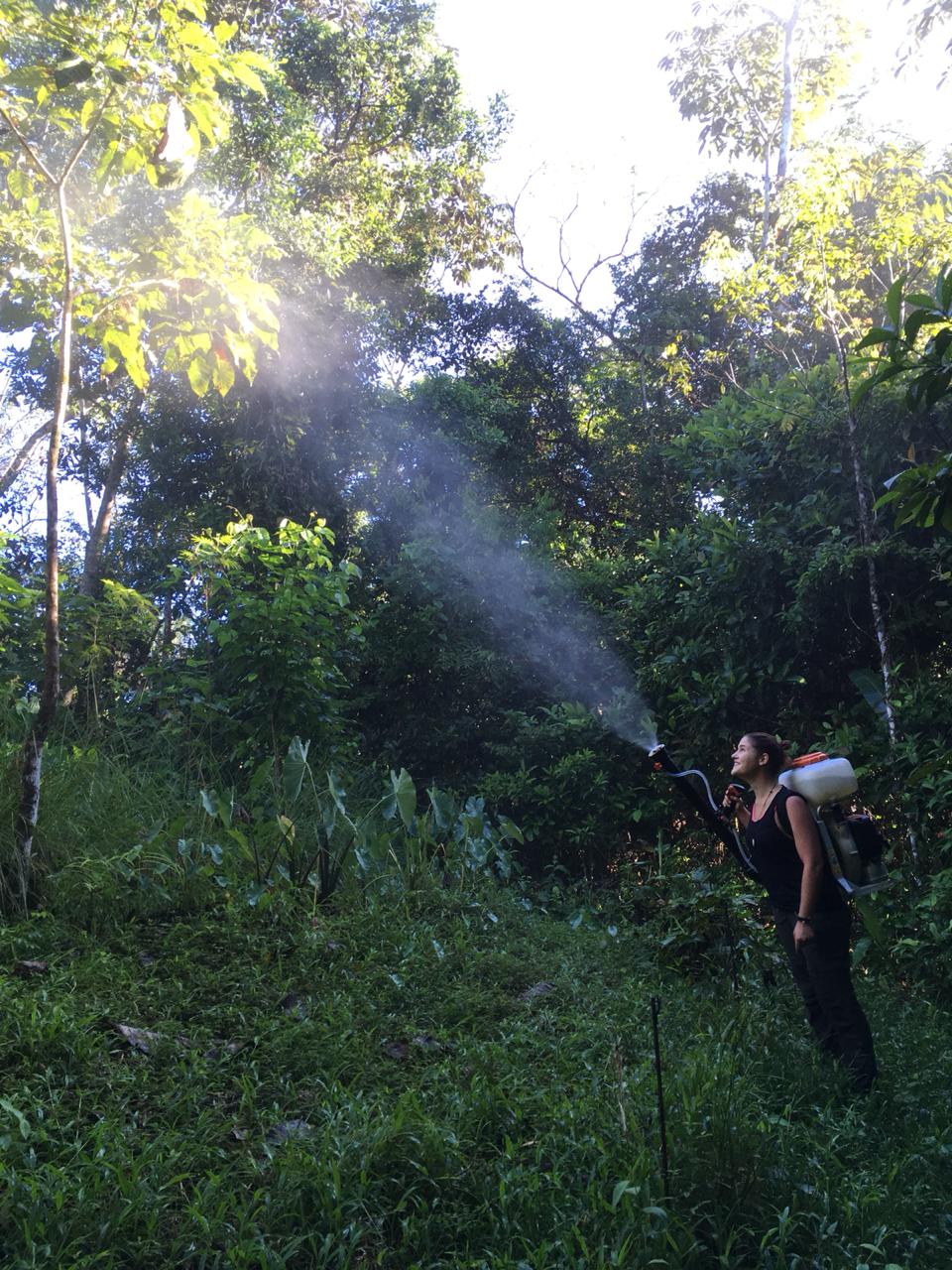
Spraying the orchards with an organic fertilizer
From this we can create a solid fermented product and then a foliar spray that will inoculate our soil with the microbiology that we need to improve our soil life. Once it is in foliar spray form we take our backpack sprayer once a week to our orchard trees. Below are the recipes for creating your own microorganisms:
Mountain Microorganism Recipe
MM Solid
3 sacks of Microorganisms
- This is the duff layer of brown leaves and sticks that contain the mycorrhiza
2 sacks of semolina
- This acts as the protein, other flour work such as yucca or green banana
1 gallon of molasses
- This is the sugar that provides the microorganisms with energy
- Alternatives include fruit or cane juice
1 gallon of water to dilute molasses
3kg of rock dust phosphate
55 gallon plastic drum to store (never metal)
Mix a layer of the duff with the semolina on a tarpaulin with your hands. Sprinkle the molasses and water over this as you are mixing layers of the duff and semolina.
Shovel the mix into your drum, while you have a friend stamp inside to compress and release any air (as this is an anaerobic ferment). Seal well and store for at least one month in the shade.
This lasts 3-4 years :)

mixing the the recipe above
MM Foliar Spray
5 kg MM Solid
1 gallon of molasses
55 gallon plastic drum filled with water
Add the molasses to the water. Use a screen sack to hang the MM into the liquid. Seal and let it sit for 5 days.
Use within 3 weeks.
When applying as a foliar spray, you can dilute with water. Make sure there is at least 10% MM liquid to be effective.
Inoculating the soil with micro-life is only one step in this process. Fungi thrive in high carbon environments so mulch, mulch, mulch! Watering and composting still need to be continued, especially in the tropical dry season.
Happy foresting and fermenting!
If you are interested in Permaculture and Agroforestry check out some of our upcoming workshops!
References:
Jeff Lowenfels & Wayne Lewis Teaming with Microbes: A Organic Gardener’s Guide to the Soil Food Web (2010)
Craig R. Elevitch & Kim M. Wilkinson The Overstory Book: Cultivating Connections with Trees (2001)
Phil Nauta Building Soils Naturally: Innovative Methods for Organic Gardeners (2012)
Scott Gallant Making Microbes: Fungal vs Bacterial Soil Life
https://permaculturenews.org/2016/11/14/making-microbes-fungal-vs-bacterial-soil-life/

Flexitarianism: Living and Sharing Solutions to Climate Change
DISCLAIMER: These are my thoughts and experiences on what can be a deeply cultural, charged and personal topic: diet. There is a lot we don’t know, especially when it comes to what a sustainable diet is. For one, most studies have been centred in high-income Western countries (Jones et al., 2016); it’s also still largely unclear exactly what a “healthy diet” should consist of, nevertheless what a truly sustainable society would look like. Integrating all of these concepts is an enormous challenge.
by Matthew Livingston
Matt is currently one of the Ranch's year-long apprentices.

DISCLAIMER: These are my thoughts and experiences on what can be a deeply cultural, charged and personal topic: diet. There is a lot we don’t know, especially when it comes to what a sustainable diet is. For one, most studies have been centred in high-income Western countries (Jones et al., 2016); it’s also still largely unclear exactly what a “healthy diet” should consist of, nevertheless what a truly sustainable society would look like. Integrating all of these concepts is an enormous challenge.
“Defining what represents a macro-nutritionally balanced diet remains an open question and a high priority in nutrition research.” (Song et al., 2016)
Before coming to the Ranch, I had been vegetarian for about a year and a half, predominantly for environmental reasons. Currently, I would probably classify as a “flexitarian” or “ethical omnivore”, as are most of the denizens here, with the majority of the diet being plant-based. Ideally ~95% of our calories would come from plants, due to extensive research on the health, longevity and environmental benefits of eating a predominantly plant-based diet (1, 2, 3). A 95:5 plant to meat ratio is manifest in all of the Blue Zones (4), examples being Okinawa & Sardinia, where people live the longest and most healthful lives in the world. Allow me to explain how I came to this decision and why I’m sticking with it for now…
My original swap to vegetarianism was influenced by my desire to live “more sustainably”, and healthily, as it is for many people now. I saw the documentary film “Cowspiracy” (bear with me) and this initiated my research into food and agriculture, which carried over into my environmental sustainability degree. It was also enough to shift one of my fundamental behavioural patterns – my diet. It was a little tough going at first, but I soon found that I didn’t miss eating meat much at all. I felt a bit better about myself, “knowing” that I wasn’t contributing as much to global warming, as my research indicated that changing one’s diet can be one of the most impactful ways of reducing your carbon footprint (Aleksandrowicz et al., 2016)…

Fast forward to May 2017, when I travelled to Ridgedale Permaculture farm in Sweden for my Permaculture Design Course with Richard Perkins. Richard is a proud meat-eater, being particularly fond of freshly line-caught fish, properly cured bacon & sausages, and a nice, juicy steak from locally reared, regeneratively farmed livestock, as viewers of his Youtube channel will know. He was keen to point out that there are in fact “no ecosystems on this planet that exist without animals driving the nutrient cycling” (Perkins, 2016). Ecosystems depend on the cycling of nutrients (and minerals) in order to function, and these nutrients can be accumulated, dispersed and concentrated by animals in such a way as to benefit the whole.
One beautiful example of this is the salmon of British Columbia, that feed the bears, eagles, forests and pretty much everything else that lives there with nitrogen and other accumulated minerals from the ocean when they return to their spawning grounds. Another was the Great Plains of North America, where tens of millions of bison roamed. These prairie lands were extraordinarily diverse habitats for a multitude of co-evolved flora & fauna, micro and macroscopic. Now they have predominantly been turned into endless fields of corn, wheat and soybeans, using fossil-fuel powered machinery and chemicals to maximise profit whilst depleting soil of not only its nutrients, contributing to erosion and nitrogen runoff, but its life too.
Regenerative Agriculture aims to work differently. The challenge is to maintain healthy yields and livelihoods whilst simultaneously enriching soil, biodiversity and ecosystems and improving the system’s ability to regenerate itself. Through various mechanisms, we can actually draw down carbon from the atmosphere and store it in soils and vegetation. What’s more, animals can help achieve this goal. Grazing animals such as bison co-evolved with grasses (which are extremely efficient sunlight accumulators, astronomically more so than our photovoltaic panels), such that massive herds would graze through perennial grasses whilst defecating and trampling the remnants down to create a mulch that left the soil covered, before moving on. The grasses would get a natural fertiliser boost but wouldn’t be eaten down completely, which meant that they could grow back and not have to deplete their soil nutrient reserves. Over time, this kind of rotational grazing, especially when well-managed, can build significant amounts of soil. At Ridgedale, they have employed it, along with other techniques such as Keyline Design, to build over 6 inches of soil in just four seasons. There is even a project called Pleistocene Park in northern Siberia that hopes to repopulate the Mammoth Steppe, which historically supported one of the largest densities of herbivores in history and could function as a massive carbon sink. Surely we need animals as a part of our (agri)culture, then?

Well, you might point out that ruminant animals like cows and sheep that we are now cultivating in extremely large numbers produce methane as a part of their digestion, a greenhouse gas with ~30 times more “global warming potential” than CO2. Greenhouse gas accountancy is a complex topic and there is still significant debate as to whether the sequestered carbon pays off the methane produced during the lifecycle of the animal (see Garnett et al., 2017 & P.P.S.); that said, it’s also possible that the earth historically supported much larger numbers of herbivores, many of which were likely driven extinct by humans thus contributing to ecosystem disruption, as discussed in Sapiens and elsewhere (7, 8).
Another common argument is that eating animals is calorically inefficient when we could eat what we feed them. I would say this is a partially valid point in that animals, especially cattle, often need more land and water to produce than their plant-based counterparts, but it’s less valid when discussing purely grass-fed animals whose rumens are evolutionarily designed to digest grass, which most of us humans obviously don’t do very well; this suggests that if you want to obtain food from a parcel of land that wants to be grassland, you could force it to be not grassland, or you could manage and eat animals that are designed to live in and perpetuate that ecosystem. The Sustainable Food Trust goes so far as to say “the only sustainable way to obtain food from grassland is to graze it with ruminants”, which does sound a bit extreme especially considering that rabbits and geese are just two examples of non-ruminants that can be grass-fed. Livestock especially are getting a lot of bad rap due to the significant environmental damages of deforestation for pasture (an example of forcing an ecosystem to be something it doesn’t want to be) and their methane and nitrous oxide emissions (Steinfield, 2006; Stoll-Kleemann, 2015; many others).

Whilst not negligible, I’m concerned that many of the livestock systems under scrutiny aren’t representative of best-practice regenerative methods and that there is definitely the problem of reducing a living creature to the efficiency metric of its greenhouse gas emissions per kg of meat without considering all of its other beneficial functions and services; this metric has led people to the conclusion that “landless systems” or feedlots are better for the environment (Garnett et al., 2017), despite animal welfare being known to be abysmal and where wastes are concentrated and rarely dealt with properly. These factors go against the principles of regenerative agriculture and thus wouldn’t be allowed to continue; yes, grass-fed cows and other ruminants require more land, but we could limit the amount of land devoted to raising them and thereby reduce the total stock and consumption. In this manner, by allowing animals and ecosystems to express their true functions and behaviours according to the co-evolutionary properties of the animals and their environments, it might be possible for humans to yield ethically sound animal-derived food that positively contributes to the whole-earth system.
There are also a few points I would like to discuss with regards to plant-based (especially vegan) diets. Vegetables and whole grains, which form the staples of most healthful plant-based diets, as well as fruits and nuts, obviously take some amount of energy to produce, thus we need to consider where this energy or fertility comes from. We also need to consider where the dietary fat, protein and vitamin B12 will come from (amongst other nutrients/minerals) when meat is abstained from completely; I believe it is possible to meet your protein needs on a plant-based diet (Ranganathan et al., 2016), but doing so in the dead of winter in a temperature climate in a sustainable manner might be more difficult (are the Inuits an unsustainable people?)

Even the “most sustainable”farming methods I am aware of (which may or may not be organic certified) acknowledge that the inputs to grow food ultimately have to come from biological nitrogen fixation, conversion via animals, or inorganic elements (chemicals). For example, compost is vital to almost all organic, traditional and regenerative farms, and often incorporates animal manure, which adds additional nitrogen and biology to the soil and ultimately to the plants. The only exceptions I can think of to this would be Jean-Pain compost (which uses only wood chips and water) and Masanobu Fukuoka style rice and winter wheat cultivation, where the straw from the previous crop was left on the field as mulch and nutrients. Even the ancient and incredibly successful Meso-american Chinampas systems, as well as the rice cultivating nations of China, South Korea and Japan, have utilised ferti-irrigation techniques comprised predominantly of the wastes of fish as nutrients. Thus, since no sustainable farming methods can use inorganic chemicals derived from fossil fuels, most consumers that eat a purely plant-based diet are still deriving their nutrients from (the functioning and inclusion of) animals… Perhaps the question then becomes can, should and how would we integrate animals into our farming systems without eating them?
I’m still considering the implications of these questions and my position on the frequency and type of my animal consumption. We’ve had four “Pig Parties” in the four months I’ve been here at the Ranch, and chicken about once a week on average, all of which was reared and slaughtered locally in Mastatal. This corresponds pretty well to a 95:5 plant:meat ratio (see P.P.P.S.). For the first of the two pigs I visited the farm where it lived, died and bore witness to how it was processed; for the second we had an intro on how to properly butcher a pig. I think this is a crucial missing link for the majority of meat consumers and we need to continue building awareness of the realities of industrial slaughterhouses. Both of the animals I visited lived outdoors in tropical home gardens, feeding on bananas and other food scraps, although I’ve now been told it’s likely they were fed some concentrated feed. Pigs will eat just about anything, including chickens – they are probably the ultimate organic material recycling animal. Feeding farm animals to other farm animals is illegal in many parts of the world, but we need to always be searching for ways to turn “waste” into food, and pigs are one effective way of doing so. They in turn provide manure to feed back into the ecosystem and, when the time is right, are themselves converted into protein, fat and flavour for dozens of people for multiple meals. They can also provide piglets so that the system can continue, perhaps indefinitely. Without pigs in this system, you would have to replace the dietary protein and fat, which in our climate would likely come from more annual beans and palm oil from cleared forest land, as well as find another method of recycling the food scraps (vermi-compost is great, but doesn’t provide food in return).

Based on this discussion, I would like to present my initial take on a scale to classify diets based on their ability to be sustained, from best to worst:
Local regenerative
Local organic certified
Non-local regenerative
Non-local organic certified (many vegetarians/vegans in cities)
Local conventional
Non-local conventional (most consumers)
Where locality is on a scale from hyper-local (within 5km), to local (within 50km), to regional (within 250km), to non-local (further than 250km). Another important variable that goes hand-in-hand with locality is seasonality. Thus a checklist for regenerative dietary choices might be something like:
Is it local? (as the crow flies to place of origin): <=5km — <=50km — <=250km — >250km — Don’t know
Does it come from your garden, your nearest farmer, your nearest market, or another country?
Is it in season?: Yes — No — Don’t know
Are you regularly eating avocado, chocolate or coffee in winter in a temperate climate? What can you eat and drink locally and seasonally to replace imported goods you habitually desire?
Are you consuming fermented foods and beverages? The Japanese have one of the strongest food cultures (called Washoku 和食) and longest lived people in the world, and 5/6 of their staple food ingredients are fermented foods. Fermentation is not only extremely beneficial for your health, but ties in beautifully with preserving the abundance of the harvest.
Was it produced regeneratively?
Did it build soil and/or sequester carbon?: Yes — No — Don’t know
Did its production support local farmer(s)/community? Yes — No — Don’t know
Did it use no chemicals and no or very little fossil-fuel powered machinery in its production? Yes — No — Don’t know

It is my guess that many consumers would tick No or Don’t Know for every field, whilst falling into the worst category (non-local conventional). We need to shift first from ignorance to awareness before we can shift to understanding and action – behavioural change is flipping hard! All I can say right now is the link between diet and planetary health is crucial in navigating our transition towards a sustainable prosperity.
Let me be clear: plant-based diets are absolutely a big part of the solution, and there are many cases (including the average Western diet) where meat consumption should be reduced, but nevertheless animals aren’t the enemy. Vegans, vegetarians and ethical omnivores have a common enemy, and that is industrial agriculture (especially feedlots, which are completely awful). Meat in moderation, i.e. Meat Mondays as opposed to Meatless Mondays, may be a way forward for many people, rather than jumping straight to 100% plant-based diets based on quinoa and avocados shipped in from someplace slightly more exotic. I think this better follows the Transition Ethic that Rob Hopkins thoroughly emphasises via the Transition Network, by meeting people where they’re at – there is an irrepressible demand for meat due to complex sociocultural factors that will take time to shift away from, but if we can make ethical compromises that simultaneously shift mindsets, we will be well on our way to a more symbiotic relationship between humans and Nature.

May The Triforce (Plants, Animals and Fungi!) Be With You!
P.S. Follow the debate here, and here.
P.P.S. For the adventurous you can read my Regenerative Agriculture Brief and explore the references there too!
P.P.P.S. Three meals a day with chicken for 52 meals and pork for 12 meals in a year = (365*3-(52+12))/(365*3)*100 = 94.2%.
References, a.k.a. some of the things I’ve read:
Badgley, C. et al., 2017. Organic agriculture and the global food supply.
Davis, K.F. et al., 2016. Meeting future food demand with current agricultural resources.
Garnett, T. et al., 2017. Grazed and Confused? Ruminating on cattle, grazing systems, methane, nitrous oxide, the soil carbon sequestration question – and what it all means for greenhouse gas emissions. FCRN, University of Oxford.
Jones et al., 2016. A Systematic Review of the Measurement of Sustainable Diets.
Perkins, R., 2016. Making Small Farms Work: A Pragmatic Whole Systems Approach to Profitable Regenerative Agriculture.
Ranganathan, J. et al., 2016. Shifting Diets for a Sustainable Future. World Resources Institute.
Smith, P.S. et al., 2014. AR5, WG3, Ch 11, Agriculture, Forestry and Other Land Use (AFOLU). Ar5, Wg3, pp.811–922.
Steinfield, H.G., 2006. Livestock’s role in climate change and air pollution. Livestock’s Long Shadow. Environmental Issues and Options, pp.79–123. Available at: http://www.fao.org/docrep/010/a0701e/a0701e00.HTM.
Stoll-Kleemann, S. & O’Riordan, T., 2015. The Sustainability Challenges of Our Meat and Dairy Diets.
Weber, C.L. & Matthews, H.S., 2008. Food-miles and the relative climate impacts of food choices in the United States. Environmental Science and Technology, 42(10), pp.3508–3513.
West el al., 2015. Leverage points for improving global
food security and the environment.

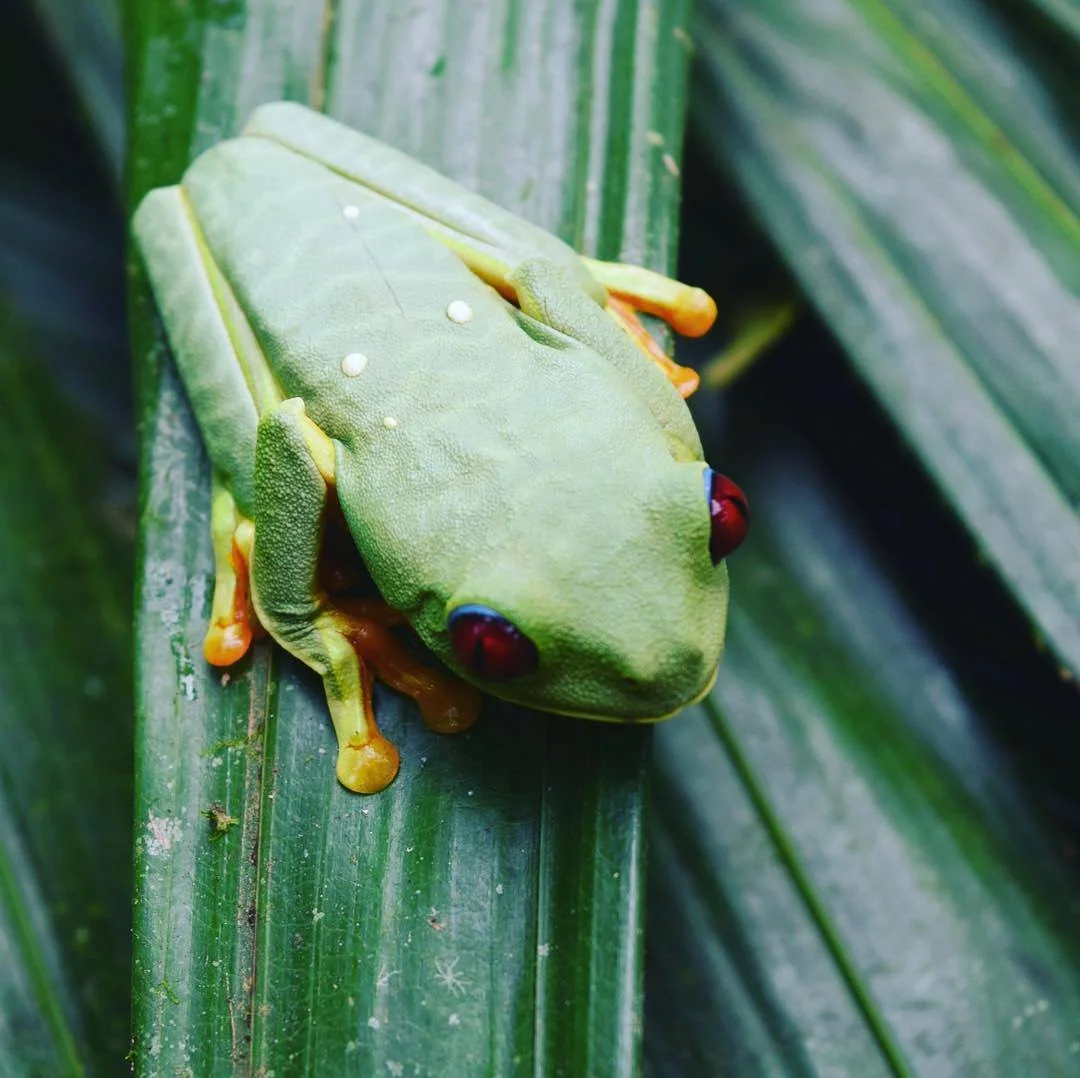
Contemplating an Uncertain Future: The Ranch and Climate Change
Climate change, after decades of lulling at the bottom of the news cycle, has belatedly made it into the headlines as increasing numbers of people become aware, convinced and concerned about the environmental and social impacts of the Earth’s evolving atmospheric conditions. I frequently think about disrupted weather patterns and what my role in this unfolding story should be.
by Tim O'Hara
Climate change, after decades of lulling at the bottom of the news cycle, has belatedly made it into the headlines as increasing numbers of people become aware, convinced and concerned about the environmental and social impacts of the Earth’s evolving atmospheric conditions. I frequently think about disrupted weather patterns and what my role in this unfolding story should be.

Many climate experts argue that we have surpassed the carrying capacity of our planet and that our natural resource base cannot support our modern lifestyles at our current population numbers. I find this argument believable given the observable degradation of our natural systems everywhere I go. Modern technology might for a time delay the worst impacts of our behavior, but soon we will stare more squarely in the face the consequences of the environmental alterations that we’ve set in motion. Indications of a more brittle world are clear to me.
Humans are descending to systematically destruct our limited natural resource base and in turn one another. I am discouraged thinking about the future that my daughter is inheriting and struggle to decide how to divide my time between work, personal care and engagement in efforts that help mitigate some of our biggest societal challenges, especially climate change. I’m not optimistic, but I cherish life, my family and my friends and strive to do my part in figuring out how we can usher in a more just world.

I was recently asked how Rancho Mastatal is responding to climate change and whether we feel as if we are helping to create an alternative future for those becoming heir to the approaching changes. In large part Robin and I started the Ranch to address and answer this question. Widespread social and environmental injustice partly inspired us to leave the United States and a more common life path to set up an “alternative” project that we hoped would contribute to a brighter future. We are dedicated to learning and teaching more environmentally appropriate ways to grow food in poor soils, build structures that are kinder on Mother Earth, and implement practices that allow us to meet our basic needs without destroying the elements that make it possible for the soil and atmosphere to sustain us. We are helping to teach future generations that there is indeed a better way to live; a way that is not dominated by an addiction to consumer purchases and modern conveniences or reliant on oppressive economic systems. We are experimenting with community structures that rely on cooperation and regeneration and have made efforts to conserve a relatively large and intact tract of rainforest.

A loss of corporate and governmental confidence in dealing with our warming climate has prompted us to start to execute strategies that make us less reliant on traditional businesses and executive bodies. We’re working towards attaining personal and communal well-being with our everyday activities and are compelled to look for ways to avoid our compromised medical care systems by looking at food as medicine. We’re looking for ways to engage in the process of designing and building our own homes with the help of friends and learning techniques to grow food for our family and community as global food supplies become more susceptible to unsteady financial systems and weather patterns. Communities are being torn apart by pollution, sickness, flagging economies and racism. To address this we want to learn and practice other forms of governance and community structure that we believe can serve us and the world more equitably.
Our modest efforts won’t be enough to stem the suffering for everyone. In fact the sad truth is that it might not even prevent future hardships for myself and family. Nevertheless, we’ve chosen to focus on this work with the hope that profound change might come from the accumulation of millions of small acts, projects and movements that when influential enough will begin to shift the human perspective to a more caring one. It’s also a way for us to prepare for changes ahead.

Future challenges will in part be most successfully met by strong networks of compassionate people dedicating their lives to the local problems that most impact them. As our daughter gets older we’ll encourage her to explore avenues that will simultaneously challenge her intellectually while leading to improvements in our world. Some of the areas that I encourage Ranch students to explore include energy conservation and renewable energy, education, responsible food production, social and environmental activism, politics, medicine, and counseling. A warming climate will require bold and courageous engineers, teachers, farmers, activists, health care professionals, mentors, and politicians. I encourage each of you today to take one small step to become a more engaged steward of our planet. If not now, then when?
Check out our updated workshop schedule to see how you can start building relevant skills to make a difference.
Read this interesting article about how agroforestry can help to sequester carbon, Can Dirt Save the Earth?

Where to Buy Your Trees and Seeds in Costa Rica?
Ever have a challenging time finding your favorite plant in Costa Rica? Or wonder where to get supplies for a new greenhouse? What about organic pesticides? After nearly a decade working in country, our team has compiled a comprehensive list of nurseries, seed banks, botanical gardens, and farm/garden suppliers.
By Nic, Core Team
Costa Rica has always been a challenging place to source your materials, as more places are getting online though, it is getting easier and easier to find things that were once impossible.

We are delighted to be able to share with you some of our favorite places to buy grafted fruit trees, seeds and so much more
Gary Zill is one of the leading produces of tropical grafted trees in Costa Rica and the tropics. A must visit in Orotina area. Check his website out for more info
Peter Kring runs a fantastic botanical gardens in Puerto Viejo and has many rare and difficult to find grafted fruit trees. Check out his Facebook, he also sells fruits at the puerto viejo farmers market every week.
The La Garita area in Alajuela just off the pan american highway near the airport is a place with many many nurseries, it is probably one of the best areas to purchase your more commonly available fruit trees like mango and citrus, but they are unlikely to have any more niche trees like Durian or Salak. El Punto is one we have used in the past.
CATIE in Turrialba area has a large seedbank of cover crops, native trees, timber species and some fruit trees. you can contact them through their website for upto date info about what they currently have.
ICE, Costa Rica’s electricity company usually has stock of native trees and nitrogen fixers available for free for reforestation projects. They can be phoned for free on 800-VIVEROS (800-8483-767) for more info.
For local annual vegetable seeds, our friends at Semillas Plantae have a fantastic selection of organic seeds available in country that can even be delivered to your house!
At the Ranch we also have a small nursery with a variety of Nitrogen Fixing Species, grafted fruit trees etc.. Please contact us if you would like to know what we currently have in stock.
The Earth University also maintains an extensive nursery, David Guido can be contacted on +506- 8639-9928
Join us for our annual Permaculture Design Course to learn more about designing, implementing, and maintaining your own farm and project.
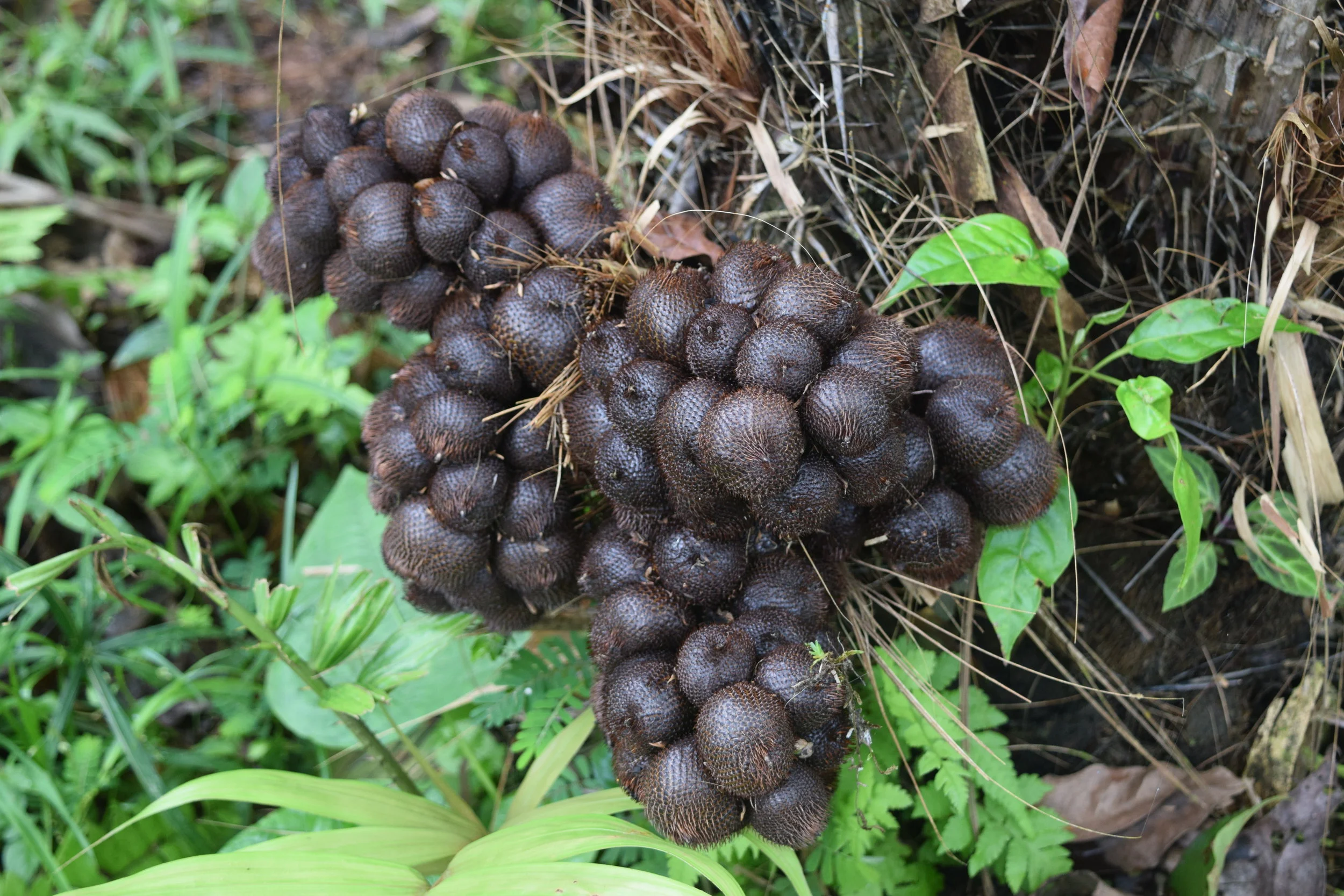
Salak Palm: A Guide for Tropical Permaculture
This article was originally published at the Porvenir Design blog.
Salak palm or snake fruit (Salacca edulis or Salacca zalacca) is a high value understory species for tropical agroforestry plantings. Salak palm is native to southeast Asia, where it is commercially cultivated in Indonesia, Malaysia, and Java, in their wet tropical lowland climates. At higher elevations the "Bali" variety can be grown. It produces a delicious fruit, eaten out of hand, with a taste similar to strawberry with an apple-like texture. The fruit transports well and can be stored at room temperature for a week with little degradation in quality.
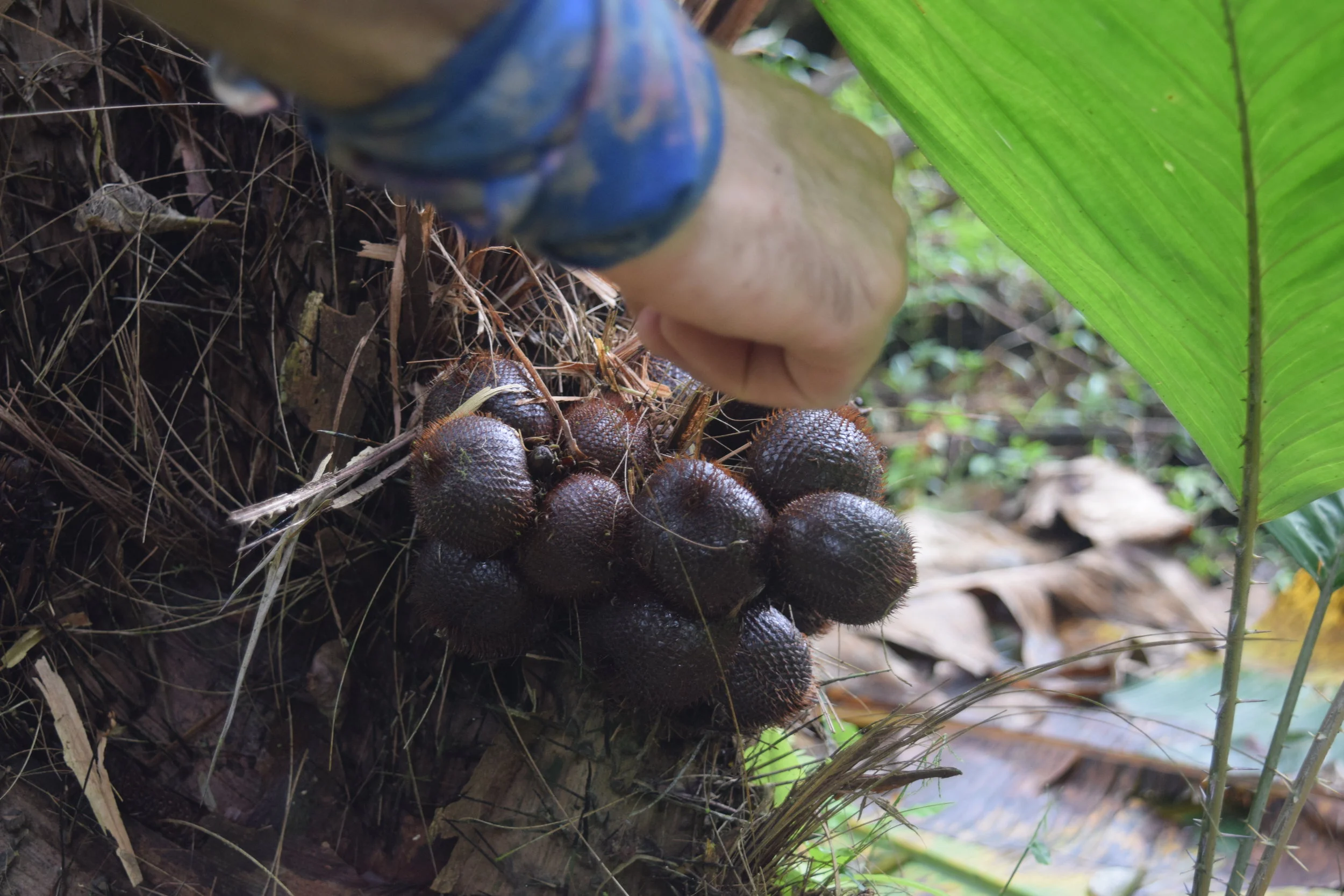
This article was originally published at the Porvenir Design blog.
Salak palm or snake fruit (Salacca edulis or Salacca zalacca) is a high value understory species for tropical agroforestry plantings. Salak palm is native to southeast Asia, where it is commercially cultivated in Indonesia, Malaysia, and Java, in their wet tropical lowland climates. At higher elevations the "Bali" variety can be grown. It produces a delicious fruit, eaten out of hand, with a taste similar to strawberry with an apple-like texture. The fruit transports well and can be stored at room temperature for a week with little degradation in quality.
This guide has been created based on the experience of growing a small number of plants, 30 palms, at Rancho Mastatal Sustainability Education Center in Costa Rica. It was created with the support of Peter Kring of Finca La Isla, a fruit farm in Puerto Viejo, Costa Rica, that has been growing and selling Salak fruit for over 20 years.
This short guide provides advice on propagation, planting and establishment, pruning and pollination management, and more.
Agroforestry Establishment
Propagation
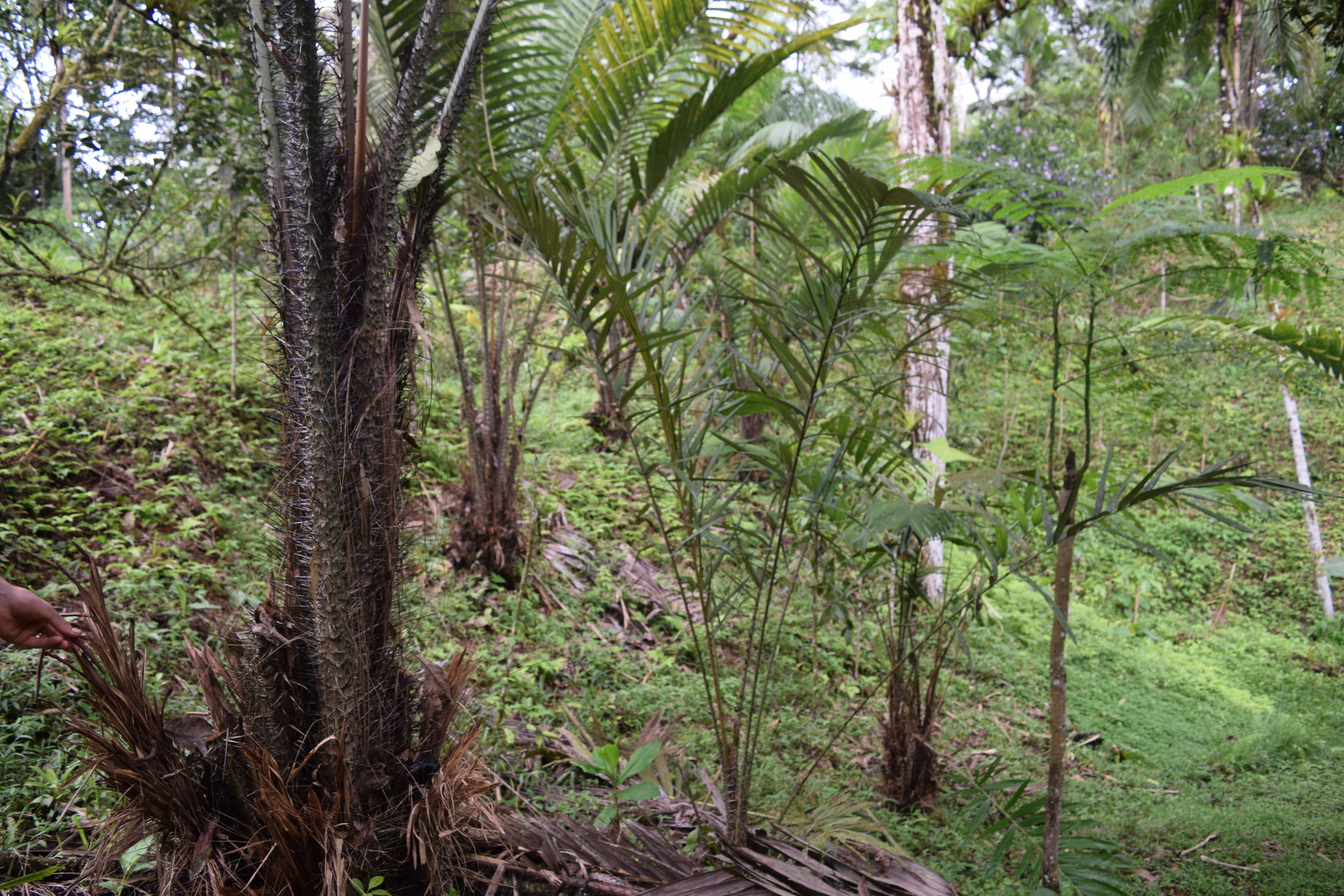
Salak palms are individually male or female and you need to have both for fruit production. There is no way to know if a seedling salak will be male or female until it flowers, some 3-4 years after planting.
Salak palm is easily started from seed. Seeds should be placed sideways and half buried in a well drained potting mix.
Asexual propagation, usually to increase female plants, is done through sucker removal. Soil should be mounded up around the base of the sucker. This allows the sucker to form its own root system. Then use a saw to partially sever the connection to the mother plant. This process should be repeated every few weeks over a two month period, until the plants are separated and the sucker has it's own root system. The sucker can be removed and placed in the nursery for further establishment.
Establishment
Once plants in the nursery have reached at least 40 cm in height they are ready to go in the ground. They should be planted at the beginning of the rainy season. The soil around the palm should be heavily top-dressed with biochar, manure, compost, etc and then mulched. Salak feeder roots will come up into this mulch.
Salak can be supported by additional species such as Musa sp, Gliricida sepium (and other legumes), and Tithonia diversifolia. All of these fast growing plants provide shade for the young palms and can all be pruned/chopped aggressively for mulch.
Guilding

These palms are traditional understory species in their native forest habitat of SE Asia. The leaves reach 5 meters into the air, but they are not a dense plant if pruned properly.
They are best planted under a canopy of fruit, nut, or timber species which are low maintenance and let through about 50% of the sun's light. This is a similar setting to shade grown coffee and cacao.
The spikey nature of Salak discourages overstory species whose fruit falls to the ground upon harvest or must be maneuvered around easily for harvest.
Layout and Spacing
Salak are dioecious, meaning each individual plant either produces female flowers or male flowers, although there are some varieties of Salak which are known to be self fertile. In order to balance pollination and production it is recommended to have 3 female plants for every 1 male plant in an orchard.
Individual palms should be planted 2.5 meters apart.
This 3:1 ratio and 2.5 meter spacing can be achieved in a number of ways. One can plant at 5 meters apart, divide suckers from sexed females and plant these in-between at 2.5 meters. Or one can plant out at the final spacing and thin out males, replacing them with divided female suckers.
Salak are best planted in the same vicinity because of there pollination needs.
Management
Pruning
During years 1 to 3 the palm should be minimally pruned. Only remove outer leaves that are dying. You want to encourage as much photosynthesis as possible while the plant is approaching sexual maturity.
Once the plants reach full size, 3 plus meters tall, and begin flowering you should remove all outer leaves. Leave 4 to 5 leaves, as part of the original mother plant. Remove any leaves that interfere with walking paths.
Don't let suckers develop unless you need them for propagation.
If flowers emerge between an outer leaf and the palm trunk, remove the leaf in order to expose the flower for pollination.
Cut leaves should be chopped into smaller pieces and placed in a pile that doesn't interfere with access or management.
The best tools for this job include loppers, a sharp machete and a pruning saw with a long blade or handle.

Pollination
Salak plants are either female or male and are pollinated by a number of native pollinators, including stingless bees. But these pollinators are inefficient, with only 10 to 15 % of flowers producing fruit. By hand pollinating Salak, you can easily achieve close to 100% pollination.
Female flowers are coned shaped and covered with a dense fiber sheath. As they develop over many months slowly remove their outer sheath. This will allow you to completely see the flower as it approaches maturity. Once removed from these sheaths the cone takes one to four weeks to open. Once open the flower reveals a deep pink color which is ready to receive the male flower.
The male flower needs little management. When pollen is available the flower also opens up and reveals a pink interior, although in a much subtler way. Usually the pollen granules are easily visible though and stingless bees are often indicators of a ready flower.
The male should be removed with clipperss and brought to the female plant, where it is used to "dust" the open female flower. This is best done in dry weather, which allows the pollen to fall out of the male flower with ease. It is wise to check your salak grove for receptive female flowers ever other day.
Within a few days the flower will harden up if it was successfully pollinated. If not it will become soft and should be removed. All dead flowers, male and female, should be regularly removed to encourage more flowering.
Harvest

Plants will begin to flower at three to four years of age.
To determine if the fruit is ready to harvest, try one from a bunch and see if the seed color has turned from white to brown or light brown. See color is the best way to determine if a fruit is ready to pick. It is best to try fruit from the base of the bunch. If the individual fruits fall off of the bunch, they are likely ready.
Pests, such as aguti, can compete for ripe fruit.
The fruit does not ripen off of the plant.
Time Commitment
We budget one minute per plant, 2 to 3 days per week, in order to meet all of our pollination, flower management, and pruning requirements.
In addition to this, time should be set aside a few times per year to provide mulch, prune support species, and add amendments (limestone, foliar sprays, manure, compost, etc).
Overall salak is a crop that gives back when you give it the attention it needs. If you are consistent about pollination, regularly prune the spare leaves, and give a little fertility, then they will reward you with one of the best tropical fruits you will ever taste.

Need Help Siting Your Salak?
The team at Porvenir Design is ready to come to your site and put stakes in the ground. Write us at info@porvenirdesign.com for more information.
Around the Permaculture World
Core Team member Scott is teaching two workshops in Monteverde at the Valle Escondido Reserve and Monteverde Inn during the month of November. Consider joining him for a 2 day Introduction to Permaculture or a 2 day Introduction to Agroforestry course!
Ranch friends at ViVerde in Grenada, Nicaragua are launching their internship program! They are looking for a Wood Working and Food and Fermentation Intern. Help them spread the word and find some talented folks to join their project!
Abrazos
The Ranch Crew
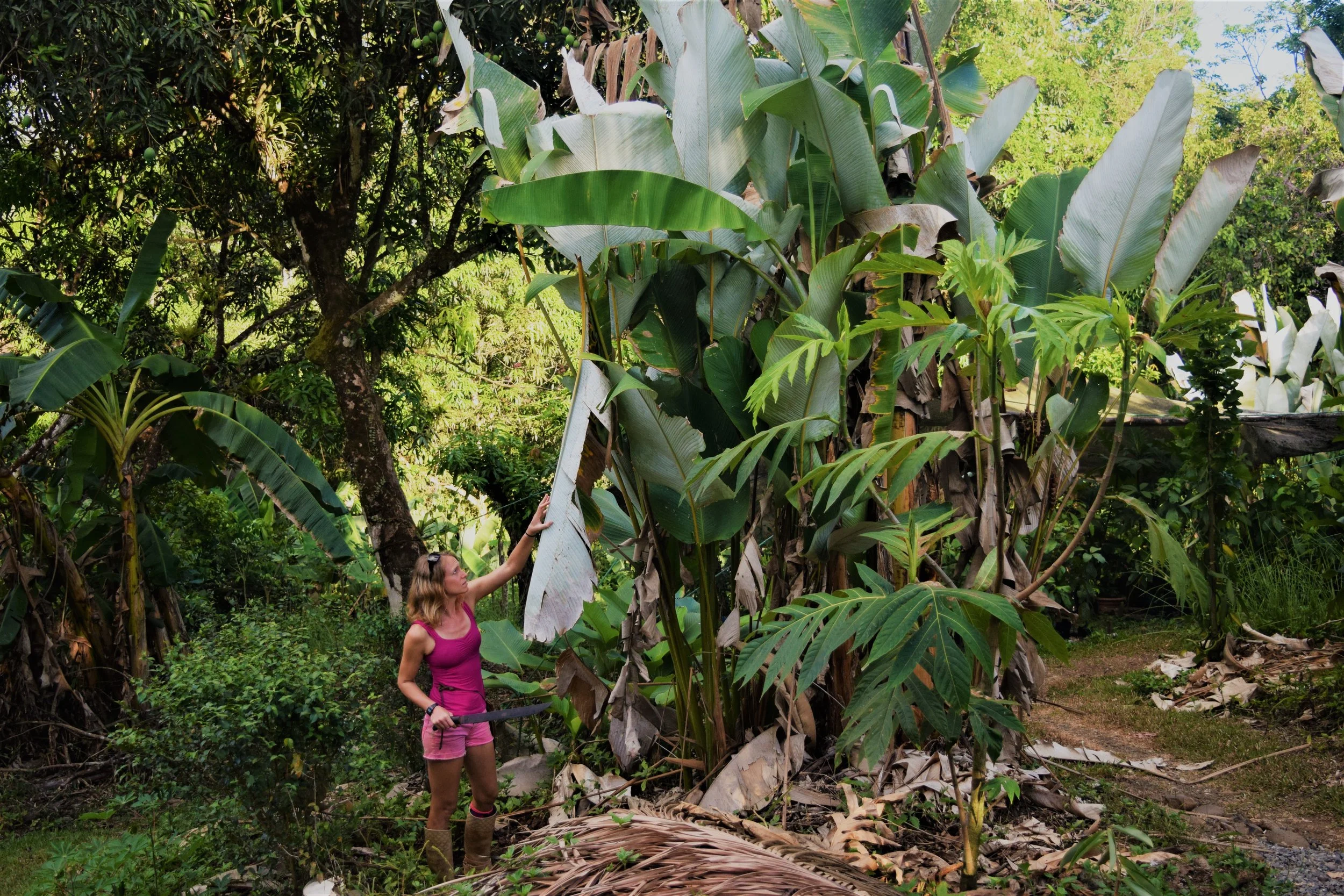
5 "Grow-Your-Own" Mulch Plants for the Tropics
This post was originally published by the ECHO Community newsletter and was reposted from the Porvenir Design blog.
The tropical forest is constantly self-mulching. After a walk in the woods I usually return with bits of leaves and twigs caught in my hair. Lying in bed at night, my partner and I often hear branches and even whole trees tumbling toward the great soil food web below.

This post was originally published by the ECHO Community newsletter and was reposted from the Porvenir Design blog.
The tropical forest is constantly self-mulching. After a walk in the woods I usually return with bits of leaves and twigs caught in my hair. Lying in bed at night, my partner and I often hear branches and even whole trees tumbling toward the great soil food web below. This self-mulching is one important piece in the self-renewing fertility cycle of the tropical forest. And of all the functions of the forest that we can seek to mimic, generating and applying our own mulch may be the most important.
Mulch has many familiar functions, like reducing soil temperature and maintaining higher moisture levels. But all of these means really flow toward one perfect end: feeding and housing the microbial soil community. It is this community that runs the engine which results in a healthy, happy, and abundant permaculture farm.
Grow Your Own Mulch
With this in mind I've spent years seeking out the best means for mulching our food forest. In the early days this involved traveling to neighbors' farms and loading the truck with banana trunks and rice straw. Unfortunately in rural Costa Rica, unlike many parts of the temperate world, there are not huge quantities of organic material lying around as waste, ready to be re-appropriated. Organic material, my future mulch, doesn't sit around waiting for the right farmer to scoop it up--here, the tropical rain and sun break it down rapidly. And local farmers generally re-purpose most waste products before they become, well, waste. We quickly found we had to find another solution for acquiring mulch. We decided to grow our own.
We began planting thousands of nitrogen fixing trees (NFTs) that could be chopped and dropped in place for mulch. This has worked great in general, but I've found that other plants not in the legume family actually far out produce most of these trees when it comes to biomass. I've come to believe that there is an over-emphasis on NFTs in the tropical permaculture community, and instead we should focus more on the biomass quantity itself. While I wish all of my mulch was rich in nitrogen, what I'm now seeking is weed suppression and moisture retention. Both of which take a hard stab at eliminating my least favorite activities, weeding and watering; all while moving us closer to the no-work permaculture ideal.
Top 5 Mulch Plants

For our climate, the low land humid tropics, these five plants are what I recommend to clients for growing prodigious amounts of mulch.
Cuadrado/Guineo (Musa sp)
A species sharing the same genus as bananas and plantains, cuadrados are generally considered a less domesticated crop. They grow rapidly, spread aggressively, propagate easily, and produce a delicious fruit that can be used in nearly the same way as plantains. In our corner of the world, they are considered a poor person's food, likely because they produced when nothing else did.
The trunks can be cut back multiple times per year and they will keep sprouting out of the same base. The leaves are slow to decompose, like many plants on this list, and provide excellent weed suppression.
In addition they are a great pioneer species; creating a shady microclimate for your more delicate climax species.
Torch Ginger (Etlingera elatior)
This huge ornamental ginger is a fixture in tropical gardens around the globe for its beautiful flower, huge leaves, and the dense shade they produce. It takes two years for this plant to take off, but once it does you have a steady diet of 4 meter long herbaceous stems and leaves ready for chop and drop mulch.
Torch ginger propagates by root division. One plant can be scaled easily into many more. It works well as a privacy barrier between lots or between public and private spaces. Don't chop it completely to the ground but consistently remove older stems with a clean cut near the base of the plant.
Vetiver (Vetiveria zizaniodes)
Vetiver grass, already in the tropical permaculture lexicon for its use as an erosion control species, is also a great multi-functional mulch plant. It is a bunching grass, with a deep root system. It doesn't produce seeds and thrives in full sun on recently disturbed sites. Where it gets plenty of water and sun, the grass will grow to reach two meters in height.
It can be cut back to 30 cm two to three times per year. The mulch is dense and slow to break down. Use a nice set of hedge shears, a sharp machete, or a weed trimmer with a metal blade attachment for cutting vetiver. Use gloves as the grass can easily cut an exposed hand running along the edge.
It is propagated easily by root division. Keep young plants free of weed competition for two years and they will reward you with prolific growth and biomass.
Mexican Sunflower (Tithonia diversifolia)
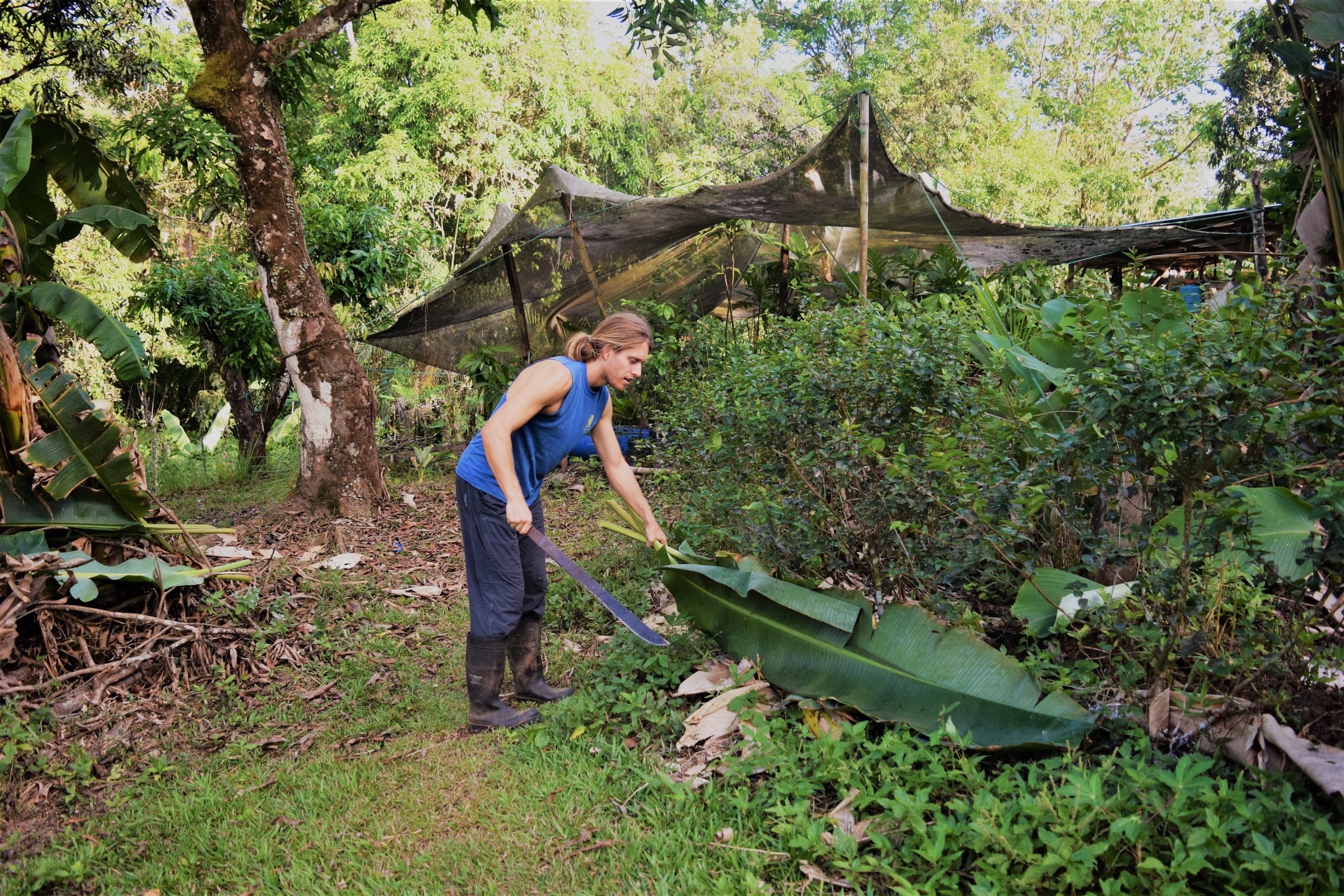
This wild sunflower, also known as Boton de Oro, is a woody shrub reaching up to 4 meters in height. It is gaining traction in the tropical agroforestry community for its use in silvopastoral systems and as a green manure. It makes a great cut and carry fodder for cattle and goats throughout the dry season.
The Mexican sunflower easily propagates by cuttings and loves full sun, where it throws out a beautiful flower throughout the dry season that support a host of pollinators. It purportedly, like sunflowers, has the ability to accumulate phosphorous in its leaves and stems. This would be a nice addition to any mulch pile. Hack at the plant with a machete or clippers with little fear or taking too much off. It has a strong coppice response, providing a steady supply of woody mulch.
More research is needed on this support species, as it appears to be an important addition to our agroforestry plant matrix.
Bijagua (Calathea lutea/crotalifera)
This large herb reaches nearly 3 meters tall and has 1 meter long leaves. It loves wet, marshy sites, where it can quickly take over if not managed. It is common along the road side of the lowland tropics throughout Central America.
Bijagua produces a massive quantity of leaves throughout the year, which have a waxy coating that slows their decomposition, making them ideal for weed suppression. Their flowers are great for hummingbirds and other pollinators, and the leaves have historically been used for thatch roofs, to wrap tamales, and of course as quick umbrellas.
They do produce seeds, which are dispersed by birds, but are mostly propagated by root division. You can chop them down to the base completely and they will shoot back new leaves in record time.

Patterns for Mulch Species
There are a number of patterns worth recognizing that nearly all of these plants complete:
They are propagated easily by division or cutting.
They have large, slow to decompose leaves that keep the soil covered longer.
They don't produce seed, so they have a very low invasive potential.
They grow quickly, acting as pioneer species, and changing the microclimate around them.
They are easy to chop because they are herbaceous.
They hold their leaves throughout the dry season which help shade the soil during the hottest months of the year.
As you look for mulch and biomass plants in your own climate, look back at these patterns as guides. They might lead you to the next ah-ha moment and jump start the success on your site.
Around the Permaculture Universe
The Ranch has a wonderfully full workshop schedule ready for you in 2018. First time Japanese Plastering and Japanese Fermentation workshops mark an exciting addition to our normal staple workshops on Permaculture Design, Fermentation, Wilderness Medicine, and Renewable Energy.
Ranch Core Team member Scott will be speaking this labor day weekend at the Cincinnati Regional Permaculture Convergence. If any Ranch friends and family are in the area, we highly recommend you come for a visit.
Former Ranch PDC student Antu Vilches-Cabrera is opening a permaculture center in the Dominican Republic and crowd funding to help with the establishment. Please check out his excellent work and consider supporting!
Abrazos
The Ranch Crew

Farm to Table Tales
Good food takes time. I've heard this phrase many times before, but after nine months at the Ranch, I've truly come to understand what it means to me. The local Costa Ricans are called the Ticos. The Ticos live by the mantra "Pura Vida", which directly translates to pure life. This is indefinitely how they choose to live. "Tico time" is another phrase I've heard and come to understand here. Ticos work at their own pace, never feeling the need to hurry or stress at time. They are the happiest people I've ever met. The western way of life has much to learn from this, no more so than in the world of food. I have three stories to tell that I think shed perfect light on this matter.
Good food takes time. I've heard this phrase many times before, but after nine months at the Ranch, I've truly come to understand what it means to me. The local Costa Ricans are called the Ticos. The Ticos live by the mantra "Pura Vida", which directly translates to pure life. This is indefinitely how they choose to live. "Tico time" is another phrase I've heard and come to understand here. Ticos work at their own pace, never feeling the need to hurry or stress at time. They are the happiest people I've ever met. The western way of life has much to learn from this, no more so than in the world of food. I have three stories to tell that I think shed perfect light on this matter.
Beans

One day back in April myself and my fellow apprentices were asked by one of the local farmers and Mastatal old timer, Chepo, to help him with his black bean harvest. We were so excited by the opportunity to see and learn how black beans get from the soil to our plates, given the fact that we eat them with almost every meal. We started with a trek from the road through the jungle to the black bean field.
Here, Chepo was harvesting stems of beans that had been cut a week prior and left to dry on the ground. It was a blistering hot day, typical of the dry season and the sun was beating down on the exposed field. We jumped in and helped him collect the many hundreds of black bean vines from the undulating ground. We took them to the side of the field and mounded them up beside the bean bashing station, a big blue tarp strung between four bamboo poles. When the beans were all collected we started piling them onto the blue tarp, then Chepo stood at one end with two heavy wooden poles in both his hands. He started bashing the mounds of dried bean vines to release the beans from their pods. We rotated around, all getting in to have a go. The poles were much heavier than I'd expected and after about five minutes my shoulders started to burn and my sweaty palms started to blister.

Once one pile was done we tossed the bean vines to the side, bagged the loose beans on the tarp then loaded up another mound. It took our group of eight almost two hours to release and bag all of the beans. Once the bags were tied up we each grabbed one, slung it over our shoulders and started our slippery, steep 30 minute hike to the road, each one of us slipping under the weight of the bags and the tough terrain. But this didn't phase us, we all still had big smiles on our faces feeling accomplished and grateful for having this experience. We also all recognized that if we hadn't been there to help Chepo, he would have been doing all this work alone, as I'm sure he and fellow farmers have done many times before.
I will never eat beans the same way again. I have a new appreciation for this humble staple food. When I worked at an organic food store back home, it was regulation that if anything fell onto the floor we would throw it away. We had no compost system at the time so anything that fell onto the ground was destined for the landfill. I can't tell you how many times people struggled with the manual bean dispenser, spilling beans all over the floor. Never did we think twice about throwing them away, it was just what was done. Looking back on this now breaks my heart more than it initially did because I've seen the amount of work and effort that goes into growing and harvesting this food crop. One sweep of our broom and all the time, effort and resources that went into getting those beans into our shop were binned. Something that I never would have learned if I hadn't come here.

Pejibaye
Another story from the ranch is about the pejibaye season that has sadly just ended. Pejibaye is an incredibly nutrient-dense palm fruit. This season, each of our trees produced roughly nine bunches of fruit, each bunch containing about 30-40 fruits. Every golf-ball-sized fruit contains 200 calories! As you can imagine for an aspiring self-sufficient community, this is valuable food crop. But it doesn't come easily.
Pejibaye or peach palm in English is a tall skinny Palm tree. It's trunk is covered with needle-like spikes that will pierce through even the thickest rain boots. To harvest pejibaye we use our home crafted 20 meter long pull saw. It's a very useful tool but rather difficult to maneuver around a spiny trunk. Once the bunches of fruit are released from the tree, they splatter on the ground and we forage around the spine covered slopes to collect every one of these protein packed nature balls.
When these guys arrive in the kitchen they must be processed within two days or they will mold and spoil. So we remove them from their stems and boil them in their skin for 40 minutes. Then we drain them and have a peel party, each one of us delicately peeling and de-seeding around 60 fruits per weekly harvest. Once peeled they're ready to use in puree, soup, burgers, pancakes, torte and an endless number of other delicious recipes. It is a long process but well worthwhile when we enjoy the fruits of our labor for the next week and share this taste of the tropics with our guests.

Jackfruit
Jackfruit is a similar story. Harvesting just two mature jackfruit can feed ten people three meals. Harvesting jackfruit requires you to climb into the tree and up to the fruit, chop the stems with your machete and watch as the 5kg spiky football-shaped fruit catapults to the ground. It's not rare to get a splatter of glue-like sap on your clothes, hands and cheeks at this stage, as well as the canopy company of wasps residing in the trees. Once harvested, we take the fruit back to the kitchen, grabbing a few banana leaves on the way, oil our hands and knives, and get to work.
First we cut it open, separating the flesh from the seeds. To use the flesh we must brine or boil it. Brining takes one to three weeks and boiling takes 45 minutes. Then the flesh is ready to use in another recipe. The seeds must be dried, peeled and boiled. By the end of this process, our hands are covered with latex sap and so are the knives, despite our efforts to oil everything prior to processing. It's just the reality of processing your own food and a rather exciting part of it.
Good food really does take time. And I believe that this time and effort always makes our food taste better. Because we've put our hearts, our sweat, our blood and sometimes even our tears into growing, harvesting and preparing the food. It's an entire new way of eating that gives you a deep sense of appreciation for the food on your plate and on the plates of the people you love and care about.
News from around the permaculture community

The Monteverde Community Fund has a job opening for their Executive Director position. This is a great opportunity for the non-profit sector in Costa Rica.
What's your favorite permaculture present? We got a pack of the Permaculture Playing Cards from our friends at Permies.com this past year. We love the funky artwork and all the permaculture principles, founders, and strategies.
Abrazos
The Ranch Crew

Making Microbes: Fungal vs Bacterial Soil Life
Organic gardeners and farmers understand the need to cultivate and protect soil microorganism life. The strategies to do this involve mulching, composting, and avoiding soil disturbance as much as possible. We know that these strategies, in addition to many others, encourage a healthy soil-food-web.

Organic gardeners and farmers understand the need to cultivate and protect soil microorganism life. The strategies to do this involve mulching, composting, and avoiding soil disturbance as much as possible. We know that these strategies, in addition to many others, encourage a healthy soil-food-web.
The soil-food-web is the interconnected matrix of invisible (fungi, bacteria, protozoa, nematodes) and visible (earthworms, beetles, arthropods) creatures that have a whole host of functions which create a healthy ecosystem for plant growth. They aerate the soil, decompose organic matter, make nutrients available, prevent nutrient leaching, break down toxins, protect plants from pathogens, fix nitrogen and so forth.
What we can take away from this bit of knowledge is that we want these organisms operating on our garden or farm. The best way to do this is by creating the habitat and food they need in order to thrive. This seems simple, but it quickly becomes complicated when we explore the details.
Each of these organisms does better with different food sources and each of them change their environment in different ways. In addition each species of plant we are growing thrives in different soil environments; apples and arugula have evolved very differently and the more we can support their evolutionary requirements the healthier the plants will be.
That becomes our starting point; where we ask:
What type of soil environment do our crops desire?
How can we then encourage the specific type of microorganisms to create that environment?
Fungal-Bacterial Ratio
Here at the Ranch we are growing tree crops, which as I've written in this blog before, thrive in an environment that mimics the forest ecology surrounding our orchards. One measure we can use to understand this ecology is the fungal to bacteria biomass ratio (F/B).
This is a measure of the portions of the microbial biomass, ie. all the living organisms in the soil, that is fungal vs that which is bacterial. The F/B ratio is primarily used to study the impact of human land disturbance on the soil-food-web. It can therefore also be used to determine what individual plants desire. For example annual grains and vegetables like a ratio of 0:3 to 1:1 and orchard trees thrive in 10:1 to 50:1 soils
Depending on the types of crops we are growing, again in our case tree crops, we may want to alter the dominance of fungi or bacteria in our soil. These microorganism, particularly fungi, are quite sensitive to changes in land usage, therefore we need to understand how different techniques affect this ratio and why we want the ratio to be high or low in the first place.
Ecosystem Mimicry
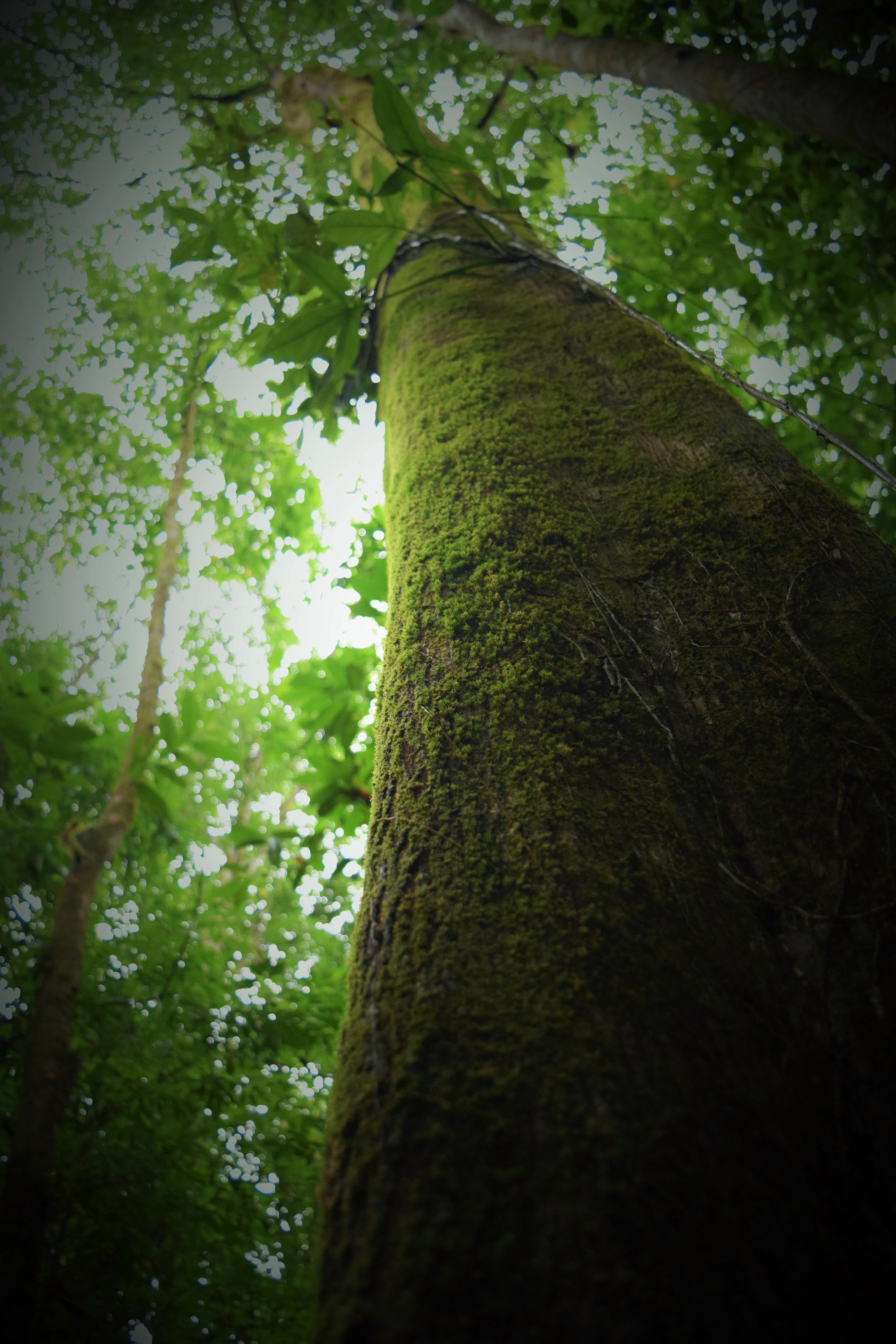
Forest soils have a higher fungi to bacteria ratio. Looking at quantities of each, as measured in a teaspoon of soil, we find that bacteria remain steady in quantities through the spectrum from agricultural soils to prairie soils to forest soils. In one teaspoon of soil there are 100 million to 1 billion individuals. Fungi, measured in yards of hyphae, though increase significantly along this spectrum. In agricultural soils they are measured in several of yards, while in deciduous forest soils hundreds of yards are found, and in coniferous forest this actually increases to miles.
Fungi love high carbon materials, think cellulose and lignin which are the primary building blocks of tree leaves and wood. Most bacteria struggle to break this down. Bacteria instead thrive with high nitrogen food sources, think manure, incorporated cover crops, etc.
We can gather from this how different gardening and farming techniques affect this ratio. Fox example mulching with wood chips encourages fungi, tillage kills fungi and encourages bacteria, and incorporating organic material into different soil horizons shifts the ratio toward bacteria.
Mineralization/Immoblization Balance
This makes it apparent as well that fungi and bacteria have different roles in the soil-food-web. Fungi are better are taking in and retaining nutrients as part of the mineralization/immobilization process. This is the process where microbes consume nutrients, thereby immobilizing them in their bodies and preventing nutrient leaching.
As they live their lives, producing waste and eventually being consumed further up the food chain, these nutrients re-enter the soil-food-web in a form that is soluble to plants. This is called mineralization. Fungi and bacteria are immensely important to different stages of this process and are each most effective depending on what they are being feed.
Knowledge to Practice
In our orchards we want to cultivate an F/B ratio between 10:1 and 50:1. There are many ways for us to work toward this goal, the simplest being understanding the ecology of fungi and providing the necessary shelter and food source. We do this by consistently mulching our trees with woody materials.

We can get more specific in the process by cultivating our own indigenous microorganisms from the forest and inoculating them directly into our orchards. This practice is called Mountain Microorganism (MM). We have been applying MM to our orchards consistently over the past year in order to shift our F/B ratio higher and gain the benefits, such as pathogen control, that these microorganisms provide to the native forests.
Next steps for us in this process is to use our microscope to analyze the biological content of our soil. With the proper training and experience we expect to be able to determine rough F/B ratios in both our soils and the MM we are applying as a foliar drench. We will be sure to let you know what we find.
For anyone interested in making their own microbes, below is the recipe we use. If you would like to learn more about this process you should consider joining us for our upcoming Permaculture Design Certification course in April/May of 2017.
Mountain Microorganisms Recipe
Phase 1: MM Solid

Ingredients
3 sacks microorganisms (duff layer of primary forest)
2 sacks semolina, yuca flour, or green banana flour
1 gallon molasses, cane juice, or fruit juice
1 gallon water
Instructions
Spread a layer of duff on a top and cover with a layer of semolina. Mix well with hands. Dilute the molasses with the water and sprinkle on top as you continue to mix. If you grab a fistful of the mixture it should be lightly damp and fall apart easily after you squeeze it.
Next, have someone stand in a 55 gallon plastic drum (never metal), while you shovel the material inside. As you shovel, the person stamps the mixture down with their feet to compress it and remove any air pockets. Seal the barrel and leave at least one month, stored in the shade.
The mixture should be good for three years. When ready, it should have a strong smell of lactic acid.
Phase 2: Liquid MM

Ingredients
5 kilos MM Solid
1 gallon molasses
55 gallon plastic drum filled with water
Instructions
Mix the molasses into the water. Put the MM into a screen sack and let hang in the water. Seal the drum and let sit 4 days.
Between day 4 and 15 this can be used as a foliar spray (between 10 and 100% ratio to water). After 15 days use the MM as a soil drench and after three weeks the product should be fully used up.
Once you have used the MM Liquid, you can make one more batch with the same sack of microbes. Just add 1 gallon molasses and refill the drum with water.
References
Lowenfels, Jeff, and Wayne Lewis. Teaming with Microbes: The Organic Gardener's Guide to the Soil Food Web. Portland, Or.: Timber, 2010. Print.
"Soil Health." Soil Health. N.p., n.d. Web. 15 Oct. 2016. <http://www.soilhealth.com/>.
News from around the Permaculture Community
Matt Duffy, from our 2015 PDC, wants to capture your story with his new film company No Mad Films. Duffy is an incredible story teller who we hope can come back to the Ranch, bring his cameras and capture our life in action.
Our collection of cast iron kitchen skillets and dutch ovens is extensive. A good cast iron skillet is by far the most basic but essential kitchen item for our team. Over the years we have learned a trick or two about their maintenance. This article, from Permies.com, sums up nicely how to use and clean cast iron.
The many Ranch friends at Round the Bend Farm, located in southeast Massachusetts are hosting a series of Fermentation Workshops with our very our Core Team member Laura Killingbeck. These come highly recommended for anyone in the area.
Abrazos
The Ranch Crew
Categories
Topics
- Agriculture 6
- Agroforestry 21
- Animals 2
- Apprenticeship 19
- Appropriate Technology 6
- Backpacking 1
- Bananas 1
- Basic Pantry 4
- Biochar 1
- Books 3
- Build Your Own Home 1
- Central America 5
- Chiles 1
- Cinnamon 1
- Clay Carving 1
- Climate 2
- Climate Change 1
- Cob oven 1
- Communication 5
- Community 24
- Compost 2
- Composting Toilets 2
- Condiments 1
- Conservation 2
- Cooking 4
- Costa Rica 18
- Design 10
- Earthen Construction 10
- Eat Local 2
- Ecohome 1
- Education 9
- Environment 3
- Ethics 4
- Farm to Table 12
- Fasting 1
- Fermentation 14
- Food 22
- Food Choices 8
- Food Forest 8
- Food Processing 15
- Food Systems 12
- Gap Year 1
- Gardening 5
- Ginger Beer 1
- Harvest 2
- Health 12
- Healthy living 5
- Homemade 2
- Homestead 8
- Internet 2
Due to popular demand we have put together a document that outlines how our composting toilets are designed and made. The documents include
-dimensions for different size chambers based on number of people using it
-door design
-chamber design
We have spent years fine tuning our design and details based on what is easiest and what works. This is the culmination of building 11 different composting toilets and each time improving the design.
It is important that you understand that this design is only for the composting toilet element, it does not include any of the timber frame or bamboo framing that form the structure for the roof that covers these all over the ranch.