
BLOG
Stories, articles, and updates from the Ranch community.

Permaculture Education: Virtual Reality and Keeping it Real
Nearly a decade ago I moved to where I live now-- a tiny, isolated, town in rural Latin America. Its charms include lush towers of tropical rain forest, rainbows of succulent fruits, and a nightly chorus of a thousand frogs. A single disheveled bus leaves in the morning and returns at night, except on Sundays, or when the road washes out. The place is home to farmers, families, and a spattering of eclectic foreigners. The town's namesake, the Mastate, is a tree that bears a thick white sap which people sometimes drink in coffee, like milk.
By Laura Killingbeck
This article was first published in the Permaculture Design Magazine.
Nearly a decade ago I moved to where I live now-- a tiny, isolated, town in rural Latin America. Its charms include lush towers of tropical rain forest, rainbows of succulent fruits, and a nightly chorus of a thousand frogs. A single disheveled bus leaves in the morning and returns at night, except on Sundays, or when the road washes out. The place is home to farmers, families, and a spattering of eclectic foreigners. The town's namesake, the Mastate, is a tree that bears a thick white sap which people sometimes drink in coffee, like milk.

Our house at Rancho Mastatal. My partner Scott Gallant and I designed the yard to grow food, medicine, and market crops. (Photo Credit Laura Killingbeck; Mastatal, Costa Rica)
I live in a two-room cabin made of wood, earth, and bamboo, and teach food and fermentation classes at a sustainability education center. Each morning I commute six minutes to work—by foot, of course--on a trail through the orchard. I do not have WiFi. And until very recently, I did not have a cell phone, a car, or grid electricity either. My life has been, and largely still is, made up entirely of the world that reaches me directly.
Despite the rural nature of my home and work, I am constantly surrounded by a transitioning cast of characters—short and long term residents of the community, students and instructors from around the world, and international guests and groups. I frequently share breakfast, lunch, and dinner, with 40 or more people. So my isolation really is a relative one: I have constant contact with many people face to face, and very little with anyone more than a quarter mile away.

Rancho Mastatal students and apprentices come from around the world to learn about engaging deeply with place. (Photo Credit Laura Killingbeck; Mastatal, Costa Rica; Instructors from left to right: Bill Steen, Athena Steen, Benito Steen)
Not all of my time is spent here. For part of the year I live on another beautiful and secluded farm in Massachusetts, where I also have no car, no cell phone, and limited internet. Here I also live in community, sharing most meals with at least a half dozen folks, and enjoy a social circle that radiates about five miles, to neighboring farms, the park, and a local brewery.
It is a simple and curious life. Most of the time I am literally surrounded by people, yet I have almost no access to anyone that is not directly in front of me. For most of my life, my participation in an online identity has been “virtually” blank.
This relative isolation has shaped my relationship with the world around me. Until very recently I never looked at something—a beautiful sunset, a fallen leaf, a friend--and thought to take a picture. I did not have a cell phone to take a selfie, or text someone, or make a Facebook post. It was just me, and us, and the moment I was a part of. With no truncated or modified story about what I was doing or why, I had the freedom to choose it and experience it, completely and wholly, of my own accord. In many ways, this “isolation” felt like the ultimate integrity.

Round the Bend Farm Center for Restorative Community in Dartmouth, Massachusetts. (Photo Credit Laura Killingbeck)
But the way people communicate, share, and socialize continues to evolve. A big part of how we understand ourselves and others is sculpted from the stories we tell about our lives. These stories begin from our own perspective, which is then shaped and shifted by the responses of others. How we understand ourselves and our lives is personal, and also social. And as more and more people are “virtually” social, my “virtual” isolation has felt more, well, isolating.
Social media, blogging, Facebook, Instagram, the internet in general, are all “virtual realities” of human engagement. The pictures we post, the hashtags we link to, the words or emoticons we use, form a web of “virtual” identity and relationships. Increasingly, we supplement or even replace our direct experience with other people and the world with the indirect experience mediated by this technology. And increasingly, we shift the way we actually live our real lives, or the stories we tell about our real lives, to accommodate the beast of social media.
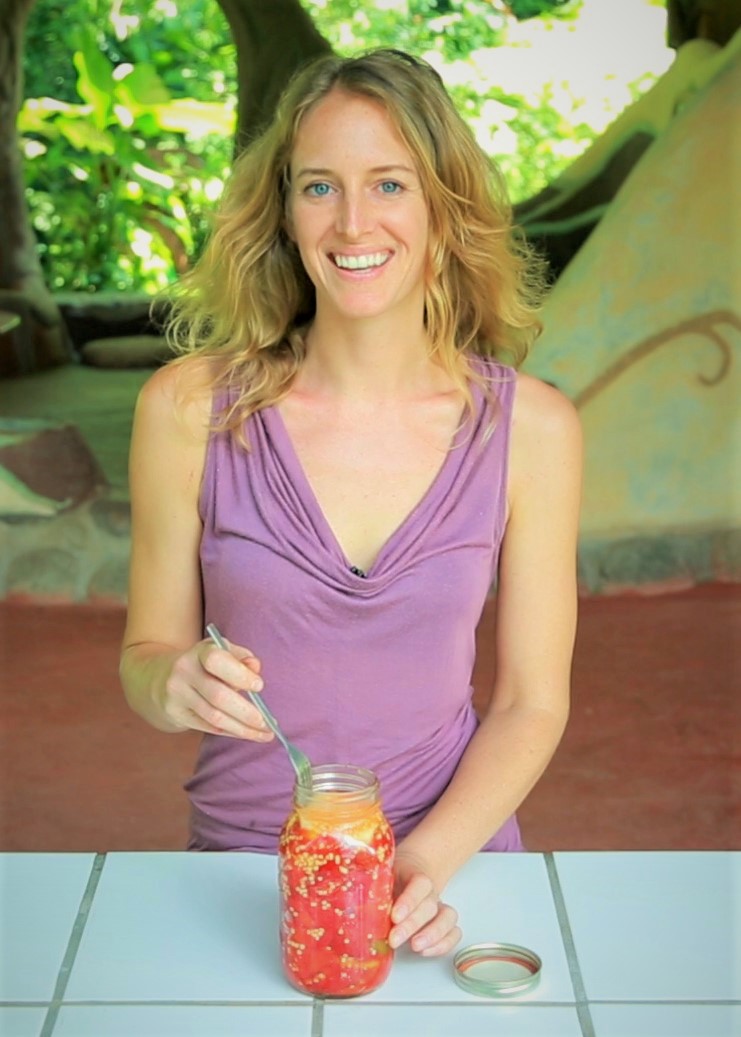
Filming the online Fermentation Tutorial. (Photo Credit Spenser Gabin; Mastatal, Costa Rica, of Laura Killingbeck)
Over the years I have seen thousands of people pass through my tiny corner of the world, seeking education, rejuvenation, inspiration. I have watched dozens of instructors across many disciplines—agroforestry, permaculture design, natural building, renewable energy, health and nutrition—repeat over and over again the same mantra—that we must learn how to engage with the world around us to create truly sustainable homes, livelihoods, and communities rooted in place. We have to actually feel the clay to know if its suitable for making clay plaster; to watch the tree to know when its time to prune; to taste the pickles to see if they're fully fermented. We need to focus our energy on the vivid, tangible relationships between the objects of our immediate surroundings. Every aspect of applied permaculture and sustainable design on some level revolves around this single spark of observation and engagement with real reality.
Just as there is an irony to my constant contact with streams of people in a tiny, rural setting, there is an irony that permaculture educators must increasingly tell the story of their direct experience with the world around them via the interface of the internet. We now use social media, online videos, and blogs to teach permaculture theory and skills, and connect with others doing the same. This makes sense--we need to be able to tell the stories of our lives and work in a way that people can access. Our great challenge in this is to translate our real reality into virtual reality, while keeping our lives really real, and keeping our students really involved.

I use Instagram to share simple recipes and special moments about real life. These are two varieties of jackfruit from the farm. (Photo Credit Laura Killingbeck; Mastatal, Costa Rica)
For most of my life I resisted getting a smart phone because I wanted to fully connect with the people and place around me; I finally got one for the same reason. This year I bought my first smart phone and got connected to the web. I entered online participation by starting an Instagram account and filming an online fermentation tutorial (Fermenting in Warm Climates, to be released in November, 2017). The purpose of the tutorial is to enable people to understand the broad theory and methods behind fermentation, in a way they can adapt to the specific foods from the place where they live. As devoted as I am to place-based experiential education, there was a constant irony to filming something designed to be accessible to a global market. But this is exactly the challenge of permaculture education in all its iterations—using a globalized perspective of broad methods to hone in on specific relationships with particular places. For this reason, the tutorial demonstrates patterns and methodologies for fermenting vegetables, dairy, fruits, etc, and provides instruction about how people can adapt these to their own local foods. The “best” fermentation recipes are not the same for everyone, everywhere. The best recipes are intrinsically tied to the fresh foods and cultures (both human and microbial!) of the specific places where people live. By creating an online tutorial I hope to be able to reach more people who find this information useful, while simultaneously leading them to engage directly with their own local foods.

Scott Gallant maps a landscape with a phone app. (Photo Credit Laura Killingbeck; Mastatal, Costa Rica; of Scott Gallant)
Online education, social media, and all other outlets of virtual reality that teach us about permaculture design and applied skills should always draw us to engage more in real reality. Real reality is dynamic, unstandardized, unhomogenized. Information on the internet often defaults to the least common denominator of most common products or ideas. In the case of fermentation, recipes often default to the most widely accessible ingredients, microbial cultures, or plant varieties from mass markets. This funnels more and more people into understanding fermentation and food from a peculiarly standardized perspective. But local food is dynamic, and microbes don't care about business as usual. Filming the online tutorial made me realize how important it is that we hold our ground and address a global audience with a clear emphasis on the dynamic nature of real reality, even if it doesn't fit the current most popular algorithm, hashtag, or SEO. When we go virtual, we need to keep it real.

Quiet moments are important arenas for self reflection. (Photo Credit Laura Killingbeck; Mastatal, Costa Rica)
There is something valuable about crafting our lives without anyone looking. About feeling, and appreciating, a moment without anyone knowing. About making decisions because they represent the core of who we are, nothing more and nothing less. I sometimes fear that the constant contact of social media draws us farther away from this core. I see people poking away at their phones when they could be experiencing a spectacular moment in real life. Or maybe not a spectacular moment—maybe just the mundane. But even these moments, rote, predictable, commonplace, are arenas for our minds to wander, probe, filter. We can find strange things in these moments. Simple or complicated truths. The moments when there is nothing to think about and nothing to do are some of the greatest resources we have for self reflection. To lose these to online shopping, Facebook scrolling, or texting would be devastating.

I learned a lot about tropical starch fermentation online. (Photo Credit Laura Killingbeck; Mastatal, Costa Rica)
But there is also something both valuable and necessary about sharing our lives with others, listening to a wider range of voices, and participating in global conversations. Even in Mastatal, my tiny green town, there is no real escape or seclusion. Here we see changes in climate that affect our crops; changes in tourism that affect our economies; changes in policies that affect our land and homes. You can escape from many things, but not from everything, happening all at once, sweeping you with it.
As a millennial just entering the periphery of online participation, I realize I am on the far end of a spectrum for how I balance my real life with my virtual one. But my position on the sideline has given me the advantage of a unique perspective about how to manage this balance. Most days I turn my phone on twice—once in the morning to check emails and make an Instagram post, and once in the afternoon to follow up on questions or comments. The bulk of the day is internet free, but I am still able to connect virtually to lots of people. I understand that this limited access is not possible or desirable for everyone. Lots of people do amazing and positive work via the internet, which I value to no end. What does apply to all of us though, is the understanding that we often have more power than we think to design a balanced relationship with the internet, and as permaculture educators and practitioners, we can use this to our advantage. We can leverage the global access the internet provides, to funnel people towards local engagement, without losing our real selves in the process.
When I gave my partner Scott the first draft of this article to edit, he read it and said “This is great, Sweetie, but I think this conversation already happened...twenty years ago!”
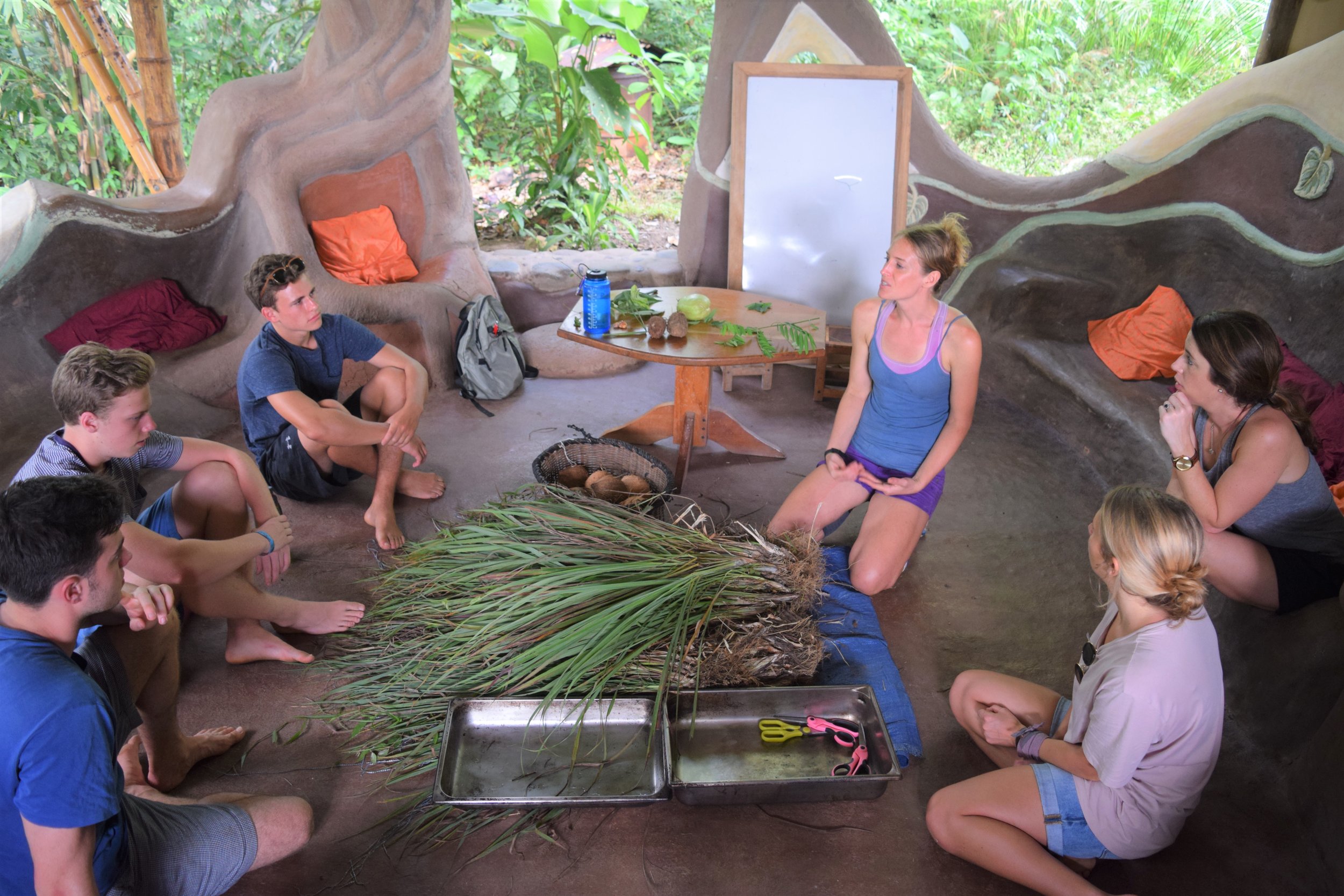
Students learn about herbal medicine by making it. (Photo Credit Scott Gallant; Mastatal, Costa Rica; of Laura Killingbeck and students)
I thought, “Dang.”
But then I realized that the longevity of this conversation is part of the point here. As time passes, our relationship with technology becomes habit. The fast growth and evolution of the internet means we continually need to navigate our interaction with it. As permaculture designers and educators, I think we need to embrace technology in its myriad forms to regenerate a positive human ecology with the earth. I also hope virtual reality will always remain a compliment to, rather than a replacement for, direct engagement with our real and living world. I think we need to pay attention to this as much now as we ever have, and I hope we do.
Bio: Laura Killingbeck has been working with Rancho Mastatal Sustainability Education Center in Costa Rica since 2009. She oversees the development and management of the Ranch's food education programs, and creates systems and strategies for utilizing whole foods on both a community and home scale. Follow her on Instagram @laurakillingbeck
Looking for opportunities to expand your horizons?
Join Rancho Mastatal for one of our upcoming 2018 workshops. Learn more here.
ViVerde is a developing educational eco-lodge and permaculture farm on a 15-acre property right outside of colonial Granada, Nicaragua. They are now recruiting for two work-trade positions, one to do fine woodworking and the other to coordinate the community kitchen and farm to table systems. Go to http://www.viverde-nica.com/recruiting-work-traders for more information.

Life with Limited Communications: How We Thrive with Crappy Internet
I’m unable to answer all of the emails that I receive into my inbox everyday. Even though I do receive my fair share of electronic correspondence, my inability to reply to all messages is not likely a result of the inordinate amount of inquiries that I receive compared to many of you out there. The reason is that I live in a place with shitty Internet.

I’m unable to answer all of the emails that I receive into my inbox everyday. Even though I do receive my fair share of electronic correspondence, my inability to reply to all messages is not likely a result of the inordinate amount of inquiries that I receive compared to many of you out there. The reason is that I live in a place with shitty Internet.
I have a 2-hour window each morning before most people in town are awake to get into my account and open and answer my emails. After that, people begin to chew up the ever so precious limited bandwidth that serves our community. In my head I envision people in town rolling out of bed to take a peak at their Facebook accounts or watch a video on Youtube before school or work while I struggle to open a reservation request that might result in a booking and some income for the Ranch. Our painfully slow Internet means that I can generally check emails only once a day. If I didn’t respond to an email this morning, it will simply have to wait until tomorrow.

To add to my current communication challenges, I don’t have a cell phone, much less a smart phone. The pressure seems to mount each day to get one. Given my administrative obligations as the director of Rancho Mastatal, all of this results in a daily confrontation that I strive to find balance with continuously. For those of you with poor Internet connections, which may only be a small minority of you reading this, what do you do when you simply can’t open an email that you know you should read and respond to as soon as possible? How do you react when you can’t attach a simple Excel spreadsheet to your email to send to a prospective client? In an age when businesses increasingly rely on the Internet for their survival, how has the Ranch been able to make ends meet for 15 years, the first 8 without even a phone in our town, in a world that today demands email responses in minutes or hours, not days or weeks?
Honestly, I don’t have a great answer or fully know. It’s an interesting dissertation topic for a future graduate student that loves our community. I think mostly it’s been a life-or-death (for the business, not us as humans) need. Somehow, we’ve been able to organize our work and lives to make it work, in spite of the poor odds in Vegas. We’ve persisted and persevered while the communications here have slowly improved. We’ve been forced to depend on our amazing library (with real books) for research and traditional means to build friendships, trust and a dedicated following that have kept us alive and mostly well.
Every 3 weeks, for almost a decade, I drove 2 hours to find a reasonably fast Internet connection. I also relied on a terribly annoying auto response message that asked those emailing to me to please be patient when waiting for a reply. Many of you probably remember (and still receive a watered down version of) the message that states that I’ll get back to you sometime within the next century. This is mainly how I assuaged and bought time with those interested in our project and “stayed on top” of bookings and guest visits early on in our evolution.

In the earliest days, I would wait in line at the public phone in San Miguel, 4 kilometers from Mastatal, to make bookings for our educational groups. If I had to make more than one call, I would have to get back in line to make the second. A third. Back in line. You catch my drift. This little exercise might take me half a day. Setting up homestays for our high school groups would take multiple days. It now takes me an hour by phone.
The current reality, fortunately, is that I’ll probably be able to respond to an email that you send to me within a week, and if it’s high priority, even sooner. But that doesn’t mean it’s always easy. While most of you enjoy life with high-speed wifi and 4g service, we struggle with a 3g network that’s reminiscent of my first email experience with AOL and dial up just out of the Peace Corps in the mid-90s. I haven’t come that far in the past 20 years, but I’ve come somewhere, and all this said, there’s great relief and many benefits in not owning a cell phone and being tied to the Internet 24/7. I am currently avoiding total dependence on modernity’s electronic leashes (or nooses) but also appreciate and recognize the great benefits that the Internet brings to me, my family, and our business. Without it we would struggle even more than we presently do to make financial ends meet and stay in touch with our families. My weekly drive to the highest point in the region to check phone messages has evolved to a predawn wakeup and email session in my cozy cob home, and I’ll take the latter any day of the week.

Visitors to the Ranch almost universally, eventually feel relief when they spend many days, weeks or months with us and are unable to stay uber connected to their digital lives back home. The Internet and cell phones are yet other additions to a continuous string of technologies that we have to learn to find a happy medium with and balance. Like so many of life’s conveniences, too much has proven over and over to destroy our mental and physical health in the long-run, and just like coffee, hooch and phone access, a little can and should go a long way.
NEWS AND NOTES
We have a number of life changing workshops coming up.
Please share around if you know anyone who is ready for a trip to beautiful Costa Rica, a swim in the waterfalls, nourished with homemade meals, and challenged with an intensive educational experience.
Abrazos,
The Ranch Crew
Categories
Topics
- Agriculture 6
- Agroforestry 21
- Animals 2
- Apprenticeship 19
- Appropriate Technology 6
- Backpacking 1
- Bananas 1
- Basic Pantry 4
- Biochar 1
- Books 3
- Build Your Own Home 1
- Central America 5
- Chiles 1
- Cinnamon 1
- Clay Carving 1
- Climate 2
- Climate Change 1
- Cob oven 1
- Communication 5
- Community 24
- Compost 2
- Composting Toilets 2
- Condiments 1
- Conservation 2
- Cooking 4
- Costa Rica 18
- Design 10
- Earthen Construction 10
- Eat Local 2
- Ecohome 1
- Education 9
- Environment 3
- Ethics 4
- Farm to Table 12
- Fasting 1
- Fermentation 14
- Food 22
- Food Choices 8
- Food Forest 8
- Food Processing 15
- Food Systems 12
- Gap Year 1
- Gardening 5
- Ginger Beer 1
- Harvest 2
- Health 12
- Healthy living 5
- Homemade 2
- Homestead 8
- Internet 2