

BLOG
Stories, articles, and updates from the Ranch community.

Los Suelos y Su Importancia para la Existencia de la Vida
El suelo es una delgada capa de minerales, agua, gases, y material orgánico, la cual se encuentra activa biológicamente y debiese cubrir la mayoría de la superficie de la tierra.
Escrito por el aprendiz 2024, Felipe
El suelo es una delgada capa de minerales, agua, gases, y material orgánico, la cual se encuentra activa biológicamente y debiese cubrir la mayoría de la superficie de la tierra. Acá se desarrollan una serie de interacciones, entre los múltiples elementos que habitan los suelos se encuentran: plantas, minerales, hongos, bacterias, filamentos, algas, pequeños animales desde protozoos a lombrices, insectos mamíferos, etc.
El suelo es un sistema biológicamente activo que otorga una serie de servicios ecosistémicos claves para el mantenimiento de la biosfera (la parte de la tierra donde existe la vida), así como para la regulación del clima. Es la base del sistema alimentario del ser humano: 95% de los alimentos provienen de los suelos, es la base de la agricultura y es el medio donde crecen casi todas las plantas productoras de alimentos. Es uno de los ecosistemas más importantes para asegurar la existencia de la vida en el planeta. Aproximadamente un cuarto de las especies del planeta que se encuentran registradas necesita de los suelos para existir. Es extremadamente vital mantener la biodiversidad subterránea, para que los suelos estén saludables, en simbiosis y siendo el hábitat de diferentes especies, logrando un ecosistema equilibrado y balanceado para el buen funcionamiento de la cadena alimentaria del planeta.

Algunos de los beneficios que los suelos otorgan al medio ambiente son los siguientes:
Producción de biomasa que sirve de alimento para muchas especies
Dotación de energía a muchos seres vivos
Filtra, regula y transforma la materia que absorbe
Es el hábitat de innumerables especies
Fijación de Dióxido de carbono
Tiene un importante rol en la regulación del clima
Protección del recurso hídrico en las capas subterráneas
La formación de 1 cm de capa de suelo, puede tomar entre cien a miles de años. Este proceso llamado meteorización, consiste en la descomposición de distintas rocas madres y minerales que conforman una macroestructura, disolviéndose en partículas más pequeñas y originando nuevos minerales a través de la erosión que ocasiona el aire y el agua a través del paso del tiempo. El periodo de formación de los suelos depende de: tipo de roca madre, clima, la vegetación, topografía y el tiempo.
Según la OMS, 40% de los suelos del planeta hoy se encuentran degradados. En África, solo un 8% de los suelos es adecuado para su uso en la agricultura. Hoy en día, existe una gran amenaza para la seguridad alimentaria de los seres humanos, debido a la perdida de los suelos. La principal causa de esta amenaza, es el ser humano a través de la contaminación. La mayoría de los contaminantes provienen de desechos urbanos no tratados y actividades humanas como: las prácticas agrícolas insostenibles, la industria, la minería, deposición de contaminantes atmosféricos, entre otros. Ejemplos de estos contaminantes son: derrames de hidrocarburos, residuos urbanos, medicamentos, antibióticos, desinfectantes, pesticidas y fertilizantes, metales pesados como el plomo, cadmio, el mercurio, como también los plásticos y microfibras que afectan negativamente a los suelos. Otros factores importantes en la desertificación y perdida de los suelos son los monocultivos y la sobre expansión urbana. Esto tiene como consecuencia la pérdida definitiva de suelos productivos. El problema de la degradación de los suelos puede traer consecuencias graves como: sequias, guerras por recursos hídricos, pobreza, hambruna, marginación, emigración obligada, disminución de recursos esenciales, etc.


Algunas de las iniciativas que se pueden emplear para proteger los suelos son:
Aumentar la materia orgánica en los suelos, con mayor cubierta vegetal, vegetación, lechos orgánicos y compost
Usar la vegetación para proteger los suelos del viento y la salinidad
Practicar una labranza mínima (que reduzca las emisiones CO2) y retener los residuos de los cultivos
Implementar pastoreo rotacional
Usar fertilizantes orgánicos y evitar los químicos
Tener 100% cobertura vegetal durante todo el año
Permitir el crecimiento de la biodiversidad por encima y por debajo del suelo
Apoyar y proteger la simbiosis microbiana del suelo, incluido los hongos
Reducir los combustibles fósiles
Usar los residuos orgánicos que generamos para nutrir los suelos
Algunas de las estrategias que se aplican en Rancho Mastatal para el manejo de los suelos arcillosos de la zona, los cuales tienden a ser pobres en material orgánico y bajos en nutrientes disponibles, consiste en la nutrición de los suelos a través de compost para elevar el nivel de materia orgánica.


En el rancho se manejan distintos tipos de procesamiento de compost:
Compost pasivo con el material orgánico de cocina en composteras verticales, formando niveles de residuos de cocina, cubiertos con hojas secas. La estructura de las composteras es en base de alambres, para incrementar la aireación, ayudando a la descomposición del material orgánico en estructuras más simples que servirán de alimento para las plantas del Rancho
Compost en pila con estiércol de animales, de granjas aledañas de la zona, mezclados con aserrín para balancear la proporción C:N, el cual se voltea cada semana y se humedece para no perder el nitrógeno de la mezcla
Lombricultura, en donde se alimentan las lombrices con los residuos del biodigestor. El biodigestor se alimenta con estiércol de animales de la zona para producir metano, el cual se utiliza como fuente de energía en la cocina. De esta forma, se tiene como resultado, el humus que producen las lombrices que van directamente a enriquecer el suelo de las plantas del vivero y gas para cocinar los alimentos del Rancho.
A partir del compost generado, se procede a ejecutar la fórmula de la santa trinidad de los suelos, la cual se forma a través de adicionar estos tres componentes ricos en nutrientes, que serán los encargados de devolverle el equilibrio a los suelos, alimentándolos de manera adecuado y sustentable.
Materia Organica + Micorganismos de Montaña + Biocarbon = Suelo Dorado
Materia orgánica: el componente del compost descrito anteriormente
Microrganismo de Montaña: esta enmienda natural se genera a partir de la recolección de hojas y material orgánico de los bosques de la zona que contienen un alto nivel de microrganismos, hongos y bacterias altamente activos, para desarrollar los procesos biológicos que tanto los suelos necesitan. Estos residuos se depositan en un contenedor mezclado con agua y melaza para alimentar los microrganismos en un proceso anaeróbico, con el objetivo de multiplicarlos y reproducirlos. Muy parecido a como si se fuera a hacer una infusión de té. Después de dos semanas se tiene un fertilizante natural lleno de vida que los suelos y las plantas estarán muy felices de recibir. Lea más sobre esto aquí.
Biocarbón: este componente se obtiene a través de la combustión incompleta de madera, donde se realiza una fogata y llegando a cierto punto de combustión se reduce la cantidad de oxígeno para permitir una estructura amplia y porosa. Para este proceso se utilizan los residuos de las maderas que se usan para los diferentes proyectos de la comunidad.
Otra estrategia que se aplica en el Rancho, es cubrir con mantillos los suelos y las especies deseadas, como árboles frutales, con el objetivo de retener la humedad en los suelos, incrementar la biomasa, para dar un hábitat propicio para la acumulación de microrganismos y hongos que benefician la absorción de nutrientes para el buen desarrollo del sistema radicular de las plantas. Para el proceso de elaboración de los mantillos y mejorar la calidad de los suelos se siembran distintas plantas de soporte, autóctonas de la zona y de rápido crecimiento, con el objetivo de proporcionar: biomasa (vetiver), fijación de nitrógeno (calliandra) , ornamentación (monstera) y diferentes nutrientes a los suelos, a través de las plantas que actúan como acumuladores dinámicos (girasol mexicano).
A través de la aplicación de las estrategias descritas anteriormente, se mejoran los suelos en Rancho Mastatal, contribuyendo con la restauración y la reparación de los suelos que tanto se necesita, devolviéndole la vida a este ecosistema tan dañado e ignorado por los seres humanos.



Fermented Plant Juice (FPJ) and Its Application
Learning how to prepare these ferments will not only add macronutrients to your soil system but will increase the bioavailability of preexisting nutrients in your soil. Gardening really boils down to being a soil steward, which basically means we’re ranching microorganisms.
By Connor Gilmartin, apprentice 2022
Earlier this year, I wrote a short article on preparing a garden amendment called Water Soluble Calcium (WCA). That short essay focused on how to make small batches of WCA in the comfort of your home using discarded eggshells and vinegar. Water Soluble Calcium is one of the five pillars of Korean Natural Farming (KNF). The remaining four recipes KNF methodology encourages us to utilize are Lactic Acid Bacteria (LAB), Fermented Plant Juice (FPJ), Oriental Herbal Nutrient (OHN) and Fish Amino Acid (FAA). Because this article won’t cover the remaining three ferments in-depth, I highly recommend looking into the University of Hawaii’s College of Tropical Agriculture’s papers on this subject. The authors of those articles do a great job at explaining the process of making and applying these homemade amendments. These KNF ferments we’re talking about have a symbiotic relationship with one another. Generally speaking, they serve your garden’s needs best in the presence of each other – especially when they’re used to inoculate biochar or indigenous microorganism (IMO) culture.

It’s worth mentioning the obvious here - everyone’s gardening environment is completely unique, and every soil system has different nutritional requirements. For the sake of brevity, it’s necessary to generalize a bit. If you’re interested in diving deeper into soil science and plant nutrient uptake, I would highly recommend Jeff Lowenfels’s books Teaming with Microbes and Teaming with Nutrients, as well as Steve Solomon’s The Intelligent Gardener.
I chose to write my first article for Rancho Mastatal on Water Soluble Calcium simply because of the abundance of eggshells we have here, and our robust supply of homemade vinegars. While Calcium is an essential macronutrient in plant growth and fruit development, it is only one piece – albeit a very important piece - of the puzzle of plant nutrient uptake. So, with that being said, lets learn about another pillar of Korean Natural Farming, Fermented Plant Juice (FPJ).
“Growth is controlled not by the total amount of resources available, but by the scarcest resource.”
Before we learn about FPJ’s, dynamic accumulators, and the fundamentals of fermentation, I want to ramble about Justus Von Liebig’s Law of the Minimum - a very important concept in regard to plant nutrient uptake. Liebig’s law states, “Growth is controlled not by the total amount of resources available, but by the scarcest resource.” This is particularly relevant when trying to rebalance minerals and macronutrients in your soil. In, Teaming with Nutrients, Jeff Lowenfels discusses the Law of the Minimum and writes, “plant growth is limited by the least abundant mineral, no matter how abundant the other minerals happen to be.” So, with that in mind, we can make more informed decisions when choosing how to fertilize our gardens.
Before we fertilize at all, a soil test is probably in order. The informed gardener understands that N-P-K listings on commercially available fertilizers only account for three of the seventeen elements necessary for plant life. Many of us have been tricked into thinking Nitrogen, Phosphorus and Potassium are the only elements we need to consider when fertilizing our soil. This couldn’t be farther from the case, and has resulted in massive amounts of excess nutrients polluting our watersheds and harming aquatic life essential in maintaining Earth’s homeostasis. I am a firm believer in a balanced approach to gardening, and certainly don’t believe all bagged fertilizers and amendments are the devil’s work. There are amazing, conscious companies that specialize in producing ethically sourced organic fertilizers. I have purchased bulk earthworm castings, mycorrhizal inoculants, crustacean meals, bokashi grain blends, and many more amendments that did not come from my garden. Does this violate Albert Howards’s Law of Return? Certainly. I am importing ingredients from hundreds, maybe thousands of miles away into my garden’s soil. The very nature of gardening for consumption violates the law of return. This is okay – gardening is a dynamic process, yields can be achieved and measured in many ways. As Masanobu Fukuoka writes in One Straw Revolution,
“It doesn’t matter how the harvest will come out. Just sow seeds and care tenderly for the plants and soil… The ultimate goal of farming is not the growing of crops but the cultivation and perfection of human beings.”
I learn something every season I germinate seeds. I feel an overwhelming sense of satisfaction and joy when I feed my plants a nutrient-rich tea, or spread a cover crop on a resting hugelmound. Maybe these more philosophical “yields” are really what I crave… Who am I kidding – I also want massive, nutrient-dense broccoli, that I can brag about – and share – with my neighbors. Point in case, there are many ways to address fertilization requirements in the garden. I’m not a devotee of any gardening guru, and I’m not advocating for any one specific strategy. I’m interested in holistic plant and soil stewardship that integrates many approaches.

Now, lets get down to business. FPJ’s are made using two simple ingredients. Chopped up biomass and brown sugar. There are a whole lot of plant species that can be used to make FPJ’s. I’ve used the young, vigorously growing tips of mugwort, comfrey, stinging nettle, wormwood, tulsi, and Mexican sunflower to name a few. I’ve also used unripe persimmons, pumpkins, and other fruits and vegetables to make Fermented Fruit Juice (FFJ). There are a whole lot of individual plant species and combinations that experienced horticulturalists have found to be beneficial in their gardens. It’s been observed that certain plants have a tendency to accumulate one macronutrient more than others. In the Korean Natural Farming and biodynamic gardening community, these plants are generally referred to as, “dynamic accumulators.” The concept of dynamic accumulators is a bit contentious, and some people doubt the idea. To be fully transparent, I do not know enough to say with 100% certainty that certain plant species have an affinity to accumulate one macronutrient over the other. However, I’ve visited many extremely productive, beautiful garden spaces whose caretakers embrace this idea, and it certainly doesn’t seem to be hurting anything. I will leave this entirely up to you to decide for yourself. Horsetail (Lorim ipsum) is known to have a high concentration of silica in its stalky biomass. Bamboo shoot FPJ is known to contain high amounts of nitrogen. FfJ made from young, unripe fruit can contain high amounts of phosphorous. With mindful intervention, we can amplify the nutritional impact these biomasses have on our garden by utilizing the friendly yeasts and other microorganisms drifting about. By feeding the microorganisms that reside on the biomass of these plants organic brown sugar, we catalyze the process of fermentation. The weak alcohol that is produced by the yeast as they nibble on the sugar we’ve so graciously provided them extracts chlorophyl from the biomass and other ethanol-soluble compounds contained in the plants via the process of osmosis. These compounds are called phytochemicals. The following section will cover the materials needed and list the step-by-step process to produce and apply FPJ.
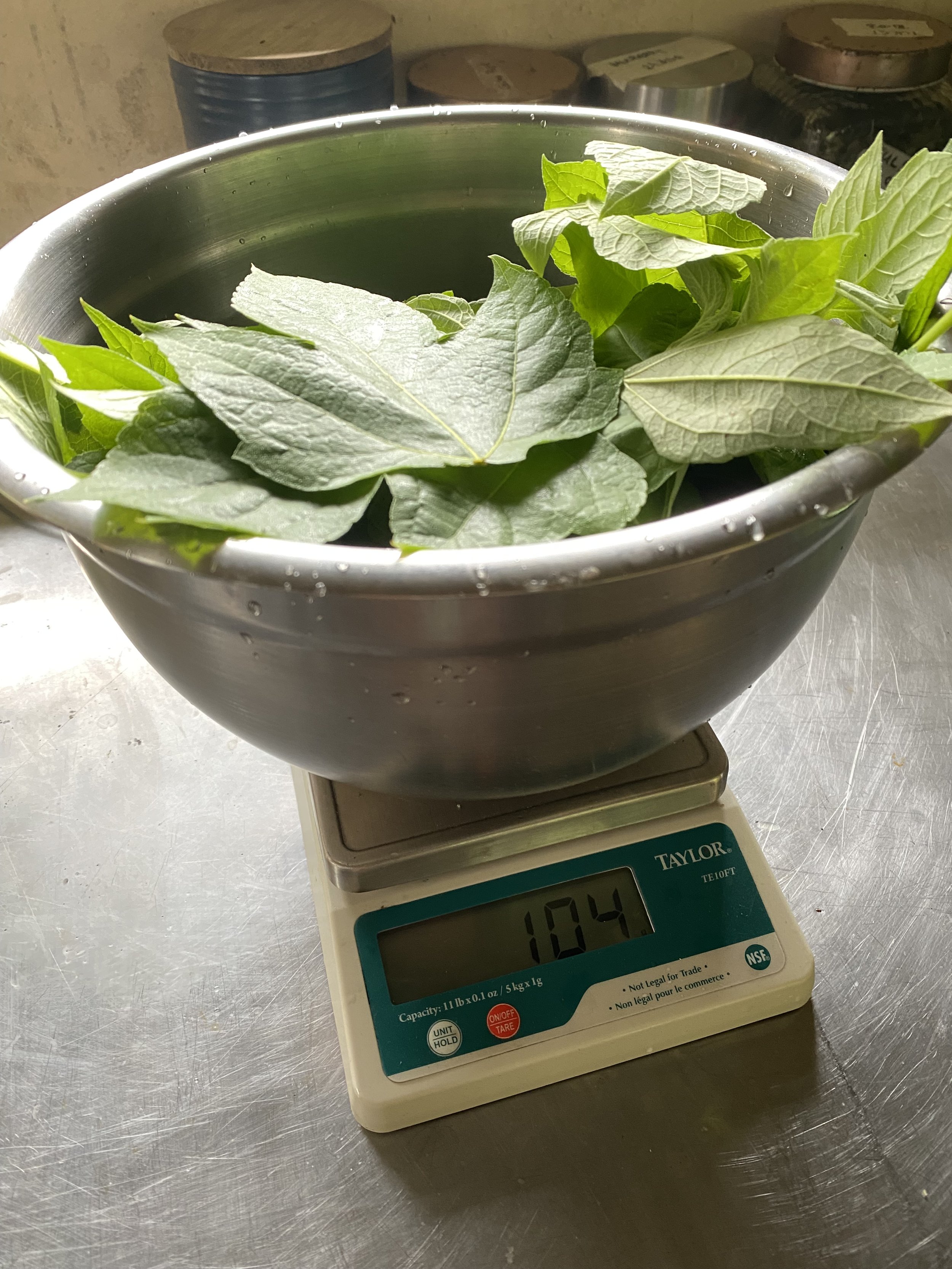

Materials
I’ll begin by listing the materials you’ll need to make a batch of Fermented Plant Juice (FPJ). They are as follows:
Glass jar or food-grade plastic container
A sharp, clean knife to chop up the biomass
Organic brown sugar
A breathable cloth to act as a “lid” (cheesecloth or nut milk bags work quite well)
How To Prepare a batch of FPJ
Collect plant material
It is ideal to harvest the biomass before sunrise. Cut the young, vigorously growing tips of your desired plant and store in a clean container
Harvesting before sunrise ensures the plants are in respiration-mode, not photosynthesis-mode
Avoid collecting biomass during or after a heavy rain event
Cut and weigh the plant material
Do not rinse collected plant parts, to conserve surface microorganisms
Record weight of biomass
Add brown sugar
1:1 (brown sugar to biomass) ratio. If you have one pound of comfrey, put in one pound of brown sugar. Coat as much of the surface area of the plant material as possible to encourage the fermentation process
Pack the brown sugar-coated biomass into a fermentation vessel
Pack tightly
Attach breathable lid using string or a rubber band, depending on the size of the fermentation vessel
Store the covered container in a well-ventilated area away from light and extreme heat or cold
Check the container after 24 hours and adjust the volume if necessary
Your fermentation vessel should be no more than 2/3 full. If the container is too full, the microbes will not have enough air to properly ferment.
Let the contents ferment for 4 -7 days
You will know that fermentation is occurring when bubbles start to form in the liquid
Fermentation is complete when the plant material floats and the liquid settles at the bottom, there is a slightly alcoholic smell due to breakdown of chlorophyll and the liquid tastes sweet, not bitter. It is possible that the plant material doesn’t form a distinct layer in the solution, so these are loose guidelines – everyone’s fermentation environment is different. This process is heavily influenced by the ambient temperature of the environment you live in.
Strain the solution
Separate the plant material from the liquid
The spent biomass can be added to compost or mulched directly into your soil
Store the FPJ
Transfer FPJ into a clean ball jar or food grade plastic container
Cover with a loose lid - the microorganisms in the solution are very much alive and will continue to produce carbon dioxide as they consume leftover sugar. This could cause a jar to explode if the lid is on too tight.
How To apply FPJ
Dilute at a ratio of 1:500, 1:800 or 1:1,000. This translates to 4-8ml of FPJ per gallon of water. It’s powerful! You can always add more, you can never add less.
The dilution of 1:800 or 1:1,000 should be used if:
You’re applying a mixture of different amendments (ex. WCA + FPJ + FAA)
You’re applying FPJ in hot weather
FPJ can be applied as a soil drench (diluted in a in a watering can or other water dispersal system) or as a foliar spray. Apply the solution once a week or so, no more than once a week. Try and apply FPJ’s that were prepared using biomass that was collected at a similar stage of the plant’s growth cycle to the ones you’re feeding. For example, use a light dilution of young mugwort FPJ for young plants, and use an FFJ of unripe, green fruit when those plants are beginning to enter their reproductive stage of development.
Korean Natural Farming is a dynamic process that requires familiarization with the unique terroir of your gardening environment. Just like baking sourdough or making kombucha, preparing KNF amendments might require some trial and error. I feel inclined to repeat – “dilution is the solution.” These ferments are highly concentrated. Apply wisely, consciously, and out of direct sunlight. Take your time, enjoy the process, and revel in the beneficial microorganisms you’re stewarding.
Learning how to prepare these ferments will not only add macronutrients to your soil system but will increase the bioavailability of preexisting nutrients in your soil. Gardening really boils down to being a soil steward, which basically means we’re ranching microorganisms. Imagine yourself as a benevolent god, feeding trillions of beneficial soil macro and microbiota for the betterment of the world. Your plants will thank you.
Happy gardening, mulch love.
Connor can be contacted via email with any questions or professional inquires (connorjgilmartin@gmail.com).
“I sometimes think that never blows so red
The rose as where some buried Caesar bled;
That every Hyacinth the garden wears
Dropt in her lap from some once lovely head”


Amending Calcium-Deficient Soils – A Tropical Permaculturist’s Approach
By 2022 apprentice Connor Gilmartin

A walk through our orchard systems
Wade Davis once wrote that the Kogi people of Columbia believe “The surface of the Earth itself is an immense loom upon which the sun weaves the fabric of existence”. The garden and orchards of Rancho Mastatal are proof of this eloquent observation. While walking through the orchard spaces of the Ranch, your field of vision is overtaken by a mosaic of emerald green foliage, and gem-like, plump tropical fruits. This intentionally designed agroforest is abundant - however, a productive tropical orchard or garden does not come without hard work. Without mindful intervention, these orchards and gardens would not reach their fullest potential. It is our goal to listen to Madre Tierra, and help her achieve her most resilient, healthiest form.
Tropical Soils
While the jungle soils of Mastatal are abundant in in biodiversity, they are lacking in potential hydrogen (pH), which results in acidic soil. This low-pH, high acidity soil presents a bit of a problem for a gardener like myself, who is keen on optimizing a plant’s growing medium, in search of nutrient-dense, boast-worthy fruits and vegetables. Simply put, acidic soil results in low levels of available calcium. It is a known fact that calcium plays a crucial role in plant health and development. So… how can we remedy this issue? I’m glad you wondered.
A tropical permaculturist in this predicament is faced with two options; purchase bulk calcium carbonate in the form of ground limestone to apply as a top dress, OR use all those eggshells sitting on the top of the compost bucket to make Water-Soluble Calcium (WCA). WCA is one of the five inputs developed by Master Han Kyu Cho, the prolific South Korean gardener responsible for what is known globally as Korean Natural Farming (KNF). I’ll note that topdressing with limestone (CaCO3) does play a role in our agroforested zones - foliar feeding 12 acres of orchards would be unrealistic, to say the least. Foliar feeding a quarter acre of raised garden beds is a different story. Preparing WCA is fulfilling and presents a phenomenal opportunity to help close the loop between your garden and kitchen, while also providing your plants a calcium-rich tonic they’ll thank you for. When you see your pepper’s shiny leaves praying towards the morning sun, you’ll see what I mean.
How to Make Water-Soluble Calcium
I’ll begin by listing the materials you’ll need to make a batch of Water-Soluble Calcium (WCA). They are as follows;
1.) Two clean glass jars (I am personally Ball Brand loyal, but any clean glass jars will do)
2.) Eggshells (Rinsed after cracking to remove organic matter)
3.) Brown Rice Vinegar (3% acetic acid is what you’re shooting for if you make your own vinegar like we do here at the Ranch)
4.) A cast iron skillet
5.) A breathable cloth to act as a “lid” (cheesecloth or nut milk bags work quite well)

Washed egg shells and homemade bottles of vinegar

One of our alternative wood fired cooking stoves
I chose not to list specific quantities of eggshells and vinegar because the amount of WCA you might want or need is variable, depending on the size of your garden space or application schedule. By weight, the solution will be prepared using a ratio of 1:10 (eggshells to brown rice vinegar).
To prepare the WCA solution:
1.) Collect eggshells, gently wash with water after cracking.
2.) Lightly roast the cleaned, dried eggshells in a cast iron skillet for approximately 30-45 minutes. This removes any potential leftover organic matter stuck to the shell. Shells should be dry and toasted golden but not charred.
3.) Add toasted shells to a glass jar filled with brown rice vinegar. You will see carbon dioxide being released as the eggshells float up and down the vinegar. This is good. This is a sign the calcium is being dissolved into the solution.
4.) Cover your jar with a breathable cloth. This prevents pests or large organic matter from entering your prized water-soluble calcium solution.
5.) Place jar in a cool, dry location for 7 to 10 days.
6.) After this time has passed, check to see if the solution is still bubbling. If it’s not, that means your solution is saturated and all set for the final step.
7.) Strain your solution into a clean glass jar to remove eggshells. Cover with airtight lid, label, and store at room temperature out of direct sunlight.

Toasted egg shells

Egg shells sitting in vinegar
Voila! A week has passed and now you have a jar of homemade water-soluble calcium. You must be excited to go give your plants a taste. I’d recommend doing so in the early morning. Greet the sun, sing to your plants, and remember, your mind is a garden, your thoughts are the seeds, you can grow flowers, or you can grow weeds. Happy gardening!

Want to learn More?
We have been applying permaculture principles to our agriculture systems for the past two decades. Join us for our yearly Permaculture Design Certification to learn more about designing and implementing sustainable tropical systems.
Check out these past blogs on Tropical Agriculture
Tips for Working with Tropical Soils
Using Mountain Microorganism to Create Organic Fertilizer

Improving Soils in the Humid Tropics of Costa Rica
In permaculture and agroforestry circles it’s common to hear the idea that we’re not growing plants so much as we’re cultivating rich, healthy soils in which plants will do their own growing.
By Anthony, Apprentice 2020
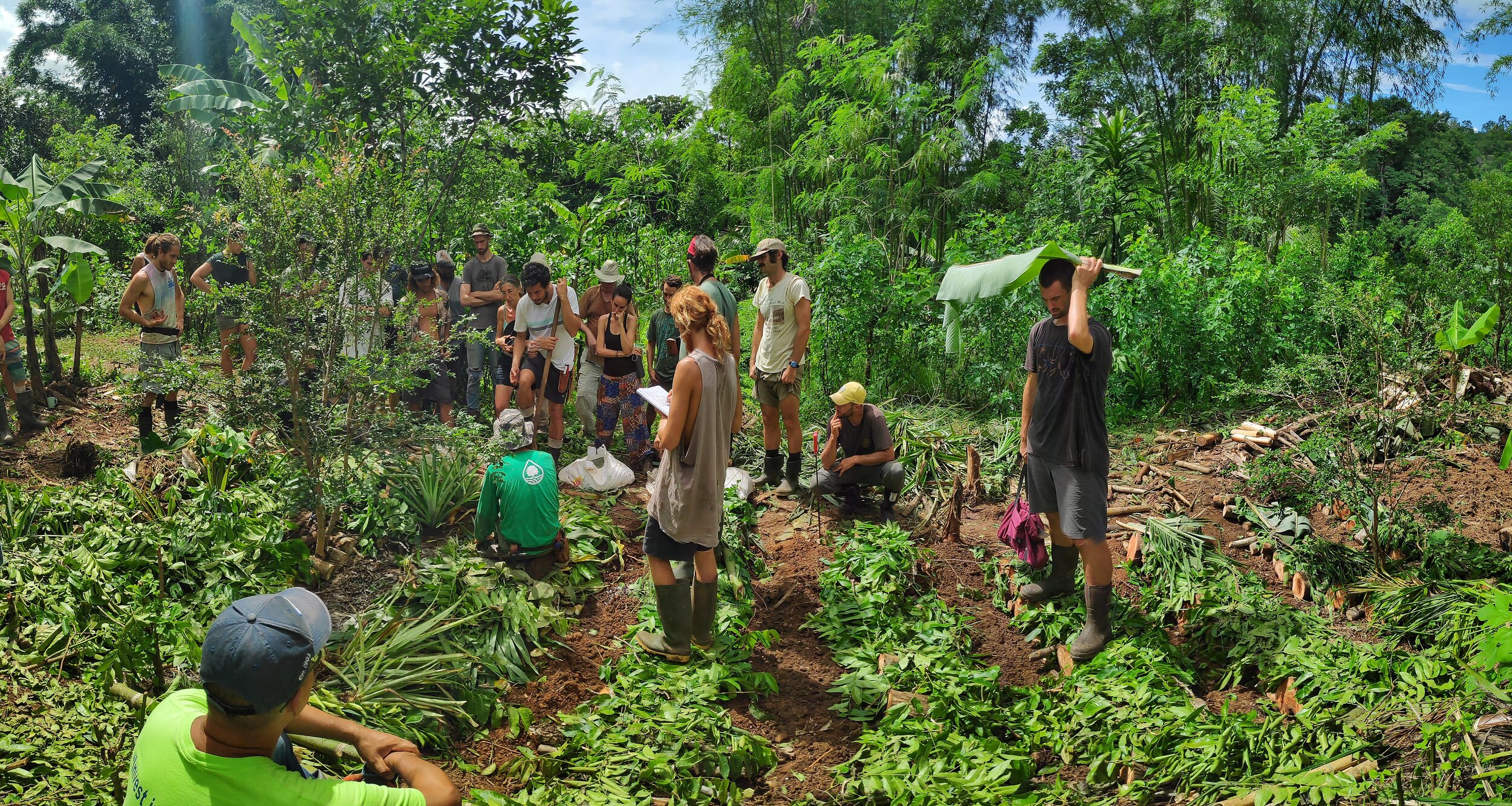
Syntropic farming workshop at Rancho Mastatal
In permaculture and agroforestry circles it’s common to hear the idea that we’re not growing plants so much as we’re cultivating rich, healthy soils in which plants will do their own growing. Yet, to this end changing the make-up of soils seems like a daunting job. So how can we go about the task of improving our soils in a simple and efficient way that corresponds with permaculture principles?
The challenge of Tropical Soils
Soils in humid Tropical America are generally found to be eroded and leached. In this region’s ecosystems, about 85% of nutrients are held in plants and animals, so the soils themselves are infertile. Only terraces, floodplains, and new volcanoes keep some soil fertility replenished if land is cultivated (Mollison, 2004). This yields soils that are high in clay content, poor in nutrient content, and often quite acidic. As we say here at the Rancho Mastatal, a permaculture farm in Costa Rica, it’s soil that’s great for natural building, yet not ideal for growing an abundance of food.
The goal with soils like ours is to improve soil texture, increase mineral and nutrient content, reduce soil acidity, enrich microbial life, and increase the quantity of organic matter held in the soil.
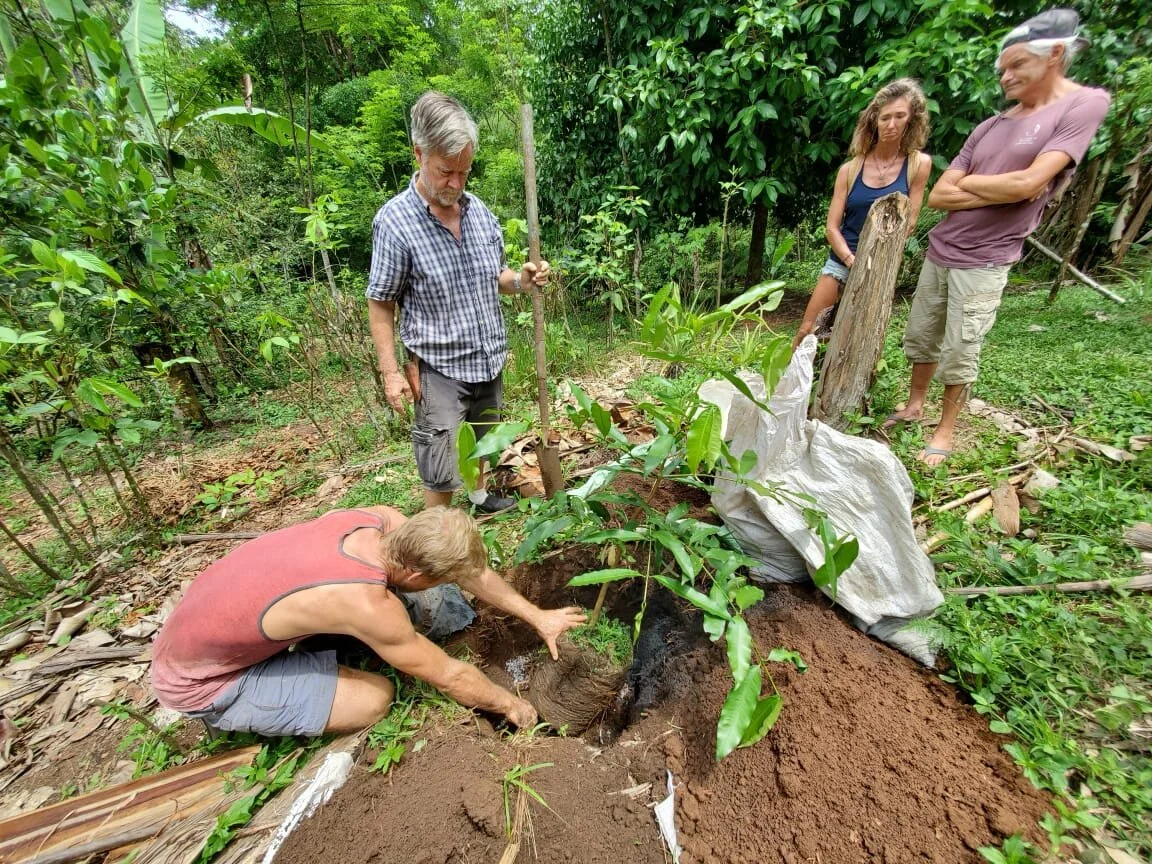
Planting a fruit tree during our annual Agroforestry Skills Workshop
Permaculture & Agroforestry based strategies
In a recent agroforestry workshop held at the Rancho Mastatal here in Costa Rica, a class that worked through concepts of a multi-strata, diverse style of permaculture, the holy trinity of soil amendments for the humid tropics was revealed. The three pillars of improving cultivated soils are
Biomass
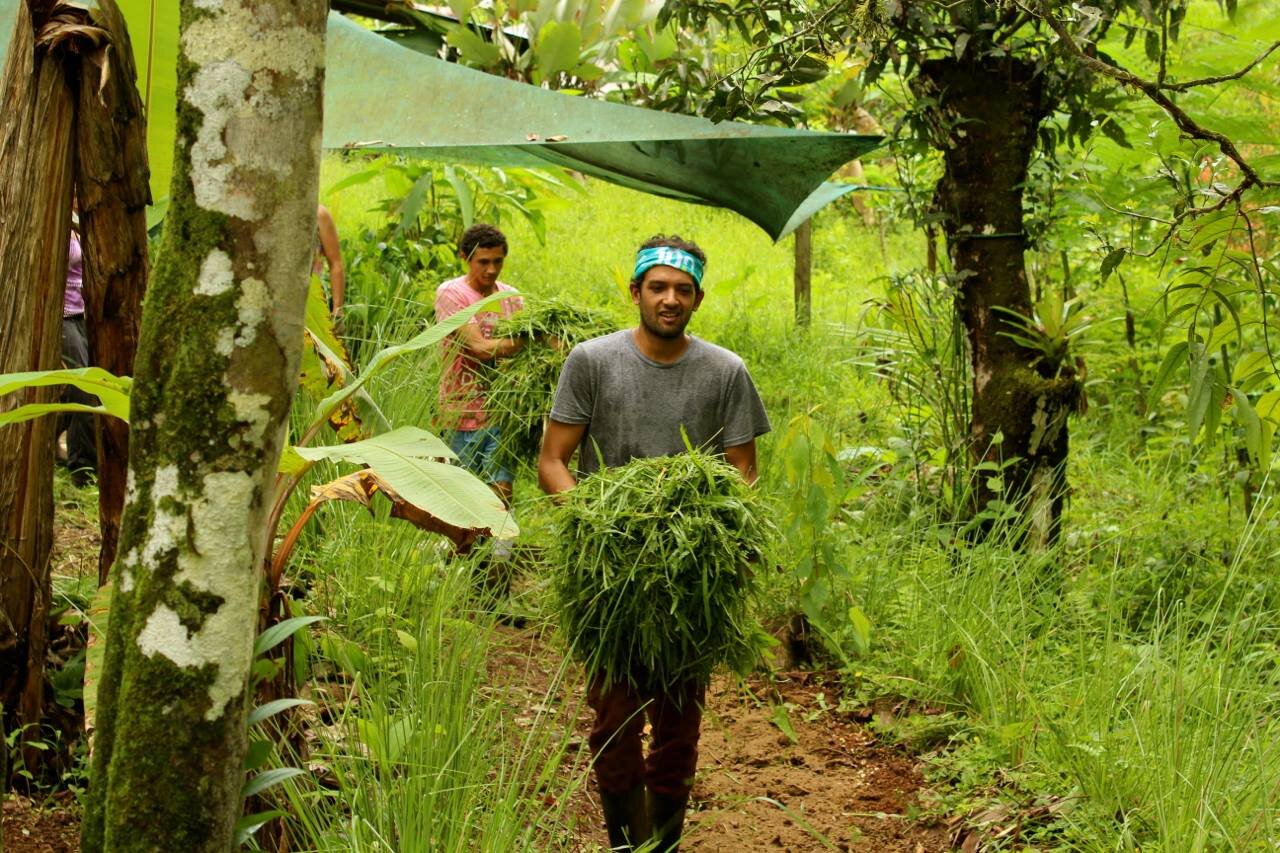
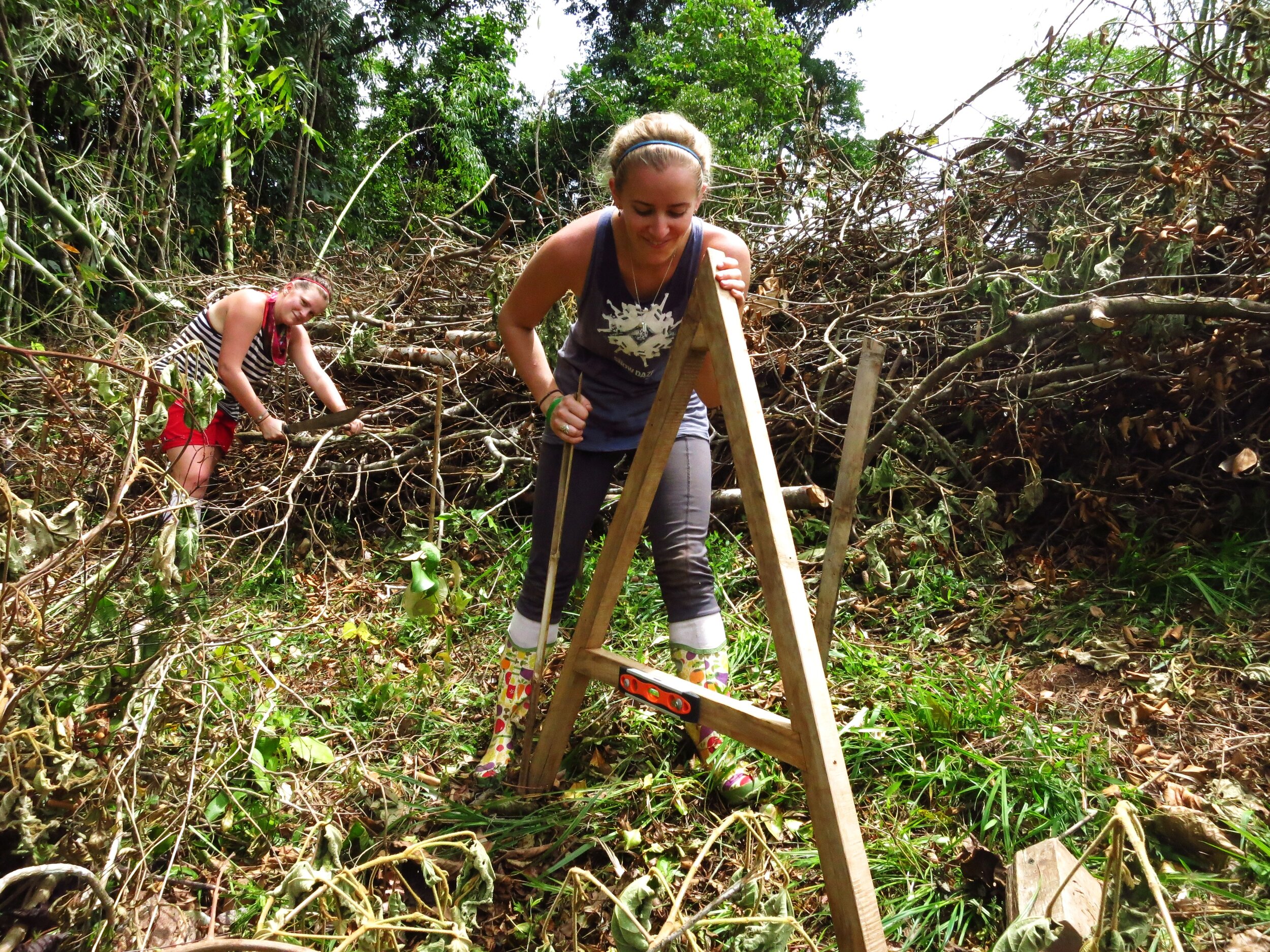
The strategy of biomass organized on contour (lines running perpendicular to the direction of the cultivated slope) is the most visible method used here at Rancho Mastatal to improve the soil’s structure and nutritional/mineral content, our ‘organic’ way of applying fertilizer. In the humid tropics, biomass tends to be available in great quantity, and can be used to build up the mentioned contours. Over time these will build to form terraces that greatly reduce soil loss related to erosion and leaching.
Mountain Microorganisms
Mountain microorganisms is a world of its own. Through the fermentation of leaf litter from nearby forests, we cultivate microorganisms which are then applied to our soils, the foliage of our plants, and our compost. We are reproducing healthy bacteria and yeast that, when used in our permaculture systems, will in turn help our plants absorb more nutritional benefit from our soils. To read in more depth about how to make Mountain Microorganisms read this article.
Biochar
Biochar will then provide a long-lasting refuge for these beneficial microorganisms. This is due to its incredibly high surface area within its structure. This special form of charcoal is extremely slow to break down and both directly provides nutrients and minerals to our soils as well as creating a positive feedback loop of topsoil production.


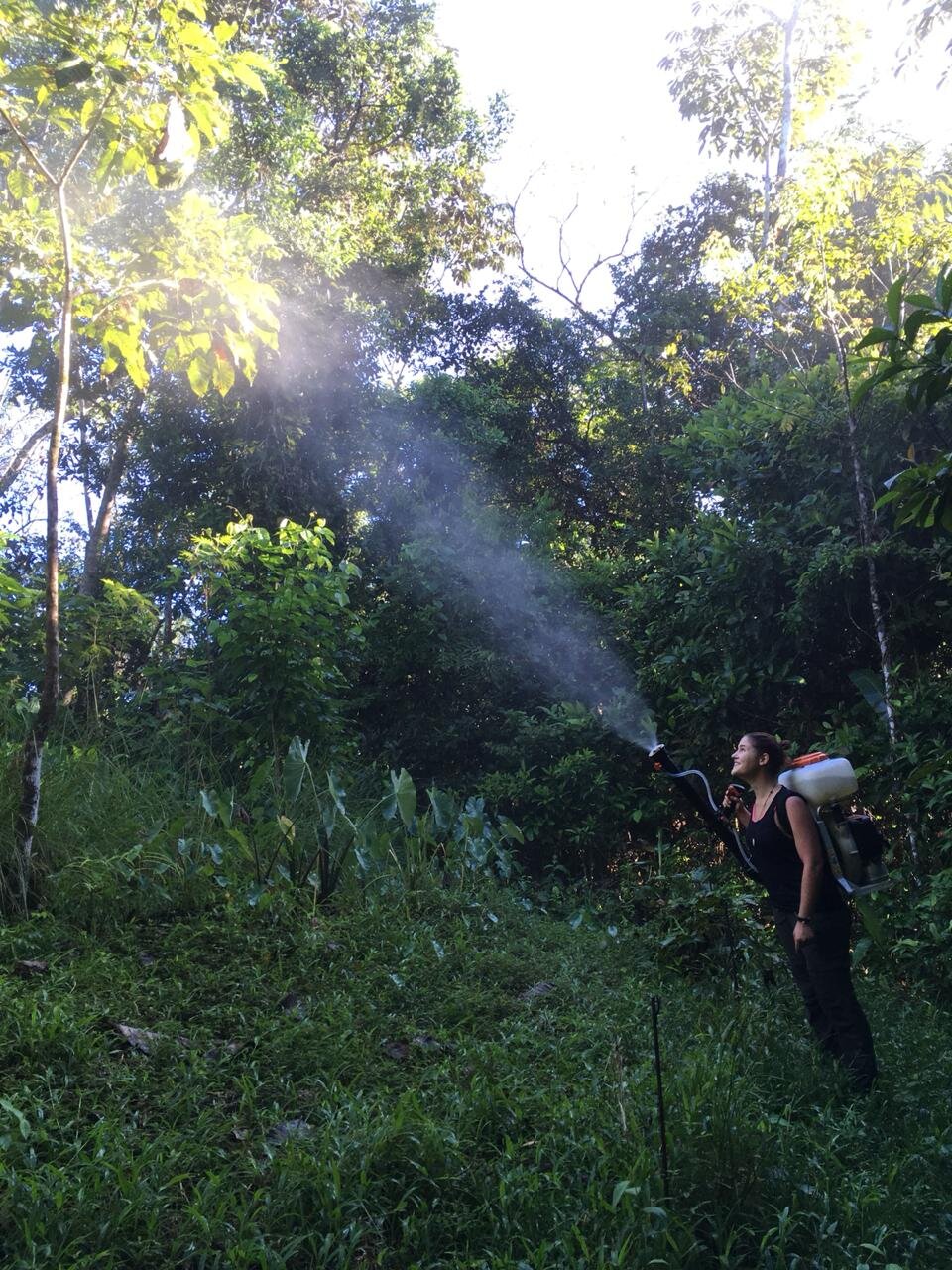
Many ways to develop tropical soils
There are other solid permaculture concepts for improving soils in the humid tropics that should be mentioned here. To deal with highly acidic soils, adding lime at regular temporal intervals is a useful strategy. We tend to avoid planting annuals while opting for perennials, by which we disturb the soil less and reduce potential erosion. Read our article about which perennial greens do well in the tropics here. Over time these plants will help build humus and topsoil. There are plenty of pro tips from the world of permaculture that you’ll find helpful, like adding shredded cane and bamboo species as a mulch for silica and calcium enrichment. This will in turn help to raise pH levels (lower acidity) of soils and reduce leaching and erosion. We add Humanure and effluent from our Biodigestors, this helps build our soil and use commonly wasted products to grow food!
Want to Learn More?
If you’re interested in agricultural concepts such as improving soils, make sure to check out Rancho Mastatal’s workshops, including:
Past Blogs on Soil and Permaculture in the Tropics
We have a lot of past blogs on this topic. Here are a few to read:
Applied Permaculture Principles

Our apprentices doing some chop and drop in the orchards
Categories
Topics
- Agriculture 6
- Agroforestry 21
- Animals 2
- Apprenticeship 19
- Appropriate Technology 6
- Backpacking 1
- Bananas 1
- Basic Pantry 4
- Biochar 1
- Books 3
- Build Your Own Home 1
- Central America 5
- Chiles 1
- Cinnamon 1
- Clay Carving 1
- Climate 2
- Climate Change 1
- Cob oven 1
- Communication 5
- Community 24
- Compost 2
- Composting Toilets 2
- Condiments 1
- Conservation 2
- Cooking 4
- Costa Rica 18
- Design 10
- Earthen Construction 10
- Eat Local 2
- Ecohome 1
- Education 9
- Environment 3
- Ethics 4
- Farm to Table 12
- Fasting 1
- Fermentation 14
- Food 22
- Food Choices 8
- Food Forest 8
- Food Processing 15
- Food Systems 12
- Gap Year 1
- Gardening 5
- Ginger Beer 1
- Harvest 2
- Health 12
- Healthy living 5
- Homemade 2
- Homestead 8
- Internet 2