

BLOG
Stories, articles, and updates from the Ranch community.

Tips for Incoming Apprentices
Congrats on being accepted! As you are preparing for this crazy beautiful adventure, here´s a list of things we wish we knew before coming to the Ranch.
By Sedona Lewis and the 2023 Apprentices
Congrats on being accepted! As you are preparing for this crazy beautiful adventure, here´s a list of things we wish we knew before coming to the Ranch.
Re-read all apprenticeship documents multiple times. There are so many important details (including a lot of this information) that are easy to miss.
Types of shoes that we've found useful:
C.R.O.C.S. Release your inhibitions and just get yourself a pair. It's incredible how fitting they are for Ranch life.
Rain boots for work parties and rainy season, any brand will do. Its nice to have the tall ones.
Tennis shoes/ trainers for hiking and sports.
Comfortable shoes to wear indoors during cooking shifts and food days. The floors in the kitchen spaces are concrete.
Flip flops for the shower to prevent fungus.
Shoes for hiking down to the waterfall/river. Something that can get wet and doesn't fall off when walking through water. Crocs are great for this, but some prefer a Chaco/ Teva/ Bedrock/ Earthrunner kind of sandal.
Any shoes that slip on and off are really nice. We are constantly walking between structures and taking shoes on and off. This is why CROCS are the best!
Organize zoom calls together before you come! It is super useful to get to know each other a bit and ask questions as you are preparing and packing.
During these calls, discuss and plan for the beach trip in May. Book your house ASAP!
If possible, when arriving in January, organize transportation from San Jose to the Ranch. We rode with Fernando, his number can be found in the transportation section of the Ranch website. Regardless of who you choose, make sure to tell the driver how much luggage you have collectively!
Reach out to past (and current!) apprentices and ask questions. Email the core team for contact info and organize phone calls if you can!
It can be chilly at night. Its great to bring good long sleeved shirts/ a light hoodie/ leggings/ long pants. Also warm clothes to sleep in if you're a cold sleeper.
Light weight, long, loose fitting clothing is the best protection against bugs.
Bring good tupperware(s). The kitchen prepares two meals a day, so saving leftovers to eat in between is really nice. Also, containers are great for storing things other than food.
Be prepared to only eat meat once a week. If you´re accustomed to eating meat more than this, you can buy chickens or cheese from our providers in the community to supplement for yourself.
Seriously, make sure the core team knows about any health problems or dietary restrictions you have before you arrive so they can help you to prepare.
To keep electronics safe from the humidity, bring Ziploc bags and silica packs to store them in. Silica packs can be dehydrated in the dehydrator and reused once you are here. Surge protectors are a must too.
A heads-up for Spotify users: Spotify removes downloaded content from your phone after 30 days of being offline. Also, downloaded content has a tendency to mysteriously and randomly disappear. Maybe do some research on how this can be prevented / if a different streaming platform might work better during long periods offline? Or the safest option is to download your library as mp3s.
It is not necessary, but pretty useful to have a computer here. Mainly for writing blog posts, viewing e-library material, planning and teaching the internship, and organizing travel during visa runs. Be aware that this environment is very hard on electronics, so make sure to bring those silica packs and airtight packages!
Small, decorative things to make your room feel like home are worth the space in your suitcase. Thumb tacks are useful, as well as some rope to hang things. And tapestries are awesome to hang as curtains to create privacy in the Hankey. Also, completely unnecessary, but its nice to have some relaxed lighting for night time (fairy lights or a little salt lamp).
You want to have items that make you feel at home, but keep in mind that this climate is very harsh on everything including clothes, jewelry, leather goods, and anything wooden. Only bring things if you can accept that they will get moldy.
If you are going to bring a mosquito net, get a 4 point one that will fit over a double or queen sized bed. You want to have plenty of room under there!
Definitely bring a good notebook(s) and pens/ pencils- you'll be taking lots of notes!
Its worth it to invest in a good quality flashlight and umbrella. The cheap stuff doesn't last long.
Bring your favorite card games, instruments, and art supplies! Again, worth the suitcase space. Its refreshing to spend your free time doing things that make you feel like yourself. Some of our favorites have been playing guitar and flute, crosswords, painting, and beading.
The cell connection is weak and unreliable. Make sure your friends and family know that it will be difficult for you to maintain “normal” communications. We don't have major issues keeping in touch with people, but some days things just don't load.
Ladies, there is nowhere in Mastatal to buy menstrual products. Bring everything you need for the first three months. We have had great success with diva cups and reusable cloth pads and underwear.
Don't be afraid to bring some nail polish, a face mask, or a nice body scrub if you're into that. Some luxurious self care feels fabulous.
Stock up your med-kit and try to be prepared for all types of sickness (flu, cough, loose stools, fever, congestion, etc.) If you are prone to something (like headaches, UTIs, ear infections) be prepared!!!
Someone (usually Robin) goes to town once every couple months. So no need to panic if something small needs to be picked up (toothpaste, etc.).
To inform your decision making as you determine how much spending money you want to bring for periods in between visa runs: A beer at the bar costs about 1,500 colones, a small bar of chocolate is 1,500 colones and a large bar is 3,500 colones, and an empanada at Chepo's soda is about 1,000 colones.
Ranch life can be very emotionally, socially, and physically overwhelming, especially in the first few weeks. It is very important to develop a routine that allows you to stay balanced and recharge your batteries in the ways that you need. Be diligent about carving out time for yourself from the beginning. Listen to your body and bring what you can to make yourself comfy. Its going to be an amazing year!
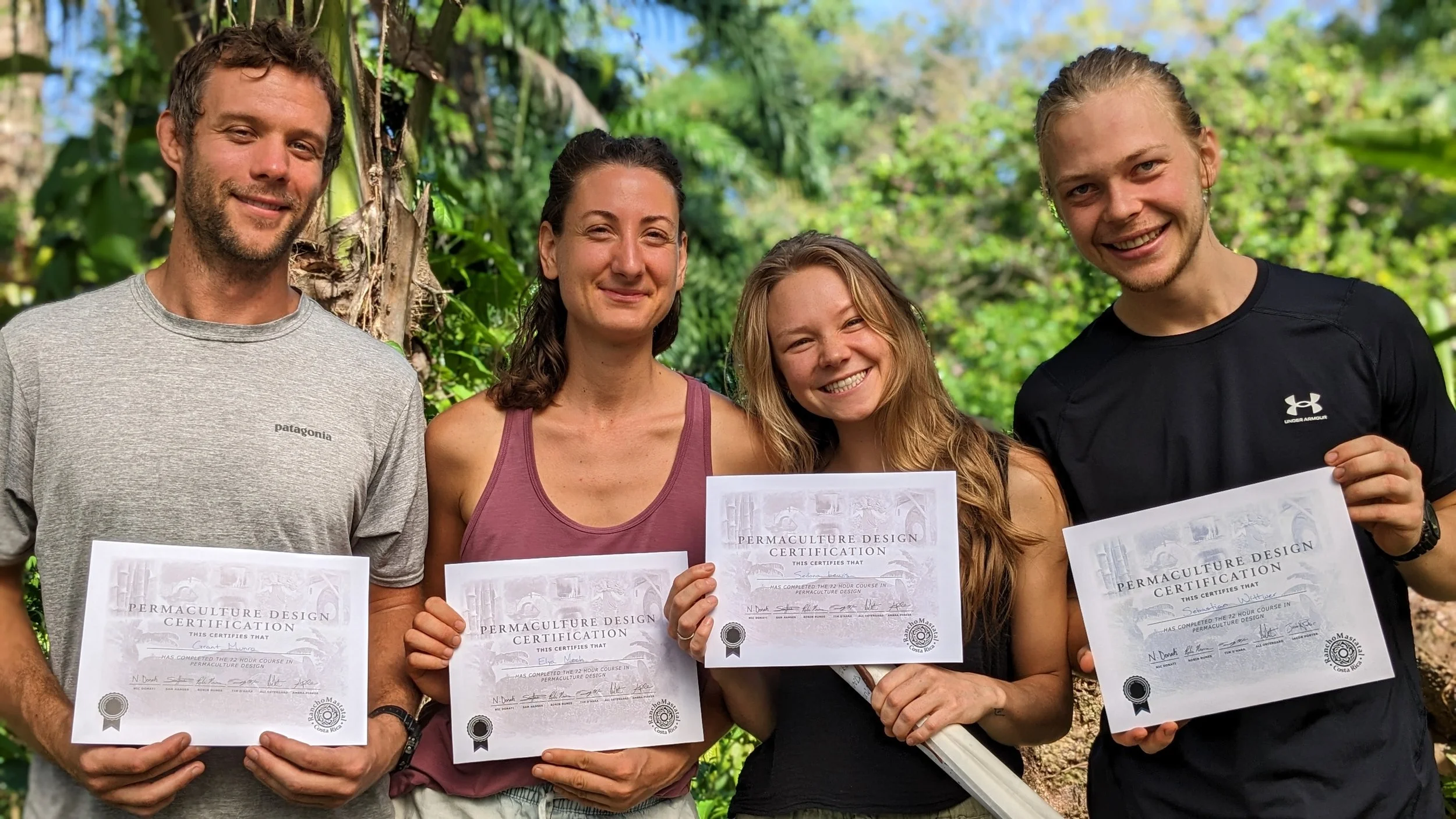
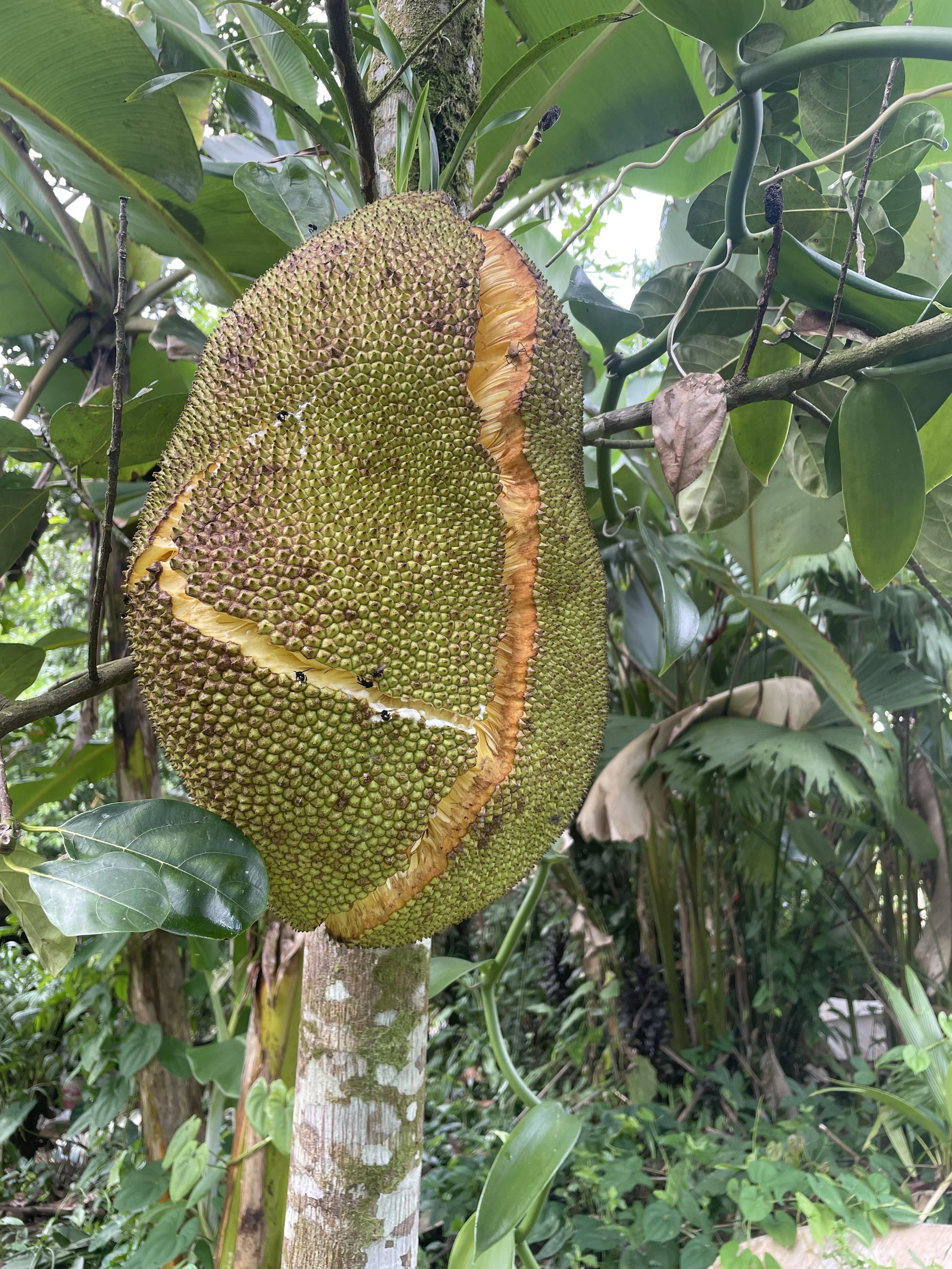
The Fear of Splitting Open, and no, I’m not talking About Jackfruit
The most transformational aspect of this experience, hands down, is the intensity of self-reflection and personal growth that is a natural biproduct of our new social living conditions.
By 2023 apprentice Elya Justina Mech
Living in community as an apprentice at Rancho Mastatal has stirred many changes within me, perhaps more so than the hotter climate, the ever present bugs and stinging things, the new work which challenges my body and mind. The most transformational aspect of this experience, hands down, is the intensity of self-reflection and personal growth that is a natural biproduct of our new social living conditions.

Who am I?
I thought I knew who I was before coming here, having been through many seasons of inner work and change, of death and rebirth. And of course one does not ‘arrive’, finding themselves in a place where the work is complete and the Self ceases to evolve. But there is a unique, accelerating factor of community that hastens this process and perhaps probes a little deeper than ‘regular life’.
Who am I in community?
In the earlier days of my arrival, I was surprised at how my personality took to hiding behind short, congenial answers, shy mouthfuls of food, and letting someone else do the talking. I was afraid to be vulnerable with my new group of apprentices and the core team, let alone the groups of guests who were arriving and departing every week or two and visitors who may join us for just a few days. I had considered myself to be outgoing, silly, confident and eager to speak of matters of the heart. Where did I go?
I recently read a passage of a book that said our personalities develop out of our survival of childhood – we are who we are to continue to receive love and affection. So perhaps unconsciously aware, I was craving such acceptance by my new group of friends/fellow students/housemates/teachers/mentors, and yet was afraid.
What parts of myself am I willing to share? What parts of myself am I willing to be rejected? Or misunderstood? Which of my shadows are being exposed against my attempts to conceal them, the bad habits I know I need to work on, the ones I’d rather not have to face right now? And who am I becoming, in this environment of everything new, who is this new me?

One aspect that has been particularly contrasted for me was the sharing of my artwork and poetry. Before coming to the Ranch, it was my usual habit to share these expressions of myself online or within an already established artist community. I have sold paintings at street markets, posted poetry online, and shared photos of projects I’ve been working on. Sharing bits of yourself to ‘’the whole world’’ although somewhat anonymously, hidden behind a profile is quite different to sitting in the presence of another while you open a part of your soul, vulnerable to their opinion whether spoken or simply felt. I had been meaning to attend an open mic night back home to read some of my writing aloud but I never worked up the courage and continued to find excuses not to get on stage.
But here at the Ranch, I felt a new opportunity stir within me, to be brave enough to share some of my poems that were closest to my heart. Firstly, at our evening Hankey hangouts by fairy lights (‘’The Hankey’’ is one of the natural buildings here which houses up to five of the apprentices at a time), and later at our dinnertime circles at the main house.

Thank you for letting me be brave in this community
I was further inspired by a solo traveller who was kind enough to gift me with a pocket sized watercolour set after our conversations regarding art and writing. I had packed my brushes and a pad of paper but neglected to bring along a vital set of paints. I have enjoyed many afternoons either in my ‘’Annex’’ bedroom (an extension of the Hankey that seems to float among the trees), down at the river or perched in the old honey bee shed among the jackfruit trees and bamboo. Thank you sweet friend.
I’m also grateful for the kind guest and new friend who spent time harvesting fruit with me several afternoons, speaking of our philosophies of life and talking about poetry, favourite books and humble living. I was encouraged to continue working on my books and art and it reaffirmed my desire to live as close to the creative process and Source of creation as possible, that being my true joy.

Thank you for letting me be me in this community
Another new interpersonal experience for me has been learning how to have a bad day around others. No longer being able to retreat fully from the world when I’m feeling out of sorts, I am discovering how to be myself and not put on a mask which is easy to do in conventional living. When someone here asks you how you’re doing, you don’t get away with a simple ‘’fine’’ or ‘’good’’ ;)
Conversely, I have also been learning how to let others have a bad day as well, offering concern and a listening ear but giving space, the understanding when perhaps they are short-tempered with you and being available later for smoothing things over if egos were bruised.

Thank you for letting me be imperfect in this community
At this point, after nearly five months of jungle community living, I’m forgetting what ‘normal’ is, what endless concrete feels like to look at, why billboards exist. The thought of eating dinner alone seems preposterous and I have grown quite used to living with no walls and only a curtain to provide me most of my privacy. (A hummingbird just flew into my bedroom as I write this, so, you can understand the trade-off). I’m still learning how to show up as my best self, allowing the lessons coming my way to be integrated gracefully.
So what profound conclusion can I leave you with? Just one that is not my own and has been said time and time again. Despite the truth in this song I’ve been listening to lately
‘’perhaps the fear of splitting open, showing some parts of yourself that you don’t even really want to –‘’
Be yourself. Bravely, your imperfect self and see what new things unfold.

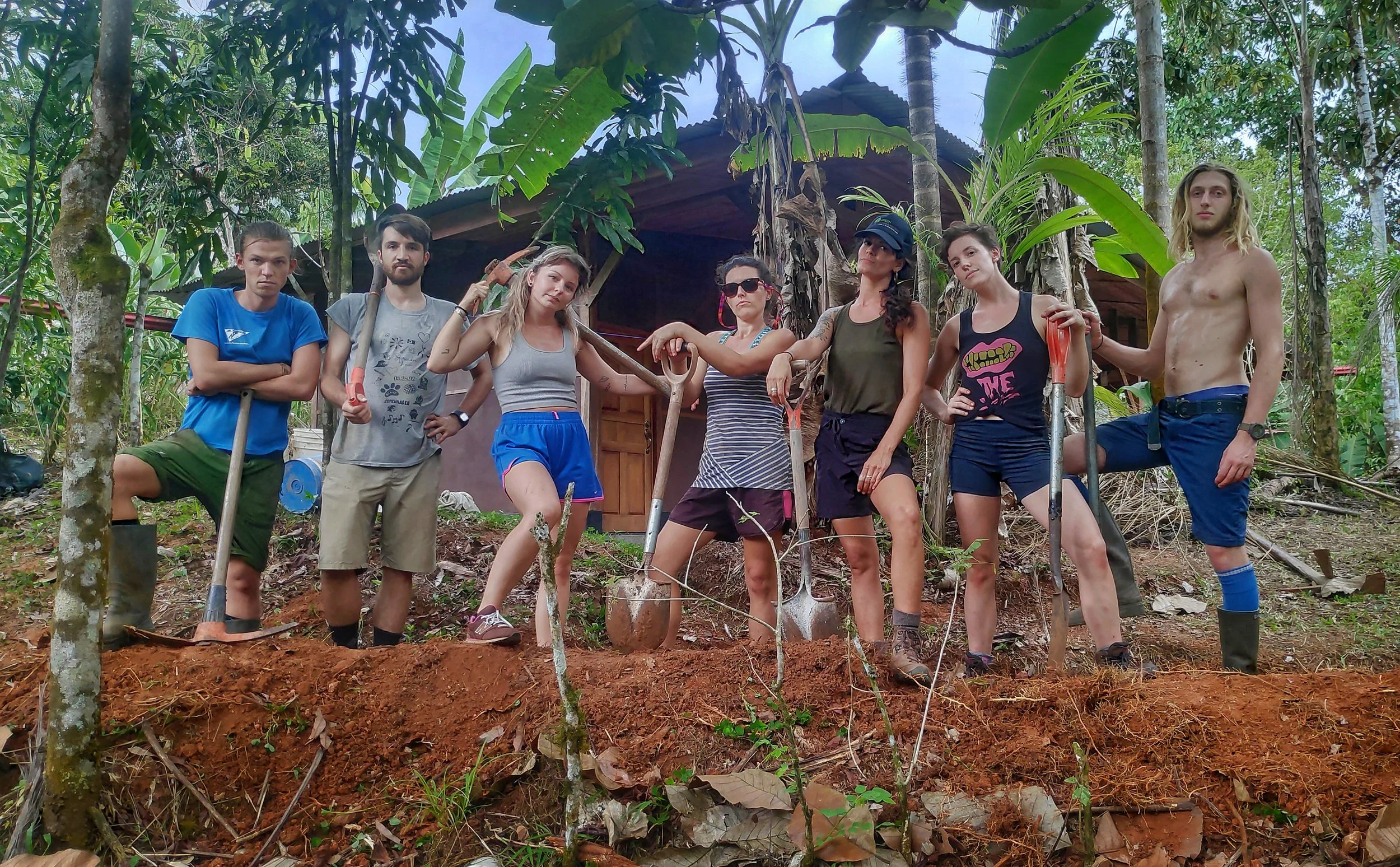
How to Run A Permaculture Internship
Every year, Rancho Mastatal offers a year long apprenticeship and a 2 month long internship for people interested in taking a deep dive into agroforestry, natural building, and farm to table food preparation while living in community.
By 2021 Apprentice Abbey Cmiel
Every year, Rancho Mastatal offers a year long apprenticeship and a 2 month long internship for people interested in taking a deep dive into agroforestry, natural building, and farm to table food preparation while living in community. In the Rancho Mastatal model, all apprentices arrive in January and have 7 months of varied and ongoing learning in all the Ranch has to offer. Then, the apprentices fully organize and run the two month internship in August and September. As an apprentice, this means I had the opportunity to first study and absorb an immense amount of knowledge, and then share it with 4-5 other individuals interested in learning as interns.
When I first learned about this aspect of the apprenticeship I felt quite intimidated. Who was I to run an internship at a center that was not my own on subjects I had not yet learned? But now having completed running the internship, I am extremely proud of our collective ability to offer an educational and entertaining program, as well as grateful for the chance to deepen my knowledge through the leadership role.
My intention in writing this blog is to support others who are interested in starting or developing an internship program at their farm or educational center. Though my experience is somewhat limited, I hope to offer some of the challenges we faced, the successes we found, and my own experience as both a participant and teacher in permaculture immersion programs. Also, I would love to learn about other similar programs and your experiences, so please feel free to reach out!
First, a bit about myself and my experiences of permaculture-based internships. My name is Abbey and I am a 24 year from North Carolina and California. Following college, I signed up for a 10 week permaculture immersion at the Eco Institute in Chapel Hill, NC and fell in love with the integrated lifestyle of a farm and justice based community. Following this path, I then moved to The Occidental Arts & Ecology Center in Northern California where as a year long intern, I helped run the nursery, host activist groups, work in the garden, and organize a permaculture design course. These experiences each brought me to Rancho Mastatal, where I recently finished organizing and running the two month internship alongside my six fellow apprentices.
These combined experiences of living in community, participating in, and running permaculture-based internships have allowed me to see common challenges and successes between them. So, without further ado, here are some of the tips and tricks I’ve gathered over the years.
1. Create a schedule or structure
Most people enjoy having routine or some basic structure to return to, especially when in an unfamiliar location and social setting. Even if what you’re doing changes every day, it’s helpful to have a standing schedule so interns can create expectations. At the Ranch we have two “work parties” a day from 7:30-10 am and 11:30 am-2 pm. We eat our meals at 10 am and 6 pm, and also have set times for sports, meetings, and rest. This makes it easier for everyone to take care of other needs, such as self care, laundry, tool maintenance, phone communication etc. because they know when they’ll have time.
2. Have Established Meeting Times
At the Ranch, we have four types of meetings: square, circle, app/intern/core team meetings, and 1-on-1s. Square meetings happen every morning after brunch around 10:30 am. During this time, one person volunteers to facilitate “reading the board” and we review what we did in the morning, briefly discuss the upcoming day, delegate projects, and go over any simple announcements. This meeting takes no longer than 15 minutes. Any longer form questions or decisions are reserved for “circle” meetings.

Our earthen structure that we hold our meetings in
Circle meetings happen every Friday afternoon and last 1-2 hours. We begin by going around the circle and sharing a 3 minute-ish update on how we’re doing mentally, physically, emotionally, etc. After completing the circle, the space is opened for agenda items that require more in-depth discussion. We use consent-based decision making in which, after discussion, a person will make a proposal. That proposal is then voted on by everyone who chooses to participate with a thumbs up or thumbs down. Thumbs up agreeing to the proposal or willing to live with it, thumbs down having “paramount objection”, something they absolutely cannot agree to otherwise they will leave. This is an abbreviated account of the decision making protocol, read here for a more in depth explanation. Finally, we end by going around the circle and stating an intention or hope for the upcoming week.
Every week on Thursdays, we meet amongst our intern, apprentice, and core team cohorts to discuss any agenda items that pertain directly to that group. This meeting typically lasts an hour.
Lastly, about once a month, we have 1-on-1s in which a “core team” (long term staff or residents) member pairs off with an apprentice to discuss their experiences and how each party can be better supported. While running the internship, each apprentice would pair off with an intern. This is a good time to talk over any challenges, feedback or affirmations each party has. It’s important that time is set aside for a longer conversation so both people feel they are being heard and the person with less authority is comfortable expressing discomforts.
3. Make sure people have enough food
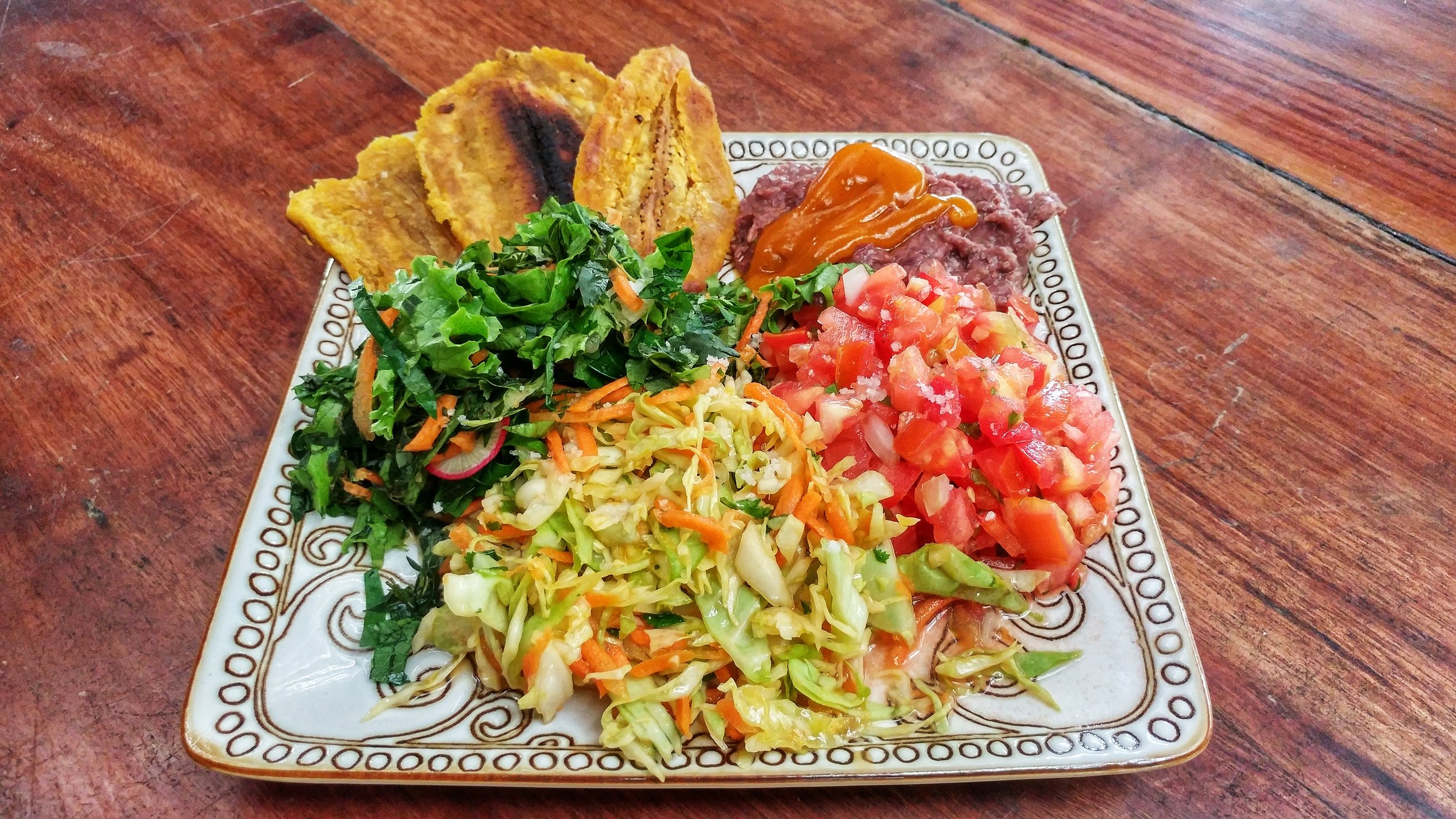
A typical dinner plate
Ah, the near-impossible task of feeding many people with different food needs! Especially if you are hosting a permaculture or sustainability related internship, expect people who are very intentional about their eating habits. Always ask for food restrictions. Be sure to outline what a typical meal schedule looks like so people who are vegan, vegetarian, gluten free, dairy free, and those with other allergies can decide if the program aligns with their needs.
As someone with an allergy to gluten, I am quite used to preparing additional food or being flexible with what I eat. You will find most people with alternative diets are quite good at meeting their needs with little additional input. It is important, however, that they have access to kitchen time or a grocery store. If neither of these are accessible, be sure to outline these limitations.
At the Ranch, we eat two meals a day at 10 am and 6:30 pm. Additionally, hard boiled eggs, leftovers, and bananas always available. We find this two meal a day schedule means much less cooking and cleaning and more time to do what we love!
Create clear guidelines about what food can be eaten for snacks and what is reserved for communal meals. Check in to see people are feeling fed and energized.
4. Distribute cooking and dishes equitably
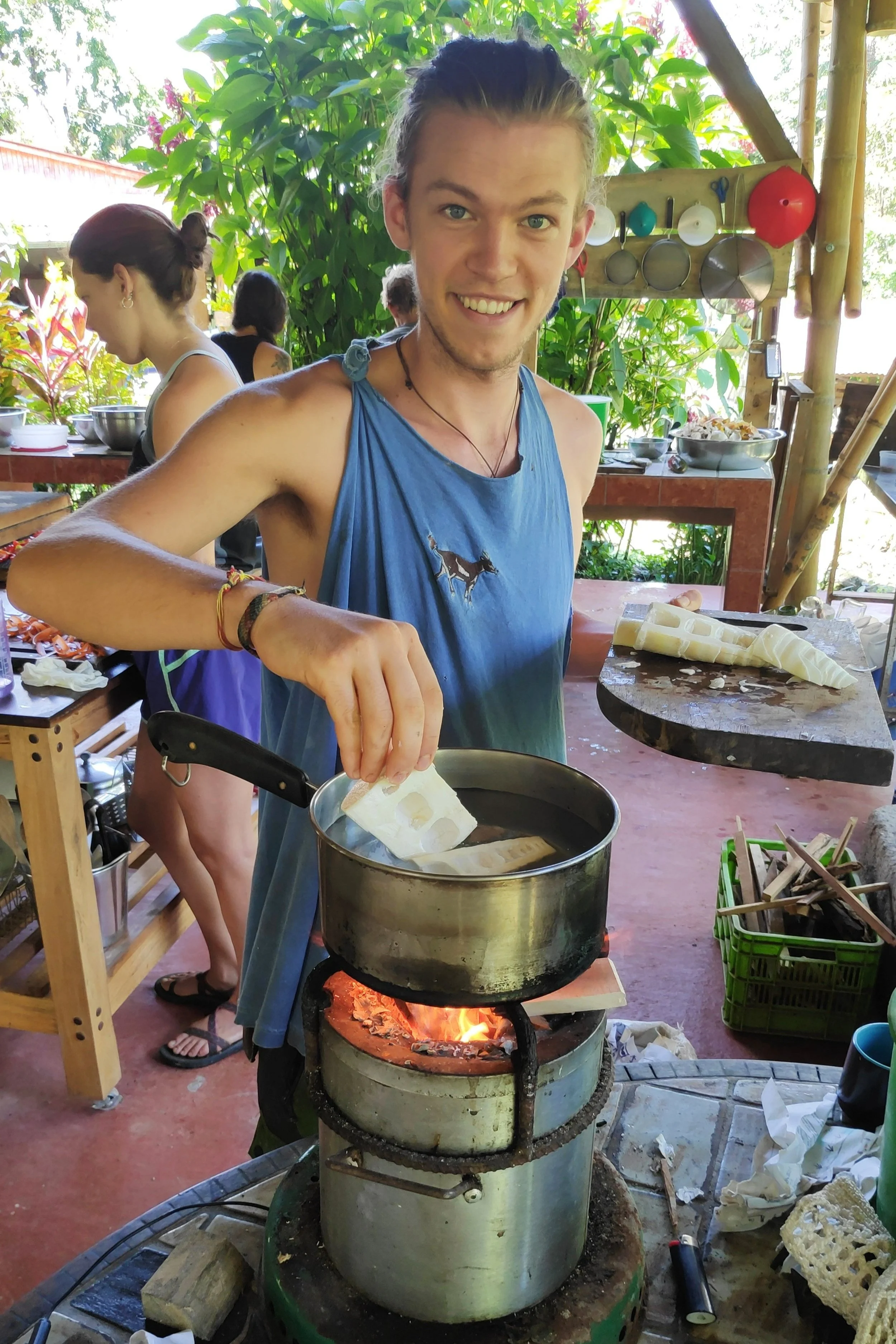
Cooking up some bamboo shoots for condiments
I’ve heard it said before that communities are made or broken by their dish washing systems. At the Eco Institute we had 3 “cook teams” and “dish teams”. The group on cooking would cook all meals for a week. The team on washing washed all serving and eating dishes (dishes other than those used to prepare food) that week. The third group has a rest week. At OAEC, the person on dinner cooking duty also washes the dishes after dinner. Otherwise people wash their own dishes throughout the day. Finally, at the Ranch we rotate cooking and cleaning duties so people have an equal number of cooking and cleaning shifts throughout the week.
If hosting an internship, decide how much of their experience you want to be dedicated to cooking and cleaning. These are formative times for group bonding, but can also be quite time consuming and draining. At both OAEC and the Ranch, we were lucky to have cooking support from local chefs to take on some of the cooking shifts. Especially if interns are paying to be there, it may be worth hiring a cook to help with at least a few meals a week.
5. Don’t underestimate the time and energy needed to have interns
A common fallacy is that internships will be an easy way to make money and have extra labor. Be sure to make a thorough budget to make sure this is actually the case. If interns pay to attend your program, they will likely expect an educational experience as much as a work experience. This requires significant time and energy from staff or a program manager. If they do not pay, they are likely unskilled labor who will require significant training to do the work you might be able to pay someone to do or do yourself much faster. If you decide to take on interns, be sure there are enough tasks that are educational, fitting for their skill level, and meaningful.
6. To charge or not to charge?
That is the question. It’s time for some deep soul searching. Why do you want to have interns? What are the added benefits to your community?
At the Ranch, the core team decided to run the internship program to provide a shorter educational program to the year long apprenticeship, as well as a learning opportunity for the apprentices. Their model is learn, practice, teach, manage. The internships falls in the “teach” section, providing a great opportuniy to hone in their new skills.
Now that you’re clear on the why, what input do you need to make it happen? Is your program designed to be educational or does it require significant labor from the interns? How much will it cost to feed, house, and take care of the miscellaneous expenses for each intern? How much of your labor will go into planning for, instructing, feeding, and managing the group? What is your target market?
Once you factor in the time necessary to teach interns, you may realize it is quite “expensive” to have them there. How might you be able to offset some of the costs? Can you apply for grants or host a fundraising dinner and silent auction for a scholarship fund, particularly to support marginalized groups in attending your program? Can you create a set up where longer term apprentices run the internship?
7. Get out there!

Going on field trips to our local farmers
One of my favorite parts of our internship was planning field trips to connect with nearby farms and neighbors. During the two months, we organized a trip to the “trapiche” where our sugar cane is milled, to our neighbor who keeps cows and supplies us with milk and cheese, and went on day hikes to the waterfalls and mountains nearby. All of these trips, combined with playing sports in town and cooking with locals, help paint a larger picture of the community we’re a part of and mix up group dynamics.
8. Give Interns a sense of autonomy
More and more, highly educated and motivated people are seeking out farming and permaculture immersions. As a result, you may attract very intelligent and independent individuals to your program. Make sure there are ways for people to take on individual responsibility and challenge. At the Ranch, we each have morning community contribution skills such as chopping wood, preparing salads, tending the garden, etc. Additionally, we have the opportunity to submit project proposals to take on larger independent projects on our own. This allows people to express themselves individually and find pride in their work.
Personally, I have taught weekly yoga classes for the community, led vermicompost workshops, and led many gardening and permaculture sessions for our interns. These individual tasks allowed me to deepen my knowledge and share it with others.
9. Practice nonviolent communication or otherwise encourage open communication between participants
At the beginning of the apprenticeship and internship at Rancho Mastatal, we create a collective community cultural agreement for how we will interact with one another and then sign it. Additionally, we taught nonviolent communication modules (based on Marshall B. Rosenberg’s Nonviolent Communication) to encourage open communication around the conflicts that naturally arise when living in community.
10. Create a comprehensive document with expectations and packing list before arrival
The more you can set expectations coming in the better! Send pictures or thorough descriptions of the housing, food, work expectations, visitor policy, phone policy, the larger community, etc. Supply a thorough packing list with any items that will be helpful during the internship. If you are able, set up a text, email or WhatsApp group with the interns in advance so they meet one another and ask questions.
11. Make sure everyone has enough rest and alone time
At the Ranch, we have free time every day from 2 pm - 6:30 pm. This is a great time to work on independent projects in the orchards, woodshop, food smithery, and kitchen. Additionally, we have a large library with fiction, nonfiction, and educational books to deepen our learning experience. Most days, a group meets at 4 pm to play sports or do yoga. The key is that people have a choice whether to interact with others or take time for themselves.
12. Organize special events & find time to celebrate!!
Woohoo! You have done the hard work of bringing together a group of amazing people and creating a super special intern program. Now find the time to celebrate! We have made a practice of gathering for new and full moons, the equinoxes and solstices, birthdays, and other special days. Something as simple as playing music, having a small party, making a fire, watching a movie with popcorn, or baking a cake with local ingredients can allow people to feel socially and emotionally fulfilled. Isn’t that why we all want to live in community anyways? Support any ideas your interns have for fun and creative gatherings. A field day, trivia night, or tea party are all great ways to bond and be silly together.

The yearly talent show
I am infinitely grateful to the centers and people who have opened their doors and arms to me as an intern or apprentice. I hope this article empowers you to do the same so we can continue to build purposeful, skilled, and joyful communities together!
Check out these past blogs on Community Living
Enriching Community Soil: 5 Simple Strategies That Support Sustainable Relationships

5 years on: an apprentice story.
It’s approaching five years since I started my apprenticeship at Rancho Mastatal. Looking back at the last five years lot of life has been lived, with many joys, personal development breakthroughs, and vulnerabilities, that at times felt so heavy, or were unbearably light.
By Anthony Wijeyeratne (Shea), Apprentice 2015
It’s approaching five years since I started my apprenticeship at Rancho Mastatal. Looking back at the last five years lot of life has been lived, with many joys, personal development breakthroughs, and vulnerabilities, that at times felt so heavy, or were unbearably light. However my time in Mastatal was a game changer, I came from an office environment to a ranch in the jungle, which eventually led me to find my passion for food that I turned into a farming career. I hope this is just the beginning of an ever-expanding life involved with food.

Being disgruntled and immersed in office culture, I felt my life was stagnant, and I needed a change. An opportunity presented itself, when I got an offer to be an apprentice at Rancho Mastatal. I accepted without hesitation and embarked on a year-long journey to learn about sustainable living.
My time at the ranch I met many amazing, and talented people, learned a set of skills that applies to a lot of what I am doing now, and got an amazing hands on education in cooking, fermenting, natural building and various system designs. However the biggest takeaway was from silencing myself, and turning into a listener, and observer. The Ranch gave me an opportunity to learn not just from great instructors, but also from my self, and about myself. It thought me how to be bored and turn that boredom to an enjoyable solitude of productivity, and critical thinking, which changed and expanded my perspective on everyday happenings in my day-to-day life. I was reading more books than I had ever read, which made me appreciate learning in silence so much more, and as well, I explored my creativity in the world of food, and writing.
I’m sure there are many positive testimonials about the ranch, but this is important, because it shaped me in getting to where I am now. Currently I am farmer for the YMCA, growing fruits, veggies and flowers for a 70 plus member CSA on a small-scale 3.5 acre farm. I have also decided to put myself in a vulnerable position to start my own business, and lease a piece of land to grow my own specialty veggies for restaurants.
Being vulnerable willingly can be difficult, but it can also be rewarding, and I learned a lot of that at the ranch. Pushing through jobs I wasn’t keen on or interested in, having difficult conversations with fellow apprentices because communal living can be straining, and coming across bittersweet realizations on the many realities of how being sustainable is difficult, and sometimes not the best or obvious option. My romancing, created a vulnerability I didn’t see coming, I was in a strange paradox. On one hand I was ideal and ready to learn and demonstrate the virtue of sustainability, on the other hand I was naïve, and ignorant to the realities of it, and that sometimes being sustainable won’t be the best option. This was a necessary realization, and the good folks at the ranch demonstrated, that they are not perfect or do have the best systems, but they try, and sometimes you have to compromise, and maybe later on down the road there will be an opportunity to remove yourself of that compromise.
Allowing my self to be vulnerable and crawling out of the vulnerabilities was at times how I felt my world needed to be. This can be both good, and bad. Good because I was determined to see my situations for what they were and learn, and improve from it, and finish what I started. It also helped me to be more resilient and resourceful. Bad because I was willingly accepting these vulnerable circumstances without critically thinking if there was a better option, and almost putting myself in a repetitive mental cycle. It almost brought me to a place where I gave myself a low ceiling.

My first farm experience after my year at the ranch was an internship at Foxglove Farm in British Columbia, where I earned a meager stipend of $500/month with room and board. This I romanticized, and it was easy to. Foxglove was a beautifully manicured farm with intelligent systems design that really showed me what the potential of and efficient and effective small-scale farm is capable of. But Foxglove also kicked my ass. I always felt I got drafted as a hot prospect and turned out to be a dud. I had no idea what I got myself into, and it was so overwhelming and much more physically demanding than I anticipated, I really wasn’t sure if I fit in this world. The only thing I knew is that I had to finish the season, keep trying and most of all learn. Although my time at foxglove came to premature end in September, I was determined to finish the season off, and found employment on another farm. In a strange way it was a weird accomplishment.
I came back to my home province of Ontario, determined to have a presence in the world of food. In the offseason, I worked at a restaurant and applied for various farm hand positions. Somehow I got offered a position growing vegetables for an order of Canada Chef. I don’t know how? I took the job because it was glamorous and exciting, but I made myself immensely vulnerable yet again. The farm barely had any infrastructure for growing crops. No nursery, no irrigation, no washing station, and old farm equipment that were not effective for the soil I was working on. Also, what am I doing growing veggies for one of Canada’s best chef’s? This could ruin me if I mess up. To add to that we had the wettest spring on record, and fell further behind on planting. On top of this, I discovered the strain of lightness, Growing veggies and putting in the labor, no problem. Being patient and allowing things to unfold however was unbearable, and to make it worse the chef and his staff were amazing individuals who made an amazing effort to integrate me, which created some guilt, and pressure to not let down these wonderful people. Somehow, it worked out. It wasn’t ideal, but I did it on my own, and was able to produce quality food, for a nice 10 week run.
The following season I moved closer to my family and got my job with the YMCA. I decided on the YMCA, because of my two past experiences. One was a model farm, and the other was one starting from scratch. The YMCA on the other hand is a cross between the two previous. It’s a young developing farm with descent infrastructure and equipment, which allows me autonomy to grow, experiment, and develop with the farm. There is an expectation of growth every year, in terms of clients, food, and revenue. These are puzzles that motivate me to not settle and create plans to try and improve if there is a sensible way to do so. In my short time at the YMCA I have helped spearhead ideas to grow more food, on less land, to manage better, and yield less waste, and to put a sustainable stamp to protect and nourish the land, which grows the food.
Through all the changes and the difficulties since my departure from Mastatal, the internal skills I acquired from the ranch, never left me. I have a greater thirst for continuous learning, and my resilience to persevere and finish what I started is at its highest motivation ever. This wouldn’t have been possible if not for my time at the ranch, and the relationships that I forged with the ranch and its directors, especially former ranch director Scott Gallant, who has been a great mentor and friend since I left the ranch and returned to Canada.
I feel at this point, sky is the limit for me, and being vulnerable gives me the opportunity for great discovery and virtue. Oddly enough this is how I feel about food, and it makes me romance and idealize about breeding new varieties of veggies, growing mushrooms, making art by way of grafting fruit trees, fermenting everything, and cooking just for the sake of, “I wonder what that would taste like”. It’s the same MO, but I’m better prepared to listen to the outcomes of the actions I take, and solve the puzzles that come my way.

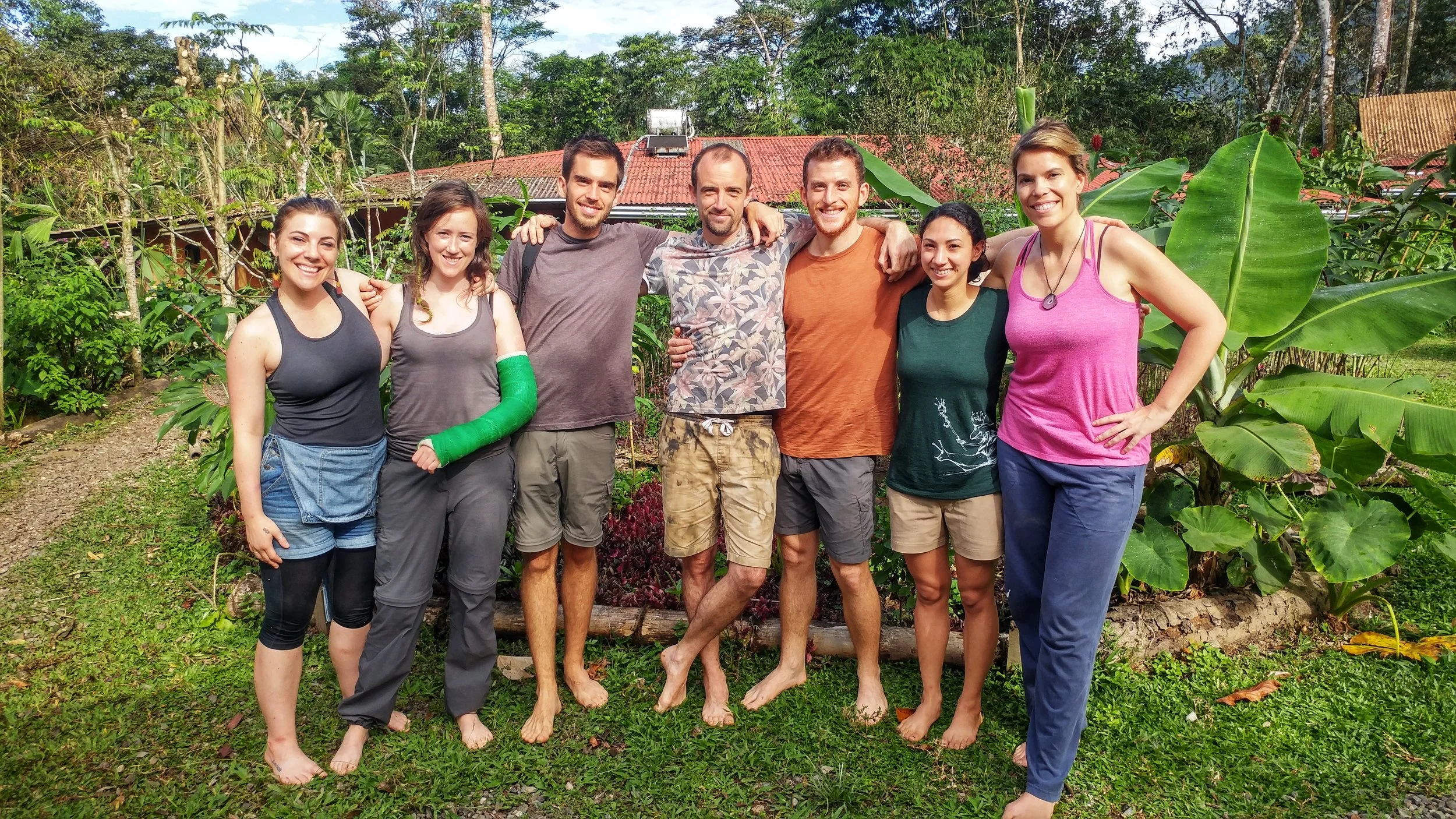
Life after the Ranch (Part 1: Day to Day Life)
The Ranch experience for me was completely life changing. This is the common feedback that is given from anyone that has stayed there, whether it was for a day, or a year. This place gets under your skin and awakens something inside you that makes you think differently.
By Marrissa Taylor
2018 Apprentice
The Ranch experience for me was completely life changing. This is the common feedback that is given from anyone that has stayed there, whether it was for a day, or a year. This place gets under your skin and awakens something inside you that makes you think differently. There is something very special about being given the space to learn, to question and to experiment with new information and skills. For the first 6-8 months we received a lot of training and workshops and in the second part of the apprenticeship we were all encouraged to take on our own projects in areas of interest, as well as continue the regular tasks and projects that we needed to do to contribute to the functioning of the Ranch. This was a great life balance – as you can never get away from the things you need to do to survive – but you can look at the ‘doing’ in a different way. So yes, you need to haul and lift the heavy bags of wet cow dung, then make a daily poop soup out of them to feed the Bio-digester. Most of us at the beginning did not look forward to our rotation on the Bio-D, but once you do it, and it becomes a part of your daily life. Something shifts.. You start to understand the extremely amazing system you are working on. That this task you are doing kicks off a very cool, yet simple, process of fermentation. The results of this both provide fuel you can feed 50 people on, and manure that you can feed your veggie seedlings with. It is at this point you also start to notice the tiny little delicate mushrooms that seem to magically come from nowhere, and how the birds congregate around the piles of manure for the worms underneath. Then finally in yourself, the smells that use to repel you suddenly become the smell of the earth at work, and the peace that surrounds this space is teaming with curious life. You learn to observe and experience the world differently. Something inside of you shifts… this is the Ranch.

One of the signs at the Biodigestor
Life after the Ranch, after this shift in perspective can be jarring for sure depending on where you are going. For me it was heading home to the cold winter of Canada. My newly strong body, my heart full of peace and nostalgia of leaving the Ranch and all my wonderful friends that are as close to family as you can get, now to enter the ‘real world’. This world is fast, full of social media, tv series bingeing conversations, food whose ingredients are barely recognizable and a taste that can only be described as chemical. Although it is balanced off because it is lovely to be reunited with family and friends and the familiar. It is as this point that others start to notice… you also start to notice, you are different now. Something inside you has shifted… You have an understanding of the effort that it takes to bring that food to your plate. How harmful the gobs of packaging is on the environment. You know what real un-chemically treated food tastes like – and even how that taste is further enhanced when you plant it, nurture it and wait expectantly for it to be ready to harvest. You have also spent the time on the ranch relatively disconnected from the web so the incessant surfing does not appeal like it used to. You crave real conversations, face to face, and even miss the gratitude dinner circle as you come to realize it is not common place to say thank you to people (even strangers) genuinely in the day to day. Something inside you has shifted…

The 2018 apprentice team
After the farm, I needed to find a job. It was the dead of winter and going to a farm was not an option. So I looked for casual work in my old career in international development. I ended up getting a 3 month contract in South Africa, so I left the cold. A part of me felt really guilty. I was ‘selling out’ on my farm life just to go back to my old career. Some of my other apprentice group were able to continue working on a farm – they could do it and they were happy for the most part. What was I doing?? So when I was offered a longer contract that also came with a feeling of major guilt. I needed to look at this opportunity differently. What I came to realize as I now sit in my new home in the mountains of Eswatini (Swaziland).. something in me had shifted and this cannot be defined by what I do on my daily, but rather how I do it – whether it be making poop soup or working with vulnerable communities – I have changed. I see and approach my life is differently. It is more whole hearted and with a sense of curiosity I did not have before.
On a practical note, there are permaculture groups EVERYWHERE in the world! So I am building linkages with some of these groups so that I can still continue to learn and connect in this way. I will have my own land one day, but until then I will continue to practice what I have learned when I can, teach what I know when I can.. and be forever grateful for how my experience at the ranch has shifted something in me.
Marissa

Why Permaculture?
What is Permaculture?
Permaculture is the design system for creating sustainable human environments. In a modern society, which is not sustainable could permaculture hold a solution?
by PJ Barton
2019 Apprentice
During our Apprenticeship at Rancho Mastatal we spend a year immersed in a working example of how Permaculture can work on a practical level. We take several workshops throughout the year including the annual Permaculture Design Certification (PDC).
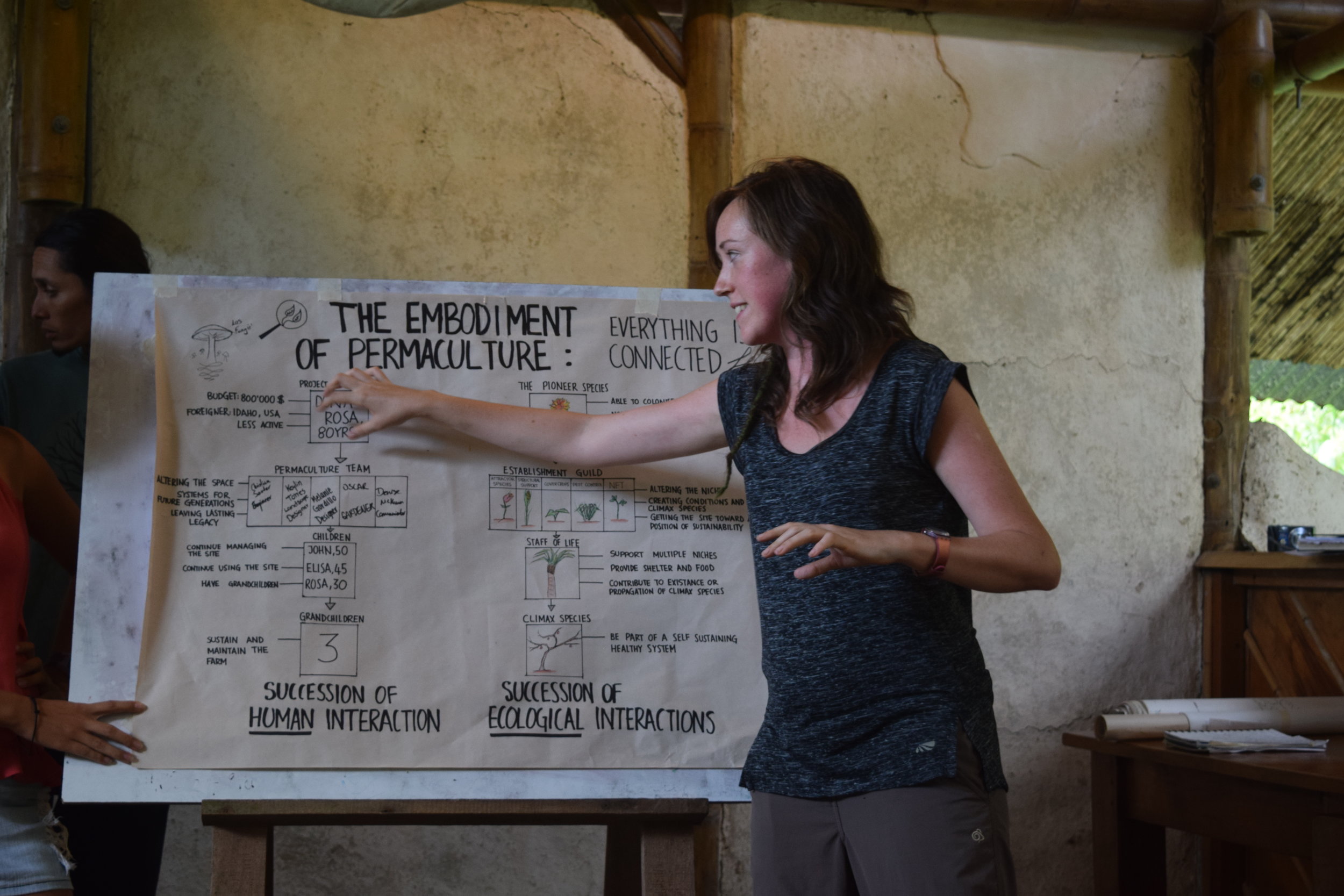
Presentation at the PDC
What is Permaculture?
Permaculture is the design system for creating sustainable human environments. In a modern society, which is not sustainable could permaculture hold a solution?
Permaculture was coined in the 1970s by Bill Mollison and David Holmgren, the word is a contraction of permanent agriculture and permanent culture which are intertwined in our history as a society. By pulling both culture and agriculture into our attention we a focusing on what the relationship is between them, how they function together as a whole. Permaculture looks at meeting the needs of the present in harmony with our environment. Although it is designed as a agricultural practices it also can be applied socially. The broad framework means it can include multiple parts of our society linking things together and how they function as a whole.
The 3 Core Ethics of Permaculture
1. Care of the Earth
Care of all living and non living things. By applying this ethic we can appreciate all organisms on earth. Invisible to the naked eye are all the mico-organisms upon which life is built; everything is alive. It is not obvious at first that a plant is breathing and under its roots there's an incredible network of organisms working together. If we view all things as beings our attitude and relationship will change towards them, developing respect for what we interact with.
2. Care of the People
As a society/ individual we need to meet our basic needs as humans: food, water and shelter. Considering our basic needs while creating systems that can sustain us in the long term. Permaculture uses these basic needs to design systems that can hold solutions for the growing inequality that is gathering pace on a global scale. Modern systems don't focus on care instead they're driven through profit. Many of our social programs designed to care for the less fortunate are being dismantled in an effort to create more profit; looking after one another and care are given little time into our busy society.
3. Contribution of Surplus
This ethic is a way of circulating the wealth back into the system. In a our conditioned society, rather than circulating wealth it is common to hoard it - the idea of spending all of your wealth is a radical idea, when is enough money or wealth enough to have surplus? By reinvesting surplus, it self perpetuates the movement. The system would be regenerative constantly sustaining itself. Like any system if you continually extract resources without replenishing them it will eventually collapse. When the needs of a society are not met from within the system we look to extra energy inputs and ultimately pay the price in increasing energy consumption and its resulting pollution.

The ethics of permaculture give us another way to view the world which is perhaps different from modern, conventional society. Observing and approaching situations guided by these ethics permaculture can be applied to help us steward the earth and guide our activities in a better direction. Our fragmented society often misses the connection that helps it function as a whole seeing only the tip of a large iceberg. Sometimes we make connections but fail as a whole. Moving together, finding patterns that work and what needs to be improved. We are surrounded by nature who we can observe and mimic. She becomes our inspiration helping us establish sustainable systems. Perhaps that is why we should use permaculture.
For more information about Permaculture check out some of the excellent free resources on David Holmgrens website get involved in you local permaculture movement and consider taking a Permaculture Design Certification near you or with us!

Tropical Brewing
The craft brewing movement has migrated to Central America and the Caribbean. A growing number of small scale artisanal producers are building on the American Craft Brewing tradition by incorporating local spices and fruits into traditionally brewed ales. To distinguish themselves, from their temperate counterparts, they are adding a tropical flare and creating innovative flavor combinations
by Connor Harron
The craft brewing movement has migrated to Central America and the Caribbean. A growing number of small scale artisanal producers are building on the American Craft Brewing tradition by incorporating local spices and fruits into traditionally brewed ales. To distinguish themselves, from their temperate counterparts, they are adding a tropical flare and creating innovative flavor combinations. For example Domingo7’s Maracuyá Pale Ale (that’s Spanish for Passionfruit) in Costa Rica, Ocean Lab’s B.O.B. - Blood Orange Blonde in Puerto Rico and Lu Bru’s Maiz Azul (Blue Corn) Ale in Mexico all demonstrate how local producers are beginning to incorporate regional ingredients into local craft beer movements. This is surely a positive development and one that leads us to consider other ways we might be able to further highlight local and seasonal ingredients into craft beers.

These efforts will help to make brewing both more sustainable and position craft brewing as a vehicle for more thoroughly exploring terroir, which describes the potential for fermentation to be used as a method of expressing the unique environmental conditions of the places in which our ferments are produced. By using exclusively local ingredients as well as wild captured yeasts, we have the power to capture the unique flavors of seasons and regional differences that allow for near infinite variation and creativity to explore new combinations of flavors that are rooted in cultural tradition while simultaneously pushing the frontier of artesian brewing. As much as I love finding good craft beer in places like Mexico and Costa Rica, I constantly find myself asking if it really makes sense to be brewing beer with imported German Barley and Hops from the Pacific Northwest United States when there are such a plethora of sugar sources and bittering herbs available locally in nearly every corner of the globe. Could we instead develop beers using a hybridized process and create products that are truly local while still maintaining the key characteristics that make beer, beer?
Speaking of, have you ever asked yourself what it is that really makes a beer? It turns out, the answer really depends on who you ask and where you live. In the most general terms, beers are fermented from carbohydrate rich starches (typically grains such as barley) that first need to be enzymatically converted into simple sugars and extracted into a liquid malt before the substrate can be fermented to produce appreciable levels of alcohol. Wines and Ciders on the other hand, are fermented from fruits and simple sugars that can be fermented into alcohol with limited or no processing. In the case of beers, bittering herbs such as hops are commonly added to provide antimicrobial properties, improve shelf stability and add complex flavors to ferments. In the United States, it turns out that hops are not required in the production of beer and that there are many malt substitutes that are allowed in the production of beer, including “rice, grain of any kind, bran, glucose, sugar, and molasses (TTB Ruling, 2008).” This definition is actually quite liberating, and creates the opportunity to experiment with non-traditional malts and bittering herbs in ways that will promote creativity and improve the sustainability of the craft brewing market globally. This flexibility in malt production will be especially important given that recent climate models suggest that the regional distribution of barley production will become increasing restricted over the next 20 years (Nature, 2018).

In Costa Rica, we have been experimenting and finding repeated success using a wide range of local ingredients including banana, corn, rice, cacao beans, coffee and local cane sugar for producing malts. Corn and bananas, for example, both have long cultural traditions of being used in the creation of local beers. In Eastern Africa, Bananas have long been used to create malt for the production of banana beer (Urwaga or Mubisi as it is locally known). Bananas make for an interesting malt base because they fall into a relatively unique category of fruits that when ripe are rich in both simple sugars and complex carbohydrates that can be easily fermented into a strongly alcoholic brew while maintaining a mouthfeel that is remarkably similar to beer brewed from barley. When the ripe bananas are boiled for several hours, the sugars begin to caramelize, transforming the flavor of the malt into a sweet, neutral flavored base that remarkably, tastes very little of banana, making it an ideal substrate for mixing with bitter herbs or other local products such as coffee and chocolate that can be fermented into either an Ale or Stout like brew.

Conversely, in many parts of South America, but perhaps most notably in Peru, Maize has been used for centuries to produce a corn beer called Chicha. Unlike barley, which when sprouted produces a large concentration of Amylase Enzymes (the key types of enzymes needed to convert complex carbohydrates into fermentable sugars), to make a corn beer, these enzymes need to come from another source. The indigenous peoples of South America developed an ingenious solution to this challenge when they discovered that chewing the cooked corn would transform the starchy, carbohydrate rich grain into a sweet masa that could then be re-boiled in water and strained to create a fermentable Wort made purely from Maize. Although many foreigners cringe when they first learn about the process, for the Inca’s, it was a powerful community building practice that would bring people together to sit around the fire, alternating between sharing stories and laughter while chewing the cooked corn and then depositing all of the masa into a large pot. Although they almost assuredly could not have fully comprehended the transformations that were taking place, their solution was so ingenious because human saliva is packed full of the enzymes needed to break down the carbohydrates in corn into fermentable sugars. I experimented with the traditional process a couple years ago, and I have to admit it was a powerful community building process that for me, took the idea of collective fermentation to a whole other level. Talk about terroir!
The problem with the traditional process is that it is incredibly labor intensive. If you are lucky, like me, you might be able to convince your friends to help you chew a few pounds of corn once or twice for the novelty of the experience, but you are likely to be hard pressed to find a consistent source of labor to chew through the many pounds of corn you will need to produce even a few gallons of Peruvian style Chicha. Fortunately, today we have access to many sources of amylase besides our saliva. As it turns out, ripe bananas (and in particular, ripe banana peels), contain a very high concentration of the same amylase enzymes needed to convert the starches in Maize into fermentable sugars. If you think about it, this actually makes a lot of sense. Unripened green bananas and plantains are a very starchy staple food crop that is used culinarily in a similar fashion to potatoes. As the skin yellows and the banana ripens however, the banana naturally transforms those carbohydrates into simple sugars that make dessert bananas so pleasant to eat directly out of hand.
Due to the high concentration of amylase enzymes present in ripe banana peels, they can be dehydrated and pulverized into an enzyme rich powder that can be mixed with ground maize and water and then mashed similarly to a barley based beer between 140-160 F for 2-24 hours (depending on the ratio of corn to powdered banana peels used) before being strained and boiled to make a fermentable wort. You’ll need to taste the Mash or use iodine strips to determine when the conversion has been completed. There are actually lots of fruits and vegetables that are rich in amylase enzymes. Sweet potato, for example, has such a high concentration of these enzymes that its peel is often used in the commercial production of Amylase.
Alternatively, instead of using the enzymes present in another product, it is also possible to ferment grains with certain types of molds that consume starches and in turn naturally produce the enzymes needed to convert the grains of carbohydrates into fermentable sugars. In Japan for example, Aspergillus Oryzae (or Koji as it is better known), is a humble yet miraculous mold that has been grown on rice for millennia in order to sweeten the rice and make Sake. It is also the key ingredient for making naturally brewed Soy Sauce or fermenting Miso due to the rich diversity of enzymes Koji produces that not only sweeten carbohydrate rich foods, but also break down proteins into amino acids that are the basis for savory foods and the flavor of umami. Due to these impressive properties, koji has now made it’s way out of Japan is slowly become increasingly familiar around the globe. This is assuredly a wonderful thing, because it has now been well established that Koji can be grown on a variety of substrates and virtually any grain, including rice, barley and corn, making it an ideal candidate for assisting in the brewing process anywhere on Earth.

To further explore local flavors and novel combinations, while boiling our worts we have been experimenting with using a variety of local bittering herbs and teas to add complex flavors to our beers, including ginger, turmeric, lemongrass, vanilla and many others. During either primary or secondary fermentations, we use nylon mesh bags weighed down with boiled volcanic rocks to infuse fresh fruit from the farm such as Pineapple, Soursop, Starfruit, or freshly roasted Cacao Nibs, just to name a few examples. Finally, by fermenting our beers with mixed cultures, wild captured yeasts and/or locally adapted strains, we have been able to produce ales with several layers of harmonious flavors, which provide depth and complexity that is only possible to achieve with mixed culture fermentation.
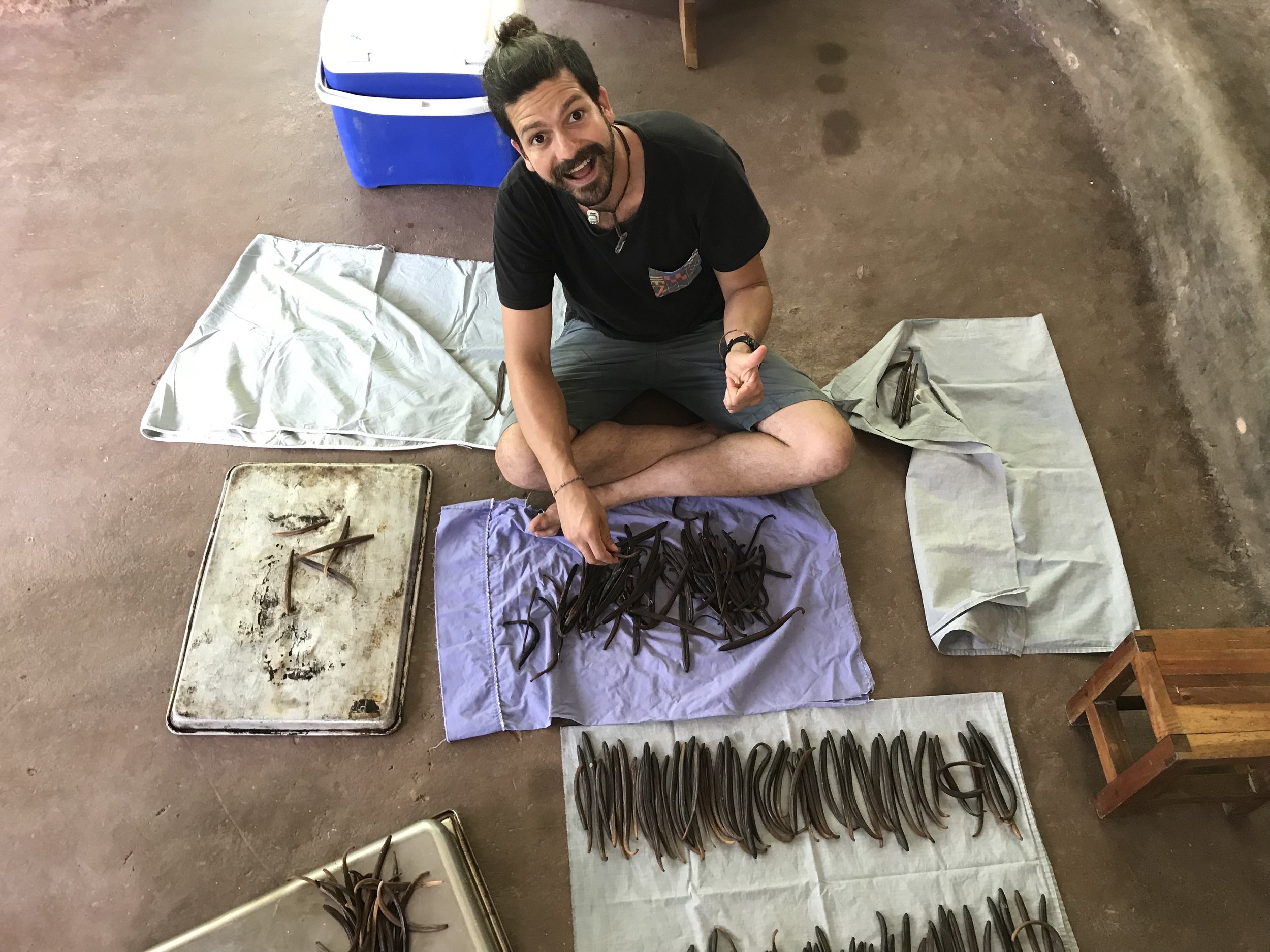
I would not have believed what a powerful role yeast and bacteria play in the creation of complex beers and wines when I first started brewing over a decade ago. Now however, I have learned first hand just what a difference the cultures we use can make. The experience of trialing yeast captured off of different fruits and flowers has led me to encounter flavors I never would have dreamed possible. Some have certainly been on the far side of the funky extreme, including cultures that produce the dreaded odor of sweaty feet or burnt rubber. This however, is exactly the reason for small scale trials rather than placing our faith in large scale spontaneous fermentation. Once you discover the joy of fermenting a simple malt of dissolved sugar or Dry Malt Extract with wild yeast and tasting apples, pears, or other citrus fruits magically appear in the finished product, I believe that like me, you will never want to use a commercialized yeast strain on it’s own again.
I believe that by drawing from the richness of our cultural traditions around the world, we have the potential to greatly expand the breadth of our palates and to more intimately link our brews to the time and place in which they were crafted. The craft brewing revolution is still in its infancy and if I am to have a part of to play in it’s development, then Ginger Hibiscus Sake Hybrids, Banana Coffee Stouts, and Mayan Chocolate Ales will be just the tip of the iceberg.

If you would like our simple Hooch recipe, read our blog article with step by step instructions. If you want to learn more about the wild world of fermentation consider joining us for our year long apprenticeship where apprentices go deep into advanced fermentation techniques.

Dairy Dairies: How to Make Cream Cheese with Dairy Kefir
Dairy Kefir is so interesting to me because it embodies stacking functions - like alchemy, it's possible for 1+1 to equal 4. Milk, grains (scoby) and a days time and voila, you have a delicious base product better than the milk you started with. It's now lightly carbonated, stable in the fridge, resistant to microbial incursion, lower in lactose, tangy, creamy, probiotic and great for your gut.
By Ryan Roberts
2019 Apprentice
That's right folks, we're making cheese with the champagne of yogurts.
Dairy Kefir is so interesting to me because it embodies stacking functions - like alchemy, it's possible for 1+1 to equal 4. Milk, grains (scoby) and a days time and voila, you have a delicious base product better than the milk you started with. It's now lightly carbonated, stable in the fridge, resistant to microbial incursion, lower in lactose, tangy, creamy, probiotic and great for your gut.
Furthermore, that stable base product, can be used to create a wide variety of different specialty products that carry with it those unique value-added characteristics that we impart with our time, energy and expertise. During our last diary entry, we discovered Dairy Kefir Creme Fraiche, which you can read about here . This time we'll be making luscious, spreadable and customizable cream cheese out of dairy kefir.
In our first diary entry we discussed dairy kefir's characteristics and how it's made. You may recall that the dairy kefir scoby acidifies the milk as a defensive (or offensive) measure against other microbial life, which have difficulty surviving with such a low pH.
I've discovered for myself, though I don't claim to be first, that we can utilize that acidity to accomplish what is usually done with rennet, vinegar or citric acid: separating the curds (fats) from the whey (protein). Though the exact function of this process is unknown to me, the result appears to be the same. Left for a few days at room temperature, reveals to me that the dairy kefir will separate on its own. But there's a trick!
While leaving the scoby in the milk will speed the process of acidification, we want to be able to easily separate the scoby from the curds and from the whey. We do this with a sieve that catches only the grains, allowing the kefir to flow thru to your ready container. When the kefir is left to ferment longer and it separates, it makes it difficult to capture the curds and grains separately.
Instead, I remove the grains from the dairy kefir prior to separation. The dairy kefir will continue to acidify, though slower, but you'll be left without the headache of hunting thru the curds for your grains.
So starting with the previous step, here are the steps. Now that you have your dairy kefir and scoby separate we can begin:
1. Make your dairy kefir. Follow the instructions laid out in my first blog entry here (link 1st blog).
2. Remove scoby and place in a container with fresh milk.
3. Secure cheese cloth around the rim of a tall container. Make sure there is room for whey to drip to the bottom and accumulate.
4. Pour dairy kefir into fine cheese cloth hanging over the container.

5. Wait 24 hours, allowing time for the remaining whey to drain from the curds. I repeat this process a few times till it quits draining from gravity. The remaining cream is our cream cheese. The live-culture whey can be used in a variety of ways, including starting new ferments by inoculation, using as a probiotic protein supplement, and for cooking with in soups.

Dairy Kefir Cream Cheese

Whey - delicious for soup stock
6. Spread the cream cheese out on a pan with a rubber spatula. Sprinkle in salt and your choice of herbs or dried vegetables. Imagine sun-dried tomatoes, garlic, onions… yes please!

7. Now fold the cheese onto itself, repeatedly, which helps to mix the ingredients in evenly.

8. Place in a container and serve. Buen Provecho!
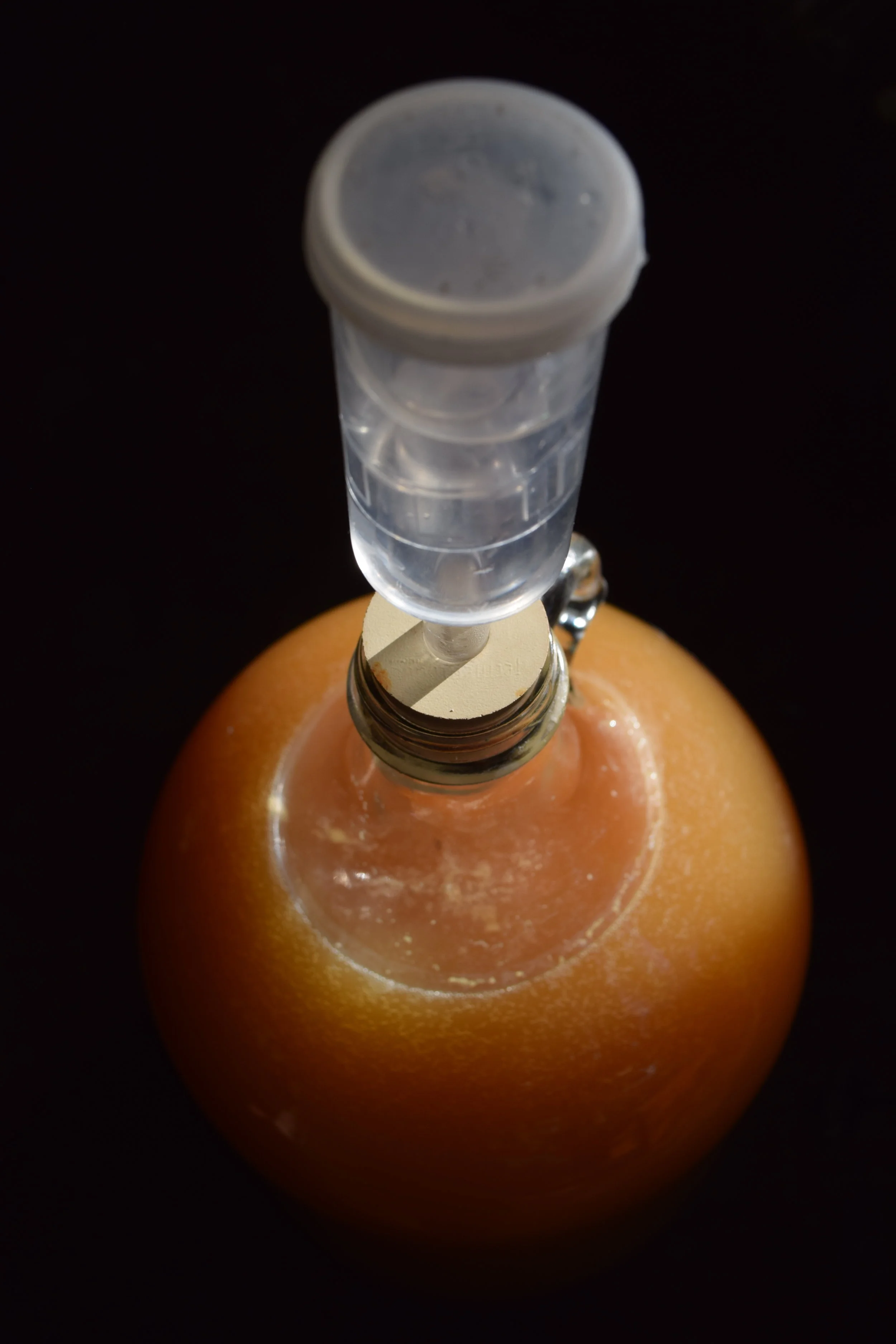
How to Make a Simple Hooch
Hooch is a homemade alcoholic beverage and in this blog I’m going to explain how to make it.
For thousands of years humans have been fermenting for recreational, spiritual and medicinal uses. Fermentation allowed humans to store and use ingredients they’d harvested later in the year. Although hooch is an alcoholic beverage, it can also be brewed for medicinal purposes.
by PJ Barton, 2019 Apprentice
Hooch is the name we use to refer to our own homemade alcoholic beverages. In this blog I am going to explain how we make our delicious home brew. Interested in Fermentation? join us for our upcoming workshop THE ART OF FERMENTATION.
During the peak season at Rancho Mastatal we drink around 15 gallons of Hooch a week. We brew our Hooch in Corny kegs, these are great as they are made of stainless steel, they are easy to clean and easy to maintain as you can easily purchase all of the replacement seals.

Our Corny Kegs
For thousands of years humans have been fermenting for recreational, spiritual and medicinal uses. Fermentation allows us to safely store ingredients without the need for refrigeration and prior to the advent of electricity it was the primary way to store certain foods and drinks. Although hooch is an alcoholic beverage, it can also be brewed for medicinal purposes, by adding herbs and spices with the desired properties. By actively harvesting fresh fruits and yeasts from our surrounding area, creating and exploring new brews, we are able to connect to our environment in a fun and practical way. Hooch is a great way to use up fruits which are already naturally fermenting and processing them into something enjoyable to consume, turning our waste into something useful.


Yeast is a culture that is one of the base ingredients for making Hooch. It feeds on sugars when we mix it with sugar and water creating carbon dioxide and alcohol. We can buy commercial yeast strains, which are sold for brewing or we can harvest our own wild yeasts from our environment. Different wild yeasts will impart different flavors and characteristics to our homemade brew, try experimenting with these wild yeasts and see which ones produce flavors you enjoy most!
Harvesting Wild Yeast
To harvest wild yeasts from fruits and flowers
Collect them in a sterile jar and leave in a dilution of 20 percent sugar to water (eg 40g of sugar to 200ml of water).
After 48 hours (although this will depend on the ambient temperature), sediment should start form on the bottom of the jar, bubbles will start appearing, and your solution will begin to ferment. this is a sign of a healthy solution!.
Remove the fruit or flower from the liquid.
Continue feeding with sugar every day for a week and you will have you own yeast culture that you can use to start brewing with.
Basic Hooch recipe
This basic Hooch recipe is really simple and uses 3 simple ingredients. You can add fruits or herbs to extract the taste that you desire. There are many opportunities for experimentation when you start making your own alcohol and hopefully you can create delicious beverages to enjoy with your family and friends.
Simple recipe to make your homemade hooch:
For a 2 gallon batch
· 2 pounds unrefined cane sugar (we use Tapa Dulce)
· 2 gallons of water – 1 gallon tea
· 2 cups of wild yeast solution (see above instructions on how to harvest wild yeasts)

Tapa Dulce
How to prepare:
Melt the sugar into a gallon of hot water, until the sugar has dissolved.
Mix in the remaining gallon of water to help cool off the sugar water, make sure you cool it down to 100F degrees. This process is creating a wort in which you pitch the yeast.
Once the liquid has cooled down pitch the yeast. Stir it well and transfer it to a container with an airlock for a minimum of 1 week before consuming
This is a standard hooch consumed on the ranch other enjoyable combinations such as coca, vanilla and ginger or oranges, cinnamon ginger. In every available resource there’s a new taste to explore. Enjoy and have fun experimenting
Want to learn more? Join us for a day workshop or a longer residential workshop


Gardening and Permaculture practices at the Ranch
Here at the Ranch the year long apprentices have various roles and functions that support the Ranch community. By taking on responsibilities and managing certain areas we the chance to learn and experience those areas on a deeper level . Part of the educational model created by the ranch team is a monthly rotation of these so called life skills. Each apprentice transitions their life skill to the next apprentice, passing on all of the relevant information to their colleague in order to complete the various tasks associated with each life skill.
by Diana Dagash
2019 Apprentice

our front gardens
Here at the Ranch the year long apprentices have various roles and functions that support the Ranch community. By taking on responsibilities and managing certain areas we the chance to learn and experience those areas on a deeper level . Part of the educational model created by the ranch team is a monthly rotation of these so called life skills. Each apprentice transitions their life skill to the next apprentice, passing on all of the relevant information to their colleague in order to complete the various tasks associated with each life skill.
One of the life skills is currently called the Garden Gnome. I would like to share some of my experience and reflections from doing this task every morning for a month. The garden gnome is in charge of maintaining the front gardens. This is referred to as our zone 1 garden using permaculture lingo. It is the area that is in closest in proximity to the most frequently used space- the main house. In the Zone 1 gardens we grow herbs, annual and perennial crops such as mustard greens, katuk, Haitian basket vine, hibiscus, cucumbers, squash, yard long beans,wing beans, radishes, sweet potato, moringa, basil, oregano, mint, parsley and curry leaf and other amazing tropical goodies which we use in our kitchen everyday. Having these crops growing in close proximity to where we spend most of our time allows us to easily provide the daily maintenance of this space such as watering, harvesting and weeding.
In Rancho Mastatal we approach gardening through a permaculture lens. By mimicking the patterns in nature we are able to create micro climates in which our crops thrive. We create systems that have many functions and support other systems in their functions, allowing them to thrive in harmony with nature. We apply a range of those practices at the ranch and we continue learning and experimenting with new possibilities.
Given that we live in the tropics we have two opposite seasons, about half the year its is dry and the other half rainy. Although the dry season has its own challenges I can only speak from my own experience taking care of the garden in the rainy season, for instance i believe that in the rainy season there is a lot of weeding whereas in the dry season there is a lot of watering!
As the rains increase in volume and frequency it is a time when everything begins to grow rapidly. The jungle fills up with even more green vegetation, popping out of every space available. It rains consistently every afternoon , sometimes all day and night. The soil is saturated . It is a happy time for ALL living things to thrive, including some of the more challenging species like mold, fungus and insects. Some of our crops were over taken by fungus or eaten by insects, others became over saturated with water as they were lacking sun and/or air flow. As with every challenge, i found an opportunity to research and experiment with natural recipes for pest and fungus control.
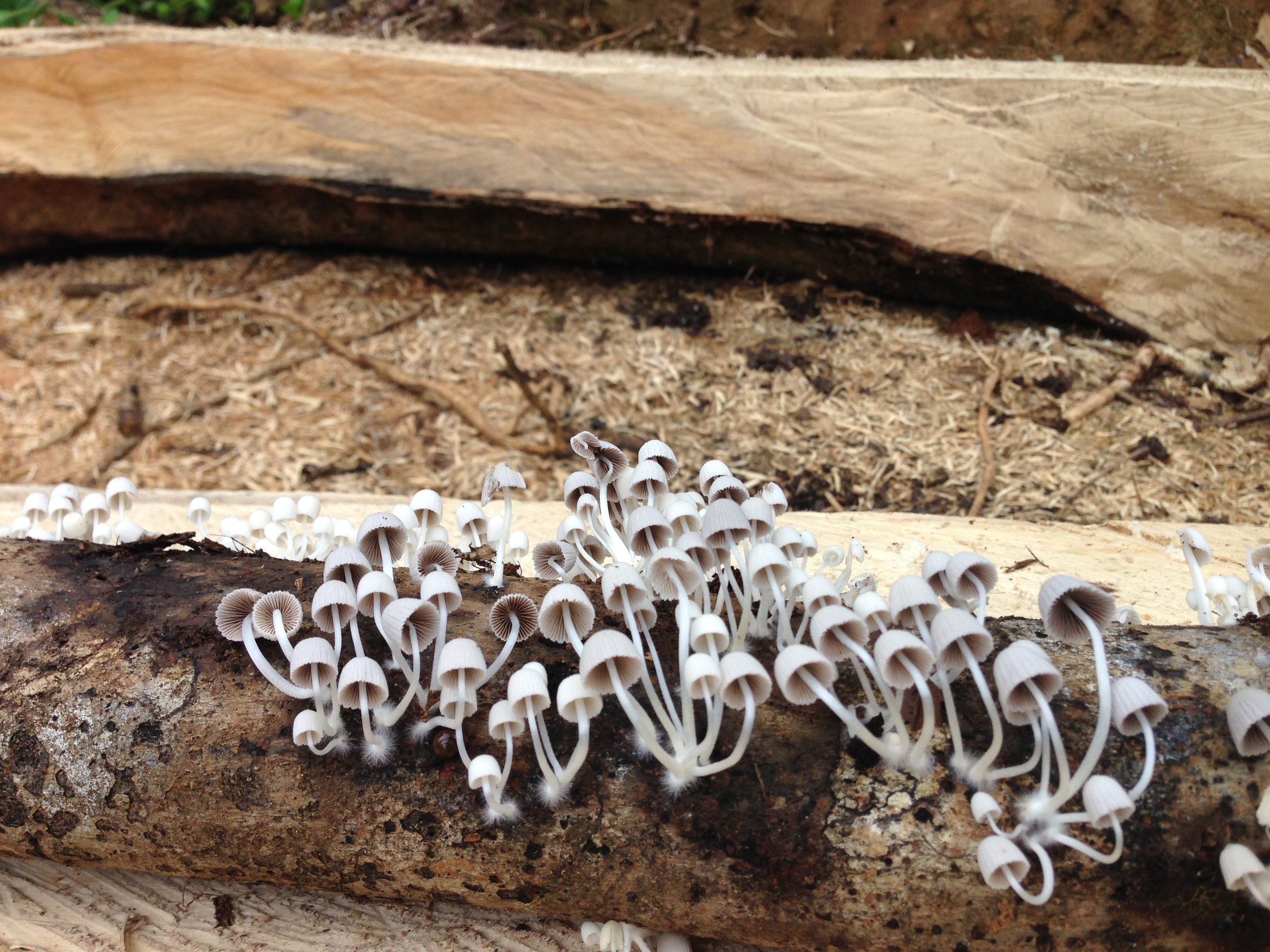
with the onset of the rains, mushrooms started popping up everywhere
My days started early in the mornings with a walk through the garden, observing the plants and checking the soil moisture levels. As I walked I noticed plants that seem to be struggling and tried to identify what might be affecting them. This is then communicated with the garden manager so we could discuss further ideas and solutions. We researched potential natural insecticides and fungicides that could help solve these issues.
Here is some of what we have learned and the practices we apply here at the ranch.
We are surrounded by amazing medicinal plants growing all around us, thriving under the jungle canopy or occupying disturbed pockets. These plants contain medicinal properties that can benefit humans as well as plants.

For example turmeric contains anti-inflammatory and antibacterial properties beneficial to humans and when planted among the roots of a tree, benefits the tree with those same properties This is referred to as companion planting. By planting diverse species next to each other they are able to support, protect and ultimately benefit one another. This can be as simple as providing shade or wind protection. Not only can companion planting by a useful tool in our belt to fight against disease and pest pressure but we can also use the properties of some local herbs. Here are some examples of what we have been doing.
Jackass bitter - the most bitter herb known, contains antifungal and antiparasitic properties. Spraying this tea onto diseased plants can repel insects and prevent fungal issues.
Inter cropping aromatic herbs like oregano, lemon grass and basil with certain food crops can confuse and repel insects with their scent and prevent disease with their antimicrobial and antifungal properties.
Using the shade of the cucumber trellis to help shade and shelter more delicate herbs underneath them.
Using peanut grass as a living mulch to crowd out weeds and provide nitrogen to the soil underneath some of our taller perennial crops such as Katuk and Cranberry hibiscus.
Planting Marigolds everywhere to reduce nematode populations, there is controversy about the effectiveness of this though.
Working in the front gardens has also made me reflect on the ideas of closed loop systems. As i am partially responsible for management of the kitchen compost. I really like the idea that there is no such thing as waste. Everything can be transformed into something useful. All of our food scraps are composted creating a finished compost that can then be added back to the soil to enrich it, closing the loop.

Another big part of the practices we apply when it comes to the food forests is observation of the environment and meeting the land's needs by mimicking patterns in nature. Thanks to all the researches and life long practices in the agro forestry and gardening world, a network of knowledge has been created for us to share our experience and knowledge. We are continuously learning and working towards improvement of our systems.
With each piece of land we carry the responsibility for the history, present and future of it. It is up to us to create a relationship with our land, to observe it's needs and potentials.To be stewards of the land and assist it to become a healthy ecosystem in which we can humbly live and feed ourselves.
This experience, of being an apprentice at Rancho Mastatal, has opened my eyes to a new world of possibilities, inspiring ideas, regenerative solutions, discovering new ways to live lighter on the planet and in harmony with nature .
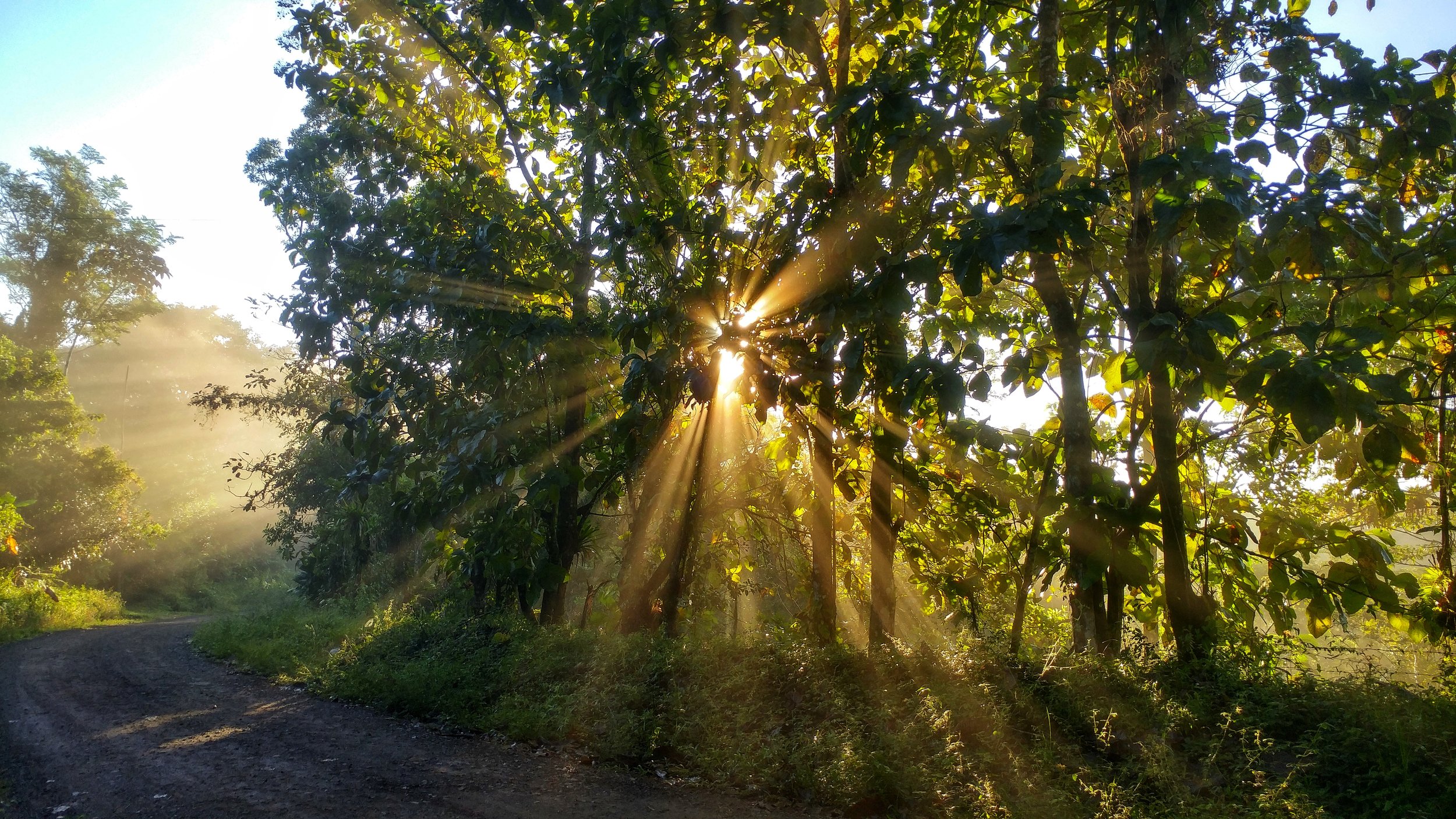
I am inspired by the movement towards an ecological , sustainable lifestyle and feel grateful to be a part of a project that focuses on sustainability, permanent culture and agriculture.
I invite you to share your experience and discoveries with growing food in the lowland tropics.
What interesting practices have you learn about recently?
Which annual crops did well for you in the tropical rainy season of Costa Rica?
What kind of companion planting worked well for you?
Would love to hear from you!
Blessings,
Diana D.
For more information about Permaculture consider joining us for our Permaculture Design Certification. For info about being an apprentice please go to the apprentice page. Here you will find in depth descriptions of what life is like in Mastatal.
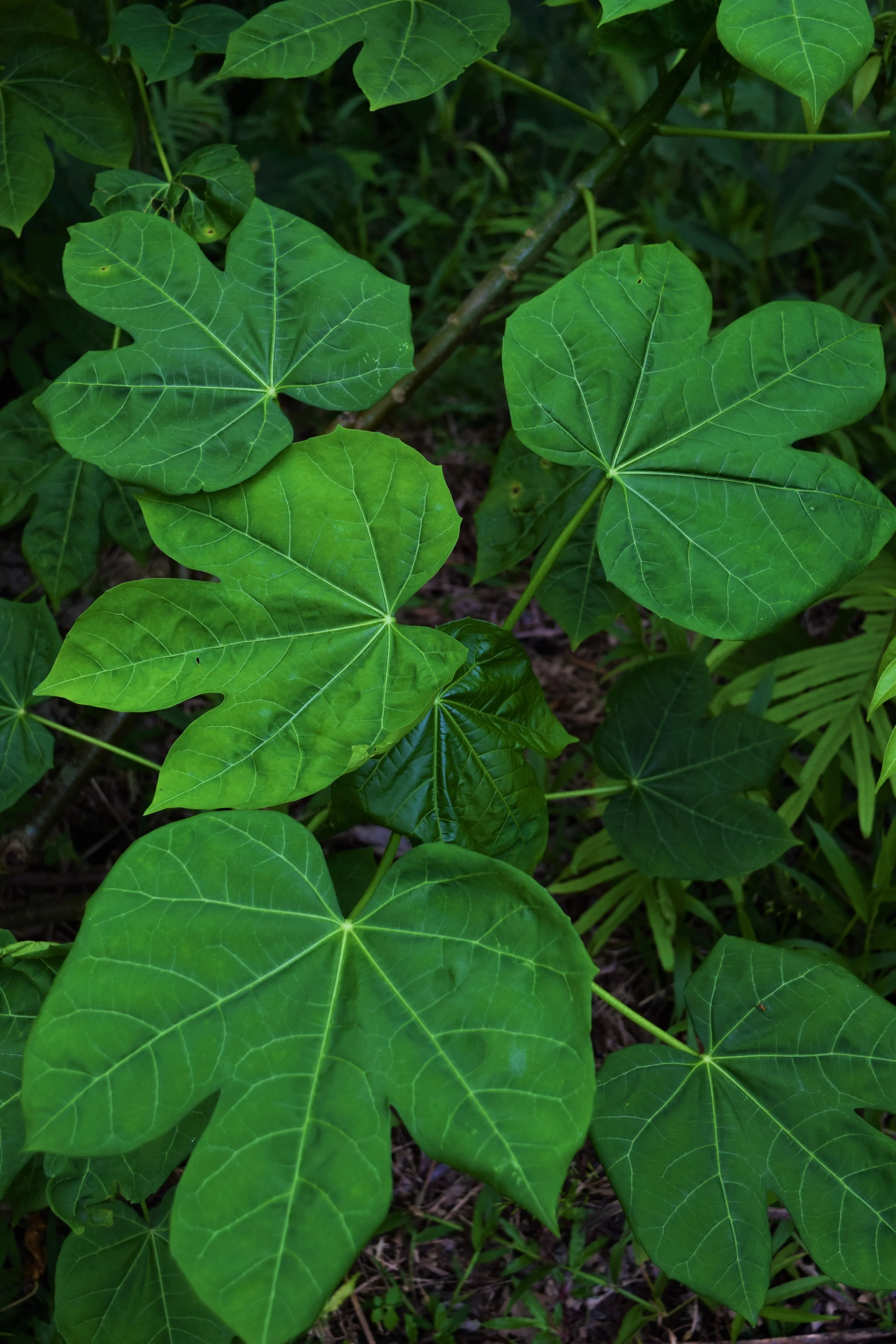
Vegetables & Greens that Thrive in the Tropical Rainy Season
When the rainy season arrived, it started with a sense of relief - dry season went on longer than expected and our trees and plants were scorching in the heat. For myself the cooler air was welcome comfort, and the rains a reminder of home and getting cozy. Mornings were beautiful with the sight of the sun rising through the dewy mist.
By Amy Dodds,
2019 Apprentice
When the rainy season arrived, it started with a sense of relief - dry season went on longer than expected and our trees and plants were scorching in the heat. For myself the cooler air was welcome comfort, and the rains a reminder of home and getting cozy. Mornings were beautiful with the sight of the sun rising through the dewy mist.
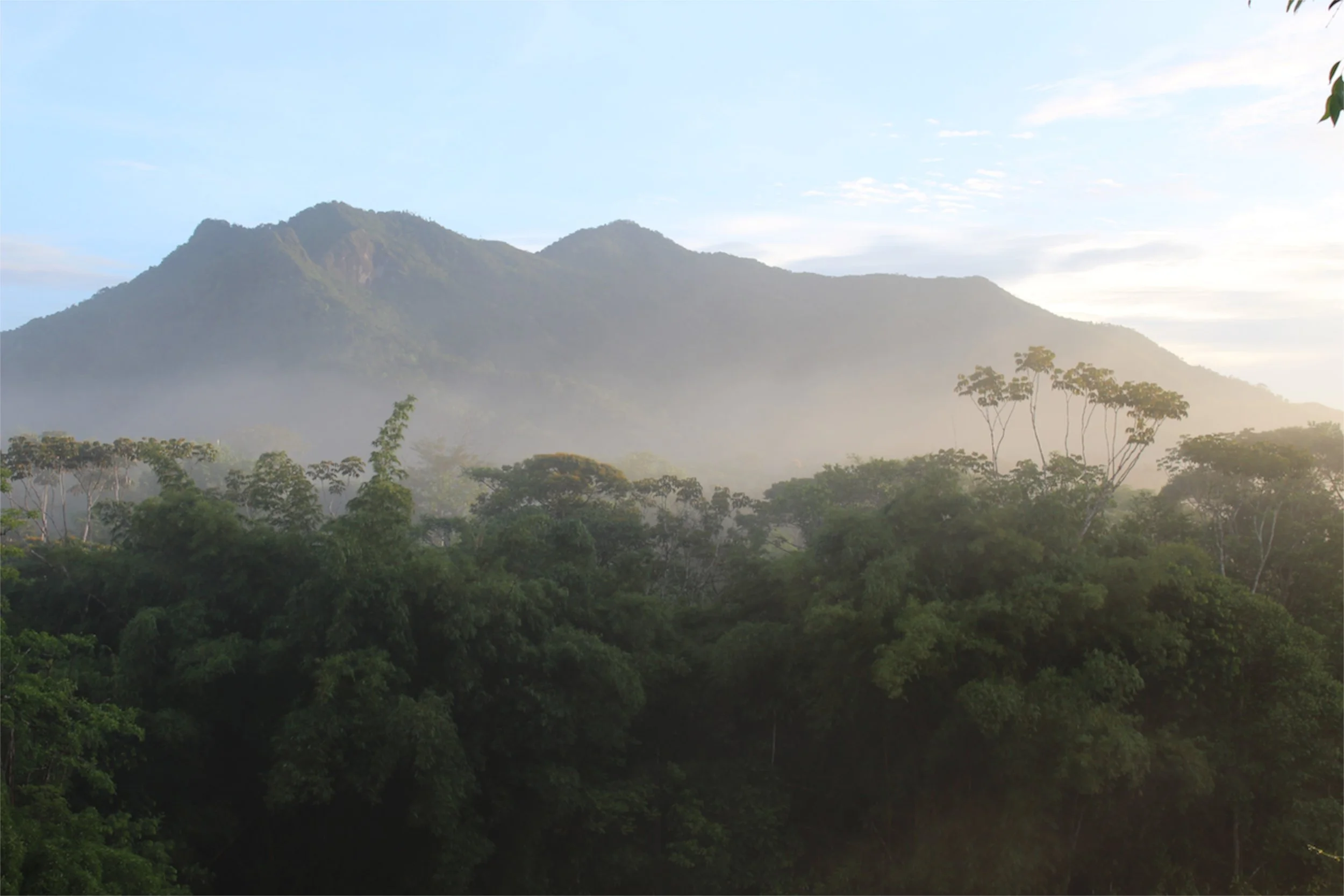
But very soon our zone one vegetable gardens with our recently planted greens began to suffer - the sheer force of the rains and the humidity brought fungal and mildew issues. Faced with the reality that our beans and delicate greens were going to die out, I thought about the potential of using cover crops, such as sweet potato, for the rest of the year. But this did not seem to fit in my idea of what permaculture asks us to do: observe and interact with the environment we are situated in and use that to our advantage. With this in mind, we at Rancho Mastatal have been planting crops that thrive both in the intense heat and thumping rain. Below are some of the most popular vegetables that we are growing in the Ranch that are suitable for the rainy season:
Cucumber:
Cucumbers have been abundant in our garden this season with us pumping out quick pickles nearly every day. Not bad for a community feeding 30-40 people daily! Thankfully, cucumbers like warm, humid weather. We grew ours by seed on a trellis to allow for more air flow and for the fruit to stay above ground.

Okra:
Described as among the most heat-tolerant vegetable species in the world. It is planted for its seed pods which can be cooked, pickled, eaten raw, or included in salads. It does become mucilaginous so do consider this if you're sensitive to the slime.
Kang Kong spinach:
This leaf green is native to southeast Asian and is delicious stir-fried with soy sauce and garlic. It is a semi aquatic plant, a creeper that grows in or near the water on moist soils, so it is ideal for our climate.

Hibiscuses:
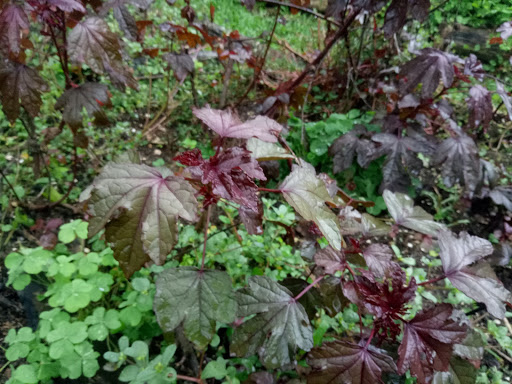
Both Green and Cranberry Hibiscus are delicious perennials that thrive in the warm and wet. They self seed easily during dry season so when the rains come you have a whole bunch of babies to keep your salad zesty and fresh. The leaves do contain oxalic acid so cannot be consumed in large, consistent quantities.
Chaya:
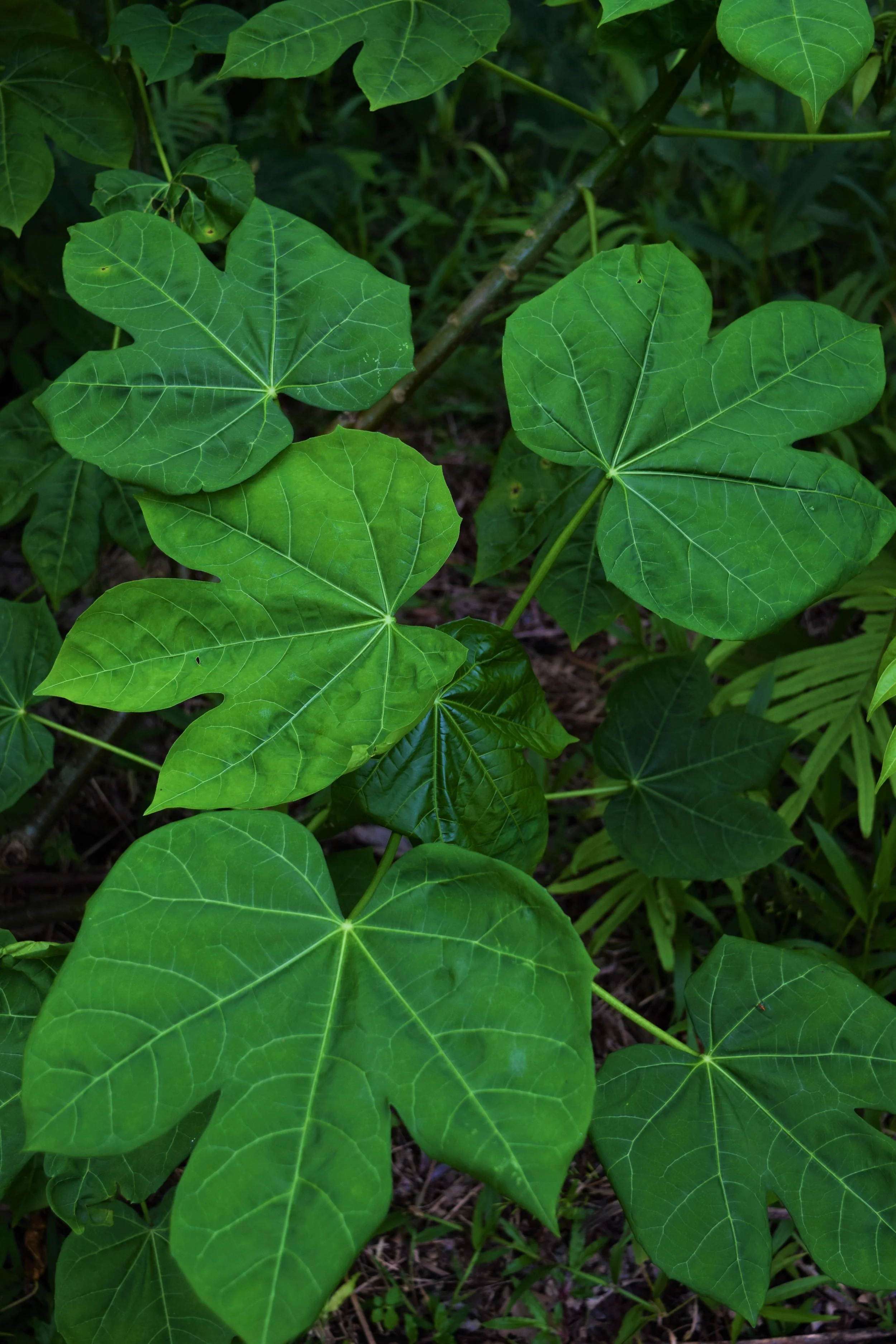
Also known as tree spinach this is an excellent perennial green native to Mexico. It's leaves are edible once cooked, like spinach. It's easy to propagate by cutting and loves the heavy rain.
Malabar spinach:
Malabar spinach is another heat and moisture-loving spinach-like green. The succulent leaves can be eaten both raw and cooked. We have only a few plants so we are trying to improve the population. We use a trellis to support its tendency to vine.
Winged bean:
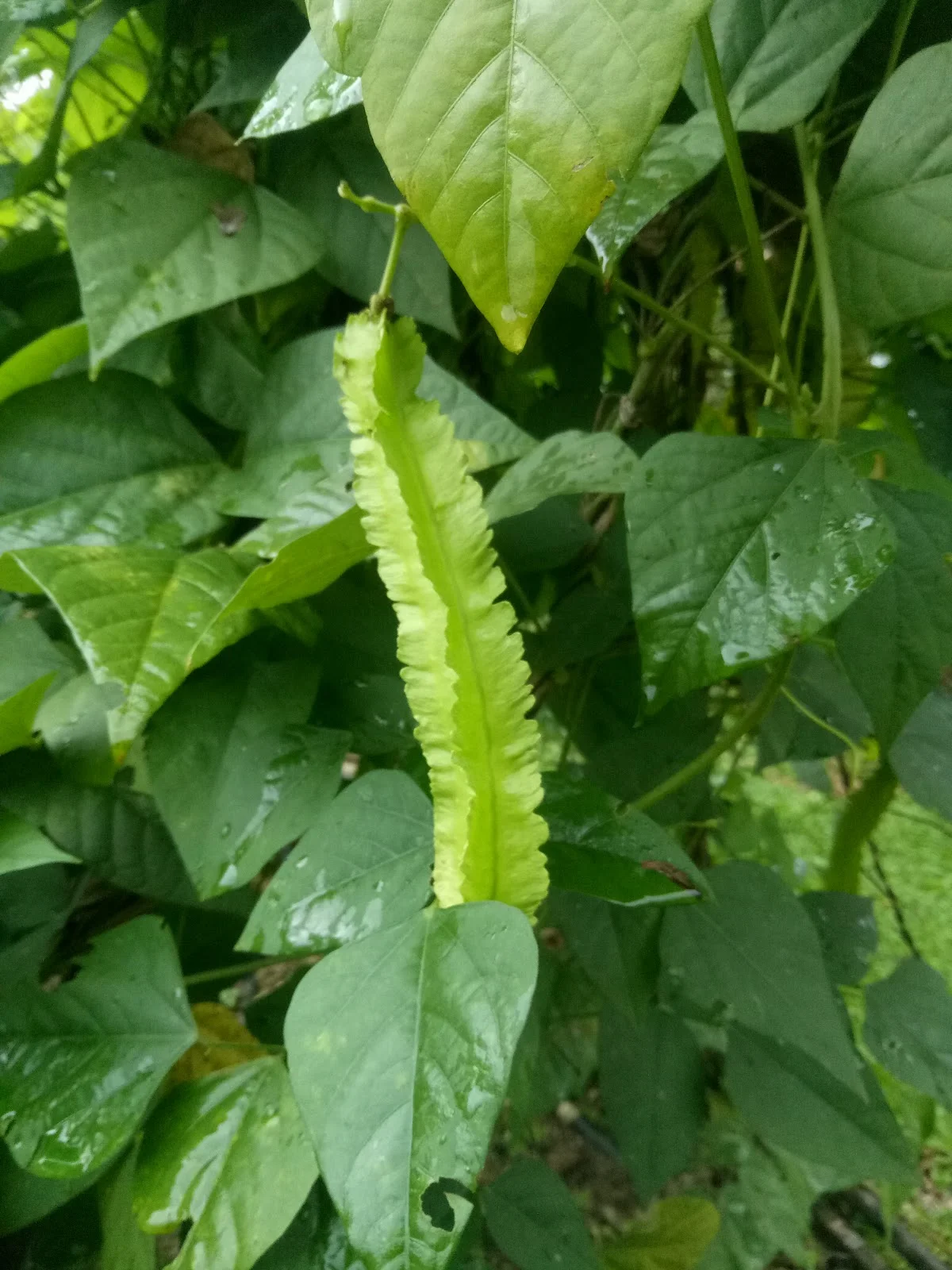
Also known as Goa bean and princess beans, these are sweet protein packed vegetables that do well in heat and humidity. They can fix their own nitrogen when the bacterium Rhizobium is in the soil. They are best harvested young and tender, and great raw in a salad.
Other more delicate greens we are growing in our nursery as they don't require as much water, such as Arugula, mustard greens and Asian cabbages.
By having our covered nursery space we are able to grow things under cover that otherwise would not do so well outside, we are also experimenting with making some movable covered spaces for out outdoor garden beds….. we will update you with progress so make sure to Like and Follow us on Facebook & Instagram
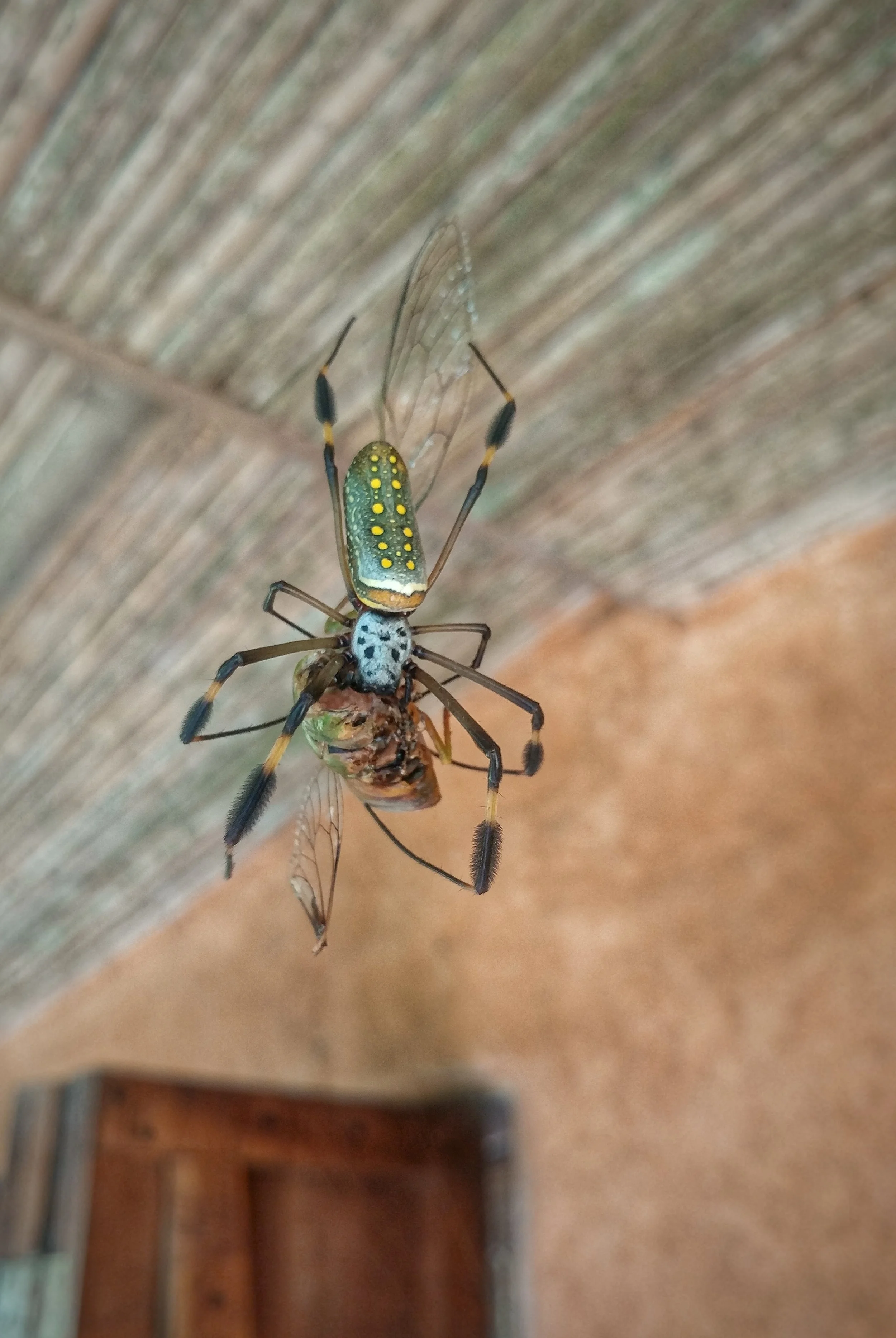
When The Ants Go Marching
Even before the start of my apprenticeship at the ranch, I would not have described myself as a particularly squeamish person. I like to think that I reacted to incidents involving large numbers of insects (infestations) with an appropriate amount of squeam. However, on more than one occasion, I was nudged outside of my comfort zone within the first few days of my time at the Ranch. Over the past few weeks, my relationship to these small jungle friends has changed once again.
By Abby Kuchar, 2019 Apprentice
Even before the start of my apprenticeship at the ranch, I would not have described myself as a particularly squeamish person. I like to think that I reacted to incidents involving large numbers of insects (infestations) with an appropriate amount of squeam. However, on more than one occasion, I was nudged outside of my comfort zone within the first few days of my time at the Ranch. Over the past few weeks, my relationship to these small jungle friends has changed once again.

My partner and I had just moved into our lovely abode, the Goat Barn. One evening when we returned home after dinner, we found at least 50 large army ants running around our floor! Quickly, we both started stomping away, desperate to kill every last one before climbing into bed, only to be kept awake by the feeling of phantom ants crawling between the sheets. The next morning, we exuberantly told the team the story of our ant adventures. A core team member, Ali, who has lived in Mastatal for the past six years, quipped “Only fifty? That’s weird.” Which, to say the least, was not the reaction I was expecting. “There’s usually A LOT more than that. The army ants will swarm a house for a few hours, clearing out the other insect larvae and bug parts. They’ll leave after an hour or so.” She explained.
A couple of days later, I noticed dark lines running along the outside walls of my house as I approached. Horrified, I realized the lines were actually dense highways of ants. Ribbons of industrious soldiers marched their way through the seams of the wall panels, into my home. I peeked my head into the room and saw an impressive and well organized network of army ants coming and going. Quickly I darted inside, grabbed my water bottle and book (the purpose of my trip) and gave the hard-working soldiers a quick salute. I will be back in five hours; I hope you all won’t be. I attempted to communicate, telepathically.
Sure enough, as we cautiously crept back into the house that evening, not a single ant could be found. In fact, the house felt eerily clean. Even the top of our mosquito netting, which had built up a graveyard of insects zapped by the overhanging light, was spotless. I hope they come back soon, our house could use a nice deep clean again.
Are you interested in experiencing Rancho Mastatal? Why not join us as a guest, maybe you will have the army ants clean your house too?!

Salak Pollination
As apprentices at Rancho Mastatal, we take on a Plant Skill, where we each are responsible for a plant variety in our agroforestry system. When we began as apprentices many of us wanted to avoid the Salak palm, as it has splinter inducing spikes throughout the stem and leaves. Following my intention to dive into challenges this year, I decided to take being caretaker of the prickliest palm on the Ranch.
Salak Pollination - dangerous work, with a delicious pay off
By Amy Dodds, 2019 Apprentice
As apprentices at Rancho Mastatal, we take on a Plant Skill, where we each are responsible for a plant variety in our agro-forestry system. When we began as apprentices many of us wanted to avoid the Salak palm, as it has splinter inducing spikes throughout the stem and leaves. Following my intention to dive into challenges this year, I decided to take being caretaker of the prickliest palm on the Ranch.
This is a breakdown on my experience, playing Cupid by pollinating this spiky palm!

Salak palm, or Snake fruit palm, originated from Indonesia, South East Asia. The main reason for planting in an agro-forestry system is that is produces a crunchy fruit that tastes like a tropical apple, which you can eat immediately after peeling the snakelike skin. It does well in humid lowland tropical areas, so is perfect for our climate at the Ranch. It is best to plant in a forest as an under story crop, especially as the young palms require heavy shade. They have superficial roots and therefore needs to be watered regularly, making it thrive in rainy season. Interestingly, pollination is most effective by hand. This can done by insects but is much more productive with human intervention.
While it may appear a harsh plant, I have found the Salak palm to be a rewarding plant to interact with. So far it has meant that every few days I get to go into the lush and cool Fern Gully and practice being mindful in the forest. I have to be slow and calm when navigating the spikes and surrounding orb spiders. And I get the joy of sharing the tasty fruit with my friends!
The main task is pollinating the female flowers with the male pollen at least 3 times a week. I am essentially playing matchmaker in Mastatal’s forest. Salak plants are either male or female. At the Ranch we have 20 plants, with the ratio of 3 females to males in our orchards. The female palms are the fruit producers. Their flowers develop in a hard pointy sheath, which you open with clippers once it becomes more hairy. This allows you to see when they develop a deep pink colour, meaning they are ready to receive the pollen. You can tell the male stamen is ready when they also become pink with small yellow pollen granules. I clip the male stamen at the stem and carry it carefully to the female flower, shaking the male spike on the ripe pink open flowers. Within a few days the flower should harden. If it becomes soft and dry pollination is unsuccessful.
When the fruit is ready it should fall off easily from the bunch. Taste can help indicate if it is ready - unripe Salak has a dry astringent flavour, whereas a ripe fruit should taste juicy and sweet.
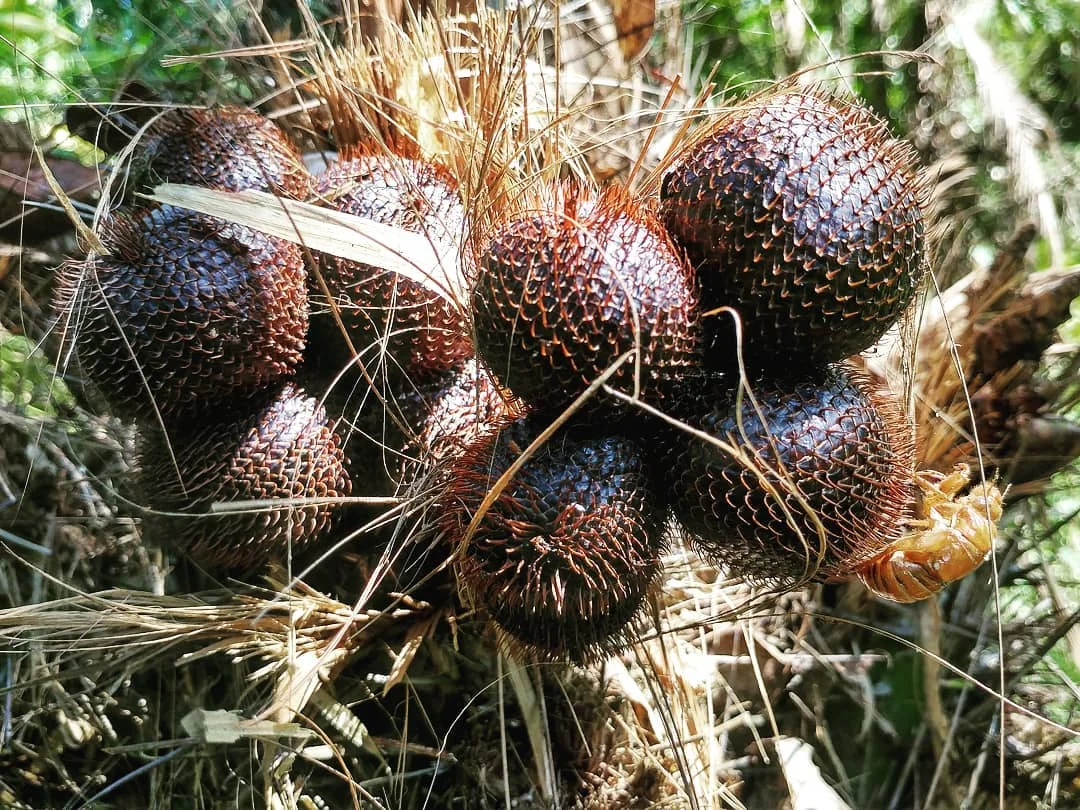
Included in the pruning process is clipping the suckers to prevent reproduction, pruning the leaves to keep only 4-5 mother leaves and removing any dead female and male flowers.
Other uses for Salak besides food production include using it as a hedge if you don't like neighbours or visitors. Or you can use it as an intimidating potted plant!
Overall this experience has been an important one to improve my permaculture skills of observation and interaction with this particular species. Plus it has become a mindfulness practice!
For more further reading on the propagation and care see our blog article on Salak.
Interested in tropical agro-forestry systems and their design, why not join us for our year long apprenticeship or check out some of our upcoming workshops

How Can We Make a Change in the World
Everything seems to have been created by a higher intelligence that has designed this universe in mysterious ways for us to live off. We live in a perfect symbiosis with nature. Everything seems to have a purpose which co-exists with all that is around us yet we don’t have an explanation to all this perfection.
by Diana Dagash, Apprentice 2019
Everything seems to have been created by a higher intelligence that has designed this universe in mysterious ways for us to live off. We live in a perfect symbiosis with nature. Everything seems to have a purpose which co-exists with all that is around us yet we don’t have an explanation to all this perfection.
What if we had the access to tap in to the secrets of nature, would it be possible to live a healthier and more sustainable way?
How does our connection and understanding of nature relate back to ourselves?
What if the way we treat our own bodies reflects on the way we treat Mother Earth?
If we look at the patterns in nature we can see that Earth is a macrocosm reflection of our own organisms. Earth is our body, the trees our lungs, plants our hair. The waters, seas are our fluids, that are in sync with the moon and the planets. The stages of the moon reflect on our emotional, energetical and physical states. The new moon represents a new cycle for growth, setting intentions, regeneration and with the full moon we reach peak of our energy as the tides of the sea rise, the winds get stronger, nature is at its highest strength. It is a good time to harvest what we’ve sown.
When the body is ill and weak it struggles to regulate its own temperature the, extremes of hot and cold temperatures resemble the behavior of our planet. Observing today’s climate change and natural disasters reflect on how we’ve been treating this planet. We already see the consequences of our actions. We have abused and exploited the forests and waters.
Mother Earth is patient and compassionate, she embraces us , provides us with all our needs , we are her children. She needs our cooperation , our understanding of the messages she sends to us, for us all to survive and thrive. We have forgotten our origin, where our food comes from, what allows us to coexist.
We are trying to live against the cycle of life by suppressing our illness symptoms just as we are manipulating the weather to cover the climate change that we have caused. Society has surrounded itself with comfort, trying to protect itself from nature and to change its power dynamics .We came out of sync and communication with Mother Earth. We are already paying the price of destruction, exploitation of natural resources and struggle to live in abundance.
The amount of food wasted that could feed the whole world if we stopped and reevaluated our needs and priorities in life. The individualism and race to accumulate more that we could every possible need! The greediness has blinded many of us from love and care to ourselves , to one another and to the planet we live on. The industrialism has left very little space for small farmers to survive. The food grown is mass produced and poisoned in interest to earn money as well as pharmaceutical companies wants us to always come back.
Our heads have been turned to the other side. Our education has not introduced us to our connection with nature and the healing powers within us and around us. We have not been taught to peacefully communicate with one another, nor how to explore our inner world that provides us with intuition and peaceful mind.
It has been said already “ The whole world is within you.” If we focused ourselves within, maybe we could find the answers to our problems and create a peaceful world we there is no war?
“You cannot solve a problem with the same way of thinking that create it “
I believe that if we integrate education on sustainable living into schools, children growing up with have more much awareness on the importance of sustainable living and the change we can make to a healthier life.
I strongly believe that if we want a change education would be at the base of it all.
How I believe we can make a change:
1. Proper education on sustainable living for example : permaculture, agroforestry, natural building, carpentry, homesteading , making your own biodegradable body and cleaning products, culinary skills.
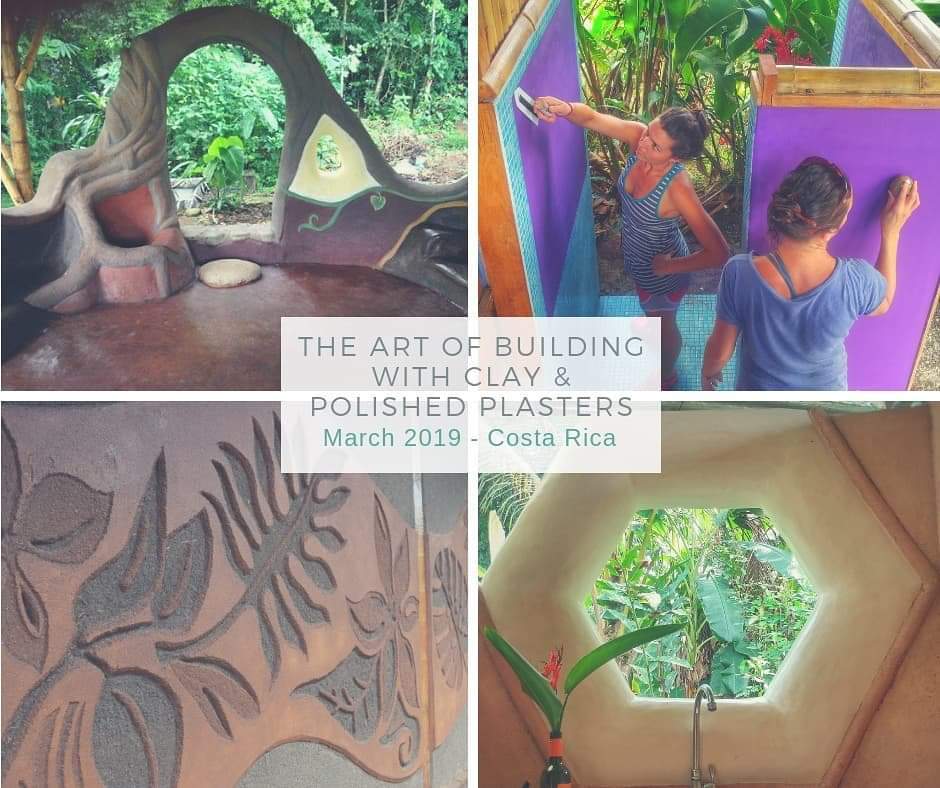
Workshops to inspire and empower you to change
2. Taking responsibility for our actions, the consequences of consumerism and how to stop mass waste production. For example – grow your own food.

Planting seedlings for food production
3. Self-development, healing the micro and macrocosm. Bringing awareness within, practices that pro mote introspection and self-reflection like meditation , learn to peacefully interact with others. Some great book references for this are the following :
The Power of Now by Eckhart Tolle
Non-Violent Communication Dr. Rosenberg
The 4 agreements Don Miguel Ruiz
4. Learn life skills that are beneficial to your environment.

Bamboo building at Rancho Mastatal, a sustainable building material
5. Choosing the possibility to live at your highest path , to stand for righteous actions and lifestyle.
6. Gain knowledge of medicinal plants in your area, get familiar with natural medicine, self-healing and maintain a preventative holistic lifestyle.
7. Make space for self-exploration , discover your interests and passions that you heart calls, surely they will benefit the world.
For me it is a priority to dedicate my life to create a greener healthier world, to learn how to be self-sufficient , build my own house , grow my own food, live harmlessly in nature, educate and promote that lifestyle and provide a good future for future generations .
Currently I live in Costa Rica doing a year long apprenticeship on sustainable educational farm that focuses on those matters and has created a heavenly community of loving , caring people that come together to learn and make a change.
I like to visualize a world that lives in abundance and has everyone’s basic needs met. A planet with clean air and water, where we would have food forests all around and houses surrounded with edible greens and herbs. It inspires me to think of what’s possible and focus my energy onto creating it.
Together we can change the world, so let’s take action, create ripples that will spread across the world. The power is within us to create the world we want to live in.
I wish you to pursue your purpose in life and discover your highest path for living.
I warmly invite you to visit farm that teach about sustainability such as Rancho Mastatal, learn about self-sufficiency, minimizing industrialism and harm to the ecology
Seeing all the movements rising to save our Earth I have faith and am excited to see the good changes happening in our society.
There is a rise in consciousness around the globe, let’s all be part of it!
Blessings to all
Diana

Contemplating an Uncertain Future: The Ranch and Climate Change
Climate change, after decades of lulling at the bottom of the news cycle, has belatedly made it into the headlines as increasing numbers of people become aware, convinced and concerned about the environmental and social impacts of the Earth’s evolving atmospheric conditions. I frequently think about disrupted weather patterns and what my role in this unfolding story should be.
by Tim O'Hara
Climate change, after decades of lulling at the bottom of the news cycle, has belatedly made it into the headlines as increasing numbers of people become aware, convinced and concerned about the environmental and social impacts of the Earth’s evolving atmospheric conditions. I frequently think about disrupted weather patterns and what my role in this unfolding story should be.

Many climate experts argue that we have surpassed the carrying capacity of our planet and that our natural resource base cannot support our modern lifestyles at our current population numbers. I find this argument believable given the observable degradation of our natural systems everywhere I go. Modern technology might for a time delay the worst impacts of our behavior, but soon we will stare more squarely in the face the consequences of the environmental alterations that we’ve set in motion. Indications of a more brittle world are clear to me.
Humans are descending to systematically destruct our limited natural resource base and in turn one another. I am discouraged thinking about the future that my daughter is inheriting and struggle to decide how to divide my time between work, personal care and engagement in efforts that help mitigate some of our biggest societal challenges, especially climate change. I’m not optimistic, but I cherish life, my family and my friends and strive to do my part in figuring out how we can usher in a more just world.

I was recently asked how Rancho Mastatal is responding to climate change and whether we feel as if we are helping to create an alternative future for those becoming heir to the approaching changes. In large part Robin and I started the Ranch to address and answer this question. Widespread social and environmental injustice partly inspired us to leave the United States and a more common life path to set up an “alternative” project that we hoped would contribute to a brighter future. We are dedicated to learning and teaching more environmentally appropriate ways to grow food in poor soils, build structures that are kinder on Mother Earth, and implement practices that allow us to meet our basic needs without destroying the elements that make it possible for the soil and atmosphere to sustain us. We are helping to teach future generations that there is indeed a better way to live; a way that is not dominated by an addiction to consumer purchases and modern conveniences or reliant on oppressive economic systems. We are experimenting with community structures that rely on cooperation and regeneration and have made efforts to conserve a relatively large and intact tract of rainforest.

A loss of corporate and governmental confidence in dealing with our warming climate has prompted us to start to execute strategies that make us less reliant on traditional businesses and executive bodies. We’re working towards attaining personal and communal well-being with our everyday activities and are compelled to look for ways to avoid our compromised medical care systems by looking at food as medicine. We’re looking for ways to engage in the process of designing and building our own homes with the help of friends and learning techniques to grow food for our family and community as global food supplies become more susceptible to unsteady financial systems and weather patterns. Communities are being torn apart by pollution, sickness, flagging economies and racism. To address this we want to learn and practice other forms of governance and community structure that we believe can serve us and the world more equitably.
Our modest efforts won’t be enough to stem the suffering for everyone. In fact the sad truth is that it might not even prevent future hardships for myself and family. Nevertheless, we’ve chosen to focus on this work with the hope that profound change might come from the accumulation of millions of small acts, projects and movements that when influential enough will begin to shift the human perspective to a more caring one. It’s also a way for us to prepare for changes ahead.

Future challenges will in part be most successfully met by strong networks of compassionate people dedicating their lives to the local problems that most impact them. As our daughter gets older we’ll encourage her to explore avenues that will simultaneously challenge her intellectually while leading to improvements in our world. Some of the areas that I encourage Ranch students to explore include energy conservation and renewable energy, education, responsible food production, social and environmental activism, politics, medicine, and counseling. A warming climate will require bold and courageous engineers, teachers, farmers, activists, health care professionals, mentors, and politicians. I encourage each of you today to take one small step to become a more engaged steward of our planet. If not now, then when?
Check out our updated workshop schedule to see how you can start building relevant skills to make a difference.
Read this interesting article about how agroforestry can help to sequester carbon, Can Dirt Save the Earth?

Orienting Oneself to Mastatal
If you’re anything like me, then you will find Rancho Mastatal to be a place of incredible beauty, endless inspiration, and powerful community. Even if we have very little in common, you will certainly find it to be unique. Among ecovillages and permaculture communities, over the years Rancho Mastatal has developed a reputation for its intricate systems, well organized educational programs, and gorgeous natural buildings that sprinkle the 300 + acre Ranch.

This post was first published at the blog Fed by Connor. Connor is one of our year long apprentices.
We are now interviewing applicants for our 2018 apprenticeship program. Help us spread the word by sharing this blog post!
If you’re anything like me, then you will find Rancho Mastatal to be a place of incredible beauty, endless inspiration, and powerful community. Even if we have very little in common, you will certainly find it to be unique. Among ecovillages and permaculture communities, over the years Rancho Mastatal has developed a reputation for its intricate systems, well organized educational programs, and gorgeous natural buildings that sprinkle the 300 + acre Ranch.
Mastatal is a small rural community in central Costa Rica near the Pacific Coast, roughly a three hour drive from the capital, San Jose. In Mastatal things come in singles: there is one dirt road lined by the local bar, one restaurant, a school, community center, convenience store, and a soccer pitch. Although the community center technically provides wifi, it usually doesn’t work, which can add to a sense of isolation that can feel simultaneously liberating and stifling. Despite its size, the Ranch sits in the heart of the community. From the main house you are a stones throw away from the bar, and you can often hear music echoing across the valley as the locals unwind in the evening over one of the two Costa Rican brews.
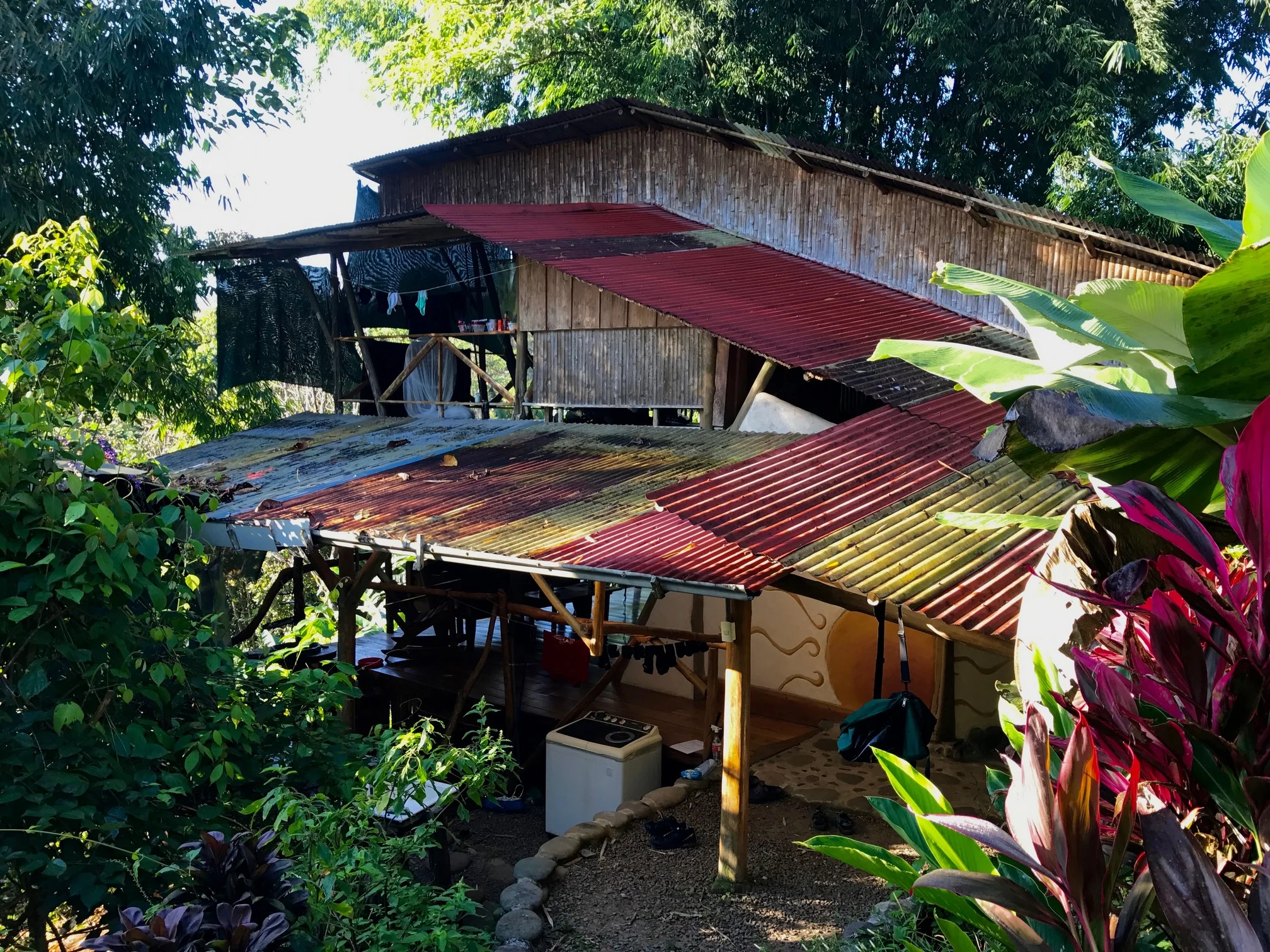
To orient oneself in Mastatal, especially coming from an urban hub like Los Angeles, requires a letting go of one's typical expectations. Many of the core team describe this experience as “losing oneself in a humble task,” or to be more accurate, a series of humble tasks. Fortunately, at the Ranch this is easy. Days here are filled from dawn until well past dusk, leaving precious little time to contemplate how or why someone has arrived in this space. Although often simple, each task requires focus and care in order to do well and avoid personal injury.
As an apprentice, our mornings begin at 6:00 am with “life skills.” These individual pre-breakfast chores make up the basic activities that are necessary to keep the farm running. These include managing the firewood, bio-digester (more on that later), and chickens; harvesting salad greens, caring for the main house/kitchen, nursery, zone 1 gardens, and orchards. To ensure that we gain experience in each system on the farm, the apprenticeship program is designed for us to rotate among the life skills on a monthly basis.
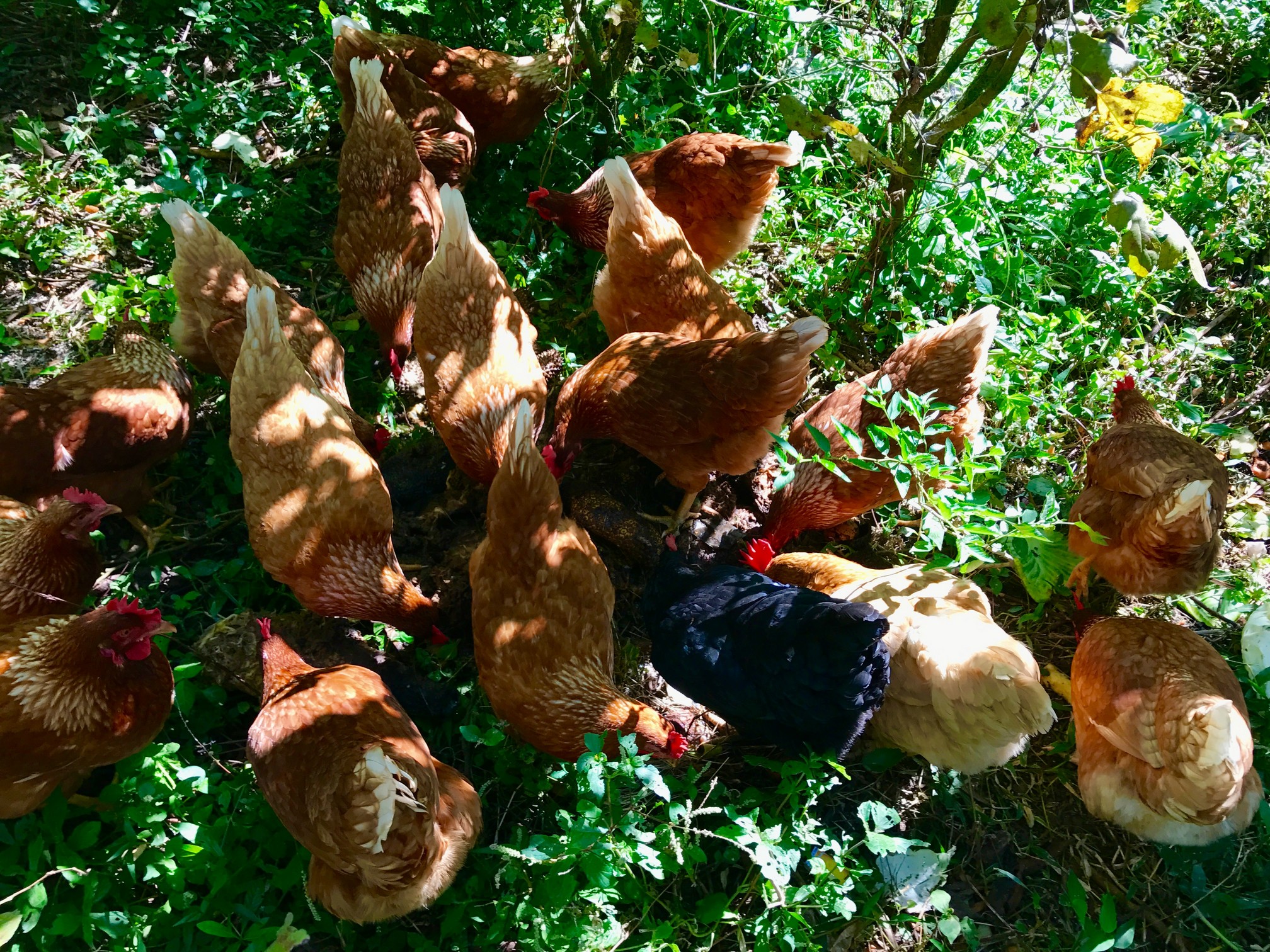
These tasks need to be completed by 8:00 am when we have a group breakfast, which depending on the number of visitors at the farm can range from 12 to 50 people. Cooking and cleaning shifts are also traded on a rotating schedule. After breakfast, all the apprentices chip in on a “work party” to help complete the larger projects around the Ranch. This can include trail building in the orchards, weeding and prepping new beds in the gardens, harvesting jackfruit or bananas, processing food for the kitchen, or even helping to build a new structure on the property.
At 1 pm everyone breaks for lunch. Nearly every meal served on the Ranch includes rice, beans, and a fresh garden salad prepared each morning. To add a little variety to the meals, each dish also includes something a little special. Whether it’s emplatanados con queso, fresh hand pressed tortillas or homemade dosas, each meal comes with a treat to avoid the monotony that is risked when eating arroz con frijoles three times each day. On the side, fresh salsa and a kefir dressing made from local cows milk and fresh herbs make each dish a true delight. To drink, there is fresh coffee from local shade grown beans, water kefir soda filled with pro-biotics to improve digestion, and a house-made rehydration drink (think homemade Gatorade) that is packed with electrolytes to prevent dehydration during long days working under the sun. In the evenings, there is even country wine or “hooch” as it is called here, that is fermented using yeast, water, local unprocessed sugar, and whatever fruit happens to be in season (jackfruit and passion fruit are two of the local favorites).

Afternoons at el Rancho are more varied. Three days a week this time is reserved for Personal and Practice Time. On the Ranch, one quickly realizes that these are extremely valuable chunks of time and can be used for many things, although jerking off in the apprentice house while a tour goes by (as the orientation packet mentions) is not one of them. It is however a great time for writing, taking a nap, swimming at the local waterfall, calling family, or sharpening one's tools; just to name a few examples. During the rest of the week, the afternoons are reserved for additional work parties, community check-ins, or cooking depending on the day.
Dinner is served every day (except Sunday) at 6:30 and begins with “circle time,” one of the oldest traditions on the Ranch. This time is nothing more, and nothing less than an opportunity each day for the entire community to come together, hold hands, and offer thanks (if one is so inclined) for anything/everything they are currently feeling grateful for. It is a brief yet powerful ritual that allows everyone to slow down, take a deep breath, and appreciate the wonderful space and community everyone here is privileged enough to enjoy. Afterwards dinner is served! The only rule is, be kind and respect those behind. This usually means there is more than enough for everyone, although specialty items (like guacamole) can mysteriously disappear rather quickly. The last person through the line rings the bell, meaning seconds are up for anyone still craving more.

After dinner and clean up, if you’re not ready for bed at 7:30, which is often the case, there are always a plethora of interesting people to chat with over a beer or glass of hooch, and any number of board games to be played until late into the evening (and by late I mean 9:30, because by then you will DEFINITELY be ready for bed). After lying down and becoming one with your mattress, dawn will come suddenly and this routine will repeat itself seemingly on end. At the time of writing this however I have now been here for two weeks. I can already tell that one day soon I will look up, only to realize it’s already December, time to pack my bags and head back to the “real” world. One lesson this experience has already taught me, however, is that for the individuals who make up this community, Mastatal is the real world, not just a temporary excursion. For those who choose to step outside the typical expectations of industrialized society and reconnect with the roots of human civilization, this is an obtainable lifestyle. Whether you want this world or the chaos of our modern cities to be more real, is up to you to decide.
Across the Permaculture Universe
We have a few spots left in our upcoming Fermentation Workshop! Learn the art and science of making microbes your allies.
Many of our core team members are starting to show off their work through some great photos on instagram. Check out Ali, Rachel, Laura, and Scott!
Our friends at ECHO have a new Central American and Caribbean forum, including development notes dedicated to this region. We are hoping to start sharing our work through their publication in the months ahead.
Abrazos
The Ranch Crew

Meet our 2017 Apprentices!
Our newest apprentice team has arrived and settled into the Ranch life. They hail from across the United States and Latin America. They come from a diverse set of backgrounds and will undoubtedly shape the Ranch and our community deeply in the year ahead.
Our newest apprentice team has arrived and settled into the Ranch life. They hail from across the United States and Latin America. They come from a diverse set of backgrounds and will undoubtedly shape the Ranch and our community deeply in the year ahead.
Our team is looking forward to working, playing, and feasting with this group for the next many months.



We are now accepting applications for our 2018 program and will begin interviewing in the months ahead. Check out the page here for more information.
Is one year too long? Then consider our Sustainability Primer program, which runs this fall for three months.
Abrazos
The Ranch Crew

Top Ten Tips for the New Apprentices
"Everyone is looking at my feet," I say to my dad.
"No they're not," he scoffs back. Sure enough, he glances sideways at a group of teenage girls eying my dirty toes clad in Chacos.
We are not in the jungle any more. It's December in New York City, I am traveling on the subway with a large backpack, and five layers of sweatshirts, never having worn more than one at a time in the tropics. Fresh off the airplane, here I am with my exposed feet and disheveled appearance-- "Is she homeless?" the girls snicker.

This post is part of a series of reflections we are asking past apprentices to contribute to our blog. If you would like to share where you stand now and how your time at the Ranch effected your place in the world please write to scott@ranchomastatal.com.
"Everyone is looking at my feet," I say to my dad.
"No they're not," he scoffs back. Sure enough, he glances sideways at a group of teenage girls eying my dirty toes clad in Chacos.
We are not in the jungle any more. It's December in New York City, I am traveling on the subway with a large backpack, and five layers of sweatshirts, never having worn more than one at a time in the tropics. Fresh off the airplane, here I am with my exposed feet and disheveled appearance-- "Is she homeless?" the girls snicker.
I come home and sit under my first hot shower in a year and scrub the dirt from my feet. Goodbye Rancho Mastatal, I'll be seeing you one day. In the meantime, I have a new life to create. Sometimes reverse culture shock can be more cunning than culture shock.
In case you are one of the seven new apprentices and worried about the ensuing change, this article serves as advice come January 2017. Are you ready? To be ready, you must clear your mind. You'll never be ready. Those who don't know speak of it. Those who do know don't speak of it. To stay afloat in the presence that is Rancho Mastatal means just this. This will all make sense soon. Now for ten more pieces of advice in preparation for your apprenticeship.
My fellow apprentice crew enthusiastically chimed in for this article to not bring any white clothing. It is very likely to get stained by any number of hands on tasks. Even if you're not performing physical labor, even if you're just eating lunch, there's a good chance that anything white you wear will be found by a stain. The turmeric in the pickle is a renown dye, as is the achiote in the rice. Whole food diets, with their richly colorful displays, are your wardrobes' worst enemy. Even if your white blouse is hanging on a line miles from the orchards, the wood shop, the kitchen-- virtually every danger zone-- black mold will STILL find it, stain it, and make you regret bringing it. Tip #1: Don't bring white clothes.
Tip #2: If you are prone to stains but want to maintain your public decency, patterned clothing compensates (credit tip to Rachel Jackson).

Stains and patterns aside, there is another debate on the type of clothing appropriate for the tropics. Expect the climate to be humid and hot. Cotton is not your friend. It takes a long time to dry and harbors all sorts of odorous microorganisms. Tip #3: Bring clothing made from synthetic materials that are comfortable to wear.
There are times, however, when you'll want to look sharp. Welcome to the campo of Costa Rica. Ticos take public appearances seriously, so pack accordingly. I recommend bringing something that is clean and modest, not something too out there. This is a small village, after all, and it's more valuable to blend in. A brief study of Costa Rican fashion will reveal that it's not too different from most mainstream, Western cultures. Tip #4: Keep an outfit clean reserved for community celebrations and appearances.
On that note, Tip #5: In Costa Rican culture, if you do not smell good, you smell bad. A good soap and light perfume are recommended for community occasions. The jungle offers delectable scents that can be sourced from plant materials on the Ranch. Tip #6: If you want to dabble in the ancient and romantic art of perfume making, bring a little bit of Everclear, coconut oil, and a spritzer bottle. Creative inspiration soon to follow, but I've had great success with vetiver root, galangal, orange peel, and lemongrass.
This brings us to the toiletry topic. Some people bring a lot of toiletries. In my experience, I learned the unnecessary reality of many of the things that can be purchased from the drug store. With a clean diet, acne can fade, and pesty bugs can be deterred. The humidity keeps your skin moist, and most lotions just sweat off. You may even want to try to go "no poo" (that is, shampoo) method this year.
Tip #7: Abandon shampoo and conditioners. I had personally been avoiding chemical hair soaps for one year before the Ranch, but for other people, this may be a great time to go "no poo". It's usually within the first two months that hair builds up an excess of grease, then soon after, this balances out. Shampoo strips your hair of its natural oils, and conditioner replaces it with a synthetic luster. If you want to keep your hair clean with minimal input, try the baking soda and vinegar method. Use one tablespoon of vinegar for one cup of water. Shake in a bottle with a dispenser cap, pour overhead, and massage deeply into your hair. Rinse with water. Vinegar can also be applied to help balance the pH. Any type of vinegar will work just fine, and the smell dissipates quickly. After the initial grease sweat, your locks will evolve into tropical lusciousness.

You may be concerned about sunscreen. Despite my pale complexion, the sun was never an issue for me. This is because most of the time outside is spent in the shade. Cheers to the benefits of an agroforestry canopy! If you're working in the sun, you'll probably be sweating any sun protection off. Tip #8: Favor sun hats and long, light sleeves for sun protection. Despite covering your skin, you'll actually stay a lot cooler, too.
Bugs can be another nuisance. Mosquito populations are typically non-problematic until the rains hit in April. That's when populations skyrocket. Maybe you don't mind the cloud of deet, or natural sprays that are also available, but the reapplication of sprays can be resource and time intensive. Tip #9: Either you suck it up and evolve some better antibodies, or just cover up with long pants and sleeves, and CERTAINLY bring a bug net for your bed. I've laid on my bed in October, the wettest month of the season, and counted literally dozens of mosquitoes trying to pass the unbreakable seal. Fortunately none of the sensationalized diseases that mosquitoes carry made an epidemic in Mastatal, so don't stress about vaccinations or antibiotics.
If mosquitoes aren't the type to sweeten your inner naturalist's cup of tea, think about the things that do. Maybe it's plants, maybe it's birds. Whatever it is, make a point to recognize those things at home before you leave, because when you come to the jungle, it's all going to change. Tip #10: Recognize the fauna and flora in your new home to develop a sense of place. A sense of awareness and appreciation for your home's native creatures will make rooting a lot easier. The dormilonas, which bow down when you tap or pee on them, and the carpet like moss that grows in the tree nursery, or the sprawling herb with small white flowers with purple stripes inside that attract the black bees with yellow bottoms-- those were some of my favorite Ranch weeds. You'll see patterns, and you'll appreciate the subtle natural life, too.
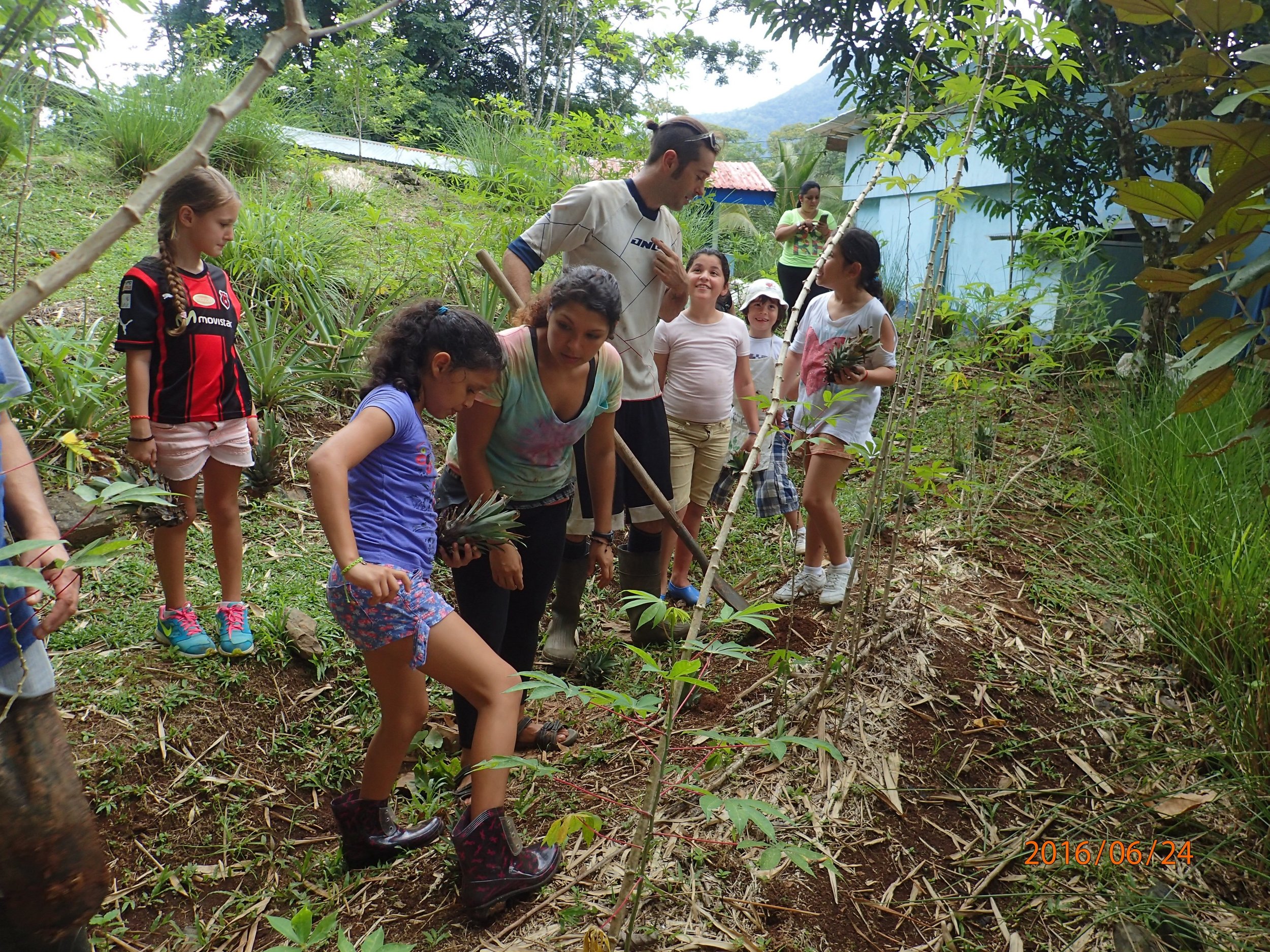
Bonus Tip #11: Appreciate the foods that are locally sourced. Rice and beans are the vehicles of countless cultural traditions and can be transformed in one million ways, but they're delicious served simply too. The Ranch agroforestry system offers biriba, jackfruit, coconuts, bananas, cuadrados, and plantains all year round. Be prepared for the grandeur of seasonality. Lemondrop mangosteens will be one of your first tree harvests in January. Then the acerola, aka Barbados cherries, will ripen. These ferment into an excellent, complexly flavored wine. The Victoriana and arasa will ripen shortly after: Sour, yet delicious, when sweetened for jams. Mango season starts in April and lasts for the month. Pickle as many green mangoes as you can stand, they make the best kimchi, especially when finely shredded. The pejibayes start turning color at the beginning of the rainy season, too, followed by the mamonchinos. The mamonchino tree with the best flavor lies at the bottom of the Banana Bowl, but you have to climb it, then sit in the branches with a huge pole with a basket on the end. This is farm fitness, but the collection process is worth it. Nature really did perfect the art of candy. Come December, the oranges will begin ripening, and you can race Scott in a juice pressing contest. You will experience the cycle of a year as it truly happens, as an ecosystem partitioned it; for each part to be appreciated.
Maybe you're the type to meditate, maybe not. When I left the Ranch, and the data came back to my cellphone, and the advertisements jumped off the walls of the streets, and the drama of the world flooded in like a leaky pipe, that's when I knew what it meant to be able to meditate. I once thought about running away to a monastery, but I found Rancho Mastatal instead. There's no preacher, there's no text, there's just you and your purpose for coming. You come, you work hard, you play hard, and you learn. It might not feel like you're meditating, but, if you allow the experience to envelop you, if you allow yourself to tread lightly on this planet, you too can be a great apprentice. You may not become an expert wood crafter or beekeeper, or even learn how to count, but there you have it: ten pieces of advice from a gal who now walks barefoot in the city.
News and Notes from Around the Permaculture Community
Laura has been busy the last few weeks filming an online fermentation workshop series. She is partnering with Ranch friend Spenser Gabin in the creation of this course. You can see more of Spenser's work at his website here.
We were fortunate enough to host Erle and Suset from Wa Samaki Ecosystems on Trinidad during our Natural Building Practicum. It is always inspiring to meet fellow permaculture teachers, doers, and designers, and now we have the itch to visit their site which has been operating for nearly 20 years!
Our Central American Scholarship Program fundraiser is underway! We've already had over 20 applicants for the few spots in our annual PDC. If the fundraiser is successful though, we hope to have a record number of Ticos in our course. Please give if you are able and share the word!
Abrazos
The Ranch Crew

No Pickup, No Problem: Social Capital Trumps a Shitty Situation
My hands are grappling the rumbling, rusty wheelbarrow handles, and as we walk half a mile through the village, everyone can hear the five Rancho apprentices clunk on through. In a village of 120 people, your whereabouts are everybody's business. Don't worry, I want to say, this will all make sense soon. They'll be having a chuckle by the end of the day. For now, we are five warriors defending alternative energy. We are making the best use of our woman power (and Dan power) when the white pickup truck is out of commission. We are going to pick up poop.
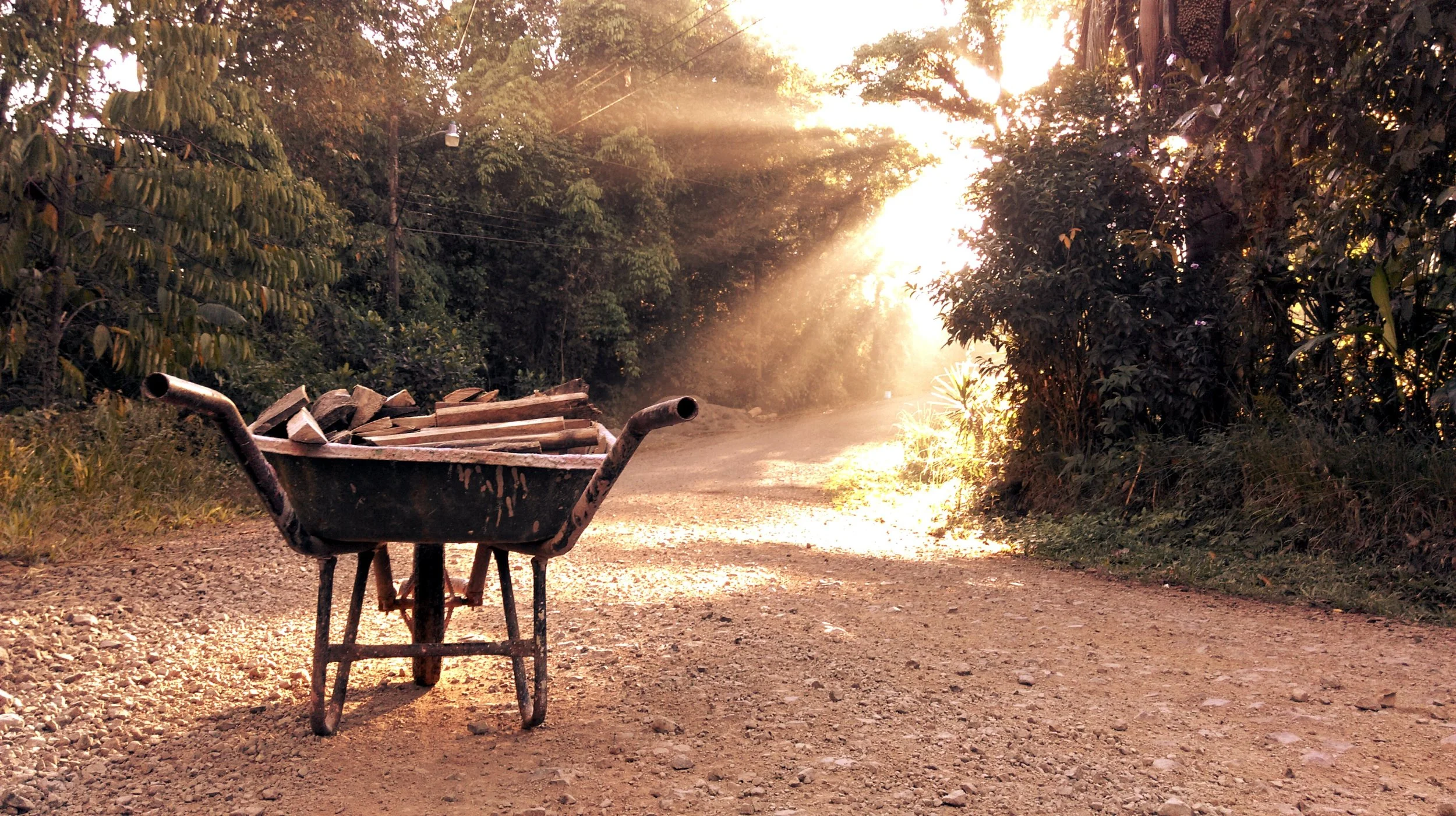
My hands are grappling the rumbling, rusty wheelbarrow handles, and as we walk half a mile through the village, everyone can hear the five Rancho apprentices clunk on through. In a village of 120 people, your whereabouts are everybody's business. Don't worry, I want to say, this will all make sense soon. They'll be having a chuckle by the end of the day. For now, we are five warriors defending alternative energy. We are making the best use of our woman power (and Dan power) when the white pickup truck is out of commission. We are going to pick up poop.
As Timo explained in a blog post last month, poop is the essential ingredient for synthesizing our kitchen's methane gas supply. Once a week, the white pickup truck is driven half a mile up the road to pick up ten sacks of manure. Assuming you have the human labor and the car labor, it's a brilliant system-- until the white truck, which has seen more years than myself, stops working. No truck, no poop, you say. Chuckle chuckle. Four of the baddest chicks and one man are about to prove you wrong. Here are two cents, to boot, on what makes a functional energy system.

We make it to Finca Siempre Verde dripping in sweat. Chilo, our friendly poop dealer, greets us as we roll five empty wheelbarrows up the driveway hill. Since we're on the theme of biodigestors, he offers to give us a tour through his biodigestor system. It's a work in progress, but here are the pigs. He shows us the pig pen which gets hosed down, and where the poop drains into a pipe. He then shows us a newly built pen that is slightly lower than the kitchen. Here, Chilo explains, will be the new site for the biodigestor. The manure will wash directly into the feeder barrel, no transport necessary.
We are five champions of renewable energy and suddenly I am wondering why my journey to move poop suddenly seems less noble. Here is a system that capitalizes on the fact that the source of manure is located at point zero for the biodigestor intake. If Chilo had a failure in one of his auto parts, there would still be gallo pinto on the table. Is Chilo's biodigestor any different than ours, or am I just about to push 100 pounds of manure half a mile because we built a delicate, un-resilient system?

Biological systems, such as Chilo's pigs, are complex. They are composed of living, breathing organisms whose livelihood is ingrained in the health of the entire system. As long as Chilo (who is also a living component in the system) continues to produce food on his farm, process it in his kitchen, bring the scraps to his pigs, and maintain his system accordingly, then poop will continue to flow through the biodigestor, methane will continue to be produced, food will continue to be produced, and the pigs will continue to be fed.
Now, suppose we swapped out those pigs for one of those nifty new robots on the market. The Porkolator 3000 is equipped with machinery that makes it the most efficient robot in converting biomass to waste product. This technological feat is revolutionary. As it turns out, however, the company that manufactures the Porkulator did not create the machine with the capacity to heal from, say, an erupted engine. So when that breaks down, and Chilo doesn't have a spare engine in the middle of the jungle, how on Earth will the gallo pinto get made?

Pigs are complex; Porkolators are complicated. The difference between a living system and a non-living system is that a living system has numerous connections and survival responses in accordance with the environment, whereas a non-living system cannot respond. A non-living system is complicated because if there are 1000 pieces and the tropics rusts one obsolete, the system will fail to function. A living system has 999 pieces you can name, and 999 to the ninth power of interconnections you cannot even see, that when one piece fails, the show must go on. On that day, our pickup truck proved to be complicated because the inability to start the engine meant that our biodigestor risked starvation.
Pigs are not the only example of complex, living systems. Communities are also complex. In the wake of realizing that our biodigestor may not get fed, we rallied the troops and took action. That's right, our engine may have failed, but our spirit did not. That morning, five apprentices and ten sacks of manure rolled through Mastatal and it didn't matter that my forearms were burning or that my hands were too dirty to wipe the sweat from my eyes. We were resilient, and let warm gallo pinto be proof.

News from around the Permaculture Community
We love books at the Ranch! Our library is constantly growing as each of us pick out a few new books to populate our shelves. Our favorite publisher is Chelsea Green publishing, and the folks over at Permies.com have been busy reviewing many of their best books. Check out the review list to see if any belong on your shelf!
The National Institute of Apprenticeships in Costa Rica is having their annual Agroecological Festival this December 3 & 4 in Cartago. We hope to attend. This will be a great opportunity for anyone interested in connecting with the Costa Rica permaculture and urban farming community!
Abrazos
The Ranch Crew
Categories
Topics
- Agriculture 6
- Agroforestry 21
- Animals 2
- Apprenticeship 19
- Appropriate Technology 6
- Backpacking 1
- Bananas 1
- Basic Pantry 4
- Biochar 1
- Books 3
- Build Your Own Home 1
- Central America 5
- Chiles 1
- Cinnamon 1
- Clay Carving 1
- Climate 2
- Climate Change 1
- Cob oven 1
- Communication 5
- Community 24
- Compost 2
- Composting Toilets 2
- Condiments 1
- Conservation 2
- Cooking 4
- Costa Rica 18
- Design 10
- Earthen Construction 10
- Eat Local 2
- Ecohome 1
- Education 9
- Environment 3
- Ethics 4
- Farm to Table 12
- Fasting 1
- Fermentation 14
- Food 22
- Food Choices 8
- Food Forest 8
- Food Processing 15
- Food Systems 12
- Gap Year 1
- Gardening 5
- Ginger Beer 1
- Harvest 2
- Health 12
- Healthy living 5
- Homemade 2
- Homestead 8
- Internet 2
The Ranch’s new cookbook is here!
This cookbook might not be quite like the others you have sitting on your shelf. We’ve made it look like a cookbook— and it might smell like a cookbook if it’s spent enough time in your kitchen— but it’s also a memoir, a history of a place, of 20 years of experimentation and learning and growing on the piece of paradise known as Rancho Mastatal.