

BLOG
Stories, articles, and updates from the Ranch community.

Los Suelos y Su Importancia para la Existencia de la Vida
El suelo es una delgada capa de minerales, agua, gases, y material orgánico, la cual se encuentra activa biológicamente y debiese cubrir la mayoría de la superficie de la tierra.
Los Suelos y Su Importancia para la Existencia de la Vida
Escrito por el aprendiz 2024, Felipe
El suelo es una delgada capa de minerales, agua, gases, y material orgánico, la cual se encuentra activa biológicamente y debiese cubrir la mayoría de la superficie de la tierra. Acá se desarrollan una serie de interacciones, entre los múltiples elementos que habitan los suelos se encuentran: plantas, minerales, hongos, bacterias, filamentos, algas, pequeños animales desde protozoos a lombrices, insectos mamíferos, etc.
El suelo es un sistema biológicamente activo que otorga una serie de servicios ecosistémicos claves para el mantenimiento de la biosfera (la parte de la tierra donde existe la vida), así como para la regulación del clima. Es la base del sistema alimentario del ser humano: 95% de los alimentos provienen de los suelos, es la base de la agricultura y es el medio donde crecen casi todas las plantas productoras de alimentos. Es uno de los ecosistemas más importantes para asegurar la existencia de la vida en el planeta. Aproximadamente un cuarto de las especies del planeta que se encuentran registradas necesita de los suelos para existir. Es extremadamente vital mantener la biodiversidad subterránea, para que los suelos estén saludables, en simbiosis y siendo el hábitat de diferentes especies, logrando un ecosistema equilibrado y balanceado para el buen funcionamiento de la cadena alimentaria del planeta.

Algunos de los beneficios que los suelos otorgan al medio ambiente son los siguientes:
Producción de biomasa que sirve de alimento para muchas especies
Dotación de energía a muchos seres vivos
Filtra, regula y transforma la materia que absorbe
Es el hábitat de innumerables especies
Fijación de Dióxido de carbono
Tiene un importante rol en la regulación del clima
Protección del recurso hídrico en las capas subterráneas
La formación de 1 cm de capa de suelo, puede tomar entre cien a miles de años. Este proceso llamado meteorización, consiste en la descomposición de distintas rocas madres y minerales que conforman una macroestructura, disolviéndose en partículas más pequeñas y originando nuevos minerales a través de la erosión que ocasiona el aire y el agua a través del paso del tiempo. El periodo de formación de los suelos depende de: tipo de roca madre, clima, la vegetación, topografía y el tiempo.
Según la OMS, 40% de los suelos del planeta hoy se encuentran degradados. En África, solo un 8% de los suelos es adecuado para su uso en la agricultura. Hoy en día, existe una gran amenaza para la seguridad alimentaria de los seres humanos, debido a la perdida de los suelos. La principal causa de esta amenaza, es el ser humano a través de la contaminación. La mayoría de los contaminantes provienen de desechos urbanos no tratados y actividades humanas como: las prácticas agrícolas insostenibles, la industria, la minería, deposición de contaminantes atmosféricos, entre otros. Ejemplos de estos contaminantes son: derrames de hidrocarburos, residuos urbanos, medicamentos, antibióticos, desinfectantes, pesticidas y fertilizantes, metales pesados como el plomo, cadmio, el mercurio, como también los plásticos y microfibras que afectan negativamente a los suelos. Otros factores importantes en la desertificación y perdida de los suelos son los monocultivos y la sobre expansión urbana. Esto tiene como consecuencia la pérdida definitiva de suelos productivos. El problema de la degradación de los suelos puede traer consecuencias graves como: sequias, guerras por recursos hídricos, pobreza, hambruna, marginación, emigración obligada, disminución de recursos esenciales, etc.


Algunas de las iniciativas que se pueden emplear para proteger los suelos son:
Aumentar la materia orgánica en los suelos, con mayor cubierta vegetal, vegetación, lechos orgánicos y compost
Usar la vegetación para proteger los suelos del viento y la salinidad
Practicar una labranza mínima (que reduzca las emisiones CO2) y retener los residuos de los cultivos
Implementar pastoreo rotacional
Usar fertilizantes orgánicos y evitar los químicos
Tener 100% cobertura vegetal durante todo el año
Permitir el crecimiento de la biodiversidad por encima y por debajo del suelo
Apoyar y proteger la simbiosis microbiana del suelo, incluido los hongos
Reducir los combustibles fósiles
Usar los residuos orgánicos que generamos para nutrir los suelos
Algunas de las estrategias que se aplican en Rancho Mastatal para el manejo de los suelos arcillosos de la zona, los cuales tienden a ser pobres en material orgánico y bajos en nutrientes disponibles, consiste en la nutrición de los suelos a través de compost para elevar el nivel de materia orgánica.


En el rancho se manejan distintos tipos de procesamiento de compost:
Compost pasivo con el material orgánico de cocina en composteras verticales, formando niveles de residuos de cocina, cubiertos con hojas secas. La estructura de las composteras es en base de alambres, para incrementar la aireación, ayudando a la descomposición del material orgánico en estructuras más simples que servirán de alimento para las plantas del Rancho
Compost en pila con estiércol de animales, de granjas aledañas de la zona, mezclados con aserrín para balancear la proporción C:N, el cual se voltea cada semana y se humedece para no perder el nitrógeno de la mezcla
Lombricultura, en donde se alimentan las lombrices con los residuos del biodigestor. El biodigestor se alimenta con estiércol de animales de la zona para producir metano, el cual se utiliza como fuente de energía en la cocina. De esta forma, se tiene como resultado, el humus que producen las lombrices que van directamente a enriquecer el suelo de las plantas del vivero y gas para cocinar los alimentos del Rancho.
A partir del compost generado, se procede a ejecutar la fórmula de la santa trinidad de los suelos, la cual se forma a través de adicionar estos tres componentes ricos en nutrientes, que serán los encargados de devolverle el equilibrio a los suelos, alimentándolos de manera adecuado y sustentable.
Materia Organica + Micorganismos de Montaña + Biocarbon = Suelo Dorado
Materia orgánica: el componente del compost descrito anteriormente
Microrganismo de Montaña: esta enmienda natural se genera a partir de la recolección de hojas y material orgánico de los bosques de la zona que contienen un alto nivel de microrganismos, hongos y bacterias altamente activos, para desarrollar los procesos biológicos que tanto los suelos necesitan. Estos residuos se depositan en un contenedor mezclado con agua y melaza para alimentar los microrganismos en un proceso anaeróbico, con el objetivo de multiplicarlos y reproducirlos. Muy parecido a como si se fuera a hacer una infusión de té. Después de dos semanas se tiene un fertilizante natural lleno de vida que los suelos y las plantas estarán muy felices de recibir. Lea más sobre esto aquí.
Biocarbón: este componente se obtiene a través de la combustión incompleta de madera, donde se realiza una fogata y llegando a cierto punto de combustión se reduce la cantidad de oxígeno para permitir una estructura amplia y porosa. Para este proceso se utilizan los residuos de las maderas que se usan para los diferentes proyectos de la comunidad.
Otra estrategia que se aplica en el Rancho, es cubrir con mantillos los suelos y las especies deseadas, como árboles frutales, con el objetivo de retener la humedad en los suelos, incrementar la biomasa, para dar un hábitat propicio para la acumulación de microrganismos y hongos que benefician la absorción de nutrientes para el buen desarrollo del sistema radicular de las plantas. Para el proceso de elaboración de los mantillos y mejorar la calidad de los suelos se siembran distintas plantas de soporte, autóctonas de la zona y de rápido crecimiento, con el objetivo de proporcionar: biomasa (vetiver), fijación de nitrógeno (calliandra) , ornamentación (monstera) y diferentes nutrientes a los suelos, a través de las plantas que actúan como acumuladores dinámicos (girasol mexicano).
A través de la aplicación de las estrategias descritas anteriormente, se mejoran los suelos en Rancho Mastatal, contribuyendo con la restauración y la reparación de los suelos que tanto se necesita, devolviéndole la vida a este ecosistema tan dañado e ignorado por los seres humanos.


Nitrogen Fixing Plants at Rancho Mastatal
A nitrogen fixing plant is a common term used to describe plants that have symbiotic relationship with microorganisms on their root nodules that allow them to fix nitrogen. These are the top ones we use here at the Rancho.
Nitrogen Fixing Trees (NFTs) at Rancho Mastatal
By Nic Donati, Core Team Member
What are Nitrogen Fixing Plants?
A nitrogen fixing plant is a common term used to describe plants that have a symbiotic relationship with microorganisms on their root nodules that allow them to fix nitrogen. The vast majority of these plants are in the Fabaceae family (the legume family), but there are other families of plants that have relationships with microorganisms that allow them to fix nitrogen. There are many trees and soft stemmed plants that have symbiotic relationships with microorganisms on their root nodules that allow them to fix nitrogen. We often in permaculture design refer to all of these as NFTs (Nitrogen Fixing Trees) for simplicity although some of the plants we are referring to are not actually trees.

Root nodules on a Poro sapling
What is Nitrogen fixation?
Nitrogen is essential to all life forms as it is used in the biosynthesis of all nitrogen containing organic compounds such as amino acids and proteins. Nitrogen makes up approximately 78% of the earth’s atmosphere, so it is in abundance, however in its gaseous form (N2) it is not readily available to plants as it cannot be easily metabolized by them. Nitrogen fixation is the process of converting N2 into a compound that can be readily metabolized by most organisms such as Ammonia (NH3).
Nitrogen fixation takes place naturally in the soil by microorganisms. Some species of plants are able to form symbiotic relationships with these microorganisms and we are interested in those plants in permaculture because of the role these species can play at increasing the fertility of our soil in a natural way. Permaculture adheres to the philosophy of working with nature rather than against it and capitalizing on these naturally occurring phenomena is a great practical application of this. We use them a lot at Rancho Mastatal in our food forests, alley cropping systems and our annual vegetable garden system.
Getting Nitrogen into the ground
Nitrogen is one of the most important nutrients for the growth and survival of plants and deficiencies in this key element will lead to problems in plant development. In recent decades this has been dealt with in conventional farming by applying chemical fertilizers. The application of these fertilizers, however, has led to huge environmental degradation. Organic growers may use naturally occurring nitrogen rich amendments like manure, blood and bone etc…. Either way it requires the addition of amendments to our soil. At Rancho Mastatal we absolutely use natural soil amendments, typically we apply dried cow manure, compost, vermicompost and other amendments that we have locally available or make ourselves, this requires a huge amount of work, collecting, hauling and applying them. We ideally want to generate all of the nutrition that our trees need right near our trees so that we don’t need a lot of resources to look after them. NFT’s present a wonderful opportunity to use the natural processes that are taking place in the soil to benefit the trees we are interested in being productive.
Agroforestry

An agroforestry system at the Rancho
Our warm, humid, tropical environment lends itself to the development of agroforestry systems. Our natural ecosystem is the rain forest and our goals as a tropical agro-forester is to create a forest environment utilizing tree species that have yields for human consumption. We typically think of these yields as food, but they could also be fodder for feeding animals, timber for building and branches for firewood amongst others, from now on we will refer to these as tree crops. We also need support species for our tree crops, which we may or may not directly use the yields of. NFTs are good examples of these support species as their roots and leaves are richer in nitrogen than other species. It means when we prune our nitrogen fixing tree and arrange its biomass around our tree crops; we are feeding the soil in multiple ways:
1. The leaves and branches around the tree break down over time and add organic material, and nutrients to the soil
2. Whilst they are breaking down, they are also protecting the soil from the harsh sun and rain.
3. The root die back that is created by pruning our NFT releases nutrients and helps aerate the local soil.
4. Even when not pruned the roots stabilize the local soil and the leaves provide protection and shade from sun and rain.
In our environment we use many different species of NFTs and we would like to share the 9 main species we use, what we use them for and why. Not all NFTs are created equal and some provide different functions than others. As I said earlier we also use the term NFT rather liberally as some of these species are actually not trees!
1. Black Wattle (Acacia mangium)
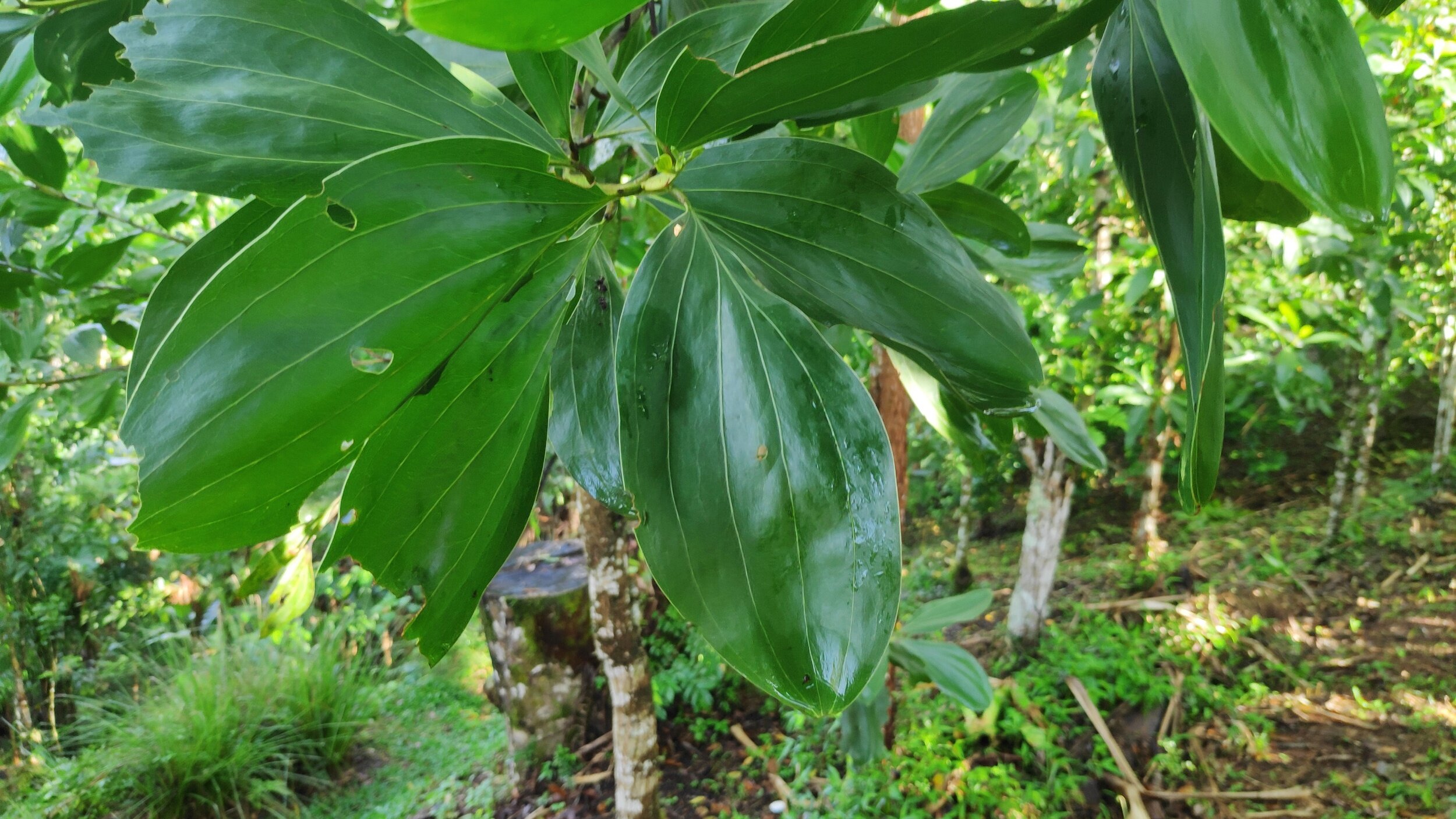
This is number one on the list as it is the most abundantly used NFT on our site. In recent years we have moved away from using it, as it can quickly get large and unwieldy, though there remains a significant number still on our site. It grows fast like most NFTs and handles pruning relatively well, but not great with a fair few dying each pruning season in comparison to some others on this list. It needs full sun and will naturally form a tall straight trunk. It is commonly used in other countries as a valued timber species. The interesting thing about this species is how it really doesn’t look too much like an NFT. Most species in the legume family have a very characteristic leaf pattern. Acacia mangium though does not have this characteristic leaf pattern and you would not think it was an NFT by looking at it. However its first emergent leaves do possess the familiar NFT leaf pattern and give away its family! It is not super easy to propagate from seed like some other NFTs and we have had no success with cuttings. We mainly used this species planted along contour lines when establishing new orchard spaces and since then have moved away from using it so much. We plant it at tight spacing and prune at the end of each dry season to provide biomass for our tree crops.
2. Cratylia argentea

This is the one species on the list that isn’t technically a tree, it is more of a climbing vine, and boy does it climb fast!!! It is an abundant source of nitrogen rich biomass, it handles pruning excellently and pretty much always bounces back. It grows very easily from seed and produces really beautiful, abundant purple flowers (great for pollinators) at the beginning of the dry season, which really facilitates the collection and storage of seeds. You have to be careful with this species as it loves to climb and it will quickly swamp tree crops if left to its own devices and can strangle and kill them. Its greatest characteristic is its speed of growth and abundant biomass, but this is also the feature which gives us a love hate relationship with this species! It loves full sun but will tolerate some shade. We are using this a lot to fill in gaps in our contour plantings of Acacia mangium where a tree has died.
3. Mountain immortelle (Erythrina poeppigiana)

Known locally as Poro, but be careful as there are several species that are known as Poro in Costa Rica. It does really well from cuttings which makes it an excellent choice as a living post for fences or a living post for trellises for climbing crops like passionfruit or dragonfruit. It has an attractive flower which is great for native pollinators and grows easily from seed. The one drawback of this species is it is typically spikey which can make it a little unfriendly to work with and to use as biomass.
4. Brazilian Fire Tree (Schizolobium parahyba)

Is by far the fastest growing NFT on the list along with Cratylia argentea, the main difference being them is it is a tree rather than a vine and it grows straight up…. Very quickly! It can grow up to 30m in 5 years, as you can imagine the wood is very light and spongy. It doesn’t produce a huge amount of foliage and creates a very light shade, it is supposed to keep its leaves during the dry season too as one of its major advantages, however in recent years it has dropped all it leaves so I will leave that one up to you. We typically grow this from seed and use it as a light shade for tree crops.
5. Quickstick (Gliricida sepium)

This species is known locally as Madero Negro, grows well from seed and has about a 50% chance of survival when planted from cutting. The mature tree is a low growing, typically not straight, that produces excellent high quality heartwood timber. The heartwood timber is known for its durability, rot resistance and is used a lot for foundations. It is also used a lot as a living fence post and the leaves can be used to deter fleas and kill rats. At the Ranch we typically use it as a living post for vanilla and black pepper. It tolerates shade, as in it will survive in shade, however don’t expect a lot of growth.
6. Ice Cream Bean (Inga Edulis)
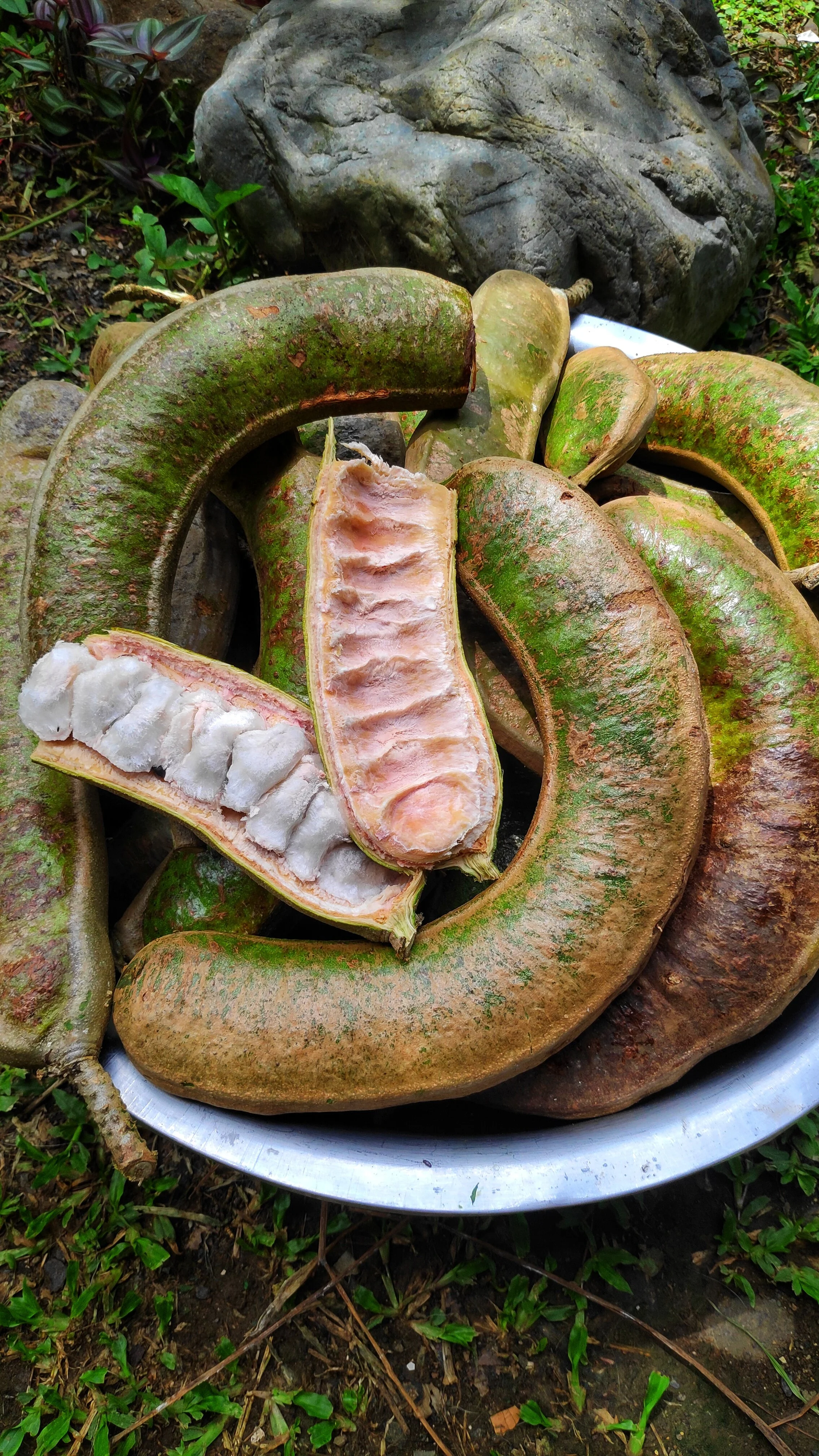
The fruit of the ice cream bean
This is one of the few NFTs that also produces an edible fruit in our environment. Locally the fruit is known as Guava or in English it is called Ice Cream Bean. There are often many wild forest varieties of this tree, some of which produce beautiful heartwood timber. Inga Edulis however produces useable timber, but it is prone to termite damage and should only be used for furniture and non structural elements. It produces huge and abundant leaves and reacts quite well to pruning, making it an excellent choice as an NFT. If you are continually pruning it though for biomass don’t expect to get any edible harvest from the tree. This will grow into a very large tree if left unmanaged.
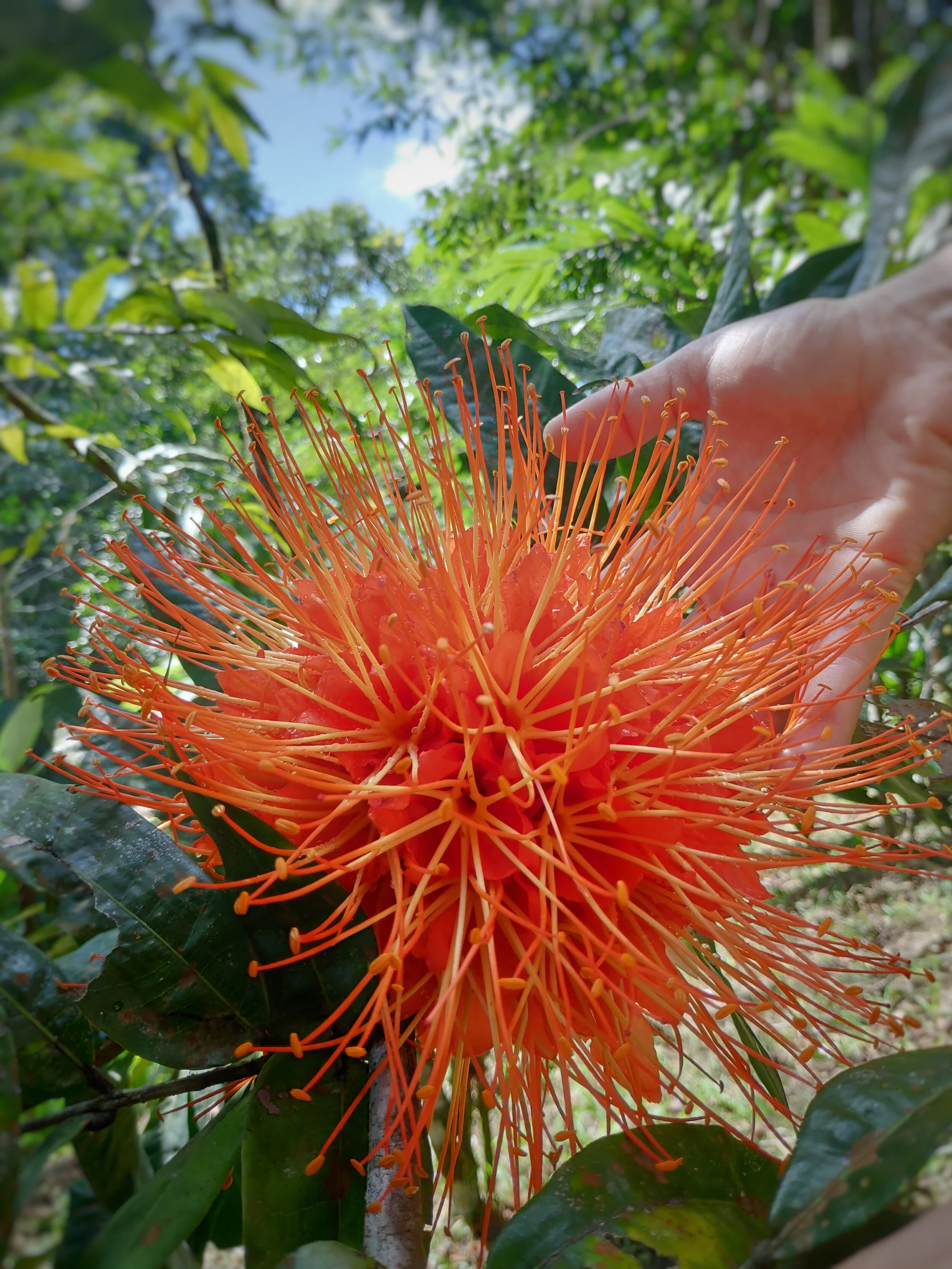
7. Venezuelan Rose (Brownea macrophylla)
This is primarily planted as an ornamental, that produces a very beautiful and striking flower at the end of the rainy season. It also tolerates shade quite well and will still produce some flowers. It can be frequently pruned but doing this will effect flowering. We struggled for many years to source this rare beauty!
8. Peanut Grass (Arachis pintoi)

Again not technically a tree but provides a formidable and fast growing ground cover. One of the important permaculture principles that we apply is covering all of our soil. Peanut grass is able to do this quickly and effectively even in very poor soils and can survive our harsh dry season and bounce back quickly once it starts raining again. It produces pretty yellow flowers and is very resistant to mowing or weed whacking. We try to use this as much as possible as a groundcover however it prefers full sun and whilst it will survive in shady areas does not really grow or spread quickly. It is most easily produced by cutting and has a very, very high success rate. Seeds can be purchased but really why would you bother? It is easier to plant via cutting.
9. Wild Hops (Flemingia macrophylla)
A bushy shrub that doesn’t get taller than a couple of meters on our site which is one of its biggest benefits! It is easy to propagate from seed and cuttings making it a great choice for our site. It seems to tolerate shade relatively well, but does prefer full sun. Its low bushy growth habit means it doesn’t swamp other plants like the Cratylia can, but it doesn’t produce nearly as much biomass. Although relatively small amount of biomass is produced in comparison to some of the other NFTs the leaves do take comparatively long to break down and provide excellent mulch. In comparison to the Schizlobium’s feathery leaves that break down incredibly quickly. We mainly start these in our bamboo planters either from seed or cuttings and use them to fill holes where other NFTs have died or not taken well.

Want to learn More?
These are the main NFTs we use at the Ranch. If you are interested in learning more about how to use Nitrogen Fixing Trees in your landscape why not join us for a Permaculture Design Course or Agroforestry workshop.
We also have some of these trees available seasonally in our nursery, so get in touch if you would like to buy some.
Happy planting!
Other blogs related to soil fertility
Improving Soils in the Humid Tropics
Making Microbes: Fungal vs Bacterial Soil Life

Improving Soils in the Humid Tropics of Costa Rica
In permaculture and agroforestry circles it’s common to hear the idea that we’re not growing plants so much as we’re cultivating rich, healthy soils in which plants will do their own growing.
Improving Soils in the Humid Tropics of Costa Rica
By Anthony, Apprentice 2020
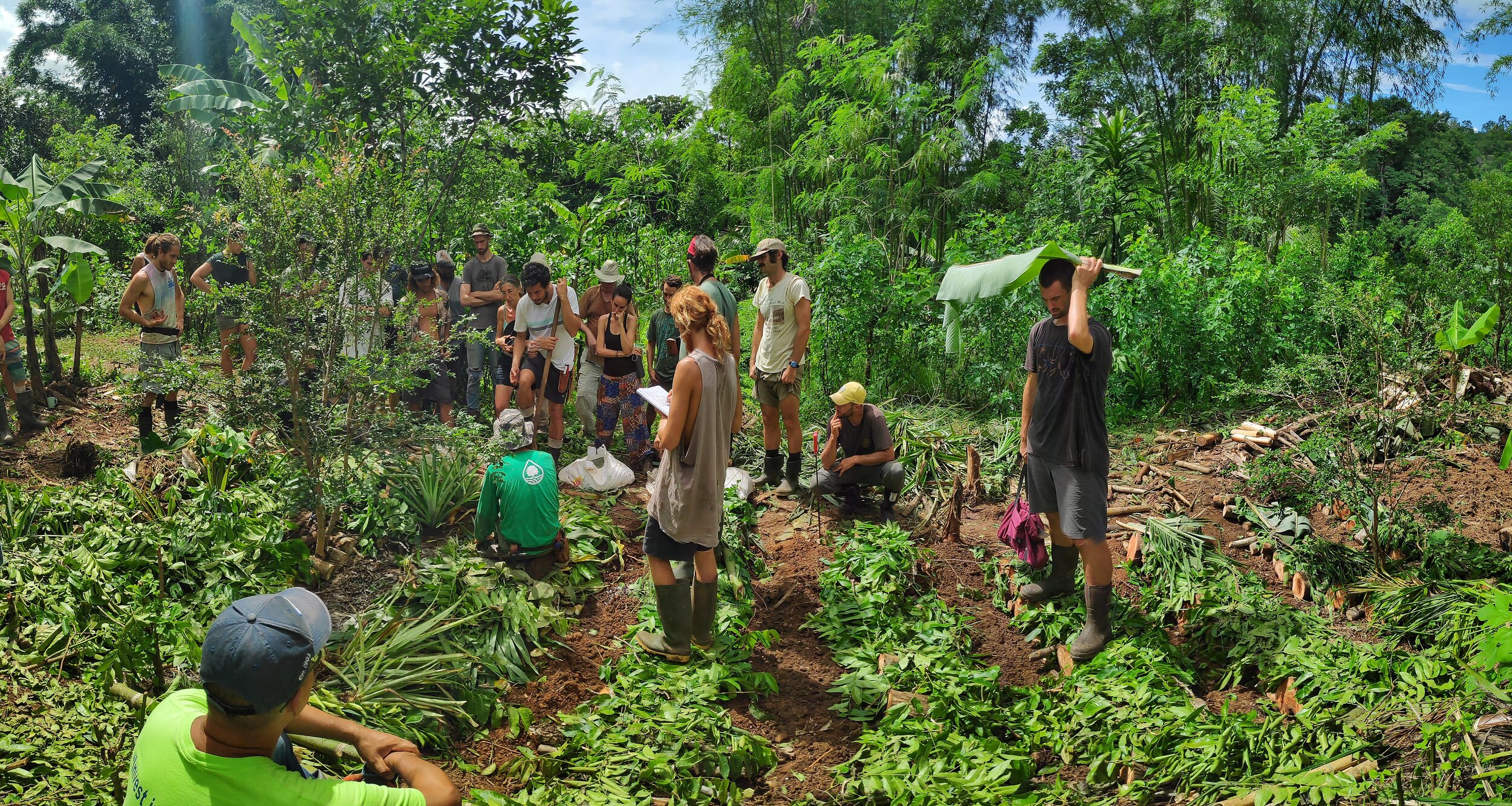
Syntropic farming workshop at Rancho Mastatal
In permaculture and agroforestry circles it’s common to hear the idea that we’re not growing plants so much as we’re cultivating rich, healthy soils in which plants will do their own growing. Yet, to this end changing the make-up of soils seems like a daunting job. So how can we go about the task of improving our soils in a simple and efficient way that corresponds with permaculture principles?
The challenge of Tropical Soils
Soils in humid Tropical America are generally found to be eroded and leached. In this region’s ecosystems, about 85% of nutrients are held in plants and animals, so the soils themselves are infertile. Only terraces, floodplains, and new volcanoes keep some soil fertility replenished if land is cultivated (Mollison, 2004). This yields soils that are high in clay content, poor in nutrient content, and often quite acidic. As we say here at the Rancho Mastatal, a permaculture farm in Costa Rica, it’s soil that’s great for natural building, yet not ideal for growing an abundance of food.
The goal with soils like ours is to improve soil texture, increase mineral and nutrient content, reduce soil acidity, enrich microbial life, and increase the quantity of organic matter held in the soil.
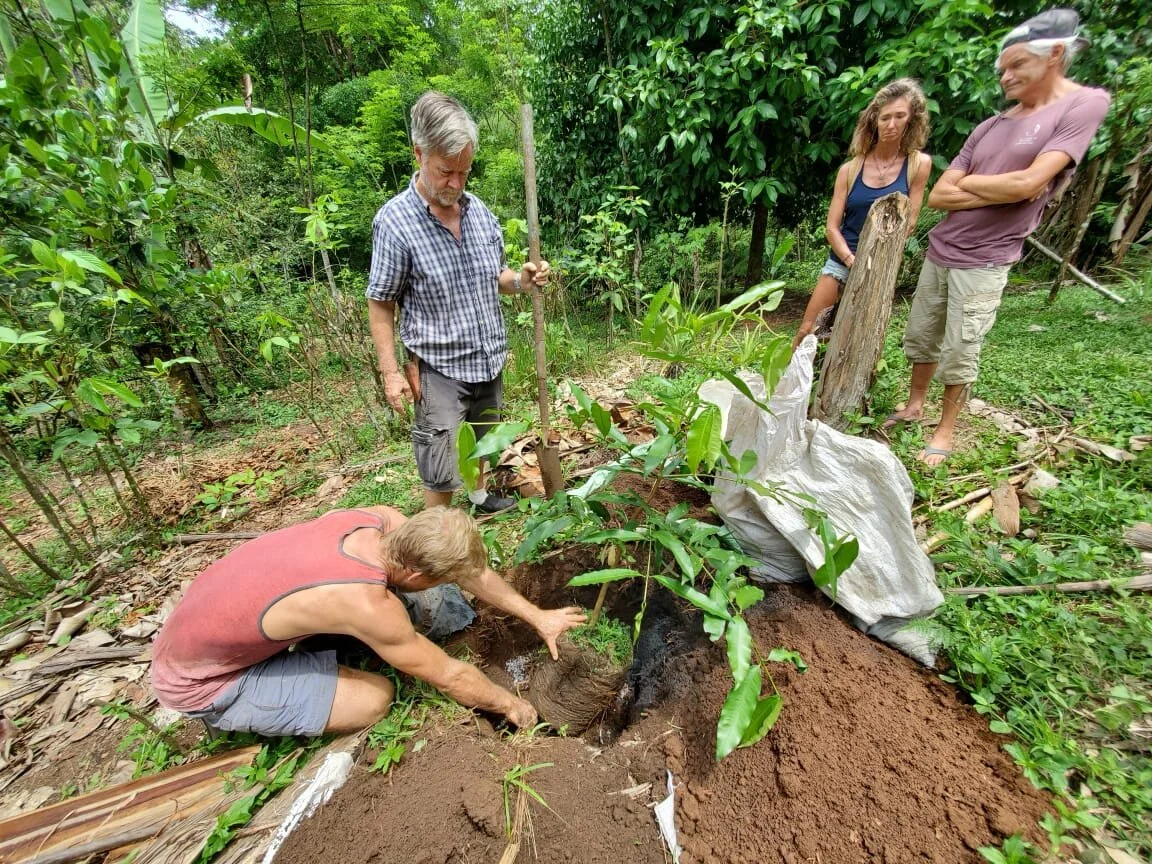
Planting a fruit tree during our annual Agroforestry Skills Workshop
Permaculture & Agroforestry based strategies
In a recent agroforestry workshop held at the Rancho Mastatal here in Costa Rica, a class that worked through concepts of a multi-strata, diverse style of permaculture, the holy trinity of soil amendments for the humid tropics was revealed. The three pillars of improving cultivated soils are
Biomass
The strategy of biomass organized on contour (lines running perpendicular to the direction of the cultivated slope) is the most visible method used here at Rancho Mastatal to improve the soil’s structure and nutritional/mineral content, our ‘organic’ way of applying fertilizer. In the humid tropics, biomass tends to be available in great quantity, and can be used to build up the mentioned contours. Over time these will build to form terraces that greatly reduce soil loss related to erosion and leaching.
Mountain Microorganisms
Mountain microorganisms is a world of its own. Through the fermentation of leaf litter from nearby forests, we cultivate microorganisms which are then applied to our soils, the foliage of our plants, and our compost. We are reproducing healthy bacteria and yeast that, when used in our permaculture systems, will in turn help our plants absorb more nutritional benefit from our soils. To read in more depth about how to make Mountain Microorganisms read this article.
Biochar
Biochar will then provide a long-lasting refuge for these beneficial microorganisms. This is due to its incredibly high surface area within its structure. This special form of charcoal is extremely slow to break down and both directly provides nutrients and minerals to our soils as well as creating a positive feedback loop of topsoil production.
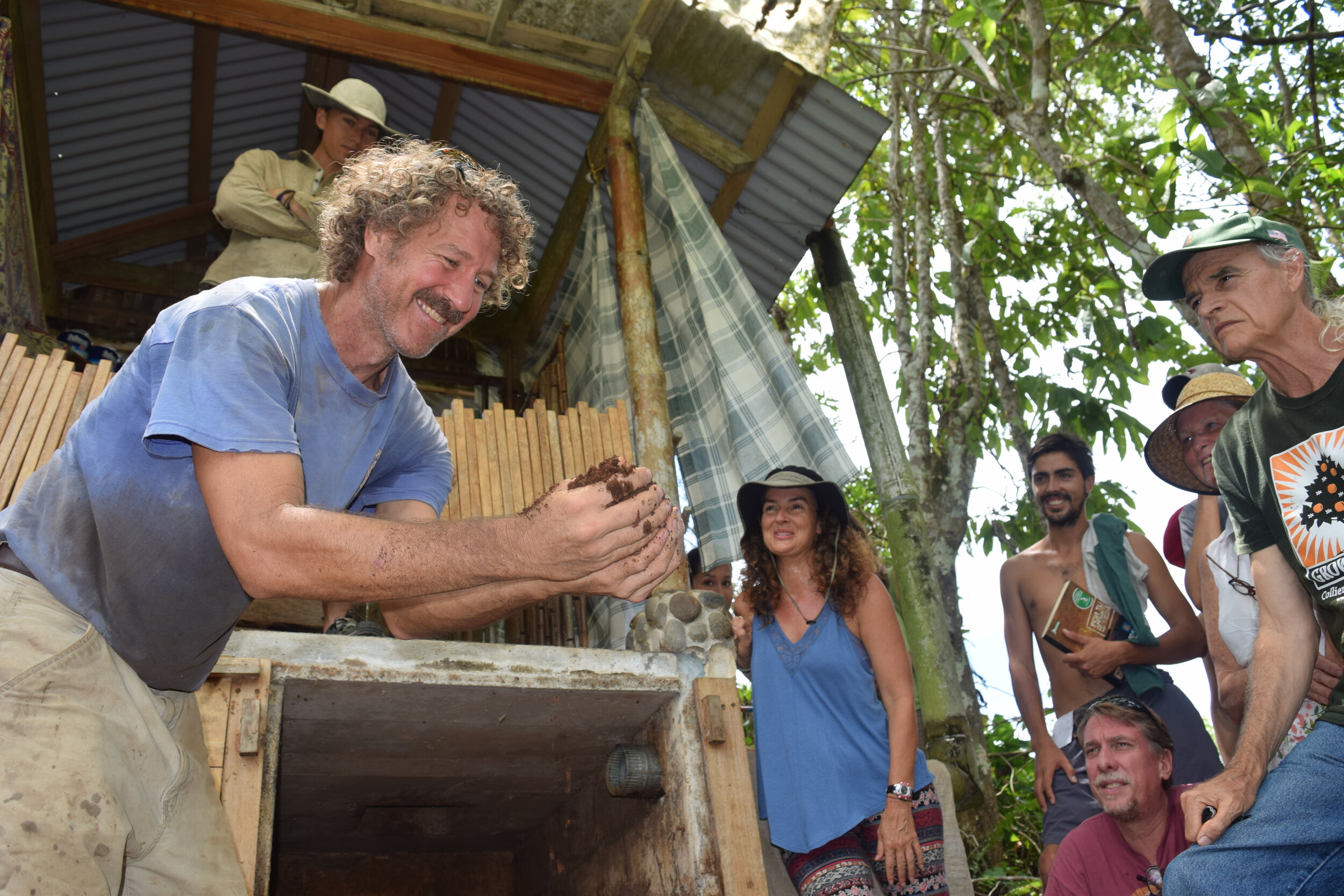
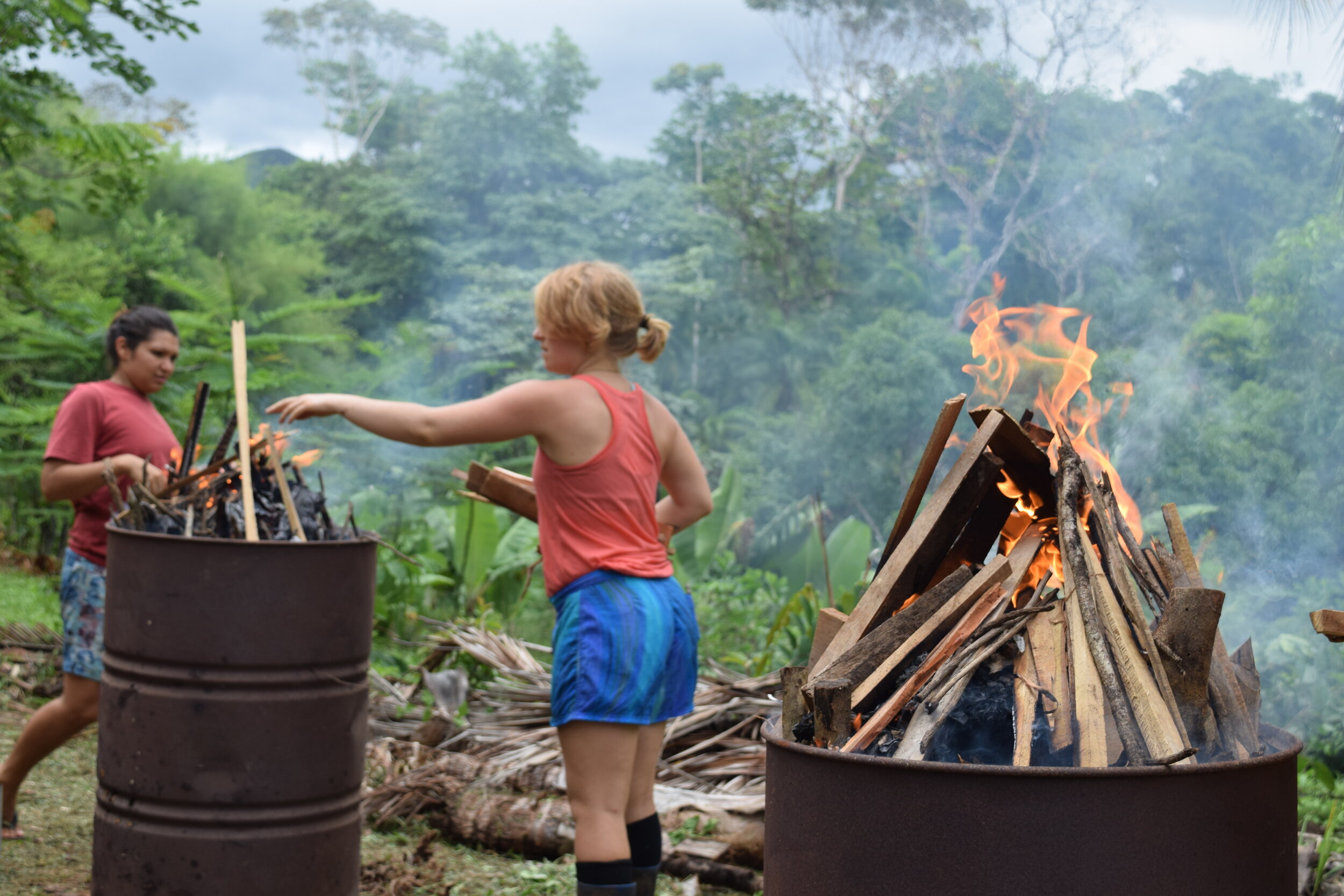
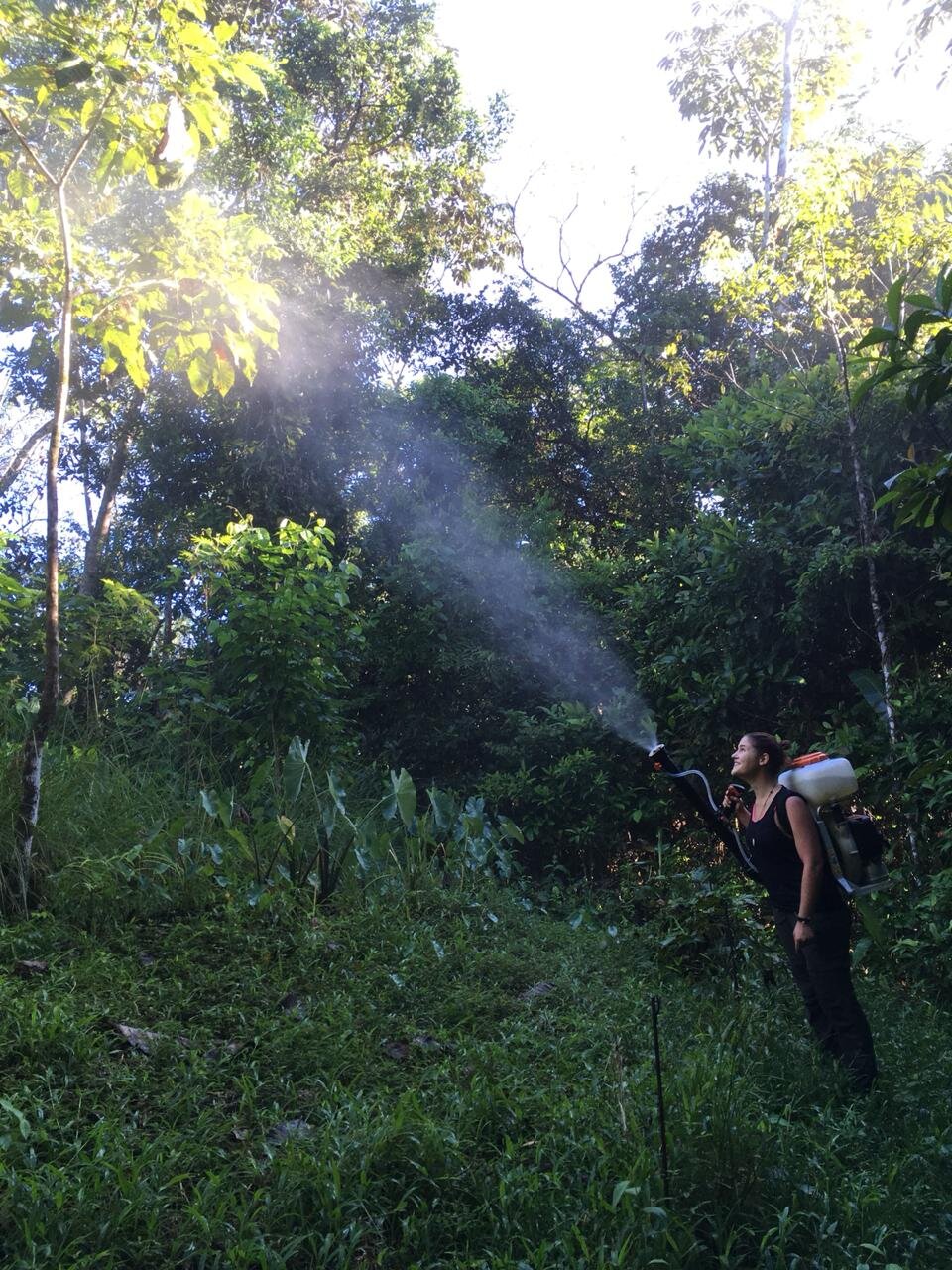
Many ways to develop tropical soils
There are other solid permaculture concepts for improving soils in the humid tropics that should be mentioned here. To deal with highly acidic soils, adding lime at regular temporal intervals is a useful strategy. We tend to avoid planting annuals while opting for perennials, by which we disturb the soil less and reduce potential erosion. Read our article about which perennial greens do well in the tropics here. Over time these plants will help build humus and topsoil. There are plenty of pro tips from the world of permaculture that you’ll find helpful, like adding shredded cane and bamboo species as a mulch for silica and calcium enrichment. This will in turn help to raise pH levels (lower acidity) of soils and reduce leaching and erosion. We add Humanure and effluent from our Biodigestors, this helps build our soil and use commonly wasted products to grow food!
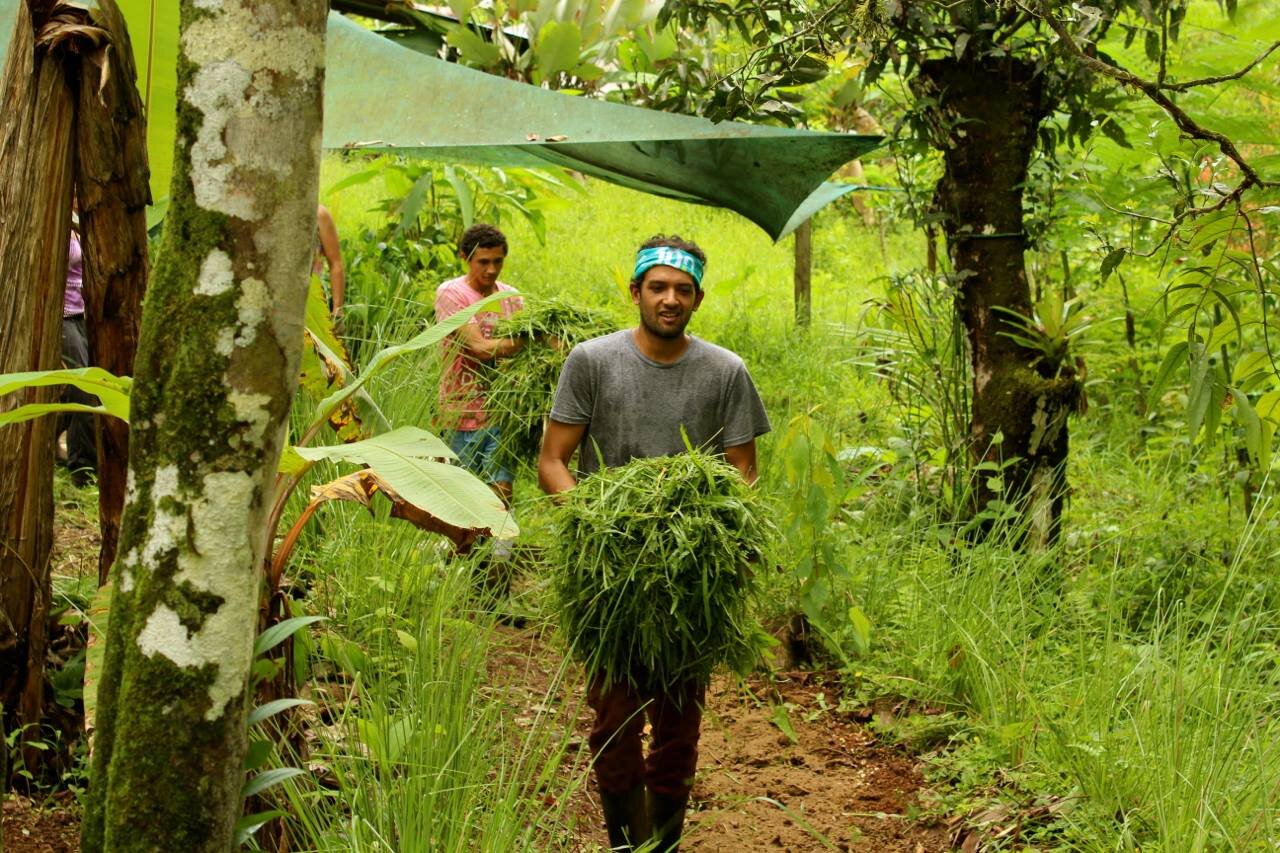
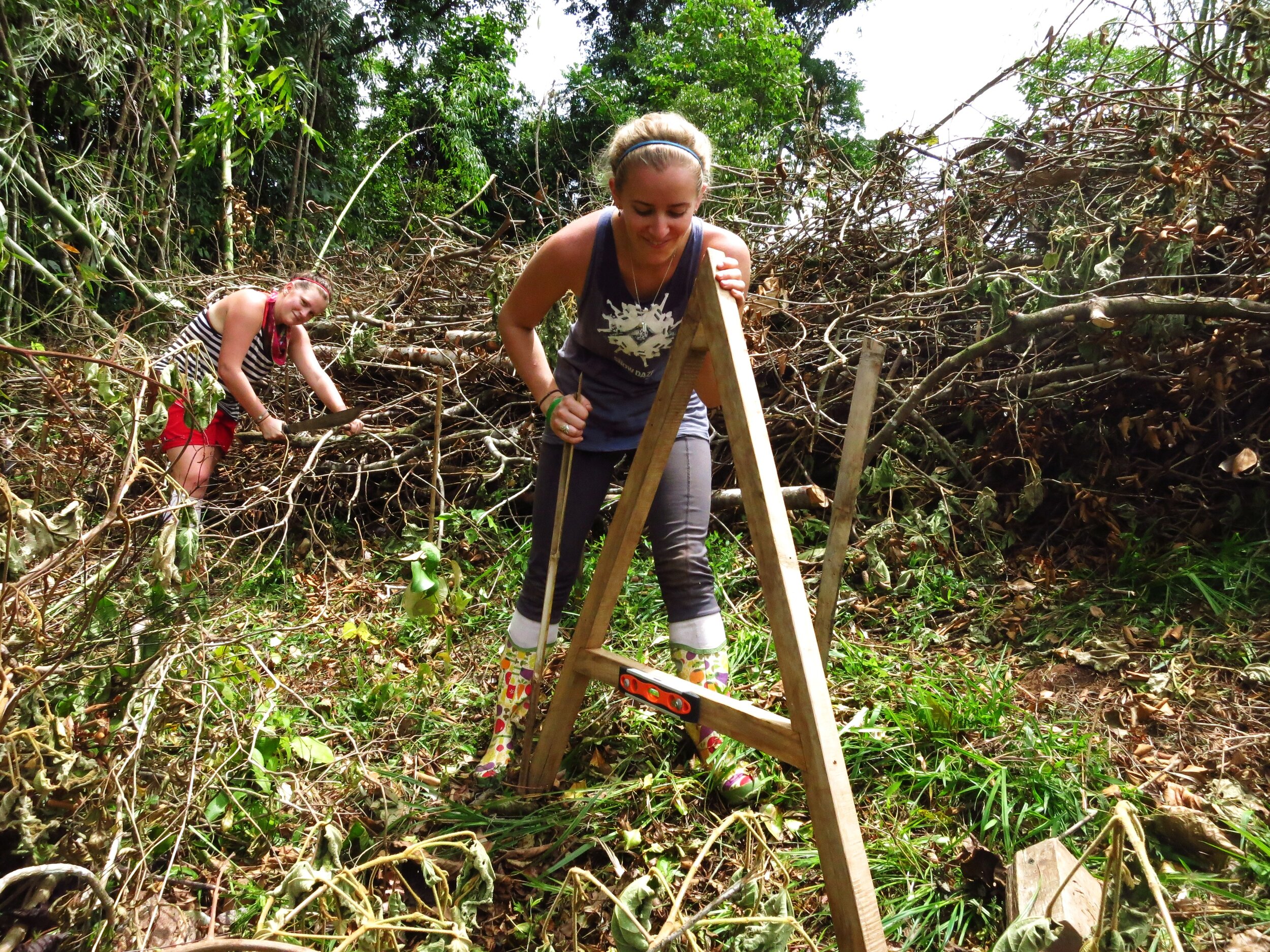
Want to Learn More?
If you’re interested in agricultural concepts such as improving soils, make sure to check out Rancho Mastatal’s workshops, including:
Past Blogs on Soil and Permaculture in the Tropics
We have a lot of past blogs on this topic. Here are a few to read:
Applied Permaculture Principles

Our apprentices doing some chop and drop in the orchards

Gardening and Permaculture practices at the Ranch
Here at the Ranch the year long apprentices have various roles and functions that support the Ranch community. By taking on responsibilities and managing certain areas we the chance to learn and experience those areas on a deeper level . Part of the educational model created by the ranch team is a monthly rotation of these so called life skills. Each apprentice transitions their life skill to the next apprentice, passing on all of the relevant information to their colleague in order to complete the various tasks associated with each life skill.
by Diana Dagash
2019 Apprentice

our front gardens
Here at the Ranch the year long apprentices have various roles and functions that support the Ranch community. By taking on responsibilities and managing certain areas we the chance to learn and experience those areas on a deeper level . Part of the educational model created by the ranch team is a monthly rotation of these so called life skills. Each apprentice transitions their life skill to the next apprentice, passing on all of the relevant information to their colleague in order to complete the various tasks associated with each life skill.
One of the life skills is currently called the Garden Gnome. I would like to share some of my experience and reflections from doing this task every morning for a month. The garden gnome is in charge of maintaining the front gardens. This is referred to as our zone 1 garden using permaculture lingo. It is the area that is in closest in proximity to the most frequently used space- the main house. In the Zone 1 gardens we grow herbs, annual and perennial crops such as mustard greens, katuk, Haitian basket vine, hibiscus, cucumbers, squash, yard long beans,wing beans, radishes, sweet potato, moringa, basil, oregano, mint, parsley and curry leaf and other amazing tropical goodies which we use in our kitchen everyday. Having these crops growing in close proximity to where we spend most of our time allows us to easily provide the daily maintenance of this space such as watering, harvesting and weeding.
In Rancho Mastatal we approach gardening through a permaculture lens. By mimicking the patterns in nature we are able to create micro climates in which our crops thrive. We create systems that have many functions and support other systems in their functions, allowing them to thrive in harmony with nature. We apply a range of those practices at the ranch and we continue learning and experimenting with new possibilities.
Given that we live in the tropics we have two opposite seasons, about half the year its is dry and the other half rainy. Although the dry season has its own challenges I can only speak from my own experience taking care of the garden in the rainy season, for instance i believe that in the rainy season there is a lot of weeding whereas in the dry season there is a lot of watering!
As the rains increase in volume and frequency it is a time when everything begins to grow rapidly. The jungle fills up with even more green vegetation, popping out of every space available. It rains consistently every afternoon , sometimes all day and night. The soil is saturated . It is a happy time for ALL living things to thrive, including some of the more challenging species like mold, fungus and insects. Some of our crops were over taken by fungus or eaten by insects, others became over saturated with water as they were lacking sun and/or air flow. As with every challenge, i found an opportunity to research and experiment with natural recipes for pest and fungus control.
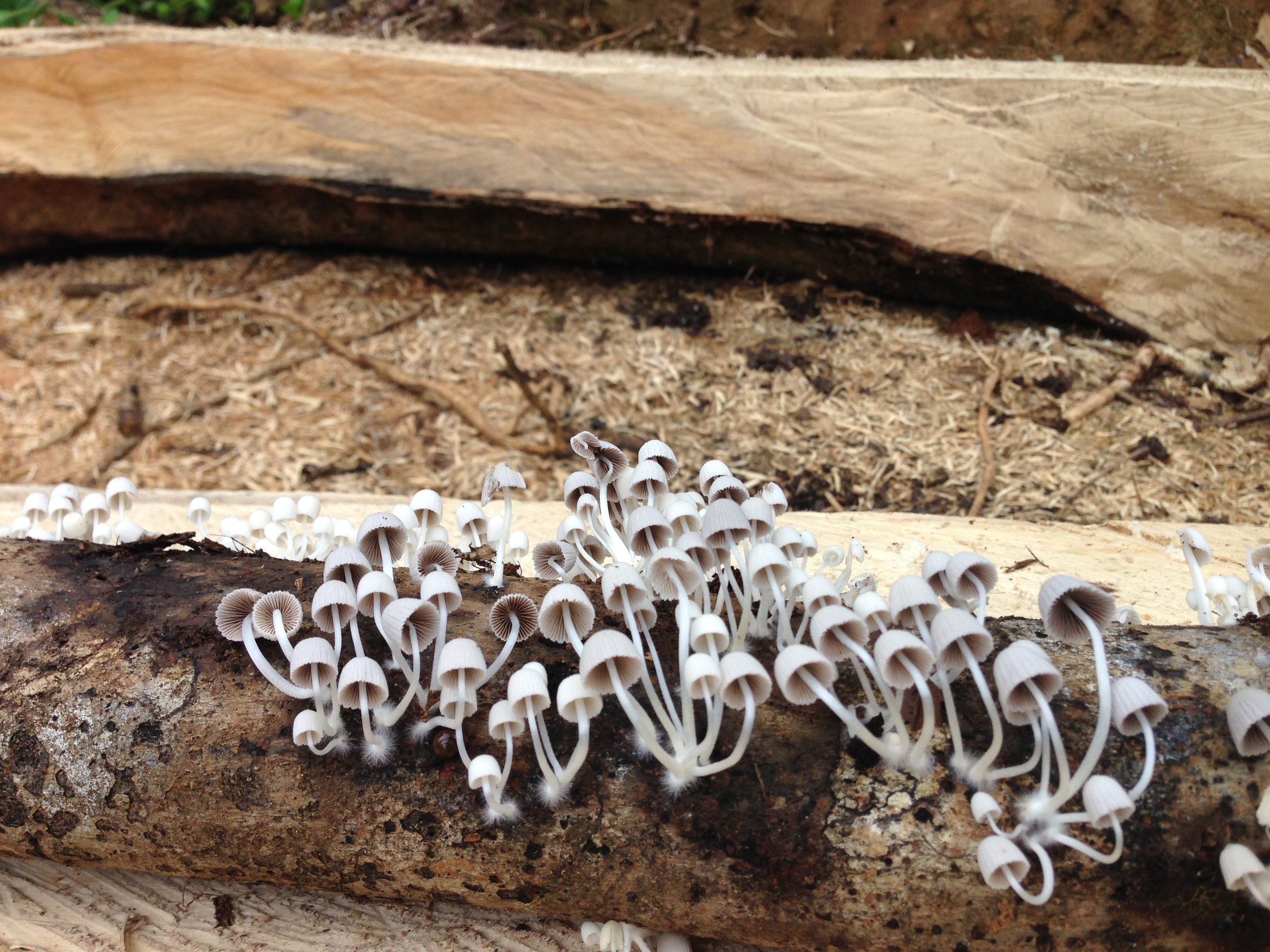
with the onset of the rains, mushrooms started popping up everywhere
My days started early in the mornings with a walk through the garden, observing the plants and checking the soil moisture levels. As I walked I noticed plants that seem to be struggling and tried to identify what might be affecting them. This is then communicated with the garden manager so we could discuss further ideas and solutions. We researched potential natural insecticides and fungicides that could help solve these issues.
Here is some of what we have learned and the practices we apply here at the ranch.
We are surrounded by amazing medicinal plants growing all around us, thriving under the jungle canopy or occupying disturbed pockets. These plants contain medicinal properties that can benefit humans as well as plants.

For example turmeric contains anti-inflammatory and antibacterial properties beneficial to humans and when planted among the roots of a tree, benefits the tree with those same properties This is referred to as companion planting. By planting diverse species next to each other they are able to support, protect and ultimately benefit one another. This can be as simple as providing shade or wind protection. Not only can companion planting by a useful tool in our belt to fight against disease and pest pressure but we can also use the properties of some local herbs. Here are some examples of what we have been doing.
Jackass bitter - the most bitter herb known, contains antifungal and antiparasitic properties. Spraying this tea onto diseased plants can repel insects and prevent fungal issues.
Inter cropping aromatic herbs like oregano, lemon grass and basil with certain food crops can confuse and repel insects with their scent and prevent disease with their antimicrobial and antifungal properties.
Using the shade of the cucumber trellis to help shade and shelter more delicate herbs underneath them.
Using peanut grass as a living mulch to crowd out weeds and provide nitrogen to the soil underneath some of our taller perennial crops such as Katuk and Cranberry hibiscus.
Planting Marigolds everywhere to reduce nematode populations, there is controversy about the effectiveness of this though.
Working in the front gardens has also made me reflect on the ideas of closed loop systems. As i am partially responsible for management of the kitchen compost. I really like the idea that there is no such thing as waste. Everything can be transformed into something useful. All of our food scraps are composted creating a finished compost that can then be added back to the soil to enrich it, closing the loop.

Another big part of the practices we apply when it comes to the food forests is observation of the environment and meeting the land's needs by mimicking patterns in nature. Thanks to all the researches and life long practices in the agro forestry and gardening world, a network of knowledge has been created for us to share our experience and knowledge. We are continuously learning and working towards improvement of our systems.
With each piece of land we carry the responsibility for the history, present and future of it. It is up to us to create a relationship with our land, to observe it's needs and potentials.To be stewards of the land and assist it to become a healthy ecosystem in which we can humbly live and feed ourselves.
This experience, of being an apprentice at Rancho Mastatal, has opened my eyes to a new world of possibilities, inspiring ideas, regenerative solutions, discovering new ways to live lighter on the planet and in harmony with nature .

I am inspired by the movement towards an ecological , sustainable lifestyle and feel grateful to be a part of a project that focuses on sustainability, permanent culture and agriculture.
I invite you to share your experience and discoveries with growing food in the lowland tropics.
What interesting practices have you learn about recently?
Which annual crops did well for you in the tropical rainy season of Costa Rica?
What kind of companion planting worked well for you?
Would love to hear from you!
Blessings,
Diana D.
For more information about Permaculture consider joining us for our Permaculture Design Certification. For info about being an apprentice please go to the apprentice page. Here you will find in depth descriptions of what life is like in Mastatal.

Making Microbes: Fungal vs Bacterial Soil Life
Organic gardeners and farmers understand the need to cultivate and protect soil microorganism life. The strategies to do this involve mulching, composting, and avoiding soil disturbance as much as possible. We know that these strategies, in addition to many others, encourage a healthy soil-food-web.

Making Microbes: Fungal vs Bacterial Soil Life
Organic gardeners and farmers understand the need to cultivate and protect soil microorganism life. The strategies to do this involve mulching, composting, and avoiding soil disturbance as much as possible. We know that these strategies, in addition to many others, encourage a healthy soil-food-web.
The soil-food-web is the interconnected matrix of invisible (fungi, bacteria, protozoa, nematodes) and visible (earthworms, beetles, arthropods) creatures that have a whole host of functions which create a healthy ecosystem for plant growth. They aerate the soil, decompose organic matter, make nutrients available, prevent nutrient leaching, break down toxins, protect plants from pathogens, fix nitrogen and so forth.
What we can take away from this bit of knowledge is that we want these organisms operating on our garden or farm. The best way to do this is by creating the habitat and food they need in order to thrive. This seems simple, but it quickly becomes complicated when we explore the details.
Each of these organisms does better with different food sources and each of them change their environment in different ways. In addition each species of plant we are growing thrives in different soil environments; apples and arugula have evolved very differently and the more we can support their evolutionary requirements the healthier the plants will be.
That becomes our starting point; where we ask:
What type of soil environment do our crops desire?
How can we then encourage the specific type of microorganisms to create that environment?
Fungal-Bacterial Ratio
Here at the Ranch we are growing tree crops, which as I've written in this blog before, thrive in an environment that mimics the forest ecology surrounding our orchards. One measure we can use to understand this ecology is the fungal to bacteria biomass ratio (F/B).
This is a measure of the portions of the microbial biomass, ie. all the living organisms in the soil, that is fungal vs that which is bacterial. The F/B ratio is primarily used to study the impact of human land disturbance on the soil-food-web. It can therefore also be used to determine what individual plants desire. For example annual grains and vegetables like a ratio of 0:3 to 1:1 and orchard trees thrive in 10:1 to 50:1 soils
Depending on the types of crops we are growing, again in our case tree crops, we may want to alter the dominance of fungi or bacteria in our soil. These microorganism, particularly fungi, are quite sensitive to changes in land usage, therefore we need to understand how different techniques affect this ratio and why we want the ratio to be high or low in the first place.
Ecosystem Mimicry
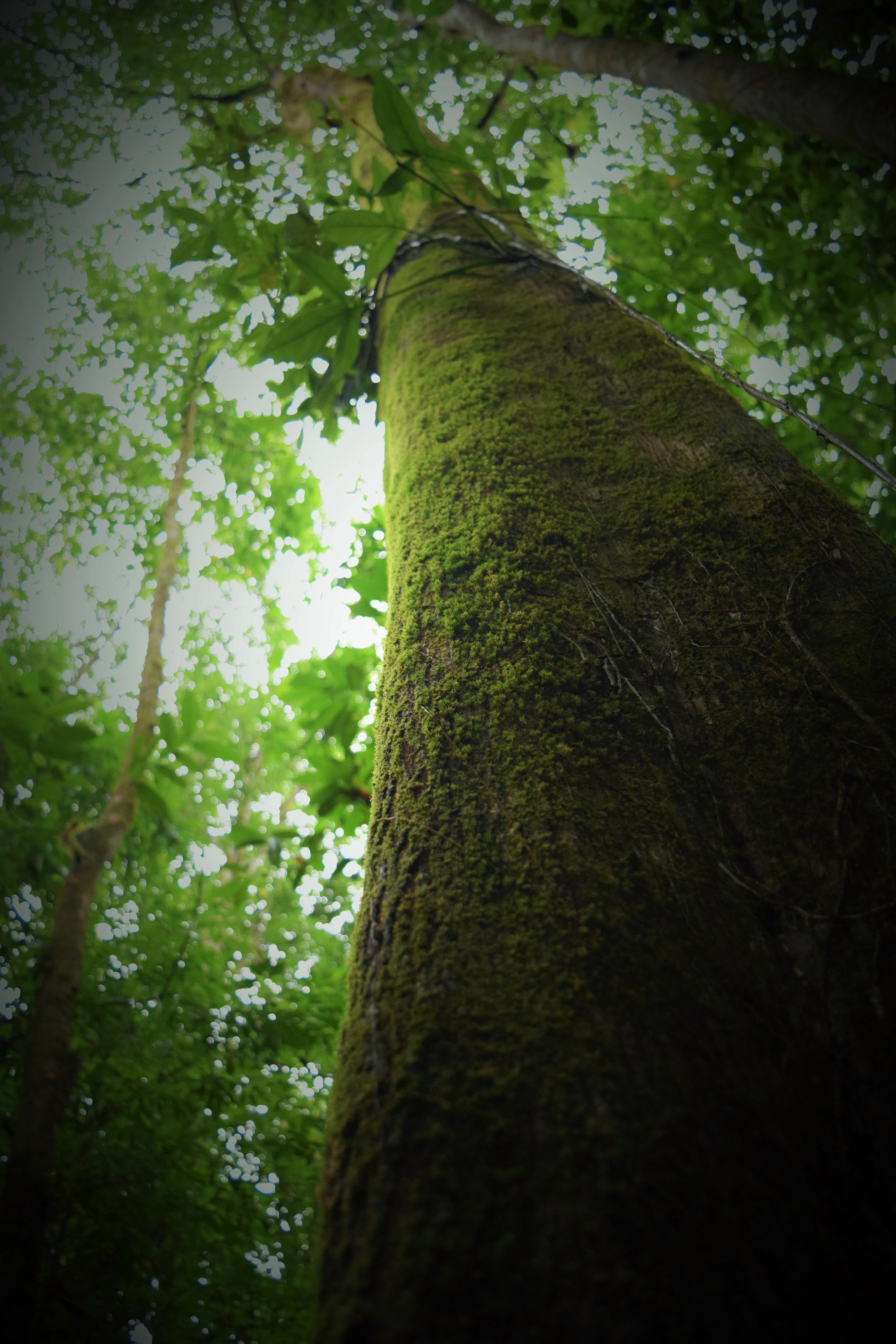
Forest soils have a higher fungi to bacteria ratio. Looking at quantities of each, as measured in a teaspoon of soil, we find that bacteria remain steady in quantities through the spectrum from agricultural soils to prairie soils to forest soils. In one teaspoon of soil there are 100 million to 1 billion individuals. Fungi, measured in yards of hyphae, though increase significantly along this spectrum. In agricultural soils they are measured in several of yards, while in deciduous forest soils hundreds of yards are found, and in coniferous forest this actually increases to miles.
Fungi love high carbon materials, think cellulose and lignin which are the primary building blocks of tree leaves and wood. Most bacteria struggle to break this down. Bacteria instead thrive with high nitrogen food sources, think manure, incorporated cover crops, etc.
We can gather from this how different gardening and farming techniques affect this ratio. Fox example mulching with wood chips encourages fungi, tillage kills fungi and encourages bacteria, and incorporating organic material into different soil horizons shifts the ratio toward bacteria.
Mineralization/Immoblization Balance
This makes it apparent as well that fungi and bacteria have different roles in the soil-food-web. Fungi are better are taking in and retaining nutrients as part of the mineralization/immobilization process. This is the process where microbes consume nutrients, thereby immobilizing them in their bodies and preventing nutrient leaching.
As they live their lives, producing waste and eventually being consumed further up the food chain, these nutrients re-enter the soil-food-web in a form that is soluble to plants. This is called mineralization. Fungi and bacteria are immensely important to different stages of this process and are each most effective depending on what they are being feed.
Knowledge to Practice
In our orchards we want to cultivate an F/B ratio between 10:1 and 50:1. There are many ways for us to work toward this goal, the simplest being understanding the ecology of fungi and providing the necessary shelter and food source. We do this by consistently mulching our trees with woody materials.

We can get more specific in the process by cultivating our own indigenous microorganisms from the forest and inoculating them directly into our orchards. This practice is called Mountain Microorganism (MM). We have been applying MM to our orchards consistently over the past year in order to shift our F/B ratio higher and gain the benefits, such as pathogen control, that these microorganisms provide to the native forests.
Next steps for us in this process is to use our microscope to analyze the biological content of our soil. With the proper training and experience we expect to be able to determine rough F/B ratios in both our soils and the MM we are applying as a foliar drench. We will be sure to let you know what we find.
For anyone interested in making their own microbes, below is the recipe we use. If you would like to learn more about this process you should consider joining us for our upcoming Permaculture Design Certification course in April/May of 2017.
Mountain Microorganisms Recipe
Phase 1: MM Solid

Ingredients
3 sacks microorganisms (duff layer of primary forest)
2 sacks semolina, yuca flour, or green banana flour
1 gallon molasses, cane juice, or fruit juice
1 gallon water
Instructions
Spread a layer of duff on a top and cover with a layer of semolina. Mix well with hands. Dilute the molasses with the water and sprinkle on top as you continue to mix. If you grab a fistful of the mixture it should be lightly damp and fall apart easily after you squeeze it.
Next, have someone stand in a 55 gallon plastic drum (never metal), while you shovel the material inside. As you shovel, the person stamps the mixture down with their feet to compress it and remove any air pockets. Seal the barrel and leave at least one month, stored in the shade.
The mixture should be good for three years. When ready, it should have a strong smell of lactic acid.
Phase 2: Liquid MM

Ingredients
5 kilos MM Solid
1 gallon molasses
55 gallon plastic drum filled with water
Instructions
Mix the molasses into the water. Put the MM into a screen sack and let hang in the water. Seal the drum and let sit 4 days.
Between day 4 and 15 this can be used as a foliar spray (between 10 and 100% ratio to water). After 15 days use the MM as a soil drench and after three weeks the product should be fully used up.
Once you have used the MM Liquid, you can make one more batch with the same sack of microbes. Just add 1 gallon molasses and refill the drum with water.
References
Lowenfels, Jeff, and Wayne Lewis. Teaming with Microbes: The Organic Gardener's Guide to the Soil Food Web. Portland, Or.: Timber, 2010. Print.
"Soil Health." Soil Health. N.p., n.d. Web. 15 Oct. 2016. <http://www.soilhealth.com/>.
News from around the Permaculture Community
Matt Duffy, from our 2015 PDC, wants to capture your story with his new film company No Mad Films. Duffy is an incredible story teller who we hope can come back to the Ranch, bring his cameras and capture our life in action.
Our collection of cast iron kitchen skillets and dutch ovens is extensive. A good cast iron skillet is by far the most basic but essential kitchen item for our team. Over the years we have learned a trick or two about their maintenance. This article, from Permies.com, sums up nicely how to use and clean cast iron.
The many Ranch friends at Round the Bend Farm, located in southeast Massachusetts are hosting a series of Fermentation Workshops with our very our Core Team member Laura Killingbeck. These come highly recommended for anyone in the area.
Abrazos
The Ranch Crew

Poop: The Secret to Sustainable Solutions
Poop. Shit. Mierda. Caca. Crap. Boñiga. Excrement. Feces. Dung. There are countless ways to say what comes out of an animal’s body as solid waste. As most visitors to the Ranch realize soon after their arrival to Mastatal, we talk about poop more than the average learning center or household, and it’s not uncommon for it to be the center of a meal conversation.

By Tim O'Hara
Poop. Shit. Mierda. Caca. Crap. Boñiga. Excrement. Feces. Dung. There are countless ways to say what comes out of an animal’s body as solid waste. As most visitors to the Ranch realize soon after their arrival to Mastatal, we talk about poop more than the average learning center or household, and it’s not uncommon for it to be the center of a meal conversation.

Human beings’ evolution towards “fecophobia”, or a fear of fecal matter, has been steady and consistent over the past few decades. The reasons behind this observation have at times been warranted, but not always. One of our goals as an organization is to initiate honest and open conversations about controversial topics related to sustainability, including how best to manage animal waste. As a child, I was taught to avoid poop at all costs. Poop was meant to be flushed away to some unknown, unasked about destination far from my house. Pull the lever on the porcelain throne and think no more about it. My closest encounters with poop growing up mostly consisted of scraping dog shit from the bottom of my sneaker with a stick after a game in the yard. This type of experience only increased any justification for not being endeared to this smelly, dangerous, and sticky substance. Nevertheless, most of us spend part of the first years of our life walking around with a load of it in our diapers, which may help to explain why my relationship with poop has oftentimes been defined by confusion. Everybody poops. That’s also the title of a book that a friend gave to our daughter Soledad when she turned 1. This wonderful little read is the author’s effort to encourage listeners and readers to start to develop a more comfortable association with an undertaking that we all partake in every day.
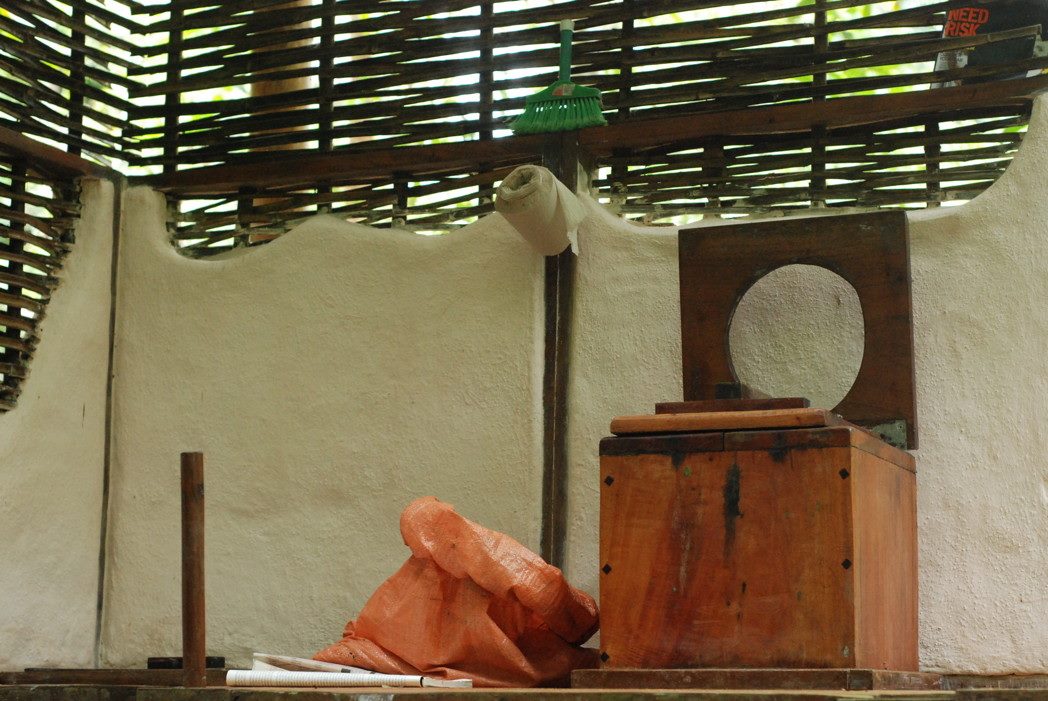
Since the years of my youth, I’ve grown more comfortable with the process of defecating. I have come to see what I used to see as waste and gross as not only a normal part of nature but a potentially valuable resource. As a Peace Corps volunteer in Uruguay in the early nineties working with organic farmers, I saw how animal manures made up an important part of the soil fertility building techniques employed by the food growers that I worked with on a daily basis. Years later upon arriving to Mastatal I was convinced that one of our first projects should be to construct a composting toilet that would turn our and our guests' body waste into usable fertilizer for our orchards. We thought that this would be a good alternative to the infrastructure that I grew up with in New York State that utilized drinking water to transport my family’s poop to some unseen (but not unsmelled) place to be treated with chemicals.

Fifteen years later we have eight composting toilets scattered around our campus. From our forays into natural building we successfully experimented with using manures in the plasters that now protect and beautify our buildings. Around 2005 we learned from a Costa Rican friend, an organic coffee farmer outside of Puriscal, about using animal waste to produce cooking gas. Shortly after hearing about this possibility the Ranch built its first methane digester that has helped us reduce our dependence on imported fossil fuel based cooking fuels. We also learned from a Ranch guest that you could raise a child without diapers and soon before Sole’s birth Robin and I decided to give that “radical” idea a try. Humans today that spend their first years in diapers contribute an average of 2 tons of feces filled diaper garbage to their local dumps. Diapers reportedly make up about 4% of landfill volume. When I read these figures for the first time I had to take a step back and think whether it could possibly make sense to contribute to this reality while allowing my child to walk around with a pile of crap in her drawers. The more I thought about it, and the more I researched the alternatives, the more I decided that diapers were yet another co-opted, environmentally destructive, profit driven invention that has been forced down the throats of almost every developed and many developing world families as the only civil and rational way to raise your baby. The vast majority of diapers are expensive, non-biodegradable, and in many cases, unnecessary. I concede that raising your child diaper free is not for everyone, but I am convinced that it could be an option for many more families if they understood the process and the benefits of this mode of child rearing.

Animal feces, if handled irresponsibly, can and does make people sick. Millions of children in Africa and other parts of the developing world die each year from diarrhea caused by poor sanitation and water contaminated by animal waste. These are serious issues that need to be addressed in responsible ways so that children do not die avoidable deaths. I am not condoning that we we live in a world where crap runs down sidewalks and flows untreated into our rivers. What I’m hoping for is that humans can develop a healthier understanding about both the benefits and shortcomings of animal waste and as a result promote rational and sustainable techniques, policies and ideas that allow us to relate with poop in ways that maximize its advantages and minimize its risks.
At Rancho Mastatal we think and talk a lot about our impact. We look for ways to build using local and natural resources, produce our own energy, improve our community’s health, save money and ameliorate the fertility of our soils. The sustainable solutions to all of these goals are in part hidden in the dark, rich world of animal poop, and when handled responsibly and intelligently provide answers to how humans can start shifting, and shitting, towards a more healthy relationship with our bodies and our planet.
NEWS AND NOTES
The busy season has come to an end, the last of our groups for the fiscal year have come and gone. Our Apprentice Crew has all but taken over running the Ranch. It is a time for projects, practice, rest, reflection, and beginning to prepare for 2017.
One of our favorite ways to reflect is looking back over old photos. Want to explore the Ranch's past with us? Check us out on Flickr and let us know your favorite pics!
Abrazos
The Ranch Crew

Tips for Working with Tropical Soils
Soil, the ever fascinating topic to any garden guru or green thumb. Here at the Ranch it's all about topsoil, which is basically non-existent. The little soil that is present has a high clay content making it particularly susceptible to compaction. It is also highly acidic. The combination of the two means that without any additives it would be challenging to grow anything at all. So we've devised a number of methods to build up the topsoil, break up the clay and raise the pH throughout our orchard and garden spaces. These methods can be used anywhere in the world to improve your soil.
Tips for Working with Tropical Soils
Lydia is one of our 2016 Apprentices in Sustainable Living. She has studied Horticulture and has a Bachelor of Environments (Landscape Architecture) from the University of Melbourne in Australia. She is super keen on plants and the fundamental relationship between plants and soil. Healthy soil is the key to healthy plants. This post is about soil in the tropics, including some of the challenges that exist and how these challenges are managed at Rancho Mastatal.

Sacha Inchi before a heavy mulch application.
Soil, the ever fascinating topic to any garden guru or green thumb. Here at the Ranch it's all about topsoil, which is basically non-existent. The little soil that is present has a high clay content making it particularly susceptible to compaction. It is also highly acidic. The combination of the two means that without any additives it would be challenging to grow anything at all. So we've devised a number of methods to build up the topsoil, break up the clay and raise the pH throughout our orchard and garden spaces. These methods can be used anywhere in the world to improve your soil.
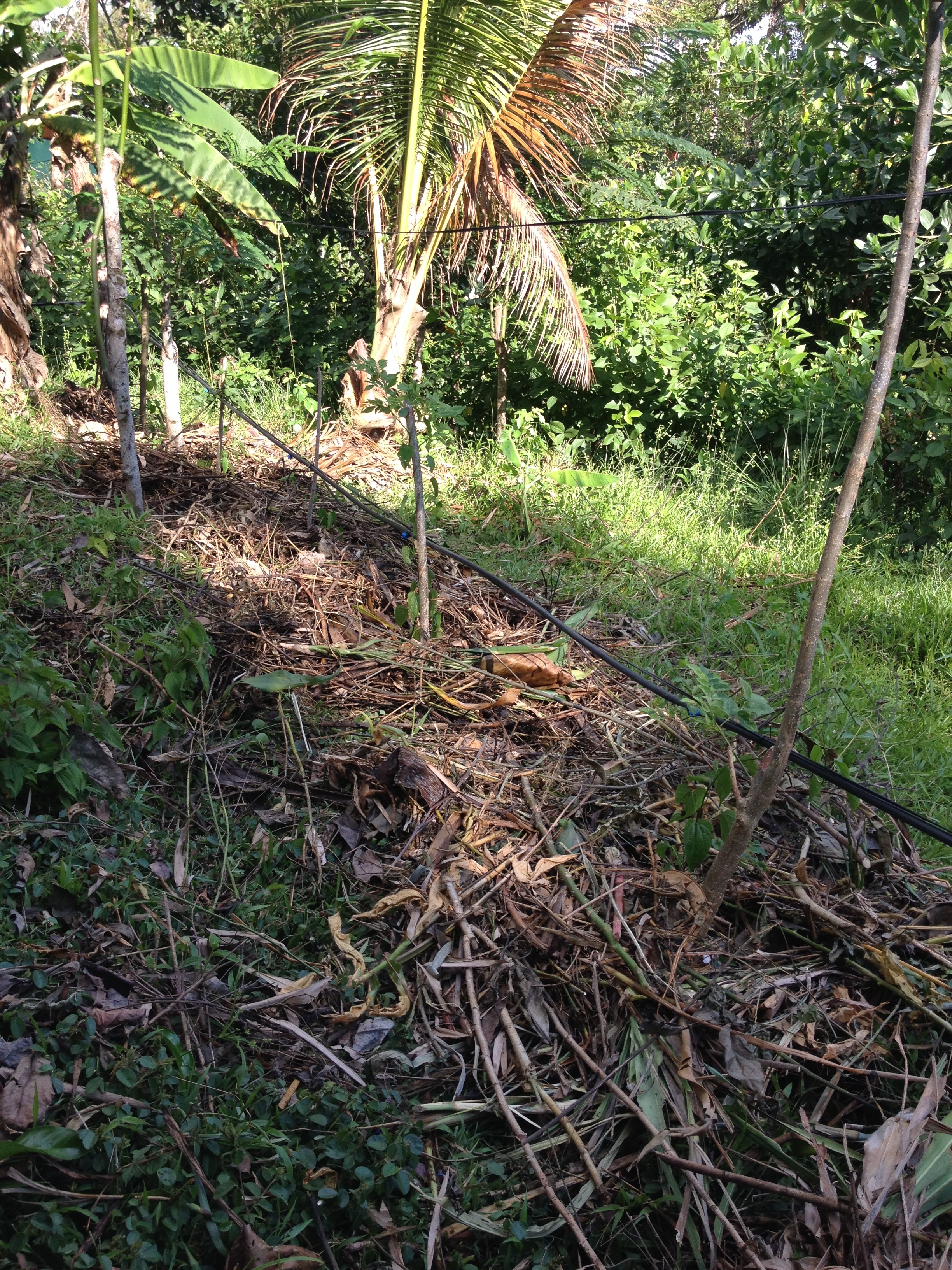
The same plants as above after a healthy mulch cover.
First and foremost, topsoil! How do we do it? The majority of nutrients in the jungle ecosystem are stored in plants. When nutrients become available plants are quick to soak them up because there is stiff competition when living in such close proximity to your neighbors. This means that plant biomass is an incredibly rich and abundant source of nutrients. Plant biomass refers to all plant material, living and dead including leaves, trunks and branches. The main way we utilize this biomass is what Scott refers to as "doughnut" mulching, basically forming circular doughnuts of plant material around the base of our fruit and nut trees. This mimics nature by following the 'top-down' approach that allows microorganisms to move the material down. It is important to note that mulch should never touch the trunk of your trees because this will cause rot. A 5 inch radius between trunk and mulch is a good aim.
Another method used in zone 1 to improve soil quality is to bury pieces of wood under the soil in our garden beds. The wood acts like a sponge, retaining water throughout the dry season and, reducing compactness in the wet season by aerating the soil. It also provides habitat for microorganisms, crucial for plant health and growth. Our garden beds are mulched regularly with dead leaves collected from the forest floor to retain moisture in the soil, reduce weed growth and add nutrients. This is known as Hugulkulture.
Now, onto soil pH, the next big topic around soil in the tropics. There are 6 cooking methods used at the Ranch, 3 of which rely on wood, the rocket stove, the biochar stove and the pizza oven (read here for more about our alternative cook stoves). With 3 meals per day, 6 days a week being pumped out of our kitchen, you can imagine how much charcoal and ash we produce. Instead of simply disposing of this alkaline-rich bi-product we add it to our soil.
Charcoal is a carbon-rich soil additive, that adds alkalinity to the soil, raising the pH. It has a high surface area on a microscopic level which means it is capable of storing water and nutrients in the soil, making it a valuable additive in both the dry season when water is required and the wet season when nutrients are required. The addition of charcoal also aerates the soil and breaks up the clay. It is essential to note that when adding charcoal to soil it must be soaked in a nitrogen solution first, such as compost/ worm tea. This will ensure it doesn't lock up precious nutrients from the soil. Ash is similar to charcoal but much finer. It also adds alkalinity to the soil, raising the pH. Limestone is another soil additive used to raise the pH and up the alkalinity. We spread lime around the base of our fruit and nut trees, vines and shrubs.
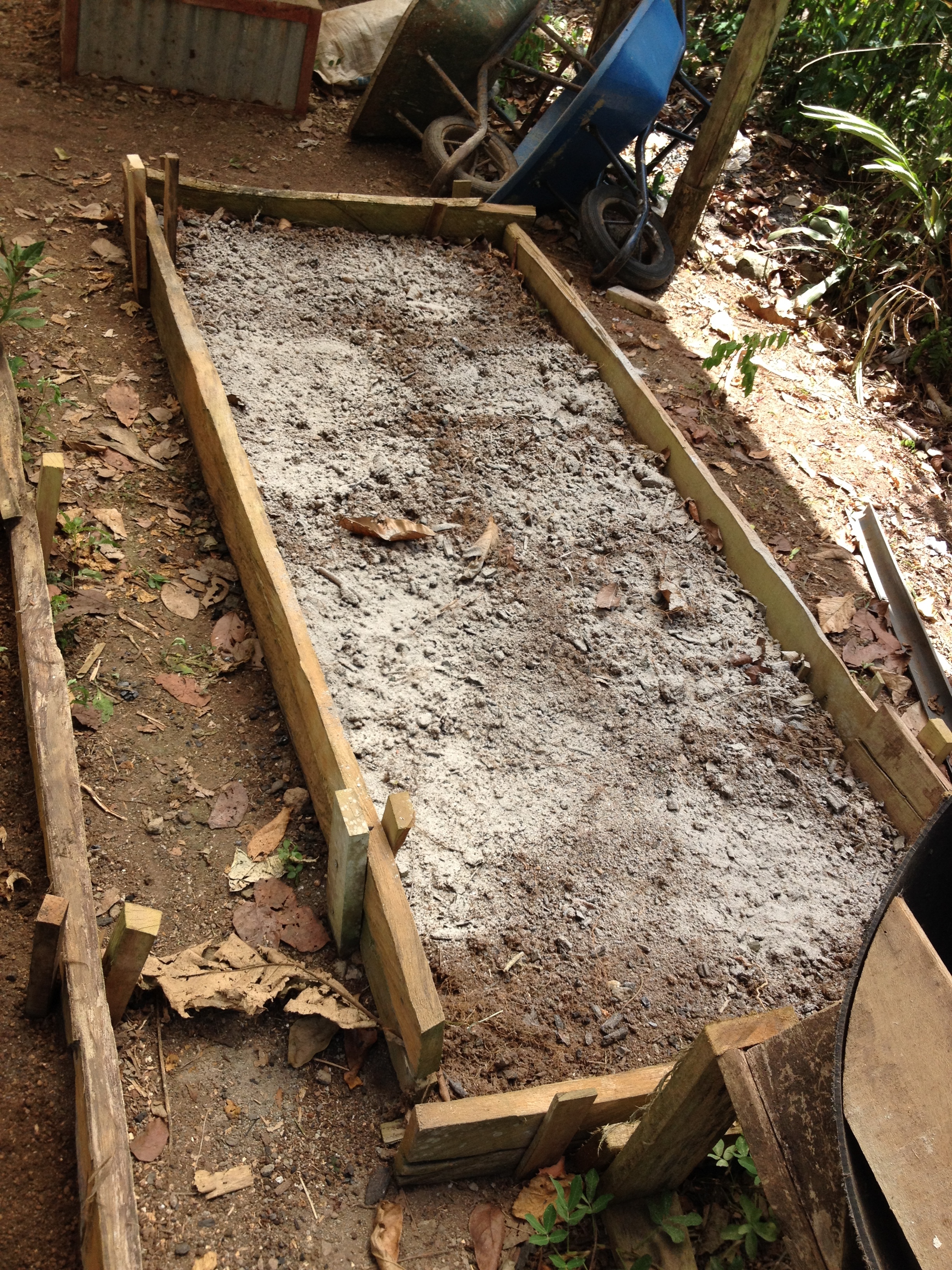
Lime applied to a raised garden bed.
Nitrogen is one of the most important soil nutrients and in order to produce good crops, nitrogen is essential. What better way to introduce nitrogen into the soil than with nitrogen fixing plants. These plants produce "cake & cookies" i.e. sugars in the soil that attract nitrogen fixing bacteria. These bacteria are capable of using these sugars to convert nitrogen gas in the soil into a plant soluble form, accessible to the surrounding plants. Believe it or not, plants control this process depending on how much nitrogen they feel they need.T he more sugars the plants produce, the more sugars the bacteria consume, converting this sugar into nitrogen for the plants. It's an incredible natural process! The nitrogen fixers most extensively used here are Acacia mangium, Shizolobium paryhybum, and Madero Negro, all of which are trees. We also use peanut grass, a spreading ground cover. Most plants in the Leguminosae family can be used as nitrogen fixing plants.
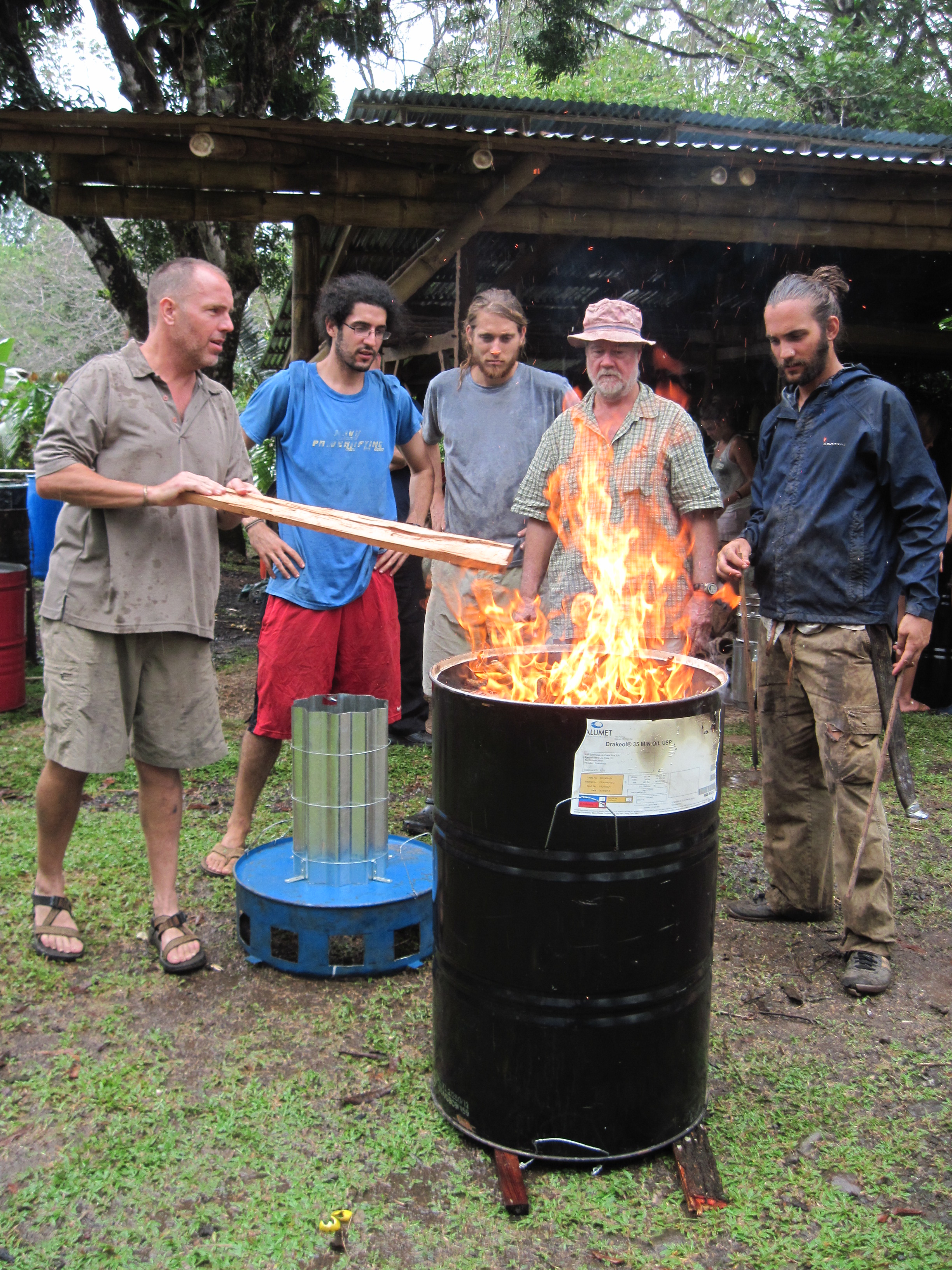
Making Biochar with a TLUD System.
Potting soil is another essential part of our plant operation here. The recipes used for potting soil change depending on what's available and required. One of the recipes we use is 2 parts forest soil plus 2 parts worm farm compost plus 1 part sifted builders sand. We collect the forest soil from the forest floor where a build up of plant material is prevalent e.g. a puddle, low point or valley. This is where nutrients gather because soil and small plant material is deposited (read here how we cultivate mountain microorganisms). The worm farm compost is a bi-product from our bio-digester system. This waste treatment system converts cow manure into methane gas, while leaving the fibrous material behind for the worm farm. The key to a great potting soil is to balance soil pH and ensue there is a rich source of matured compost where microorganisms thrive.
So there you have it, the challenges and of course the fun of soil in the tropics! Creating and enhancing topsoil, balancing soil pH, in this case raising it, balancing the clay content of your soil and making nutrient rich potting soil. I hope you can take some of these tips away and enrich your soil wherever you are. Here's to happy soil and abundant plants.
NEWS AND NOTES
We have a number of life changing workshops coming up.
We rely on all of the amazing ambassadors to our project to spread the word; if you know of anyone who needs a get-life-into-gear experience, send them to one of our classes!
Abrazos,
The Ranch Crew
Categories
Topics
- Agriculture 6
- Agroforestry 21
- Animals 2
- Apprenticeship 19
- Appropriate Technology 6
- Backpacking 1
- Bananas 1
- Basic Pantry 4
- Biochar 1
- Books 3
- Build Your Own Home 1
- Central America 5
- Chiles 1
- Cinnamon 1
- Clay Carving 1
- Climate 2
- Climate Change 1
- Cob oven 1
- Communication 5
- Community 24
- Compost 2
- Composting Toilets 2
- Condiments 1
- Conservation 2
- Cooking 4
- Costa Rica 18
- Design 10
- Earthen Construction 10
- Eat Local 2
- Ecohome 1
- Education 9
- Environment 3
- Ethics 4
- Farm to Table 12
- Fasting 1
- Fermentation 14
- Food 22
- Food Choices 8
- Food Forest 8
- Food Processing 15
- Food Systems 12
- Gap Year 1
- Gardening 5
- Ginger Beer 1
- Harvest 2
- Health 12
- Healthy living 5
- Homemade 2
- Homestead 8
- Internet 2