

BLOG
Stories, articles, and updates from the Ranch community.
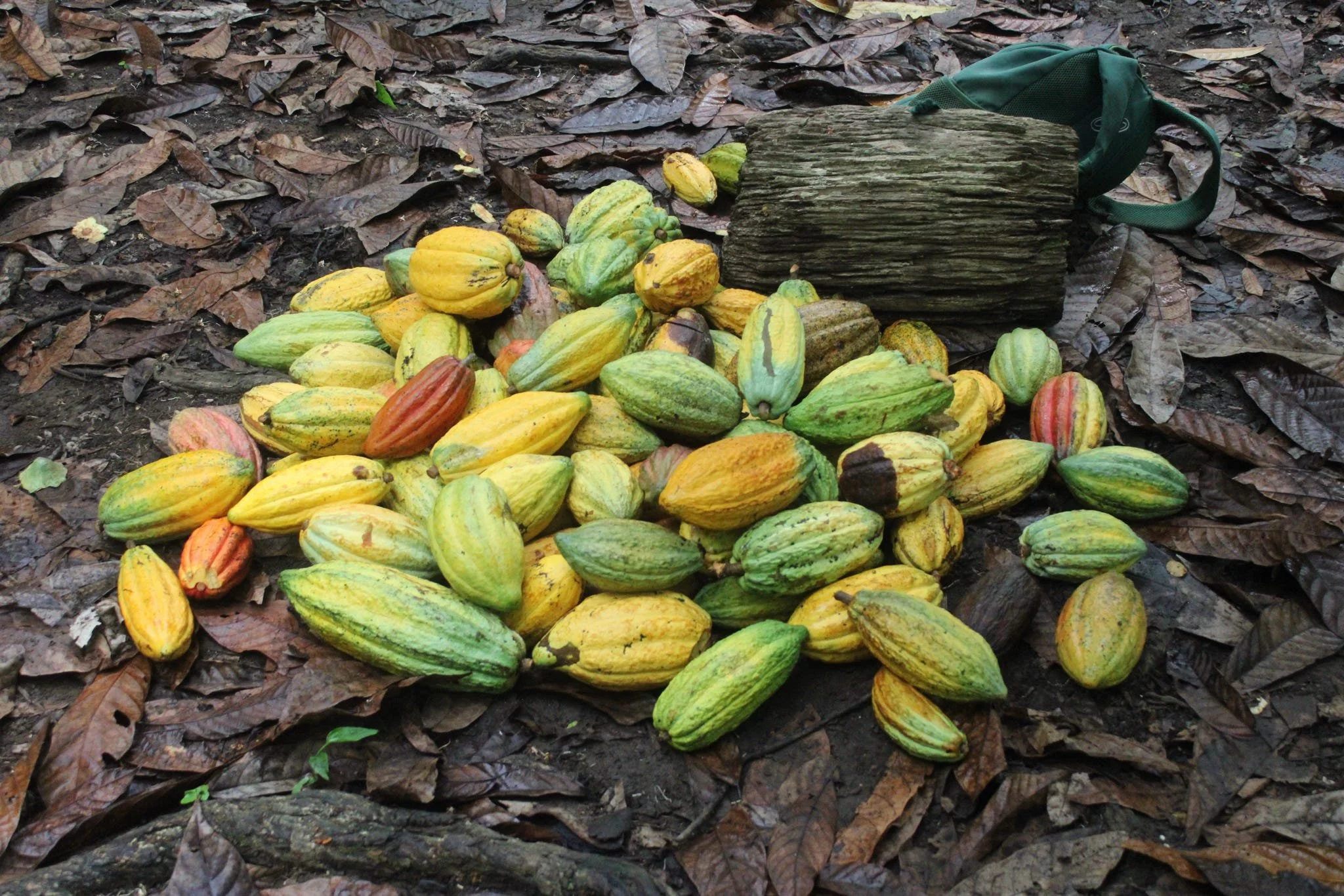
Cacao as the Catalyst
The more I released my need to know exactly where I was going, the more life seemed willing to show me. Not all at once. Just enough for the next step.
By apprentice Maria Quas
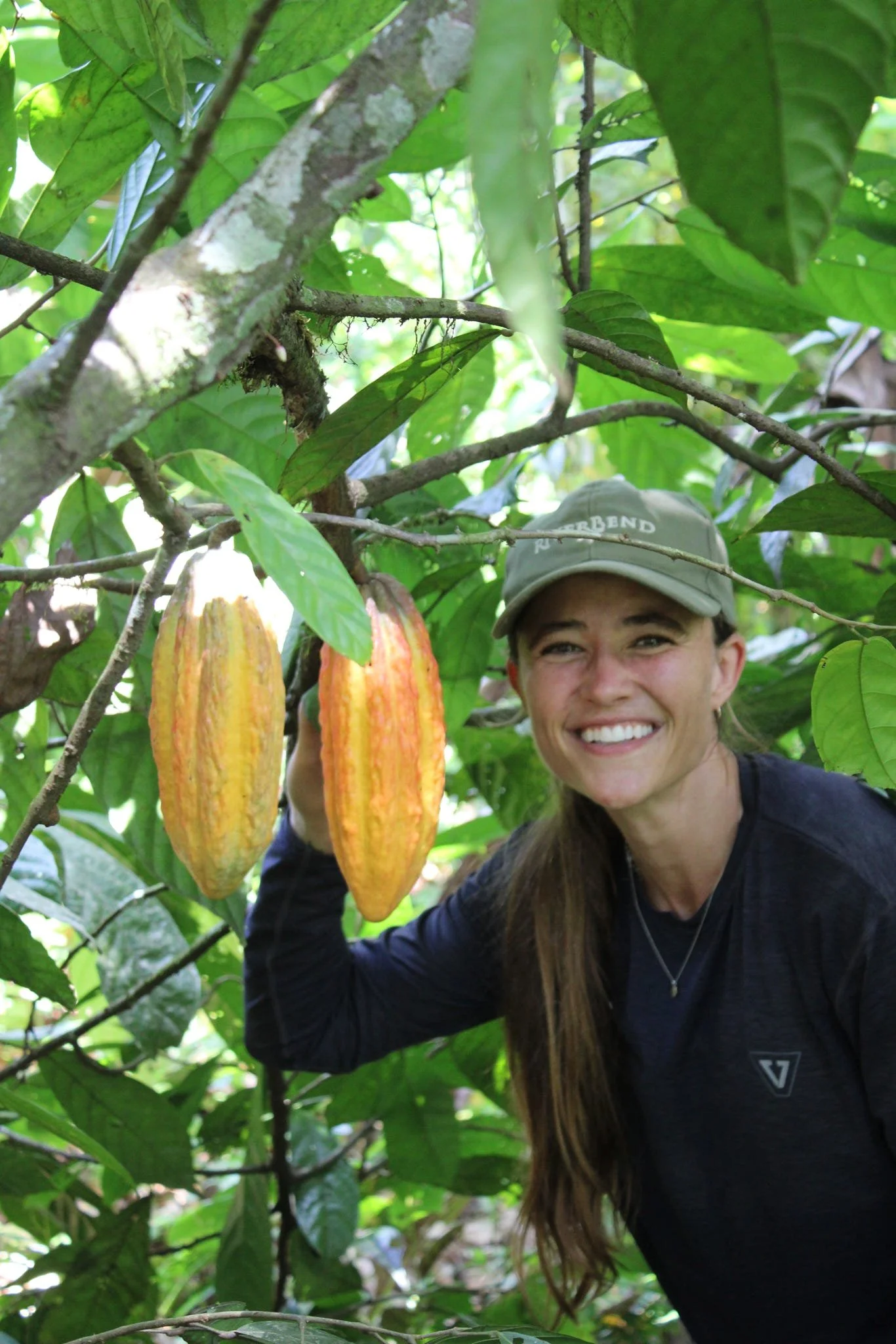
There is a strange phenomenon that happens when you begin following something you genuinely love.
At first, it feels insignificant. A passing curiosity. A book you happen to read. A conversation you almost didn't have. A path you decide to walk for no particular reason.
Then something begins to shift.
The world that once felt random starts revealing patterns.
Teachers appear. Doors open. Conversations arrive at precisely the moment they are needed. What once seemed like coincidence begins to feel more like participation in an intelligence larger than your own.
Taoist philosophy speaks of this as living in accordance with the Way—not forcing life forward, but learning to move with it. There is an old saying often attributed to Zen: when the student is ready, the teacher appears.
For most of my life, I understood that idea intellectually.
This year, living at Rancho Mastatal, I began experiencing it.
And strangely enough, cacao became the teacher.
Following the Thread
When I first arrived in Costa Rica, I thought growth would come through plans. Through goals. Through carefully constructing a path toward whatever came next.
Instead, the opposite happened.
The more I released my need to know exactly where I was going, the more life seemed willing to show me. Not all at once. Just enough for the next step.
The first lesson arrived beside a river I had crossed countless times before.
After reading about cacao's origins in Mesoamerica, I found myself walking a familiar path toward the waterfall. Along the riverbanks where cacao once thrived naturally, something caught my eye.
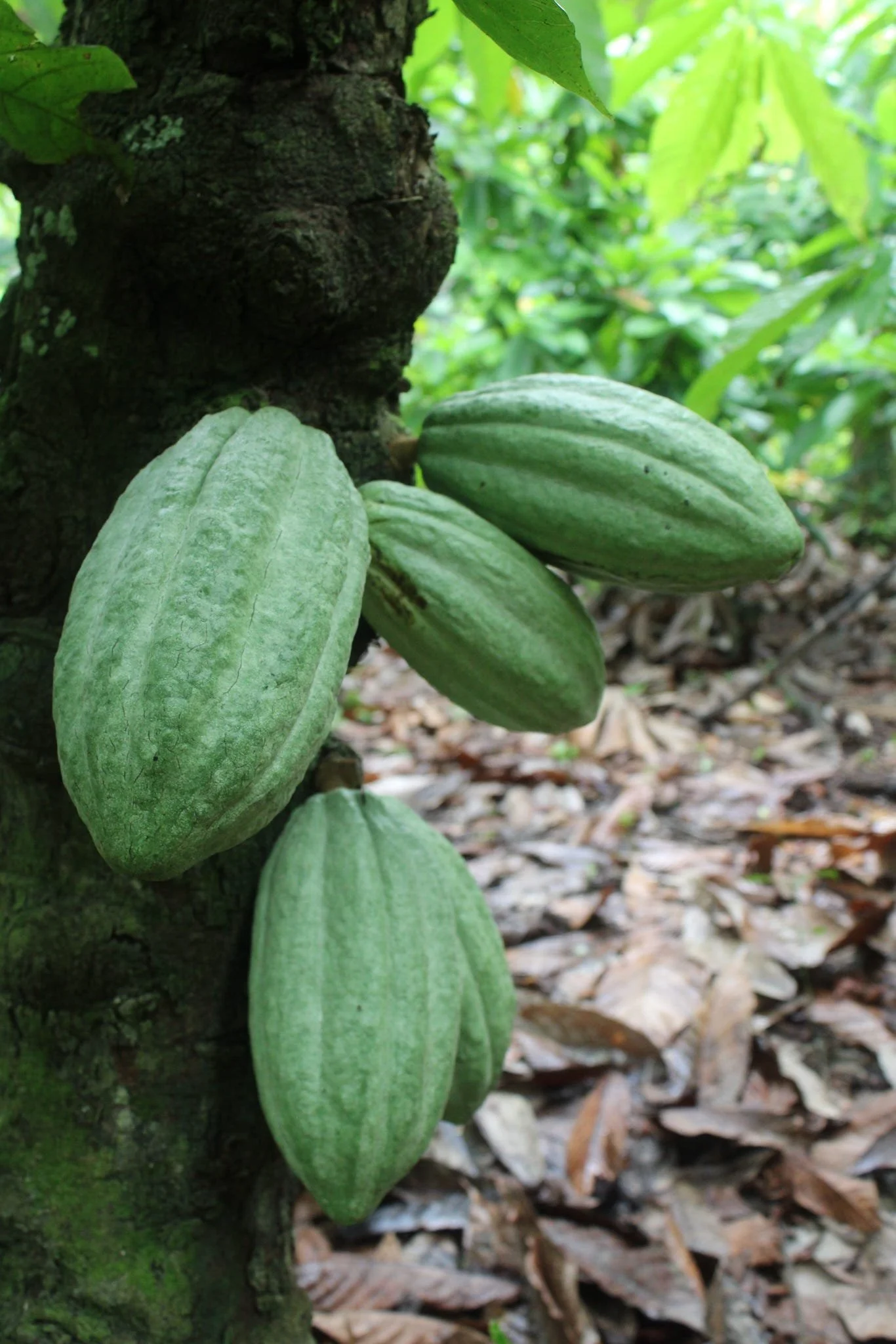
There they were.
Cacao trees.
Mint-green pods emerging directly from their trunks.
I stopped.
How many times had I walked this exact route? How many times had these trees been standing here, visible and unnoticed?
The trees had not appeared.
My attention had.
And once seen, they became impossible to ignore.
It felt less like discovering something new and more like remembering something that had been waiting for me all along.
Perhaps this is how all learning happens. The teacher is not absent. The student simply isn't ready to see.
After that day, cacao began appearing everywhere.
From Information to Wisdom
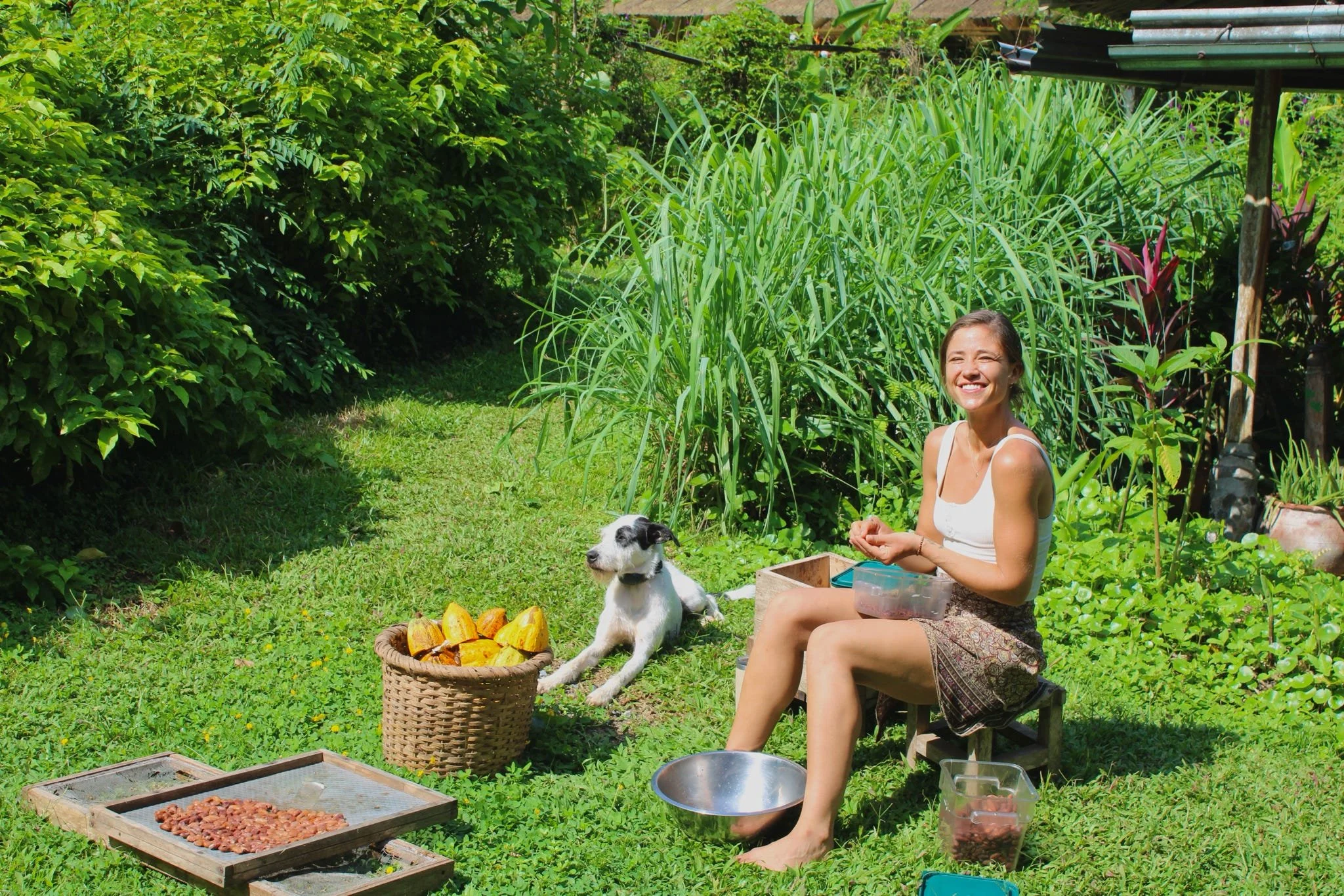
I started planting seeds in the nursery, reading about cultivation, and asking questions.
Then Victor arrived.
A cacao farmer. A chocolate maker. A living bridge between knowledge and experience.
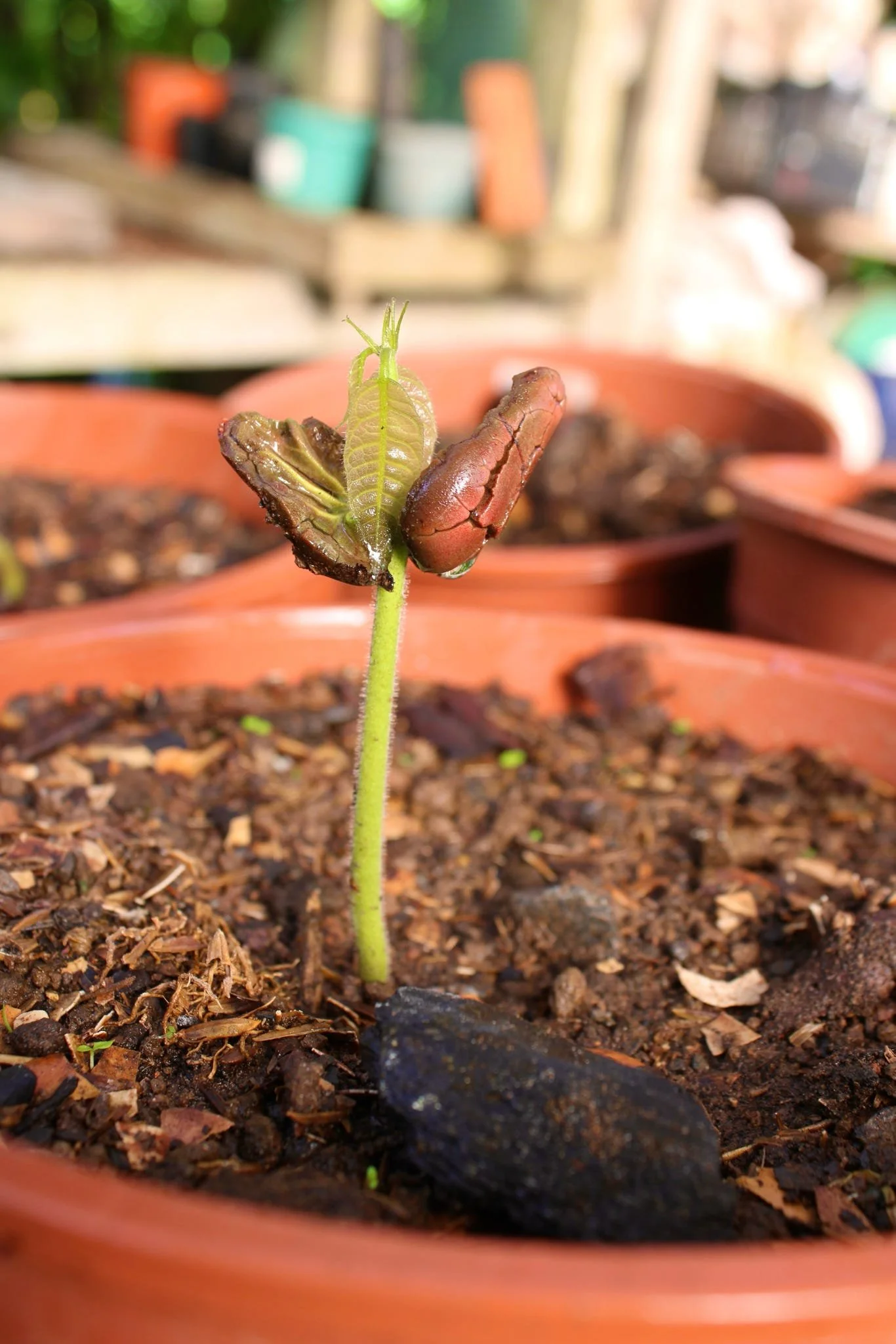
I had spent hours searching online, collecting information, and trying to understand cacao through articles and videos.
Victor showed me the difference between information and wisdom.
Information can tell you what to do.
Wisdom shows you how to see.
The internet can explain how to plant a cacao tree. A farmer can teach you how to listen to one.
Before leaving, Victor invited me to visit his farm.
Another door opened.
Not because I was searching for doors.
Because I was already walking in their direction.
And that is what has fascinated me most.
The opportunities themselves are not extraordinary. What feels extraordinary is the timing.
Cacao as Lineage
Shortly after Victor left, two brothers from the Maleku tribe arrived at Rancho Mastatal—the very community Victor had been speaking about.
Again, cacao was at the center.
But now it appeared not as agriculture, but as lineage. As culture. As memory carried through generations.
One afternoon, they noticed me working with cacao fruit and shared a marmalade recipe made from a part of the pod I had been throwing away.
A piece of fruit I saw as waste contained value within their tradition.
The lesson felt larger than cacao.
How much of life do we discard simply because we do not yet understand its purpose?
The more I followed this thread, the more connections emerged.
Not because I was forcing them.
Because I was paying attention.
Learning to Flow
Taoism teaches that water does not struggle to find its path.
It flows.
It adapts.
It moves around obstacles rather than through them.
And somehow, despite its softness, it shapes entire landscapes.
I am beginning to suspect that life works the same way.
Many of us spend years trying to manufacture a future. Building profiles. Networking strategically. Searching endlessly for opportunities.
I know I did.
Yet some of the most meaningful experiences of my life have arrived through a completely different mechanism:
Presence. Participation. Curiosity.
Not chasing the next thing, but becoming fully engaged with the thing directly in front of me.
The result feels less like achievement and more like alignment.
As if life begins responding when you stop trying to negotiate with it.
My First Cacao Harvest
My first cacao harvest deepened that understanding.
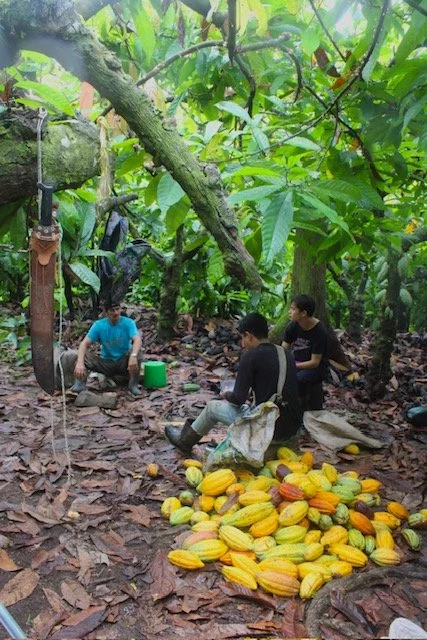
At four in the morning, I woke with the excitement of a child on Christmas Day.
An hour later, I stood before a wide river, preparing to cross on a hand-built zip line while Jorge, the owner of the farm, rode a horse through the current below.
The absurdity of the moment made me laugh.
This was not part of any plan I had ever created for myself.
Yet somehow, it felt exactly where I was supposed to be.
The harvest itself was humbling.
Everyone moved with rhythm and purpose while I struggled to understand the language, the flow, and the choreography of the work.
I felt slow.
Clumsy.
Out of place.
And yet those moments often contain the greatest gifts.
The unknown rarely feels graceful.
Growth is not the absence of discomfort.
Growth is learning to trust yourself inside it.
The Transformation of Chocolate
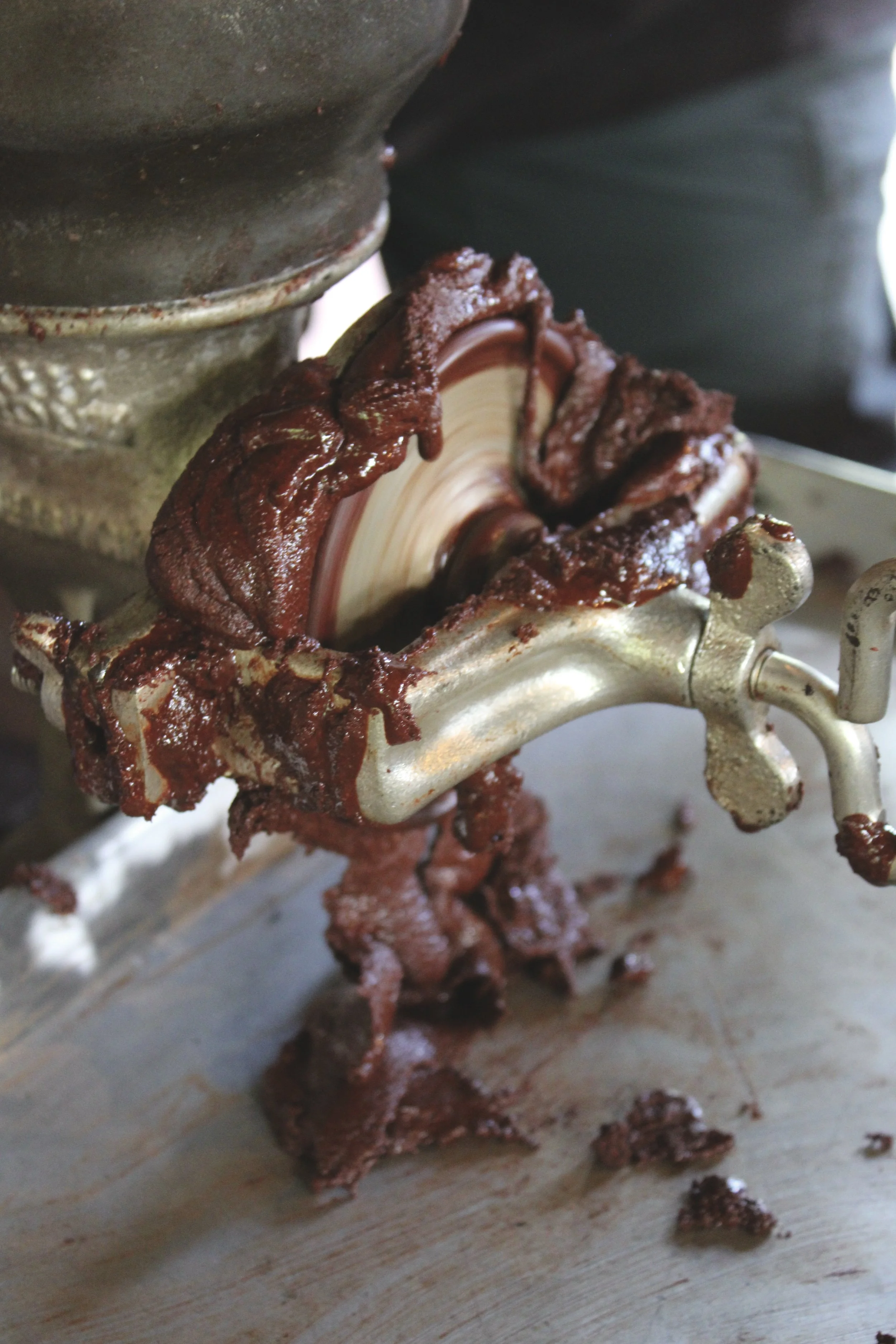
Chocolate itself seems to embody this lesson.
What eventually becomes something rich, complex, and deeply nourishing begins as something raw and unfamiliar.
The seed must ferment.
Dry.
Roast.
Transform.
Time does not happen to the process.
Time is the process.
Perhaps people are not so different.
We are always becoming. Always fermenting experiences into understanding. Always moving through stages that make little sense until viewed in retrospect.
The Real Lesson
Looking back now, I realize cacao was never the real subject.
The real subject was trust.
Trust that the next step exists even when I cannot see it.
Trust that curiosity is sometimes a more reliable compass than certainty.
Trust that the path unfolds through participation rather than prediction.
I still know very little.
But that no longer feels like a problem to solve.
It feels like an invitation.
The path does not appear all at once.
It never has.
It reveals itself in proportion to our willingness to walk.
And so I keep walking.
Not toward an outcome.
Not toward an answer.
Simply toward whatever feels most alive.
Read more
Check out these past blogs about cacao and other local foods we are enjoying here:

Yuca(n) Do It All - Processing Yuca in Rural Costa Rica
At Rancho Mastatal, yuca is a staple in the kitchen and our bellies. You can find it in at least one of our meals nearly every day in one form or another.
By 2025 apprentice Maivy Xuân Nguyễn
At Rancho Mastatal, yuca is a staple in the kitchen and our bellies. You can find it in at least one of our meals nearly every day in one form or another. Yuca is also commonly known as cassava root or tapioca (in its powdered form). So, if you’ve ever had boba–a Taiwanese milk tea drink with chewy black pearls, or tapioca pudding, you’ve had yuca!

My affinity towards yuca grew rapidly during the past two weeks when we experienced a boon in our yuca supply! I already love yuca, having grown up on boba drinks which had taken its foothold in the San Francisco Bay Area while I was a child. It has since only grown in popularity. Tapioca starch is also a key ingredient in my favorite Vietnamese dish: bánh bột lọc. It’s one of the first dishes that my mom taught me how to make and I intend to find some time to make a Rancho Mastatal version in the future. Look out for upcoming blog posts—perhaps they will have some yummy recipes.
But, my appreciation of it has grown tenfold and beyond after having worked with it on so many levels.
We have planted, harvested, processed, cooked and eaten yuca. Each step has its own set of steps and we’ll get to those in future posts. For now, I’ll talk about processing and preparing yuca for cooking. Yuca must be cooked before we consume it because it does contain some toxins, especially in its skin, that will need to burn off. Plus, it is a hard and starchy root that would be difficult to enjoy raw.
The edible parts of yuca are their tuber roots and also their new baby leaves. There are actually some varieties of yuca where only the baby leaves are eaten because the rest of the plant contains too many toxins. Luckily, we have the sweet kind with delicious roots!
Processing
If you get your yuca from a store, it will have likely gotten a parafin wax treatment. This is to prevent oxidation of the tuber which happens quickly. You’ll want to wash and scrub that off first.
We got ours straight from the ground so our first step was to wash and scrub off the dirt.
Then, cut the tuber into sections.
Make a cut along the tuber and using a paring knife, spoon or your fingers, separate not just the papery skin, but also the thicker white skin from the tuber. The layer of white skin contains cyanide, so you'll want to be sure to get it all off. Sometimes the skin comes off easily with just some maneuvering and other times it is stubborn and you may just need to cut through it.


Once you have the peeled root, give it another rinse and process it further as you'd like. We chunked it and shredded it so it could be cooked for our brunch time fried yuca or hash. The raw yuca will last about a week in the fridge. I will turn black as it oxidizes so try to keep it in airtight containers.
We also made yuca flour by dehydrating the shredded yuca and then blitzing it in a blender or food processor.


To make yuca starch, soak your shredded yuca in water overnight. Then strain and squeeze out the solids and keep the water. The starches will have been released into the water. Let the starch settle to the bottom and then pour off the water once it’s separated. You’ll end up with some wet starch. You can then dehydrate the starch and break it up into powder.
If kept dry and airtight, yuca flour can last for up to a year.
Now you’ve got a few ways to process yuca!


Planting

During one of our earlier work parties in the agricultural systems, we remade two zone 1 garden beds and planted some yuca, among many other plants and veggies.
The method through which we planted the yuca was through cuttings.
Yuca tubers take about 8-12 months to mature. So the ones we planted then are not the ones that we harvested or processed these past weeks. The boom came from outside of the Rancho and from the wider community of Mastatal.
Harvesting
A neighboring farmer, Don Jaime, had been forced off a piece of land that he's been farming for the past 20+ years.
The first week, the apprentice crew just came to pick up the sacks of yuca that Don Jaime had harvested that day, the four sacks totaled to 103 kilos.
It wasn't until the next week, when we came to help harvest more of the yuca from that land, that we got to see the full extent of his work.


Want to Learn More?
Join us for one of our yearly Permaculture Design Courses to get theory and practice in growing your own food.

The Ecstasy of Cheese: A Meditation on Our Conceptions of Value
After only a few months living at the Ranch, I have observed my experience of eating good cheese transform from mundane to something approaching ecstasy. This has lead me to reflect on our personal and collective conceptions of value.
By 2023 apprentice, Sedona Lewis
One evening the apprentices were enjoying dinner when Sam, a core team member, approached us with a gift. From our reaction, a bystander might have assumed he unveiled something approximating a winning lottery ticket. However our hoots and hollars were in response to, simply, cheese.
After only a few months living at the Ranch, I have observed my experience of eating good cheese transform from mundane to something approaching ecstasy. This has lead me to reflect on our personal and collective conceptions of value.
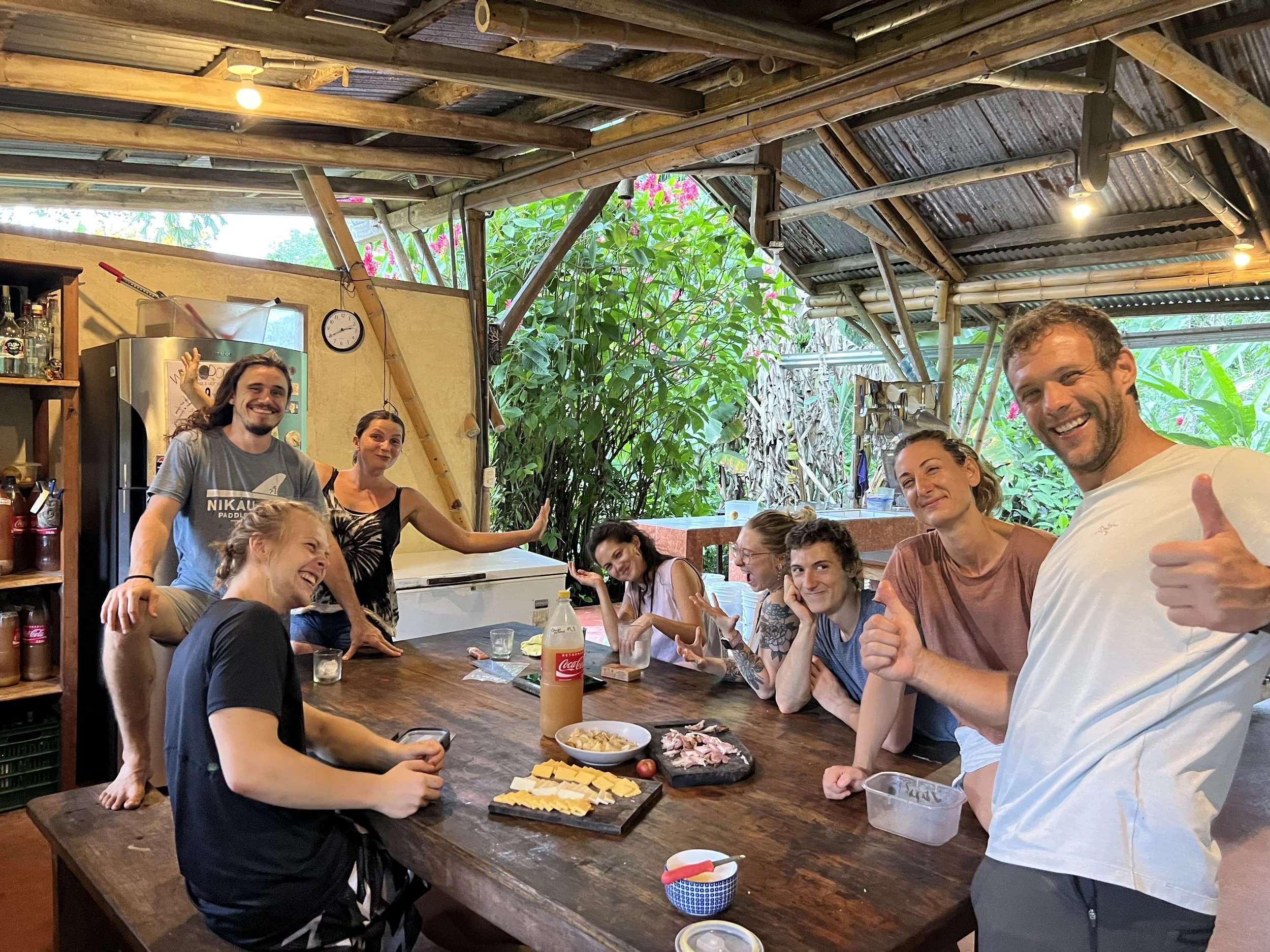
Apprentices excited about cheese!
A Permaculture Diet
As a society we have grown accustomed to waltzing into a grocery store and purchasing virtually any vegetable, fruit, grain, nut, or seed we desire. Globalization has artificially eliminated scarcity and seasonality from our lives; we are living in an age of unprecedented abundance.

Seasonal fruits off the farm
In Mastatal, there is no grocery store. Aside from the local bar and the Soda, a small restaurant, the closest store is forty minutes by car. Despite our isolation, the Ranch is a place of remarkable abundance. However different from the globalized, western sort of 'abundance' referenced earlier.
We are lucky to operate in a part of the world which provides a prolific variety of edible and otherwise useful plants. Things we can't produce ourselves are mostly purchased from our neighbors, such as milk, eggs, and pork. Nearly all other vegetables, fruits, and other food items sourced regionally. Thanks to the hard work of our meal coordinators (mostly Robin), over 80% of the calories we consume are sourced within fifty miles of the Ranch.
We maintain a sense of place within our diets; during meal times we are engaging with our surroundings. No longer are we enjoying cheese from France, salami from Italy, and wine from Spain in the same meal. We're embracing the here through our food.
In keeping with the ethics of Permaculture, this means we are dependent on and invested in the health of our local and regional communities. The variation in our meals comes with the seasons, and our health is linked to that of our environment. I have observed that this way of interacting with food has changed the way I think about, and value, my food.

Sedona with her morning harvest of salad greens
Our Conceptions of Value
Olive oil, butter, cheese, meat, bread, and nuts are examples of foods that many of us used to consume almost daily. Delicious, yes, but not extraordinary, and only worth what the price tag says at the store. Now, several months into the apprenticeship, items like these have become precious.
During my days splitting bamboo, sifting clay, and working in the orchards, I've had the opportunity to ponder the following questions. I invite you to consider them for yourself before reading my list of ideas.
What makes something valuable?
Perhaps...
An item's relative availability
The effort required to acquire the item
The relative necessity (a bowl of rice when you've just eaten a meal and a bowl of rice when you haven't eaten for 2 days may as well be two completely different items)
Personal preferences/tastes
The collective value structure and social narrative associated with that item
The experiential and monetary value of a food item can be somewhat arbitrary...
Of course it's important to note and remember that our species evolved under conditions in which sufficient nutrition was not the norm. It makes sense why nutrient dense foods such as cheese, meat, and honey were and are sought after and treasured.
But still, we invest a lot of resources shipping things like salad greens, spices, and liquors around the world. Is the Italian wine really that much better? Couldn't the same caloric and satisfactory needs be met with items produced regionally? It seems that there is something deeper influencing our values surrounding food.
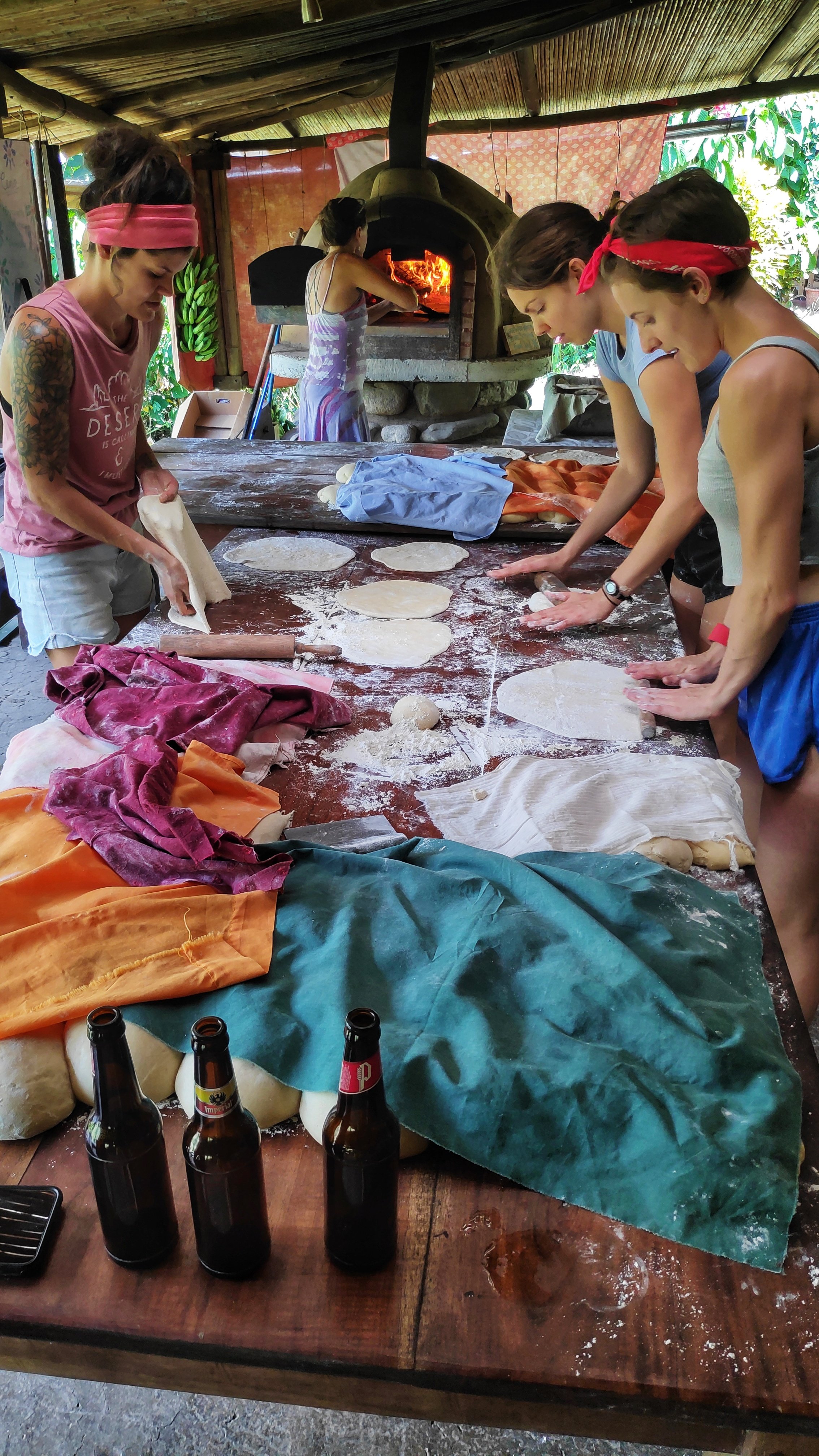
Our special occasion pizza party
what do we gain by attaching arbitrary value to specific foods?
Special foods provide a sense of occasion and celebration
These occasions provide a sense of anticipation, which alters our experience
Special foods, and the events formed around them, provide space for community to be built
As food is a human universal, sharing food is a way to bridge and build relationships
A Note on Sharing
One might assume that precious food items at the Ranch would be hoarded; kept in decoy packaging in the back of the refrigerator with the intention of maximal solitary indulgence. However, as we have adjusted to our new environment, I have observed something entirely different. The reflexive action when in possession of said precious items has been radical generosity. Perhaps it is because a precedent of sharing and reciprocity has been set for us by the culture here at the Ranch. However, it genuinely seems like reveling in the remarkable depth of blue cheese is just more enjoyable when done in the company of others.

Enjoying sharing some treats with the community
The utility of sharing is easy to see when living in community. When taken out of the individualist paradigm operating in most of the western world, reciprocity is an undeniably advantageous practice. Given the unpredictable nature of life, I wouldn't be surprised if appropriate generosity has been selected for throughout our evolutionary history. No doubt those who refuse to share with their community when needed would feel the consequences of their actions later on.
Looking Ahead
So, I invite you to consider how living in this age of convenience and instant gratification affects your sense of value.
How might your experience of peaches change if you only ate them when they were in season? What could be gained by manufacturing a bit of scarcity, creating some anticipation, in your life? How can you apply these principles, rooted in Permaculture, to repair your communities and regenerate our natural environment?
Just food for thought - because now we only have cake on birthdays, and I think it tastes sweeter.
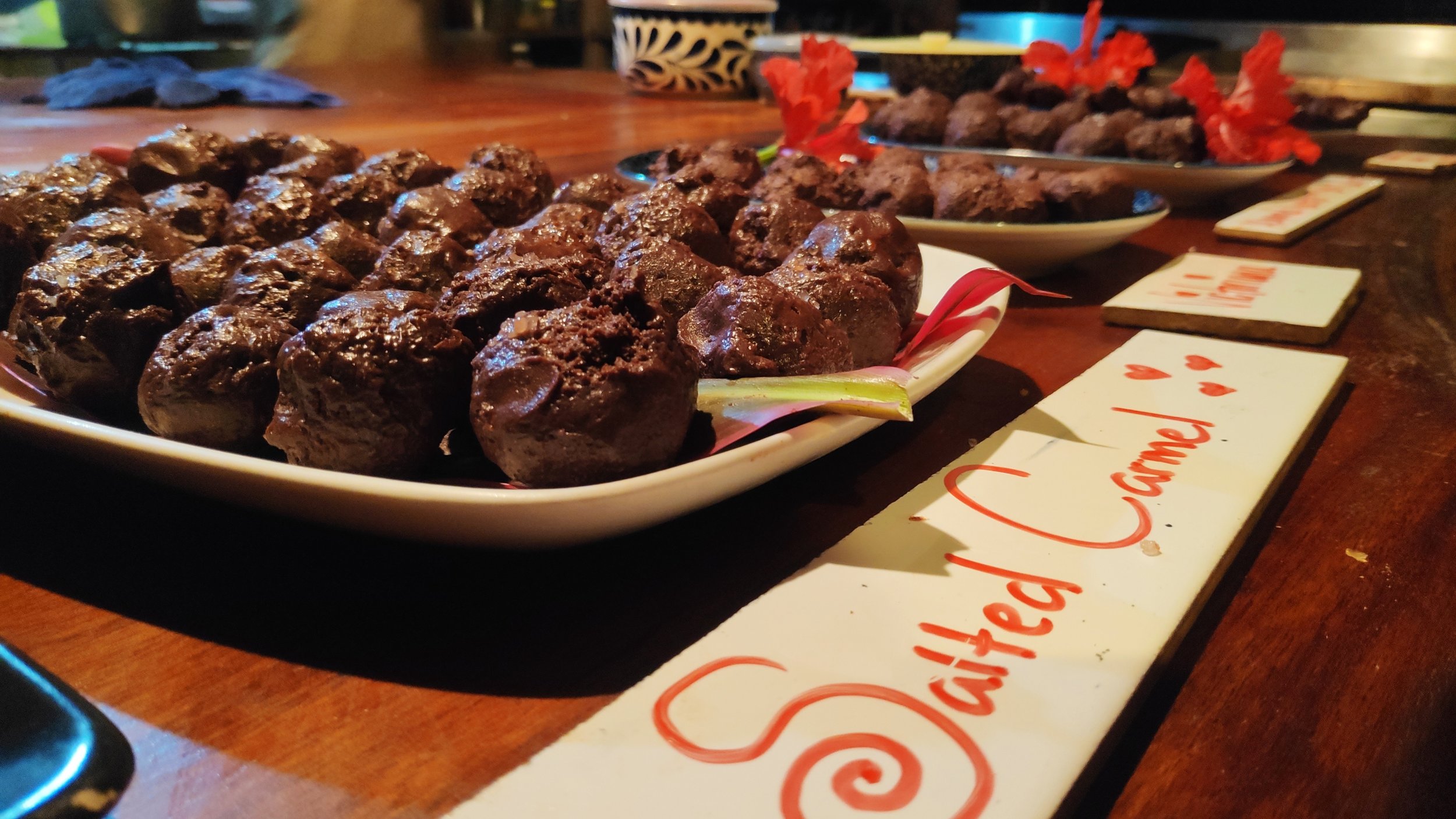
Chocolate bon bons, made from locally grown cacao
What is Lacto-Fermentation
What would a traditional Korean Barbecue be without kimchi, your scrambled eggs without Tabasco and a hot, sunny afternoon without a fresh pickle? Lacto-ferments are around us every day. Often they are made into dishes that we don’t even consider as fermented.
By Constantin Demuth, apprentice 2021

One of our favorite lacto-fermented condiments- Green Papaya Kimchi
What would a traditional Korean Barbecue be without kimchi, your scrambled eggs without Tabasco and a hot, sunny afternoon without a fresh pickle? Lacto-ferments are around us every day. Often they are made into dishes that we don’t even consider as fermented. Many of which are staples that have backed up our diets for hundreds of years. Try and think of the last lacto-fermented goodie you ate.
Recently, lacto-fermentation is going through a renaissance. People are realizing how easy it is to recreate flavors of their cultural ancestry. Kraut is just cabbage, salt and water. Pickles are just cucumbers, salt and water. It’s easy to make at home and much better than the stuff you buy in the supermarket. In this article I would like to take you on a little journey through the wide world of lacto-ferments, share some of the Ranch’s deepest secrets, and how we take foods from the farm and transform them into delicious, nutritious, and long lasting dishes.
History
In a time where we can buy produce all year around from every corner of the world and store them conveniently in the fridge, the reason why people ferment their food is becoming obsolete. In the beginning, they were not looking for the most incredible flavors that people at Noma’s Food Lab try to create. They were more interested in preservation, keeping their produce edible, eliminating molds and buffering cold winters without harvests. As farm to table cooking is becoming more popular again, being able to preserve foods through the year is increasingly important. The easiest method of preserving large quantities of raw vegetables is by using salt. Salt creates an environment that allows good bacteria to survive while killing bacteria harmful to humans. Today, we know salt preservation also makes nutrients bioavailable, increases digestibility and creates a great source of raw foods in our diets.
Preservation

Lacto-fermented pickles
Let’s go into a bit more detail of what happens in our jars when we mix vegetables with salt. Adding salt or salt brine to vegetables helps Lactic Acid Bacteria (LAB) to develop. LAB then turns the natural sugars of the vegetables into lactic acid. This acidified environment inhibits the growth of bacteria that makes the vegetables go bad and mold. This way we can store lacto-fermented vegetables for long periods of time without worrying about spoilage. The acidity gives these ferments their original flavor and preserves the satisfying crunch that we all crave.
As opposed to other fermentation methods, lacto-fermentation does not require any input of certain bacteria. When using fresh (preferably organic) produce we are able to work with LAB that is native to the vegetables and helps create the environment we want. As a result of their work, LAB often produce oxygen that makes our ferments bubbly. In case you find bubbles in your jars, don’t worry. That’s a sign that it works!
Lacto-ferments at the Ranch
Here at the Ranch we use lacto-fermentation every week and we eat it basically every day. Our favorite staples are Green Papaya Kimchi, Salsa Starter and some sort of pickled vegetables. The most recent and exciting experiments in the test kitchen include pickled Katuk (our daily salad green) and fermented black beans for our home made Hoisin Sauce.
We use lacto-fermentation for three basic reasons. Reason one: It’s good for us. It makes all the nutrients that fresh vegetables have to offer available to us. Reason two: We can store fresh harvests and consume them later, which is super convenient when you have an amazing orchard that produces a variety of things all year around. Reason three: It is delicious and we love delicious food!

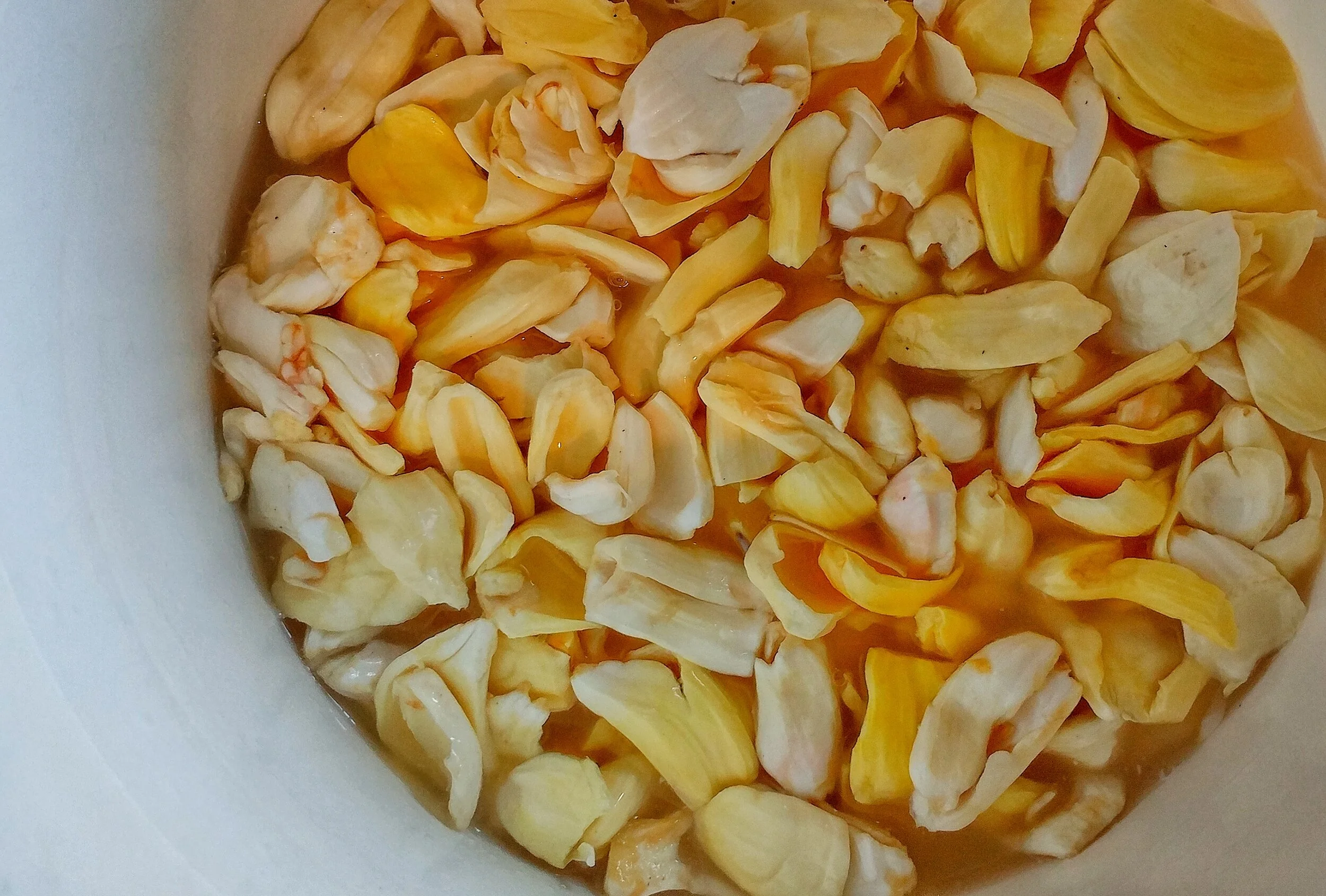
Green jackfruit processing
Green Jackfruit
Jackfruit is a perfect example of how we use lacto-fermentation as a way to preserve fresh produce. Jackfruit is the biggest fruit in the world and we have several trees in our orchards. Once jackfruit is ripe, it goes bad relatively quickly and some people don’t like its flavor when ripe. We started harvesting them when they are still green to incorporate them as a vegetable into our diet. Even here where we feed many hungry souls every day, we cannot consume the amount of jackfruit we harvest. This is where our friend lacto-fermentation comes into play. We submerge all the jackfruit meat in a 2% salt brine, which inhibits growth of undesirable bacteria, prevents oxidation and gives a deep, rich salty flavor that we want in our dishes.
Green Papaya Kimchi
The purpose of our Kimchi is less for preservation and more for the “ooh “and “ahh” moments when we serve fresh condiments with all our foods. The kimchi accompanies eggs in the morning, hearty slow roasted pork on special occasions and provides the freshness in our weekday burritos.

We use green papaya, but you can use any local, seasonal, crunchy vegetable
As opposed to jackfruit, where we submerge the flesh in a brine, for Kimchi we use its own juice. Again, salt is our partner in crime. Shredding 20 kg of green papaya on Wednesday mornings is not everyone’s favorite exercise, but the result makes up for the work. We used to do this all with hand graters, but recently we purchased an industrial hand cranked shredder by Nemco Food Equipment. We highly recommend this tool if you are making large batches of sauerkrauts, kimchi, etc. By shredding the fruit, we make it easier for the salt to penetrate. After mixing papaya, salt and spices (aka the *flavor bomb) enough brine is being produced for the ferment to be safe. Three days in the fermentation bucket and voila, kimchi is ready. Pack this into glass jars that can be stored in the fridge.
Now it’s time to reveal the big secret you’ve been waiting for. Rancho Mastatal is giving out its kimchi recipe for the first time. Two things that are important: First, if you cannot find green papaya, use any type of cabbage. It’s important to use fresh, local and seasonal (when you live in a temperate climate please, please do not go to the supermarket and buy green papaya!). Second, fermentation is no science! Don’t get overwhelmed by ratios, phrases or utensils. Trust your senses; look at it, smell it and taste it. Your nose knows best.
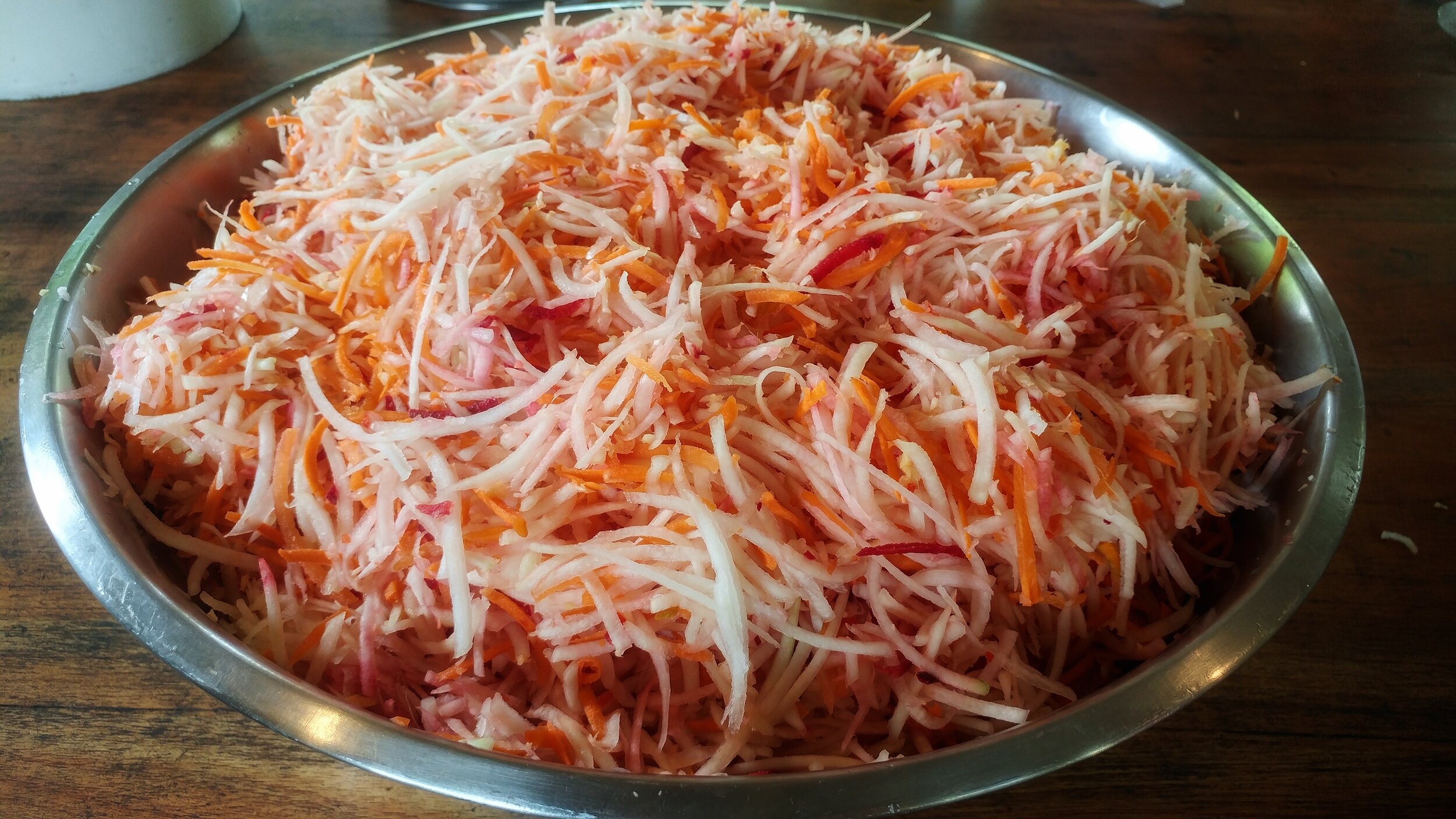
Shredded ingredients ready to be combined with salt and flavors
Recipe
3 green papaya, peeled and seeded
1 carrot and/or 1 beet
Salt (2% of the total weight)
*Flavor Bomb
1/2 cup peeled ginger
1/2 cup peeled garlic
1 chili (optional)
Equipment
Fermentation vessel: A food safe container that can hold all the vegetables plus at least 20cm of headspace (buckets, mason jars, big Tupperware all work perfectly fine).
Instructions
1. Cut the papaya in half and discard the seeds. Peel the papaya.
2. Using a kitchen grater, grate the papaya, carrot and/or beet and set aside.
3. Peel the ginger and garlic. Cut the chili in half and discard the seeds. Blend all the ingredients for your flavor bomb in a food processor.
4. Weigh out all your vegetables and place them in your fermentation vessel.
5. Add 2% Salt to the total weight of the vegetables (e.g. if you have 1kg of vegetables, use 20g of salt) and mix the salt in. Stirring it helps to break up the papaya and releases the brine.
6. Make sure your Kimchi is submerged in brine. Keep it on the counter at room temperature and wait for at least three days (this will depend on your climate). You will see bubbles and be able to smell the acidification after a few days. When it’s reached your desired flavor, bottle the Kimchi in jars and keep them in the fridge. Enjoy!

Green papaya cut in half
Learn more
Those are just a couple of the many vegetables we lacto-ferment. Lacto-fermentation has made our farm to table cooking and preservation more efficient, produce less waste, and create delicious, unique and fun foods.
Join us for a workshop to learn more about fermentation, farm to table cooking, permaculture and more.
Other Farm to table blog articles
Eating Local: Reconnecting to Food
Turn Local Rice and Beans into Fermented Bread
Happy fermentation, happy microbes!

Farm to Table Chocolate Bonbons
It wasn’t long into my apprenticeship that Robin handed me a piece of a chocolate bonbon, made with raw cacao picked from the farm down the road, that I experienced something like awe; and that in the old sense of both amazement and terror. This is what chocolate is supposed to taste like?
By Kara, Apprentice 2020
Beautiful beaches, abundant wildlife, fresh fruit, incredible coffee, and local chocolate; these are some of the things I anticipated experiencing in Costa Rica. While everything but the beaches has been a part of my experience here at Rancho Mastatal so far, one thing in that list stands out to me. The chocolate.
I’ve splurged on the good chocolate bars back home in Canada, the fair trade, single-origin, handmade stuff- and I enjoyed every bite to get my $10 worth- but I know now that I had never truly experienced chocolate. As fair-trade and handmade as all of that was, it was still flown halfway around the world and had sat on a store shelf for who-knows-how-long.

Cacao being toasted
It wasn’t long into my apprenticeship that Robin handed me a piece of a chocolate bonbon, made with raw cacao picked from the farm down the road, that I experienced something like awe; and that in the old sense of both amazement and terror. This is what chocolate is supposed to taste like? And I’ve been missing out on it for the last 27 years? Memories of foil-wrapped bunnies and coins surfaced, and I tried to make the connection between that waxy-sweet substance and what I had in my hand now; something subtle, complex, layered with sweet and smoky and earthy and bitter- no additives necessary.
I was hooked after that first taste, and when Robin said that she wanted a flight of bonbons for her
birthday dessert, I was ready to take on that challenge. The recipes we created for that event were truly a farm-to-table experience- nearly everything sourced from the Ranch property or from farms
around Mastatal (salt and peanuts being our exceptions). The focus on sustainable, local sourcing did nothing to impede the quality of our bonbons, in fact, it’s that parameter that brings out the most creativity (and the best flavors, oftentimes) of most food made at the Ranch.
So instead of going on waxing poetic about chocolate, I want to share those recipes we made and some tips on working with raw cacao. The funny thing about these recipes is that I don’t intend for them to be followed, not exactly, at least. We used what we had on hand; fruits in season, experimental condiments and flavorings from other projects- and I want to encourage the same approach in you. Look through the foods you have available, both in your pantry and in the local market. Can something be dehydrated? Fermented? Powdered? Turned into wine, vinegar or syrup?
Get creative, play, then eat some chocolate.

A productive harvest of cacao at our local family run chocolate farm, La Iguana Chocolate
Basic Chocolate mix
1 cup raw cacao
1 tsp salt (or to taste)
1 Tbsp grated tapa dulce (or sugar)
1. In a hot, dry skillet toast the raw cacao. They will blacken as they toast, and become wonderfully fragrant. You will know they are done when they start to make popping sounds as the skin separates from the seed.
2. Remove from heat, and let the cacao cool until you can comfortably handle them. Once cool, remove the outer skin by pinching the seed between thumb and forefinger of each hand, and twisting in opposite directions. Remove the skin, but don’t discard it! The little flakes of toasted skin make a wonderful cacao tea.
3. Grind the cacao. We use our hand-cranked corona coffee grinder, but a food processor or a mortar and pestle could work, too. Add the salt and tapa dulce to the cacao as you’re grinding to incorporate it into the resulting mix. You should end up with a mix the texture of gritty sand.
4. This is the base mix to which you will add all of your flavorings. For any bonbon flavor, you
will need something sticky to bind the cacao mixture. Syrups, dulce de leche, finely chopped gooey dried fruits such as dates, have all worked successfully for us. If you add liquids as flavoring, make
sure to watch the texture of the resulting mix. It needs to be wet and sticky enough to bind the cacao together, but not so wet that it slumps.
5. Roll your bonbons into spheres, or any shape of your choice, decorate, then refrigerate until serving.

Cacao seeds being crushed

A freshly picked cacao pod. The white pulp around the seeds is delicious!
Recipe Ideas
*all made with basic chocolate mix
Ranch-oreo: Make two small balls of chocolate mix per bonbon, mixing in dulce de leche to bind, then flatten them into bite size discs. Add a dollop of dulce de leche between the disks, and top with cinnamon and grated tapa.
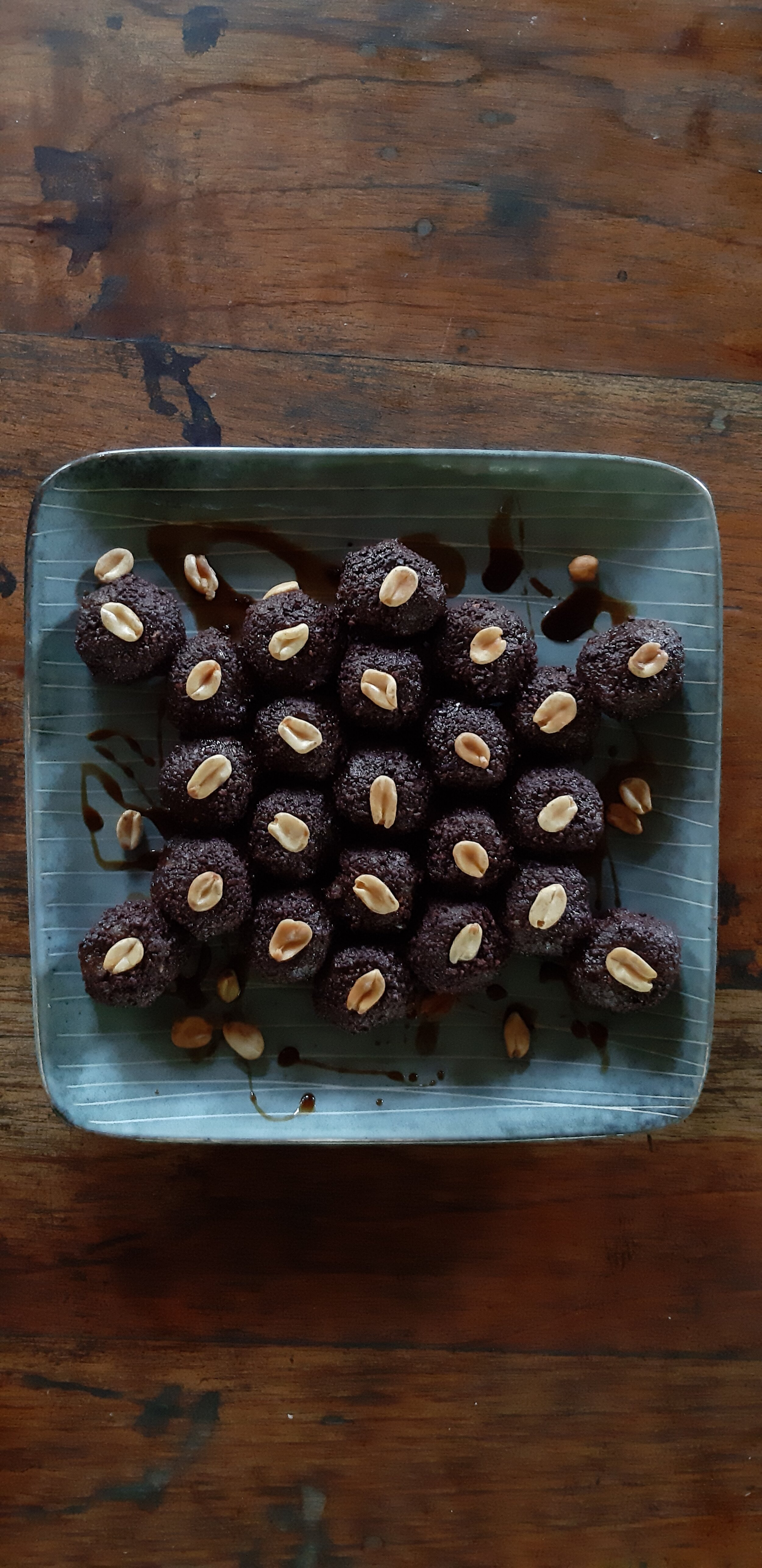
Peanut Butter Balls: Bind the chocolate mix with coffee flavored syrup (we used a coffee kombucha reduced with tapa dulce), and make a quick peanut butter to fill the bonbon. Toast peanuts with salt, and put them in a food processor with sour cream until it reached your desired texture. Make a ball of the peanut butter, then wrap a layer of the chocolate mix around it.
Ginger Jack Bites: Add ginger syrup and lime (we used powdered) to the chocolate mix, then incorporate finely chopped dried jackfruit. Roll into balls, and top with a slice of dried manzana de agua.
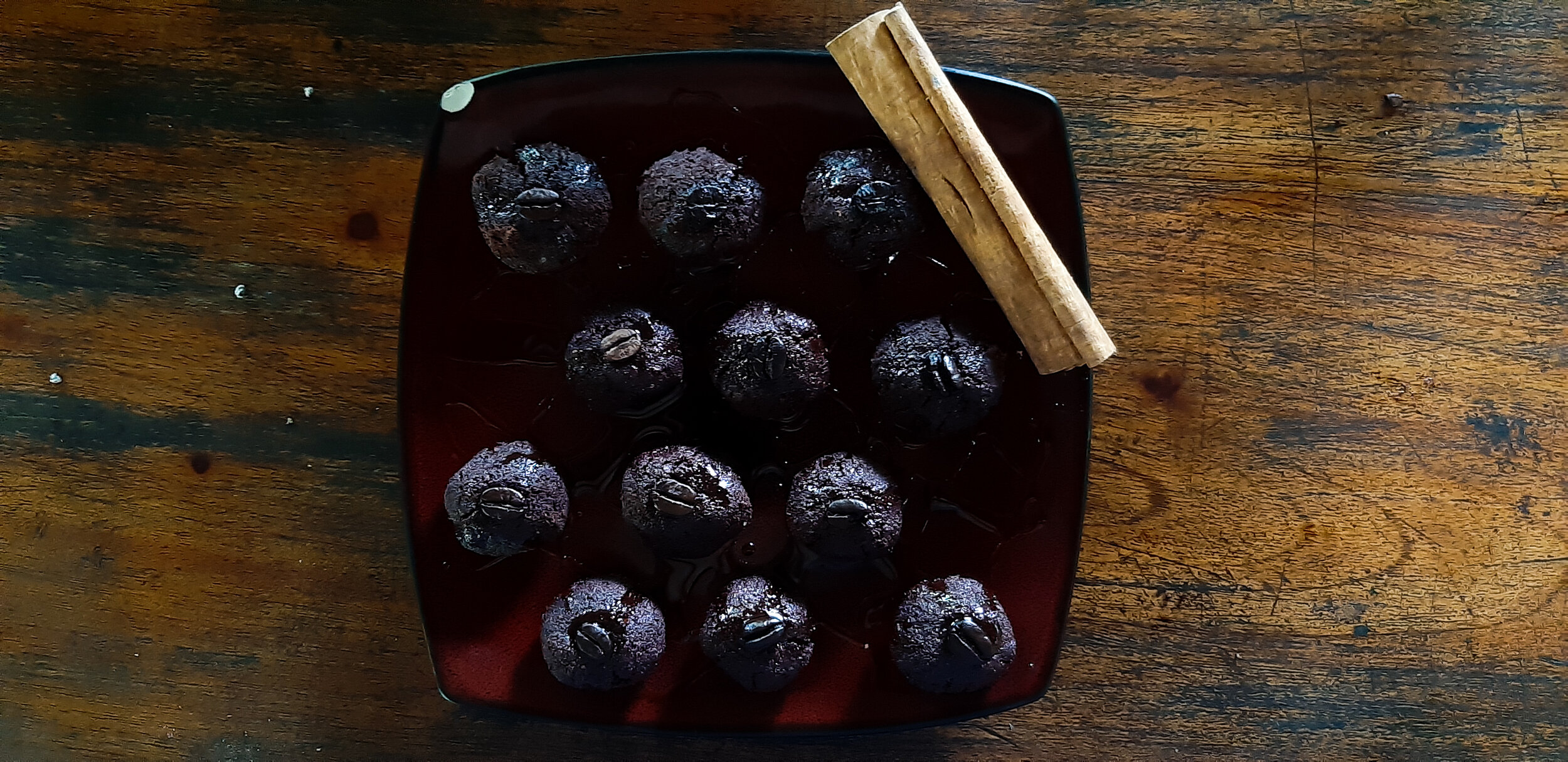
Coffee Cinnamon Balls: Mix the chocolate with coffee kombucha syrup to bind, roll into balls and top with a coffee bean and sprinkled cinnamon
Chilli Chocolate Bites: Mix the chocolate with starfruit syrup, chilli infused vinegar, lime, and dried chilli flakes. Roll into balls. Careful, this one gets hotter the longer you leave the chilli flakes infusing in the chocolate!
Simply Sweet: Mix the chocolate with dulce de leche, roll into balls, then create an indent with your finger in each bonbon, and fill it with a dollop of dulce de leche.
want to learn more?
Come stay with us as a guest and you’ll get to enjoy and make these tasty treats on a day trip to La Iguana Chocolate.
Visit our guest page for more info on coming and being a part of the Ranch and Mastatal community.
Past blog articles about cacao and farm to table products:
From Tree to Bar: How to Process Raw Cacao
Life of Spice: Farm to Table Cinnamon
Vanilla Cultivation: A Practical Guide for the Tropical Homestead
Workshops we host and teach that are related to agriculture and homesteading:
Permaculture Design Certification
Agroforestry Skills
Plants as Medicine
Syntropic Farming
And more! Visit our website for more information on our upcoming workshops.
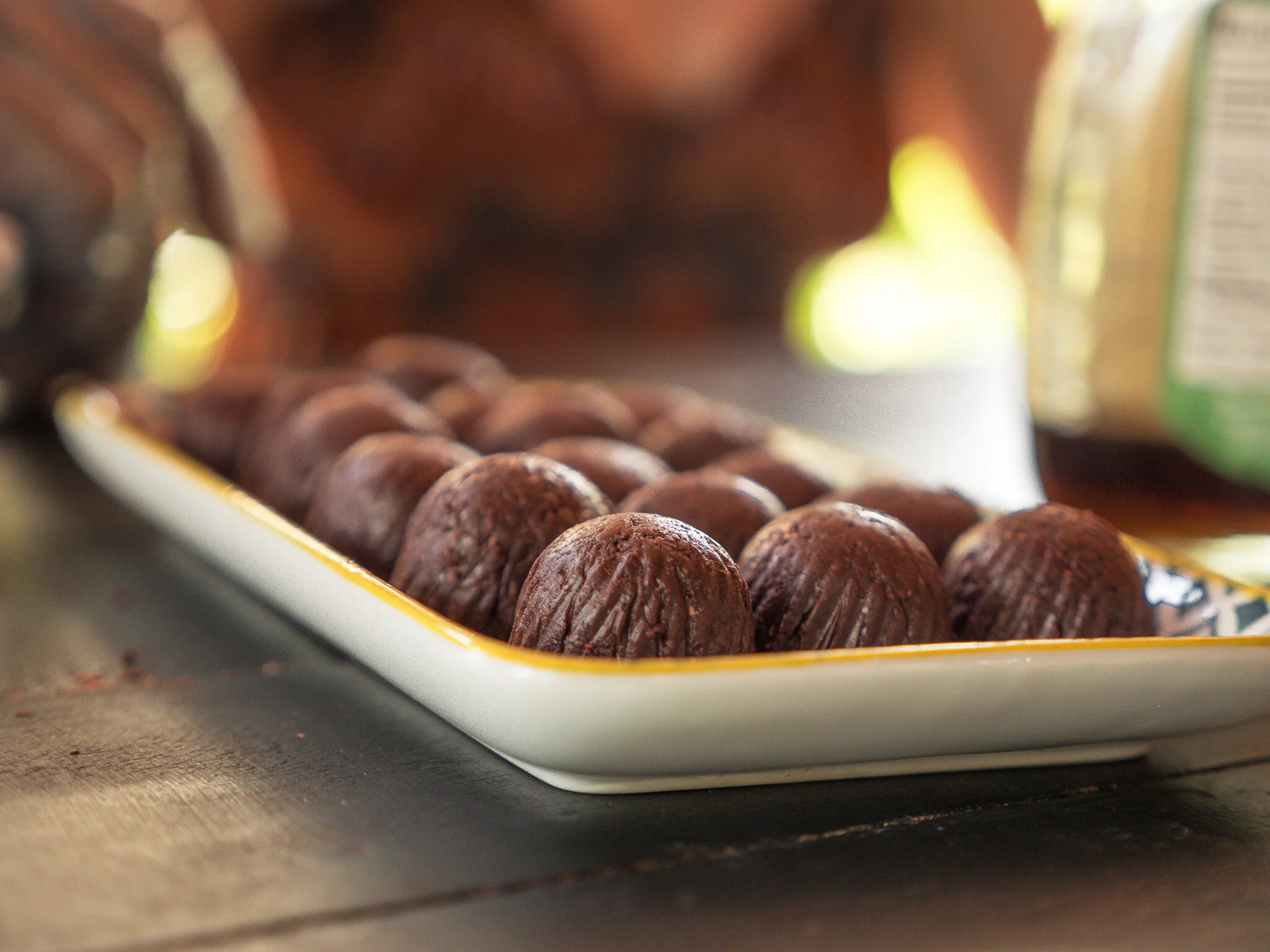
Locally sourced and made chocolate from our neighbors at La Iguana Chocolate

Natural Log Cultivation of Shiitake Mushrooms in the Tropics
Even though growing shiitake in bags of synthetic logs is more common due to labor and material costs for bigger scale production, we decided to go for the traditional natural log cultivation, as it has been grown for thousands of years. So if you’re thinking about starting mushroom cultivation, here are a few tips on how to do it:
By Nico, Apprentice 2020

Apprentices inoculating the logs
Managing an orchard space involves dealing with a lot of biomass, especially here in the tropics. From weeding, to pruning, chopping down NFTs that are getting way to big, etc. We are then left with a lot of plant material. Most of this biomass is returned to the soil around our beloved fruits trees, decomposed by microorganism and turned into a nutritious soil, hence completing the life cycle of our healthy ecosystem. But, every once in a while we are faced with the dilemma of having to take down bigger trees. At the Rancho we always try to honor the life of those trees by using them in the best way possible. Following permaculture principles, we don’t see any by-product as waste but rather as a resource. So when we had to take down a magnificent Pau d’arco for safety reasons, we took this opportunity to give it second life. The biggest logs were milled by 2 local sawyers, and are currently drying in the barn to be turned into the next piece of beautiful furniture. We used the smallest logs/branches to make a tincture, since the tree has so many wonderful medicinal properties. The bark, a powerful botanical medicine that restores the immune system, has been cited traditionally to treat the following health problems: anaemia, arteriosclerosis, arthritis, asthma, bronchitis, boils, cancer, candida, colitis, colds, constipation, coughs, cystitis, diabetes, diarrhoea, emphysema, dysentery, eczema, fevers, flu, gastritis, gallbladder problems, infections, liver problems, lung problems, leukaemia, pain relief, parasites, prostatitis, pyorrhoea and wounds!
*Learn more about Plants as Medicine in our annual workshop*
Finally, having noticed that the wild Oyster mushrooms are growing pretty well on this species once dead, we decided to use the medium sized logs that were too small to be used for furniture, to tackle one of my many long-time wishes: growing shiitake mushrooms. Shiitake is one of the most popular and important mushrooms in many countries. It has a long-standing history as a culinary delicacy and an immune system booster that produces lentinan, which is recognized in Japan as an
anti-cancer drug. An anti HIV property has also been detected along with other health benefits that are still being studied. It is widely cultivated not only in Southeast Asia but also North America, Europe, Australia and New Zealand, and each year more and more small scale farms are popping up.
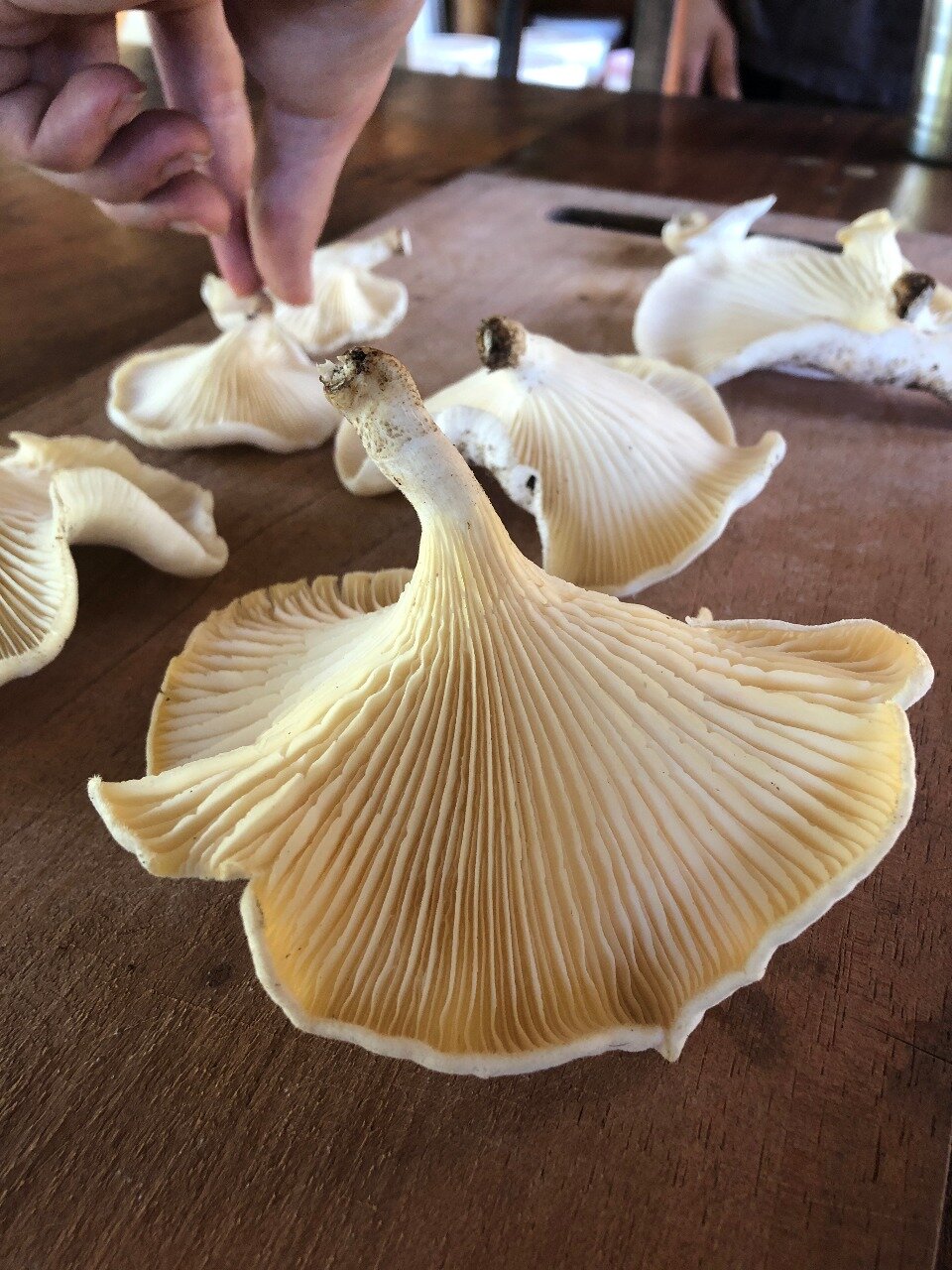
Wild oyster mushroom harvest
Even though growing shiitake in bags of synthetic logs is more common due to labor and material costs for bigger scale production, we decided to go for the traditional natural log cultivation, as it has been grown for thousands of years. So if you’re thinking about starting mushroom cultivation, here are a few tips on how to do it:
Selecting the logs
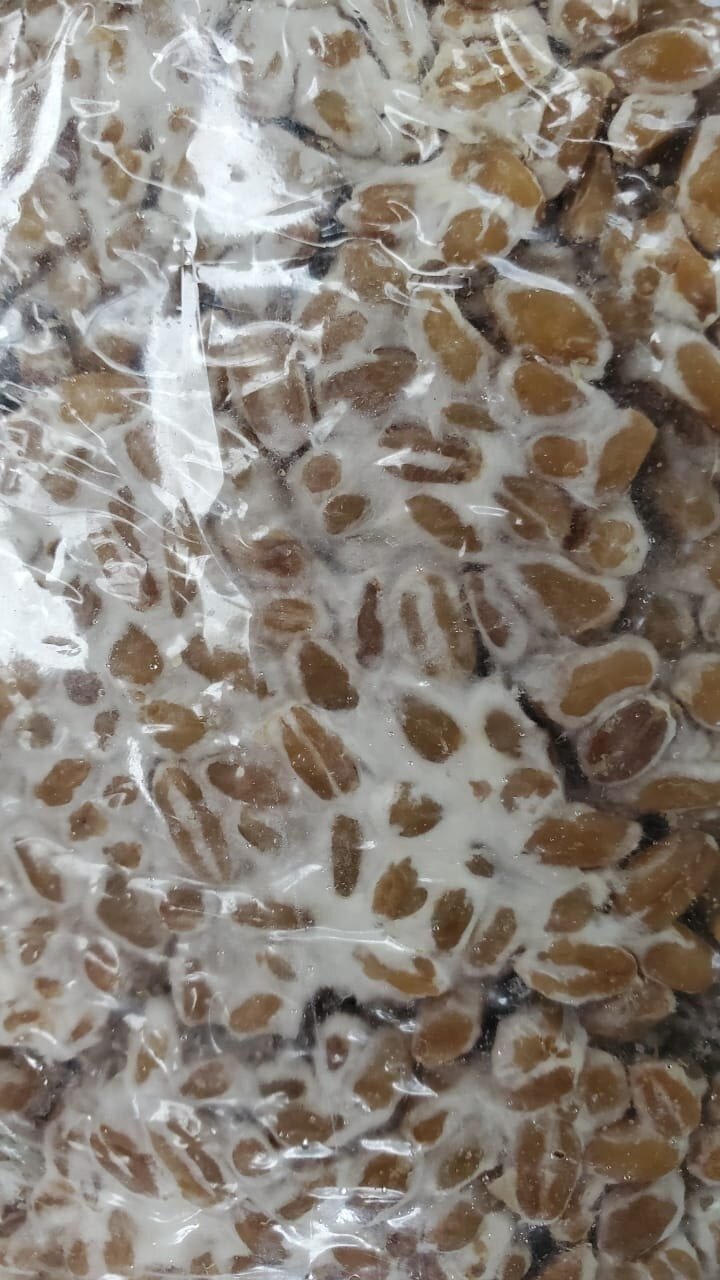
Mushroom spores
The most common species for growing shiitake in temperate climates are Oaks, Poplar, Alder, Maple, Birch, Elm and Sweetgum. On softwoods such as alder and birch, the mycelium will colonize the logs faster, but hardwood will give you a longer production time and less risk of contamination by other undesired mushrooms or molds. Growers should check to see what kind of suitable trees are available locally. Once you know which tree you will use as a substrate, you can start selecting and cutting the logs. Shiitake grows best in the sapwood and cambium because they contain the most readily available nutrients and have higher moisture content than the heart-wood, so the larger the sapwood area, the better. As Shiitake is a saprophyte, it can only grow on dead wood, so you want to make sure you inoculate your logs at least 2 weeks after the tree was chopped down so all the wood cells are dead. If inoculated sooner, the trees' natural chemical defenses against invasion may still be active and could prevent the shiitake fungus from growing. It is a good idea to soak the logs in water 24h before inoculation in order to increase the moisture content above 40%. The Ideal size for logs is about 1m in length so they are easy to manipulate, and a diameter somewhere between 7 and 15 cm (3”-6”). You want to select logs with an intact bark and try to keep it on as long as possible, as it creates an extra layer of protection against other wild molds, fungus or contaminants. Lime water can be applied on the exposed surface at the end of the logs for the same reasons, or you can also seal them with wax when doing the next step.
Inoculating the Logs
Inoculation is the introduction of the live fungus into the log. This live fungus is mixed with sawdust, grains, and other nutrients or is grown on a wooden dowel. This mixture, called spawn, is the mycelium of fungi growing on a substrate and prepared for propagation of mushrooms.

Brushing wax onto the ends of the logs
To inoculate, simply drill holes into the logs and fill them with spawn. The holes should be 0.8 cm in diameter and about 3cm deep. As mycelium spreads faster along the wood grain than across, you can place those holes 5cm apart around the log, and 10 to 15 cm apart lengthwise. Place the next row of holes diagonally, creating a diamond pattern and fill them with the spawn. Once all the holes are filled, seal them with melted beeswax to prevent drying and contamination.
Contamination is the most common reason of failure in mushroom cultivation, hence it is really important to always work in a clean environments and with sterilized tools. The more you pay attention and dedicate time towards this, the higher the chance of success.
Aftercare
Once all your logs are inoculated you want to let them sit in a warm and shaded area, in order to give the spawn the best conditions for propagation. What you’re looking for is a good balance of humidity, shade, ventilation and temperature. Each strain of mycelium has its optimal conditions, so make sure to get as much info as possible to find the perfect place. Too much heat with high humidity increase the risk of contamination, and you can balance that with good ventilation, but too much ventilation will dry out your logs, and you want to keep a stable humidity level. Think of it as having to choose a place to hang your hammock if you had to spend a whole day in it: you want it to be warm and cozy, but not in direct sunlight so you don’t start sweating. You want to have access to water (humidity) and a nice small breeze to rock in your hammock while you fall asleep.

Inoculated logs in a warm, shaded area
Give it Some Time
There you have it! Your logs are now freshly inoculated with the shiitake spawn (or any other variety you choose). The only thing left to do is give it some time to propagate and colonize the log before fruiting starts. Don’t forget to control humidity level and temperature, and check for any contaminants that might spread and steal the thunder from your precious shiitake. For fruiting to start, you can either let nature do the work or induce fruiting through different techniques that we will develop in next post, when or shiitake spawn is ready to fruit. Stay tuned for more info about fruiting, harvesting and all the next steps in your mushroom cultivation!
want to learn more?
Don’t forget to check out our yearly workshops and our apprenticeship program to get some hands on experience in sustainable living in the tropics!
Yearly workshops related to plants and homesteading include:
Happy mushroom growing!

Life of Spice: Farm to Table Cinnamon
When cooking over a fire, I often imagine that I am a witch brewing a potion. As I stirred with a big wooden spoon, the cinnamon began to sizzle, wafting its wondrous fragrance into the air and taking me to another place.
By Dani, Apprentice 2020

Farm to table cinnamon sticks!
Local Cinnamon
One morning at the Rancho, I was toasting some cinnamon to try to spice up an orange kefir water concoction. When cooking over a fire, I often imagine that I am a witch brewing a potion. As I stirred with a big wooden spoon, the cinnamon began to sizzle, wafting its wondrous fragrance into the air and taking me to another place.
The scents of spices are fantastical, and I have always thought that the spice rack is a mystical, magical place of otherworldly ingredients. As I learn more about spices , that magic has not faded, but rather has revealed new perspectives. We grow cinnamon in the permaculture orchards at the Ranch, and using this magnificent spice from tree to table has made me appreciate it so much more.
The cinnamon in my potion that morning is about as local as you can get. As the cinnamon toasted, the aroma traveled into my nose, triggering my memory, as scents often do. I was captivated by the smell when someone walked into the food smithy and exclaimed, “It smells like Christmas!” I snapped out of my cinnamon induced daydream and concurred. Even though it was a hot February day in the tropics, with temperatures around 85 degrees Fahrenheit, I could almost taste the crisp cold air of Wisconsin. It took me home. To me, the scent of cinnamon evokes feelings of cold winter nights with Christmas cookies by the fire. It feels like cool fall air and spiced apple cider at the orchard. It tastes like pumpkin pie at the dinner table. Cinnamon is for days of wool socks and sweaters. It smells like home to me. It is cozy. It is comfortable. It’s nostalgic.
But I had never even seen a cinnamon tree until coming to the tropics. So how did I come to associate this tropical flavor with with cold cozy evenings in Wisconsin? How did it become the holiday flavor of a climate where it doesn’t grow?
Origin of the Spice
By definition, spices come from the aromatic parts of tropical plants: roots, flowers, seeds, or bark. Unless you live in the tropics, the likelihood of consuming local , farm to table spices is slim to none.
Cinnamon comes from the bark of an evergreen tree which is native to Sri Lanka (Ceylon), and in ancient times, it was one of the most sought after spices. Like pepper, it has thousands of years of history in the globalization of foods and was known in China as early as 2700 B.C. It is even mentioned in the old testament as well as in Sanskrit texts. The globalization of cinnamon is not new, and the magical qualities of cinnamon ignited ideas of paradise in the minds of many, causing them to set sail in search of the heavenly lands from where they believed the magical spice must have come.
Cinnamon has a powerful scent, so powerful that it played a part in progressing the sharing of cultures and globalization as we know it. Some wonderful new cuisines came out of the spice trade, but it was not without a cost; the spice trade was also linked to slavery and centuries of abuse towards the local producers. It is important to remember both the fascinating and dark histories of the foods we eat.
Today, Great Britain is the leading consumer of cinnamon, followed by the United States and Spain, all places where the spice does not grow. The word, cinnamon, comes from the Greek word for spice and the prefix ‘Chinese’. Cassia is another spice, closely related to cinnamon, and they are often sold interchangeably, though cassia has a more delicate taste. Most of the cinnamon sold in the United States is actually cassia. Cassia is native to Myanmar and northern India as well as some Indonesian islands. Records of this spice date back over 6,000 years, and it was grown around present-day Hanoi during the Han Dynasty.
Cinnamon and Cassia can be distinguished by their color, true cinnamon being tan and cassia being more of a darker reddish brown. I had no idea that most of the cinnamon I have consumed in my life was probably not even cinnamon
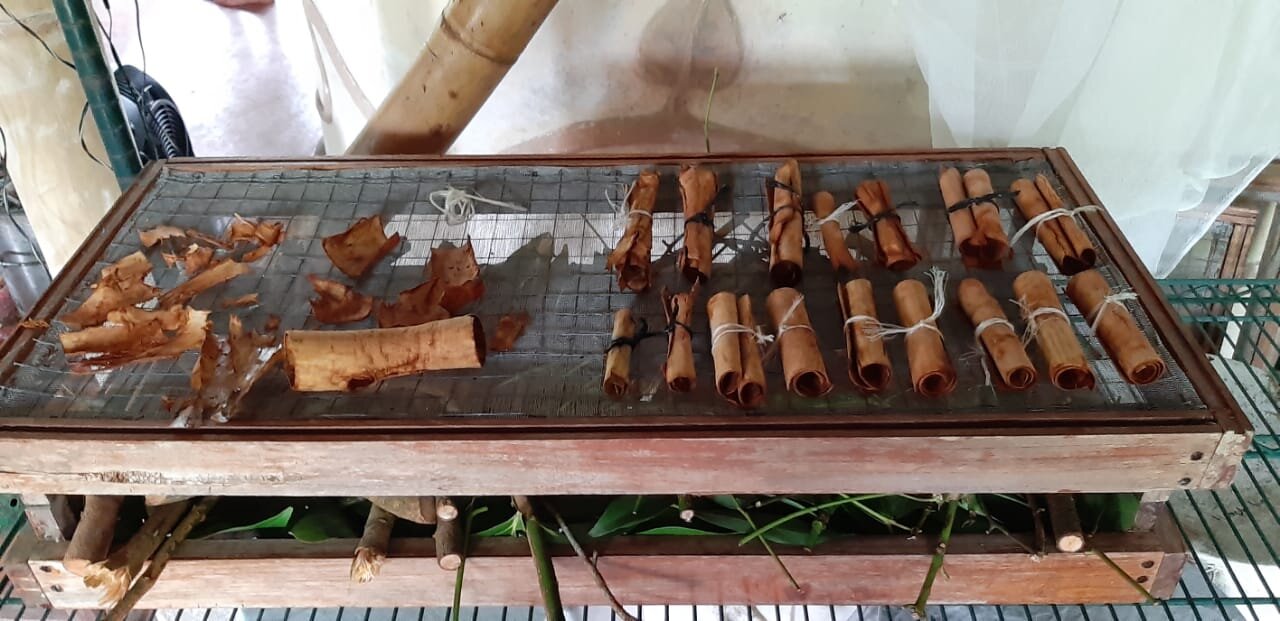
Cinnamon sticks rolled and drying
Permaculture Processing
The journey of cinnamon from the farm to our tables is neither short nor simple. After harvesting and processing cinnamon here at the Ranch, I would argue its processing is truly an art.
Ideally, cinnamon is grown to be long and straight to maximize yields. The offshoots should be pruned as they take energy away from the trunk, which is where the good stuff is. The darker bark is harvested to use as the spice. Once the tree reaches about 2 meters and the trunk is about 2-4 inches thick, it is ready to harvest. It’s good practice to chop the tree down to 10-15cm at a 30-degree angle for water and sun protection. After the tree is chopped, it will produce 2-6 new shoots, increasing the yield of the next harvest which will be ready in about 2 years. This practice can be continued for the lifespan of the tree. With a permaculture mindset, we harvested some cinnamon at the Ranch with hopes that in a few years, yields will increase with the new shoots. After chopping the tree, we took off the lateral branches and leaves. The wonderful cinnamon flavor is also contained in the stems at the base of the leaves so we saved and dried these for tasty tea. We then chopped it into smaller, more manageable pieces, and using a knife, we shaved off the outer bark. The next layer down is called the cambium, and that is the stuff you want in your carrot cake.
The cambium is the part of the tree between the outer bark and the heart wood and what we know as cinnamon. To separate it from the heart of the tree, we made an incision using a knife down the entire length of the piece. Then, we slowly began to peel it off using a spoon, trying to keep it is one piece. It was not easy, especially if there was a knot in the wood. Finally, we rolled the cinnamon cambiums and tied them, and put them to dry. Sometimes cinnamon is cut into quills of over three feet in length! Though I have always thought that cinnamon sticks were beautiful in form, after struggling with my three-inch piece, I realized there is a whole layer of beauty I had not seen. I was blind to the artists behind them, the growers and processors of this special tree.
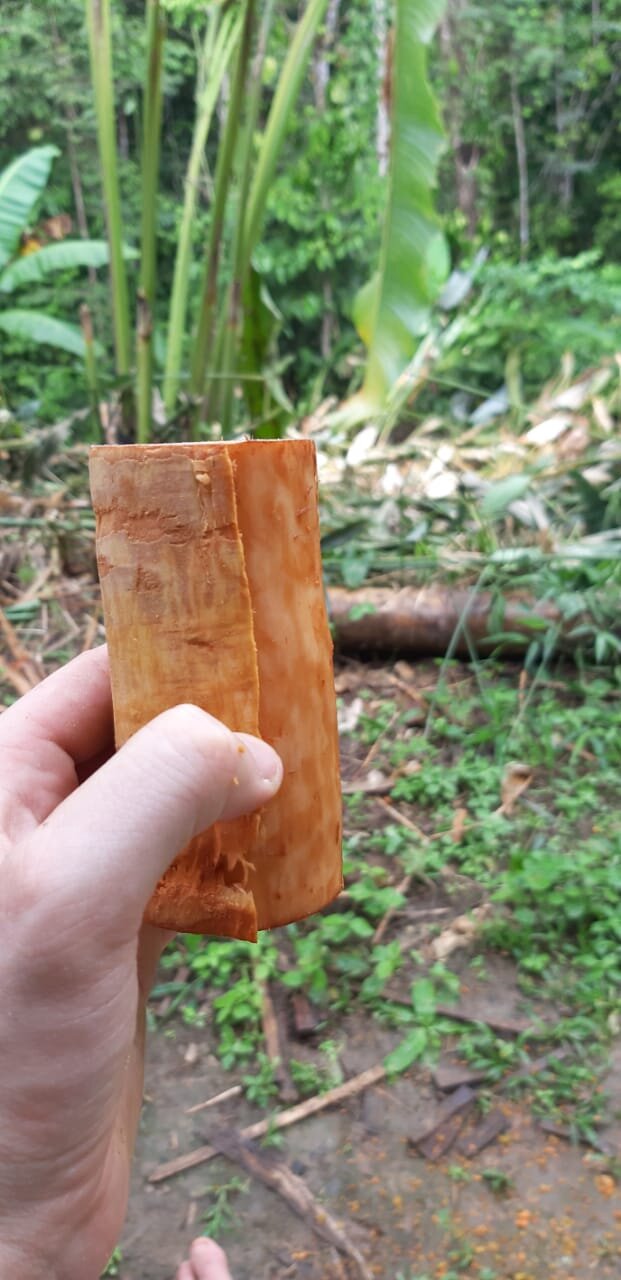
The outer bark shaved off, exposing the cambium layer
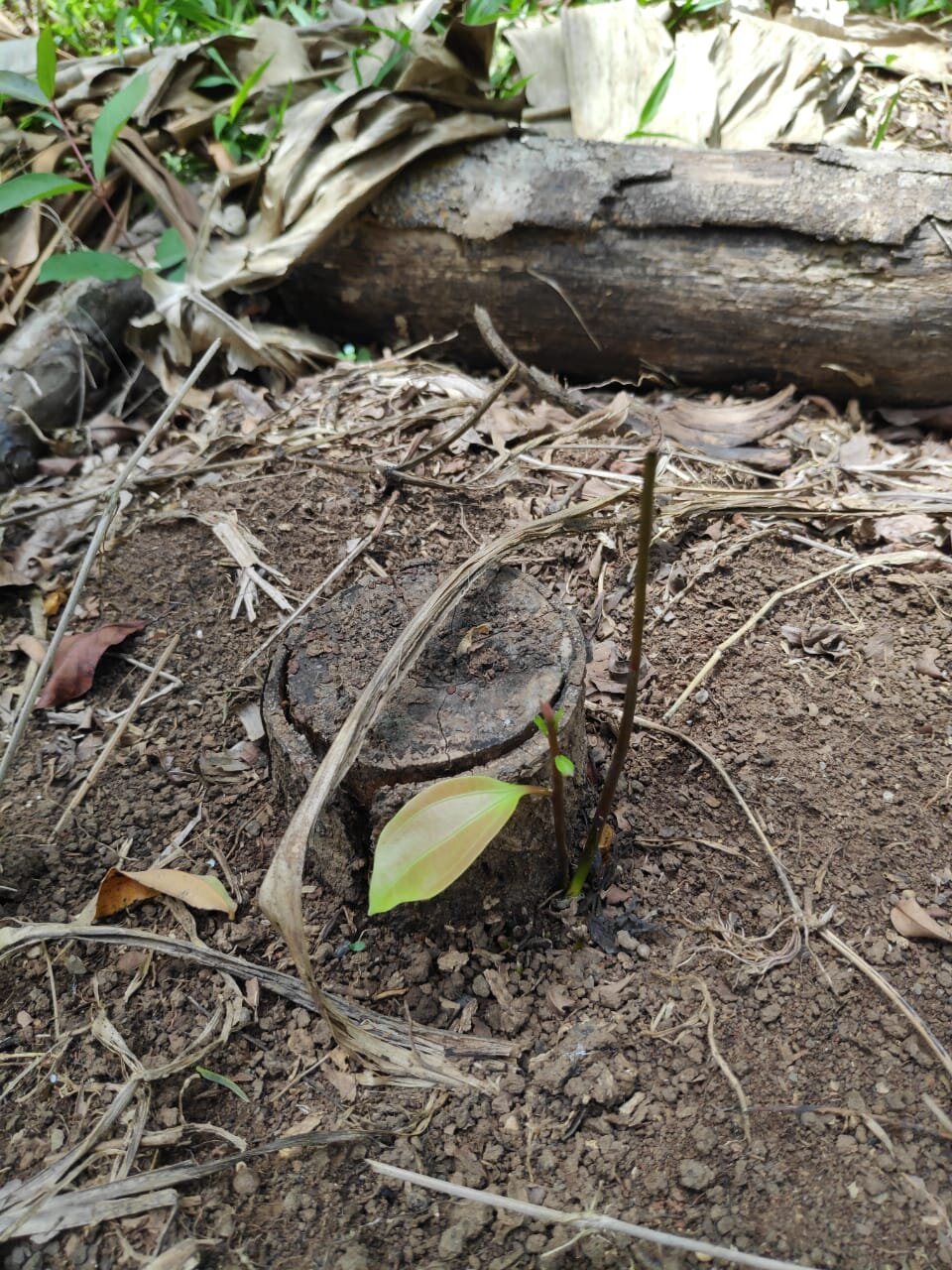
The new shoots coming up
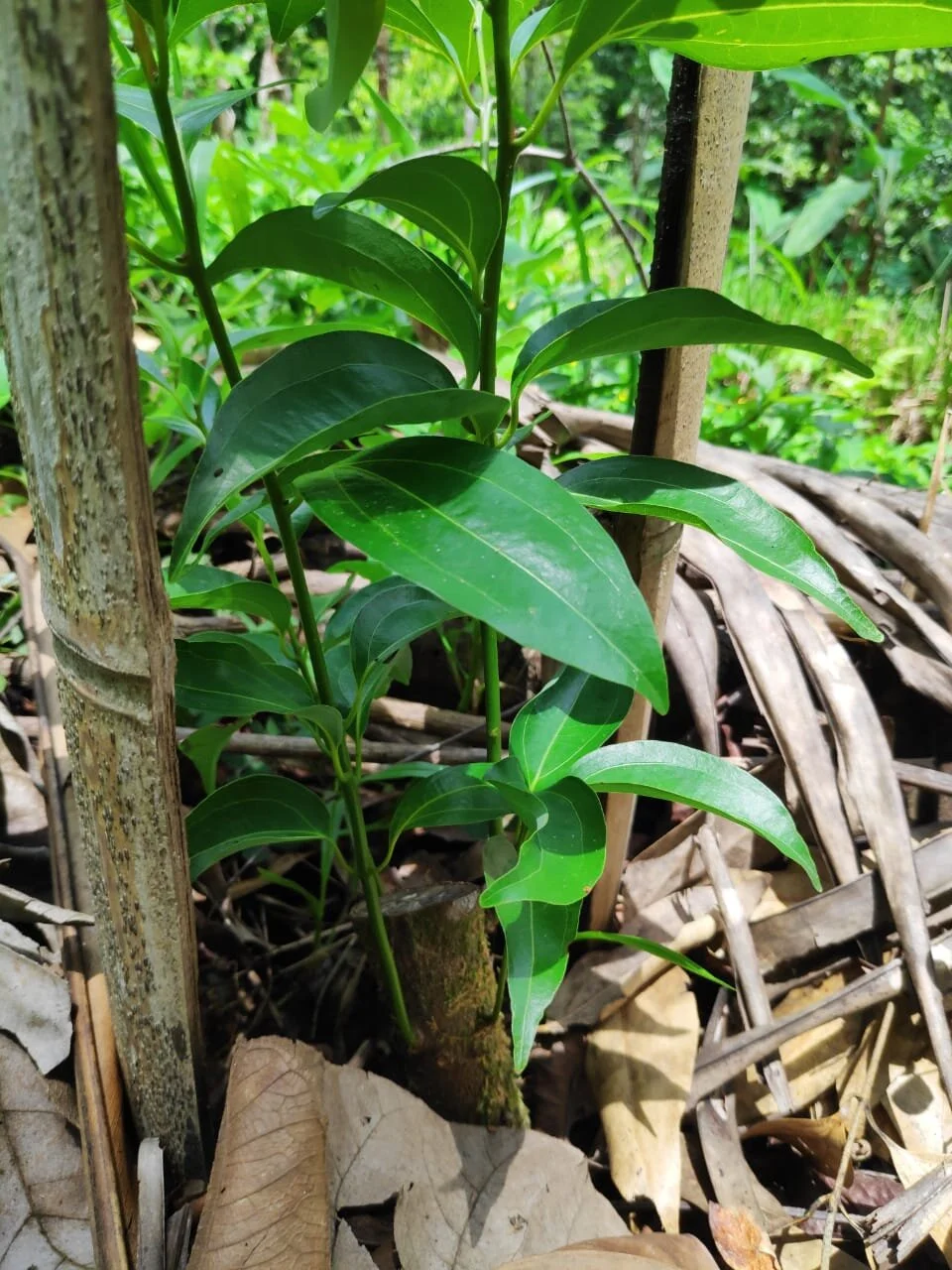
A healthy cinnamon tree re-growing
Conscious Consumption
There is so much in the food we eat: natural resources, back-breaking labor, rich traditions, culture, history, and beautiful artistry. It is important to consider where our food comes from, not only for our health, but for the well-being of those who grow and process our foods, and for the sake of our planet.
I think this is more difficult when it comes to spices. But these days, there are companies striving to produce fair trade spices through sustainable farming practices. Vermont-based Forestrade, started in Sumatra, demonstrated to local farmers how cinnamon can be grown without clearing huge sections of land that would endanger the surrounding national park. They now collaborate with 6,000 indigenous producers in Indonesia and Guatemala. Another example is a group of Hindu People on the mainly Buddhist island of Sri Lanka, the Salagama, who traditionally peeled the cinnamon bark from the trees. These people were devastated by the spice trade, controlled by the English, the Dutch, and the Portuguese. Today, the situation has changed, and they are able to sell their product to a fair trade association for 4o percent above the market rate.
These programs only work if we as consumers are aware of where our spices come from and are willing to pay a little more for our products. Through our consumption habits, we have the power to improve the lives of so many. I encourage everyone to enjoy cinnamon in their hot chocolate on a crisp cold evening, but as the aroma fills the room be mindful of how it got there. Spices truly are incredible, and I hope that while we are doing our best to eat local, we can be conscious of the magic contained in the spice rack.

Achiote to be made into paste

Fresh turmeric harvest

Farm to table peppercorns
Want to learn more?
Stay tuned for my next Life of Spice blog! And if you didn’t read my last blog about farm to table black pepper, read it here!
Want to learn more about growing your own foods and spices? Join us for our annual Permaculture Design Course or Agroforestry Skills Workshop, you can find more info on both these workshops here.
Check out these past articles about farm to table foods we are planting and processing here:
Sources and Further Reading
Heinerman’s Encyclopedia of Healing Herbs and Spices by John Heinerman
Spices – A Global History by Fred Czarra
Eating Local: Reconnecting to Food
Food nourishes us and forms the heart of our community. Understanding where it comes from, how it is grown, and who has grown it helps us value our food in a way that we have lost in the modern era. We can get overwhelmed by the challenges of the modern world and food can provide us with some of the easiest and most accessible ways that we can begin to regenerate our planet.
By Nic, core team member
Food nourishes us and forms the heart of our community. Understanding where it comes from, how it is grown, and who has grown it helps us value our food in a way that we have lost in the modern era. We can get overwhelmed by the challenges of the modern world and food can provide us with some of the easiest and most accessible ways that we can begin to regenerate our planet.

Pejibaye: One of the delicious, nutritious and locally available staple tree crops
Since the agricultural revolution, our communities have been molded by the food we produce. Thriving when abundant and starving when scarce. The quest to guarantee our food security has led to mass population movements, wars, terrible famines and giant metropolises. But as we stand on the edge of environmental catastrophe, does it also hold the key to our own redemption? Does revisiting and re-valuing what has become just another commodity on the store shelf give us the opportunity to take back the power that we have given up with our disassociation from our food production and provide real tangible solutions to the current climate crisis? In Paul Hawken’s excellent book Drawdown: The Most Comprehensive Plan Ever Proposed to Reverse Global Warming, 2 of the top 3 solutions are food based (reducing food waste and eating a plant based diet). Each one is totally achievable on an individual level and something that we must demand on a wider commercial and political level.
Working at the Ranch people often ask me what they can do to be more sustainable or environmentally friendly when they return home. This is a question that I could answer in any number of ways. The answer that is the easiest and most accessible is to simply “eat local”. This is by no means the only answer, but today I am going to discuss just this one, simple act. that could help us move to larger changes for our climate and population.
Eat Local
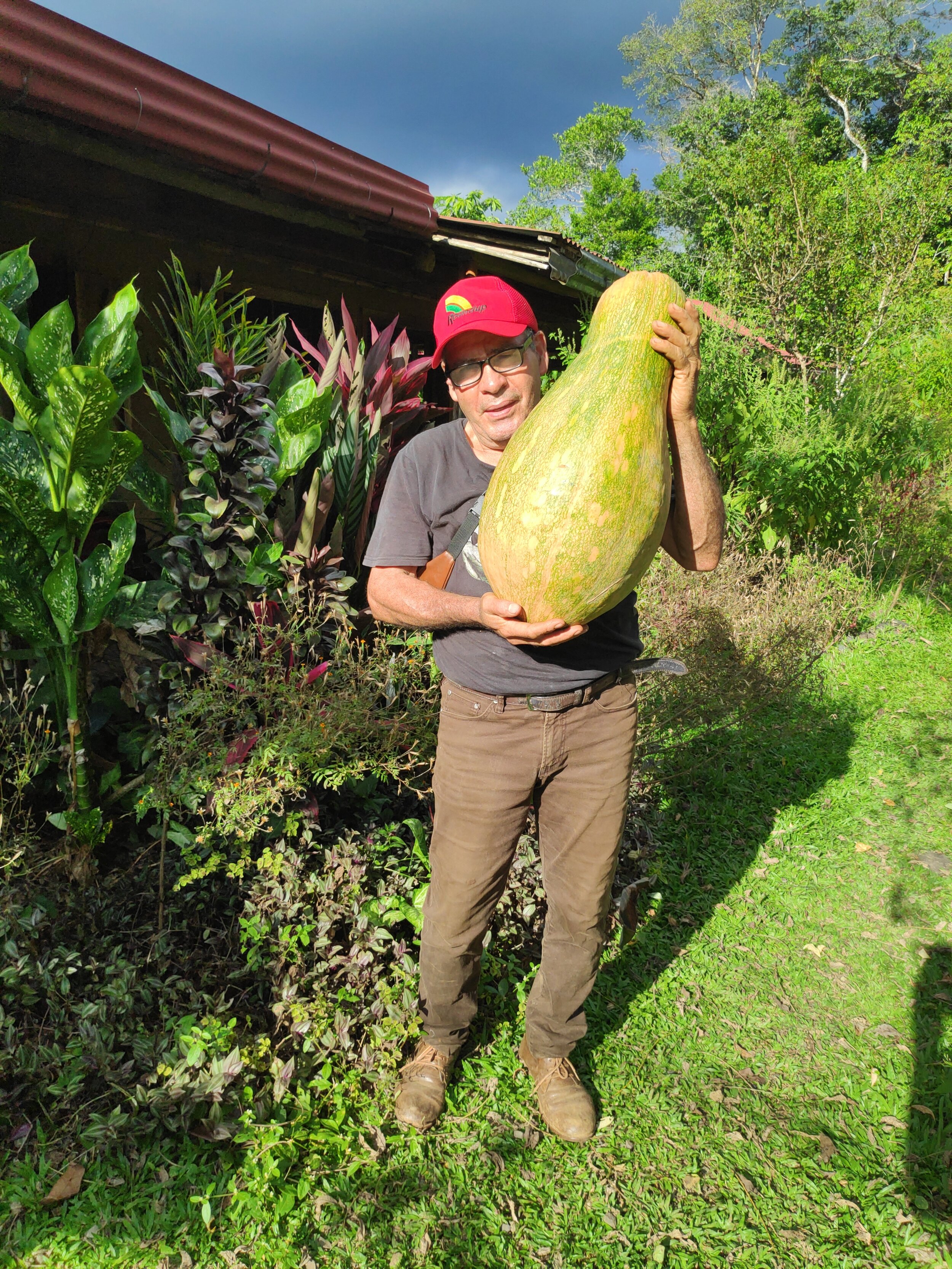
Nelson holding a giant squash he grew for us.
Since the early days of the Ranch, local foods have been a cornerstone of our cuisine. One of our goals is to create an easy market where local producers can sell their products. Not only does this reduce the carbon footprint of our meals, it helps to ensure that this region’s farmers continue to grow food. Unfortunately, people worldwide are moving to urban areas and abandoning the farming practices of their parents. Essentially, by buying whatever is brought to our door, we are saying to the local community; “if you produce it, we will buy it.” We want to let them know that we value their products and are committed to work with them to maintain the food security of our region. After 20 years we continue to buy from many of same producers. This results in delicious, locally grown food for our table, while providing an essential income to numerous households in our community.
Over the years the Ranch has produced increasing amounts of its own food as our agroforestry systems have matured and our understanding of tropical agriculture has evolved. We serve over 20,000 meals yearly with about 90% of our calories coming directly from the Ranch, the community of Mastatal, or the local area (within a 20 km radius from the Ranch). We are fortunate to still enjoy food security regionally. We purchase the following directly from the producers themselves: milk, eggs, cheese, sour cream, tapa dulce (unrefined sugar cane), coffee, corn, beans, rice, squash, yucca, plantains, avocados, chicken, pork, lard, peach palm, citrus, papaya, pineapple, citrus, mango, palm heart, lettuce and chocolate. We have created a diverse and delicious menu based on what we can either grow or buy from our friends and neighbors. We have taken the cuisine of the “ticas” and tweaked it a bit while adding an international flare.

One of our indulgences: wheat based pizza party!
This transition to eating a local based diet has taken some adjustments. As Westerners, our diet is heavily dominated by wheat products. Wheat comes in the form of cereal for breakfast, bread in a sandwich for lunch and pasta for dinner. Wheat is by far the most heavily consumed grain in the western world. After moving to Central America we needed to adapt to a new food culture full of new ingredients and tropical comestibles. We look to the wonderful traditions of our region and Asia to inspire our new diet and to create new and wonderful food that is based on locally available ingredients. We are not purists however, and of course we love to have a pizza party every now and again, but we have spent much time experimenting with wheat free, local doughs (read about our Permaculture pizza quest).
Why is eating local so important?
There are many pieces that make eating local such powerful change. I think one of the most appealing is that it is relatively easy to do, it is not really much of an inconvenience and does not require huge changes to your lifestyle. What follows are some of the reasons I believe eating local to be important.
Local Economy
By creating a market for local producers to sell their agricultural products we are supporting the local economy. This happens on many levels that are all intertwined. Firstly, you are valuing agricultural products that people know how to grow successfully. This means that farmers in our region can continue to do what they know how to do and are not forced from their land to cities to find other work. Secondly, they can get a much better price selling their products direct to the consumer as this removes the middle man (the supermarket) from the equation. When you buy a $3 head of lettuce, how much of that do you think goes to the farmer and how much goes to the supermarket? Thirdly, it keeps the money in town. By keeping transactions local the money tends to stay in our community, creating a circular economy that can support more than just the farmer. In this scenario the farmer can now buy products from other local people who can develop businesses that further support the community that in turns creates more economy!

We have been purchasing local eggs for Doña Flor for as long as I can remember.
Transportation and Carbon Footprint
This may seem obvious, but by buying local food you are reducing the carbon footprint and the transportation inputs that are associated with that food product. Unfortunately, in our globalized world, many of our products are shipped all over the world before making it to the final consumer. This is not just true of food, but also of many consumer goods. Cotton is often grown in the US and then exported to a country with a cheap labor force and poor working conditions so that it can be fabricated into a t-shirt, only to be shipped back to the US to be sold in the US market! Isn’t that crazy? If we buy our food from a local farmer then we know where it has come from and we know that the transportation of that food is minimized.
Fresh Food

Farm fresh: these bananas are simply delicious, ripening naturally.
By reducing transportation, you also increase freshness! Did you know that the majority of fruits are shipped when they are still unripe in order to reduce damage during shipping? The banana is a classic example. When the banana arrives to its destination it is gassed with a chemical that induces the fruit to turn ripe so that it can be sold at the market. This effects freshness and flavor massively, not only because these commercial fruit varieties have been selected for good shipping quality rather than taste, but also because when the banana ripens like this it tastes totally different. I have eaten many supermarket bananas and after now living in the tropics can confidently say that they’re weird. They never hover in the perfect ripe zone like a farm fresh banana does, and it goes straight from green to brown and bad tasting. A banana that is harvested freshly and allowed to ripen naturally has a far superior flavor and hovers in that perfect zone of ripeness for many days.
Developing Relationships
By interacting directly with your farmer you can have your say about what is grown and how it’s grown,. You can visit their farm and see for yourself the practices that they use. This is a powerful tool as there are many misunderstandings as to how food is grown and where it comes from. This can only be reconciled through personal experience and empathy. Maybe you really love blueberries, but the organic type only come from far away, whereas all the local blueberries are not organic. Why might that be? Maybe this is worth further investigation that developing a relationship with some local berry farmers might shed some light on. Maybe this will lead you to understanding something that you didn’t know about berry farming in your area, or maybe it won’t, but you won’t know until you investigate!
Creating Community
Our globalized world has broken up small communities where everyone traditionally knew one another. It is not uncommon now to not know your neighbors or the people who live on the same street as you. This has broken down the fabric of our communities and our relationships with one another. It is up to us to rebuild those relationships and it is going to require time and effort. A great place to start is with your food choices. If you can buy food directly from farmers then you can begin to create that direct relationship with your food and the land that grows it. Maybe it will be with a local butcher, or a local shop, where you get to know the person or people who are selling the food. Once you have formed this relationship you can cultivate a mutual understanding of what you are looking for in your food. You will begin to see the same people also shopping in these places and this is the way that we can begin to cultivate community for ourselves in urban and rural environments. Another fantastic place to develop community is at your community gardens, “pea patches” or allotments. Food is so fundamental to us as humans that communities based around food are incredibly powerful and resilient.
Connection to Place
The average American moves 12 times in their lifetime. This is a long way from our lives just 100 years ago when most people grew up and died in the same house or the same town. By moving so frequently we lose our connection to place. Our homes, our food, our street are just commodities to be bought and sold. This loss of connection to our local environment creates a disconnect between our realities of the world and the limitations of our land. Avocados, believe it or not, are not in season all year round. You wouldn’t know it by going to the store though, as they are pretty much available all year round. In fact most food products are available all year round and we don’t even think about it. By eating locally you are by default also eating seasonally and this will allow you to truly connect to your place and environment, deepening your connection to the land and local climate.

Lights on in the food smithy!
How Can I Eat Local?
What follows are some of the simplest and most accessible ways that we can begin the transition to eating local.
Farmer Markets
In most urban centers now there are farmers’ markets. Usually they take place just a day or two a week so you might need to schedule time to go to these markets when they are open. Here you should be able to find local, seasonal and fresh food.
Directly from Farmers
If you live in a rural area it is likely that you have farmers all around you. You can approach them directly, ask them what they are cultivating and see if they already have a farm stand or go to farmers’ market on certain days. This is an opportunity to get know your neighbors! If you live in an urban center, check out if there is some innovative commercial urban or city farm that is selling their produce.

Tapa Dulce: locally sourced sugar - purchased directly from the local farmers
Grow your Own
Depending where you are, this could be on your balcony, at a community garden or in your yard! The scale of your new garden will have to be proportional to your available space and your time. Growing herbs on your window sill is a great place to start!
Local Business
Try and buy as much as you can from local business rather than going to a supermarket. It is not always cheaper from the supermarket and the quality and freshness can vary massively.
CSA or Veggie Box
If you can’t find a farmers’ market you could look into a veggie box or CSA (community supported agriculture). These are great ways to directly support farmers and you can often get the food delivered or pick it up close to your house to make it more convenient.
Farm to Table
Lastly, where do you choose to eat out? It might be worth exploring a local farm-to-table restaurant and make that your special treat for birthdays or special occasions.

Farm to Table meal at the Ranch, green banana chips, pejibaye dip, starfruit pickles and jackfruit salsa….Yummy!
I hope this has inspired you to think about your food and where it comes from and how to incorporate more locally available foods into your diet. Next time you see a farm stand, stop, buy your weekly fruits and veggies from there, and skip the supermarket. It wasn’t long ago when we all had a hand in the food we ate. To think about the separation that the majority of the world has from food now is astounding. So, plant something whether it’s big or small, find out where the nearest farms are to you, and change your diet to eat locally available products. I bet you’ll enjoy fresher, more delicious food and make a few connections along the way.

Bamboo Shoots
Bamboo is of huge economic value and is not only used in the building industry, but it can be used also for eating (more on this later!), as a cooking device, burnt for charcoal, woven into a fabric, made into paper, used as a musical instruments, and much more!!
By Nic, Core Team member
Bamboo
Bamboo is a wonderfully sustainable building material due to the speed in which it grows and its weight to strength ratio (stronger than steel for its weight!!). Bamboo is of huge economic value and is not only used in the building industry, but it can be used also for eating (more on this later!), as a cooking device, burnt for charcoal, woven into a fabric, made into paper, used as a musical instruments, and much more!! At the Ranch we use it for many of these things; the most noteworthy being our use of it in our natural buildings (read here about how to treat your bamboo). We have 6 structures that are built almost entirely from Bamboo including a nursery, a meeting room, our classroom and the popular guest structure the Hooch. We have also used it as firewood and to make biochar and we have several bamboo instruments. Today however we are going to talk about the latest way we have learnt to use bamboo and that is in our farm to table world!
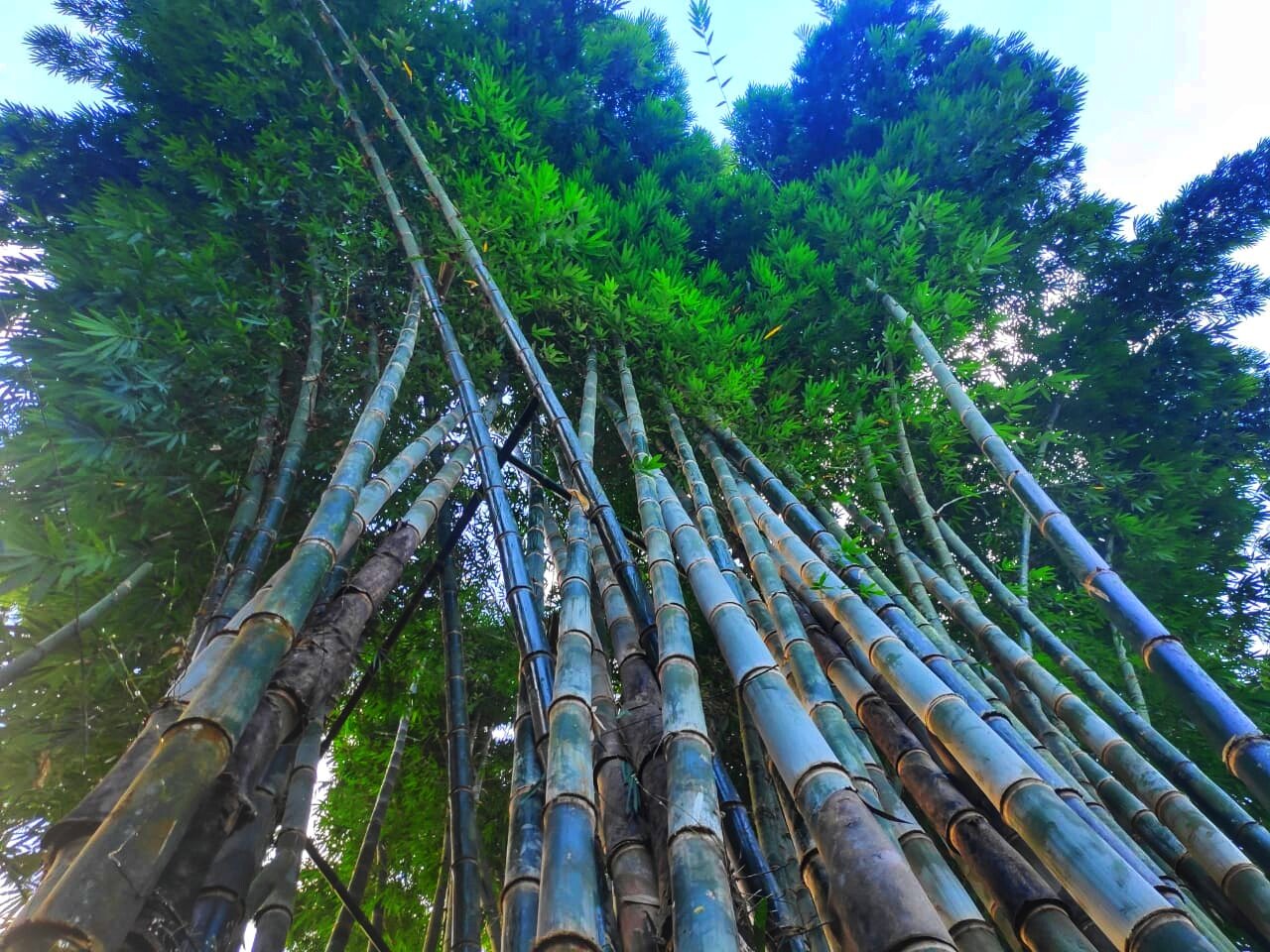
A clump of bamboo on our farm
Bamboo as Food
Humans have a long history of eating bamboo, but we are not the only animals that love eating bamboo. The Giant Panda loves eating the young bamboo shoots as well as the leaves and stems, along with a number of other animals including the bamboo lemurs of Madagascar and mountain gorillas in central Africa. Chimpanzees have also been seen drinking fermented bamboo sap which has turned alcoholic. It will not be a surprise then to hear that Yes! we can eat bamboo too, in fact its delicious and during the beginning of the wet season it is an abundant source of food.
At Rancho Mastatal we have some of the most revered species of bamboo for eating and for building. The species that we have that are known for providing tasty bamboo shoots are Dendrocalymus asper, Gigantochloa sp. and Bitcheeyana sp.

These are just 2 week old bamboo shoots!
Farm to Table Bamboo Shoots
Bamboo shoots contain a cyanogenic glycoside that produces cyanide in the gut. This is not good for you as you might know, cyanide is very poisonous, so we have to be careful to process our bamboo shoots carefully in order to make them edible. As it turns out this is relatively simple! Just boiling the bamboo for around 10 minutes removes that compound and can also remove any bitterness that can be present in the shoot. We found that adding ample salt and some sugar to the water before boiling makes them instantly a delicious crunchy snack! We have also lacto-fermented them (make a very pungent ferment!), pickled them in vinegar, and just boiled them and added them to dishes. But before you get to eat the bamboo shoots you have to know when to harvest them and how to prepare them.
Harvesting bamboo shoots

Peeled bamboo shoot
Generally speaking you want to harvest them as young as possible as they can become bitter if they are too old. As you may know bamboo grows incredibly quickly, so you will need to keep an eye on your clumps as a daily practice. As the rains start here in Costa Rica around April/May (on the pacific side) we found that initiated the growth of the new shoots. There is a delay though between the start of the rains and the shooting of the bamboo and this will vary be species and by the year. So its safe to say that once it starts to rain you need to start checking your clumps regularly. We found that this year the Guadua started shooting first (not a good bamboo to eat) and Dendrocalymus was the last one to start shooting in late June/July. Ideally you will want to harvest the bamboo shoot when it is around ~10-15” (~25-35cm) tall. Cut it at an angle as low as you can. This will then shed water and is less likely to lead to disease entering the plant. Generally speaking from a well-managed clump you should be harvesting about 33% of the new shoots. Take them from the places where they are not as ideally situated ie. Close to another shoot, with a blocked path etc… To learn more about how to manage you bamboo, join us for our bamboo management workshop.
Processing Bamboo Shoots
Take the bamboo shoot back to the kitchen and cut it lengthwise in half. You should be able to get your thumb and then your hands between the outer layers and the inner solid part and pry off the sheathing. This will leave you with a rather alien looking shoot. At this point it’s a good idea to chop it into strips several inches wide and then slice across the strips into thin pieces. The thinner the pieces the more bitterness is removed by cooking. At this stage you have the option to lacto-ferment the bamboo in a 2-3% by weight salt brine. This produces a very pungent ferment that smells very reminiscent of canned bamboo shoots from the grocery store. By lacto fermenting the shoots you also remove the cyanogenic glycoside and you gain the nutritional value of a raw bamboo and the probiotic qualities of the ferment.
By cooking these thin pieces of bamboo in a salty and slightly sweet brine we were able to produce a delicious treat with a great crunch, the flavor is not too dissimilar to Heart of Palm, although there was a large spectrum of views on what it tasted like. Everyone agreed that it was a delicate flavor that had an excellent texture.

Cut lengthwise
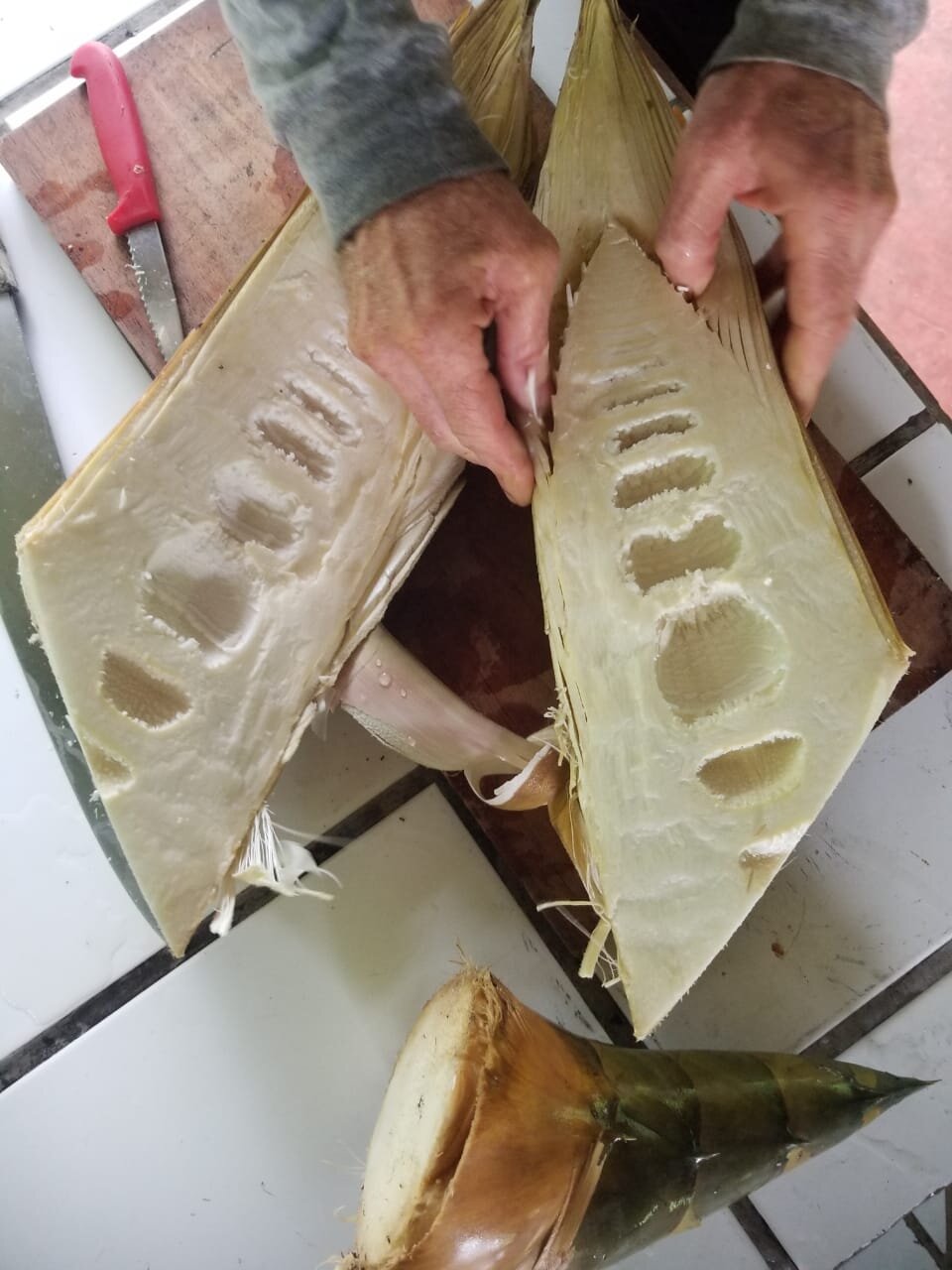
Then using your thumbs peel off outer layers
Bamboo Tea
The upper parts of the shoot that will have been left attached to the sheathing when you pried it out makes a very nice and refreshing tea. By taking a paring knife you can remove any of the soft parts still attached to the sheathing and dry them in the sun (or a dehydrator). This can then be added to hot water and left to steep.

Fresh bamboo shoot
Want to Learn More About Bamboo?
Join us for one or both of our upcoming bamboo related workshops!
Bamboo Management April 6 - 9, 2021
Bamboo Construction April 12 - 17, 2021
Stay tuned and up to date on what’s happening around here by subscribing to our monthly blog and visiting our website.
Check out our past blog article on Bamboo Treatment

Just KIS Me: A Neighboring Project focused on Plants and Indigenous Culture
About eight years ago, Kealy and Ivannia were talking about how they wanted to continue to be strong, badass women. They wanted to support one another and thrive, and step outside the stereotypical woman’s role that is often seen in the Mastatal community. Kealy was once again visiting for a few months from the States and was leaving in a few days so plans needed to happen soon!
Just KIS Me: A Neighboring Project focused on Plants and Indigenous Culture
By Kealy Rudersdorf
About eight years ago, Kealy and Ivannia were talking about how they wanted to continue to be strong, badass women. They wanted to support one another and thrive, and step outside the stereotypical woman’s role that is often seen in the Mastatal community. Kealy was once again visiting for a few months from the States and was leaving in a few days so plans needed to happen soon!
The previous year, they had decided to go to the river at night to catch shrimp together--the snakes and darkness under the new moon never scared them off. This year, they were going to bushwhack to the top of La Cangreja National Park mountain. If you have gone in recent years, this was before the path was maintained and the hike was truly an adventure in the jungle. They needed a guide, as neither had ever been. Ivannia suggested her cousin, Solin, who was incredible with the machete and always full of jokes. It was bound to be a great day!
That day marked the very beginning of KIS Botanicals, as Solin described different uses of a variety of plants and Solin and Ivannia shared stories about how their family used the different plants they found along the trail. It was an immemorable day, filled with laughter, love, and the sharing of stories - the same energy we strive to bring with us into KIS Botanicals today!

What is KIS Botanicals?
KIS Botanicals is a growing herbal business, up the road from the well-known Rancho Mastatal. We are focused on the preservation of plant knowledge and culture in the Mastatal/Zapaton region of Costa Rica. As Solin and Ivannia say, our ancestors have a beautiful interwoven history with plants from the rainforest; our goal is to awaken and share this history.
In our project, we make a series of plant-based, herbal products (to heal the skin, aide in sleep…), using recipes we learned from our grandparents and community members. We also provide educational programs for locals and tourists through medicine making workshops, medicinal plant tours, and food-as-medicine classes.

PRODUCTS
Our artisanal products are inspired by tried-and-true recipes. All of our plants are hand-harvested and our products are handmade – by us! We have access to nearly 100 different medicinal plants that Solin farms sustainably, using traditional agriculture and permaculture techniques.
We currently have 8 artisanal herbal products that we absolutely love! These include a skin healing salve, a muscle and bruise salve, a sleep aide tincture, a tincture for colds and flus, a cough tincture, a bug repellent, an immune booster tincture, and a bug bite relief roll-on. There are many more products in the works, for example an aphrodisiac spray, an anti-fungal spray, stomach calming tincture, energy clearing spray, anti-anxiety tincture, etc. With so many plants to choose from, it’s hard to know where to start! As our apothecary grows, we will continue to add to our line of products.

When we start to make a new product, first, Solin and Ivannia remember plant uses they’ve witnessed throughout their lives. In addition, we frequently talk to community elders or remember conversations from years past. With these memories and conversations, we make a list of plants. We spend time trialing recipes and researching to make sure our products are stellar. The stories and memories are shared on the back of our products, so you too can share in the story!
Currently, we are selling our products at our wonderful friends and neighboring projects: Rancho Mastatal, Villas Mastatal, La Iguana Chocolate and La Choza del Mundo.

EDUCATIONAL PROGRAMS
We are excited to offer a variety of educational programs. Come, partake in our programs - we can’t wait to learn with you! Here are our current and future offerings:
A Cultural and Medicinal Plant Walking Tour: Come walk leisurely with us while we share with you our local history and culture. We will bring artifacts and stories from our grandparents' lives and describe the uses of many of our medicinal plants. We will provide a tasty and traditional treat or drink!

Medicine Making Workshop: Together, we will enjoy a short leisurely walk to explore medicinal plants. We will share with you an ancestral recipe (or two!). Tradition will be combined with modern herbal techniques. You will leave with an herbal product, made by you!
Food is Medicine – A Traditional Cooking Class: Come to a cooking class, using traditional techniques and foods. Over a wood burning stove, we will share a traditional recipe (or two!), laughs and stories.

In the future, we plan to offer an intensive two-week long course on cultural and medicinal plants. We will offer the opportunity to learn from us and other community members, as well as play and experiment with our farm of medicinal tropical plants. Your teachers will be primary-source voices!
Once we are properly on our feet, we plan to provide classes to the local schools. We will teach students about how their/our ancestors used plants to cook, to clean, and to heal. Students will learn new and old techniques with hands-on lessons and tutorials. We hope that they take these lessons back home with them and share their enthusiasm with their parents and grandparents, calling forth memories and providing inspiration. We are SO excited about providing this service to our community.

Who is KIS Botanicals?
The original KIS Botanical team consists of three people: Ivannia, Solin and Kealy. Ivannia and Solin are cousins and lifelong members of the Mastatal / Zapaton community and grew up learning about the medicinal plants in the area. Ivannia is a wiz in the kitchen. She is the one responsible for processing the plants, making the products, and giving thanks to the plants as we compost them. Solin has been working with plants his entire life, being handed a machete as a 2-year-old. The depth of his plant knowledge, understanding of nature, and love of plants is key to KIS’s success. Kealy has been visiting the Mastatal / Zapaton area for over 11 years, and Solin and Kealy are now married with a baby. Her role in KIS is to research plants, formulate recipes, share her knowledge of making shelf stable herbal products, translate our programs into English, promote KIS with marketing, and give the plants extra love.

Why we started KIS Botanicals?
From the words of Ivannia and Solin: We started KIS because we saw our generation and the following generations pull away from plants and the environment. We witnessed the high schoolers obsessed with their new cell phones and motorcycles, littering the street with their chip wrappers and soda bottles. Our community was changing dramatically. Starting in the late 1980s, houses received electricity, running water, and phones, but also within that same generation, the community received access to the internet, cell phones arrived, and all of a sudden there was almost a motorbike or car per person in town. In most of the United States and Europe, these changes happened over several generations.
We have witnessed a huge disconnect from our ancestors and the understanding of how they lived in harmony with the rainforest. This younger generation has mostly left the area for other opportunities after high school, leaving the community void of a generation. With KIS Botanicals, we hope to show that our ancestor’s way of life continues to have value. We aim to re-awaken our ancestral plant knowledge in the younger generations with our products and educational programs within local schools. We also want to be an example of how to be a successful, locally owned business, making our local economy stronger and more diverse.

How to help us??
We have come a long way from 3 friends bushwhacking to the top of the La Congreja mountain to making KIS Botanicals a reality. To be successful in preserving and sharing our ancestral knowledge, we need your help!! This is what would be most helpful to us:
When you visit Costa Rica, come to the town of Mastatal to buy our products and learn with us by signing up for one of our educational programs.
Help us spread the word. Tell your friends and family about us. If they plan to visit Costa Rica, encourage them to take a workshop or tour with us and check out our products.
DONATE! Keep your eyes peeled. Shortly we will be fund raising to build a Ministry of Health approved processing kitchen. We would greatly appreciate your assistance in reaching this goal!!
Send us love and positive energy.
Like us on Facebook and follow us on Instagram @KISBotanicals
We can be contacted at KISBotanicals@gmail.com.
Thanks for your support! We hope to see you soon.
With love,
Ivannia, Solin and Kealy

Life of Spice: Pepper
Farm to table is an inspiring movement whose time has come. As anxiety about our environment and health increases, awareness is spreading about the impact our diet has on not just own well-being, but the well-being and future of the entire planet. Alarms are going off worldwide. Our eyes are opening. People everywhere are waking up. We’re waking up… and eating breakfast.
By Dani, Apprentice 2020
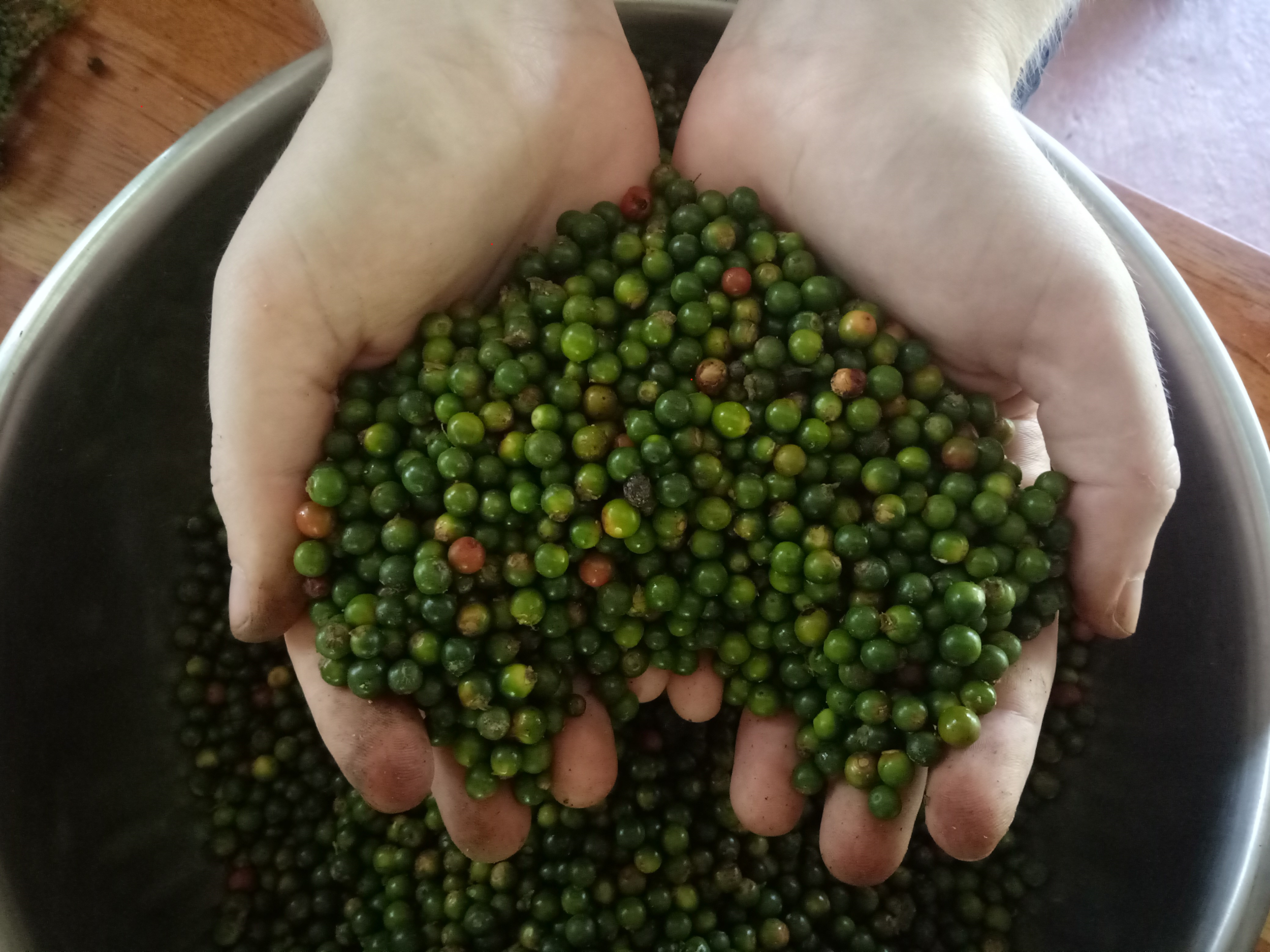
Farm to table is an inspiring movement whose time has come. As anxiety about our environment and health increases, awareness is spreading about the impact our diet has on not just own well-being, but the well-being and future of the entire planet. Alarms are going off worldwide. Our eyes are opening. People everywhere are waking up. We’re waking up… and eating breakfast.
Eating Black Pepper
It’s a typical morning in the conscious kitchens of North America. Today’s special is one of my favorites, a spinach omelet with caramelized onions and a side of roasted potatoes. The eggs are from a permaculture farm’s weekly CSA box, the onions and potatoes from the local farmers’ market, and the spinach is from the garden in the backyard. The omelet slides off the skillet, smothered in rich butter from a small scale dairy farm nearby. The potatoes, piping hot from the oven, make a great companion on the plate. It’s a mouthwatering sight, dotted with black pepper for a little bit of spice.
Mmmmmm, pepper: king of the spices, maker of meals, creator of cuisine. The pepper in our breakfast today came from… somewhere. Somewhere local? Probably not. Spices are the sorcery of every meal, turning bland into brilliant, mediocre to magical. Most of us are blessed with a diet full of spice, but when we talk about eating local, the spice rack often gets overlooked. One way we can work towards restoring the health of our bodies, our minds, our society, and our home planet is to bring more awareness into our diets. Think local. Practice permaculture. Eat farm to table. We hear these terms all the time now, but while people talk about where the eggs on their breakfast table came from, what about the pepper on the eggs?
Black pepper is consumed more than all other spices put together. It sits next to salt on the tables in every diner in America and in most people’s homes. It is hard to imagine a kitchen without pepper, but it hasn’t always been this way. The globalization of food has been happening for so long, a lot of us are completely unaware of which foods are native to where. Chickens originally came from the jungle. Asia used to be without chilies, Italy without tomatoes. What does eating local mean, and how long has it been since people actually ate that way? We’re making big efforts to be conscious consumers, but how often do we stop and appreciate the spice in our lives?
Origins of Black Pepper
Pepper is native to India and is one of the spices that sparked the global spice trade and in turn the globalization of food. Pepper has been traded for thousands of years, and there are even references to pepper found in Egypt from 2600 B.C. For centuries, it spun the wheels of the trade world and brought wealth to many merchants, and it wasn’t only a way of making money. Pepper itself became money and served as hard currency throughout much of the middle ages. In some places, people’s wealth could actually be judged by their pepper assets. Imagine if they could see the casual way in which it is consumed today.
The Value of Black Pepper
Currently, the average price of pepper across the globe is $4.34 per kilogram. These days, Vietnam is the leading country in pepper production, producing about one-third of the world’s pepper. It’s followed by India. Vietnam is also the leading consumer of pepper at 166 thousand tons per year. Again, India follows at 88 thousand tons. That makes sense, right? The places producing pepper are consuming it, local eating. The third biggest consumer of pepper is the USA at 68 thousand tons per year. That is a lot of pepper for a place that doesn’t produce any. On Amazon, a kilogram of McCormick’s Whole Black Pepper costs about $30. The biggest cost in pepper production is labor, but the average price farmers collect for pepper is just $2-$4 per kilogram.
Farm to Table Spices
Understanding where things grow, how they are processed, and who grows them is one way to create a deeper appreciation and understanding of the food we eat and nourish our connection to the earth from which it grows. Trying to live a life embodying permaculture values at Rancho Mastatal has given me a wonderful opportunity to see how different foods are grown and processed. Until recently, I had definitely taken spices for granted. My experience with pepper here has led to reflection on the spice in my life and an appreciation for the sources behind the sorcery. So how does pepper get from the farm to our table?
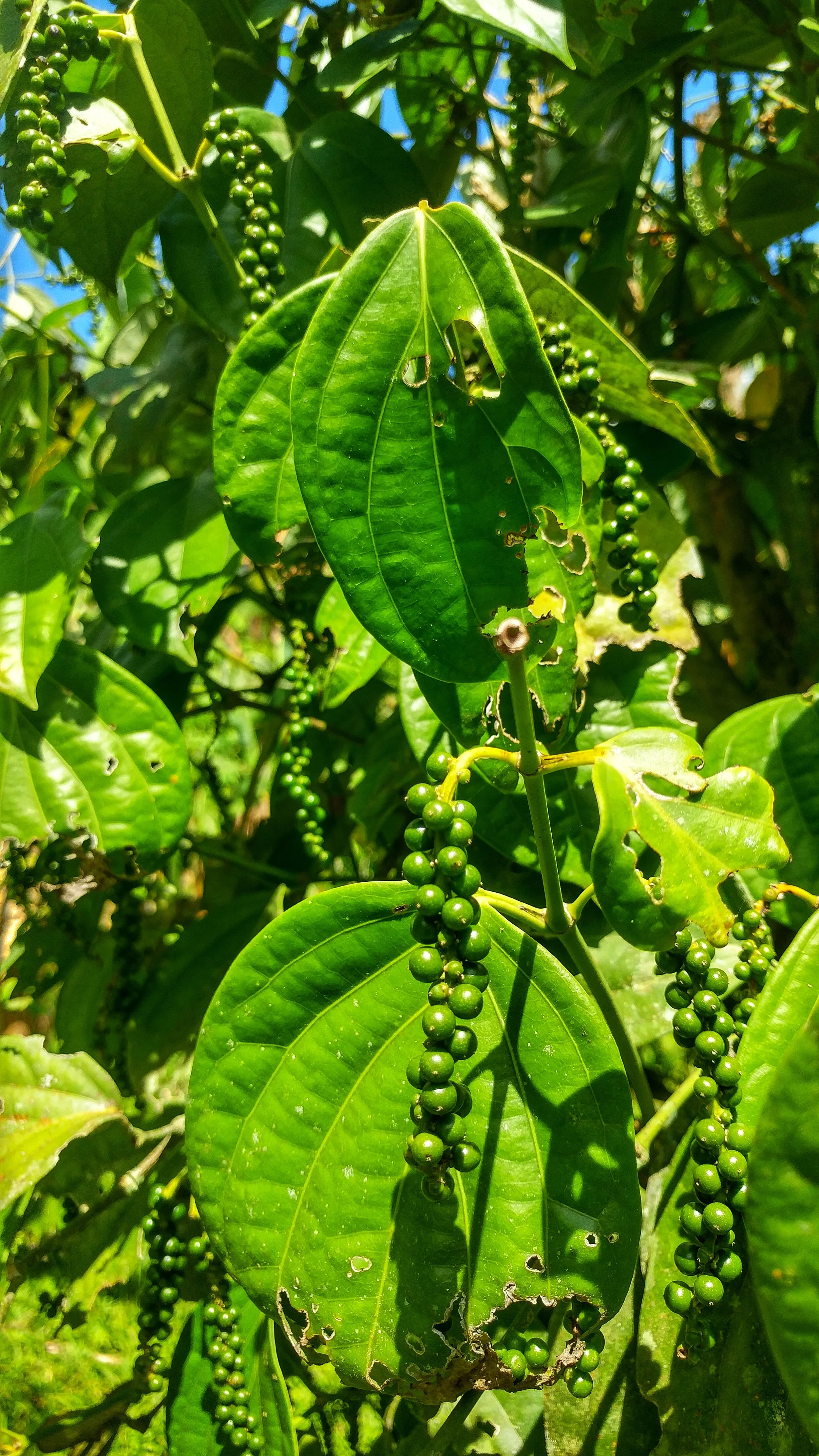
That black pepper on our omelet and potatoes is from a fruit, often referred to as a berry or peppercorn. It grows on a tropical climbing bush, and the white pepper in so many well-loved curries comes from the same plant. The pepper plant is a vine grown best on a living post, from small bushes to massive trees. Here at the ranch, we grow pepper on Gliricidia sepium, (known as madero negro in Costa Rica) a nitrogen fixing tree. Pepper has its origins in forest ecosystems, so it is a fitting plant for a permaculture food forest in the tropics.
How to care for your Black Pepper plant
To maximize yields, pepper plants need to be pruned properly. Once the vine is at least 8 nodes tall, it can be pruned from 3-4 nodes up from the base of the vine, just above a node. After pruning, the plant will send up two new shoots, and the vine cutting can be propagated by placing the stem in soil where it will grow new roots. People have given pepper new roots all over the world. Global trade increased the demand for pepper and sparked efforts to grow it in tropical places across the globe. Now, pepper is grown in 26 different countries, including Costa Rica.

Red Pepper and Green Pepper

White Pepper and Black Pepper
How to Process Peppercorns
The first time I had pepper that was farm to table was here at Rancho Mastatal where we spent a day harvesting and processing pepper. Pepper is ready to harvest once one of the fruits in a bunch has turned red. First, the we collected the peppercorns in bunches and took them off the branches. We then separated the red berries from the green ones. The red berries become white pepper by soaking them in water for a day and peeling off the red flesh to reveal the white seeds. The seeds are then dried to make the white pepper on our spice racks.
The green berries we picked were destined to become black pepper. We blanched these for 1-2 minutes which starts an enzymatic reaction that turns the pepper black. Then we spread them on a drying rack. They can either be sun-dried, or you can use a dehydrator. Pepper dries to one-third of its weight.

Though the steps may seem simple, this was a very labor intensive process. It took seven of us 3 hours to harvest and process 4.5kg of pepper which dried down to 1.5 kg of pepper. This is about 40 dollars’ worth of pepper. It is truly a wonder that pepper is relatively inexpensive and so readily available. I wonder how many working hands and how many miles it has taken to bring pepper to my meals all these years.
Farm to Table Black Pepper
Farm to table has become a mainstream movement, and the growing awareness about the connection between our health and the well-being of our planet in relation to our diets is such a positive shift in our consciousness. But how would all those amazing farm fresh, local foods taste without spices? What would our omelet be without the king of spice itself?
Permaculture & Spices
While I don’t think people should go into their kitchens and empty their spice racks, I do think it’s important to appreciate all the resources and labor that go into every food we eat as well as understand the history of how it got from the forest to our table. Part of the word permaculture is culture, and it is incredible how pepper affected cultures everywhere and added to a permanent globalization of foods. It influenced the way people prepare, experience, and appreciate food. It changed people’s tastes. It changed cultures’ cuisines. Pepper was a powerful initiator in the transition away from eating local. With the globalization of our diets going back millenniums, what does it mean to truly eat local these days? As I continue to live my life of spice, I will keep asking these questions.
Hope you have a better understanding of the process of black pepper and how it gets from the vine to your grinder.
Speaking of spice… check out our past blog posts about vanilla!
And stay tuned for Dani’s next article on Life of Spice, featuring cinnamon!
Sources and Further Reading
Heinerman’s Encyclopedia of Healing Herbs and Spices by John Heinerman
Black Pepper- Piper Nigrum edited by P.N. Ravindran
Spices – A Global History by Fred Czarra
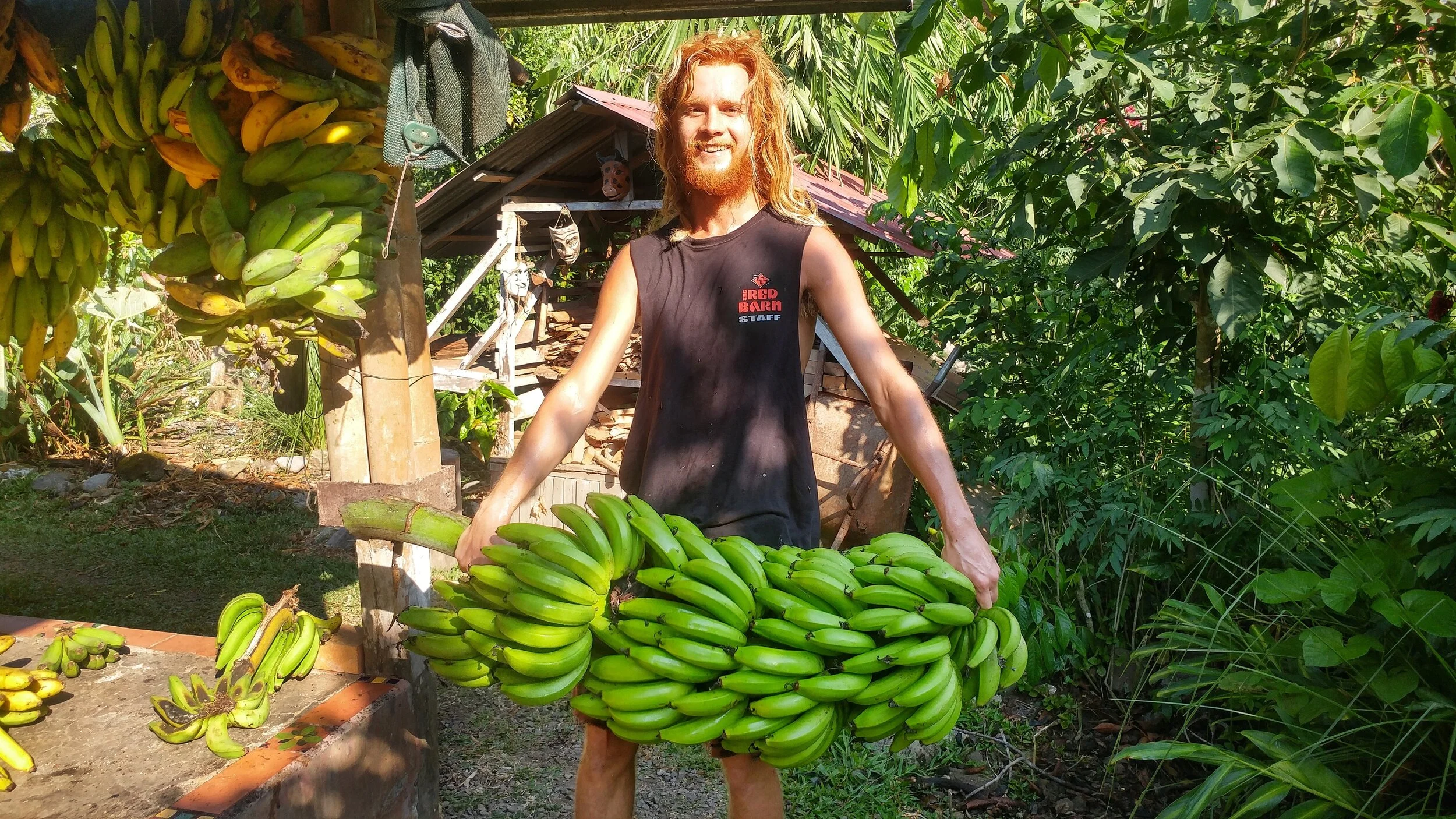
Farm to Table Banana Vinegar
I know, it sounds like a weird flavour combo. Sour banana? Whaaat? But it works and it’s tasty. This recipe is a very accessible way of doing farm to table whilst utilizing and transforming “waste” into something productive and delicious – permaculture 101.
By Marco, Apprentice 2020
Permaculture Vinegar?
I know, it sounds like a weird flavor combo. Sour banana? Whaaat? But it works and it’s tasty. This recipe is a very accessible way of doing farm to table whilst utilizing and transforming “waste” into something productive and delicious – permaculture 101.
What makes a Vinegar
Firstly, let’s take a quick look at what vinegar is. The word vinegar comes from the Latin vinum acer – literally “sour wine”. Alcohol is fermented by a large family of bacteria called Acetic Acid Bacteria (AAB), who turn ethanol into acetic acid. These little guys are everywhere - airborne and on the surface of most living things including me, you and, as it turns out, bananas! AAB are aerobic, which means they need air (oxygen) to do their thing, unlike Lactic Acid Bacteria for example (the main players in lactic acid ferments, such as kimchi and sauerkraut) which are anaerobic.


Check out our last blog on home-brewing your own alcohol.
Farm to Table Vinegar
So, here is a breakdown of how we make our farm to table banana vinegar here:

Go out and harvest them bananas, or maybe you already did that and you have far too many ripening… so next
With our main and only ingredient: bananas we don’t even need to peel them. You can just smoosh ‘em all up, skin n all, and chuck ‘em into a bucket. Beautiful. This process works best when they’re very ripe. We’re talking leaky, mushy and black. The ones nobody wants to eat, which sit around in the fruit bowl way too long, eventually they get picked up by the loser of rock, paper scissors and thrown out with an overly extended arm and a wincing face… Yeah. These are the ones that make great vinegar. Waste? Nay, but a resource in the wrong place. It’s farm to table, not farm to trash.
After you’ve smushed them all up and put them into a large container (we use a 5 gallon bucket, but you could use any large enough container), all you need to do is leave it and wait for the acetic acid bacteria to get to work on turning the alcohol into acetic acid. The time this takes varies depending on your conditions and the state of your bananas, but somewhere between 1-3 months. Remember that AAB like oxygen, so keeping a breathable lid on top of your vinegar, such as a muslin, will help speed up the process. o You could also attach an air pump and air stone (such as one that you’d use in an aquarium) to pump and diffuse air into your vinegar. This should significantly decrease fermentation time.
[TIP: you can hammer a nail into the bucket near the bottom. Leave the nail in until you’ve finished fermenting. Once your vinegar is ready, you can remove the nail and all the liquid in the bottom of the bucket will drain out.]

Upon opening your banana vinegar for the first time, you’re gonna get a bit of a shock as you see what appears to be a sprawling metropolis of mold growing all over your black bananas. Do not despair. Despite everything you were taught about rotting fruit, this is not a bad thing. Generally speaking, bright colored molds (pinks, yellow, greens etc.) are the ones to be wary of. Get another container and a sieve and pour whatever liquid you have into this second container through the sieve.

Next, take those moldy bananas into your hands and squish with all your might. Get in there! Don’t be afraid! Squish harder, dammit! Get all those lovely juices out and dispose of the solids.
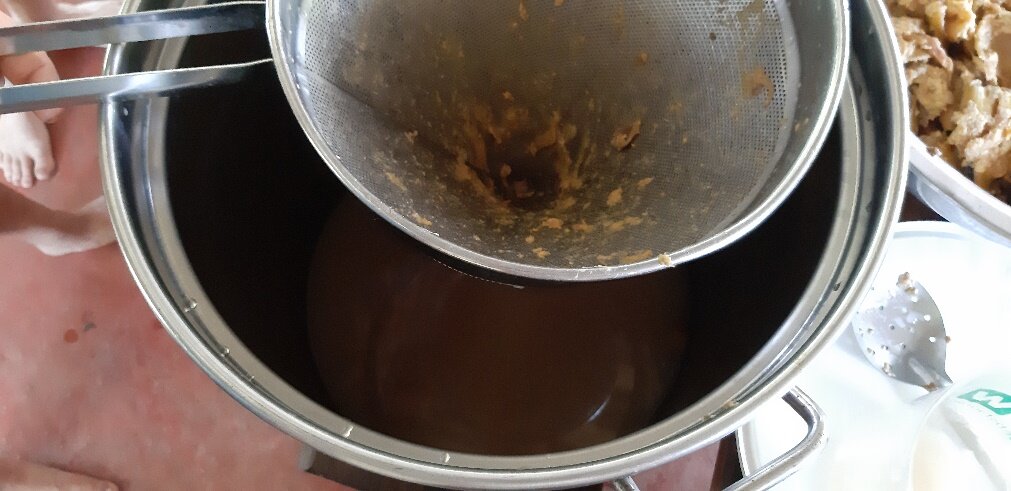
Finished squishing? Good. It’s time for your first taste test. If the vinegar tastes too sweet and not sour enough, it probably needs more time. If this is the case, you can add a little sugar – this is to allow the yeast present to convert more ethanol for our AAB friends to metabolise into more acetic acid. Another option is adding a little vinegar from a previous batch (this is called backslopping in fermentation lingo). If you don’t have a previous batch, you can use a shop-bought vinegar - white vinegar is a good bet as it has a neutral taste that won’t mess with the bananary-ness. Check back every week or so until your vinegar has reached the desired level of acidity. And there you have it! Easy-peasy farm to table banana vinegar using permaculture principles – there is no such thing as waste.
You can now bottle your vinegar and age them. This step is optional and will enhance the flavour profile of the vinegar. We use glass bottles that we recycle from the farm. It is important to use a sealed bottle and fill it as much as possible. If the AAB are exposed to oxygen they could begin to break down your acetic acid into carbon dioxide and water.
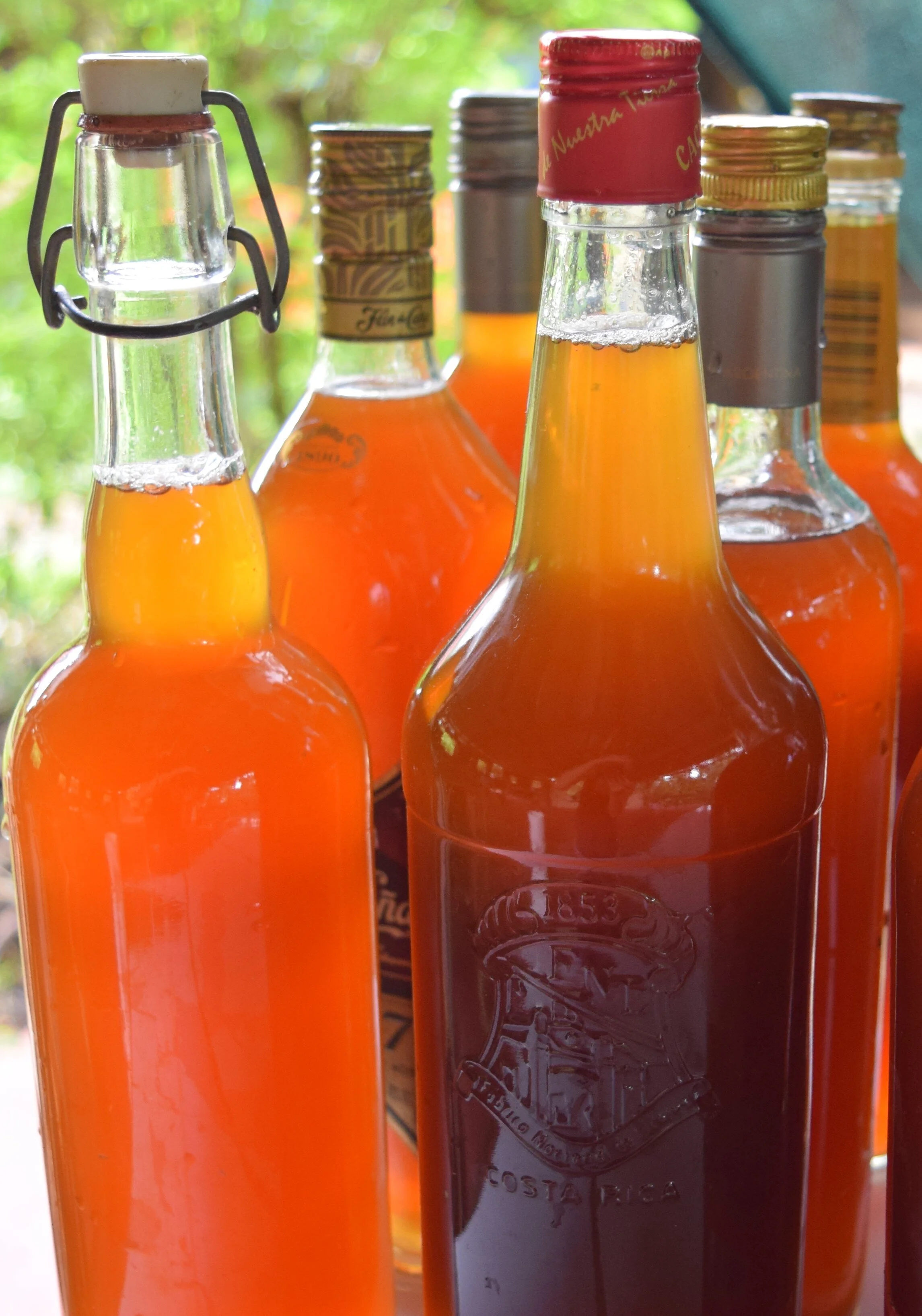
It’s that simple folks! This is a great way to use up all those old bananas.
Enjoy your farm fresh, homemade vinegar! This can be done with a variety of fruits that you have in excess off the farm!
Stay tuned for more farm fresh recipes.

The Wonders of Vanilla
Vanilla is the second most expensive spice in the world. Being sold between $600-1200 per kilo, that is more expensive than silver!
What makes it so precious?
by Diana D, 2019 Apprentice
Vanilla is the second most expensive spice in the world. Being sold for between $600-1200 per kilo, that is more expensive than silver!
What makes it so precious?
Vanilla comes from the largest family of flowering plants, the orchids, as well it is the only orchid that produces pods. Every stage of vanilla bean production needs to be completed by hand, making it one of the world's most labor intensive crops.
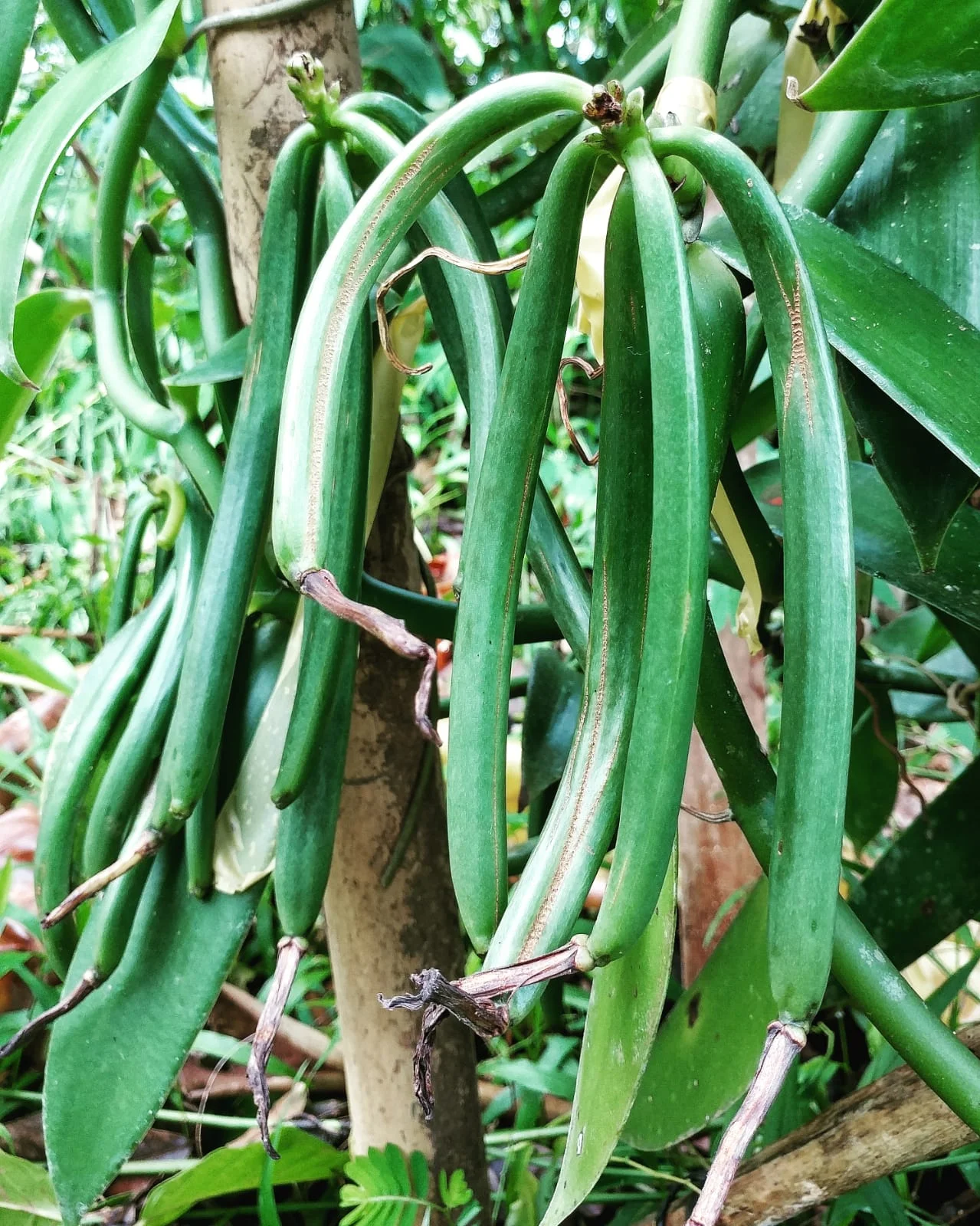
This orchid originated in Mexico, it's cultivation is being practiced from Mexico to India . Being producers and exporters to the world market these countries each produce up to 200 tons of vanilla annually. Madagascar is by far the largest producer of vanilla, accounting for over 80% of global production. Although the value of vanilla is very high this has had some unfortunate repercussions for vanilla farmers as crime and theft of their valuable product has increased. This has led to instability in the lives of the farmers. Natural disasters have also affected them deeply, wiping out entire crop yields for the year. With such a delicate and refined production system It could take up to 7 years to regenerate the vanilla and return to the same levels of production. As with any single crop production system, it is a high risk strategy to rely on one crop for all of your income. There is a growing awareness of these issue for vanilla farmers and some new more sustainable and resilient techniques are being adapted.

To learn more interesting facts about vanilla, its history, creating a sustainable way to grow vanilla and support the farmers read this great article. This article was written by the first company to have an integrated, sustainable, vanilla supply that began transforming the Malagasy vanilla business in 2006.
My interest in vanilla arose when I started to take care of it and pollinate it as part of my morning experiential learning tasks at Rancho Mastatal. The production of vanilla is a fascinating delicate and attentive process that if done successfully is extremely rewarding. I am able to experience the growth of the vanilla plant, the pollination of it's flowers , and after many stages of fermentation, curing and extraction we are able to enjoy the amazing product of this magnificent plant.
During my year long apprenticeship here in Costa Rica, I am able to immerse myself into the plant kingdom as well as learn the essential skills for self sufficient homesteading. I also get to apply and practice other skills such as carpentry and natural building which will allow me to lead a more sustainable lifestyle .
Vanilla is only one of the many fascinating things I have learned about here. I warmly invite you to come visit us in Rancho Mastatal in the rainforest of Costa Rica. There is so much to learn about how we can improve our lives within our communities and in harmony with nature. How we can all provide our own food and support our community with their projects.
What I have learnt from the vanilla plant is that I would love to grow it on my own land, it's prices are rising so why don't we grow it for ourselves? Let's take little steps to self sufficiency by growing our own food as much as possible and by supporting the companies that treat the farmers well.

Leon (2017 Apprentice) drying vanilla
I hope we keep growing vanilla and benefit from the heavenly smelling pods in our delicious deserts.
On that note I'm off to prepare a vanilla cocoa wine!
P.S This article contains the basic hooch recipe, check it out if you want to learn how to make delicious homemade hooch :)
Blessings,
Diana D

Tropical Brewing
The craft brewing movement has migrated to Central America and the Caribbean. A growing number of small scale artisanal producers are building on the American Craft Brewing tradition by incorporating local spices and fruits into traditionally brewed ales. To distinguish themselves, from their temperate counterparts, they are adding a tropical flare and creating innovative flavor combinations
by Connor Harron
The craft brewing movement has migrated to Central America and the Caribbean. A growing number of small scale artisanal producers are building on the American Craft Brewing tradition by incorporating local spices and fruits into traditionally brewed ales. To distinguish themselves, from their temperate counterparts, they are adding a tropical flare and creating innovative flavor combinations. For example Domingo7’s Maracuyá Pale Ale (that’s Spanish for Passionfruit) in Costa Rica, Ocean Lab’s B.O.B. - Blood Orange Blonde in Puerto Rico and Lu Bru’s Maiz Azul (Blue Corn) Ale in Mexico all demonstrate how local producers are beginning to incorporate regional ingredients into local craft beer movements. This is surely a positive development and one that leads us to consider other ways we might be able to further highlight local and seasonal ingredients into craft beers.

These efforts will help to make brewing both more sustainable and position craft brewing as a vehicle for more thoroughly exploring terroir, which describes the potential for fermentation to be used as a method of expressing the unique environmental conditions of the places in which our ferments are produced. By using exclusively local ingredients as well as wild captured yeasts, we have the power to capture the unique flavors of seasons and regional differences that allow for near infinite variation and creativity to explore new combinations of flavors that are rooted in cultural tradition while simultaneously pushing the frontier of artesian brewing. As much as I love finding good craft beer in places like Mexico and Costa Rica, I constantly find myself asking if it really makes sense to be brewing beer with imported German Barley and Hops from the Pacific Northwest United States when there are such a plethora of sugar sources and bittering herbs available locally in nearly every corner of the globe. Could we instead develop beers using a hybridized process and create products that are truly local while still maintaining the key characteristics that make beer, beer?
Speaking of, have you ever asked yourself what it is that really makes a beer? It turns out, the answer really depends on who you ask and where you live. In the most general terms, beers are fermented from carbohydrate rich starches (typically grains such as barley) that first need to be enzymatically converted into simple sugars and extracted into a liquid malt before the substrate can be fermented to produce appreciable levels of alcohol. Wines and Ciders on the other hand, are fermented from fruits and simple sugars that can be fermented into alcohol with limited or no processing. In the case of beers, bittering herbs such as hops are commonly added to provide antimicrobial properties, improve shelf stability and add complex flavors to ferments. In the United States, it turns out that hops are not required in the production of beer and that there are many malt substitutes that are allowed in the production of beer, including “rice, grain of any kind, bran, glucose, sugar, and molasses (TTB Ruling, 2008).” This definition is actually quite liberating, and creates the opportunity to experiment with non-traditional malts and bittering herbs in ways that will promote creativity and improve the sustainability of the craft brewing market globally. This flexibility in malt production will be especially important given that recent climate models suggest that the regional distribution of barley production will become increasing restricted over the next 20 years (Nature, 2018).

In Costa Rica, we have been experimenting and finding repeated success using a wide range of local ingredients including banana, corn, rice, cacao beans, coffee and local cane sugar for producing malts. Corn and bananas, for example, both have long cultural traditions of being used in the creation of local beers. In Eastern Africa, Bananas have long been used to create malt for the production of banana beer (Urwaga or Mubisi as it is locally known). Bananas make for an interesting malt base because they fall into a relatively unique category of fruits that when ripe are rich in both simple sugars and complex carbohydrates that can be easily fermented into a strongly alcoholic brew while maintaining a mouthfeel that is remarkably similar to beer brewed from barley. When the ripe bananas are boiled for several hours, the sugars begin to caramelize, transforming the flavor of the malt into a sweet, neutral flavored base that remarkably, tastes very little of banana, making it an ideal substrate for mixing with bitter herbs or other local products such as coffee and chocolate that can be fermented into either an Ale or Stout like brew.

Conversely, in many parts of South America, but perhaps most notably in Peru, Maize has been used for centuries to produce a corn beer called Chicha. Unlike barley, which when sprouted produces a large concentration of Amylase Enzymes (the key types of enzymes needed to convert complex carbohydrates into fermentable sugars), to make a corn beer, these enzymes need to come from another source. The indigenous peoples of South America developed an ingenious solution to this challenge when they discovered that chewing the cooked corn would transform the starchy, carbohydrate rich grain into a sweet masa that could then be re-boiled in water and strained to create a fermentable Wort made purely from Maize. Although many foreigners cringe when they first learn about the process, for the Inca’s, it was a powerful community building practice that would bring people together to sit around the fire, alternating between sharing stories and laughter while chewing the cooked corn and then depositing all of the masa into a large pot. Although they almost assuredly could not have fully comprehended the transformations that were taking place, their solution was so ingenious because human saliva is packed full of the enzymes needed to break down the carbohydrates in corn into fermentable sugars. I experimented with the traditional process a couple years ago, and I have to admit it was a powerful community building process that for me, took the idea of collective fermentation to a whole other level. Talk about terroir!
The problem with the traditional process is that it is incredibly labor intensive. If you are lucky, like me, you might be able to convince your friends to help you chew a few pounds of corn once or twice for the novelty of the experience, but you are likely to be hard pressed to find a consistent source of labor to chew through the many pounds of corn you will need to produce even a few gallons of Peruvian style Chicha. Fortunately, today we have access to many sources of amylase besides our saliva. As it turns out, ripe bananas (and in particular, ripe banana peels), contain a very high concentration of the same amylase enzymes needed to convert the starches in Maize into fermentable sugars. If you think about it, this actually makes a lot of sense. Unripened green bananas and plantains are a very starchy staple food crop that is used culinarily in a similar fashion to potatoes. As the skin yellows and the banana ripens however, the banana naturally transforms those carbohydrates into simple sugars that make dessert bananas so pleasant to eat directly out of hand.
Due to the high concentration of amylase enzymes present in ripe banana peels, they can be dehydrated and pulverized into an enzyme rich powder that can be mixed with ground maize and water and then mashed similarly to a barley based beer between 140-160 F for 2-24 hours (depending on the ratio of corn to powdered banana peels used) before being strained and boiled to make a fermentable wort. You’ll need to taste the Mash or use iodine strips to determine when the conversion has been completed. There are actually lots of fruits and vegetables that are rich in amylase enzymes. Sweet potato, for example, has such a high concentration of these enzymes that its peel is often used in the commercial production of Amylase.
Alternatively, instead of using the enzymes present in another product, it is also possible to ferment grains with certain types of molds that consume starches and in turn naturally produce the enzymes needed to convert the grains of carbohydrates into fermentable sugars. In Japan for example, Aspergillus Oryzae (or Koji as it is better known), is a humble yet miraculous mold that has been grown on rice for millennia in order to sweeten the rice and make Sake. It is also the key ingredient for making naturally brewed Soy Sauce or fermenting Miso due to the rich diversity of enzymes Koji produces that not only sweeten carbohydrate rich foods, but also break down proteins into amino acids that are the basis for savory foods and the flavor of umami. Due to these impressive properties, koji has now made it’s way out of Japan is slowly become increasingly familiar around the globe. This is assuredly a wonderful thing, because it has now been well established that Koji can be grown on a variety of substrates and virtually any grain, including rice, barley and corn, making it an ideal candidate for assisting in the brewing process anywhere on Earth.

To further explore local flavors and novel combinations, while boiling our worts we have been experimenting with using a variety of local bittering herbs and teas to add complex flavors to our beers, including ginger, turmeric, lemongrass, vanilla and many others. During either primary or secondary fermentations, we use nylon mesh bags weighed down with boiled volcanic rocks to infuse fresh fruit from the farm such as Pineapple, Soursop, Starfruit, or freshly roasted Cacao Nibs, just to name a few examples. Finally, by fermenting our beers with mixed cultures, wild captured yeasts and/or locally adapted strains, we have been able to produce ales with several layers of harmonious flavors, which provide depth and complexity that is only possible to achieve with mixed culture fermentation.
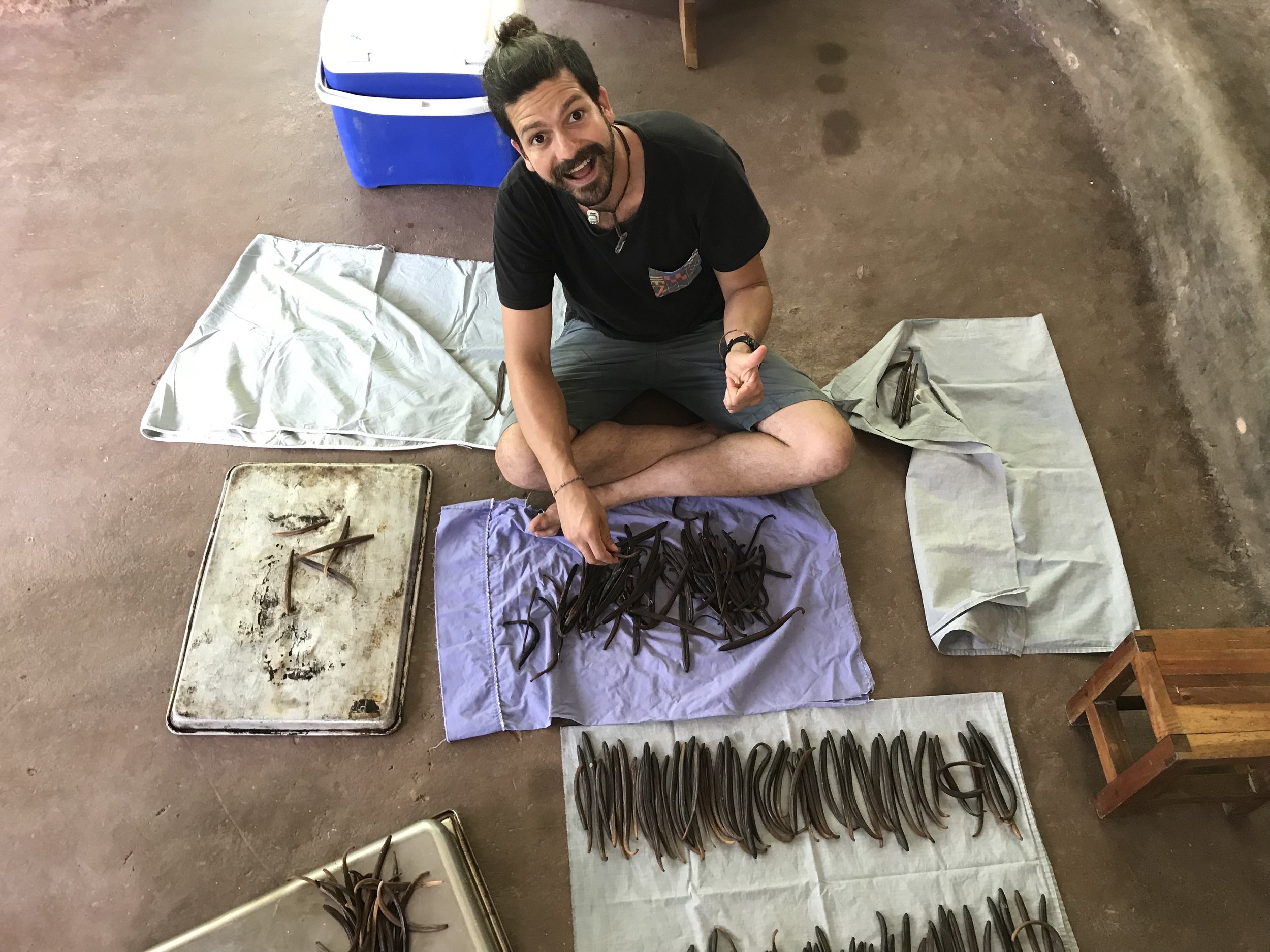
I would not have believed what a powerful role yeast and bacteria play in the creation of complex beers and wines when I first started brewing over a decade ago. Now however, I have learned first hand just what a difference the cultures we use can make. The experience of trialing yeast captured off of different fruits and flowers has led me to encounter flavors I never would have dreamed possible. Some have certainly been on the far side of the funky extreme, including cultures that produce the dreaded odor of sweaty feet or burnt rubber. This however, is exactly the reason for small scale trials rather than placing our faith in large scale spontaneous fermentation. Once you discover the joy of fermenting a simple malt of dissolved sugar or Dry Malt Extract with wild yeast and tasting apples, pears, or other citrus fruits magically appear in the finished product, I believe that like me, you will never want to use a commercialized yeast strain on it’s own again.
I believe that by drawing from the richness of our cultural traditions around the world, we have the potential to greatly expand the breadth of our palates and to more intimately link our brews to the time and place in which they were crafted. The craft brewing revolution is still in its infancy and if I am to have a part of to play in it’s development, then Ginger Hibiscus Sake Hybrids, Banana Coffee Stouts, and Mayan Chocolate Ales will be just the tip of the iceberg.

If you would like our simple Hooch recipe, read our blog article with step by step instructions. If you want to learn more about the wild world of fermentation consider joining us for our year long apprenticeship where apprentices go deep into advanced fermentation techniques.
Vegetables & Greens that Thrive in the Tropical Rainy Season
When the rainy season arrived, it started with a sense of relief - dry season went on longer than expected and our trees and plants were scorching in the heat. For myself the cooler air was welcome comfort, and the rains a reminder of home and getting cozy. Mornings were beautiful with the sight of the sun rising through the dewy mist.
By Amy Dodds,
2019 Apprentice
When the rainy season arrived, it started with a sense of relief - dry season went on longer than expected and our trees and plants were scorching in the heat. For myself the cooler air was welcome comfort, and the rains a reminder of home and getting cozy. Mornings were beautiful with the sight of the sun rising through the dewy mist.
But very soon our zone one vegetable gardens with our recently planted greens began to suffer - the sheer force of the rains and the humidity brought fungal and mildew issues. Faced with the reality that our beans and delicate greens were going to die out, I thought about the potential of using cover crops, such as sweet potato, for the rest of the year. But this did not seem to fit in my idea of what permaculture asks us to do: observe and interact with the environment we are situated in and use that to our advantage. With this in mind, we at Rancho Mastatal have been planting crops that thrive both in the intense heat and thumping rain. Below are some of the most popular vegetables that we are growing in the Ranch that are suitable for the rainy season:
Cucumber:
Cucumbers have been abundant in our garden this season with us pumping out quick pickles nearly every day. Not bad for a community feeding 30-40 people daily! Thankfully, cucumbers like warm, humid weather. We grew ours by seed on a trellis to allow for more air flow and for the fruit to stay above ground.

Okra:
Described as among the most heat-tolerant vegetable species in the world. It is planted for its seed pods which can be cooked, pickled, eaten raw, or included in salads. It does become mucilaginous so do consider this if you're sensitive to the slime.
Kang Kong spinach:
This leaf green is native to southeast Asian and is delicious stir-fried with soy sauce and garlic. It is a semi aquatic plant, a creeper that grows in or near the water on moist soils, so it is ideal for our climate.

Hibiscuses:
Both Green and Cranberry Hibiscus are delicious perennials that thrive in the warm and wet. They self seed easily during dry season so when the rains come you have a whole bunch of babies to keep your salad zesty and fresh. The leaves do contain oxalic acid so cannot be consumed in large, consistent quantities.
Chaya:
Also known as tree spinach this is an excellent perennial green native to Mexico. It's leaves are edible once cooked, like spinach. It's easy to propagate by cutting and loves the heavy rain.
Malabar spinach:
Malabar spinach is another heat and moisture-loving spinach-like green. The succulent leaves can be eaten both raw and cooked. We have only a few plants so we are trying to improve the population. We use a trellis to support its tendency to vine.
Winged bean:
Also known as Goa bean and princess beans, these are sweet protein packed vegetables that do well in heat and humidity. They can fix their own nitrogen when the bacterium Rhizobium is in the soil. They are best harvested young and tender, and great raw in a salad.
Other more delicate greens we are growing in our nursery as they don't require as much water, such as Arugula, mustard greens and Asian cabbages.
By having our covered nursery space we are able to grow things under cover that otherwise would not do so well outside, we are also experimenting with making some movable covered spaces for out outdoor garden beds….. we will update you with progress so make sure to Like and Follow us on Facebook & Instagram
How to Make Dairy Kefir Banana Creme Fraiche
Welcome back, it's Ryan again!
In our last conversation I shared a little about dairy kefir; the history, chemistry and process for making it. This time we'll talk about an exceptional use of dairy kefir - making banana kefir creme fraiche!
by Ryan Roberts, 2019 Apprentice
Welcome back, it's Ryan again!
In our last conversation I shared a little about dairy kefir; the history, chemistry and process for making it. This time we'll talk about an exceptional use of dairy kefir - making banana kefir creme fraiche!

Velvety smooth and udderly delicious, this topping is ideal applied atop crepes, pancakes, granola. Next time you're making a pancake breakfast-in-bed for your bae, you can blow their minds with this yummy topping.
Here's the kicker: the bi-product of this process will yield a delightfully flavorful and intensely proteus “banana-infused” whey. I recommend drinking it straight or adding it to your morning shake to spike it with great flavor and a boatload of protein.
If at this point your finding yourself lost on the fundamentals of dairy kefir, check out my first installment of Dairy Diaries here, before proceeding to the next section.
So diving back into the science for a moment; Dairy kefir is a specialized symbiotic colony of organisms, favoring lactose sugars, and adapted to consume them, but this doesn't preclude it from utilizing what sugars are available. Bananas are intensely sweet, potassium rich and full of minerals, making it a fine fuel for your SCOBY friends. The process will break down and alter the banana, unlocking new flavors and heightening nutritional qualities.
This process will take you through the steps of making dairy kefir first, then walk you through separating your two products and processing them to completion.
Ingredients
- Whole organic milk
- Spoonful of dairy kefir SCOBY (or “grains”)
- Glass container for your next batch
- Two medium-sized bowls: one for your creme fraiche, the other for your whey
- Spoon
- Funnel (optional)
- Fine mesh strainer
- Hand blender or food processor (optional)
Process
1. Sterilize your container, using boiling water for your first clean.
2. Chop bananas to your desired quantity and thickness. I chose to use three small bananas. Note that increasing the surface area of your banana by chopping it will make it easier for the SCOBY to access the sugars in the banana. In this step, I quartered the bananas then chopped them horizonally into thin pizza slices. Put the bananas into your container.


3. Put a spoon-full of dairy kefir SCOBY into your container.

4. Pour your organic whole milk into your container, taking care to minimize splashing.

5. Place a lid lightly over the container, creating only a light seal to allow CO2 to escape. Let sit for 12 - 24 hours depending on temperature. Warmer temperatures will yield a faster process. The goal here is to stimulate the mixture to self-separate into the whey on the bottom and the cream on top. It looks funky, but don't sweat it. The cream along with the bananas will become our creme fraiche and the whey, whatever you want to do with it.

6. Pour the whole mixture into a fine mesh strainer. Let the whey drip through the mesh, which will happen mostly on it's own because the cream is now chemically separated from the whey. Light stirring is ok, but seek to minimize the amount of cream that falls through the strainer!
7. Now hunt for your SCOBYs amongst the cream! The goal of this step is different from that of making plain dairy kefir. We want to recover our SCOBY, but we don't want our banana kefir cream to fall through into the whey, so we place our bowl under the strainer now. You may use a gentle scooping motion along the bottom of the strainer to find your grains. Whatever cream falls through should be added back once you've recovered your SCOBY babies. This step can be challenging and awkward.

8. Place your SCOBYs back into their home container, refill it with milk and lightly stir the milk with a clean spoon.
9. Now we have whey in one bowl, cream and bananas in the other and our SCOBYs happily in their new batch of milk.
10. The final step is optional and that is blending the mix. You can certainly enjoy the cream and banana bits mixture at this point, or you can thoroughly blend the bananas and the cream until you produce a uniform appearance. This final step is what yields your creme fraiche.

11. Keep refrigerated till consumption.
That concludes this little adventure into this novel dairy kefir product. Next installment, we'll be exploring a savory herbal cream cheese, YUM!
Have you always wanted to learn about SCOBYs, fermentation or brewing? Check out our upcoming workshops for anything that might be of interest!
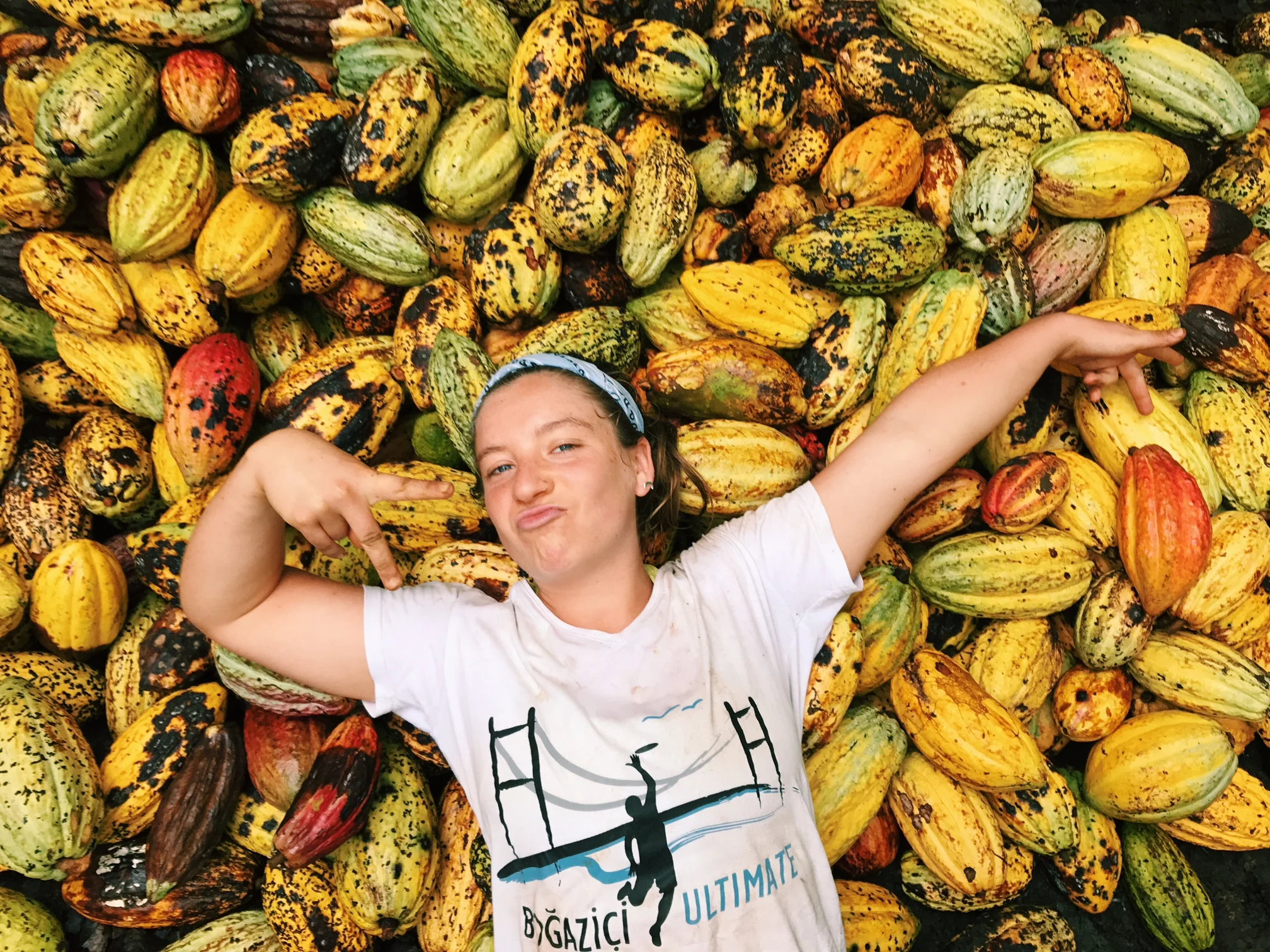
From Tree to Bar: How to Process Raw Cacao
Living in the tropics I found myself surrounded by cocoa trees, which was something you’d dream about as a kid. “Chocolate trees” But like so many things we’re used to consuming we don’t have the knowledge of how to process a raw material into something we can use, within the society we live convenience has removed us from the source. A simple act of making something gives us a connection to our environment.
by PJ Barton, Apprentice 2019
Living in the tropics I found myself surrounded by cacao trees, which was something you’d dream about as a kid. “Chocolate trees” But like so many things we’re used to consuming we don’t have the knowledge of how to process a raw material into something we can use, within the society we live convenience has removed us from the source. A simple act of making something gives us a connection to our environment. Walking through a supermarket we are surrounded by products readily available with a seemingly endless supply leading to a mass consumerism in our present society. This unsustainable consumption stems from our lack of involvement in the food we consume. So let us connect through raw cacao.
Throughout history so many cultures have cultivated cacao. From Mesoamerrica through to Europe. Its a world wide sweet enjoyed by millions, like most things the origin was much different to the present. Dating back 1400 BC chocolate was fermented into alcohol. It was a common commodity throughout Mesoamerica and the seeds were thought of as a gift from Quelzaledol, the goddess of wisdom. It was actually used as a currency.

Processing raw cacao pods into beans is easy, tasty and fun!!
Processing
After harvesting the seeds which should be a yellow or bronzed color you crack open the pods to reveal a white flesh seed with a brown centre. The fruit itself is commonly eaten in Indonesia and reminds me of a mangosteen.
Scrap the seeds out leaving them to ferment. Place in a bowl and leave with a lid to keep off flies. We used banana leaves. To help the fermentation, yeast can be added we put kombucha to inoculate the ferment. During this process maintain temperatures of around 40 degrees and gradually increasing to 50 degrees. It’s not dependent on this I’ve made cacao before by just leaving it alone but by monitoring the temperature you’re going to create an optimal environment from the enzymatic reaction breaking the acidity of the bean.

After the beans have fermented for 4 – 5 days spread the beans out in the sun to dry the beans. This can also be done using a low heat in the oven but let’s harvest the energy of the sun which will enrich the bean. This can take a few days. The outer shell will be easy to break and the raw cacao is ready to use as desired.
Alternatively you can then roast the nut in a wok or in the oven paying close attention not to burn the seeds. It will start to crackle and a fill the air with an intoxicating aroma of chocolate. Leave to cool and break off outer shell. These roasted chocolate beans can be used how ever you desire.

Chocolate doesn’t grow on trees but if we understand the process it suddenly feels like it. Using ingredients from there raw form makes us more conscience intertwining us with the food we are consuming leading to a sustainable outlook towards life.
In Mastatal we are fortunate to not only grow our own cacao but also live next to a family run buisness, The Iguana Chocolate. Why not come and stay with us as a guest and do a tour at the local chocolate farm!

Dairy Diaries: How I Make Dairy Kefir
My name is Ryan and I'm part of the apprentice team at Rancho Mastatal for 2019. I've been navigating my lactose-intolerance since I was a child and gluten-intolerance since I identified it approximately five years ago. In this and the following installments of Dairy Diaries. I'll be exploring dairy kefir, in my personal effort to find ways to make dairy products I enjoy healthier, more digestible and more delicious.
By Ryan Roberts, 2019 Ranch Apprentice
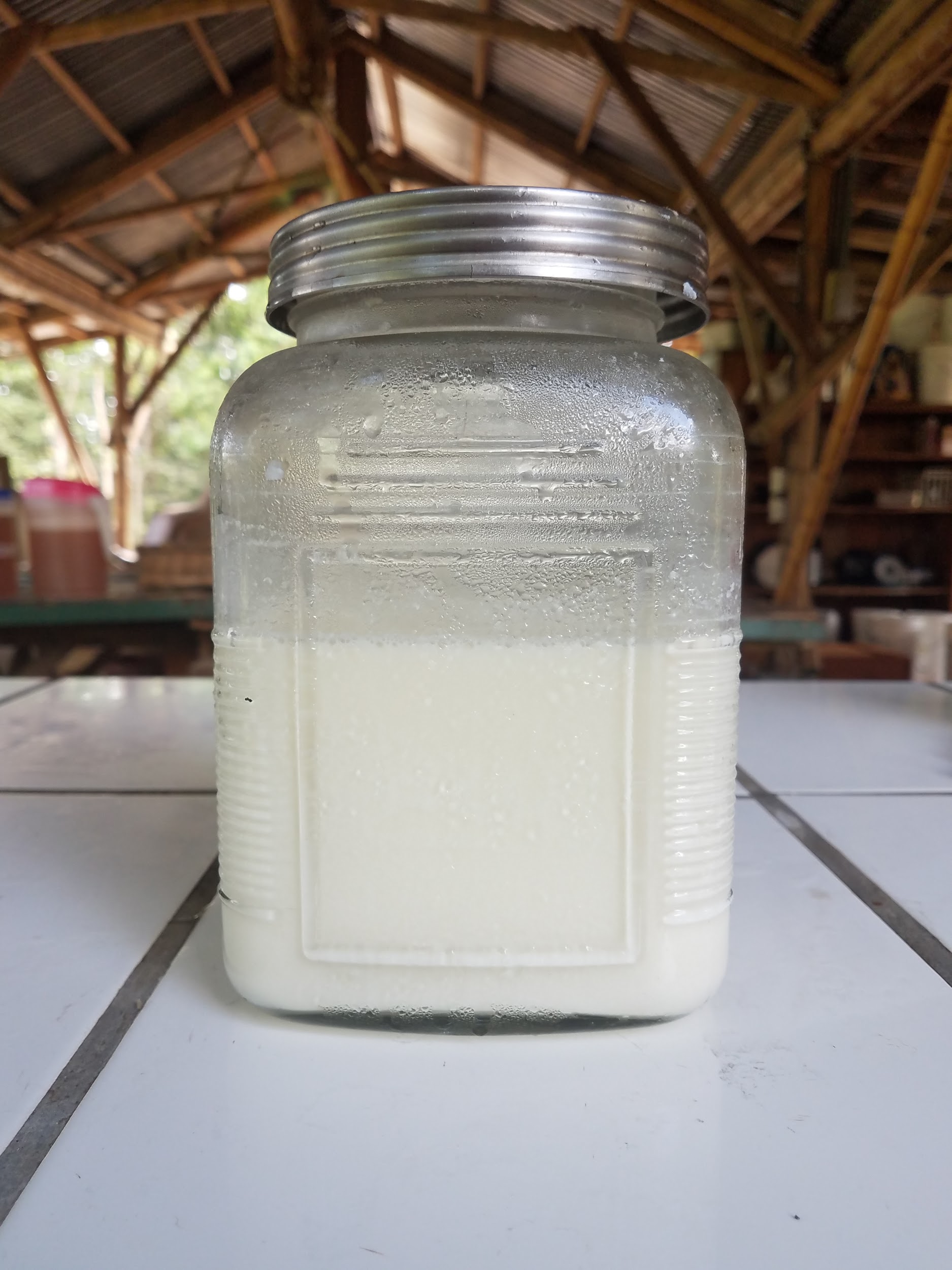
My name is Ryan and I'm part of the apprentice team at Rancho Mastatal for 2019. I've been navigating my lactose-intolerance since I was a child and gluten-intolerance since I identified it approximately five years ago. In this and the following installments of Dairy Diaries. I'll be exploring dairy kefir, in my personal effort to find ways to make dairy products I enjoy healthier, more digestible and more delicious.
I have a mixed understanding of my dairy sensitivity, in part because throughout my life I have chosen to accept the consequences of consuming dairy products that I enjoy such as cheese and ice cream. Over the last few years, in an effort to better understand the nuances of my sensitivity, I've taken to experimenting through exposure and carefully observing my reactions.
Since arriving at the Ranch, I've taken a fascination with dairy kefir, a cultured milk product which we make regularly as a base for salad dressing. My interest was piqued upon discovering that the salad dressing failed to upset my sensitive stomach.
Dairy kefir is tangy, effervescent and probiotic, closely comparable to yoghurt, with origins in the Caucasus Mountains of Eastern Europe. It is made using a dairy kefir SCOBY, which stands for a "symbiotic colony of bacteria and yeast", which are often called "grains" in the case of dairy kefir. Dairy kefir grains look like clumped grains of rice that are yellowish white. They tend to clump together in spongy, somewhat tough little colonies.
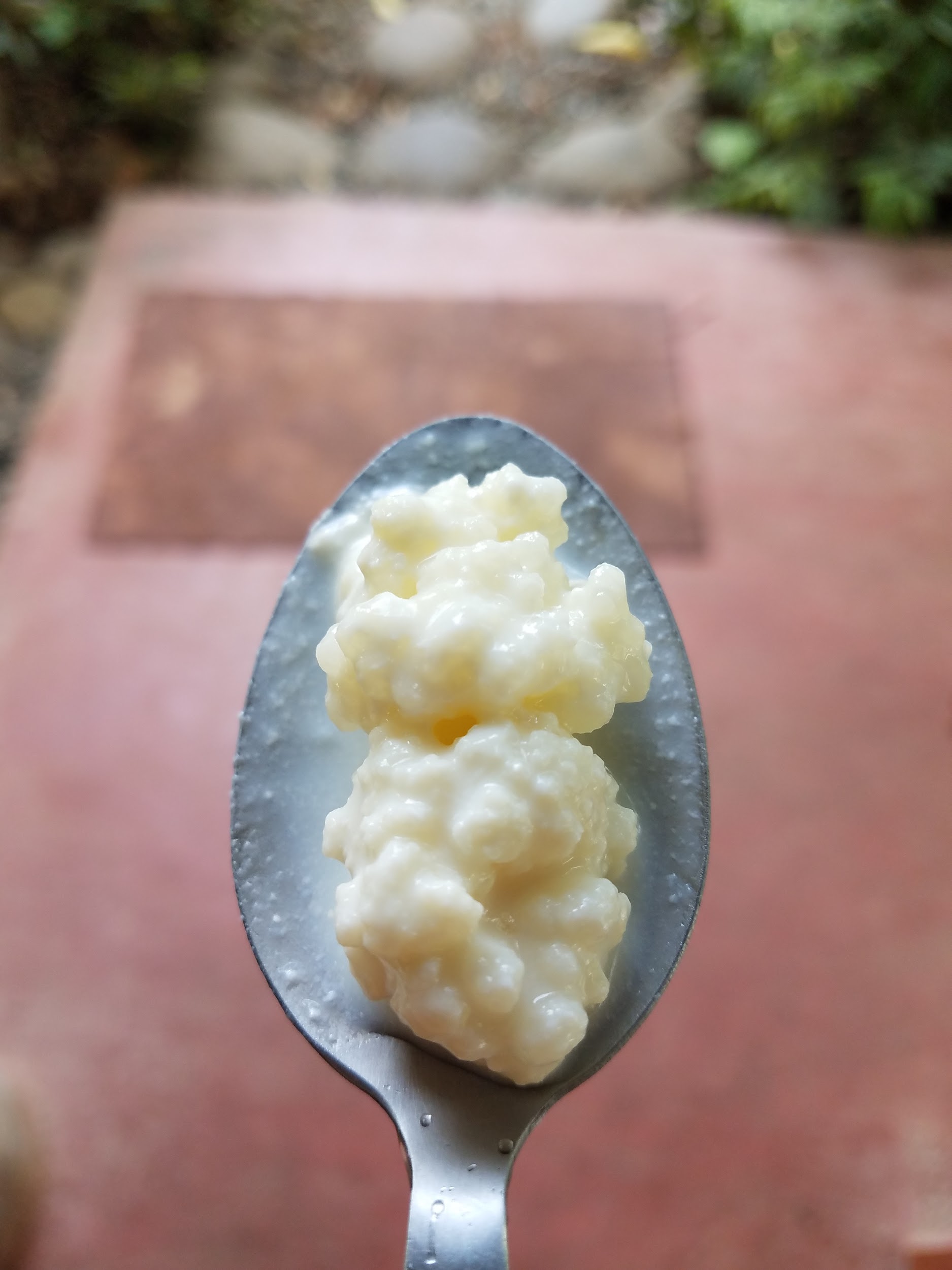
The SCOBY consumes the sweet lactose in the milk, converting in into lactic acid and multiplying the microorganisms beneficial to the health of our stomach, intestines and the whole ecosystem of our body. This makes it possible for folks with a sensitivity to lactose to consume delicious milk products fermented with this SCOBY.
It's delicious, it's great for you, and I'm excited to share that it is stupid easy to make and maintain.
It really is as simple as adding the dairy kefir SCOBY to your milk and letting the little SCOBYs get to work. When you are ready to consume your freshly fermented kefir, strain out the grains using a fine mesh strainer and a spoon, wash your container lightly and reintroduce the SCOBY and a new batch of milk.
The Process
1. Clean your container, using boiling water for your first clean. Let the glass cool.
2. Put a spoon-full of dairy kefir SCOBY into your container.
3. Pour your milk into your container, taking care to minimize splashing.
4. Place a lid over the container, creating only a light seal to allow CO2 to escape.
5. Let sit for desired level of tanginess.
6. Pour fermented milk and grains out through a fine mesh strainer.
7. Gentle rinse your container, ensuring you clean areas where the milk is splashed above the milk line.
8. Use a gentle scooping motion along the bottom of the strainer to find your grains.
9. Place them back into your container, refill with milk and lightly stir the milk with a clean spoon.
10. Enjoy your dairy kefir!

Here are some considerations when raising and caring for your dairy kefir babies:
Temperature:
Warmer temperatures accelerate the work of the dairy kefir SCOBY significantly. Here at the Ranch, we let our kefir sit for 12 hours to 20 hours through the heat of the day and the temperate evening. Generally after 12 hours, we put the fermented dairy kefir in the refrigerator overnight, but leaving it over night has led to a tangier, more desirable final product and an easier process.
Time:
The longer you let your dairy kefir SCOBY work, the tangier, thicker, more probiotic, and in my opinion, more delicious the kefir will become. Sit time varies based on your preference from 12 to 48 hours, depending on temperature. Refrigeration will allow you to store the kefir for up to a week. Note that while this significantly slows the metabolism of the SCOBY, the enzymatic activity remains active, breaking down the milk into more bioavailable and nutritious bits for our stomach.
Sanitation:
Like many ferments, the SCOBY creates an environment for itself that limits the growth of competing organisms through increased acidity and the production of ethanol (though in dairy kefir the alcohol is negligible). This means that the risk of contamination is limited to that which remains outside the milk. The best way to mitigate any rogue elements is to wipe away any splashed or remaining milk that won't be under the liquid. Other than that, thorough cleaning of the container for the dairy kefir is unnecessary - a simple water rinse will suffice.
The SCOBY:
The little yellow white SCOBY is actually quite durable and resilient, so don't worry about being terribly ginger with them. The only thing we want to avoid doing is pressing the grains through the fine mesh, which will cut and damage them. Prevent this by using a light scooping motion along the bottom of the strainer.
The SCOBY is also resilient to being left in the milk. If you want to take a break from the dairy kefir, you can do so by refrigerating the SCOBY in milk for weeks at a time. Every two weeks replace the milk with a little bit of new milk. It doesn't needed much.
The SCOBY will also grow in size and multiply. When you begin to find more grains, you can remove them and place them in a separate container to make even more kefir, or better yet, gift them to a friend! Dairy kefir, like many ferments, is the gift that keeps on giving.
So go forth and spread the love: for your taste buds, your gut, and your friends.
Check out Ryan’s other blog on dairy kefir crème fraiche
If you are interested in fermentation why not join us for our upcoming tropical homebrewing workshop?
Sources:
Rancho Mastatal Food Skills , Dairy Kefir, Laura Killingbeck
Brazilian Journal of Microbiology
https://www.ncbi.nlm.nih.gov/pmc/articles/PMC3833126/#!po=0.595238

How Can We Make a Change in the World
Everything seems to have been created by a higher intelligence that has designed this universe in mysterious ways for us to live off. We live in a perfect symbiosis with nature. Everything seems to have a purpose which co-exists with all that is around us yet we don’t have an explanation to all this perfection.
by Diana Dagash, Apprentice 2019
Everything seems to have been created by a higher intelligence that has designed this universe in mysterious ways for us to live off. We live in a perfect symbiosis with nature. Everything seems to have a purpose which co-exists with all that is around us yet we don’t have an explanation to all this perfection.
What if we had the access to tap in to the secrets of nature, would it be possible to live a healthier and more sustainable way?
How does our connection and understanding of nature relate back to ourselves?
What if the way we treat our own bodies reflects on the way we treat Mother Earth?
If we look at the patterns in nature we can see that Earth is a macrocosm reflection of our own organisms. Earth is our body, the trees our lungs, plants our hair. The waters, seas are our fluids, that are in sync with the moon and the planets. The stages of the moon reflect on our emotional, energetical and physical states. The new moon represents a new cycle for growth, setting intentions, regeneration and with the full moon we reach peak of our energy as the tides of the sea rise, the winds get stronger, nature is at its highest strength. It is a good time to harvest what we’ve sown.
When the body is ill and weak it struggles to regulate its own temperature the, extremes of hot and cold temperatures resemble the behavior of our planet. Observing today’s climate change and natural disasters reflect on how we’ve been treating this planet. We already see the consequences of our actions. We have abused and exploited the forests and waters.
Mother Earth is patient and compassionate, she embraces us , provides us with all our needs , we are her children. She needs our cooperation , our understanding of the messages she sends to us, for us all to survive and thrive. We have forgotten our origin, where our food comes from, what allows us to coexist.
We are trying to live against the cycle of life by suppressing our illness symptoms just as we are manipulating the weather to cover the climate change that we have caused. Society has surrounded itself with comfort, trying to protect itself from nature and to change its power dynamics .We came out of sync and communication with Mother Earth. We are already paying the price of destruction, exploitation of natural resources and struggle to live in abundance.
The amount of food wasted that could feed the whole world if we stopped and reevaluated our needs and priorities in life. The individualism and race to accumulate more that we could every possible need! The greediness has blinded many of us from love and care to ourselves , to one another and to the planet we live on. The industrialism has left very little space for small farmers to survive. The food grown is mass produced and poisoned in interest to earn money as well as pharmaceutical companies wants us to always come back.
Our heads have been turned to the other side. Our education has not introduced us to our connection with nature and the healing powers within us and around us. We have not been taught to peacefully communicate with one another, nor how to explore our inner world that provides us with intuition and peaceful mind.
It has been said already “ The whole world is within you.” If we focused ourselves within, maybe we could find the answers to our problems and create a peaceful world we there is no war?
“You cannot solve a problem with the same way of thinking that create it “
I believe that if we integrate education on sustainable living into schools, children growing up with have more much awareness on the importance of sustainable living and the change we can make to a healthier life.
I strongly believe that if we want a change education would be at the base of it all.
How I believe we can make a change:
1. Proper education on sustainable living for example : permaculture, agroforestry, natural building, carpentry, homesteading , making your own biodegradable body and cleaning products, culinary skills.

Workshops to inspire and empower you to change
2. Taking responsibility for our actions, the consequences of consumerism and how to stop mass waste production. For example – grow your own food.

Planting seedlings for food production
3. Self-development, healing the micro and macrocosm. Bringing awareness within, practices that pro mote introspection and self-reflection like meditation , learn to peacefully interact with others. Some great book references for this are the following :
The Power of Now by Eckhart Tolle
Non-Violent Communication Dr. Rosenberg
The 4 agreements Don Miguel Ruiz
4. Learn life skills that are beneficial to your environment.

Bamboo building at Rancho Mastatal, a sustainable building material
5. Choosing the possibility to live at your highest path , to stand for righteous actions and lifestyle.
6. Gain knowledge of medicinal plants in your area, get familiar with natural medicine, self-healing and maintain a preventative holistic lifestyle.
7. Make space for self-exploration , discover your interests and passions that you heart calls, surely they will benefit the world.
For me it is a priority to dedicate my life to create a greener healthier world, to learn how to be self-sufficient , build my own house , grow my own food, live harmlessly in nature, educate and promote that lifestyle and provide a good future for future generations .
Currently I live in Costa Rica doing a year long apprenticeship on sustainable educational farm that focuses on those matters and has created a heavenly community of loving , caring people that come together to learn and make a change.
I like to visualize a world that lives in abundance and has everyone’s basic needs met. A planet with clean air and water, where we would have food forests all around and houses surrounded with edible greens and herbs. It inspires me to think of what’s possible and focus my energy onto creating it.
Together we can change the world, so let’s take action, create ripples that will spread across the world. The power is within us to create the world we want to live in.
I wish you to pursue your purpose in life and discover your highest path for living.
I warmly invite you to visit farm that teach about sustainability such as Rancho Mastatal, learn about self-sufficiency, minimizing industrialism and harm to the ecology
Seeing all the movements rising to save our Earth I have faith and am excited to see the good changes happening in our society.
There is a rise in consciousness around the globe, let’s all be part of it!
Blessings to all
Diana

The Basic Pantry Analysis: Design, Food, Sourcing
Cuisine is diet that's unique to a physical place and a human cultural group. We can taste the patterns of modern cuisine in the melding of characteristic ingredients into characteristic forms. Wheat noodles with tomato sauce points us in the direction of Italy. Fermented spiced cabbage leads us to Korean kimchi.
By Laura Killingbeck, Porvenir Design's Food System Designer
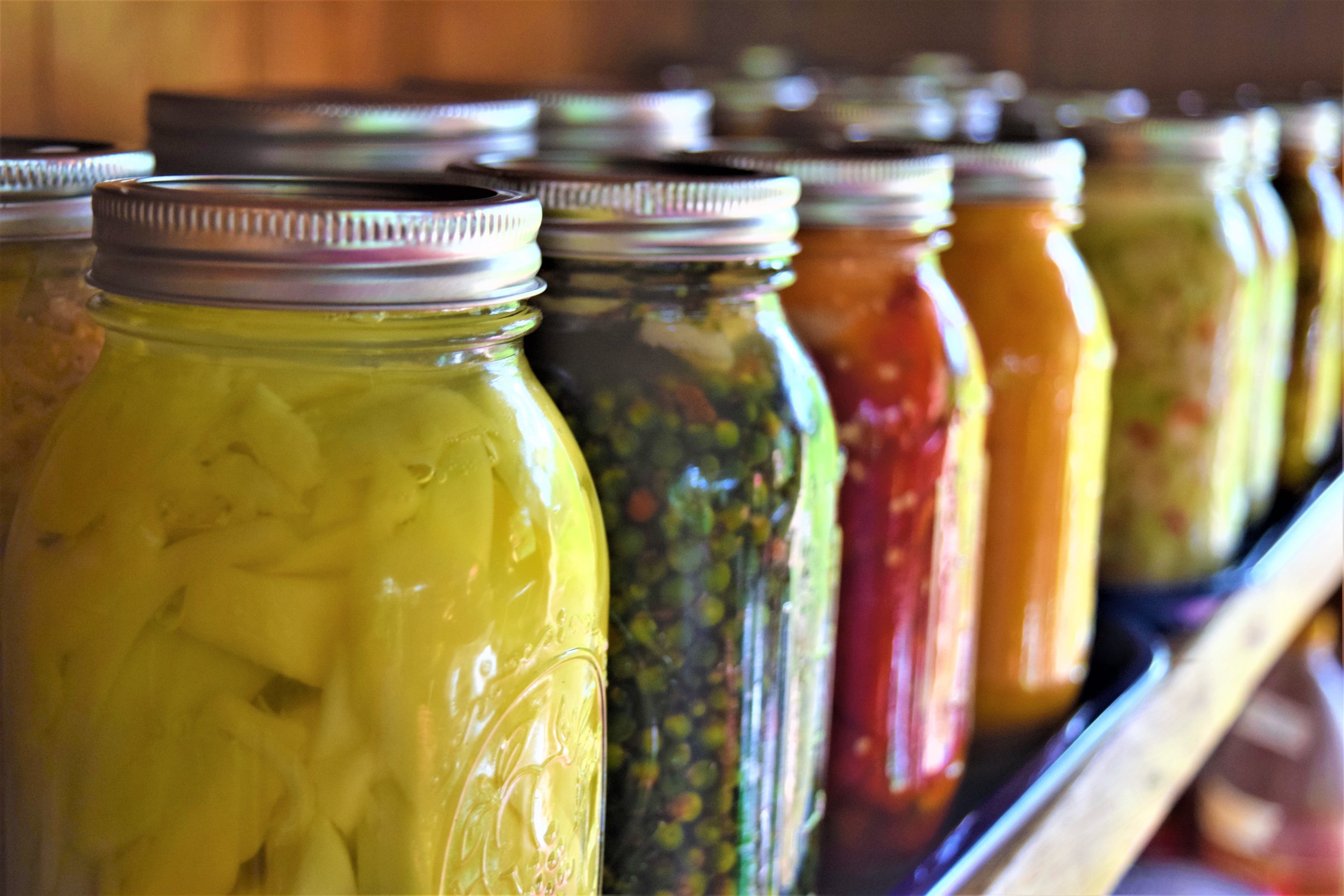
The Human Diet as An Ecological System
Cuisine is diet that's unique to a physical place and a human cultural group. We can taste the patterns of modern cuisine in the melding of characteristic ingredients into characteristic forms. Wheat noodles with tomato sauce points us in the direction of Italy. Fermented spiced cabbage leads us to Korean kimchi. Even amid tremendous variation, and even as these cultural foods are exported, appropriated, and evolve in different ways in different places, we are still able in many cases to recognize a cultural and geographical narrative embedded within relational patterns of flavors and forms.
Across the span of human agricultural history, cuisine sprung from ecological relationships—people ate what grew well in their area, and they grew what nourished them. Humans shaped the morphology of plant, animal, and microbial species by selective breeding; in turn, these foods changed the physiology of the human body. Cultural groups vary widely in their tolerance and desire for certain foods—these are genetic adaptations to their peoples' long history of evolution with specific cuisine. The co-transformation of people and food species was exquisitely mediated by the opportunities and limitations of the ecological niche of the place where they lived. Growth was balanced and calibrated within an ecological feedback loop of regenerating resources.
But in recent human history, globalization expanded our access to place and people, while simultaneously breaking this ecological feedback loop. We travel, and food travels; neither is linked, necessarily, in place. People are still connected with the world, but now we are connected differently. This shift is transforming the evolution of cuisine in unprecedented ways.

If you imagine the path of human ecology as a train traveling down a railroad track, globalization is the conductor turning the train onto a new track. Human relationships with food are now evolving in a different direction than they did before. The foundation for cuisine is no longer an ecological relationship between people and place; it is an economic relationship between people and business. Businesses grow or produce food and ship it around the world, where chains of distributors buy it and warehouse it in grocery stores. Surely this is not the only way that food works, and local food cultures still thrive in many areas. But it is a style of human-food interaction that is growing and replacing such local cultures. As we become increasingly separate from our direct relationship with the ecological patterns that once mediated food and diet, we become more deeply fused with a new, abstract, relationship with global commerce. The foods we like to eat often have less to do with healthy ecology, and more to do with macroeconomics and marketing.
We know there are a lot of problems with this. The Western Diet (aka, global cuisine) is correlated to chronic disease and poor health. Mass agriculture depletes soil and species diversity. Industrial pesticides and fertilizers damage ecosystems. There is a lot more to say but I don't have to say it—on some level we know, all the time, that this is bad. And even as we know, we still eat global-industrial foods, because we're hungry, its what we know, and its what's there.

Post-Harvest Permaculture Design
Permaculture design is essentially applied ecology for human development. It studies and teaches how life relates to place, with the object of sustaining that life and that place. A lot of the literature within Permaculture Design centers on the infrastructure development of building, landscape, and agricultural systems. It most often highlights the agricultural side, with ideas and methods of learning how to integrate human agricultural systems with the larger ecology of life on earth.
But interestingly, the focus on agricultural systems within Permaculture Design methodologies often only lightly brushes post-harvest food handling and cuisine development. The general thinking is that once people understand food production as a functional part of ecological systems, they will be able to grow more food. This has been very successful for many people, with one caveat—growing plants, animals, or microbial species that are edible does not mean you are growing food that is ready to eat. A a plot of wheat and a chicken pecking bugs can be wonderful parts of an agricultural ecosystem, but if you want a chicken sandwich there is still a lot of work to do.
Over the last nine years I've worked with two farms and education centers who dedicated themselves to the process of farm-to-table food production—one in temperate Massachusetts, and the other in tropical Costa Rica. This allowed me to study and practice food preservation and processing across climates, and see the similarities and differences that unfolded.

At Rancho Mastatal in Costa Rica, even very common foods, like malanga, tiquisque, cuadrados, pejibaye, and chaya were all new to us. And what do you do with a sudden hundred pounds of ripe bananas? At Round the Bend Farm in Massachusetts, we needed to preserve large quantities of food seasonally to last the winter, in a way that was totally different than in the tropics. We also transitioned from a home-scale cooking facility to one which could serve hundreds, and had to scale our systems up to meet new demands. At both organizations, it took us a lot of time, and a lot of trial and error, to acquire the skills, tools, and labor to do these things. And to do these things efficiently, it took structured seasonal planning. The teaspoon of ginger you need now in your recipe had to be grown a year ago, then harvested, dried, powdered, and stored. We had to learn how to organize ourselves in relation to local food, in ways that were intrinsically different from how we used to organize ourselves in relation to globalized foods.
The human element of how we interacted with food based on our personal and cultural backgrounds was another huge piece of the puzzle for local eating, especially in Costa Rica. We craved western-style bread products; people didn't always like Costa Rican cuisine; some people were afraid of new foods like fermented bananas. Eating locally meant coming to terms with the cultural references for desirability of foods we had brought with us, in relation to the ecological and cultural backdrop of a new country and climate. We had to adapt ourselves to new styles of cuisine, and adapt that cuisine to ourselves as newcomers.
Most of my work in Costa Rica and Massachusetts was to create, systematize, and implement post-harvest food processing and preservation strategies based on farm foods. I also worked with numerous farm owners, communities, and homesteaders who were and are in the process of divesting from their dependence on global-market food supplies. It is through these relationships and experiences that I began to notice consistent patterns in the challenges people faced in transforming their farms into food. I started comparing patterns of limitations and successes that people were reporting, with those of the organizations I was working with. I used permaculture design to organize these patterns into a systematic format that I could use to consult with people about how to achieve more efficient and accelerated farm-to-table food system success.

I call this consultation service the Basic Pantry Analysis. The title and process drew inspiration from many collaborators in the fields of permaculture design and farm-to-table cuisine; in particular the work of Costa Rican ethnobotonist Rafael Ocampo, as well as that of the Sat Yoga Institute. A similar process focused on family nutrition has also been promoted by the Instituto de Nutrición de Centroamérica y Panamá (INCAP). My version of this process is based on my experience working with farms and communities, and is an adaptation of a wonderful wealth of collaboration among many individuals and organizations.
The Basic Pantry Analysis
The Basic Pantry Analysis matches the ecological needs of your land, with your cultural and personal frames of reference, your dietary needs and desires, and your resource capacity, to form a “basic pantry” of ingredients, whole and value added, that you will use to develop your own dynamic cuisine—that is, the meals you eat every day to sustain yourself in the place you live. This process is useful for anyone who wants to accelerate their ability to grow, process, and eat local foods.
Your Basic Pantry will be designed through a combination of personal decisions and desires, which inform a multitude of what are often very simple tasks. Those big ideas and those little tasks are what build the complex whole. The consultation service is divided into four primary parts: Vision, Layout, Basic Pantry, and Adaptation. The scope of service varies depending on the client's needs and desires.

Sample Outline of Basic Pantry Service
Please note this varies based on client needs.
Vision
This is the overall concept of your cuisine. Exploration of goals and values, and how those relate to your capacity. Make decisions about priorities for ecological, cultural, dietary, financial, factors.
What the client receives:
• A one paragraph vision statement for your cuisine.
• A one page analysis of the factors and values that contribute to that vision.
• A sample set of meals you could expect to eat over the course of the year.
Layout
This is the architectural layout of your plan—it shows clearly how different food elements and tasks fit into your cuisine over time.
What the client receives:
• Daily, weekly, monthly, and/or annual list of post-harvest food tasks for your mature food system.
• Analysis of tools and infrastructure.
• Analysis of skills and labor needed.
• Basic five year analysis of how your food system transitions through time.
Basic Pantry
You need lots of ingredients to make meals—this is the list of those ingredients, whole and value-added. I work closely with the agricultural team to make recommendations about food species.
What the client receives:
• Sourcing and Growing list
• Processed and Preserved foods list
Adaptation
Your Basic Pantry Analysis is a starting point, not an end. It will grow and shift and evolve as you and your land do. This section is a structured feedback loop to help you grow and shift your cuisine based on your priorities.
What the client receives:
• Design concept follow up questions
• Blank harvest, processing, and/or other charts for feedback
• Supporting appendix—contains client-specific documents on further skills and strategies, and/or other supplementary documentation as needed.
For more information on costs and deliverables of this service please write our team at info@porvenirdesign.com.
For information on food related workshops at Rancho Mastatal please see go to our Workshops page.

Categories
Topics
- Agriculture 6
- Agroforestry 21
- Animals 2
- Apprenticeship 19
- Appropriate Technology 6
- Backpacking 1
- Bananas 1
- Basic Pantry 4
- Biochar 1
- Books 3
- Build Your Own Home 1
- Central America 5
- Chiles 1
- Cinnamon 1
- Clay Carving 1
- Climate 2
- Climate Change 1
- Cob oven 1
- Communication 5
- Community 24
- Compost 2
- Composting Toilets 2
- Condiments 1
- Conservation 2
- Cooking 4
- Costa Rica 18
- Design 10
- Earthen Construction 10
- Eat Local 2
- Ecohome 1
- Education 9
- Environment 3
- Ethics 4
- Farm to Table 12
- Fasting 1
- Fermentation 14
- Food 22
- Food Choices 8
- Food Forest 8
- Food Processing 15
- Food Systems 12
- Gap Year 1
- Gardening 5
- Ginger Beer 1
- Harvest 2
- Health 12
- Healthy living 5
- Homemade 2
- Homestead 8
- Internet 2
The Ranch’s new cookbook is here!
This cookbook might not be quite like the others you have sitting on your shelf. We’ve made it look like a cookbook— and it might smell like a cookbook if it’s spent enough time in your kitchen— but it’s also a memoir, a history of a place, of 20 years of experimentation and learning and growing on the piece of paradise known as Rancho Mastatal.