

BLOG
Stories, articles, and updates from the Ranch community.
Contemplating an Uncertain Future: The Ranch and Climate Change
Climate change, after decades of lulling at the bottom of the news cycle, has belatedly made it into the headlines as increasing numbers of people become aware, convinced and concerned about the environmental and social impacts of the Earth’s evolving atmospheric conditions. I frequently think about disrupted weather patterns and what my role in this unfolding story should be.
by Tim O'Hara
Climate change, after decades of lulling at the bottom of the news cycle, has belatedly made it into the headlines as increasing numbers of people become aware, convinced and concerned about the environmental and social impacts of the Earth’s evolving atmospheric conditions. I frequently think about disrupted weather patterns and what my role in this unfolding story should be.

Many climate experts argue that we have surpassed the carrying capacity of our planet and that our natural resource base cannot support our modern lifestyles at our current population numbers. I find this argument believable given the observable degradation of our natural systems everywhere I go. Modern technology might for a time delay the worst impacts of our behavior, but soon we will stare more squarely in the face the consequences of the environmental alterations that we’ve set in motion. Indications of a more brittle world are clear to me.
Humans are descending to systematically destruct our limited natural resource base and in turn one another. I am discouraged thinking about the future that my daughter is inheriting and struggle to decide how to divide my time between work, personal care and engagement in efforts that help mitigate some of our biggest societal challenges, especially climate change. I’m not optimistic, but I cherish life, my family and my friends and strive to do my part in figuring out how we can usher in a more just world.

I was recently asked how Rancho Mastatal is responding to climate change and whether we feel as if we are helping to create an alternative future for those becoming heir to the approaching changes. In large part Robin and I started the Ranch to address and answer this question. Widespread social and environmental injustice partly inspired us to leave the United States and a more common life path to set up an “alternative” project that we hoped would contribute to a brighter future. We are dedicated to learning and teaching more environmentally appropriate ways to grow food in poor soils, build structures that are kinder on Mother Earth, and implement practices that allow us to meet our basic needs without destroying the elements that make it possible for the soil and atmosphere to sustain us. We are helping to teach future generations that there is indeed a better way to live; a way that is not dominated by an addiction to consumer purchases and modern conveniences or reliant on oppressive economic systems. We are experimenting with community structures that rely on cooperation and regeneration and have made efforts to conserve a relatively large and intact tract of rainforest.

A loss of corporate and governmental confidence in dealing with our warming climate has prompted us to start to execute strategies that make us less reliant on traditional businesses and executive bodies. We’re working towards attaining personal and communal well-being with our everyday activities and are compelled to look for ways to avoid our compromised medical care systems by looking at food as medicine. We’re looking for ways to engage in the process of designing and building our own homes with the help of friends and learning techniques to grow food for our family and community as global food supplies become more susceptible to unsteady financial systems and weather patterns. Communities are being torn apart by pollution, sickness, flagging economies and racism. To address this we want to learn and practice other forms of governance and community structure that we believe can serve us and the world more equitably.
Our modest efforts won’t be enough to stem the suffering for everyone. In fact the sad truth is that it might not even prevent future hardships for myself and family. Nevertheless, we’ve chosen to focus on this work with the hope that profound change might come from the accumulation of millions of small acts, projects and movements that when influential enough will begin to shift the human perspective to a more caring one. It’s also a way for us to prepare for changes ahead.

Future challenges will in part be most successfully met by strong networks of compassionate people dedicating their lives to the local problems that most impact them. As our daughter gets older we’ll encourage her to explore avenues that will simultaneously challenge her intellectually while leading to improvements in our world. Some of the areas that I encourage Ranch students to explore include energy conservation and renewable energy, education, responsible food production, social and environmental activism, politics, medicine, and counseling. A warming climate will require bold and courageous engineers, teachers, farmers, activists, health care professionals, mentors, and politicians. I encourage each of you today to take one small step to become a more engaged steward of our planet. If not now, then when?
Check out our updated workshop schedule to see how you can start building relevant skills to make a difference.
Read this interesting article about how agroforestry can help to sequester carbon, Can Dirt Save the Earth?

No Pickup, No Problem: Social Capital Trumps a Shitty Situation
My hands are grappling the rumbling, rusty wheelbarrow handles, and as we walk half a mile through the village, everyone can hear the five Rancho apprentices clunk on through. In a village of 120 people, your whereabouts are everybody's business. Don't worry, I want to say, this will all make sense soon. They'll be having a chuckle by the end of the day. For now, we are five warriors defending alternative energy. We are making the best use of our woman power (and Dan power) when the white pickup truck is out of commission. We are going to pick up poop.
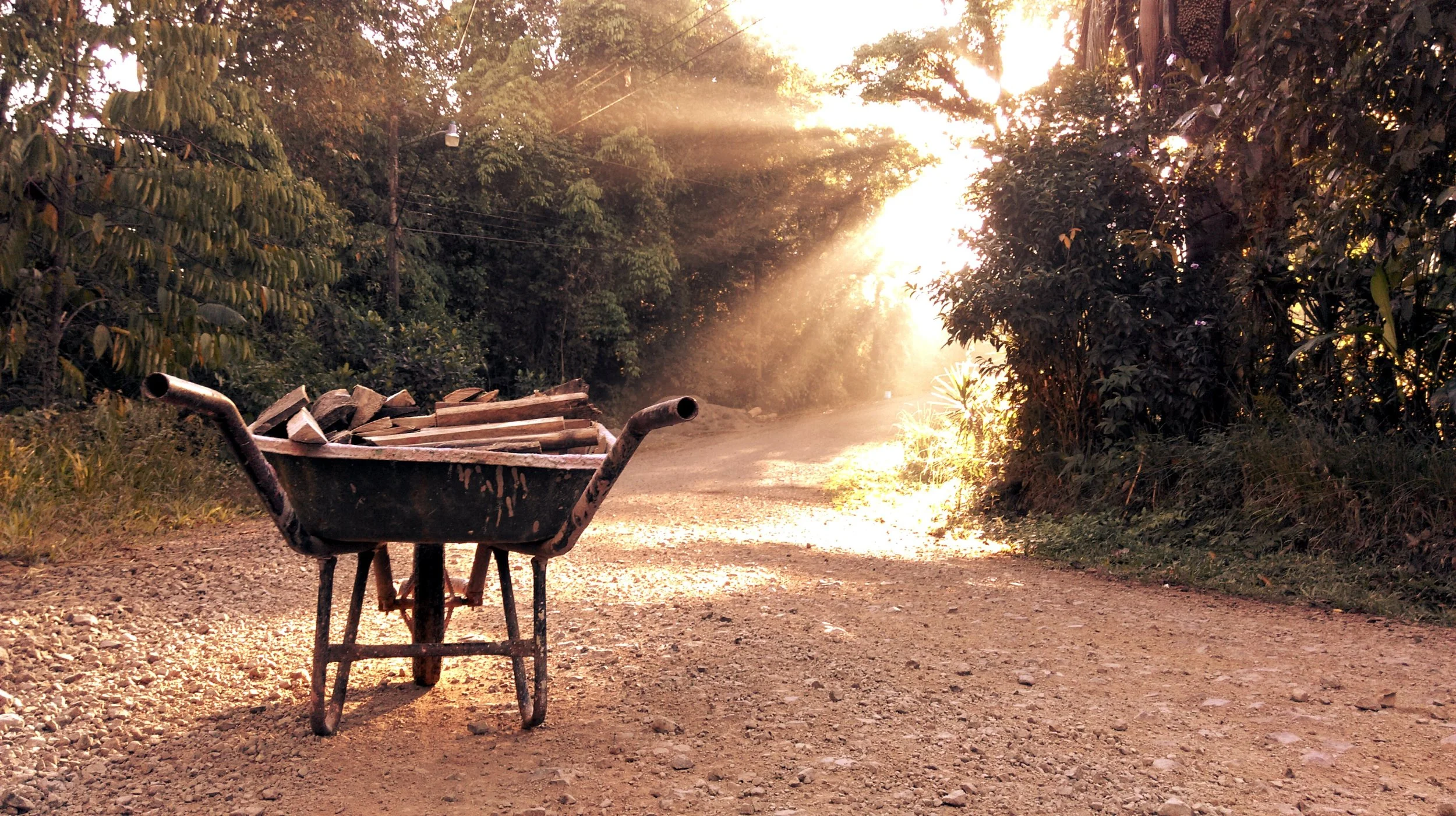
My hands are grappling the rumbling, rusty wheelbarrow handles, and as we walk half a mile through the village, everyone can hear the five Rancho apprentices clunk on through. In a village of 120 people, your whereabouts are everybody's business. Don't worry, I want to say, this will all make sense soon. They'll be having a chuckle by the end of the day. For now, we are five warriors defending alternative energy. We are making the best use of our woman power (and Dan power) when the white pickup truck is out of commission. We are going to pick up poop.
As Timo explained in a blog post last month, poop is the essential ingredient for synthesizing our kitchen's methane gas supply. Once a week, the white pickup truck is driven half a mile up the road to pick up ten sacks of manure. Assuming you have the human labor and the car labor, it's a brilliant system-- until the white truck, which has seen more years than myself, stops working. No truck, no poop, you say. Chuckle chuckle. Four of the baddest chicks and one man are about to prove you wrong. Here are two cents, to boot, on what makes a functional energy system.
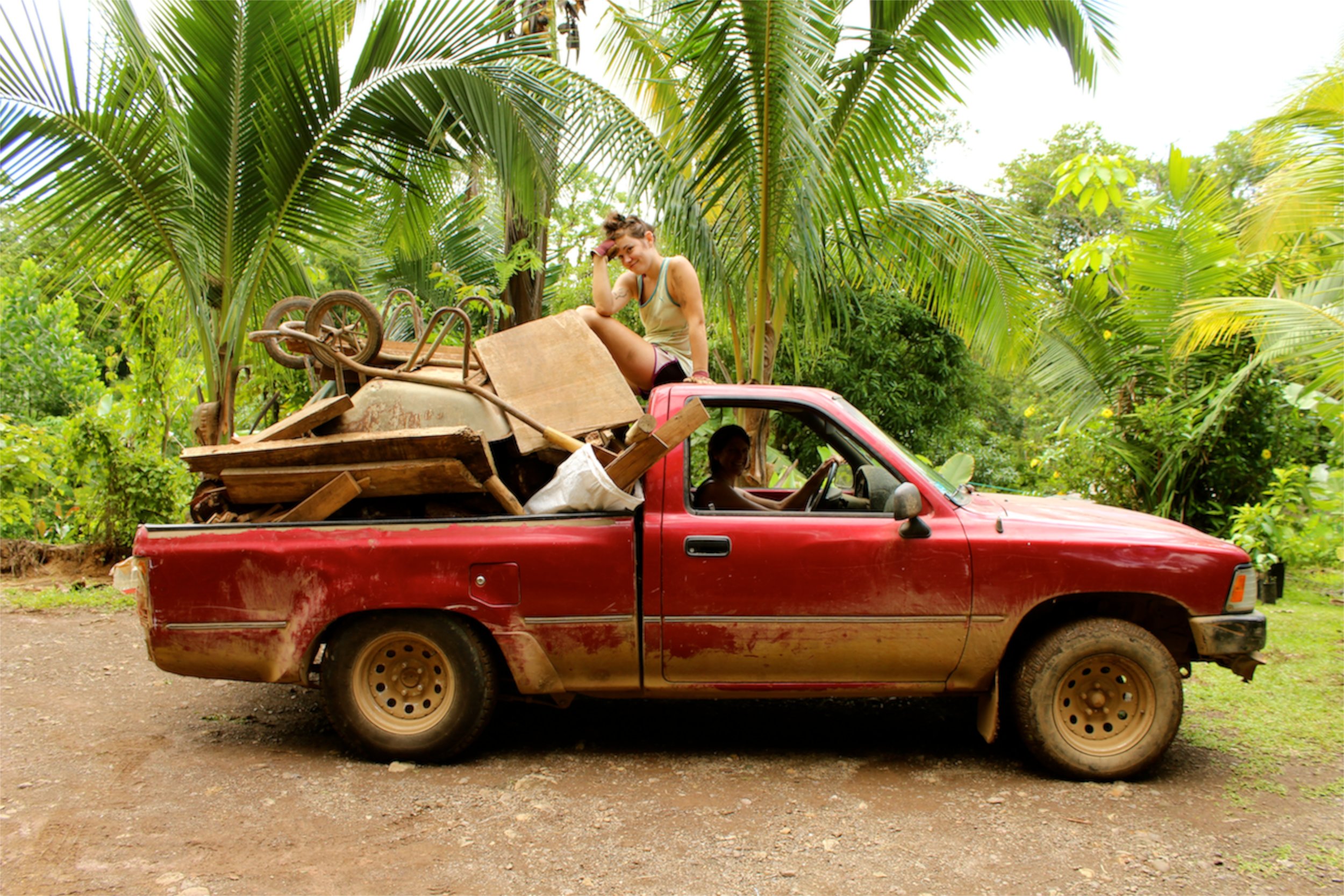
We make it to Finca Siempre Verde dripping in sweat. Chilo, our friendly poop dealer, greets us as we roll five empty wheelbarrows up the driveway hill. Since we're on the theme of biodigestors, he offers to give us a tour through his biodigestor system. It's a work in progress, but here are the pigs. He shows us the pig pen which gets hosed down, and where the poop drains into a pipe. He then shows us a newly built pen that is slightly lower than the kitchen. Here, Chilo explains, will be the new site for the biodigestor. The manure will wash directly into the feeder barrel, no transport necessary.
We are five champions of renewable energy and suddenly I am wondering why my journey to move poop suddenly seems less noble. Here is a system that capitalizes on the fact that the source of manure is located at point zero for the biodigestor intake. If Chilo had a failure in one of his auto parts, there would still be gallo pinto on the table. Is Chilo's biodigestor any different than ours, or am I just about to push 100 pounds of manure half a mile because we built a delicate, un-resilient system?

Biological systems, such as Chilo's pigs, are complex. They are composed of living, breathing organisms whose livelihood is ingrained in the health of the entire system. As long as Chilo (who is also a living component in the system) continues to produce food on his farm, process it in his kitchen, bring the scraps to his pigs, and maintain his system accordingly, then poop will continue to flow through the biodigestor, methane will continue to be produced, food will continue to be produced, and the pigs will continue to be fed.
Now, suppose we swapped out those pigs for one of those nifty new robots on the market. The Porkolator 3000 is equipped with machinery that makes it the most efficient robot in converting biomass to waste product. This technological feat is revolutionary. As it turns out, however, the company that manufactures the Porkulator did not create the machine with the capacity to heal from, say, an erupted engine. So when that breaks down, and Chilo doesn't have a spare engine in the middle of the jungle, how on Earth will the gallo pinto get made?

Pigs are complex; Porkolators are complicated. The difference between a living system and a non-living system is that a living system has numerous connections and survival responses in accordance with the environment, whereas a non-living system cannot respond. A non-living system is complicated because if there are 1000 pieces and the tropics rusts one obsolete, the system will fail to function. A living system has 999 pieces you can name, and 999 to the ninth power of interconnections you cannot even see, that when one piece fails, the show must go on. On that day, our pickup truck proved to be complicated because the inability to start the engine meant that our biodigestor risked starvation.
Pigs are not the only example of complex, living systems. Communities are also complex. In the wake of realizing that our biodigestor may not get fed, we rallied the troops and took action. That's right, our engine may have failed, but our spirit did not. That morning, five apprentices and ten sacks of manure rolled through Mastatal and it didn't matter that my forearms were burning or that my hands were too dirty to wipe the sweat from my eyes. We were resilient, and let warm gallo pinto be proof.

News from around the Permaculture Community
We love books at the Ranch! Our library is constantly growing as each of us pick out a few new books to populate our shelves. Our favorite publisher is Chelsea Green publishing, and the folks over at Permies.com have been busy reviewing many of their best books. Check out the review list to see if any belong on your shelf!
The National Institute of Apprenticeships in Costa Rica is having their annual Agroecological Festival this December 3 & 4 in Cartago. We hope to attend. This will be a great opportunity for anyone interested in connecting with the Costa Rica permaculture and urban farming community!
Abrazos
The Ranch Crew
Categories
Topics
- Agriculture 6
- Agroforestry 21
- Animals 2
- Apprenticeship 19
- Appropriate Technology 6
- Backpacking 1
- Bananas 1
- Basic Pantry 4
- Biochar 1
- Books 3
- Build Your Own Home 1
- Central America 5
- Chiles 1
- Cinnamon 1
- Clay Carving 1
- Climate 2
- Climate Change 1
- Cob oven 1
- Communication 5
- Community 24
- Compost 2
- Composting Toilets 2
- Condiments 1
- Conservation 2
- Cooking 4
- Costa Rica 18
- Design 10
- Earthen Construction 10
- Eat Local 2
- Ecohome 1
- Education 9
- Environment 3
- Ethics 4
- Farm to Table 12
- Fasting 1
- Fermentation 14
- Food 22
- Food Choices 8
- Food Forest 8
- Food Processing 15
- Food Systems 12
- Gap Year 1
- Gardening 5
- Ginger Beer 1
- Harvest 2
- Health 12
- Healthy living 5
- Homemade 2
- Homestead 8
- Internet 2