

BLOG
Stories, articles, and updates from the Ranch community.
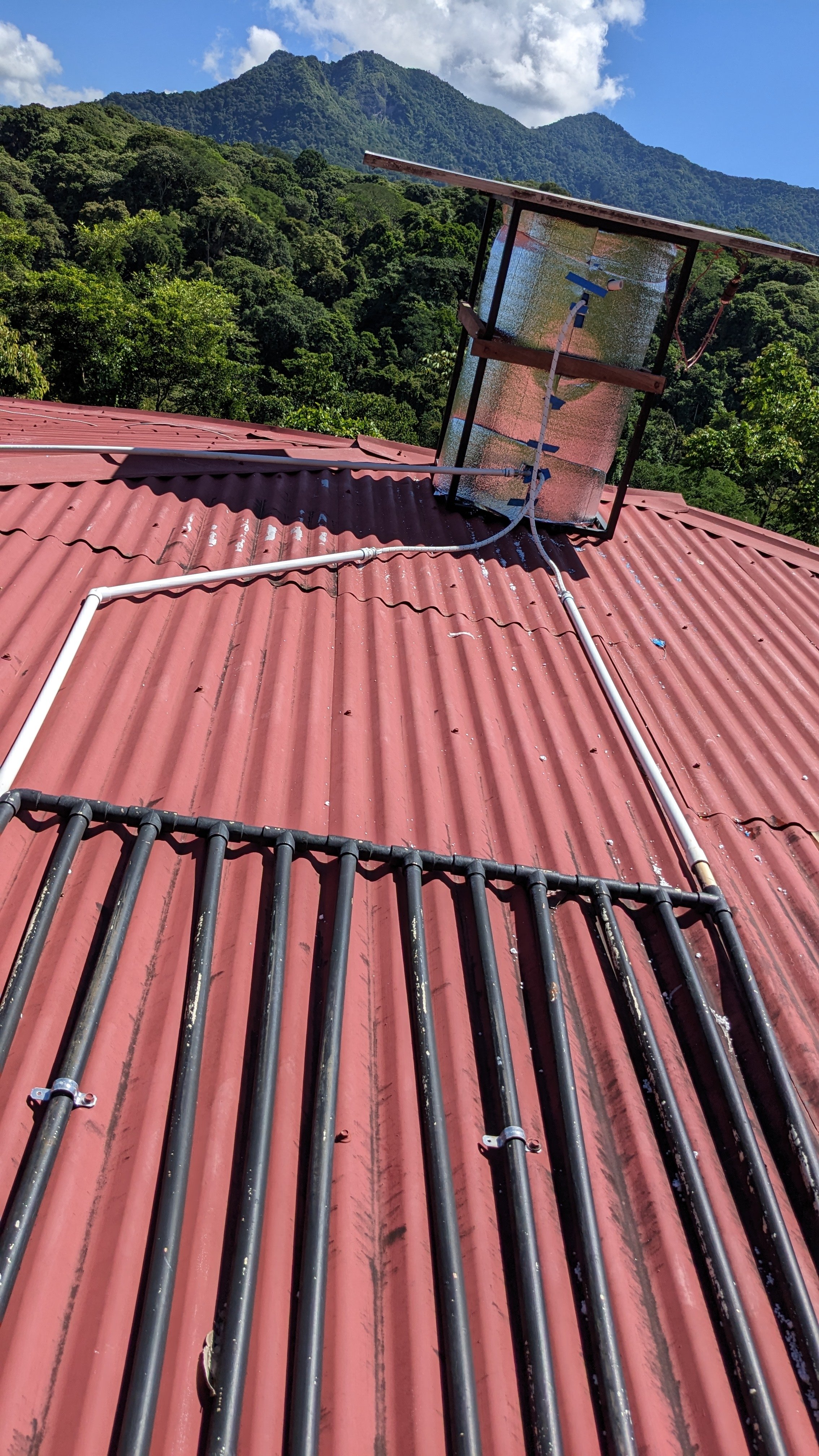
How to Make a Solar Hot Water Heater for under $100
You wouldn't guess that in the tropics having hot water was so desirable, but at our elevation, it gets quite chilly for me in the evenings. During the rainy season the nights can get particularly cold and if you've been in the rain working, a rejuvenating warm shower is just the ticket!
Over the years we have trialed two different types of hot water systems: composting hot water and solar hot water. I've personally installed and used both systems and would like to share what I've learned.
By Nic, Core Team
You wouldn't guess that in the tropics having hot water was so desirable, but at our elevation, it gets quite chilly for me in the evenings. During the rainy season the nights can get particularly cold and if you've been in the rain working, a rejuvenating warm shower is just the ticket!
Over the years we have trialed two different types of hot water systems: composting hot water and solar hot water. I've personally installed and used both systems and would like to share what I've learned.
Using appropriate technologies is one of the cornerstones of our permaculture principles and something that we teach about during our Permaculture Design Certification. It meets many of our principles to use local, recycled and repurposed materials and not only does that create a functional piece of technology its also cheap! This project came in under $100 and mainly used recycled materials.
Here is what you would need
55 gallon barrel
10 gallon barrel this must fit inside and leave enough space for insulation
Old EPS packaging (see below for description)
24m of 3/4” PVC tubes, Ts and Ls fittings
1/2” PVC for connecting to shower
Material for making the frame for the barrel ( i used some 1” steel square stock but you could use wood too)
reflective insulation to prevent 55 gal degrading in sun
Bulkhead fittings to connect pipes to tank
Compost Hot Water
When we first installed the composting hot water it was revolutionary in its simplicity: one uses the heat of a decomposing compost pile to heat water. It also is a classic permaculture stacked function of decomposing material and taking advantage of the heat that it creates. We refer to this typically in Permaculture as “stacking functions”. This is generally achieved by having a long tube coiled inside the compost mound. As you create the pile you slowly coil the tube amongst all the to be decomposed additions. This must be a hot, or thermophilic, compost system. When I first constructed this system it was fantastic. The water heats up within 24 hours and it stays hot night and day.
The really hot water lasts around two to four weeks, depending on the size of the pile, but over the next six weeks it does start to slowly cool down. At this point you have to build another pile for it to heat up again. At first this was easy, we would collect all of the trimmings from the occasional chopping of the soccer field to make the next pile. This would last about the same amount of time as the field took to overgrow and be cut again. It was good timing.
Once the community bought a lawn mower though, this abundant supply of nitrogen for the pile dried up. Instead of waiting six to eight weeks between cuttings, the field began to get mowed regularly and now there are no longer large amounts of grass clippings available for a hot compost pile. There were other challenges; the tubing often became twisted and was an absolute pain to dismantle and re-use with each new pile. The hot water didn't last long per shower, about five minutes, as it was limited to the amount of water held in the total length of tubing. All of this added up to a trip back to the drawing board!
Solar Hot Water


One of the key Permaculture principles, Catch and Store Energy is perfectly illustrated by using the suns energy to heat water. We have had several different solar hot water systems at the ranch. They all work really well as long as it is hot and sunny while you are taking a shower. Of course this is exactly the time when you don't need a hot shower, usually a cold water shower feels most refreshing. I want a hot shower when it is cold and rainy!
Until now, none of our solar hot water showers would produce hot water when I wanted hot water. This was for two main reasons. The first was that the tanks were never insulated. Even though the water in the tank would heat up, it would not stay warm into the night without insulation. The second was the lack of a functioning thermosiphon system.
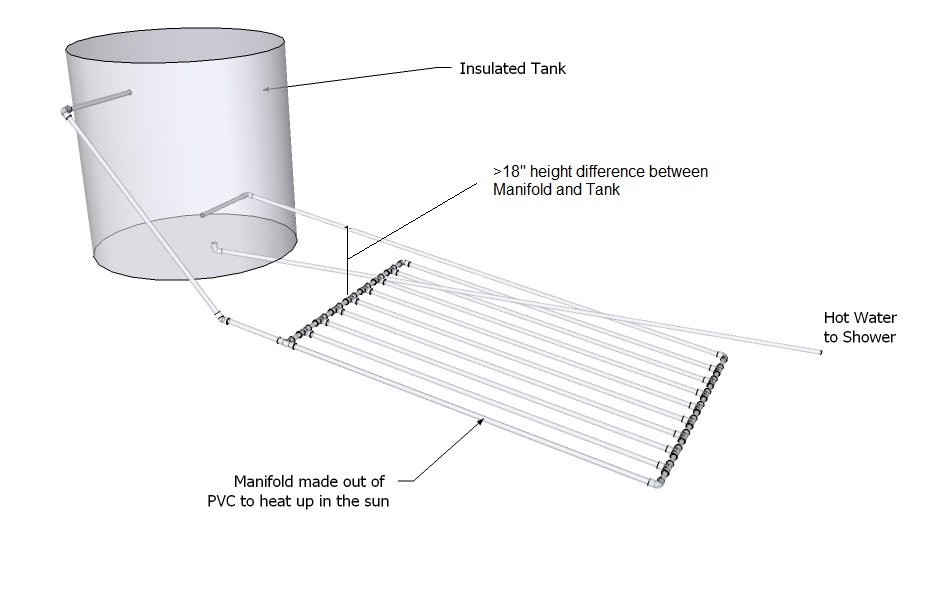
A thermosiphon is created when a manifold exposed to the sun heats up, this then hats the water inside, the water expands and becomes less dense than the cool water in the system. This creates a cycle of the cooler water in the tank sinking into the manifold (area exposed to the sun) below it whilst the water in the manifold travels up into the tank. This creates a continuous cycling of hot water through the system.

3/4” PVC Manifold
But if the height differential between the tank and the manifold is not large enough or there is not a one way valve the same thing can happen in reverse, this is known as reverse thermosiphoning. This meant that the passive thermosiphon process which heats the water up while it was sunny would then reverse once it cooled down and the tank would quickly cool. This occurred in our systems because there needs to be at least 18” height difference between the tank and manifold.
Manifold
In the photo above you can see the manifold we glued together using 3/4” PVC. It is 1.5m long (so that you can get 4 lengths from a 6m piece) by 1.2m. The large surface area and the black paint are what allows the water to heat up inside of the tubes and to circulate via the thermosiphon. We decided to use 3/4” PVC to reduce the friction inside of the tubes and allow the water to circulate more easily vs using the 1/2” PVC. we just used any old black paint that was lying around, it wasn’t specifically for painting PVC. Lightly sand the PVC with 220 grit and the paint will stick much better!
Improved Hot Water Batch System
We have now created what we believe to be the perfect appropriate technology permaculture solution, the solar hot water batch system! In our new solar hot water system we have made some important changes from our past systems.

EPS Loose Insulation
We increased the surface area of water in the pipe to increase speed of water heating up. By using 3/4" PVC pipe in the form seen in the pictures we are creating a larger surface area to heat water up in the sun. There is also a relatively short distance for each amount of heated water to travel in order to rise to the tank. In old systems we have had one long continuous tube.
We insulated the tank to keep the water hotter for a longer period of time. By insulating the tank with about 4-5" of EPS insulation we can now keep the water hot for a minimum of 24 hours (enough time until the sun comes out to continue heating the water again).
We made sure that the bottom of the tank was more than 18” above the top of the manifold.
In its current form the solar hot water works as a batch heater, meaning that as you use the hot water one must manually refill the tank by opening and closing the cold water input to the tank. The overflow on the tank tells you when it is full. We do not have access to tanks that can control the very high water mains pressure that we have, therefore we use this manual system.
Insulation
We have experimented with a number of natural insulations over the years including sawdust, newspaper, clay sawdust fired bricks, wood ash and pummice amongst others. In our first solar hot water we used sawdust insulation and it did a good job. This time we had bought several ceiling fans for a new construction that had come packaged in Expanded Polystyrene (EPS). We used the weedwacker and the metal blade attachment in a large barrell to chop up the EPS to a loose fill. This way we could easily pour the insulation into our barrell. The advantage of using this insulation is that we were able to recycle a material that would have otherwise gone to the landfill. It would also not break down in a potentially damp environment, if there was a leak or excessive condensation.
Water pressure
As this is essentially a tank of water on your roof the pressure is dictated by the height of your roof, the higher the water tank the higher the pressure. It means that the water pressure whilst perfectly adequate to take a nice warm shower is much lower than that of our mains water. If you want high pressure hot water you would have to install a pump of use a pressurized tank and heat exchanger all of which add complexity and cost. You also must consider that if you don't live close to the equator you will have to think about the potential freeze risk of having a tank of water on your roof during colder months.
There are many forms and variations of solar hot water systems which can be designed and built. I like this system because it is passive, simple, cheap, uses easy to source materials and involves very little maintenance.
To learn more about systems like these, keep an eye out for upcoming workshops on renewable energy and appropriate technology. We include an appropriate technology module in our annual Permaculture Design Certification.
NEWS AND NOTES
We have a number of life changing workshops coming up. Please check out our workshops page for more information of upcoming workshop.
Please share around if you know anyone who is ready for a trip to beautiful Costa Rica, a swim in the waterfalls, nourished with homemade meals, and challenged with an intensive educational experience.
Abrazos,
The Ranch Crew
Endeavors to End Propane: Local Fuel Sources and Efficient Cooking Technologies
Cooking food can make it tastier, easier to digest and absorb nutrients, and safer and healthier to eat. Cooking at the Ranch happens multiple times a day, and on some days, pretty continuously throughout the day. We generally have a lot of hungry bellies to fill! Over the decades we have been steadily reducing our use of propane to meet our cooking needs.

Self-made rocket stove at the Ranch
By Tim O’Hara
Ranch Core Team Member
Endeavors to End Propane: Local Fuel Sources and Efficient Cooking Technologies
Cooking food can make it tastier, easier to digest and absorb nutrients, and safer and healthier to eat. Cooking at the Ranch happens multiple times a day, and on some days, pretty continuously throughout the day. We generally have a lot of hungry bellies to fill! Over the decades we have been steadily reducing our use of propane to meet our cooking needs. Propane is a refined product that comes from crude oil or natural gas. The negative environmental impact from its extraction and refinement on communities and the earth are well documented. We have lessened our dependency on this imported product (Costa Rica has few crude oil resources and a moratorium on oil drilling) through the production and use of our own biogas, the utilization of solar cookers, dehydrators, and hay boxes and perhaps most importantly by incorporating efficient wood burning stove technology into our culinary domain.

Our woodshed
Wood is renewable and abundant in and around Mastatal. That’s not to say that wood can’t and isn’t managed poorly in many parts of the world where it is used for cooking. For us, fortunately, we have a plentitude of this resource in a country that does a commendable job of taking care of its timber resources. We have almost limitless supplies of firewood coming from our woodshed, local small-scale bandsaw mills that operate in the region, and our own agroforestry systems.

Common open cook stove
According to the World Health Organization, approximately 3 billion people worldwide still cook using solid fuels such as wood and dung in open fires and on inefficient stoves. Poorly designed stoves and age-old cooking practices can produce high levels of small soot particles and other pollutants that penetrate deep into our lungs. Exposure is particularly high among women who cook indoors and their children resulting in 3.8 million premature deaths a year from pulmonary illnesses. The extensive use of wood for cooking can also contribute severely to deforestation and its associated devastating social and environmental impacts. It can also consume precious and considerable time to gather and haul.
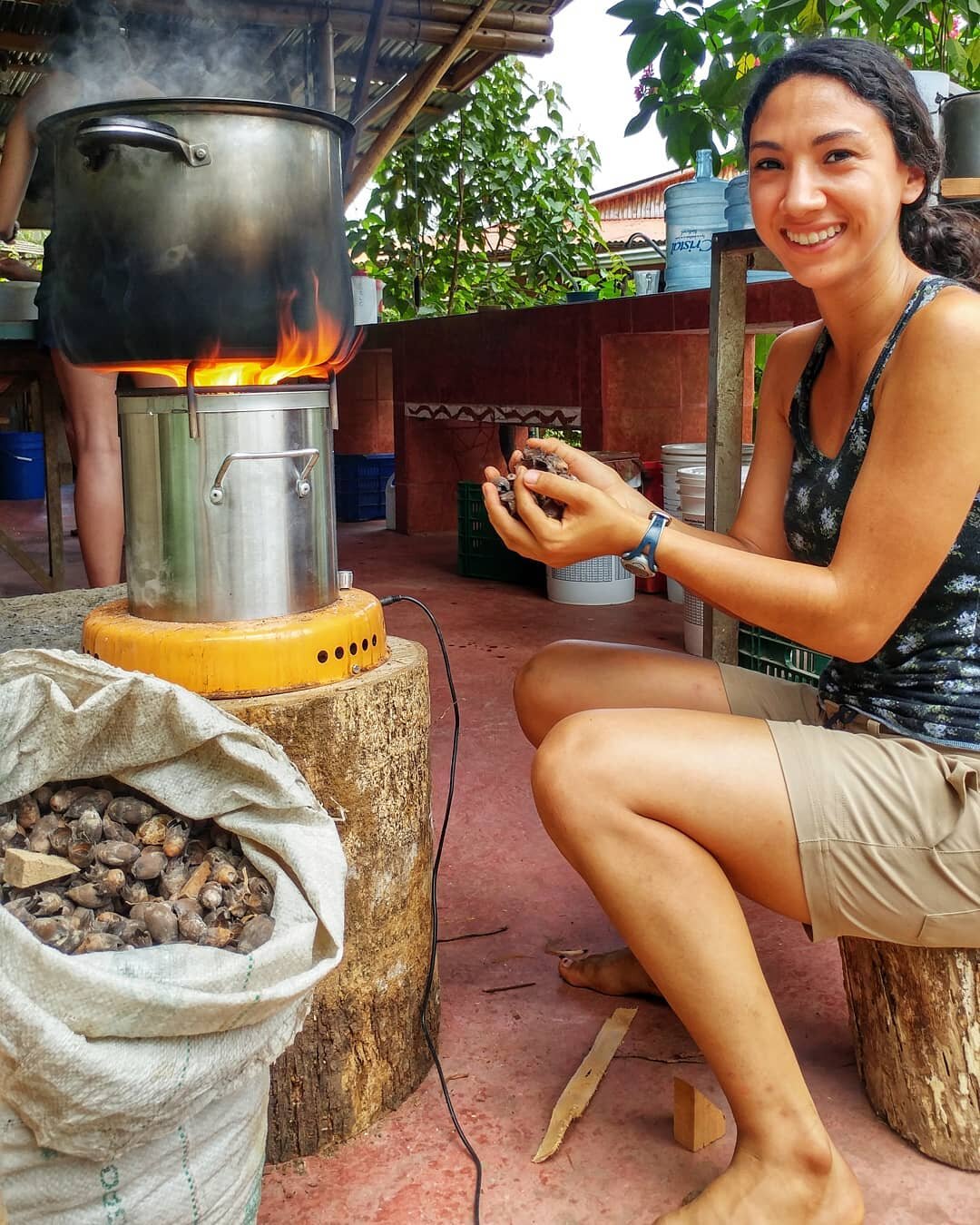
ACE One in action!
These worrisome facts have led us to build and invest in efficient wood burning technologies and food production methods that allow us to sustainably and safely use this local resource to cook with. Our alternative cooking workhorses are our 5 rocket stoves; 3 purchased ACE Ones, and two adobe/cob stoves designed and built in-house. These stoves produce little to no smoke based on a design that features an air intake or fan that produces extreme heat in the combustion chamber that ignites and “burns away” any smoke that is produced. This can be referred to as “complete combustion” and reduces or eliminates soot from the cooking process. The ACE One stoves use small pieces of wood whereas the home-built versions use slightly larger pieces of wood. These efficient stoves burn smaller quantities of wood and produce less or no smoke while retaining the many benefits of cooking with this local and accessible resource.

One of Ranch’s agroforestry systems
When possible, efficient rocket stoves can be coupled with a well-managed agroforestry system that through the extensive planting and pruning of nitrogen-fixing and food producing trees can yield a steady supply of accessible firewood and the food that will be cooked on the rocket stoves. This is yet another example of the closed-loop systems that we oftentimes strive for on our farm.

Adobe rocket stove being built at Ranch
Rocket stoves can be small or large, take many shapes, and can be made from a wide variety of materials. What’s common to all of them is the their ability to efficiently produce extremely hot combustion chambers. To improve performance, your rocket stove chamber can be insulated and your burning surface sized and designed to effectively support your favorite cooking pot. You can even buy rocket stoves for camping these days though if you’re a do-it-yourselfer or on a tight budget, we’d encourage you to design and build your own. There are plans all over the internet.

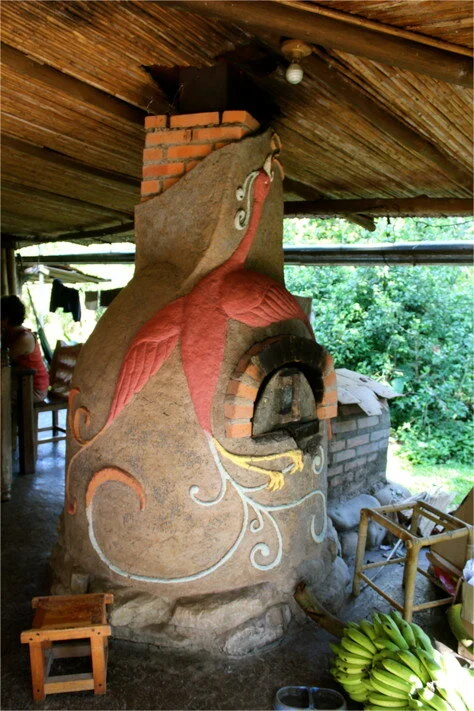
Our cob oven
In addition to our repertoire of rocket stoves, we have a self-built cob oven that we use for pizza parties and other baking endeavors, 3 Wonderbags, a solar and electric dehydrator and of course our magical biogas stove. We’ll tell you more about these in a future article but in the meantime I’d encourage those that love simple solutions to check out the wonders of the Wonderbag and see how you can help transform a family’s life in Africa while saving a considerable amount of cooking fuel.
Let us know if you have any questions and come and check out are array of alternative cooking technologies if you find yourself in our neighborhood. We love to share our experiences and hope that this has found you well well.

Simple rocket stove being built in community of Mastatal

6 reasons to use a biodigester as a low tech, off the grid, renewable energy source for cooking
For almost two decades now, Rancho Mastatal has been working on creating a more sustainable lifestyle by researching, developing, and teaching about more efficient ways to build, grow food, cook, and live as a community while reducing the impact these activities have on our environment.
As cooking is one of the most energy-consuming activities within a house, we find it relevant to implement an alternative renewable energy source to satisfy one of our guests’ favorite moments of the day: meals. With that perspective, we built a biodigestor 8 years ago.
By Nico, Apprentice 2020
“Agricultural, industrial, and human digestion processes create an ongoing (and growing) stream of organic refuse. Without thoughtful management, organic wastes can emit fugitive methane gases as they decompose. Methane creates a warming effect 34 times stronger than carbon dioxide over one hundred years.” - Project Drawdown
Renewable Energy for Cooking
For almost two decades now, Rancho Mastatal has been working on creating a more sustainable lifestyle by researching, developing, and teaching about more efficient ways to build, grow food, cook, and live as a community while reducing the impact these activities have on our environment.
As cooking is one of the most energy-consuming activities within a house, we find it relevant to implement an alternative renewable energy source to satisfy one of our guests’ favorite moments of the day: meals. With that perspective, we built a biodigestor 8 years ago.
What is a Biodigestor?

Our biodigestor
A biodigestor is basically a system that allows us to produce methane out of human and animal manure (see more info on last year’s article). Here at the Ranch we decided to go for a low tech, polyethylene tubular biodigester technology, also known as the sausage system here in Costa Rica, because of the shape of the chamber. We chose this because it is a cheap and simple way to produce methane for small-scale farmers. It is appealing to rural people, firstly because of the low cost of the installation and therefore of the gas, and also for the improvement in the environment that the installation allows. It can be applied in rural or urban areas and in both low and hilly lands, creating a low tech system able to produce a renewable energy source as well as a fertilizer for your land.

A glance at our system
6 Reasons to Build a Biodigestor
But besides the awesome concept of being able to transform waste into energy, there are many other advantages to having a biodigestor. Here are 6 reasons on why you should build one:
1. Biodigestors can be Low Tech
A common misconception about biodigestors is that they should be these high tech, expensive systems made out of a lot of different components. Like people, biodigestors come in many shapes and sizes: from continuously fed to batch fed, made out of metal or polyethylene, vertical or horizontal, using cow manure or human waste (or both), there is probably a biodigestor out there waiting for you. If you decide to go for a simple system like ours, there aren’t many components and you would be surprised by their simplicity. With the help of a couple people and some skills, you can set your system up within two days. The maintenance is pretty simple as well, and again, depending on the system you choose, you can decide to either dedicate a bit of time for maintenance every day, or choose a batch fed system, which takes more time to put in place but is then autonomous for a couple weeks
2. Biodigestors can be cheap
Again, this depends on a lot of variables: which system you choose, whether you have to excavate soil, if you are willing to do it yourself or prefer hiring people, whether you are able to use reused materials, etc. For instance, the main component of our system, which acts as a fermentation chamber and a gas reservoir, cost us $700.
3. It can be used off-grid
Here at the Ranch, the amount of people coming through doesn’t allow us to be completely off the grid; we cook over 23,000 meals a year! We still decided to implement this system in an effort to reduce our dependence upon fossil fuels such as propane and take a step toward ecological self-sufficiency. For smaller communities, like a small scale farm, or by increasing the size of the system, it is totally possible to implement an off the grid cooking system.

The methane stove that we cook meals on
4. It creates a nutrient rich organic fertilizer
This low tech system houses a wide variety of bacteria, each one with a specific task. Some break the matter into simpler molecules of sugars and acids. Other microbes, which find oxygen toxic, are able to break down the simple organic matter to form gases. The ultimate end result of this process is both the natural gas for heat and electricity as well as valuable soil amendments which we disperse throughout our gardens.
5. It reduces the greenhouse effect
Methane, CH4, which makes up 70% of the biogas produced by our biodigester, creates a warming effect 34 times stronger than carbon dioxide. By burning this gas, not only do we create a renewable energy source that allows us to produce energy, we decompose the methane into a less potent greenhouse gas.
6. It’s comfortable
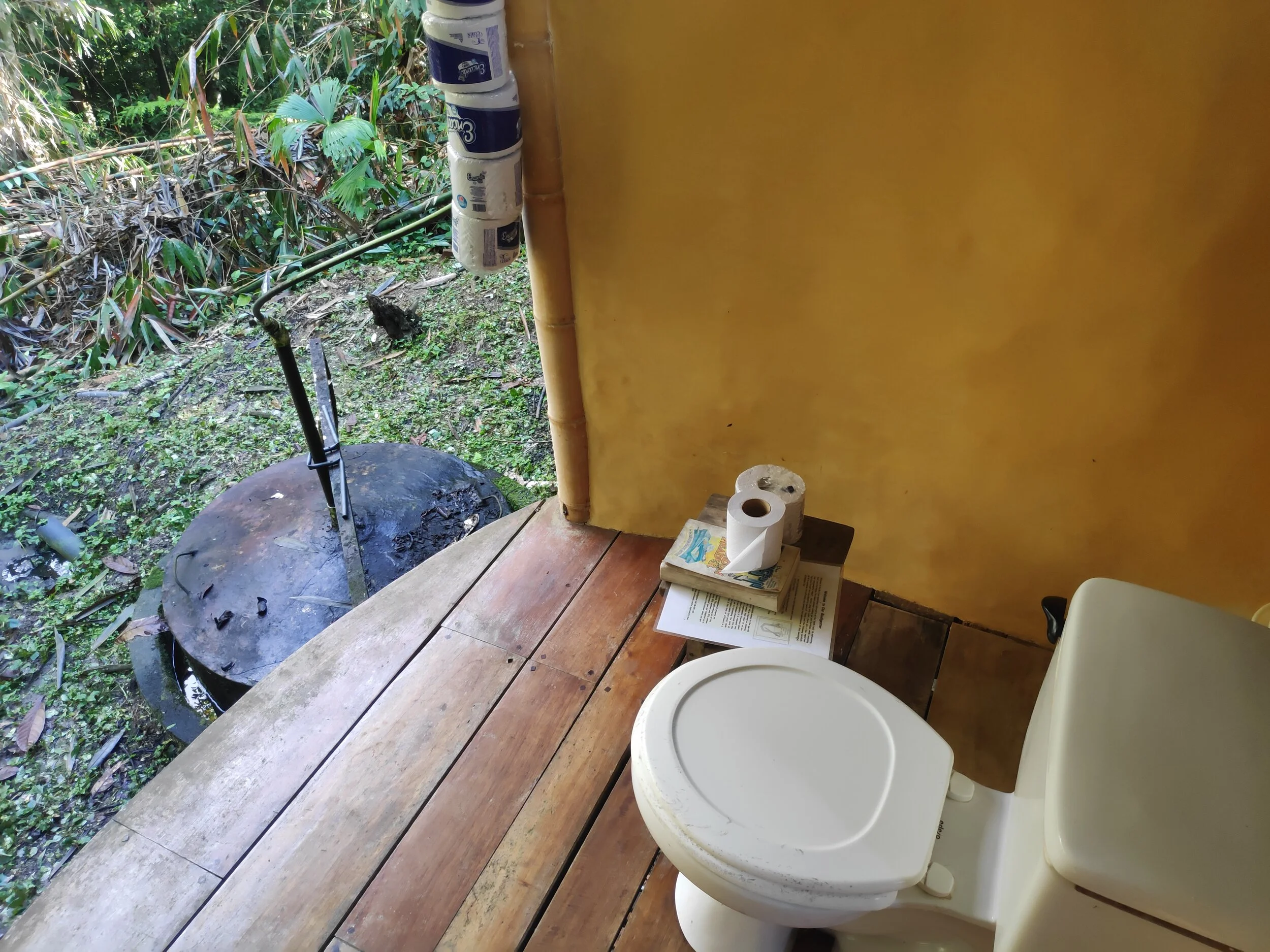
Some people are apprehensive about the idea of having to use a composting toilet ( even though they shouldn’t be, see article by Moanna on Composting Toilets to discover all the wonders of using a composting toilet, a wonderful low tech and off the grid system). By connecting your greywater system to a biodigestor, you will keep the comfort of doing your doodies in a water system while doing your duties for our wonderful Earth. As a matter of fact, our biodigster’s toilet was voted the Best Compost Loo In The World Award in 2012 by the readers of Permaculture Magazine, Inspiration for Sustainable Living.
Why else are Biodigestors Great!
The list doesn’t stop here. A biodigester helps reduce landfill and water-polluting effluents, and eradicates odors and pathogens. It allows small scale farming to create a renewable energy source while allowing them to better control the breaking down of their animal manure into fertilizer, being more self-sufficient and less dependent upon other chemicals. In a world where it has become increasingly urgent to find simple solutions to step towards sustainability, implementing low tech and easy to manage solutions like this one seems more relevant than ever.
The Project Drawdown, a comprehensive plan to combating climate change, puts Biodigestors in the top 100 things we can do.
Hope you feel inspired to think about and make changes to the current system of waste management.
Check out Moanna’s latest article on why composting toilets are another great way to make a sustainable change in the system.

Transforming Human-waste into Fertilizer: Compost Toilets
You likely grew up with flushing toilets, seeing your poop as something to dispose of, but you might also be one of those who agree that humans can only thrive once we live in harmony with nature. The zero-waste movement is in a sense, a yearning to imitate nature where there is no such thing as waste; one organism's excrement is another's food. Compost toilets turn human "waste" (discarded feces and urine) into soil fertility as humanure (food for micro-organisms and fruit trees) - the actual human waste is everything that cannot decompose: cigarette butts, plastic-sixpack rings, deodorant cans, batteries, the five billion gallons of polluted drinking water we flush down our toilets everyday, and the millions of tons of organic material dumped into the natural environment year after year.
by Moanna , 2020 Apprentice
"Carelessly dumping waste out into the world is a self-centered act of arrogance. Humanure composters can stand under the stars at night gazing at the heavens, and know that, when nature calls, their excretions will not foul the planet. Instead, those excretions are humbly collected, fed to microorganisms, and returned to the Earth as a healing medicine for the soil" -
Joseph Jenkins, author of the Humanure Handbook
Zero Waste?
You likely grew up with flushing toilets, seeing your poop as something to dispose of, but you might also be one of those who agree that humans can only thrive once we live in harmony with nature. The zero-waste movement is in a sense, a yearning to imitate nature where there is no such thing as waste; one organism's excrement is another's food. Compost toilets turn human "waste" (discarded feces and urine) into soil fertility as humanure (food for micro-organisms and fruit trees) - the actual human waste is everything that cannot decompose: cigarette butts, plastic-sixpack rings, deodorant cans, batteries, the five billion gallons of polluted drinking water we flush down our toilets everyday, and the millions of tons of organic material dumped into the natural environment year after year.
Two thirds of the world have no toilet, and don't have a choice, and must live intimately with their shit. Some of us have the opportunity to use it as fuel and fertilizer, instead of turning it into poison. It can feed us, heat us and cure us. There are so many ways to shit properly.


Composting Toilets
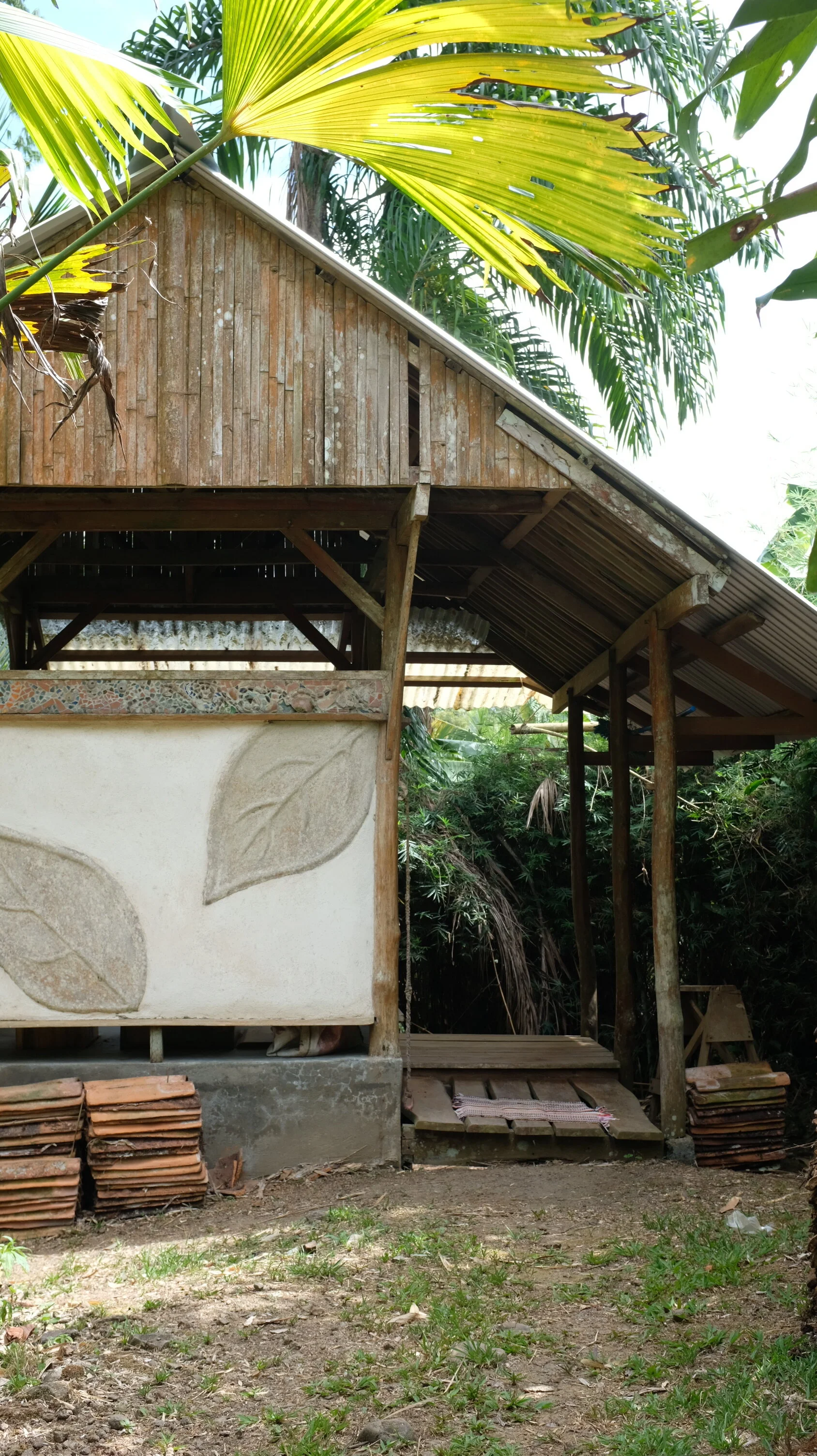
Pooping at any of the Rancho's outdoor compost toilets is a pleasing experience; they are made of beautiful natural materials and you are likely to observe all kinds of butterflies or birds. What has nourished your body and instead of being disposed, will feed and sustain millions of other lifeforms. Pooping and urinating becomes a contribution rather than a disposal; instead of waste that gets dumped somewhere, it's a useful resource that gets valued.
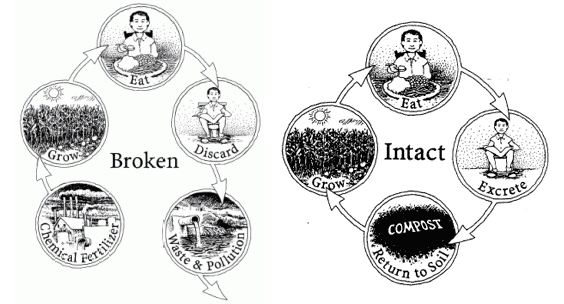
From the Humanure Handbook by Joseph Jenkins
The human nutrient cycle goes like this 1) grow food 2) eat it 3) collect and process organic residues (feces, urine, food scraps) 4) return the processed organic matter to the soil, thereby enriching the soil and enabling more food to grow!
Why Composting Toilets?
"If you want to be free, learn to live simply. Use what you have and be content where you are." - Joseph Jenkins, author of the Humanure Handbook
It is not only for those with gardens and fruit trees who should be excited by humanure but all of us who value clean water and air. Compost toilets align with the permaculture ethics of care for Earth and people, and a fair distribution of resources. Here are a few aspects on why and how.
Protect and save water
Each toilet flush launches five to six gallons of polluted water - All life depends on water, and although Earth is mostly water only 3% is without salt and of that 2/3's are locked up in ice - this means that humans pollute the less than 1% of drinking water we have. If a household switches to waterless toilets it would save 40 thousand gallons of water per year. Each flush usually goes somewhere to be "treated", where despite the massive amount of energy and chemical input, pollutants such as nitrates, chlorine, pharmaceutical drugs, industrial chemicals and many more are let out into our living planet, which affects us since we are apart of and one with this living world.
Pumps up resilience
We will be facing all kinds of disruption due to the speed and frequency of natural disasters and their consequences. Flushing toilets rely heavily on well-established infrastructure, and loads of energy, water and chemicals. With the growing number of natural disasters, this system is super vulnerable as storms, floods, and fires can cause disruption many parts of that system. Urban and suburban areas globally are experiencing storm events causing flooding and overflowing the basins in sewage systems. This can go on for days or weeks, and human excrement along with all the other waste that goes down the drains ends up in the streets, and we're back to the middle ages where diseases and pathogens get to have a big party. So if you know how to compost and make humanure, you can stop relying on this fragile and eco-cidic system and help others in the same direction, and when disruption occurs in your surrounding community you can continue to recycle your brown gold!
Compost can degrade toxic chemicals
An Austrian farmer could feed his community with the produce from his fields that were sprayed with compost-type microorganisms, whereas the produce from surrounding farms were banned due to radioactive cesium contamination from the Chernobyl disaster. Micro-organisms in compost are able to digest these toxic compounds because many produce antibiotics. If this excites you, check out Mycilium Running by Paul Stamets.
SCARY FACTS About the current waste system
There is an exceptional degree of agreement within the scientific community that natural systems can no longer absorb the burden of current human practices
The use of antibiotics is so widespread that many people are now breeding antibiotic resistant bacteria in their intestinal systems. These bacteria are excreted into toilets and make their way to wastewater treatment plants where the antibiotic resistance can be transferred to other bacteria, and the water containing and breeding these bacteria is led out into our living planet. The chlorine used to supposedly clean water seems to increase bacterial resistance to some antibiotics. (Waste water microbiology p.86 Humanure Handbook)
Chlorine is used to disinfect much of the world's drinking water and wastewater before its released out to our environment. The most harm comes from the by-products such as chloroform and dioxin, that cause all sorts of awful stuff such as death in snapping turtles, death in lake trout, reproductive problems in otters and minks, and cancer in humans - to name a few.
50-90% of pharmaceutical drugs humans consume end up in waterways - chemotherapy drugs, antibiotics, hormones and much more are found in tap water, lakes, rivers and drinking water aquifers.
Too often waste is being dumped into water bodies, which the treatment plants are not prepared to deal properly with. Sadly governments and private co-operations are too busy to let consumers know - in review of twenty water systems in six states, out 157 drinking water quality violations, the public were notified on time in only 17 of the cases (humanure book pg 112).
Humanure Fun Facts
Human excrement is in many south east asian countries known as "night soil", and was never wasted. Quite the opposite it was a valuable resource! On the island Tainan in Taiwan it was sold on blackmarkets to fertilize fishfarms.
Fecal transplant saves lifes: A dose of healthy poop, with its 35,000 families of bacteria, can replenish the gut's flora and settle it back to normal. With our massive use of antibiotics we wipe out the good bacteria along with the bad. Transplanting a healthy gut flora into a one suffering from Clostridium diificile (which kills 100,000 each year in america and europe) has been shown in studies to heal 91% of patients in certain cases. (Colours magazine, Shit: a survival guide)
Squating while pooping is the most healthy posture, as it straightens the canal to the desirable 132 degrees. In a study it took squatters 51 seconds to move their bowels, while it took 131 seconds for those who sat. (Colours magazine, Shit: a survival guide)
How do Composting Toilets Work?
"Composting is easier to do than to describe, and like lovemaking, magic when you do it well" -
Sim Van der Ryn
Is it safe? Will it eliminate pathogens and diseases? Does it get stinky? Will it attract flies and rats? Is it hard work? All these question will depend on how the system is designed. There are loads of different systems, and ways of composting humanure. You can buy all sorts of commercial composting toilets, and your climate, local regulations and way of living will guide you to the most appropriate way to turn your "waste" into resource. * This also means that the decomposition process depends on and varies according to each system, place and environment. *
Here at Rancho Mastatal we have 11 composting toilets in 2 sizes (large scale capacity and single family capacity). We size these based on their location and projected use. All of them are designed to be passive systems with little to no management or maintenance. The Ranch's compost toilet system is simple; there are two chambers, when one is filled it gets left to decompose, and by the time the second is filled, the first has transformed into brown gold/rich fertilizer!
The ones in the pictures are the large size composting toilets (each chamber about 2m x 1m x 1m), these are used on average over the year by 7-10 people. They have been sized to take about one year for one side of the chambers to fill up, and the decomposition process is also one year, the same amount of time for the other side to get filled up.

Emptying a composted side of humanure into reusable bags to spread on our orchards

The 2 chamber system that we use here
Composting requires 4 neccesities: Oxygen, moisture, appropriate temperature and a balanced diet, which is the right carbon/nitrogen ratio. When these conditions are right bacteria will start to get active and heat up the compost, creating temperatures over 120 degrees fahrenheit. This rapidly kills pathogens, and just like Mother Nature intended, humanure is a treat for the soil.
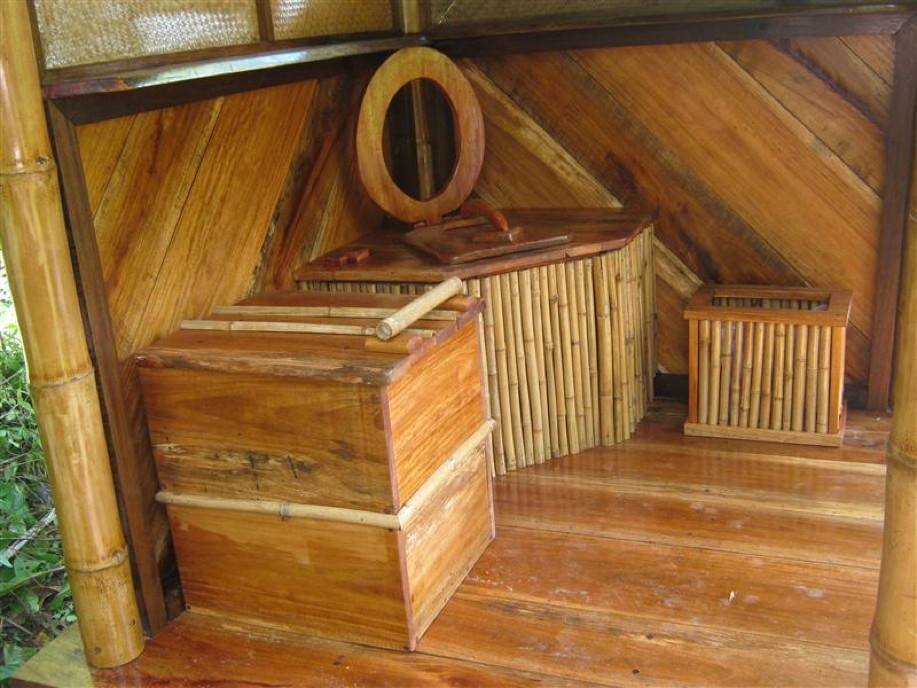
A cozy seat
When one chamber is filled the toilet-seat is moved on top of the next chamber, the first is left to decompose with a lid on, and in between is a box for sawdust. For each 'contribution' 2-3 scoops of sawdust is applied to balance the carbon/nitrogen ratio (Sawdust is the carbon sucking up all the nitrogen rich human contributions). Before starting a new chamber it is filled with bigger bulky carbon materials, generally a lattice of bamboo or sticks. This helps create an aerobic environment for the composting organisms to do their work and we avoid having an anaerobic environment, which means no air for the good bacteria to do their job resulting in a stinky toilet.
The design of this system is based on the diverse flow of people on the Ranch; when we have all kinds of people in different quantities for many different periods of time that use our compost toilets, the design is simple for low maintenance. All that needs to be managed is to make sure there is sawdust available and adding the finished soil fertilizer around our orchards once a year. Our main food production is in agro-forestry so we feed the humanure to the trees, by using the natural biological filter of the trees nutrient absorption system we get as an extra layer of safety from any potential pathogens or chemicals in the humanure.
The Composting Stages
Stage 1:
Mesophilic bacteria, (100 million - 1 billion per g of compost), eats, reproduce and create heat until it reaches around 44-52*C (111-125*F) which is the transition to
Stage 2:
Thermophilic bacteria thrives in the higher temperatures, takes over and continue to create heat, sometimes reaching up to 70*C . This heating stage can take place over days, weeks or months. As it cools down again we reach
Stage 3:
Where more diverse organisms such as fungi and earthworms moves in, and digest bigger and more coarse material.
Stage 4:
Is the curing/maturing phase, a long and important one. A long curing period (e.g., half a year in the tropics or a whole year in the temperate, after the thermophilic stage) adds a safety net for pathogen destruction. The longer they are subjected to the microbiological competition of the compost pile, the more likely they will die a swift death. All of this is linked to the soil food web.

Humanure is harmless to handle once fully decomposed and aged
Thanks to the bacteria, fungi and bugs, thriving with good moisture, air and a mix of human excrement and sawdust, the poop from 2018 has gone through a curing process through 2019, and last month the 2020 apprentice team could empty out the beautifully smelling and textured humanure.
Before you begin on this journey towards saving water, decreasing the the extraction and pollution of limited clean freshwater, protecting planetary health and enhancing soil fertility, further exploration and information is necessary. Some simple tips would also be to explore the possibilities to phase out flush toilets in your local community and check out what other people in similar situations to you are doing to stop pooping in drinking water. "The Humanure Handbook" is possibly the best and most enjoyable source of information, Joseph Jenkins shares his 20+years of compost toilet experience and knowledge, and the way he writes has made many crack out in laughter.
This simple low-tech composting system has a positive impact on the Earths ecosystems, making us closer to a harmonious relationship with this living planet. It aligns you with permaculture principles such as catching and storing energy, creating zero-waste, obtain a yield, and makes use of the permaculture attitude where "the problem is the solution". We don't need more science or bigger technology or complexity to meet the crazy complicated crisis that we're facing, but some humility and respect for all that is simple; deal with our own excretions, by making humanure that enhance soil fertility!
Legal issues in Costa Rica
Yes! They are Legal!!
In Costa Rica the legal principles guiding black water disposal are based on the possible contamination of fresh water resources. Composting toilets fall into the category of a safe alternative to blackwater disposal as they don't even create the blackwater in the first place as they are dry (use no flush system). In this document published by the ministry of health, you can see in annex 5 (scroll all the way to the bottom) that composting toilets are legally allowed as a viable alternative to a conventional septic system if the stipulations as outlined in the document are met. This is exciting news for people based in Costa Rica and hopefully can act as a catalyst for other places in the world including them in the building and health codes.
Humanure into Food?
Methane from a Biodigestor
Here at The Ranch our compost toilets feeds the soil, and our Bio-D toilet makes gas for cooking breakfast, it is more attractive option for those who are more comfortable with a flushing toilet, and it is another way of turning "waste" into a valuable resource.

Our biodigester
Black soldier flies
They eat everything, create rich fertilizer and both insects and flies can be a rich protein source for chickens!
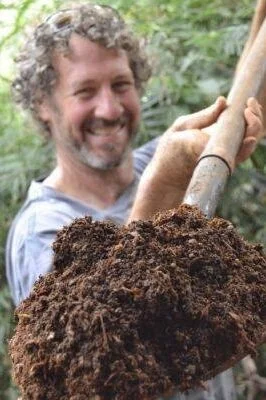
A beautiful scoop of humanure

One of our outdoor compost toilets
Hope you feel inspired to, if you can, stop contributing to the modern waste cycle and start creating closed loop systems! Don’t know what closed loop systems are? Join us for our annual Permaculture Design Course to learn about the ethics and principles of permaculture design.
We have been using compost toilets here on the farm for 19 years and always had successful turnouts.
Stay tuned for our next blog on our biodigestor.
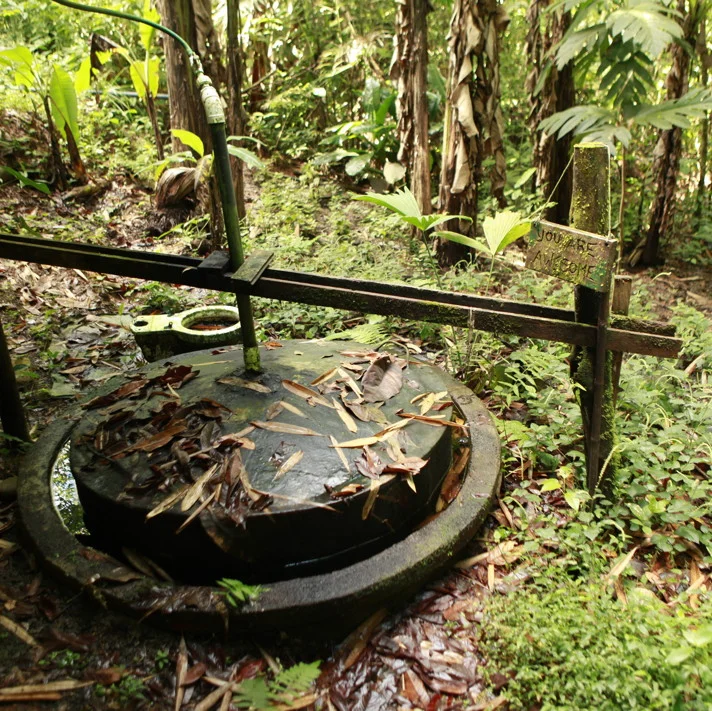
The Biodigester
It's 5.30 am in the dewy morning rainforest of Mastatal – the cacophony of squawks and birdsong remind us that the winged beings have begun their daily business of foraging for themselves and their young, the toads have tucked themselves into the nook of a tree or within a pile of leaves to avoid the relentless heat of the new day, and one by one the guests at Rancho Mastatal stretch and yawn their way out of their abodes and ease their way towards their first cup of coffee.
By Mike Paladino, 2019 Rancho Mastatal Apprentice
It's 5.30 am in the dewy morning rainforest of Mastatal – the cacophony of squawks and birdsong remind us that the winged beings have begun their daily business of foraging for themselves and their young, the toads have tucked themselves into the nook of a tree or within a pile of leaves to avoid the relentless heat of the new day, and one by one the guests at Rancho Mastatal stretch and yawn their way out of their abodes and ease their way towards their first cup of coffee. Within moments of a couple of team members arriving, one opens a valve on a stove and WHOOSH! sparks the flame upon which we will cook our breakfast. But the source for this gas isn't of your average origin. This fuel comes from one of the most potentially troublesome yet profoundly utile resources on Earth: poo.

Here at the Ranch we are utilizing two means of generating alternative energy known as “biodigesters.” A biodigester houses various bacterial species to break down organic matter and capture biogas (namely, methane) released by the bacteria in a process called anaerobic fermentation – i.e. the organic matter is digested by the microbes in the absence of oxygen. In the particular case of Rancho Mastatal and many other sustainability centres around the globe, the common organic matter for these microscopic busybodies is excrement, primarily bovine with a smaller source coming from yours truly. There are several kinds of microbes at work here. Some break the matter into simpler molecules of sugars and acids. Other microbes, which find oxygen toxic, are able to break down the simple organic matter to form gases. The ultimate end result of this process is both energy for heat and electricity as well as valuable soil amendments which we disperse throughout our gardens. Essentially all of our breakfasts (roughly 30% of all food cooked here) are prepared solely with the captured methane gas from the combined two mechanism. It is estimated that reliance upon propane as our major cooking gas was cut by roughly 50% percent after the installation of the biodigester systems.
The human waste system is (and should remain) an ultimately hands-off process. A six-foot deep brick tank surrounded by an air seal was installed seven years ago and inoculated with bacteria to jump start the production of biogas. As the two toilets are flushed, they drain into the tank where the material broken down by the bacteria and transformed into methane which is piped directly to our stove top. The system involving cow manure demands daily attention, but can usually be tended within thirty minutes or less. It requires adding fresh cow patties (one and a half recycled rice bags for us) to a 55-gallon barrel and filling it up with water. It is necessary to pulverize the material so that it becomes water soluble – roughly 15 liters for every kilogram of organic matter. Here it is left to sit for a twenty four hour period prior to being pumped into the four barrels below. As the solids settle to the top, the liquid is moved through the series of tanks below before finally arriving in a PVC bag. The gas is captured and then join the same pipe before reaching the kitchen. The solids are tossed into a 14-day compost rotation before they arrive to the gardens to be sifted and applied to our beds.

Any technology that enables us to transform abandoned “waste” into usable energy shows much promise for small-scale homesteads striving for self-sufficiency as well as society at large. And that's not just another hippie talking s&%t.

Contemplating an Uncertain Future: The Ranch and Climate Change
Climate change, after decades of lulling at the bottom of the news cycle, has belatedly made it into the headlines as increasing numbers of people become aware, convinced and concerned about the environmental and social impacts of the Earth’s evolving atmospheric conditions. I frequently think about disrupted weather patterns and what my role in this unfolding story should be.
by Tim O'Hara
Climate change, after decades of lulling at the bottom of the news cycle, has belatedly made it into the headlines as increasing numbers of people become aware, convinced and concerned about the environmental and social impacts of the Earth’s evolving atmospheric conditions. I frequently think about disrupted weather patterns and what my role in this unfolding story should be.

Many climate experts argue that we have surpassed the carrying capacity of our planet and that our natural resource base cannot support our modern lifestyles at our current population numbers. I find this argument believable given the observable degradation of our natural systems everywhere I go. Modern technology might for a time delay the worst impacts of our behavior, but soon we will stare more squarely in the face the consequences of the environmental alterations that we’ve set in motion. Indications of a more brittle world are clear to me.
Humans are descending to systematically destruct our limited natural resource base and in turn one another. I am discouraged thinking about the future that my daughter is inheriting and struggle to decide how to divide my time between work, personal care and engagement in efforts that help mitigate some of our biggest societal challenges, especially climate change. I’m not optimistic, but I cherish life, my family and my friends and strive to do my part in figuring out how we can usher in a more just world.

I was recently asked how Rancho Mastatal is responding to climate change and whether we feel as if we are helping to create an alternative future for those becoming heir to the approaching changes. In large part Robin and I started the Ranch to address and answer this question. Widespread social and environmental injustice partly inspired us to leave the United States and a more common life path to set up an “alternative” project that we hoped would contribute to a brighter future. We are dedicated to learning and teaching more environmentally appropriate ways to grow food in poor soils, build structures that are kinder on Mother Earth, and implement practices that allow us to meet our basic needs without destroying the elements that make it possible for the soil and atmosphere to sustain us. We are helping to teach future generations that there is indeed a better way to live; a way that is not dominated by an addiction to consumer purchases and modern conveniences or reliant on oppressive economic systems. We are experimenting with community structures that rely on cooperation and regeneration and have made efforts to conserve a relatively large and intact tract of rainforest.

A loss of corporate and governmental confidence in dealing with our warming climate has prompted us to start to execute strategies that make us less reliant on traditional businesses and executive bodies. We’re working towards attaining personal and communal well-being with our everyday activities and are compelled to look for ways to avoid our compromised medical care systems by looking at food as medicine. We’re looking for ways to engage in the process of designing and building our own homes with the help of friends and learning techniques to grow food for our family and community as global food supplies become more susceptible to unsteady financial systems and weather patterns. Communities are being torn apart by pollution, sickness, flagging economies and racism. To address this we want to learn and practice other forms of governance and community structure that we believe can serve us and the world more equitably.
Our modest efforts won’t be enough to stem the suffering for everyone. In fact the sad truth is that it might not even prevent future hardships for myself and family. Nevertheless, we’ve chosen to focus on this work with the hope that profound change might come from the accumulation of millions of small acts, projects and movements that when influential enough will begin to shift the human perspective to a more caring one. It’s also a way for us to prepare for changes ahead.

Future challenges will in part be most successfully met by strong networks of compassionate people dedicating their lives to the local problems that most impact them. As our daughter gets older we’ll encourage her to explore avenues that will simultaneously challenge her intellectually while leading to improvements in our world. Some of the areas that I encourage Ranch students to explore include energy conservation and renewable energy, education, responsible food production, social and environmental activism, politics, medicine, and counseling. A warming climate will require bold and courageous engineers, teachers, farmers, activists, health care professionals, mentors, and politicians. I encourage each of you today to take one small step to become a more engaged steward of our planet. If not now, then when?
Check out our updated workshop schedule to see how you can start building relevant skills to make a difference.
Read this interesting article about how agroforestry can help to sequester carbon, Can Dirt Save the Earth?

No Pickup, No Problem: Social Capital Trumps a Shitty Situation
My hands are grappling the rumbling, rusty wheelbarrow handles, and as we walk half a mile through the village, everyone can hear the five Rancho apprentices clunk on through. In a village of 120 people, your whereabouts are everybody's business. Don't worry, I want to say, this will all make sense soon. They'll be having a chuckle by the end of the day. For now, we are five warriors defending alternative energy. We are making the best use of our woman power (and Dan power) when the white pickup truck is out of commission. We are going to pick up poop.
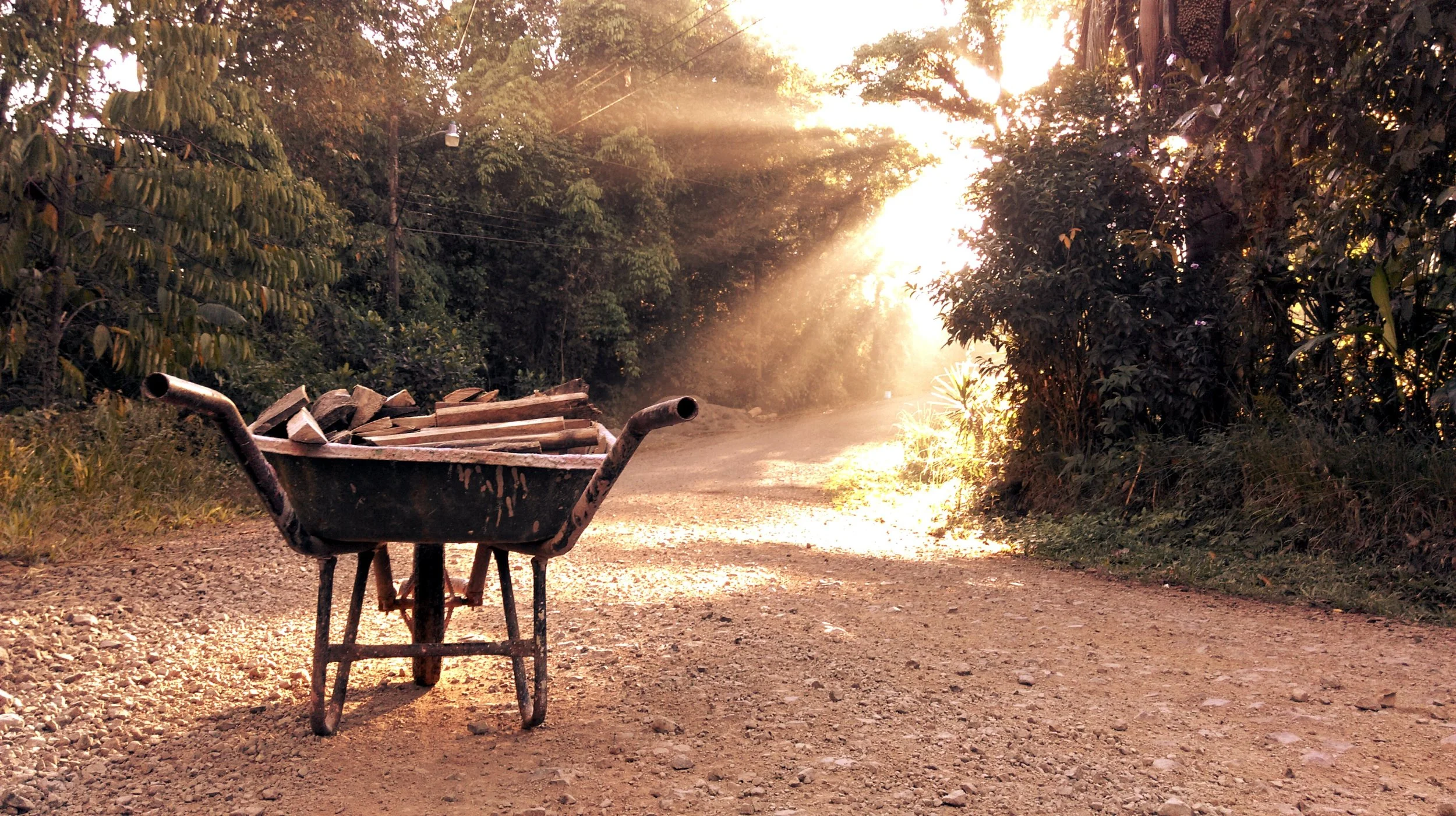
My hands are grappling the rumbling, rusty wheelbarrow handles, and as we walk half a mile through the village, everyone can hear the five Rancho apprentices clunk on through. In a village of 120 people, your whereabouts are everybody's business. Don't worry, I want to say, this will all make sense soon. They'll be having a chuckle by the end of the day. For now, we are five warriors defending alternative energy. We are making the best use of our woman power (and Dan power) when the white pickup truck is out of commission. We are going to pick up poop.
As Timo explained in a blog post last month, poop is the essential ingredient for synthesizing our kitchen's methane gas supply. Once a week, the white pickup truck is driven half a mile up the road to pick up ten sacks of manure. Assuming you have the human labor and the car labor, it's a brilliant system-- until the white truck, which has seen more years than myself, stops working. No truck, no poop, you say. Chuckle chuckle. Four of the baddest chicks and one man are about to prove you wrong. Here are two cents, to boot, on what makes a functional energy system.

We make it to Finca Siempre Verde dripping in sweat. Chilo, our friendly poop dealer, greets us as we roll five empty wheelbarrows up the driveway hill. Since we're on the theme of biodigestors, he offers to give us a tour through his biodigestor system. It's a work in progress, but here are the pigs. He shows us the pig pen which gets hosed down, and where the poop drains into a pipe. He then shows us a newly built pen that is slightly lower than the kitchen. Here, Chilo explains, will be the new site for the biodigestor. The manure will wash directly into the feeder barrel, no transport necessary.
We are five champions of renewable energy and suddenly I am wondering why my journey to move poop suddenly seems less noble. Here is a system that capitalizes on the fact that the source of manure is located at point zero for the biodigestor intake. If Chilo had a failure in one of his auto parts, there would still be gallo pinto on the table. Is Chilo's biodigestor any different than ours, or am I just about to push 100 pounds of manure half a mile because we built a delicate, un-resilient system?

Biological systems, such as Chilo's pigs, are complex. They are composed of living, breathing organisms whose livelihood is ingrained in the health of the entire system. As long as Chilo (who is also a living component in the system) continues to produce food on his farm, process it in his kitchen, bring the scraps to his pigs, and maintain his system accordingly, then poop will continue to flow through the biodigestor, methane will continue to be produced, food will continue to be produced, and the pigs will continue to be fed.
Now, suppose we swapped out those pigs for one of those nifty new robots on the market. The Porkolator 3000 is equipped with machinery that makes it the most efficient robot in converting biomass to waste product. This technological feat is revolutionary. As it turns out, however, the company that manufactures the Porkulator did not create the machine with the capacity to heal from, say, an erupted engine. So when that breaks down, and Chilo doesn't have a spare engine in the middle of the jungle, how on Earth will the gallo pinto get made?

Pigs are complex; Porkolators are complicated. The difference between a living system and a non-living system is that a living system has numerous connections and survival responses in accordance with the environment, whereas a non-living system cannot respond. A non-living system is complicated because if there are 1000 pieces and the tropics rusts one obsolete, the system will fail to function. A living system has 999 pieces you can name, and 999 to the ninth power of interconnections you cannot even see, that when one piece fails, the show must go on. On that day, our pickup truck proved to be complicated because the inability to start the engine meant that our biodigestor risked starvation.
Pigs are not the only example of complex, living systems. Communities are also complex. In the wake of realizing that our biodigestor may not get fed, we rallied the troops and took action. That's right, our engine may have failed, but our spirit did not. That morning, five apprentices and ten sacks of manure rolled through Mastatal and it didn't matter that my forearms were burning or that my hands were too dirty to wipe the sweat from my eyes. We were resilient, and let warm gallo pinto be proof.

News from around the Permaculture Community
We love books at the Ranch! Our library is constantly growing as each of us pick out a few new books to populate our shelves. Our favorite publisher is Chelsea Green publishing, and the folks over at Permies.com have been busy reviewing many of their best books. Check out the review list to see if any belong on your shelf!
The National Institute of Apprenticeships in Costa Rica is having their annual Agroecological Festival this December 3 & 4 in Cartago. We hope to attend. This will be a great opportunity for anyone interested in connecting with the Costa Rica permaculture and urban farming community!
Abrazos
The Ranch Crew
Categories
Topics
- Agriculture 6
- Agroforestry 21
- Animals 2
- Apprenticeship 19
- Appropriate Technology 6
- Backpacking 1
- Bananas 1
- Basic Pantry 4
- Biochar 1
- Books 3
- Build Your Own Home 1
- Central America 5
- Chiles 1
- Cinnamon 1
- Clay Carving 1
- Climate 2
- Climate Change 1
- Cob oven 1
- Communication 5
- Community 24
- Compost 2
- Composting Toilets 2
- Condiments 1
- Conservation 2
- Cooking 4
- Costa Rica 18
- Design 10
- Earthen Construction 10
- Eat Local 2
- Ecohome 1
- Education 9
- Environment 3
- Ethics 4
- Farm to Table 12
- Fasting 1
- Fermentation 14
- Food 22
- Food Choices 8
- Food Forest 8
- Food Processing 15
- Food Systems 12
- Gap Year 1
- Gardening 5
- Ginger Beer 1
- Harvest 2
- Health 12
- Healthy living 5
- Homemade 2
- Homestead 8
- Internet 2
Due to popular demand we have put together a document that outlines how our composting toilets are designed and made. The documents include
-dimensions for different size chambers based on number of people using it
-door design
-chamber design
We have spent years fine tuning our design and details based on what is easiest and what works. This is the culmination of building 11 different composting toilets and each time improving the design.
It is important that you understand that this design is only for the composting toilet element, it does not include any of the timber frame or bamboo framing that form the structure for the roof that covers these all over the ranch.