

BLOG
Stories, articles, and updates from the Ranch community.

6 reasons to use a biodigester as a low tech, off the grid, renewable energy source for cooking
For almost two decades now, Rancho Mastatal has been working on creating a more sustainable lifestyle by researching, developing, and teaching about more efficient ways to build, grow food, cook, and live as a community while reducing the impact these activities have on our environment.
As cooking is one of the most energy-consuming activities within a house, we find it relevant to implement an alternative renewable energy source to satisfy one of our guests’ favorite moments of the day: meals. With that perspective, we built a biodigestor 8 years ago.
6 reasons to use a biodigester as a low tech, off the grid, renewable energy source for cooking
By Nico, Apprentice 2020
“Agricultural, industrial, and human digestion processes create an ongoing (and growing) stream of organic refuse. Without thoughtful management, organic wastes can emit fugitive methane gases as they decompose. Methane creates a warming effect 34 times stronger than carbon dioxide over one hundred years.” - Project Drawdown
Renewable Energy for Cooking
For almost two decades now, Rancho Mastatal has been working on creating a more sustainable lifestyle by researching, developing, and teaching about more efficient ways to build, grow food, cook, and live as a community while reducing the impact these activities have on our environment.
As cooking is one of the most energy-consuming activities within a house, we find it relevant to implement an alternative renewable energy source to satisfy one of our guests’ favorite moments of the day: meals. With that perspective, we built a biodigestor 8 years ago.
What is a Biodigestor?

Our biodigestor
A biodigestor is basically a system that allows us to produce methane out of human and animal manure (see more info on last year’s article). Here at the Ranch we decided to go for a low tech, polyethylene tubular biodigester technology, also known as the sausage system here in Costa Rica, because of the shape of the chamber. We chose this because it is a cheap and simple way to produce methane for small-scale farmers. It is appealing to rural people, firstly because of the low cost of the installation and therefore of the gas, and also for the improvement in the environment that the installation allows. It can be applied in rural or urban areas and in both low and hilly lands, creating a low tech system able to produce a renewable energy source as well as a fertilizer for your land.

A glance at our system
6 Reasons to Build a Biodigestor
But besides the awesome concept of being able to transform waste into energy, there are many other advantages to having a biodigestor. Here are 6 reasons on why you should build one:
1. Biodigestors can be Low Tech
A common misconception about biodigestors is that they should be these high tech, expensive systems made out of a lot of different components. Like people, biodigestors come in many shapes and sizes: from continuously fed to batch fed, made out of metal or polyethylene, vertical or horizontal, using cow manure or human waste (or both), there is probably a biodigestor out there waiting for you. If you decide to go for a simple system like ours, there aren’t many components and you would be surprised by their simplicity. With the help of a couple people and some skills, you can set your system up within two days. The maintenance is pretty simple as well, and again, depending on the system you choose, you can decide to either dedicate a bit of time for maintenance every day, or choose a batch fed system, which takes more time to put in place but is then autonomous for a couple weeks
2. Biodigestors can be cheap
Again, this depends on a lot of variables: which system you choose, whether you have to excavate soil, if you are willing to do it yourself or prefer hiring people, whether you are able to use reused materials, etc. For instance, the main component of our system, which acts as a fermentation chamber and a gas reservoir, cost us $700.
3. It can be used off-grid
Here at the Ranch, the amount of people coming through doesn’t allow us to be completely off the grid; we cook over 23,000 meals a year! We still decided to implement this system in an effort to reduce our dependence upon fossil fuels such as propane and take a step toward ecological self-sufficiency. For smaller communities, like a small scale farm, or by increasing the size of the system, it is totally possible to implement an off the grid cooking system.

The methane stove that we cook meals on
4. It creates a nutrient rich organic fertilizer
This low tech system houses a wide variety of bacteria, each one with a specific task. Some break the matter into simpler molecules of sugars and acids. Other microbes, which find oxygen toxic, are able to break down the simple organic matter to form gases. The ultimate end result of this process is both the natural gas for heat and electricity as well as valuable soil amendments which we disperse throughout our gardens.
5. It reduces the greenhouse effect
Methane, CH4, which makes up 70% of the biogas produced by our biodigester, creates a warming effect 34 times stronger than carbon dioxide. By burning this gas, not only do we create a renewable energy source that allows us to produce energy, we decompose the methane into a less potent greenhouse gas.
6. It’s comfortable
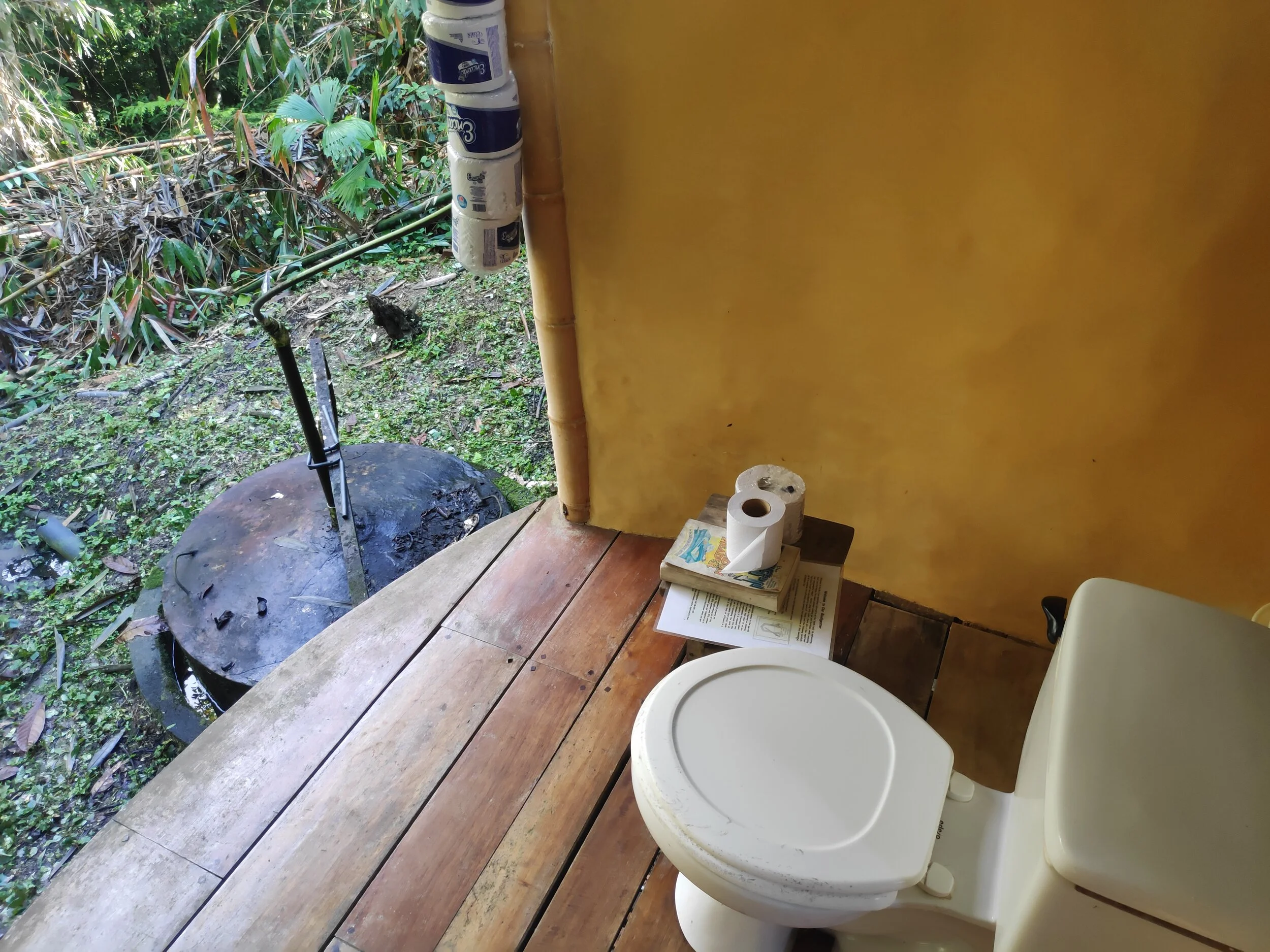
Some people are apprehensive about the idea of having to use a composting toilet ( even though they shouldn’t be, see article by Moanna on Composting Toilets to discover all the wonders of using a composting toilet, a wonderful low tech and off the grid system). By connecting your greywater system to a biodigestor, you will keep the comfort of doing your doodies in a water system while doing your duties for our wonderful Earth. As a matter of fact, our biodigster’s toilet was voted the Best Compost Loo In The World Award in 2012 by the readers of Permaculture Magazine, Inspiration for Sustainable Living.
Why else are Biodigestors Great!
The list doesn’t stop here. A biodigester helps reduce landfill and water-polluting effluents, and eradicates odors and pathogens. It allows small scale farming to create a renewable energy source while allowing them to better control the breaking down of their animal manure into fertilizer, being more self-sufficient and less dependent upon other chemicals. In a world where it has become increasingly urgent to find simple solutions to step towards sustainability, implementing low tech and easy to manage solutions like this one seems more relevant than ever.
The Project Drawdown, a comprehensive plan to combating climate change, puts Biodigestors in the top 100 things we can do.
Hope you feel inspired to think about and make changes to the current system of waste management.
Check out Moanna’s latest article on why composting toilets are another great way to make a sustainable change in the system.

Timber Framing: A Real Application of Sustainable Forestry Management
The deforestation problem that constantly threatens our global forest resources is one that we can overcome. To accomplish this, though, we must again learn to give our forests real value. The main idea here is that our forests must be more economically valuable in their current state than they would be under competing land uses. If not, they will be deforested.
Timber Framing: A Real Application of Sustainable Forestry Management
By Anthony, 2020 apprentice
The deforestation problem that constantly threatens our global forest resources is one that we can overcome. To accomplish this, though, we must again learn to give our forests real value. The main idea here is that our forests must be more economically valuable in their current state than they would be under competing land uses. If not, they will be deforested.
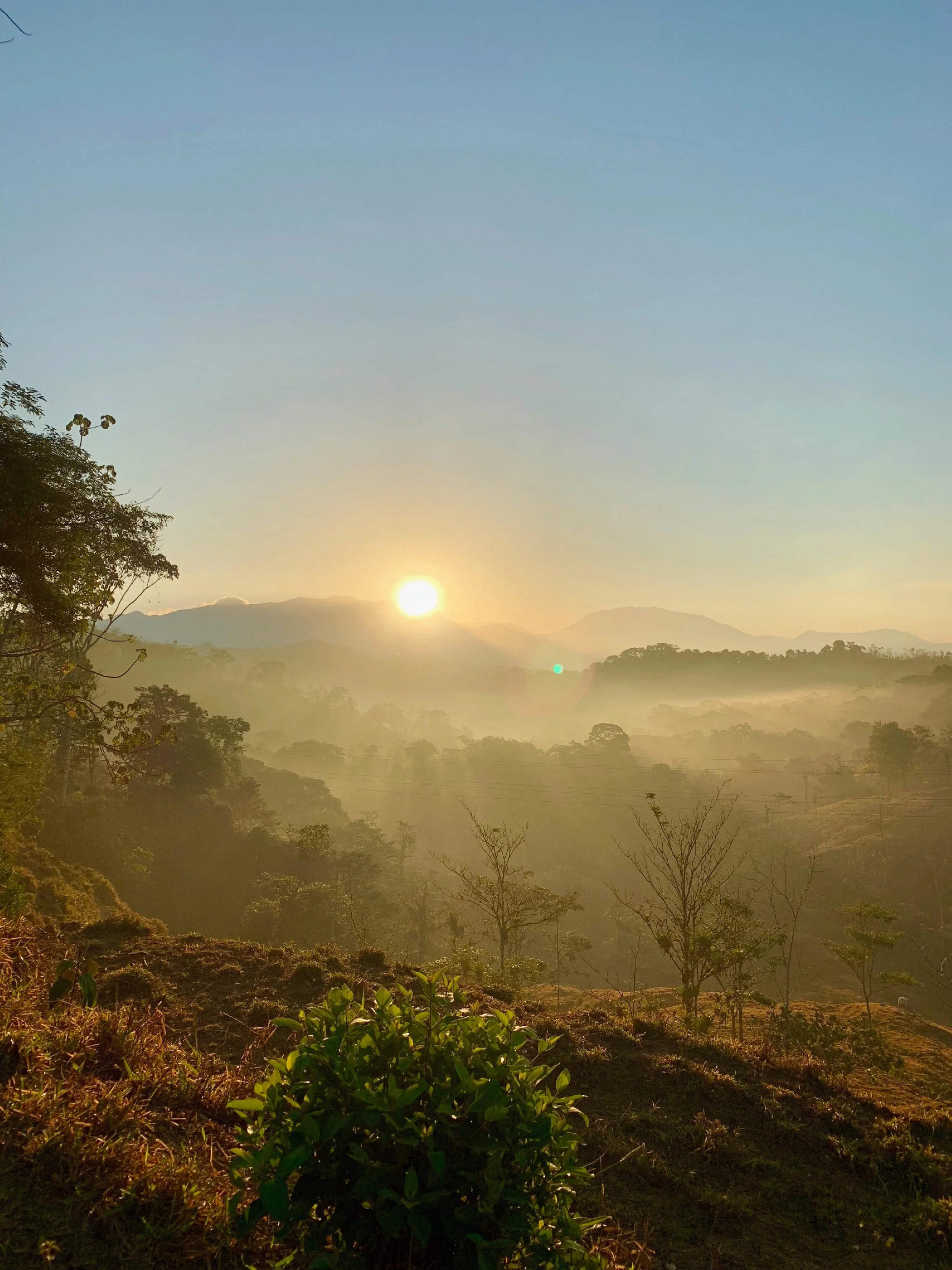
Cattle Pasture and Forest,
Latin America’s diverse and astoundingly beautiful forests are constantly under threat. Here, deforestation occurs when forest owners decide that they can earn more money doing something else with their land. Forests are routinely slashed and burned to make room for agricultural systems, cattle ranches, infrastructure, urbanizations, and mining, to name a few alternative land uses.
One real strategy to conserve our precious forests is sustainable forestry management, a practice that selectively and sustainably chooses trees to be harvested within a forest in order to use their timber for construction, furniture, tools, and artisanal products. When well planned and carried out respectfully, sustainable forest management gives way to increased biodiversity within a given forest, offers employment opportunities in rural communities, and, perhaps above all, makes a forest’s continued existence economically possible.
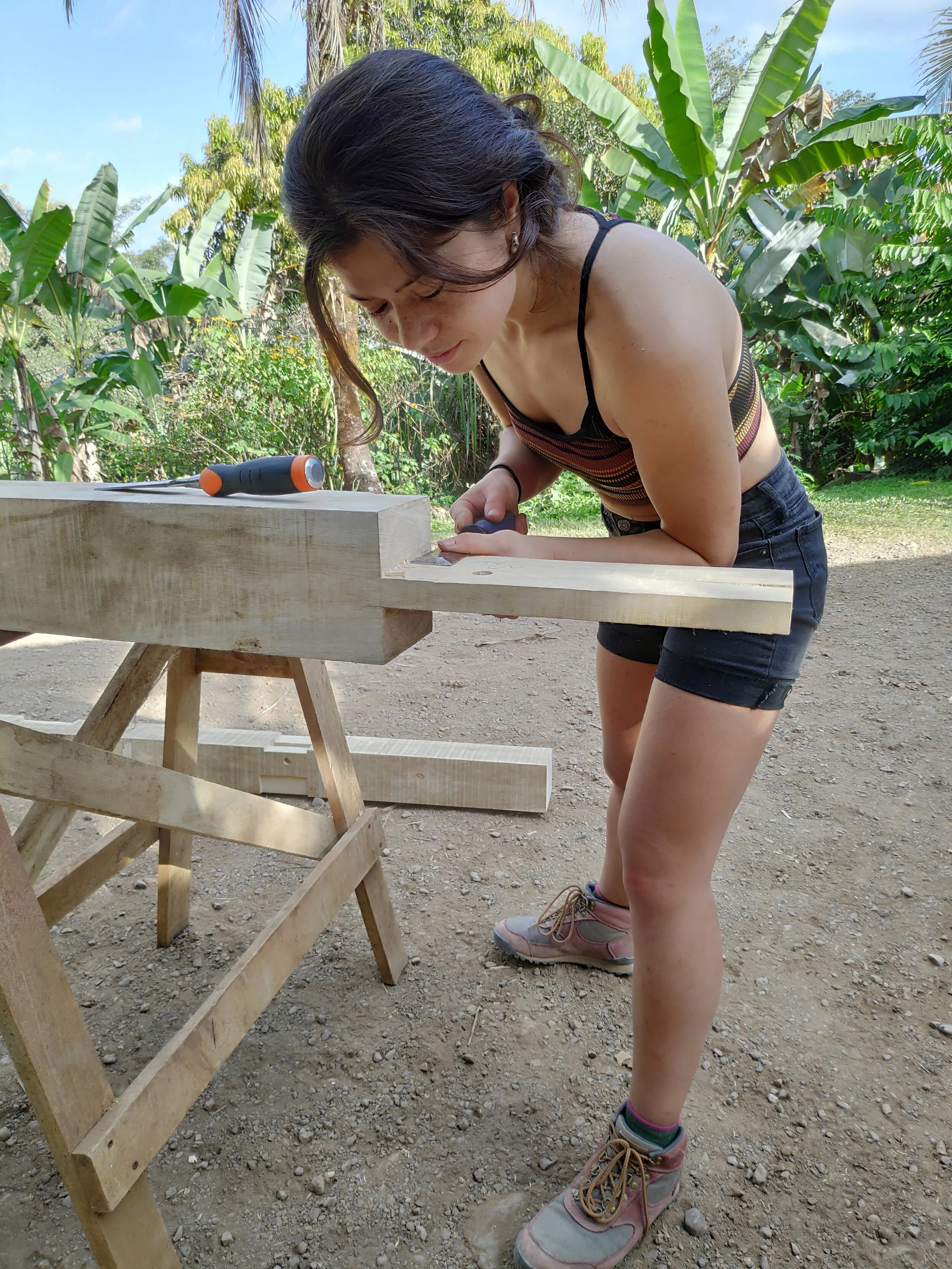
Timber Framing
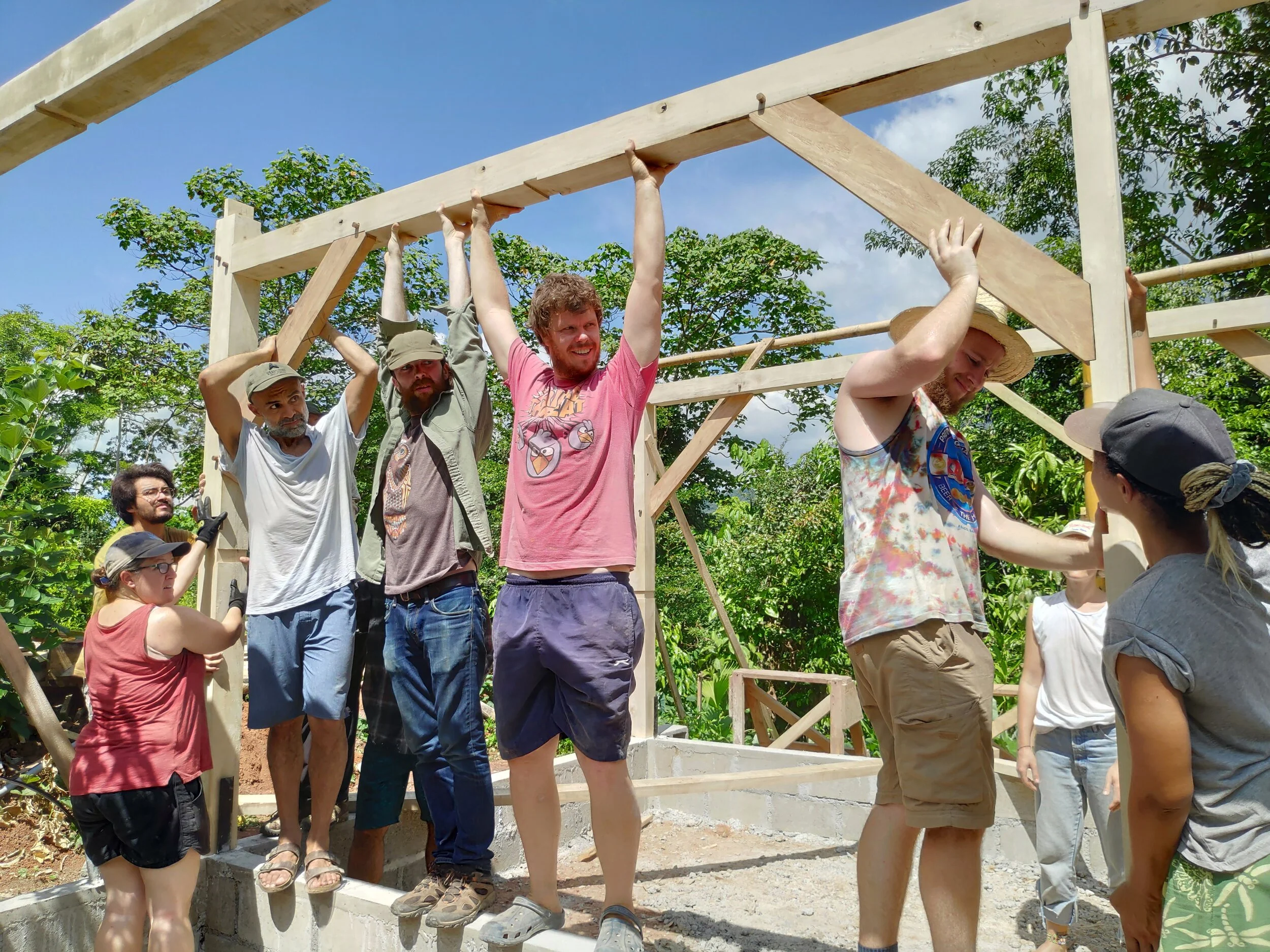
Rancho Mastatal is putting this plan into action. This Costa Rican-based educational farm offers workshops in diverse areas with an emphasis on sustainable community living in the tropics. One of their flagship courses, ‘Introduction to Timber Framing’ leads workshop attendees through the process of building a simple and elegant timber frame home. Starting with the basics, such as tool sharpening and laying out a timber using the square-rule method, the workshop ends in climactic style on raising day when the students see their work come to fruition. After many days of focused, methodical work chiseling and sawing, the timber frame home is assembled in a swift group effort in a single morning. The workshop is an ideal combination of focused individual development and group camaraderie.


Sourcing sustainable wood
The timber used for the construction of Rancho Mastatal’s timber frames originates from two main sources, both of which are sustainably and carefully chosen: selectively-felled trees from managed secondary forests, and trees planted specifically to be harvested for their wood. Additionally, the national context of the timber frame workshops is significant. Rancho Mastatal exists in a nation aiming to be carbon neutral by the year 2021. So far, large-scale national strategies have been based on a renewable energy sector, yet little has been done for real improvement in the construction sector. Here Rancho Mastatal leads the way toward carbon neutrality while conserving tradition.
To be original, one returns to the origins. Sustainable forestry management and timber frame buildings are ancient traditions that must be practiced in order to be culturally conserved. By integrating these traditions into a business plan through its educational workshops, Rancho Mastatal and its core team aim to realize an originality apt for modern times.

A nice display of the different joinery in one post
Stay tuned for the next blog Timber Framing Tips: The Things You Didn’t Know You Needed to Know.
Join us in 2021 for our Timber Framing Workshop to get hands on practice and instruction on this beautiful and traditional form of building.

Transforming Human-waste into Fertilizer: Compost Toilets
You likely grew up with flushing toilets, seeing your poop as something to dispose of, but you might also be one of those who agree that humans can only thrive once we live in harmony with nature. The zero-waste movement is in a sense, a yearning to imitate nature where there is no such thing as waste; one organism's excrement is another's food. Compost toilets turn human "waste" (discarded feces and urine) into soil fertility as humanure (food for micro-organisms and fruit trees) - the actual human waste is everything that cannot decompose: cigarette butts, plastic-sixpack rings, deodorant cans, batteries, the five billion gallons of polluted drinking water we flush down our toilets everyday, and the millions of tons of organic material dumped into the natural environment year after year.
Transforming Human-waste into Fertilizer: Compost Toilets
by Moanna , 2020 Apprentice
"Carelessly dumping waste out into the world is a self-centered act of arrogance. Humanure composters can stand under the stars at night gazing at the heavens, and know that, when nature calls, their excretions will not foul the planet. Instead, those excretions are humbly collected, fed to microorganisms, and returned to the Earth as a healing medicine for the soil" -
Joseph Jenkins, author of the Humanure Handbook
Zero Waste?
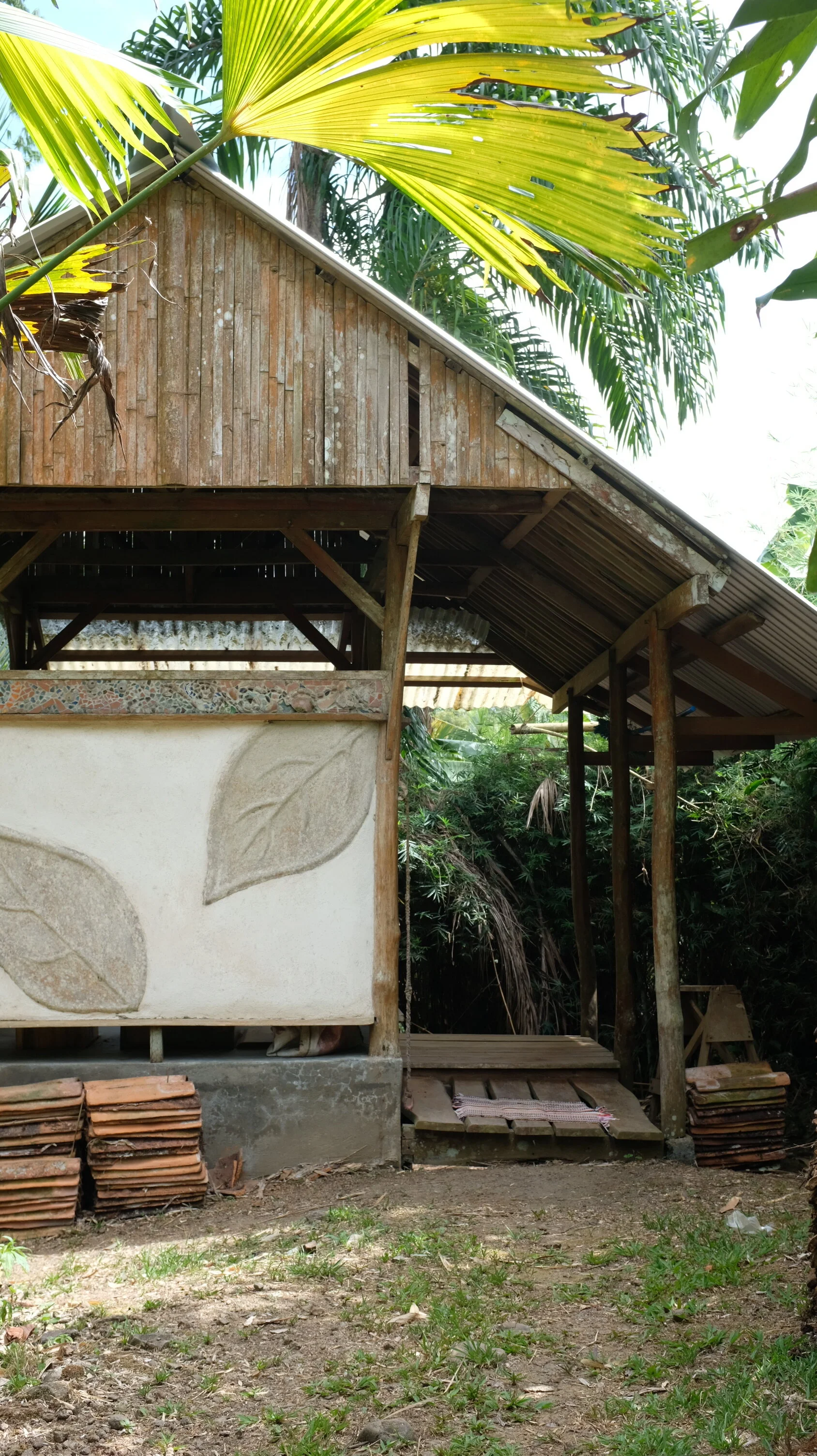
You likely grew up with flushing toilets, seeing your poop as something to dispose of, but you might also be one of those who agree that humans can only thrive once we live in harmony with nature. The zero-waste movement is in a sense, a yearning to imitate nature where there is no such thing as waste; one organism's excrement is another's food. Compost toilets turn human "waste" (discarded feces and urine) into soil fertility as humanure (food for micro-organisms and fruit trees) - the actual human waste is everything that cannot decompose: cigarette butts, plastic-sixpack rings, deodorant cans, batteries, the five billion gallons of polluted drinking water we flush down our toilets everyday, and the millions of tons of organic material dumped into the natural environment year after year.
Two thirds of the world have no toilet, and don't have a choice, and must live intimately with their shit. Some of us have the opportunity to use it as fuel and fertilizer, instead of turning it into poison. It can feed us, heat us and cure us. There are so many ways to shit properly.
Composting Toilets
Pooping at any of the Rancho's outdoor compost toilets is a pleasing experience; they are made of beautiful natural materials and you are likely to observe all kinds of butterflies or birds. What has nourished your body and instead of being disposed, will feed and sustain millions of other lifeforms. Pooping and urinating becomes a contribution rather than a disposal; instead of waste that gets dumped somewhere, it's a useful resource that gets valued.
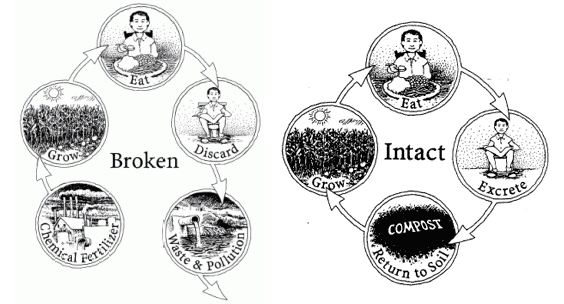
From the Humanure Handbook by Joseph Jenkins
The human nutrient cycle goes like this 1) grow food 2) eat it 3) collect and process organic residues (feces, urine, food scraps) 4) return the processed organic matter to the soil, thereby enriching the soil and enabling more food to grow!
Why Composting Toilets?
"If you want to be free, learn to live simply. Use what you have and be content where you are." - Joseph Jenkins, author of the Humanure Handbook
It is not only for those with gardens and fruit trees who should be excited by humanure but all of us who value clean water and air. Compost toilets align with the permaculture ethics of care for Earth and people, and a fair distribution of resources. Here are a few aspects on why and how.
Protect and save water
Each toilet flush launches five to six gallons of polluted water - All life depends on water, and although Earth is mostly water only 3% is without salt and of that 2/3's are locked up in ice - this means that humans pollute the less than 1% of drinking water we have. If a household switches to waterless toilets it would save 40 thousand gallons of water per year. Each flush usually goes somewhere to be "treated", where despite the massive amount of energy and chemical input, pollutants such as nitrates, chlorine, pharmaceutical drugs, industrial chemicals and many more are let out into our living planet, which affects us since we are apart of and one with this living world.
Pumps up resilience
We will be facing all kinds of disruption due to the speed and frequency of natural disasters and their consequences. Flushing toilets rely heavily on well-established infrastructure, and loads of energy, water and chemicals. With the growing number of natural disasters, this system is super vulnerable as storms, floods, and fires can cause disruption many parts of that system. Urban and suburban areas globally are experiencing storm events causing flooding and overflowing the basins in sewage systems. This can go on for days or weeks, and human excrement along with all the other waste that goes down the drains ends up in the streets, and we're back to the middle ages where diseases and pathogens get to have a big party. So if you know how to compost and make humanure, you can stop relying on this fragile and eco-cidic system and help others in the same direction, and when disruption occurs in your surrounding community you can continue to recycle your brown gold!
Compost can degrade toxic chemicals
An Austrian farmer could feed his community with the produce from his fields that were sprayed with compost-type microorganisms, whereas the produce from surrounding farms were banned due to radioactive cesium contamination from the Chernobyl disaster. Micro-organisms in compost are able to digest these toxic compounds because many produce antibiotics. If this excites you, check out Mycilium Running by Paul Stamets.
SCARY FACTS About the current waste system
There is an exceptional degree of agreement within the scientific community that natural systems can no longer absorb the burden of current human practices
The use of antibiotics is so widespread that many people are now breeding antibiotic resistant bacteria in their intestinal systems. These bacteria are excreted into toilets and make their way to wastewater treatment plants where the antibiotic resistance can be transferred to other bacteria, and the water containing and breeding these bacteria is led out into our living planet. The chlorine used to supposedly clean water seems to increase bacterial resistance to some antibiotics. (Waste water microbiology p.86 Humanure Handbook)
Chlorine is used to disinfect much of the world's drinking water and wastewater before its released out to our environment. The most harm comes from the by-products such as chloroform and dioxin, that cause all sorts of awful stuff such as death in snapping turtles, death in lake trout, reproductive problems in otters and minks, and cancer in humans - to name a few.
50-90% of pharmaceutical drugs humans consume end up in waterways - chemotherapy drugs, antibiotics, hormones and much more are found in tap water, lakes, rivers and drinking water aquifers.
Too often waste is being dumped into water bodies, which the treatment plants are not prepared to deal properly with. Sadly governments and private co-operations are too busy to let consumers know - in review of twenty water systems in six states, out 157 drinking water quality violations, the public were notified on time in only 17 of the cases (humanure book pg 112).
Humanure Fun Facts
Human excrement is in many south east asian countries known as "night soil", and was never wasted. Quite the opposite it was a valuable resource! On the island Tainan in Taiwan it was sold on blackmarkets to fertilize fishfarms.
Fecal transplant saves lifes: A dose of healthy poop, with its 35,000 families of bacteria, can replenish the gut's flora and settle it back to normal. With our massive use of antibiotics we wipe out the good bacteria along with the bad. Transplanting a healthy gut flora into a one suffering from Clostridium diificile (which kills 100,000 each year in america and europe) has been shown in studies to heal 91% of patients in certain cases. (Colours magazine, Shit: a survival guide)
Squating while pooping is the most healthy posture, as it straightens the canal to the desirable 132 degrees. In a study it took squatters 51 seconds to move their bowels, while it took 131 seconds for those who sat. (Colours magazine, Shit: a survival guide)
How do Composting Toilets Work?
"Composting is easier to do than to describe, and like lovemaking, magic when you do it well" -
Sim Van der Ryn
Is it safe? Will it eliminate pathogens and diseases? Does it get stinky? Will it attract flies and rats? Is it hard work? All these question will depend on how the system is designed. There are loads of different systems, and ways of composting humanure. You can buy all sorts of commercial composting toilets, and your climate, local regulations and way of living will guide you to the most appropriate way to turn your "waste" into resource. * This also means that the decomposition process depends on and varies according to each system, place and environment. *
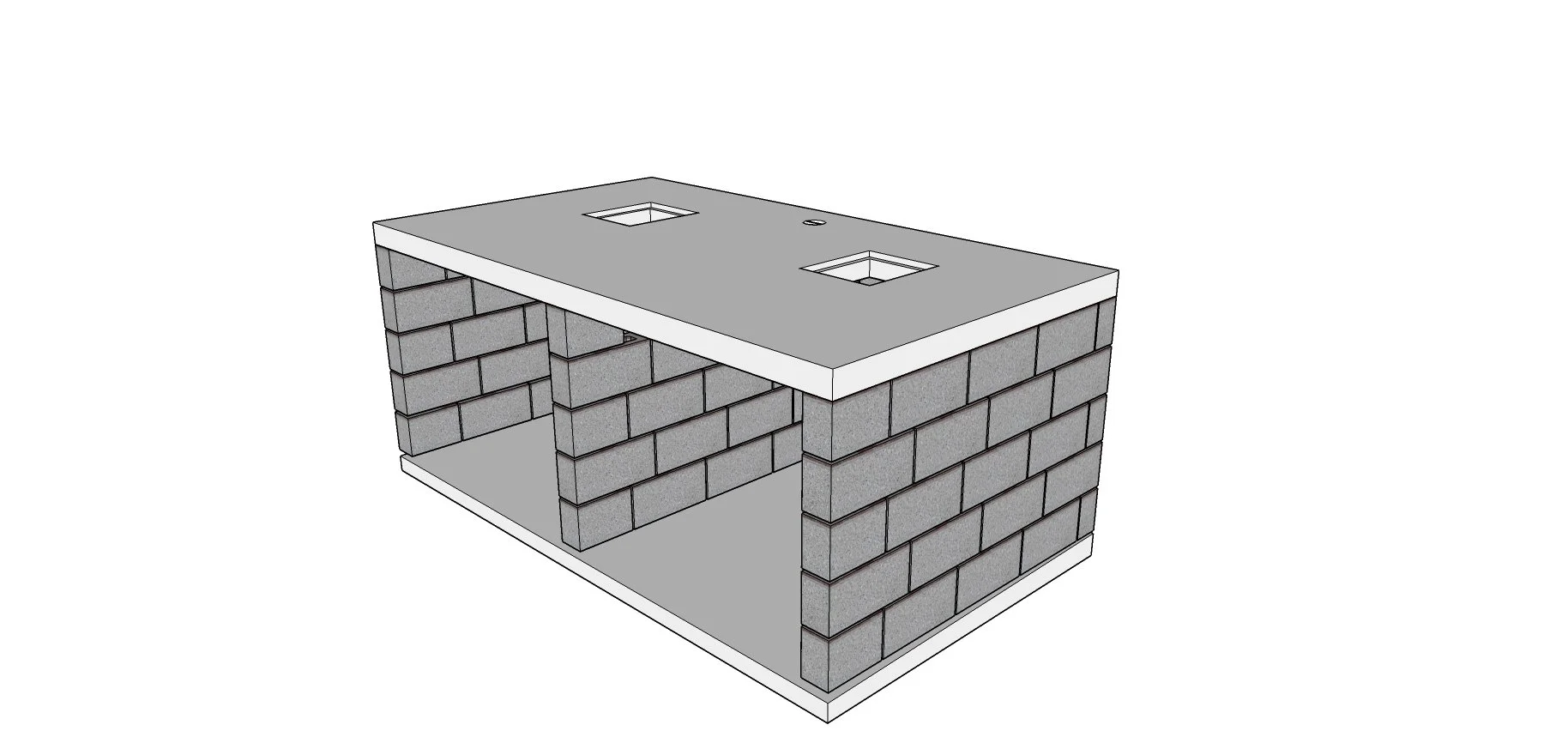
Here at Rancho Mastatal we have 11 composting toilets in 2 sizes (large scale capacity and single family capacity). We size these based on their location and projected use. All of them are designed to be passive systems with little to no management or maintenance. The Ranch's compost toilet system is simple; there are two chambers, when one is filled it gets left to decompose, and by the time the second is filled, the first has transformed into brown gold/rich fertilizer!
The ones in the pictures are the large size composting toilets (each chamber about 2m x 1m x 1m), these are used on average over the year by 7-10 people. They have been sized to take about one year for one side of the chambers to fill up, and the decomposition process is also one year, the same amount of time for the other side to get filled up.

Emptying a composted side of humanure into reusable bags to spread on our orchards

The 2 chamber system that we use here
Composting requires 4 neccesities: Oxygen, moisture, appropriate temperature and a balanced diet, which is the right carbon/nitrogen ratio. When these conditions are right bacteria will start to get active and heat up the compost, creating temperatures over 120 degrees fahrenheit. This rapidly kills pathogens, and just like Mother Nature intended, humanure is a treat for the soil.
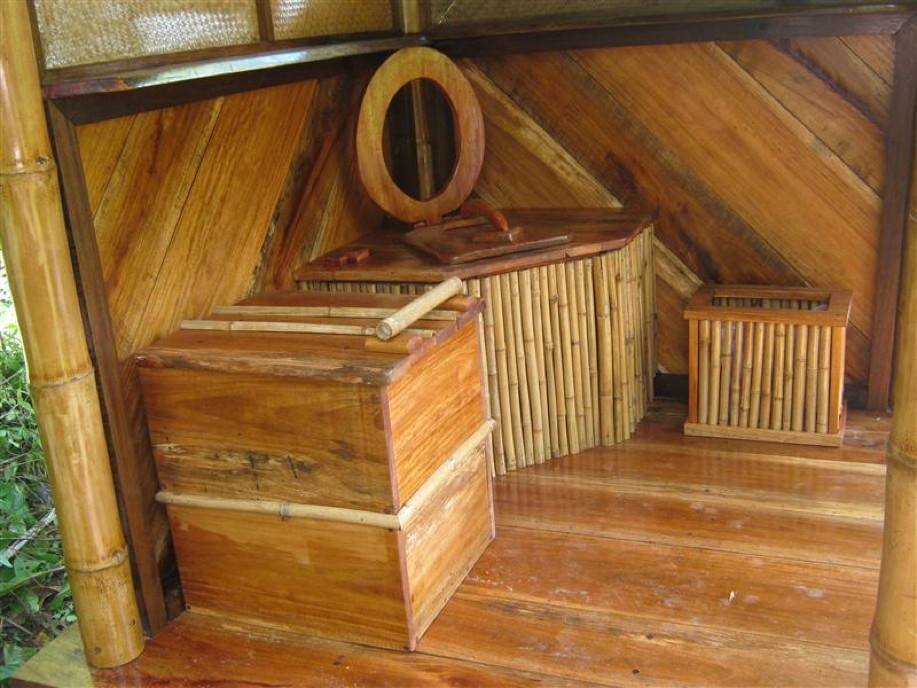
A cozy seat
When one chamber is filled the toilet-seat is moved on top of the next chamber, the first is left to decompose with a lid on, and in between is a box for sawdust. For each 'contribution' 2-3 scoops of sawdust is applied to balance the carbon/nitrogen ratio (Sawdust is the carbon sucking up all the nitrogen rich human contributions). Before starting a new chamber it is filled with bigger bulky carbon materials, generally a lattice of bamboo or sticks. This helps create an aerobic environment for the composting organisms to do their work and we avoid having an anaerobic environment, which means no air for the good bacteria to do their job resulting in a stinky toilet.
The design of this system is based on the diverse flow of people on the Ranch; when we have all kinds of people in different quantities for many different periods of time that use our compost toilets, the design is simple for low maintenance. All that needs to be managed is to make sure there is sawdust available and adding the finished soil fertilizer around our orchards once a year. Our main food production is in agro-forestry so we feed the humanure to the trees, by using the natural biological filter of the trees nutrient absorption system we get as an extra layer of safety from any potential pathogens or chemicals in the humanure.
The Composting Stages
Stage 1:
Mesophilic bacteria, (100 million - 1 billion per g of compost), eats, reproduce and create heat until it reaches around 44-52*C (111-125*F) which is the transition to
Stage 2:
Thermophilic bacteria thrives in the higher temperatures, takes over and continue to create heat, sometimes reaching up to 70*C . This heating stage can take place over days, weeks or months. As it cools down again we reach
Stage 3:
Where more diverse organisms such as fungi and earthworms moves in, and digest bigger and more coarse material.
Stage 4:
Is the curing/maturing phase, a long and important one. A long curing period (e.g., half a year in the tropics or a whole year in the temperate, after the thermophilic stage) adds a safety net for pathogen destruction. The longer they are subjected to the microbiological competition of the compost pile, the more likely they will die a swift death. All of this is linked to the soil food web.

Humanure is harmless to handle once fully decomposed and aged
Thanks to the bacteria, fungi and bugs, thriving with good moisture, air and a mix of human excrement and sawdust, the poop from 2018 has gone through a curing process through 2019, and last month the 2020 apprentice team could empty out the beautifully smelling and textured humanure.
Before you begin on this journey towards saving water, decreasing the the extraction and pollution of limited clean freshwater, protecting planetary health and enhancing soil fertility, further exploration and information is necessary. Some simple tips would also be to explore the possibilities to phase out flush toilets in your local community and check out what other people in similar situations to you are doing to stop pooping in drinking water. "The Humanure Handbook" is possibly the best and most enjoyable source of information, Joseph Jenkins shares his 20+years of compost toilet experience and knowledge, and the way he writes has made many crack out in laughter.
This simple low-tech composting system has a positive impact on the Earths ecosystems, making us closer to a harmonious relationship with this living planet. It aligns you with permaculture principles such as catching and storing energy, creating zero-waste, obtain a yield, and makes use of the permaculture attitude where "the problem is the solution". We don't need more science or bigger technology or complexity to meet the crazy complicated crisis that we're facing, but some humility and respect for all that is simple; deal with our own excretions, by making humanure that enhance soil fertility!
Legal issues in Costa Rica
Yes! They are Legal!!
In Costa Rica the legal principles guiding black water disposal are based on the possible contamination of fresh water resources. Composting toilets fall into the category of a safe alternative to blackwater disposal as they don't even create the blackwater in the first place as they are dry (use no flush system). In this document published by the ministry of health, you can see in annex 5 (scroll all the way to the bottom) that composting toilets are legally allowed as a viable alternative to a conventional septic system if the stipulations as outlined in the document are met. This is exciting news for people based in Costa Rica and hopefully can act as a catalyst for other places in the world including them in the building and health codes.
Humanure into Food?
Methane from a Biodigestor
Here at The Ranch our compost toilets feeds the soil, and our Bio-D toilet makes gas for cooking breakfast, it is more attractive option for those who are more comfortable with a flushing toilet, and it is another way of turning "waste" into a valuable resource.

Our biodigester
Black soldier flies
They eat everything, create rich fertilizer and both insects and flies can be a rich protein source for chickens!
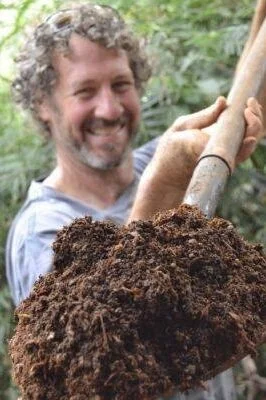
A beautiful scoop of humanure

One of our outdoor compost toilets
Hope you feel inspired to, if you can, stop contributing to the modern waste cycle and start creating closed loop systems! Don’t know what closed loop systems are? Join us for our annual Permaculture Design Course to learn about the ethics and principles of permaculture design.
We have been using compost toilets here on the farm for 19 years and always had successful turnouts.
Stay tuned for our next blog on our biodigestor.
Farm to Table Banana Vinegar
I know, it sounds like a weird flavour combo. Sour banana? Whaaat? But it works and it’s tasty. This recipe is a very accessible way of doing farm to table whilst utilizing and transforming “waste” into something productive and delicious – permaculture 101.
Farm to Table Banana Vinegar
By Marco, Apprentice 2020
Permaculture Vinegar?
I know, it sounds like a weird flavor combo. Sour banana? Whaaat? But it works and it’s tasty. This recipe is a very accessible way of doing farm to table whilst utilizing and transforming “waste” into something productive and delicious – permaculture 101.
What makes a Vinegar
Firstly, let’s take a quick look at what vinegar is. The word vinegar comes from the Latin vinum acer – literally “sour wine”. Alcohol is fermented by a large family of bacteria called Acetic Acid Bacteria (AAB), who turn ethanol into acetic acid. These little guys are everywhere - airborne and on the surface of most living things including me, you and, as it turns out, bananas! AAB are aerobic, which means they need air (oxygen) to do their thing, unlike Lactic Acid Bacteria for example (the main players in lactic acid ferments, such as kimchi and sauerkraut) which are anaerobic.


Check out our last blog on home-brewing your own alcohol.
Farm to Table Vinegar
So, here is a breakdown of how we make our farm to table banana vinegar here:

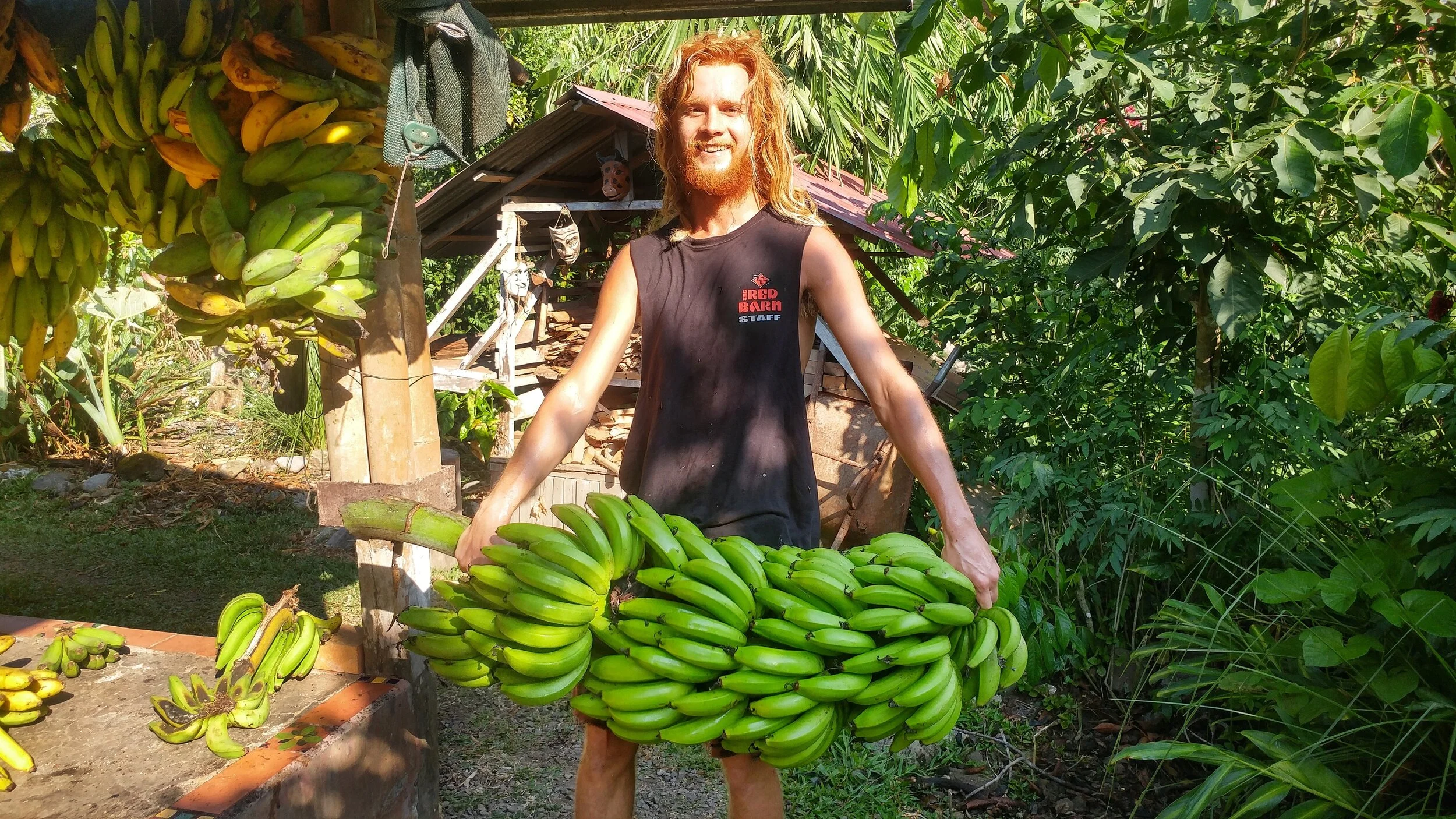
Go out and harvest them bananas, or maybe you already did that and you have far too many ripening… so next
With our main and only ingredient: bananas we don’t even need to peel them. You can just smoosh ‘em all up, skin n all, and chuck ‘em into a bucket. Beautiful. This process works best when they’re very ripe. We’re talking leaky, mushy and black. The ones nobody wants to eat, which sit around in the fruit bowl way too long, eventually they get picked up by the loser of rock, paper scissors and thrown out with an overly extended arm and a wincing face… Yeah. These are the ones that make great vinegar. Waste? Nay, but a resource in the wrong place. It’s farm to table, not farm to trash.
After you’ve smushed them all up and put them into a large container (we use a 5 gallon bucket, but you could use any large enough container), all you need to do is leave it and wait for the acetic acid bacteria to get to work on turning the alcohol into acetic acid. The time this takes varies depending on your conditions and the state of your bananas, but somewhere between 1-3 months. Remember that AAB like oxygen, so keeping a breathable lid on top of your vinegar, such as a muslin, will help speed up the process. o You could also attach an air pump and air stone (such as one that you’d use in an aquarium) to pump and diffuse air into your vinegar. This should significantly decrease fermentation time.
[TIP: you can hammer a nail into the bucket near the bottom. Leave the nail in until you’ve finished fermenting. Once your vinegar is ready, you can remove the nail and all the liquid in the bottom of the bucket will drain out.]

Upon opening your banana vinegar for the first time, you’re gonna get a bit of a shock as you see what appears to be a sprawling metropolis of mold growing all over your black bananas. Do not despair. Despite everything you were taught about rotting fruit, this is not a bad thing. Generally speaking, bright colored molds (pinks, yellow, greens etc.) are the ones to be wary of. Get another container and a sieve and pour whatever liquid you have into this second container through the sieve.

Next, take those moldy bananas into your hands and squish with all your might. Get in there! Don’t be afraid! Squish harder, dammit! Get all those lovely juices out and dispose of the solids.
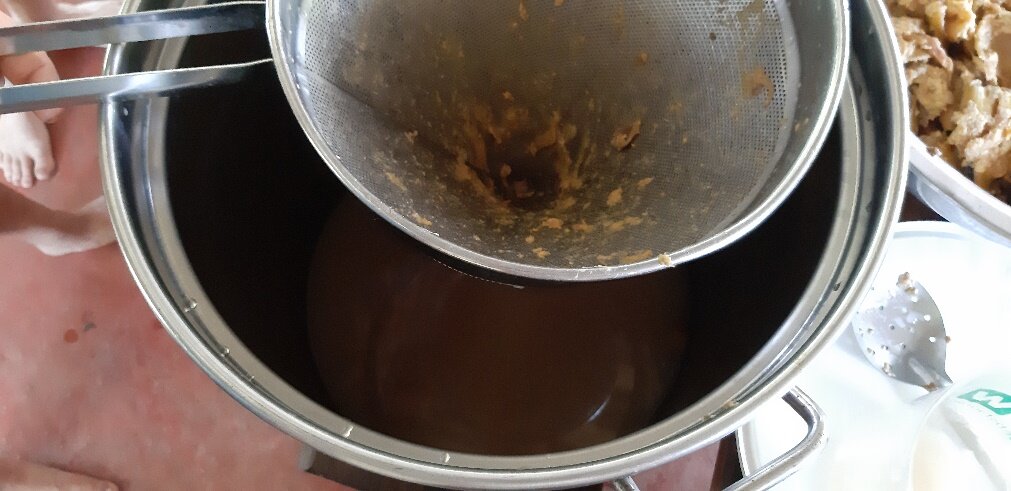
Finished squishing? Good. It’s time for your first taste test. If the vinegar tastes too sweet and not sour enough, it probably needs more time. If this is the case, you can add a little sugar – this is to allow the yeast present to convert more ethanol for our AAB friends to metabolise into more acetic acid. Another option is adding a little vinegar from a previous batch (this is called backslopping in fermentation lingo). If you don’t have a previous batch, you can use a shop-bought vinegar - white vinegar is a good bet as it has a neutral taste that won’t mess with the bananary-ness. Check back every week or so until your vinegar has reached the desired level of acidity. And there you have it! Easy-peasy farm to table banana vinegar using permaculture principles – there is no such thing as waste.
You can now bottle your vinegar and age them. This step is optional and will enhance the flavour profile of the vinegar. We use glass bottles that we recycle from the farm. It is important to use a sealed bottle and fill it as much as possible. If the AAB are exposed to oxygen they could begin to break down your acetic acid into carbon dioxide and water.
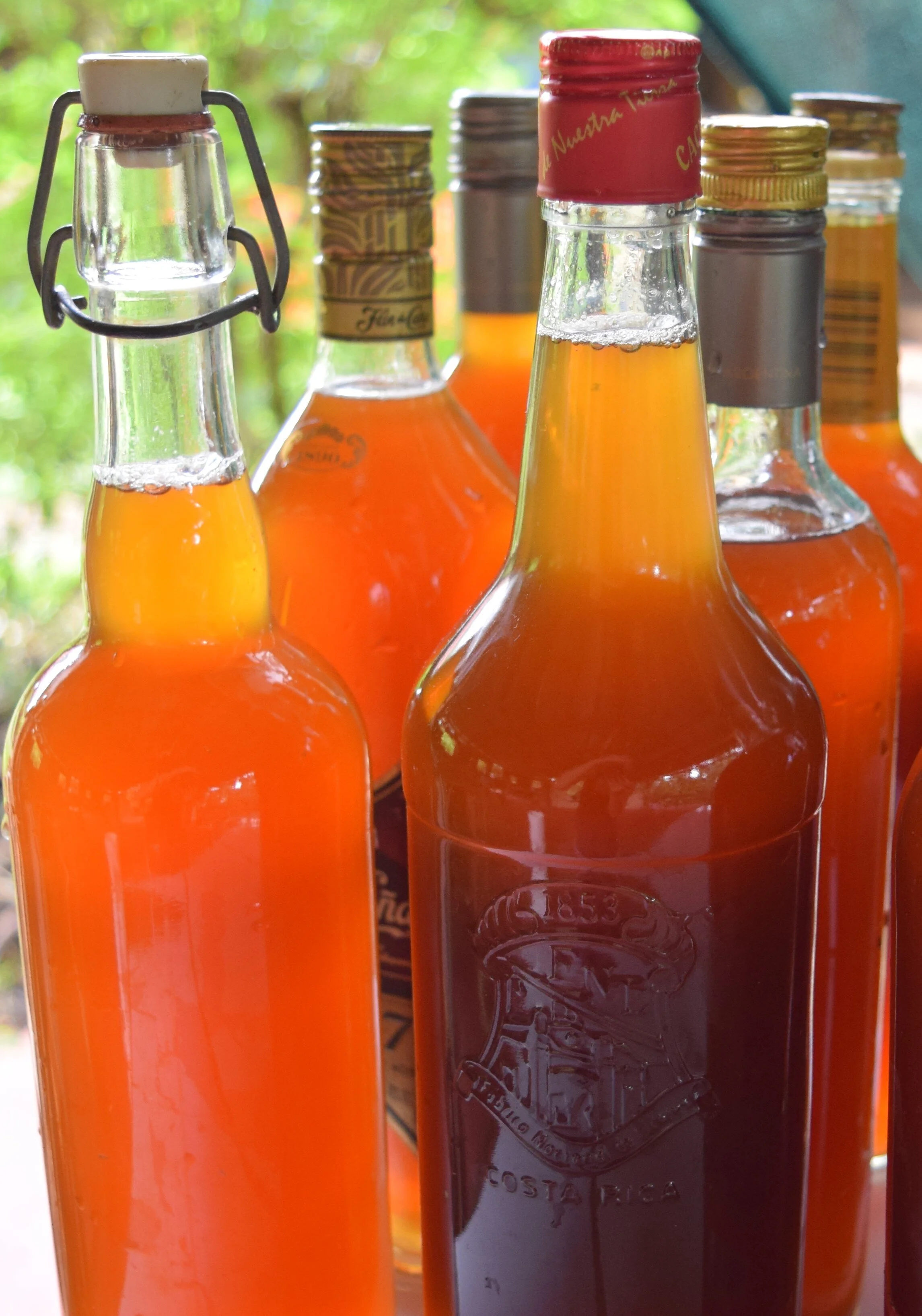
It’s that simple folks! This is a great way to use up all those old bananas.
Enjoy your farm fresh, homemade vinegar! This can be done with a variety of fruits that you have in excess off the farm!
Stay tuned for more farm fresh recipes.

Awakening the student and teacher in us all
I like to think I’m open-minded and my ideas flow freely, but as a professor I can become stuck in the rigid model of preparing lectures, grading and academic writing. The opportunity to have my sense of wonder reawakened and be reminded that there are so many springs of knowledge available in the world in invaluable. Rancho Mastatal reminds me of this truth and has inspired every student I have brought to think bigger, make connections and consider what their role in addressing the climatic challenges we face.
Awakening the student and teacher in us all
By Mary Little, School for Field Studies
I like to think I’m open-minded and my ideas flow freely, but as a professor I can become stuck in the rigid model of preparing lectures, grading and academic writing. The opportunity to have my sense of wonder reawakened and be reminded that there are so many springs of knowledge available in the world in invaluable. Rancho Mastatal reminds me of this truth and has inspired every student I have brought to think bigger, make connections and consider what their role in addressing the climatic challenges we face.
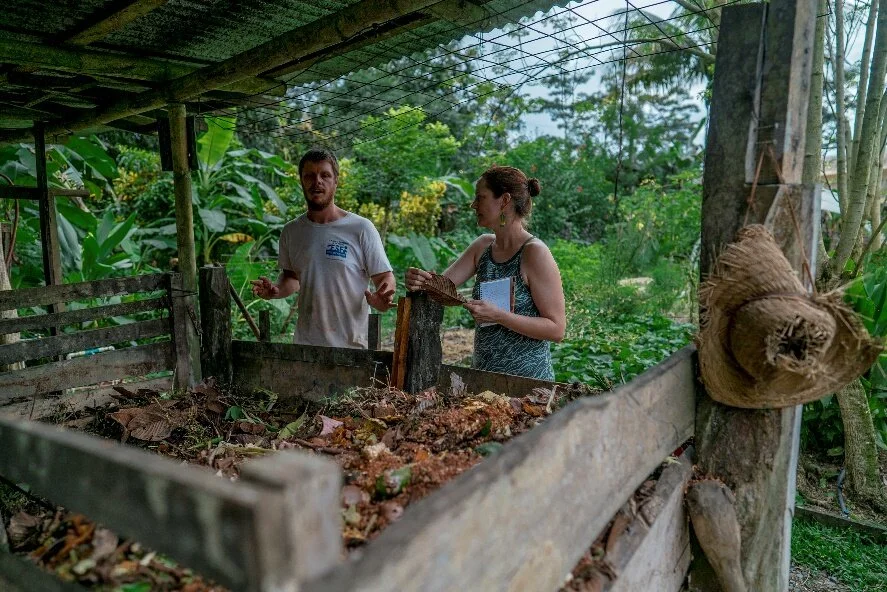
Nic Explaining the kitchen compost system
I am always looking for places that exemplify the principles of ecological justice we cover in my Environmental Ethics courses. Upon my first scouting trip to Rancho Mastatal I was introduced to a holistic education experience that I was eager to share with my students. It has inspired us to carry out research on the impacts of ecotourism on the local population and environment that can be used to ensure sustainable development. This community is a clear example of the possibilities and challenges of harnessing the abundance of local materials to feed, house and entertain themselves by collaborating with surrounding ecosystems.
This balance extends beyond ecological principles to Rancho Mastatal’s place in the community. Over nearly 20 years they have learned to listen and become a positive player that works with the needs of the committee to provide work, classes and support projects that are deemed meaningful by residents. Robin Nunes (co-owner and teacher) shared that the objective of Rancho Mastatal isn’t to be self-sustaining, it is to be community sustained.
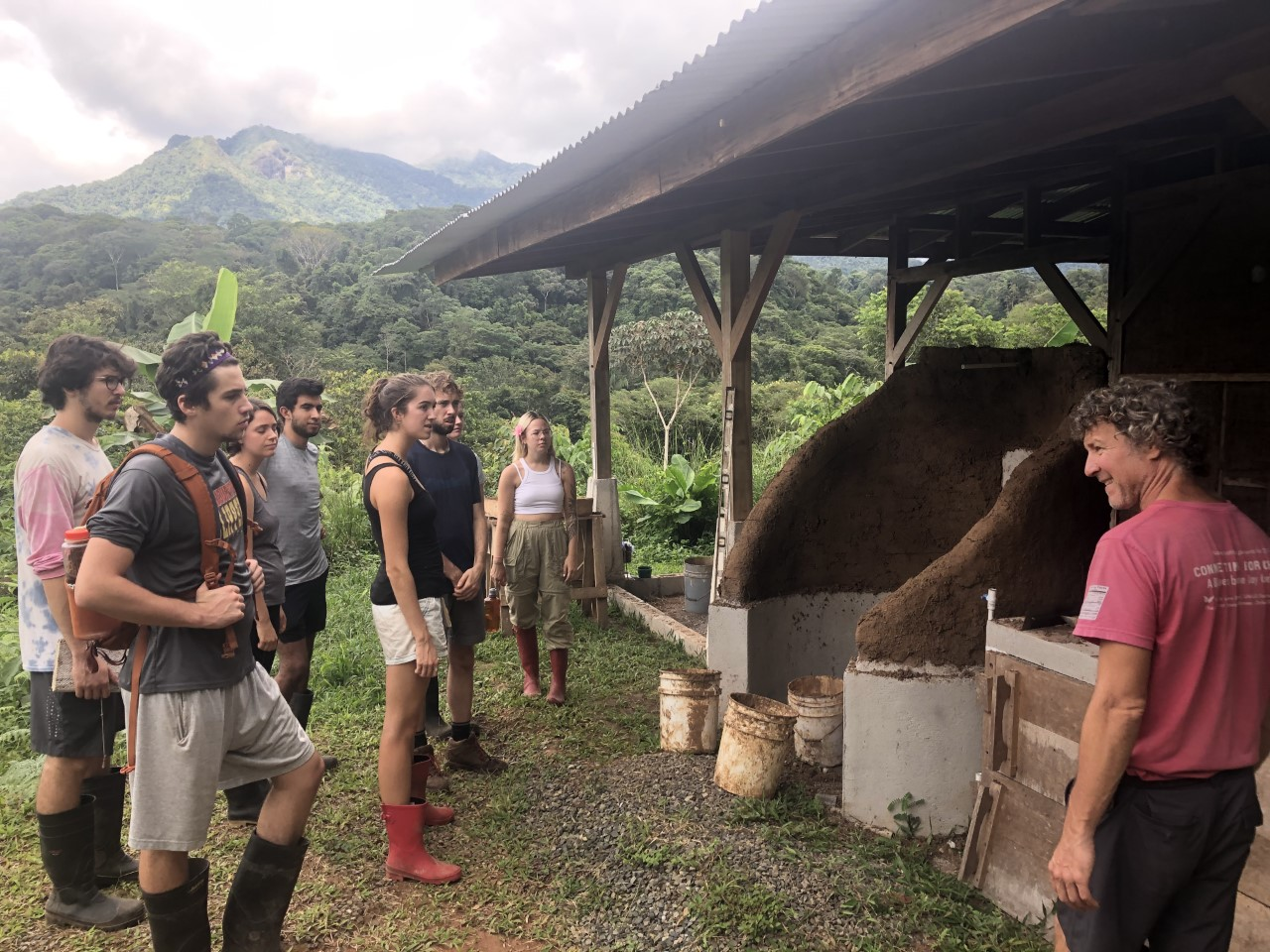
Tim showing the SFS students around on a tour.
This attitude has created a foundation for the community to take up ecotourism as a way of transitioning from conventional agriculture to permaculture and sustainable economic development. Once tourists began visiting the Rancho, one family revived their cacao farm, started making incredible chocolate bars and giving tours at La Iguana Chocolate farm. Another family created Siempre Verde Ecolodge and offers nature tours in the adjacent La Cangreja National Park and Spanish classes at their lodge. A local leader at the nearby Zapaton indigenous community offers presentations on medicinal plants and practices like basket weaving. All are local teachers with unique experiences and insights.
There is a powerful sense at Rancho Mastatal that community members are there to learn from one another. Tim and Robin begin each visit with a tour to demonstrate what they’ve learned and implemented at the Rancho, inviting the individual to think about what they expect to learn on their visit with possibilities as broad as composting and food preservation to natural building. From the first meal, apprentices begin to share their passion for the things they’ve learned and are willing to pass it on, either through conversation or a brief workshop. My students have taken fermentation and food preparation classes, gaining skills they can implement once they return home. There are also the other guests of all ages and walks of life that contribute their experiences and skills to the mix. I’ve shared insights with dancers, photographers and arborists, to name a few, at the massive communal dining table that seems to be built for just this purpose.

an SFS student taking advantage of the huge library
I appreciate that Rancho Mastatal organically fosters knowledge sharing. It reinforces that we are all simultaneously teachers and students and how to embrace both roles. Each time I visit, I’m reminded how much more there is to grasp and apply to make positive change. I return because it is a pleasure to learn from such diversity in nature and humanity in this dynamic setting.
(I’ll be writing about some of my research on waste issue the impacts of tourism in coming blogs.)
Mary Little is a Professor of Environmental Ethics at the School for Field Studies located in Atenas, Costa Rica. Her primary areas of interest are eco/agritourism, sustainable food systems and environmental justice. She can be contacted at mlittle@fieldstudies.org.

5 years on: an apprentice story.
It’s approaching five years since I started my apprenticeship at Rancho Mastatal. Looking back at the last five years lot of life has been lived, with many joys, personal development breakthroughs, and vulnerabilities, that at times felt so heavy, or were unbearably light.
5 years on, an apprentice story.
By Anthony Wijeyeratne (Shea), Apprentice 2015
It’s approaching five years since I started my apprenticeship at Rancho Mastatal. Looking back at the last five years lot of life has been lived, with many joys, personal development breakthroughs, and vulnerabilities, that at times felt so heavy, or were unbearably light. However my time in Mastatal was a game changer, I came from an office environment to a ranch in the jungle, which eventually led me to find my passion for food that I turned into a farming career. I hope this is just the beginning of an ever-expanding life involved with food.

Being disgruntled and immersed in office culture, I felt my life was stagnant, and I needed a change. An opportunity presented itself, when I got an offer to be an apprentice at Rancho Mastatal. I accepted without hesitation and embarked on a year-long journey to learn about sustainable living.
My time at the ranch I met many amazing, and talented people, learned a set of skills that applies to a lot of what I am doing now, and got an amazing hands on education in cooking, fermenting, natural building and various system designs. However the biggest takeaway was from silencing myself, and turning into a listener, and observer. The Ranch gave me an opportunity to learn not just from great instructors, but also from my self, and about myself. It thought me how to be bored and turn that boredom to an enjoyable solitude of productivity, and critical thinking, which changed and expanded my perspective on everyday happenings in my day-to-day life. I was reading more books than I had ever read, which made me appreciate learning in silence so much more, and as well, I explored my creativity in the world of food, and writing.
I’m sure there are many positive testimonials about the ranch, but this is important, because it shaped me in getting to where I am now. Currently I am farmer for the YMCA, growing fruits, veggies and flowers for a 70 plus member CSA on a small-scale 3.5 acre farm. I have also decided to put myself in a vulnerable position to start my own business, and lease a piece of land to grow my own specialty veggies for restaurants.
Being vulnerable willingly can be difficult, but it can also be rewarding, and I learned a lot of that at the ranch. Pushing through jobs I wasn’t keen on or interested in, having difficult conversations with fellow apprentices because communal living can be straining, and coming across bittersweet realizations on the many realities of how being sustainable is difficult, and sometimes not the best or obvious option. My romancing, created a vulnerability I didn’t see coming, I was in a strange paradox. On one hand I was ideal and ready to learn and demonstrate the virtue of sustainability, on the other hand I was naïve, and ignorant to the realities of it, and that sometimes being sustainable won’t be the best option. This was a necessary realization, and the good folks at the ranch demonstrated, that they are not perfect or do have the best systems, but they try, and sometimes you have to compromise, and maybe later on down the road there will be an opportunity to remove yourself of that compromise.
Allowing my self to be vulnerable and crawling out of the vulnerabilities was at times how I felt my world needed to be. This can be both good, and bad. Good because I was determined to see my situations for what they were and learn, and improve from it, and finish what I started. It also helped me to be more resilient and resourceful. Bad because I was willingly accepting these vulnerable circumstances without critically thinking if there was a better option, and almost putting myself in a repetitive mental cycle. It almost brought me to a place where I gave myself a low ceiling.

My first farm experience after my year at the ranch was an internship at Foxglove Farm in British Columbia, where I earned a meager stipend of $500/month with room and board. This I romanticized, and it was easy to. Foxglove was a beautifully manicured farm with intelligent systems design that really showed me what the potential of and efficient and effective small-scale farm is capable of. But Foxglove also kicked my ass. I always felt I got drafted as a hot prospect and turned out to be a dud. I had no idea what I got myself into, and it was so overwhelming and much more physically demanding than I anticipated, I really wasn’t sure if I fit in this world. The only thing I knew is that I had to finish the season, keep trying and most of all learn. Although my time at foxglove came to premature end in September, I was determined to finish the season off, and found employment on another farm. In a strange way it was a weird accomplishment.
I came back to my home province of Ontario, determined to have a presence in the world of food. In the offseason, I worked at a restaurant and applied for various farm hand positions. Somehow I got offered a position growing vegetables for an order of Canada Chef. I don’t know how? I took the job because it was glamorous and exciting, but I made myself immensely vulnerable yet again. The farm barely had any infrastructure for growing crops. No nursery, no irrigation, no washing station, and old farm equipment that were not effective for the soil I was working on. Also, what am I doing growing veggies for one of Canada’s best chef’s? This could ruin me if I mess up. To add to that we had the wettest spring on record, and fell further behind on planting. On top of this, I discovered the strain of lightness, Growing veggies and putting in the labor, no problem. Being patient and allowing things to unfold however was unbearable, and to make it worse the chef and his staff were amazing individuals who made an amazing effort to integrate me, which created some guilt, and pressure to not let down these wonderful people. Somehow, it worked out. It wasn’t ideal, but I did it on my own, and was able to produce quality food, for a nice 10 week run.
The following season I moved closer to my family and got my job with the YMCA. I decided on the YMCA, because of my two past experiences. One was a model farm, and the other was one starting from scratch. The YMCA on the other hand is a cross between the two previous. It’s a young developing farm with descent infrastructure and equipment, which allows me autonomy to grow, experiment, and develop with the farm. There is an expectation of growth every year, in terms of clients, food, and revenue. These are puzzles that motivate me to not settle and create plans to try and improve if there is a sensible way to do so. In my short time at the YMCA I have helped spearhead ideas to grow more food, on less land, to manage better, and yield less waste, and to put a sustainable stamp to protect and nourish the land, which grows the food.
Through all the changes and the difficulties since my departure from Mastatal, the internal skills I acquired from the ranch, never left me. I have a greater thirst for continuous learning, and my resilience to persevere and finish what I started is at its highest motivation ever. This wouldn’t have been possible if not for my time at the ranch, and the relationships that I forged with the ranch and its directors, especially former ranch director Scott Gallant, who has been a great mentor and friend since I left the ranch and returned to Canada.
I feel at this point, sky is the limit for me, and being vulnerable gives me the opportunity for great discovery and virtue. Oddly enough this is how I feel about food, and it makes me romance and idealize about breeding new varieties of veggies, growing mushrooms, making art by way of grafting fruit trees, fermenting everything, and cooking just for the sake of, “I wonder what that would taste like”. It’s the same MO, but I’m better prepared to listen to the outcomes of the actions I take, and solve the puzzles that come my way.

Life after the Ranch (Part 1: Day to Day Life)
The Ranch experience for me was completely life changing. This is the common feedback that is given from anyone that has stayed there, whether it was for a day, or a year. This place gets under your skin and awakens something inside you that makes you think differently.
Life after the Ranch (Part 1: Day to Day Life)
By Marrissa Taylor
2018 Apprentice
The Ranch experience for me was completely life changing. This is the common feedback that is given from anyone that has stayed there, whether it was for a day, or a year. This place gets under your skin and awakens something inside you that makes you think differently. There is something very special about being given the space to learn, to question and to experiment with new information and skills. For the first 6-8 months we received a lot of training and workshops and in the second part of the apprenticeship we were all encouraged to take on our own projects in areas of interest, as well as continue the regular tasks and projects that we needed to do to contribute to the functioning of the Ranch. This was a great life balance – as you can never get away from the things you need to do to survive – but you can look at the ‘doing’ in a different way. So yes, you need to haul and lift the heavy bags of wet cow dung, then make a daily poop soup out of them to feed the Bio-digester. Most of us at the beginning did not look forward to our rotation on the Bio-D, but once you do it, and it becomes a part of your daily life. Something shifts.. You start to understand the extremely amazing system you are working on. That this task you are doing kicks off a very cool, yet simple, process of fermentation. The results of this both provide fuel you can feed 50 people on, and manure that you can feed your veggie seedlings with. It is at this point you also start to notice the tiny little delicate mushrooms that seem to magically come from nowhere, and how the birds congregate around the piles of manure for the worms underneath. Then finally in yourself, the smells that use to repel you suddenly become the smell of the earth at work, and the peace that surrounds this space is teaming with curious life. You learn to observe and experience the world differently. Something inside of you shifts… this is the Ranch.

One of the signs at the Biodigestor
Life after the Ranch, after this shift in perspective can be jarring for sure depending on where you are going. For me it was heading home to the cold winter of Canada. My newly strong body, my heart full of peace and nostalgia of leaving the Ranch and all my wonderful friends that are as close to family as you can get, now to enter the ‘real world’. This world is fast, full of social media, tv series bingeing conversations, food whose ingredients are barely recognizable and a taste that can only be described as chemical. Although it is balanced off because it is lovely to be reunited with family and friends and the familiar. It is as this point that others start to notice… you also start to notice, you are different now. Something inside you has shifted… You have an understanding of the effort that it takes to bring that food to your plate. How harmful the gobs of packaging is on the environment. You know what real un-chemically treated food tastes like – and even how that taste is further enhanced when you plant it, nurture it and wait expectantly for it to be ready to harvest. You have also spent the time on the ranch relatively disconnected from the web so the incessant surfing does not appeal like it used to. You crave real conversations, face to face, and even miss the gratitude dinner circle as you come to realize it is not common place to say thank you to people (even strangers) genuinely in the day to day. Something inside you has shifted…

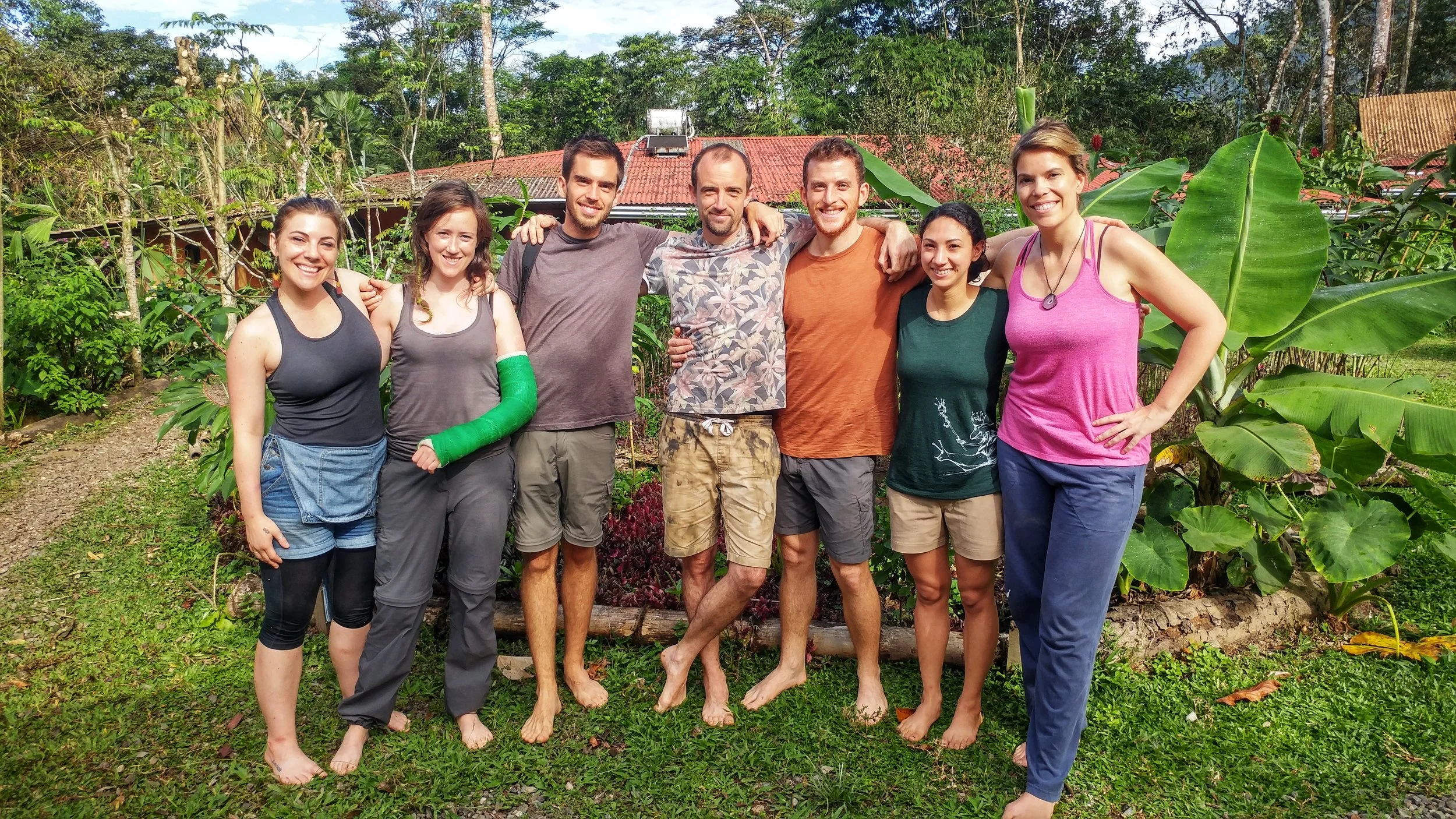
The 2018 apprentice team
After the farm, I needed to find a job. It was the dead of winter and going to a farm was not an option. So I looked for casual work in my old career in international development. I ended up getting a 3 month contract in South Africa, so I left the cold. A part of me felt really guilty. I was ‘selling out’ on my farm life just to go back to my old career. Some of my other apprentice group were able to continue working on a farm – they could do it and they were happy for the most part. What was I doing?? So when I was offered a longer contract that also came with a feeling of major guilt. I needed to look at this opportunity differently. What I came to realize as I now sit in my new home in the mountains of Eswatini (Swaziland).. something in me had shifted and this cannot be defined by what I do on my daily, but rather how I do it – whether it be making poop soup or working with vulnerable communities – I have changed. I see and approach my life is differently. It is more whole hearted and with a sense of curiosity I did not have before.
On a practical note, there are permaculture groups EVERYWHERE in the world! So I am building linkages with some of these groups so that I can still continue to learn and connect in this way. I will have my own land one day, but until then I will continue to practice what I have learned when I can, teach what I know when I can.. and be forever grateful for how my experience at the ranch has shifted something in me.
Marissa

Why Permaculture?
What is Permaculture?
Permaculture is the design system for creating sustainable human environments. In a modern society, which is not sustainable could permaculture hold a solution?
Why Permaculture?
by PJ Barton
2019 Apprentice
During our Apprenticeship at Rancho Mastatal we spend a year immersed in a working example of how Permaculture can work on a practical level. We take several workshops throughout the year including the annual Permaculture Design Certification (PDC).
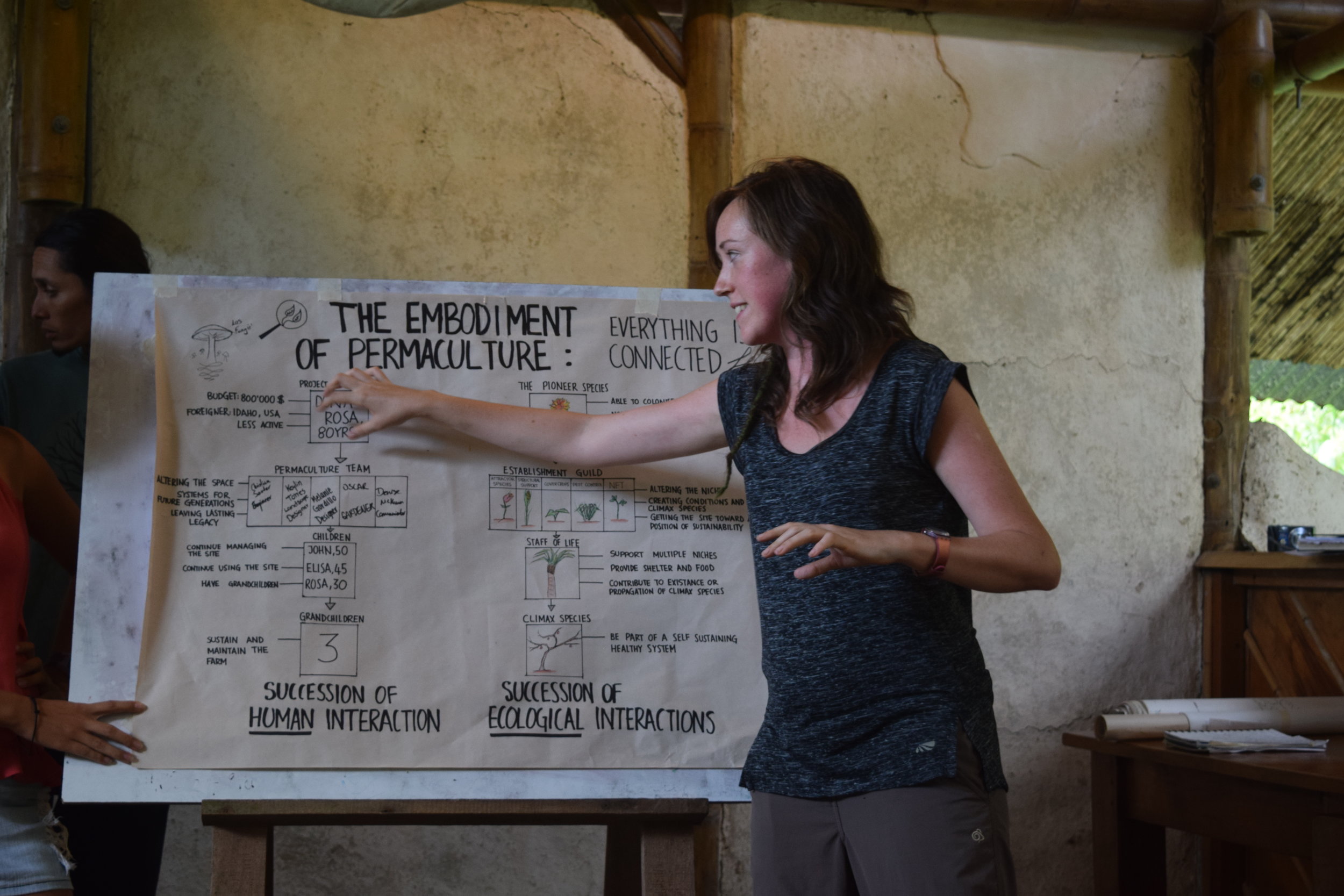
Presentation at the PDC
What is Permaculture?
Permaculture is the design system for creating sustainable human environments. In a modern society, which is not sustainable could permaculture hold a solution?
Permaculture was coined in the 1970s by Bill Mollison and David Holmgren, the word is a contraction of permanent agriculture and permanent culture which are intertwined in our history as a society. By pulling both culture and agriculture into our attention we a focusing on what the relationship is between them, how they function together as a whole. Permaculture looks at meeting the needs of the present in harmony with our environment. Although it is designed as a agricultural practices it also can be applied socially. The broad framework means it can include multiple parts of our society linking things together and how they function as a whole.
The 3 Core Ethics of Permaculture
1. Care of the Earth
Care of all living and non living things. By applying this ethic we can appreciate all organisms on earth. Invisible to the naked eye are all the mico-organisms upon which life is built; everything is alive. It is not obvious at first that a plant is breathing and under its roots there's an incredible network of organisms working together. If we view all things as beings our attitude and relationship will change towards them, developing respect for what we interact with.
2. Care of the People
As a society/ individual we need to meet our basic needs as humans: food, water and shelter. Considering our basic needs while creating systems that can sustain us in the long term. Permaculture uses these basic needs to design systems that can hold solutions for the growing inequality that is gathering pace on a global scale. Modern systems don't focus on care instead they're driven through profit. Many of our social programs designed to care for the less fortunate are being dismantled in an effort to create more profit; looking after one another and care are given little time into our busy society.
3. Contribution of Surplus
This ethic is a way of circulating the wealth back into the system. In a our conditioned society, rather than circulating wealth it is common to hoard it - the idea of spending all of your wealth is a radical idea, when is enough money or wealth enough to have surplus? By reinvesting surplus, it self perpetuates the movement. The system would be regenerative constantly sustaining itself. Like any system if you continually extract resources without replenishing them it will eventually collapse. When the needs of a society are not met from within the system we look to extra energy inputs and ultimately pay the price in increasing energy consumption and its resulting pollution.

The ethics of permaculture give us another way to view the world which is perhaps different from modern, conventional society. Observing and approaching situations guided by these ethics permaculture can be applied to help us steward the earth and guide our activities in a better direction. Our fragmented society often misses the connection that helps it function as a whole seeing only the tip of a large iceberg. Sometimes we make connections but fail as a whole. Moving together, finding patterns that work and what needs to be improved. We are surrounded by nature who we can observe and mimic. She becomes our inspiration helping us establish sustainable systems. Perhaps that is why we should use permaculture.
For more information about Permaculture check out some of the excellent free resources on David Holmgrens website get involved in you local permaculture movement and consider taking a Permaculture Design Certification near you or with us!

The Wonders of Vanilla
Vanilla is the second most expensive spice in the world. Being sold between $600-1200 per kilo, that is more expensive than silver!
What makes it so precious?
The Wonders of Vanilla
by Diana D, 2019 Apprentice
Vanilla is the second most expensive spice in the world. Being sold for between $600-1200 per kilo, that is more expensive than silver!
What makes it so precious?
Vanilla comes from the largest family of flowering plants, the orchids, as well it is the only orchid that produces pods. Every stage of vanilla bean production needs to be completed by hand, making it one of the world's most labor intensive crops.
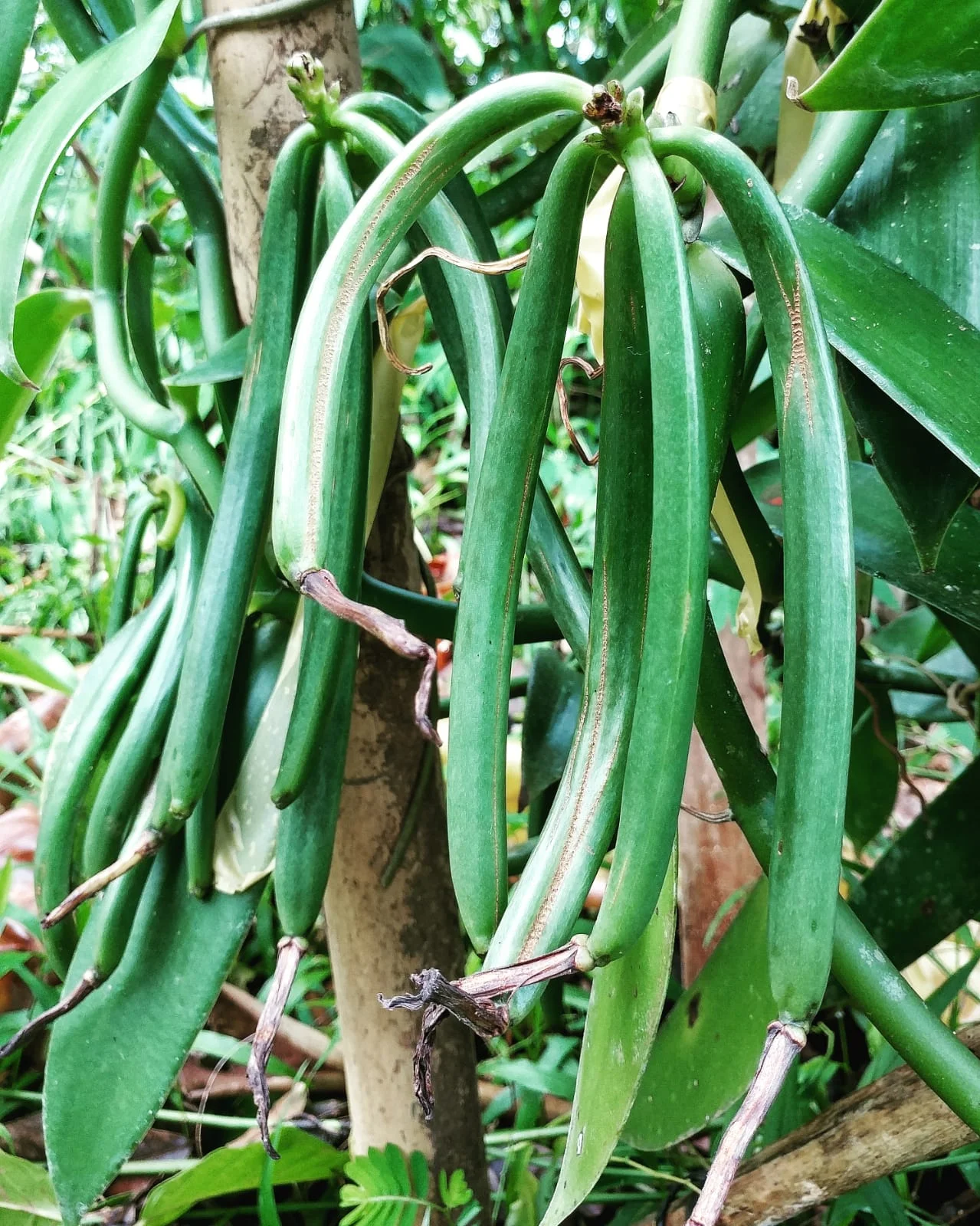
This orchid originated in Mexico, it's cultivation is being practiced from Mexico to India . Being producers and exporters to the world market these countries each produce up to 200 tons of vanilla annually. Madagascar is by far the largest producer of vanilla, accounting for over 80% of global production. Although the value of vanilla is very high this has had some unfortunate repercussions for vanilla farmers as crime and theft of their valuable product has increased. This has led to instability in the lives of the farmers. Natural disasters have also affected them deeply, wiping out entire crop yields for the year. With such a delicate and refined production system It could take up to 7 years to regenerate the vanilla and return to the same levels of production. As with any single crop production system, it is a high risk strategy to rely on one crop for all of your income. There is a growing awareness of these issue for vanilla farmers and some new more sustainable and resilient techniques are being adapted.

To learn more interesting facts about vanilla, its history, creating a sustainable way to grow vanilla and support the farmers read this great article. This article was written by the first company to have an integrated, sustainable, vanilla supply that began transforming the Malagasy vanilla business in 2006.
My interest in vanilla arose when I started to take care of it and pollinate it as part of my morning experiential learning tasks at Rancho Mastatal. The production of vanilla is a fascinating delicate and attentive process that if done successfully is extremely rewarding. I am able to experience the growth of the vanilla plant, the pollination of it's flowers , and after many stages of fermentation, curing and extraction we are able to enjoy the amazing product of this magnificent plant.
During my year long apprenticeship here in Costa Rica, I am able to immerse myself into the plant kingdom as well as learn the essential skills for self sufficient homesteading. I also get to apply and practice other skills such as carpentry and natural building which will allow me to lead a more sustainable lifestyle .
Vanilla is only one of the many fascinating things I have learned about here. I warmly invite you to come visit us in Rancho Mastatal in the rainforest of Costa Rica. There is so much to learn about how we can improve our lives within our communities and in harmony with nature. How we can all provide our own food and support our community with their projects.
What I have learnt from the vanilla plant is that I would love to grow it on my own land, it's prices are rising so why don't we grow it for ourselves? Let's take little steps to self sufficiency by growing our own food as much as possible and by supporting the companies that treat the farmers well.

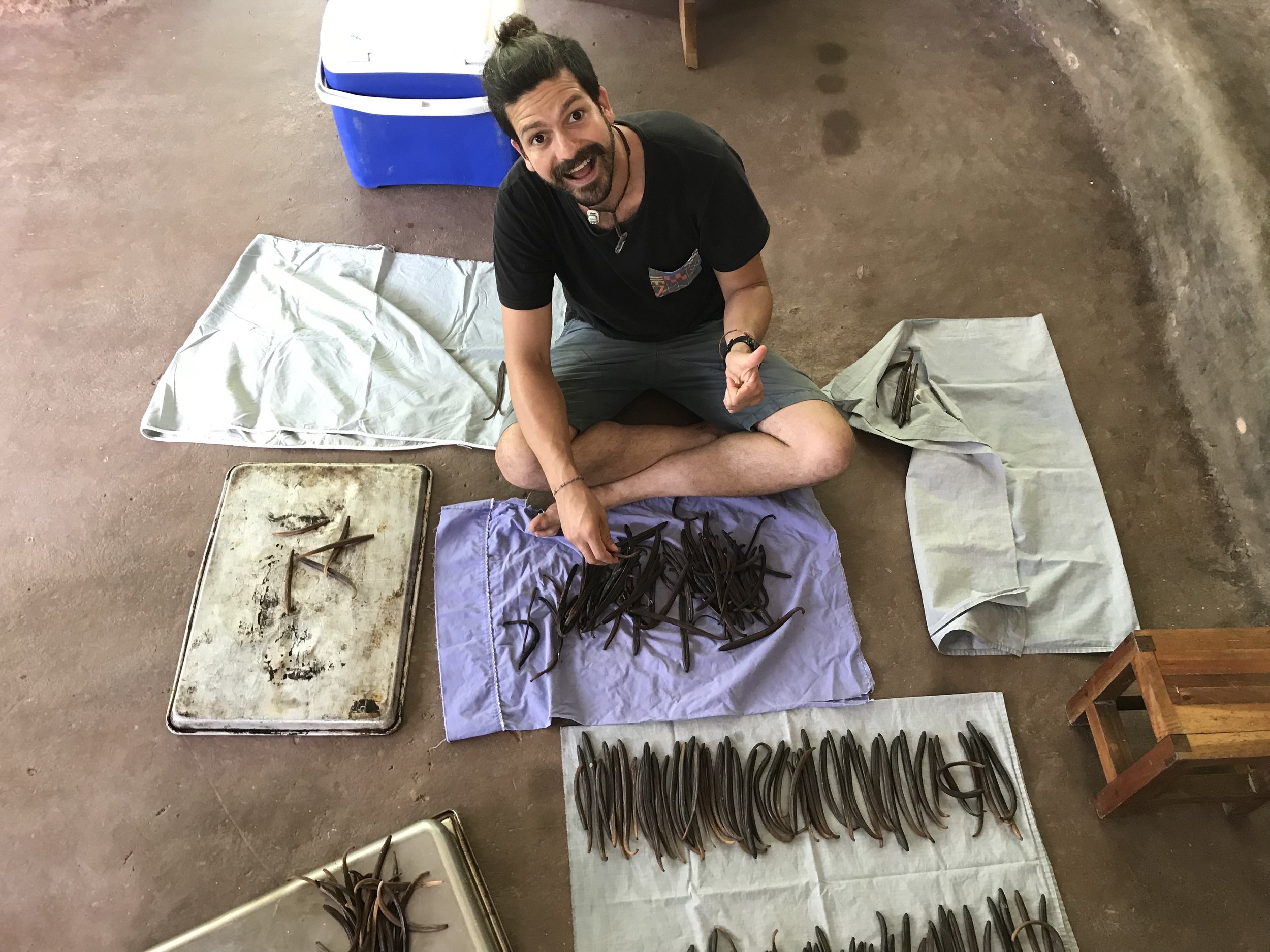
Leon (2017 Apprentice) drying vanilla
I hope we keep growing vanilla and benefit from the heavenly smelling pods in our delicious deserts.
On that note I'm off to prepare a vanilla cocoa wine!
P.S This article contains the basic hooch recipe, check it out if you want to learn how to make delicious homemade hooch :)
Blessings,
Diana D

Tropical Brewing
The craft brewing movement has migrated to Central America and the Caribbean. A growing number of small scale artisanal producers are building on the American Craft Brewing tradition by incorporating local spices and fruits into traditionally brewed ales. To distinguish themselves, from their temperate counterparts, they are adding a tropical flare and creating innovative flavor combinations
Tropical Brewing
by Connor Harron
The craft brewing movement has migrated to Central America and the Caribbean. A growing number of small scale artisanal producers are building on the American Craft Brewing tradition by incorporating local spices and fruits into traditionally brewed ales. To distinguish themselves, from their temperate counterparts, they are adding a tropical flare and creating innovative flavor combinations. For example Domingo7’s Maracuyá Pale Ale (that’s Spanish for Passionfruit) in Costa Rica, Ocean Lab’s B.O.B. - Blood Orange Blonde in Puerto Rico and Lu Bru’s Maiz Azul (Blue Corn) Ale in Mexico all demonstrate how local producers are beginning to incorporate regional ingredients into local craft beer movements. This is surely a positive development and one that leads us to consider other ways we might be able to further highlight local and seasonal ingredients into craft beers.

These efforts will help to make brewing both more sustainable and position craft brewing as a vehicle for more thoroughly exploring terroir, which describes the potential for fermentation to be used as a method of expressing the unique environmental conditions of the places in which our ferments are produced. By using exclusively local ingredients as well as wild captured yeasts, we have the power to capture the unique flavors of seasons and regional differences that allow for near infinite variation and creativity to explore new combinations of flavors that are rooted in cultural tradition while simultaneously pushing the frontier of artesian brewing. As much as I love finding good craft beer in places like Mexico and Costa Rica, I constantly find myself asking if it really makes sense to be brewing beer with imported German Barley and Hops from the Pacific Northwest United States when there are such a plethora of sugar sources and bittering herbs available locally in nearly every corner of the globe. Could we instead develop beers using a hybridized process and create products that are truly local while still maintaining the key characteristics that make beer, beer?
Speaking of, have you ever asked yourself what it is that really makes a beer? It turns out, the answer really depends on who you ask and where you live. In the most general terms, beers are fermented from carbohydrate rich starches (typically grains such as barley) that first need to be enzymatically converted into simple sugars and extracted into a liquid malt before the substrate can be fermented to produce appreciable levels of alcohol. Wines and Ciders on the other hand, are fermented from fruits and simple sugars that can be fermented into alcohol with limited or no processing. In the case of beers, bittering herbs such as hops are commonly added to provide antimicrobial properties, improve shelf stability and add complex flavors to ferments. In the United States, it turns out that hops are not required in the production of beer and that there are many malt substitutes that are allowed in the production of beer, including “rice, grain of any kind, bran, glucose, sugar, and molasses (TTB Ruling, 2008).” This definition is actually quite liberating, and creates the opportunity to experiment with non-traditional malts and bittering herbs in ways that will promote creativity and improve the sustainability of the craft brewing market globally. This flexibility in malt production will be especially important given that recent climate models suggest that the regional distribution of barley production will become increasing restricted over the next 20 years (Nature, 2018).

In Costa Rica, we have been experimenting and finding repeated success using a wide range of local ingredients including banana, corn, rice, cacao beans, coffee and local cane sugar for producing malts. Corn and bananas, for example, both have long cultural traditions of being used in the creation of local beers. In Eastern Africa, Bananas have long been used to create malt for the production of banana beer (Urwaga or Mubisi as it is locally known). Bananas make for an interesting malt base because they fall into a relatively unique category of fruits that when ripe are rich in both simple sugars and complex carbohydrates that can be easily fermented into a strongly alcoholic brew while maintaining a mouthfeel that is remarkably similar to beer brewed from barley. When the ripe bananas are boiled for several hours, the sugars begin to caramelize, transforming the flavor of the malt into a sweet, neutral flavored base that remarkably, tastes very little of banana, making it an ideal substrate for mixing with bitter herbs or other local products such as coffee and chocolate that can be fermented into either an Ale or Stout like brew.

Conversely, in many parts of South America, but perhaps most notably in Peru, Maize has been used for centuries to produce a corn beer called Chicha. Unlike barley, which when sprouted produces a large concentration of Amylase Enzymes (the key types of enzymes needed to convert complex carbohydrates into fermentable sugars), to make a corn beer, these enzymes need to come from another source. The indigenous peoples of South America developed an ingenious solution to this challenge when they discovered that chewing the cooked corn would transform the starchy, carbohydrate rich grain into a sweet masa that could then be re-boiled in water and strained to create a fermentable Wort made purely from Maize. Although many foreigners cringe when they first learn about the process, for the Inca’s, it was a powerful community building practice that would bring people together to sit around the fire, alternating between sharing stories and laughter while chewing the cooked corn and then depositing all of the masa into a large pot. Although they almost assuredly could not have fully comprehended the transformations that were taking place, their solution was so ingenious because human saliva is packed full of the enzymes needed to break down the carbohydrates in corn into fermentable sugars. I experimented with the traditional process a couple years ago, and I have to admit it was a powerful community building process that for me, took the idea of collective fermentation to a whole other level. Talk about terroir!
The problem with the traditional process is that it is incredibly labor intensive. If you are lucky, like me, you might be able to convince your friends to help you chew a few pounds of corn once or twice for the novelty of the experience, but you are likely to be hard pressed to find a consistent source of labor to chew through the many pounds of corn you will need to produce even a few gallons of Peruvian style Chicha. Fortunately, today we have access to many sources of amylase besides our saliva. As it turns out, ripe bananas (and in particular, ripe banana peels), contain a very high concentration of the same amylase enzymes needed to convert the starches in Maize into fermentable sugars. If you think about it, this actually makes a lot of sense. Unripened green bananas and plantains are a very starchy staple food crop that is used culinarily in a similar fashion to potatoes. As the skin yellows and the banana ripens however, the banana naturally transforms those carbohydrates into simple sugars that make dessert bananas so pleasant to eat directly out of hand.
Due to the high concentration of amylase enzymes present in ripe banana peels, they can be dehydrated and pulverized into an enzyme rich powder that can be mixed with ground maize and water and then mashed similarly to a barley based beer between 140-160 F for 2-24 hours (depending on the ratio of corn to powdered banana peels used) before being strained and boiled to make a fermentable wort. You’ll need to taste the Mash or use iodine strips to determine when the conversion has been completed. There are actually lots of fruits and vegetables that are rich in amylase enzymes. Sweet potato, for example, has such a high concentration of these enzymes that its peel is often used in the commercial production of Amylase.
Alternatively, instead of using the enzymes present in another product, it is also possible to ferment grains with certain types of molds that consume starches and in turn naturally produce the enzymes needed to convert the grains of carbohydrates into fermentable sugars. In Japan for example, Aspergillus Oryzae (or Koji as it is better known), is a humble yet miraculous mold that has been grown on rice for millennia in order to sweeten the rice and make Sake. It is also the key ingredient for making naturally brewed Soy Sauce or fermenting Miso due to the rich diversity of enzymes Koji produces that not only sweeten carbohydrate rich foods, but also break down proteins into amino acids that are the basis for savory foods and the flavor of umami. Due to these impressive properties, koji has now made it’s way out of Japan is slowly become increasingly familiar around the globe. This is assuredly a wonderful thing, because it has now been well established that Koji can be grown on a variety of substrates and virtually any grain, including rice, barley and corn, making it an ideal candidate for assisting in the brewing process anywhere on Earth.

To further explore local flavors and novel combinations, while boiling our worts we have been experimenting with using a variety of local bittering herbs and teas to add complex flavors to our beers, including ginger, turmeric, lemongrass, vanilla and many others. During either primary or secondary fermentations, we use nylon mesh bags weighed down with boiled volcanic rocks to infuse fresh fruit from the farm such as Pineapple, Soursop, Starfruit, or freshly roasted Cacao Nibs, just to name a few examples. Finally, by fermenting our beers with mixed cultures, wild captured yeasts and/or locally adapted strains, we have been able to produce ales with several layers of harmonious flavors, which provide depth and complexity that is only possible to achieve with mixed culture fermentation.
I would not have believed what a powerful role yeast and bacteria play in the creation of complex beers and wines when I first started brewing over a decade ago. Now however, I have learned first hand just what a difference the cultures we use can make. The experience of trialing yeast captured off of different fruits and flowers has led me to encounter flavors I never would have dreamed possible. Some have certainly been on the far side of the funky extreme, including cultures that produce the dreaded odor of sweaty feet or burnt rubber. This however, is exactly the reason for small scale trials rather than placing our faith in large scale spontaneous fermentation. Once you discover the joy of fermenting a simple malt of dissolved sugar or Dry Malt Extract with wild yeast and tasting apples, pears, or other citrus fruits magically appear in the finished product, I believe that like me, you will never want to use a commercialized yeast strain on it’s own again.
I believe that by drawing from the richness of our cultural traditions around the world, we have the potential to greatly expand the breadth of our palates and to more intimately link our brews to the time and place in which they were crafted. The craft brewing revolution is still in its infancy and if I am to have a part of to play in it’s development, then Ginger Hibiscus Sake Hybrids, Banana Coffee Stouts, and Mayan Chocolate Ales will be just the tip of the iceberg.

If you would like our simple Hooch recipe, read our blog article with step by step instructions. If you want to learn more about the wild world of fermentation consider joining us for our year long apprenticeship where apprentices go deep into advanced fermentation techniques.
La Importancia de la Permacultura
La creciente crisis social y medioambiental nos ha obligado a buscar métodos y procesos alternativos que reduzcan el impacto humano en la naturaleza y nuestro entorno. Como una de las principales alternativas de cambio, la Permacultura constituye un sistema donde se combinan la vida de los seres humanos de una manera respetuosa y beneficiosa con los animales y plantas, y donde se logran implementar soluciones de menor impacto medioambiental para satisfacer las principales necesidades humanas
La Importancia de la Permacultura
Rhina Guido Tellez, Estudiante de Permacultura
La creciente crisis social y medioambiental nos ha obligado a buscar métodos y procesos alternativos que reduzcan el impacto humano en la naturaleza y nuestro entorno. Como una de las principales alternativas de cambio, la Permacultura constituye un sistema donde se combinan la vida de los seres humanos de una manera respetuosa y beneficiosa con los animales y plantas, y donde se logran implementar soluciones de menor impacto medioambiental para satisfacer las principales necesidades humanas. Si bien el termino Permacultura suena nuevo o hasta desconocido para algunos, podríamos traducirlo en ecología, desarrollo sustentable, preservación del hábitat, practicas eco amigables, etc. Este término no es más que la compilación de éticas y principios de diseño universales en planeación, desarrollo, mantenimiento, organización y preservación del hábitat apto para sostenerse en el futuro.

La Permacultura reúne una seria de principios éticos y de diseño que aplicados en áreas como la Arquitectura hacen posible la creación de entornos sustentables. Los principios éticos están dirigidos al desarrollo de la conciencia en temas del cuido de la tierra, relaciones humanas y equidad. Por su parte, los principios de diseño son los que fácilmente podemos ver materializados, en el ambiente construido con la utilización de materiales y técnicas de construcción locales, la autoconstrucción, climatización natural, implementación de técnicas eco amigables como sanitarios secos, reutilización y reciclaje, generación de energías renovables y cultivo biointensivo.
¿Por qué es importante la Permacultura? Porque nos encontramos en ese punto de inflexión donde se hace necesario tomar medidas que nos permitan crear ambientes más seguros y sanos. El sistema permacultural nos ayuda a generar cambios a nivel personal y local para proceder con los niveles colectivos y global. Este como tal contribuye poco a poco a reducir las marcadas brechas sociales, los altos niveles de pobreza, la falta de acceso a viviendas dignas así como a lograr cambios en los sistemas económicos globales que producen y reproducen desigualdad y que limitan el acceso a bienes físicos y sociales.
La Permacultura nos permite crear sistemas productivos sostenibles en espacios de área reducida, lo que significa que puede ser fácilmente aplicado tanto en zonas rurales como urbanas mediante el reconocimiento de los patrones y procesos naturales para luego ser integrados en nuestra vida diaria sin alterar el orden natural de los elementos que constituyen los diferentes ecosistemas. Su principal importancia radica en que no solo genera cambios a nivel personal sino que una vez que es implementado produce una especie de efecto domino en los demás ámbitos de nuestras vidas como en las prácticas de consumo, relaciones humanas, niveles de respuesta ante temas sociales, etc.
Teniendo en cuenta que uno de los principales agravantes de las problemáticas sociales y ambientales lo constituyen en muchas casos los mismos gobiernos locales que se rehúsan a destinar los recursos necesarios para llevar a cabo políticas públicas que ayuden a contrarrestar las diferentes problemáticas que aquejan a nuestras sociedades; se hace necesario contar con espacios como el que nos brinda Rancho Matastal, donde haciendo uso del método de aprender haciendo, podemos adquirir una serie de conocimientos teórico-prácticos para luego ser capaces de brindar soluciones que pueden ser fácilmente aplicadas en nuestras comunidades sin la necesidad de contar con altos niveles de experiencia.

Rancho Matastal no solo nos brinda la oportunidad de obtener conocimientos básicos en temas como Permacultura, Bioconstrucción, Agroforestación, entre otros; sino que podemos experimentar en primera persona la oportunidad de convivir en un entorno sustentable y evidenciar los cambios que se pueden lograr con la implementación de sistemas amigables con la naturaleza y que a su vez propician la preservación de las costumbres y tradiciones que forman parte de la identidad de cada lugar donde son desarrollados. Además de su aporte a la preservación del medio ambiente este tipo de centros de educación nos ayudan a elevar nuestros niveles de conciencia acerca de los efectos que tienen cada acción individual y colectiva en nuestro entorno y que terminan convirtiéndose en verdaderas experiencias de vida que hacen replantearnos hábitos y costumbres que pudieran afectar directa o indirectamente nuestro entorno.


Dairy Dairies: How to Make Cream Cheese with Dairy Kefir
Dairy Kefir is so interesting to me because it embodies stacking functions - like alchemy, it's possible for 1+1 to equal 4. Milk, grains (scoby) and a days time and voila, you have a delicious base product better than the milk you started with. It's now lightly carbonated, stable in the fridge, resistant to microbial incursion, lower in lactose, tangy, creamy, probiotic and great for your gut.
Dairy Dairies:
How to Make Cream Cheese
with Dairy Kefir
By Ryan Roberts
2019 Apprentice
That's right folks, we're making cheese with the champagne of yogurts.
Dairy Kefir is so interesting to me because it embodies stacking functions - like alchemy, it's possible for 1+1 to equal 4. Milk, grains (scoby) and a days time and voila, you have a delicious base product better than the milk you started with. It's now lightly carbonated, stable in the fridge, resistant to microbial incursion, lower in lactose, tangy, creamy, probiotic and great for your gut.
Furthermore, that stable base product, can be used to create a wide variety of different specialty products that carry with it those unique value-added characteristics that we impart with our time, energy and expertise. During our last diary entry, we discovered Dairy Kefir Creme Fraiche, which you can read about here . This time we'll be making luscious, spreadable and customizable cream cheese out of dairy kefir.
In our first diary entry we discussed dairy kefir's characteristics and how it's made. You may recall that the dairy kefir scoby acidifies the milk as a defensive (or offensive) measure against other microbial life, which have difficulty surviving with such a low pH.
I've discovered for myself, though I don't claim to be first, that we can utilize that acidity to accomplish what is usually done with rennet, vinegar or citric acid: separating the curds (fats) from the whey (protein). Though the exact function of this process is unknown to me, the result appears to be the same. Left for a few days at room temperature, reveals to me that the dairy kefir will separate on its own. But there's a trick!
While leaving the scoby in the milk will speed the process of acidification, we want to be able to easily separate the scoby from the curds and from the whey. We do this with a sieve that catches only the grains, allowing the kefir to flow thru to your ready container. When the kefir is left to ferment longer and it separates, it makes it difficult to capture the curds and grains separately.
Instead, I remove the grains from the dairy kefir prior to separation. The dairy kefir will continue to acidify, though slower, but you'll be left without the headache of hunting thru the curds for your grains.
So starting with the previous step, here are the steps. Now that you have your dairy kefir and scoby separate we can begin:
1. Make your dairy kefir. Follow the instructions laid out in my first blog entry here (link 1st blog).
2. Remove scoby and place in a container with fresh milk.
3. Secure cheese cloth around the rim of a tall container. Make sure there is room for whey to drip to the bottom and accumulate.
4. Pour dairy kefir into fine cheese cloth hanging over the container.

5. Wait 24 hours, allowing time for the remaining whey to drain from the curds. I repeat this process a few times till it quits draining from gravity. The remaining cream is our cream cheese. The live-culture whey can be used in a variety of ways, including starting new ferments by inoculation, using as a probiotic protein supplement, and for cooking with in soups.

Dairy Kefir Cream Cheese

Whey - delicious for soup stock
6. Spread the cream cheese out on a pan with a rubber spatula. Sprinkle in salt and your choice of herbs or dried vegetables. Imagine sun-dried tomatoes, garlic, onions… yes please!

7. Now fold the cheese onto itself, repeatedly, which helps to mix the ingredients in evenly.

8. Place in a container and serve. Buen Provecho!

Book Recommendations: The Titles I Read this Fall
Last year I wrote a short article about the books that I read while visiting my family last fall in the United States. I received a handful of positive responses after we posted it to the Ranch’s blog and as a result I thought that I’d go ahead and repeat the exercise this year. The books are in the order that I read them. I would recommend and learned something important from all of them. A few of them impacted me profoundly. I will try to incorporate the lessons that I learned in many of these books into my personal and work life.
Book Recommendations: The Titles I Read this Fall
by Tim O’Hara
Last year I wrote a short article about the books that I read while visiting my family last fall in the United States. I received a handful of positive responses after we posted it to the Ranch’s blog and as a result I thought that I’d go ahead and repeat the exercise this year. The books below are in the order that I read them. I would recommend and learned something important from all of them. A few of them impacted me profoundly. I will try to incorporate the lessons that I learned in many of these books into my personal and work life.
Harvest of Empire: A History of Latinos in America by Juan Gonzalez
This book evoked Howard Zinn’s A People’s History of the United States of America and Eduardo Galeano’s The Open Veins of Latin America. It’s an enlightening look at latino history from the perspective of the oppressed and highlights their role, courage and sacrifice in modern American history. If you’re interested in obtaining a more balanced look at Latin American history, add this one to your collection.

The Wolf at Twilight: An Indian Elder's Journey through a Land of Ghosts and Shadows by Kent Newburn
Rich Esposito, a former visitor to the Ranch, gifted me and the Ranch both this book and The Girl Who Sang to the Buffalo: A Child, an Elder, and the Light from an Ancient Sky (see below). They are books 2 and 3 in Kent Nerbern’s trilogy about the author’s time spent with a Lakota elder named Dan and some of his closest friends. All 3 books affected me deeply. I can highly recommend them all. I think that it would be beneficial if they were required reading in public high schools throughout the US. If more people read stories like this, their impact might bring us closer, faster to the type of society that I aspire to live in. Ceremony, slowing down, deep listening, honor and respect are themes that seem to have less and less room in our modern, high-paced, sometimes dysfunctional society. I will be doubling down on my commitment to these lessons as I try to improve myself and dedicate my work to creating an alternative model to the broken communities that many of us live in.

Overstory: A Novel by Richard Powers
This book was recommended to me by a visitor to the Ranch in August. I picked it up as soon as we arrived to the States. It read much like a Barbara Kingsolver novel. Mr. Powers weaves together the lives of a disparate collection of people around the theme of the power and importance of trees. Wow. If you’re a tree lover, get your hands on this book. If you believe in the power of trees, buy this book. If you want to better understand the critical role that trees play in our ecosystem, borrow this book from your local library. If this book were required reading for everyone we might become better stewards of the magical, rooted beings that gift us life.
The War on Normal People: The Truth About America's Disappearing Jobs and Why Universal Basic Income Is Our Future by Andrew Yang
After getting sucked back into the US political scene this fall, I decided, based on Brian “Sparky” O’Rourke’s suggestion, to pick up and read 2020 Democratic Presidential Candidate Andrew Yang’s book about his thoughts on Universal Basic Income (UBI), the state of academia, and the changing landscape of the US economy and how it’s being revolutionized by automation. It was a pretty quick read and one full of provocative and compelling snippets that got me thinking differently about what our future may hold. I like Mr. Yang’s straightforward and compassionate style and it seems as if many people in the US electorate agree as I’ve watched his poll numbers creep upwards ever since he’s walked onto the national stage.

Braiding Sweetgrass: Indigenous Wisdom, Scientific Knowledge and the Teachings of Plants by Robin Wall Kimmerer
This book, loaned to us from 2019 Apprentice Abby Kuchar, is a must-read. The author, based in Upstate NY not far from where I grew up, takes both a scientific and spiritual look at plants and their critical importance to the human species. The book is beautifully written and touches on difficult subjects in a way that feels both profound and accessible. This book should arguably have a place in everyone’s library. My sense is that if you read this book every year that you’d continue to glean something life-changing from it with each read. It’s a perspective changer in the best way. Ms. Kimmerer has a way of bringing together the gifts of indigenous cultures and the practicalities of science to show us a path on how we can live on this planet in a way that might be necessary if Homo sapiens are to stick around much longer.

The Girl Who Sang to the Buffalo: A Child, an Elder, and the Light from an Ancient Sky by Kent Newburn
I read this book in 2 days. I could not put it down. I think that everyone that reads this book, especially white people born in the United States, will benefit from the lessons herein and the important stories that take a candid look at American Indian life. Be prepared to shed tears of both joy and anguish. This was my favorite book of the trilogy (outlined above). I didn’t want it to end. These stories seem critical to share. I want to shout from the top of lungs, “read this book!”. I would like to buy a copy for every high school English classroom and everyone I’ve every met. Mr. Nerburn has a gift for sharing the stories of American Indians in a way that is consequential and educational to non-Indians.

Lakota Woman by Mary Crow Dog and Richard Erdoes
Mary’s straightforward and matter-of-fact storytelling shares the story of the plight of the modern American Indian from the oftentimes unheard woman’s perspective. This is an intimate, candid, first-hand look at the tragedy and beauty of American Indian life. This important story includes first hand accounts of the takeover of the Bureau of Indian Affairs (BIA) building in Washington D.C. in 1972 and the protests and incident at Wounded Knee in 1973. Mary’s a courageous woman who has inspired a generation of American Indian women to be proud of their heritage and fight for the rights of this land’s original stewards.

Trees of Power: Ten Essential Arboreal Allies by Akiva Silver
Akiva Silver, the founder of Twisted Tree Farm in Spencer, NY not far from my mom’s home in Binghamton, NY, is an agroforestry innovator, farmer and nursery manager who’s having a profound impact in this region of the United States and beyond. I love his philosophy and dedication to spreading the gospel of temperate perennial tree producers. The book is inspirational and practical with the second half of the book focusing on 10 agroforestry species that with large scale plantings could get humans thinking differently about food production and how to feed the world. Akiva and his family are doing important work in this part of the world. If you’re in the Northeast, check out his farm and nursery and if you’re looking for trees to plant on your farm, in your yard, or throughout your community, Twisted Tree should be at the top of your list to check out.
Blood and Thunder: The Epic Story of Kit Carson and the Conquest of the American West by Hampton Sides
This book was recommended to me by my sister-in-law Tracy. It’s about the life of frontiersman Kit Carson and the conquest of the the American West by the U.S. government. It’s a tragic recount of the continuous wars between Britain, Spain, Mexico and various American Indian tribes and the fledgling United States. The common thread that runs through this story is one of deception, broken promises and treaties, massacre and murder. I felt that Mr. Sides did a reasonable job in presenting a somewhat objective history of the horrors of how the country of my birth realized its “manifest destiny” through the eyes of one of its most well-known adventurers and pioneers.
Happy reading to you all. I’m always looking for book recommendations so let me know if there’s anything in your library that you think that I would enjoy and/or learn from.
Abrazos,
Tim


Building an Adobe Shower with Tadelakt Plaster
We recently completed our adobe shower and thought we would share with everybody how and in what order it was executed. The building blocks of the design were Adobes that we made with our 2018 apprentices and student groups that visited us through the year
Building an Adobe Shower with Tadelakt Plaster
By core team members Nic & Ali
We recently completed another adobe shower and thought we would share with everybody how and in what order it was executed. The building blocks of the design were adobes that we made with our 2018 apprentices and student groups that visited us through the year. In total we used around 500 adobe bricks at 5” x 5” x 10”.

What is an Adobe brick?
An adobe brick is mixture of sand, straw and clay, formed in a mold and sun dried.
How to make an Adobe brick
Start by making tests with your soil, if you are not sure what that means, read this article. Where we live we have an abundance of red clay soil. Using our soil, which is almost pure clay, we can use 1 part soil to 3 parts sand as a good starting point, depending on variations in the soil we may need to mix at 1:4 too. We add about ½ a part of long straw too, this gives the adobes some additional tensile strength. We then put all our ingredients on a tarp and begin to mix it together. Once the adobe mix is ready (one uniform color of mixed sand and clay) the mixture is put into an adobe form. When packing the forms make sure to fill all the corners! The form is then removed and the brick is left in the sun to dry until it dry enough to be moved and stacked. In our climate during the dry season this takes 3 to 5 days.
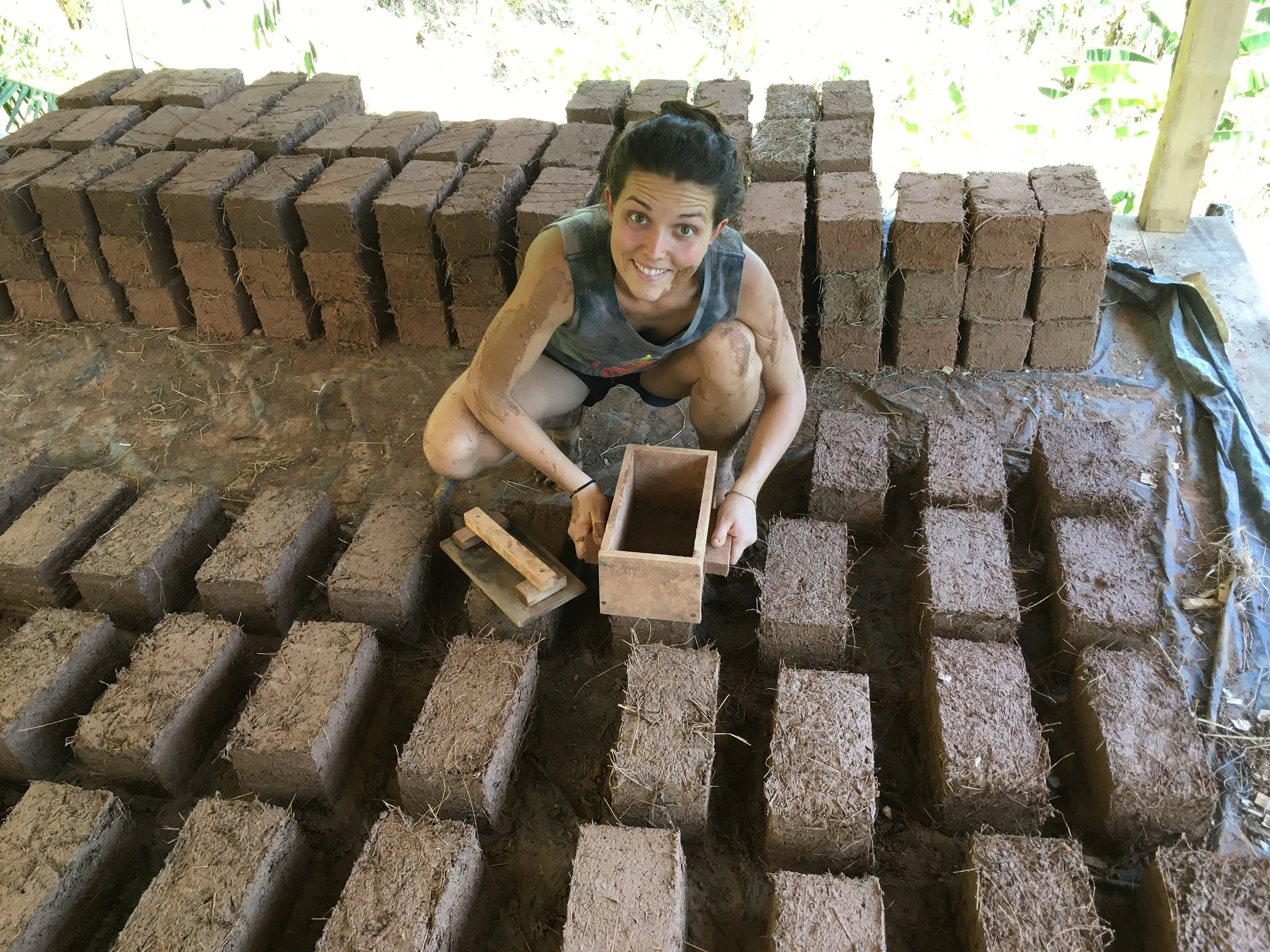
Steps to making a shower
1. Planning
As with all successful projects the key is good planning. We like to use a program called SketchUp to mock up all of our designs, lay out foundations, the frame and even plumbing. Every detail must be planned in advance this makes sure that the correct provisions can be designed in and made in advance.

2. Foundations
For our shower we used concrete blocks cut in half so that they could form the curves that we wanted. A shower is going to be a wet area so it is important that you think about this during the planning stage, where will the water drain to? Are my pipes embedded in my foundation? How is my roof going to be attached. In our design we decided to have a separate Timber Frame to support the roof structure.

Step 3 - Adobe
The first course of adobes were attached to the foundation using a cement based mortar this helped them bond strongly to the concrete foundation.
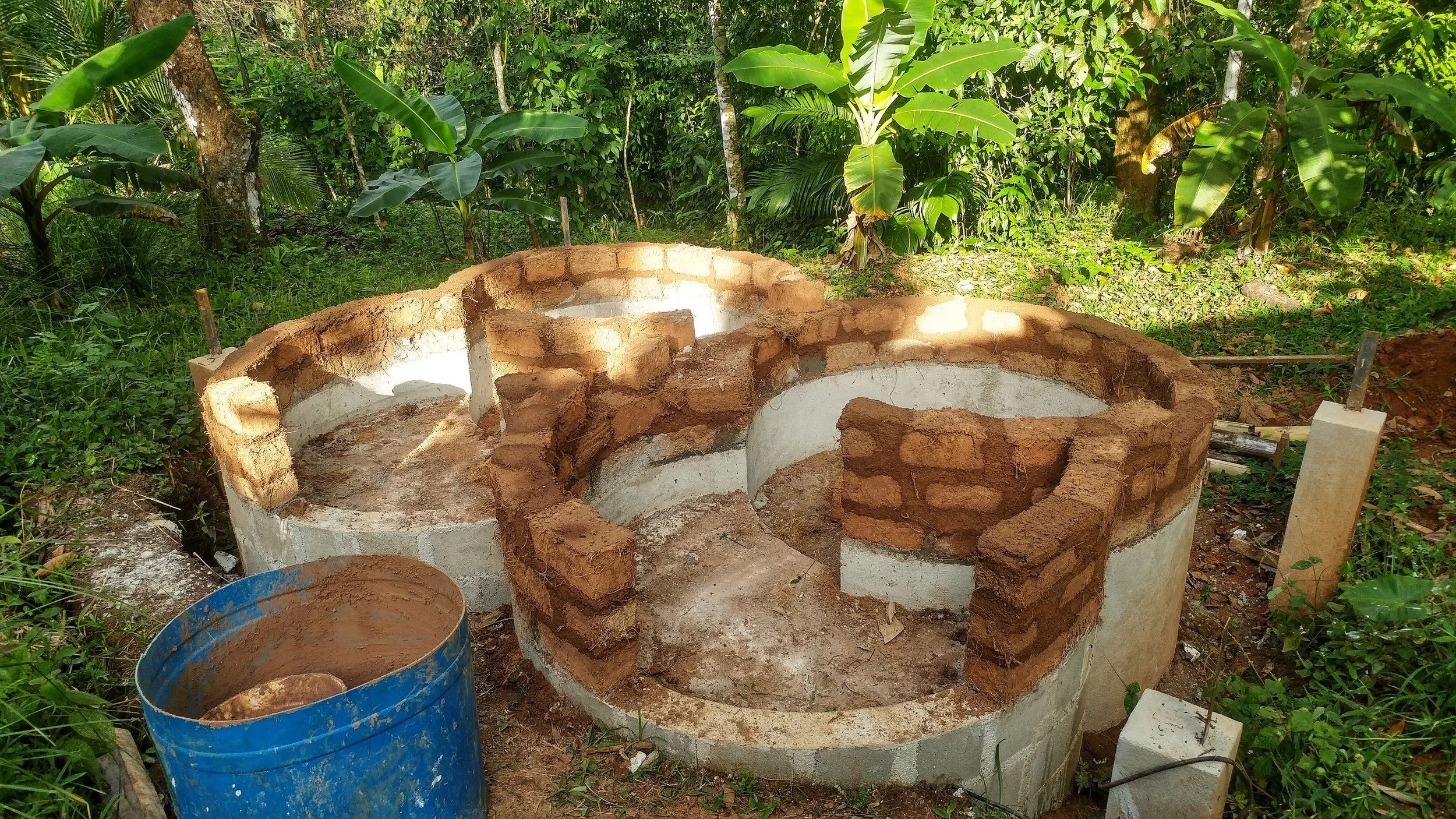
Step 4 - Bond Beam
From the second course upwards we used a sandy clay mortar for the adobes. Every 4 courses of adobes we made a cob bond beam for extra strength.

Step 5 - Gringo Blocks
Wooden hollow blocks (known as gringo blocks) were put at the end of each wall to attach in the wooden frame for the doors and a hollow plumbing box was installed where all the plumbing would be inserted for the shower handle. In Costa Rica the plumbing parts easily purchased in the local hardware store are terrible and always leak so we made most of the plumbing accessible from the outside. It is generally a good idea when making your initial design to plan for replacing parts in the future.
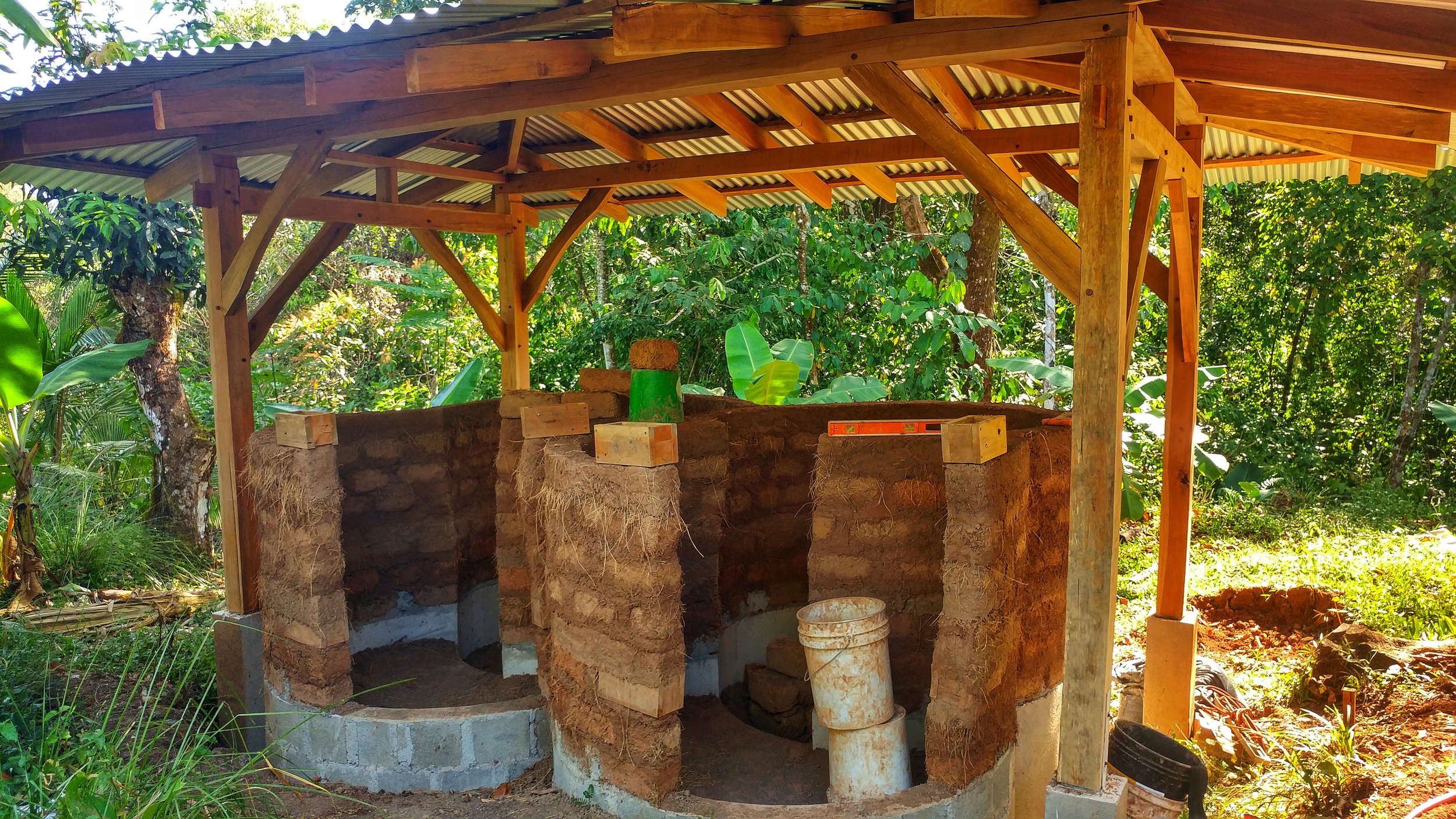
Step 6 - Frames
The door frames were installed at this point and they were screwed into the Gringo blocks. The door frames were also tied into the adobe structure using some mesh, we used what we could locally find which is what they sell for chicken fencing. You could also use a variety of natural alternatives, attaching them to the wood and plastering them in to the wall to give them extra stability.

Step 7 - Leveling
A leveling coat was then applied to sculpt and level the walls, this was tied into the door frame to give extra support too.
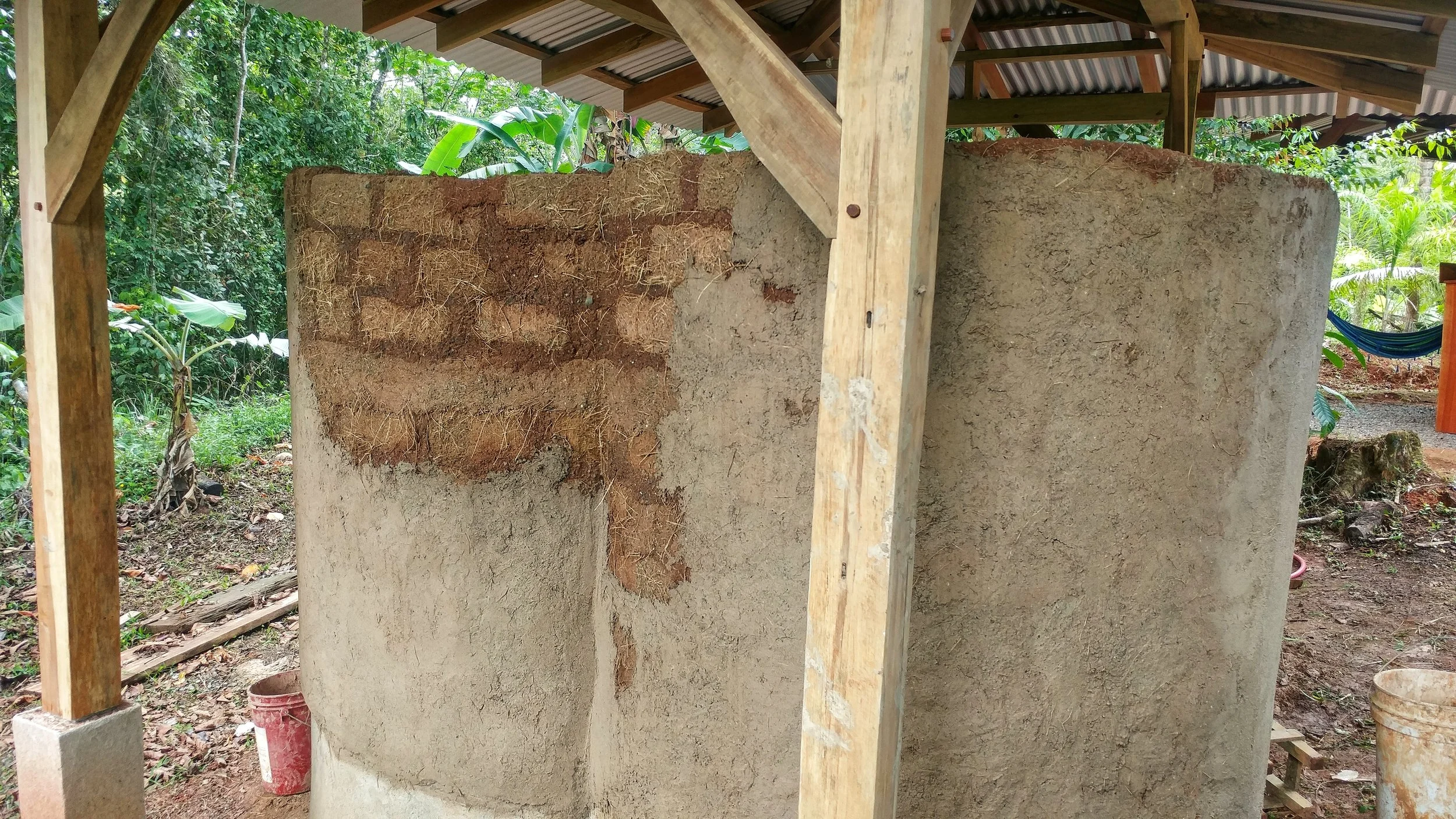
Step 8 - Tiling
The vertical surfaces of the concrete block were tiled to provide a plaster stop on the bottom edge were the plaster would meet the tile.
Step 9 - Plastering
A lime base coat was then applied over the earthen leveling coat. Whilst this basecoat was still damp (before it started wicking moisture again) we applied the tadelakt mix (1 part fine lime sand and 1 part lime). We did the Tadelakt like this as we had such a large continuous surface area to plaster and needed the time to work it all.

Step 10 - Tadelakt
Once the plaster had dried enough we stoned and soaped the wall using our homemade soap. The Stearic Acid in soap reacts with the Calcium Hydroxide (hydrated lime) to make Calcium Stearate which is highly hydrophobic and one of the reason Tadelakt is considered water resistant. Read more about Tadelakt here.
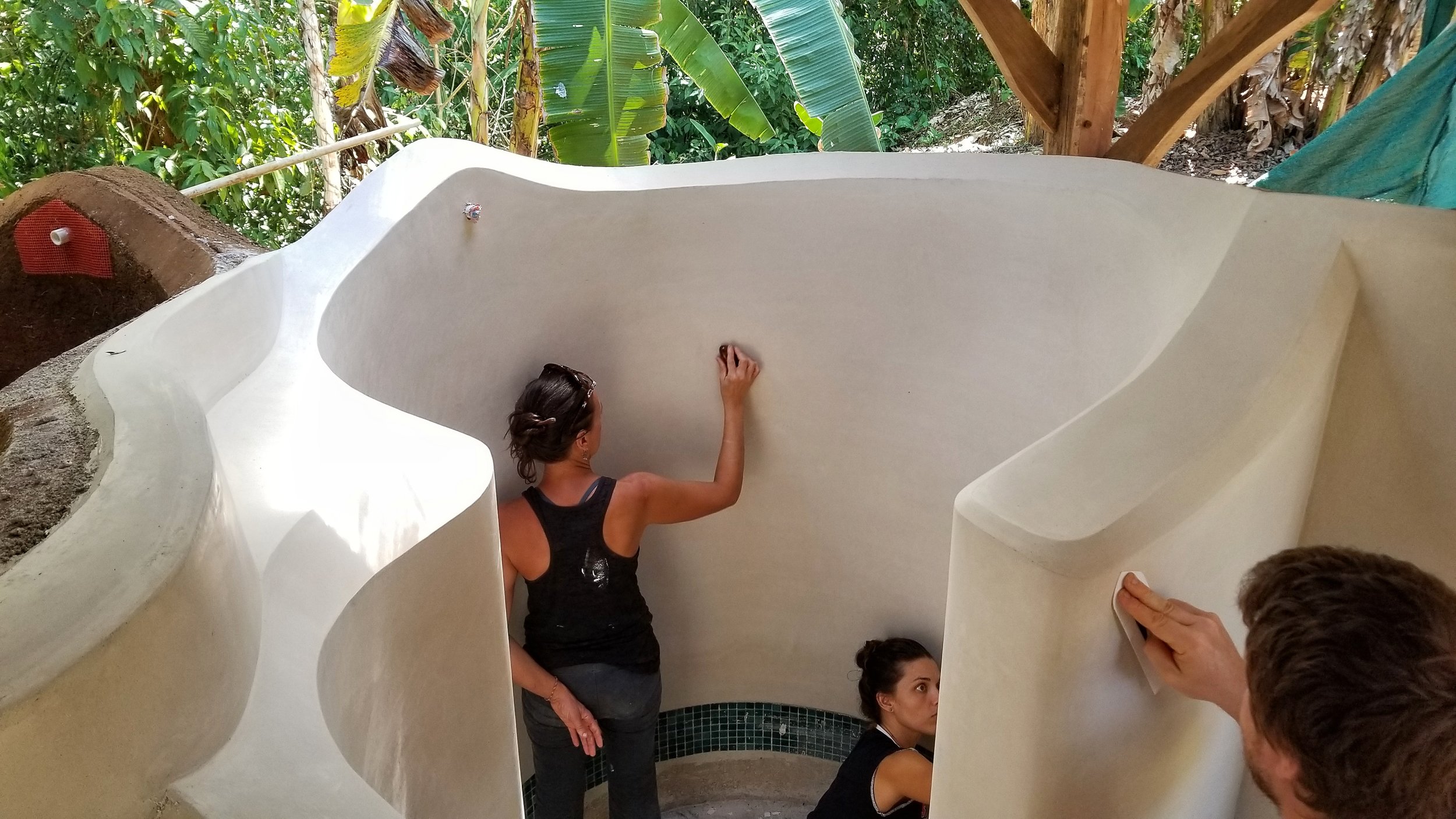
Step 11 - Mosaic
The remaining horizontal surfaces were tiled using different colored swimming pool tiles.

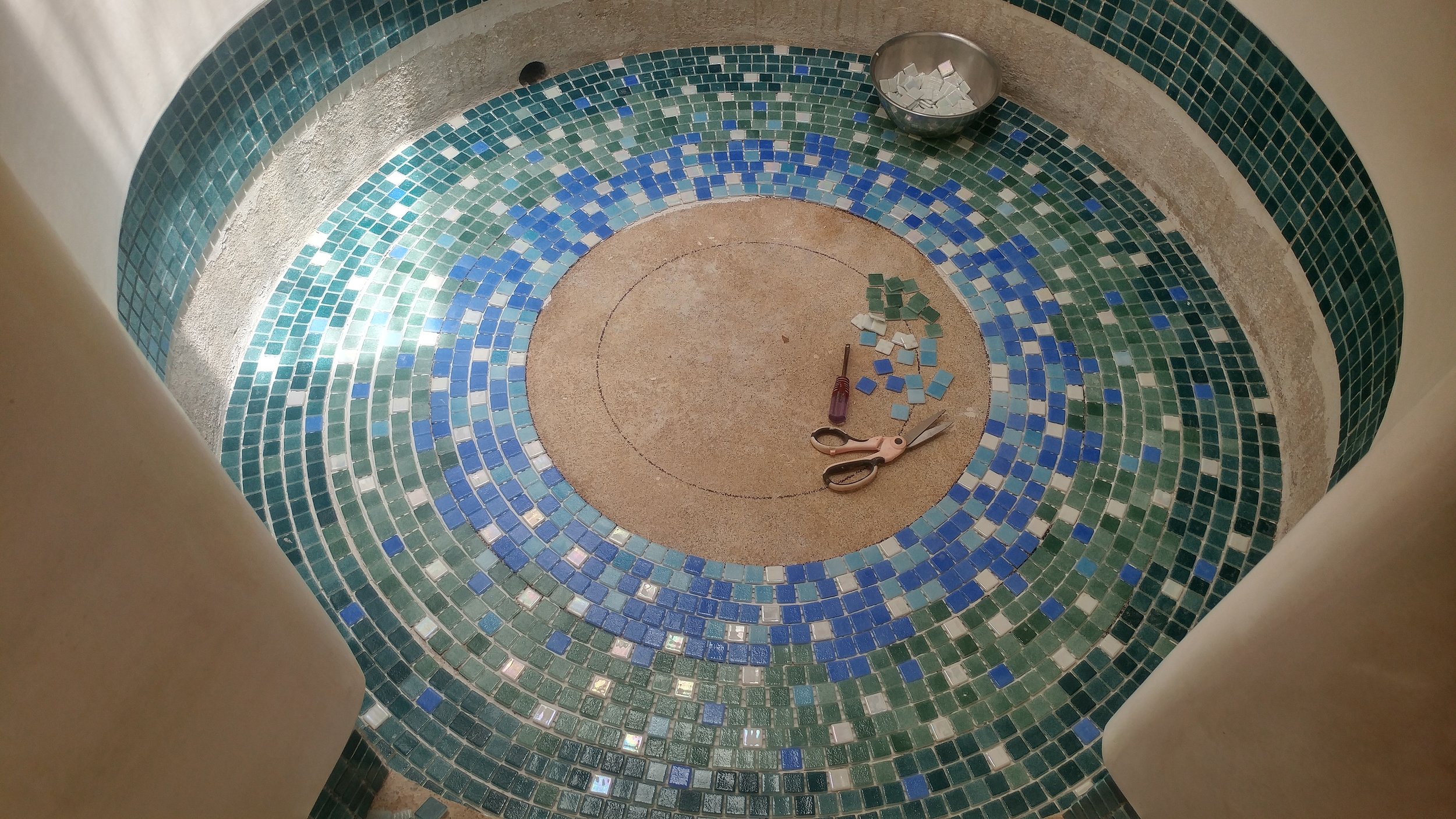


Step 12- Exterior Plaster
We used some of our left over mixes to do a base coat and finish in one pass, adding some pigments to alter the color. We used floats and darbies for the base coat and a sponge float and flexible Japanese trowel for the finish
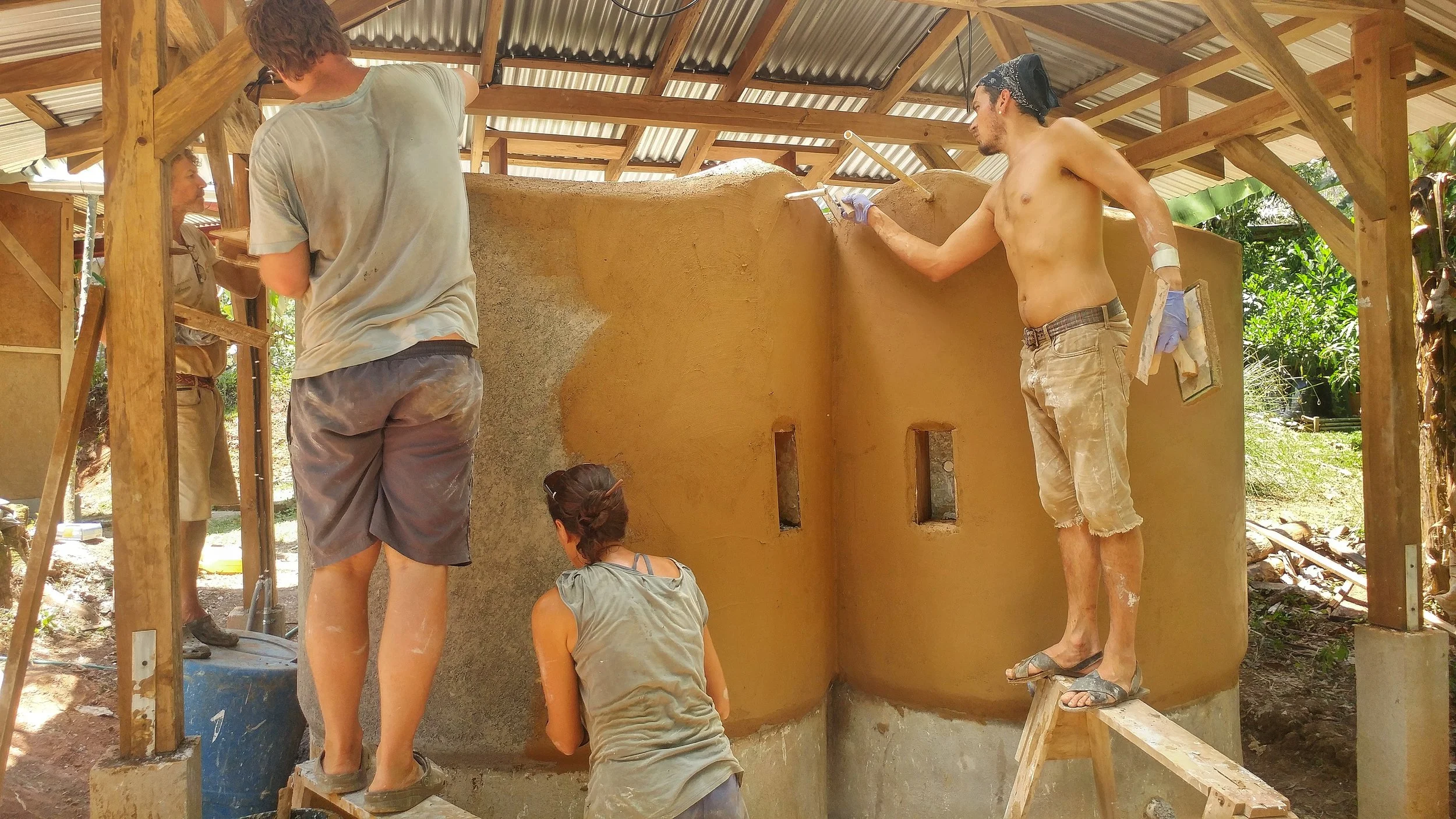
The shower was ready, once the plumbing was connected all that was left to do was enjoy the cool water in these wonderful showers. The two sides of the shower are pretty similar, the main difference being the color combination on the tile mosaic floor. Do you want to bathe in this epic outdoor shower? Come stay with us at Bernies Bungalow!
want to learn more?
Dream of building your own home, outdoor space, or maybe just a simple earthen garden bench?
With over 15 years of experience building and teaching natural building techniques, the Ranch is a perfect setting to get inspired and hands on learning.
Join us for one of our upcoming natural building focused workshops. We generally host a workshop in natural building, timber framing, and/or bamboo construction annually.

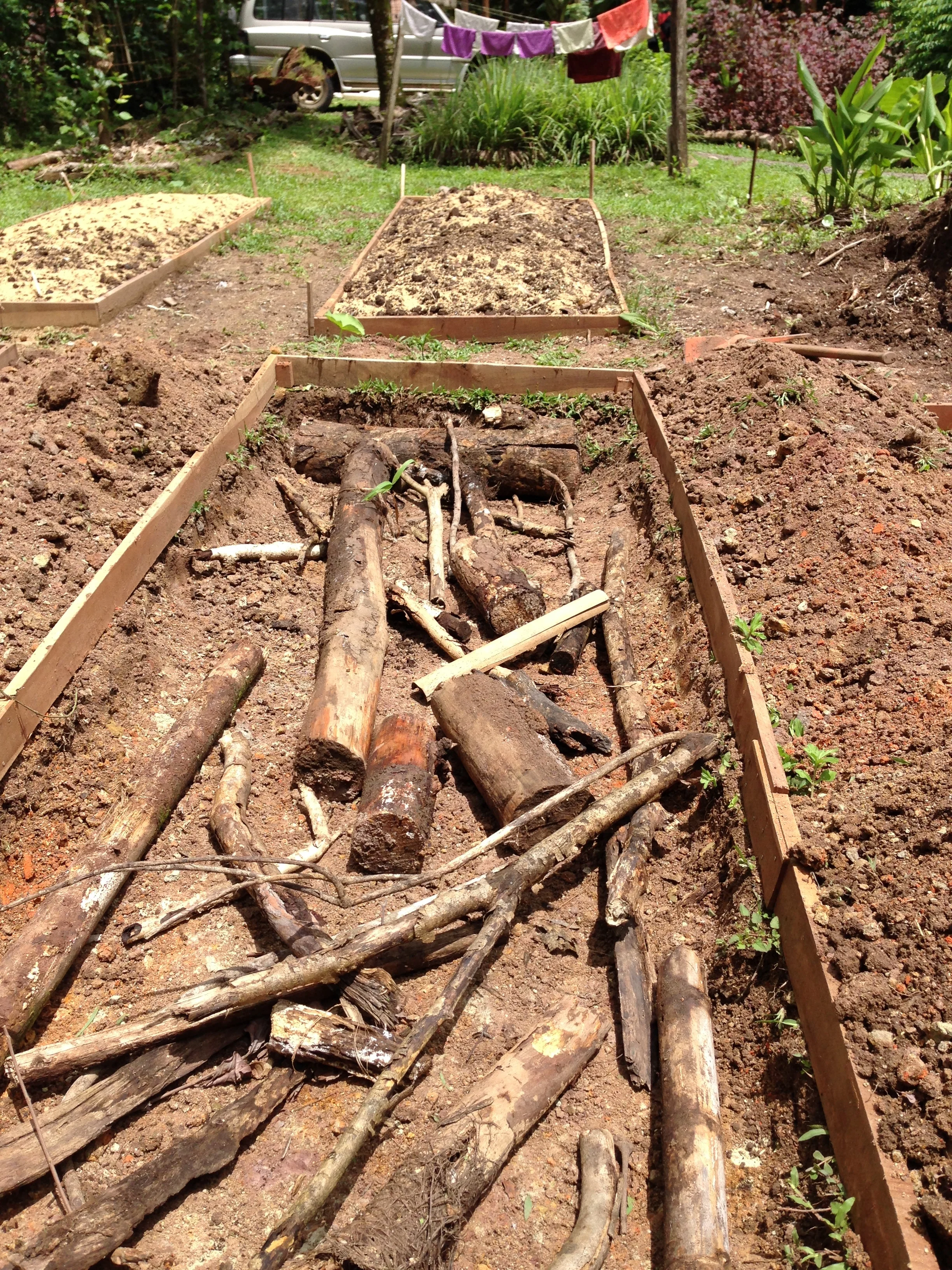
Hugulkultur in the Tropics
Hugelkultur means hill or mound in German combined with culture. It has been practiced in Europe for hundreds of years. Hugelkultur is a simple agricultural practice that doesn’t take much to set up and provides numerous benefits.
Hugulkultur in the Tropics
by Ben Behrend, 2019 Apprentice
Hugelkultur means “hill” or “mound” in German combined with “culture”. It has been practiced in Europe for hundreds of years. Hugelkultur is a simple agricultural practice that doesn’t take much to set up and provides numerous benefits. As the wood decomposes it creates air pockets; it releases nutrients slowly and also absorbs and retains water. This retention of water is important during drier periods or places like the desert or the dry season in the tropics.
This year at Rancho Mastatal, it has been hot and dry, causing strain on many of our plants. Immediately surrounding our main gathering area/kitchen is zone 1 which would be a great place to experiment with hugelkultur. Not much has been written on Hugelkultur in the tropics. Several groups of apprentices have trialed using woody material underneath garden beds. Whilst it is difficult to say with certainty that due to the hugelkultur practices yields have increased, it is safe to say that yields have increased and i would summarize that this due to many factors one of which is the use of hugelkultur. I feel inspired to continue experimenting myself and see how it works first hand. Below are instructions that you can follow to make your own hugelkultur.

· Dig a foot or two of the top soil and put that aside.
· Pile in decomposing tree limbs the more “rotten” the better, biggest on bottom and working up with smaller. Some people use burned logs, or add ash for extra potassium. Not all woods are created equally when it comes to hugelkultur
o It is not good to use Cedar for example as it takes longer to decomposes due to its natural pesticides/ herbicides/anti-fungal/anti-microbial properties. Black locust won’t break down fast and is very toxic. Based on this i would guess that Spanish Cedar and any hardwood used as fence posts may not be suitable in the tropics either eg Guachipelin, Madero Negro etc…
o Woods that work best: Alders, apple, aspen, birch, cottonwood, maple, oak, poplar, willow in temperate climates. For the tropics i would guess that any wood refered to as “semi-duro” would work i.e. any medium strength hardwood eg. Roble, most fruit tree woods etc…
o Layer the sod on top of this
· Layer sheet mulch an example
o 5 inches well aged compost
o 4 inches manure
o 8-12 inches of hay, straw, dead decomposing leaves, seaweed
o 1 inch of newspaper/cardboard
o Soil amendments (blood meal, bone meal, manure)
Letting the mound “rest” for several months, or even 1-2 years before planting is sometimes recommended. Beds are built up in a mound that can be up to waist height, any desired a length, and a narrow width (one source recommended three feet width). The recommended angle of the mound is 60-85 degrees by some sources, creating a triangle. Others, make a less steep slope that is also documented to work well. Over time as the wood decomposes it creates a sponge like bed underneath. This holds the moisture and produces lots of nutrients and fungal friends.

Toby Hemenway mentions in “Gaia’s Garden”, you can start potatoes a month early in this kind of bed. “Some naturalists theorize that roots and fungal mycelia may translocate water from these woody caches to plants and fungi many feet away.” (Gaia’s Garden, pg. 70). Wood locking up nitrogen has been a concern by some yet Hemenway feels wood decomposes so slowly that very little nitrogen is tied up by microbes gnawing at logs.
Over the first year, your hugels may sink as much as a foot depending on the climate. This is a natural settling of the pile, as the mound breaks down and decomposes. If you want to “rebuild’ hugels at the beginning of each year you can add more compost, otherwise you will produce excellent humus by the time your hugel levels out. Hugelkultur offers an attractive way to build top soil and retain water during the dry season.
We will keep you updated with our progress, in the mean time let us know what you are trying to do at home or have done with hugelkultur!
Interested in having the opportunity to learn whilst doing? Why not apply for our year long apprenticeship. Can’t dedicate the time to our year long apprenticeship, why not join us for our shorter internship?

How Rancho Mastatal Changed my Life
It seems hyperbolic, but it’s hard to overstate the overwhelmingly positive effect that my experiences at Rancho Mastatal have had on my life, and my current career path.
How Rancho Mastatal Changed my Life
By Kristen Mandala,
It seems hyperbolic, but it’s hard to overstate the overwhelmingly positive effect that my experiences at Rancho Mastatal have had on my life, and my current career path.
I was first introduced to Rancho Mastatal when I was running high school trips with a small Canadian eco-tourism company in January of 2017, called Evolve Tours. I was able to experience first-hand the effect the ranch has on inspiring young minds and reconnecting them with nature through hands-on activities and facilitation-style learning. I knew from the first night staying in the bamboo tree house (affectionately called the Hooch) that I was in for an unforgettable experience. The peaceful jungle-sleeps, coupled with the incredibly healthful and delicious food made it easy to return the following year to bring more youth to stay at the ranch.
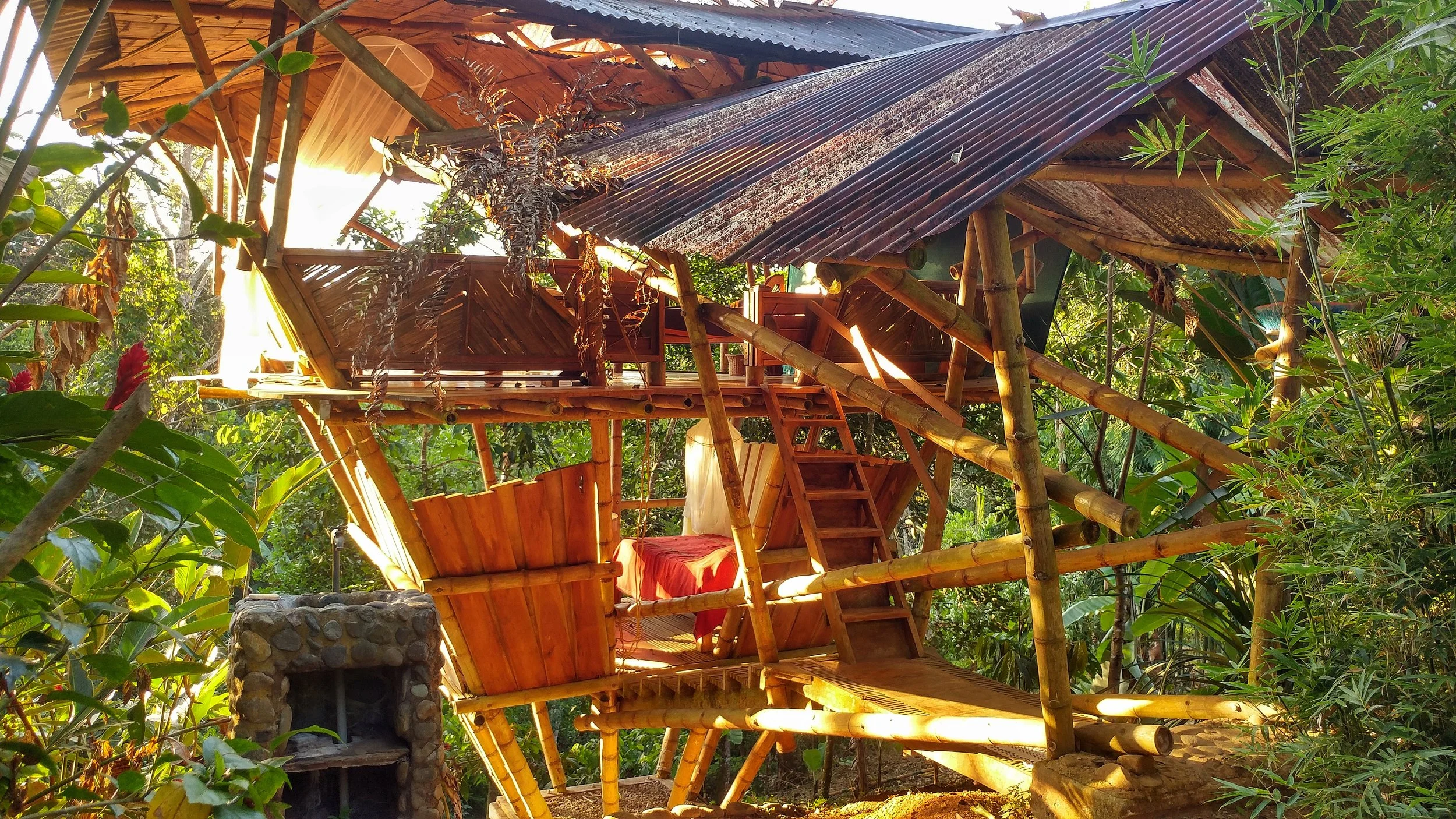
The Hooch at sunrise
They weren’t the only ones who gained knowledge from the lesson plans. The more I sat in on and participated in activities, the more I realized that my passion for sustainability and food systems could be more than my side “passion project” that I indulged in after regular work hours. Rancho Mastatal planted the seeds for what has become my new career back home in Toronto.
After moving on from touring, I decided to invest in my own education and enrolled in the Permaculture Design Course in April of 2018. This would be my first time travelling to the ranch as an individual and my first non-traditional education experience post-grad. My two weeks learning under Scott Gallant, Rachel Jackson, Laura Killingbeck, Chris Shanks, and Alejandro Arango as well as the incredible Core Team (love and gratitude to Nic, Ali, Timo, and Robin) and the 2018 apprentices was truly transformative.
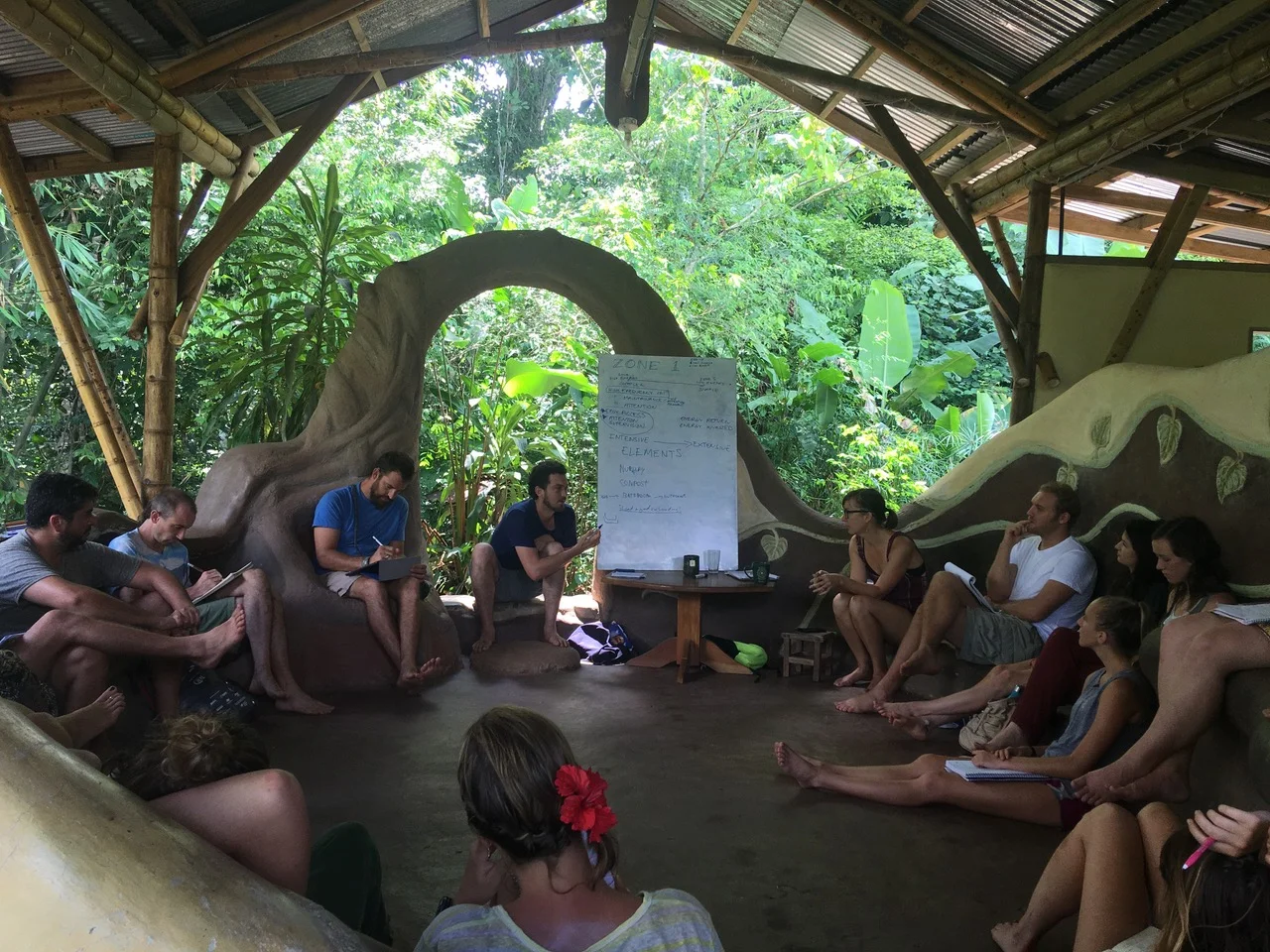
PDC lesson in our Ceiba Lounge
I was able to fully immerse myself in the world of permaculture, sustainable living, and social/food justice surrounded by like minded people from all over the world. It was like summer camp when I was a kid in all of the best ways, intersected with some of the most inspiring and stimulating lessons and conversations I’ve ever been apart of. The two weeks not only expanded my knowledge of regenerative ecology and permaculture, but also instilled in me a deep sense of optimism for the future state of the world knowing that there are so many incredibly intelligent people who want to bring the earth back to it’s roots through community-centered activism and organizing.
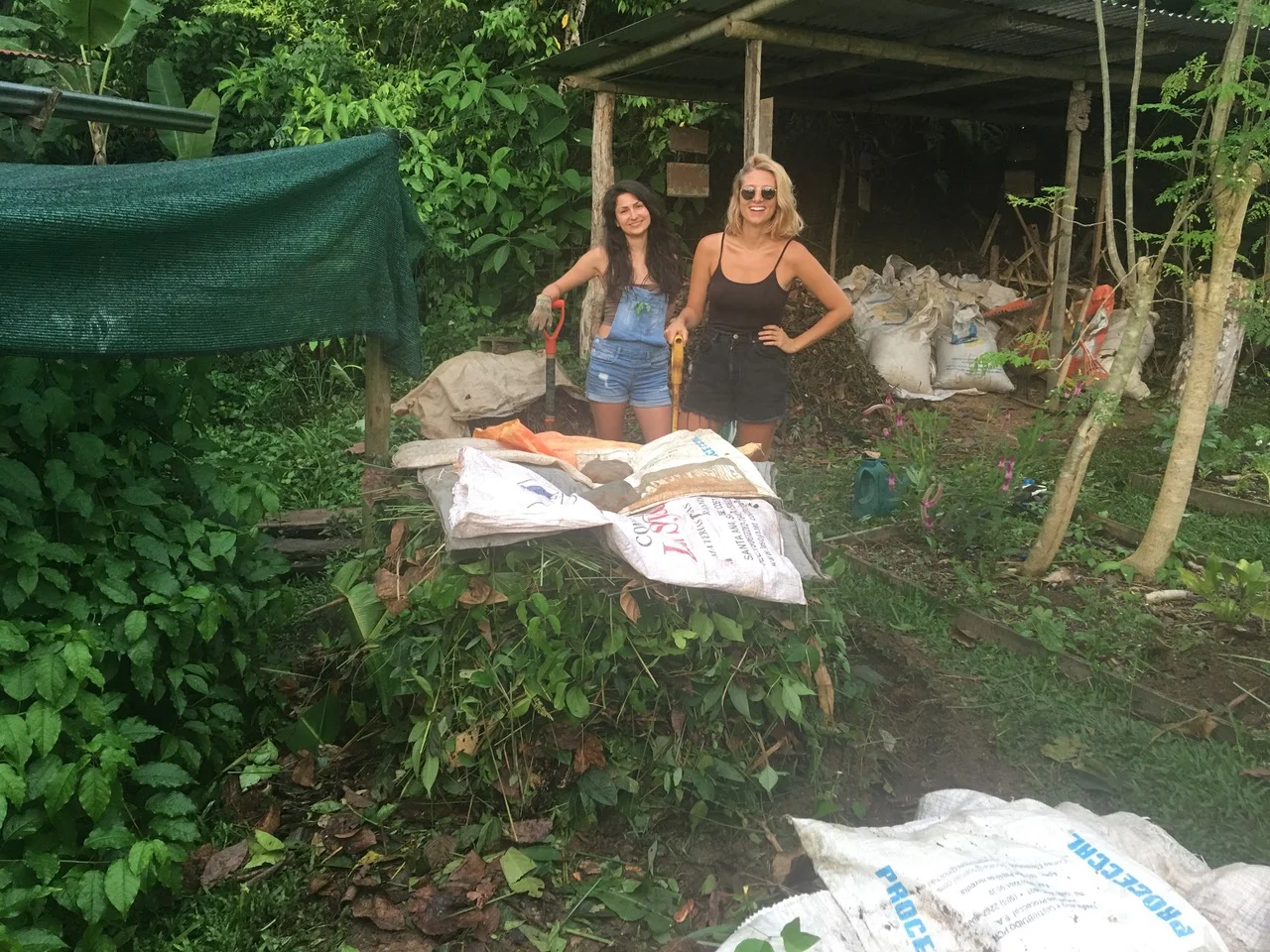
Fast-forward a year, I am lifelong friends with many of the people from the PDC, who have proven to be a beautiful support-system regardless of time zones; I have created a sustainable consulting company called The Greener Good, aimed at inspiring those in schools and offices throughout the Toronto area to incorporate sustainable habits into their daily lives through on-site workshops; and I am eternally grateful that I trusted myself and invested in my education by studying Permaculture Design at Rancho Mastatal.
Enjoying the waterfall
My highlights of my time at the Ranch include: waking up and doing yoga on the deck overlooking the jungle, the coffee, the food (cannot emphasize enough how good the damn food is), SO MUCH LEARNING (from someone who struggled to stay engaged in school, I was hungry to learn more each day), running to the waterfall at lunch for a refreshing dip, walking to class and picking fruits on the way, playing soccer or ultimate before dinner, ending each night with some of the best conversations, and waking up and doing it all again.
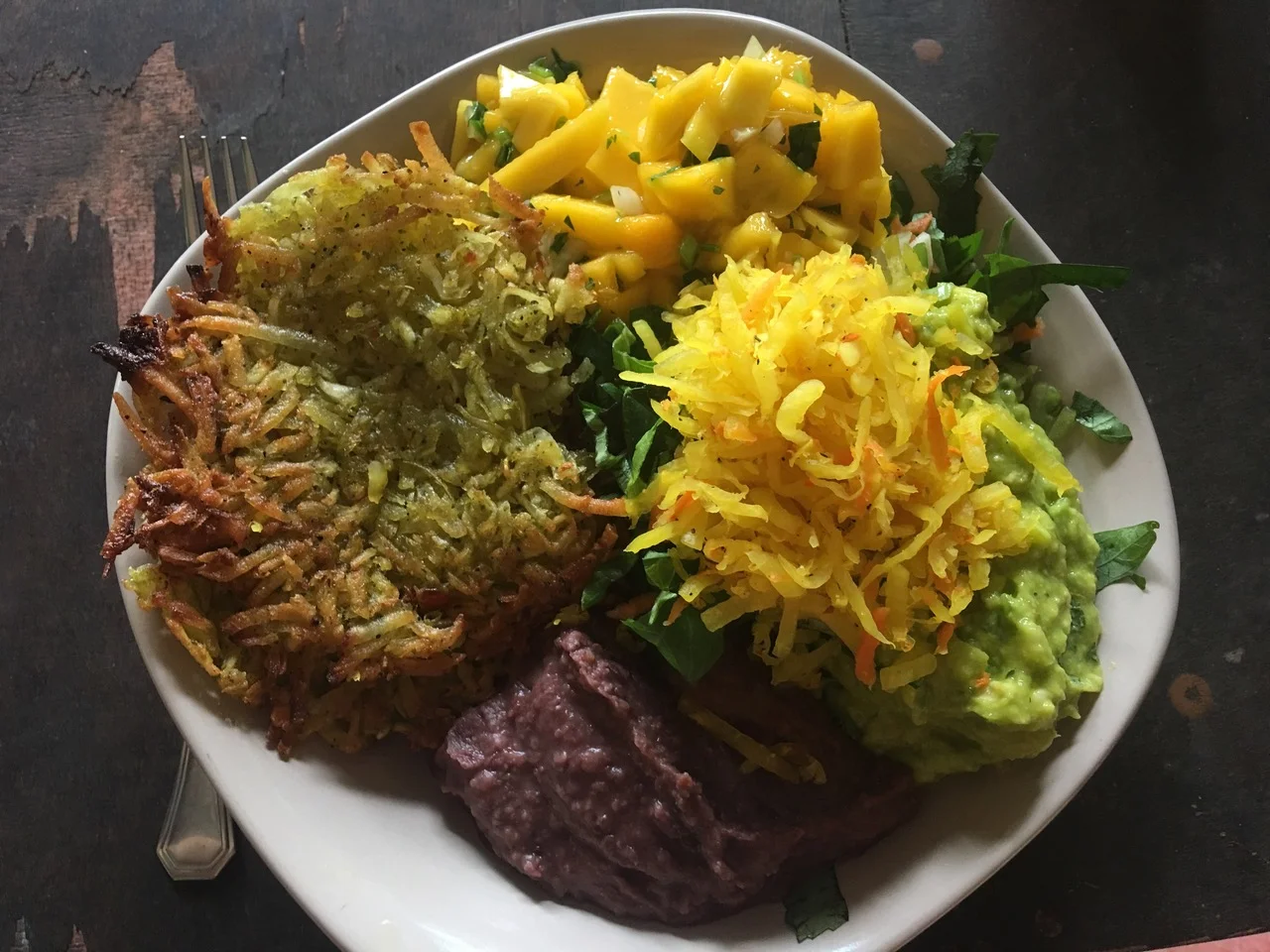
Locally sourced meals
Okay, I should end this now as I am currently flooded with nostalgia and my emotions doth runneth over as I type. To the folks at the Ranch, thank you for reminding me of my strengths, empowering me to use them, and for making a small piece of Costa Rica feel like home. I continue to thank Mother Nature before my meals and express gratitude at every turn, a practice introduced by Robin and Timo that I will always carry with me.
If anyone is looking for a sign to invest in themselves, this is it.
If you are interested in learning more about my project you can go to:
Instagram: www.instagram.com/@the.greener.good
Website: www.thegreenergood.net
Facebook: www.facebook.com/kristen.greener.good
With love and gratitude,
Kristen
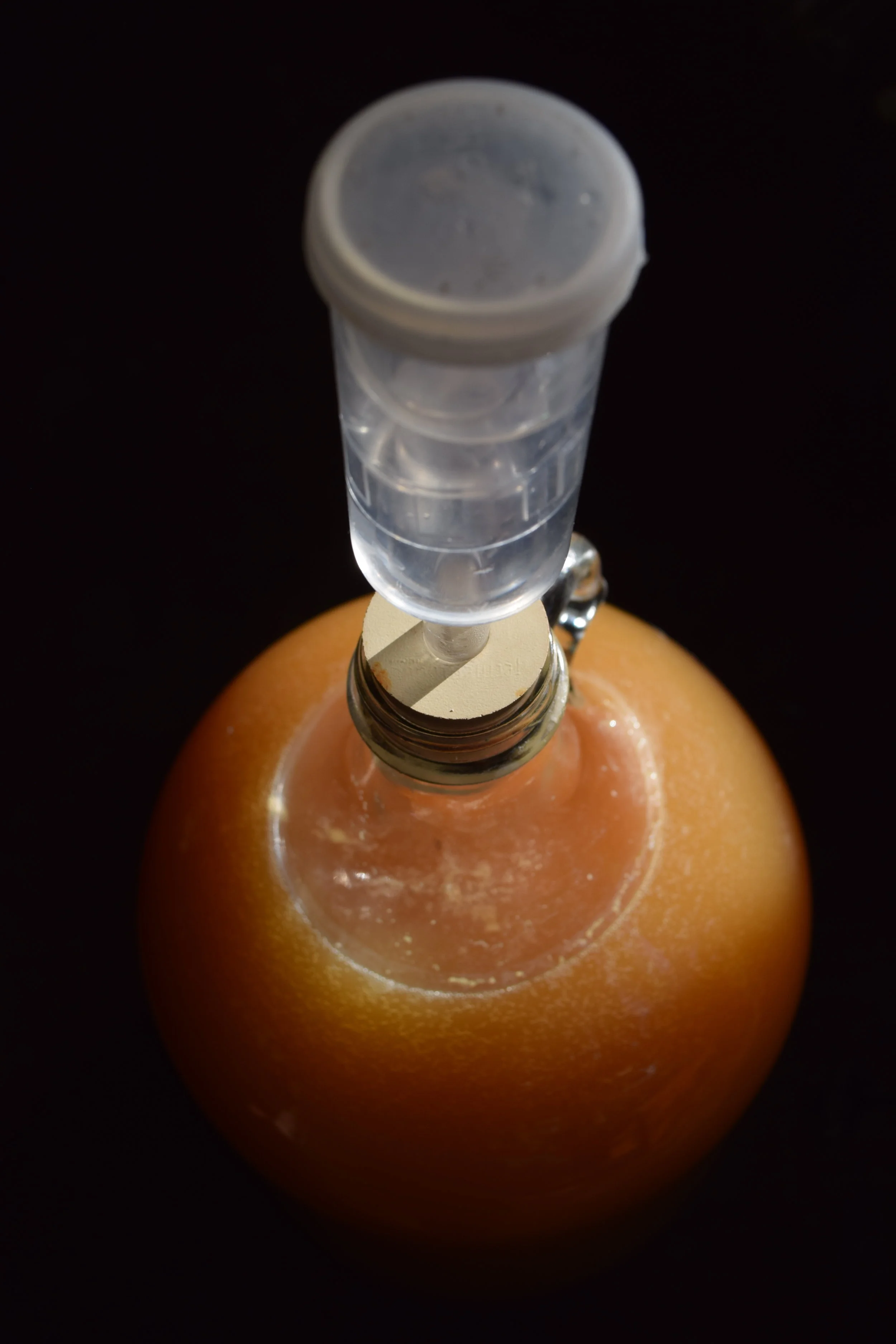
How to Make a Simple Hooch
Hooch is a homemade alcoholic beverage and in this blog I’m going to explain how to make it.
For thousands of years humans have been fermenting for recreational, spiritual and medicinal uses. Fermentation allowed humans to store and use ingredients they’d harvested later in the year. Although hooch is an alcoholic beverage, it can also be brewed for medicinal purposes.
How to Make a Simple Hooch ?
by PJ Barton, 2019 Apprentice
Hooch is the name we use to refer to our own homemade alcoholic beverages. In this blog I am going to explain how we make our delicious home brew. Interested in Fermentation? join us for our upcoming workshop THE ART OF FERMENTATION.
During the peak season at Rancho Mastatal we drink around 15 gallons of Hooch a week. We brew our Hooch in Corny kegs, these are great as they are made of stainless steel, they are easy to clean and easy to maintain as you can easily purchase all of the replacement seals.

Our Corny Kegs
For thousands of years humans have been fermenting for recreational, spiritual and medicinal uses. Fermentation allows us to safely store ingredients without the need for refrigeration and prior to the advent of electricity it was the primary way to store certain foods and drinks. Although hooch is an alcoholic beverage, it can also be brewed for medicinal purposes, by adding herbs and spices with the desired properties. By actively harvesting fresh fruits and yeasts from our surrounding area, creating and exploring new brews, we are able to connect to our environment in a fun and practical way. Hooch is a great way to use up fruits which are already naturally fermenting and processing them into something enjoyable to consume, turning our waste into something useful.
Yeast is a culture that is one of the base ingredients for making Hooch. It feeds on sugars when we mix it with sugar and water creating carbon dioxide and alcohol. We can buy commercial yeast strains, which are sold for brewing or we can harvest our own wild yeasts from our environment. Different wild yeasts will impart different flavors and characteristics to our homemade brew, try experimenting with these wild yeasts and see which ones produce flavors you enjoy most!
Harvesting Wild Yeast
To harvest wild yeasts from fruits and flowers
Collect them in a sterile jar and leave in a dilution of 20 percent sugar to water (eg 40g of sugar to 200ml of water).
After 48 hours (although this will depend on the ambient temperature), sediment should start form on the bottom of the jar, bubbles will start appearing, and your solution will begin to ferment. this is a sign of a healthy solution!.
Remove the fruit or flower from the liquid.
Continue feeding with sugar every day for a week and you will have you own yeast culture that you can use to start brewing with.
Basic Hooch recipe
This basic Hooch recipe is really simple and uses 3 simple ingredients. You can add fruits or herbs to extract the taste that you desire. There are many opportunities for experimentation when you start making your own alcohol and hopefully you can create delicious beverages to enjoy with your family and friends.
Simple recipe to make your homemade hooch:
For a 2 gallon batch
· 2 pounds unrefined cane sugar (we use Tapa Dulce)
· 2 gallons of water – 1 gallon tea
· 2 cups of wild yeast solution (see above instructions on how to harvest wild yeasts)

Tapa Dulce
How to prepare:
Melt the sugar into a gallon of hot water, until the sugar has dissolved.
Mix in the remaining gallon of water to help cool off the sugar water, make sure you cool it down to 100F degrees. This process is creating a wort in which you pitch the yeast.
Once the liquid has cooled down pitch the yeast. Stir it well and transfer it to a container with an airlock for a minimum of 1 week before consuming
This is a standard hooch consumed on the ranch other enjoyable combinations such as coca, vanilla and ginger or oranges, cinnamon ginger. In every available resource there’s a new taste to explore. Enjoy and have fun experimenting
Want to learn more? Join us for a day workshop or a longer residential workshop


Gardening and Permaculture practices at the Ranch
Here at the Ranch the year long apprentices have various roles and functions that support the Ranch community. By taking on responsibilities and managing certain areas we the chance to learn and experience those areas on a deeper level . Part of the educational model created by the ranch team is a monthly rotation of these so called life skills. Each apprentice transitions their life skill to the next apprentice, passing on all of the relevant information to their colleague in order to complete the various tasks associated with each life skill.
by Diana Dagash
2019 Apprentice

our front gardens
Here at the Ranch the year long apprentices have various roles and functions that support the Ranch community. By taking on responsibilities and managing certain areas we the chance to learn and experience those areas on a deeper level . Part of the educational model created by the ranch team is a monthly rotation of these so called life skills. Each apprentice transitions their life skill to the next apprentice, passing on all of the relevant information to their colleague in order to complete the various tasks associated with each life skill.
One of the life skills is currently called the Garden Gnome. I would like to share some of my experience and reflections from doing this task every morning for a month. The garden gnome is in charge of maintaining the front gardens. This is referred to as our zone 1 garden using permaculture lingo. It is the area that is in closest in proximity to the most frequently used space- the main house. In the Zone 1 gardens we grow herbs, annual and perennial crops such as mustard greens, katuk, Haitian basket vine, hibiscus, cucumbers, squash, yard long beans,wing beans, radishes, sweet potato, moringa, basil, oregano, mint, parsley and curry leaf and other amazing tropical goodies which we use in our kitchen everyday. Having these crops growing in close proximity to where we spend most of our time allows us to easily provide the daily maintenance of this space such as watering, harvesting and weeding.
In Rancho Mastatal we approach gardening through a permaculture lens. By mimicking the patterns in nature we are able to create micro climates in which our crops thrive. We create systems that have many functions and support other systems in their functions, allowing them to thrive in harmony with nature. We apply a range of those practices at the ranch and we continue learning and experimenting with new possibilities.
Given that we live in the tropics we have two opposite seasons, about half the year its is dry and the other half rainy. Although the dry season has its own challenges I can only speak from my own experience taking care of the garden in the rainy season, for instance i believe that in the rainy season there is a lot of weeding whereas in the dry season there is a lot of watering!
As the rains increase in volume and frequency it is a time when everything begins to grow rapidly. The jungle fills up with even more green vegetation, popping out of every space available. It rains consistently every afternoon , sometimes all day and night. The soil is saturated . It is a happy time for ALL living things to thrive, including some of the more challenging species like mold, fungus and insects. Some of our crops were over taken by fungus or eaten by insects, others became over saturated with water as they were lacking sun and/or air flow. As with every challenge, i found an opportunity to research and experiment with natural recipes for pest and fungus control.
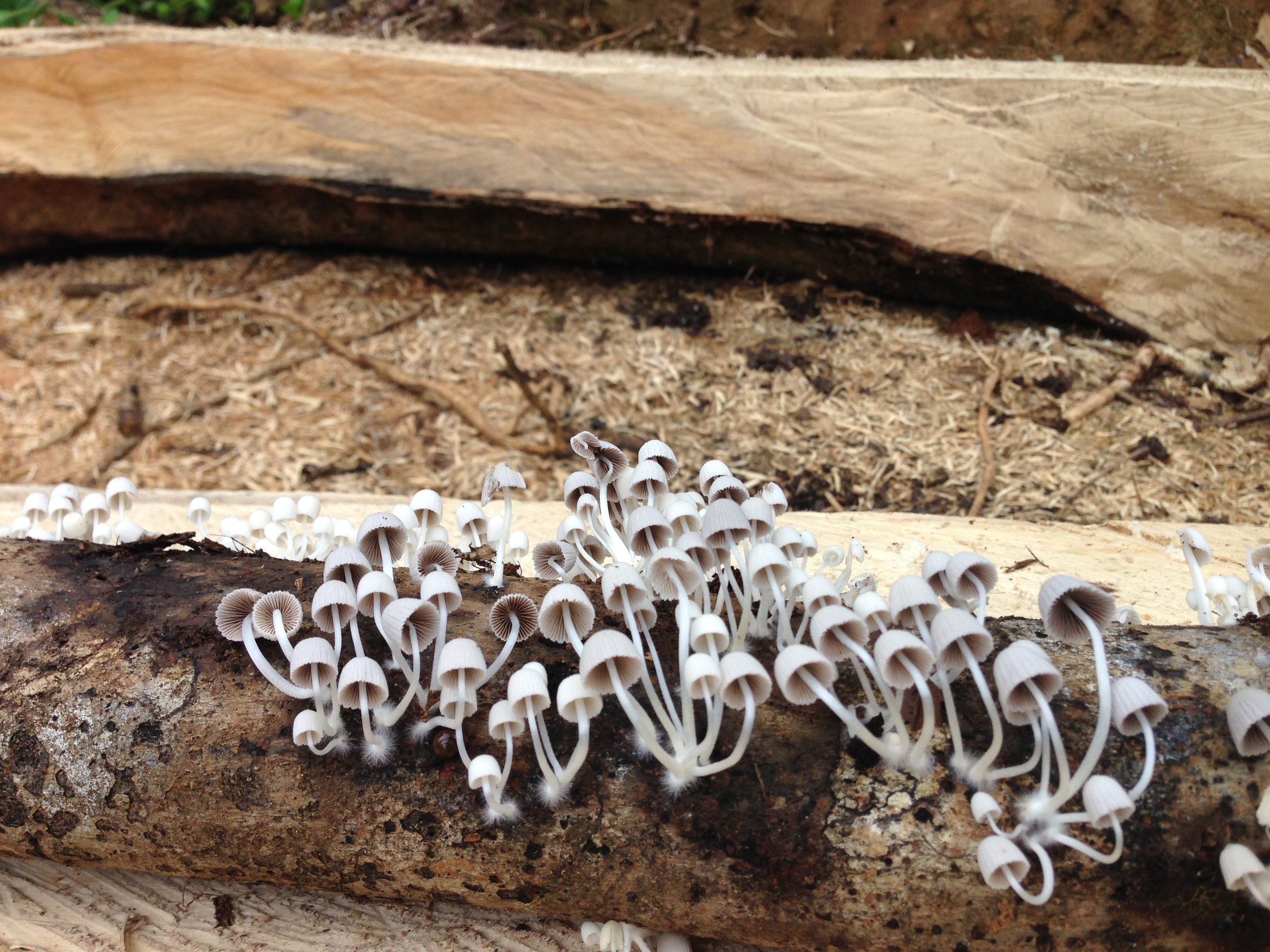
with the onset of the rains, mushrooms started popping up everywhere
My days started early in the mornings with a walk through the garden, observing the plants and checking the soil moisture levels. As I walked I noticed plants that seem to be struggling and tried to identify what might be affecting them. This is then communicated with the garden manager so we could discuss further ideas and solutions. We researched potential natural insecticides and fungicides that could help solve these issues.
Here is some of what we have learned and the practices we apply here at the ranch.
We are surrounded by amazing medicinal plants growing all around us, thriving under the jungle canopy or occupying disturbed pockets. These plants contain medicinal properties that can benefit humans as well as plants.

For example turmeric contains anti-inflammatory and antibacterial properties beneficial to humans and when planted among the roots of a tree, benefits the tree with those same properties This is referred to as companion planting. By planting diverse species next to each other they are able to support, protect and ultimately benefit one another. This can be as simple as providing shade or wind protection. Not only can companion planting by a useful tool in our belt to fight against disease and pest pressure but we can also use the properties of some local herbs. Here are some examples of what we have been doing.
Jackass bitter - the most bitter herb known, contains antifungal and antiparasitic properties. Spraying this tea onto diseased plants can repel insects and prevent fungal issues.
Inter cropping aromatic herbs like oregano, lemon grass and basil with certain food crops can confuse and repel insects with their scent and prevent disease with their antimicrobial and antifungal properties.
Using the shade of the cucumber trellis to help shade and shelter more delicate herbs underneath them.
Using peanut grass as a living mulch to crowd out weeds and provide nitrogen to the soil underneath some of our taller perennial crops such as Katuk and Cranberry hibiscus.
Planting Marigolds everywhere to reduce nematode populations, there is controversy about the effectiveness of this though.
Working in the front gardens has also made me reflect on the ideas of closed loop systems. As i am partially responsible for management of the kitchen compost. I really like the idea that there is no such thing as waste. Everything can be transformed into something useful. All of our food scraps are composted creating a finished compost that can then be added back to the soil to enrich it, closing the loop.

Another big part of the practices we apply when it comes to the food forests is observation of the environment and meeting the land's needs by mimicking patterns in nature. Thanks to all the researches and life long practices in the agro forestry and gardening world, a network of knowledge has been created for us to share our experience and knowledge. We are continuously learning and working towards improvement of our systems.
With each piece of land we carry the responsibility for the history, present and future of it. It is up to us to create a relationship with our land, to observe it's needs and potentials.To be stewards of the land and assist it to become a healthy ecosystem in which we can humbly live and feed ourselves.
This experience, of being an apprentice at Rancho Mastatal, has opened my eyes to a new world of possibilities, inspiring ideas, regenerative solutions, discovering new ways to live lighter on the planet and in harmony with nature .
I am inspired by the movement towards an ecological , sustainable lifestyle and feel grateful to be a part of a project that focuses on sustainability, permanent culture and agriculture.
I invite you to share your experience and discoveries with growing food in the lowland tropics.
What interesting practices have you learn about recently?
Which annual crops did well for you in the tropical rainy season of Costa Rica?
What kind of companion planting worked well for you?
Would love to hear from you!
Blessings,
Diana D.
For more information about Permaculture consider joining us for our Permaculture Design Certification. For info about being an apprentice please go to the apprentice page. Here you will find in depth descriptions of what life is like in Mastatal.
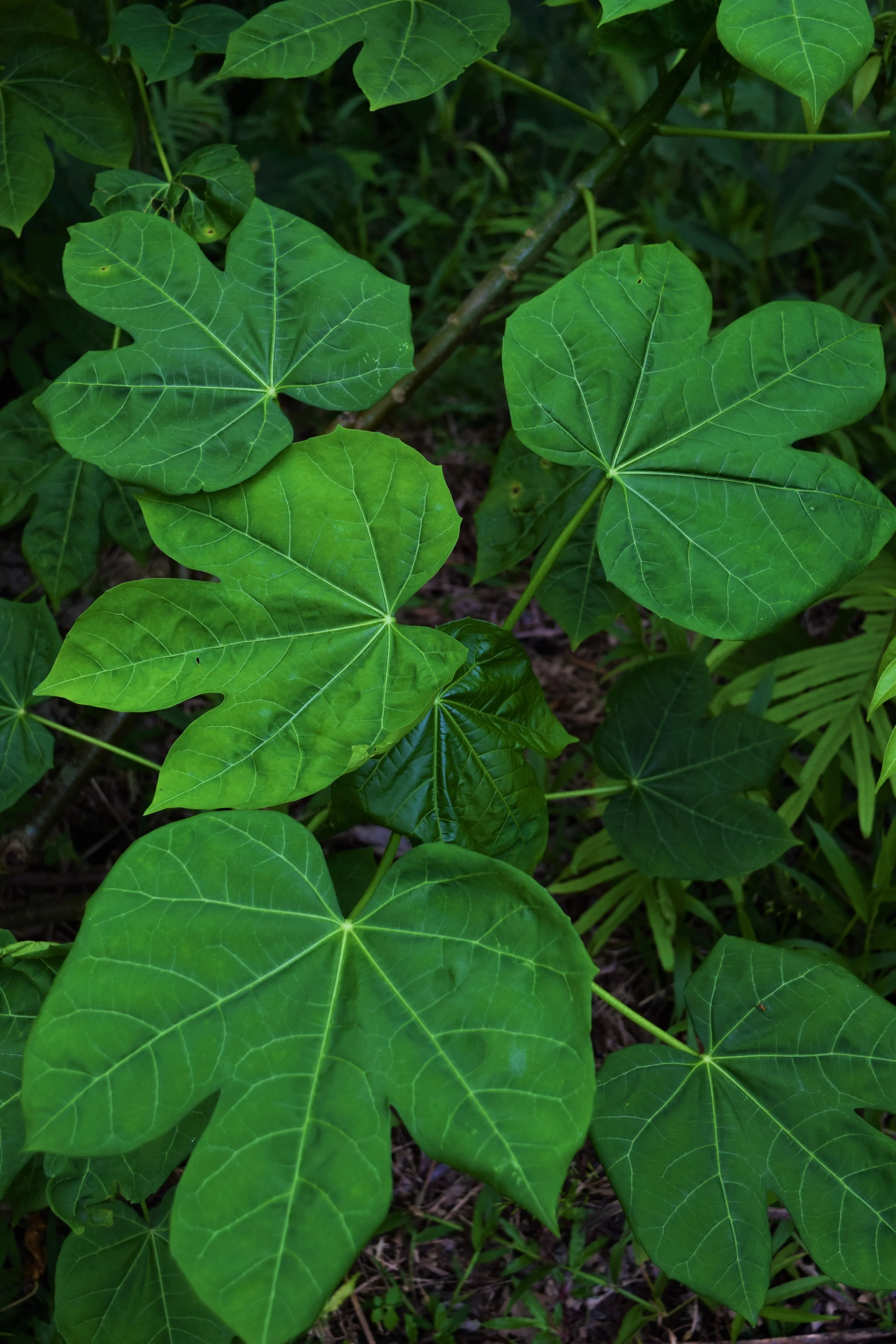
Vegetables & Greens that Thrive in the Tropical Rainy Season
When the rainy season arrived, it started with a sense of relief - dry season went on longer than expected and our trees and plants were scorching in the heat. For myself the cooler air was welcome comfort, and the rains a reminder of home and getting cozy. Mornings were beautiful with the sight of the sun rising through the dewy mist.
By Amy Dodds,
2019 Apprentice
When the rainy season arrived, it started with a sense of relief - dry season went on longer than expected and our trees and plants were scorching in the heat. For myself the cooler air was welcome comfort, and the rains a reminder of home and getting cozy. Mornings were beautiful with the sight of the sun rising through the dewy mist.
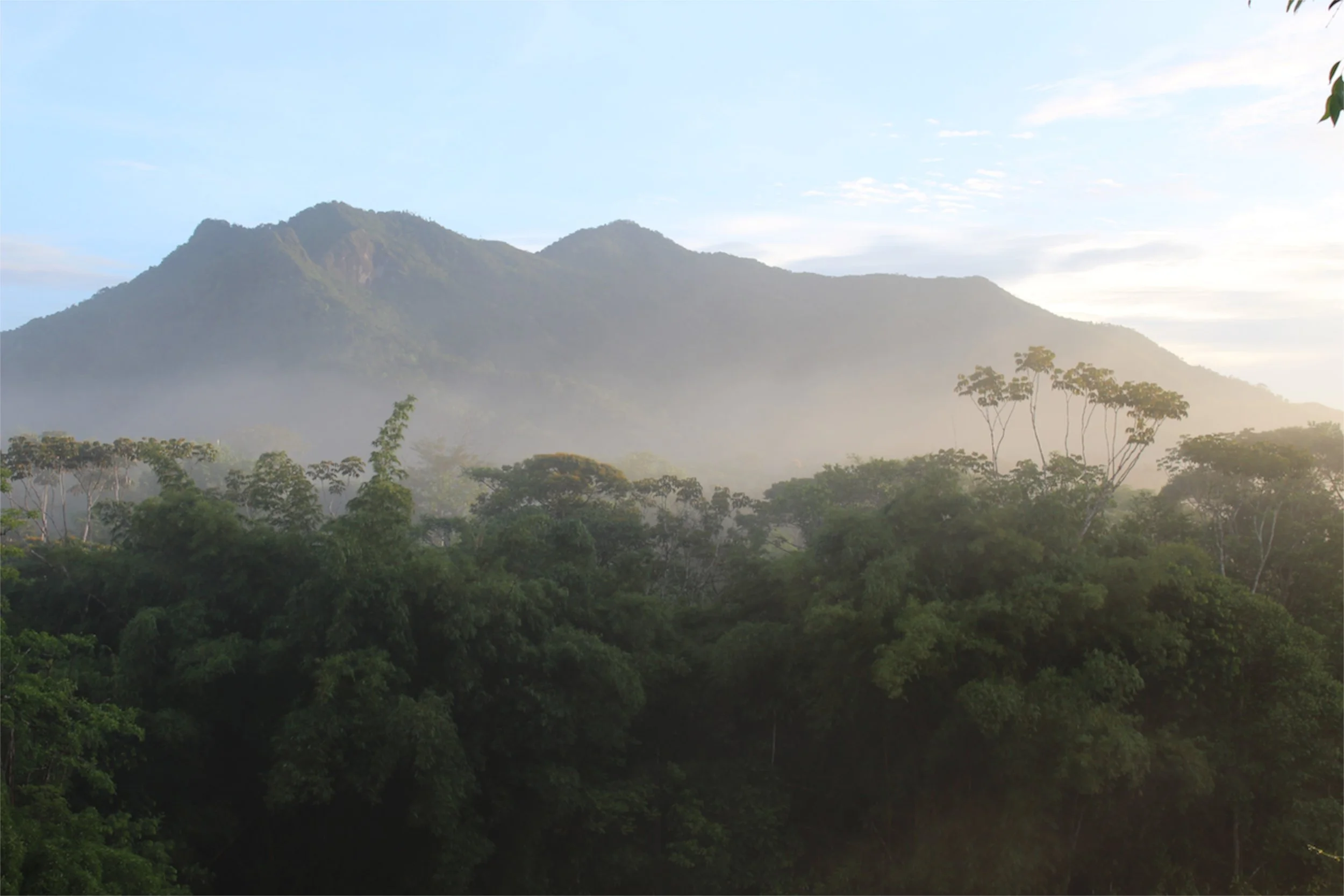
But very soon our zone one vegetable gardens with our recently planted greens began to suffer - the sheer force of the rains and the humidity brought fungal and mildew issues. Faced with the reality that our beans and delicate greens were going to die out, I thought about the potential of using cover crops, such as sweet potato, for the rest of the year. But this did not seem to fit in my idea of what permaculture asks us to do: observe and interact with the environment we are situated in and use that to our advantage. With this in mind, we at Rancho Mastatal have been planting crops that thrive both in the intense heat and thumping rain. Below are some of the most popular vegetables that we are growing in the Ranch that are suitable for the rainy season:
Cucumber:
Cucumbers have been abundant in our garden this season with us pumping out quick pickles nearly every day. Not bad for a community feeding 30-40 people daily! Thankfully, cucumbers like warm, humid weather. We grew ours by seed on a trellis to allow for more air flow and for the fruit to stay above ground.

Okra:
Described as among the most heat-tolerant vegetable species in the world. It is planted for its seed pods which can be cooked, pickled, eaten raw, or included in salads. It does become mucilaginous so do consider this if you're sensitive to the slime.
Kang Kong spinach:
This leaf green is native to southeast Asian and is delicious stir-fried with soy sauce and garlic. It is a semi aquatic plant, a creeper that grows in or near the water on moist soils, so it is ideal for our climate.

Hibiscuses:
Both Green and Cranberry Hibiscus are delicious perennials that thrive in the warm and wet. They self seed easily during dry season so when the rains come you have a whole bunch of babies to keep your salad zesty and fresh. The leaves do contain oxalic acid so cannot be consumed in large, consistent quantities.
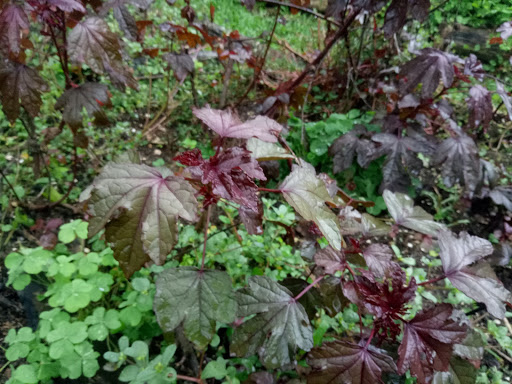
Chaya:
Also known as tree spinach this is an excellent perennial green native to Mexico. It's leaves are edible once cooked, like spinach. It's easy to propagate by cutting and loves the heavy rain.
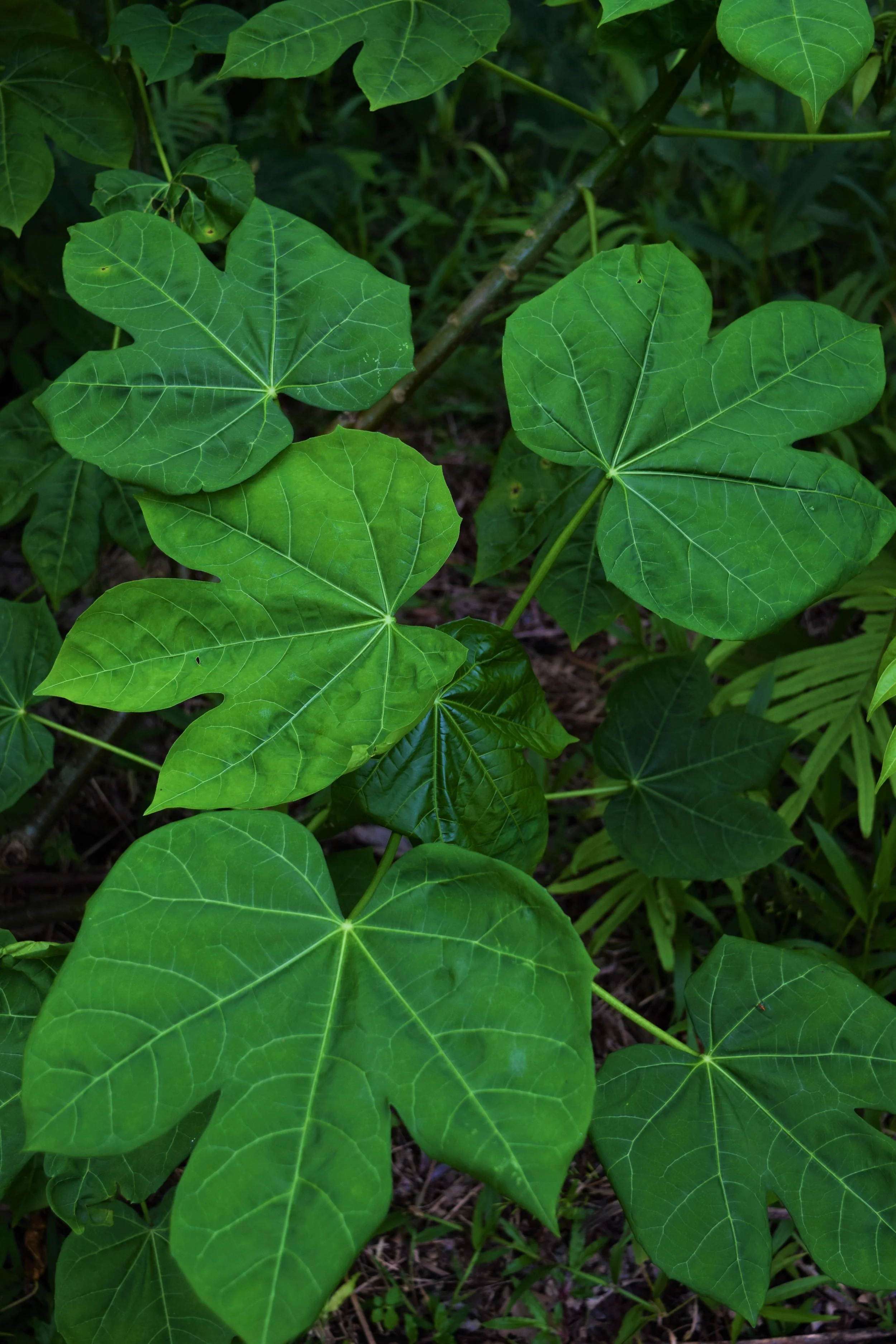
Malabar spinach:
Malabar spinach is another heat and moisture-loving spinach-like green. The succulent leaves can be eaten both raw and cooked. We have only a few plants so we are trying to improve the population. We use a trellis to support its tendency to vine.
Winged bean:
Also known as Goa bean and princess beans, these are sweet protein packed vegetables that do well in heat and humidity. They can fix their own nitrogen when the bacterium Rhizobium is in the soil. They are best harvested young and tender, and great raw in a salad.
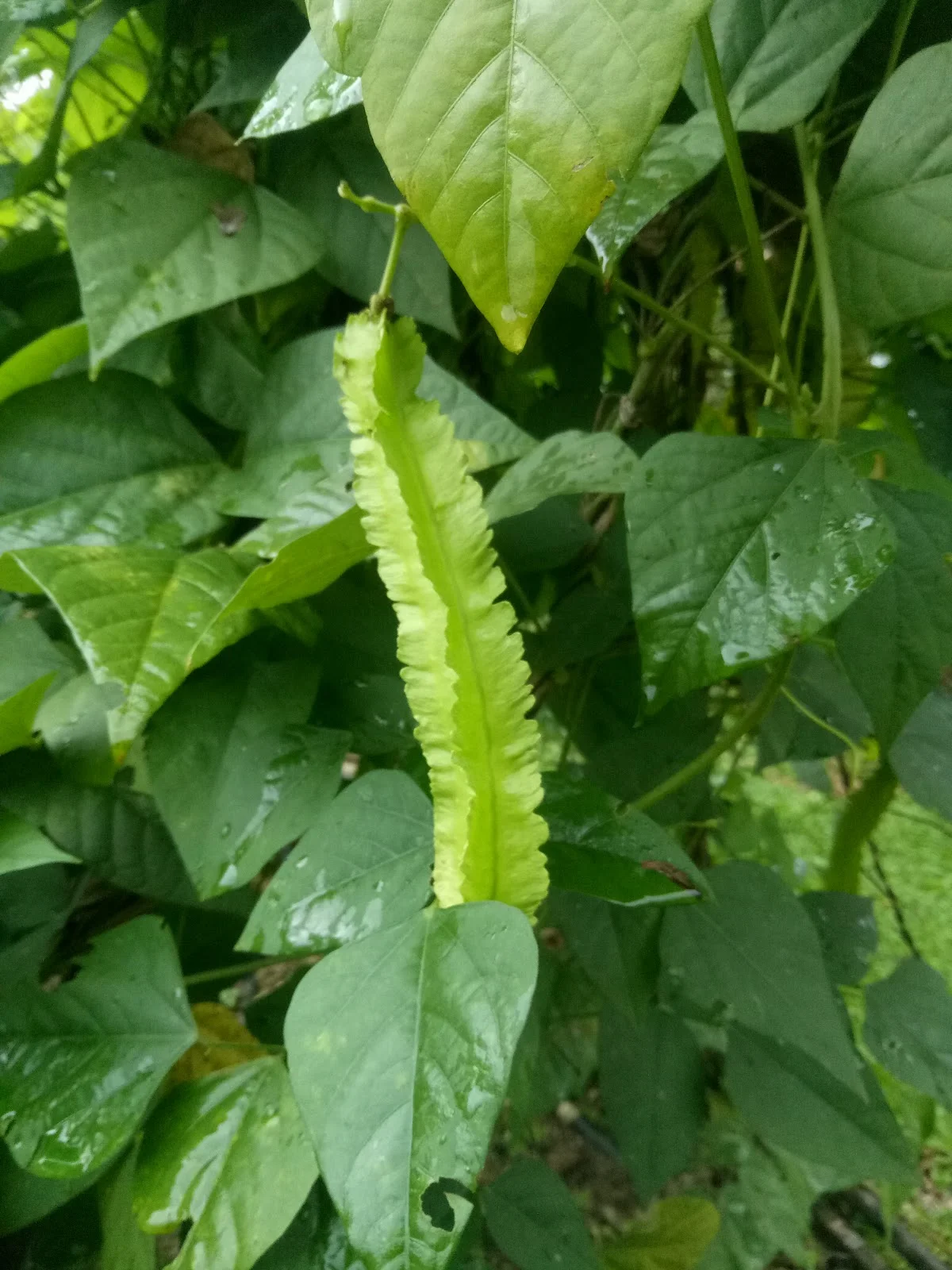
Other more delicate greens we are growing in our nursery as they don't require as much water, such as Arugula, mustard greens and Asian cabbages.
By having our covered nursery space we are able to grow things under cover that otherwise would not do so well outside, we are also experimenting with making some movable covered spaces for out outdoor garden beds….. we will update you with progress so make sure to Like and Follow us on Facebook & Instagram

When The Ants Go Marching
Even before the start of my apprenticeship at the ranch, I would not have described myself as a particularly squeamish person. I like to think that I reacted to incidents involving large numbers of insects (infestations) with an appropriate amount of squeam. However, on more than one occasion, I was nudged outside of my comfort zone within the first few days of my time at the Ranch. Over the past few weeks, my relationship to these small jungle friends has changed once again.
When The Ants Go Marching
By Abby Kuchar, 2019 Apprentice
Even before the start of my apprenticeship at the ranch, I would not have described myself as a particularly squeamish person. I like to think that I reacted to incidents involving large numbers of insects (infestations) with an appropriate amount of squeam. However, on more than one occasion, I was nudged outside of my comfort zone within the first few days of my time at the Ranch. Over the past few weeks, my relationship to these small jungle friends has changed once again.

My partner and I had just moved into our lovely abode, the Goat Barn. One evening when we returned home after dinner, we found at least 50 large army ants running around our floor! Quickly, we both started stomping away, desperate to kill every last one before climbing into bed, only to be kept awake by the feeling of phantom ants crawling between the sheets. The next morning, we exuberantly told the team the story of our ant adventures. A core team member, Ali, who has lived in Mastatal for the past six years, quipped “Only fifty? That’s weird.” Which, to say the least, was not the reaction I was expecting. “There’s usually A LOT more than that. The army ants will swarm a house for a few hours, clearing out the other insect larvae and bug parts. They’ll leave after an hour or so.” She explained.
A couple of days later, I noticed dark lines running along the outside walls of my house as I approached. Horrified, I realized the lines were actually dense highways of ants. Ribbons of industrious soldiers marched their way through the seams of the wall panels, into my home. I peeked my head into the room and saw an impressive and well organized network of army ants coming and going. Quickly I darted inside, grabbed my water bottle and book (the purpose of my trip) and gave the hard-working soldiers a quick salute. I will be back in five hours; I hope you all won’t be. I attempted to communicate, telepathically.
Sure enough, as we cautiously crept back into the house that evening, not a single ant could be found. In fact, the house felt eerily clean. Even the top of our mosquito netting, which had built up a graveyard of insects zapped by the overhanging light, was spotless. I hope they come back soon, our house could use a nice deep clean again.
Are you interested in experiencing Rancho Mastatal? Why not join us as a guest, maybe you will have the army ants clean your house too?!
Categories
Topics
- Agriculture 6
- Agroforestry 21
- Animals 2
- Apprenticeship 19
- Appropriate Technology 6
- Backpacking 1
- Bananas 1
- Basic Pantry 4
- Biochar 1
- Books 3
- Build Your Own Home 1
- Central America 5
- Chiles 1
- Cinnamon 1
- Clay Carving 1
- Climate 2
- Climate Change 1
- Cob oven 1
- Communication 5
- Community 24
- Compost 2
- Composting Toilets 2
- Condiments 1
- Conservation 2
- Cooking 4
- Costa Rica 18
- Design 10
- Earthen Construction 10
- Eat Local 2
- Ecohome 1
- Education 9
- Environment 3
- Ethics 4
- Farm to Table 12
- Fasting 1
- Fermentation 14
- Food 22
- Food Choices 8
- Food Forest 8
- Food Processing 15
- Food Systems 12
- Gap Year 1
- Gardening 5
- Ginger Beer 1
- Harvest 2
- Health 12
- Healthy living 5
- Homemade 2
- Homestead 8
- Internet 2
Due to popular demand we have put together a document that outlines how our composting toilets are designed and made. The documents include
-dimensions for different size chambers based on number of people using it
-door design
-chamber design
We have spent years fine tuning our design and details based on what is easiest and what works. This is the culmination of building 11 different composting toilets and each time improving the design.
It is important that you understand that this design is only for the composting toilet element, it does not include any of the timber frame or bamboo framing that form the structure for the roof that covers these all over the ranch.