

BLOG
Stories, articles, and updates from the Ranch community.
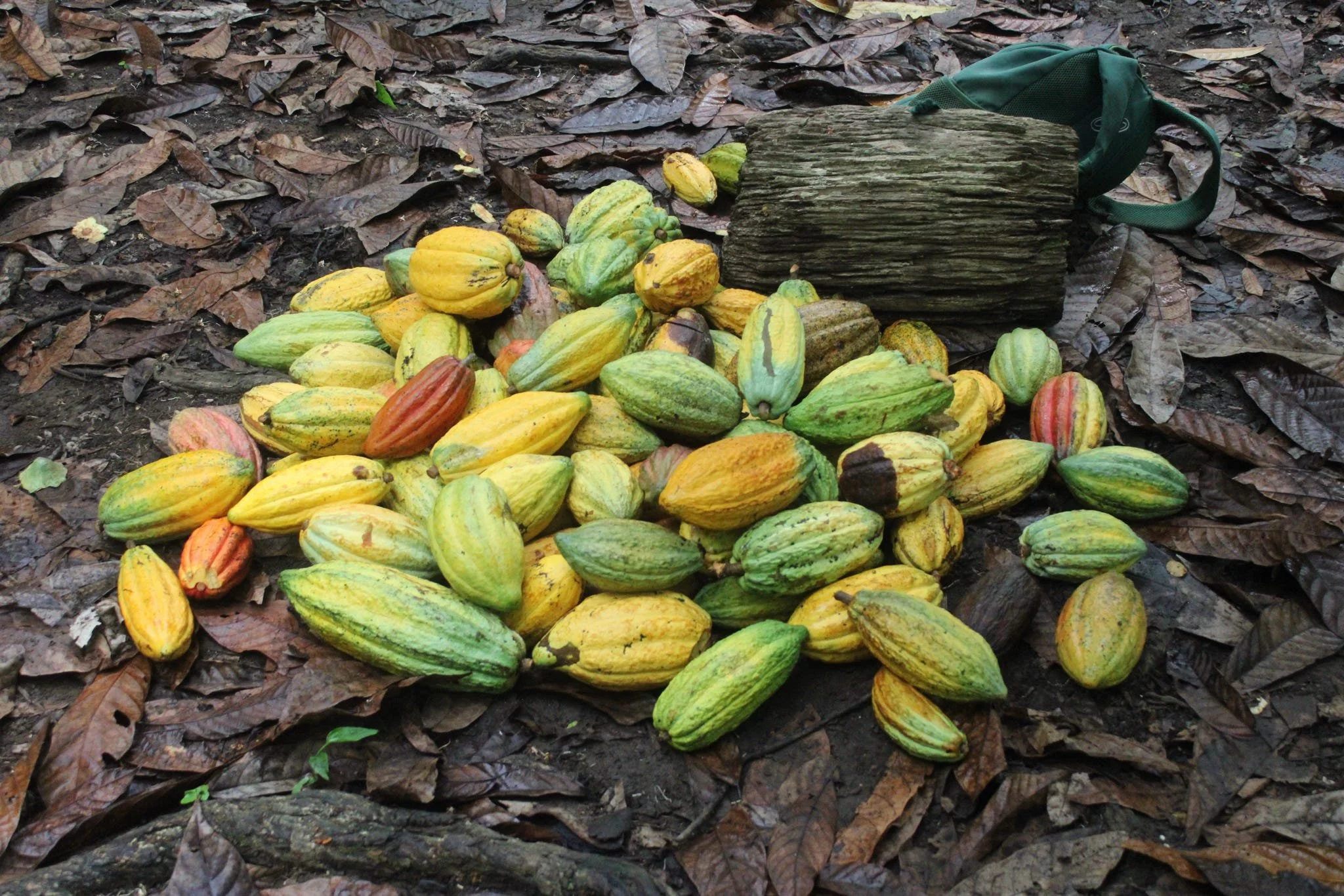
Cacao as the Catalyst
The more I released my need to know exactly where I was going, the more life seemed willing to show me. Not all at once. Just enough for the next step.
Cacao as the Catalyst
By apprentice Maria Quas
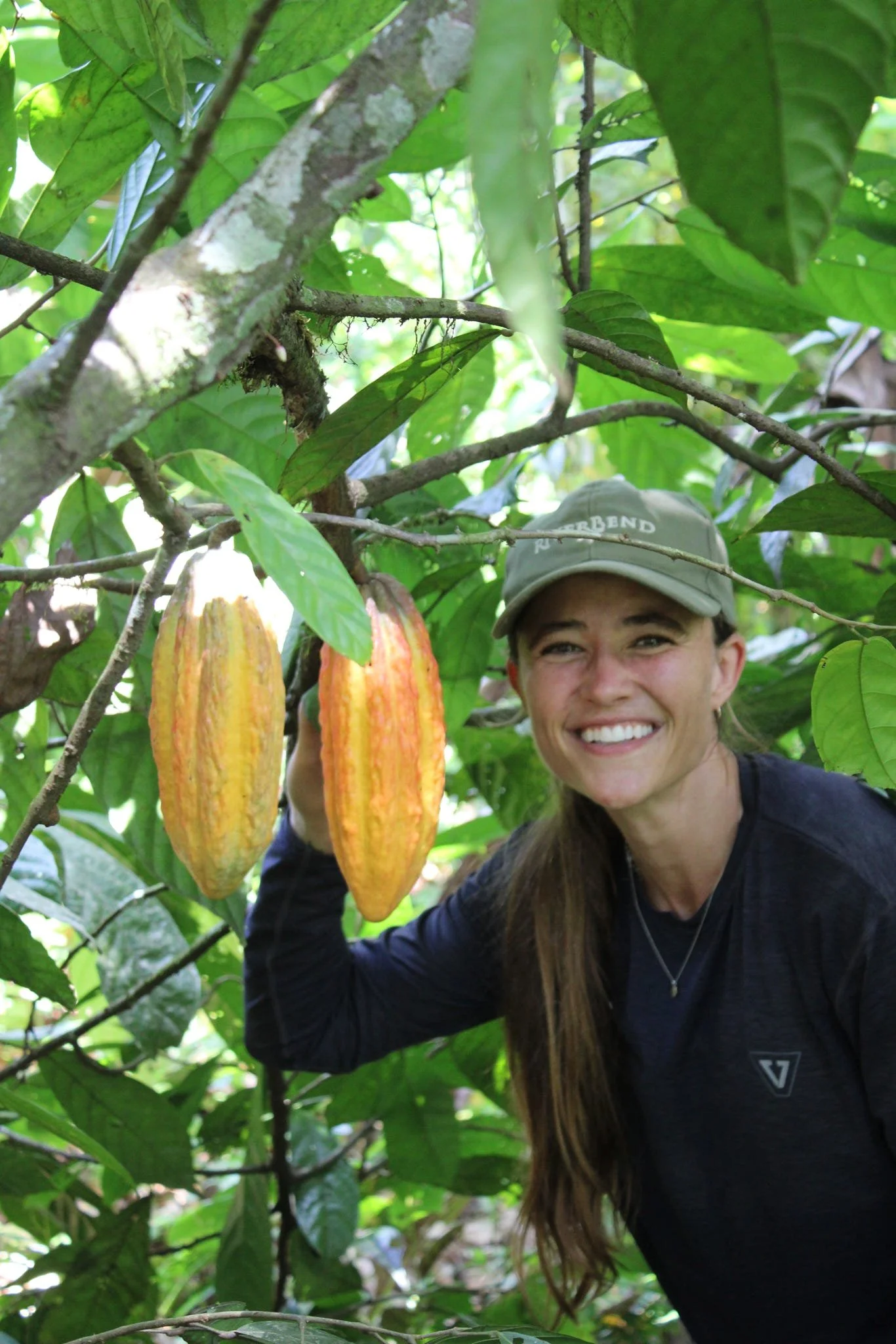
There is a strange phenomenon that happens when you begin following something you genuinely love.
At first, it feels insignificant. A passing curiosity. A book you happen to read. A conversation you almost didn't have. A path you decide to walk for no particular reason.
Then something begins to shift.
The world that once felt random starts revealing patterns.
Teachers appear. Doors open. Conversations arrive at precisely the moment they are needed. What once seemed like coincidence begins to feel more like participation in an intelligence larger than your own.
Taoist philosophy speaks of this as living in accordance with the Way—not forcing life forward, but learning to move with it. There is an old saying often attributed to Zen: when the student is ready, the teacher appears.
For most of my life, I understood that idea intellectually.
This year, living at Rancho Mastatal, I began experiencing it.
And strangely enough, cacao became the teacher.
Following the Thread
When I first arrived in Costa Rica, I thought growth would come through plans. Through goals. Through carefully constructing a path toward whatever came next.
Instead, the opposite happened.
The more I released my need to know exactly where I was going, the more life seemed willing to show me. Not all at once. Just enough for the next step.
The first lesson arrived beside a river I had crossed countless times before.
After reading about cacao's origins in Mesoamerica, I found myself walking a familiar path toward the waterfall. Along the riverbanks where cacao once thrived naturally, something caught my eye.
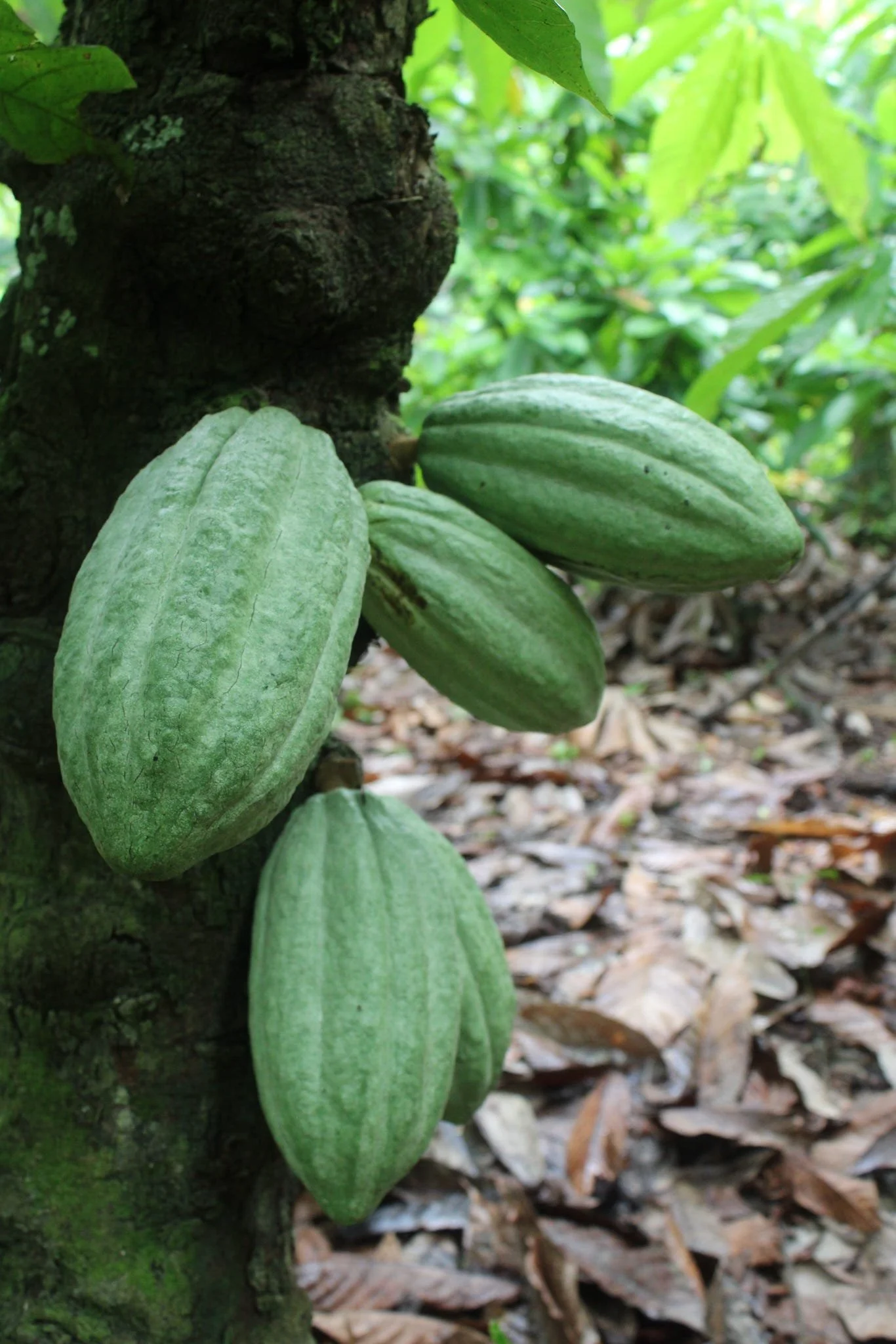
There they were.
Cacao trees.
Mint-green pods emerging directly from their trunks.
I stopped.
How many times had I walked this exact route? How many times had these trees been standing here, visible and unnoticed?
The trees had not appeared.
My attention had.
And once seen, they became impossible to ignore.
It felt less like discovering something new and more like remembering something that had been waiting for me all along.
Perhaps this is how all learning happens. The teacher is not absent. The student simply isn't ready to see.
After that day, cacao began appearing everywhere.
From Information to Wisdom
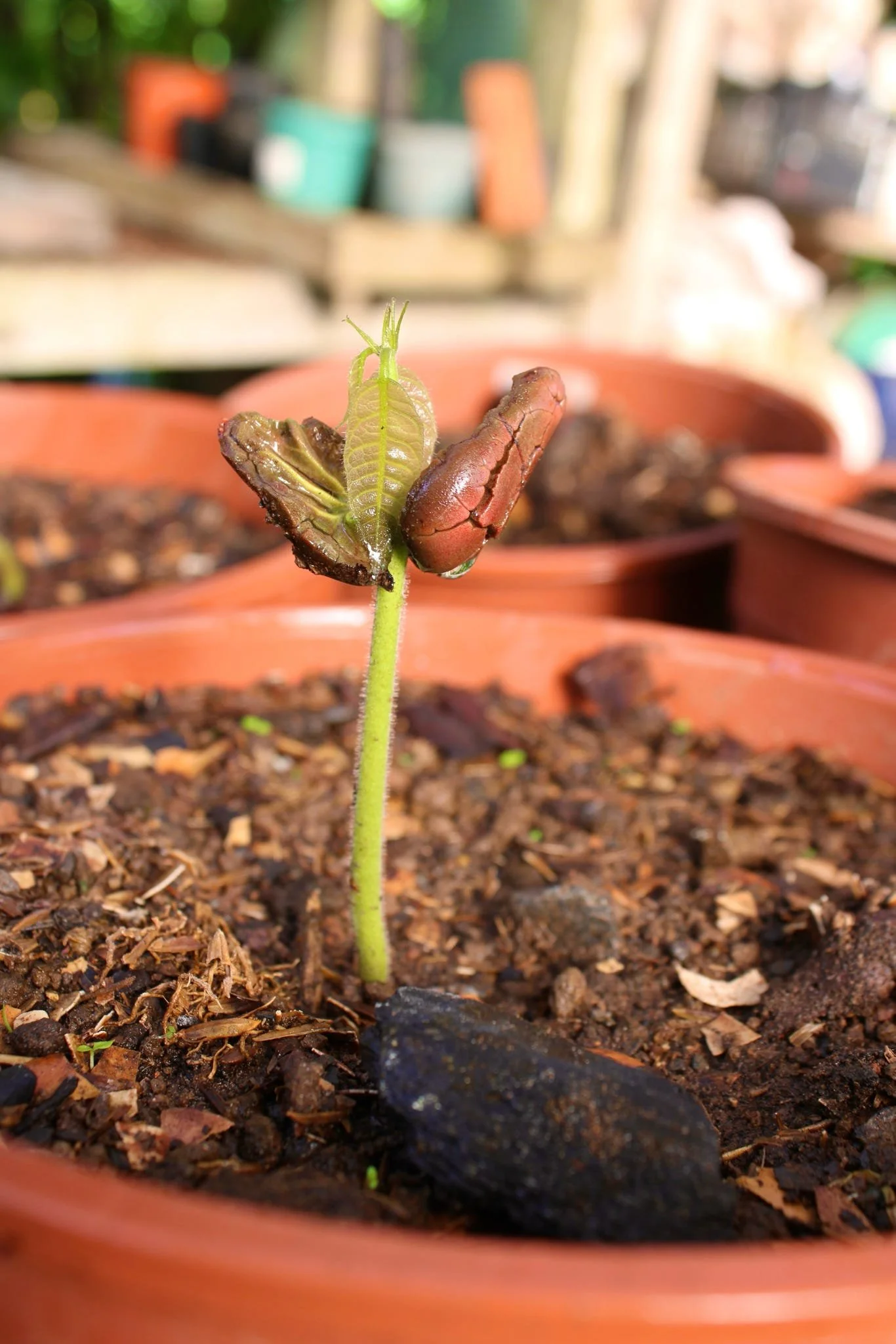
I started planting seeds in the nursery, reading about cultivation, and asking questions.
Then Victor arrived.
A cacao farmer. A chocolate maker. A living bridge between knowledge and experience.
I had spent hours searching online, collecting information, and trying to understand cacao through articles and videos.
Victor showed me the difference between information and wisdom.
Information can tell you what to do.
Wisdom shows you how to see.
The internet can explain how to plant a cacao tree. A farmer can teach you how to listen to one.
Before leaving, Victor invited me to visit his farm.
Another door opened.
Not because I was searching for doors.
Because I was already walking in their direction.
And that is what has fascinated me most.
The opportunities themselves are not extraordinary. What feels extraordinary is the timing.
Cacao as Lineage
Shortly after Victor left, two brothers from the Maleku tribe arrived at Rancho Mastatal—the very community Victor had been speaking about.
Again, cacao was at the center.
But now it appeared not as agriculture, but as lineage. As culture. As memory carried through generations.
One afternoon, they noticed me working with cacao fruit and shared a marmalade recipe made from a part of the pod I had been throwing away.
A piece of fruit I saw as waste contained value within their tradition.
The lesson felt larger than cacao.
How much of life do we discard simply because we do not yet understand its purpose?
The more I followed this thread, the more connections emerged.
Not because I was forcing them.
Because I was paying attention.
Learning to Flow
Taoism teaches that water does not struggle to find its path.
It flows.
It adapts.
It moves around obstacles rather than through them.
And somehow, despite its softness, it shapes entire landscapes.
I am beginning to suspect that life works the same way.
Many of us spend years trying to manufacture a future. Building profiles. Networking strategically. Searching endlessly for opportunities.
I know I did.
Yet some of the most meaningful experiences of my life have arrived through a completely different mechanism:
Presence. Participation. Curiosity.
Not chasing the next thing, but becoming fully engaged with the thing directly in front of me.
The result feels less like achievement and more like alignment.
As if life begins responding when you stop trying to negotiate with it.

My First Cacao Harvest
My first cacao harvest deepened that understanding.
At four in the morning, I woke with the excitement of a child on Christmas Day.
An hour later, I stood before a wide river, preparing to cross on a hand-built zip line while Jorge, the owner of the farm, rode a horse through the current below.
The absurdity of the moment made me laugh.
This was not part of any plan I had ever created for myself.
Yet somehow, it felt exactly where I was supposed to be.
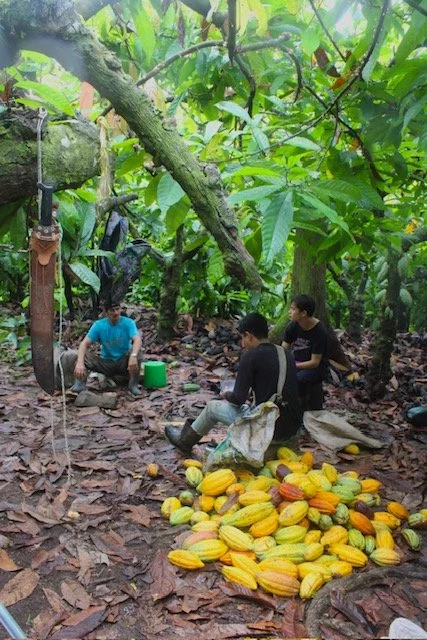
The harvest itself was humbling.
Everyone moved with rhythm and purpose while I struggled to understand the language, the flow, and the choreography of the work.
I felt slow.
Clumsy.
Out of place.
And yet those moments often contain the greatest gifts.
The unknown rarely feels graceful.
Growth is not the absence of discomfort.
Growth is learning to trust yourself inside it.
The Transformation of Chocolate

Chocolate itself seems to embody this lesson.
What eventually becomes something rich, complex, and deeply nourishing begins as something raw and unfamiliar.
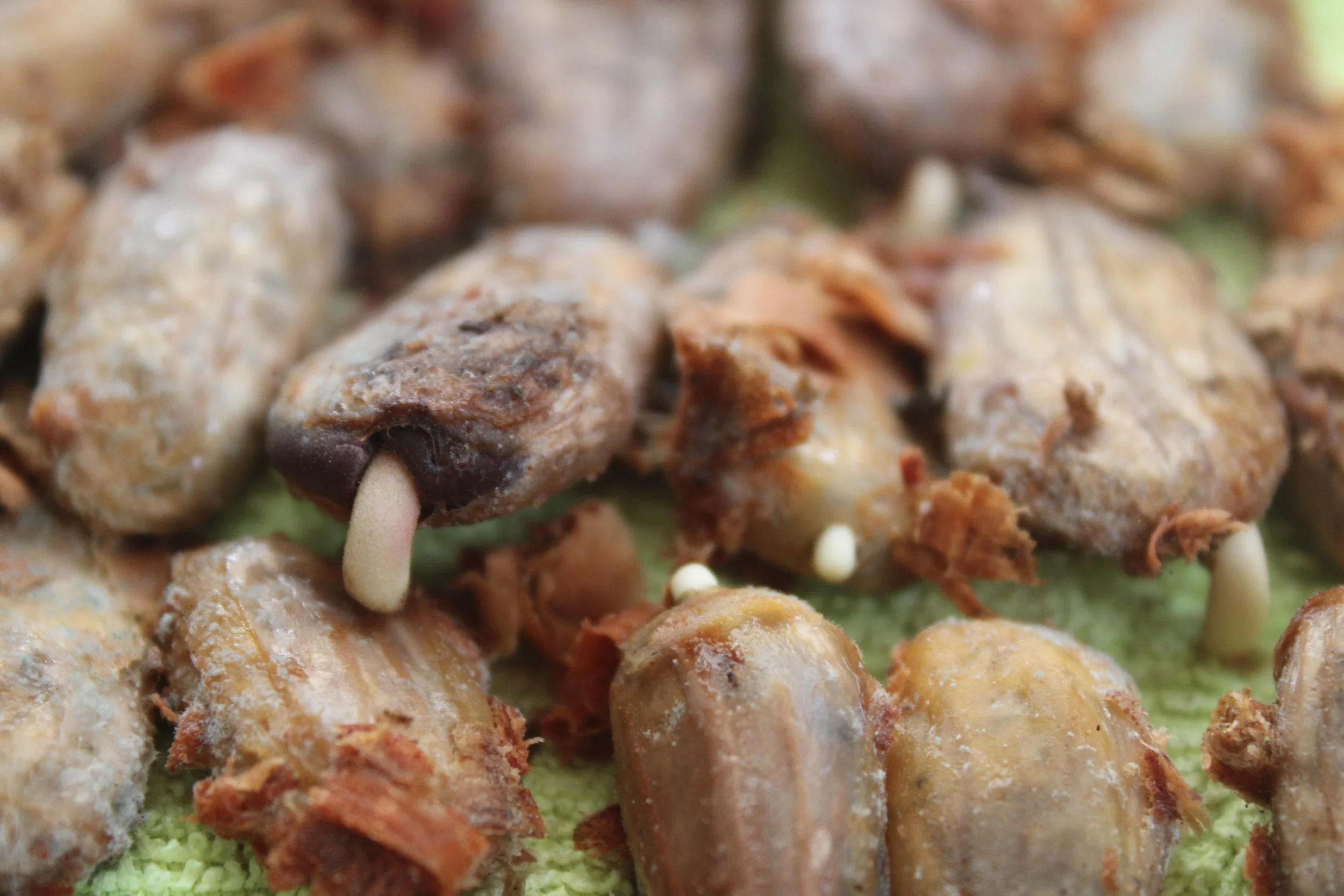
The seed must ferment.
Dry.
Roast.
Transform.
Time does not happen to the process.
Time is the process.
Perhaps people are not so different.
We are always becoming. Always fermenting experiences into understanding. Always moving through stages that make little sense until viewed in retrospect.
The Real Lesson
Looking back now, I realize cacao was never the real subject.
The real subject was trust.
Trust that the next step exists even when I cannot see it.
Trust that curiosity is sometimes a more reliable compass than certainty.
Trust that the path unfolds through participation rather than prediction.
I still know very little.
But that no longer feels like a problem to solve.
It feels like an invitation.
The path does not appear all at once.
It never has.
It reveals itself in proportion to our willingness to walk.
And so I keep walking.
Not toward an outcome.
Not toward an answer.
Simply toward whatever feels most alive.
Read more
Check out these past blogs about cacao and other local foods we are enjoying here:
On The Practical Meditation Of Sharpening Tools
Taking time to care for our tools facilitates relationships with them that change the quality of our work.
On The Practical Meditation Of Sharpening Tools
By Hope Kelley - Apprentice 2026
Taking time to care for our tools facilitates relationships with them that change the quality of our work
In the first several months of my apprenticeship at Rancho Mastatal, I did not sharpen my machete once. Anyone who works with blades — or tools of any kind, for that matter — may be appalled to read this. We’ve all heard the old adage that “a sharp blade is a safe blade,” but still I put off the routine maintenance task week over week in my early months here — doubtful, I suppose, of my ability to properly carry it out.
Us apprentices had received a brief sharpening tutorial toward the beginning of our time here, and were expected to notice when our blades needed sharpening and attend to that need accordingly. As with many things at the Ranch, students are expected to implement and practice the skills we learn here without prodding or reminding. I knew machete care fell into this category of My Responsibility, yet I continued to procrastinate doing it. So, there came a day out in the agroforestry spaces — where we prune, chop and drop, and any number of other tasks with our machetes — where I could no longer ignore the fact that I was working with a dull blade.
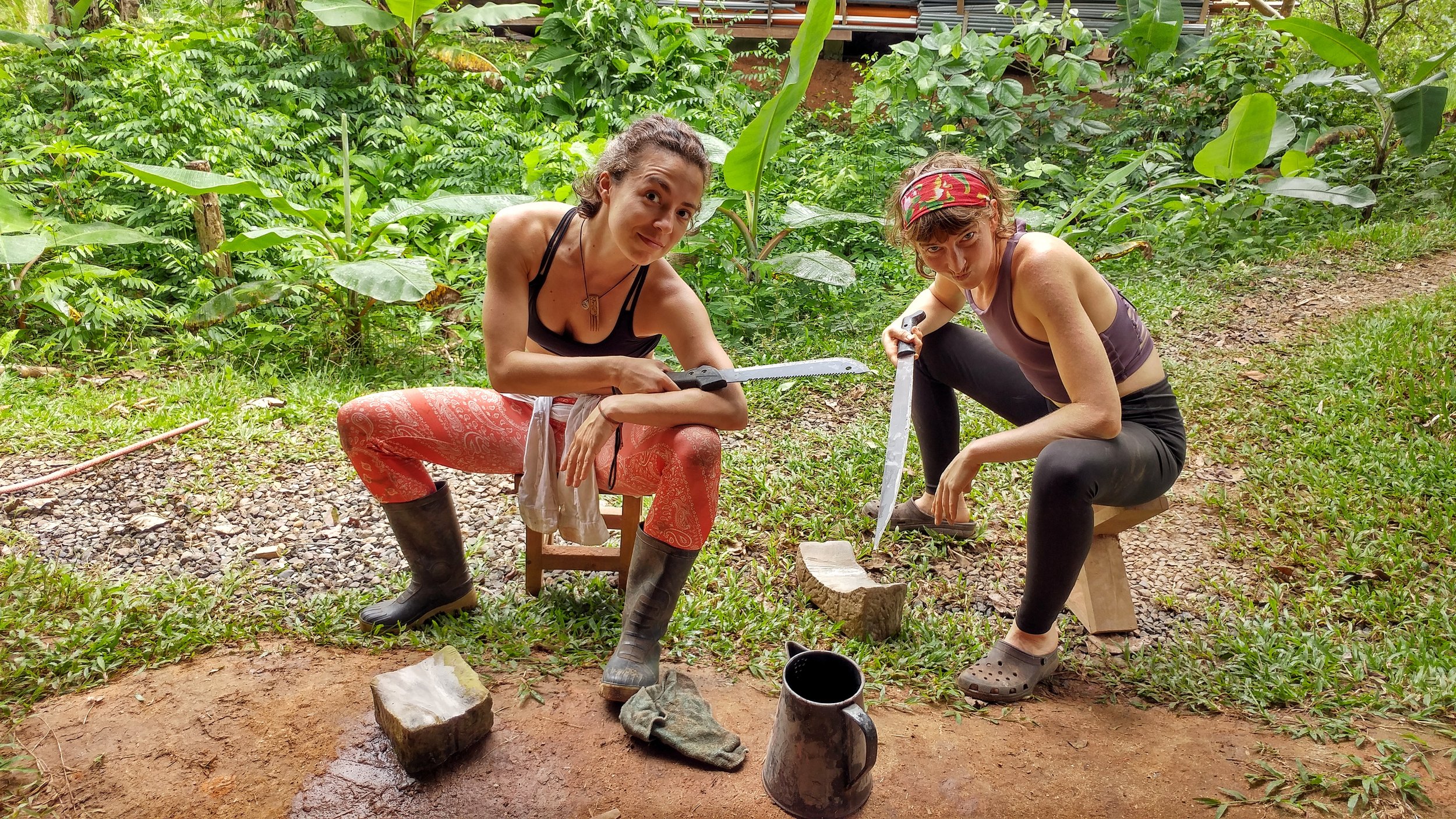
On this same day, as our afternoon work session came to a close, a fellow apprentice announced that he’d be busting out the sharpening stones that afternoon to tend to his machete and that any of us were welcome to join. I jumped at the opportunity for some accountability, and what ensued surprised me on several fronts.
Firstly, I found the process of sharpening the machete to be deeply enjoyable. It was, in fact, a meditation of sorts. Before beginning, I set up an intentional workstation at a table of appropriate height so I did not have to stoop or stand on tip toe to work at a proper angle. I laid out the stone with a damp rag underneath to keep it from slipping, as well as a bowl of water and another rag to wet the stone as I went along.
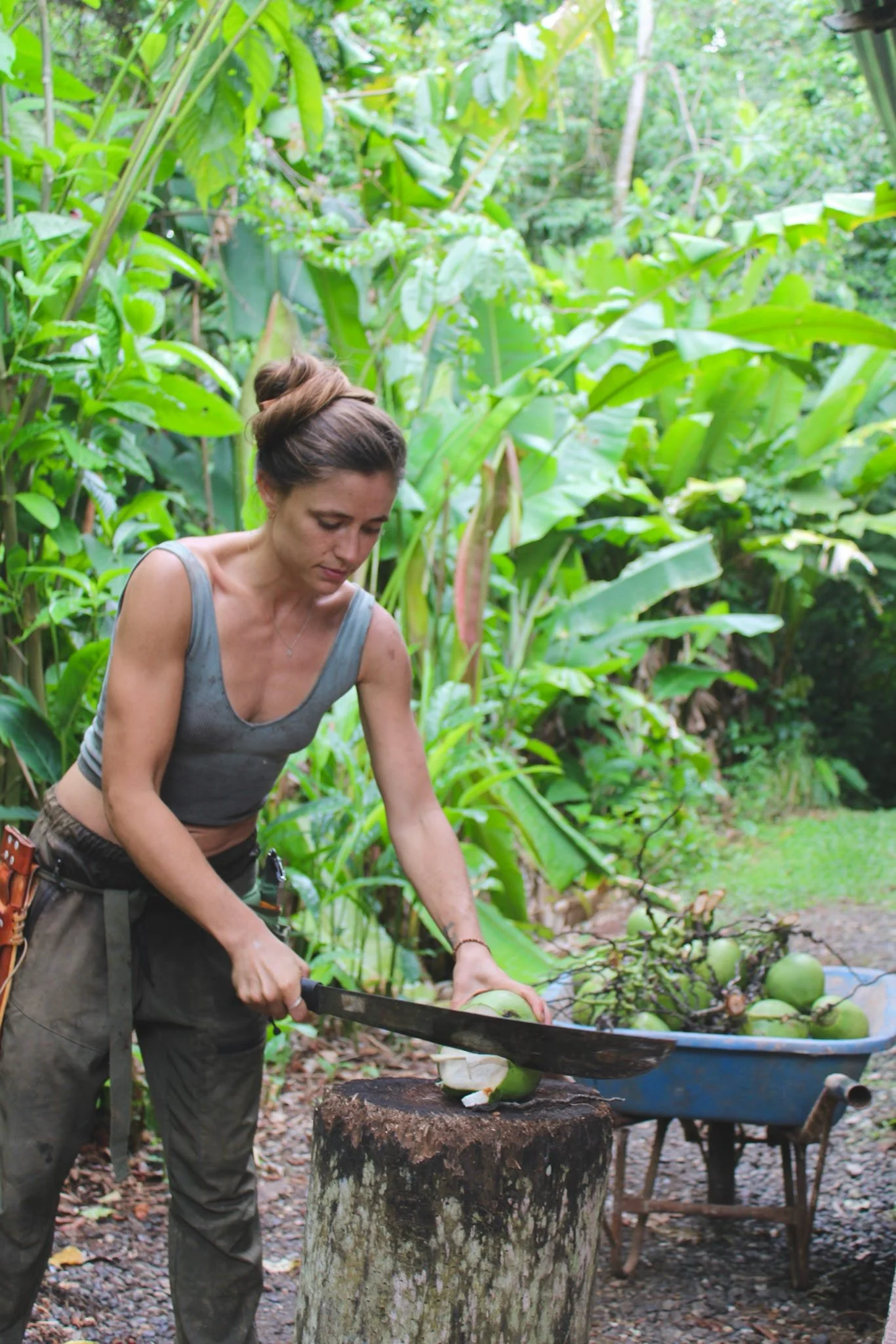
Additionally, as a preparation method for an inexperienced blade-sharpener, I needed to inspect my blade before putting it to stone. I took note of the angle of the blade on each face, the curve of the tip, the width and the shape. It was the most amount of time I’d spent looking at my tool since it was first placed in my hands during our orientation months earlier. After inspecting it, I began running the blade over the stone, moving it against the grain, holding it at an angle so the stone would, with its rough face, polish the blade to a shine.
Perhaps by virtue of being new to the task, I found my mind unable to wander as soon as I touched steel to stone. I had to keep reminding myself which direction I was meant to move the blade in and how much pressure I should be applying. Thus, I found my mind to be singularly-focused and my breathing to be steady. With each inspection, the blade looked brighter as my hands worked in unison with the stone to pare back the dulled steel.
The second thing that surprised me happened the following day when I returned to the agroforestry spaces to clear pathways lined with a clumping grass species called Mambasa, which grows quickly but does not spread and serves as reliable biomass to adorn the feet of our fruit trees. From the moment I commenced slashing the grass with my machete blade, I felt the transformation that had taken place in my tool. I moved through the rows efficiently and with a certain level of enjoyment — a sharp blade may be a safe blade, but I would argue that it’s also a satisfying blade. Before sharpening, I had thought of my machete as a means to an end. Now, I saw it as an ally in my work, one that could improve both the quality of my work and my own enjoyment of it. All this is to say that until I began intentionally caring for my tool, I did not have a relationship with it, and ultimately did not enjoy working with it nearly as much I came to discover I could.
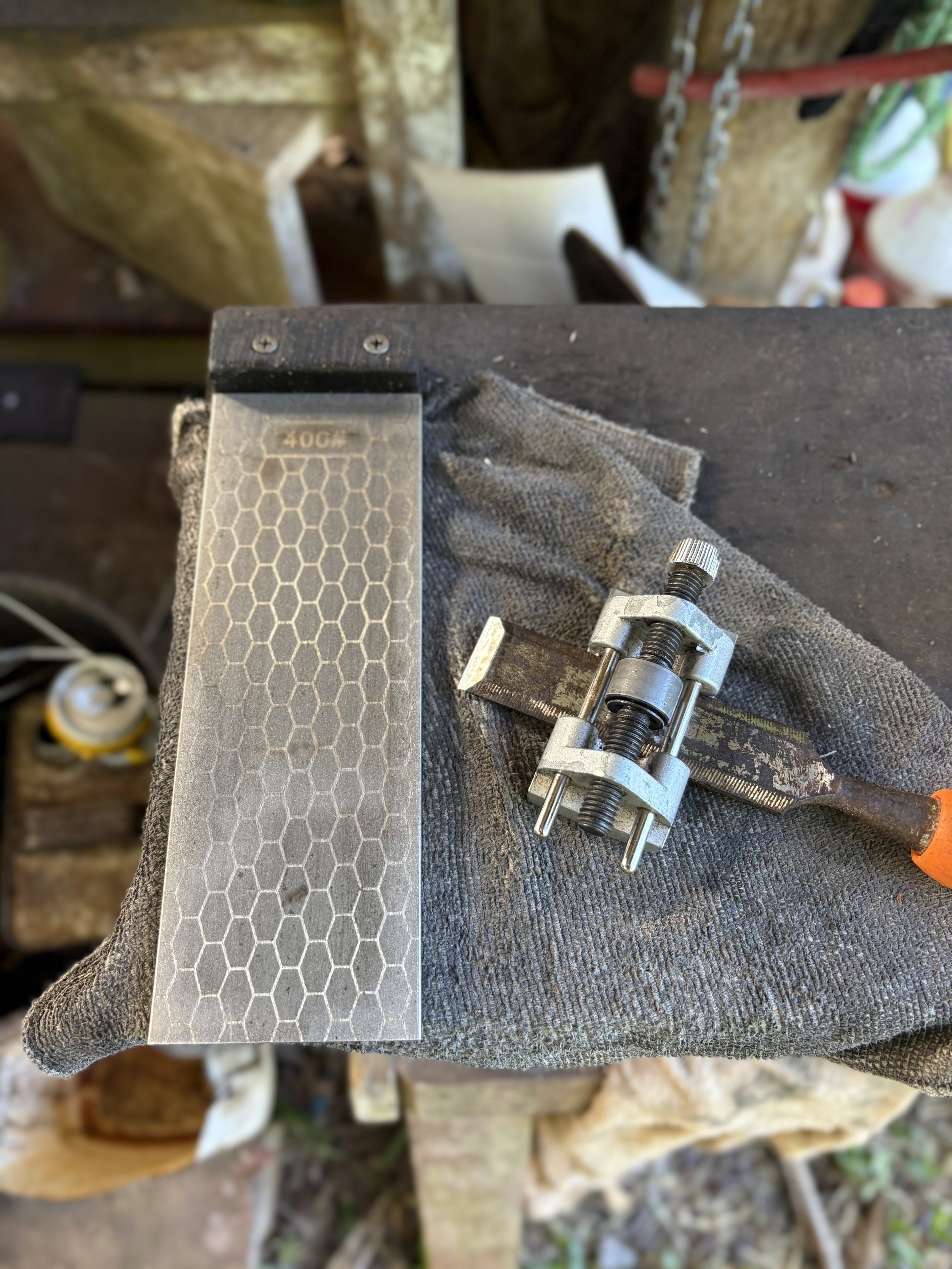
When we care for our tools — putting our time, attention, and energy into them — we inevitably create a relationship with them. I’ve experienced this phenomenon when washing my paintbrushes or putting a fresh coat of wax on my surfboard, but am only now beginning to experience it with tools here, too. Before beginning the work of carving joinery for furniture-making in the Ranch woodshop, for example, I’ve come to enjoy the ritual of sharpening the blade of my chisel before getting to work. It feels like having a wordless conversation with the tool, one that reintroduces us to each other before we set off on a journey toward creating something new. During the chiseling work itself, I feel differently toward the tool after our maintenance session than I would have if I’d jumped right in with an unsharpened (and ungreeted) blade. It’s not just that the tool is sharper and thus easier to work with, but rather that the tool has become a being that I have a connection to, that I am in partnership with toward the completion of a common goal. This makes me work with more intention, with more respect for the tool and ultimately for the medium we are manipulating — be it lumber or Mambasa grass. It also allows me to enjoy the process more, to fixate less on the product and more on the journey toward it, to be more open to learnings and revelations along the way as I practice a number of new crafts throughout my apprenticeship.
As I write this, it is a Sunday afternoon in Mastatal and I am sitting at my desk. My machete is leaning against the wall beside me in its leather sheath, waiting with a steely patience for the tasks it will facilitate throughout the work week ahead. Undoubtedly, our collaboration in the coming days (and weeks and months) will be enhanced and strengthened by some time together at the sharpening stone, a moment to connect and prepare, a small and very practical prayer.
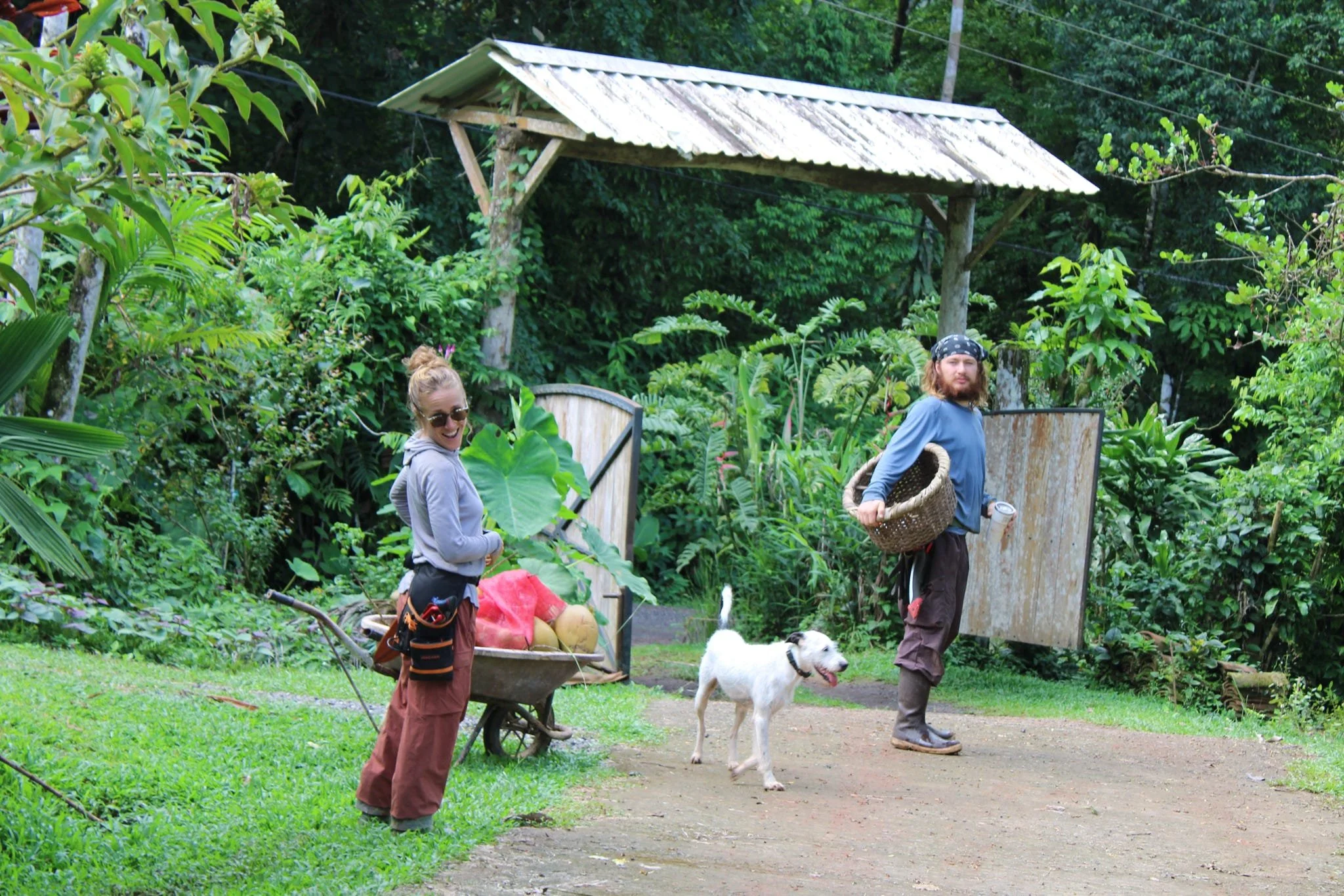
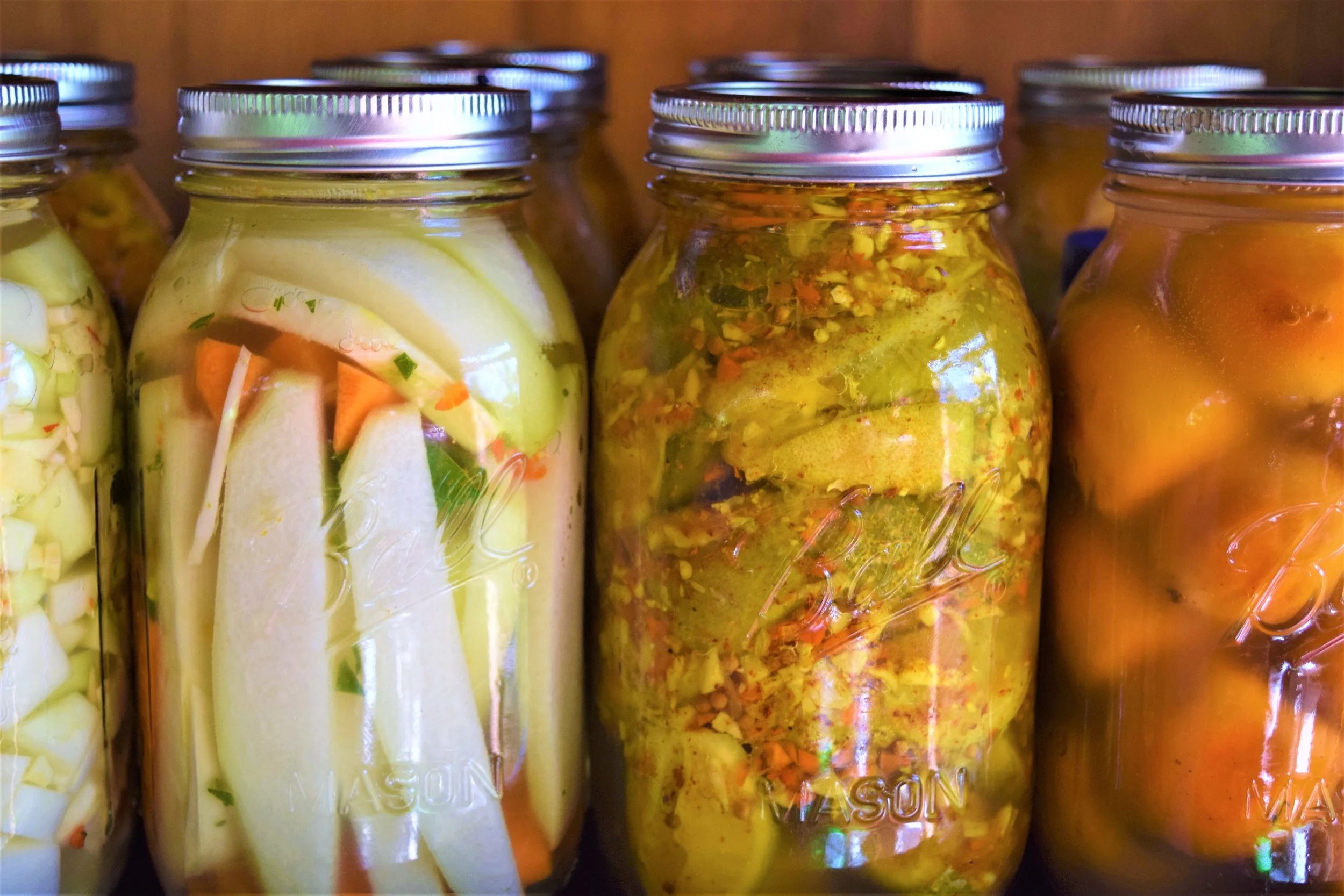
Los beneficios y los tipos de fermentación
La Fermentación es un proceso catabólico de oxidación incompleta, por el cual ocurre una transformación de los alimentos.
Los Beneficios y los Tipos de Fermentación
Escrito por el aprendiz 2024, Felipe
La Fermentación es un proceso catabólico de oxidación incompleta, por el cual ocurre una transformación de los alimentos. Esta transformación la realizan ciertos tipos de microrganismos que metabolizan estos compuestos de manera natural para su propia sobrevivencia. Este proceso se lleva a cabo a traves de la reacción bioquímica de la descomposición de moléculas de azúcar como: sacarosa, maltosa, fructuosa, entre otros, en compuestos mas simples obteniendo como resultado; energía, etanol, lactato, gas hidrógeno, enzimas, productos alimenticios fermentados, modificadores del sabor y productos farmacéuticos. Los principales productos de fermentación son ácidos orgánicos, alcohol etílico y dióxido de carbono.
Algunos de los productos finales obtenidos muy codiciados son: kimchi, chucrut, pan de masa madre, salsa de soya, vino, cerveza, Kefir, queso, salami, yogur entre otros.


La historia de la fermentación data de mas de 10,000 años A.C, donde los humanos utilizaron la fermentación para preservar los alimentos y en otras civilizaciones usaban las bebidas fermentadas para sus rituales y ceremonias. Este proceso se extrajo de la observación de la naturaleza, en donde los alimentos se trasformaban de manera natural y adquirían nuevas propiedades.
La fermentación posee un gran numero de beneficios para los seres humanos entre los cuales destaca:
Conservación de alimentos sin necesidad de químicos, al fermentar los alimentos, se crea un ambiente hostil para los microrganismos patógenos, ya sea un ambiente ácido producido por las bacterias, o un ambiente con presencia de alcohol de las levaduras.
Favorece las defensas de la mucosa intestinal, los probióticos (microrganismos beneficiosos para la salud) ayudan a fortalecer el sistema inmune, para prevenir las infecciones.
Restaura y conserva la flora intestinal, los probióticos proveen una colonia diversa y saludable a los intestinos, además de combatir y reducir el efecto de los pesticidas y sustancias químicas y tóxicas para el organismo.
Ayuda a la digestion y mejora la biodisponibilidad de nutrientes, de esta manera se incrementa la digestion de los alimentos y la absorción de nutrientes, ya que proporciona capacidades esenciales para la fermentación de nutrientes no digeribles como las fibras dietéticas. Ocurre una transformación de las largas cadenas e moléculas de los alimentos en compuestos mas simples de digerir. Rompe y degrada gran parte de las toxinas de las plantas y anti-nutrientes que dañan la salud.
Desarrollo de sabores y texturas únicos en los alimentos, esta es una característica única de este proceso ya que los microrganismo encargados del proceso producen compuestos aromáticos y ácidos orgánicos, pasando de sabores simples y planos a sabores complejos, deliciosos para los sentidos.

Existen dos formas de llevar a cabo una fermentación, fermentación espontanea o la fermentación inoculada. La primera se refiere a una fermentación con microrganismos que se encuentran en el habitat y podemos extraer, o ya sea fermentando algún material orgánico del lugar para utilizarlo como el catalizador o el cultivo primal de microrganismos a utilizar. La segunda corresponde al proceso que se ejecuta a traves de microrganismos que se obtienen comprándolos en tiendas de cultivos, que son controlados en laboratorios, donde han ido seleccionando y recreando ciertas especies mas resistentes o que tienen un objetivo en particular.
Dependiendo de la sustancia química formada en el proceso de fermentación se pueden clasificar en distintos tipos. Los siguientes son algunos de los tipos de fermentación que se practican en el Rancho:

Fermentación Alcohólica
Este proceso de fermentación está liderado por levaduras que consumen glucosa y la transforman en etanol y dióxido de carbono. Este es un proceso anaeróbico, es decir, sin presencia de oxígeno. Existe una regla general de 2:1 de azúcar a grados alcohólicos. Es decir, si partimos con una concentración de azúcar del 20% en nuestra solución (agua + glucosa (frutas, azúcar, panela, etc 20%)), obtendremos un vino de alrededor 10% de alcohol, es decir el porcentaje de alcohol es la mitad de la concentración de azucares en la solución. Tiempo de fermentación va depender de muchos factores, pero al menos un tiempo de entre 2 a 4 semanas.
Para llevar a cabo este proceso se deben tener las siguientes consideraciones:
Sanitizar los implementos y los ingredientes
Romper en estructuras pequeñas los ingredientes a utilizar
Las levaduras no pueden vivir en ambientes con un porcentaje de alcohol mayor a 14%, por lo tanto se debe partir con una solución que no exceda 28% de glucosa
La temperatura en la cual las levaduras están cómodas es de 18 a 25 celcius
PH no puede estar menos de 4
Algunos de los productos que el rancho crea a partir de este tipo de fermentación son:
Vinos de muchas de las frutas que se extraen de los sistemas agroforestales, algunos de estos ejemplos son: carambola, pitanga, canela, pitaya, piña etc.
Cerveza de jengibre

Fermentación Acido Láctica
Este proceso de fermentación es liderado por la bacterias láctica, que al igual del proceso anterior consumen la glucosa presentes en los alimentos y los convierten en ácidos lácticos. Este es un proceso anaeróbico y los beneficios de estos ácidos es la conservación de los alimentos ya que impide el crecimiento de patógenos y provee condiciones propicias para la aparición de los probióticos.
Algunos de los ejemplos de fermentación de este tipo que se practican en el Rancho,:
El kimchi de papaya verde, el cual se agrega la papaya y otras especies (ajo, jengibre, etc) bien trituradas, se pesa todo el conjunto y se calcula el 2% de ese peso, que sera la cantidad de sal que se debe poner los ingredientes, para estimular la salida del liquido al exterior de los ingredientes generando un caldo de cultivo ideal para que las bacterias se reproduzcan. Finalmente, después de agregar la sal, se estruja y se deja en un recipiente, percatándose que todo este sumergido en liquido exprimido de los vegetales. Dependiendo de diferentes factores el tiempo de fermentación varía, acá en el Rancho 0-es de una semana.

Fermentación Acido Acética
Este tipo de fermentación se lleva a cabo a partir de la bacteria acetobacter, la cual se desarrolla en un medio aérobico, la cual se alimenta de etanol, que es un tipo de alcohol que se genera en la fermentación alcohólica, convirtiéndolo en ácido acético, la sustancia característica del vinagre. Es el proceso de oxidación del etanol. Aca en el rancho la manera de producir vinagre, es mediante la exposición al ambiente de los vinos/productos de la fermentación alcohólica, y se añade la madre de vinagre que se ha generado en fermentaciones anteriores para acelerar el proceso. Finalmente se cubren con un paño para que no se infecten con otros insectos. El tiempo de fermentación varía de 1 a 3 meses.

Fermentación Simbiosis de Levaduras y Bacterias (SCOBY)
Es un tipo de fermentación donde participan un conjunto levaduras y bacterias que trabajan y coexisten en simbiosis. Acá los microrganismos transforman la glucosa en ácidos orgánicos, etanol y dióxido de carbono. Es un proceso aeróbico y anaeróbico a la vez.
Uno de los ejemplos del rancho en este tipo de fermentación es:
Kefir de agua, se utilizan una taza de granos de SCOBY y se agregan en una solución de 3 galones de agua y 3 tapa dulces, se dejan fermentar anaeróbicamente por 48 horas y están listos para ser embotellados y arreglados con jugos frutales locales. Se dejan por 5 horas en segunda fermentación y se ponen a refrigerar para bajar la actividad y er consumidos por los miembros y visitantes del rancho.


Team Sports as a Bridge Between Expats and Local Community
I am watching something pretty remarkable taking place almost every day here in Mastatal, Costa Rica, and that is the magic of team sports.
Team Sports as a Bridge Between Expats and Local Community
Written by 2024 apprentice Brooklyn
In my personal experience with international travel, I have time and time again come across the phenomenon of “Expat” communities separated both geographically and relationally from “Native” or “Natural Citizen” communities. We travel and migrate, often with the intention of immersing ourselves in a new culture, but remain “outsiders” “foreigners” etc. It can be challenging to integrate ourselves into our new homes and communities; to make friends, to really feel like a part of our new home. This is true even if we are collaborating with the locals in our work. This begs the question, how do we build real relationships with our new neighbors, colleagues, community?
I may not have a complete answer to this question yet, but I am watching something pretty remarkable taking place almost every day here in Mastatal, Costa Rica, and that is the magic of team sports.
In general, there are many benefits to participating in Team Sports – everything from morale, team building and physical fitness to self-esteem and mental health gains – but for the sake of this article, I will be looking at some of the benefits specific to blended native / expat communities.

Creating Common Ground
At first glance, we may not think we have a lot in common with the members of our new community, and/or maybe they feel that way about us. We come from different places, have totally different backgrounds and life experiences, maybe different religious and spiritual beliefs, different skillsets, different hobbies, likely different first languages- it can be challenging to know where to start in building relationships. The Campo here in Mastatal, from what I have seen so far, feels like the common thread that invites everyone together; puts us all on an even playing field, so to speak. It not only brings everyone to a central location, but also gives us something in common. Something to get excited about, to bond over.
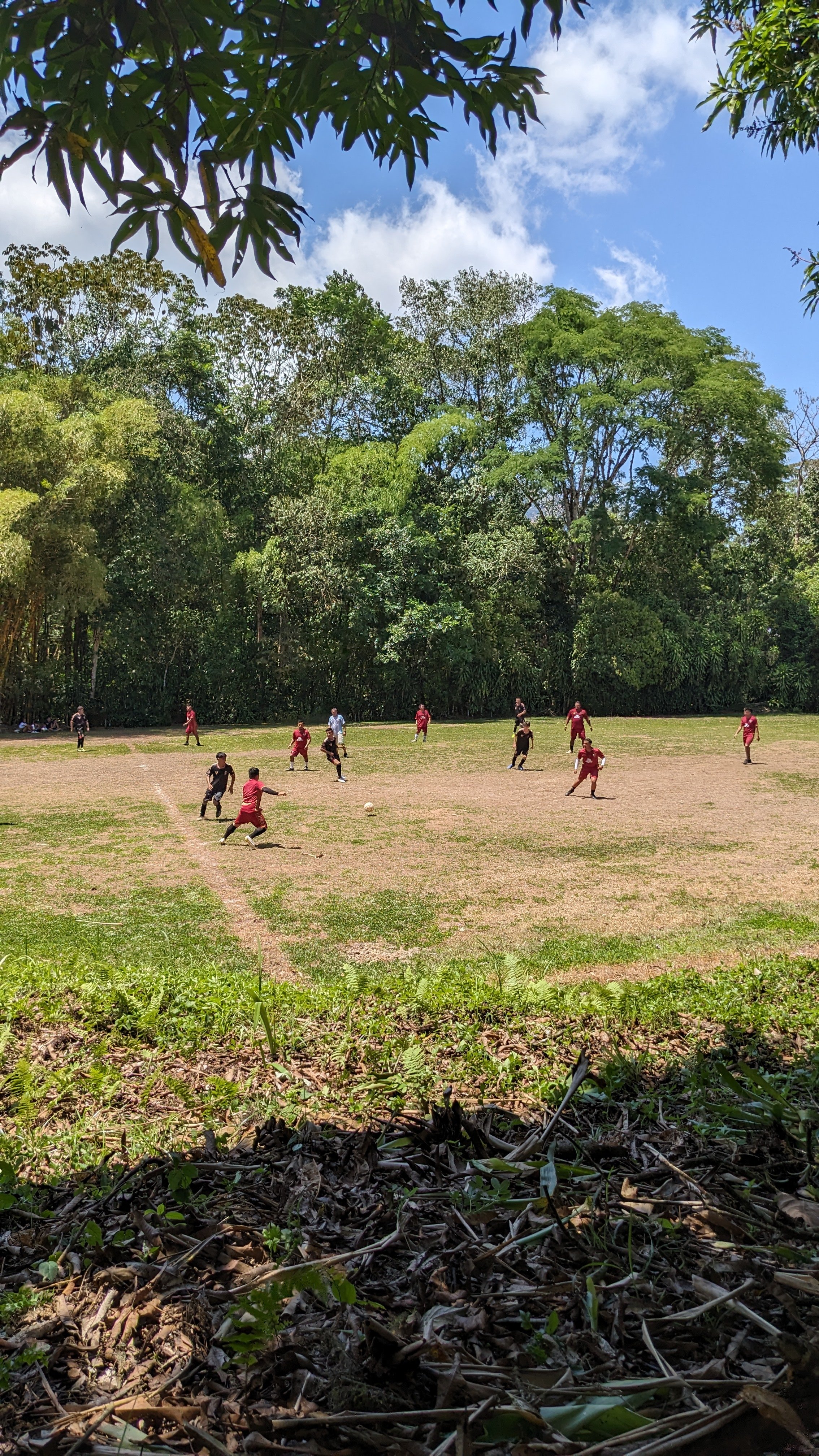
Teamwork / Comradery
There are 3 main sports we play here: Volleyball, Ultimate Frisbee, and Soccer. There is a near-fixed schedule that repeats weekly (Monday, Wednesday, Friday – Ultimate Frisbee; Tuesday, Thursday, Saturday – Volleyball; Sundays are left open for whatever people are interested in playing, with some sort of pick-up soccer happening most days). Sports are scheduled for 4 pm every day, which around here means everyone shows up around 4:20-4:30 and we play until around 5:45-6 pm. No matter which day or which sport you join, everyone is invited and whoever shows up is split into teams as evenly as possible. You may or may not already know the members of your new team. They may be locals, longtime residents, new residents, long term guests or students, passers-through, you name it; it doesn’t matter. You are now working together to take your team to victory (in a friendly competition kind of spirit, of course). We get hyped together, we cheer each other on, we score, we drop passes, we win, we lose, we do it all as a team and it is an incredibly fast way to connect and bond with new friends.
**one caveat – that note about the friendly competitive spirit is CRUCIAL to this being a bonding experience. Egos and taking the game too seriously need to be left off the field. We try HARD around here, but there is no arguing over technicalities, or anything for that matter. Remember, we’re doing this for fun!**
Moves Relationships Beyond Work-Life
Speaking specifically of what I witness here at El Rancho Mastatal, participation in team sports makes a huge impact on working relationships. The Core Team at the ranch has cooperative working relationships with many locals. At this moment, we have a large structure being built on the property and it is a collective effort of our natural building team with local builders. The sheer size and scope of the project is grounds for accumulating tension. However, multiple times per week, everyone involved in the project makes their way to the field, runs hard, plays hard, laughs together, and lets off steam in a healthy way; and it shows in team morale and how well everyone continues to work together and stay on track.

Overcoming Language Barriers
We have a wide range of English / Spanish skill levels in this community. Spanish-only, Spanish / English, English only and every level in between. In sports here, you may be on a team with someone you aren’t able to have a proper conversation with, but you’re still able to work together toward a common goal, laugh together at mistakes and mishaps, and have a great time. It’s a starting point to making real connections.
Encouraging Intergenerational Bonds
Something I really felt was lacking in the communities I was familiar with back in the states is the connection between generations. There has been a loss of the passing down of wisdom and just generally spending time with people of different age groups. Here on el campo, there may be players who are 14 (occasionally even younger) and players in their 60s in the same game. Every age, gender, skill level, etc. is welcomed and encouraged to join. Everyone gets to play to the best of their ability and have an awesome experience.
Last Thoughts
I have written this article very much from a “new eyes” perspective. I am both new to Mastatal and pretty new to team sports in general. I didn’t even plan on getting involved in team sports before I came here. However, from what I can see, team sports are a powerful force here in this community. Joining in on the games has quickly become one of the aspects of living here that I value the most and has made me feel so much more connected to everyone around me.

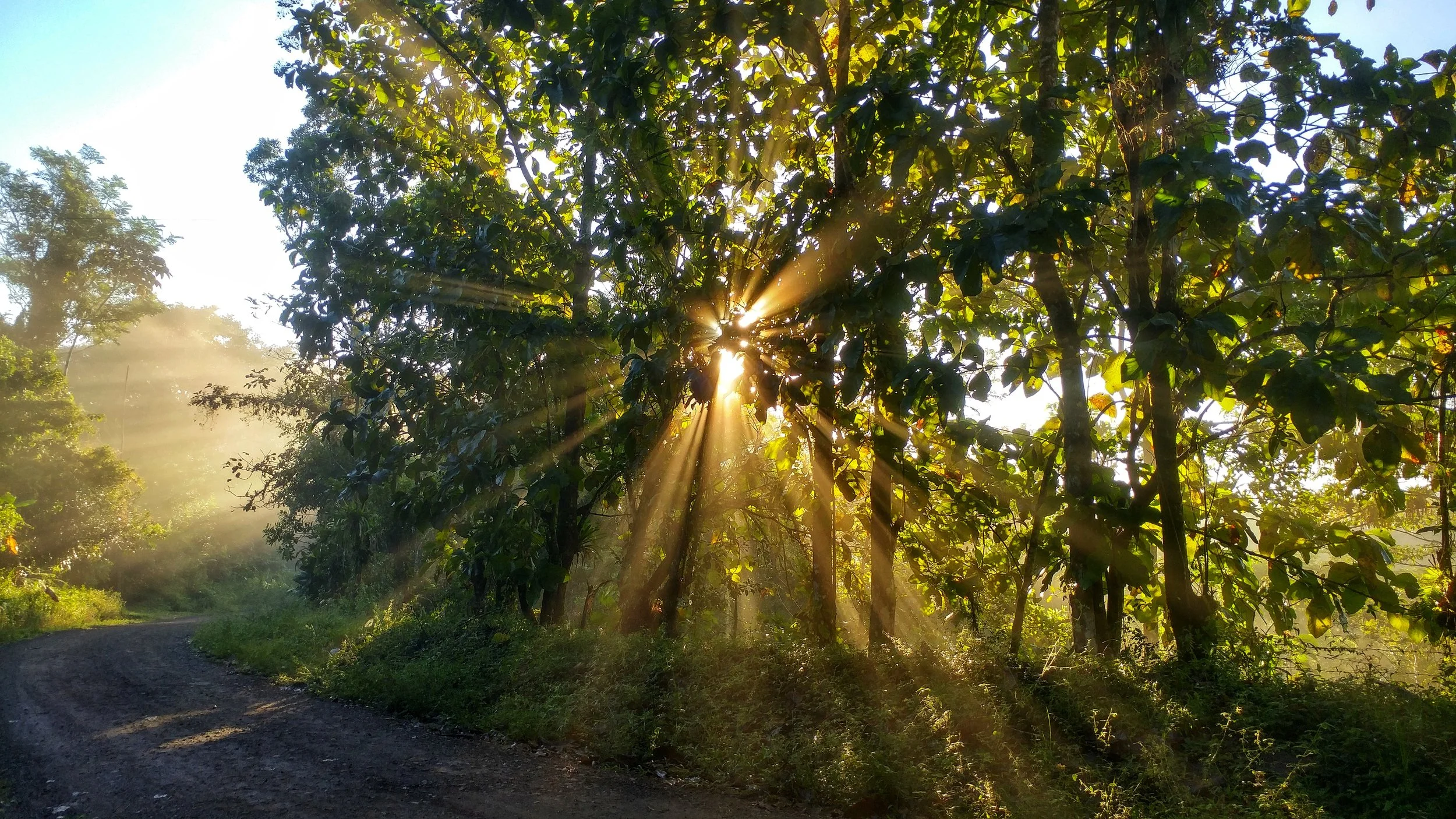
The Art of Simplicity
If we intend to design a culture where the permaculture ethic "fair share" is embodied - where the needs of all beings are met- it is necessary to learn to live simply, taking only what we need and distributing the surplus fairly- the abundance that nature so graciously lavishes upon us.
The Art of Simplicity
By 2024 apprentice Julia Holer
If we intend to design a culture where the permaculture ethic "fair share" is embodied - where the needs of all beings are met- it is necessary to learn to live simply, taking only what we need and distributing the surplus fairly- the abundance that nature so graciously lavishes upon us. We have to (re)learn and practice the art of simplicity -a way of life many of us seem to have forgotten.
Living simply is living lightly on this earth. The complexity of modern life is weighing us down - in the material realm as well as the mental realm. Human made materials have already outweighed the earth's natural biomass.
We tend to look at people who do subsistence farming as "backwards," but considering the world's state isn't it more "backwards" to go to the gym and work out on exercise bikes while using fossil fuels to go grocery shopping? Modern life has created a lot of complexities - physically and mentally. Too much or too little of anything creates complexity. For example drinking water. If you drink too little your body dries up - If you drink too much you are bloated. Burn Out - Working yourself to the brink of exhaustion instead of having a balance between moving, challenging and nourishing yourself - is a symptom of the complexity of modern life. So is our consumerist culture - accumulating more and more stuff, distractions and stimuli of all sorts lead to polluted minds, stagnant creativity and a lack of focus and awareness.
Countermovement like the minimalist trend, pick up on the complexities modern living has created and embrace a simpler, decluttered lifestyle, following the quote by William Morris:

“Have nothing in your house
that you do not know to be useful
or believe to be beautiful.”
Learning to live with fewer and simpler things, fewer expenses brings us greater freedom and makes us less vulnerable to social and economic crisis. We worry less about loss and spend less time protecting what we have. Simple living is less exploitative and also requires less effort to maintain.
When we live in complexity our needs (energy, material goods...) increase and we live at the expense of others. The simpler our lives the more possible it becomes to contribute in proportion to what we use.
A handmade life
If you want to invite more simplicity into your life - learn and practice a craft - any craft (knitting, carving, drawing, weaving, cooking,...) where you have to use both head and hands. Crafting things with your hands brings you into a space of inner calmness and gives you confidence in your ability to create, expanding your creative potential as well as your wellbeing and contributes to the enrichment of the design and quality of the things surrounding us - which in consequence simplifies our lives - we own less things, but the things we have, we truly appreciate. There is a few things more satisfying than using items you have made yourself.
Living in intentional community
Living in intentional community can simplify our lives greatly - sharing tasks, tools, cooking and cleaning shifts, spaces and ideas is a beautiful way to consume less and live life in a more meaningful way. In a community where creativity is fostered the focus shifts from having things to making them, as a result they become a source of great satisfaction and pleasure.
Designing simplicity
Design in its essence is the analysis of a problem and seeking the best solution - in order to create more efficiency, solutions have to be simple (and slow). Using locally available materials reduces transport distances and carbon emissions. Using the output of one element of our system for another element’s input is diminishing the need for outside inputs, thus simplifiying the system as a whole. Appropriate technology needs to be fitted to human needs as well as the needs of our ecosystems. Thoughtful and conscious choices that might not seem like the "as little as possible" option at first but save energy, time or labor (power tools, using cement for certain structures, using washing machines,...) might also contribute to more simplicity if used with intention. Permaculture Design looks at all these factors - designing systems that simplify our lives while not creating more complexity for other (eco)systems.
Inner simplicity
Inner noise and turmoil is one of the symptoms of modern societies and can manifest in the form of stress, burn-out and mental illnesses. The times we spend in silence, meditation, prayer, contemplation or other spiritual/mindful practices helps us to remove inner clutter.
There lies immeasurable worth in treating our bodies and spirits as temples and gardens- entering barefoot and in quietness, watering and caring for them, tending them to grow, being diligent in discerning what we allow to enter in or let linger in these sacred spaces.
The clearing of inner spaces helps us to interact with the outside word in more simple and gracious ways - we are growing in our ability to communicate clearly, precisely and to the point - discerning when to be silent and practice active listening.
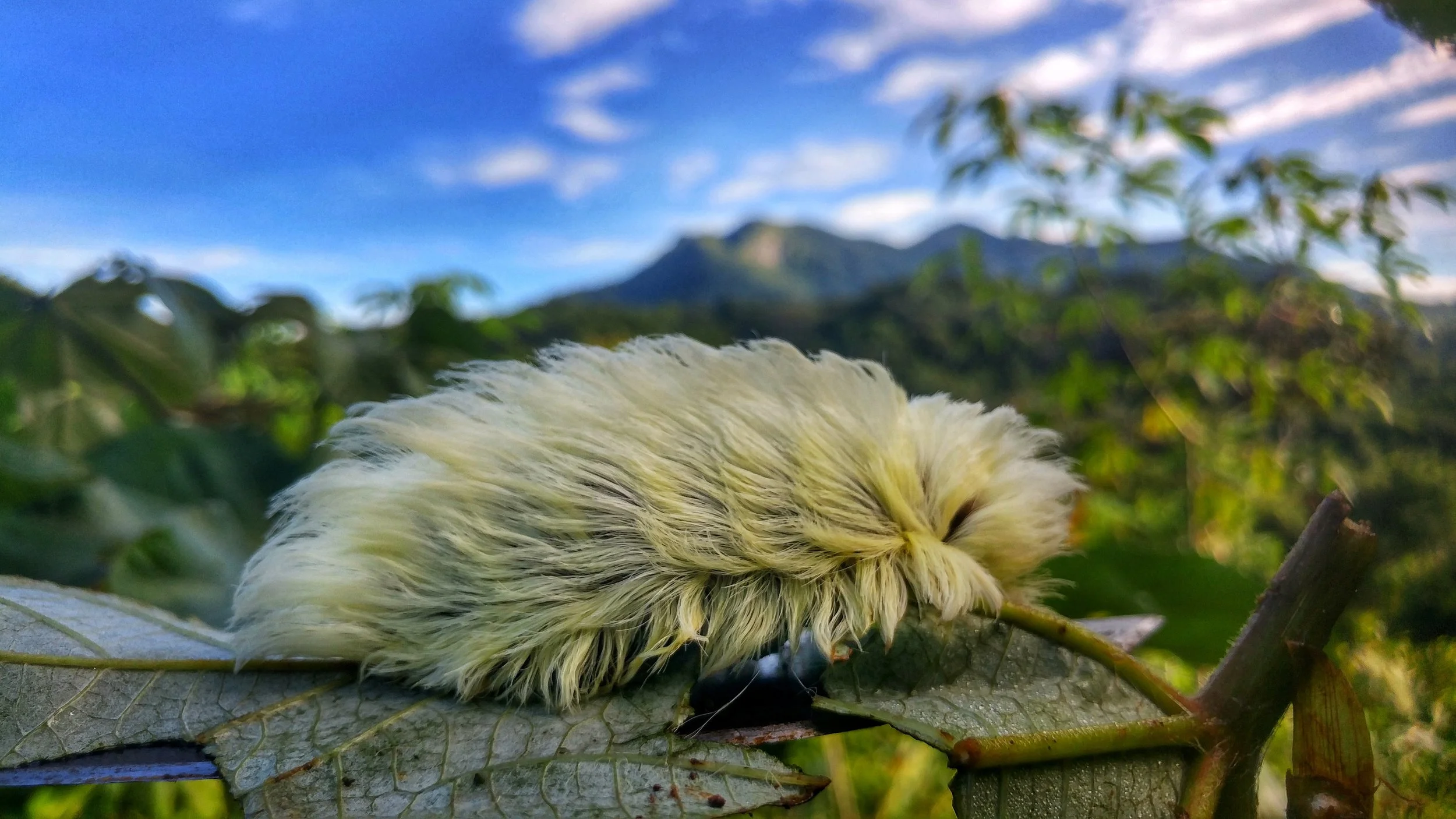
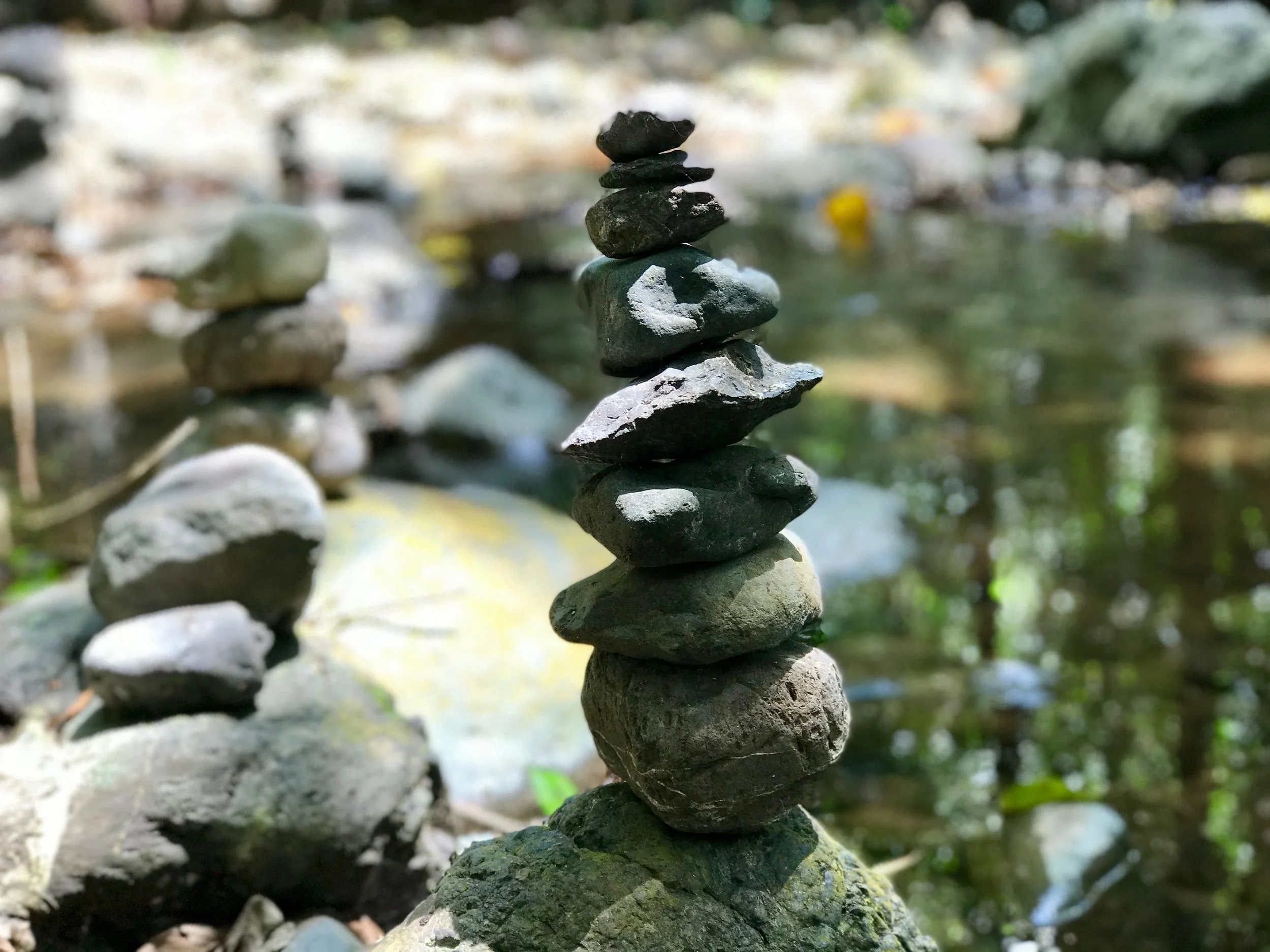
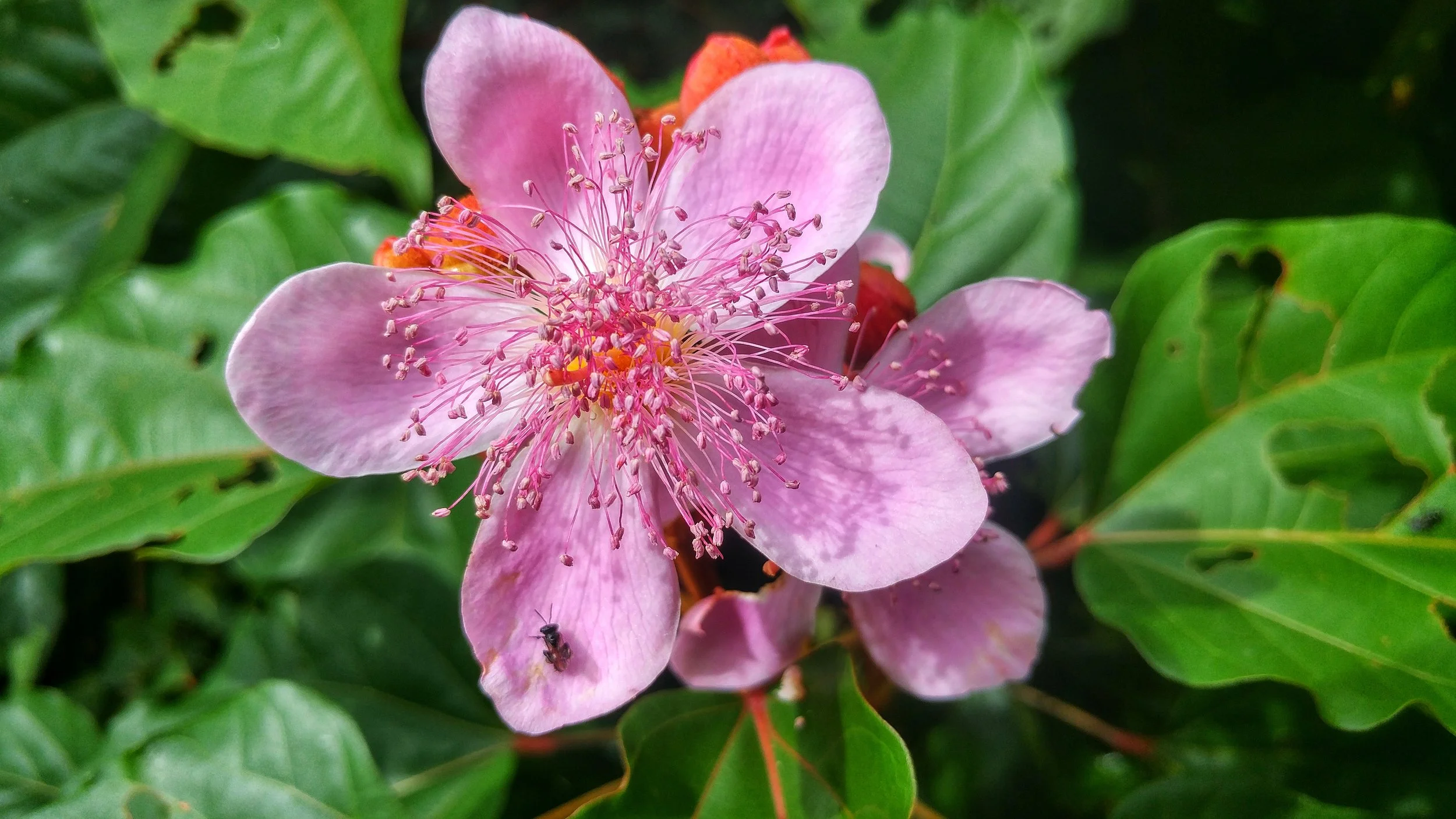

Coming here to Rancho Mastatal for the apprenticeship was the much needed fulfillment of a deep longing for more simplicity in my life. Complex life in the city required a lot of effort to stay energetically balanced and grounded. Being emmersed in nature, eating well, doing physical work, being surrounded and inspired by kindred spirits has simplified and at the same time enriched my life in so many ways.
Every day I feel more grounded, content and grateful for a simple, intentional and balanced life - which of course doesn't just happen randomly - at Rancho Mastatal you can find the well designed and continuously adjusted workspaces, living areas and agricultural spaces - as well as the beautiful weavings of invisible structures - community building through meetings, check-ins, team-sports and so much more that keeps this place working well, and simplifying while at the same time enhancing all of our lives here.
In the process of thinking about the art of simplicity the following questions came up that I want to share with you as a prompt to invite more simplicity into your own life:

How do I use my energy?
Am I aware of my needs?
What's the simplest solution you can think of to meet your needs?
Where can I do with less?
Where do I have too much clutter in my life -inside and outside?
Are the things I own useful or do they bring me joy?
How can I invite more simplicity and efficiency into my life - without creating complexity for others?
Contemplating simplicity and taking appropriate steps, designing your life with intention is contributing to the betterment of our world as a whole - ending with the words of Elizabeth Seton:
“Live simply - so that others may simply live.”

Finding Home in Permaculture
There is a word I once heard called Solistalgia. It’s meaning is similar to nostalgia, but it is for a place you are already in. It is feeling lost and missing even when you are “home.”
Finding Home in Permaculture
By 2024 apprentice Allura
“Stand Still. The trees ahead and bushes beside you are not lost. Wherever you are is called Here, and you must treat it as a powerful stranger, must ask permission to know it and be known. The forest breathes. Listen. It answers, I have made this place around you. If you leave it you may come back again, saying Here. No two trees are the same to Raven. No two branches are the same to Wren. If what a tree or a bush does is lost on you, you are surely lost. Stand still. The forest knows where you are. You must let it find you.” - David Wagoner
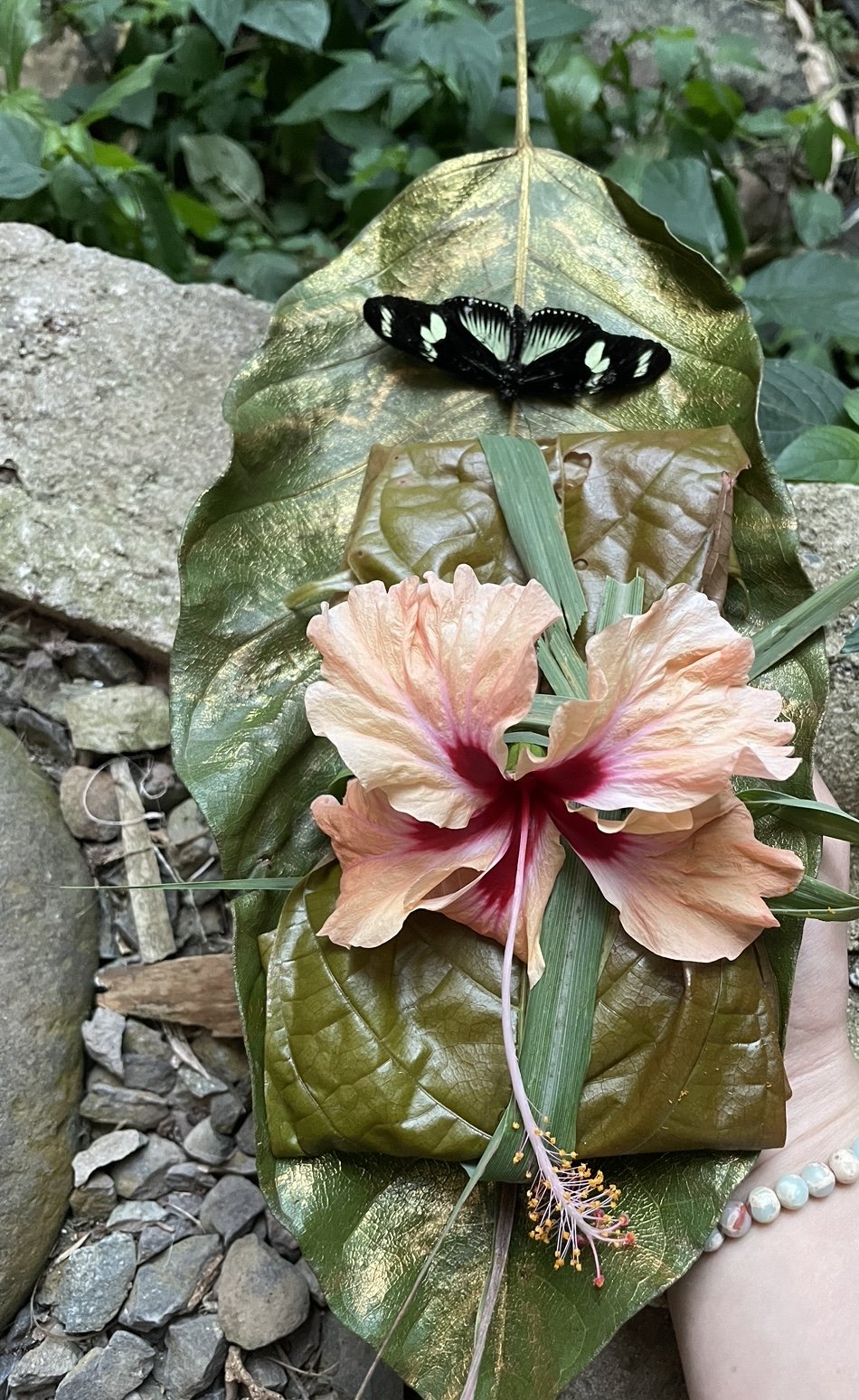
There is a word I once heard called Solistalgia. It’s meaning is similar to nostalgia, but it is for a place you are already in. It is feeling lost and missing even when you are “home.” It was brought up at a discussion I attended by an indigenous elder, so too was the quote above, recited with strength and invitation. She said it is a collective occurrence, “for the forest to be lost on us”. For us to be disconnected from the land in which we dwell, for nowhere to feel quite like home and to be searching for it everywhere. To remain in a state of longing. But then a sense of gladness washed over her form, and she spoke again with an antidote: ‘let the forest find you. let the plants identify you instead of you trying to identify them. That is how we come home’ This wisdom is an upside down concept for many of us when we’ve been taught that we are the only observers when “alone” within the trees. Yet I also think it is quite simple and innate, to remember the awareness that surrounds us. It is a practice of receptivity and reconnection, one that seems so natural within children. Simply opening ourselves up to pay attention to the wonders and mystery of life as adults may at first seem like an intangible act but I truly believe it is just a practice of nurturing and reawakening one of our many organs of perception. One of my greatest guides to relearning these perceptions has been through the study of Permaculture, a culture that merges ancient wisdom and new through a system of principles and designs, bringing humans back into harmony with the earth. And it is the first principle, to Observe and Interact, that grounds me with roots deep and unwavering into my sense of ‘Here’ wherever my feet kiss the ground.
When we are children, it is instinctual to observe the mystery and wonder of life through interacting with nature. When we are small and physically closer to the earth it's as if we can hear her better and we naturally want to play, explore and relish in the awe of it all. I believe Observing and Interacting is the first principle to practice in permaculture because it drops us into the beginner's mind reminding us that we need to return to this way of observation and truly learn how to be with the land before anything else. This seems simple but it takes time. This principle goes against the reading or looking up of information on the internet with motivations of speeding up the process. David Holmgren, co-founder of Permaculture, says in his book “Although I recognize the value of formal education and training and communications media, they are also part of the problem preventing us from a more direct connection with, and experience of, the natural world through observation and experience.” Relearning how to be present and open is a fundamental prerequisite to reigniting our connection to the earth in order to work with her again. It is as if only the soft whisper in the trees can sing us a song to enchant us with her magic- ‘do you remember how to be with me?’ she asks. When coming to the first principle of permaculture, we must take the time to get to know our unique ways of observing and interacting with the earth.

So I am learning how to join the dance of being one with the heartbeat of the earth again, a rhythm that I realize I knew quite well when I was young. Some ways I choose to interact with the land is by falling to my knees in her beauty, before the silent mountains or at dawn in the long grass that holds the morning dew. Falling in love with Earth, I consider an interaction too, with the sounds of the jungle’s midnight symphony lulling me into my dreams, or with the seedling in the nursery that sprouts strongly towards the long time sun. Sometimes I do interact with reading, about the plants or out loud to them. I merge my sense of play and devotion by encircling trees with offerings. Sometimes that is by clearing the space around them and surrounding their trunk in leaves and compost for nourishing support. Other times it is an altar of flowers and dark chocolate in honor of their beating spirit. I dare my quiet and shaky voice to talk with the plants too, asking questions and for guidance or by offering words of my own love. I am learning that I am interacting when I am in the forest and being, just being or singing, laughing or crying, dancing or resting, and loving. These are the ways I know to Interact. And I observe with my breath in reverent stillness of my mind. Sitting with a plant and breathing in, gratitude for their life and the air they feed me, I breathe out- this exhalation is for them. I believe these ways of observing and interacting with the land relays a message to the earth that I am ‘Here’, that I am listening and I am paying attention. I think it is not about what we do when we “Observe and Interact” but the intention behind it that forms a language of patience, appreciation and awe with the earth. The ways in which we each do this are unique to each person but in essence I think it is all within the same song. I hope this song can be heard, but in truth, I don’t know if I can prove to you that it is. I decide to carry on and do it anyway because after all, this is a process of being found rather than of finding.

“By observation we usually mean using our eyes, but this reflects how visually dominated modern people are, raised in a literate and now graphical world. All of our senses have great potential to provide valuable information.” David Holmgren
I believe it is possible to reconnect to the wonder and mystery of life by opening our senses to observe and interact, as the first principle of permaculture suggests. And when we can learn/remember how to connect with the wondrous earth that holds us, maybe within our sense of longing we can feel her longing for us too. Longing for us to remember that she is home and our ‘Here’ no matter where we wander off to in this wild world. How can we feel her closeness? There have been studies that show us the mycelium mat under the soil, which acts as the sentient mind of the forest connecting all trees, is able to sense when someone walks inside. It is becoming common academic knowledge that individual trees have the ability to hear, feel, see, recognize rhythm, store memory and the ability to communicate what they know amongst other trees. We already know the earth is identifying us. The unraveling knowledge becoming apparent is pure magic and can provide some reassurance to this process. But must we read it to believe it? Or can we simply join the dance and awaken our perception to believe and know it deep in our bones. ‘Stand still, the forest knows where you are.’ It has certainly found me.
“Thus the thinking and design revolution, of which permaculture is a part, only makes sense when it reconnects us to the wonder and mystery of life” David Holmgren


The Importance of Attention to Intention
In a world vying for attention in all directions and in oh so many ways, the importance of directing yours towards intention remains ever important but seemingly less inherent.
The Importance of Attention to Intention
By 2024 apprentice Rabbit
In a world vying for attention in all directions and in oh so many ways, the importance of directing yours towards intention remains ever important but seemingly less inherent. Around us, there are currents that flow and paths to walk at all times. Currents as the energetic rivers created by individuals or groups, and paths as the trails we can walk towards our goals with our intentions. Taking a current forward, a flow, carries an air of submission while walking a path could be viewed as more self driven but both ways of moving forward are possible to be executed without any personal intention. It is also entirely possible to carry on in these ways chock-full of intention and the social aspects of permaculture taught here at the ranch have helped me to develop more lucidly a framework for moving forward in this manner.


The hypothetical person living as an island without relationships of any influence while still taking part in the world might find that they are able to remain in their own direction as a natural unfolding without much thought of intention - congratulations! The less hypothetical person who finds themselves more intricately involved with family, friends, partners, neighbors, community members, might find their direction in life altered from time to time by taking a dip in the flow of those that surround. One can live this way, flowing with the currents of folks and relations, and hark! experience a beautiful life! If this way of living is your intention I do believe when you reach that river’s delta on your way to Big Blue you might just be able to kick back in your innertube (compostable of course) close those weary eyes underneath your sweet foldable gracious sunnies and breath out a grateful last breath with a smile. On the other hand, if you reach the mouth of the river you fell in to by chance and without a thought as you pass by that old worn sign reading: “So long, and thanks for your intention!” and you mutter under your breath, “Intention?” the sight of the quickly approaching and assimilating hungry blue maw might make you lose those expensive foldable sunnies as you clamor to use the oars of your birthright, frantically doggy paddling your way back upstream.

Taking a step back from oceanic metaphors, I’d like to speak from personal experience. Arriving at the ranch and being still slightly new to the extroverted side of myself I stepped in to a pattern of being, subconscious as it is, or was. One would hope that in agreeing to take part in a year long apprenticeship four thousand miles from whence I came that I boarded that plane with intention. One would be pleased to hear that their hopes were not in vain. But upon joining a new group of strangers with curious dynamics and flows all their own I quickly became a thriving social lepidoptera, fluttering about, at times even frantically, sustained by the sweet nectar of long conversations and personal connection. A sustenance needed because I was not feeding myself in other equally important ways. Late nights formulate in to sleep deprivation, constant socializing leads to a neglected relationship with my internal self, at times even with my partner, and on a more material level; I don’t get jack done!
Praise the day we walked down to Robin’s porch and began a class labeled as Social Permaculture in which, on that day, we would find ourselves identifying our vision and core values.
If this lovely brain is remembering correctly, our first task was to envision an ideal self after this year long apprenticeship was through and to catalogue said vision in our notebooks. Then, with a list of some three hundred odd values encompassing a spectrum more specific and articulate than I could have hoped to pull out of the aforementioned noggin, we were to pick the ones we deemed important to us with the idea that we would also be refining them to a list of ten and ordering them in a cascade of importance. Once completed we were to re-visit our vision with the new outline of our values and see how they matched up. Was our vision displaying proudly the badges of our values as it walked off the ranch? These two processes alone were a breath of fresh (if somewhat sharp) air. Taking the time to look within to create an honest image of where I would like to be helped me to realize that I might be floating on a foreign river. However! Being that this class took place so early in the game, I was still able to see my desired path on the shore. But how do I get back to land? My solutions were discovered in the next step. Creating goals. Long term, short term, personal wellness, and learning goals. Who would have thought! A little structure for the self from the honest and thoughtful self and you’ve got yourself a dinghy with an outboard! The long term goals better defining what the vision consists of, and the contemporary personal wellness and learning goals being activities to create the future that is holding the desired vision and long term goals in its gentle hands.
With these goals as structures in place in my life I moved forward into the following weeks with a renewed sense of purpose in being here and a stronger sense of self. I had been living with the idea of intention but only sometimes employing it. While I am no perfect one, and am still prone to the occasional off day, I find myself refining and redefining my goals but keeping in the grace of my structures is allowing me to better ponder and act in and on my own desired intentions. I don’t know what every step of the path looks like, but as I move forward using these tools I swear I can see what looks like my vision illuminating and growing more opaque with each passing day, somewhere not far ahead.
See you not too soon Big Blue, I’ll be holding on to my sweet sunnies thank you very much.



Tips for Incoming Apprentices
Congrats on being accepted! As you are preparing for this crazy beautiful adventure, here´s a list of things we wish we knew before coming to the Ranch.
Tips for Incoming Apprentices
By Sedona Lewis and the 2023 Apprentices
Congrats on being accepted! As you are preparing for this crazy beautiful adventure, here´s a list of things we wish we knew before coming to the Ranch.
Re-read all apprenticeship documents multiple times. There are so many important details (including a lot of this information) that are easy to miss.
Types of shoes that we've found useful:
C.R.O.C.S. Release your inhibitions and just get yourself a pair. It's incredible how fitting they are for Ranch life.
Rain boots for work parties and rainy season, any brand will do. Its nice to have the tall ones.
Tennis shoes/ trainers for hiking and sports.
Comfortable shoes to wear indoors during cooking shifts and food days. The floors in the kitchen spaces are concrete.
Flip flops for the shower to prevent fungus.
Shoes for hiking down to the waterfall/river. Something that can get wet and doesn't fall off when walking through water. Crocs are great for this, but some prefer a Chaco/ Teva/ Bedrock/ Earthrunner kind of sandal.
Any shoes that slip on and off are really nice. We are constantly walking between structures and taking shoes on and off. This is why CROCS are the best!
Organize zoom calls together before you come! It is super useful to get to know each other a bit and ask questions as you are preparing and packing.
During these calls, discuss and plan for the beach trip in May. Book your house ASAP!
If possible, when arriving in January, organize transportation from San Jose to the Ranch. We rode with Fernando, his number can be found in the transportation section of the Ranch website. Regardless of who you choose, make sure to tell the driver how much luggage you have collectively!
Reach out to past (and current!) apprentices and ask questions. Email the core team for contact info and organize phone calls if you can!
It can be chilly at night. Its great to bring good long sleeved shirts/ a light hoodie/ leggings/ long pants. Also warm clothes to sleep in if you're a cold sleeper.
Light weight, long, loose fitting clothing is the best protection against bugs.
Bring good tupperware(s). The kitchen prepares two meals a day, so saving leftovers to eat in between is really nice. Also, containers are great for storing things other than food.
Be prepared to only eat meat once a week. If you´re accustomed to eating meat more than this, you can buy chickens or cheese from our providers in the community to supplement for yourself.
Seriously, make sure the core team knows about any health problems or dietary restrictions you have before you arrive so they can help you to prepare.
To keep electronics safe from the humidity, bring Ziploc bags and silica packs to store them in. Silica packs can be dehydrated in the dehydrator and reused once you are here. Surge protectors are a must too.
A heads-up for Spotify users: Spotify removes downloaded content from your phone after 30 days of being offline. Also, downloaded content has a tendency to mysteriously and randomly disappear. Maybe do some research on how this can be prevented / if a different streaming platform might work better during long periods offline? Or the safest option is to download your library as mp3s.
It is not necessary, but pretty useful to have a computer here. Mainly for writing blog posts, viewing e-library material, planning and teaching the internship, and organizing travel during visa runs. Be aware that this environment is very hard on electronics, so make sure to bring those silica packs and airtight packages!
Small, decorative things to make your room feel like home are worth the space in your suitcase. Thumb tacks are useful, as well as some rope to hang things. And tapestries are awesome to hang as curtains to create privacy in the Hankey. Also, completely unnecessary, but its nice to have some relaxed lighting for night time (fairy lights or a little salt lamp).
You want to have items that make you feel at home, but keep in mind that this climate is very harsh on everything including clothes, jewelry, leather goods, and anything wooden. Only bring things if you can accept that they will get moldy.
If you are going to bring a mosquito net, get a 4 point one that will fit over a double or queen sized bed. You want to have plenty of room under there!
Definitely bring a good notebook(s) and pens/ pencils- you'll be taking lots of notes!
Its worth it to invest in a good quality flashlight and umbrella. The cheap stuff doesn't last long.
Bring your favorite card games, instruments, and art supplies! Again, worth the suitcase space. Its refreshing to spend your free time doing things that make you feel like yourself. Some of our favorites have been playing guitar and flute, crosswords, painting, and beading.
The cell connection is weak and unreliable. Make sure your friends and family know that it will be difficult for you to maintain “normal” communications. We don't have major issues keeping in touch with people, but some days things just don't load.
Ladies, there is nowhere in Mastatal to buy menstrual products. Bring everything you need for the first three months. We have had great success with diva cups and reusable cloth pads and underwear.
Don't be afraid to bring some nail polish, a face mask, or a nice body scrub if you're into that. Some luxurious self care feels fabulous.
Stock up your med-kit and try to be prepared for all types of sickness (flu, cough, loose stools, fever, congestion, etc.) If you are prone to something (like headaches, UTIs, ear infections) be prepared!!!
Someone (usually Robin) goes to town once every couple months. So no need to panic if something small needs to be picked up (toothpaste, etc.).
To inform your decision making as you determine how much spending money you want to bring for periods in between visa runs: A beer at the bar costs about 1,500 colones, a small bar of chocolate is 1,500 colones and a large bar is 3,500 colones, and an empanada at Chepo's soda is about 1,000 colones.
Ranch life can be very emotionally, socially, and physically overwhelming, especially in the first few weeks. It is very important to develop a routine that allows you to stay balanced and recharge your batteries in the ways that you need. Be diligent about carving out time for yourself from the beginning. Listen to your body and bring what you can to make yourself comfy. Its going to be an amazing year!
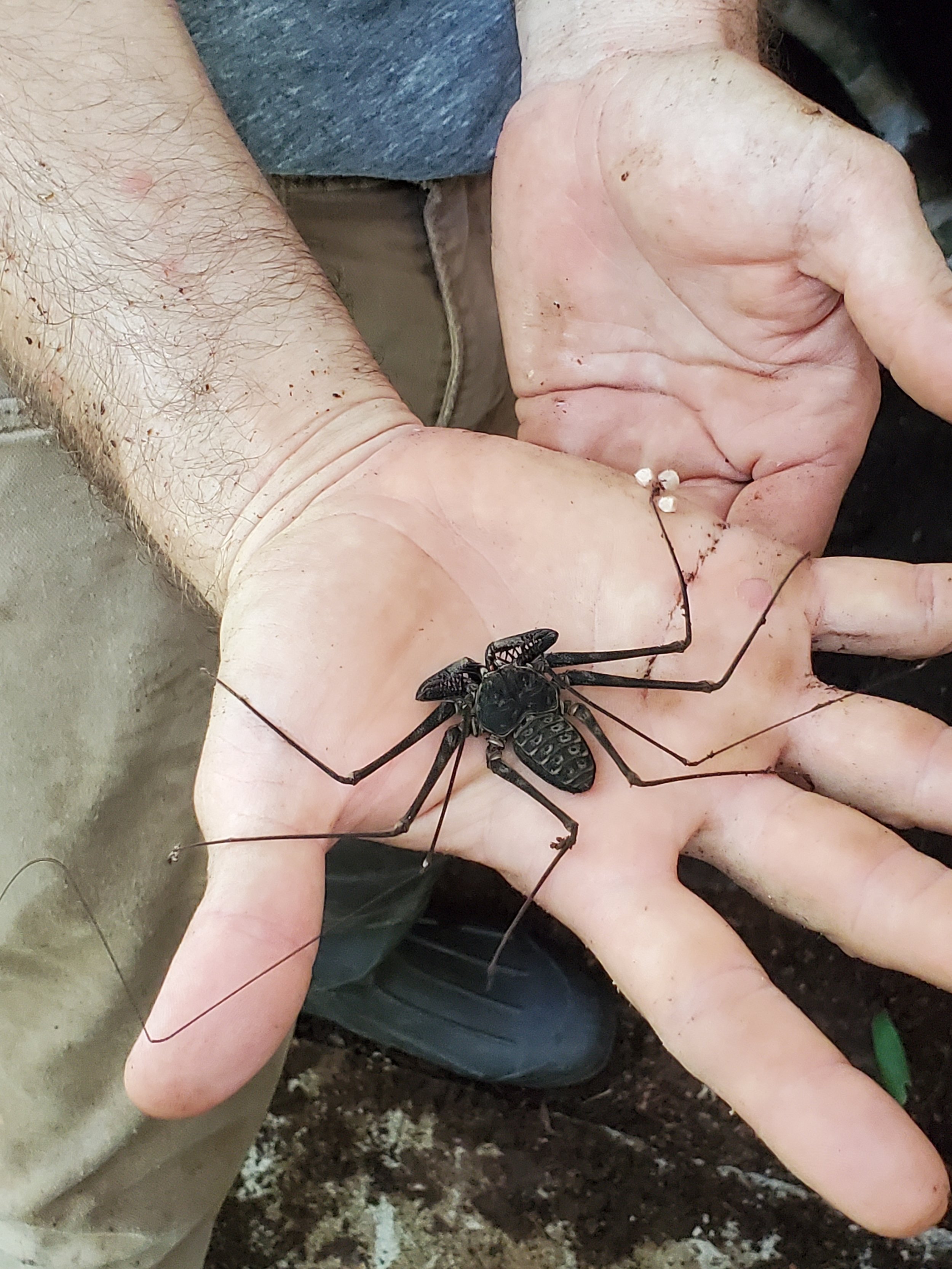
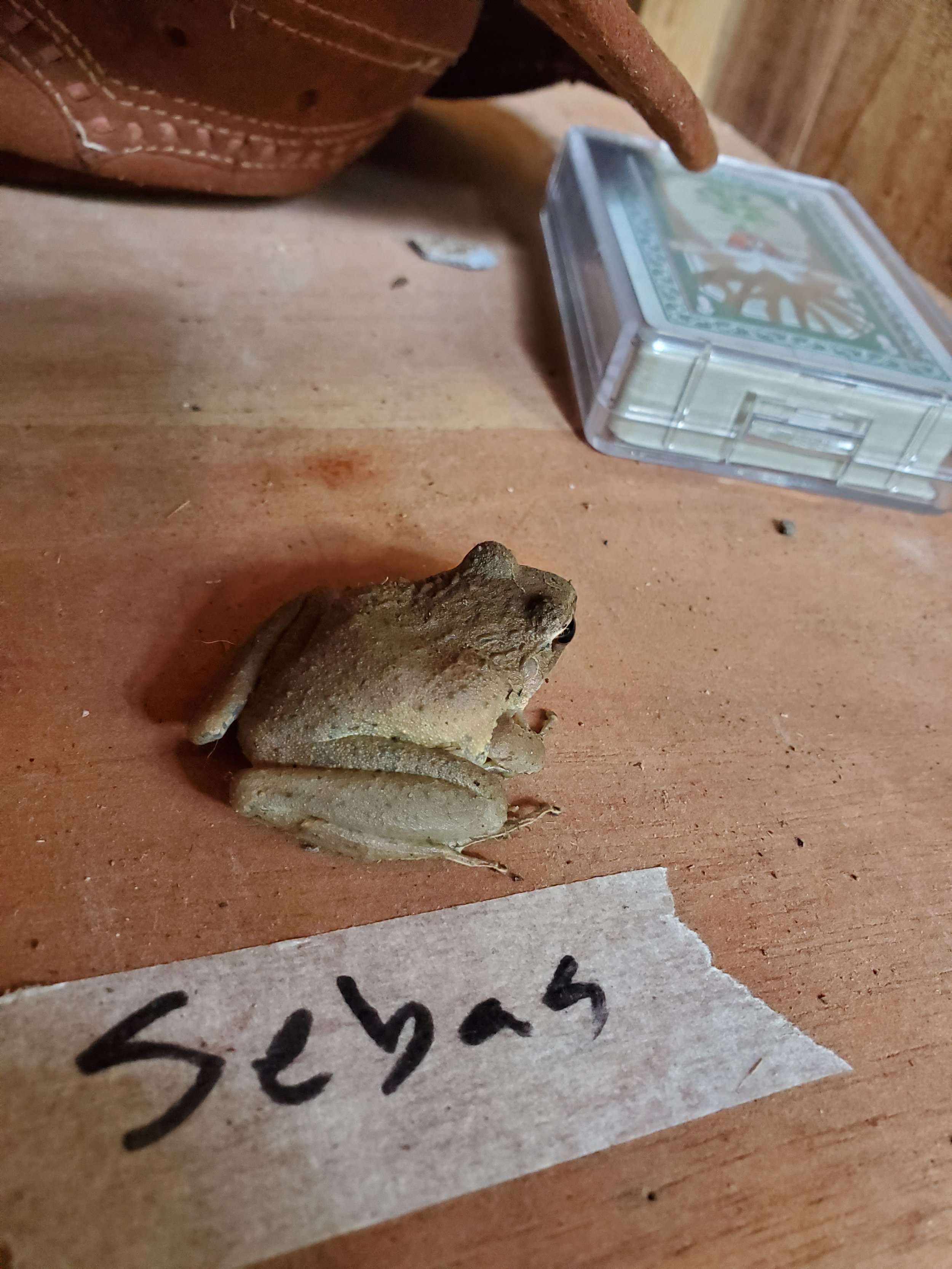
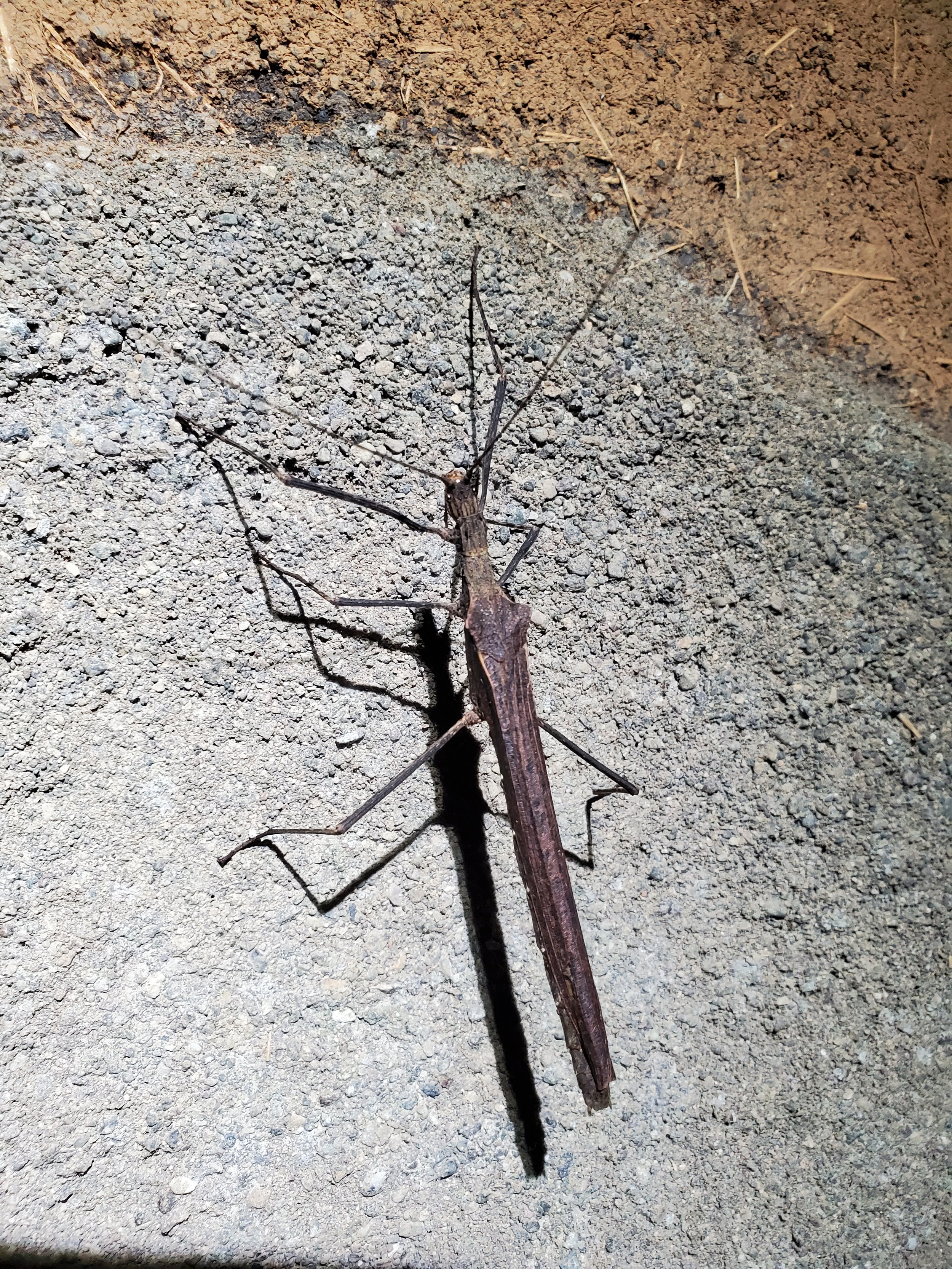
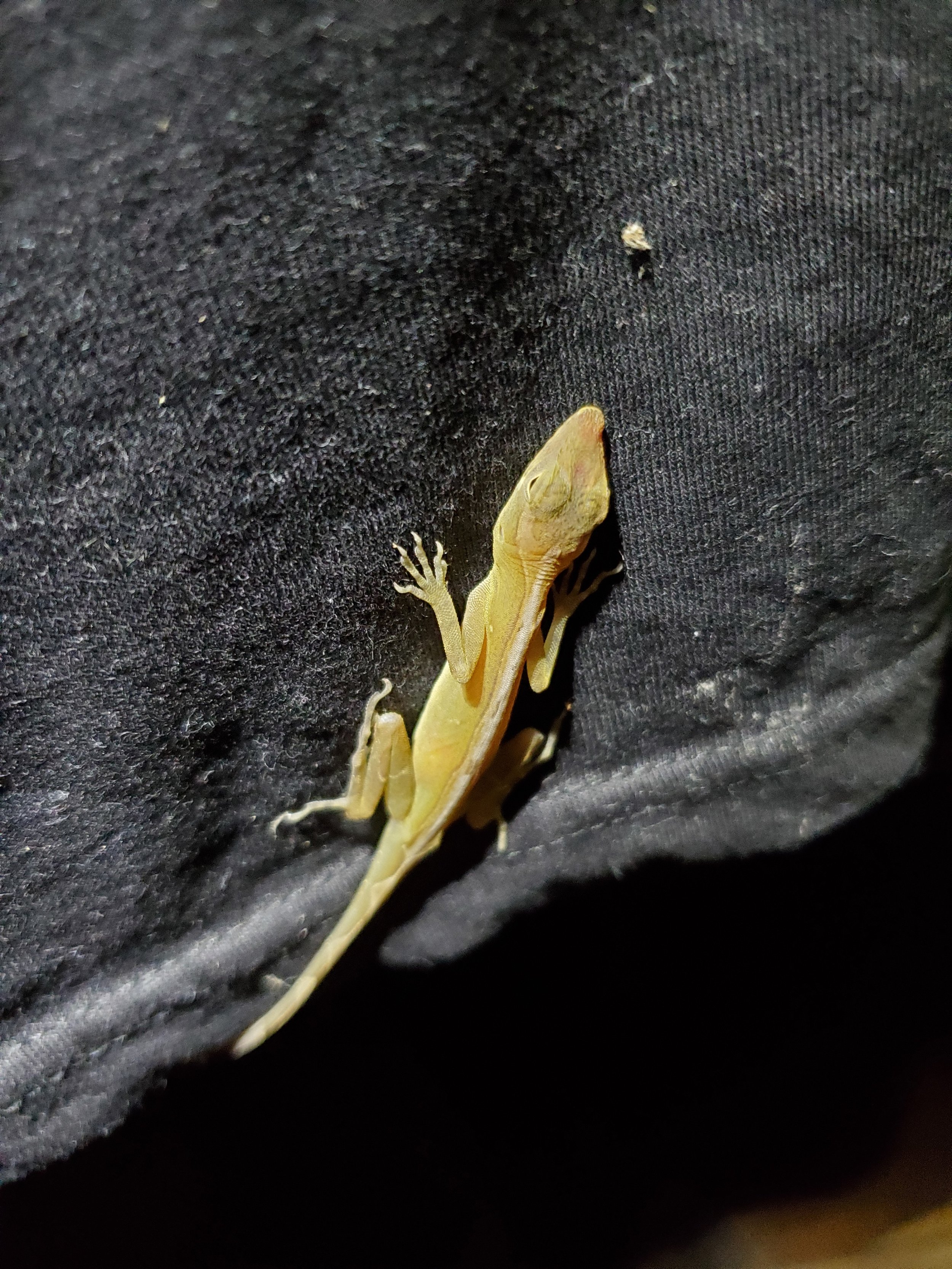
Rancho Mastatal Wildlife Catalogue
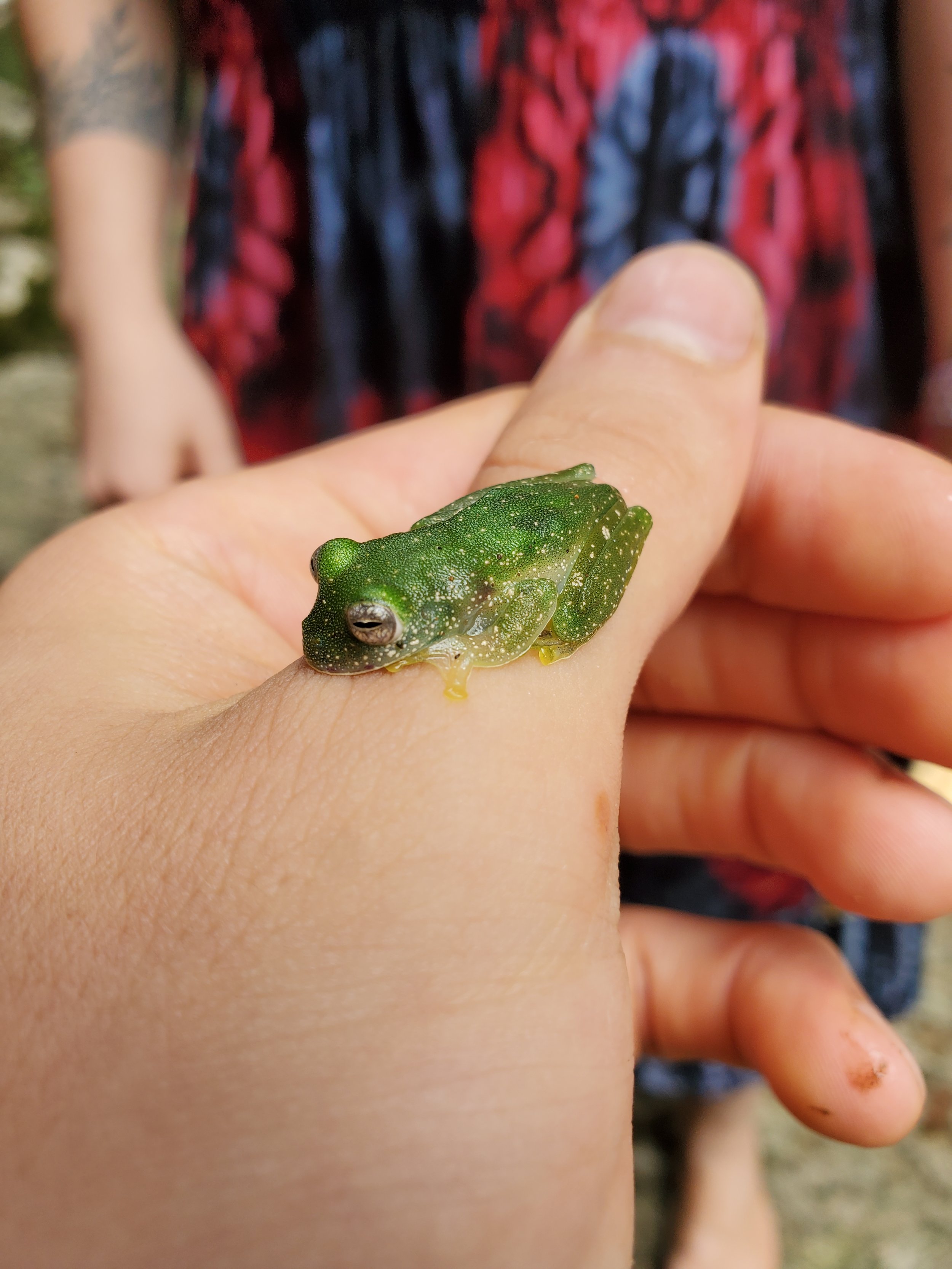
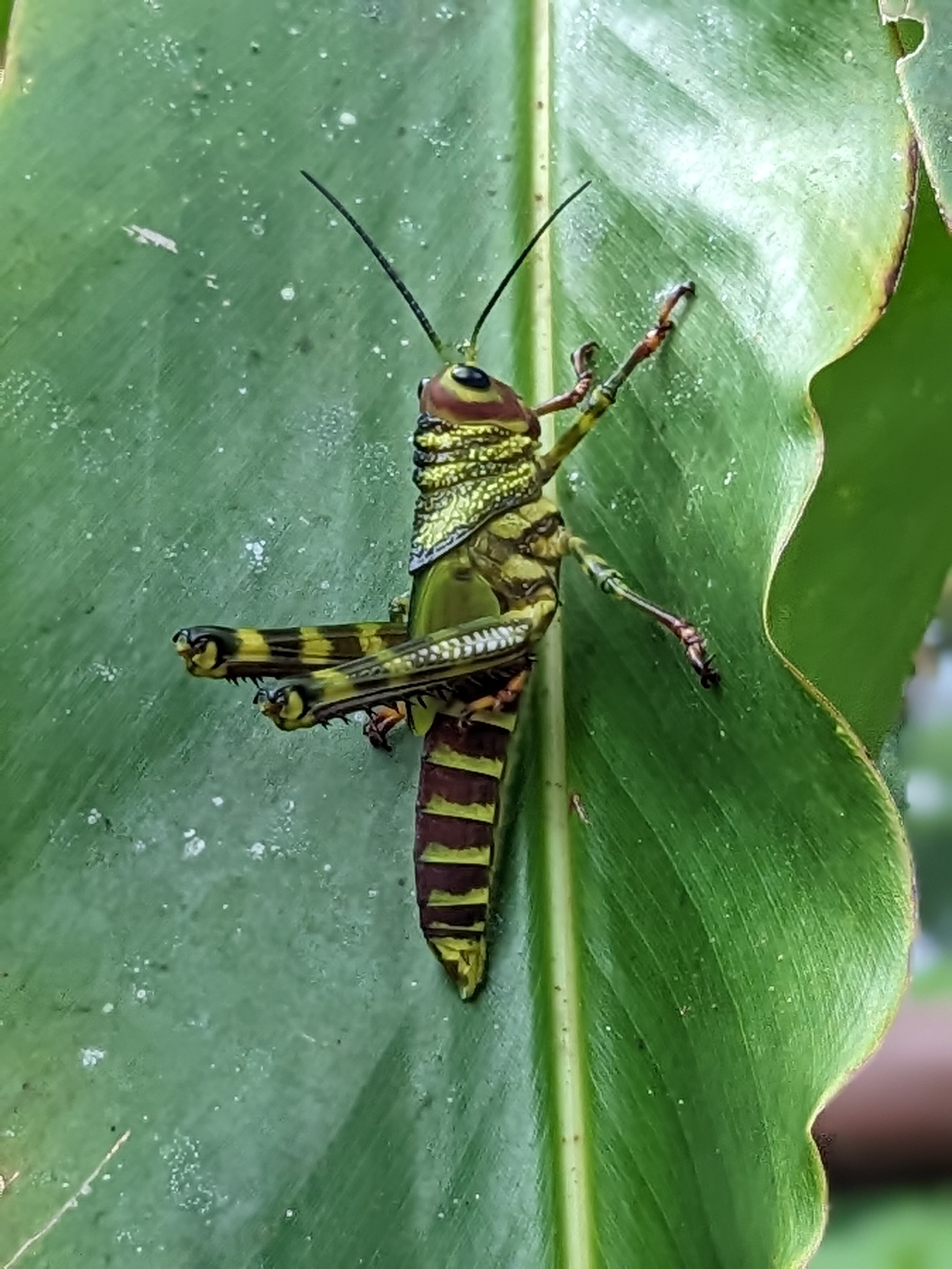
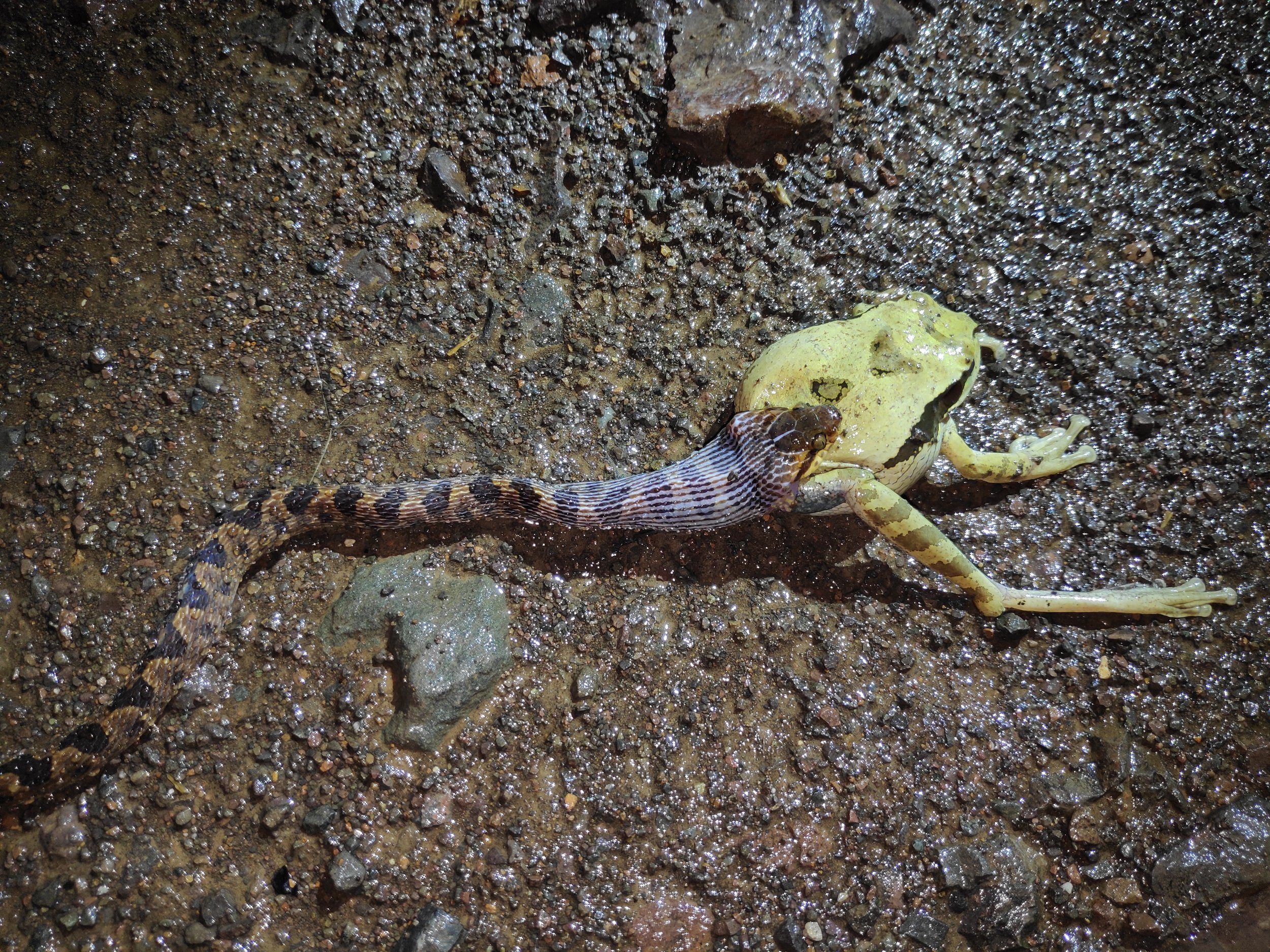
My goal here is to catalogue and display some of the wild critters that we are exposed to while living in our little jungle homes.
Rancho Mastatal Wildlife Catalogue
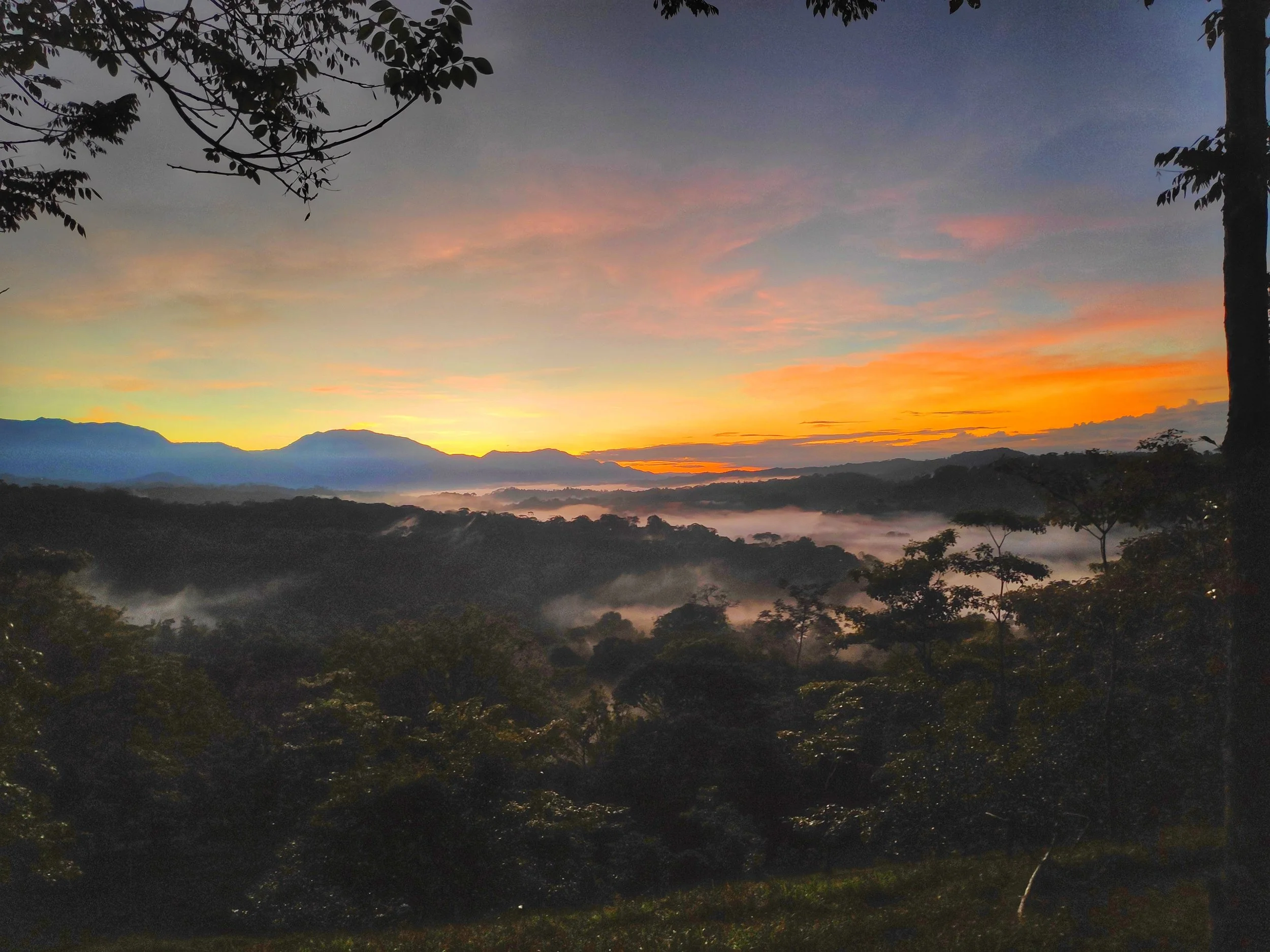
Rancho Mastatal is nestled in almost 300 acres of rich, wild jungle. We are constantly surrounded by a huge quantity of flora and fauna, with lots of our lessons revolving around learning about and caring for the flora we cultivate. Fauna care certainly has its place in Permaculture and is a part of Ranch life. During our year here as apprentices, however, we have no livestock or producing animals to care for; only our lovely pets.

As a lover of animals I am somewhat saddened by the lack of time we get to spend with creatures here; I know some of the struggles the Ranch has experienced in the past with animals, and appreciate that this isn't a time for intensive livestock care. That being said, we still get to see loads of things on a daily basis! My goal here is to catalogue and display some of the wild critters that we are exposed to while living in our little jungle homes. It will be a wildly incomplete list, hopefully subsidized by stories from others who have spent time here, and more official wildlife catalogues of mountainous areas in Costa Rica. We'll have sections of mammals, birds, reptiles and amphibians, and crawlies, and we'll go small to big because that's fun.
Reptiles, Amphibians (Scaly, slimy, slithery)
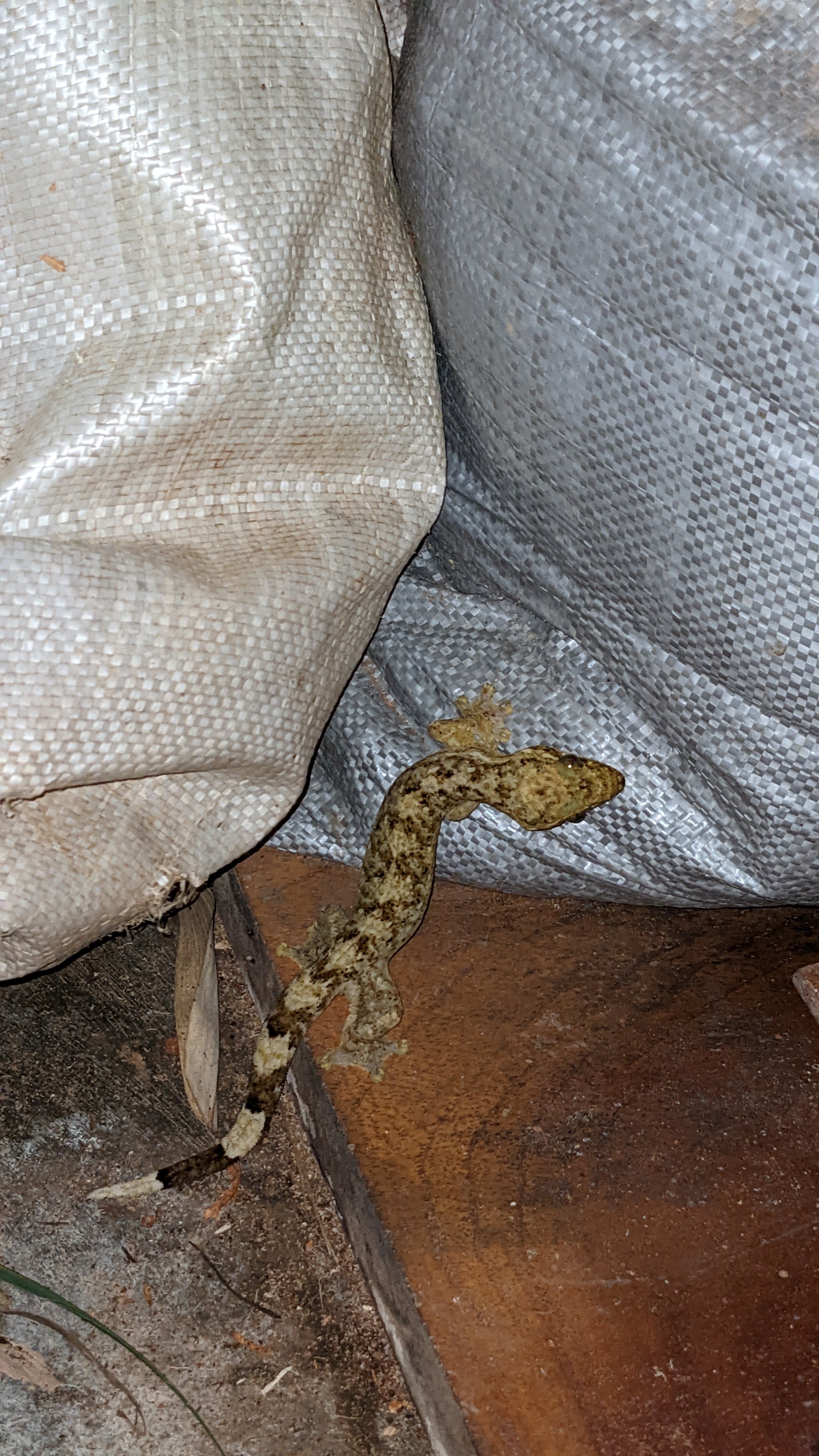
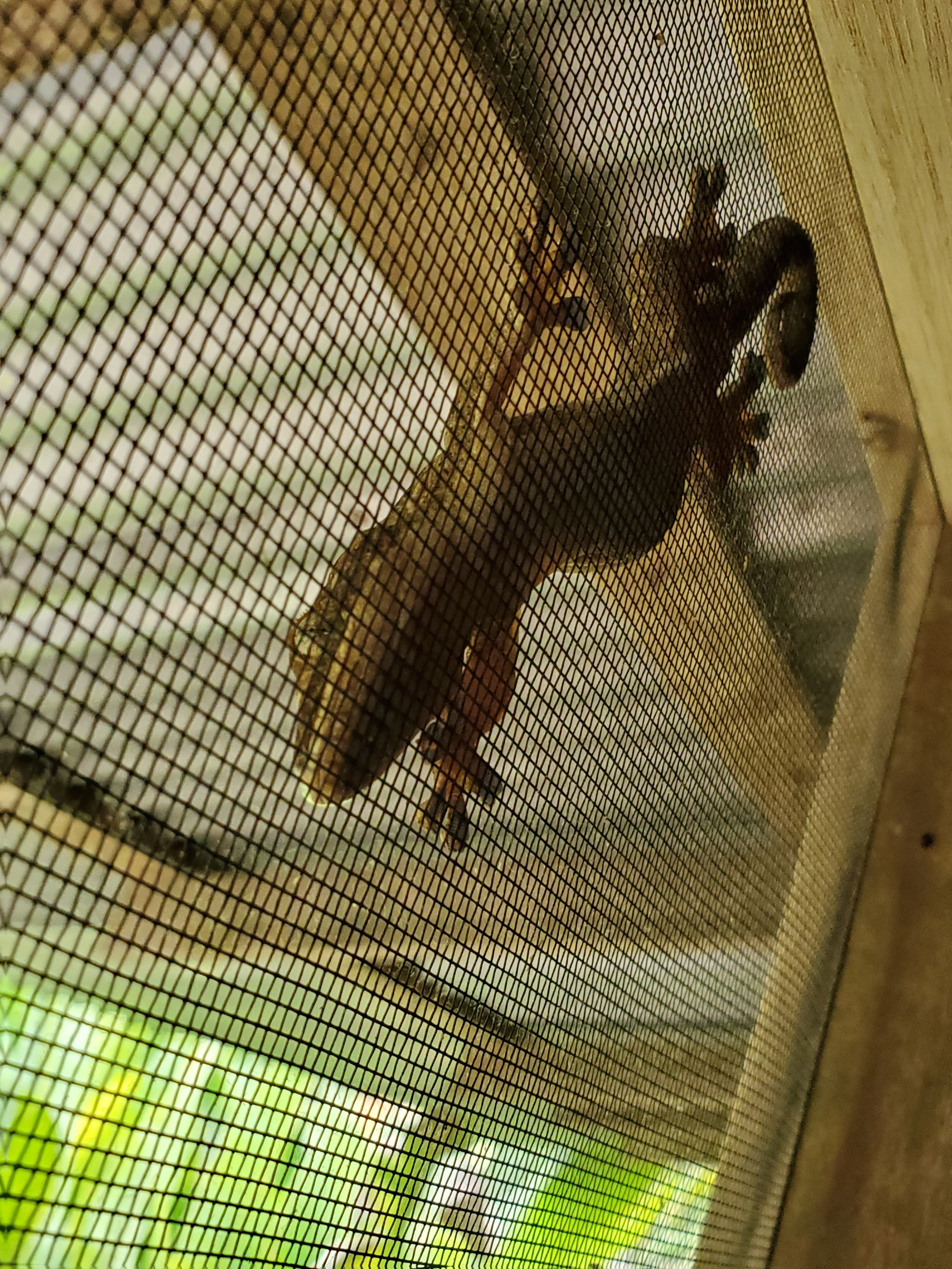
1 - Geckos
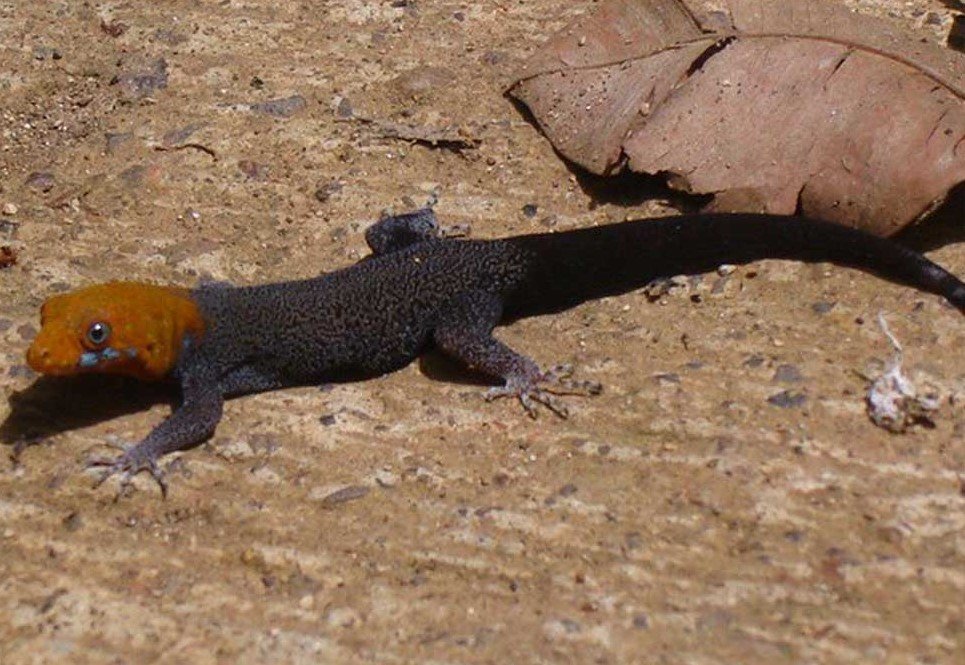
Geckos are everywhere at the Ranch! The common invasive varieties are usually no more than about 5 centimeters long, where fully-grown endemic varieties can be upwards of about 12. Our most common are Yellow-headed Geckos (Gonatodes albogularis), and the most wonderful are Banded Geckos (Coleonyx mitratus). They have sticky pads on their little toes to help them climb everywhere, and they chirp much louder than you'd expect!


2 - Dart Frogs (Dendrobates auratus)
Green-and-Black Poison Dart Frogs are very common in the forested areas surrounding the Ranch. Indigenous peoples used them throughout Central and South America to coat the tips of darts and arrows with poison, which can actually be done without harming the frog; the coating of their skin contains the toxin. Super fun to look at, but caution recommends not to touch.
3 - Cane Toad, or Giant Toad (Bufo marinus)
My personal favorite. Very common in all areas, especially babies and adolescents in damp forested areas and around the rivers. Can grow quite large, enough to intimidate a cat. They can actually be quite dangerous, especially for dogs and other small animals, as they produce a milky substance in glands behind their eyes that can be psychoactive and extremely toxic. Good rainy day companions.

4 - Snakes
Snakes could be an entire topic of their own, and I'll keep it short as opposed to diving in to a very deep subject. The two most common types here are Pit Vipers and Corals.
Our biggest concern here is the Fer-De-Lance (Bothrops asper), or known here as terciopelo, a type of pit viper. A very large, naturally intimidating snake. Very large head in relation to the body, and an angular diamond pattern along its length. There is a "falso" or copycat species which is not venemous, so knowing what is dangerous and what isn't is important.
5 - Iguana (Ctenosaura similis)
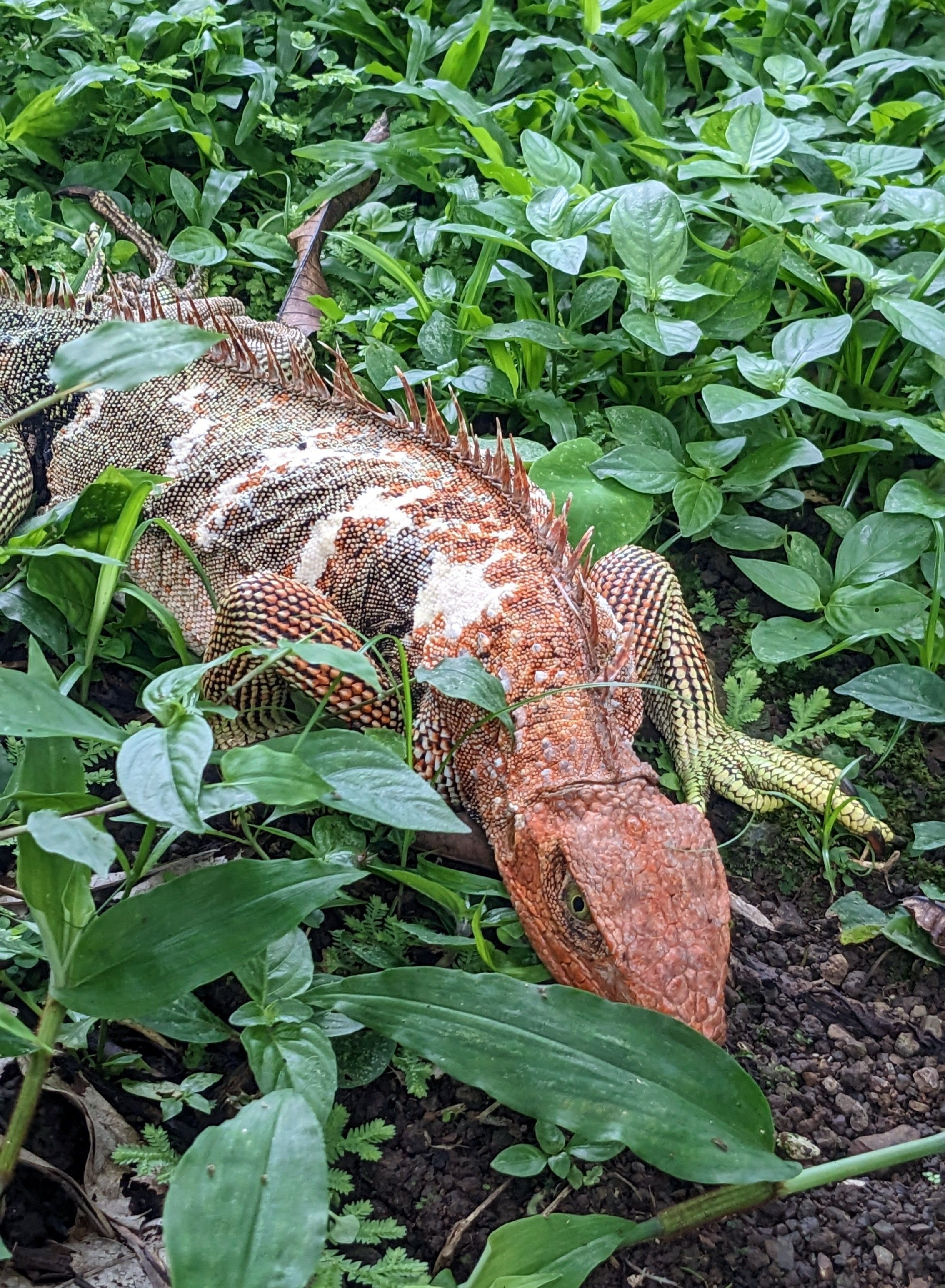
Spiny-tailed Iguana are not uncommon, and are most noticeable when they fall out of trees onto roofs, producing a massive crash. A very tragic spectacle to behold, but, being ancient reptiles very well adapted to the hardships of life, they are usually fine. Also regularly seen crossing roads or lazing in tree branches. They can grow to over a meter in length. Spines run down their back from head to tail.
Birds (Flap flap, flap!)
Again, far too large a topic to cover in depth! Just a few favorites and common sightings here. Costa Rica, and our area around La Cangreja National Park in particular, are amazing places for birdwatching and I will not be able to do justice to the hundreds of species we are neighbors with here. In recent bird counts here in the park they have identified over 300 different birds!
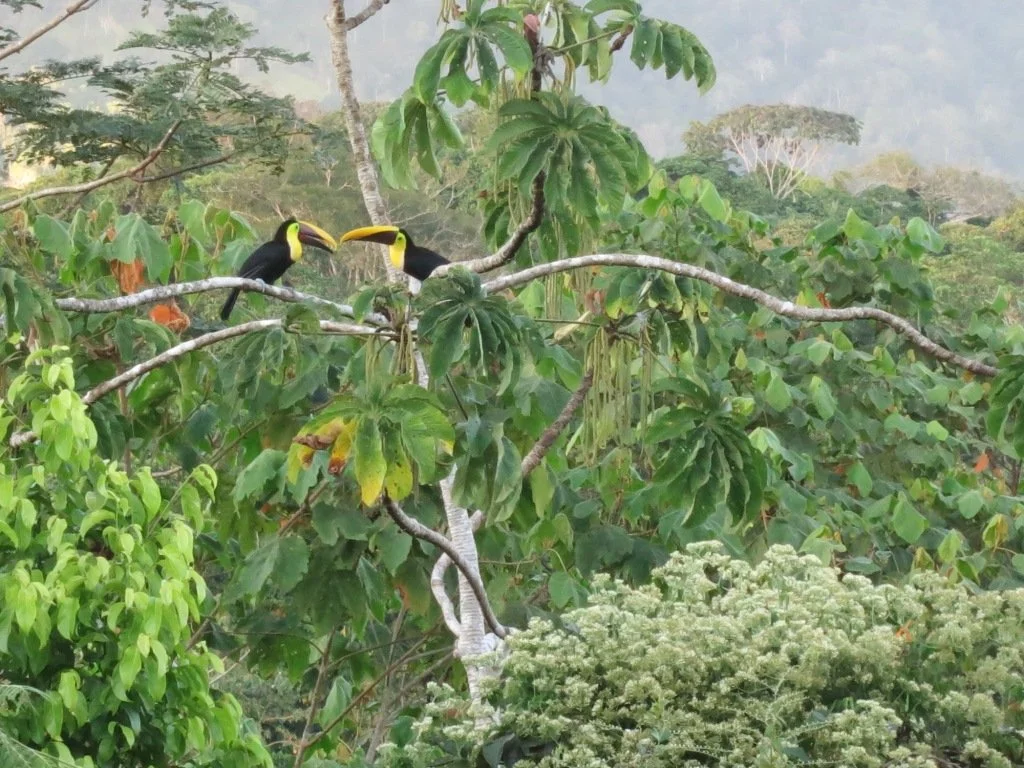
1 - Toucan
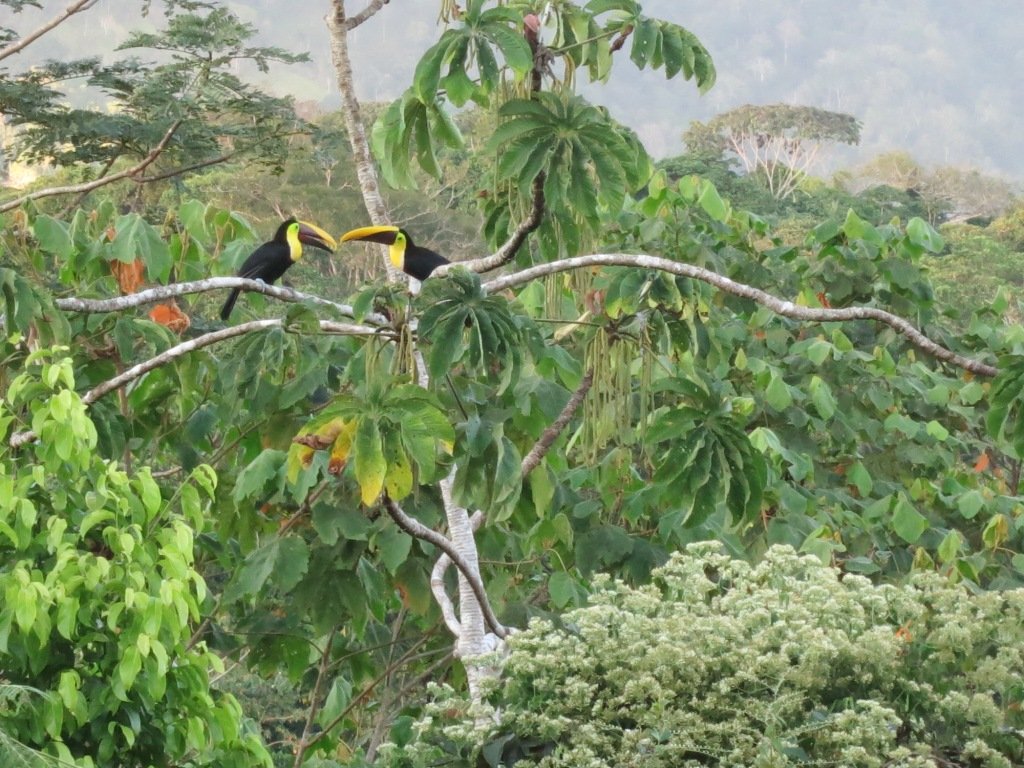
There are several different types of toucans that live in and move through Mastatal, but the most common is the Chestnut-mandibled Toucan (Ramphastos swainsonii). They are kind of bullies, and will take advantage of squirrels and eggs and other slightly saddening sources of food regularly. Beautiful, though!
2- Scarlet Macaw (Ara macao)
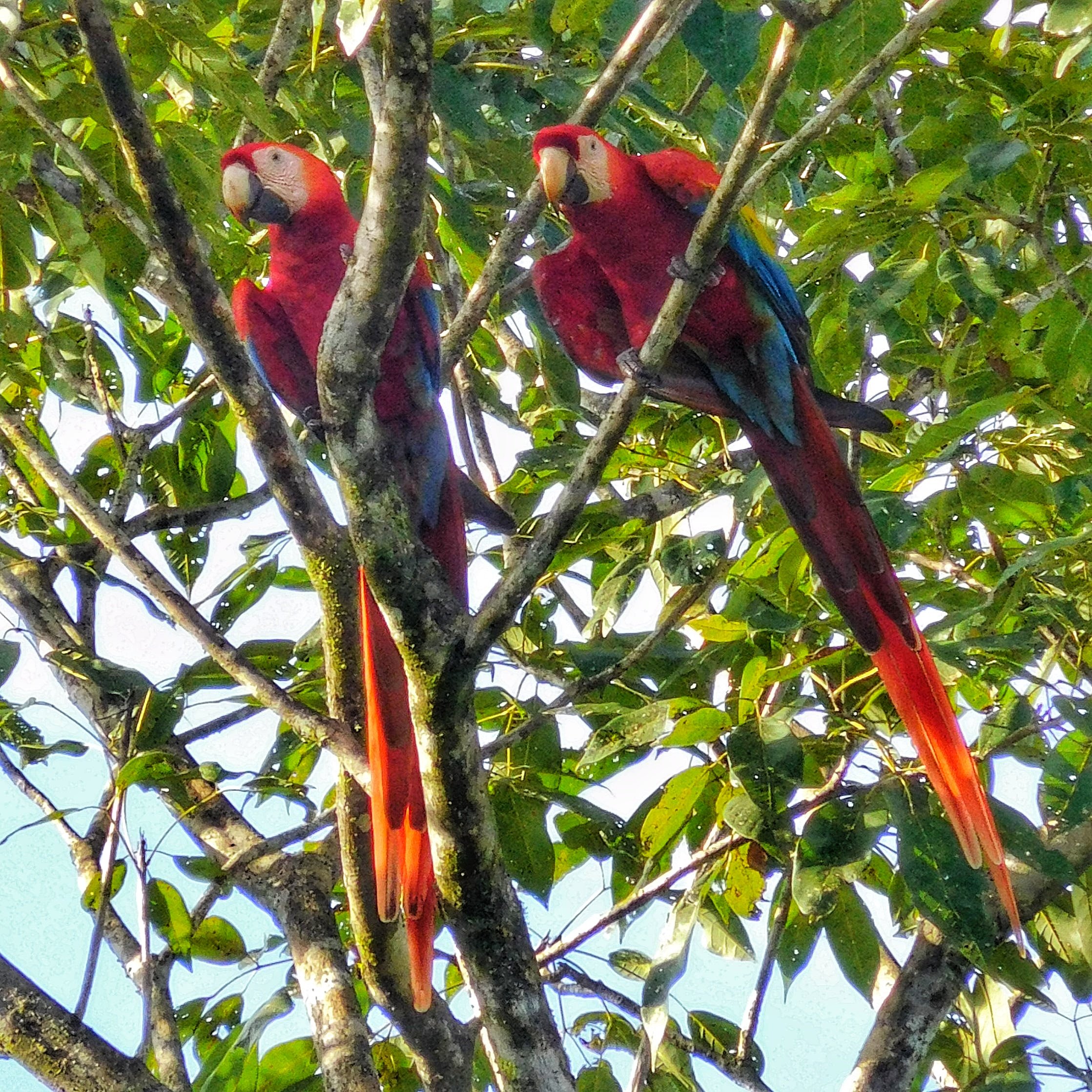
Macaws are incredibly beautiful to behold and make a squawk like an animal in a great deal of pain. They travel daily from the mountains to the coast (and then back), so we often see them flying overhead towards the west. They mate for life, so you always see them travelling in pairs, which is precious.
3 - Turkey vultures (Cathartes aura)
One I'm familiar with from my home region, and was very happy to encounter here. Not the most enchantingly beautiful creatures on the planet, but they have some of the best souls. Incredible composters and digesters, they feed on carrion and do a fantastic job of cleaning up the forest. Their stomach acid is strong enough to kill almost all harmful viruses and pathogens that they ingest. I wonder if they have tasted ripe fruit before, and if they've enjoyed it. I hope so.
Mammals (Fuzzy, hairy, tails sometimes)
1 - Squirrels (Sciurus variegatoides)
Squirrels, while lovely and precious, are relatively mundane. Although less common here than they are in my native Appalachia, they perform about the same role. Not a ton of wow factor, but still a valued sighting. Our most common variety here is the Variegated Squirrel which vary in color and pattern very greatly.
2- Agouti - Dasyprocta punctata
Agoutis are rodents that look very similar to capybaras in build. The only difference is that they are tiny :) They spend lots of time in our orchard spaces under fruiting trees, and around our banana-compost circle near the main house. They will steal (forage is a fairer word, there's no hard feelings) bananas and peels to snack on and then rush back into the woods. Our cat Chester, pictured above, is not fond of them in the slightest.
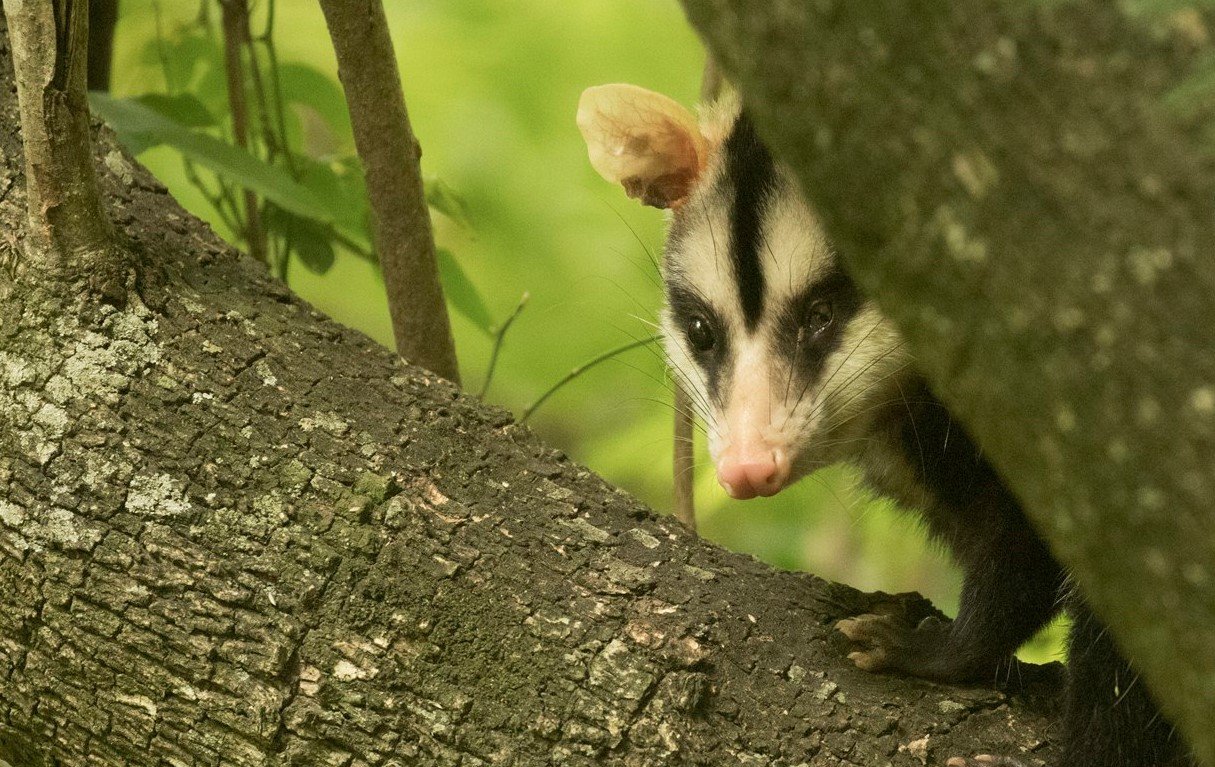
3 - Opossum - Didelphis marsupialis
Similar interactions here as the interactions I've had in Appalachia. They are usually encountered wandering guiltily in the dead of the night, freezing when found. We saw one, absolutely mortified, in the middle of the day in a Mulberry tree not too long ago. I adore them, and hope they get their fill of berries and fruits. The jungle is a hard place for a lil opossum.
4 - Pizote, or Coati - Nasua narica
Coati resemble raccoons with longer tails and precious long little noses. They are climbers, and regularly fight our harvesters for the best in-season fruits. They have very good taste, unfortunately, and will take the best of the best of our rarer fruits. Guard your zapote well.
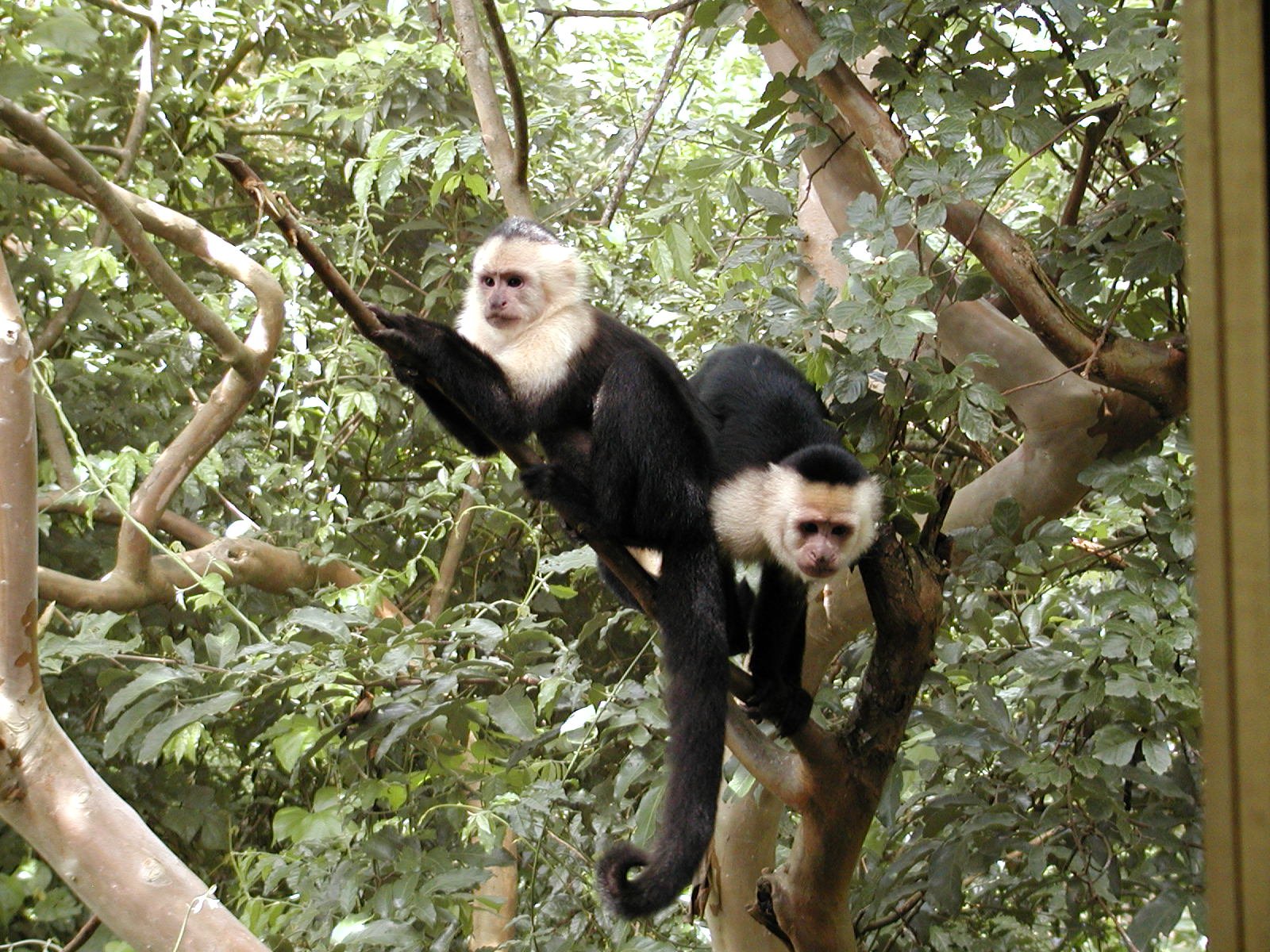
5 - Caro blanco, or Capuchin
Capuchins are the most well-represented type of monkey in pop culture. They live in large family groups led by alpha males, and spend the vast majority of their time in the canopy of more forested areas. Groups will range in size from the single digits to upwards of 30. In about six months here I have seen two groups passing through the jungle around our river trail.
6 - Puma
I have not seen this beast myself yet, maybe for the best. A couple here this year had an encounter with a mature puma while on their way down to the river, with a neighborhood dog accompanying them; as recanted to me, it seems like the encounter could have gone very badly for the dog, but all escaped unharmed. No photo for this one, because I am not a tracker and wouldn't be brave enough to wait for a picture if I saw one.
Creepy Crawlies (or creepy flyers. Sometimes not creepy)
1 - Ants
Mundane, but they demand mentioning. They are our most numerous neighbors, and vary in type widely. "Sugar ants" are harmless and numerous, mostly found in and around our kitchens taking advantage of anything left unattended for a few sparing moments. Fire ants are very common in our garden spaces and are your punishment for weeding in one spot for too long. Army ants act as a single massive organism, living nomadically and weeding out other bugs from their areas of interest ruthlessly. Incredible to behold in action. Finally, cuiscanas, (SPELL CHECK) or "devil ants" are small, red, slow ants that live in garden and orchard spaces. They don't bite, but secrete an acid as they wander on your bod which burns and stings for longer than preferred. Spraying alcohol on the affected area helps, but not enough.
2 - Horsefly
With the rainy season come the tabanos, horrible flying creatures which are much more aggressive here than I've experienced them being in the southern States. They hunt you and bite hard. They range in size from about housefly size to about the size of a quarter. Particularly horrible to experience while playing field sports, and while showering. No photo, primarily because I do not think they deserve it, secondarily because they pretty much just look like normal flies.
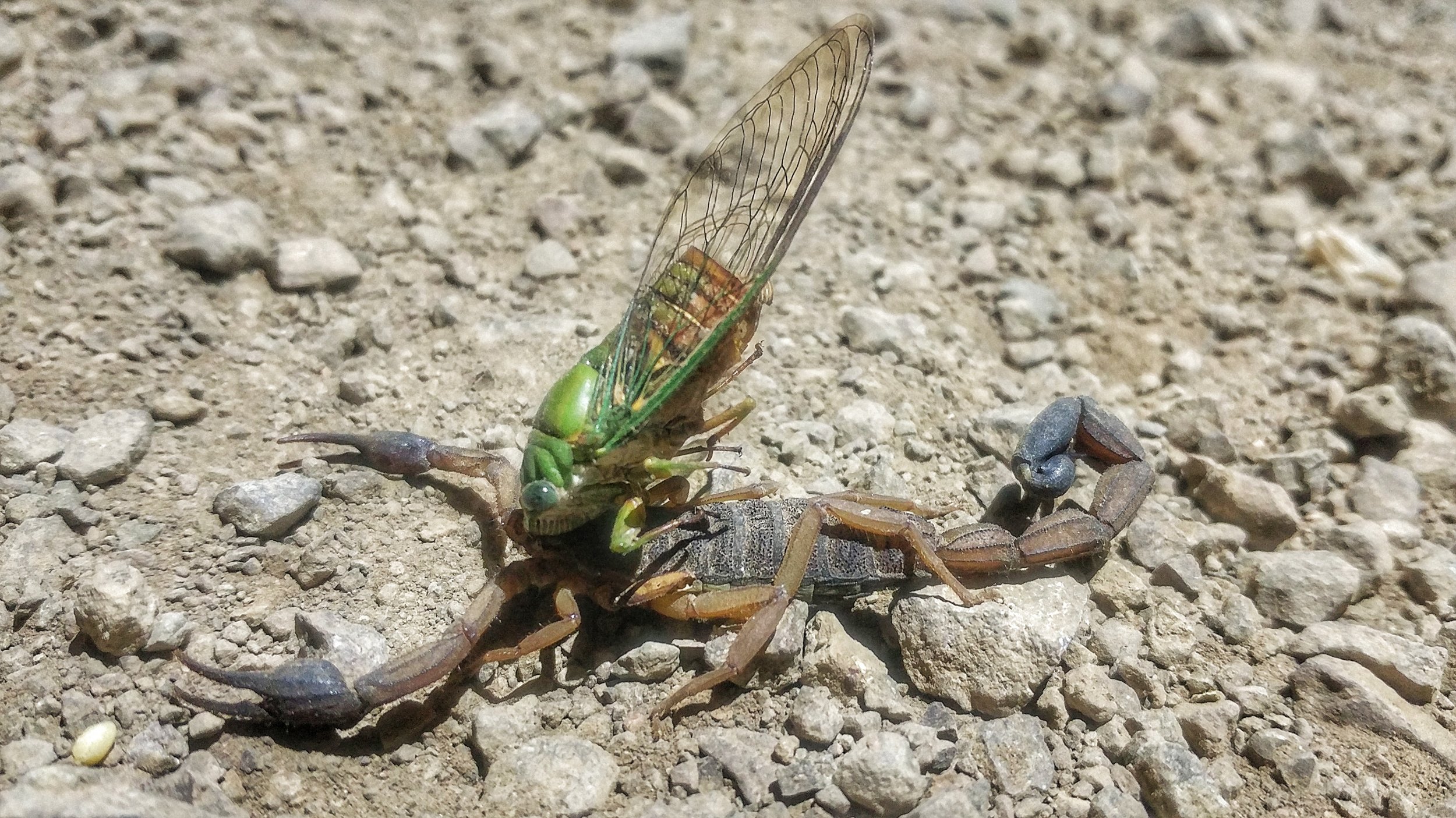
3 - Scorpions - Centruroides limbatus
Certainly creepy, certainly crawly. Our most common here is the Bark Scorpion, which can grow to be upwards of about 10 centimeters. Thankfully there are no varieties which will harm you much more than a stinging bee, though in other places in the world they can be much more dangerous. Check your boots, and pillowcases :)
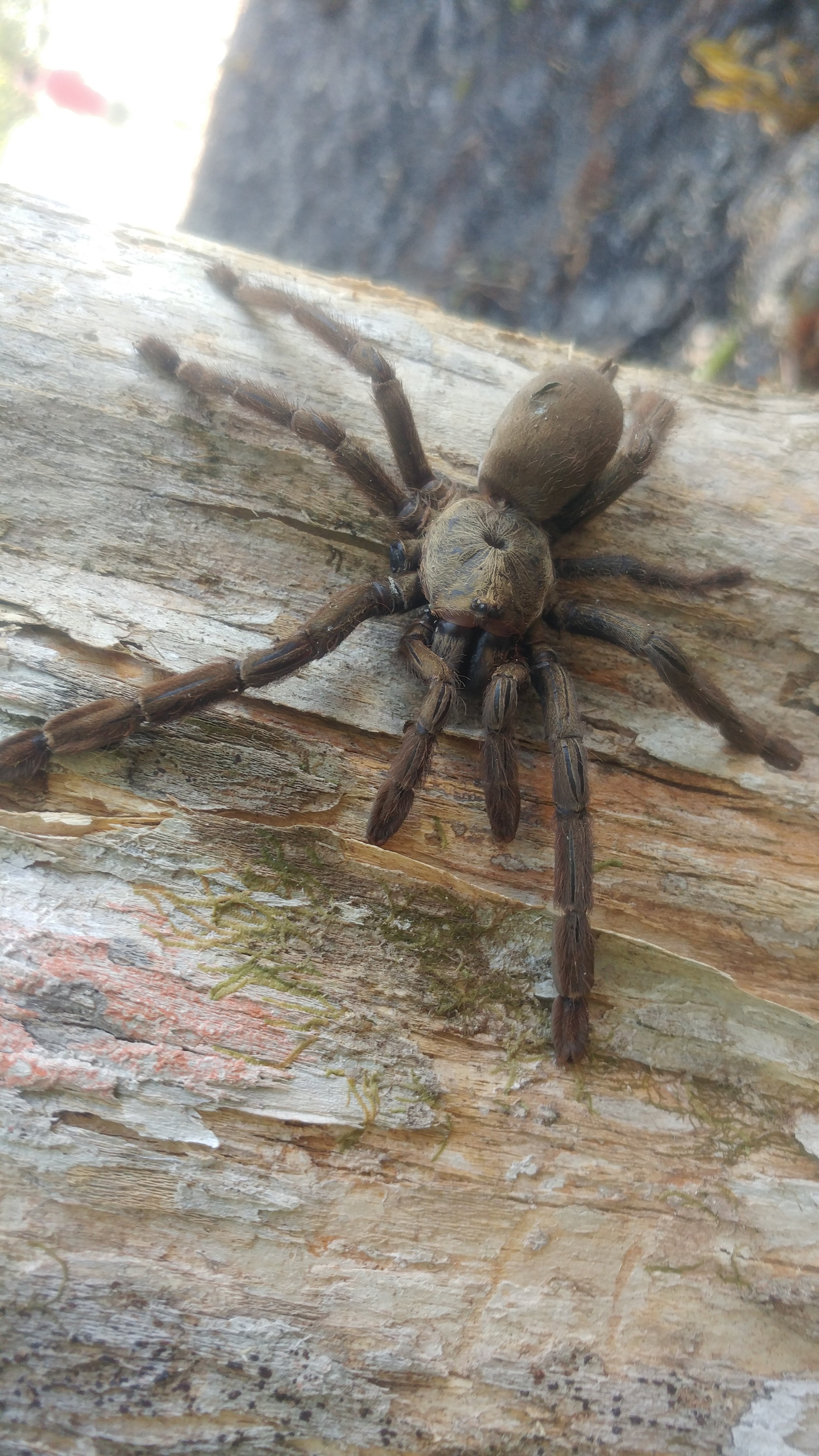
4 - Tarantula
Honorable mention, shamefully with no photograph, because I got to see a baby in a firewood bucket. I'm unsure of how common they are, having only seen one once so far. Consequently I'm also not too loaded with tarantula facts. They are many-legged and hairy, and I've heard they can shoot their spines off their legs! Not sure if that's a myth or fact. Definitely sounds believeable.
5 - Blue Morpho - Morpho helenor (and other beautiful flyers)
Blue Morpho butterflys are very well known by Central American travellers. Their bright color is astounding and their manner of flying very interesting. They bob through the air with long, slow, heavy beats of their wings, rising and falling huge distances between flaps in a mezmerizing way. They are deceptively quick, however, and are excellent at avoiding photographs which display their in-person vibrance.

Rancho Mastatal - A Paradigm Shifter
To be able to initiate changes that may someday become radically transformative it needs places starting with small, reformist changes. Rancho Mastatal has proven itself over more than 20 years to be one of those places.
Rancho Mastatal - A Paradigm Shifter
By 2023 Apprentice, Sebastian Wittwer
The current paradigm
PROGRESS, DEVELOPMENT, FREE TRADE. The western world runs on an inexplorable logic, replacing people with machines, creating local interdependences with global markets and excluding ancient knowledge preserved by native tribes. With an ultimate sense of righteousness, this industrial model is being spread around the globe, reducing the worlds diversity to a monoculture in a literal sense. This monoculture is only possible since freedom based on individualism is pushed as one of the “culture’s” main achievements. This freedom means also freedom from traditional community values which can lead to a loss of all sense of importance. Consumerism doesn’t express freedom, but slavery to purely material values. Everyone living in the same kind of buildings, wearing the same kind of clothes, working for the same reasons is not individuality but rather the homogenization of all people. True individuality depends on community. We have been taught to live in a culture of alienation, separation, and blocked initiatives rather than in practices of commitment. Freedom from responsibility for others is equally a loss of assurance that others are ready to be supportive of. To be able to obtain a rich diversity in culture around the globe and on the search for a renewed sense of community, it seems necessary to develop concepts of self that are very different from that with which we have been indoctrinated. Therefore we have to rethink the way we want to live in the modern world.
The significance of rooted teachers

Emme (Apprentice 2023) leading the daily meeting – the communal way of communication
Rancho Mastatal is living and teaching prime examples of what it actually means to loosen up these seemingly “set in stone” structures by returning to a communal oriented life.
Against sacrificing local production, local economic stability and communal security to transient efficiencies and the quick profits of distant businessmen/women through electronic communication and teaching, Rancho Mastatal provides educators willing to live where they work and to work where they live. A class of educators that cultivate a sense of place and that is therefore able to distinguish between local and universal, particular and general, concrete and abstract. Not only does this push their educational standard over most western universities’, it also helps building a strong local community by including native tribes and their knowledge, by creating local wealth and social security, and by emphasizing real and honest relationships towards everyone around.

Core team member Ali, hands on teaching clay plastering – one of the many skills she owns and can give instant feedback on
The importance of building onto the local economy
Through an orientation of their agriculture towards local needs, local possibilities, and local limits, Rancho Mastatal also supports the health of the land, the people, and their democratic liberties.
By switching their priority from the global to the local economy, they reduce the outflow of capital to distant corporations and capital then circulates within the local economy. Instead of trying to live as self-sufficient as possible, a sense of relying on their community has proven itself as the way to be. Instead of isolation, incorporation of the local community has proven itself as more community friendly, more efficient and a more sustainable way to be. This expresses itself especially through the food they eat (mostly locally grown rice, beans, eggs, veggies like yuca and malanga), which goes against the culture of food from where the majority of the core team comes from.

Typical brunch meal: Gallo Pinto, fried eggs, malanga patties, leftover frittata, fruit, salad, kimchi, salad dressing – mostly locally sourced, in parts even self-grown
By building this local food economy (which is at this point as much local as possible, though not free of regional, national and international products), one might even call it a local foodshed as they add a lot of value to the community. First it overall improves the quality of the food itself. Second they increase consumer influence over production which makes each and every consumer a participatory member in their own food economy and helps to ensure a sustainable dependable supply of food at the same time. Farming practices are immensely improved and last but not least the costs associated with long supply chains (locking at packaging, transportation and advertising) are reduced, reducing the cost of food in general while increasing income to local growers, creating a positive feedback loop within their community.
A constant moral compass
Through their degree of popularity, Rancho Mastatal could totally start emphasizing monetary profits and capitalize of the place a lot more, which would most probably induce a decrease in their ability to stick to the permaculture ethics (people care, earth care, fair share, transition). Against this common western path, this place and its people stay true to their moral compass even though they wouldn’t have to. Instead of going ever bigger and bigger while trying to maximize profits, they are using their resources to give back to their community in any and every way possible.
Courses held in Spanish that only cover the costs during its time or simply sending people over to the local soda to get extra/different food are minor examples of what is described above as measures of their established paradigm against the monocultural life of the west.
To be able to initiate changes that may someday become radically transformative it needs places starting with small, reformist changes. Rancho Mastatal has proven itself over more than 20 years to be one of those places.

Locally produced chocolate by La Iguana Chocolate sold by Juan Luis - Good business during the dry season with all the guests, course attendees and friends visiting the Ranch and therefore one way of bringing more capital into the community as a whole

The Ecstasy of Cheese: A Meditation on Our Conceptions of Value
After only a few months living at the Ranch, I have observed my experience of eating good cheese transform from mundane to something approaching ecstasy. This has lead me to reflect on our personal and collective conceptions of value.
The Ecstasy of Cheese: A Meditation on Our Conceptions of Value
By 2023 apprentice, Sedona Lewis
One evening the apprentices were enjoying dinner when Sam, a core team member, approached us with a gift. From our reaction, a bystander might have assumed he unveiled something approximating a winning lottery ticket. However our hoots and hollars were in response to, simply, cheese.
After only a few months living at the Ranch, I have observed my experience of eating good cheese transform from mundane to something approaching ecstasy. This has lead me to reflect on our personal and collective conceptions of value.
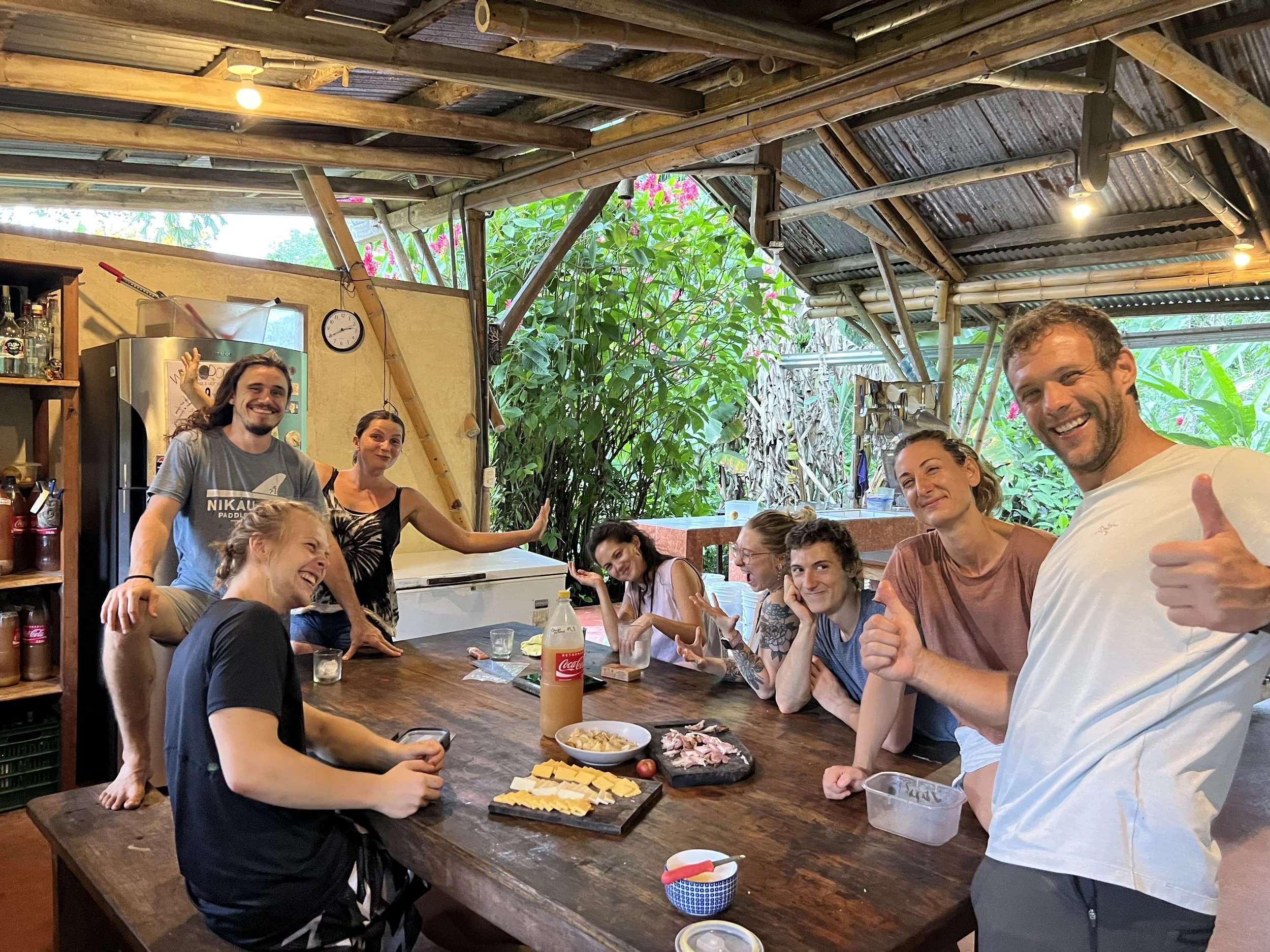
Apprentices excited about cheese!
A Permaculture Diet
As a society we have grown accustomed to waltzing into a grocery store and purchasing virtually any vegetable, fruit, grain, nut, or seed we desire. Globalization has artificially eliminated scarcity and seasonality from our lives; we are living in an age of unprecedented abundance.

Seasonal fruits off the farm
In Mastatal, there is no grocery store. Aside from the local bar and the Soda, a small restaurant, the closest store is forty minutes by car. Despite our isolation, the Ranch is a place of remarkable abundance. However different from the globalized, western sort of 'abundance' referenced earlier.
We are lucky to operate in a part of the world which provides a prolific variety of edible and otherwise useful plants. Things we can't produce ourselves are mostly purchased from our neighbors, such as milk, eggs, and pork. Nearly all other vegetables, fruits, and other food items sourced regionally. Thanks to the hard work of our meal coordinators (mostly Robin), over 80% of the calories we consume are sourced within fifty miles of the Ranch.
We maintain a sense of place within our diets; during meal times we are engaging with our surroundings. No longer are we enjoying cheese from France, salami from Italy, and wine from Spain in the same meal. We're embracing the here through our food.
In keeping with the ethics of Permaculture, this means we are dependent on and invested in the health of our local and regional communities. The variation in our meals comes with the seasons, and our health is linked to that of our environment. I have observed that this way of interacting with food has changed the way I think about, and value, my food.

Sedona with her morning harvest of salad greens
Our Conceptions of Value
Olive oil, butter, cheese, meat, bread, and nuts are examples of foods that many of us used to consume almost daily. Delicious, yes, but not extraordinary, and only worth what the price tag says at the store. Now, several months into the apprenticeship, items like these have become precious.
During my days splitting bamboo, sifting clay, and working in the orchards, I've had the opportunity to ponder the following questions. I invite you to consider them for yourself before reading my list of ideas.
What makes something valuable?
Perhaps...
An item's relative availability
The effort required to acquire the item
The relative necessity (a bowl of rice when you've just eaten a meal and a bowl of rice when you haven't eaten for 2 days may as well be two completely different items)
Personal preferences/tastes
The collective value structure and social narrative associated with that item
The experiential and monetary value of a food item can be somewhat arbitrary...
Of course it's important to note and remember that our species evolved under conditions in which sufficient nutrition was not the norm. It makes sense why nutrient dense foods such as cheese, meat, and honey were and are sought after and treasured.
But still, we invest a lot of resources shipping things like salad greens, spices, and liquors around the world. Is the Italian wine really that much better? Couldn't the same caloric and satisfactory needs be met with items produced regionally? It seems that there is something deeper influencing our values surrounding food.
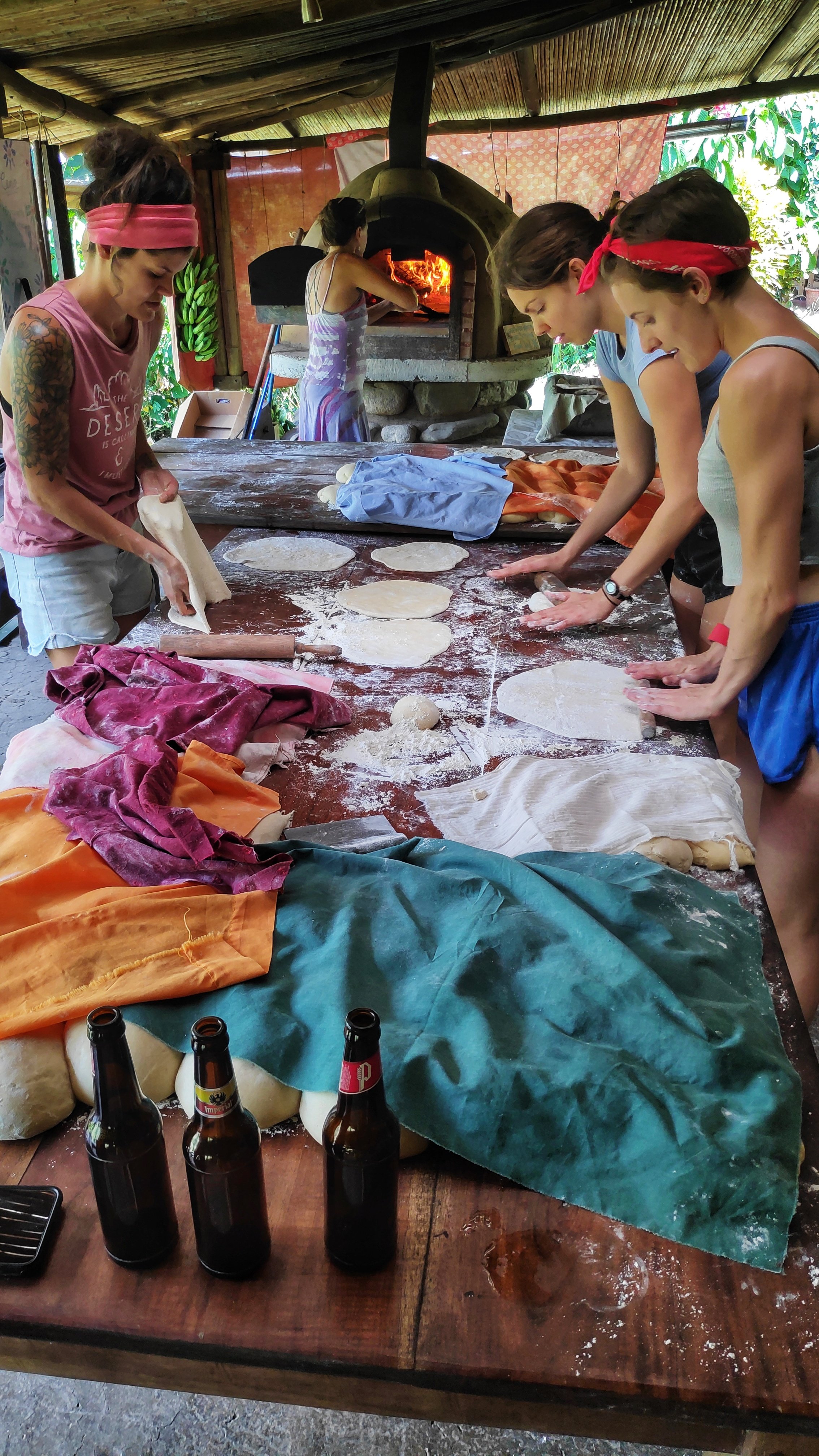
Our special occasion pizza party
what do we gain by attaching arbitrary value to specific foods?
Special foods provide a sense of occasion and celebration
These occasions provide a sense of anticipation, which alters our experience
Special foods, and the events formed around them, provide space for community to be built
As food is a human universal, sharing food is a way to bridge and build relationships
A Note on Sharing
One might assume that precious food items at the Ranch would be hoarded; kept in decoy packaging in the back of the refrigerator with the intention of maximal solitary indulgence. However, as we have adjusted to our new environment, I have observed something entirely different. The reflexive action when in possession of said precious items has been radical generosity. Perhaps it is because a precedent of sharing and reciprocity has been set for us by the culture here at the Ranch. However, it genuinely seems like reveling in the remarkable depth of blue cheese is just more enjoyable when done in the company of others.

Enjoying sharing some treats with the community
The utility of sharing is easy to see when living in community. When taken out of the individualist paradigm operating in most of the western world, reciprocity is an undeniably advantageous practice. Given the unpredictable nature of life, I wouldn't be surprised if appropriate generosity has been selected for throughout our evolutionary history. No doubt those who refuse to share with their community when needed would feel the consequences of their actions later on.
Looking Ahead
So, I invite you to consider how living in this age of convenience and instant gratification affects your sense of value.
How might your experience of peaches change if you only ate them when they were in season? What could be gained by manufacturing a bit of scarcity, creating some anticipation, in your life? How can you apply these principles, rooted in Permaculture, to repair your communities and regenerate our natural environment?
Just food for thought - because now we only have cake on birthdays, and I think it tastes sweeter.
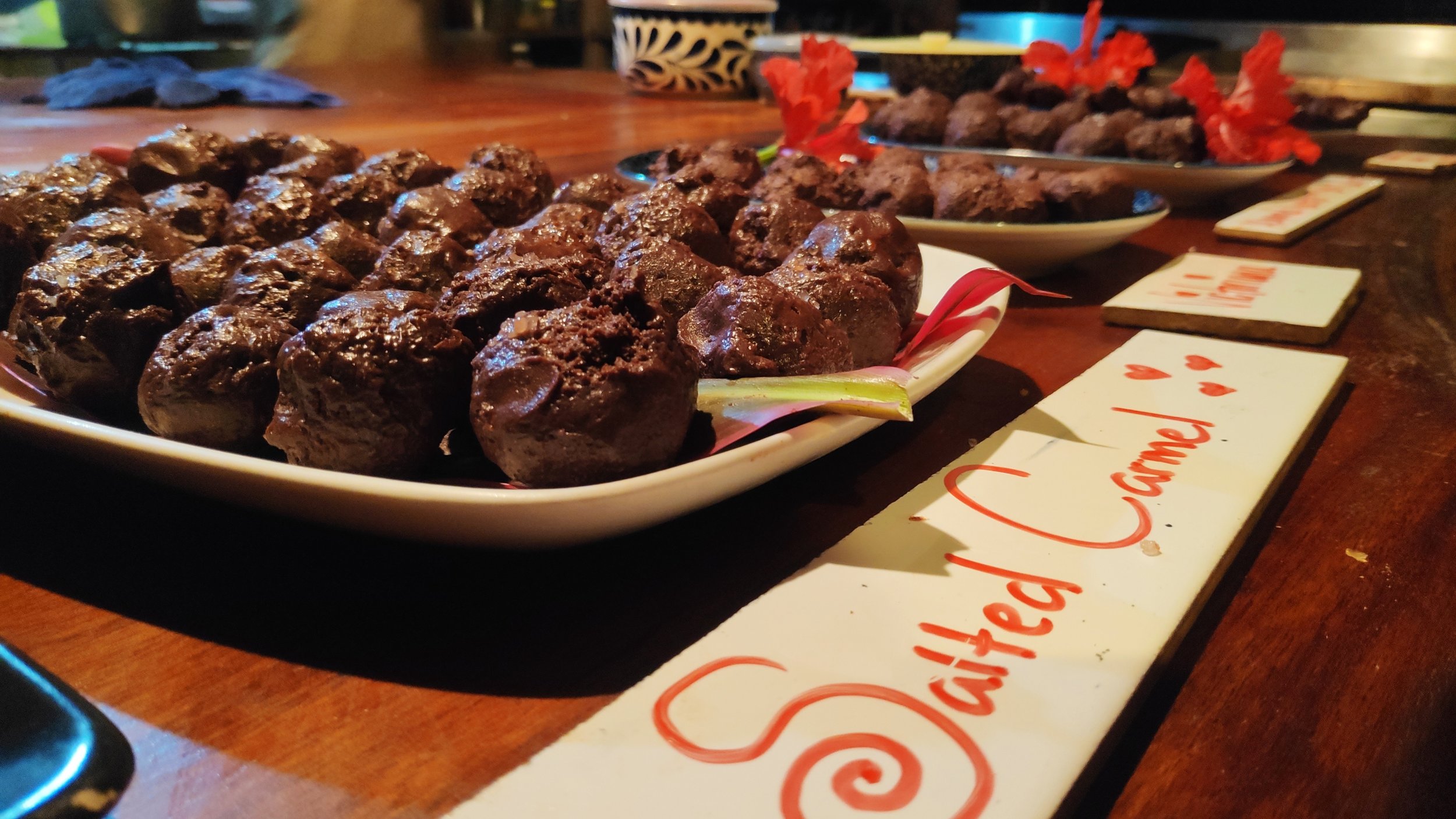
Chocolate bon bons, made from locally grown cacao

Wealth Exists Not in Having Great Possessions, But in Having Few Wants
There’s no escaping from the fact that we are in the midst of a social, economic, physical and mental health crisis. We have been waking up to this fact at an increasing pace and the majority of people can see that a change is essential if we don’t want to enter another mass extinction of our own doing.
Wealth Exists Not in Having Great Possessions, But in Having Few Wants
By 2023 apprentice, Grant Munro
There’s no escaping from the fact that we are in the midst of a social, economic, physical and mental health crisis. We have been waking up to this fact at an increasing pace and the majority of people can see that a change is essential if we don’t want to enter another mass extinction of our own doing. The abundance of information out there can be confusing and can leave us feeling stuck in the mud, unsure of where to direct our efforts. Additionally, the typical modern lifestyle leaves most of us feeling far removed from the essence of what it is to be human. I can imagine that I’m not the only one who has felt overwhelmed, not knowing which way to turn to make an impact. Studying permaculture over the last 3 months at the Ranch has shown me the potential that the principles of permaculture have to help us with these problems.

Having spent the last 14 years of study and practice as a chiropractor, I’ve come to understand and witness that, most times, what makes us healthy or sick comes down to the stories and concepts we hold about our health, the world and our place in it. We could call this our world view, or cosmology. We align our behaviours to what we have been taught by our family traditions, trauma, our now archaic colonial educational institutions and cultural narratives shaped by the media. These behaviours either lead us towards health or towards chronic stress and ultimately disease. An example would be that my Grandad had back pain, my Dad has back pain, I have back pain therefore I must have back pain because it’s genetic. There has never been a gene found for expressing simple low back pain, what’s been passed down is a concept. When we shift the story, we shift the expression.
The recipe for shifting towards the expression of health looks to be simple and repeatable for those who truly desire to and have a driving reason to get well. In practice I have found we must create a healing image based upon logical truth to move towards health, and not away from disease. For example, we can logically argue that the human being is designed to be healthy, not sick. When we remove interference/irritations, establish new, simple behaviours aligned to human values and commit over time, people start to transition and get well. Irritations include intrusive thoughts, residual traumas and accumulation of toxins. The body naturally expresses health when we address these alongside the addition of gentle exercise, proper breathing, daily time in nature, a strong connection to community and nourishing food and water. However, Big Pharma’s marketing experts will have you believe it’s way more complicated than that, ensuring they rack up huge profits year on year whilst somehow we get sicker and sicker.
It’s easy to see how this draws parallels to climate catastrophe. Big Ag and other Big Industry see Earth as a giant dead rock for sale, extracting resources at an alarming rate in the name of profit and wealth accumulation for the few. Their marketing campaigns, execs and the media do a great job of spinning why we should sacrifice our lives and happiness for their cause. The stories they tell us are woven in to our very way of being and the behaviours we are coerced in to are impacting how we view and impact Earth.
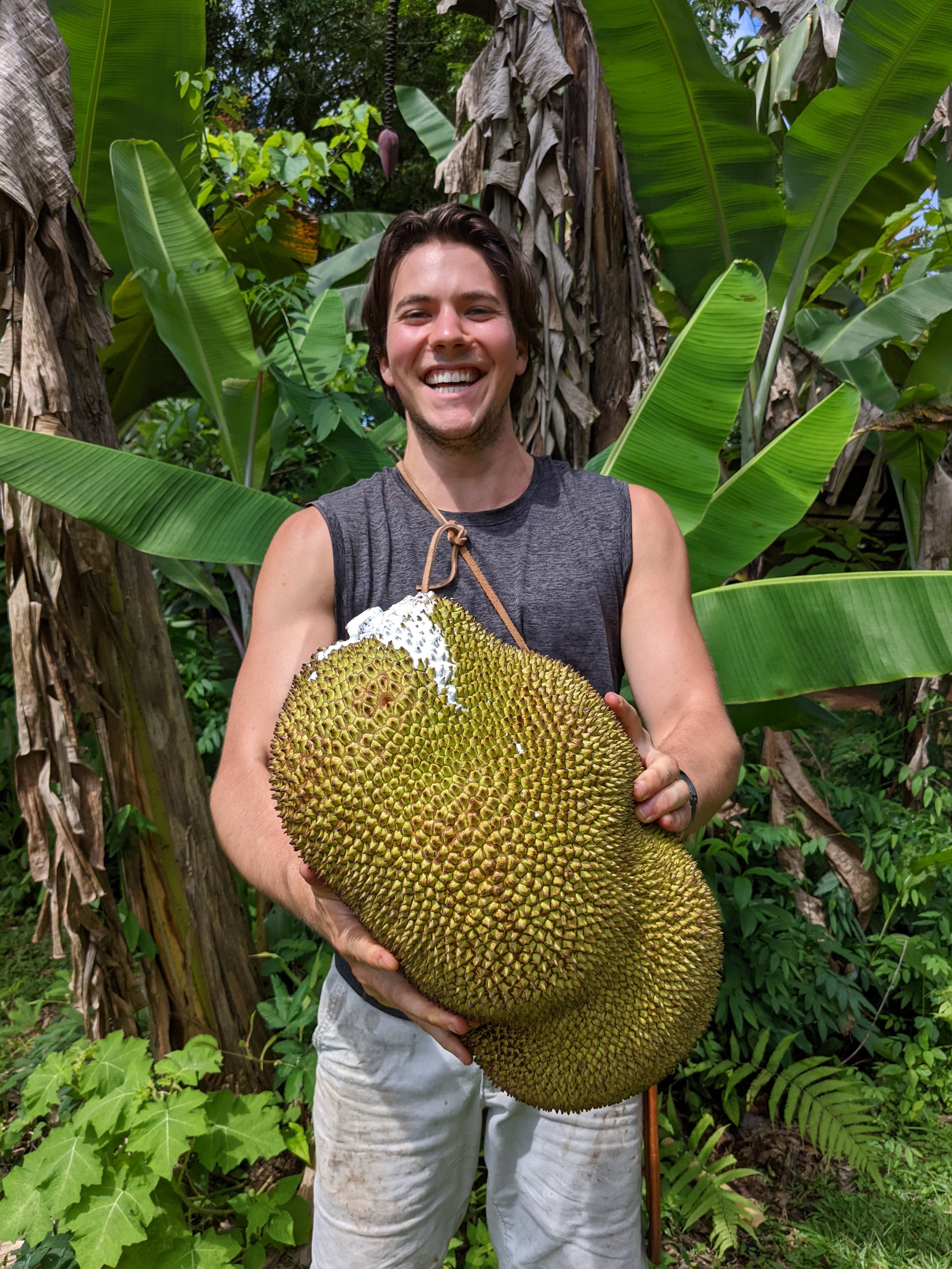
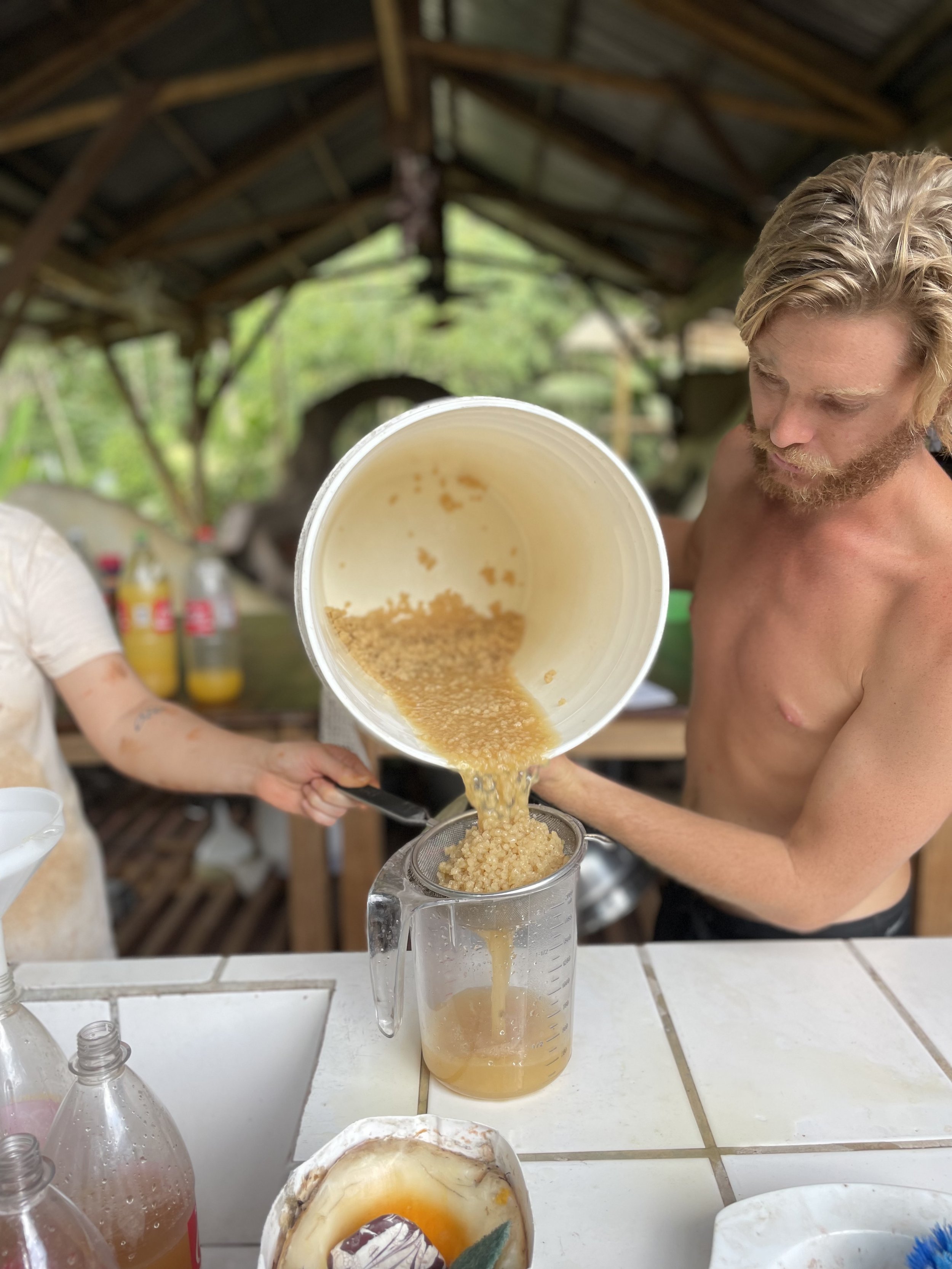
In his book, ‘Change the Story’ Change the Future’ David C. Korten goes in to more detail about our psychology and how we make purpose in our lives. He describes the current paradigm as The Sacred Money and Markets Story; essentially we sacrifice ourselves to serve the Money God who is never happy. We can flip that story to one that is more consistent with living heart-centred and to the traditional values and needs of humans. It’s an easy and thought-provoking read which I assure will create a shift in your confidence in making change.
We have the responsibility to educate ourselves in order to educate our children. If we don’t do it, Big Industry will continue to do so through our educational systems and the current story will continue. We have sleepwalked in to this mess and it is going to take intentionality, commitment and consistency to rewrite the potential of the future. The ethics of permaculture are Earth Care, People Care, Fair Share and Transition. The act of transitioning is where the movement for change starts to take place.
Transition takes time. No one can expect to go from sick to healthy in a day. And we can’t expect to shift the health of the planet in a day or even a year. But change happens with commitment to small and consistent repeated inputs. Just finding a way to shift our energy balance from extraction to regeneration can be as simple as taking a moment to find out where your coffee comes from and give thanks to the Earth and people who grew it – creating ritual rather than chugging it down. Or it can be as grand as selling everything you own and moving to a countryside and starting a farm/community/education centre.
The truth is that most of us are going to be somewhere in between. Commit to what’s just uncomfortable enough for it to be meaningful. A Permaculture Design Course is a great place to start.
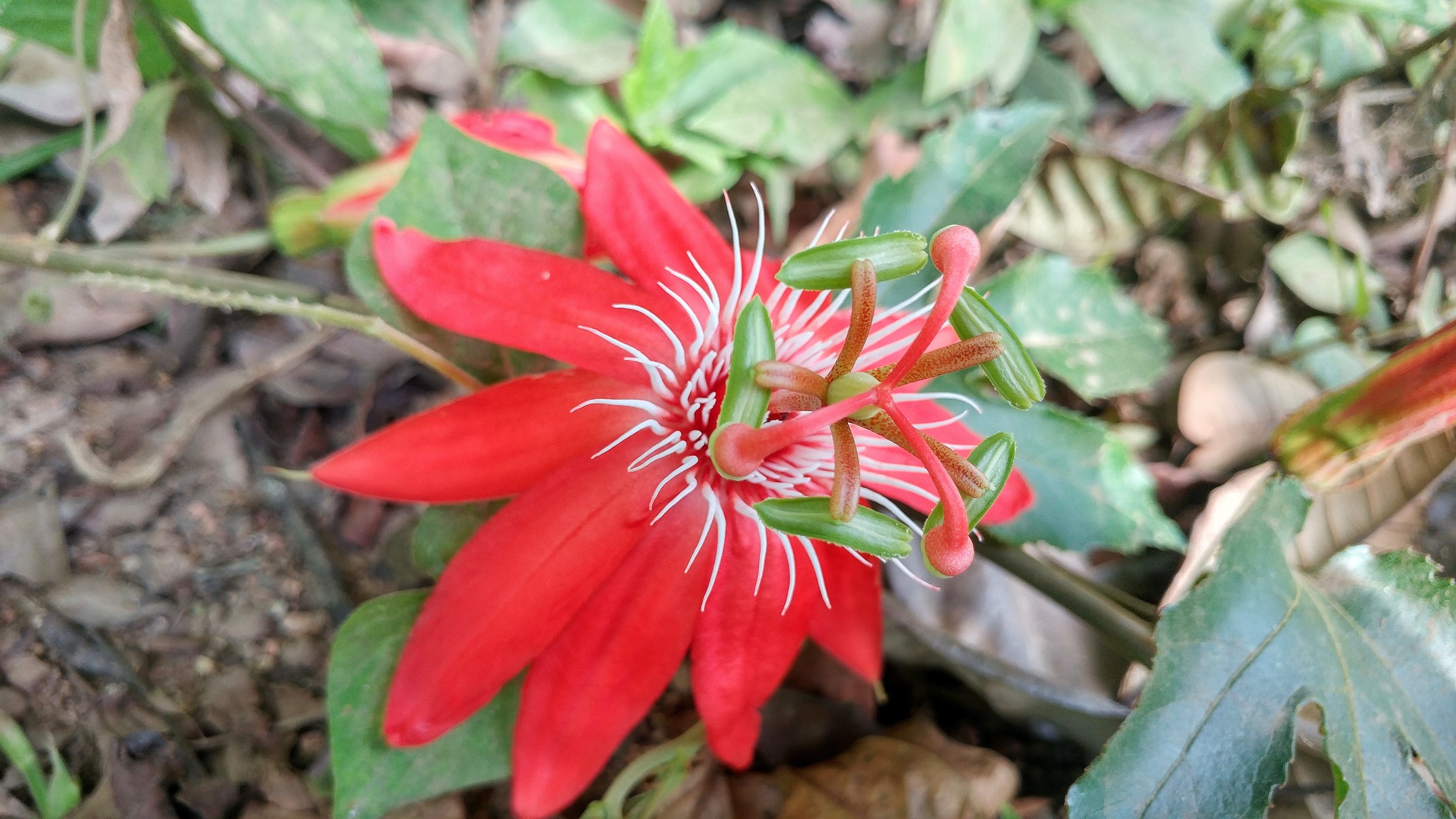
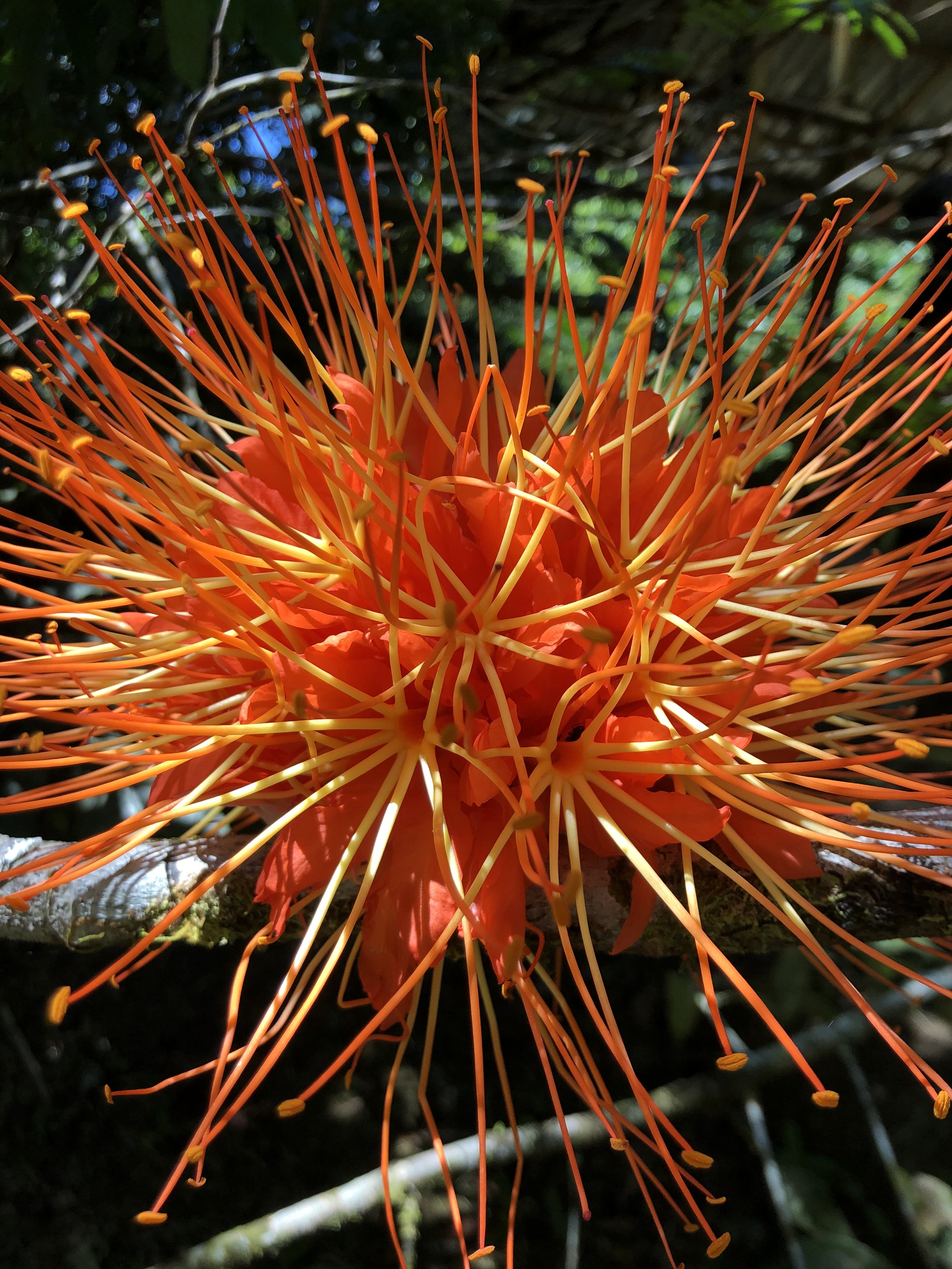
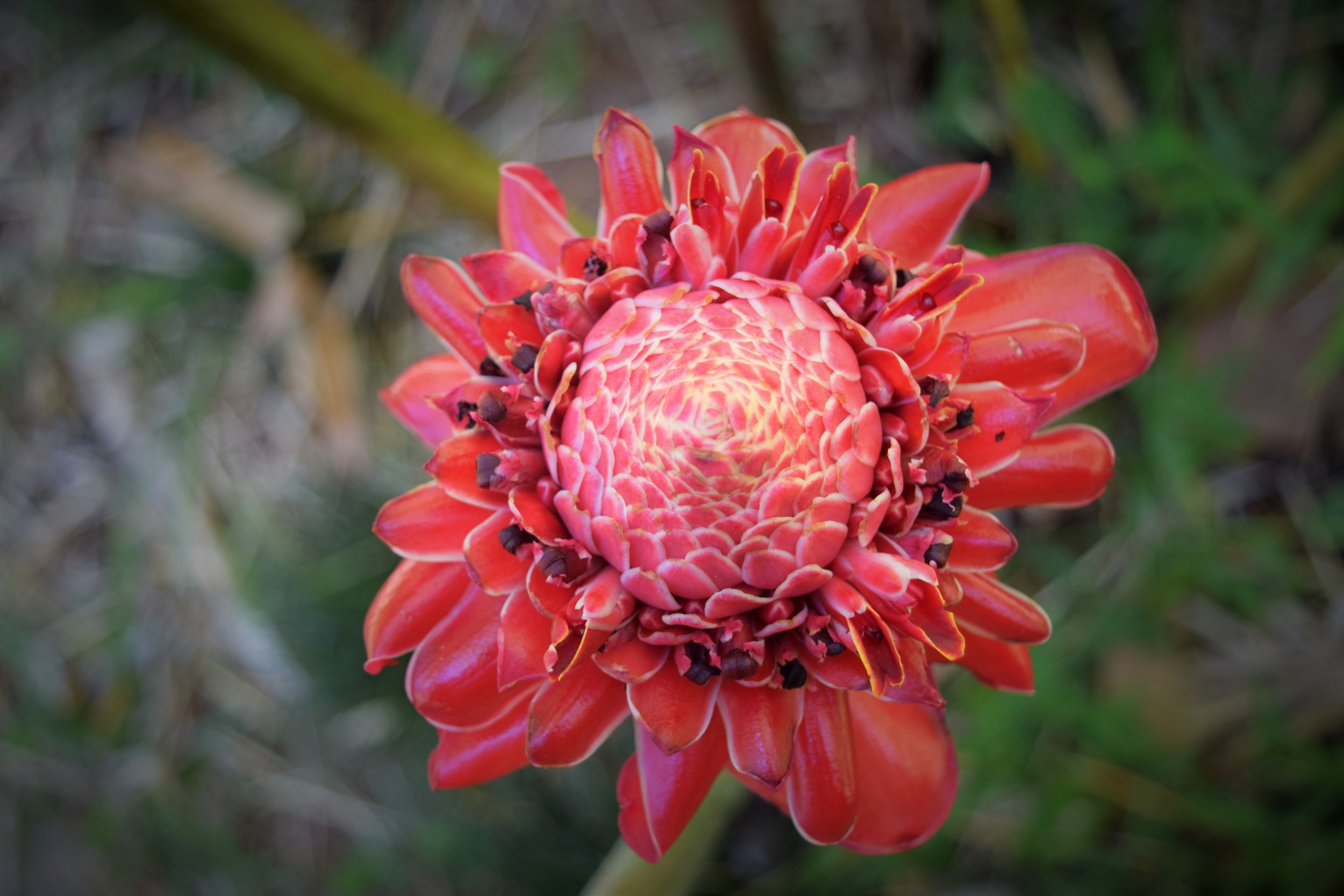

An Interwoven Life
As you pass through the gates at Rancho Mastatal, you step into another world. A place where perhaps the hands you hold at evening circle are the very ones who built the structure you'll sleep in that night.
An Interwoven Life
By 2023 apprentice Elya Justina Mech
As you pass through the gates at Rancho Mastatal, you step into another world. A place where perhaps the hands you hold at evening circle are the very ones who built the structure you'll sleep in that night. Where your salad greens come from the garden you walked through that morning with your coffee, and the cows down the road have not only given the kitchen milk to make dairy kefir, but manure to fuel the bio-digester cooking system. The connections here are endless; its permaculture life you can see and touch.
As apprentices we are learning the principles of permaculture - not just in the classroom but also in our morning community contribution skills, during meal prep, on our walks through the agroforestry system, and as we assist with the daily function of the Ranch's infrastructure.
Its easy to understand why this way of life makes so much sense. We can see our regenerative influence on the natural environment, and feel a deep satisfaction from knowing how the components of your day are interwoven.
And at the Ranch it's very clear to see that you are also nature, you belong here, and you can have a healing impact on the earth.
Here are some more examples of ways in which our daily life is interconnected:
Water Kefir or "Balm" that we enjoy at our meals is a probiotic-rich, fermented drink made from yeast, local raw cane sugar with a base of fruits, spices and herbs from our gardens and orchards.
Eggs from Dona Flor, a chicken farmer in Mastatal who provides us with a large supply of our daily protein. Our beautiful brunches feature frittata or scrambled eggs. We also make homemade mayonnaise and use the eggs in baking for special occaisions.
Composting toilets allow us to drastically reduce our water consumption compared to conventional toilets. They also create nutrient-rich humanure to be used in our orchard spaces.
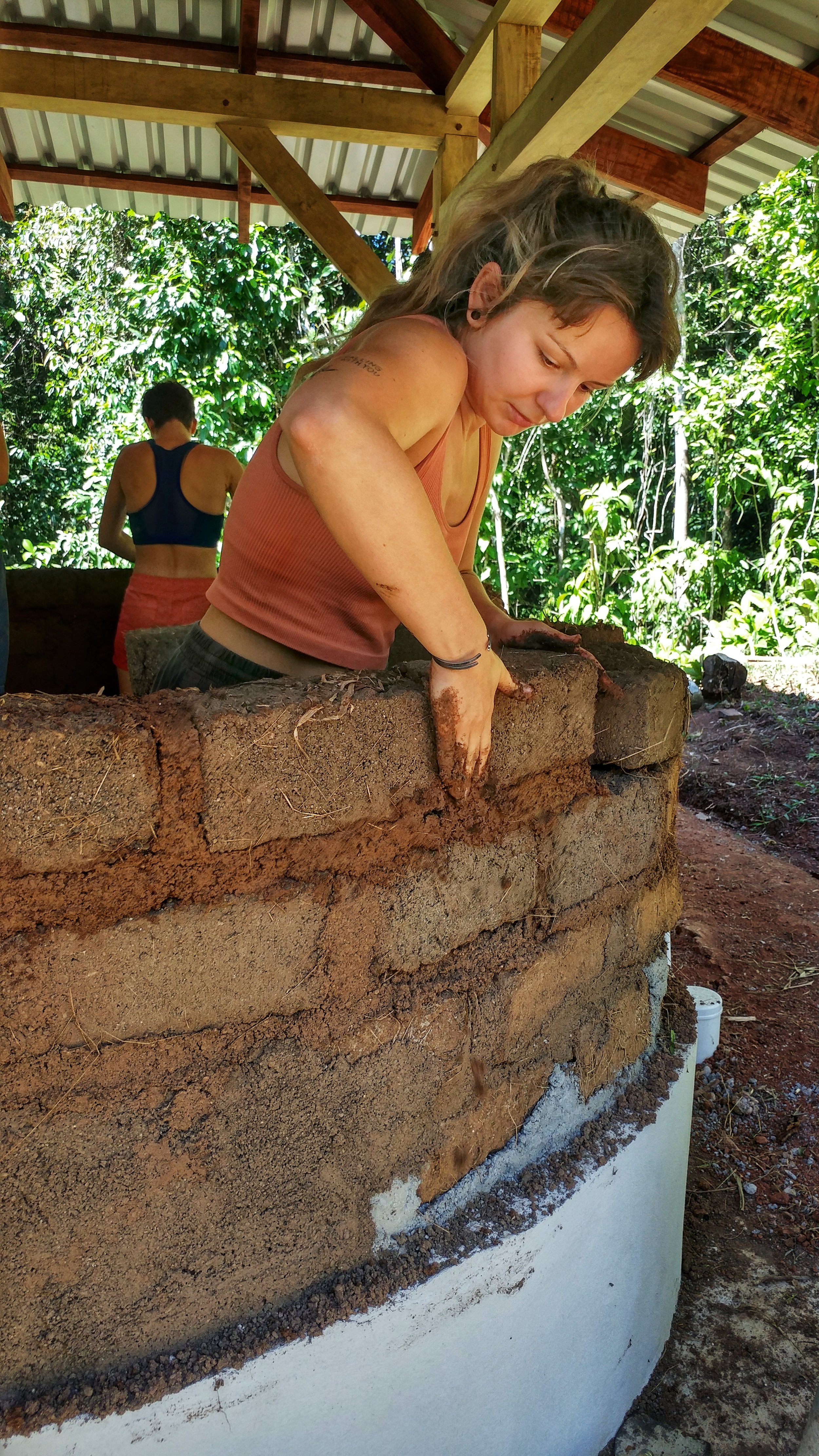
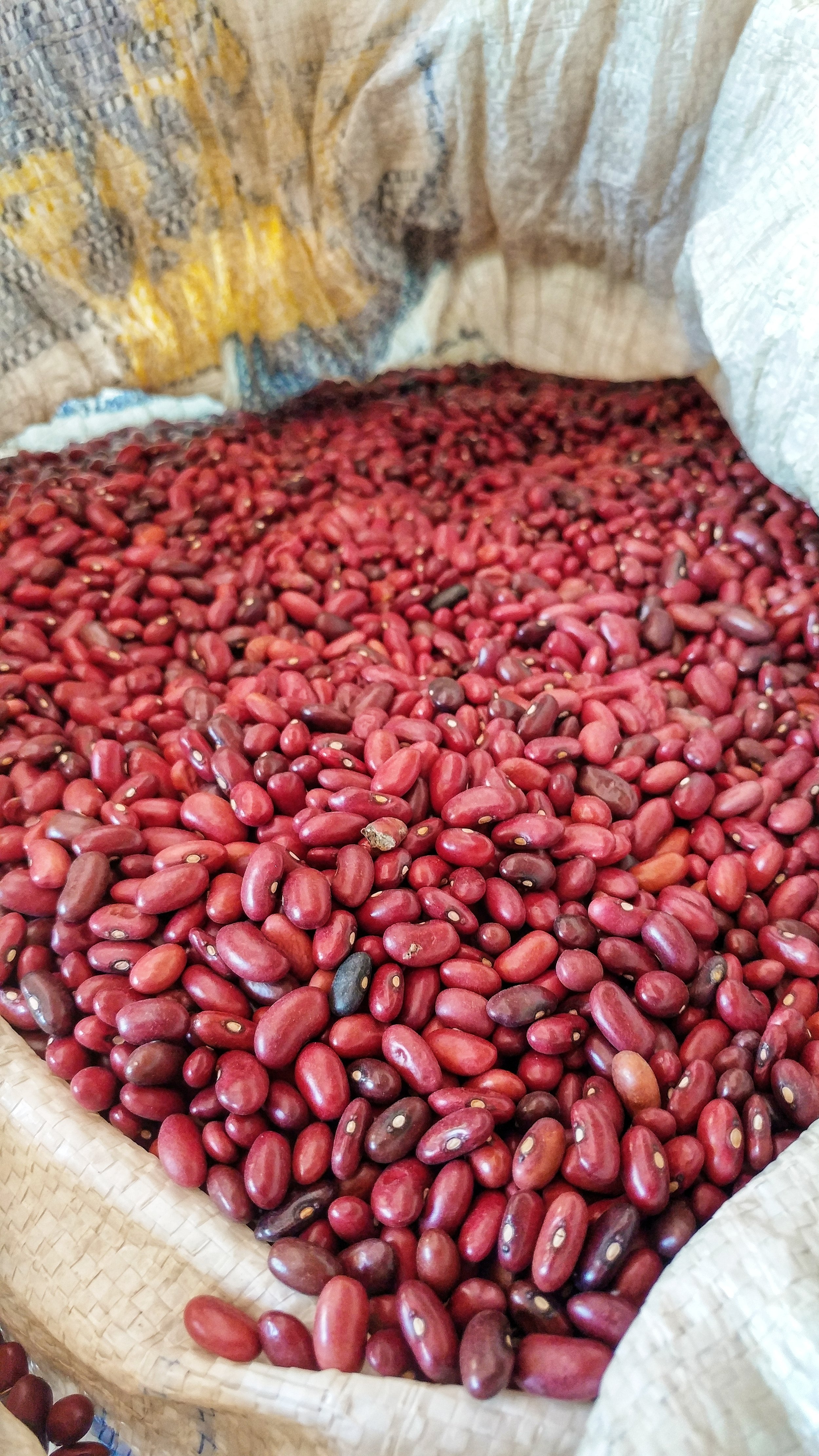
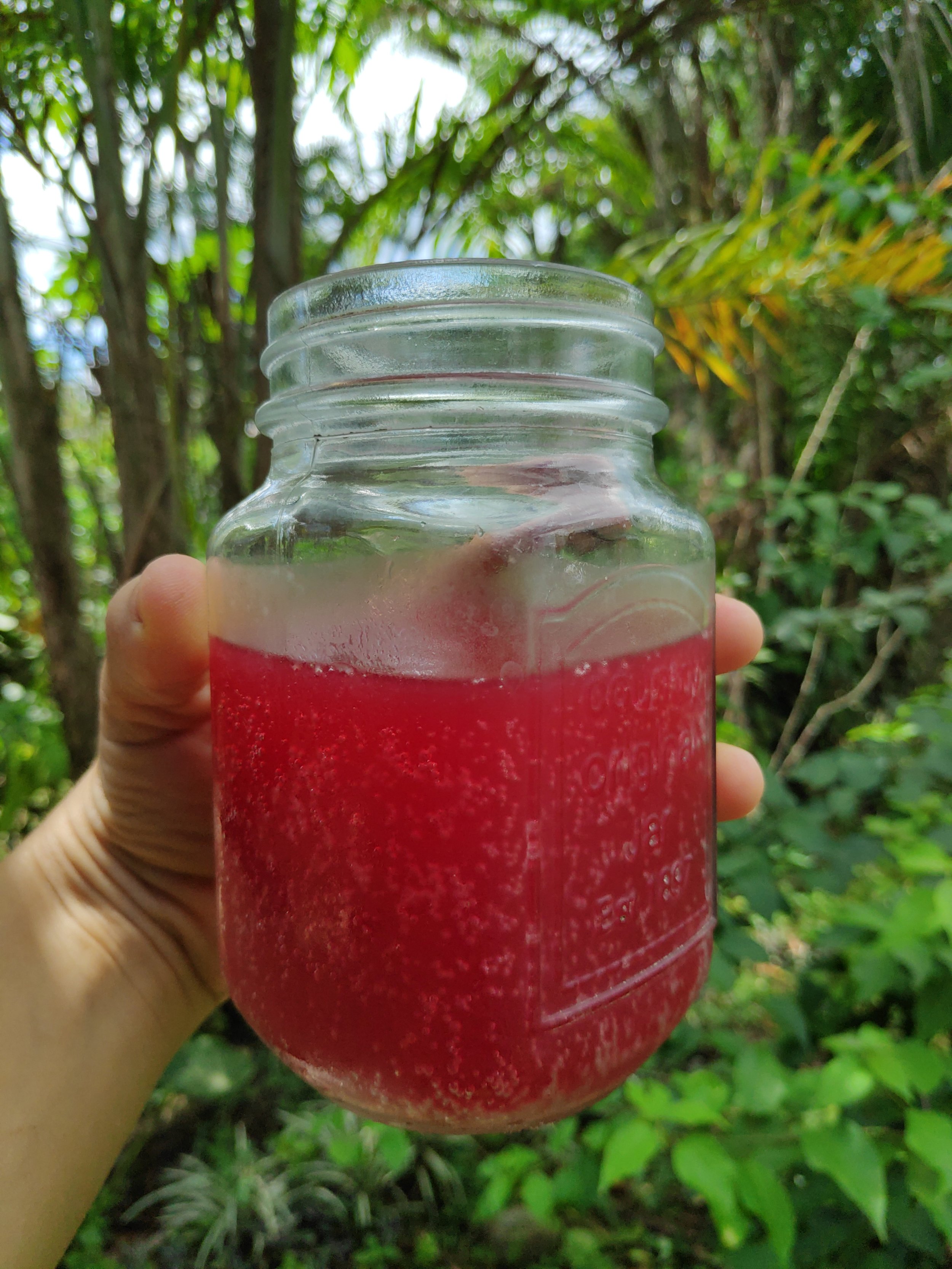
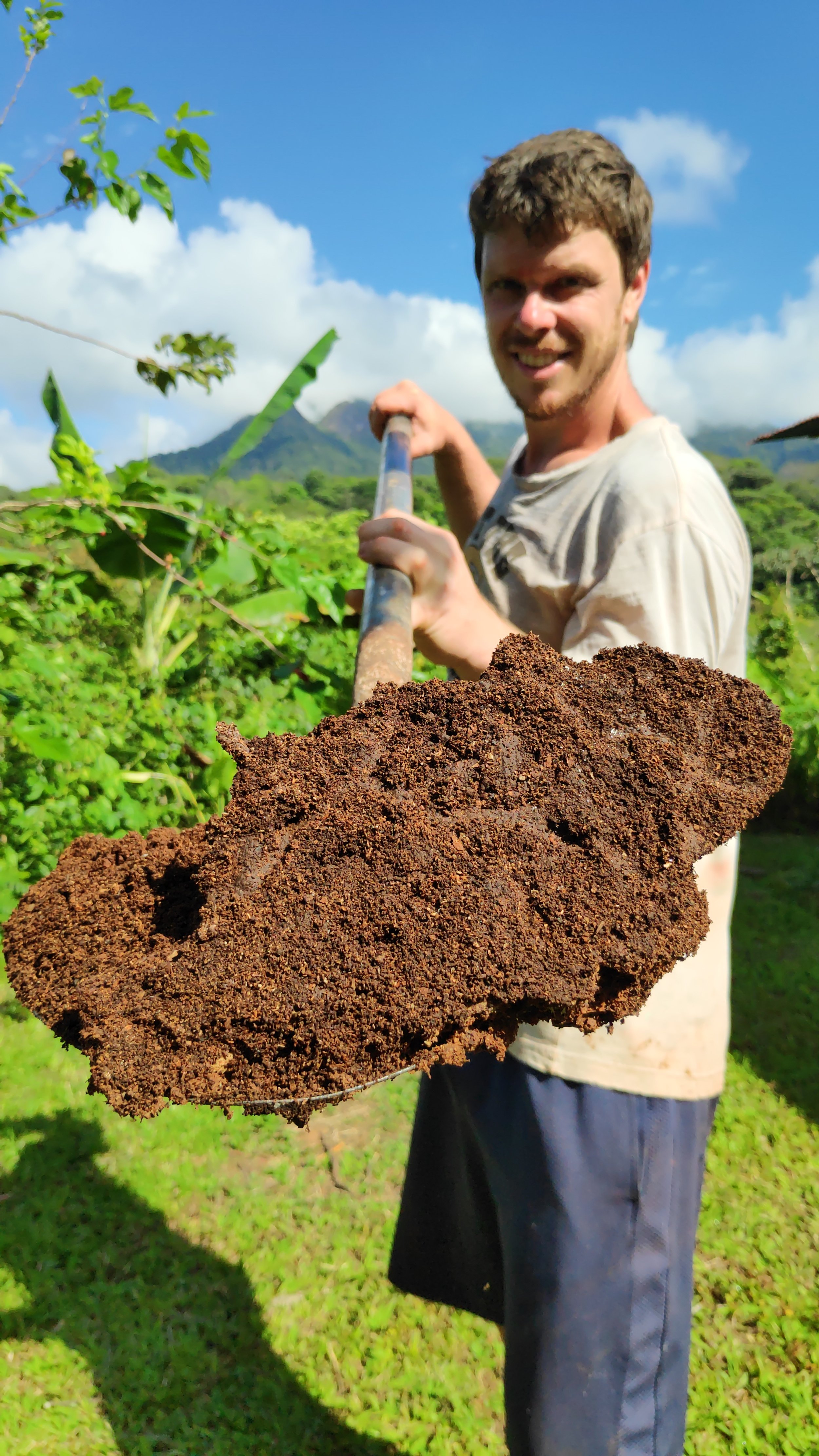
Meeting our energetic, nutritional, and social needs in symbiosis with nature brings such a joy and satisfaction to all those who live, work and visit Rancho Mastatal. Its inspiring to see how we can live in way that is kinder to the Earth and healthier for our bodies and minds.
Thinking back to life before the Ranch, its easy to see how many components of my daily life came from far off places and how my needs were often met by people whom I did not know and came from sources I was unfamiliar with. Without that integration I felt disconnected and there was a part of my spirit which was searching for more.
When we think about all the aspects of our daily lives - what we eat, how we process our waste, how we spend our time, and the spaces we occupy, we can ask ourselves 'how interconnected are these elements'?
Part of the magic of the Ranch is how its inspiring others to bring back these values and ideas to wherever they're from and share a new way of living with their family and community. You don't have to be living in a rural town in the tropical rainforest of Costa Rica to have a life that is interwoven, regenerative, and full of meaning.
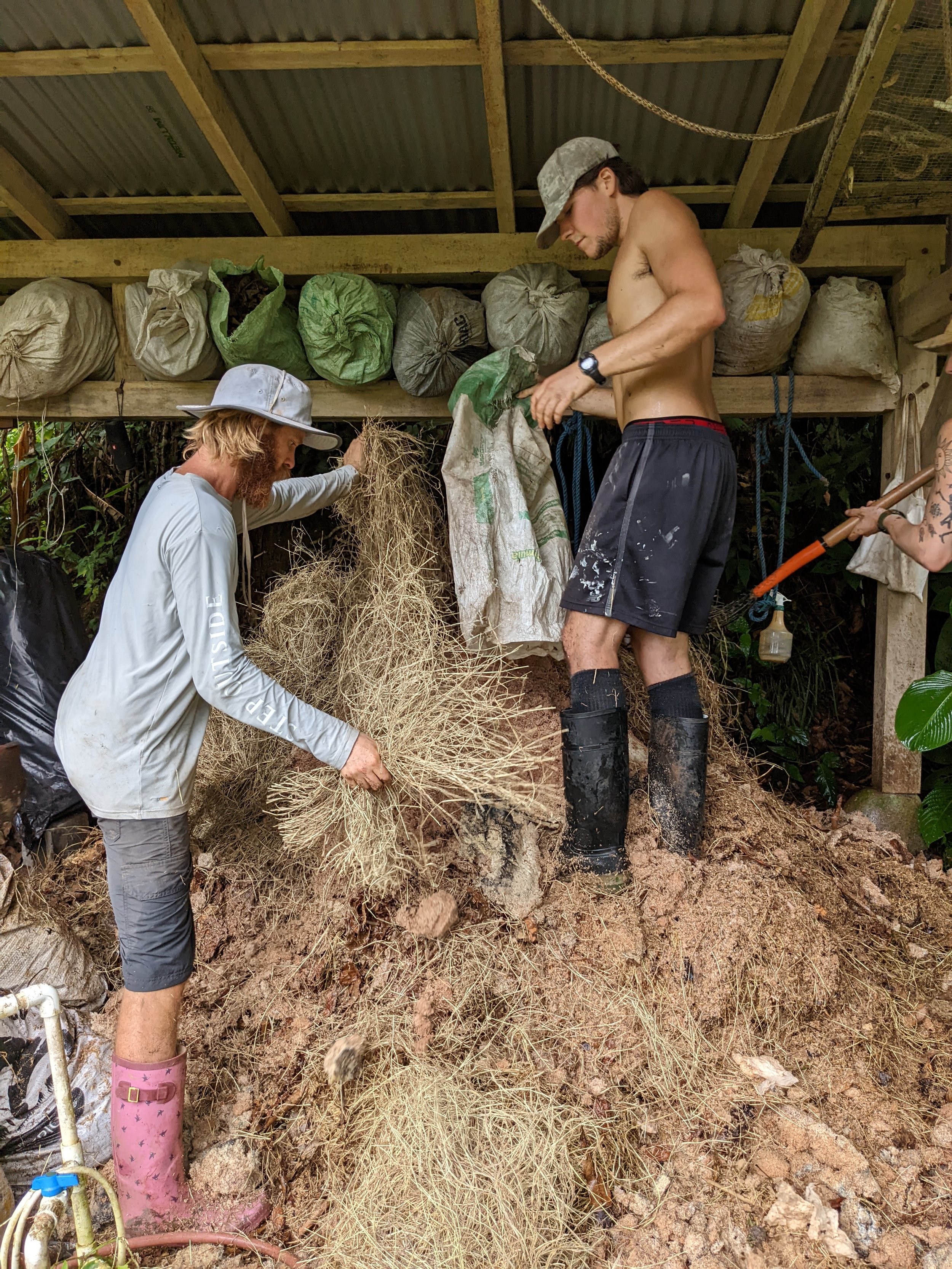
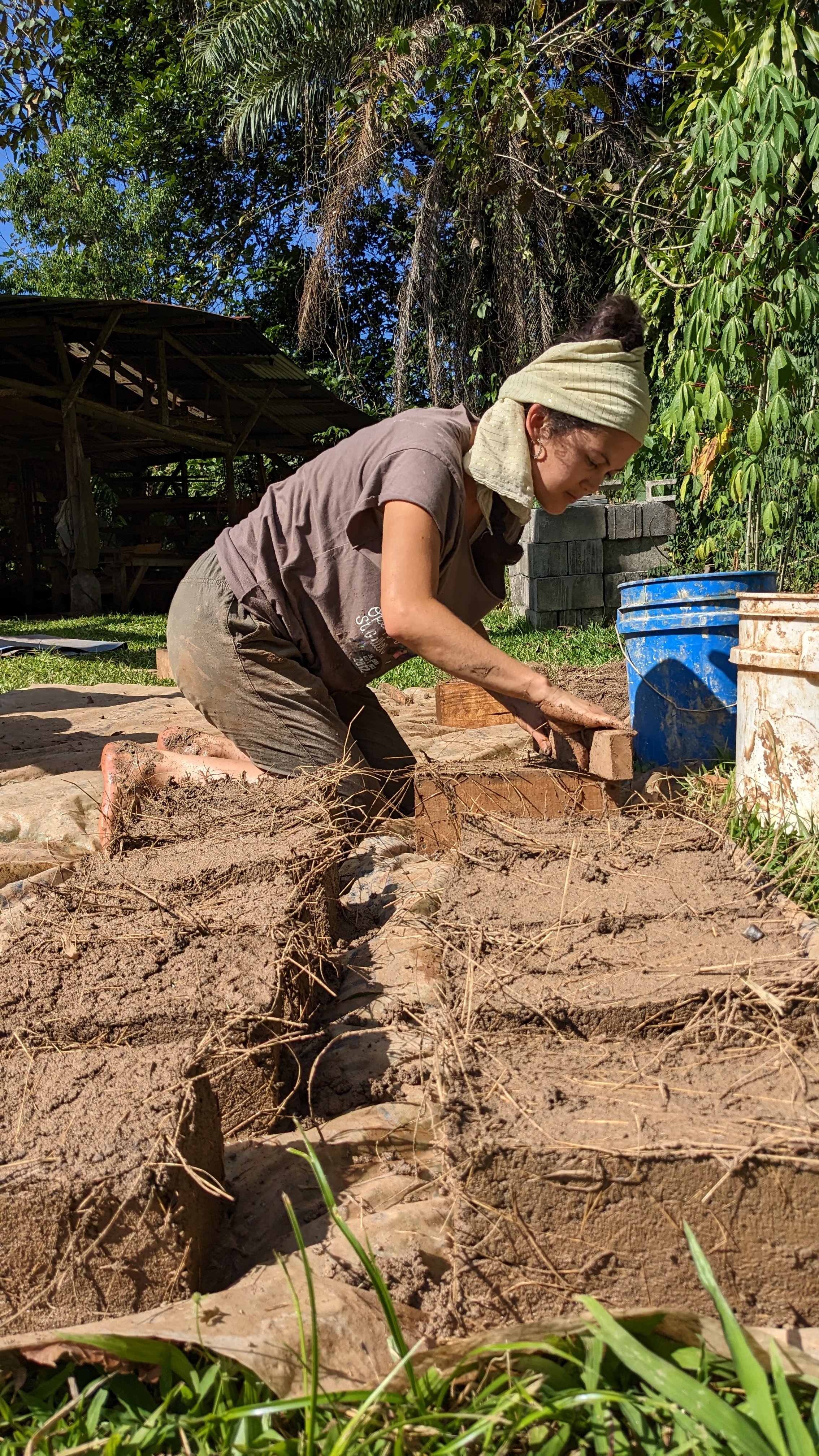
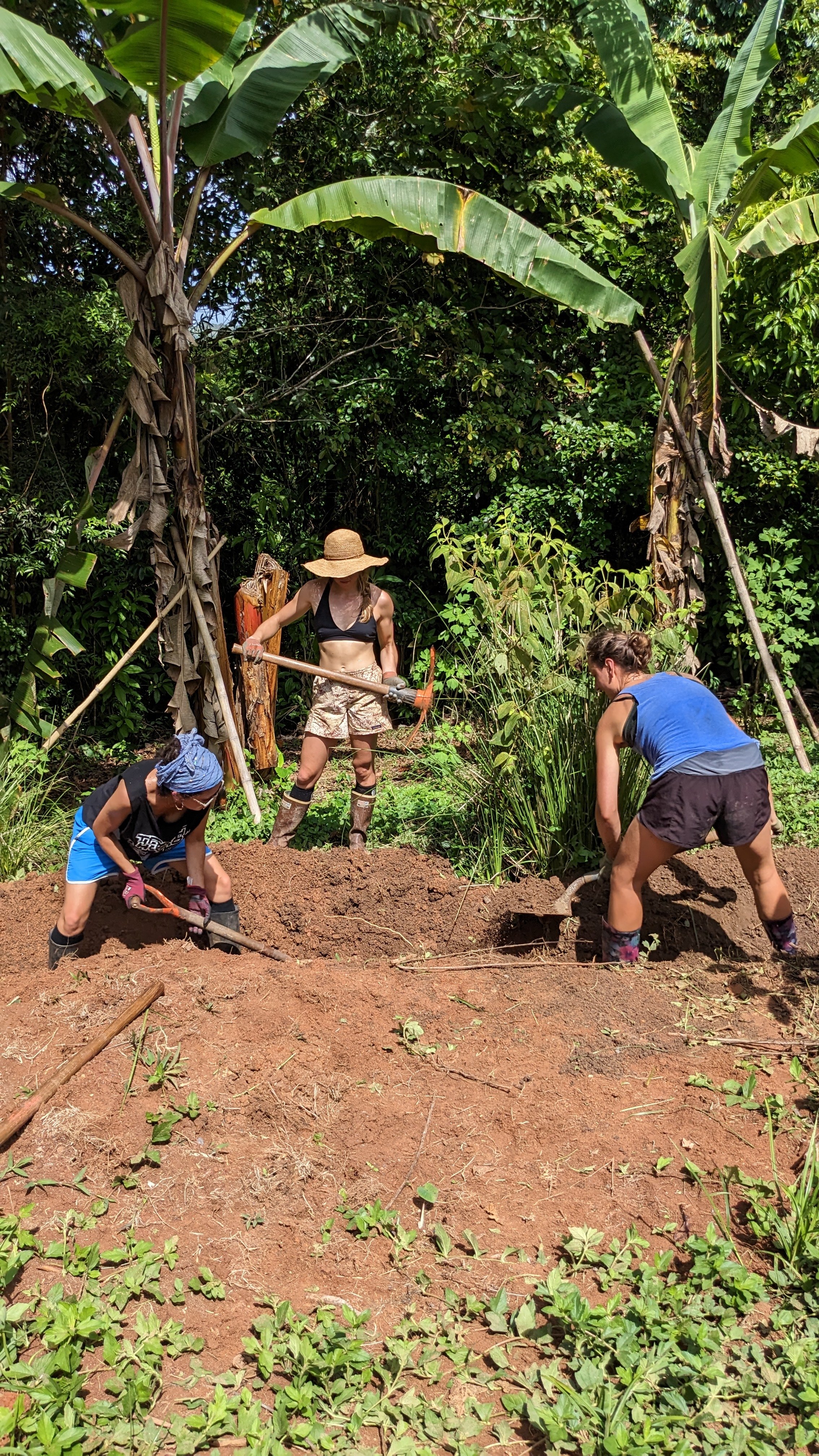
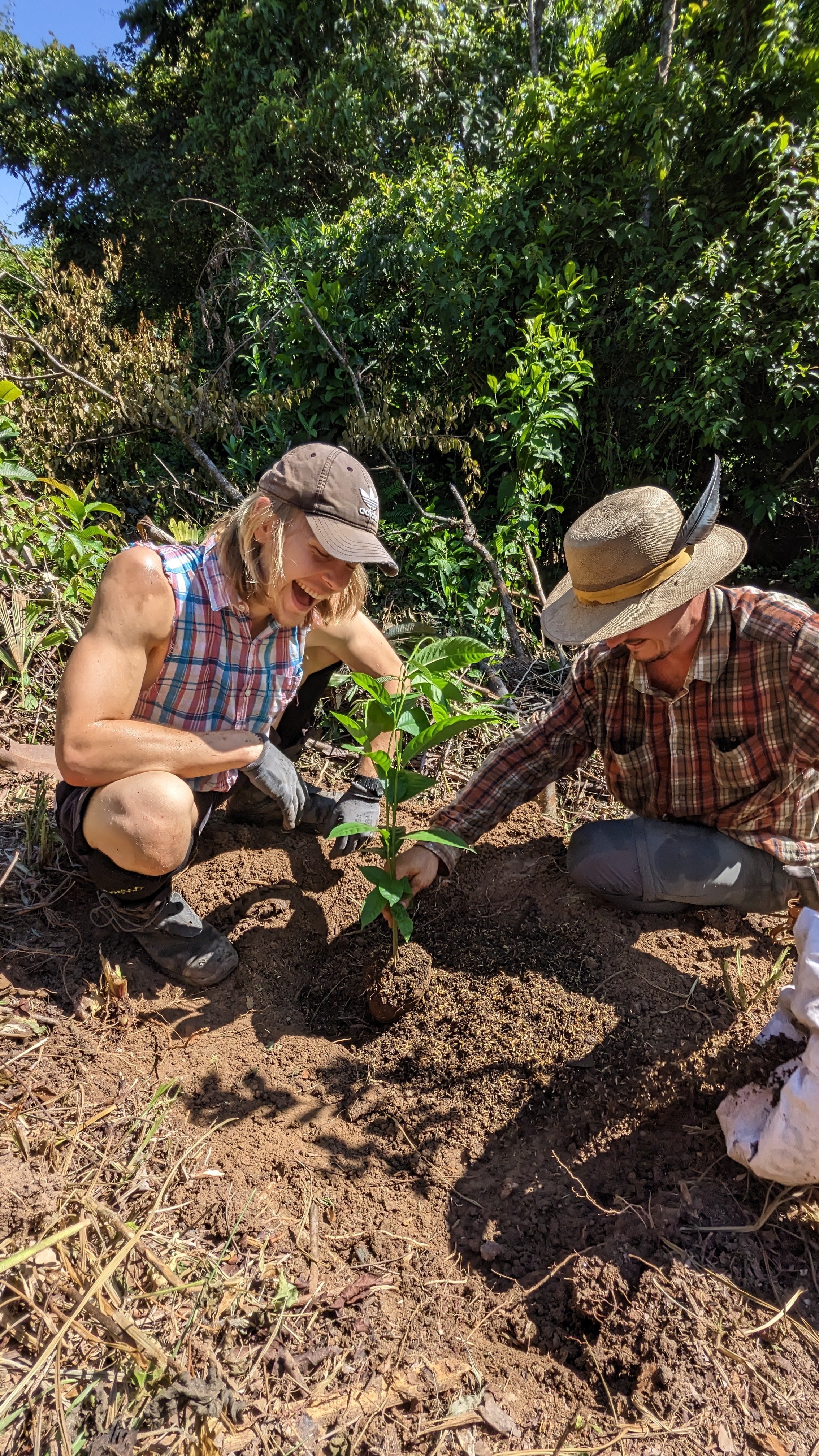
Perhaps you can start by growing some herbs or veggies in your own backyard or by finding a farmer's market to visit each week. How about hosting a monthly dinner with your neighbours and inviting everyone to bring a homemade dish? Which local businesses in your city can you become a patron of?
Maybe you are already living on a piece of land you'd like to develop into a community project. There could be a nearby seed saving bank to help you get started on growing heirloom varieties of vegetables or neighbours to borrow tools from and donate building materials. Often times there are school groups looking for volunteer opportunities and gardening clubs who have years worth of knowledge to share. The farmers in your area will also be a valuable resource to connect with, having insight into growing seasons and weather patterns. If you are looking to raise animals, they may be willing to help you get started and even sell animals to you.
Permaculture is all about creating a thriving and regenerative world for us to live in and enjoy. We can use smart and slow solutions right where we are to improve the way we meet our needs and the needs of others.
As I spend another beautiful day at Rancho Mastatal I am filled with gratitude to be able to learn these lessons in the heart of a thriving community. With each meal, every visit to the garden and orchardsand spending time in structures that have been lovingly made from the land, I realize how this interwoven life has enriched me and changed the way I will live from now on.

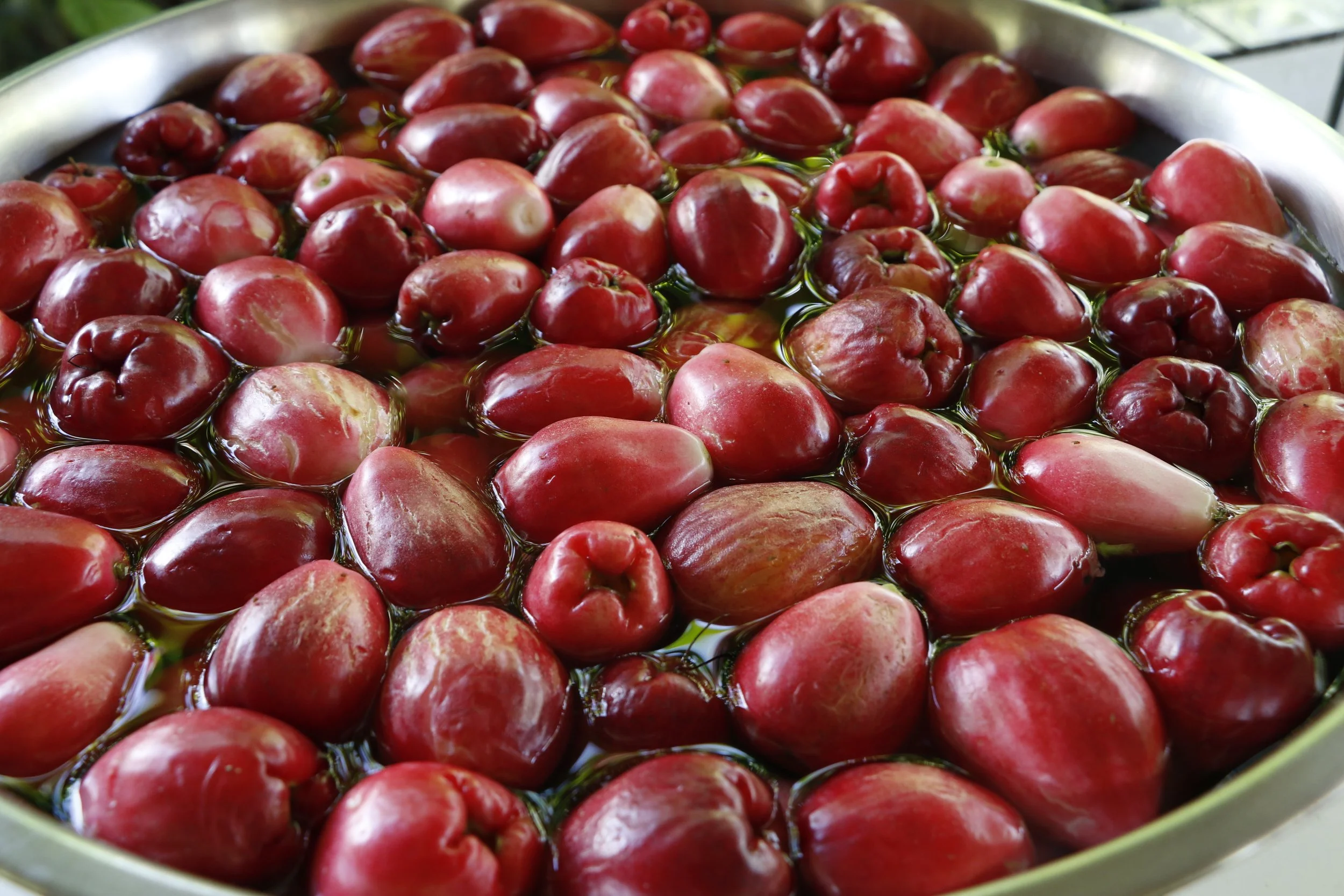
Phytochemicals: The Key to a Longer and Healthier Life
The way we treat the soil directly affects the plants health, which in turn affects our health. How we choose to farm shapes what we become. We are what our food eats.
Phytochemicals: The Key to a Longer and Healthier Life
By AJ Nolan, apprentice 2022
“The health of soil, plant, animal, and man is one indivisible whole.”
-Eve Balfour
There is not a doubt in my mind that living at Rancho Mastatal for the one year apprenticeship has contributed to extending and improving my life. I have been lucky enough to enjoy countless thought-provoking discussions, meaningful manual labor, and untethered access to healthy, local food.

In this article, I will focus on one aspect of our healthy lifestyle – food. Our foodshed is quite small and we always have access to seasonal fruits and vegetables. Using a refractometer, we have compared the nutrient density in the produce from our small foodshed to conventional supermarket produce. The Brix readings we get from our local, organically farmed produce are significantly higher than average Brix readings obtained from the supermarket produce. The Brix value indicates the number of soluble solids present in a sample of food. A higher Brix value indicates an increase in plant sugars, which can translate into a higher number of bio-available nutrients. Why does our hyper-local produce have more nutrients than supermarket produce? Phytochemicals.
Phytochemicals are compounds that plants make to help them defend themselves, facilitate growth, and communicate. Every plant on this great green earth makes phytochemicals. Stressors like temperature, drought, harvesting, and toxins cue plants to make phytochemicals. Plants then use these phytochemicals to communicate with their kin, warning them of nearby pests and pathogens. Plants are stuck in the ground and without these phytochemicals, they would be defenseless. They work as preventative medicine when they are a part of our diet. Phytochemicals neutralize toxins, aid in cellular cleanup, and retard the growth of cancerous cells. There are currently no daily dietary requirements for phytochemicals like there are for minerals and nutrients. This is a catastrophic oversight as phytochemicals are essential for optimal health. Phytochemicals lend flavor, color, and taste to every fruit, vegetable, grain, meat, and dairy product you’ve ever eaten.
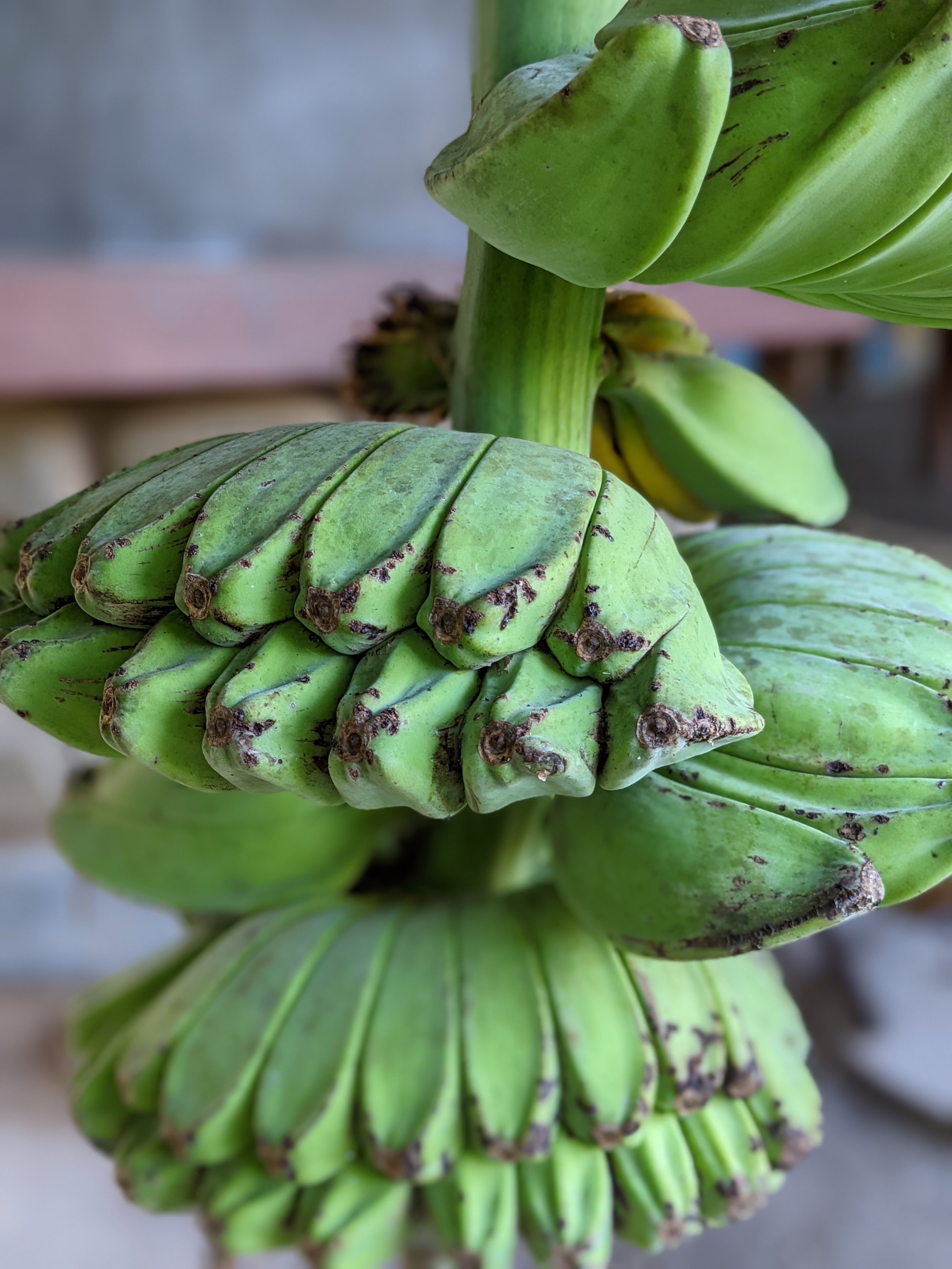
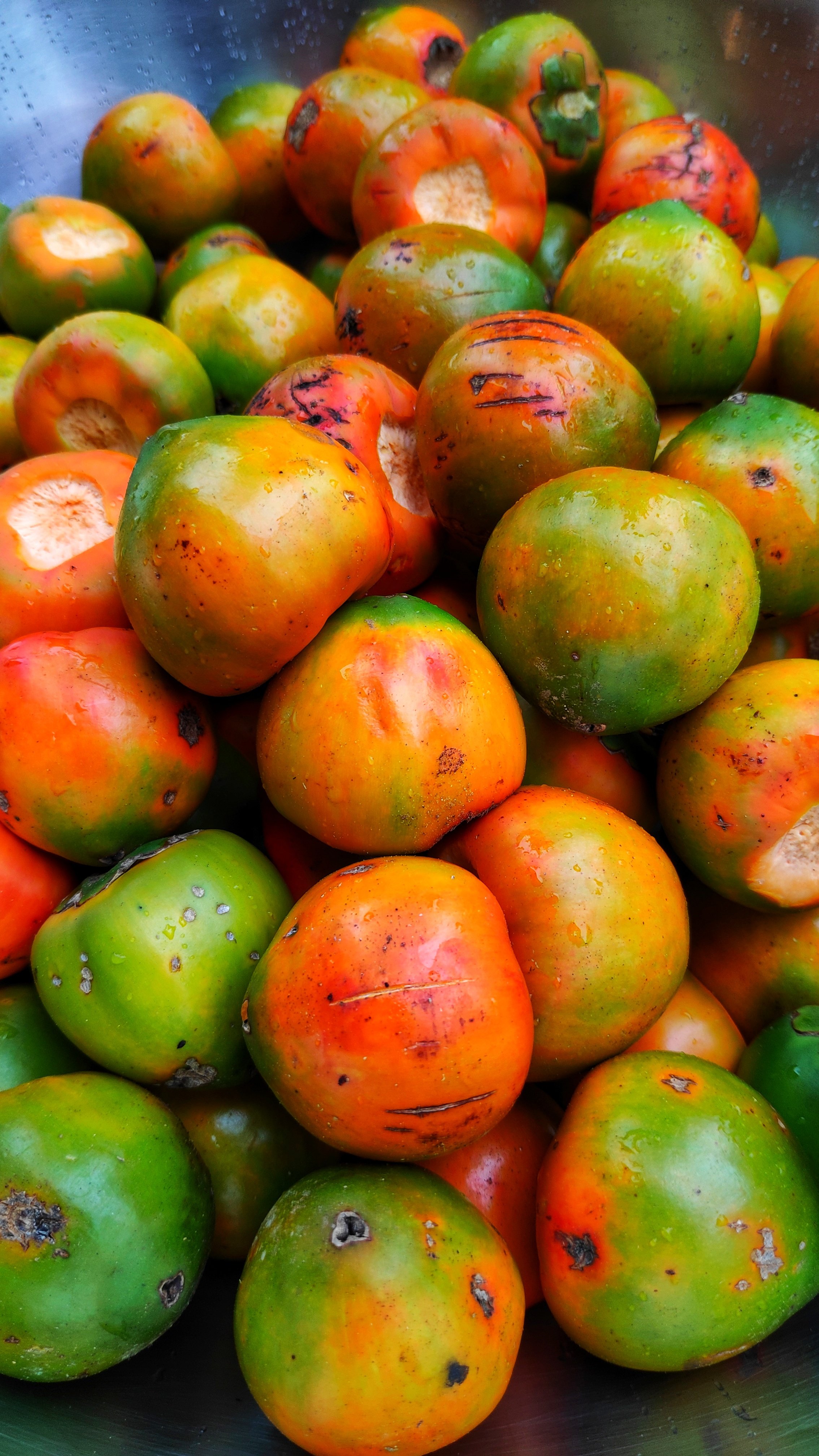
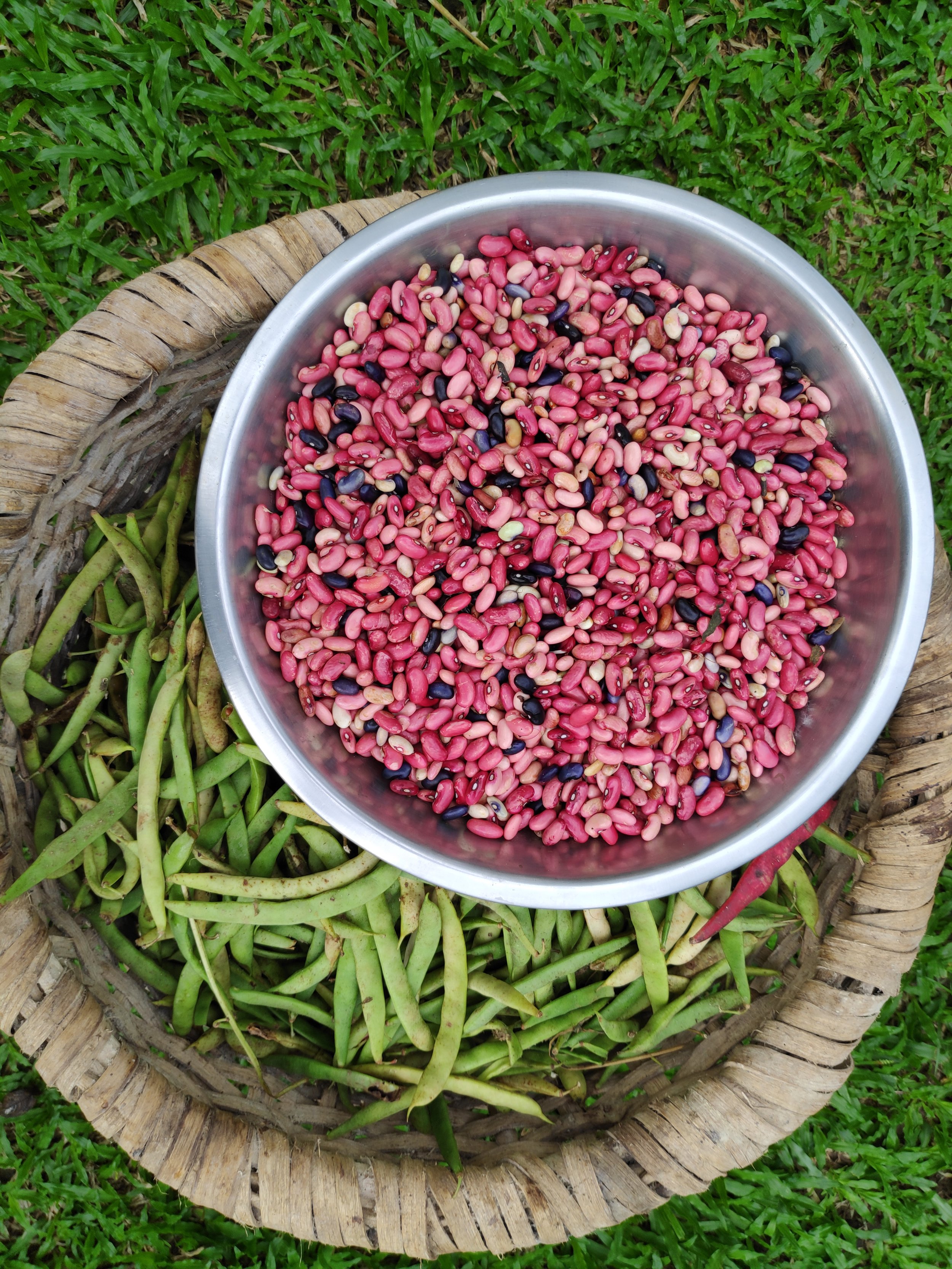
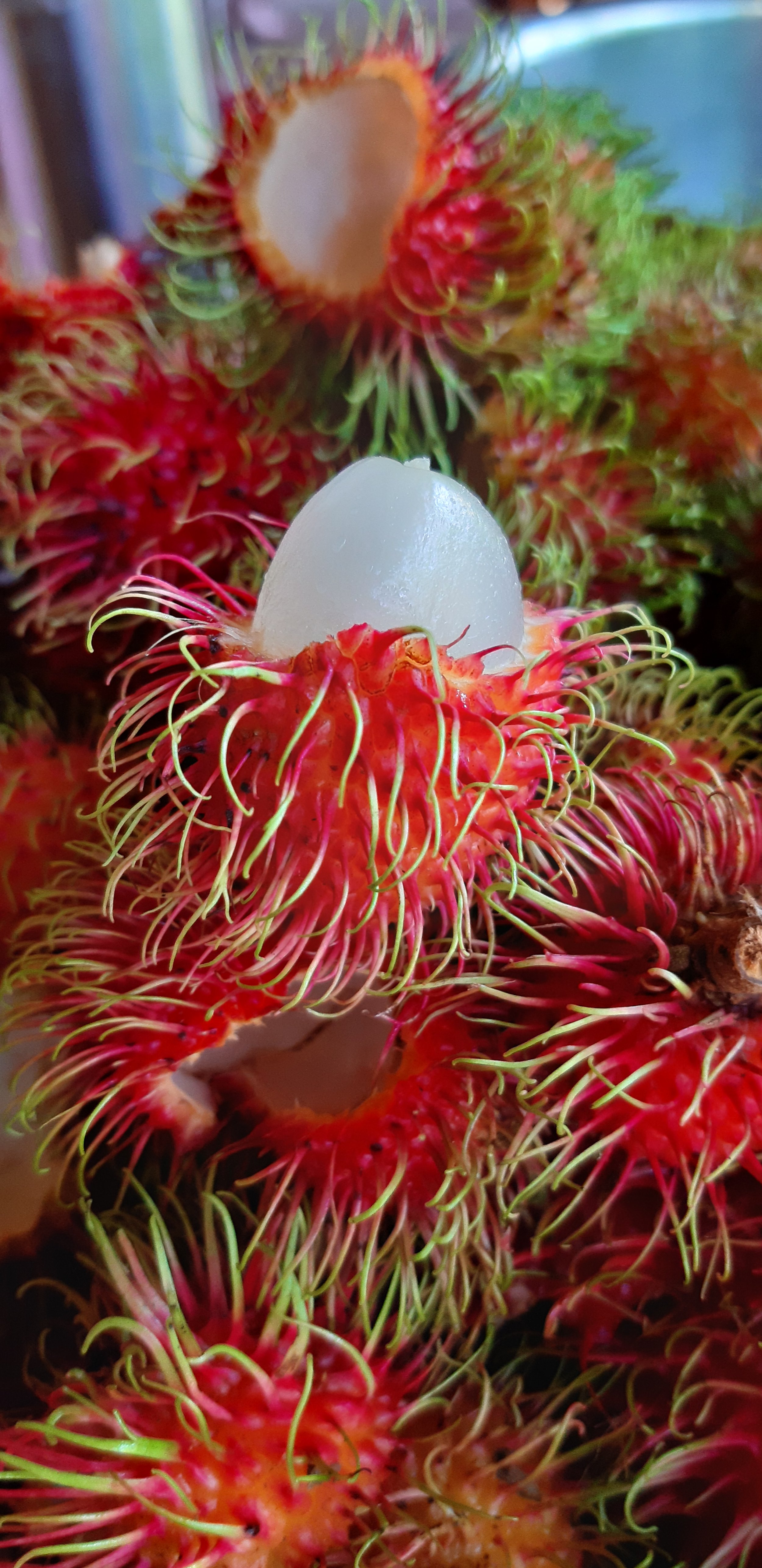
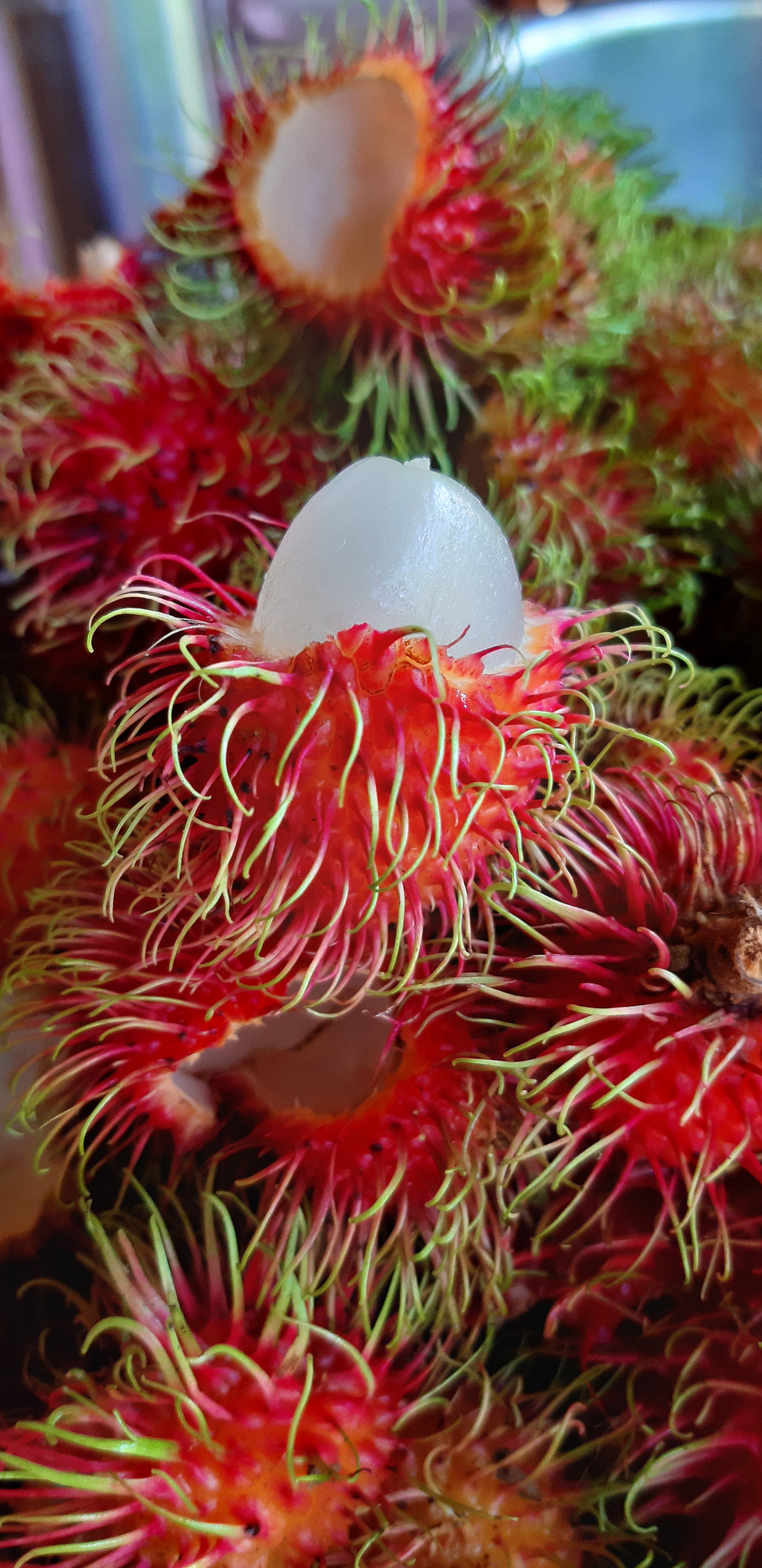
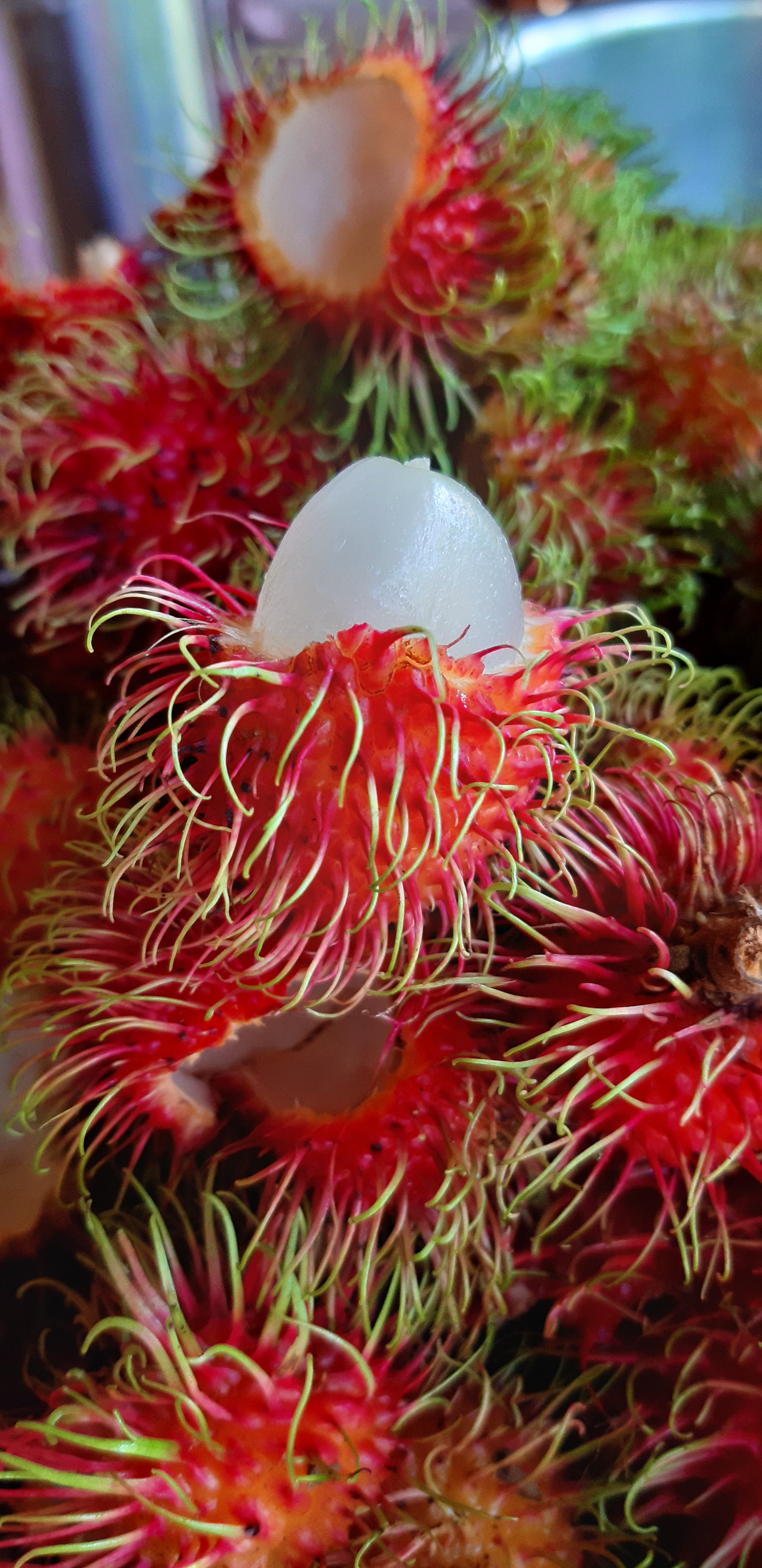
There are over 50,000 known phytochemicals. The most widely studied group of phytochemicals is called polyphenols. Polyphenols lower the risk of coronary heart disease, improve vascular health, and reduce inflammation through antioxidant and anti-inflammatory effects. When combined with a healthy gut microbiome, phytochemicals can perform essential cellular maintenance. Resveratrol is a polyphenol found in blueberries and red wine that promotes the death of tumor cells through its strong antioxidant and anti-inflammatory properties. Lycopene, found in tomatoes, influences intercellular communication and immune system modulation. Flavonoids are a subgroup of polyphenols that specifically inhibits the activity of enzymes associated with inflammation. Quercetin is a flavonoid pigment that is found in citrus, onions, grapes, and tea that inhibits the activity of enzymes linked to inflammation. It also aids in reversing diabetes as it blocks the uptake of glucose and triggers the destruction of existing fat cells.

Many phytochemicals act as antioxidants, thus reducing the amount of “reactive oxygen species” (ROS) or free radicals. All the cells in our body are constantly using oxygen to burn energy to fuel their activities. This oxidation process creates free radicals. Free radicals can cause tissue damage if they remain in our bodies for too long. This buildup can lead to chronic ailments such as autoimmune disorders and cancer. Antioxidants help in disposing free radicals, halting the acceleration of chronic diseases. What we need in our diets is a steady supply of these phytochemicals that act as antioxidants. Diets that are plentiful in whole grains, legumes, nuts, seeds, and colorful fruits and vegetables contain antioxidant phytochemicals necessary to maintain our long-term health.
Certain farming practices can influence the number of phytochemicals in plants. Conventional agriculture utilizes excessive amounts of pesticides and chemical fertilizers, inhibiting a plant’s ability to make phytochemicals. A study conducted by the British Journal of Nutrition found that organically grown foods contained 20 to 60 percent more phytochemicals than conventional farmed foods. Degraded soil undermines phytochemical production, leaving crops more vulnerable to pests and diseases. This leads to a greater use of pesticides that end up in our food and negatively impact our health. To increase phytochemical production in plants we need to rethink the way we farm. Regenerative agriculture practices that build soil health are key. These practices include minimal tillage, implementation of cover crops, composting, the utilization of soil amendments, and effective crop rotation without the use of chemical fertilizers and pesticides.
The way we treat the soil directly affects the plants health, which in turn affects our health. How we choose to farm shapes what we become. We are what our food eats.

Sources
“What Your Food Ate” by David Montgomery and Anne Biklé
“Nourishing Traditions” by Sally Fallon
“The Regenerative Grower’s Guide to Garden Amendments” by Nigel Palmer
“On Food and Cooking” by Harold McGee
Read Past Blog Articles
Improving Soils in the Humid Tropics of Costa Rica
Amending Calcium-Deficient Soils – A Tropical Permaculturist’s Approach

How to Make Your Own Homemade Soap
Soap and permaculture go hand in hand. Making our own soap meets our environmental and sustainable goals, and beginning to do things for ourselves instead of relying on the big companies.
How to Make Your Own Homemade Soap
By core team member Ali Ostergard
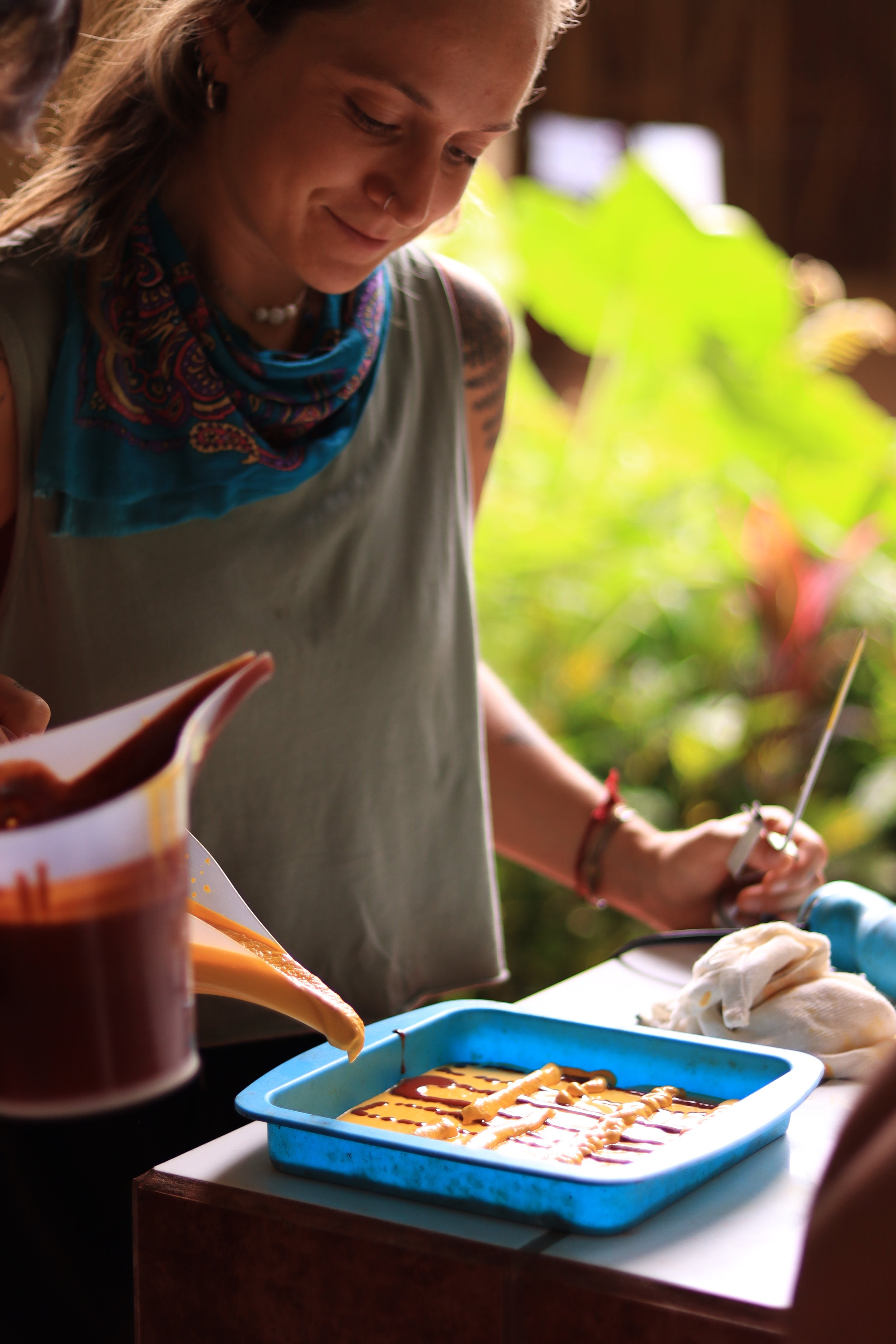
Story has it that soap was discovered by the women of Mount Sapo, Italy as they were washing in the river and noticed lathery bubbles beginning to form. These bubbles began to form after a volcanic eruption dumped ash into the river that flowed over their ceremonial location where they sacrificed animals to the gods. The combination of ash, animal fats, and water created the lather and bubbles, and what today we know as soap.
Soap, despite what you read on the back of a box of generic soap, is formed by three simple ingredients: sodium hydroxide (lye), fatty acids, and water. So for the town of Mount Sapo the volcanic eruption created ash, which contains sodium hydroxide, which fell into the waters of the river, which then flowed over the ceremonial areas that contained animal fats, the fatty acids, and once these elements all combined they reacted to create a simple soap.
Obviously as time progressed we modified and perfected this soap process and the ingredients. None the less, the process of soap making is still very simple and accessible to every household. If you use soap, which I sure hope you do, there is no reason to not be making it yourself.
WHY MAKE YOUR OWN SOAP
For us here at the Ranch we have three primary reasons for making our own soap, both body and dish.
Environmental: Creating your own soap allows you to assure it contains only biodegradable ingredients that aren’t harmful for the environment (especially important if you are using your grey-water to irrigate crops). Also, by making your own soap products you can reduce or even eliminate the packaging waste that comes along with store bought products. Think, everyone says, ‘oh I only use one shampoo bottle a year,’ times that by the millions that do, you end up with a lot of plastic bottles in landfills. Where if you make your own, you can reuse that bottle and reduce your waste.
Personal Health: Did you know that cosmetic companies and products outside the E.U. are not fully regulated by any health department? The rule is the ingredient needs to be proven harmful before it will be taken off the shelf, rather than proven safe before being put on the shelf. What company do you think is going to prove their product harmful…? When you look at the ingredients on the back of any cosmetic product, including soaps, the list is very long and full of words that can barely be pronounced. Our skin is our largest organ, and absorbs what we put on it, so does it seem healthy to be lathering up in something that contains Dimethicone 200/50, Disodium Edta, Stearoxytrimethylsilane, etc… every day? By making your own soap, you can insure the ingredients going into it are safe.
Be a Producer Not a Consumer: Not only is there immense satisfaction in making your own soap and products, but you are moving away from relying on outside sources for your basic needs. We are big believers in this here at the Ranch, not just with soap, but with building your own home, growing your own food, and if you can’t do it then supporting your neighbor that can. Check out our workshops that will help you begin learning how to do more of these basic skills.

WHAT IS SOAP
Soap as mentioned earlier, is made up of our three simple ingredients (lye, fat, water), that when combined go through a chemical reaction called saponification. There is some basic chemistry that happens here, that I’m not going to go into too much, but basically the process of saponification is the reaction that occurs when our lye water is combined with the fatty acids, and this process creates soap.
A soap molecule is made up of a hydrophobic end (water repelling) and a hydrophilic end (water loving). The hydrophobic end grabs onto the dirt and grime, and the hydrophilic end grabs onto the water and washes that dirt away.
Soap is not naturally antibacterial. It simply works by washing away the dirt, bacteria, etc off the surface. There is a lot of new studies to suggest that antibacterial soaps are causing more harm than good, and are really unnecessary outside a hospital setting. You can do your research on this topic.
MAKING YOUR OWN SOAP
Here at the Ranch we have been making our own body and dish soaps since the beginning. This skill is something we teach to our apprentices, school groups, and in our Permaculture Design Course. We truly believe it is something that everyone can do!
Equipment
Digital scale (accuracy is important)
Thermometer
Stainless steel or glass bowls
Emersion blender (you can do this by hand, but depending on the oils you use this step could take a while)
Spatula
Soap mold
Eye and hand protection (glasses and gloves)
Ingredients
Sodium Hydroxide (also known as lye)
Fatty acids (almost any oil can be used, this is where you can be creative)
Water
Additives: salt, exfoliants like oats or coffee grounds, essential oils, milk, honey, clay, pigments, dried flowers, etc…
Fatty Acids or Oils
You can use a variety of different oils to make your soap; the important thing to note is that each oil has a different amount of lye needed for saponification to happen. I’m going to give the recipes we use for our bar and dish soap using the oils we use, but if you are to use different oils, you will need to change the recipe. There are good online recipe calculators; one we use often is thesoapcalculator.com.
A quick note on the oils we use and why, because that also goes into our ethics as an organization and meeting those when making soap.
Lard: lard makes an excellent soap; it creates a lathery, creamy, and hard soap. But, we mainly use lard because it is produced locally in the next town, we get the second rounds of lard that have already been used in the restaurants, meaning we are using a byproduct that would usually just be thrown out. Some people find this gross, but I find it super amazing! You are taking a product that would be thrown out and making it into something useful again. AMAZING! Food for thought, check out our blog about lard and why we are big fans.
Palm oil: this very controversial oil is also great in soap making. Why we use it? Again it is produced locally down the road, somewhere that isn’t contributing to new deforestation. Of all the vegetable oils, palm oil is the most productive and yielding. If you are going to deem palm oil bad, I would ask yourself what about coconut oil, sunflower oil, soy oil, or any mono culture crop that is essentially grown and produced in the same way.
Coconut oil: also produced locally, we get ours from a small family operation. We don’t put this in our dish soap, as it is much more expensive to use on such a large scale (we go through a lot of soap).
We get all these oils in reusable containers that we send back to be refilled, reducing our waste.
The list of oils you can use is large, pretty much anything that is considered a fatty acid can be used. I would encourage you to find a local oil source.
Short list of oils that can be used: avocado, canola, vegetable, olive, cacao butter, shea butter…

Recipes:
Bar Soap
188 grams coconut oil
375 grams lard
188 grams palm oil
188 grams water
108 grams lye
1 tsp. salt
Dish Soap
500 grams lard
500 grams palm oil
300 grams water
137 grams lye
1 tsp. salt
Instructions
Measure out all your ingredients into separate containers.
Heat your oils to between 110-130 degrees Fahrenheit.
Add the salt to the water and then add the lye to the water, stirring constantly to make sure it doesn’t stick on the bottom. Lye is very caustic and will burn if it gets on your skin. Wearing eye protection and gloves is recommended. The lye water solution will heat up quickly and begin off gassing, so keep your head away from directly over the bowl and do this in a ventilated area. You need to cool the lye water solution down to between 110-130 degrees Fahrenheit.
You want your oil and lye water to be at the same temperatures. Once they are both within a few degrees of each other (between 110-130 degrees Fahrenheit), pour the lye water into the oil and stir.
Using the emersion blender begin slowly blending this solution, being careful not to splatter the mix on your skin or in your eyes.
You are now looking to get the solution to a light trace. Meaning when you drizzle some on the surface the lines are visible on the surface.
Once you have reached a light trace you can then pour the mix into your molds.
Wait 48 hours to pop your soap out of the mold.
Place in a ventilated area and let it cure for minimum 3 weeks before using.
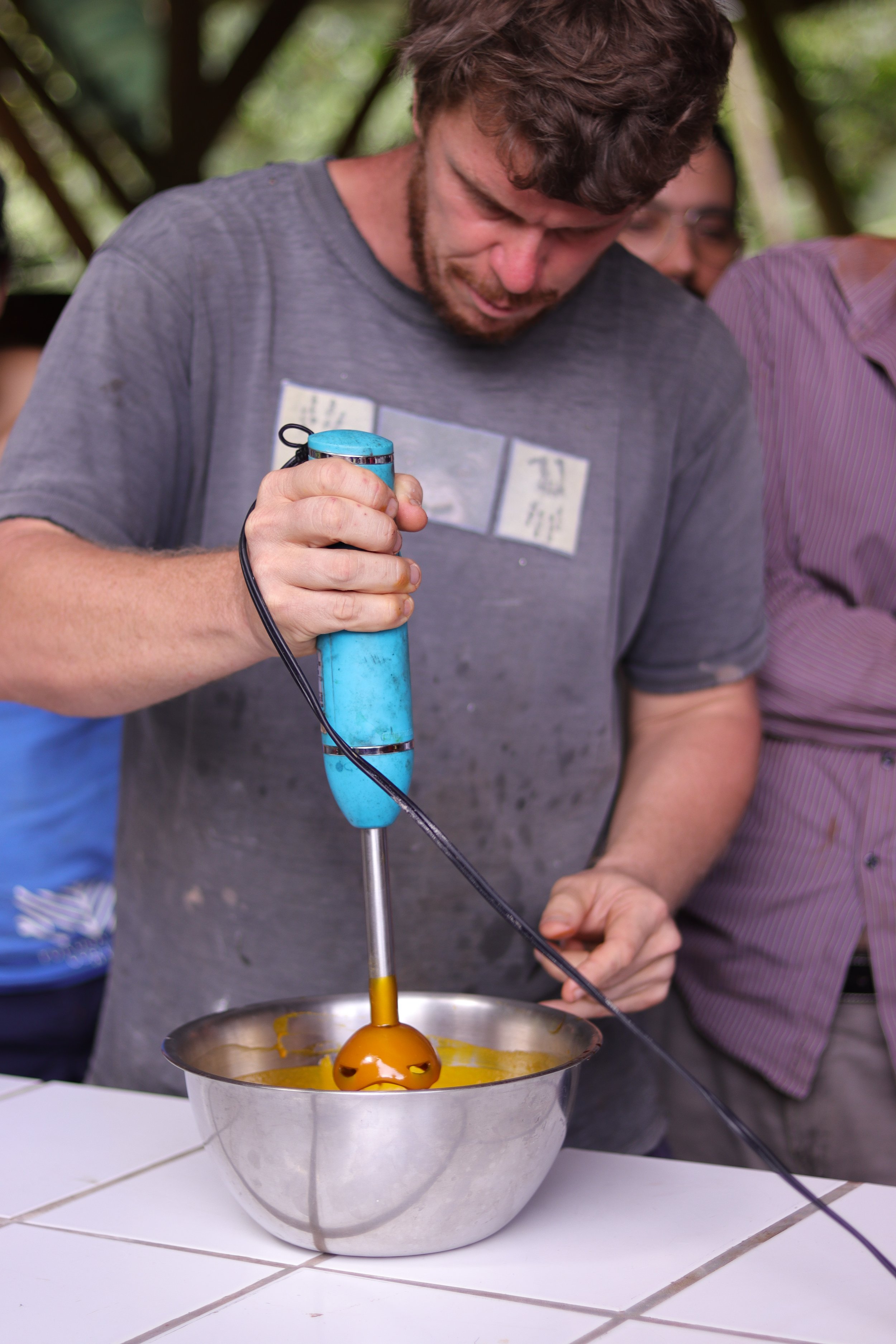
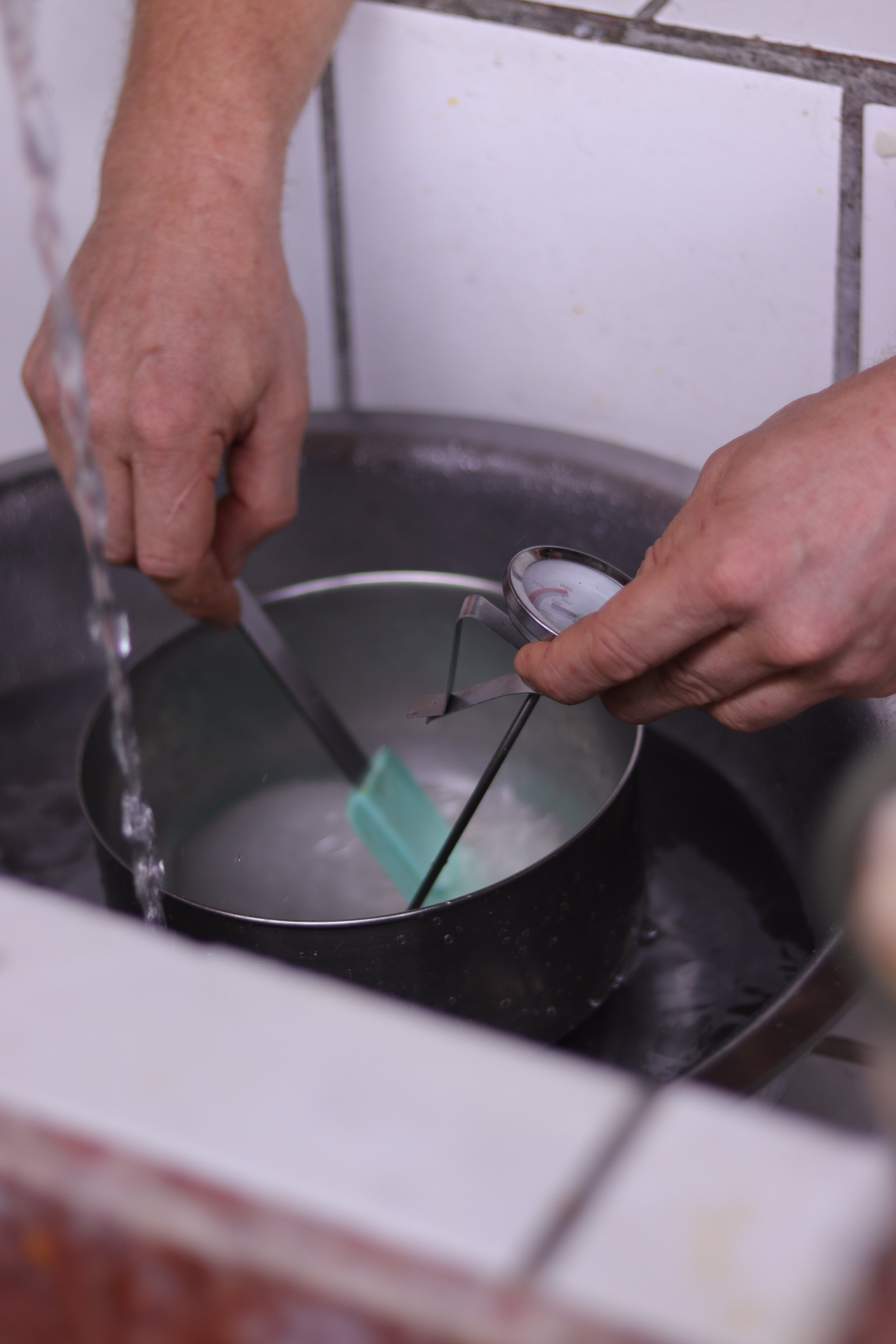
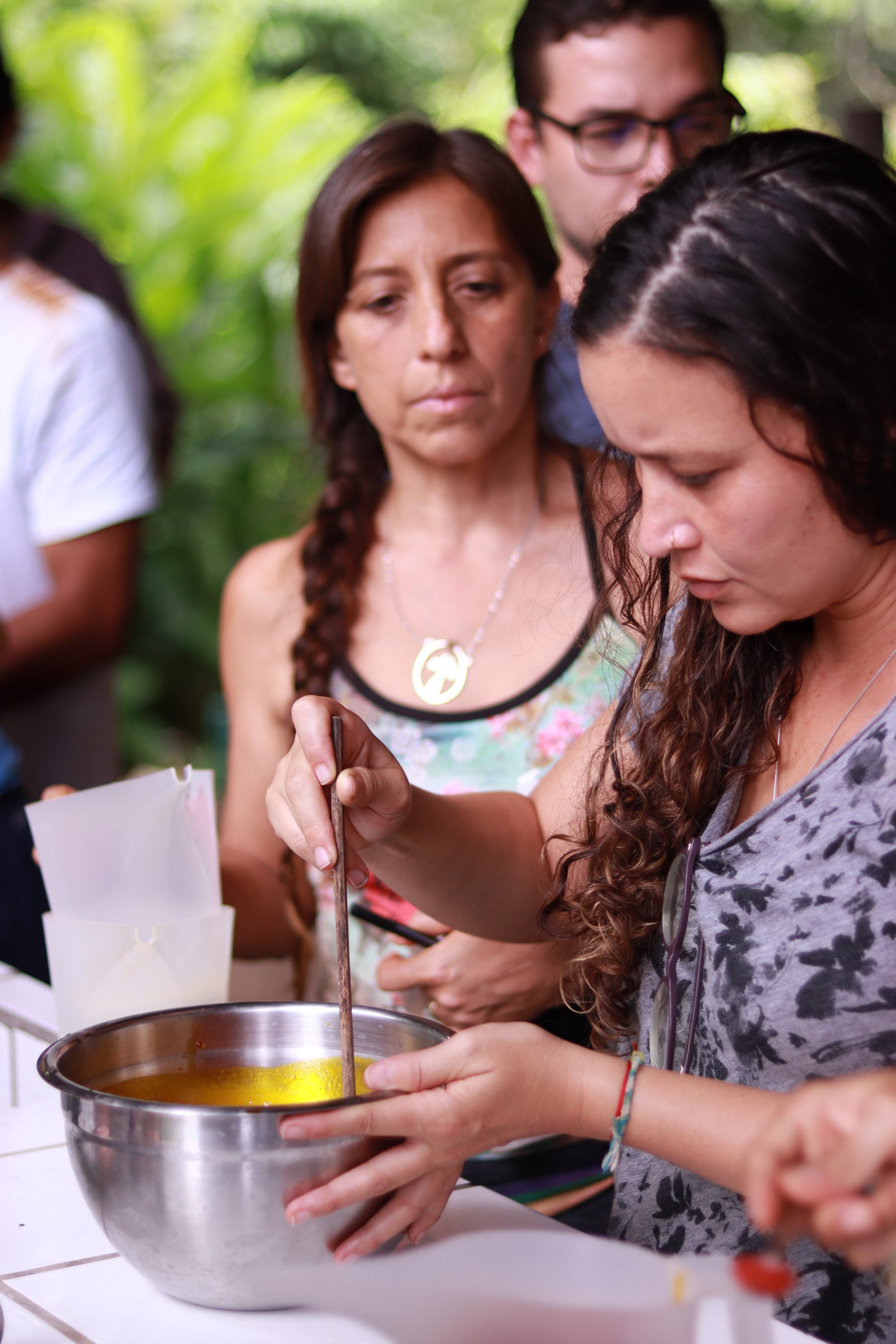
This version of soap making is called ‘cold process’, there is also a ‘hot process’ that involves slow cooking the ingredients which speeds up the saponification and curing time. To make liquid soap is another process and uses potassium hydroxide.

You can get super fancy and add fragrances, put in additives, and make pretty designs. I would do a couple simple batches before advancing to these. But in no time you will have perfected the process and be ready to make some gorgeous, sustainable, and luxurious soap.
Soap and permaculture go hand in hand. Making our own soap meets our environmental and sustainable goals, and beginning to do things for ourselves instead of relying on the big companies. Join us for one of our Permaculture Design Courses where we will have a class on soap making along with natural building, fermentation, soil building, and more.
Happy soap making!
Book Recommendations and Reviews #3
Due to the unique circumstances of the past two plus years, I never seemed to find the time to write what I hoped would be a yearly blog on the books that I read. The two times that I’ve done this in the past we were stateside visiting family, with a bit more time to dedicate to catching up on what seems to be an ever growing list of “books to read”.
by Tim O’Hara
Due to the unique circumstances of the past two plus years, I never seemed to find the time to write what I hoped would be a yearly blog on the books that I read. The two times that I’ve done this in the past we were stateside visiting family, with a bit more time to dedicate to catching up on what seems to be an ever growing list of “books to read”. With travel plans all over the board since COVID became a common part of life, we were only able to make 2 much quicker than normal trips back to see our loved ones in the US. Nevertheless, I’ve been able to squeeze in some solid educational, inspirational and informative reads that I’d like to quickly review for those of you out there that appreciate personal reading suggestions. I’ll try to include as many of the books that I’ve read since the last time I shared my recommendations though I may miss a few as it’s been a while. I’ll also do my best to list them in the order that I read them though my memory doesn’t always serve me as well as it used to. As always, I love to receive other people’s recommendations and in fact a few on those on the below list came from some of you that responded to my last blog reviewing books. Without further ado, here we go. Enjoy.
All the King’s Men by Robert Penn Warren
I randomly picked this classic off of the Ranch’s library shelf one day looking for a good read. I don’t often choose fiction these days but this book, written as fictional history, really resonated as I flipped through the pages and got lured in by the in-depth character development and story of corruption, dirty politics, and the reality of how decisions are sometimes made by those in power. The book is set in the southeastern US in the 1930s. I was saddened by how little much has seemed to change on the political front this past century.
Killer of the Flower Moon: The Osage Murders and the Birth of the FBI by David Grann
Holy shit. I wish I was surprised by the story laid out by author David Grann. This book was recommended to me by our neighbor Jim Veeder. It’s an unbelievable story of pillage, theft and the rising up of J. Edgar Hoover and the Federal Bureau of Investigation. Add another chapter to the story of sinister imperialism and Manifest Destiny that left destruction, thievery, and murder in its wake. The book was gripping. I burned through it in a few days and found myself at the end ashamed to descend from the race and gender that has done so much damage to this planet and its people. Highly recommended.
The Warmth of Other Suns: The Epic Story of America's Great Migration by Isabel Wilkerson
This book about the “Great Migration” of African Americans from the Southeastern US north and west follows the lives of 3 unrelated people that moved to New York, Los Angeles and Chicago respectively.
This is a good overview of the plight of black Americans in the early and mid-1900s as they continued to work against the repressive forces set in motion by slavery and subsequently Jim Crow. I also plan on reading Wilkerson’s more recent book entitled Caste.
Rising: Dispatches from the New American Shore by Elizabeth Rush
What will happen as our coastal cities go underwater? What will happen as our estuaries become part of the sea? How will we mitigate the ensuing disasters of climate chaos as sea levels rise and begin to swallow up areas inhabited by millions of people? We are in for a rude awakening and Elizabeth Rush does a nice job of laying out our despondent future in a way that I found accessible and even at times enjoyable. The book was written fairly recently and is a good selection to bring yourself up to speed on recent developments in the climate disaster conversation.
There There by Tommy Orange
This read takes a look at indigenous populations in urban settings as it individually follows the lives of a number of indigenous people who are connected in some way and who all come together in the same space in Oakland at the end of this compelling, sad but important and absorbing book. If you read Overstory, it’s similarly laid out by following and highlighting the lives of the characters and then creatively weaving them together before a final crescendo that leaves you reeling a bit. I blew through this page-turner and would highly recommend it to anyone interested in the human project. This is one the first books that I’ve read about American Indians that focuses on the urban story, where most American Indians live today, and their challenges as it relates to life in the city.
Call of the Reed Warbler: A New Agriculture – A New Earth by Charles Massy
This book was also recommended to me by Jim Veeder, our neighbor who lives up over the mountain in a small community named Tufares. Jim’s an avid reader that shares my reading preferences and this book really fit the bill with its many examples of regenerative food systems on the continent of Australia. Inspirational for readers concerned about how humans can responsibly provide for themselves in the future.
October 1964 by David Halberstam
I needed a break from the serious reads and settled on an account of the 1964 World Series between the St. Louis Cardinals and the New York Yankees. It was an enjoyable recount of the season leading up to what was one of the most exciting World Series up until that point in history. I especially enjoyed the read due to the fact that many of the players highlighted in the book were still playing when I started watching baseball in the early 70s.
The Human Swarm: How Our Societies Arise, Thrive, and Fall by Mark W. Moffett
This book impacted me more than any book I’ve read in a long time. Moffett, a biologist who for much of his career focused on ants, makes a leap into the world of apes as he uncovers why we do what we do. Fascinating, eye-opening, riveting and refreshing. It answered so many questions about human nature that I have been carrying around with me for a long time. Highly recommended for readers interested in human evolution and behavior.
Catching Fire: How Cooking Made Us Human by Richard W. Wrangham
I blasted through this easy-to-read book that postulates that we are who we are today due to as much as anything else our coevolution with fire. The author suggests that we essentially cannot be healthy beings without the act cooking. I found it to be a captivating book full of new ideas (for me) that seemed almost commonsensical and plausible looking back. Fire, more than any human “discovery”, influenced who our species is today. Dedicated raw food enthusiasts will likely push back on much of the content in this excellent read.
How to be an Anti-Racist by Ibram X. Kendi
It took me a few chapters to warm up to this New York Time’s bestseller. I learned a lot from Kendi’s messages and enjoyed the way that he wove his personal story into the bigger message of how to carry ourselves in an ever complex world of stereotypes, racism, sexism, homophobia, classicism and a white supremicist patriarchy. I’d say an important addition for anyone interested in working to navigate today’s entangled social landscape.
Parable of the Sower by Octavia E. Butler
This title was recommended to me twice on the same day by different people and so I decided that I had to give it a whirl. I found out afterwards that this book has been popular on a number of reading circuits based in part by the accuracy of it’s prophetic message. The book was written in the early 1990s and set in the mid-2020s and depicts an apocalyptic setting in California that features death, danger and dystopia in a way that makes the story totally believable given the current state of the world. Octavia Butler seems to continue to get increasingly popular since her recent death. This black award winning author who died in 2006 is known as a sci-fi writer and has enjoyed a large following for many years. This book has a sequel entitled Parable of the Talents.
The Red Deal: Indigenous Action to Save Our Earth by The Red Nation
This book outlines a bold sociopolitical message to reconcile past atrocities done to the indigenous people of North America. I’d say that everyone would benefit in some way from this book. It provides a roadmap for reparations to American Indians and in turn a roadmap to return to civility in American and human society. I greatly resonate with the content in this book.
A Flag for Sunrise by Robert Stone
One of only 3 fiction books on this list, I again randomly picked this up in the Ranch library and quickly got engrossed in this historically accurate book about imperial destruction, revolution, greed and power in Central America.
Farming While Black: Soul Fire Farm's Practical Guide to Liberation on the Land by Leah Penniman
We had the opportunity many years ago while visiting Robin’s mom outside of Albany, NY to visit Soul Fire Farm near Troy, NY not far from where Robin grew up and where the author and her partner Jonah started an impactful project that focuses on food security and farming with a focus on the underserved black community in the capitol district area of NY. The book is wonderfully written, clear and powerful and outlines a path for both black and white people to work towards a future of land justice.
Dirty Work: Essential Jobs and the Hidden Toll of Inequality in America by Eyal Press
I’ll start by sharing one of the final passages in this book that struck me, “When people gather to hear veterans talk about moral transgressions they had committed in the course of fighting America’s wars, the most effective way to help them overcome moral injury is to communize it, Jonathan Shay argued in Achilles in Vietnam. When those not doing the fighting can deliver a message to them and to all of the “dirty workers” that they deserved to hear. “We sent you into harm’s way. We put you into situations where atrocities were possible. We share responsibility with you: for all that you have seen; for that you have done; for all that you failed to do.”. This book should be read by all Americans and highlights the “dirty work” that helps to drive our economy, put food on our table, and keep us safe. This heart-wrenching book looks at the modern underclass and their struggles to get by by doing the least desirable work in our economy and its impact on their psyche and society at large. Essential reading.
America: The Farewell Tour by Chris Hedges
I’ve really liked Chris Hedges’ journalism over the years. He seems to have had the sustained courage to speak to power. I blew through this book. Sad, compelling, motivating, and provocative. Hedges delves deep into the addictions of opioids, gambling, sadism, and hate and how they are being fed by a failed corporate state. If you haven’t given Chris a shot, this would be a good dip into his decades long investigative journalism career.

The Heartbeat of Wounded Knee: Native America from 1890 to the Present by David Treuer
As you may remember I enjoy reading about Native American history. The first part of this book quickly recaps the history of Native Americans in North America up until the massacre at Wounded Knee in 1890 and then delves deep into American Indian policy post-Wounded Knee with a focus on the miraculous survival of Indians in the United States and the amazing stories of resilience that continue to define this segment of the population. The book ends on a high note by highlighting all of the incredible work being done on reservations and in urban centers. American Indians are beginning to thrive and create an example of what our nation can become in the face of climate disaster and out-of-control capitalism that’s pushing our species to the brink of extinction. It’s a somewhat thick read but a worthwhile one for those interested in issues that revolve around indigenous culture.
Building Community Food Webs by Ken Meter
A good, quick read for anyone looking to go a bit deeper into building local economies that revolve around food. Ken Meter argues why local food movements matter and why we should support those growing food in our regions.

Inflamed: Deep Medicine and the Anatomy of Injustice by Rupa Marya and Raj Patel
A great book for those interested in making the connections between physical deterioration and the deterioration of our economy and democracy. Chronic stress makes us sick in ways that we have not understood until recently. And low-income people of color experience the highest levels of chronic stress. This has led to generational sickness and a decreasing life expectancy in many demographics. Yet another call for equitable policies that lead to a brighter future for all. Thanks to former apprentice Abby Cmiel for this wonderful gift!
Bitter Grounds by Sandra Benitez
A wonderful read and the last fiction selection on the list. This book follows 3 generations of poor El Salvadoran women in the middle half of the 1900s who’s lives are intimately connected with an elite El Salvadoran family. Beautifully written. Sad, eye-opening, page-turning.
One Day of Life by Manlio Argueta
This book, also set in El Salvador in the 1970s, follows a family through the struggles of civil war and is told through the eyes of the poor rural women who lead tragic lives in this war-torn country. The sad and all too often told story of US government involvement leading to the installation of corrupt powerful figures who lead their countries with iron fists that have caused much of the strife that has led to mass migration to the US from this region of the world. A tragic, well told and easy read for those interested in the politics and strife of Central America.
Happy reading to you all. I’m always looking for book recommendations so let me know if there’s anything in your library that you think that I would enjoy and/or learn from. We just got an influx of a few hundred new books so more to come from me next year. Let me know if you have any questions in the meantime.
Abrazos,
Tim
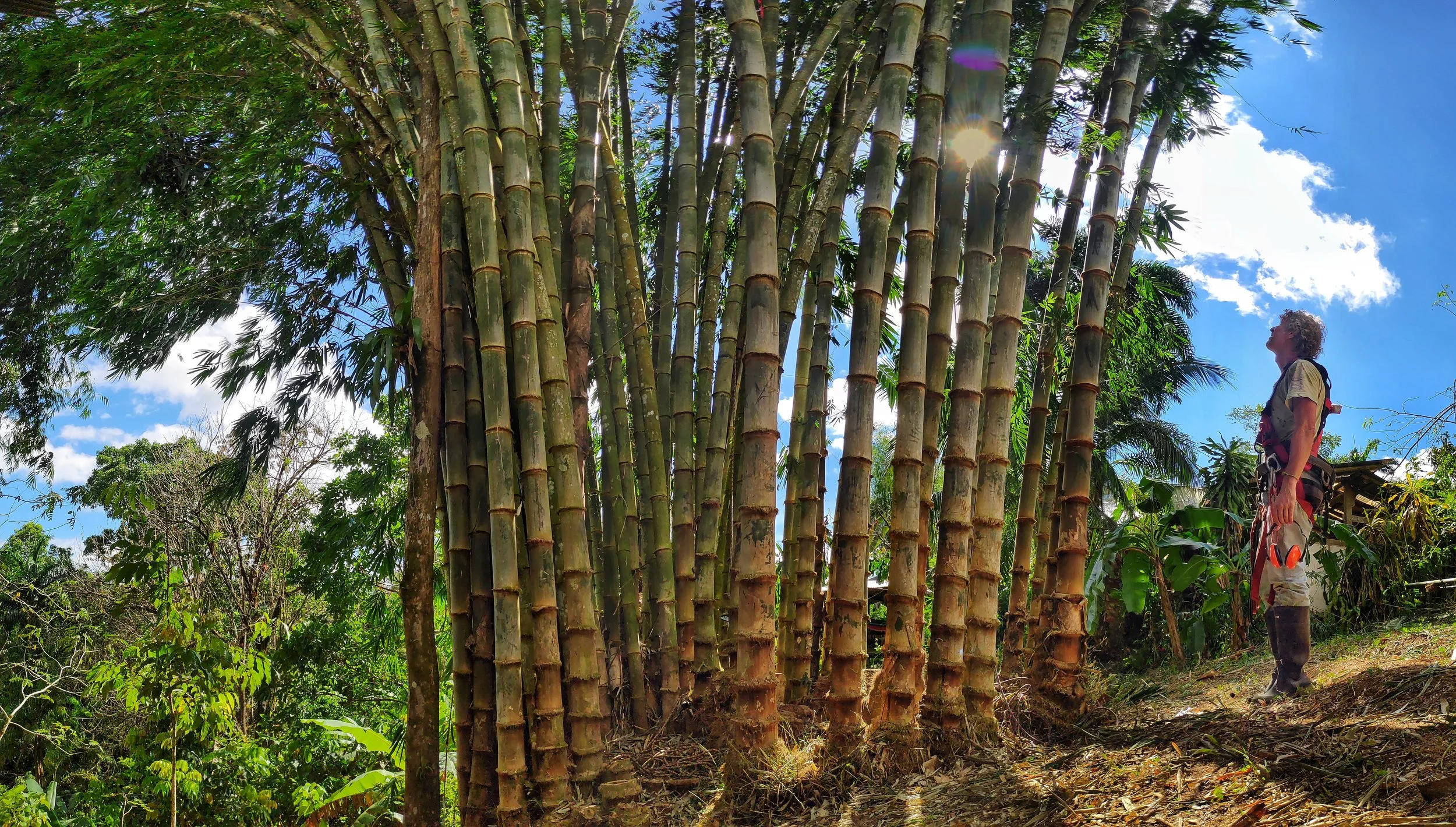
The Wizard and The Prophet — A Book Review that Resolves the Duel
Imagine two completely opposed ways of seeing the world and today’s environmental issues.
The Wizard and The Prophet — A Book Review that Resolves the Duel
By 2022 apprentice Lucas Babinec

Imagine two completely opposed ways of seeing the world and today’s environmental issues. The first represents the Wizards and sees humans as large-scale problem solvers, able to create massive top-down fixes with cutting edge technology and innovations, perhaps outside the bounds of nature. The second features the Prophets and sees humans as needing to consume less, becoming more efficient, less wasteful, adhering to the biological limits all other species live within. These two paradigms became two of the most significant movements within environmentalism over the last 150 years and in The Wizard and The Prophet, Charles Mann dives deep into the lives of the two men who most embodied the two distinct views: William Vogt and Norman Borlaug. Mann also brings a magnifying glass up to their impact on initiatives to modern day dilemmas regarding food, water, energy, and climate change.
The book’s successes
The read was often captivating, really humanizing two prominent people who dedicated their lives to the environmental challenges we face as a species. I feel environmentalism can get quite unapproachable and unrelatable for the typical person. People talking about problems that are far away from one’s own backyard, not only physically, but timescale too (decades in the future). Mann impressively paints the story arc of the lives of these two men, weaving the philosophies and figures that influenced them smoothly into a cohesive narrative. Here’s some essential info about them:
William Vogt ~ aka the Prophet
· Born in “pre-suburban” Long Island in 1902 and dealt with polio and serious family drama
· Saw the degradation of the surrounding natural habitat during his early adulthood as a bird watching enthusiast
· Headed to the guano islands off the coast of Peru in 1939; hired to conduct research about the birds there
· Published The Road to Survival in 1948
· National director of Planned Parenthood from 1951 until 1961
Norman Borlaug ~ aka the Wizard
· Born in rural Iowa in 1914 and watched his family struggle to make ends meet year after year farming the land
· Had ambitions to get out of his small town and studied forestry at the University of Minnesota
· Researched wheat rust in Mexico beginning in 1944; new cultivars of disease resistant wheat discovered in the late 1950s
· Methods applied to wheat in other countries plus rice and other staple crops throughout 1960s, “Green Revolution” coined in 1968
· Won a Nobel prize in 1970
The way Mann structures the middle portion of the book into sections (food production, freshwater supply, energy usage, and climate change) is intuitive. To see the two different approaches directly applied to real life challenges made the whole premise of the book way more relevant.
Mann skillfully explains the process farmers use to create new breeds of a plant as well as the process of photosynthesis as it relates to attempts to create adaptations in new varieties of food plants. There are a couple of helpful graphics to accompany these detailed explanations too (pp140 & pp195).
In the water section it was fascinating to learn about mega-projects and the pitfalls that come up, like lack of funding, ecosystem degradation, and poor efficiency.
The stories in the energy section about the demise of oil boom towns and the machines of the initial solar power movement like the Pyrheliophoro, were particularly interesting.
In the climate change section Mann nimbly bounces between reforestation of deserts in Burkina Faso, a debris mountain named Fridgelandia in post-Katrina NOLA, the burning Jharia coal field, US senate testimonies about change in carbon dioxide levels, and much much more.
The deluge of information would be overwhelming if it weren’t for Mann’s deft ability to sow the threads in the overarching narrative.
Constructive criticisms
While being quite exhaustive in regard to history, the book’s breadth of scope looking at how the ideologies look in modern day solutions is disappointing. For example, the word ‘permaculture’ is not mentioned a single time in the book. One reason that alternative solutions are marginalized is because best-selling authors such as Charles Mann don’t devote awareness to them. Thousands of readers could have been exposed to key words such as permaculture, holistic management, or regenerative agriculture and are instead left to wonder if big technological fixes are our only way out. To his credit, Mann does say in the prologue that the book is not “a blueprint for tomorrow.” However, this contradicts the text on the cover flap that claims “The Wizard and The Prophet is essential reading on the future of our species.”
Another critique is the subtle sensationalization of opposition in the two views. Though they did have their differences, Vogt and Borlaug shared many similarities, most importantly being english speaking white men who grew up in the United States in the early 20th century. Both were immersed in the cultural soup of the times and it follows that they were subject to the same biases as anyone with close proximity to power. Vogt walked in the footsteps of racist elitist conservationists (pp81-82) and Borlaug was influenced by the heads of the big money groups who funded his projects (pp119-120). The inherited intellectual imperialism seeps out insidiously in both the Wizard and Prophet views portrayed in this book. A caption on a photo captures it perfectly:
“According to its architect, Ralph Walker, the modernist IRRI [International Rice Research Institute — An institute based in the Philippines funded by the Rockefeller and Ford Foundations] campus, constructed entirely of imported materials, symbolized ‘a new type of imperialism’ of ‘specialized knowledge generously given to backwards peoples,’” (190).
The passages that compare the two ideologies are rift with divisive language such as: ‘hostilities’, ‘conflict’, and ‘radically different’. Mann even writes, “indeed, the dispute between Wizards and Prophets has, if anything, become more vehement” (7).
It’s 2022 and there’s enough tribalism and opposition going on, at least in my home country of the US. We don’t need another book that pits two groups against each other. Maybe that is what’s needed for some people to build awareness of our species’ ecological situation.
Personally, I would have been much more interested if Mann also focused a bit on the similarities between the two men and their philosophies and how we can integrate both approaches to find the best, most appropriate solutions.
In the end of the prologue Mann asserts that “I wrote this book to satisfy my own curiosity, and to see if I could learn something about the roads my children could take,” and I hope his curiosity has led him into researching more holistic, healing, and regenerative solutions (such as permaculture) in the next book he publishes.

The Bottom Line
The Wizard and The Prophet is exceptional as a history and at the same time, lacking as a source of knowledge for the future. If you want a detailed account of two major establishment approaches to environmental challenges, this is a book for you. If you are more interested in reading about holistic solutions to our global ecological crisis, seeking a source of inspiration, or want to read about ways of bridging different ways of thinking, I highly recommend these books:
All We Can Save
Braiding Sweetgrass
Climate: A New Story
Permaculture: A Designer’s Handbook


Book Recommendations: The Titles I Read this Fall
Last year I wrote a short article about the books that I read while visiting my family last fall in the United States. I received a handful of positive responses after we posted it to the Ranch’s blog and as a result I thought that I’d go ahead and repeat the exercise this year. The books are in the order that I read them. I would recommend and learned something important from all of them. A few of them impacted me profoundly. I will try to incorporate the lessons that I learned in many of these books into my personal and work life.
Book Recommendations: The Titles I Read this Fall
by Tim O’Hara
Last year I wrote a short article about the books that I read while visiting my family last fall in the United States. I received a handful of positive responses after we posted it to the Ranch’s blog and as a result I thought that I’d go ahead and repeat the exercise this year. The books below are in the order that I read them. I would recommend and learned something important from all of them. A few of them impacted me profoundly. I will try to incorporate the lessons that I learned in many of these books into my personal and work life.
Harvest of Empire: A History of Latinos in America by Juan Gonzalez
This book evoked Howard Zinn’s A People’s History of the United States of America and Eduardo Galeano’s The Open Veins of Latin America. It’s an enlightening look at latino history from the perspective of the oppressed and highlights their role, courage and sacrifice in modern American history. If you’re interested in obtaining a more balanced look at Latin American history, add this one to your collection.

The Wolf at Twilight: An Indian Elder's Journey through a Land of Ghosts and Shadows by Kent Newburn
Rich Esposito, a former visitor to the Ranch, gifted me and the Ranch both this book and The Girl Who Sang to the Buffalo: A Child, an Elder, and the Light from an Ancient Sky (see below). They are books 2 and 3 in Kent Nerbern’s trilogy about the author’s time spent with a Lakota elder named Dan and some of his closest friends. All 3 books affected me deeply. I can highly recommend them all. I think that it would be beneficial if they were required reading in public high schools throughout the US. If more people read stories like this, their impact might bring us closer, faster to the type of society that I aspire to live in. Ceremony, slowing down, deep listening, honor and respect are themes that seem to have less and less room in our modern, high-paced, sometimes dysfunctional society. I will be doubling down on my commitment to these lessons as I try to improve myself and dedicate my work to creating an alternative model to the broken communities that many of us live in.

Overstory: A Novel by Richard Powers
This book was recommended to me by a visitor to the Ranch in August. I picked it up as soon as we arrived to the States. It read much like a Barbara Kingsolver novel. Mr. Powers weaves together the lives of a disparate collection of people around the theme of the power and importance of trees. Wow. If you’re a tree lover, get your hands on this book. If you believe in the power of trees, buy this book. If you want to better understand the critical role that trees play in our ecosystem, borrow this book from your local library. If this book were required reading for everyone we might become better stewards of the magical, rooted beings that gift us life.
The War on Normal People: The Truth About America's Disappearing Jobs and Why Universal Basic Income Is Our Future by Andrew Yang
After getting sucked back into the US political scene this fall, I decided, based on Brian “Sparky” O’Rourke’s suggestion, to pick up and read 2020 Democratic Presidential Candidate Andrew Yang’s book about his thoughts on Universal Basic Income (UBI), the state of academia, and the changing landscape of the US economy and how it’s being revolutionized by automation. It was a pretty quick read and one full of provocative and compelling snippets that got me thinking differently about what our future may hold. I like Mr. Yang’s straightforward and compassionate style and it seems as if many people in the US electorate agree as I’ve watched his poll numbers creep upwards ever since he’s walked onto the national stage.

Braiding Sweetgrass: Indigenous Wisdom, Scientific Knowledge and the Teachings of Plants by Robin Wall Kimmerer
This book, loaned to us from 2019 Apprentice Abby Kuchar, is a must-read. The author, based in Upstate NY not far from where I grew up, takes both a scientific and spiritual look at plants and their critical importance to the human species. The book is beautifully written and touches on difficult subjects in a way that feels both profound and accessible. This book should arguably have a place in everyone’s library. My sense is that if you read this book every year that you’d continue to glean something life-changing from it with each read. It’s a perspective changer in the best way. Ms. Kimmerer has a way of bringing together the gifts of indigenous cultures and the practicalities of science to show us a path on how we can live on this planet in a way that might be necessary if Homo sapiens are to stick around much longer.

The Girl Who Sang to the Buffalo: A Child, an Elder, and the Light from an Ancient Sky by Kent Newburn
I read this book in 2 days. I could not put it down. I think that everyone that reads this book, especially white people born in the United States, will benefit from the lessons herein and the important stories that take a candid look at American Indian life. Be prepared to shed tears of both joy and anguish. This was my favorite book of the trilogy (outlined above). I didn’t want it to end. These stories seem critical to share. I want to shout from the top of lungs, “read this book!”. I would like to buy a copy for every high school English classroom and everyone I’ve every met. Mr. Nerburn has a gift for sharing the stories of American Indians in a way that is consequential and educational to non-Indians.

Lakota Woman by Mary Crow Dog and Richard Erdoes
Mary’s straightforward and matter-of-fact storytelling shares the story of the plight of the modern American Indian from the oftentimes unheard woman’s perspective. This is an intimate, candid, first-hand look at the tragedy and beauty of American Indian life. This important story includes first hand accounts of the takeover of the Bureau of Indian Affairs (BIA) building in Washington D.C. in 1972 and the protests and incident at Wounded Knee in 1973. Mary’s a courageous woman who has inspired a generation of American Indian women to be proud of their heritage and fight for the rights of this land’s original stewards.

Trees of Power: Ten Essential Arboreal Allies by Akiva Silver
Akiva Silver, the founder of Twisted Tree Farm in Spencer, NY not far from my mom’s home in Binghamton, NY, is an agroforestry innovator, farmer and nursery manager who’s having a profound impact in this region of the United States and beyond. I love his philosophy and dedication to spreading the gospel of temperate perennial tree producers. The book is inspirational and practical with the second half of the book focusing on 10 agroforestry species that with large scale plantings could get humans thinking differently about food production and how to feed the world. Akiva and his family are doing important work in this part of the world. If you’re in the Northeast, check out his farm and nursery and if you’re looking for trees to plant on your farm, in your yard, or throughout your community, Twisted Tree should be at the top of your list to check out.
Blood and Thunder: The Epic Story of Kit Carson and the Conquest of the American West by Hampton Sides
This book was recommended to me by my sister-in-law Tracy. It’s about the life of frontiersman Kit Carson and the conquest of the the American West by the U.S. government. It’s a tragic recount of the continuous wars between Britain, Spain, Mexico and various American Indian tribes and the fledgling United States. The common thread that runs through this story is one of deception, broken promises and treaties, massacre and murder. I felt that Mr. Sides did a reasonable job in presenting a somewhat objective history of the horrors of how the country of my birth realized its “manifest destiny” through the eyes of one of its most well-known adventurers and pioneers.
Happy reading to you all. I’m always looking for book recommendations so let me know if there’s anything in your library that you think that I would enjoy and/or learn from.
Abrazos,
Tim

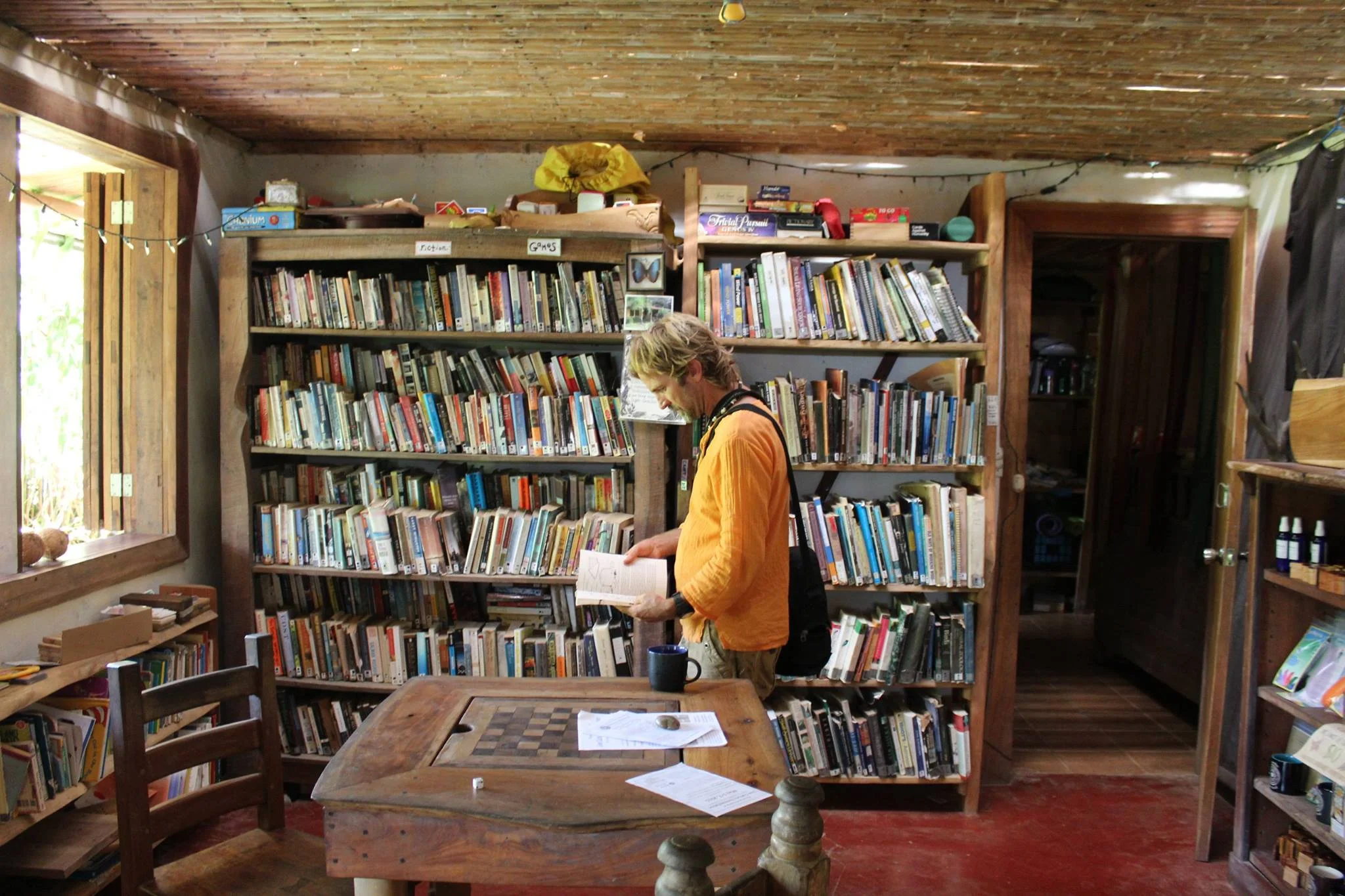
Ranch Reading Recommendations: 8 Great Books I Read This Fall That Relate To Our Work
During my annual visits to see family in the United States, I oftentimes have the opportunity to catch up on some reading that regularly alludes me during the busy seasons here in Mastatal. More than any year in recent memory, I felt as if I hit the jackpot with the titles that I was recommended, came across, and picked up this fall.
Ranch Reading Recommendations: 8 Great Books I Read This Fall That Relate To Our Work
By Tim O’Hara, Ranch Core Team
During my annual visits to see family in the United States, I oftentimes have the opportunity to catch up on some reading that regularly alludes me during the busy seasons here in Mastatal. More than any year in recent memory, I felt as if I hit the jackpot with the titles that I was recommended, came across, and picked up this fall. Here’s a quick glance at them, all of which I’d suggest to anyone looking to add a good volume or two to their personal or professional library. I think that all of these titles are relevant to our work at the Ranch and the greater work that so many of you that read our blog are interested in.
The Story of the Human Body: Evolution, Health and Disease by Dr. Daniel Lieberman
An informative and thought-provoking book for readers interested in human and cultural evolution and how they have come together to impact our specie’s health in modern times.
The Wizard and the Prophet: Two Remarkable Scientists and their Conflicting Visions of the Future of the Planet by Charles Mann
A dissertation about two philosophies on how to tackle current problems of feeding a growing global population and dealing with climate change. One view contemplates technological and engineering solutions while the other espouses resolutions with a softer touch on our environment.
Neither Wolf Nor Dog: On Forgotten Roads with an Indian Elder by Kent Nerbern
Nerbern documents the thoughts, beliefs and stories of a Lakota Sioux elder in this eye-opening, sometimes heartbreaking, and other times hopeful look at how humans might change the way they live to find common ground in addressing past atrocities and future challenges. It had been quite a few years since I read a book focusing on Native American challenges. I couldn’t put this book down once I started. Some other titles related to Native American history that I’ve read in the past and also recommend include Peter Matthiesson’s In the Spirit of Crazy Horse, Dee Brown’s Bury My Heart at Wounded Knee, John Neihardt’s Black Elk Speaks, and Sherman Alexie’s Reservation Blues.
Lost Connections: Uncovering the Real Causes of Depression and the Unexpected Solutions by Johann Hari
An eye-opening book about the nature of anxiety and depression and some surprising strategies to deal with these increasingly challenging and difficult social issues. I read another of Hari’s books last fall entitled Chasing the Scream: The Opposite of Addiction is Connection. I raced through both books. Hari’s writing style is accessible, absorbing and compelling.

How to Change Your Mind: What the New Science of Psychedelics Teaches Us about Consciousness , Dying, Addiction, Depression and Transcendence by Michael Pollen
A fascinating read about the history of psychedelics and their potential use to address social problems such as addiction, depression and terminal illness. Pollen strays from writing about food for the first that I know about in many years. I think that this is a courageous attempt to shed light on an oftentimes contentious, misunderstood and polemic subject that deserves another look by researchers, academia, medical professionals and society as a whole.
Bringing it to the Table: On Farming and Food by Wendell Berry
A nice compilation of essays about food and farming. Over the last decade or more I have repeatedly returned to Berry when I feel the need to reground. His essays are a refreshing look into the darkness of what has become of conventional agriculture in the United States and elsewhere.
The Gift of Good Land by Wendell Berry
A great collection of short essays by one of my favorite authors. Berry’s compositions never fail to get me thinking deeply about the topics that are most relevant to my future.
I’ll also add another book even though I haven’t finished it yet as it is offering a fascinating perspective about humans and our current predicaments.

Sapiens: A Brief History of Humankind by Yuval Noah Harari
The book goes deeper into some topics populated by Jared Diamond’s Guns, Germs and Steel and Charles Mann’s 1492. It’s a fascinating read that includes new research and theory as to how we have become the planet’s dominant species with insight as to why that argument is changing so quickly and alarmingly as humans impact the natural planetary systems that sustain them.
I found all of the books on this list riveting, well-written and provocative. They all had me at one time or another thinking about what I could be doing better as a father, business owner and global citizen. The information that I ingested was at times difficult to read, inspiring, despairing, hopeful and motivational. As I always appreciate personal recommendations for new books, I wanted to share with others the topics that have most recently been on the forefront of my evolving brain.

Mastatal’s Local Library

Help Improve Workshop Access for Central Americans
Workshops, one of many forms of education, are expensive to organize, risky to run, and an immense amount of work to pull off and host well. They can also be transformational and inspirational for the participants and provide them with an amazing educational experience. We have been offering life-changing courses and classes in a vast array of areas related to sustainability for over 15 years
Help Improve Workshop Access for Central Americans
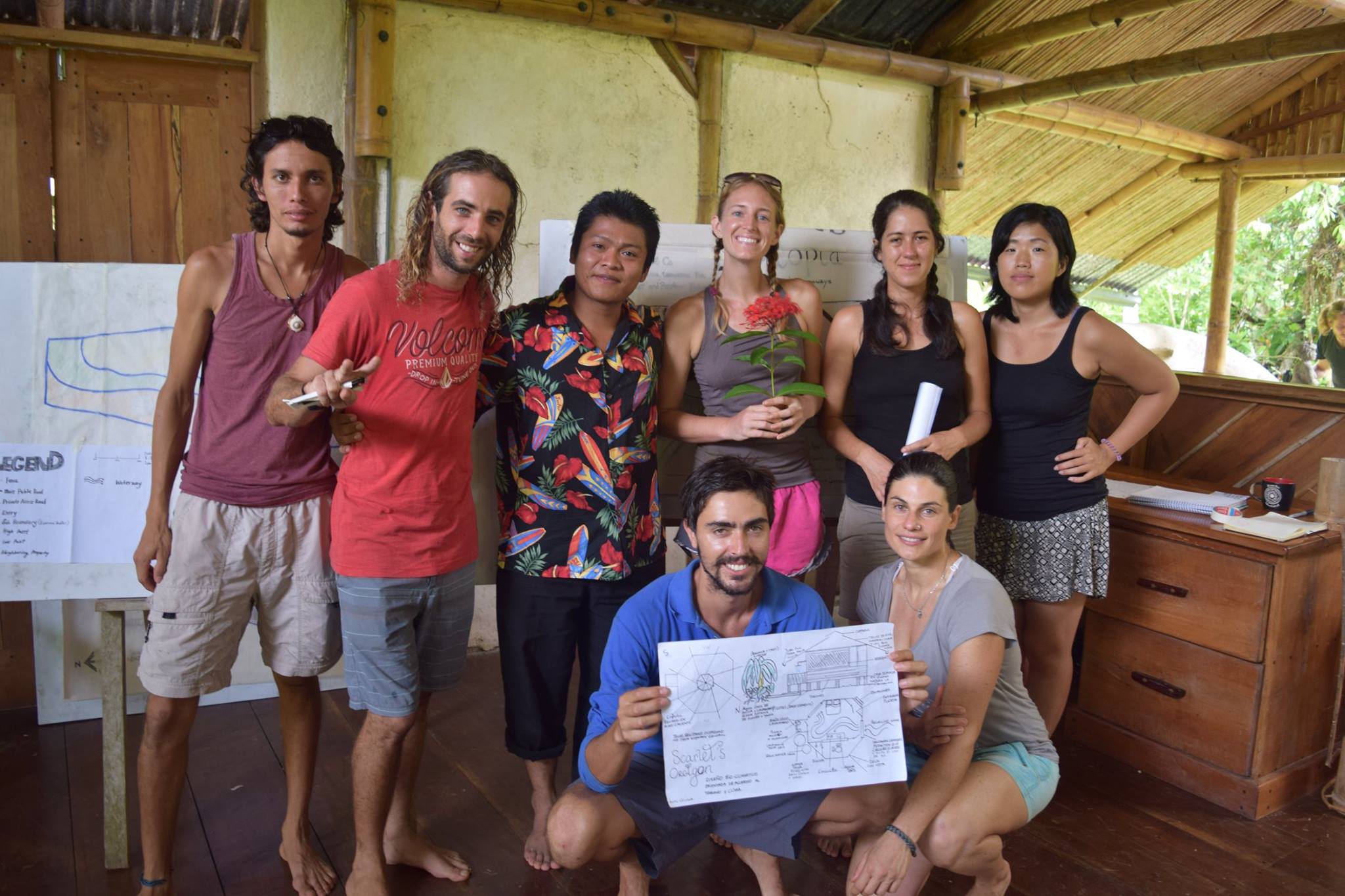
By Tim O'Hara
Workshops, one of many forms of education, are expensive to organize, risky to run, and an immense amount of work to pull off and host well. They can also be transformational and inspirational for the participants and provide them with an amazing educational experience. We have been offering life-changing courses and classes in a vast array of areas related to sustainability for over 15 years. During this time our core team has reflected on how to assure that our offerings are accessible to as many people as possible, especially low-income and future leaders in our region, without running our business into the red. It’s been a fine line to walk and one that we’ve commonly fallen on the wrong side of.
In 2015 we began a discussion about how to provide Central Americans with options to apply for economic assistance to attend permaculture, natural building and other sustainability related courses in our region. It is not uncommon for regional workshops to cost working Central Americans months of pay or more. Moreover, workshop students commonly lose income and make other sacrifices while away from their obligations at home. It’s a difficult situation that leaves these opportunities out of reach to the majority of people that are interested in them. From our observations, there are a growing number of people in our area that have a strong desire to participate in courses which will expand their horizons, expose them to valuable networking opportunities, and provide them with hard skills that they can take back to their communities. With all of this in mind, the idea of a scholarship fund began to emerge and make increasing sense.

Mastate Charitable Foundation (MCF), a small non-profit under the umbrella of the Marion Institute, achieved some important fundraising successes in 2015-16 that allowed them to create a Central American Scholarship Fund Program that provided seven partial scholarships to our Permaculture Design and Wilderness First Responder Certification courses and 2017 Apprenticeship in Sustainable Living.
Based on these favorable developments and the associated positive experiences participants had, we have been encouraged to look for ways to expand this program so as to meet the growing demand for these types of opportunities in the future.
Rancho Mastatal has already received over 20 scholarship applications for classes taking place in 2017. We believe that there are few better investments than supporting meaningful and empowering education for leaders rooted in their communities. In too many cases, populations worldwide have suffered the degradation of their communal structures from years of neglect and shrinking budgets, brain drain, worsening economic situations, and environmental atrocities that make living in certain areas of the world less viable. To rebuild will require courageous leadership, hard work and resources.
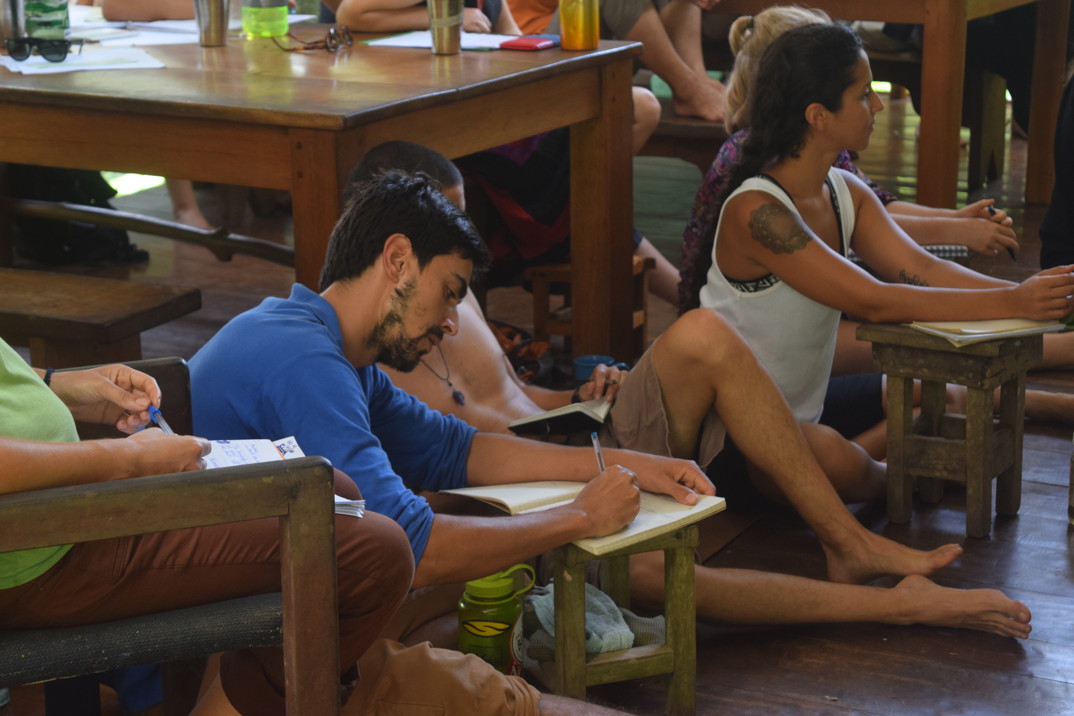
If you or someone you know would like to sponsor one or more scholarships during the upcoming calendar year please learn more about MCFs charitable work here. Tax deductible donations for the Central American Scholarship Fund can be made here. General donations can also be made on the MCF website here. The opportunities provided by your assistance can change the trajectory of not only a scholarship recipient but of their entire community. Help us to support a more sustainable future for Central America.
NEWS FROM AROUND THE PERMACULTURE COMMUNITY
We love food preservation at the Ranch, usually by means of fermentation. One of our challenges is finding good supplies, e.g. food grade, appropriate scale, etc., here in Costa Rica. But for you all in the States, you might check out Pantry Paratus for a great selection of supplies.
As our team at the Ranch looks toward the future, we've found much inspiration in the recent writings on commoning by David Bollier. We highly recommend the article Commoning as a Transformative Social Paradigm. You may also want to check out the workshop Reinventing the Commons: Social Ecosystems for Local Stewardship & Planetary Survival.
Abrazos,
The Ranch Crew
Categories
Topics
- Agriculture 6
- Agroforestry 21
- Animals 2
- Apprenticeship 19
- Appropriate Technology 6
- Backpacking 1
- Bananas 1
- Basic Pantry 4
- Biochar 1
- Books 3
- Build Your Own Home 1
- Central America 5
- Chiles 1
- Cinnamon 1
- Clay Carving 1
- Climate 2
- Climate Change 1
- Cob oven 1
- Communication 5
- Community 24
- Compost 2
- Composting Toilets 2
- Condiments 1
- Conservation 2
- Cooking 4
- Costa Rica 18
- Design 10
- Earthen Construction 10
- Eat Local 2
- Ecohome 1
- Education 9
- Environment 3
- Ethics 4
- Farm to Table 12
- Fasting 1
- Fermentation 14
- Food 22
- Food Choices 8
- Food Forest 8
- Food Processing 15
- Food Systems 12
- Gap Year 1
- Gardening 5
- Ginger Beer 1
- Harvest 2
- Health 12
- Healthy living 5
- Homemade 2
- Homestead 8
- Internet 2