

BLOG
Stories, articles, and updates from the Ranch community.
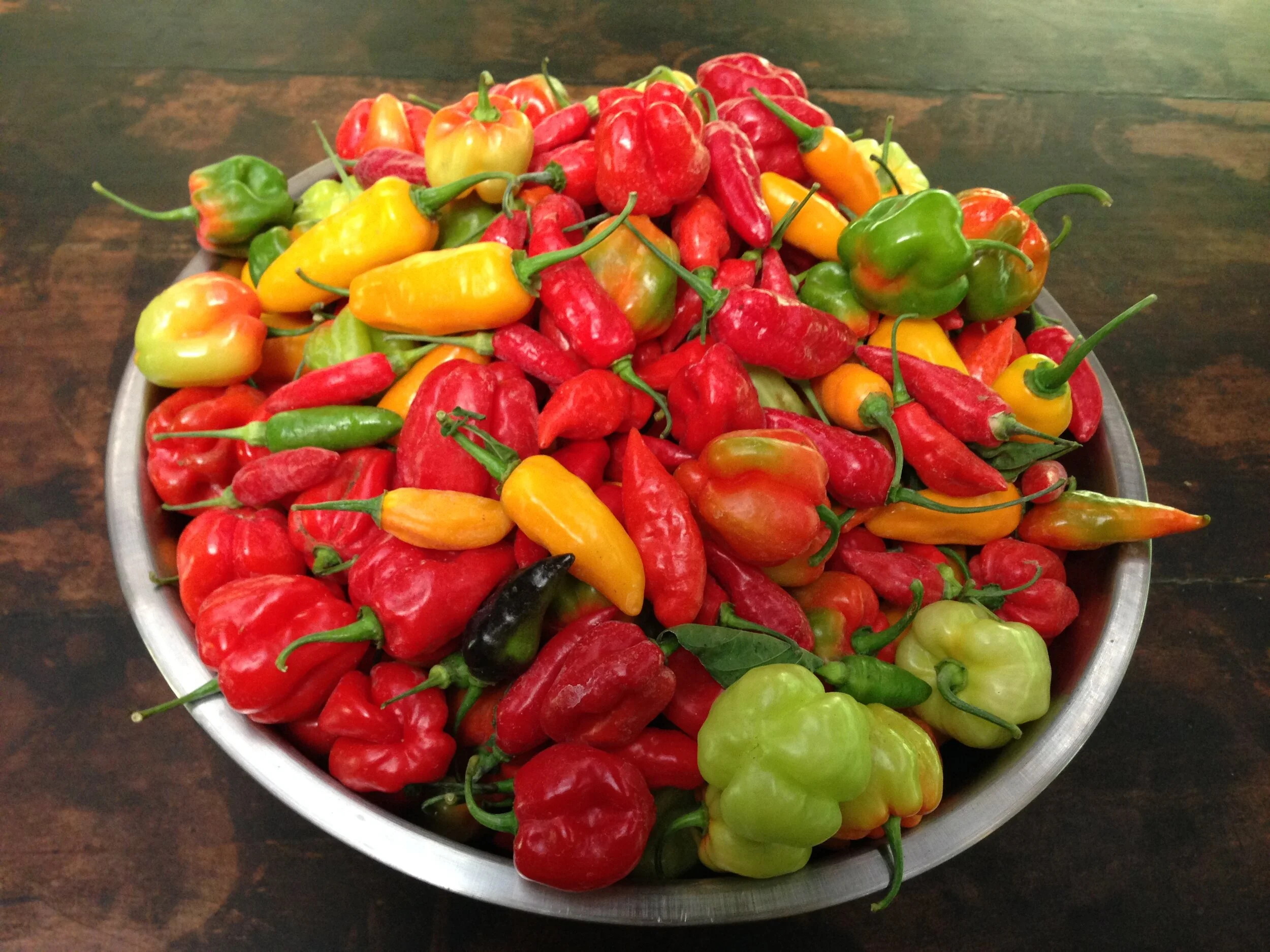
Farm to Table: Chilie Recipes
What do you do with all those chiles?!
Farm to Table: Chile Recipes
By Marco, Apprentice 2020
Before we get hot and saucy…
…is it chile, chilli, or chili? Good question. I usually hedge my bets and switch between the three spellings. Actually, all of them are correct. They all come from the Aztec Nahuatl word “chilli”, which became chile in Spanish and eventually the anglicised chilli. Chili, with one l, is the American spelling and is the reason my spell check is red-lining me right now. Anyway, glad we got that out the way. Moving on…
A Brief History of Chiles
When Columbus first landed in the West Indies (in modern-day Dominican Republic and Haiti) in 1492, he noted that the locals (Arawak) were preserving meat using pepper juices, specifically one type called “axi”. This is where the Spanish word aji was derived. (It was around this time that they noticed the Nahuatl word “chilli” being used as well). These plants were very valuable to the natives and were used extensively in most of their cuisine. The Spanish discovered that the peppers were easily preserved when dried and that the seeds kept well, leading to their far, wide and rapid dissemination throughout the world. (Thanks also, in no small part, to birds, of course. Cheers guys.)
Peppers vs. Chiles
One last bit of nomenclature clarification is the common confusion between the various peppers – bell peppers, black/white pepper (peppercorn) and chilli peppers. This goes back again to Columbus and his crew. Back in the day, peppercorn was as valuable as silver to Europeans. Thus, when they arrived in what they thought was India, they also expected to find peppercorn. Instead they found chillies. Nobody’s sure whether they dubbed them “pimiento” (pepper in Spanish) because they mistook them for peppercorn, or if they were trying to pull a fast one…my money’s on the latter. Learn more about black pepper from Dani’s last article “Life of Spice.”
Farm to Table Chile Recipes at the Ranch
At the Ranch, we try our best to follow permaculture principles. A couple of big ones are obtaining a yield and transforming/repurposing waste. Hence farm to table recipes abound and we are consistently trying to find novel ways of using our yields and decreasing our reliance on outside produce. This dry season has been particularly productive for our chillies and has hence inspired some spicy condiment creations. Below are a few spicy specials you can try at home:

Different types of chiles drying
Tabasco Sauce
Tabasco is perhaps the most famous hot sauce ever made. First synthesized in 1850, when Maunsel White decided to boil and mash up some chiles he’d brought back from Tabasco, Mexico and add vinegar and salt. The peppers found their way into middle-aged banker Ed McIlhenny’s hands whence they were blended, lacto-fermented for 30 days (nowadays they are fermented for 3 years in oak barrels) and then put into wine vinegar, creating the hot sauce we all know and love today. It’s a simple and delicious way to preserve chiles and comes in two varieties: quick and slow.
Ingredients:
· Chiles
· Vinegar
· Salt
Method 1 (quick version)
Step 1:
Chop up the chiles and weigh. Add 2% salt by weight (e.g. 100g chiles = 2g salt) and mix. Put them into a large container and make sure they are completely submerged in brine – you might have to add brine to achieve this. [Brine = water + 2% salt]. Leave the chilies to ferment for 1-2 weeks.
Step 2:
Remove chiles from brine (keep the brine!) and blend them into a chunky paste. Put the chiles back in their brine and add vinegar. Leave to ferment another week.
Step 3:
Strain off the liquid – this can be bottled and used as (quick) Tabasco.
[Pro-tip: The chilli solids can be dehydrated (in the sun or in an electric dehydrator) and used as chili flakes!]
Method 2 (slow/proper Tabasco version)
Step 1:
Same as quick version
Step 2:
Same as before - strain, blend and put into a jar but don’t add vinegar or brine this time. Place a muslin cloth (we just use a repurposed pillowcase) over the top of the jar and press down.
Step 3:
Add a thick layer of salt on top of the cloth – this will help seal the sauce whilst absorbing much of the moisture. This salt can then be dried and used as chile salt, once the sauce is ready.

Place cloth on top of jar and press down

Add thick layer of salt

Fold edges into the jar and cap
Step 4:
Leave to ferment for 6 – 36 months.

Chiles fermenting away

Finished Tabasco Sauce!
Chilli Jam (approx. 800ml)
This is one of my favorite condiments. It goes great with anything fried, meaty, cheesy and/or salty. Yum. The ingredients are few and the method easy. You can play around with this one as much as you like, substituting, adding and subtracting ingredients to your heart’s (and tongue’s) desire…
Ingredients
- 4 tomatoes
- 4 bell peppers
- 20 chiles
- 2 onions
- 2 heads of garlic
- 5-10grams of ginger
- 700grams sugar
- 300ml malt/balsamic vinegar
- [fruit of your choice]

You can smoke your chiles to give it a smoky taste!
Method
- Start by blending everything (except the tomatoes, sugar and vinegar) to a chunky consistency.
- Roughly chop the tomatoes and chuck them into a pot over medium heat. Cook them until they are softened up and the skins are starting to come off (5mins).
- Throw in the rest of the blended ingredients. Stir and cook (2mins).
- [You can throw in any fruit of your choosing here to give a unique flavour to the jam. We've had success with: pineapple, passion fruit, pickled limes, papaya and roasted zucchini.]
- Add sugar. Stir until dissolved (2mins).
- Add vinegar. Stir.
- Cook on a low-medium heat stirring occasionally until the jam has cooked down to a jammy consistency (30-45mins).
- Leave to cool - flavours will combine and take on new dimensions once the jam has cooled!
- Put in a glass jar and store in the fridge. Should keep for at least 3 months.
Jalapeno & Lime Pickle Hot Sauce
This is a two-step recipe that involves an initial lacto-ferment. Like the chilli jam, you can get creative and substitute the lime pickle for other fruits.
Ingredients
- 20+ Jalapeno peppers (or another chile of your choosing)
- 2 onions
- 2 heads of garlic
- 5-10grams ginger
- 2 carrots
- 250ml orange juice syrup*
- 2 lime pickles / juice of 2 limes

Lime Pickle
Method
Step 1 - Lacto-ferment:
- Roughly chop the: 20+ Jalapeno peppers, 2 onions, 2 heads of garlic, 5-10cm ginger, 2 carrots
- Weigh the total and add 2% salt. Mix.
- Put into a jar and submerge in brine (salt water).
- Leave to ferment for 1-3 weeks.
Step 2:
- Take your lacto-fermented ingredients and blend them (brine 'n all) to a paste.
- Mix in orange juice syrup.*
- Finely chop lime pickles / squeeze the juice of 2 limes and mix into sauce.
- Bottle it up and enjoy!
*Make the syrup by mixing 1 part orange juice to 1 part sugar. Cook over a low heat until the liquid reduces down to a syrupy texture.
So, there you go. Three simple chili sauce recipes to spice up your meals and make your grandmother proud. Hope you enjoy them as much as we do! Stay tuned for more farm to table tips, tricks, and recipes!


Life of Spice: Pepper
Farm to table is an inspiring movement whose time has come. As anxiety about our environment and health increases, awareness is spreading about the impact our diet has on not just own well-being, but the well-being and future of the entire planet. Alarms are going off worldwide. Our eyes are opening. People everywhere are waking up. We’re waking up… and eating breakfast.
By Dani, Apprentice 2020
Farm to table is an inspiring movement whose time has come. As anxiety about our environment and health increases, awareness is spreading about the impact our diet has on not just own well-being, but the well-being and future of the entire planet. Alarms are going off worldwide. Our eyes are opening. People everywhere are waking up. We’re waking up… and eating breakfast.
Eating Black Pepper
It’s a typical morning in the conscious kitchens of North America. Today’s special is one of my favorites, a spinach omelet with caramelized onions and a side of roasted potatoes. The eggs are from a permaculture farm’s weekly CSA box, the onions and potatoes from the local farmers’ market, and the spinach is from the garden in the backyard. The omelet slides off the skillet, smothered in rich butter from a small scale dairy farm nearby. The potatoes, piping hot from the oven, make a great companion on the plate. It’s a mouthwatering sight, dotted with black pepper for a little bit of spice.
Mmmmmm, pepper: king of the spices, maker of meals, creator of cuisine. The pepper in our breakfast today came from… somewhere. Somewhere local? Probably not. Spices are the sorcery of every meal, turning bland into brilliant, mediocre to magical. Most of us are blessed with a diet full of spice, but when we talk about eating local, the spice rack often gets overlooked. One way we can work towards restoring the health of our bodies, our minds, our society, and our home planet is to bring more awareness into our diets. Think local. Practice permaculture. Eat farm to table. We hear these terms all the time now, but while people talk about where the eggs on their breakfast table came from, what about the pepper on the eggs?
Black pepper is consumed more than all other spices put together. It sits next to salt on the tables in every diner in America and in most people’s homes. It is hard to imagine a kitchen without pepper, but it hasn’t always been this way. The globalization of food has been happening for so long, a lot of us are completely unaware of which foods are native to where. Chickens originally came from the jungle. Asia used to be without chilies, Italy without tomatoes. What does eating local mean, and how long has it been since people actually ate that way? We’re making big efforts to be conscious consumers, but how often do we stop and appreciate the spice in our lives?
Origins of Black Pepper
Pepper is native to India and is one of the spices that sparked the global spice trade and in turn the globalization of food. Pepper has been traded for thousands of years, and there are even references to pepper found in Egypt from 2600 B.C. For centuries, it spun the wheels of the trade world and brought wealth to many merchants, and it wasn’t only a way of making money. Pepper itself became money and served as hard currency throughout much of the middle ages. In some places, people’s wealth could actually be judged by their pepper assets. Imagine if they could see the casual way in which it is consumed today.
The Value of Black Pepper
Currently, the average price of pepper across the globe is $4.34 per kilogram. These days, Vietnam is the leading country in pepper production, producing about one-third of the world’s pepper. It’s followed by India. Vietnam is also the leading consumer of pepper at 166 thousand tons per year. Again, India follows at 88 thousand tons. That makes sense, right? The places producing pepper are consuming it, local eating. The third biggest consumer of pepper is the USA at 68 thousand tons per year. That is a lot of pepper for a place that doesn’t produce any. On Amazon, a kilogram of McCormick’s Whole Black Pepper costs about $30. The biggest cost in pepper production is labor, but the average price farmers collect for pepper is just $2-$4 per kilogram.
Farm to Table Spices
Understanding where things grow, how they are processed, and who grows them is one way to create a deeper appreciation and understanding of the food we eat and nourish our connection to the earth from which it grows. Trying to live a life embodying permaculture values at Rancho Mastatal has given me a wonderful opportunity to see how different foods are grown and processed. Until recently, I had definitely taken spices for granted. My experience with pepper here has led to reflection on the spice in my life and an appreciation for the sources behind the sorcery. So how does pepper get from the farm to our table?
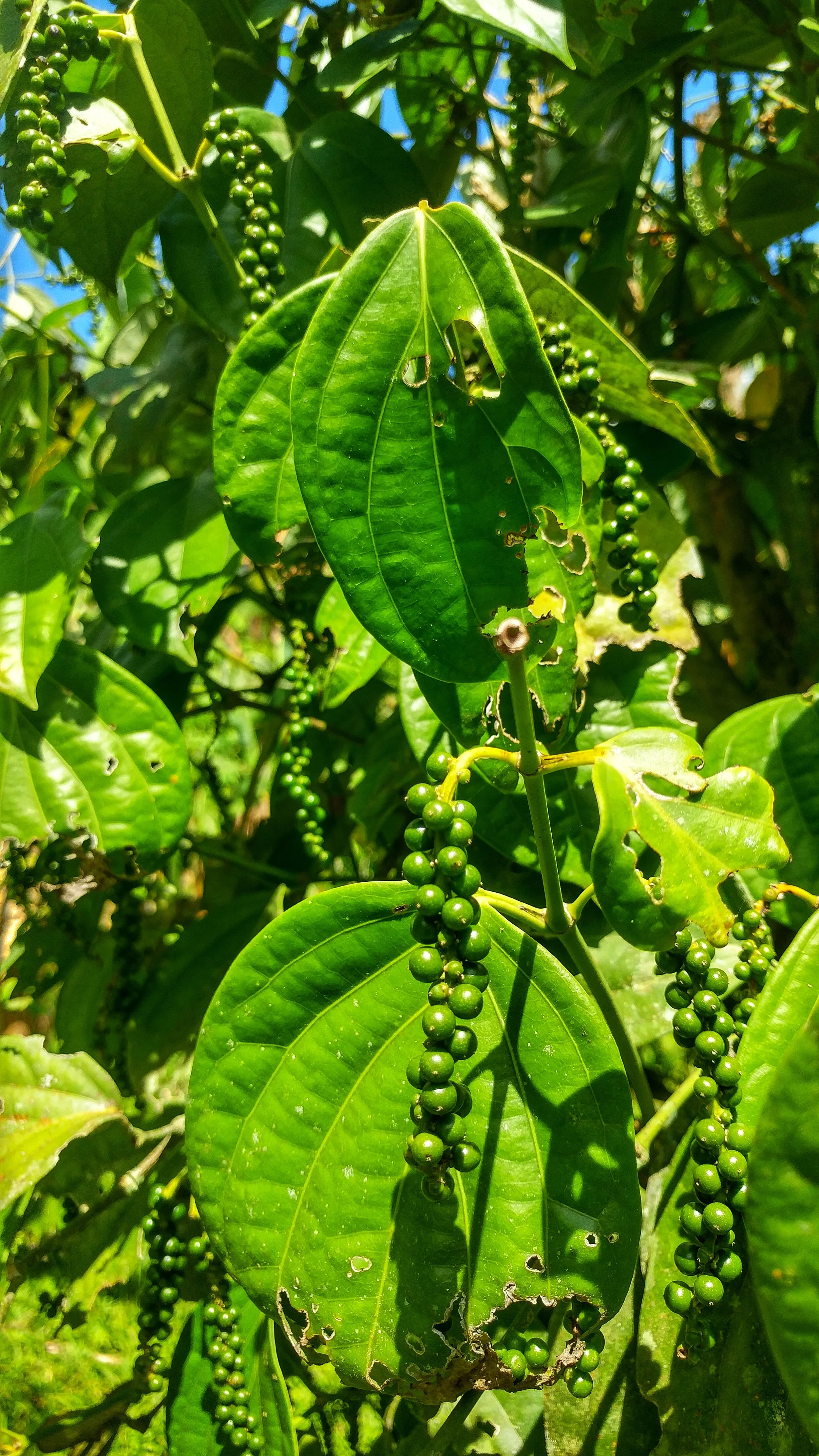
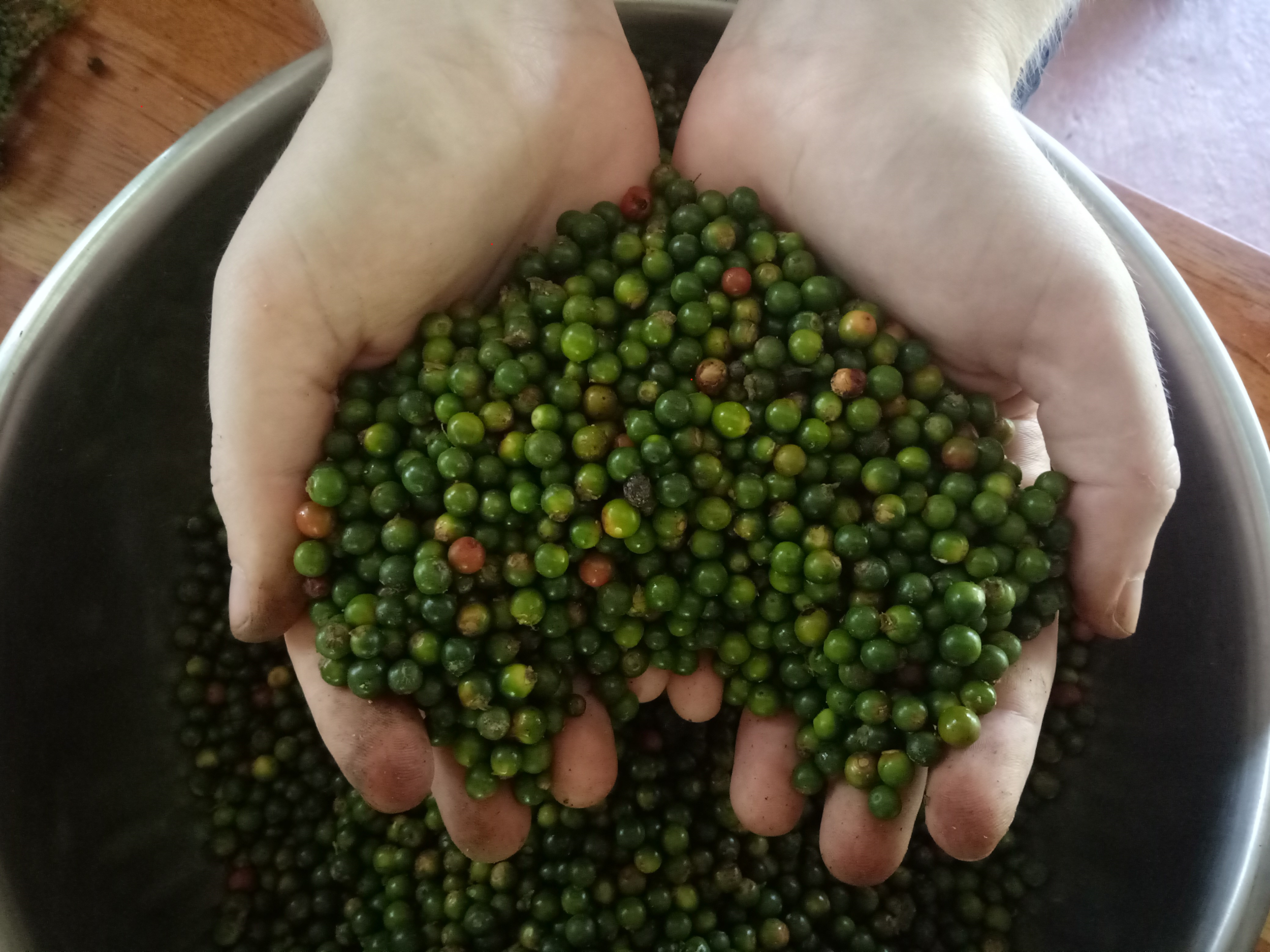
That black pepper on our omelet and potatoes is from a fruit, often referred to as a berry or peppercorn. It grows on a tropical climbing bush, and the white pepper in so many well-loved curries comes from the same plant. The pepper plant is a vine grown best on a living post, from small bushes to massive trees. Here at the ranch, we grow pepper on Gliricidia sepium, (known as madero negro in Costa Rica) a nitrogen fixing tree. Pepper has its origins in forest ecosystems, so it is a fitting plant for a permaculture food forest in the tropics.
How to care for your Black Pepper plant
To maximize yields, pepper plants need to be pruned properly. Once the vine is at least 8 nodes tall, it can be pruned from 3-4 nodes up from the base of the vine, just above a node. After pruning, the plant will send up two new shoots, and the vine cutting can be propagated by placing the stem in soil where it will grow new roots. People have given pepper new roots all over the world. Global trade increased the demand for pepper and sparked efforts to grow it in tropical places across the globe. Now, pepper is grown in 26 different countries, including Costa Rica.

Red Pepper and Green Pepper

White Pepper and Black Pepper
How to Process Peppercorns
The first time I had pepper that was farm to table was here at Rancho Mastatal where we spent a day harvesting and processing pepper. Pepper is ready to harvest once one of the fruits in a bunch has turned red. First, the we collected the peppercorns in bunches and took them off the branches. We then separated the red berries from the green ones. The red berries become white pepper by soaking them in water for a day and peeling off the red flesh to reveal the white seeds. The seeds are then dried to make the white pepper on our spice racks.
The green berries we picked were destined to become black pepper. We blanched these for 1-2 minutes which starts an enzymatic reaction that turns the pepper black. Then we spread them on a drying rack. They can either be sun-dried, or you can use a dehydrator. Pepper dries to one-third of its weight.

Though the steps may seem simple, this was a very labor intensive process. It took seven of us 3 hours to harvest and process 4.5kg of pepper which dried down to 1.5 kg of pepper. This is about 40 dollars’ worth of pepper. It is truly a wonder that pepper is relatively inexpensive and so readily available. I wonder how many working hands and how many miles it has taken to bring pepper to my meals all these years.
Farm to Table Black Pepper
Farm to table has become a mainstream movement, and the growing awareness about the connection between our health and the well-being of our planet in relation to our diets is such a positive shift in our consciousness. But how would all those amazing farm fresh, local foods taste without spices? What would our omelet be without the king of spice itself?
Permaculture & Spices
While I don’t think people should go into their kitchens and empty their spice racks, I do think it’s important to appreciate all the resources and labor that go into every food we eat as well as understand the history of how it got from the forest to our table. Part of the word permaculture is culture, and it is incredible how pepper affected cultures everywhere and added to a permanent globalization of foods. It influenced the way people prepare, experience, and appreciate food. It changed people’s tastes. It changed cultures’ cuisines. Pepper was a powerful initiator in the transition away from eating local. With the globalization of our diets going back millenniums, what does it mean to truly eat local these days? As I continue to live my life of spice, I will keep asking these questions.
Hope you have a better understanding of the process of black pepper and how it gets from the vine to your grinder.
Speaking of spice… check out our past blog posts about vanilla!
And stay tuned for Dani’s next article on Life of Spice, featuring cinnamon!
Sources and Further Reading
Heinerman’s Encyclopedia of Healing Herbs and Spices by John Heinerman
Black Pepper- Piper Nigrum edited by P.N. Ravindran
Spices – A Global History by Fred Czarra
Farm to Table Banana Vinegar
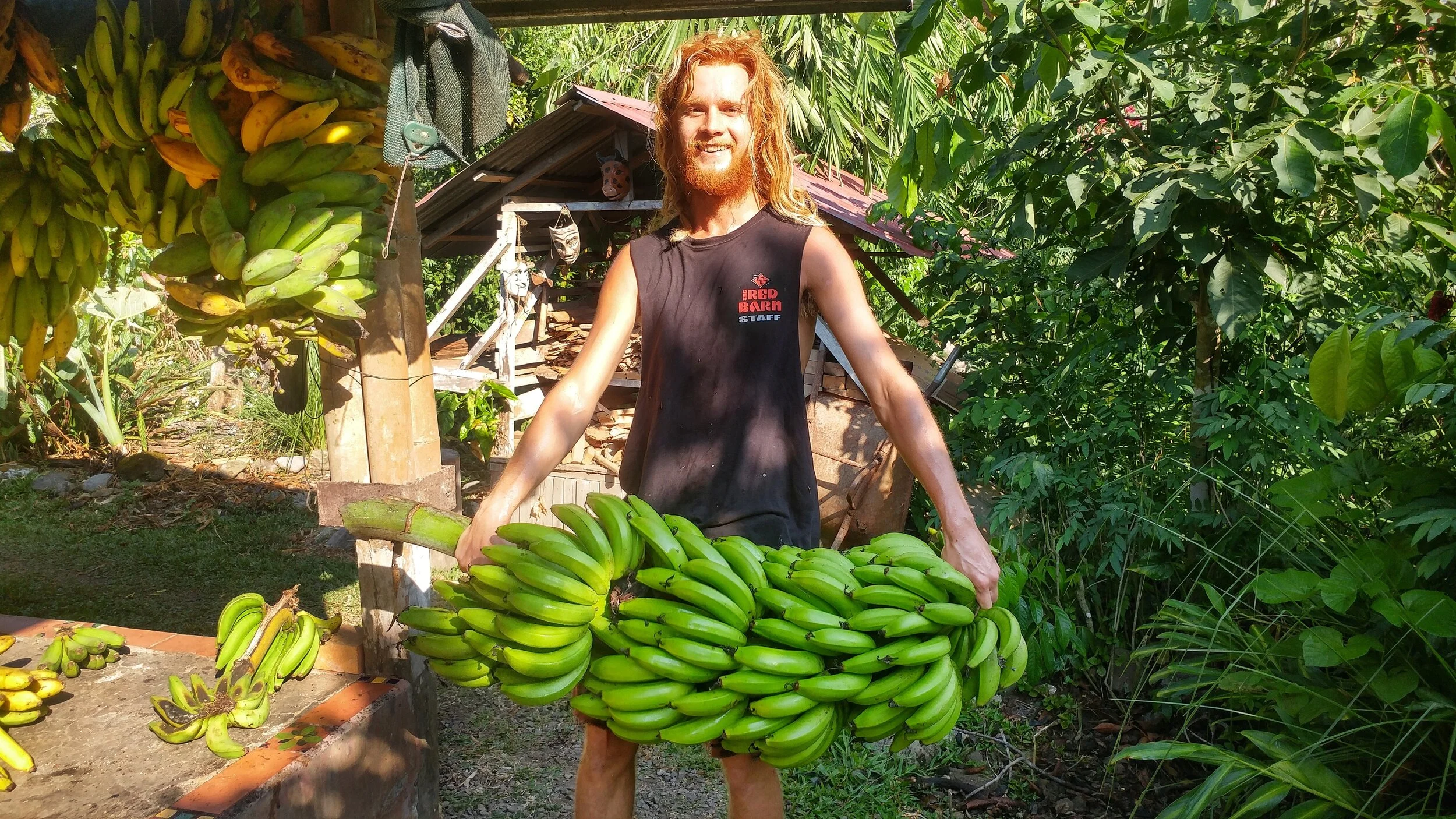
I know, it sounds like a weird flavour combo. Sour banana? Whaaat? But it works and it’s tasty. This recipe is a very accessible way of doing farm to table whilst utilizing and transforming “waste” into something productive and delicious – permaculture 101.
By Marco, Apprentice 2020
Permaculture Vinegar?
I know, it sounds like a weird flavor combo. Sour banana? Whaaat? But it works and it’s tasty. This recipe is a very accessible way of doing farm to table whilst utilizing and transforming “waste” into something productive and delicious – permaculture 101.
What makes a Vinegar
Firstly, let’s take a quick look at what vinegar is. The word vinegar comes from the Latin vinum acer – literally “sour wine”. Alcohol is fermented by a large family of bacteria called Acetic Acid Bacteria (AAB), who turn ethanol into acetic acid. These little guys are everywhere - airborne and on the surface of most living things including me, you and, as it turns out, bananas! AAB are aerobic, which means they need air (oxygen) to do their thing, unlike Lactic Acid Bacteria for example (the main players in lactic acid ferments, such as kimchi and sauerkraut) which are anaerobic.


Check out our last blog on home-brewing your own alcohol.
Farm to Table Vinegar
So, here is a breakdown of how we make our farm to table banana vinegar here:

Go out and harvest them bananas, or maybe you already did that and you have far too many ripening… so next
With our main and only ingredient: bananas we don’t even need to peel them. You can just smoosh ‘em all up, skin n all, and chuck ‘em into a bucket. Beautiful. This process works best when they’re very ripe. We’re talking leaky, mushy and black. The ones nobody wants to eat, which sit around in the fruit bowl way too long, eventually they get picked up by the loser of rock, paper scissors and thrown out with an overly extended arm and a wincing face… Yeah. These are the ones that make great vinegar. Waste? Nay, but a resource in the wrong place. It’s farm to table, not farm to trash.
After you’ve smushed them all up and put them into a large container (we use a 5 gallon bucket, but you could use any large enough container), all you need to do is leave it and wait for the acetic acid bacteria to get to work on turning the alcohol into acetic acid. The time this takes varies depending on your conditions and the state of your bananas, but somewhere between 1-3 months. Remember that AAB like oxygen, so keeping a breathable lid on top of your vinegar, such as a muslin, will help speed up the process. o You could also attach an air pump and air stone (such as one that you’d use in an aquarium) to pump and diffuse air into your vinegar. This should significantly decrease fermentation time.
[TIP: you can hammer a nail into the bucket near the bottom. Leave the nail in until you’ve finished fermenting. Once your vinegar is ready, you can remove the nail and all the liquid in the bottom of the bucket will drain out.]

Upon opening your banana vinegar for the first time, you’re gonna get a bit of a shock as you see what appears to be a sprawling metropolis of mold growing all over your black bananas. Do not despair. Despite everything you were taught about rotting fruit, this is not a bad thing. Generally speaking, bright colored molds (pinks, yellow, greens etc.) are the ones to be wary of. Get another container and a sieve and pour whatever liquid you have into this second container through the sieve.

Next, take those moldy bananas into your hands and squish with all your might. Get in there! Don’t be afraid! Squish harder, dammit! Get all those lovely juices out and dispose of the solids.
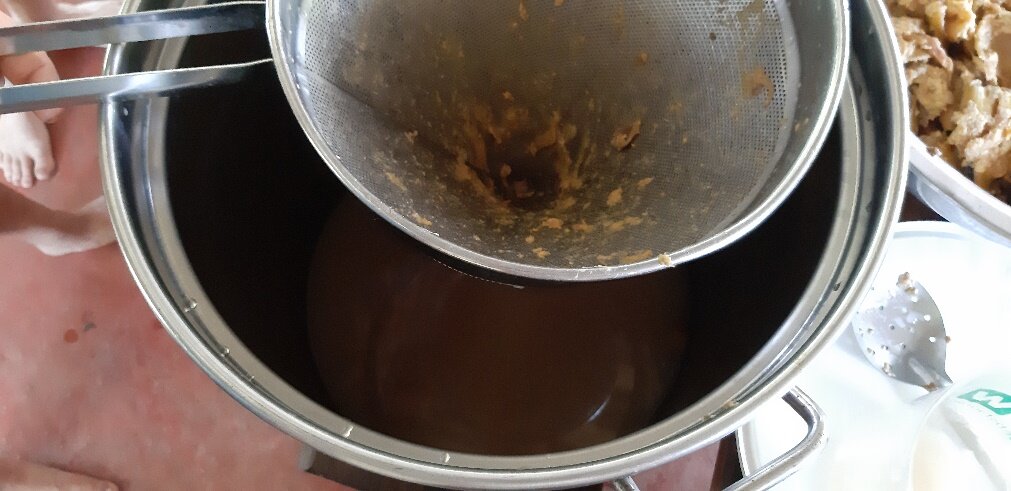
Finished squishing? Good. It’s time for your first taste test. If the vinegar tastes too sweet and not sour enough, it probably needs more time. If this is the case, you can add a little sugar – this is to allow the yeast present to convert more ethanol for our AAB friends to metabolise into more acetic acid. Another option is adding a little vinegar from a previous batch (this is called backslopping in fermentation lingo). If you don’t have a previous batch, you can use a shop-bought vinegar - white vinegar is a good bet as it has a neutral taste that won’t mess with the bananary-ness. Check back every week or so until your vinegar has reached the desired level of acidity. And there you have it! Easy-peasy farm to table banana vinegar using permaculture principles – there is no such thing as waste.
You can now bottle your vinegar and age them. This step is optional and will enhance the flavour profile of the vinegar. We use glass bottles that we recycle from the farm. It is important to use a sealed bottle and fill it as much as possible. If the AAB are exposed to oxygen they could begin to break down your acetic acid into carbon dioxide and water.
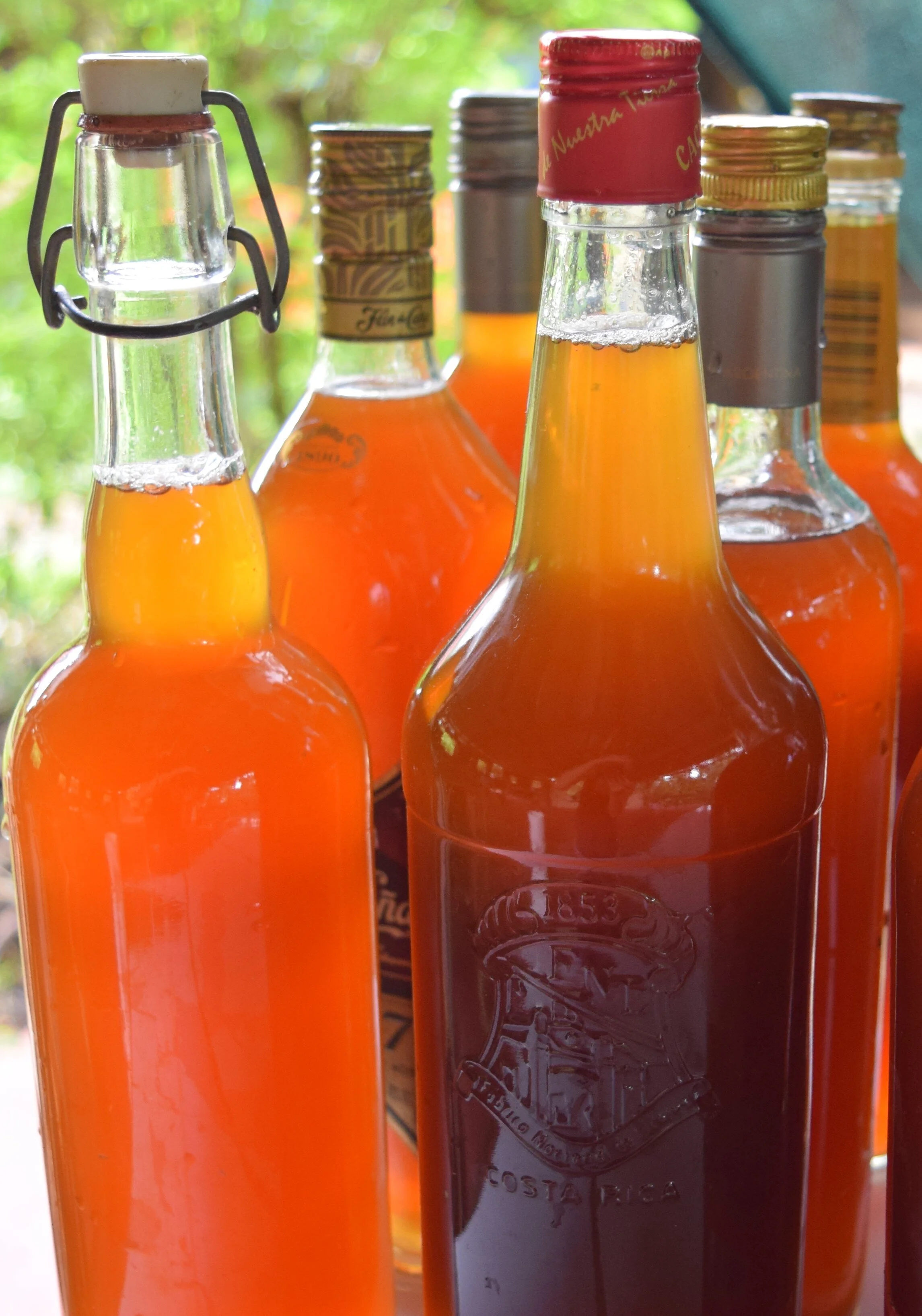
It’s that simple folks! This is a great way to use up all those old bananas.
Enjoy your farm fresh, homemade vinegar! This can be done with a variety of fruits that you have in excess off the farm!
Stay tuned for more farm fresh recipes.

The Basic Pantry Analysis: Design, Food, Sourcing
Cuisine is diet that's unique to a physical place and a human cultural group. We can taste the patterns of modern cuisine in the melding of characteristic ingredients into characteristic forms. Wheat noodles with tomato sauce points us in the direction of Italy. Fermented spiced cabbage leads us to Korean kimchi.
By Laura Killingbeck, Porvenir Design's Food System Designer
The Human Diet as An Ecological System
Cuisine is diet that's unique to a physical place and a human cultural group. We can taste the patterns of modern cuisine in the melding of characteristic ingredients into characteristic forms. Wheat noodles with tomato sauce points us in the direction of Italy. Fermented spiced cabbage leads us to Korean kimchi. Even amid tremendous variation, and even as these cultural foods are exported, appropriated, and evolve in different ways in different places, we are still able in many cases to recognize a cultural and geographical narrative embedded within relational patterns of flavors and forms.
Across the span of human agricultural history, cuisine sprung from ecological relationships—people ate what grew well in their area, and they grew what nourished them. Humans shaped the morphology of plant, animal, and microbial species by selective breeding; in turn, these foods changed the physiology of the human body. Cultural groups vary widely in their tolerance and desire for certain foods—these are genetic adaptations to their peoples' long history of evolution with specific cuisine. The co-transformation of people and food species was exquisitely mediated by the opportunities and limitations of the ecological niche of the place where they lived. Growth was balanced and calibrated within an ecological feedback loop of regenerating resources.
But in recent human history, globalization expanded our access to place and people, while simultaneously breaking this ecological feedback loop. We travel, and food travels; neither is linked, necessarily, in place. People are still connected with the world, but now we are connected differently. This shift is transforming the evolution of cuisine in unprecedented ways.

If you imagine the path of human ecology as a train traveling down a railroad track, globalization is the conductor turning the train onto a new track. Human relationships with food are now evolving in a different direction than they did before. The foundation for cuisine is no longer an ecological relationship between people and place; it is an economic relationship between people and business. Businesses grow or produce food and ship it around the world, where chains of distributors buy it and warehouse it in grocery stores. Surely this is not the only way that food works, and local food cultures still thrive in many areas. But it is a style of human-food interaction that is growing and replacing such local cultures. As we become increasingly separate from our direct relationship with the ecological patterns that once mediated food and diet, we become more deeply fused with a new, abstract, relationship with global commerce. The foods we like to eat often have less to do with healthy ecology, and more to do with macroeconomics and marketing.
We know there are a lot of problems with this. The Western Diet (aka, global cuisine) is correlated to chronic disease and poor health. Mass agriculture depletes soil and species diversity. Industrial pesticides and fertilizers damage ecosystems. There is a lot more to say but I don't have to say it—on some level we know, all the time, that this is bad. And even as we know, we still eat global-industrial foods, because we're hungry, its what we know, and its what's there.

Post-Harvest Permaculture Design
Permaculture design is essentially applied ecology for human development. It studies and teaches how life relates to place, with the object of sustaining that life and that place. A lot of the literature within Permaculture Design centers on the infrastructure development of building, landscape, and agricultural systems. It most often highlights the agricultural side, with ideas and methods of learning how to integrate human agricultural systems with the larger ecology of life on earth.
But interestingly, the focus on agricultural systems within Permaculture Design methodologies often only lightly brushes post-harvest food handling and cuisine development. The general thinking is that once people understand food production as a functional part of ecological systems, they will be able to grow more food. This has been very successful for many people, with one caveat—growing plants, animals, or microbial species that are edible does not mean you are growing food that is ready to eat. A a plot of wheat and a chicken pecking bugs can be wonderful parts of an agricultural ecosystem, but if you want a chicken sandwich there is still a lot of work to do.
Over the last nine years I've worked with two farms and education centers who dedicated themselves to the process of farm-to-table food production—one in temperate Massachusetts, and the other in tropical Costa Rica. This allowed me to study and practice food preservation and processing across climates, and see the similarities and differences that unfolded.

At Rancho Mastatal in Costa Rica, even very common foods, like malanga, tiquisque, cuadrados, pejibaye, and chaya were all new to us. And what do you do with a sudden hundred pounds of ripe bananas? At Round the Bend Farm in Massachusetts, we needed to preserve large quantities of food seasonally to last the winter, in a way that was totally different than in the tropics. We also transitioned from a home-scale cooking facility to one which could serve hundreds, and had to scale our systems up to meet new demands. At both organizations, it took us a lot of time, and a lot of trial and error, to acquire the skills, tools, and labor to do these things. And to do these things efficiently, it took structured seasonal planning. The teaspoon of ginger you need now in your recipe had to be grown a year ago, then harvested, dried, powdered, and stored. We had to learn how to organize ourselves in relation to local food, in ways that were intrinsically different from how we used to organize ourselves in relation to globalized foods.
The human element of how we interacted with food based on our personal and cultural backgrounds was another huge piece of the puzzle for local eating, especially in Costa Rica. We craved western-style bread products; people didn't always like Costa Rican cuisine; some people were afraid of new foods like fermented bananas. Eating locally meant coming to terms with the cultural references for desirability of foods we had brought with us, in relation to the ecological and cultural backdrop of a new country and climate. We had to adapt ourselves to new styles of cuisine, and adapt that cuisine to ourselves as newcomers.
Most of my work in Costa Rica and Massachusetts was to create, systematize, and implement post-harvest food processing and preservation strategies based on farm foods. I also worked with numerous farm owners, communities, and homesteaders who were and are in the process of divesting from their dependence on global-market food supplies. It is through these relationships and experiences that I began to notice consistent patterns in the challenges people faced in transforming their farms into food. I started comparing patterns of limitations and successes that people were reporting, with those of the organizations I was working with. I used permaculture design to organize these patterns into a systematic format that I could use to consult with people about how to achieve more efficient and accelerated farm-to-table food system success.

I call this consultation service the Basic Pantry Analysis. The title and process drew inspiration from many collaborators in the fields of permaculture design and farm-to-table cuisine; in particular the work of Costa Rican ethnobotonist Rafael Ocampo, as well as that of the Sat Yoga Institute. A similar process focused on family nutrition has also been promoted by the Instituto de Nutrición de Centroamérica y Panamá (INCAP). My version of this process is based on my experience working with farms and communities, and is an adaptation of a wonderful wealth of collaboration among many individuals and organizations.
The Basic Pantry Analysis
The Basic Pantry Analysis matches the ecological needs of your land, with your cultural and personal frames of reference, your dietary needs and desires, and your resource capacity, to form a “basic pantry” of ingredients, whole and value added, that you will use to develop your own dynamic cuisine—that is, the meals you eat every day to sustain yourself in the place you live. This process is useful for anyone who wants to accelerate their ability to grow, process, and eat local foods.
Your Basic Pantry will be designed through a combination of personal decisions and desires, which inform a multitude of what are often very simple tasks. Those big ideas and those little tasks are what build the complex whole. The consultation service is divided into four primary parts: Vision, Layout, Basic Pantry, and Adaptation. The scope of service varies depending on the client's needs and desires.

Sample Outline of Basic Pantry Service
Please note this varies based on client needs.
Vision
This is the overall concept of your cuisine. Exploration of goals and values, and how those relate to your capacity. Make decisions about priorities for ecological, cultural, dietary, financial, factors.
What the client receives:
• A one paragraph vision statement for your cuisine.
• A one page analysis of the factors and values that contribute to that vision.
• A sample set of meals you could expect to eat over the course of the year.
Layout
This is the architectural layout of your plan—it shows clearly how different food elements and tasks fit into your cuisine over time.
What the client receives:
• Daily, weekly, monthly, and/or annual list of post-harvest food tasks for your mature food system.
• Analysis of tools and infrastructure.
• Analysis of skills and labor needed.
• Basic five year analysis of how your food system transitions through time.
Basic Pantry
You need lots of ingredients to make meals—this is the list of those ingredients, whole and value-added. I work closely with the agricultural team to make recommendations about food species.
What the client receives:
• Sourcing and Growing list
• Processed and Preserved foods list
Adaptation
Your Basic Pantry Analysis is a starting point, not an end. It will grow and shift and evolve as you and your land do. This section is a structured feedback loop to help you grow and shift your cuisine based on your priorities.
What the client receives:
• Design concept follow up questions
• Blank harvest, processing, and/or other charts for feedback
• Supporting appendix—contains client-specific documents on further skills and strategies, and/or other supplementary documentation as needed.
For more information on costs and deliverables of this service please write our team at info@porvenirdesign.com.
For information on food related workshops at Rancho Mastatal please see go to our Workshops page.

Categories
Topics
- Agriculture 6
- Agroforestry 21
- Animals 2
- Apprenticeship 19
- Appropriate Technology 6
- Backpacking 1
- Bananas 1
- Basic Pantry 4
- Biochar 1
- Books 3
- Build Your Own Home 1
- Central America 5
- Chiles 1
- Cinnamon 1
- Clay Carving 1
- Climate 2
- Climate Change 1
- Cob oven 1
- Communication 5
- Community 24
- Compost 2
- Composting Toilets 2
- Condiments 1
- Conservation 2
- Cooking 4
- Costa Rica 18
- Design 10
- Earthen Construction 10
- Eat Local 2
- Ecohome 1
- Education 9
- Environment 3
- Ethics 4
- Farm to Table 12
- Fasting 1
- Fermentation 14
- Food 22
- Food Choices 8
- Food Forest 8
- Food Processing 15
- Food Systems 12
- Gap Year 1
- Gardening 5
- Ginger Beer 1
- Harvest 2
- Health 12
- Healthy living 5
- Homemade 2
- Homestead 8
- Internet 2
The Ranch’s new cookbook is here!
This cookbook might not be quite like the others you have sitting on your shelf. We’ve made it look like a cookbook— and it might smell like a cookbook if it’s spent enough time in your kitchen— but it’s also a memoir, a history of a place, of 20 years of experimentation and learning and growing on the piece of paradise known as Rancho Mastatal.