

BLOG
Stories, articles, and updates from the Ranch community.
Why Are My Homemade Jams So Runny? A Look into the World of Pectin!
Do I need more sugar? More acidic fruit? How do I get more pectin? What even is pectin? This blog will answer all your questions—and more—to help you obtain some beefier jams.
By Kyler Kradle — Apprentice 2026
Based on - On Food and Cooking: The Science and Lore of the Kitchen by Harold McGee
For the past few weeks, I've been trying my hand at making homemade Costa Rican jams here at Rancho Mastatal.
During one of our food processing classes, jam was thrown into the mix. We made two huge batches with tons of ingredients at high heat on a rocket stove for hours on end. The jam turned out well. We used it for fruit roll-ups, and it went nicely with sourdough.
However, our consistency and canning methods must have been a tad bit off in the end. Some jars had different thicknesses, odd smells and tastes, and, honestly, we had an overabundance of jam.
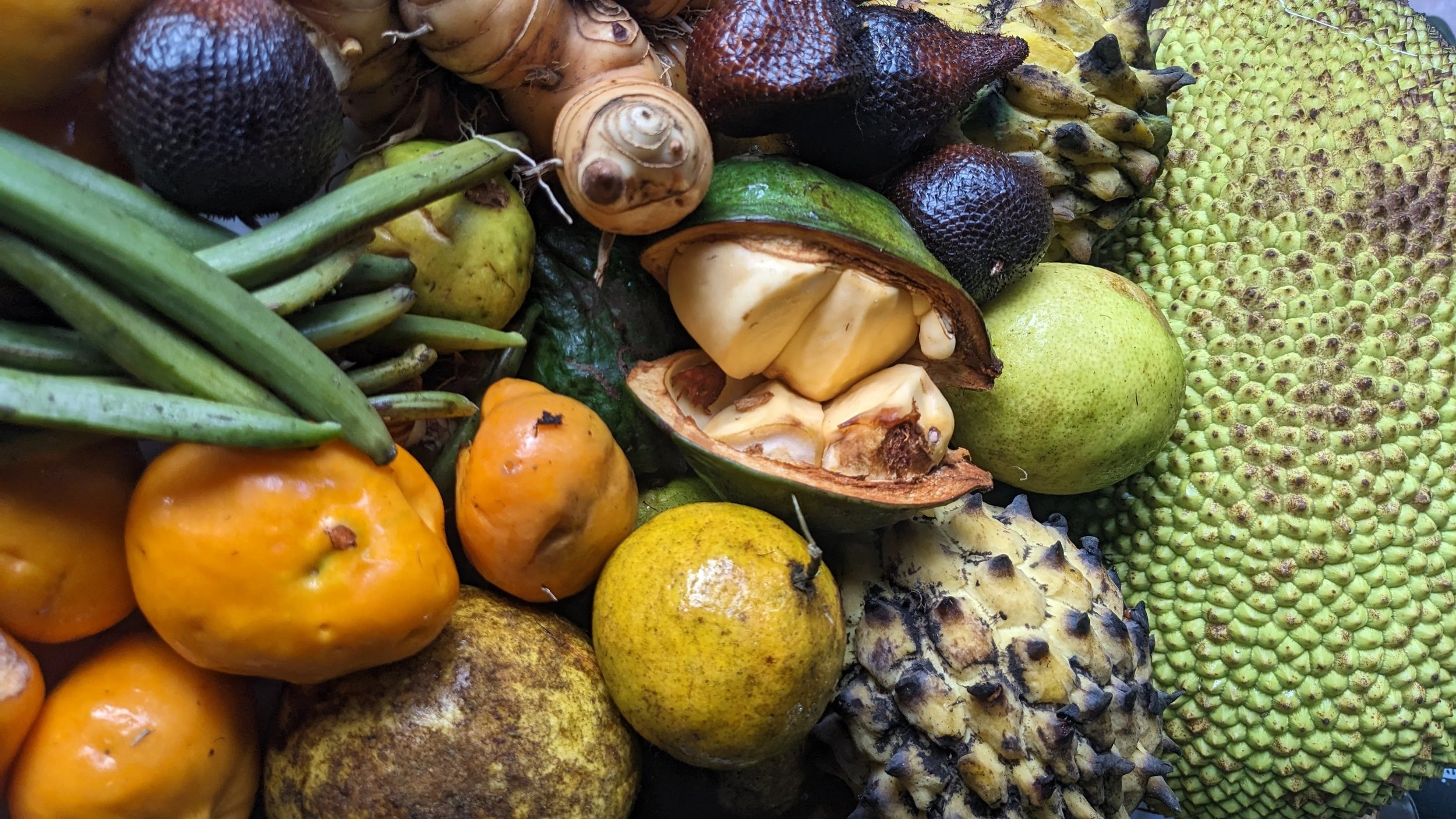
A couple of weeks later, we had some extra Victoriana fruit from our harvest day. I used this to make another jam. Alongside the Victoriana, I used a whole pineapple and papaya. This was tossed into a blender with sugar to create a liquid. The liquid was then cooked thoroughly, and more sugar was added little by little until the sugar percentage was up to about 50–55%.
The mixture was very sweet, had what seemed like a good consistency, and passed the plate-tilt test. The plate test involves putting a little spoonful of jam on a plate and tilting it to see its consistency.
However, after letting the mixture set, it was quite liquidy and more like a sauce.
On another occasion, I made a jam for a cheesecake using Victoriana and Arasá fruit. Again, this also turned out runny, even with the more acidic fruit, which I thought had higher pectin.
So the question is…
Why Are My Jams Runny?
Do I need more sugar? More acidic fruit? How do I get more pectin? What even is pectin?
This blog will answer all your questions—and more—to help you obtain some beefier jams.
What Is Pectin?
Speaking of beef, let's think of meat for a second.
Say you cook chicken, put it in the fridge, and take it back out again. The juice turns into this gelatin-like substance around the chicken, binding the liquid together.
Historically, this is where the ideal consistency for jam came from: a mixture between solid and liquid that is bouncy and joyful.
Pectin is the creator of this consistency, but how does it do it?
The best way to think about pectin is like an adobe brick wall. The cells are the bricks, the pectin is the mortar, and the wall itself is the cell wall.
Pectin is the natural substance that holds the cells together, creating a cell wall. When a fruit is firm and underripe, the pectin is strong and long, holding the cells together.
On the other hand, when a fruit ripens, the pectin gets weakened by enzymes.
For those wondering, like I was, enzymes are proteins that help conduct chemical reactions made by living things. Basically, they're a tool that helps complete a job faster—like cutting paper with scissors instead of your hands. The enzyme is the scissors.
When cooking fruit, the wall breaks and the cells open, changing their current structure. Imagine shaving away an adobe brick wall to make a curve. Those shavings still have the same ingredients, but they're just in a different form.
That's the pectin getting dissolved into the fruit juice.
With this crumbly substance, you can't just form another wall again, just like pectin can't simply turn back into a gel. The pectin chains have been diluted in water and now hold a negative charge that makes them repel each other instead of bonding.
They need some help and other ingredients to find each other again.
Similar to rebuilding an adobe wall, the cook—the builder—can use several different methods to help bring pectin back to its gel form.
Four Ways to Help Pectin Form a Gel
1. Lots of Sugar
Sugar molecules attract water molecules to themselves.
This helps reduce the amount of water available in the mixture.
2. Boiling
Boiling pulls water away from the pectin, exposing the pectin chains to each other again.
Sugar increases the boiling point.
Boiling evaporates water, bringing pectin chains closer together while also creating an overall higher concentration in the mixture.
3. Increased Acidity
Acid neutralizes the negative repelling charge that the pectin mixture is currently holding.
The wandering pectin molecules are then able to bond together to form a gel.
4. Supplemental Pectin
Pectin can be bought commercially or found in other fruits.
It can be added directly to a mixture to replace broken-down pectin molecules and help bring the gel form back to life.
Note: Overuse of heat and acid can shorten pectin chains, causing the jam to become liquidy.
Ideal Conditions for Making Jam
The usual challenge of preserve-making is trying to set the mixture at a proper boiling point for a specific amount of time while meeting the correct sugar percentage and creating an overall ideal concentration.
Other problems can occur because of the quality and amount of pectin or acid.
Here are the ideal conditions for creating a proper concentration:
pH: 2.8–3.5, roughly equal to orange juice
Acid: 0.05% by weight
Pectin concentration: 0.5–1.0%
Sugar concentration: 60–65° Brix
If you happen to do what I do and make liquidy jam, there are a couple of troubleshooting solutions you can try.
Liquid or concentrated pectin can be commercially purchased. Another trick is using the zest or peel of acidic fruits soaked in the jam.
Other options include cream of tartar, lemon juice, and a quick reboiling.
I would also recommend doing a quick search for the fruits you want to use and checking their pectin levels.
A Basic Understanding of How to Make Fruit Preserves
1. Cook the Fruit to Extract Its Pectin
Make cooking as brief and gentle as possible.
Prolonged cooking damages pectin.
2. Add Sugar
Rapidly bring the mixture to a boil to remove water and concentrate the other ingredients.
Continue boiling until the mixture reaches 217–221°F (103–105°C).
This indicates that the sugar level has reached approximately 65%, or you can use a refractometer to measure the sugar percentage.
Cook best at a gentle simmer and in a wide pot with a large surface area for evaporation.
3. Add Supplemental Pectin if Needed
Store-bought pectin packets, citrus peel, or green apple stock are common options.
These can be added directly or placed in cheesecloth and soaked in the mixture.
4. Add Supplemental Acid if Needed
Add acid later in the process to avoid completely breaking down the pectin chains.
Too much acid can cause fluid to weep from an overly firm gel.
5. Test the Jam
Readiness can be tested using the plate, spoon, or water test to see if the mixture gels.
6. Pour into Sterilized Jars
The mixture sets as it cools below 180°F / 80°C, but it sets most rapidly around 86°F / 30°C.
The mixture can continue to become firmer over the course of several days or weeks.
Jam Experiment!
So, I decided to do a little experiment to test out some variables in my jam.
Realizing that pectin is the key ingredient for achieving the perfect consistency, I revolved my experiment around it.
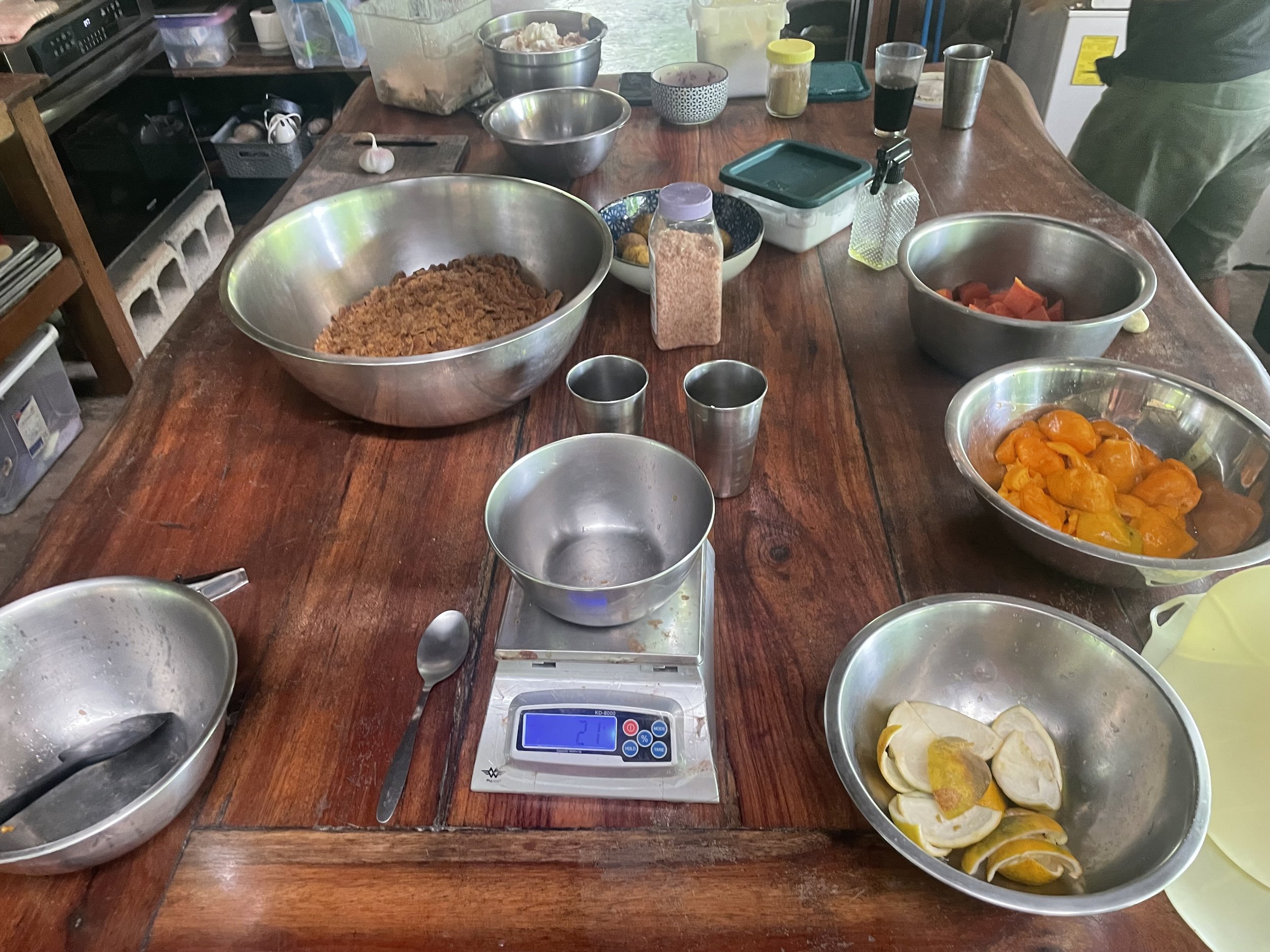
Here's how I broke it down using what I had at the ranch.
I took two fruits, Victoriana, which is high in pectin, and papaya, which is low in pectin, as my subjects.
Sugar is needed for every jam, so that stayed constant for each sample. My fruit weight was 150 g to 100 g of sugar, which gave me a sugar percentage of about 65%.
Basically, I was measuring two-thirds of the fruit weight in sugar.
My pectin variables consisted of orange peels and lime juice.
My controls were:
Cooking time: 10 minutes
Cooking temperature: 100°C on the induction stove
Boiling time: 5 minutes
Pot size
Here's another look for easier comparison.
High-Pectin Fruit
1. Victoriana, 150 g + sugar, 100 g
2. Victoriana, 150 g + sugar, 100 g + 32 g lemon juice
3. Victoriana, 150 g + sugar, 100 g + half an orange peel in cheesecloth
4. Victoriana, 150 g + sugar, 100 g + 32 g lemon juice + half an orange peel in cheesecloth
Low-Pectin Fruit
5. Papaya, 150 g + sugar, 100 g
6. Papaya, 150 g + sugar, 100 g + 32 g lemon juice
7. Papaya, 150 g + sugar, 100 g + half an orange peel in cheesecloth
8. Papaya + sugar + 32 g lemon juice + half an orange peel in cheesecloth
High- and Low-Pectin Fruit
9. Victoriana, 150 g + papaya, 150 g + sugar, 200 g
10. Victoriana, 150 g + papaya, 150 g + sugar, 200 g + 32 g lemon juice + half an orange peel
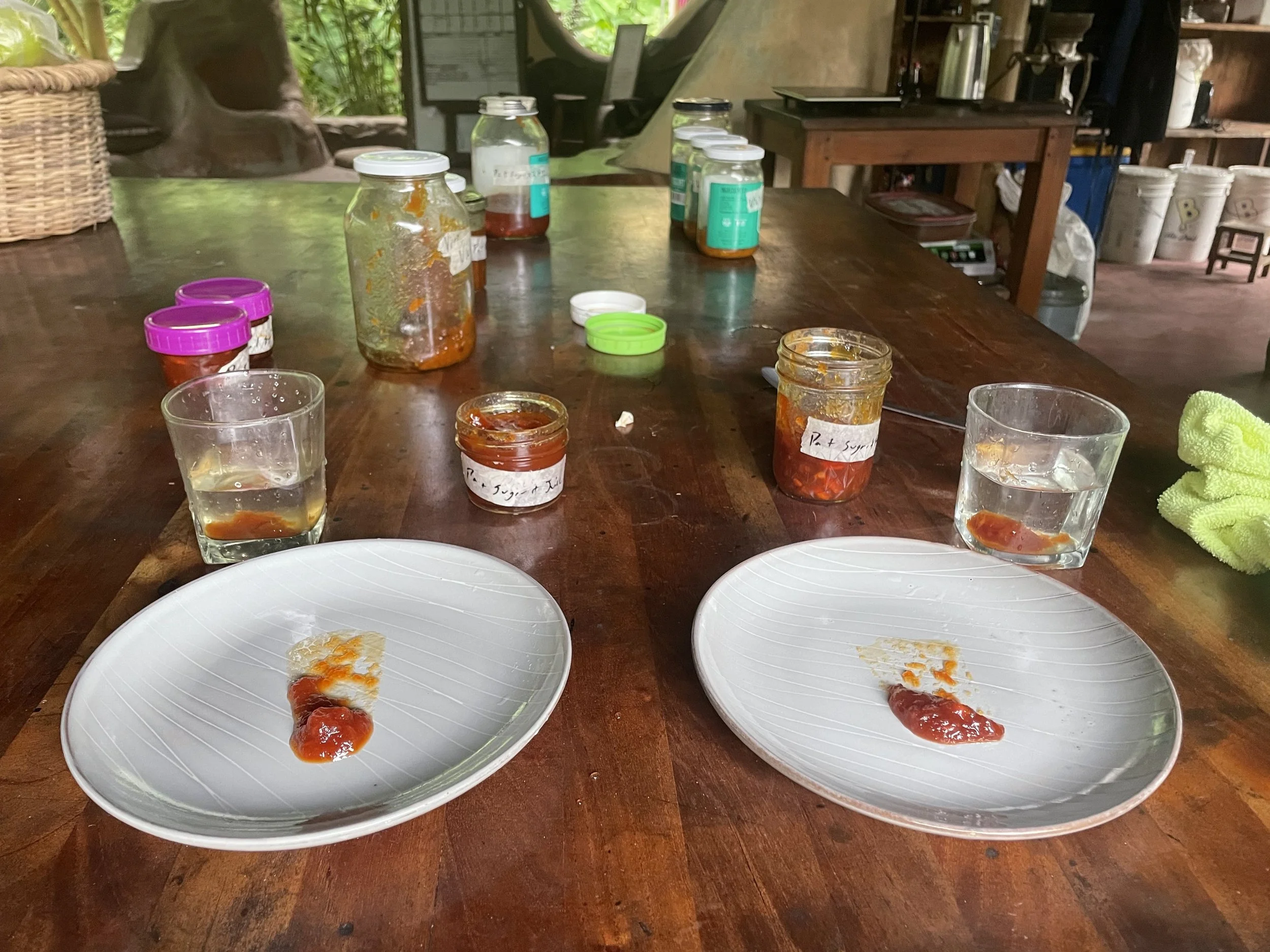
To compare my results, I used a plate test and water test over a setting time of 48 hours.
I also tried to compare taste to the best of my ability, although taste is obviously subjective.
Overall, I thought the best consistency was going to be the Victoriana with the orange peel because citrus peels are supposedly high in pectin, along with the high-pectin fruit.
Experiment Conducted!
Things That Went Wrong
Lime juice measurements were inconsistent.
I messed up my ratio for lime juice and added way too much compared to the whole mixture.
When mixing in the peel, I think the cheesecloth might have soaked up some of the lime juice and liquid, which, in this case, was probably good because I had added too much.
I used orange peels.
I think I can just toss these straight into the mixture next time.
With such a small batch, I'm not sure if they even totally soaked in.
Was I boiling for too long?
It felt like I might have been over-boiling the mixture because of the liquidness of the majority of my jams.
When compared to my experimental sugar-level test jam, it was so thick I could hold it upside down and it wouldn't fall out.
Results
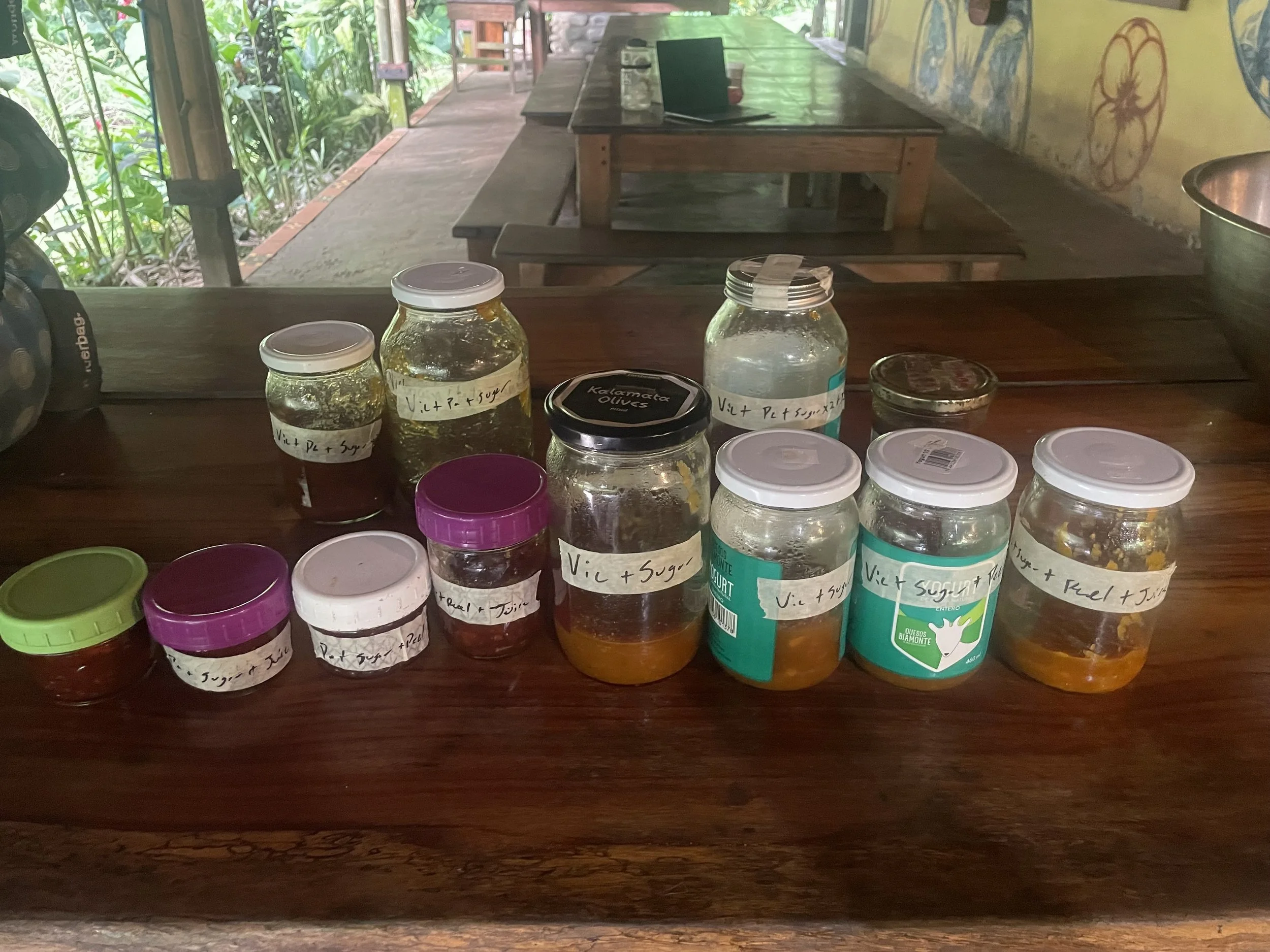
High-Pectin Fruit
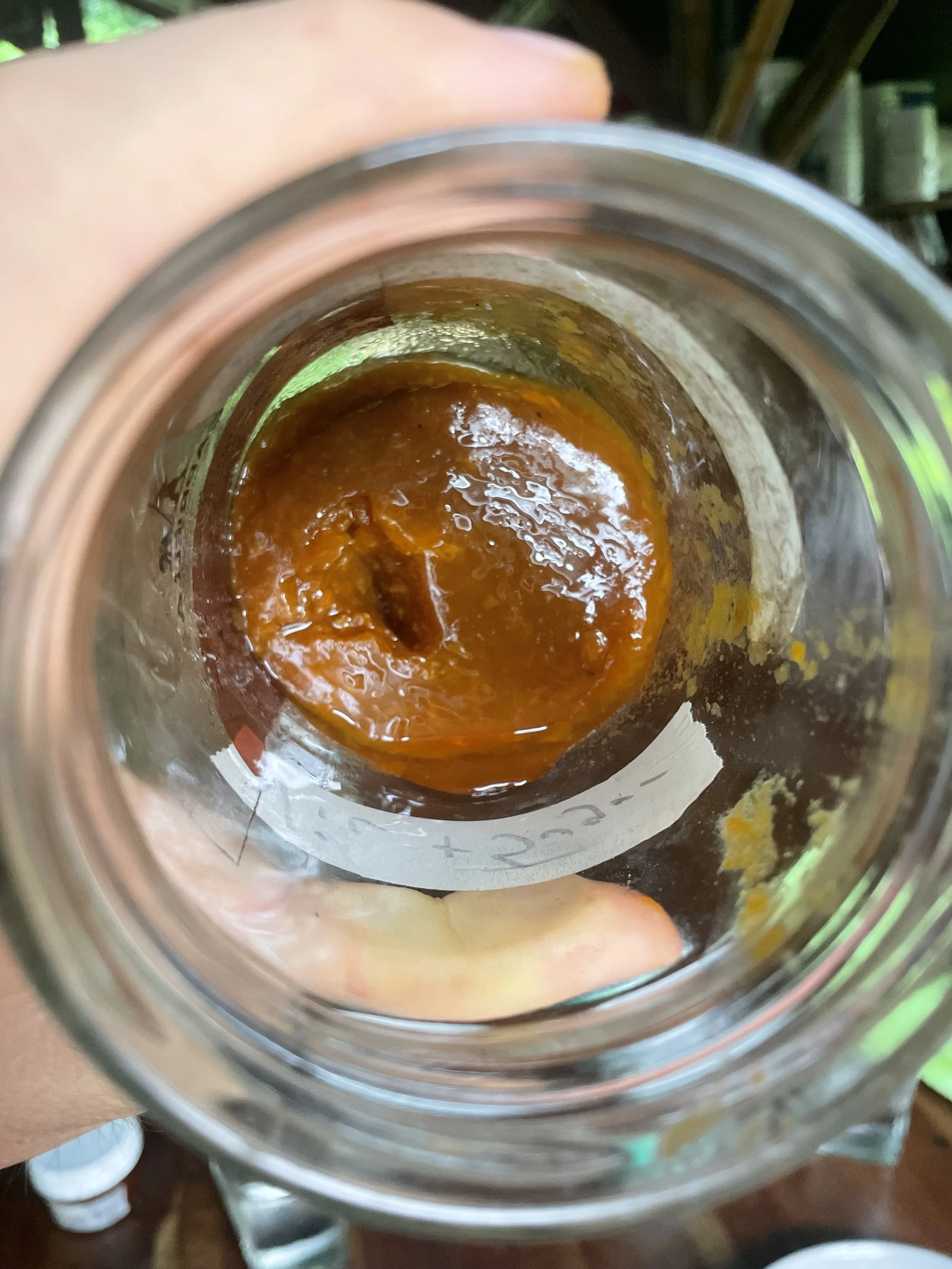
1. You can see the spoon mark—it's so thick! Great consistency, with a small amount of liquid pushed to the top. It left small, clumpy gel trails that were very visible and moved as a solid mass. On the plate test, it stayed completely as one unit. In the water test, there was no fuzz coming off. The taste was sour and delicious.
2. One mass on the top layer, but it dwindled into the same mass deeper into the jar. It was also liquidy on top, with a big snail trail, but still gel-like. It stayed as one mass in the water but left some fuzz in the water. The taste was acidic.
3. Very thick, with little to no gel trail on the plate test. Great consistency and no liquid on top. It stayed as one mass in the water test with no fuzz coming off. The taste was very similar to #1.
4. Good consistency, but with a little more movement. It left barely a mark on the plate test. It stayed as one mass in the water test but was still a little hairy. Solid taste, but kind of sour.
Low-Pectin Fruit
5. Solid structure, with little to no skid on the plate test. It all moved as a solid mass. It stayed as one mass in the water test. The taste was somewhat bland.
6. Biggest snail trail yet. It was still moving as a solid mass but was definitely the most liquidy so far. It stayed as one mass but slightly broke apart in the water. The taste was too acidic from the lime and hurt my teeth.
7. Solid structure. It left a light snail trail on the plate test and moved as a solid mass. It stayed as one mass in the water test. The taste was again somewhat bland.
8. Good consistency. It left behind small gel clumps but still moved as a solid mass. It stayed as one mass in the water test. The taste was relatively better than #5.
High- and Low-Pectin Fruit
9. More on the liquid side. There were clumpy gel spots on the plate test, but it stayed as one mass in the water test. The overall taste was solid.
10. More of a solid-mass consistency on the top, but it dwindled down. It left a noticeable snail trail on the plate test, like small gel bubbles. It stayed as one mass in the water test. The taste was too much like lime.
Observations
First things first: all the jams turned out great and had a solid consistency overall. I would consider none of them to be liquidy or sauce-like.
So, I obtained pectin, and the experiment was a success!
However, they were all so similar that it was kind of hard to differentiate between them. I'm not sure which one even had the best consistency.
I think the plate and water tests are supposed to be done while cooking the jam to check its consistency, but I suppose they still worked here.
I also saw what McGee was talking about with the weeping fluid caused by too much acidic juice. The acid-sample mixtures had a great mass-like consistency, but liquid was sitting on the top and edges.
I definitely added too much lime, and it really wasn't necessary. It also gave the jam a bad taste and hurt my teeth—it was so acidic!
The peel in the cheesecloth worked somewhat, but next time I'm just going to throw the peel directly into the mixture and pull it out afterward, or just leave it out altogether.
Flavor is also something to consider. These jams had the good consistency I wanted, but the flavor wasn't all that great. Combining fruits or choosing better-tasting fruits with less acidity may change the consistency while producing a better taste.
Now the question is: How can I obtain better-tasting jams with solid consistency?
What's Next?
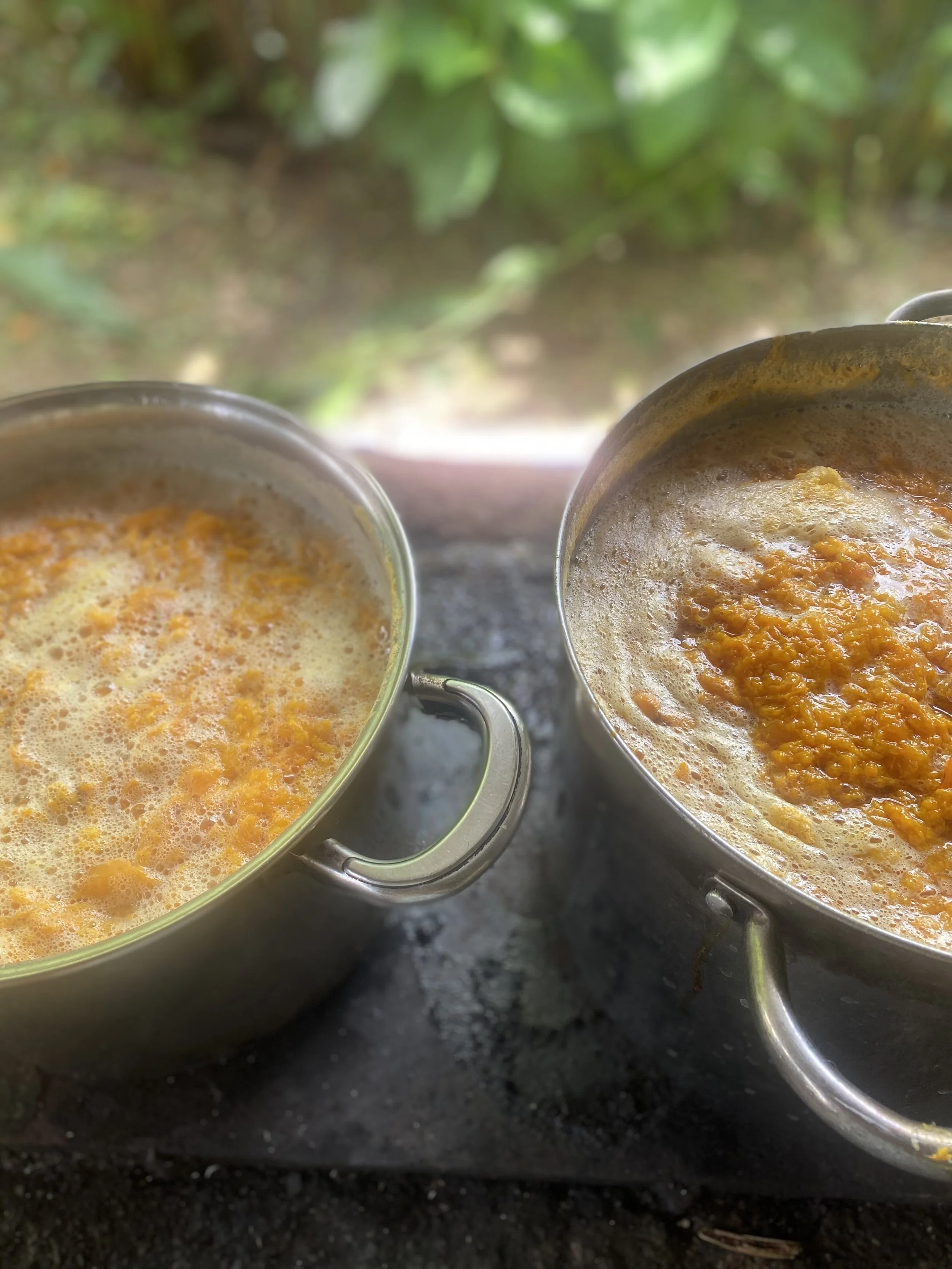
I think sugar percentage and boiling time are other variables to consider when looking at consistency.
When comparing low- and high-pectin fruits with a sugar percentage of 65%, they looked relatively the same.
Also, looking back at my previous jams, I cooked and boiled them for an intense amount of time, which I believe was shortening my pectin levels.
Compared to this experiment, where I only boiled the jams for five minutes, I obtained a great consistency.
Next time I play with jam, I want to experiment with boiling time and sugar percentage.
Time to redesign and prepare another jam sesh!
Tune back in for more jam updates and recipes to come!
Read More
Check out these other blogs related to food processing:

Yuca(n) Do It All - Processing Yuca in Rural Costa Rica
At Rancho Mastatal, yuca is a staple in the kitchen and our bellies. You can find it in at least one of our meals nearly every day in one form or another.
By 2025 apprentice Maivy Xuân Nguyễn
At Rancho Mastatal, yuca is a staple in the kitchen and our bellies. You can find it in at least one of our meals nearly every day in one form or another. Yuca is also commonly known as cassava root or tapioca (in its powdered form). So, if you’ve ever had boba–a Taiwanese milk tea drink with chewy black pearls, or tapioca pudding, you’ve had yuca!

My affinity towards yuca grew rapidly during the past two weeks when we experienced a boon in our yuca supply! I already love yuca, having grown up on boba drinks which had taken its foothold in the San Francisco Bay Area while I was a child. It has since only grown in popularity. Tapioca starch is also a key ingredient in my favorite Vietnamese dish: bánh bột lọc. It’s one of the first dishes that my mom taught me how to make and I intend to find some time to make a Rancho Mastatal version in the future. Look out for upcoming blog posts—perhaps they will have some yummy recipes.
But, my appreciation of it has grown tenfold and beyond after having worked with it on so many levels.
We have planted, harvested, processed, cooked and eaten yuca. Each step has its own set of steps and we’ll get to those in future posts. For now, I’ll talk about processing and preparing yuca for cooking. Yuca must be cooked before we consume it because it does contain some toxins, especially in its skin, that will need to burn off. Plus, it is a hard and starchy root that would be difficult to enjoy raw.
The edible parts of yuca are their tuber roots and also their new baby leaves. There are actually some varieties of yuca where only the baby leaves are eaten because the rest of the plant contains too many toxins. Luckily, we have the sweet kind with delicious roots!
Processing
If you get your yuca from a store, it will have likely gotten a parafin wax treatment. This is to prevent oxidation of the tuber which happens quickly. You’ll want to wash and scrub that off first.
We got ours straight from the ground so our first step was to wash and scrub off the dirt.
Then, cut the tuber into sections.
Make a cut along the tuber and using a paring knife, spoon or your fingers, separate not just the papery skin, but also the thicker white skin from the tuber. The layer of white skin contains cyanide, so you'll want to be sure to get it all off. Sometimes the skin comes off easily with just some maneuvering and other times it is stubborn and you may just need to cut through it.


Once you have the peeled root, give it another rinse and process it further as you'd like. We chunked it and shredded it so it could be cooked for our brunch time fried yuca or hash. The raw yuca will last about a week in the fridge. I will turn black as it oxidizes so try to keep it in airtight containers.
We also made yuca flour by dehydrating the shredded yuca and then blitzing it in a blender or food processor.


To make yuca starch, soak your shredded yuca in water overnight. Then strain and squeeze out the solids and keep the water. The starches will have been released into the water. Let the starch settle to the bottom and then pour off the water once it’s separated. You’ll end up with some wet starch. You can then dehydrate the starch and break it up into powder.
If kept dry and airtight, yuca flour can last for up to a year.
Now you’ve got a few ways to process yuca!


Planting

During one of our earlier work parties in the agricultural systems, we remade two zone 1 garden beds and planted some yuca, among many other plants and veggies.
The method through which we planted the yuca was through cuttings.
Yuca tubers take about 8-12 months to mature. So the ones we planted then are not the ones that we harvested or processed these past weeks. The boom came from outside of the Rancho and from the wider community of Mastatal.
Harvesting
A neighboring farmer, Don Jaime, had been forced off a piece of land that he's been farming for the past 20+ years.
The first week, the apprentice crew just came to pick up the sacks of yuca that Don Jaime had harvested that day, the four sacks totaled to 103 kilos.
It wasn't until the next week, when we came to help harvest more of the yuca from that land, that we got to see the full extent of his work.


Want to Learn More?
Join us for one of our yearly Permaculture Design Courses to get theory and practice in growing your own food.
Endeavors to End Propane: Local Fuel Sources and Efficient Cooking Technologies
Cooking food can make it tastier, easier to digest and absorb nutrients, and safer and healthier to eat. Cooking at the Ranch happens multiple times a day, and on some days, pretty continuously throughout the day. We generally have a lot of hungry bellies to fill! Over the decades we have been steadily reducing our use of propane to meet our cooking needs.

Self-made rocket stove at the Ranch
By Tim O’Hara
Ranch Core Team Member
Endeavors to End Propane: Local Fuel Sources and Efficient Cooking Technologies
Cooking food can make it tastier, easier to digest and absorb nutrients, and safer and healthier to eat. Cooking at the Ranch happens multiple times a day, and on some days, pretty continuously throughout the day. We generally have a lot of hungry bellies to fill! Over the decades we have been steadily reducing our use of propane to meet our cooking needs. Propane is a refined product that comes from crude oil or natural gas. The negative environmental impact from its extraction and refinement on communities and the earth are well documented. We have lessened our dependency on this imported product (Costa Rica has few crude oil resources and a moratorium on oil drilling) through the production and use of our own biogas, the utilization of solar cookers, dehydrators, and hay boxes and perhaps most importantly by incorporating efficient wood burning stove technology into our culinary domain.

Our woodshed
Wood is renewable and abundant in and around Mastatal. That’s not to say that wood can’t and isn’t managed poorly in many parts of the world where it is used for cooking. For us, fortunately, we have a plentitude of this resource in a country that does a commendable job of taking care of its timber resources. We have almost limitless supplies of firewood coming from our woodshed, local small-scale bandsaw mills that operate in the region, and our own agroforestry systems.

Common open cook stove
According to the World Health Organization, approximately 3 billion people worldwide still cook using solid fuels such as wood and dung in open fires and on inefficient stoves. Poorly designed stoves and age-old cooking practices can produce high levels of small soot particles and other pollutants that penetrate deep into our lungs. Exposure is particularly high among women who cook indoors and their children resulting in 3.8 million premature deaths a year from pulmonary illnesses. The extensive use of wood for cooking can also contribute severely to deforestation and its associated devastating social and environmental impacts. It can also consume precious and considerable time to gather and haul.
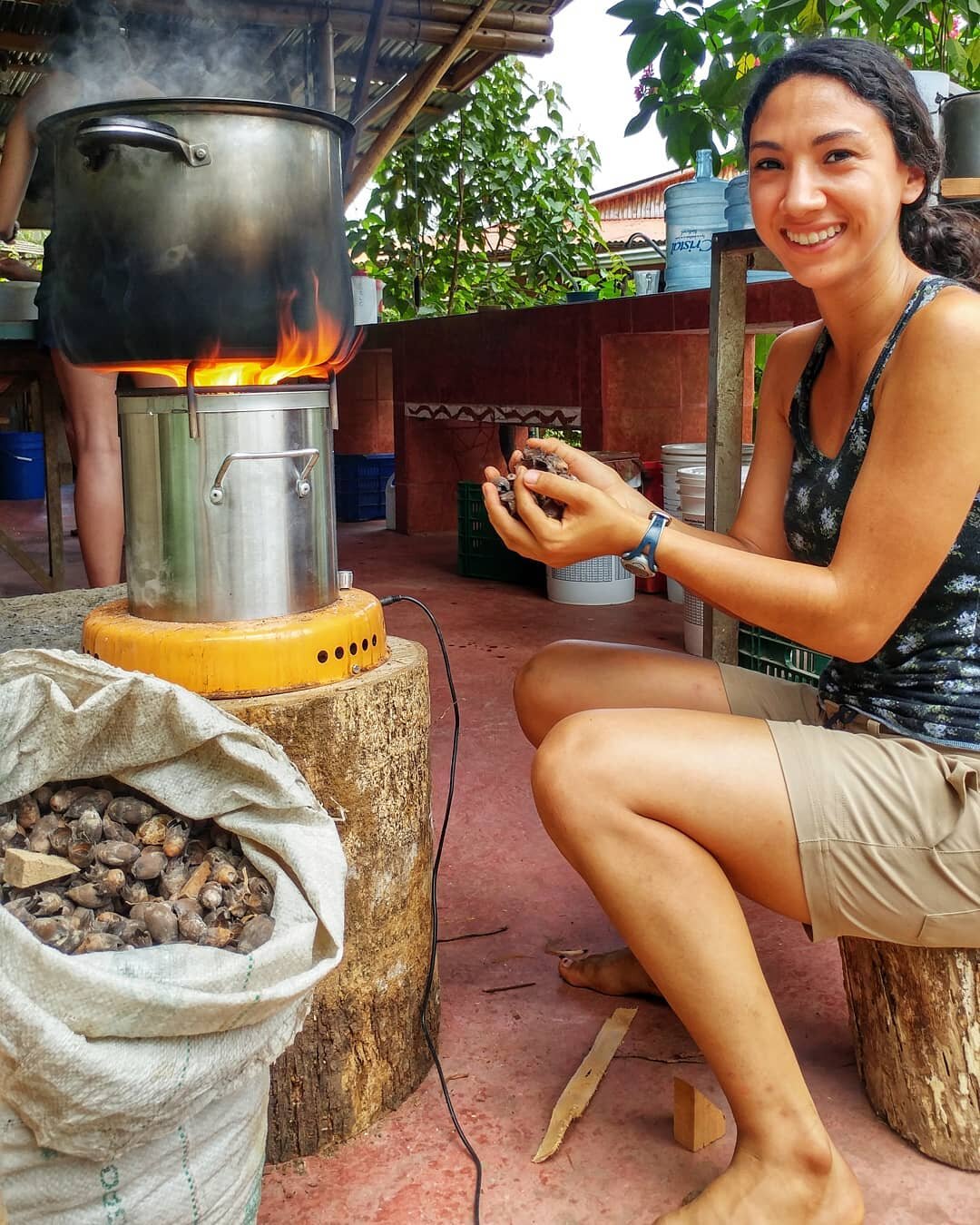
ACE One in action!
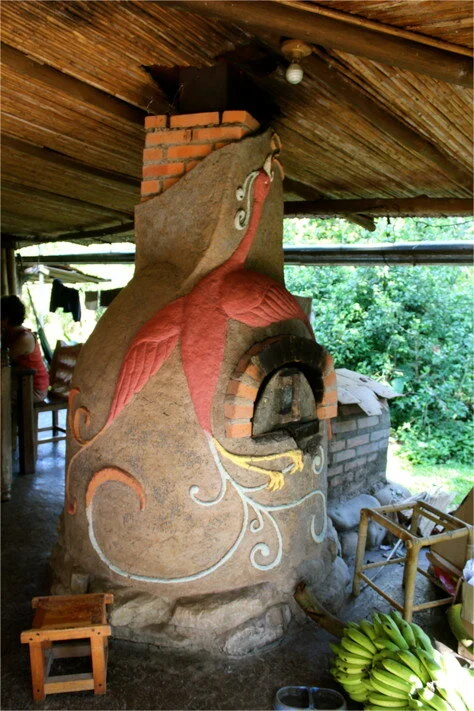
These worrisome facts have led us to build and invest in efficient wood burning technologies and food production methods that allow us to sustainably and safely use this local resource to cook with. Our alternative cooking workhorses are our 5 rocket stoves; 3 purchased ACE Ones, and two adobe/cob stoves designed and built in-house. These stoves produce little to no smoke based on a design that features an air intake or fan that produces extreme heat in the combustion chamber that ignites and “burns away” any smoke that is produced. This can be referred to as “complete combustion” and reduces or eliminates soot from the cooking process. The ACE One stoves use small pieces of wood whereas the home-built versions use slightly larger pieces of wood. These efficient stoves burn smaller quantities of wood and produce less or no smoke while retaining the many benefits of cooking with this local and accessible resource.

One of Ranch’s agroforestry systems
When possible, efficient rocket stoves can be coupled with a well-managed agroforestry system that through the extensive planting and pruning of nitrogen-fixing and food producing trees can yield a steady supply of accessible firewood and the food that will be cooked on the rocket stoves. This is yet another example of the closed-loop systems that we oftentimes strive for on our farm.

Adobe rocket stove being built at Ranch
Rocket stoves can be small or large, take many shapes, and can be made from a wide variety of materials. What’s common to all of them is the their ability to efficiently produce extremely hot combustion chambers. To improve performance, your rocket stove chamber can be insulated and your burning surface sized and designed to effectively support your favorite cooking pot. You can even buy rocket stoves for camping these days though if you’re a do-it-yourselfer or on a tight budget, we’d encourage you to design and build your own. There are plans all over the internet.

Our cob oven
In addition to our repertoire of rocket stoves, we have a self-built cob oven that we use for pizza parties and other baking endeavors, 3 Wonderbags, a solar and electric dehydrator and of course our magical biogas stove. We’ll tell you more about these in a future article but in the meantime I’d encourage those that love simple solutions to check out the wonders of the Wonderbag and see how you can help transform a family’s life in Africa while saving a considerable amount of cooking fuel.
Let us know if you have any questions and come and check out are array of alternative cooking technologies if you find yourself in our neighborhood. We love to share our experiences and hope that this has found you well well.

Simple rocket stove being built in community of Mastatal

Bamboo Shoots
Bamboo is of huge economic value and is not only used in the building industry, but it can be used also for eating (more on this later!), as a cooking device, burnt for charcoal, woven into a fabric, made into paper, used as a musical instruments, and much more!!
By Nic, Core Team member
Bamboo
Bamboo is a wonderfully sustainable building material due to the speed in which it grows and its weight to strength ratio (stronger than steel for its weight!!). Bamboo is of huge economic value and is not only used in the building industry, but it can be used also for eating (more on this later!), as a cooking device, burnt for charcoal, woven into a fabric, made into paper, used as a musical instruments, and much more!! At the Ranch we use it for many of these things; the most noteworthy being our use of it in our natural buildings (read here about how to treat your bamboo). We have 6 structures that are built almost entirely from Bamboo including a nursery, a meeting room, our classroom and the popular guest structure the Hooch. We have also used it as firewood and to make biochar and we have several bamboo instruments. Today however we are going to talk about the latest way we have learnt to use bamboo and that is in our farm to table world!
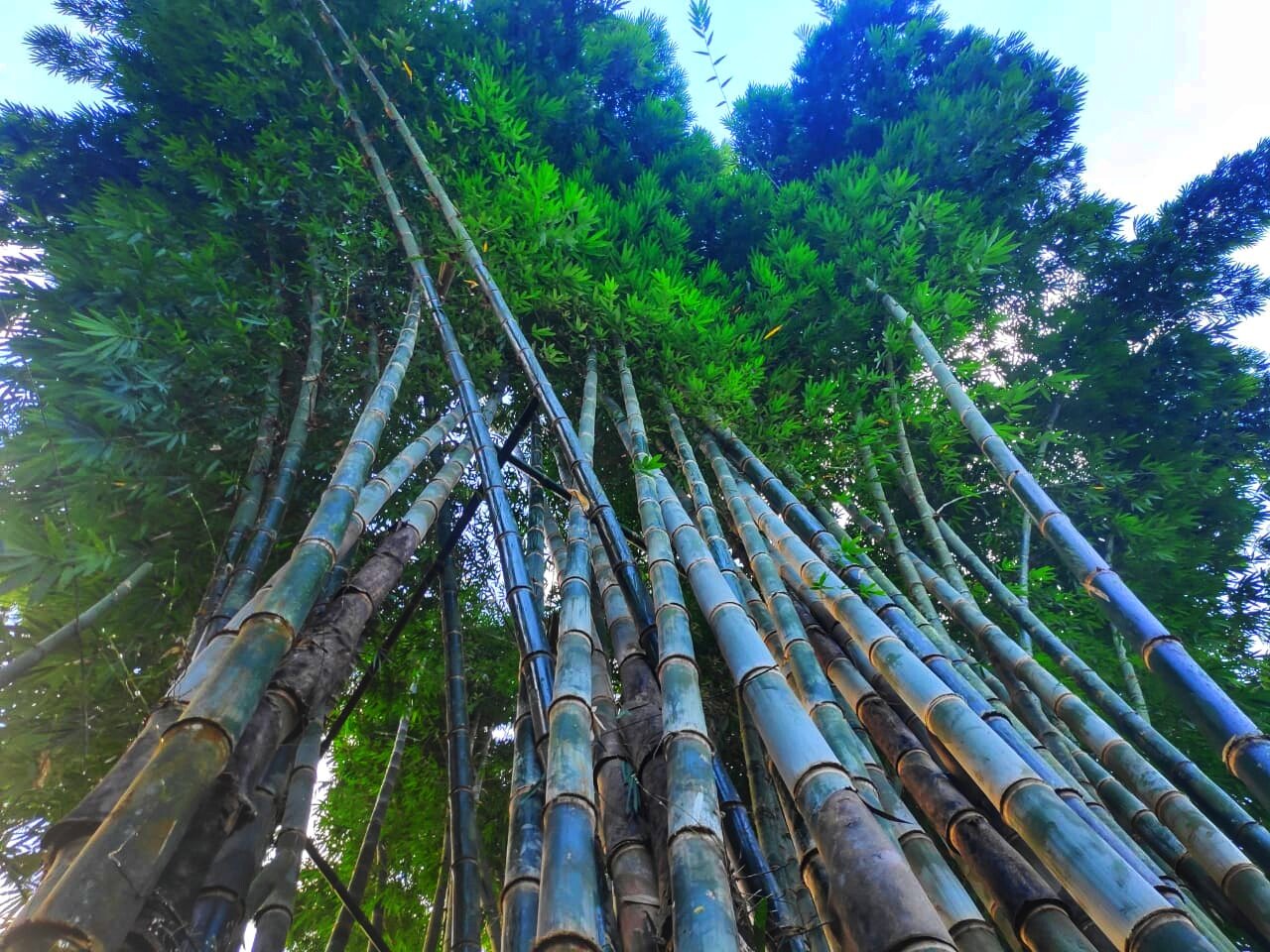
A clump of bamboo on our farm
Bamboo as Food
Humans have a long history of eating bamboo, but we are not the only animals that love eating bamboo. The Giant Panda loves eating the young bamboo shoots as well as the leaves and stems, along with a number of other animals including the bamboo lemurs of Madagascar and mountain gorillas in central Africa. Chimpanzees have also been seen drinking fermented bamboo sap which has turned alcoholic. It will not be a surprise then to hear that Yes! we can eat bamboo too, in fact its delicious and during the beginning of the wet season it is an abundant source of food.
At Rancho Mastatal we have some of the most revered species of bamboo for eating and for building. The species that we have that are known for providing tasty bamboo shoots are Dendrocalymus asper, Gigantochloa sp. and Bitcheeyana sp.

These are just 2 week old bamboo shoots!
Farm to Table Bamboo Shoots
Bamboo shoots contain a cyanogenic glycoside that produces cyanide in the gut. This is not good for you as you might know, cyanide is very poisonous, so we have to be careful to process our bamboo shoots carefully in order to make them edible. As it turns out this is relatively simple! Just boiling the bamboo for around 10 minutes removes that compound and can also remove any bitterness that can be present in the shoot. We found that adding ample salt and some sugar to the water before boiling makes them instantly a delicious crunchy snack! We have also lacto-fermented them (make a very pungent ferment!), pickled them in vinegar, and just boiled them and added them to dishes. But before you get to eat the bamboo shoots you have to know when to harvest them and how to prepare them.
Harvesting bamboo shoots

Peeled bamboo shoot
Generally speaking you want to harvest them as young as possible as they can become bitter if they are too old. As you may know bamboo grows incredibly quickly, so you will need to keep an eye on your clumps as a daily practice. As the rains start here in Costa Rica around April/May (on the pacific side) we found that initiated the growth of the new shoots. There is a delay though between the start of the rains and the shooting of the bamboo and this will vary be species and by the year. So its safe to say that once it starts to rain you need to start checking your clumps regularly. We found that this year the Guadua started shooting first (not a good bamboo to eat) and Dendrocalymus was the last one to start shooting in late June/July. Ideally you will want to harvest the bamboo shoot when it is around ~10-15” (~25-35cm) tall. Cut it at an angle as low as you can. This will then shed water and is less likely to lead to disease entering the plant. Generally speaking from a well-managed clump you should be harvesting about 33% of the new shoots. Take them from the places where they are not as ideally situated ie. Close to another shoot, with a blocked path etc… To learn more about how to manage you bamboo, join us for our bamboo management workshop.
Processing Bamboo Shoots
Take the bamboo shoot back to the kitchen and cut it lengthwise in half. You should be able to get your thumb and then your hands between the outer layers and the inner solid part and pry off the sheathing. This will leave you with a rather alien looking shoot. At this point it’s a good idea to chop it into strips several inches wide and then slice across the strips into thin pieces. The thinner the pieces the more bitterness is removed by cooking. At this stage you have the option to lacto-ferment the bamboo in a 2-3% by weight salt brine. This produces a very pungent ferment that smells very reminiscent of canned bamboo shoots from the grocery store. By lacto fermenting the shoots you also remove the cyanogenic glycoside and you gain the nutritional value of a raw bamboo and the probiotic qualities of the ferment.
By cooking these thin pieces of bamboo in a salty and slightly sweet brine we were able to produce a delicious treat with a great crunch, the flavor is not too dissimilar to Heart of Palm, although there was a large spectrum of views on what it tasted like. Everyone agreed that it was a delicate flavor that had an excellent texture.

Cut lengthwise
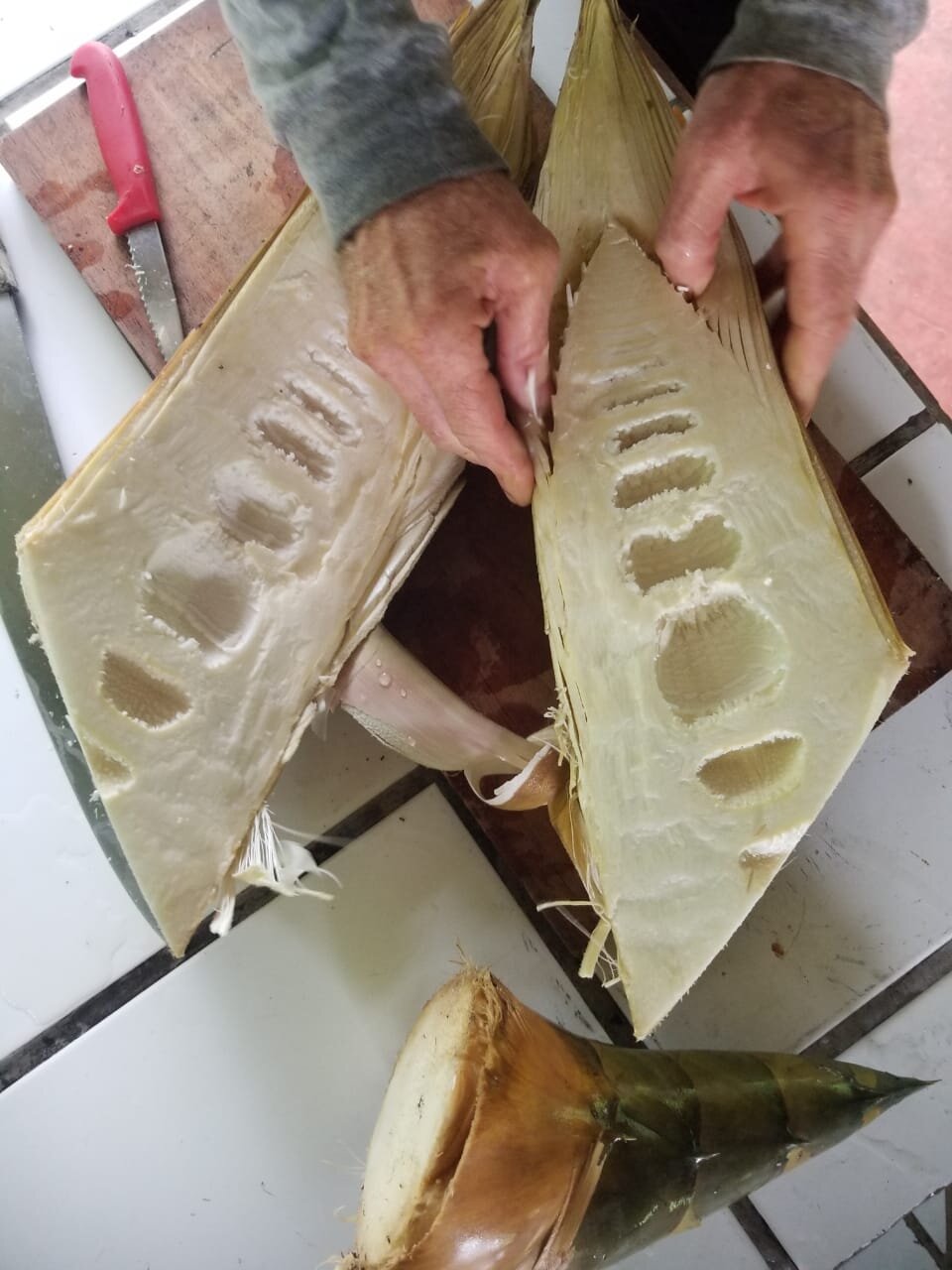
Then using your thumbs peel off outer layers
Bamboo Tea
The upper parts of the shoot that will have been left attached to the sheathing when you pried it out makes a very nice and refreshing tea. By taking a paring knife you can remove any of the soft parts still attached to the sheathing and dry them in the sun (or a dehydrator). This can then be added to hot water and left to steep.

Fresh bamboo shoot
Want to Learn More About Bamboo?
Join us for one or both of our upcoming bamboo related workshops!
Bamboo Management April 6 - 9, 2021
Bamboo Construction April 12 - 17, 2021
Stay tuned and up to date on what’s happening around here by subscribing to our monthly blog and visiting our website.
Check out our past blog article on Bamboo Treatment

Just KIS Me: A Neighboring Project focused on Plants and Indigenous Culture
About eight years ago, Kealy and Ivannia were talking about how they wanted to continue to be strong, badass women. They wanted to support one another and thrive, and step outside the stereotypical woman’s role that is often seen in the Mastatal community. Kealy was once again visiting for a few months from the States and was leaving in a few days so plans needed to happen soon!
Just KIS Me: A Neighboring Project focused on Plants and Indigenous Culture
By Kealy Rudersdorf
About eight years ago, Kealy and Ivannia were talking about how they wanted to continue to be strong, badass women. They wanted to support one another and thrive, and step outside the stereotypical woman’s role that is often seen in the Mastatal community. Kealy was once again visiting for a few months from the States and was leaving in a few days so plans needed to happen soon!
The previous year, they had decided to go to the river at night to catch shrimp together--the snakes and darkness under the new moon never scared them off. This year, they were going to bushwhack to the top of La Cangreja National Park mountain. If you have gone in recent years, this was before the path was maintained and the hike was truly an adventure in the jungle. They needed a guide, as neither had ever been. Ivannia suggested her cousin, Solin, who was incredible with the machete and always full of jokes. It was bound to be a great day!
That day marked the very beginning of KIS Botanicals, as Solin described different uses of a variety of plants and Solin and Ivannia shared stories about how their family used the different plants they found along the trail. It was an immemorable day, filled with laughter, love, and the sharing of stories - the same energy we strive to bring with us into KIS Botanicals today!

What is KIS Botanicals?
KIS Botanicals is a growing herbal business, up the road from the well-known Rancho Mastatal. We are focused on the preservation of plant knowledge and culture in the Mastatal/Zapaton region of Costa Rica. As Solin and Ivannia say, our ancestors have a beautiful interwoven history with plants from the rainforest; our goal is to awaken and share this history.
In our project, we make a series of plant-based, herbal products (to heal the skin, aide in sleep…), using recipes we learned from our grandparents and community members. We also provide educational programs for locals and tourists through medicine making workshops, medicinal plant tours, and food-as-medicine classes.

PRODUCTS
Our artisanal products are inspired by tried-and-true recipes. All of our plants are hand-harvested and our products are handmade – by us! We have access to nearly 100 different medicinal plants that Solin farms sustainably, using traditional agriculture and permaculture techniques.
We currently have 8 artisanal herbal products that we absolutely love! These include a skin healing salve, a muscle and bruise salve, a sleep aide tincture, a tincture for colds and flus, a cough tincture, a bug repellent, an immune booster tincture, and a bug bite relief roll-on. There are many more products in the works, for example an aphrodisiac spray, an anti-fungal spray, stomach calming tincture, energy clearing spray, anti-anxiety tincture, etc. With so many plants to choose from, it’s hard to know where to start! As our apothecary grows, we will continue to add to our line of products.

When we start to make a new product, first, Solin and Ivannia remember plant uses they’ve witnessed throughout their lives. In addition, we frequently talk to community elders or remember conversations from years past. With these memories and conversations, we make a list of plants. We spend time trialing recipes and researching to make sure our products are stellar. The stories and memories are shared on the back of our products, so you too can share in the story!
Currently, we are selling our products at our wonderful friends and neighboring projects: Rancho Mastatal, Villas Mastatal, La Iguana Chocolate and La Choza del Mundo.

EDUCATIONAL PROGRAMS
We are excited to offer a variety of educational programs. Come, partake in our programs - we can’t wait to learn with you! Here are our current and future offerings:
A Cultural and Medicinal Plant Walking Tour: Come walk leisurely with us while we share with you our local history and culture. We will bring artifacts and stories from our grandparents' lives and describe the uses of many of our medicinal plants. We will provide a tasty and traditional treat or drink!

Medicine Making Workshop: Together, we will enjoy a short leisurely walk to explore medicinal plants. We will share with you an ancestral recipe (or two!). Tradition will be combined with modern herbal techniques. You will leave with an herbal product, made by you!
Food is Medicine – A Traditional Cooking Class: Come to a cooking class, using traditional techniques and foods. Over a wood burning stove, we will share a traditional recipe (or two!), laughs and stories.

In the future, we plan to offer an intensive two-week long course on cultural and medicinal plants. We will offer the opportunity to learn from us and other community members, as well as play and experiment with our farm of medicinal tropical plants. Your teachers will be primary-source voices!
Once we are properly on our feet, we plan to provide classes to the local schools. We will teach students about how their/our ancestors used plants to cook, to clean, and to heal. Students will learn new and old techniques with hands-on lessons and tutorials. We hope that they take these lessons back home with them and share their enthusiasm with their parents and grandparents, calling forth memories and providing inspiration. We are SO excited about providing this service to our community.

Who is KIS Botanicals?
The original KIS Botanical team consists of three people: Ivannia, Solin and Kealy. Ivannia and Solin are cousins and lifelong members of the Mastatal / Zapaton community and grew up learning about the medicinal plants in the area. Ivannia is a wiz in the kitchen. She is the one responsible for processing the plants, making the products, and giving thanks to the plants as we compost them. Solin has been working with plants his entire life, being handed a machete as a 2-year-old. The depth of his plant knowledge, understanding of nature, and love of plants is key to KIS’s success. Kealy has been visiting the Mastatal / Zapaton area for over 11 years, and Solin and Kealy are now married with a baby. Her role in KIS is to research plants, formulate recipes, share her knowledge of making shelf stable herbal products, translate our programs into English, promote KIS with marketing, and give the plants extra love.

Why we started KIS Botanicals?
From the words of Ivannia and Solin: We started KIS because we saw our generation and the following generations pull away from plants and the environment. We witnessed the high schoolers obsessed with their new cell phones and motorcycles, littering the street with their chip wrappers and soda bottles. Our community was changing dramatically. Starting in the late 1980s, houses received electricity, running water, and phones, but also within that same generation, the community received access to the internet, cell phones arrived, and all of a sudden there was almost a motorbike or car per person in town. In most of the United States and Europe, these changes happened over several generations.
We have witnessed a huge disconnect from our ancestors and the understanding of how they lived in harmony with the rainforest. This younger generation has mostly left the area for other opportunities after high school, leaving the community void of a generation. With KIS Botanicals, we hope to show that our ancestor’s way of life continues to have value. We aim to re-awaken our ancestral plant knowledge in the younger generations with our products and educational programs within local schools. We also want to be an example of how to be a successful, locally owned business, making our local economy stronger and more diverse.

How to help us??
We have come a long way from 3 friends bushwhacking to the top of the La Congreja mountain to making KIS Botanicals a reality. To be successful in preserving and sharing our ancestral knowledge, we need your help!! This is what would be most helpful to us:
When you visit Costa Rica, come to the town of Mastatal to buy our products and learn with us by signing up for one of our educational programs.
Help us spread the word. Tell your friends and family about us. If they plan to visit Costa Rica, encourage them to take a workshop or tour with us and check out our products.
DONATE! Keep your eyes peeled. Shortly we will be fund raising to build a Ministry of Health approved processing kitchen. We would greatly appreciate your assistance in reaching this goal!!
Send us love and positive energy.
Like us on Facebook and follow us on Instagram @KISBotanicals
We can be contacted at KISBotanicals@gmail.com.
Thanks for your support! We hope to see you soon.
With love,
Ivannia, Solin and Kealy

Life of Spice: Pepper
Farm to table is an inspiring movement whose time has come. As anxiety about our environment and health increases, awareness is spreading about the impact our diet has on not just own well-being, but the well-being and future of the entire planet. Alarms are going off worldwide. Our eyes are opening. People everywhere are waking up. We’re waking up… and eating breakfast.
By Dani, Apprentice 2020
Farm to table is an inspiring movement whose time has come. As anxiety about our environment and health increases, awareness is spreading about the impact our diet has on not just own well-being, but the well-being and future of the entire planet. Alarms are going off worldwide. Our eyes are opening. People everywhere are waking up. We’re waking up… and eating breakfast.
Eating Black Pepper
It’s a typical morning in the conscious kitchens of North America. Today’s special is one of my favorites, a spinach omelet with caramelized onions and a side of roasted potatoes. The eggs are from a permaculture farm’s weekly CSA box, the onions and potatoes from the local farmers’ market, and the spinach is from the garden in the backyard. The omelet slides off the skillet, smothered in rich butter from a small scale dairy farm nearby. The potatoes, piping hot from the oven, make a great companion on the plate. It’s a mouthwatering sight, dotted with black pepper for a little bit of spice.
Mmmmmm, pepper: king of the spices, maker of meals, creator of cuisine. The pepper in our breakfast today came from… somewhere. Somewhere local? Probably not. Spices are the sorcery of every meal, turning bland into brilliant, mediocre to magical. Most of us are blessed with a diet full of spice, but when we talk about eating local, the spice rack often gets overlooked. One way we can work towards restoring the health of our bodies, our minds, our society, and our home planet is to bring more awareness into our diets. Think local. Practice permaculture. Eat farm to table. We hear these terms all the time now, but while people talk about where the eggs on their breakfast table came from, what about the pepper on the eggs?
Black pepper is consumed more than all other spices put together. It sits next to salt on the tables in every diner in America and in most people’s homes. It is hard to imagine a kitchen without pepper, but it hasn’t always been this way. The globalization of food has been happening for so long, a lot of us are completely unaware of which foods are native to where. Chickens originally came from the jungle. Asia used to be without chilies, Italy without tomatoes. What does eating local mean, and how long has it been since people actually ate that way? We’re making big efforts to be conscious consumers, but how often do we stop and appreciate the spice in our lives?
Origins of Black Pepper
Pepper is native to India and is one of the spices that sparked the global spice trade and in turn the globalization of food. Pepper has been traded for thousands of years, and there are even references to pepper found in Egypt from 2600 B.C. For centuries, it spun the wheels of the trade world and brought wealth to many merchants, and it wasn’t only a way of making money. Pepper itself became money and served as hard currency throughout much of the middle ages. In some places, people’s wealth could actually be judged by their pepper assets. Imagine if they could see the casual way in which it is consumed today.
The Value of Black Pepper
Currently, the average price of pepper across the globe is $4.34 per kilogram. These days, Vietnam is the leading country in pepper production, producing about one-third of the world’s pepper. It’s followed by India. Vietnam is also the leading consumer of pepper at 166 thousand tons per year. Again, India follows at 88 thousand tons. That makes sense, right? The places producing pepper are consuming it, local eating. The third biggest consumer of pepper is the USA at 68 thousand tons per year. That is a lot of pepper for a place that doesn’t produce any. On Amazon, a kilogram of McCormick’s Whole Black Pepper costs about $30. The biggest cost in pepper production is labor, but the average price farmers collect for pepper is just $2-$4 per kilogram.
Farm to Table Spices
Understanding where things grow, how they are processed, and who grows them is one way to create a deeper appreciation and understanding of the food we eat and nourish our connection to the earth from which it grows. Trying to live a life embodying permaculture values at Rancho Mastatal has given me a wonderful opportunity to see how different foods are grown and processed. Until recently, I had definitely taken spices for granted. My experience with pepper here has led to reflection on the spice in my life and an appreciation for the sources behind the sorcery. So how does pepper get from the farm to our table?
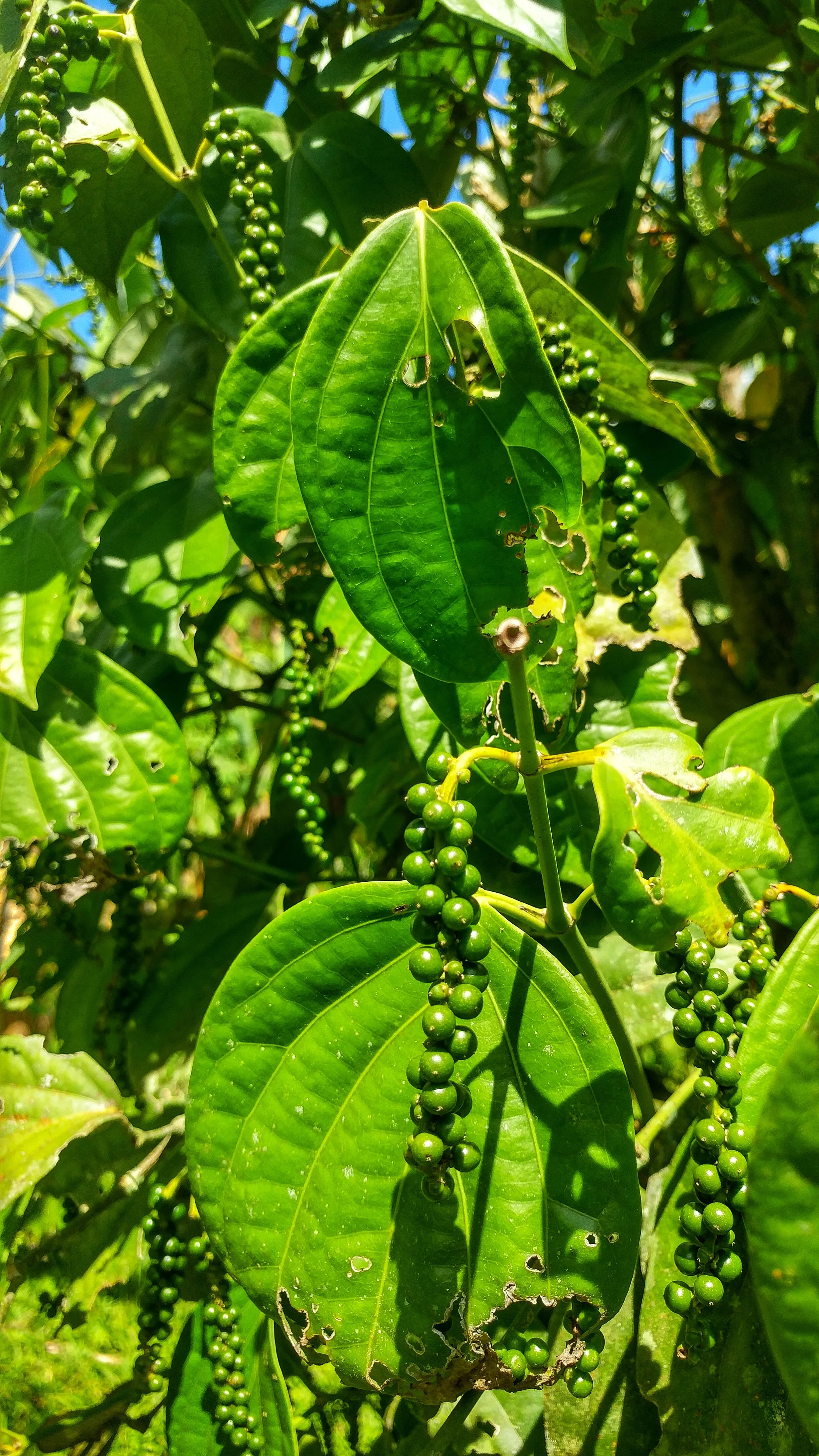
That black pepper on our omelet and potatoes is from a fruit, often referred to as a berry or peppercorn. It grows on a tropical climbing bush, and the white pepper in so many well-loved curries comes from the same plant. The pepper plant is a vine grown best on a living post, from small bushes to massive trees. Here at the ranch, we grow pepper on Gliricidia sepium, (known as madero negro in Costa Rica) a nitrogen fixing tree. Pepper has its origins in forest ecosystems, so it is a fitting plant for a permaculture food forest in the tropics.
How to care for your Black Pepper plant
To maximize yields, pepper plants need to be pruned properly. Once the vine is at least 8 nodes tall, it can be pruned from 3-4 nodes up from the base of the vine, just above a node. After pruning, the plant will send up two new shoots, and the vine cutting can be propagated by placing the stem in soil where it will grow new roots. People have given pepper new roots all over the world. Global trade increased the demand for pepper and sparked efforts to grow it in tropical places across the globe. Now, pepper is grown in 26 different countries, including Costa Rica.

Red Pepper and Green Pepper

White Pepper and Black Pepper
How to Process Peppercorns
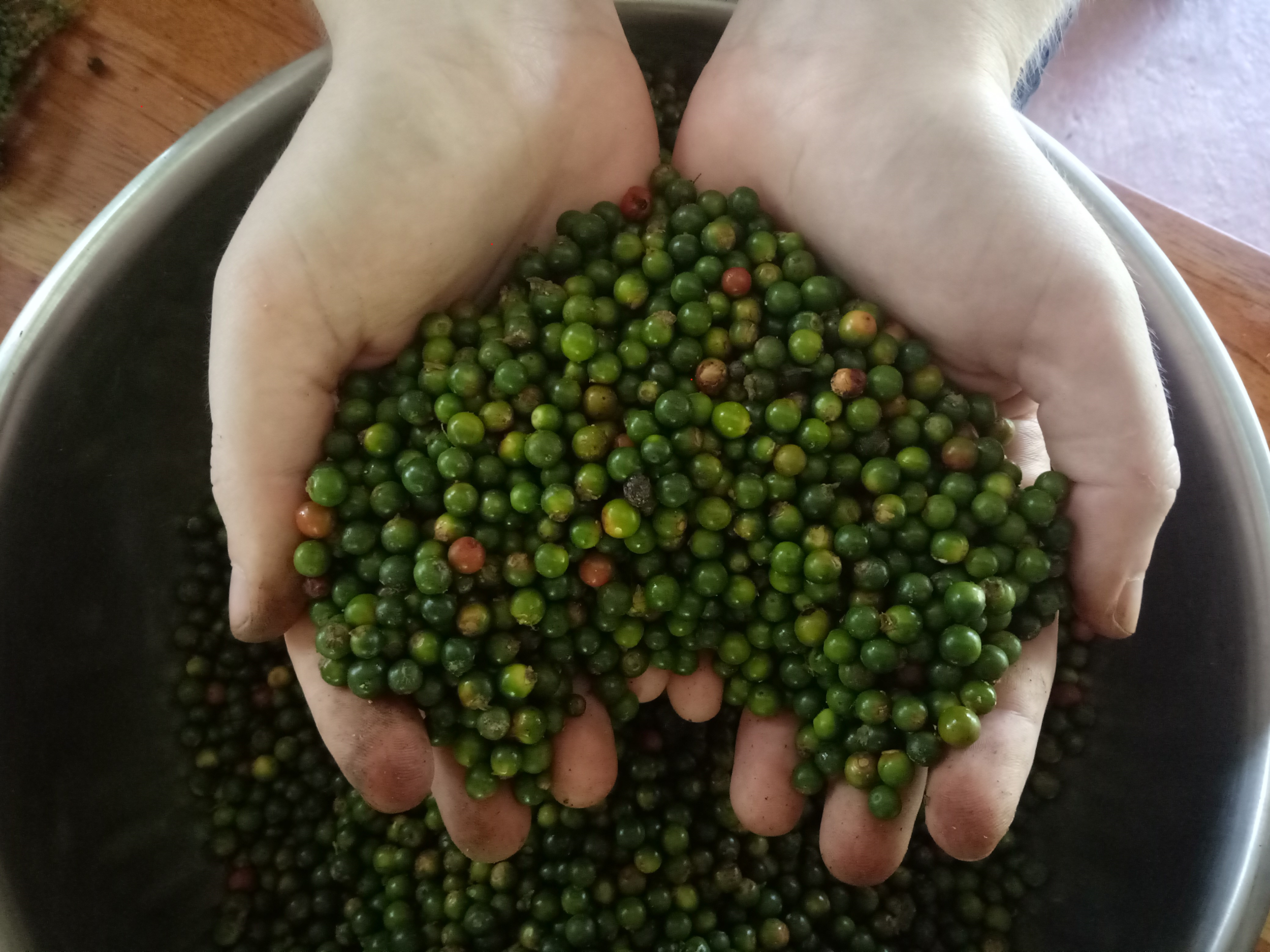
The first time I had pepper that was farm to table was here at Rancho Mastatal where we spent a day harvesting and processing pepper. Pepper is ready to harvest once one of the fruits in a bunch has turned red. First, the we collected the peppercorns in bunches and took them off the branches. We then separated the red berries from the green ones. The red berries become white pepper by soaking them in water for a day and peeling off the red flesh to reveal the white seeds. The seeds are then dried to make the white pepper on our spice racks.
The green berries we picked were destined to become black pepper. We blanched these for 1-2 minutes which starts an enzymatic reaction that turns the pepper black. Then we spread them on a drying rack. They can either be sun-dried, or you can use a dehydrator. Pepper dries to one-third of its weight.

Though the steps may seem simple, this was a very labor intensive process. It took seven of us 3 hours to harvest and process 4.5kg of pepper which dried down to 1.5 kg of pepper. This is about 40 dollars’ worth of pepper. It is truly a wonder that pepper is relatively inexpensive and so readily available. I wonder how many working hands and how many miles it has taken to bring pepper to my meals all these years.
Farm to Table Black Pepper
Farm to table has become a mainstream movement, and the growing awareness about the connection between our health and the well-being of our planet in relation to our diets is such a positive shift in our consciousness. But how would all those amazing farm fresh, local foods taste without spices? What would our omelet be without the king of spice itself?
Permaculture & Spices
While I don’t think people should go into their kitchens and empty their spice racks, I do think it’s important to appreciate all the resources and labor that go into every food we eat as well as understand the history of how it got from the forest to our table. Part of the word permaculture is culture, and it is incredible how pepper affected cultures everywhere and added to a permanent globalization of foods. It influenced the way people prepare, experience, and appreciate food. It changed people’s tastes. It changed cultures’ cuisines. Pepper was a powerful initiator in the transition away from eating local. With the globalization of our diets going back millenniums, what does it mean to truly eat local these days? As I continue to live my life of spice, I will keep asking these questions.
Hope you have a better understanding of the process of black pepper and how it gets from the vine to your grinder.
Speaking of spice… check out our past blog posts about vanilla!
And stay tuned for Dani’s next article on Life of Spice, featuring cinnamon!
Sources and Further Reading
Heinerman’s Encyclopedia of Healing Herbs and Spices by John Heinerman
Black Pepper- Piper Nigrum edited by P.N. Ravindran
Spices – A Global History by Fred Czarra

The Wonders of Vanilla
Vanilla is the second most expensive spice in the world. Being sold between $600-1200 per kilo, that is more expensive than silver!
What makes it so precious?
by Diana D, 2019 Apprentice
Vanilla is the second most expensive spice in the world. Being sold for between $600-1200 per kilo, that is more expensive than silver!
What makes it so precious?
Vanilla comes from the largest family of flowering plants, the orchids, as well it is the only orchid that produces pods. Every stage of vanilla bean production needs to be completed by hand, making it one of the world's most labor intensive crops.
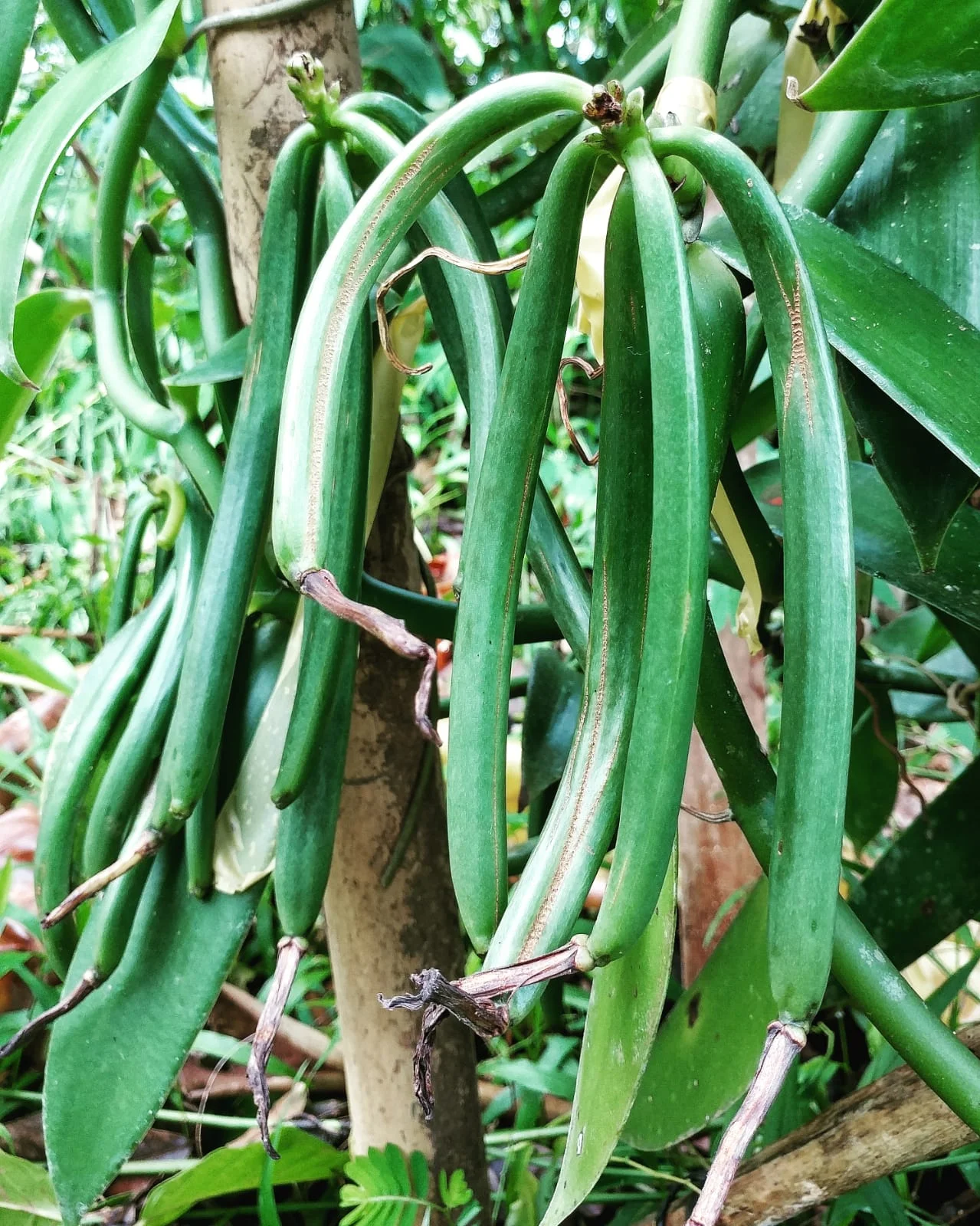
This orchid originated in Mexico, it's cultivation is being practiced from Mexico to India . Being producers and exporters to the world market these countries each produce up to 200 tons of vanilla annually. Madagascar is by far the largest producer of vanilla, accounting for over 80% of global production. Although the value of vanilla is very high this has had some unfortunate repercussions for vanilla farmers as crime and theft of their valuable product has increased. This has led to instability in the lives of the farmers. Natural disasters have also affected them deeply, wiping out entire crop yields for the year. With such a delicate and refined production system It could take up to 7 years to regenerate the vanilla and return to the same levels of production. As with any single crop production system, it is a high risk strategy to rely on one crop for all of your income. There is a growing awareness of these issue for vanilla farmers and some new more sustainable and resilient techniques are being adapted.

To learn more interesting facts about vanilla, its history, creating a sustainable way to grow vanilla and support the farmers read this great article. This article was written by the first company to have an integrated, sustainable, vanilla supply that began transforming the Malagasy vanilla business in 2006.
My interest in vanilla arose when I started to take care of it and pollinate it as part of my morning experiential learning tasks at Rancho Mastatal. The production of vanilla is a fascinating delicate and attentive process that if done successfully is extremely rewarding. I am able to experience the growth of the vanilla plant, the pollination of it's flowers , and after many stages of fermentation, curing and extraction we are able to enjoy the amazing product of this magnificent plant.
During my year long apprenticeship here in Costa Rica, I am able to immerse myself into the plant kingdom as well as learn the essential skills for self sufficient homesteading. I also get to apply and practice other skills such as carpentry and natural building which will allow me to lead a more sustainable lifestyle .
Vanilla is only one of the many fascinating things I have learned about here. I warmly invite you to come visit us in Rancho Mastatal in the rainforest of Costa Rica. There is so much to learn about how we can improve our lives within our communities and in harmony with nature. How we can all provide our own food and support our community with their projects.
What I have learnt from the vanilla plant is that I would love to grow it on my own land, it's prices are rising so why don't we grow it for ourselves? Let's take little steps to self sufficiency by growing our own food as much as possible and by supporting the companies that treat the farmers well.

Leon (2017 Apprentice) drying vanilla
I hope we keep growing vanilla and benefit from the heavenly smelling pods in our delicious deserts.
On that note I'm off to prepare a vanilla cocoa wine!
P.S This article contains the basic hooch recipe, check it out if you want to learn how to make delicious homemade hooch :)
Blessings,
Diana D
From Tree to Bar: How to Process Raw Cacao
Living in the tropics I found myself surrounded by cocoa trees, which was something you’d dream about as a kid. “Chocolate trees” But like so many things we’re used to consuming we don’t have the knowledge of how to process a raw material into something we can use, within the society we live convenience has removed us from the source. A simple act of making something gives us a connection to our environment.
by PJ Barton, Apprentice 2019
Living in the tropics I found myself surrounded by cacao trees, which was something you’d dream about as a kid. “Chocolate trees” But like so many things we’re used to consuming we don’t have the knowledge of how to process a raw material into something we can use, within the society we live convenience has removed us from the source. A simple act of making something gives us a connection to our environment. Walking through a supermarket we are surrounded by products readily available with a seemingly endless supply leading to a mass consumerism in our present society. This unsustainable consumption stems from our lack of involvement in the food we consume. So let us connect through raw cacao.
Throughout history so many cultures have cultivated cacao. From Mesoamerrica through to Europe. Its a world wide sweet enjoyed by millions, like most things the origin was much different to the present. Dating back 1400 BC chocolate was fermented into alcohol. It was a common commodity throughout Mesoamerica and the seeds were thought of as a gift from Quelzaledol, the goddess of wisdom. It was actually used as a currency.

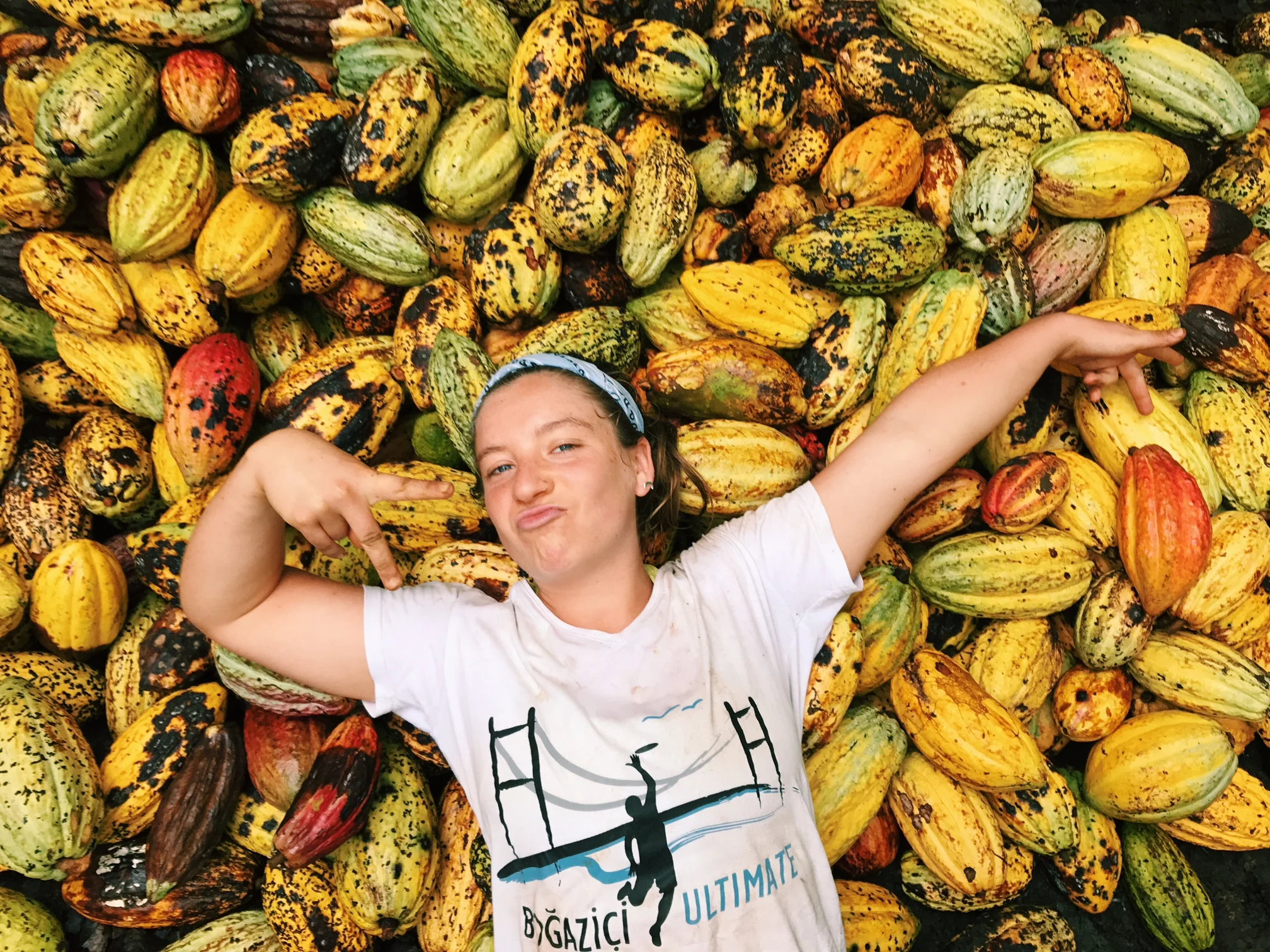
Processing raw cacao pods into beans is easy, tasty and fun!!
Processing
After harvesting the seeds which should be a yellow or bronzed color you crack open the pods to reveal a white flesh seed with a brown centre. The fruit itself is commonly eaten in Indonesia and reminds me of a mangosteen.
Scrap the seeds out leaving them to ferment. Place in a bowl and leave with a lid to keep off flies. We used banana leaves. To help the fermentation, yeast can be added we put kombucha to inoculate the ferment. During this process maintain temperatures of around 40 degrees and gradually increasing to 50 degrees. It’s not dependent on this I’ve made cacao before by just leaving it alone but by monitoring the temperature you’re going to create an optimal environment from the enzymatic reaction breaking the acidity of the bean.

After the beans have fermented for 4 – 5 days spread the beans out in the sun to dry the beans. This can also be done using a low heat in the oven but let’s harvest the energy of the sun which will enrich the bean. This can take a few days. The outer shell will be easy to break and the raw cacao is ready to use as desired.
Alternatively you can then roast the nut in a wok or in the oven paying close attention not to burn the seeds. It will start to crackle and a fill the air with an intoxicating aroma of chocolate. Leave to cool and break off outer shell. These roasted chocolate beans can be used how ever you desire.

Chocolate doesn’t grow on trees but if we understand the process it suddenly feels like it. Using ingredients from there raw form makes us more conscience intertwining us with the food we are consuming leading to a sustainable outlook towards life.
In Mastatal we are fortunate to not only grow our own cacao but also live next to a family run buisness, The Iguana Chocolate. Why not come and stay with us as a guest and do a tour at the local chocolate farm!

Dairy Diaries: How I Make Dairy Kefir
My name is Ryan and I'm part of the apprentice team at Rancho Mastatal for 2019. I've been navigating my lactose-intolerance since I was a child and gluten-intolerance since I identified it approximately five years ago. In this and the following installments of Dairy Diaries. I'll be exploring dairy kefir, in my personal effort to find ways to make dairy products I enjoy healthier, more digestible and more delicious.
By Ryan Roberts, 2019 Ranch Apprentice
My name is Ryan and I'm part of the apprentice team at Rancho Mastatal for 2019. I've been navigating my lactose-intolerance since I was a child and gluten-intolerance since I identified it approximately five years ago. In this and the following installments of Dairy Diaries. I'll be exploring dairy kefir, in my personal effort to find ways to make dairy products I enjoy healthier, more digestible and more delicious.
I have a mixed understanding of my dairy sensitivity, in part because throughout my life I have chosen to accept the consequences of consuming dairy products that I enjoy such as cheese and ice cream. Over the last few years, in an effort to better understand the nuances of my sensitivity, I've taken to experimenting through exposure and carefully observing my reactions.
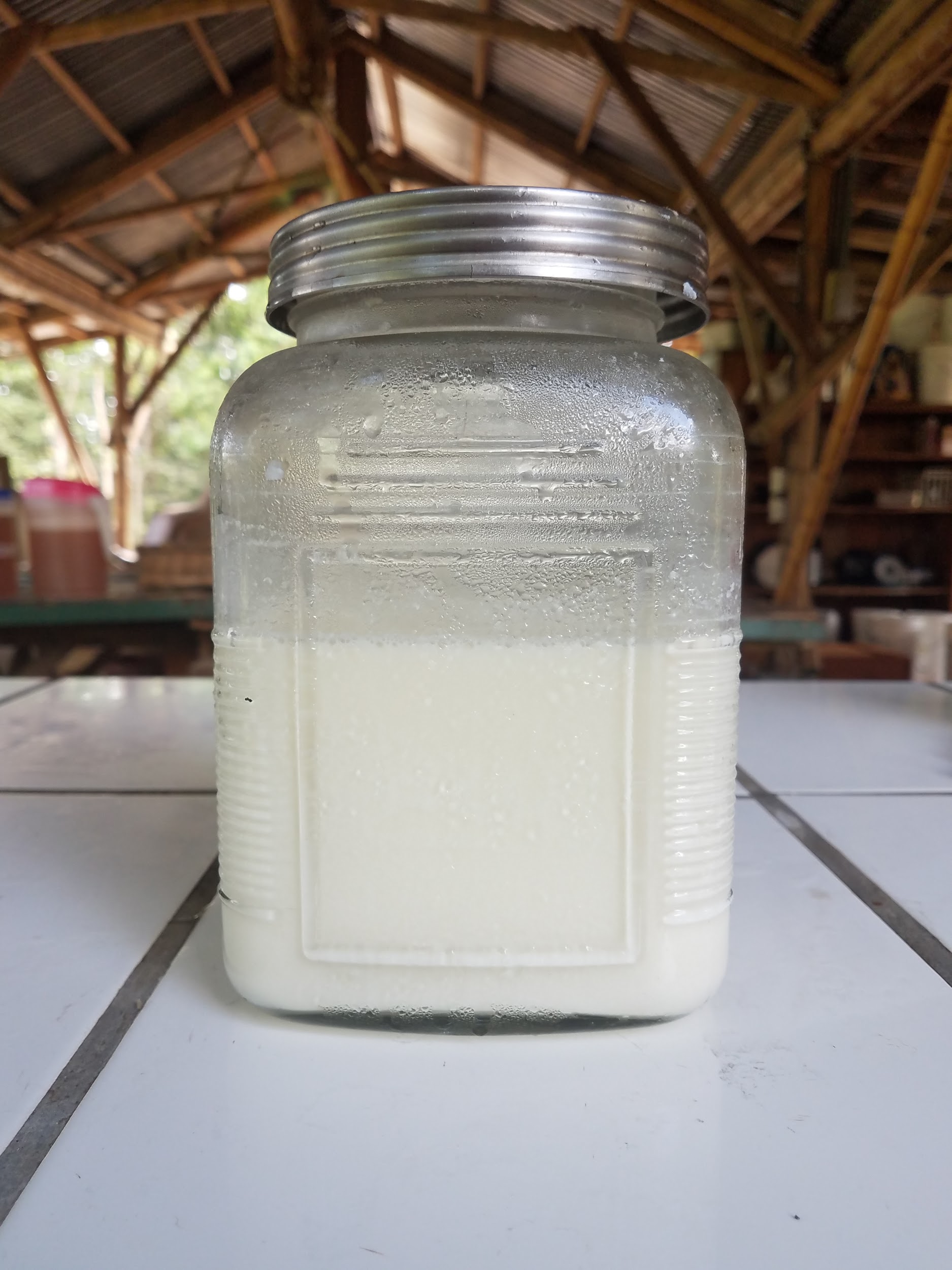
Since arriving at the Ranch, I've taken a fascination with dairy kefir, a cultured milk product which we make regularly as a base for salad dressing. My interest was piqued upon discovering that the salad dressing failed to upset my sensitive stomach.
Dairy kefir is tangy, effervescent and probiotic, closely comparable to yoghurt, with origins in the Caucasus Mountains of Eastern Europe. It is made using a dairy kefir SCOBY, which stands for a "symbiotic colony of bacteria and yeast", which are often called "grains" in the case of dairy kefir. Dairy kefir grains look like clumped grains of rice that are yellowish white. They tend to clump together in spongy, somewhat tough little colonies.
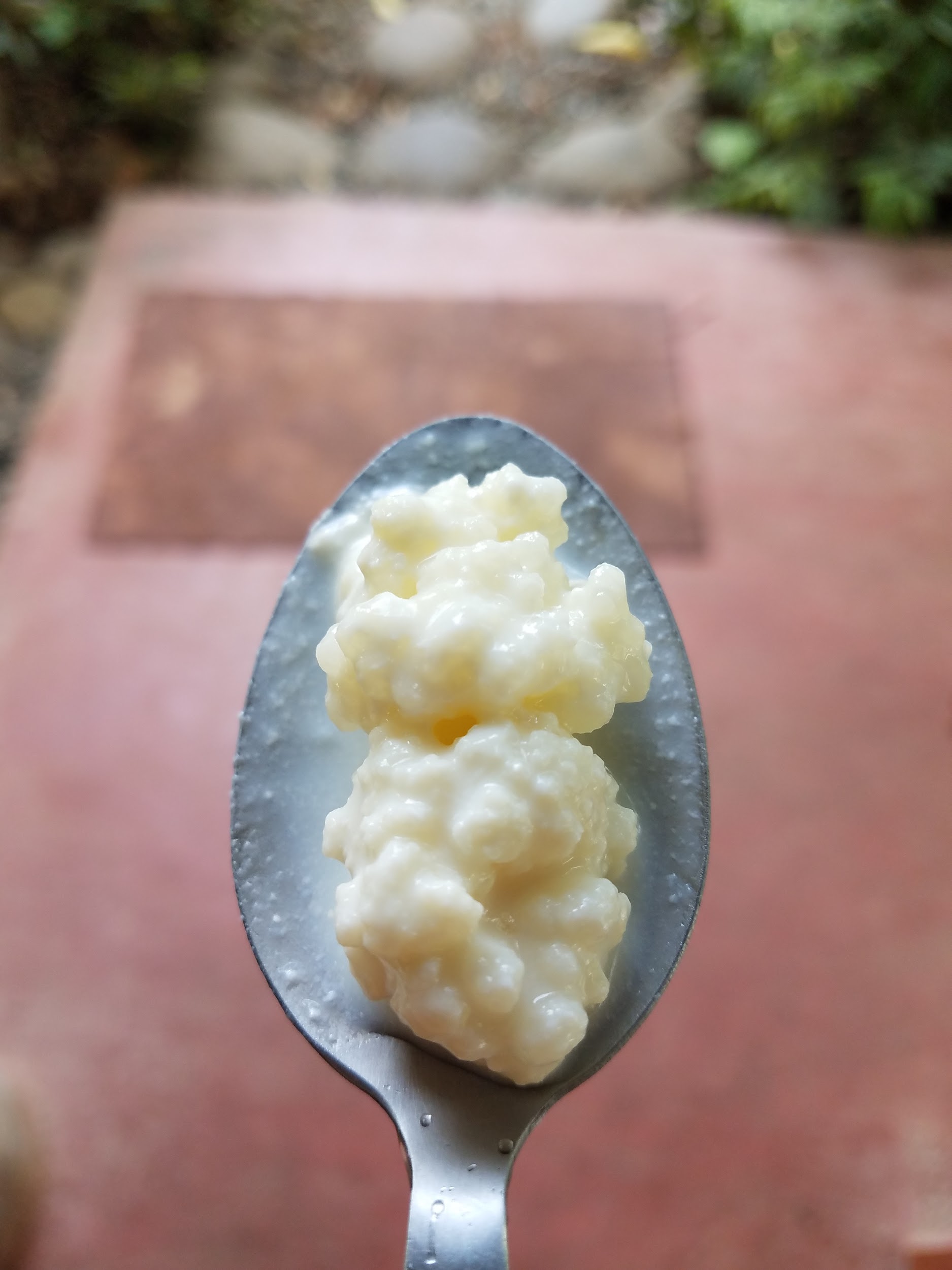
The SCOBY consumes the sweet lactose in the milk, converting in into lactic acid and multiplying the microorganisms beneficial to the health of our stomach, intestines and the whole ecosystem of our body. This makes it possible for folks with a sensitivity to lactose to consume delicious milk products fermented with this SCOBY.
It's delicious, it's great for you, and I'm excited to share that it is stupid easy to make and maintain.
It really is as simple as adding the dairy kefir SCOBY to your milk and letting the little SCOBYs get to work. When you are ready to consume your freshly fermented kefir, strain out the grains using a fine mesh strainer and a spoon, wash your container lightly and reintroduce the SCOBY and a new batch of milk.
The Process
1. Clean your container, using boiling water for your first clean. Let the glass cool.
2. Put a spoon-full of dairy kefir SCOBY into your container.
3. Pour your milk into your container, taking care to minimize splashing.
4. Place a lid over the container, creating only a light seal to allow CO2 to escape.
5. Let sit for desired level of tanginess.
6. Pour fermented milk and grains out through a fine mesh strainer.
7. Gentle rinse your container, ensuring you clean areas where the milk is splashed above the milk line.
8. Use a gentle scooping motion along the bottom of the strainer to find your grains.
9. Place them back into your container, refill with milk and lightly stir the milk with a clean spoon.
10. Enjoy your dairy kefir!

Here are some considerations when raising and caring for your dairy kefir babies:
Temperature:
Warmer temperatures accelerate the work of the dairy kefir SCOBY significantly. Here at the Ranch, we let our kefir sit for 12 hours to 20 hours through the heat of the day and the temperate evening. Generally after 12 hours, we put the fermented dairy kefir in the refrigerator overnight, but leaving it over night has led to a tangier, more desirable final product and an easier process.
Time:
The longer you let your dairy kefir SCOBY work, the tangier, thicker, more probiotic, and in my opinion, more delicious the kefir will become. Sit time varies based on your preference from 12 to 48 hours, depending on temperature. Refrigeration will allow you to store the kefir for up to a week. Note that while this significantly slows the metabolism of the SCOBY, the enzymatic activity remains active, breaking down the milk into more bioavailable and nutritious bits for our stomach.
Sanitation:
Like many ferments, the SCOBY creates an environment for itself that limits the growth of competing organisms through increased acidity and the production of ethanol (though in dairy kefir the alcohol is negligible). This means that the risk of contamination is limited to that which remains outside the milk. The best way to mitigate any rogue elements is to wipe away any splashed or remaining milk that won't be under the liquid. Other than that, thorough cleaning of the container for the dairy kefir is unnecessary - a simple water rinse will suffice.
The SCOBY:
The little yellow white SCOBY is actually quite durable and resilient, so don't worry about being terribly ginger with them. The only thing we want to avoid doing is pressing the grains through the fine mesh, which will cut and damage them. Prevent this by using a light scooping motion along the bottom of the strainer.
The SCOBY is also resilient to being left in the milk. If you want to take a break from the dairy kefir, you can do so by refrigerating the SCOBY in milk for weeks at a time. Every two weeks replace the milk with a little bit of new milk. It doesn't needed much.
The SCOBY will also grow in size and multiply. When you begin to find more grains, you can remove them and place them in a separate container to make even more kefir, or better yet, gift them to a friend! Dairy kefir, like many ferments, is the gift that keeps on giving.
So go forth and spread the love: for your taste buds, your gut, and your friends.
Check out Ryan’s other blog on dairy kefir crème fraiche
If you are interested in fermentation why not join us for our upcoming tropical homebrewing workshop?
Sources:
Rancho Mastatal Food Skills , Dairy Kefir, Laura Killingbeck
Brazilian Journal of Microbiology
https://www.ncbi.nlm.nih.gov/pmc/articles/PMC3833126/#!po=0.595238

The Basic Pantry Analysis: Design, Food, Sourcing
Cuisine is diet that's unique to a physical place and a human cultural group. We can taste the patterns of modern cuisine in the melding of characteristic ingredients into characteristic forms. Wheat noodles with tomato sauce points us in the direction of Italy. Fermented spiced cabbage leads us to Korean kimchi.
By Laura Killingbeck, Porvenir Design's Food System Designer
The Human Diet as An Ecological System
Cuisine is diet that's unique to a physical place and a human cultural group. We can taste the patterns of modern cuisine in the melding of characteristic ingredients into characteristic forms. Wheat noodles with tomato sauce points us in the direction of Italy. Fermented spiced cabbage leads us to Korean kimchi. Even amid tremendous variation, and even as these cultural foods are exported, appropriated, and evolve in different ways in different places, we are still able in many cases to recognize a cultural and geographical narrative embedded within relational patterns of flavors and forms.
Across the span of human agricultural history, cuisine sprung from ecological relationships—people ate what grew well in their area, and they grew what nourished them. Humans shaped the morphology of plant, animal, and microbial species by selective breeding; in turn, these foods changed the physiology of the human body. Cultural groups vary widely in their tolerance and desire for certain foods—these are genetic adaptations to their peoples' long history of evolution with specific cuisine. The co-transformation of people and food species was exquisitely mediated by the opportunities and limitations of the ecological niche of the place where they lived. Growth was balanced and calibrated within an ecological feedback loop of regenerating resources.
But in recent human history, globalization expanded our access to place and people, while simultaneously breaking this ecological feedback loop. We travel, and food travels; neither is linked, necessarily, in place. People are still connected with the world, but now we are connected differently. This shift is transforming the evolution of cuisine in unprecedented ways.

If you imagine the path of human ecology as a train traveling down a railroad track, globalization is the conductor turning the train onto a new track. Human relationships with food are now evolving in a different direction than they did before. The foundation for cuisine is no longer an ecological relationship between people and place; it is an economic relationship between people and business. Businesses grow or produce food and ship it around the world, where chains of distributors buy it and warehouse it in grocery stores. Surely this is not the only way that food works, and local food cultures still thrive in many areas. But it is a style of human-food interaction that is growing and replacing such local cultures. As we become increasingly separate from our direct relationship with the ecological patterns that once mediated food and diet, we become more deeply fused with a new, abstract, relationship with global commerce. The foods we like to eat often have less to do with healthy ecology, and more to do with macroeconomics and marketing.
We know there are a lot of problems with this. The Western Diet (aka, global cuisine) is correlated to chronic disease and poor health. Mass agriculture depletes soil and species diversity. Industrial pesticides and fertilizers damage ecosystems. There is a lot more to say but I don't have to say it—on some level we know, all the time, that this is bad. And even as we know, we still eat global-industrial foods, because we're hungry, its what we know, and its what's there.

Post-Harvest Permaculture Design
Permaculture design is essentially applied ecology for human development. It studies and teaches how life relates to place, with the object of sustaining that life and that place. A lot of the literature within Permaculture Design centers on the infrastructure development of building, landscape, and agricultural systems. It most often highlights the agricultural side, with ideas and methods of learning how to integrate human agricultural systems with the larger ecology of life on earth.
But interestingly, the focus on agricultural systems within Permaculture Design methodologies often only lightly brushes post-harvest food handling and cuisine development. The general thinking is that once people understand food production as a functional part of ecological systems, they will be able to grow more food. This has been very successful for many people, with one caveat—growing plants, animals, or microbial species that are edible does not mean you are growing food that is ready to eat. A a plot of wheat and a chicken pecking bugs can be wonderful parts of an agricultural ecosystem, but if you want a chicken sandwich there is still a lot of work to do.
Over the last nine years I've worked with two farms and education centers who dedicated themselves to the process of farm-to-table food production—one in temperate Massachusetts, and the other in tropical Costa Rica. This allowed me to study and practice food preservation and processing across climates, and see the similarities and differences that unfolded.

At Rancho Mastatal in Costa Rica, even very common foods, like malanga, tiquisque, cuadrados, pejibaye, and chaya were all new to us. And what do you do with a sudden hundred pounds of ripe bananas? At Round the Bend Farm in Massachusetts, we needed to preserve large quantities of food seasonally to last the winter, in a way that was totally different than in the tropics. We also transitioned from a home-scale cooking facility to one which could serve hundreds, and had to scale our systems up to meet new demands. At both organizations, it took us a lot of time, and a lot of trial and error, to acquire the skills, tools, and labor to do these things. And to do these things efficiently, it took structured seasonal planning. The teaspoon of ginger you need now in your recipe had to be grown a year ago, then harvested, dried, powdered, and stored. We had to learn how to organize ourselves in relation to local food, in ways that were intrinsically different from how we used to organize ourselves in relation to globalized foods.
The human element of how we interacted with food based on our personal and cultural backgrounds was another huge piece of the puzzle for local eating, especially in Costa Rica. We craved western-style bread products; people didn't always like Costa Rican cuisine; some people were afraid of new foods like fermented bananas. Eating locally meant coming to terms with the cultural references for desirability of foods we had brought with us, in relation to the ecological and cultural backdrop of a new country and climate. We had to adapt ourselves to new styles of cuisine, and adapt that cuisine to ourselves as newcomers.
Most of my work in Costa Rica and Massachusetts was to create, systematize, and implement post-harvest food processing and preservation strategies based on farm foods. I also worked with numerous farm owners, communities, and homesteaders who were and are in the process of divesting from their dependence on global-market food supplies. It is through these relationships and experiences that I began to notice consistent patterns in the challenges people faced in transforming their farms into food. I started comparing patterns of limitations and successes that people were reporting, with those of the organizations I was working with. I used permaculture design to organize these patterns into a systematic format that I could use to consult with people about how to achieve more efficient and accelerated farm-to-table food system success.

I call this consultation service the Basic Pantry Analysis. The title and process drew inspiration from many collaborators in the fields of permaculture design and farm-to-table cuisine; in particular the work of Costa Rican ethnobotonist Rafael Ocampo, as well as that of the Sat Yoga Institute. A similar process focused on family nutrition has also been promoted by the Instituto de Nutrición de Centroamérica y Panamá (INCAP). My version of this process is based on my experience working with farms and communities, and is an adaptation of a wonderful wealth of collaboration among many individuals and organizations.
The Basic Pantry Analysis
The Basic Pantry Analysis matches the ecological needs of your land, with your cultural and personal frames of reference, your dietary needs and desires, and your resource capacity, to form a “basic pantry” of ingredients, whole and value added, that you will use to develop your own dynamic cuisine—that is, the meals you eat every day to sustain yourself in the place you live. This process is useful for anyone who wants to accelerate their ability to grow, process, and eat local foods.
Your Basic Pantry will be designed through a combination of personal decisions and desires, which inform a multitude of what are often very simple tasks. Those big ideas and those little tasks are what build the complex whole. The consultation service is divided into four primary parts: Vision, Layout, Basic Pantry, and Adaptation. The scope of service varies depending on the client's needs and desires.

Sample Outline of Basic Pantry Service
Please note this varies based on client needs.
Vision
This is the overall concept of your cuisine. Exploration of goals and values, and how those relate to your capacity. Make decisions about priorities for ecological, cultural, dietary, financial, factors.
What the client receives:
• A one paragraph vision statement for your cuisine.
• A one page analysis of the factors and values that contribute to that vision.
• A sample set of meals you could expect to eat over the course of the year.
Layout
This is the architectural layout of your plan—it shows clearly how different food elements and tasks fit into your cuisine over time.
What the client receives:
• Daily, weekly, monthly, and/or annual list of post-harvest food tasks for your mature food system.
• Analysis of tools and infrastructure.
• Analysis of skills and labor needed.
• Basic five year analysis of how your food system transitions through time.
Basic Pantry
You need lots of ingredients to make meals—this is the list of those ingredients, whole and value-added. I work closely with the agricultural team to make recommendations about food species.
What the client receives:
• Sourcing and Growing list
• Processed and Preserved foods list
Adaptation
Your Basic Pantry Analysis is a starting point, not an end. It will grow and shift and evolve as you and your land do. This section is a structured feedback loop to help you grow and shift your cuisine based on your priorities.
What the client receives:
• Design concept follow up questions
• Blank harvest, processing, and/or other charts for feedback
• Supporting appendix—contains client-specific documents on further skills and strategies, and/or other supplementary documentation as needed.
For more information on costs and deliverables of this service please write our team at info@porvenirdesign.com.
For information on food related workshops at Rancho Mastatal please see go to our Workshops page.


Flexitarianism: Living and Sharing Solutions to Climate Change
DISCLAIMER: These are my thoughts and experiences on what can be a deeply cultural, charged and personal topic: diet. There is a lot we don’t know, especially when it comes to what a sustainable diet is. For one, most studies have been centred in high-income Western countries (Jones et al., 2016); it’s also still largely unclear exactly what a “healthy diet” should consist of, nevertheless what a truly sustainable society would look like. Integrating all of these concepts is an enormous challenge.
by Matthew Livingston
Matt is currently one of the Ranch's year-long apprentices.

DISCLAIMER: These are my thoughts and experiences on what can be a deeply cultural, charged and personal topic: diet. There is a lot we don’t know, especially when it comes to what a sustainable diet is. For one, most studies have been centred in high-income Western countries (Jones et al., 2016); it’s also still largely unclear exactly what a “healthy diet” should consist of, nevertheless what a truly sustainable society would look like. Integrating all of these concepts is an enormous challenge.
“Defining what represents a macro-nutritionally balanced diet remains an open question and a high priority in nutrition research.” (Song et al., 2016)
Before coming to the Ranch, I had been vegetarian for about a year and a half, predominantly for environmental reasons. Currently, I would probably classify as a “flexitarian” or “ethical omnivore”, as are most of the denizens here, with the majority of the diet being plant-based. Ideally ~95% of our calories would come from plants, due to extensive research on the health, longevity and environmental benefits of eating a predominantly plant-based diet (1, 2, 3). A 95:5 plant to meat ratio is manifest in all of the Blue Zones (4), examples being Okinawa & Sardinia, where people live the longest and most healthful lives in the world. Allow me to explain how I came to this decision and why I’m sticking with it for now…
My original swap to vegetarianism was influenced by my desire to live “more sustainably”, and healthily, as it is for many people now. I saw the documentary film “Cowspiracy” (bear with me) and this initiated my research into food and agriculture, which carried over into my environmental sustainability degree. It was also enough to shift one of my fundamental behavioural patterns – my diet. It was a little tough going at first, but I soon found that I didn’t miss eating meat much at all. I felt a bit better about myself, “knowing” that I wasn’t contributing as much to global warming, as my research indicated that changing one’s diet can be one of the most impactful ways of reducing your carbon footprint (Aleksandrowicz et al., 2016)…

Fast forward to May 2017, when I travelled to Ridgedale Permaculture farm in Sweden for my Permaculture Design Course with Richard Perkins. Richard is a proud meat-eater, being particularly fond of freshly line-caught fish, properly cured bacon & sausages, and a nice, juicy steak from locally reared, regeneratively farmed livestock, as viewers of his Youtube channel will know. He was keen to point out that there are in fact “no ecosystems on this planet that exist without animals driving the nutrient cycling” (Perkins, 2016). Ecosystems depend on the cycling of nutrients (and minerals) in order to function, and these nutrients can be accumulated, dispersed and concentrated by animals in such a way as to benefit the whole.
One beautiful example of this is the salmon of British Columbia, that feed the bears, eagles, forests and pretty much everything else that lives there with nitrogen and other accumulated minerals from the ocean when they return to their spawning grounds. Another was the Great Plains of North America, where tens of millions of bison roamed. These prairie lands were extraordinarily diverse habitats for a multitude of co-evolved flora & fauna, micro and macroscopic. Now they have predominantly been turned into endless fields of corn, wheat and soybeans, using fossil-fuel powered machinery and chemicals to maximise profit whilst depleting soil of not only its nutrients, contributing to erosion and nitrogen runoff, but its life too.
Regenerative Agriculture aims to work differently. The challenge is to maintain healthy yields and livelihoods whilst simultaneously enriching soil, biodiversity and ecosystems and improving the system’s ability to regenerate itself. Through various mechanisms, we can actually draw down carbon from the atmosphere and store it in soils and vegetation. What’s more, animals can help achieve this goal. Grazing animals such as bison co-evolved with grasses (which are extremely efficient sunlight accumulators, astronomically more so than our photovoltaic panels), such that massive herds would graze through perennial grasses whilst defecating and trampling the remnants down to create a mulch that left the soil covered, before moving on. The grasses would get a natural fertiliser boost but wouldn’t be eaten down completely, which meant that they could grow back and not have to deplete their soil nutrient reserves. Over time, this kind of rotational grazing, especially when well-managed, can build significant amounts of soil. At Ridgedale, they have employed it, along with other techniques such as Keyline Design, to build over 6 inches of soil in just four seasons. There is even a project called Pleistocene Park in northern Siberia that hopes to repopulate the Mammoth Steppe, which historically supported one of the largest densities of herbivores in history and could function as a massive carbon sink. Surely we need animals as a part of our (agri)culture, then?

Well, you might point out that ruminant animals like cows and sheep that we are now cultivating in extremely large numbers produce methane as a part of their digestion, a greenhouse gas with ~30 times more “global warming potential” than CO2. Greenhouse gas accountancy is a complex topic and there is still significant debate as to whether the sequestered carbon pays off the methane produced during the lifecycle of the animal (see Garnett et al., 2017 & P.P.S.); that said, it’s also possible that the earth historically supported much larger numbers of herbivores, many of which were likely driven extinct by humans thus contributing to ecosystem disruption, as discussed in Sapiens and elsewhere (7, 8).
Another common argument is that eating animals is calorically inefficient when we could eat what we feed them. I would say this is a partially valid point in that animals, especially cattle, often need more land and water to produce than their plant-based counterparts, but it’s less valid when discussing purely grass-fed animals whose rumens are evolutionarily designed to digest grass, which most of us humans obviously don’t do very well; this suggests that if you want to obtain food from a parcel of land that wants to be grassland, you could force it to be not grassland, or you could manage and eat animals that are designed to live in and perpetuate that ecosystem. The Sustainable Food Trust goes so far as to say “the only sustainable way to obtain food from grassland is to graze it with ruminants”, which does sound a bit extreme especially considering that rabbits and geese are just two examples of non-ruminants that can be grass-fed. Livestock especially are getting a lot of bad rap due to the significant environmental damages of deforestation for pasture (an example of forcing an ecosystem to be something it doesn’t want to be) and their methane and nitrous oxide emissions (Steinfield, 2006; Stoll-Kleemann, 2015; many others).

Whilst not negligible, I’m concerned that many of the livestock systems under scrutiny aren’t representative of best-practice regenerative methods and that there is definitely the problem of reducing a living creature to the efficiency metric of its greenhouse gas emissions per kg of meat without considering all of its other beneficial functions and services; this metric has led people to the conclusion that “landless systems” or feedlots are better for the environment (Garnett et al., 2017), despite animal welfare being known to be abysmal and where wastes are concentrated and rarely dealt with properly. These factors go against the principles of regenerative agriculture and thus wouldn’t be allowed to continue; yes, grass-fed cows and other ruminants require more land, but we could limit the amount of land devoted to raising them and thereby reduce the total stock and consumption. In this manner, by allowing animals and ecosystems to express their true functions and behaviours according to the co-evolutionary properties of the animals and their environments, it might be possible for humans to yield ethically sound animal-derived food that positively contributes to the whole-earth system.
There are also a few points I would like to discuss with regards to plant-based (especially vegan) diets. Vegetables and whole grains, which form the staples of most healthful plant-based diets, as well as fruits and nuts, obviously take some amount of energy to produce, thus we need to consider where this energy or fertility comes from. We also need to consider where the dietary fat, protein and vitamin B12 will come from (amongst other nutrients/minerals) when meat is abstained from completely; I believe it is possible to meet your protein needs on a plant-based diet (Ranganathan et al., 2016), but doing so in the dead of winter in a temperature climate in a sustainable manner might be more difficult (are the Inuits an unsustainable people?)

Even the “most sustainable”farming methods I am aware of (which may or may not be organic certified) acknowledge that the inputs to grow food ultimately have to come from biological nitrogen fixation, conversion via animals, or inorganic elements (chemicals). For example, compost is vital to almost all organic, traditional and regenerative farms, and often incorporates animal manure, which adds additional nitrogen and biology to the soil and ultimately to the plants. The only exceptions I can think of to this would be Jean-Pain compost (which uses only wood chips and water) and Masanobu Fukuoka style rice and winter wheat cultivation, where the straw from the previous crop was left on the field as mulch and nutrients. Even the ancient and incredibly successful Meso-american Chinampas systems, as well as the rice cultivating nations of China, South Korea and Japan, have utilised ferti-irrigation techniques comprised predominantly of the wastes of fish as nutrients. Thus, since no sustainable farming methods can use inorganic chemicals derived from fossil fuels, most consumers that eat a purely plant-based diet are still deriving their nutrients from (the functioning and inclusion of) animals… Perhaps the question then becomes can, should and how would we integrate animals into our farming systems without eating them?
I’m still considering the implications of these questions and my position on the frequency and type of my animal consumption. We’ve had four “Pig Parties” in the four months I’ve been here at the Ranch, and chicken about once a week on average, all of which was reared and slaughtered locally in Mastatal. This corresponds pretty well to a 95:5 plant:meat ratio (see P.P.P.S.). For the first of the two pigs I visited the farm where it lived, died and bore witness to how it was processed; for the second we had an intro on how to properly butcher a pig. I think this is a crucial missing link for the majority of meat consumers and we need to continue building awareness of the realities of industrial slaughterhouses. Both of the animals I visited lived outdoors in tropical home gardens, feeding on bananas and other food scraps, although I’ve now been told it’s likely they were fed some concentrated feed. Pigs will eat just about anything, including chickens – they are probably the ultimate organic material recycling animal. Feeding farm animals to other farm animals is illegal in many parts of the world, but we need to always be searching for ways to turn “waste” into food, and pigs are one effective way of doing so. They in turn provide manure to feed back into the ecosystem and, when the time is right, are themselves converted into protein, fat and flavour for dozens of people for multiple meals. They can also provide piglets so that the system can continue, perhaps indefinitely. Without pigs in this system, you would have to replace the dietary protein and fat, which in our climate would likely come from more annual beans and palm oil from cleared forest land, as well as find another method of recycling the food scraps (vermi-compost is great, but doesn’t provide food in return).

Based on this discussion, I would like to present my initial take on a scale to classify diets based on their ability to be sustained, from best to worst:
Local regenerative
Local organic certified
Non-local regenerative
Non-local organic certified (many vegetarians/vegans in cities)
Local conventional
Non-local conventional (most consumers)
Where locality is on a scale from hyper-local (within 5km), to local (within 50km), to regional (within 250km), to non-local (further than 250km). Another important variable that goes hand-in-hand with locality is seasonality. Thus a checklist for regenerative dietary choices might be something like:
Is it local? (as the crow flies to place of origin): <=5km — <=50km — <=250km — >250km — Don’t know
Does it come from your garden, your nearest farmer, your nearest market, or another country?
Is it in season?: Yes — No — Don’t know
Are you regularly eating avocado, chocolate or coffee in winter in a temperate climate? What can you eat and drink locally and seasonally to replace imported goods you habitually desire?
Are you consuming fermented foods and beverages? The Japanese have one of the strongest food cultures (called Washoku 和食) and longest lived people in the world, and 5/6 of their staple food ingredients are fermented foods. Fermentation is not only extremely beneficial for your health, but ties in beautifully with preserving the abundance of the harvest.
Was it produced regeneratively?
Did it build soil and/or sequester carbon?: Yes — No — Don’t know
Did its production support local farmer(s)/community? Yes — No — Don’t know
Did it use no chemicals and no or very little fossil-fuel powered machinery in its production? Yes — No — Don’t know

It is my guess that many consumers would tick No or Don’t Know for every field, whilst falling into the worst category (non-local conventional). We need to shift first from ignorance to awareness before we can shift to understanding and action – behavioural change is flipping hard! All I can say right now is the link between diet and planetary health is crucial in navigating our transition towards a sustainable prosperity.
Let me be clear: plant-based diets are absolutely a big part of the solution, and there are many cases (including the average Western diet) where meat consumption should be reduced, but nevertheless animals aren’t the enemy. Vegans, vegetarians and ethical omnivores have a common enemy, and that is industrial agriculture (especially feedlots, which are completely awful). Meat in moderation, i.e. Meat Mondays as opposed to Meatless Mondays, may be a way forward for many people, rather than jumping straight to 100% plant-based diets based on quinoa and avocados shipped in from someplace slightly more exotic. I think this better follows the Transition Ethic that Rob Hopkins thoroughly emphasises via the Transition Network, by meeting people where they’re at – there is an irrepressible demand for meat due to complex sociocultural factors that will take time to shift away from, but if we can make ethical compromises that simultaneously shift mindsets, we will be well on our way to a more symbiotic relationship between humans and Nature.

May The Triforce (Plants, Animals and Fungi!) Be With You!
P.S. Follow the debate here, and here.
P.P.S. For the adventurous you can read my Regenerative Agriculture Brief and explore the references there too!
P.P.P.S. Three meals a day with chicken for 52 meals and pork for 12 meals in a year = (365*3-(52+12))/(365*3)*100 = 94.2%.
References, a.k.a. some of the things I’ve read:
Badgley, C. et al., 2017. Organic agriculture and the global food supply.
Davis, K.F. et al., 2016. Meeting future food demand with current agricultural resources.
Garnett, T. et al., 2017. Grazed and Confused? Ruminating on cattle, grazing systems, methane, nitrous oxide, the soil carbon sequestration question – and what it all means for greenhouse gas emissions. FCRN, University of Oxford.
Jones et al., 2016. A Systematic Review of the Measurement of Sustainable Diets.
Perkins, R., 2016. Making Small Farms Work: A Pragmatic Whole Systems Approach to Profitable Regenerative Agriculture.
Ranganathan, J. et al., 2016. Shifting Diets for a Sustainable Future. World Resources Institute.
Smith, P.S. et al., 2014. AR5, WG3, Ch 11, Agriculture, Forestry and Other Land Use (AFOLU). Ar5, Wg3, pp.811–922.
Steinfield, H.G., 2006. Livestock’s role in climate change and air pollution. Livestock’s Long Shadow. Environmental Issues and Options, pp.79–123. Available at: http://www.fao.org/docrep/010/a0701e/a0701e00.HTM.
Stoll-Kleemann, S. & O’Riordan, T., 2015. The Sustainability Challenges of Our Meat and Dairy Diets.
Weber, C.L. & Matthews, H.S., 2008. Food-miles and the relative climate impacts of food choices in the United States. Environmental Science and Technology, 42(10), pp.3508–3513.
West el al., 2015. Leverage points for improving global
food security and the environment.


How to Make a Real Tortilla
When I was a teenager, I traveled for a few months with a Mexican shoe-shiner I met in Mazatlán. We thumbed rides across the country and were taken in along the way by a dozen or so of his relatives. I often found myself in the kitchen with his aunts, cousins, and nieces, making tamales, sopes, or other dishes that were new to me.
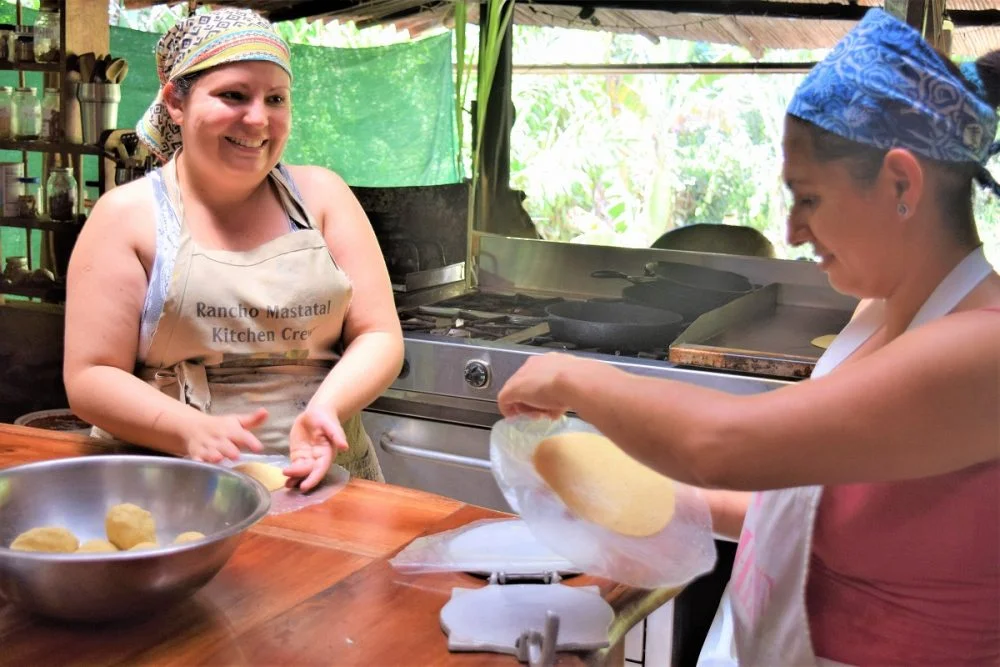
This article was originally published in the Tico Times. Please follow the link for the original article.
When I was a teenager, I traveled for a few months with a Mexican shoe-shiner I met in Mazatlán. We thumbed rides across the country and were taken in along the way by a dozen or so of his relatives. I often found myself in the kitchen with his aunts, cousins, and nieces, making tamales, sopes, or other dishes that were new to me.
Due to my lack of skill, the family often sent me to the local store to buy tortillas. Everywhere we went, no matter what town we stayed in, there was always some tiny store that sold stacks of them, fresh and hot. For me they came to represent the spirit of family and sharing in Mexican culture, and a deep pleasure in simplicity — there was really nothing better than those fresh tortillas with a slice of homemade cheese.
Most of the tortillas we bought or made were thin, six to eight inches in diameter, and made from corn. They tasted nothing like the giant flour disks from the grocery store that never went bad. They tasted original.
Later, traveling around Latin America, I came to realize that those corn tortillas really were original. In the different countries and communities I later visited, I tasted tortillas in vastly different forms. Some were fatter, some thinner, some made of yellow corn, or white, or blue, some pressed flat, others slapped into shape between two palms.
Most tortillas made by hand in Latin America are made with corn rather than wheat. This is because corn grows well here, whereas wheat in general does not. Some also incorporate pejibaye (fruits from a native palm, Bactris gasipaes) or ojoche (seeds from a a rainforest tree, Brosimum alicastrum). Variations stem from economy, culture, and landscape.
Tortillas do not have the same widespread status of daily consumption in Costa Rica as they do in Mexico or many other Latin American countries. But they do have a rich history here, and are still often eaten in the form of gallos (a tortilla curved in the hand around meat or a savory picadillo) or as an addition to a typical breakfast. There is no better way to impress your Tico and Tica friends than with a gallo made with a homemade tortilla! Where I live now in rural Costa Rica, a homemade tortilla is one made from whole corn that has been nixtamalized and ground into dough, also referred to as masa.
Corn
There are at least 150 different varieties of corn. They can be divided into four major types: sweet corn, popcorn, flint, and dent. Sweet corn is bred for its sugar content, and is eaten before the kernels are mature. Popcorn, which is usually round in size, has a specific protein ratio that makes it ideal for popping. Flint and dent varieties are generally flattish and oval, and are used to make corn flour, dough, and other foods for both humans and other animals. The corn used for making tortillas is usually a flint or dent variety that has been grown to maturity and dried. This is often referred to as field corn.
Many Costa Rican farmers still grow field corn for their families or to sell at market. A number of our neighbors grow corn and make tortillas and other corn dishes, such as tamal asada and chorreadas, at home. You can inquire about purchasing local corn at any major market, or ask your neighbors if you live in a rural area. Most people are usually quite excited to help you source this great product, and if you’re charming enough, someone’s grandma might help you make your first tortilla!
Nixtamalization
Mature dried corn presents a special challenge. Its outer seed coat, or pericarp, is hard and creates a strange texture unless you remove it. It also has a substance that can inhibit the body’s ability to uptake the vitamin niacin. You need to cook the corn in an alkaline substance to dissolve the seed coat and to ensure that niacin is bioavialable.
For populations that eat large quantities of corn, this process is essential to dry corn’s nutritional value. In addition to improving corn’s nutritional qualities, nixtamalization gives the corn structure and pliability, and improves the flavor. Ancient peoples cooked their corn in wood ash, or powders made from bones or shells, to achieve this. Many people around the world still use wood ash or other variations of alkaline substances to cook corn in this way. The following recipe calls for hydrated lime (calcium hydroxide). In Spanish this is referred to as cal.
There are many different methods to nixtamalize corn. The qualities of corn vary widely based on variety, post-harvest handling, and age of the dried kernel. The boiling time and temperature varies (15-90 minutes) depending on the type of corn you use. The following is a great recipe that works well for us with our local corn.
Nixtamalized Corn Recipe
Ingredients:
15 cups whole dry field corn
3 tablespoons hydrated lime (calcium hydroxide), sifted
Water

Instructions:
DAY 1
Rinse the corn thoroughly in water. Remove any particles, floating pieces, dirt, or corn silk.
Cover with at least four inches of water and let soak 12-24 hours in a covered pot.

DAY 2
Drain the corn, rinse again, and add nine liters of water. Mix in the 3 tablespoons of sifted lime. Stir. The corn should turn bright yellow-orange as you stir in the lime.
Put the corn and lime water on the stove and bring to a boil.
After the corn reaches a rolling boil, reduce the heat to a strong simmer and cook 30-60 minutes until the corn is tender and skins are separating and dissolving away from the kernels. The corn should be easy to bite into, but still have a bright white point in the center. The kernels should be firm and intact with the germ and tip still present.
Take the corn off the heat and let it rest for at least one hour. (We have tried many variations of this resting time, including letting it sit overnight, or not resting at all. Letting the corn rest in the alkaline solution after boiling is thought to further transform the starches and give the tortilla a better structure.)
Drain the corn into a sturdy metal colander and rinse with water. Rub the kernels between your hands and/or against the holes in the colander to remove all lime and the clear kernel skins. Use plenty of water. Once the corn is thoroughly rinsed and cleaned, it is called nixtamal.

Uses:
Nixtamal can be used whole in soups, casseroles, salsas, and side dishes; it can be ground for tortillas, corn crusts, or made into polenta, tamales, or atole. The whole nixtamal will keep for several days in the fridge, but once ground should be used within a day.
Tortilla Recipe
The dough used to make tortillas is referred to as masa. To make the masa, grind nixtamalized corn in a corona hand mill or other grinder. You may want to double grind for a finer texture. Mix with salt to taste and just enough warm water to make a dough that is soft and pliable, and adheres to itself but not to your hands. You should be able to roll it into balls that retain their form completely when you hold them in your palm.

The easiest way to make a tortilla is with a tortilla press, but if you don’t have one just substitute two cutting boards.
Grab a small chunk of masa and roll it into a ball. Use two sheets of plastic (zip lock bags work fine) and put the ball between them in the tortilla press. Press down the handle and open it back up. Carefully peel the tortilla from the plastic bag and flip it into a hot cast iron skillet.
Cook for about 40 seconds and then turn it over. If your masa is ground fine, you will see the tortilla puff up. If it is thick it won’t and that’s fine. Tortillas should be cooked through and golden (or another color depending on the color corn you started with).

“Food for Thought” is a Tico Times series from Laura Killingbeck, is the Director of Food Systems and Fermentation at Rancho Mastatal Sustainability Education Center. The Ranch is a community and education center in Mastatal, Costa Rica, that hosts residential workshops in food, permaculture, natural building, and more. Laura co-manages the Ranch facilities and programs, teaches fermentation workshops, and writes about the intersection between food, body, and place. To take a class with Laura or visit the Ranch, please visit www.ranchomastatal.com.

Farm to Table Tales
Good food takes time. I've heard this phrase many times before, but after nine months at the Ranch, I've truly come to understand what it means to me. The local Costa Ricans are called the Ticos. The Ticos live by the mantra "Pura Vida", which directly translates to pure life. This is indefinitely how they choose to live. "Tico time" is another phrase I've heard and come to understand here. Ticos work at their own pace, never feeling the need to hurry or stress at time. They are the happiest people I've ever met. The western way of life has much to learn from this, no more so than in the world of food. I have three stories to tell that I think shed perfect light on this matter.
Good food takes time. I've heard this phrase many times before, but after nine months at the Ranch, I've truly come to understand what it means to me. The local Costa Ricans are called the Ticos. The Ticos live by the mantra "Pura Vida", which directly translates to pure life. This is indefinitely how they choose to live. "Tico time" is another phrase I've heard and come to understand here. Ticos work at their own pace, never feeling the need to hurry or stress at time. They are the happiest people I've ever met. The western way of life has much to learn from this, no more so than in the world of food. I have three stories to tell that I think shed perfect light on this matter.
Beans

One day back in April myself and my fellow apprentices were asked by one of the local farmers and Mastatal old timer, Chepo, to help him with his black bean harvest. We were so excited by the opportunity to see and learn how black beans get from the soil to our plates, given the fact that we eat them with almost every meal. We started with a trek from the road through the jungle to the black bean field.
Here, Chepo was harvesting stems of beans that had been cut a week prior and left to dry on the ground. It was a blistering hot day, typical of the dry season and the sun was beating down on the exposed field. We jumped in and helped him collect the many hundreds of black bean vines from the undulating ground. We took them to the side of the field and mounded them up beside the bean bashing station, a big blue tarp strung between four bamboo poles. When the beans were all collected we started piling them onto the blue tarp, then Chepo stood at one end with two heavy wooden poles in both his hands. He started bashing the mounds of dried bean vines to release the beans from their pods. We rotated around, all getting in to have a go. The poles were much heavier than I'd expected and after about five minutes my shoulders started to burn and my sweaty palms started to blister.

Once one pile was done we tossed the bean vines to the side, bagged the loose beans on the tarp then loaded up another mound. It took our group of eight almost two hours to release and bag all of the beans. Once the bags were tied up we each grabbed one, slung it over our shoulders and started our slippery, steep 30 minute hike to the road, each one of us slipping under the weight of the bags and the tough terrain. But this didn't phase us, we all still had big smiles on our faces feeling accomplished and grateful for having this experience. We also all recognized that if we hadn't been there to help Chepo, he would have been doing all this work alone, as I'm sure he and fellow farmers have done many times before.
I will never eat beans the same way again. I have a new appreciation for this humble staple food. When I worked at an organic food store back home, it was regulation that if anything fell onto the floor we would throw it away. We had no compost system at the time so anything that fell onto the ground was destined for the landfill. I can't tell you how many times people struggled with the manual bean dispenser, spilling beans all over the floor. Never did we think twice about throwing them away, it was just what was done. Looking back on this now breaks my heart more than it initially did because I've seen the amount of work and effort that goes into growing and harvesting this food crop. One sweep of our broom and all the time, effort and resources that went into getting those beans into our shop were binned. Something that I never would have learned if I hadn't come here.

Pejibaye
Another story from the ranch is about the pejibaye season that has sadly just ended. Pejibaye is an incredibly nutrient-dense palm fruit. This season, each of our trees produced roughly nine bunches of fruit, each bunch containing about 30-40 fruits. Every golf-ball-sized fruit contains 200 calories! As you can imagine for an aspiring self-sufficient community, this is valuable food crop. But it doesn't come easily.
Pejibaye or peach palm in English is a tall skinny Palm tree. It's trunk is covered with needle-like spikes that will pierce through even the thickest rain boots. To harvest pejibaye we use our home crafted 20 meter long pull saw. It's a very useful tool but rather difficult to maneuver around a spiny trunk. Once the bunches of fruit are released from the tree, they splatter on the ground and we forage around the spine covered slopes to collect every one of these protein packed nature balls.
When these guys arrive in the kitchen they must be processed within two days or they will mold and spoil. So we remove them from their stems and boil them in their skin for 40 minutes. Then we drain them and have a peel party, each one of us delicately peeling and de-seeding around 60 fruits per weekly harvest. Once peeled they're ready to use in puree, soup, burgers, pancakes, torte and an endless number of other delicious recipes. It is a long process but well worthwhile when we enjoy the fruits of our labor for the next week and share this taste of the tropics with our guests.

Jackfruit
Jackfruit is a similar story. Harvesting just two mature jackfruit can feed ten people three meals. Harvesting jackfruit requires you to climb into the tree and up to the fruit, chop the stems with your machete and watch as the 5kg spiky football-shaped fruit catapults to the ground. It's not rare to get a splatter of glue-like sap on your clothes, hands and cheeks at this stage, as well as the canopy company of wasps residing in the trees. Once harvested, we take the fruit back to the kitchen, grabbing a few banana leaves on the way, oil our hands and knives, and get to work.
First we cut it open, separating the flesh from the seeds. To use the flesh we must brine or boil it. Brining takes one to three weeks and boiling takes 45 minutes. Then the flesh is ready to use in another recipe. The seeds must be dried, peeled and boiled. By the end of this process, our hands are covered with latex sap and so are the knives, despite our efforts to oil everything prior to processing. It's just the reality of processing your own food and a rather exciting part of it.
Good food really does take time. And I believe that this time and effort always makes our food taste better. Because we've put our hearts, our sweat, our blood and sometimes even our tears into growing, harvesting and preparing the food. It's an entire new way of eating that gives you a deep sense of appreciation for the food on your plate and on the plates of the people you love and care about.
News from around the permaculture community

The Monteverde Community Fund has a job opening for their Executive Director position. This is a great opportunity for the non-profit sector in Costa Rica.
What's your favorite permaculture present? We got a pack of the Permaculture Playing Cards from our friends at Permies.com this past year. We love the funky artwork and all the permaculture principles, founders, and strategies.
Abrazos
The Ranch Crew
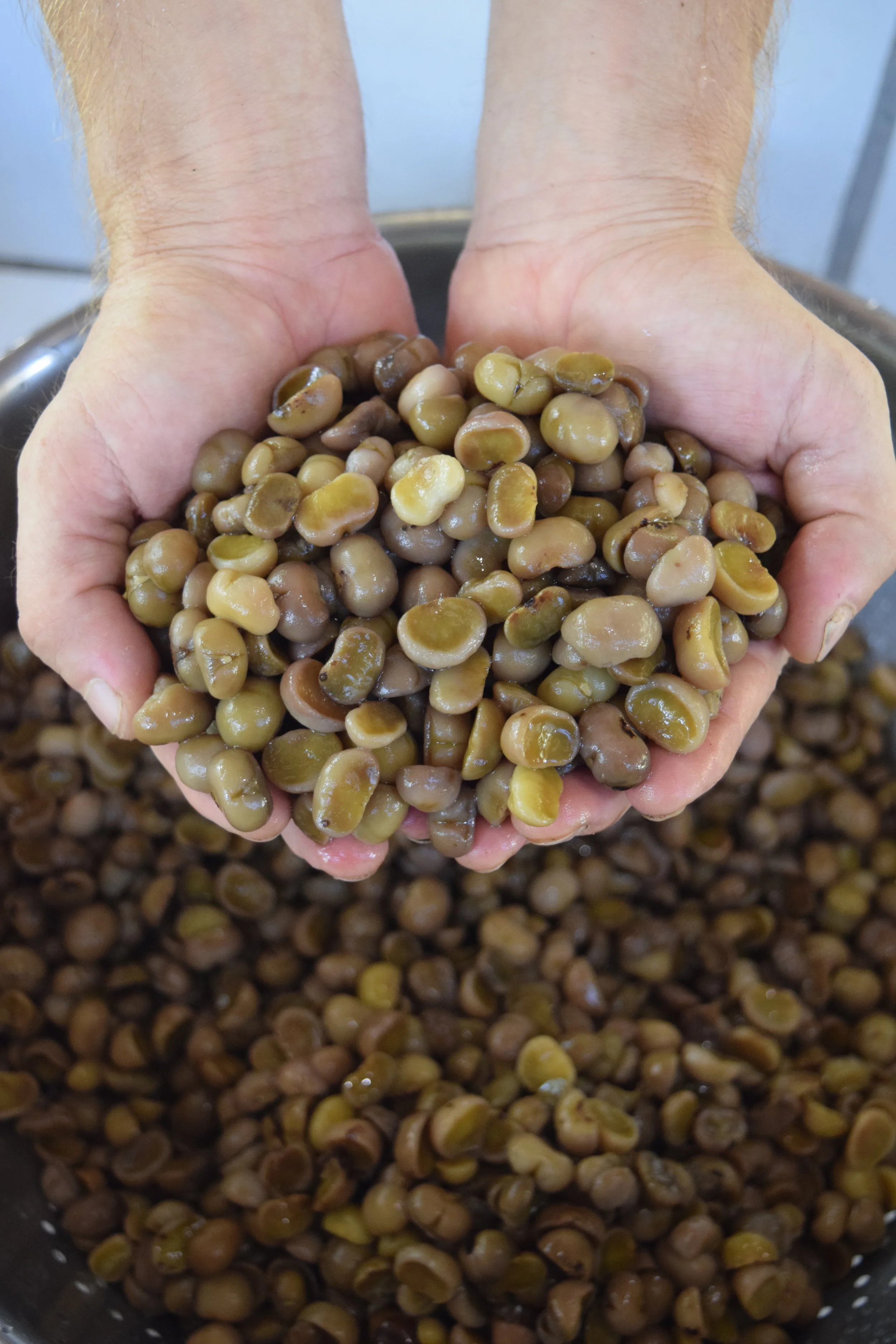
Food, Familiar Stranger
When I was a teenager thumbing rides around Mexico, I quickly realized my vegetarianism would not survive. If my friend Valente and I got in some dusty car with a family that brought us back to a tin-roofed house and gave us chicken soup, we ate that soup. The kindness of strangers humbled my big picture ideas of right and wrong.

When I was a teenager thumbing rides around Mexico, I quickly realized my vegetarianism would not survive. If my friend Valente and I got in some dusty car with a family that brought us back to a tin-roofed house and gave us chicken soup, we ate that soup. The kindness of strangers humbled my big picture ideas of right and wrong.
Wherever food comes from, as soon as it touches human hands, human mouths, it transforms into an intimate thing, a thing we all need, a thing we all want. As soon as it's prepared, or shared, or savored, it carries with it something beyond itself, a new richness. A new complexity.
***
For thousands of years, people and the food they ate grew together in the same place. Bodies—plant, animal, microbe, earth—co-evolved together in direct relationship. Communities of people created food traditions that reminded themselves how to eat, and how to live, in the place they were a part of.

But now, generations of individuals, and entire societies, are born into places dissociated from themselves. The objects of our lives that surround us—shelter, food, clothing, stuff—come from someplace else. Industrialized, machine-scale food systems and globalized food markets (food from everywhere, transported anywhere, warehoused in grocery stores) form the foundation of our new food traditions. They remind us not of a place we are connected with, but of a world we know little about.
Increasingly, the objects of our lives we know the least about are the things we recognize as most familiar. Food, and most other objects we surround ourselves with, are familiar strangers.
Recently I began researching different types of vinegars to incorporate into my fermentation classes. The vinegars I make (pear, apple, and watermelon in Massachusetts, jackfruit, banana and pineapple in Costa Rica) are easy to ferment with whole fruits and indigenous microorganisms, and the history of this type of fermentation goes back thousands of years. But I wanted to know more about the vinegars someone might buy in a grocery store.

Culinary fermentation is a radical transformation and engagement between living things—microbes, people, plants, animals. Industrial scale production cannot really make vinegar in the way an artisan would understand vinegar—it makes a replication. Large, factory scale production simply can't manage the inherent variability of wild life, so it homogenizes, standardizes, and in doing so changes the intrinsic nature of the product.
Most of these products are replications of something that was once made by human hands, from something in nature those hands could access, an original source. But what happens when we forget what the original source was to begin with? White vinegar, for example, is not made of “white”. Sometimes its made of grains, like genetically modified corn, but often its made of petroleum. Most people who buy rice vinegar or apple cider vinegar could probably wager a guess that apple cider vinegar has something to do with apples; rice vinegar something to do with rice. But white vinegar? Would anyone guess it was made from oil? Its a familiar food that has no natural precedent.

And yet, the richness and complexity of eating still exists, and we still identify, very personally, with our strange-familiar foods. As food and objects scatter around the globe, so do people. Many of us will live in or between several places over our lives. This sudden mobility exposes us to more of the world, but in less depth, and breaks the chain of linear trans-generational traditions that once held people, food, and place together. Many food traditions now dissipate and replicate laterally, around and across the world. They travel to us wherever we are, and travel with us wherever we go.
Once, on a bike trip across Colombia, my partner Scott and I stopped in a tiny town in the Andes. We went into a little country store to get some food. The man at the counter answered our Spanish with English, and started pulling things off the shelves to show us. “Look, tuna fish!” He said, waving the can, gleeful. “Peanut butter!”
“Actually, we’re looking for Colombian foods,” we replied, smiling. We had hopes of some fresh-made cheese, vegetables, corn cakes sculpted by little old lady hands. Things from the place we were in, the people we were with.
But the man wanted us to have tuna, desperately. Later he told us why. Though technically born in Colombia, he had lived his entire life in Idaho, until that past year when he was deported back to his little Andean “home town.” But it was no longer his home, or never had been. He missed the foods of the place where he grew up—not foods from the place where he grew up, as tuna fish does not hail from Idaho—but the foods he ate when he grew up in that place. The foods that surely did not come from Idaho, or even necessarily the United States, were now the foods he identified with, the ones that made him feel the nostalgia of home.

People sometimes talk about food traditions as if they were all lost, like socks that didn’t make it back from the laundromat. And its true, countless recipes and food traditions are disappearing, never to return--and it is a loss. Yet we don’t live in an absence of food traditions. People in both industrialized and developing countries increasingly now identify with the flavors, smells, textures of global market and laboratory created foods more than the real thing from the place they live. Global market food may be a stranger, but it's a stranger that we recognize, and feel comfortable around. We relate to something we can’t relate to.
Its important to recognize our personal attachment to globalized food markets, because its real, and I think its a piece of the puzzle that sometimes goes missing in the argument for local food. Only a few generations ago people felt attached to foods embedded in social lineages of cultural heritage and co-evolution. We identified with foods that only the people of the place we lived in could produce and make. But in a globalized food system, we now get attached to pop tarts, nacho flavored frito lays, diet mountain dew—foods that no one, no single person, anywhere, could really produce or make. Most of the foods on the grocery store shelf are conglomerates of ingredients from many places, products of laboratories and mechanization. No one person could make, from start to finish, a pop tart, or chips, or industrial soda, or white vinegar, in its current form, from scratch—there are too many additives, components and processes that can only be done in a factory or laboratory.
Beyond the oft quoted statistics about the vast benefits of local food systems—that local food is more nutritious, more flavorful, better for the environment, better for people, can mitigate climate change, can regenerate local economies, and much more—eating food from the place where we live, cultivated and crafted by the people of that place; be it a home, a community, or a region--connects us deeply to something meaningful, powerful, and comforting. It connects us to a world we can relate to, that we truly are a part of, and reflects something real, and unique about us.
***
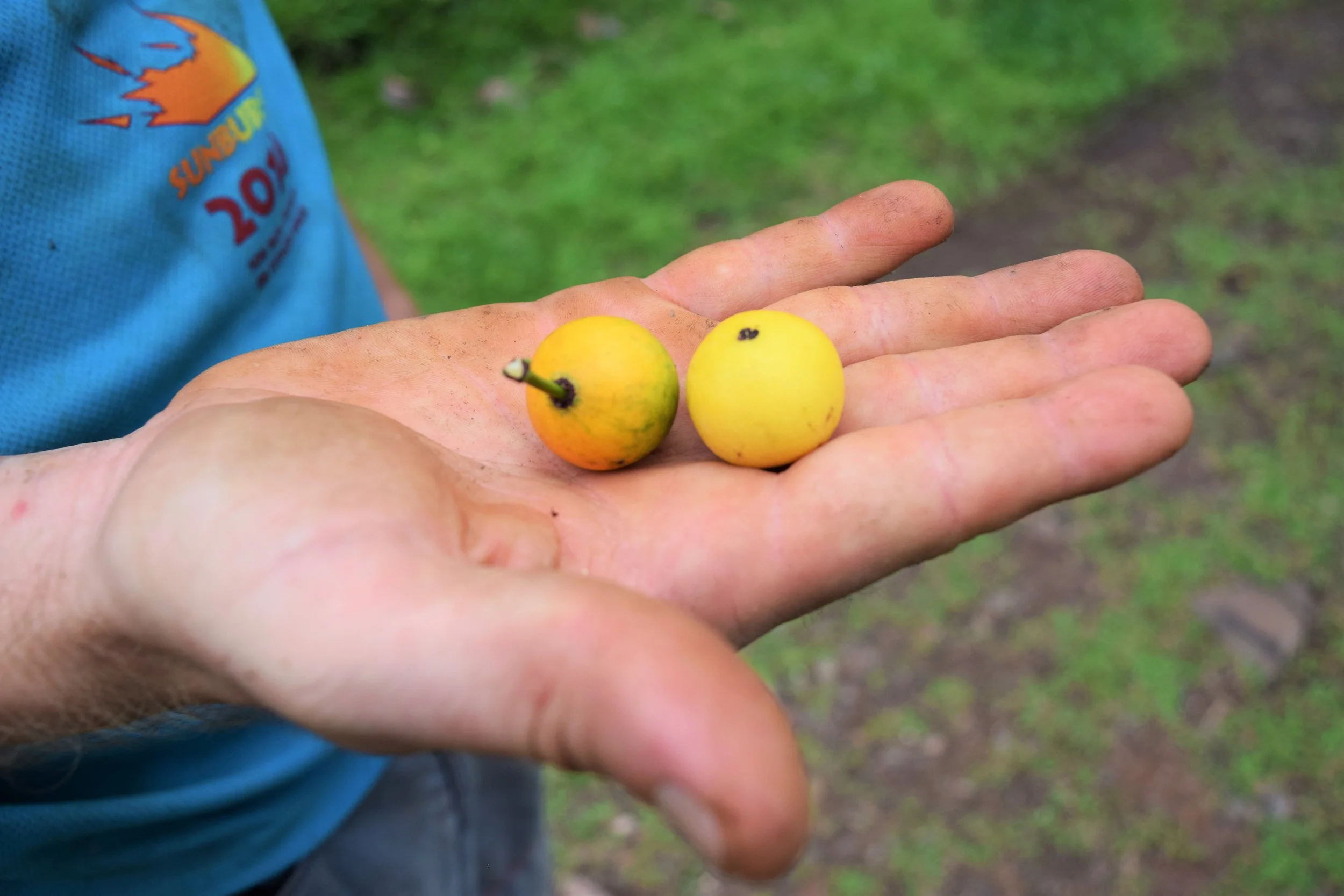
Since my teenage years I’ve changed my perspective on eating animals. My vegetarianism did in fact die, replaced by a combination of opportunitarianism and locavorism. (I’ll still gladly eat any soup you give me, but if I’m giving you the soup, I’ll make it with foods from the place where I live.) But the original ethical dilemmas I chewed on in those years remain. How do we match our values with our reality, in a world so vividly layered in tangled truths? How do we live sustainably in a world that is clearly no longer structured for sustainability? How do we reconcile a felt attachment to the objects of globalization that we grew up with, but don’t represent us?
Of all the complicated steps and solutions we can take, I think the first and most immediate one is simple: we need to engage with actual food from the place where we live. Somehow, some way. We need to “get to know” living things with our senses. To smell tomatoes ripe on the vine; watch living beans swell in water and sprout; listen to farmers talk about the plants and soil they care about; taste the salty crunch of fresh cucumber dills; touch soil, plants, animals—anything, anything real. We need to go to the source of food—the thing itself—and get to know it, remember it. On a farm, in the wild, in the kitchen—we need to engage with real foods, in real life. We need to forge identities and food cultures accessible on a human scale.

Food and our relationship with it is complicated, and to create sustainable food systems I think we need to do lots of complicated things. We need to re-skill ourselves and our communities; re-purpose tools and technologies to work for us in different and better ways; build new networks of tangible and intangible food infrastructures that make local economies easier than they are hard. But this one starting point—engaging with the real thing—is the place we can all begin.
Engage with Your Food: Upcoming Workshops with Laura
In Massachusetts or nearby? Take a class with Laura this Fall at Round the Bend Farm in Dartmouth: Fermentation Fervor: A Vegetable Fermentation Series.
Or travel to the Ranch this May 2017 for Laura's annual The Art and Practice of Live Culture Fermentation workshop.
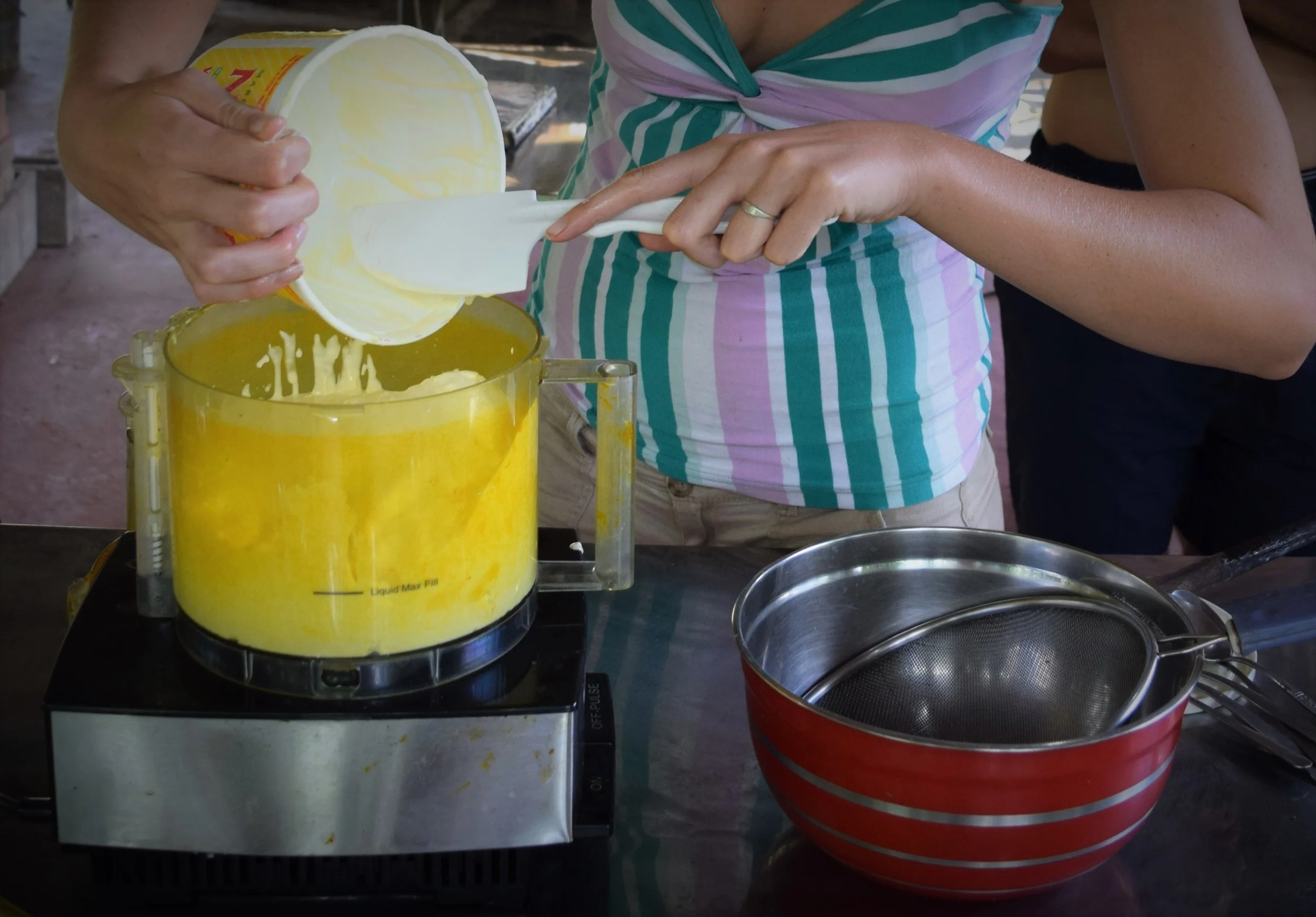
Cultured Butter & the Culture of Butter
When my dad was in third grade, his class followed the cirriculum laid out in a workbook. In times of boredom and monoteny, he would flip ahead and learn new material the class was soon to arrive at. One day he came across a particularly interesting bit: a tongue twister. My dad spent the next six weeks practicing the tongue twister in secrecy of his classmates until, finally, the class caught up to that point in the workbook. The teacher gave each student the opportunity to recite the tongue twister from the book, and each student who attempted this tongue twister stumbled through a slew of "Betty botta buddhas," until it was my dad's opportunity.

When my dad was in third grade, his class followed the curriculum laid out in a workbook. In times of boredom and monotony, he would flip ahead and learn new material the class was soon to arrive at. One day he came across a particularly interesting bit: a tongue twister. My dad spent the next six weeks practicing the tongue twister in secrecy of his classmates until, finally, the class caught up to that point in the workbook. The teacher gave each student the opportunity to recite the tongue twister from the book, and each student who attempted this tongue twister stumbled through a slew of "Betty botta buddhas," until it was my dad's opportunity. Without even glancing at the page, he busted out the tongue twister:
"Betty bought a bit of butter for the batter, but said she, 'This butter is bitter. If I'd bought a bit of better butter it would have made the butter better.'"
With impeccable clarity and speed, my dad enunciated each syllable with the swiftness of an engine. Every kid's jaw in the class dropped.
My dad told me this story when I was a kid, and at that time, it was just a funny story. Now having spent some time at the Ranch where foresight, accountability, and sustainability are key, the story has adopted some unique and colorful undertones.
We prepare a lot of our own food at the Ranch. Dark, leafy and salad greens are grown and processed right around our kitchens. Jackfruits, soncoyas, and mamonchinos are fruits grown in our orchards and slipped into our diets. We grow many of the ingredients processed into red curries, our chickens lay a portion of our own eggs and we even grate and make coconut milk. A lot of time and intention goes behind the scenes of preparing one of the 22,000 meals the Ranch serves on a yearly basis. The latest ingredient to pass through our team's newly established food processing kitchen is cultured butter.

Although butter whipping is a simple business, conventional agricultural processes have complicated matters. Imagery of sprawling fields with shady orange trees and golden sunsets are merely a misleading, commercial scheme that draws in consumers. If the same Betty from my dad's tongue twister had seen a butter package of a concentrated animal feeding operation, she may have consulted her local dairy neighbor instead.
In the campo of Costa Rica, we are fortunate enough to have two neighbors that milk their cows and preserve the cream with a microbial culture. Those two neighbors are Daisy, and coincidentally enough, Betty, who does not make bitter butter at all, but rather fresh butter. When we walk down the road, we can see that their land is integrated in Costa Rica's biological reserves, or protected forest lands that weave through the countryside's agricultural sites. A low intensive dairy system means that farmers can give more attention to the quality of the ambient environment. The flavor of the ecology shines through in four simple steps of processing sour creme into butter.
Step 1: Buy sour cream from your local dairy neighbor.
Step 2: Whip the creme with the keystone appliance, the food processor, until it has thickened.
Step 3: Pour the product through a food strainer. This separates a rich, cultured butter from the liquid, buttermilk.
Step 4: Add salt to the butter and use a spoon to press out any excess buttermilk and drain. Once this process is complete, you'll be left with your very own cultured butter product.

Freshly sourced cultured butter has revealed some illuminating assets to Ranch food culture. Like everything else served from our kitchens, the butter is delicious. It's a medium for live microbes that actually form symbiotic relationships with the microbes present in your gut. It's produced by our neighbors, so we are able to see the land and the cows and ensure we are sourcing responsibly. A simple price comparison even reveals that our homemade, cultured butter is less expensive than supermarket butter by about $1 per stick.
These are all great reasons to process your own butter, but the most important relates to reading and learning from patterns. When my dad was in third grade, he predicted the pattern laid out by the structure of his class. Each day, the class moved forward in the workbook, all of the information having been laid out before him. Patterns similarly exist in the ways cultures are interacting with their foods. We can read these patterns and change our behavior to make sure we are eating foods that are healthy for both our bodies and our land.
In 1963, maybe Betty going to the store to buy butter was the growing custom because social norms suggested that this is how the batter comes out best. As proof of the tongue twister, the only butter bought was an obviously unsatisfactory product. Global patterns in the vast mechanization of agriculture without cultural or environmental conscientiousness has contributed to their degradation. Industrializing a simple process such as butter-making means that the vitality in microbial life is significantly decreased, land ethics are overlooked, and the wheels of economic engine and government subsidies can keep the price of this process competitively low. Plus, the taste is never fresh, never pure.
Patterns are not just ways of reading into the past, they are tools for looking ahead to the future. As people make more conscience decisions about where they source their foods, they regain their food sovereignty. They can be a part of a cultural and environmental shift that heals their bodies, waterways, soils, and communities. The pattern of regeneration is exciting enough that reintroducing skills like simple butter making become more appealing. When we sit down together for a Ranch meal, we recognize a labor of love that goes into every ingredient.
In questions surrounding the ethics of sustainability, answers are never obvious. As we navigate these territories, we are met with the awesome challenge of reconstructing a culture that respects land and people. Sometimes that means we just want our butter to taste better! Whether that culture come from your food processing practices or your live microbes, it's a robust tool in assuring that nobody be left with bitter butter.
NEWS AND NOTES
Have you ever wanted to build your own home? Just bought a piece of land in Costa Rica and want to create a jungle paradise? Well in 2017 we have the classes you need to re-skill and build your place in this world.
We also have a few spots left in our Sustainability Primer program. If you know anyone interested in joining us please spread the word!
Abrazos,
The Ranch Crew
Categories
Topics
- Agriculture 6
- Agroforestry 21
- Animals 2
- Apprenticeship 19
- Appropriate Technology 6
- Backpacking 1
- Bananas 1
- Basic Pantry 4
- Biochar 1
- Books 3
- Build Your Own Home 1
- Central America 5
- Chiles 1
- Cinnamon 1
- Clay Carving 1
- Climate 2
- Climate Change 1
- Cob oven 1
- Communication 5
- Community 24
- Compost 2
- Composting Toilets 2
- Condiments 1
- Conservation 2
- Cooking 4
- Costa Rica 18
- Design 10
- Earthen Construction 10
- Eat Local 2
- Ecohome 1
- Education 9
- Environment 3
- Ethics 4
- Farm to Table 12
- Fasting 1
- Fermentation 14
- Food 22
- Food Choices 8
- Food Forest 8
- Food Processing 15
- Food Systems 12
- Gap Year 1
- Gardening 5
- Ginger Beer 1
- Harvest 2
- Health 12
- Healthy living 5
- Homemade 2
- Homestead 8
- Internet 2