

BLOG
Stories, articles, and updates from the Ranch community.
Anti-Inflammatory Herbs – Medicinal Plants
I firmly believe that we can begin to reduce the effects of this inflammation by utilizing the mosaic of plant medicines revered by our ancestors.
By 2022 apprentice Connor Gilmartin
“Watching gardeners label their plants, I vow with all beings to practice the old horticulture, and let the plants identify me” Robert Aitken
This article seeks to bring attention to two plants that possess anti-inflammatory properties, commonly grown in Mastatal, Costa Rica. My goal is to discuss their medicinal properties and suggest simple preparation methods to maximize their efficacy. The plants I will go on to discuss have been shown to bolster your immune system’s response to inflammatory antigens that one is exposed to in urban environments.
Inflammation is a complex physiological and pathological process. It is typically an adaptive response caused by harmful stimuli and conditions to keep the body in homeostasis. When inflammation persists for a long time, “it becomes chronic and can contribute to a variety of chronic diseases, such as obesity, diabetes, arthritis, pancreatitis, cardiovascular, neurodegenerative, metabolic diseases, and some types of cancer” (Peng, et al, 2021). While some diseases are not preventable, many are. We exist in a physiologically, emotionally, and spiritually inflamed world. I firmly believe that we can begin to reduce the effects of this inflammation by utilizing the mosaic of plant medicines revered by our ancestors.
The two plant species I will provide a brief overview of are as follows:
Turmeric (Curcuma longa)
- (Polyphenol, curcumin, anti-inflammation)
Pau d’arco (Tabebuia rosea)
- (Immune stimulant, anti-tumor properties, anti-parasitic)
There are a handful of books that are frequently referenced by Rancho Mastatal’s core team. One of these books is Ed Bernhardt’s, “Medicinal Plants of Costa Rica”. If you live in Costa Rica, and you know what’s best for you, you’ll get a copy – and a backup copy – of this amazing, easy to read book.

Freshly harvested turmeric
Bernhardt introduces turmeric as, “An herbaceous perennial plant of the ginger family with a bright orange rhizome”. It is prolific around Rancho Mastatal – walking along the paths of the Ranch will lead you to encounter turmeric everywhere. Turmeric has a long history of being used for both food and medicine. It has been the primary anti-inflammatory herb of ayurvedic medicine for over 6,000 years. Its principle chemical component, curcumin, has anti-cancer effects and is useful for arthritis through its potent antioxidant action. Capsules of dried, ground turmeric powder have been used to relieve stomach problems, liver and gallbladder diseases, arthritis, colds and flus. In Phyllis Balch’s text, “Prescription for Herbal Healing”, she notes, “… Laboratory studies have confirmed that curcumin has anti-inflammatory and anti-arthritic activity… It has been shown to be effective in reducing pain in patients with osteoarthritis… When used at the equivalent of 200mg of curcumin per day, patients with osteoarthritis were able to use 63% less NSAID medications and still obtain relief from pain”. Turmeric is a gorgeous plant with such massive potential. Pulling its fiery orange rhizomes out of the soft jungle soil is a beautiful experience that I consider a privilege.
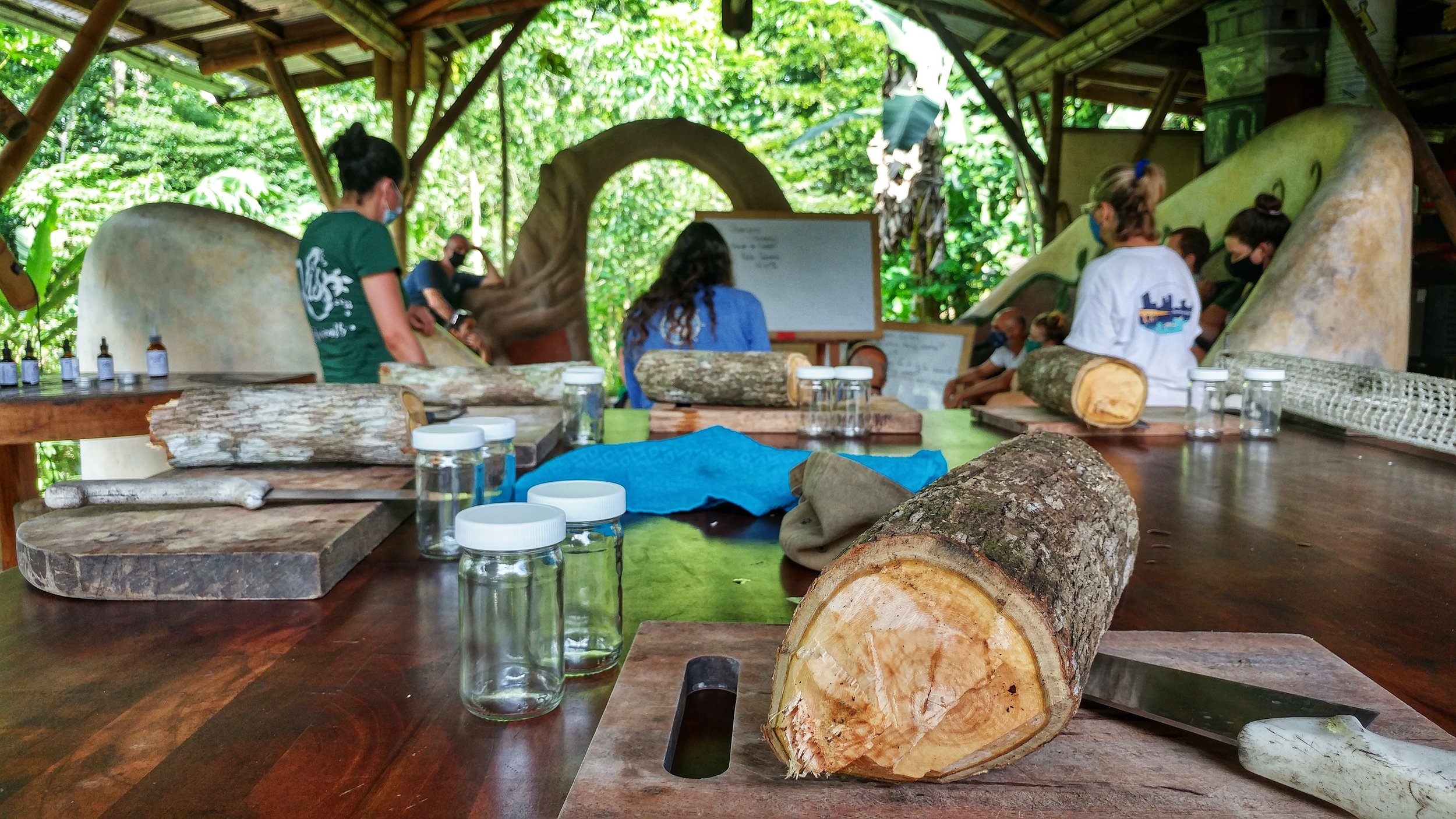
The branch of a pau d’arco tree ready to be made into a tincture
Another prolific plant species found around Mastatal is the pink trumpet tree – locally referred to as roble de sabana or pau d’arco. During the transition months of March and May, this tree puts on a dazzling display of soft, silken pink flowers that provide a striking contrast against the bright blue skies. When talking botany with elders and herbalists in the community of Mastatal, pau d’arco is never forgotten. It is revered as highly medicinal across Meso and South America. Ed Bernhart writes, “for centuries, people in the neotropics have used the inner bark of pau d’arco to make powerful botanical medicine that restores the immune system”. It has been cited traditionally to treat anemia, arthritis, asthma, bronchitis, boils, cancer, colitis, colds, coughs, diabetes, dysentery, eczema, fevers, liver infections, leukemia, parasites and wounds. There has been a great deal of research on the medicinal properties of the cambium layer of Tabebuia rosea. Researchers have demonstrated that eighteen of the bark’s many organic compounds have medicinal properties. Some of these organic compounds include quinines; compounds that help cleanse the human body of parasites and harmful protozoa. Another well-documented compound contained in the bark of the pau d’arco is lapachol – an organic alcohol that is responsible for the bark’s anti-cancer and tumor-reducing properties. Ed Bernhardt recommends reading, “Pau d’Arco: Immune Power from the Rainforest” by Kenneth Jones to learn more about the complex organic chemistry of the tree’s medicinal compounds. Pau d’Arco’s cambium layer can be prepared as a tea, or as a tincture. Mature branches must be used in the preparation of this medicine. I recommend further reading about the specifics of pau d’arco preparation as it does require some processing prior to drying the bark for tea, or making the tincture.

A student in our PDC with her homemade tincture
Both of these plants can be dried, powdered, and taken as a supplement in capsule form. Their medicinal properties can also be utilized when prepared in a concentrated tea. In my opinion, the most powerful of all preparations is to utilize ethanoyl as a solvent to extract their alcohol-soluble compounds. This concentrated, plant-based liquid is commonly referred to as a tincture. The precursor to distilled ethyl alcohol could be an herbal wine prepared at-home. You can read about how to prepare a simple, tea, sugar and yeast wine (hooch), at this article, written by an apprentice from 2017.
Realizing that plants can serve as medicine fosters a deeper appreciation of our natural environment and increases one’s sense of place. Looking into a forest and seeing it as a nutrient-rich, sentient ecosystem is something that our not-so-distant ancestors did out of necessity. I believe that if more folks started listening to what our plant teachers had to say, we’d live in a healthier, more reverent, less-inflamed world. As Terence McKenna once said, “Avoid gurus, follow plants”.
Check out these past related blogs
Also join us for our yearly Plants as Medicine Workshop
Learn More
Join us for one of our educational workshops. Learn more here.

Just KIS Me: A Neighboring Project focused on Plants and Indigenous Culture
About eight years ago, Kealy and Ivannia were talking about how they wanted to continue to be strong, badass women. They wanted to support one another and thrive, and step outside the stereotypical woman’s role that is often seen in the Mastatal community. Kealy was once again visiting for a few months from the States and was leaving in a few days so plans needed to happen soon!
Just KIS Me: A Neighboring Project focused on Plants and Indigenous Culture
By Kealy Rudersdorf
About eight years ago, Kealy and Ivannia were talking about how they wanted to continue to be strong, badass women. They wanted to support one another and thrive, and step outside the stereotypical woman’s role that is often seen in the Mastatal community. Kealy was once again visiting for a few months from the States and was leaving in a few days so plans needed to happen soon!
The previous year, they had decided to go to the river at night to catch shrimp together--the snakes and darkness under the new moon never scared them off. This year, they were going to bushwhack to the top of La Cangreja National Park mountain. If you have gone in recent years, this was before the path was maintained and the hike was truly an adventure in the jungle. They needed a guide, as neither had ever been. Ivannia suggested her cousin, Solin, who was incredible with the machete and always full of jokes. It was bound to be a great day!
That day marked the very beginning of KIS Botanicals, as Solin described different uses of a variety of plants and Solin and Ivannia shared stories about how their family used the different plants they found along the trail. It was an immemorable day, filled with laughter, love, and the sharing of stories - the same energy we strive to bring with us into KIS Botanicals today!

What is KIS Botanicals?
KIS Botanicals is a growing herbal business, up the road from the well-known Rancho Mastatal. We are focused on the preservation of plant knowledge and culture in the Mastatal/Zapaton region of Costa Rica. As Solin and Ivannia say, our ancestors have a beautiful interwoven history with plants from the rainforest; our goal is to awaken and share this history.
In our project, we make a series of plant-based, herbal products (to heal the skin, aide in sleep…), using recipes we learned from our grandparents and community members. We also provide educational programs for locals and tourists through medicine making workshops, medicinal plant tours, and food-as-medicine classes.

PRODUCTS
Our artisanal products are inspired by tried-and-true recipes. All of our plants are hand-harvested and our products are handmade – by us! We have access to nearly 100 different medicinal plants that Solin farms sustainably, using traditional agriculture and permaculture techniques.
We currently have 8 artisanal herbal products that we absolutely love! These include a skin healing salve, a muscle and bruise salve, a sleep aide tincture, a tincture for colds and flus, a cough tincture, a bug repellent, an immune booster tincture, and a bug bite relief roll-on. There are many more products in the works, for example an aphrodisiac spray, an anti-fungal spray, stomach calming tincture, energy clearing spray, anti-anxiety tincture, etc. With so many plants to choose from, it’s hard to know where to start! As our apothecary grows, we will continue to add to our line of products.

When we start to make a new product, first, Solin and Ivannia remember plant uses they’ve witnessed throughout their lives. In addition, we frequently talk to community elders or remember conversations from years past. With these memories and conversations, we make a list of plants. We spend time trialing recipes and researching to make sure our products are stellar. The stories and memories are shared on the back of our products, so you too can share in the story!
Currently, we are selling our products at our wonderful friends and neighboring projects: Rancho Mastatal, Villas Mastatal, La Iguana Chocolate and La Choza del Mundo.

EDUCATIONAL PROGRAMS
We are excited to offer a variety of educational programs. Come, partake in our programs - we can’t wait to learn with you! Here are our current and future offerings:
A Cultural and Medicinal Plant Walking Tour: Come walk leisurely with us while we share with you our local history and culture. We will bring artifacts and stories from our grandparents' lives and describe the uses of many of our medicinal plants. We will provide a tasty and traditional treat or drink!

Medicine Making Workshop: Together, we will enjoy a short leisurely walk to explore medicinal plants. We will share with you an ancestral recipe (or two!). Tradition will be combined with modern herbal techniques. You will leave with an herbal product, made by you!
Food is Medicine – A Traditional Cooking Class: Come to a cooking class, using traditional techniques and foods. Over a wood burning stove, we will share a traditional recipe (or two!), laughs and stories.

In the future, we plan to offer an intensive two-week long course on cultural and medicinal plants. We will offer the opportunity to learn from us and other community members, as well as play and experiment with our farm of medicinal tropical plants. Your teachers will be primary-source voices!
Once we are properly on our feet, we plan to provide classes to the local schools. We will teach students about how their/our ancestors used plants to cook, to clean, and to heal. Students will learn new and old techniques with hands-on lessons and tutorials. We hope that they take these lessons back home with them and share their enthusiasm with their parents and grandparents, calling forth memories and providing inspiration. We are SO excited about providing this service to our community.

Who is KIS Botanicals?
The original KIS Botanical team consists of three people: Ivannia, Solin and Kealy. Ivannia and Solin are cousins and lifelong members of the Mastatal / Zapaton community and grew up learning about the medicinal plants in the area. Ivannia is a wiz in the kitchen. She is the one responsible for processing the plants, making the products, and giving thanks to the plants as we compost them. Solin has been working with plants his entire life, being handed a machete as a 2-year-old. The depth of his plant knowledge, understanding of nature, and love of plants is key to KIS’s success. Kealy has been visiting the Mastatal / Zapaton area for over 11 years, and Solin and Kealy are now married with a baby. Her role in KIS is to research plants, formulate recipes, share her knowledge of making shelf stable herbal products, translate our programs into English, promote KIS with marketing, and give the plants extra love.

Why we started KIS Botanicals?
From the words of Ivannia and Solin: We started KIS because we saw our generation and the following generations pull away from plants and the environment. We witnessed the high schoolers obsessed with their new cell phones and motorcycles, littering the street with their chip wrappers and soda bottles. Our community was changing dramatically. Starting in the late 1980s, houses received electricity, running water, and phones, but also within that same generation, the community received access to the internet, cell phones arrived, and all of a sudden there was almost a motorbike or car per person in town. In most of the United States and Europe, these changes happened over several generations.
We have witnessed a huge disconnect from our ancestors and the understanding of how they lived in harmony with the rainforest. This younger generation has mostly left the area for other opportunities after high school, leaving the community void of a generation. With KIS Botanicals, we hope to show that our ancestor’s way of life continues to have value. We aim to re-awaken our ancestral plant knowledge in the younger generations with our products and educational programs within local schools. We also want to be an example of how to be a successful, locally owned business, making our local economy stronger and more diverse.

How to help us??
We have come a long way from 3 friends bushwhacking to the top of the La Congreja mountain to making KIS Botanicals a reality. To be successful in preserving and sharing our ancestral knowledge, we need your help!! This is what would be most helpful to us:
When you visit Costa Rica, come to the town of Mastatal to buy our products and learn with us by signing up for one of our educational programs.
Help us spread the word. Tell your friends and family about us. If they plan to visit Costa Rica, encourage them to take a workshop or tour with us and check out our products.
DONATE! Keep your eyes peeled. Shortly we will be fund raising to build a Ministry of Health approved processing kitchen. We would greatly appreciate your assistance in reaching this goal!!
Send us love and positive energy.
Like us on Facebook and follow us on Instagram @KISBotanicals
We can be contacted at KISBotanicals@gmail.com.
Thanks for your support! We hope to see you soon.
With love,
Ivannia, Solin and Kealy
Categories
Topics
- Agriculture 6
- Agroforestry 21
- Animals 2
- Apprenticeship 19
- Appropriate Technology 6
- Backpacking 1
- Bananas 1
- Basic Pantry 4
- Biochar 1
- Books 3
- Build Your Own Home 1
- Central America 5
- Chiles 1
- Cinnamon 1
- Clay Carving 1
- Climate 2
- Climate Change 1
- Cob oven 1
- Communication 5
- Community 24
- Compost 2
- Composting Toilets 2
- Condiments 1
- Conservation 2
- Cooking 4
- Costa Rica 18
- Design 10
- Earthen Construction 10
- Eat Local 2
- Ecohome 1
- Education 9
- Environment 3
- Ethics 4
- Farm to Table 12
- Fasting 1
- Fermentation 14
- Food 22
- Food Choices 8
- Food Forest 8
- Food Processing 15
- Food Systems 12
- Gap Year 1
- Gardening 5
- Ginger Beer 1
- Harvest 2
- Health 12
- Healthy living 5
- Homemade 2
- Homestead 8
- Internet 2