

BLOG
Stories, articles, and updates from the Ranch community.

Bamboo Shoots
Bamboo is of huge economic value and is not only used in the building industry, but it can be used also for eating (more on this later!), as a cooking device, burnt for charcoal, woven into a fabric, made into paper, used as a musical instruments, and much more!!
By Nic, Core Team member
Bamboo
Bamboo is a wonderfully sustainable building material due to the speed in which it grows and its weight to strength ratio (stronger than steel for its weight!!). Bamboo is of huge economic value and is not only used in the building industry, but it can be used also for eating (more on this later!), as a cooking device, burnt for charcoal, woven into a fabric, made into paper, used as a musical instruments, and much more!! At the Ranch we use it for many of these things; the most noteworthy being our use of it in our natural buildings (read here about how to treat your bamboo). We have 6 structures that are built almost entirely from Bamboo including a nursery, a meeting room, our classroom and the popular guest structure the Hooch. We have also used it as firewood and to make biochar and we have several bamboo instruments. Today however we are going to talk about the latest way we have learnt to use bamboo and that is in our farm to table world!
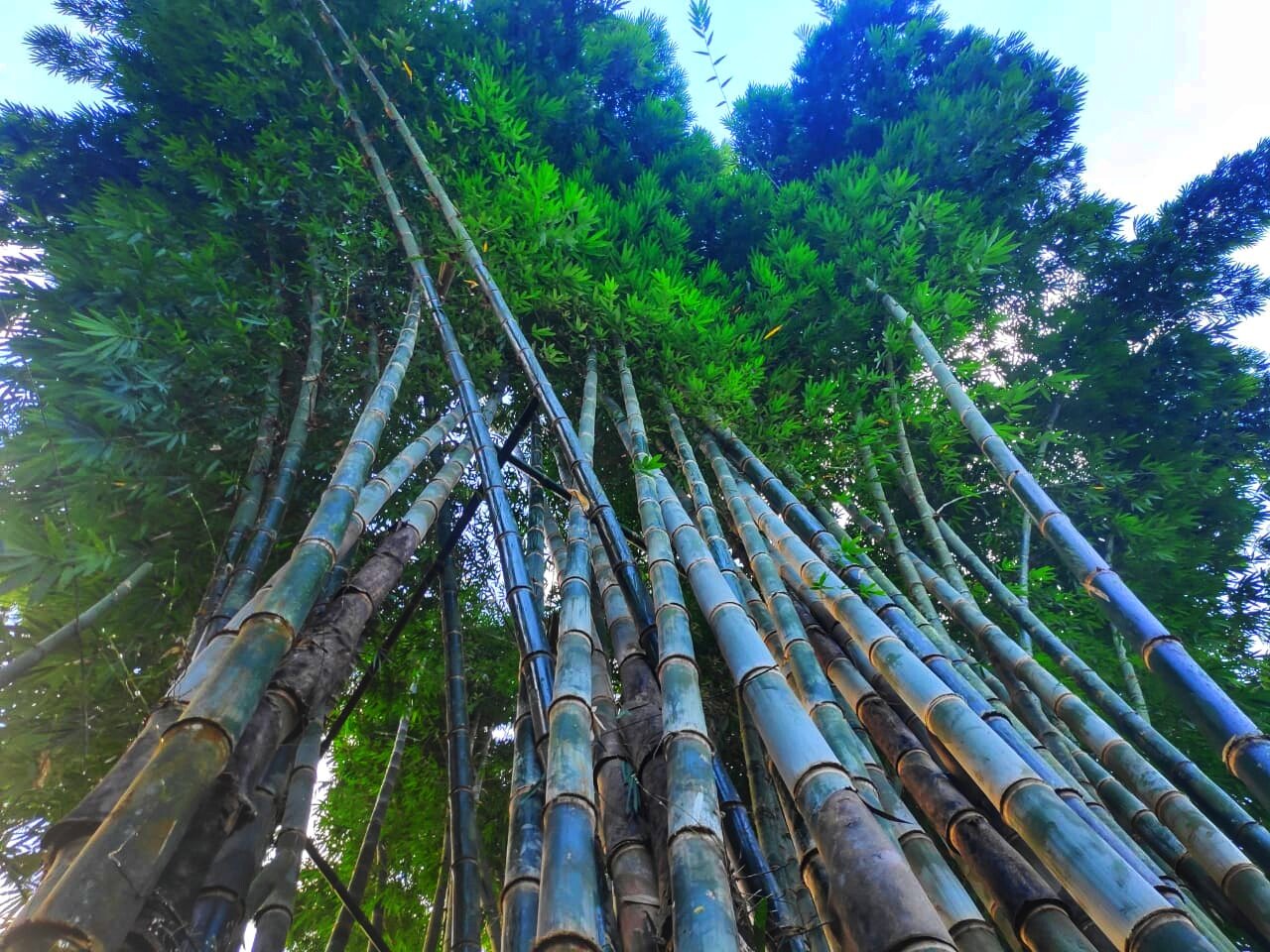
A clump of bamboo on our farm
Bamboo as Food
Humans have a long history of eating bamboo, but we are not the only animals that love eating bamboo. The Giant Panda loves eating the young bamboo shoots as well as the leaves and stems, along with a number of other animals including the bamboo lemurs of Madagascar and mountain gorillas in central Africa. Chimpanzees have also been seen drinking fermented bamboo sap which has turned alcoholic. It will not be a surprise then to hear that Yes! we can eat bamboo too, in fact its delicious and during the beginning of the wet season it is an abundant source of food.
At Rancho Mastatal we have some of the most revered species of bamboo for eating and for building. The species that we have that are known for providing tasty bamboo shoots are Dendrocalymus asper, Gigantochloa sp. and Bitcheeyana sp.

These are just 2 week old bamboo shoots!
Farm to Table Bamboo Shoots
Bamboo shoots contain a cyanogenic glycoside that produces cyanide in the gut. This is not good for you as you might know, cyanide is very poisonous, so we have to be careful to process our bamboo shoots carefully in order to make them edible. As it turns out this is relatively simple! Just boiling the bamboo for around 10 minutes removes that compound and can also remove any bitterness that can be present in the shoot. We found that adding ample salt and some sugar to the water before boiling makes them instantly a delicious crunchy snack! We have also lacto-fermented them (make a very pungent ferment!), pickled them in vinegar, and just boiled them and added them to dishes. But before you get to eat the bamboo shoots you have to know when to harvest them and how to prepare them.
Harvesting bamboo shoots

Peeled bamboo shoot
Generally speaking you want to harvest them as young as possible as they can become bitter if they are too old. As you may know bamboo grows incredibly quickly, so you will need to keep an eye on your clumps as a daily practice. As the rains start here in Costa Rica around April/May (on the pacific side) we found that initiated the growth of the new shoots. There is a delay though between the start of the rains and the shooting of the bamboo and this will vary be species and by the year. So its safe to say that once it starts to rain you need to start checking your clumps regularly. We found that this year the Guadua started shooting first (not a good bamboo to eat) and Dendrocalymus was the last one to start shooting in late June/July. Ideally you will want to harvest the bamboo shoot when it is around ~10-15” (~25-35cm) tall. Cut it at an angle as low as you can. This will then shed water and is less likely to lead to disease entering the plant. Generally speaking from a well-managed clump you should be harvesting about 33% of the new shoots. Take them from the places where they are not as ideally situated ie. Close to another shoot, with a blocked path etc… To learn more about how to manage you bamboo, join us for our bamboo management workshop.
Processing Bamboo Shoots
Take the bamboo shoot back to the kitchen and cut it lengthwise in half. You should be able to get your thumb and then your hands between the outer layers and the inner solid part and pry off the sheathing. This will leave you with a rather alien looking shoot. At this point it’s a good idea to chop it into strips several inches wide and then slice across the strips into thin pieces. The thinner the pieces the more bitterness is removed by cooking. At this stage you have the option to lacto-ferment the bamboo in a 2-3% by weight salt brine. This produces a very pungent ferment that smells very reminiscent of canned bamboo shoots from the grocery store. By lacto fermenting the shoots you also remove the cyanogenic glycoside and you gain the nutritional value of a raw bamboo and the probiotic qualities of the ferment.
By cooking these thin pieces of bamboo in a salty and slightly sweet brine we were able to produce a delicious treat with a great crunch, the flavor is not too dissimilar to Heart of Palm, although there was a large spectrum of views on what it tasted like. Everyone agreed that it was a delicate flavor that had an excellent texture.

Cut lengthwise
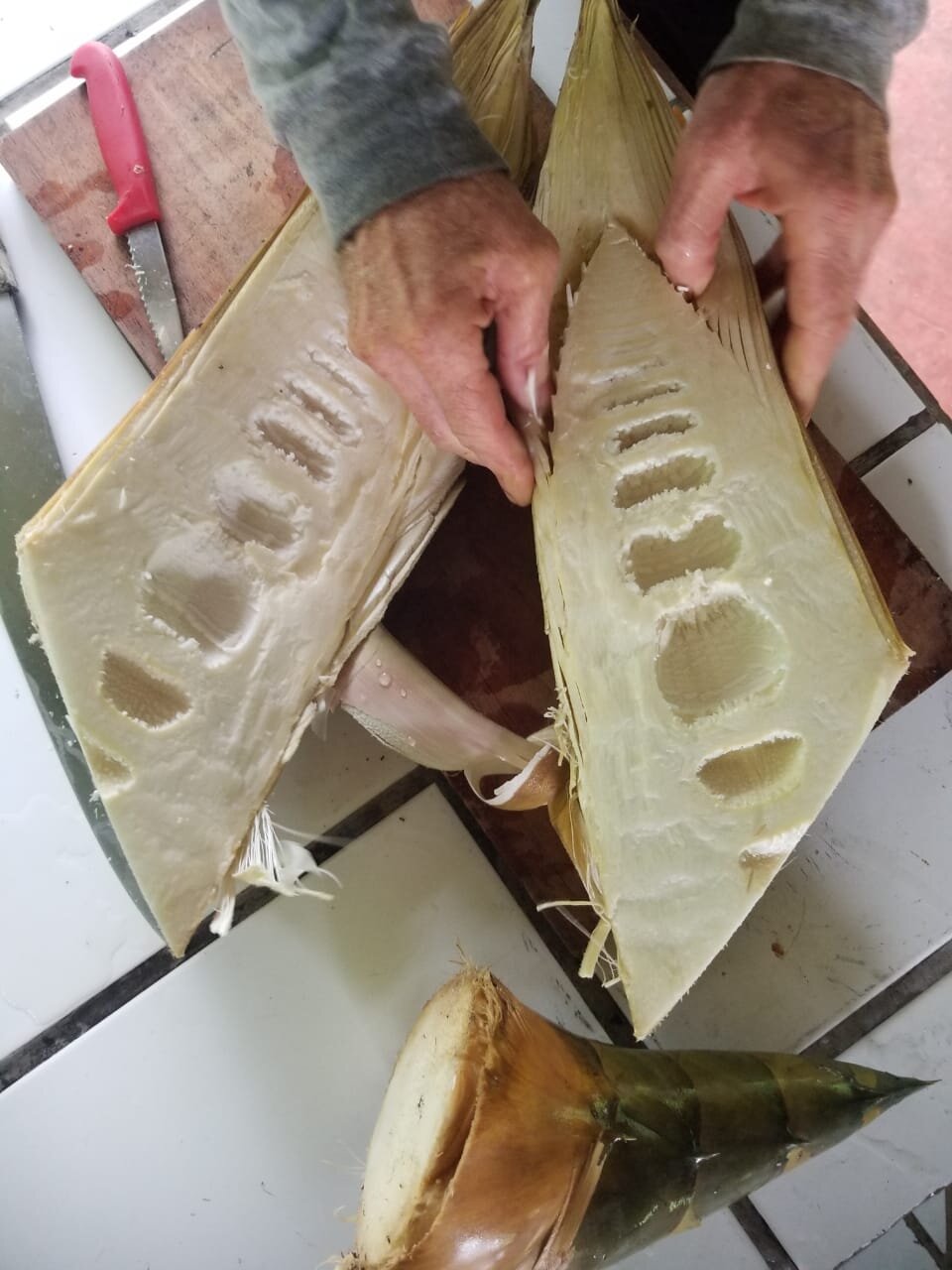
Then using your thumbs peel off outer layers
Bamboo Tea
The upper parts of the shoot that will have been left attached to the sheathing when you pried it out makes a very nice and refreshing tea. By taking a paring knife you can remove any of the soft parts still attached to the sheathing and dry them in the sun (or a dehydrator). This can then be added to hot water and left to steep.

Fresh bamboo shoot
Want to Learn More About Bamboo?
Join us for one or both of our upcoming bamboo related workshops!
Bamboo Management April 6 - 9, 2021
Bamboo Construction April 12 - 17, 2021
Stay tuned and up to date on what’s happening around here by subscribing to our monthly blog and visiting our website.
Check out our past blog article on Bamboo Treatment
Bamboo Treatment
Bamboo is a wonderful fast growing grass, it comes in all shapes and sizes and has an incredibly diverse list of uses from many cultures all around the world. Bamboo is incredibly fast growing and can grow up-to a meter a day and achieves 80% of its height in the first 2months of its life! This ability to grow quickly and produce a huge variety of usable products has got many a permaculturists and green living enthusiasts excited by its potential.
By Nic, Core Team member
What is Bamboo
Bamboo is a wonderful fast growing grass, it comes in all shapes and sizes and has an incredibly diverse list of uses from many cultures around the world. Bamboo is incredibly fast growing and can grow up-to a meter a day and achieves 80% of its height in the first 2months of its life! This ability to grow quickly and produce a huge variety of usable products has got many a permaculturists and green living enthusiasts excited by its potential. Generally speaking bamboo falls into two categories, running or clumping (although there are some that are in between). Running bamboo has the capacity to become very weedy and hard to manage if allowed to get out of control, we spent many years pulling out random culms that appeared throughout the Ranch’s front garden from the “living fence” that had been inherited upon the purchase of the property. This battle against the running bamboo Phyllostachys sp. was not an uncommon story as many people around the world can probably attest to, but was a great reminder of the will to live that bamboo species have!
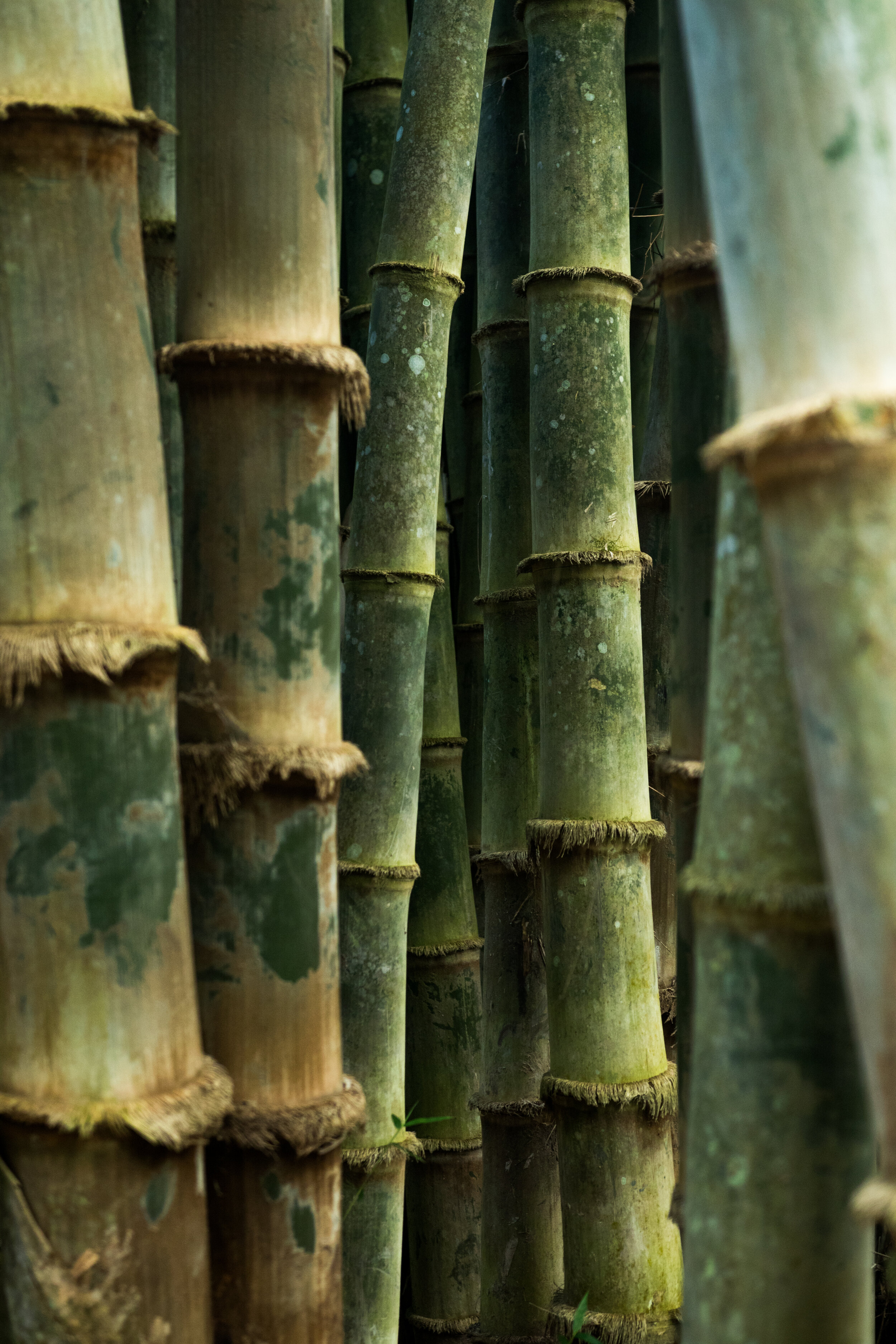
In the early years of purchasing the Ranch property, Tim and Robin sought advice from well-known bamboo builder and furniture maker Brian Erikson. They purchased several varieties of giant clumping bamboos, which we are now learning about how to manage. 20 years later these bamboo have grown to full maturity and tower above some of our orchard spaces and buildings! As the clump matures the culms get successively larger in diameter until they reach their maturation diameter. This varies from species to species, but one bamboo known as Dendrocalymus asper is massive! Each culm measuring 8” in diameter with a wall about 2” thick and approximately 30m tall, this is quite the impressive bamboo. Not only is it incredibly impressive it is incredibly intimidating to harvest!
Problems With Bamboo
Since the very beginning we have used bamboo as a building material. We had always purchased this bamboo and over time have become quite disillusioned by the varying quality of the purchased product, despite paying premium prices for the bamboo (each 6m culm at 4” diameter costs around $30 plus transportation). Not long after buildings were completed we were finding that a significant proportion of the culms were suffering from insect damage (a sign of improper curing and drying) and replacing these pieces, which were now inside of a building, was incredibly challenging and a lot of work.
The other major problem that we were facing was that typically when bamboo is treated correctly it is using an acid or a salt of Boron. Boron is a natural mineral that at approximately 10% solution is toxic to fungus and insects. Boron is an essential element for plant development and by diluting the solution down it is actually used as an organic fertilizer. Boron therefore gained a reputation of being an excellent, organic and safe treatment solution for bamboo and is the most widely used treatment for bamboo around the world. Unfortunately one of the problems of using an acid or a salt (boric acid or borax, disodium octoborate etc….) is that it is corrosive to steel and in order to attach roofing and even to combine pieces of bamboo, steel is often one of the fastening materials used (yes there are others but steel is the most practical and commonly used). We were finding that over time even galvanized steel was corroding and becoming dangerously damaged.
These two major problems had us move to using timber more and more and limiting our use of bamboo to non structural/permanent uses such as harvesting poles, temporary structures, propping posts, trellis etc… We got deep into Timber Framing and structural bamboo became a thing of the past.
Bamboo at Rancho Mastatal

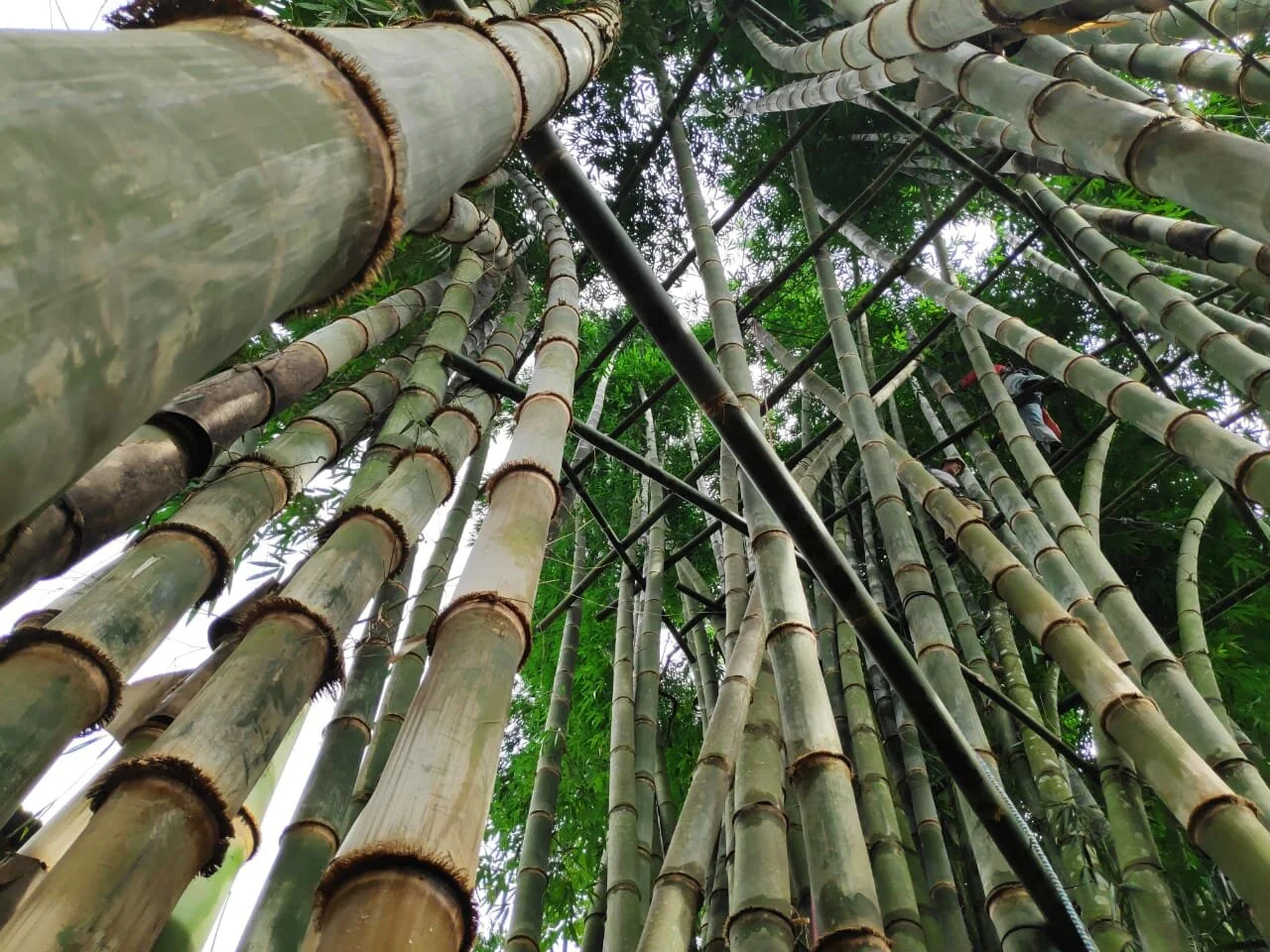
Henry setting up a scaffolding system in our bamboo
We continued to treat our own bamboo for wattle and daub walls through this period and the potential of bamboo continued to intrigue us but just seemed beyond our reach. As our stands of bamboo grew older and more daunting to manage we decided to hire in an expert to help us manage our bamboo. We found Henry Glen, a bamboo expert living in Costa Rica at Finca Bamboo in the south of the country and he was willing to come and help train us in the proper management and treatment of bamboo. With Henry’s help we have been able to (mostly!) get our bamboo under control after years of neglect and we have begun to treat our own bamboo using his very simple modified boucherie technique that I will outline below. He also sells a bamboo treatment solution called “Bam Blue” that is based on boron and copper sulphate (another organic chemical used to treat mold and insects) and also has a penetrant and anticorrosive properties. In one go Henry has solved our bamboo problems and we are now well on our way to building with bamboo again.
Please contact Henry directly through Finca Bamboo to purchase his treatment solution or enquire about his consultation services. He comes highly recommended by Rancho Mastatal.
Modified Boucherie System
Things you will need:
2” high pressure water PVC tube (schedule 40)
2” ball valve
2” Elbow
Fernco couplings
¼” NPT Tap and drill bit
¼” NPT Threaded Male compressor part
Roll of Teflon

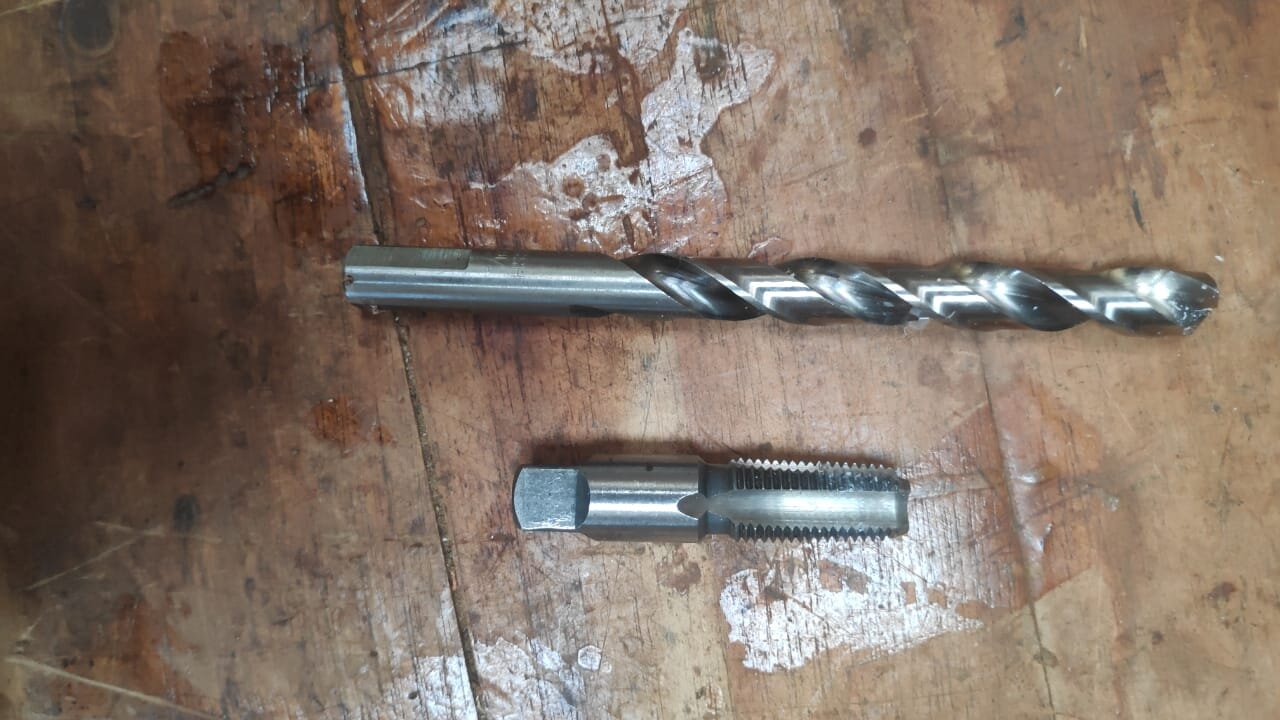

Process:
Cut one piece of 60cm 2” PVC and one piece of 15cm.
Glue your elbow to one end of the 60cm piece and the 2” ball valve on the other end. The valve handle should face opposite the direction of the elbow.
Glue the 15cm piece on the other side of the elbow.
Drill your 2” ball valve through the section that is glued to the 60cm piece of PVC and use the tap to create the threads in the hole.
Wrap your threaded male compressor piece with Teflon and screw into the PVC until tight.
One the end of the short section after the elbow attach the Fernco coupling.
Replace the Fernco pipe clamp with the stainless steel pipe clamp by constant Breeze. You can tighten these to 92 in/lb.


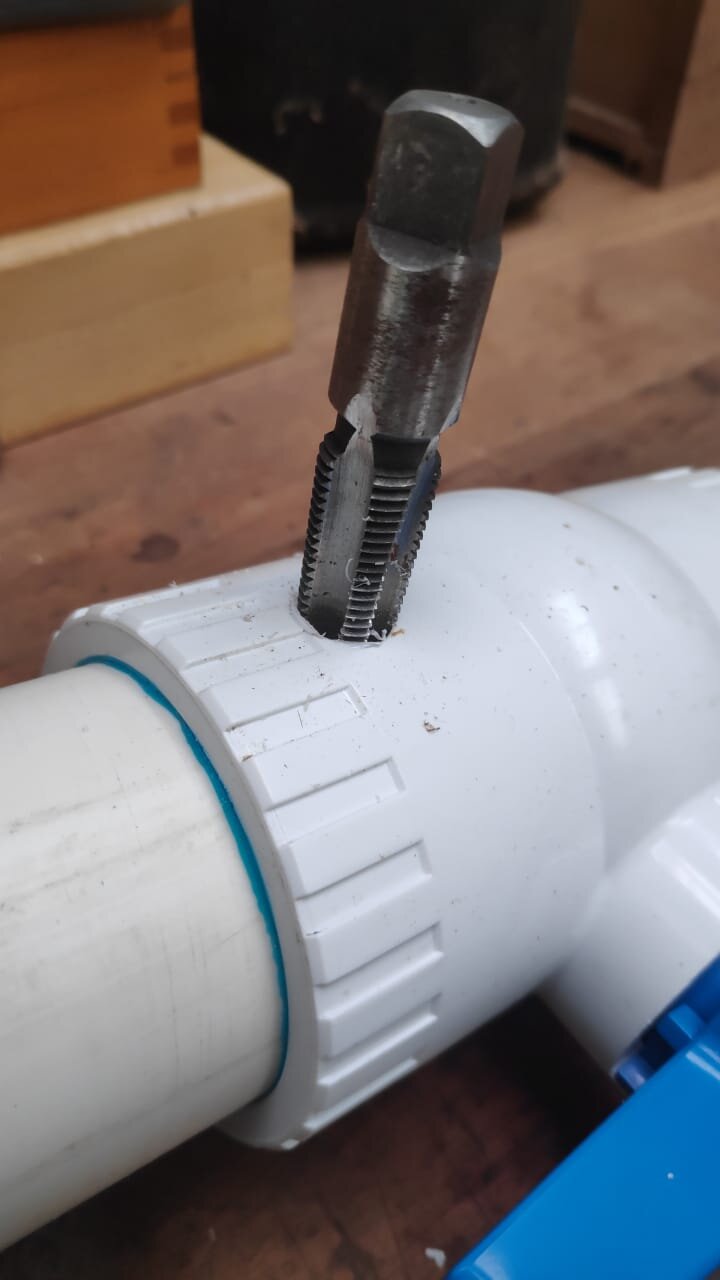

This is your basic modified boucherie set up, from here you will attach the bamboo to the Fernco coupling, fill the solution into the PVC pipe by opening the valve, close the valve and connect the compressor. Its important to keep the pressure low, around 12 PSI otherwise you will blowout the coupling. As you force the solution through the bamboo you will see the water from the bamboo coming out the other end. Soon you will begin to the see the Bam Blue begin to come out and when the full concentration is coming out the other end you can stop it running. Now you have a treated piece of Bamboo, this needs to dry vertically and can then be stored horizontally.

A piece of bamboo hooked up to the boucherie

A treated piece of bamboo
WANT TO LEARN MORE ABOUT BAMBOO?
Read our other blog about Bamboo Shoots
Stay tuned for our annual workshops that cover topics in natural building, permaculture, fermentation, and more!
Categories
Topics
- Agriculture 6
- Agroforestry 21
- Animals 2
- Apprenticeship 19
- Appropriate Technology 6
- Backpacking 1
- Bananas 1
- Basic Pantry 4
- Biochar 1
- Books 3
- Build Your Own Home 1
- Central America 5
- Chiles 1
- Cinnamon 1
- Clay Carving 1
- Climate 2
- Climate Change 1
- Cob oven 1
- Communication 5
- Community 24
- Compost 2
- Composting Toilets 2
- Condiments 1
- Conservation 2
- Cooking 4
- Costa Rica 18
- Design 10
- Earthen Construction 10
- Eat Local 2
- Ecohome 1
- Education 9
- Environment 3
- Ethics 4
- Farm to Table 12
- Fasting 1
- Fermentation 14
- Food 22
- Food Choices 8
- Food Forest 8
- Food Processing 15
- Food Systems 12
- Gap Year 1
- Gardening 5
- Ginger Beer 1
- Harvest 2
- Health 12
- Healthy living 5
- Homemade 2
- Homestead 8
- Internet 2