
Why Are My Homemade Jams So Runny? A Look into the World of Pectin!
By Kyler Kradle — Apprentice 2026
Based on - On Food and Cooking: The Science and Lore of the Kitchen by Harold McGee
For the past few weeks, I've been trying my hand at making homemade Costa Rican jams here at Rancho Mastatal.
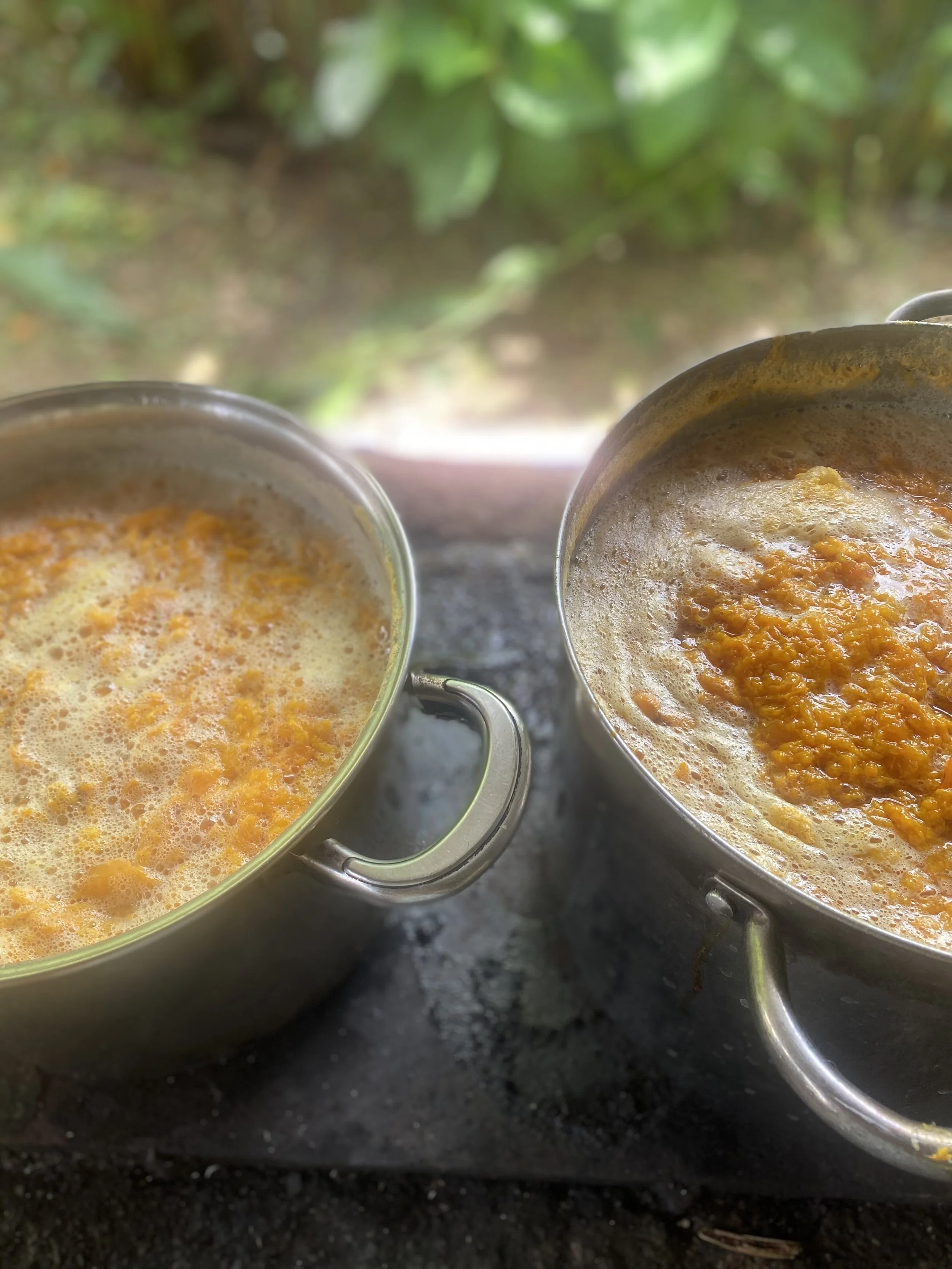
During one of our food processing classes, jam was thrown into the mix. We made two huge batches with tons of ingredients at high heat on a rocket stove for hours on end. The jam turned out well. We used it for fruit roll-ups, and it went nicely with sourdough.
However, our consistency and canning methods must have been a tad bit off in the end. Some jars had different thicknesses, odd smells and tastes, and, honestly, we had an overabundance of jam.
A couple of weeks later, we had some extra Victoriana fruit from our harvest day. I used this to make another jam. Alongside the Victoriana, I used a whole pineapple and papaya. This was tossed into a blender with sugar to create a liquid. The liquid was then cooked thoroughly, and more sugar was added little by little until the sugar percentage was up to about 50–55%.
The mixture was very sweet, had what seemed like a good consistency, and passed the plate-tilt test. The plate test involves putting a little spoonful of jam on a plate and tilting it to see its consistency.
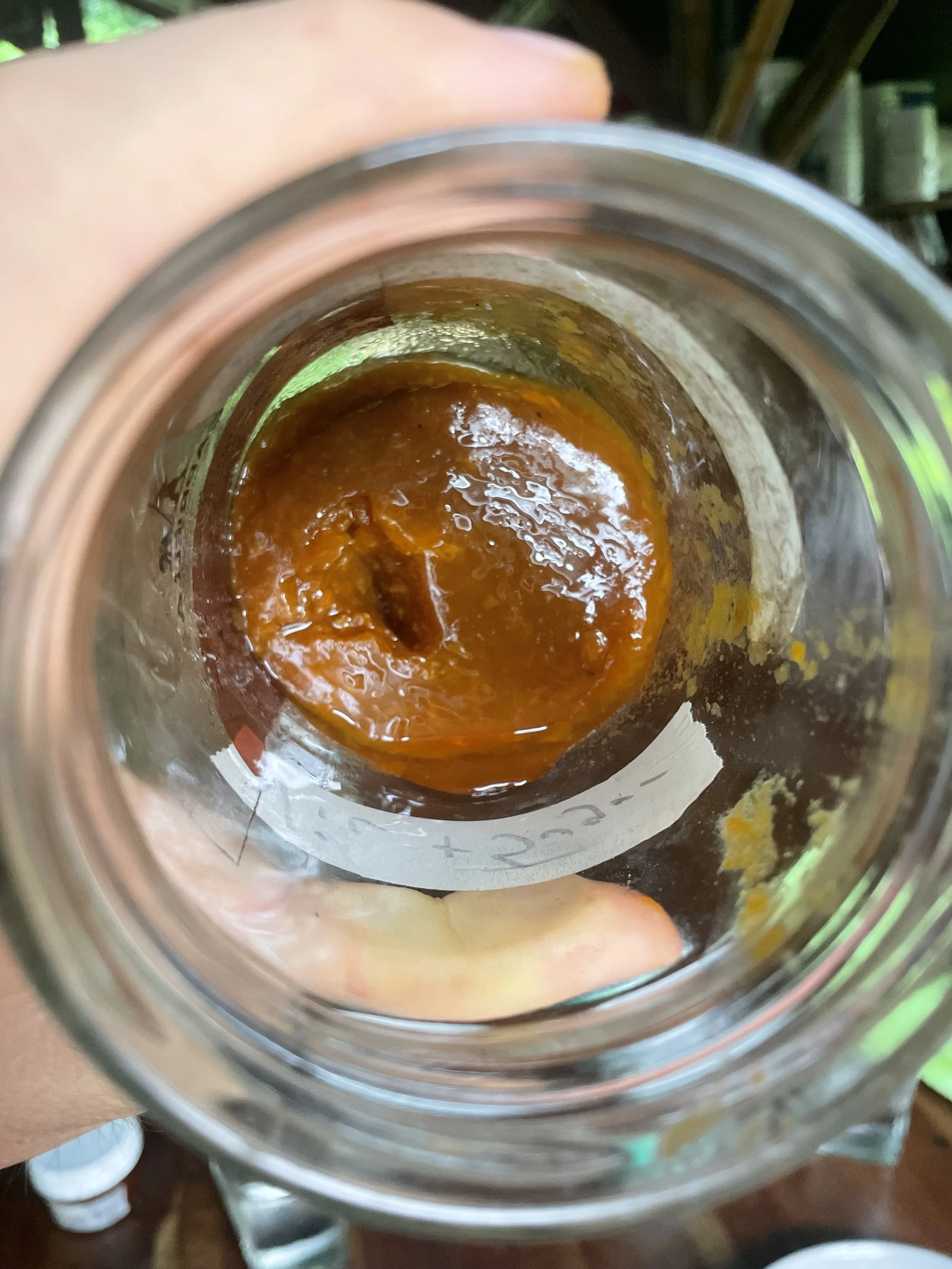
However, after letting the mixture set, it was quite liquidy and more like a sauce.
On another occasion, I made a jam for a cheesecake using Victoriana and Arasá fruit. Again, this also turned out runny, even with the more acidic fruit, which I thought had higher pectin.
So the question is…
Why Are My Jams Runny?
Do I need more sugar? More acidic fruit? How do I get more pectin? What even is pectin?
This blog will answer all your questions—and more—to help you obtain some beefier jams.
What Is Pectin?
Speaking of beef, let's think of meat for a second.
Say you cook chicken, put it in the fridge, and take it back out again. The juice turns into this gelatin-like substance around the chicken, binding the liquid together.
Historically, this is where the ideal consistency for jam came from: a mixture between solid and liquid that is bouncy and joyful.
Pectin is the creator of this consistency, but how does it do it?
The best way to think about pectin is like an adobe brick wall. The cells are the bricks, the pectin is the mortar, and the wall itself is the cell wall.
Pectin is the natural substance that holds the cells together, creating a cell wall. When a fruit is firm and underripe, the pectin is strong and long, holding the cells together.
On the other hand, when a fruit ripens, the pectin gets weakened by enzymes.
For those wondering, like I was, enzymes are proteins that help conduct chemical reactions made by living things. Basically, they're a tool that helps complete a job faster—like cutting paper with scissors instead of your hands. The enzyme is the scissors.
When cooking fruit, the wall breaks and the cells open, changing their current structure. Imagine shaving away an adobe brick wall to make a curve. Those shavings still have the same ingredients, but they're just in a different form.
That's the pectin getting dissolved into the fruit juice.
With this crumbly substance, you can't just form another wall again, just like pectin can't simply turn back into a gel. The pectin chains have been diluted in water and now hold a negative charge that makes them repel each other instead of bonding.
They need some help and other ingredients to find each other again.
Similar to rebuilding an adobe wall, the cook—the builder—can use several different methods to help bring pectin back to its gel form.
Four Ways to Help Pectin Form a Gel
1. Lots of Sugar
Sugar molecules attract water molecules to themselves.
This helps reduce the amount of water available in the mixture.
2. Boiling
Boiling pulls water away from the pectin, exposing the pectin chains to each other again.
Sugar increases the boiling point.
Boiling evaporates water, bringing pectin chains closer together while also creating an overall higher concentration in the mixture.
3. Increased Acidity
Acid neutralizes the negative repelling charge that the pectin mixture is currently holding.
The wandering pectin molecules are then able to bond together to form a gel.
4. Supplemental Pectin
Pectin can be bought commercially or found in other fruits.
It can be added directly to a mixture to replace broken-down pectin molecules and help bring the gel form back to life.
Note: Overuse of heat and acid can shorten pectin chains, causing the jam to become liquidy.
Ideal Conditions for Making Jam
The usual challenge of preserve-making is trying to set the mixture at a proper boiling point for a specific amount of time while meeting the correct sugar percentage and creating an overall ideal concentration.
Other problems can occur because of the quality and amount of pectin or acid.
Here are the ideal conditions for creating a proper concentration:
pH: 2.8–3.5, roughly equal to orange juice
Acid: 0.05% by weight
Pectin concentration: 0.5–1.0%
Sugar concentration: 60–65° Brix
If you happen to do what I do and make liquidy jam, there are a couple of troubleshooting solutions you can try.
Liquid or concentrated pectin can be commercially purchased. Another trick is using the zest or peel of acidic fruits soaked in the jam.
Other options include cream of tartar, lemon juice, and a quick reboiling.
I would also recommend doing a quick search for the fruits you want to use and checking their pectin levels.
A Basic Understanding of How to Make Fruit Preserves
1. Cook the Fruit to Extract Its Pectin
Make cooking as brief and gentle as possible.
Prolonged cooking damages pectin.
2. Add Sugar
Rapidly bring the mixture to a boil to remove water and concentrate the other ingredients.
Continue boiling until the mixture reaches 217–221°F (103–105°C).
This indicates that the sugar level has reached approximately 65%, or you can use a refractometer to measure the sugar percentage.
Cook best at a gentle simmer and in a wide pot with a large surface area for evaporation.
3. Add Supplemental Pectin if Needed
Store-bought pectin packets, citrus peel, or green apple stock are common options.
These can be added directly or placed in cheesecloth and soaked in the mixture.
4. Add Supplemental Acid if Needed
Add acid later in the process to avoid completely breaking down the pectin chains.
Too much acid can cause fluid to weep from an overly firm gel.
5. Test the Jam
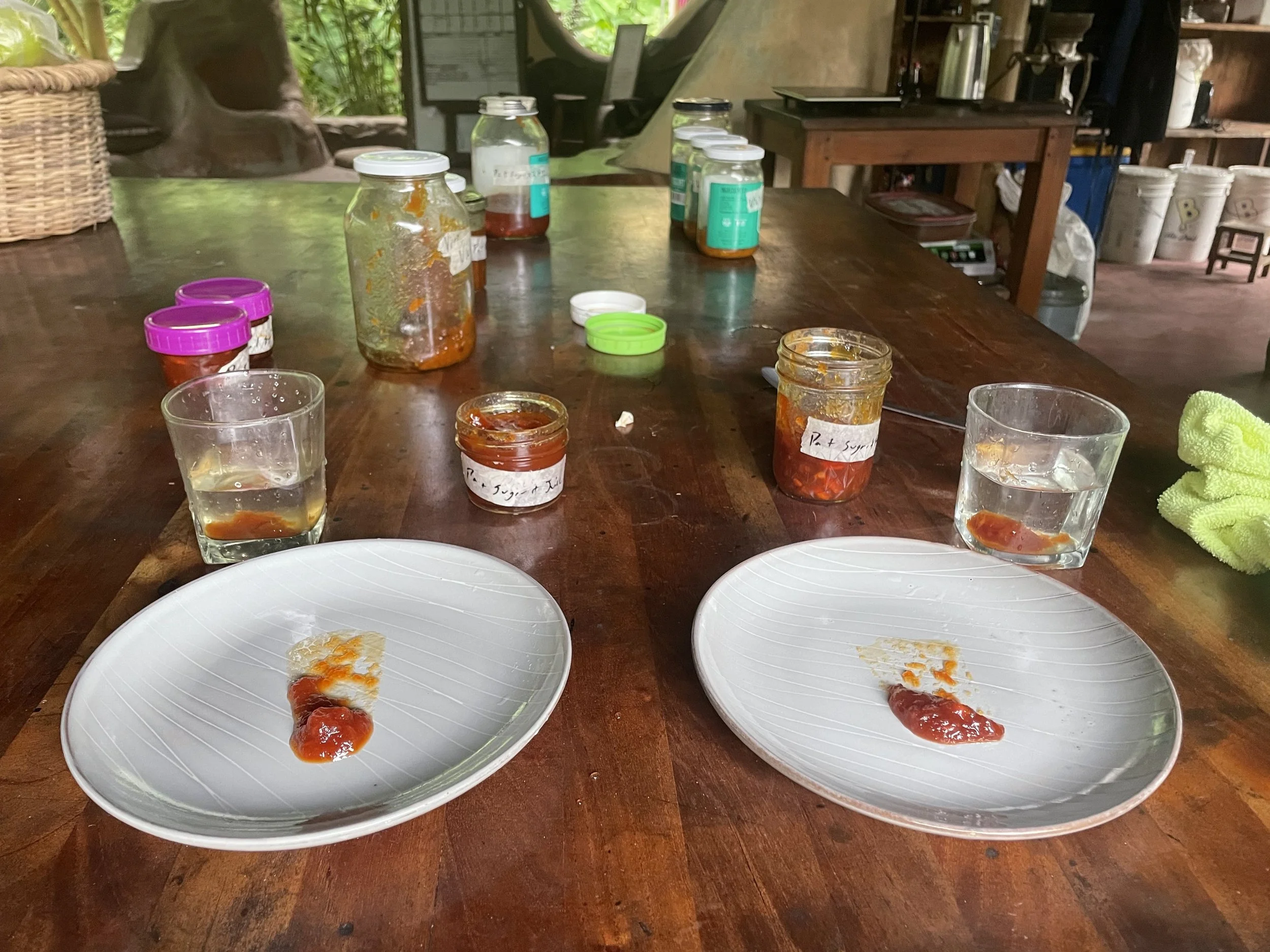
Readiness can be tested using the plate, spoon, or water test to see if the mixture gels.
6. Pour into Sterilized Jars
The mixture sets as it cools below 180°F / 80°C, but it sets most rapidly around 86°F / 30°C.
The mixture can continue to become firmer over the course of several days or weeks.
Jam Experiment!
So, I decided to do a little experiment to test out some variables in my jam.
Realizing that pectin is the key ingredient for achieving the perfect consistency, I revolved my experiment around it.
Here's how I broke it down using what I had at the ranch.
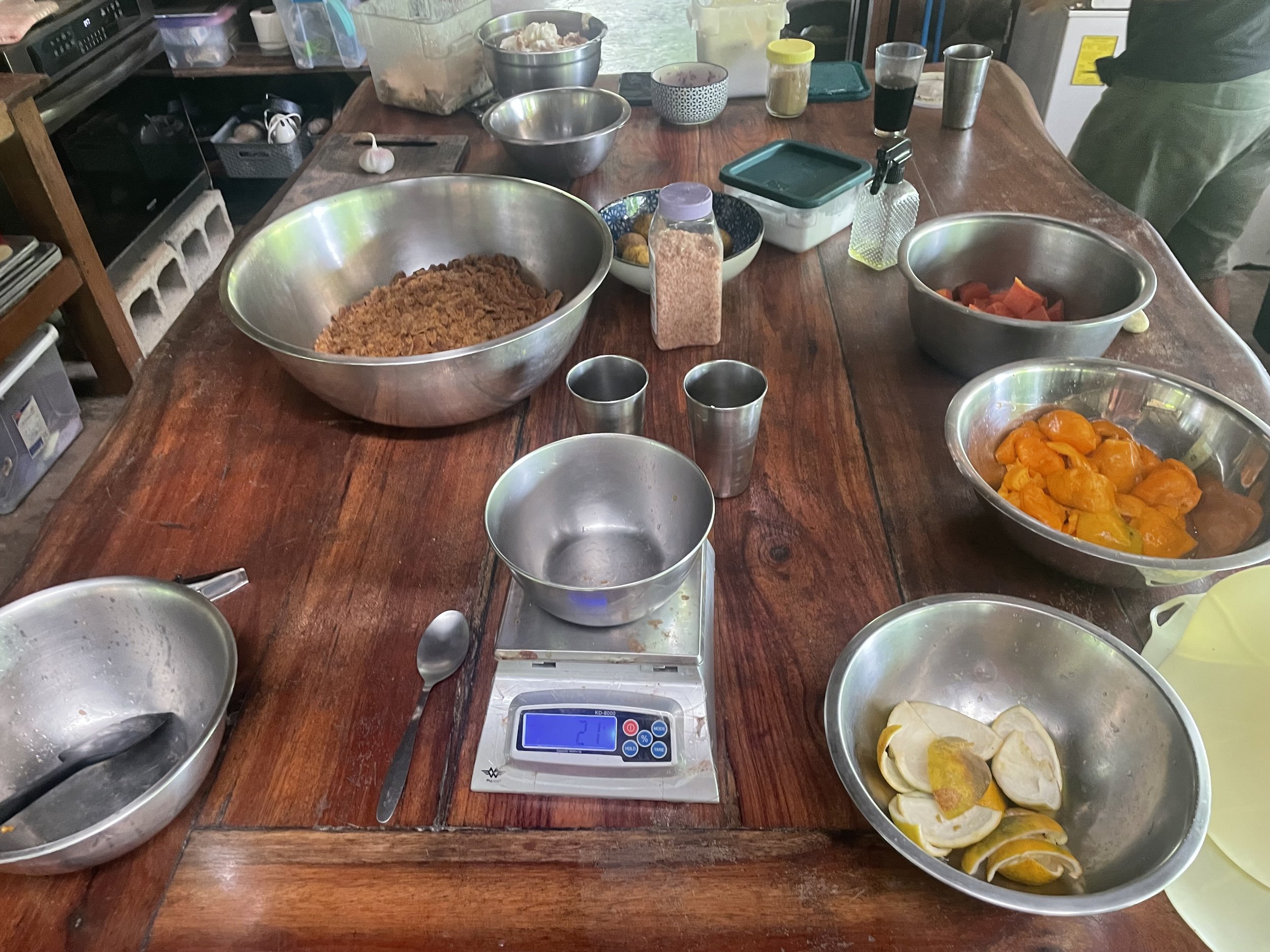
I took two fruits, Victoriana, which is high in pectin, and papaya, which is low in pectin, as my subjects.
Sugar is needed for every jam, so that stayed constant for each sample. My fruit weight was 150 g to 100 g of sugar, which gave me a sugar percentage of about 65%.
Basically, I was measuring two-thirds of the fruit weight in sugar.
My pectin variables consisted of orange peels and lime juice.
My controls were:
Cooking time: 10 minutes
Cooking temperature: 100°C on the induction stove
Boiling time: 5 minutes
Pot size
Here's another look for easier comparison.
High-Pectin Fruit
1. Victoriana, 150 g + sugar, 100 g
2. Victoriana, 150 g + sugar, 100 g + 32 g lemon juice
3. Victoriana, 150 g + sugar, 100 g + half an orange peel in cheesecloth
4. Victoriana, 150 g + sugar, 100 g + 32 g lemon juice + half an orange peel in cheesecloth
Low-Pectin Fruit
5. Papaya, 150 g + sugar, 100 g
6. Papaya, 150 g + sugar, 100 g + 32 g lemon juice
7. Papaya, 150 g + sugar, 100 g + half an orange peel in cheesecloth
8. Papaya + sugar + 32 g lemon juice + half an orange peel in cheesecloth
High- and Low-Pectin Fruit
9. Victoriana, 150 g + papaya, 150 g + sugar, 200 g
10. Victoriana, 150 g + papaya, 150 g + sugar, 200 g + 32 g lemon juice + half an orange peel
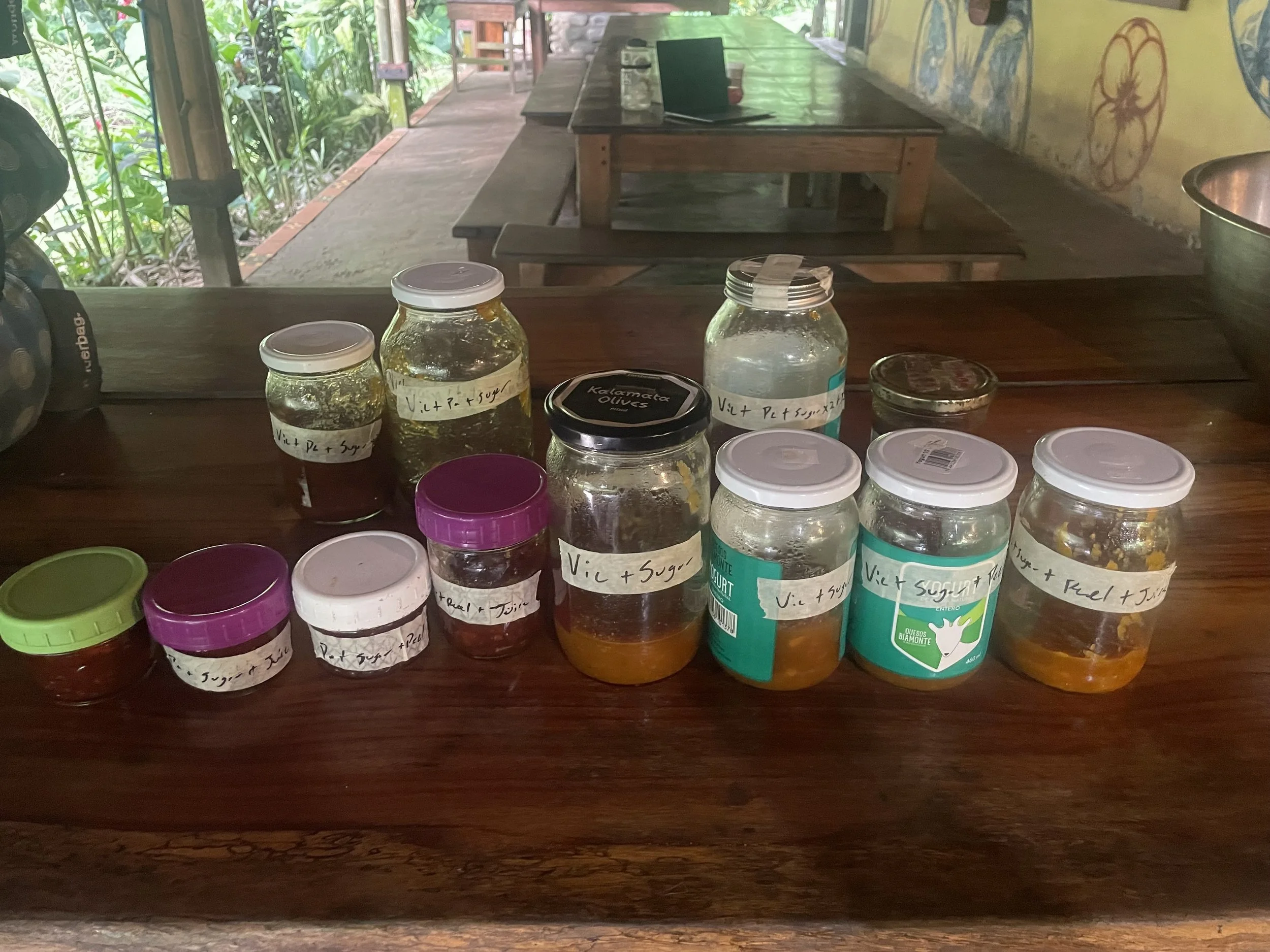
To compare my results, I used a plate test and water test over a setting time of 48 hours.
I also tried to compare taste to the best of my ability, although taste is obviously subjective.
Overall, I thought the best consistency was going to be the Victoriana with the orange peel because citrus peels are supposedly high in pectin, along with the high-pectin fruit.
Experiment Conducted!
Things That Went Wrong
Lime juice measurements were inconsistent.
I messed up my ratio for lime juice and added way too much compared to the whole mixture.
When mixing in the peel, I think the cheesecloth might have soaked up some of the lime juice and liquid, which, in this case, was probably good because I had added too much.
I used orange peels.
I think I can just toss these straight into the mixture next time.
With such a small batch, I'm not sure if they even totally soaked in.
Was I boiling for too long?
It felt like I might have been over-boiling the mixture because of the liquidness of the majority of my jams.
When compared to my experimental sugar-level test jam, it was so thick I could hold it upside down and it wouldn't fall out.
Results
High-Pectin Fruit
1. You can see the spoon mark—it's so thick! Great consistency, with a small amount of liquid pushed to the top. It left small, clumpy gel trails that were very visible and moved as a solid mass. On the plate test, it stayed completely as one unit. In the water test, there was no fuzz coming off. The taste was sour and delicious.
2. One mass on the top layer, but it dwindled into the same mass deeper into the jar. It was also liquidy on top, with a big snail trail, but still gel-like. It stayed as one mass in the water but left some fuzz in the water. The taste was acidic.
3. Very thick, with little to no gel trail on the plate test. Great consistency and no liquid on top. It stayed as one mass in the water test with no fuzz coming off. The taste was very similar to #1.
4. Good consistency, but with a little more movement. It left barely a mark on the plate test. It stayed as one mass in the water test but was still a little hairy. Solid taste, but kind of sour.
Low-Pectin Fruit
5. Solid structure, with little to no skid on the plate test. It all moved as a solid mass. It stayed as one mass in the water test. The taste was somewhat bland.
6. Biggest snail trail yet. It was still moving as a solid mass but was definitely the most liquidy so far. It stayed as one mass but slightly broke apart in the water. The taste was too acidic from the lime and hurt my teeth.
7. Solid structure. It left a light snail trail on the plate test and moved as a solid mass. It stayed as one mass in the water test. The taste was again somewhat bland.
8. Good consistency. It left behind small gel clumps but still moved as a solid mass. It stayed as one mass in the water test. The taste was relatively better than #5.
High- and Low-Pectin Fruit
9. More on the liquid side. There were clumpy gel spots on the plate test, but it stayed as one mass in the water test. The overall taste was solid.
10. More of a solid-mass consistency on the top, but it dwindled down. It left a noticeable snail trail on the plate test, like small gel bubbles. It stayed as one mass in the water test. The taste was too much like lime.
Observations
First things first: all the jams turned out great and had a solid consistency overall. I would consider none of them to be liquidy or sauce-like.
So, I obtained pectin, and the experiment was a success!
However, they were all so similar that it was kind of hard to differentiate between them. I'm not sure which one even had the best consistency.
I think the plate and water tests are supposed to be done while cooking the jam to check its consistency, but I suppose they still worked here.
I also saw what McGee was talking about with the weeping fluid caused by too much acidic juice. The acid-sample mixtures had a great mass-like consistency, but liquid was sitting on the top and edges.
I definitely added too much lime, and it really wasn't necessary. It also gave the jam a bad taste and hurt my teeth—it was so acidic!
The peel in the cheesecloth worked somewhat, but next time I'm just going to throw the peel directly into the mixture and pull it out afterward, or just leave it out altogether.
Flavor is also something to consider. These jams had the good consistency I wanted, but the flavor wasn't all that great. Combining fruits or choosing better-tasting fruits with less acidity may change the consistency while producing a better taste.
Now the question is: How can I obtain better-tasting jams with solid consistency?
What's Next?
I think sugar percentage and boiling time are other variables to consider when looking at consistency.
When comparing low- and high-pectin fruits with a sugar percentage of 65%, they looked relatively the same.
Also, looking back at my previous jams, I cooked and boiled them for an intense amount of time, which I believe was shortening my pectin levels.
Compared to this experiment, where I only boiled the jams for five minutes, I obtained a great consistency.
Next time I play with jam, I want to experiment with boiling time and sugar percentage.
Time to redesign and prepare another jam sesh!
Tune back in for more jam updates and recipes to come!
Read More
Check out these other blogs related to food processing:
