

BLOG
Stories, articles, and updates from the Ranch community.

Non-Traditional Education: Reconnecting to our Roots
Modern, conventional education systems do not work for everyone. They cater well enough to many of today’s students but not to a significant portion of the population that might be better served by alternative pedagogical approaches. In most countries, at the age of 4 or 5, or even younger, kids are shuffled into busy classrooms to learn subjects that will reportedly prepare them for a successful future. As our economies become less predictable, politics less appealing, and the environment ever more damaged, current educational models are losing traction with increasing numbers of people who recognize that the one-size-fits all approach to education is not working for our society.
Non-Traditional Education: Reconnecting to our Roots

By Tim O'Hara
Modern, conventional education systems do not work for everyone. They cater well enough to many of today’s students but not to a significant portion of the population that might be better served by alternative pedagogical approaches. In most countries, at the age of 4 or 5, or even younger, kids are shuffled into busy classrooms to learn subjects that will reportedly prepare them for a successful future. As our economies become less predictable, politics less appealing, and the environment ever more damaged, current educational models are losing traction with increasing numbers of people who recognize that the one-size-fits all approach to education is not working for our society.
Terms referring to non-standardized teaching methods and ideas such as homeschooling, unschooling, gap years, Waldorf and BOCES are all becoming more familiar in today’s educational vernacular. Instead of paying an inordinate amount of money to learn how to navigate broken social and economic structures to barely make ends meet as an educated, employed adult, more and more people believe that it’s important that humans begin to train and prepare for meaningful, place-based work that provides a fair wage while better connecting to the elements that we most need to thrive; clean water, clean air, clean soil and clean food.
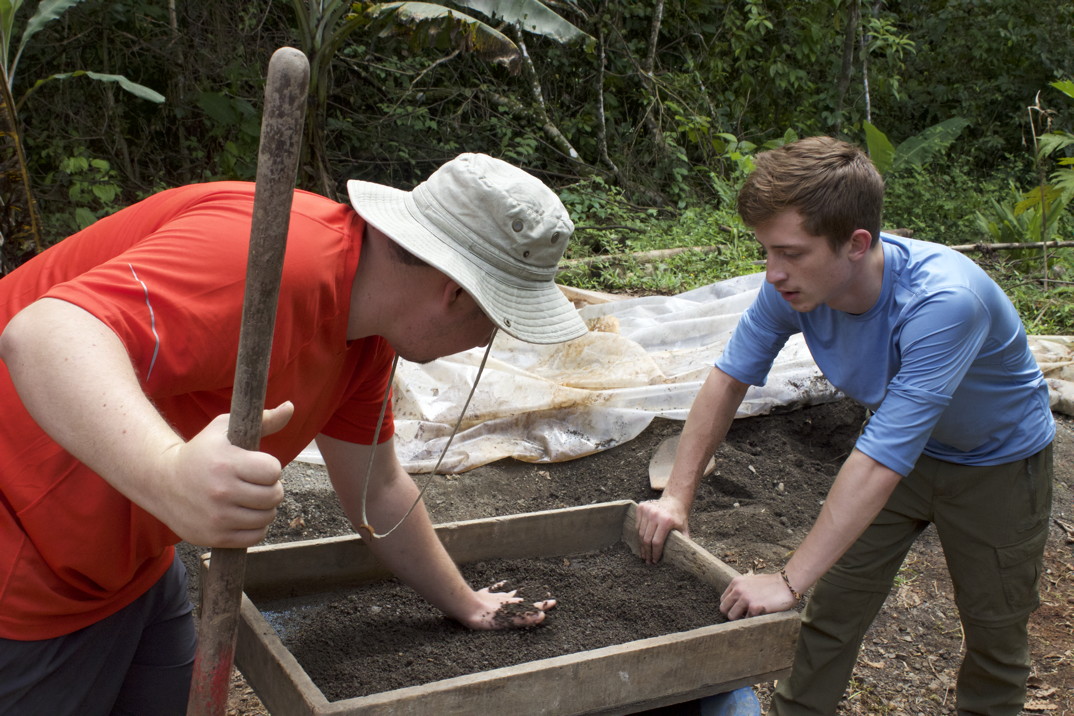
In our specie’s experiment to educate our populations to be good, productive denizens of the planet, we have lost sight of how to responsibly meet our basic needs and in the process have contaminated the resources that are inherent to a healthy life. We’re becoming a society more apt to care for our latest electronic purchase than one another.
Most visitors to the Ranch come to learn in a different setting. Many of these people are attracted to our experiential methods of teaching. As an education center since 2001, we have discovered a great deal about our students and how they develop best. We have also witnessed a trend over the last decade and a half that has students arriving to the Ranch with ever decreasing hands-on skills. It’s not uncommon to host students that have never picked up a shovel, dug their hands into the dirt, or cooked a meal from scratch.
Our education systems today praise computer work more than physical labor. While I think both skill sets are important in today’s economy, I would argue that we’ve let the pendulum swing much too far towards the idea that the solutions to today’s challenges lie only in high-tech devices and multi-billion dollar mega-projects that ignore our historical connection with and dependence on nature.
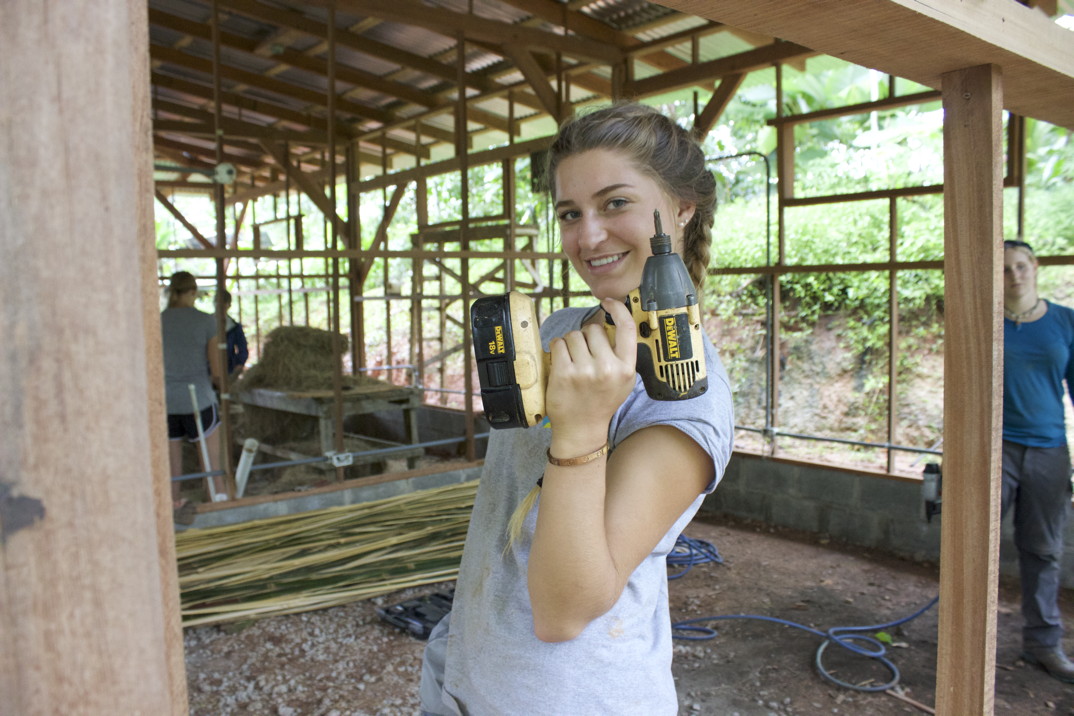
As parents, Robin and I have chosen a hybrid approach that has our daughter enrolled in Mastatal’s local, Spanish-speaking public elementary school and learning from Robin through a Waldorf-style homeschool curriculum during our trips outside of Costa Rica. We hope that this will provide her with a dynamic and solid educational foundation that will prepare her for the global problems that she and others in her generation will inherit and face as adults. We look forward to explore the growing number of non-conventional educational options as she gets older.
Gap year programs like those offered through Winterline provide an alternative to graduating high-school students. They allow students to better refine their interests before investing tens of thousands of dollars in an education that may not provide them with the schooling that they desire or need. Organizations such as Winterline recognize the existing gap in public education and focus on providing students with opportunities to learn hands-on skills. The growing popularity in these programs is a sign that parents are more willing to let go of the rigid ideas and standards that they experienced as students.
We’re proud to be a part of a more common sensible approach to schooling and we believe that well-thought out, inspirational and practical, applied programs can oftentimes provide students with a superior and more relevant learning experience. Some of today’s problems may require large, expensive and highly-engineered approaches, but others demand simplified but intelligent thinking and a genuine connection to the earth. The latter can and should be cultivated in our society’s educational programs.

Paul Stamets, the renowned mycologist, provides inspiration and an example via his mycoremediation work that partners with our fungal brethren to clean up toxic sites using simple, inexpensive and accessible technology as do Vandana Shiva’s efforts promoting food and seed sovereignty in India. Winona LaDuke’s achievement to build and restore community by means of wild rice harvesting and her work with the White Earth Land Recovery Project and Wes Jackson’s advances in perennial grain production in the Midwest of the US with The Land Institute provide us with precedents to learn from. Our hope is that the Ranch too can provide an example and a place for compassionate people in search of a better way to learn, teach, heal and live.
Check out our calendar and consider organizing a group to join our team as we promote a more rational, sensible and connected educational movement.
News from around the Permaculture Community
One of our favorite alternative education programs is Sustainable Summer. Their groups are always one of the highlights of our year and the students who go through the program leave us feeling hopeful for the future. If you are looking for something different to inspire your high- schooler, we can't recommend them enough.
We have two new stellar workshops on the calendar for May 2017:
Agroforestry Skills Inspired by the Forest: Orchard Planning, Propagation, Planting, & Production - May 17 - 18 with Peter Kring
Plant as Medicine: Reclaiming the Art of the Home Apothecary - May 17 - 18 with Ancel Mitchell
Our cob oven will be seven years old this season! We are looking at re-building the oven so that it better fits our kitchens needs. Ovens are great starter projects and these plans for a double chamber cob oven just might give you the confidence to tackle the project in your own backyard!
Abrazos
The Ranch Crew
Going Home: The Long Road Leaving Mastatal
The journey starts with a 5am wake up; just as the sunlight is starting to spread through the jungle. I take a couple deep breaths as I admire the beautiful place that I am in.I take a last look around, heave my heavy backpack on, and head down to make a cup of coffee before embarking on what will be a 36+ hour adventure back "home." I have done this journey multiple times now, from California to Costa Rica and back and forth, and each time presents new challenges and exhausting travel times.
Going Home: The Long Road Leaving Mastatal
The journey starts with a 5am wake up; just as the sunlight is starting to spread through the jungle. I take a couple deep breaths as I admire the beautiful place that I am in.I take a last look around, heave my heavy backpack on, and head down to make a cup of coffee before embarking on what will be a 36+ hour adventure back "home." I have done this journey multiple times now, from California to Costa Rica and back and forth, and each time presents new challenges and exhausting travel times.

Every time I go from one place to the other I am overwhelmed with culture shock, but the shock is always greater in my trips back to the States. While leaving the small, tranquil, jungle town of Mastatal and landing in the big, bustling, concrete jungle of Los Angeles I am caught off guard by what is happening in the “real world.”
Fortunately, I do not and have never had to live in a city, especially not one as large as Los Angeles. I grew up in the small mountain town of Bishop, CA; population 4,000. For college I moved to what I considered the city of Durango, CO; population 20,000. Then I moved to Mastatal; population 100. You could say I don’t have much city or masses-of-people experience, and this probably factors into my feelings of shock when I leave the Ranch and get dropped into one of the biggest cities in the world.
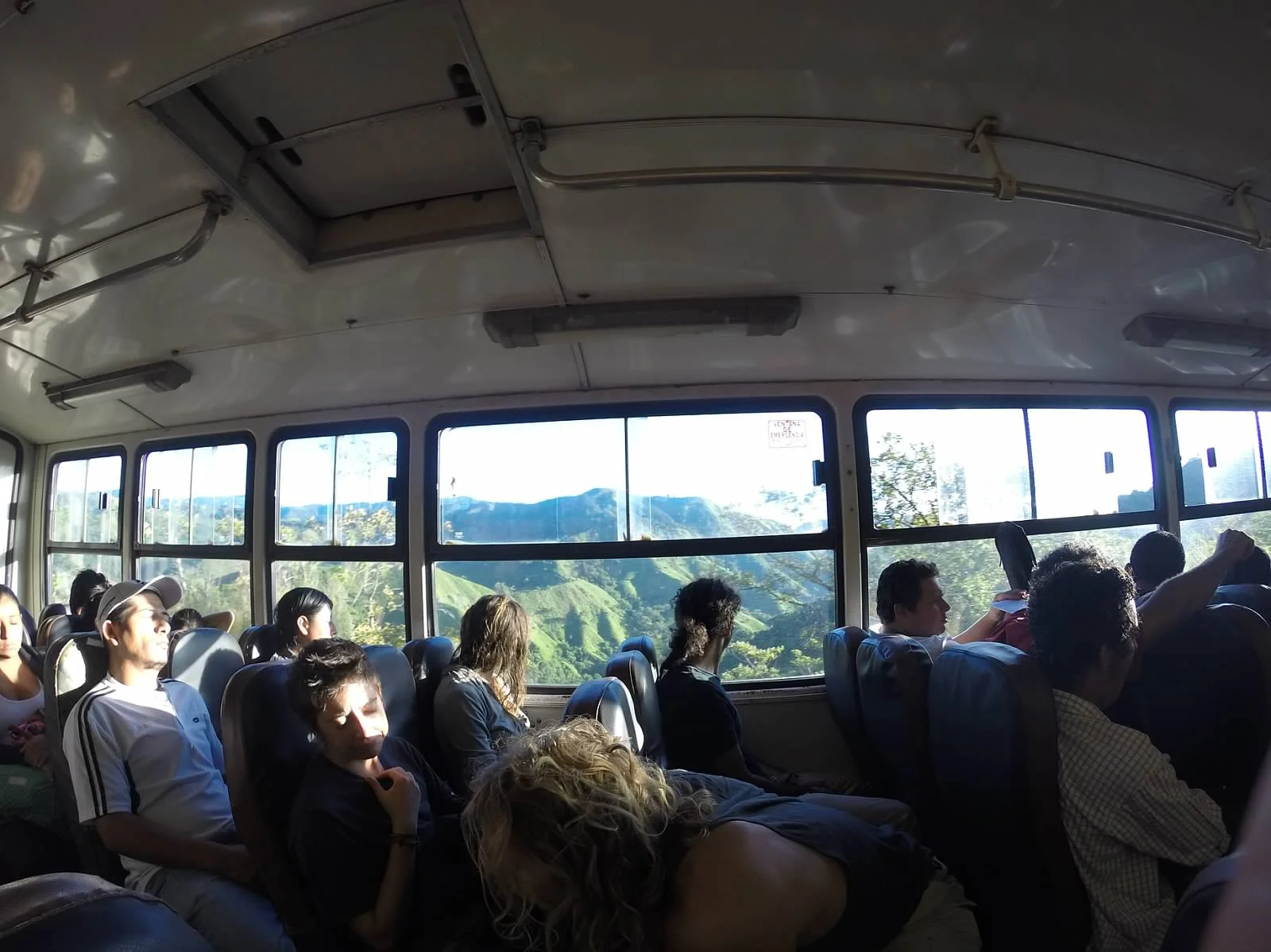
After I chug down a delicious cup of local coffee, something I know I won’t enjoy again till I return, I head out to wait for the only bus out of town. The bus arrives and I awkwardly manage to load my bag on, which always seems to be a feat when traveling. So it begins; the first of many hours sitting, waiting, and fidgeting. If any of you have traveled to the Ranch you may feel the same way, but I think the bus ride is much easier on the way out then the way in. Better as the first leg of your journey than the last,.still with a fresh traveling bum.
I enjoy the ride through the jungle, on windy, bumpy, dirt roads, admiring the unique beauty of this place. We arrive in Puriscal and I head straight to get some chicharones. These yummy hunks of meat, an avocado, and bread have become my go to traveling food to fuel me through. I take my time because my flight doesn’t leave for hours and I would rather wander around the streets then wait in the airport.Still there aren’t many exciting activities to keep me in Puriscal so I load onto the next bus to San Jose.
The whole trip gradually eases me into civilization, each stop with an increasing population. The bus stops in the middle of San Jose, I get off onto the busy streets. I have done this journey many times but I have never had to find the next bus station to the airport by myself, so this will be the interesting part. As anxiety starts to come up with the increase of people and hustle, and every other person in a car is yelling “taxi, taxi!” I inhale, exhale, tighten my backpack straps, and start walking in the direction I think is to the next bus station.
After multiple blocks I start to think I may have missed a turn.I spot a group of police officers chatting on the corner and shyly approach to ask for directions. They all jump eagerly on the opportunity to practice their English on this lost, white girl.
I make it to the airport. The Costa Rican airport is so small that everything moves smoothly.This is where I will wait for eight hours before my plane leaves. I find a nice private corner, lay out my yoga mat and start stretching. I’m the wandering, hippy, dirty, traveler that doesn’t mind making herself comfortable and if that means doing some odd yoga moves in the airport then so be it.

On my flight to LAX I sit next to a Costa Rican man that is moving to Alaska to be with his family. I wish him good luck and warn that he better buy a coat! I arrive in LAX, wait in the two hour immigration line, get on the airport shuttle to the opposite side of the airport, find my next gate, find another private corner, and lay out my yoga mat in hopes to get some sleep. By this time it is at least midnight and there is hardly anyone in the airport.
It turns out not many people sleep in the airport; except for those too cheap to get a room. With the lack of body heat the airport feels like a walk in freezer, and this is not just because I am use to the heat of the tropics. I thought I brought enough warm clothes to bare the cold airports, but I can barely feel my toes so I try wrapping myself in my yoga mat. At this point I do look like a homeless person camping in the airport. The late hours of the night are also the time that all the construction and cleaning gets done in the airport, so between the jackhammers, vacuums, and freezing temperatures I don’t get much rest.
The early morning hours come, people slowly start trickling back into the airport. I continue to wait for my flight to Mammoth, the town an hour away from my home where I will get picked up by my parents. I have had this flight canceled on me multiple times due to not enough passengers, so I worry until I'm on the flight, if it will take off or not. If this flight doesn’t run that means one of my parents will need to drive the five hours to LAX to pick me up. That for lack of a better word, sucks. Finally, the time has arrived for the last leg of my trip; I board the Mammoth flight, an hour long beautiful trip over the Sierra Nevada Mountains. I land. My dad is there to pick me up and we drive home. It has been at least 35 hours now since I left Mastatal; I am exhausted.
I am in a totally different place now. It always amazes me how one day you can be living in the tropics and the next you are in the high desert mountains. I went from a landscape of complete green, to one of different shades of browns and speckles of green. On the drive home my dad comments “it’s been raining a lot, things are looking really green here.” Ha! I think, a lot of rain, really green, you should see the jungle.
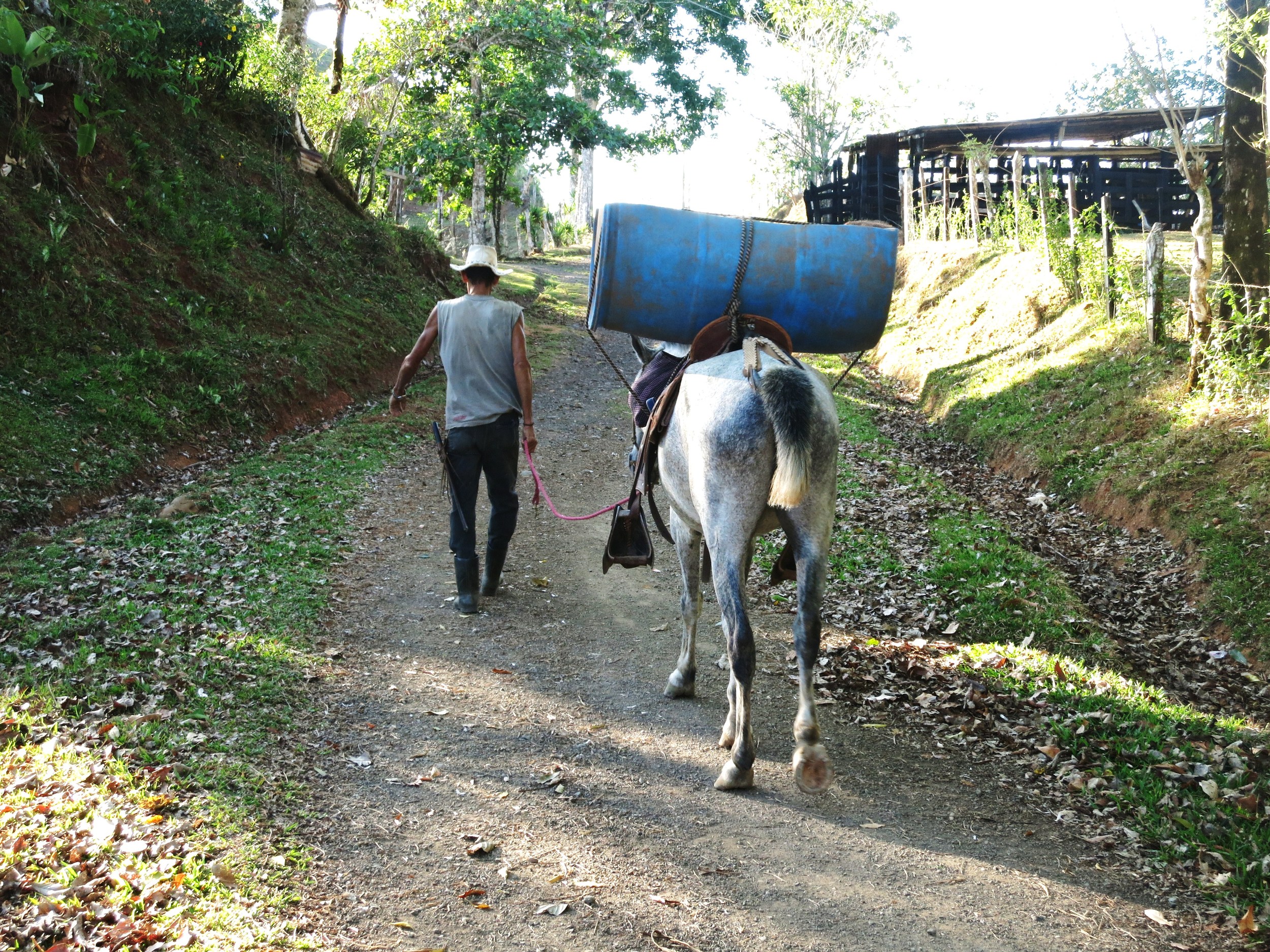
Usually my transition back into life in the States is cushioned by the comfort of being in Bishop, a town so small you almost know everyone. But unknowingly, I arrive back home during memorial day weekend. Which in Bishop is when the town holds its annual Mule Days event, a well known event that attracts 20,000+ people and their 20,000+ mules. All flooding into Bishop for a week of mule fun! It is as ridiculous as it sounds. Not having been to Mule Days in many years, a long time friend and I decide why not? So we put on the good ol’ blue jeans, cowboy boots, and plaid shirts and go down to watch the rodeo! I feel like I have walked into a costume party, what happened to the raggedy t-shirts, sweaty shorts, and old crocs of the jungle? I ain’t in Mastatal no more!
NEWS AND NOTES
Did you know the Ranch is on Instagram? Follow us here!
Have you ever wanted to build your own home? Just bought a piece of land in Costa Rica and want to create a jungle paradise? Well in 2017 we have the classes you need to re-skill and build your place in this world.
Abrazos
The Ranch Crew

Life with Limited Communications: How We Thrive with Crappy Internet
I’m unable to answer all of the emails that I receive into my inbox everyday. Even though I do receive my fair share of electronic correspondence, my inability to reply to all messages is not likely a result of the inordinate amount of inquiries that I receive compared to many of you out there. The reason is that I live in a place with shitty Internet.
Life with Limited Communications: How We Thrive with Crappy Internet

I’m unable to answer all of the emails that I receive into my inbox everyday. Even though I do receive my fair share of electronic correspondence, my inability to reply to all messages is not likely a result of the inordinate amount of inquiries that I receive compared to many of you out there. The reason is that I live in a place with shitty Internet.
I have a 2-hour window each morning before most people in town are awake to get into my account and open and answer my emails. After that, people begin to chew up the ever so precious limited bandwidth that serves our community. In my head I envision people in town rolling out of bed to take a peak at their Facebook accounts or watch a video on Youtube before school or work while I struggle to open a reservation request that might result in a booking and some income for the Ranch. Our painfully slow Internet means that I can generally check emails only once a day. If I didn’t respond to an email this morning, it will simply have to wait until tomorrow.

To add to my current communication challenges, I don’t have a cell phone, much less a smart phone. The pressure seems to mount each day to get one. Given my administrative obligations as the director of Rancho Mastatal, all of this results in a daily confrontation that I strive to find balance with continuously. For those of you with poor Internet connections, which may only be a small minority of you reading this, what do you do when you simply can’t open an email that you know you should read and respond to as soon as possible? How do you react when you can’t attach a simple Excel spreadsheet to your email to send to a prospective client? In an age when businesses increasingly rely on the Internet for their survival, how has the Ranch been able to make ends meet for 15 years, the first 8 without even a phone in our town, in a world that today demands email responses in minutes or hours, not days or weeks?
Honestly, I don’t have a great answer or fully know. It’s an interesting dissertation topic for a future graduate student that loves our community. I think mostly it’s been a life-or-death (for the business, not us as humans) need. Somehow, we’ve been able to organize our work and lives to make it work, in spite of the poor odds in Vegas. We’ve persisted and persevered while the communications here have slowly improved. We’ve been forced to depend on our amazing library (with real books) for research and traditional means to build friendships, trust and a dedicated following that have kept us alive and mostly well.
Every 3 weeks, for almost a decade, I drove 2 hours to find a reasonably fast Internet connection. I also relied on a terribly annoying auto response message that asked those emailing to me to please be patient when waiting for a reply. Many of you probably remember (and still receive a watered down version of) the message that states that I’ll get back to you sometime within the next century. This is mainly how I assuaged and bought time with those interested in our project and “stayed on top” of bookings and guest visits early on in our evolution.

In the earliest days, I would wait in line at the public phone in San Miguel, 4 kilometers from Mastatal, to make bookings for our educational groups. If I had to make more than one call, I would have to get back in line to make the second. A third. Back in line. You catch my drift. This little exercise might take me half a day. Setting up homestays for our high school groups would take multiple days. It now takes me an hour by phone.
The current reality, fortunately, is that I’ll probably be able to respond to an email that you send to me within a week, and if it’s high priority, even sooner. But that doesn’t mean it’s always easy. While most of you enjoy life with high-speed wifi and 4g service, we struggle with a 3g network that’s reminiscent of my first email experience with AOL and dial up just out of the Peace Corps in the mid-90s. I haven’t come that far in the past 20 years, but I’ve come somewhere, and all this said, there’s great relief and many benefits in not owning a cell phone and being tied to the Internet 24/7. I am currently avoiding total dependence on modernity’s electronic leashes (or nooses) but also appreciate and recognize the great benefits that the Internet brings to me, my family, and our business. Without it we would struggle even more than we presently do to make financial ends meet and stay in touch with our families. My weekly drive to the highest point in the region to check phone messages has evolved to a predawn wakeup and email session in my cozy cob home, and I’ll take the latter any day of the week.

Visitors to the Ranch almost universally, eventually feel relief when they spend many days, weeks or months with us and are unable to stay uber connected to their digital lives back home. The Internet and cell phones are yet other additions to a continuous string of technologies that we have to learn to find a happy medium with and balance. Like so many of life’s conveniences, too much has proven over and over to destroy our mental and physical health in the long-run, and just like coffee, hooch and phone access, a little can and should go a long way.
NEWS AND NOTES
We have a number of life changing workshops coming up.
Please share around if you know anyone who is ready for a trip to beautiful Costa Rica, a swim in the waterfalls, nourished with homemade meals, and challenged with an intensive educational experience.
Abrazos,
The Ranch Crew
Categories
Topics
- Agriculture 6
- Agroforestry 21
- Animals 2
- Apprenticeship 19
- Appropriate Technology 6
- Backpacking 1
- Bananas 1
- Basic Pantry 4
- Biochar 1
- Books 3
- Build Your Own Home 1
- Central America 5
- Chiles 1
- Cinnamon 1
- Clay Carving 1
- Climate 2
- Climate Change 1
- Cob oven 1
- Communication 5
- Community 24
- Compost 2
- Composting Toilets 2
- Condiments 1
- Conservation 2
- Cooking 4
- Costa Rica 18
- Design 10
- Earthen Construction 10
- Eat Local 2
- Ecohome 1
- Education 9
- Environment 3
- Ethics 4
- Farm to Table 12
- Fasting 1
- Fermentation 14
- Food 22
- Food Choices 8
- Food Forest 8
- Food Processing 15
- Food Systems 12
- Gap Year 1
- Gardening 5
- Ginger Beer 1
- Harvest 2
- Health 12
- Healthy living 5
- Homemade 2
- Homestead 8
- Internet 2