

BLOG
Stories, articles, and updates from the Ranch community.

How Mentorship will Help our Permaculture Community Grow
Mentorship may be one of the biggest opportunities for growth in our fledgling permaculture movement. There is interest in professional careers as permaculture designers, but the field lacks quality mentoring opportunities. By these I mean mentoring in a specific field, by a professional who has years of experience, with the goal of developing a specific skill set and livelihood.
This article was originally published by the NuMundo Transformational Times blog. Please go to their website to read the entire article.
How Mentorship will Help our Permaculture Community Grow
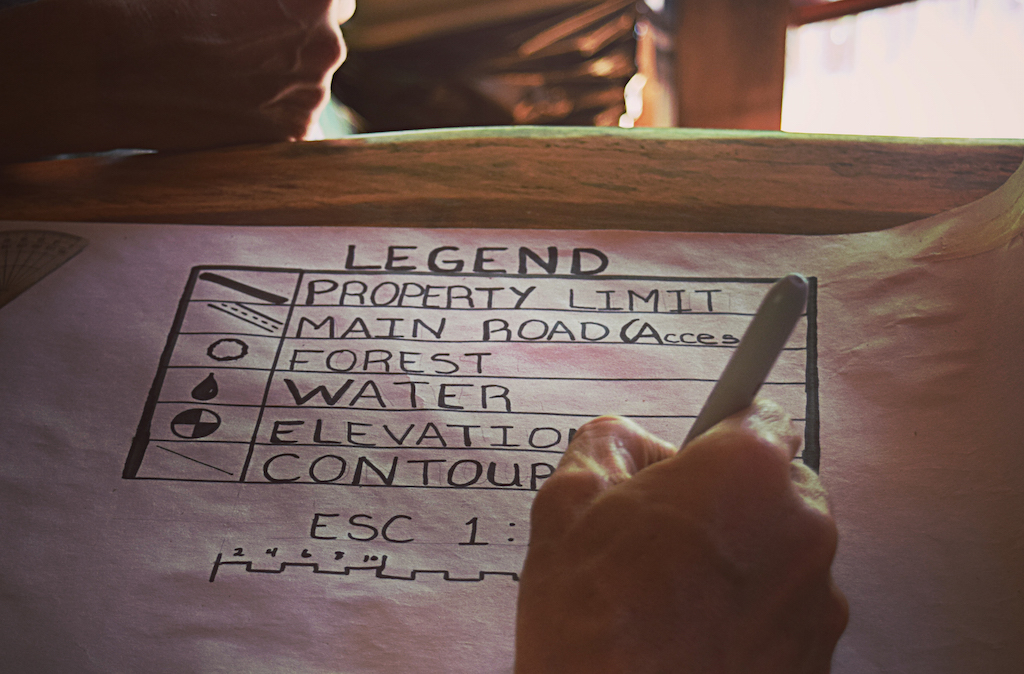
Mentorship may be one of the biggest opportunities for growth in our fledgling permaculture movement. There is interest in professional careers as permaculture designers, but the field lacks quality mentoring opportunities. By these I mean mentoring in a specific field, by a professional who has years of experience, with the goal of developing a specific skill set and livelihood.
Earlier this year I formalized my permaculture design consulting business as Porvenir Design. I’ve been doing design work for the last four years, but part time, informally, not running it as a genuine business. It was a side hustle that is now becoming a primary livelihood.
Never have I craved mentorship like I have during this process.
To finish reading this article please go to the NuMundo Transformational Times blog.
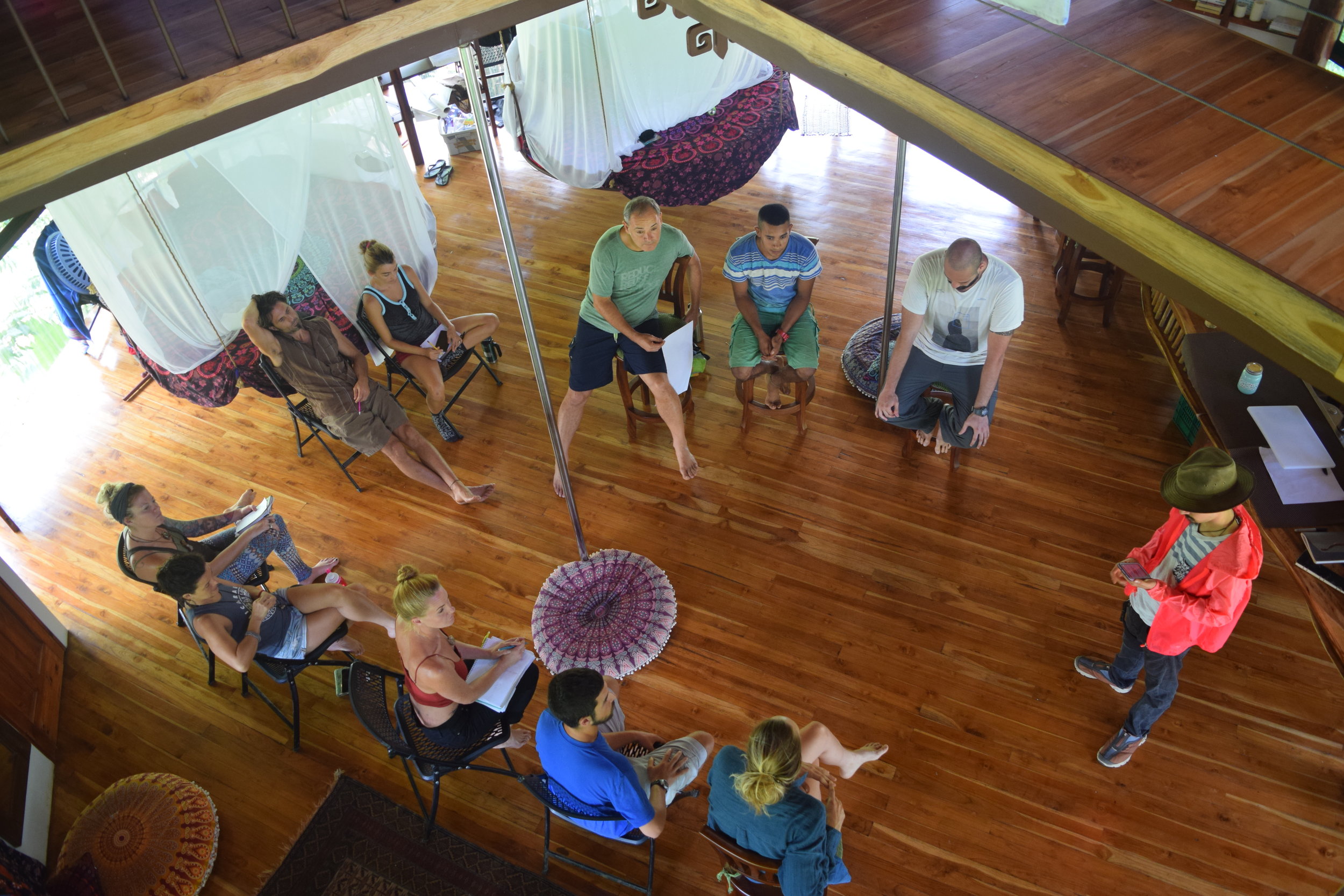

Interested in learning more? Consider joining the Porvenir Design team for their upcoming Permaculture Design Certification at Rancho Mastatal Sustainability Education Center! This intensive two week course is designed to give students hands on experience in a real world site design scenario.

The Art of Stacking Functions
Stacking functions. What does this phrase mean to you? It could mean any number of things depending on what you apply it to. In this case I'm referring to the term as it's used in permaculture. It is one of the primary principles of permaculture design. Here at the Ranch we employ as many of these principles as we can in our work and in our daily lives.

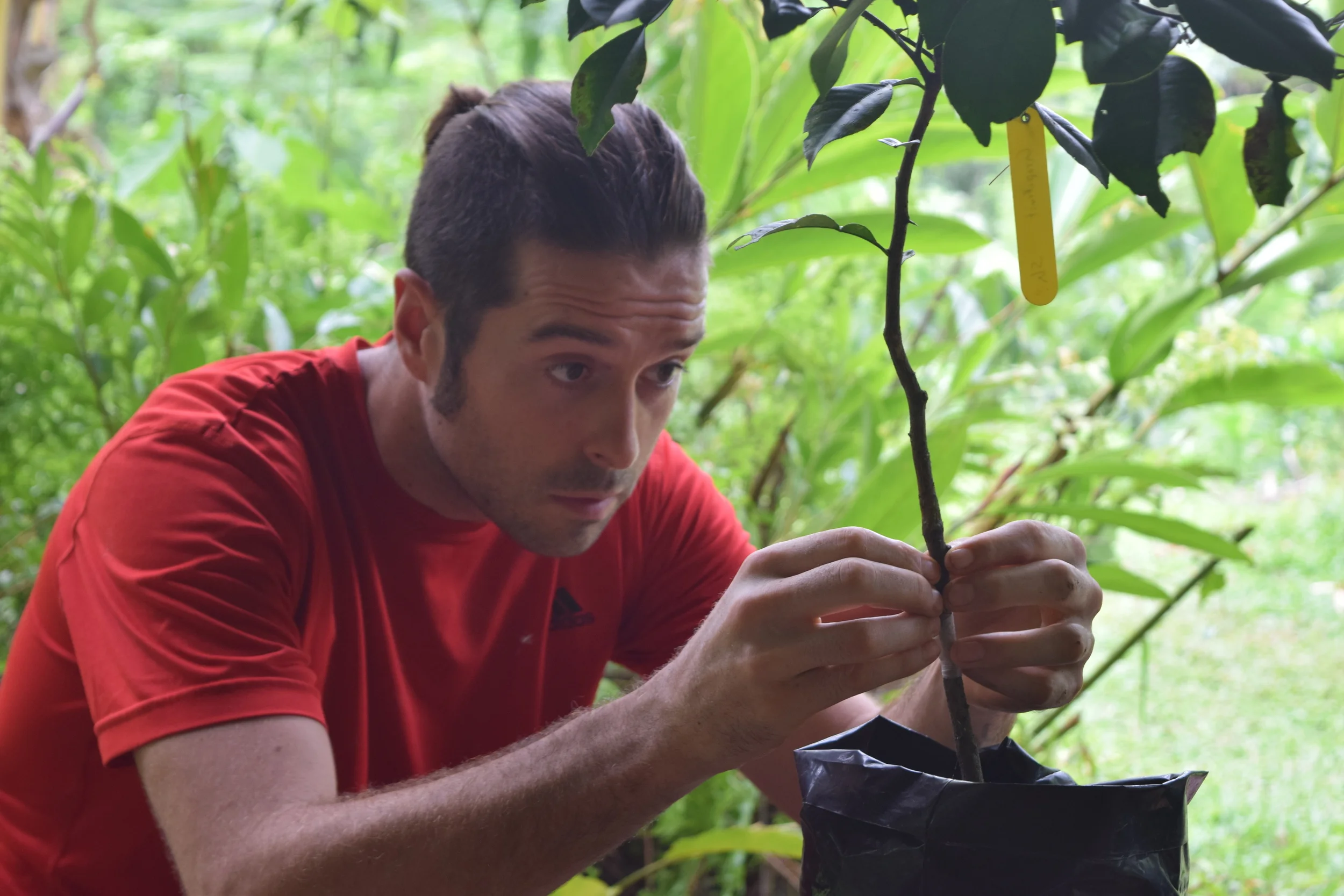
Tulsi or Sacred Basil harvested for tea.
Stacking functions. What does this phrase mean to you? It could mean any number of things depending on what you apply it to. In this case I'm referring to the term as it's used in permaculture. It is one of the primary principles of permaculture design. Here at the Ranch we employ as many of these principles as we can in our work and in our daily lives.
Before delving deeper into this topic, I think it's important to first define what permaculture is. There are thousands of definitions available but I've found it useful to come up with my own because it makes the most sense to me. I encourage anyone with an interest to do the same. Here is my definition: Permaculture is a way of life that empowers you to contribute to the regeneration of the earth on a personal level. Its use is guided by a set of principles that can be applied to any aspect of your life.
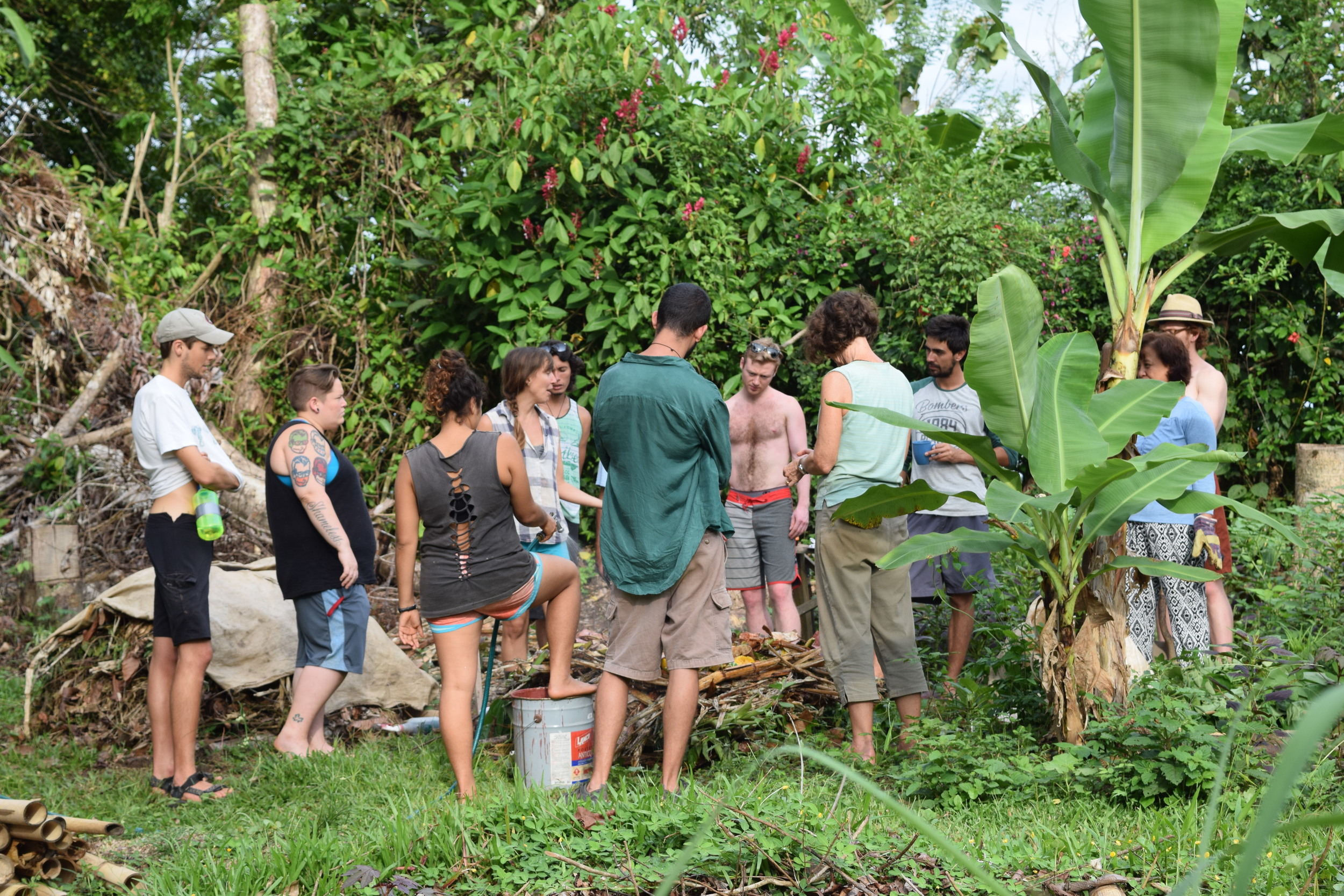
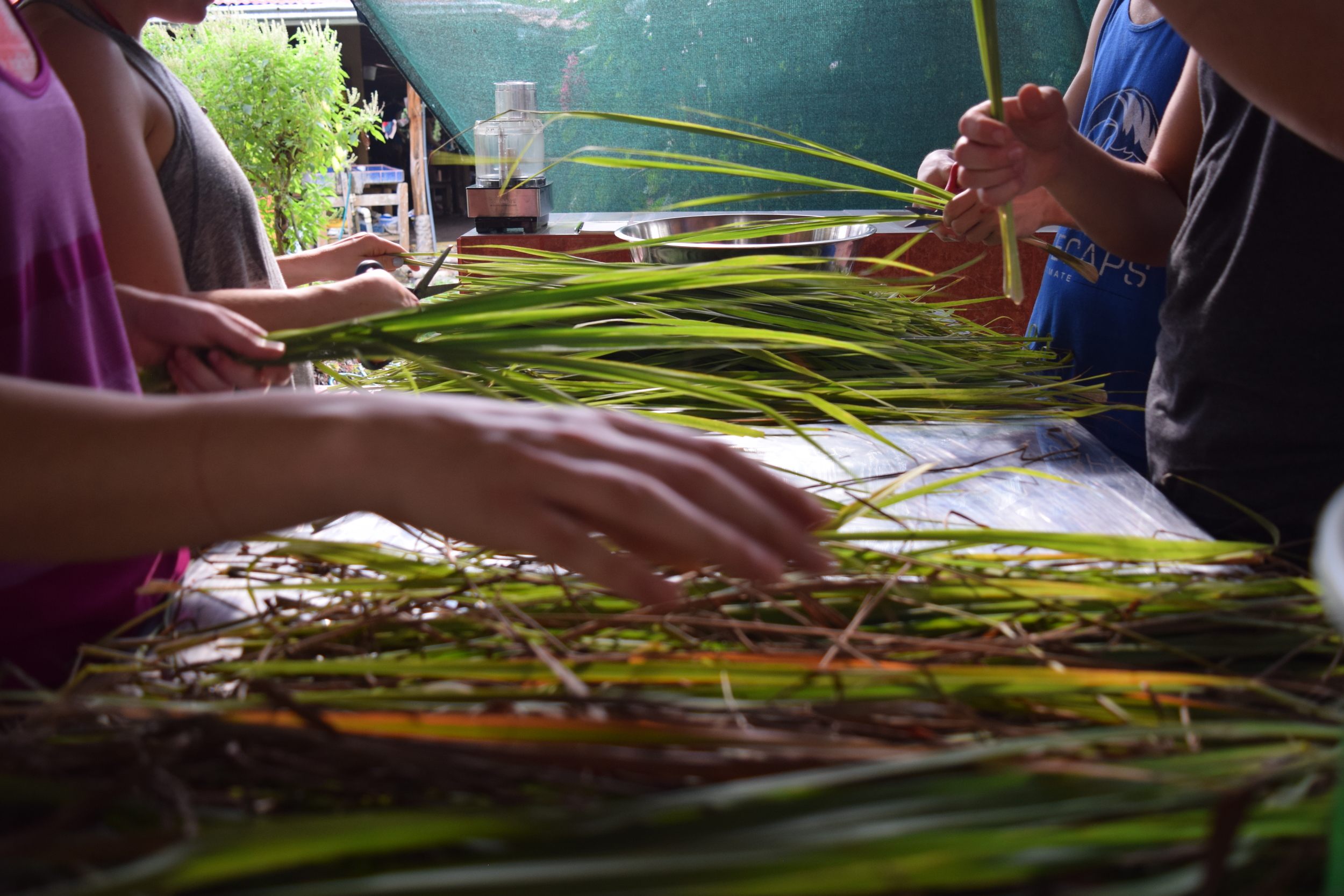
Learning about Compost making in our PDC.
With this in mind let's go back to stacking functions. As first mentioned, stacking functions is a primary principle of permaculture and basically refers to elements in your life having multiple functions, instead of a single function. I will offer a few examples to make the concept easier to grasp. A kitchen table is where food is prepared, where meals are shared and it can also become storage space. A fruit tree provides fruit, offers shade, produces mulch, fire wood and a climbing structure. Try to think of elements in your life and what you use them for. If you can only come up with one use for something, it's probably not necessary to have in your life. Can you think of anything that doesn't have multiple functions?
After taking the permaculture design course (PDC) at the ranch, I started to notice that I was applying these principles everywhere and had been all along, only now I was able to recognize this process. Stacking functions is apart of my everyday life here. My role has taken many forms, but recently I have focused on the farm to table operations. I propagate plants, nurture them and continuously maintain them until they are ready to be harvested and used in the kitchen.
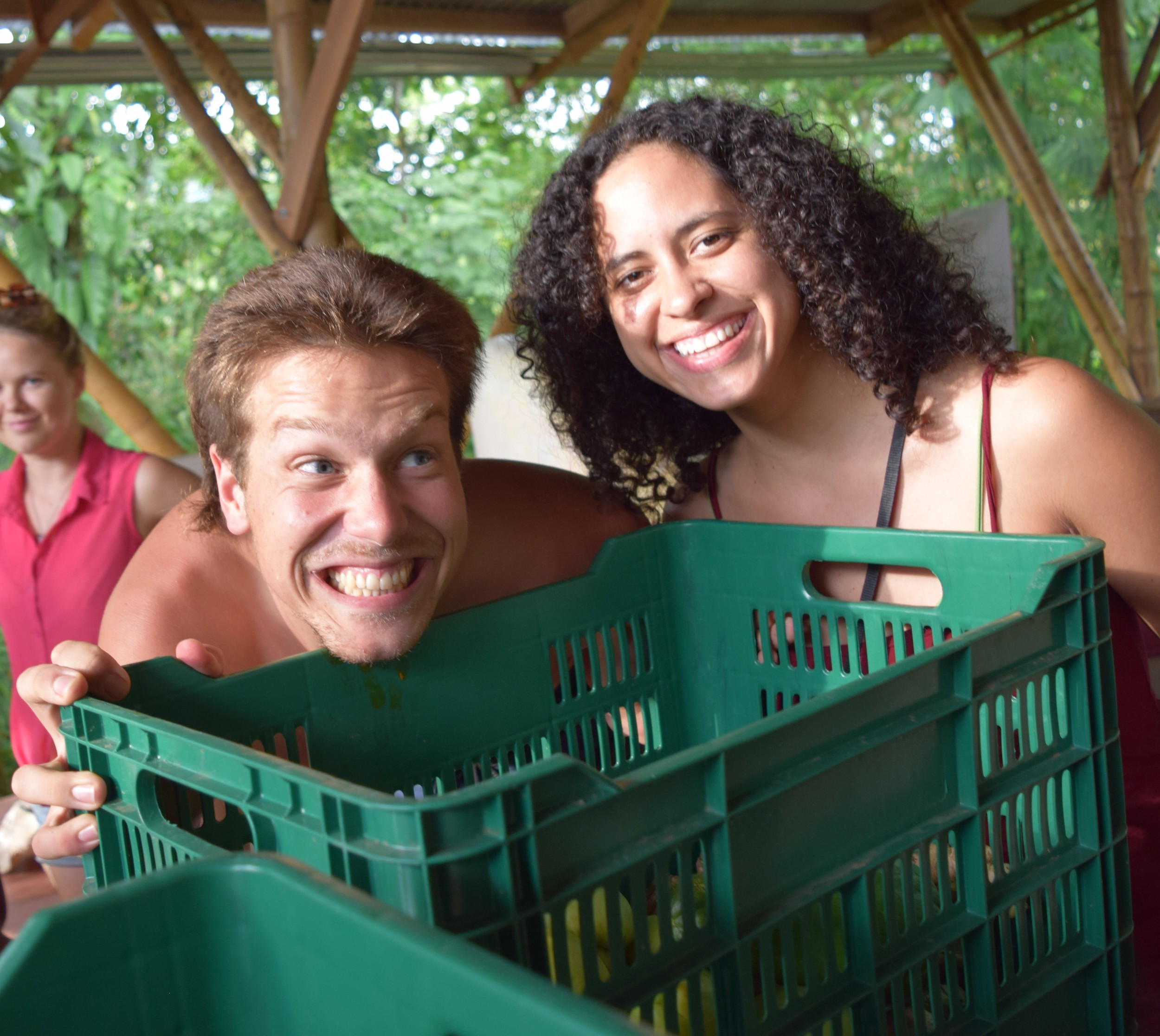
Ready to make pickles.
One morning in the Vivero (plant nursery) and kitchen gardens I realized that everything I was doing actually had multiple functions. I'd set out to clear the paths and Swales from plants too tall to hold themselves up from the relentless rainy season downpours. I was simply cutting and clearing. But it was more than that. The plants I was tending too were edible salad and cooking greens, perfect to use in the kitchen later that day. And this got me thinking, what other functions do these humble garden tasks have? Well, I was pruning and shaping the plants, helping to promote new growth and removing old growth. I was collecting cuttings to propagate in the nursery later that day. And from what was leftover, I was gathering nitrogen rich green cover for our compost pile. When I was done clearing I got onto weeding and again found myself picking out perfectly edible food growing in unintentional places. I wasn't simply weeding, I was improving the aesthetic of the gardens, creating a new intentional herb garden and collecting herbs for use in the kitchen.
Later that week I was in the kitchen processing our farm food and found myself using these ingredients in many different ways. The tulsi or holy basil I'd cut back was used fresh to make a concentrate to flavor our kefir water sodas. Some of it was dried and put on the tea table and some of it was used to flavor a meal. One of my favorite foods to process this year has been mango. When it's ripe we eat it fresh, add it to our hot sauce, use it in smoothies and freeze it to make ice cream. When it's green we pickle it, make green mango kimchi, create green mango salads or simply slice it up and sprinkle with our chili lime salt. It seems simple but I'd bet many of you have set out to do a simple but necessary task in the kitchen or garden without realizing that what you're doing or using actually has many functions.
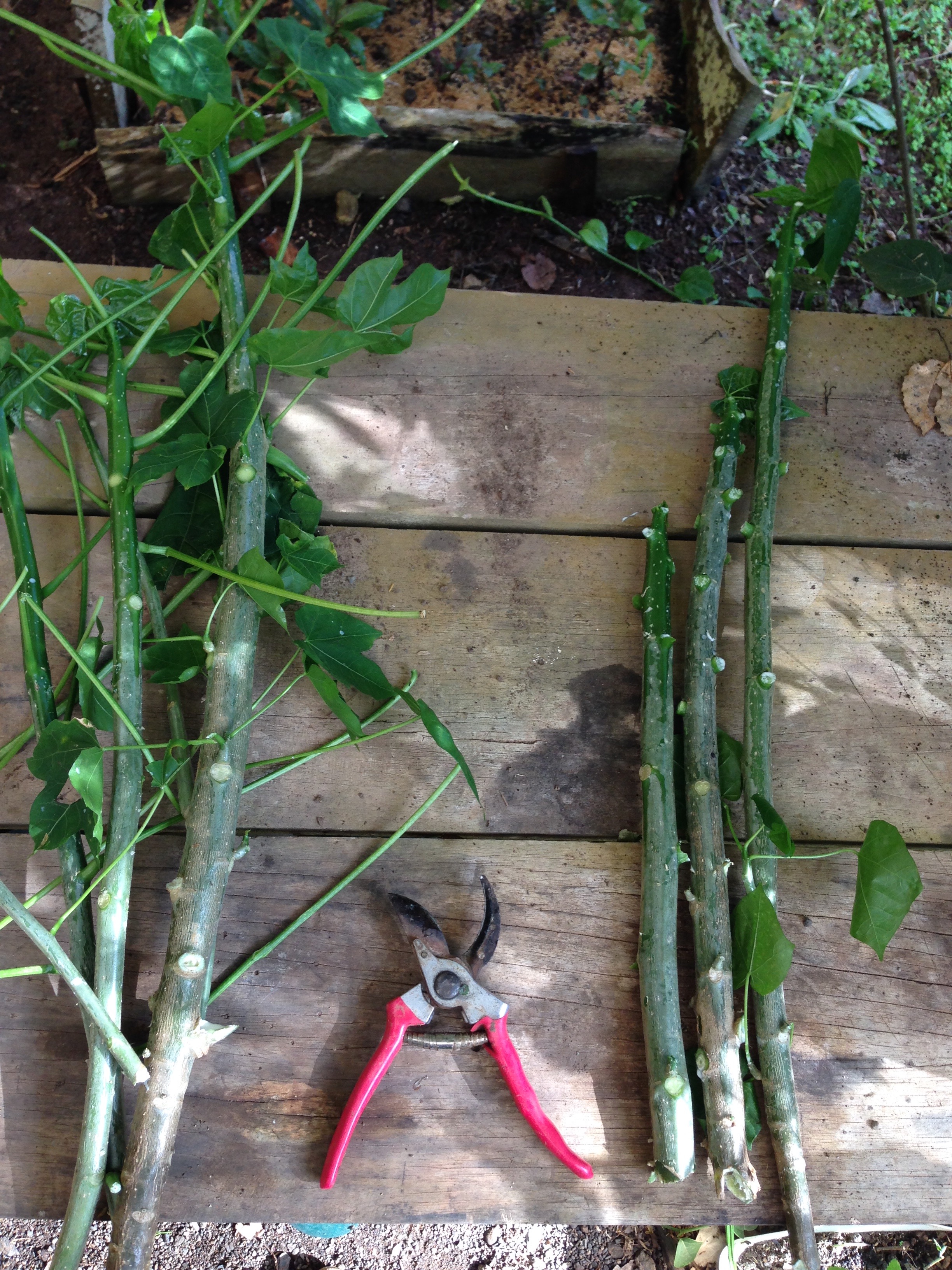
Chaya cuttings from the garden.
I've found this concept a wonderful and useful one to apply to my life here at the ranch. It is an approach I will take with me when I leave. A way of moving and doing that is easily applied to my life back home in the city. I will find myself asking the question, "what functions does this item/task/plant/food have?" over and over again. If I'm able to come up with at least 3 (positive) functions then I'm happy to purchase/do/ plant/use it. If not then I will rethink my choices. Of course there will be some situations where this concept is not applicable but there are many where it is and I believe it's simple enough for everyone to employ. After all it is these small changes in our lives and more specifically, in our thinking that help move the big change in the right direction. It is the decision to question what we are doing and using and actually think about the consequences, it is the decision to think and act consciously.
NEWS AND NOTES
Our Permaculture Design Course is on the schedule for 2017. Course runs from April 25th to May 8th. We are hoping for another great turnout so help us spread the word!
In 2016 we offered over a half dozen full and partial scholarships to students from Costa Rica and around Latin America to participate in our workshops.
We were able to do this through the generous support of the Mastate Charitable Foundation. We hope to continue this pattern in 2017 and are now accepting tax-deductible donations for our Central American Scholarship Program. Help has increase the accessibility of sustainability education to our neighbors and consider making a donation!
Abrazos
The Ranch Crew
Transition Ethics: The Art of Compromise
Permaculture Design is many things to many people, but one of its pillars is a set of three ethics. These as originally laid out by Bill Mollison are
- Care of the Earth
- Care of People
- Redistribution of the Surplus
These are our primary directives for how to act to sustain the earth. Or on a simpler level these are the ways to a good life.
Transition Ethics: The Art of Compromise
By Scott Gallant

Permaculture Design is many things to many people, but one of its pillars is a set of three ethics. These as originally laid out by Bill Mollison are
Care of the Earth
Care of People
Redistribution of the Surplus
These are our primary directives for how to act to sustain the earth. Or on a simpler level these are the ways to a good life.
Teaching these ethics during our annual Permaculture Design Certification (PDC) course is one of my favorite topics. It inevitably brings up pointed and challenging conversations, commonly around how to live these ethics in a world that often does not care for the earth, nor its people. How do we live and design for today’s world and for the parallel world we want to create? This discussion leads to fear and anger based responses, a tear-it-down approach easy to rally around in a classroom of like minded, fed up and passionate souls. Unsurprisingly, this is not an effective route for change. It became apparent to our teaching team that this conversation on ethics lacked a route to speak about compromise. To fill this gap we utilize a fourth ethic in our PDC curriculum; the Transition Ethic.
The Transition Ethic is a guide for how to be effective in creating change. In their recent book Practical Permaculture (one of the few references to the Transition Ethic in permaculture) Jessi Bloom and Dave Boehnlein state that “the transition ethic says that no one is going from zero to sustainable overnight. Making the transition takes time.” We have to meet people where they are at. We must understand their cultural context.
When I first began learning about the industrial food system and what it was doing to our personal and environmental health, I was angry. I desperately avoided all participation in that system. This was easier to embrace while living and working at the Ranch, a NuMundo impact center. But it was challenging when I returned to my parents’ home during the holidays. While they eat healthy by many standards, I was disappointed to find apples from Chile, processed meats, and corn-syrup fueled snacks around the kitchen. It was not a local food paradise by any means, so I jumped on my soapbox and preached. They needed to support local economies and take care of their bodies! Didn’t they care about the amount of pesticides used on those tomatoes?!
They responded with kindness and listened, like the wonderful parents they are, but were likely rolling their eyes in the background, and not much changed. A few years latter though, when I was able to show them how excited I was to manage a farm in Costa Rica, bake my own bread, and build my own furniture. I began to see them make real changes. As soon as my ideas came from a place of positive examples versus negative critiques the transition began for them. Their garden as expanded, they save and share more and more seeds every year, and the kitchen has a few more jars of ferments upon my home arrival.
This instilled in me that even though I was ready to change, the world around me operated at a different pace. So the question became: how do I navigate the series of compromises needed to encourage change? The original three ethics of permaculture speak to this in varying ways, but they don’t provide a road map as clearly as an ethic of transition. For me it is a road map of humility, recognizing that we are all coming from different places and we can’t begin to guess the context of others’ lives.
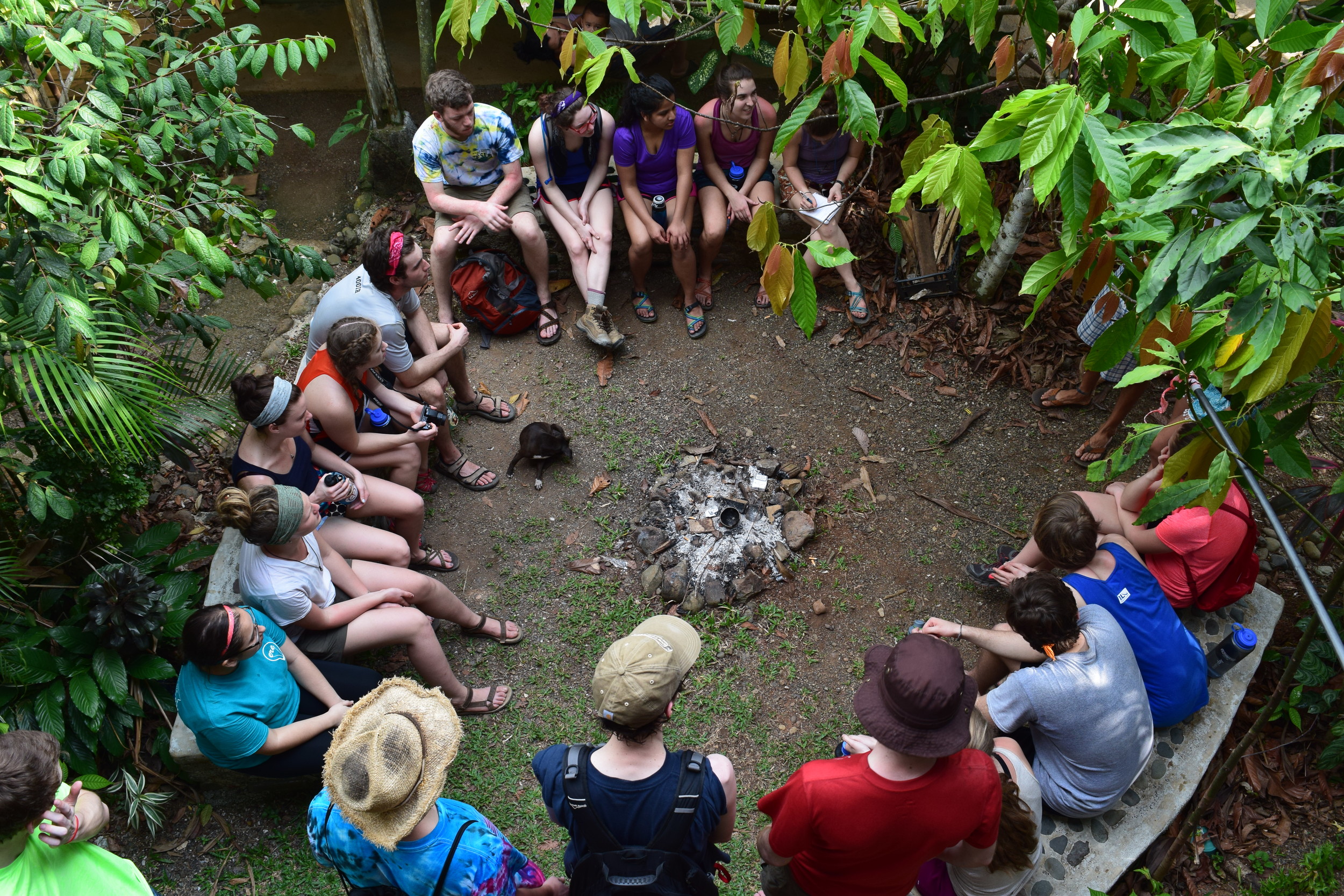
The Ranch is one of the leading natural building centers in the Americas. Yet, we still use concrete in our foundations and metal on our roofs. We don’t love the environmental impact of either of these materials, but we have done the due diligence to know that they make the most sense in our current context. These are compromises we must make in order to protect our infrastructure investments from rain, earthquakes, termites, and the tropical climate. This infrastructure allows us to operate as a world-class education center, without it our livelihood and mission fails. It is a compromise we must make.
The Transition Ethic makes it clear that these compromises are ok and often necessary. The key take away that I share with our students is that we can never compromise our ethics but we can make ethical compromises.
Most of us use fossil fuels, don’t eat only local organic food, and participate in a globalized economy. We may wish this wasn’t true, but this is the world we live in; and it requires an art of compromise. So how do we make choices and design our lives for the current world and the one we are creating and visioning for the future?
Permaculture design is one tool at our disposal to navigate these waters (primarily through good design of our lives, homes, and land) and with a Transition Ethic in place it becomes an even more robust tool.

Learn more
We have a number of life changing workshops yearly.
We rely on all of the amazing ambassadors to our project to spread the word; if you know of anyone who needs a get-life-into-gear experience, send them to one of our classes!
Abrazos,
The Ranch Crew
Business Guilds and Micro-Enterprise Niches
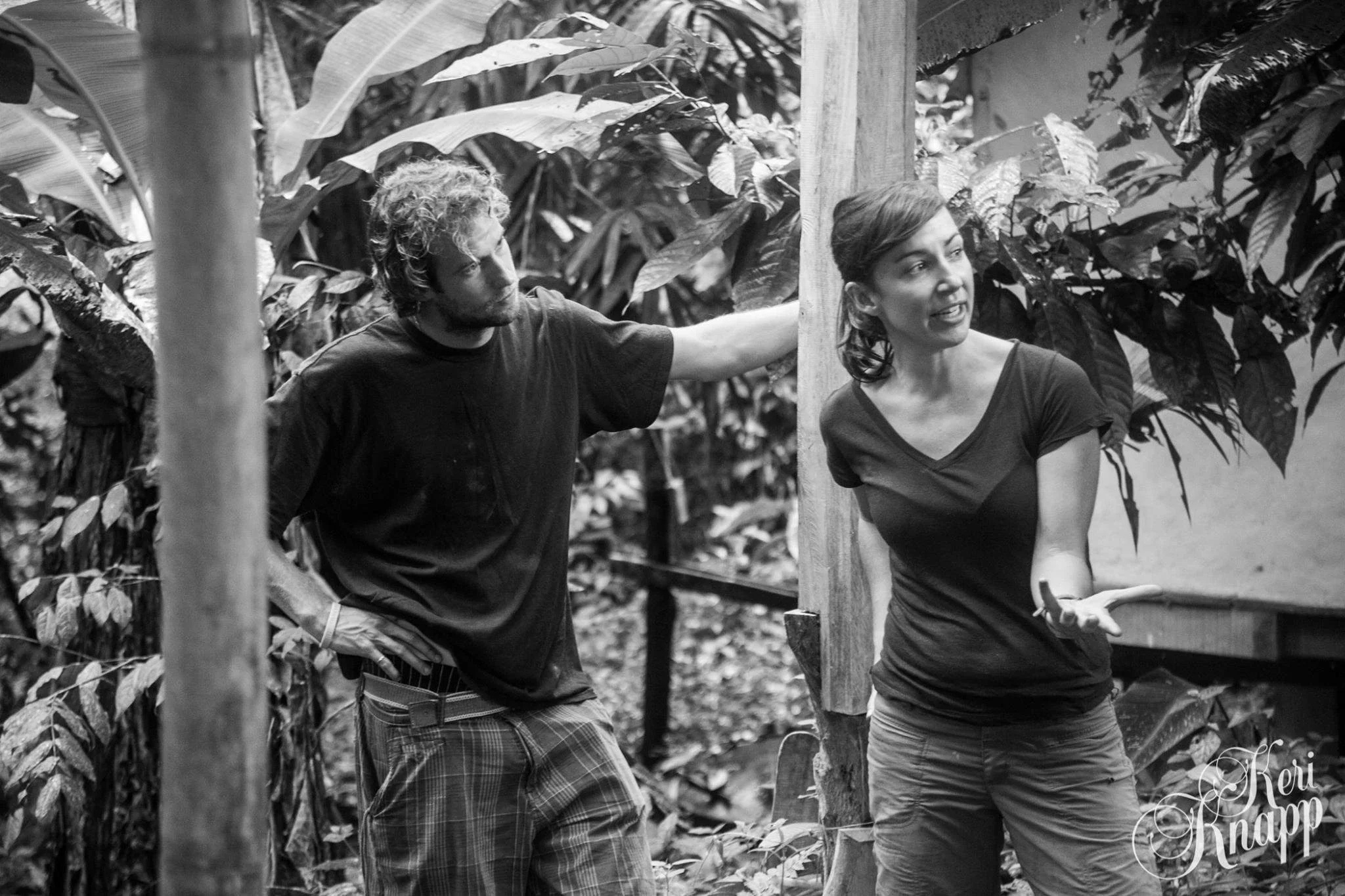
No one who works at the Ranch expects this to be a lucrative career--that's not why we get up in the morning. But we do recognize the need to earn a living that provides basic resources. . As a small business that routinely puts people and planet above profits, providing for all our team members financially has been a challenge. So we've looked toward permaculture design to inspire us, turn problems into opportunities, , and use nature as our model to find creative financial solutions.
Business Guilds and Micro-Enterprise Niches
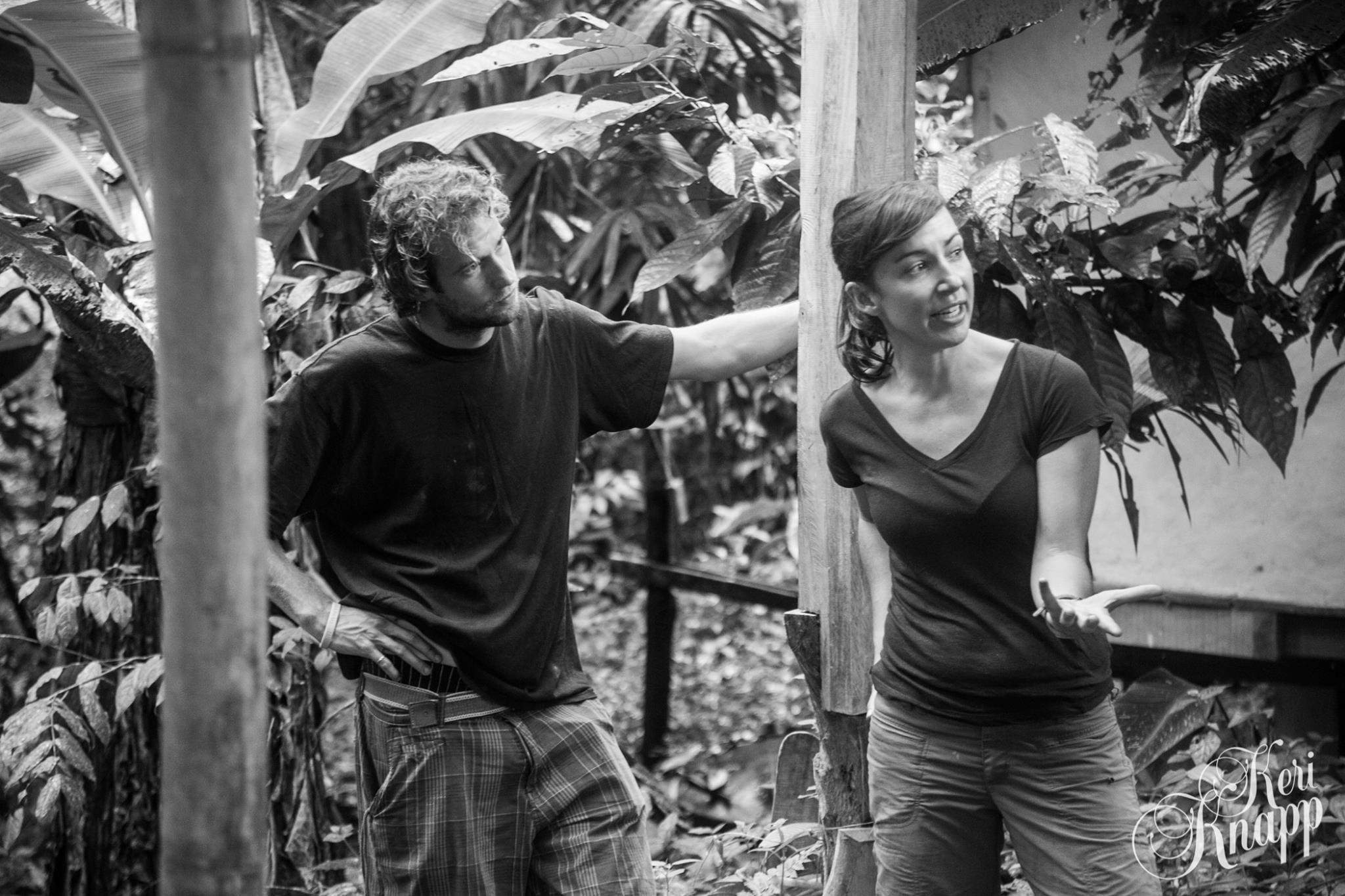
No one who works at the Ranch expects this to be a lucrative career--that's not why we get up in the morning. But we do recognize the need to earn a living that provides basic resources. . As a small business that routinely puts people and planet above profits, providing for all our team members financially has been a challenge. So we've looked toward permaculture design to inspire us, turn problems into opportunities, , and use nature as our model to find creative financial solutions.
Guilds and Niches
The permaculture concepts of guilds and niches inspired us to create a set of business guilds and niche micro-enterprises. Last year we implemented organizational (invisible) structures that allow and support each Core Team member to pursue their own micro-enterprise. Each of these enterprises is a small business which is independent of the Ranch but still greatly interconnected. This is what Toby Hemenway, in his new book The Permaculture City, refers to as a Business Guild. He defines these “as a set of independent enterprises that are tied together by connections among some of their needs and yields.”
This is a strategy mimicking the plant polyculture guilds we employ in the garden. An intentional grouping of plants can support one another to create better growing conditions or cycling surplus/waste products amongst each other. These enterprises complement and support each other and the existing umbrella organization of the Ranch in this same pattern.
The overall hope is that each micro-enterprise can bring in additional income for Core Team members, while still supporting activities at the Ranch . For instance, if I attract a client (a pollinator) for our design consulting work and they are happy with the outcome (yield), it is highly likely they will visit the Ranch as a guest (positive feedback loop), and perhaps send an employee to get trained in our Permaculture Design Course (yield). All the while I gain more experience as a permaculture designer, and can be a better instructor for our students and apprentices (multiple functions). Everyone wins (supported by multiple elements).
Each of these enterprises fills a niche or opportunity that the larger Ranch organization is unable to take advantage of. In this way, each business shapes the economic micro-climate of the others by attracting more potential clients or customers. In addition, they all share resources, such as our brand and website, store space, farming and workshop tools, and vehicles. These businesses do not compete with each other, but complement and enhance the entire guild by filling different niches.

Current micro-enterprises include:
Forest Fusion Herbal Products
Wood Art, Jewelry, and Cutting Boards
Design Consulting
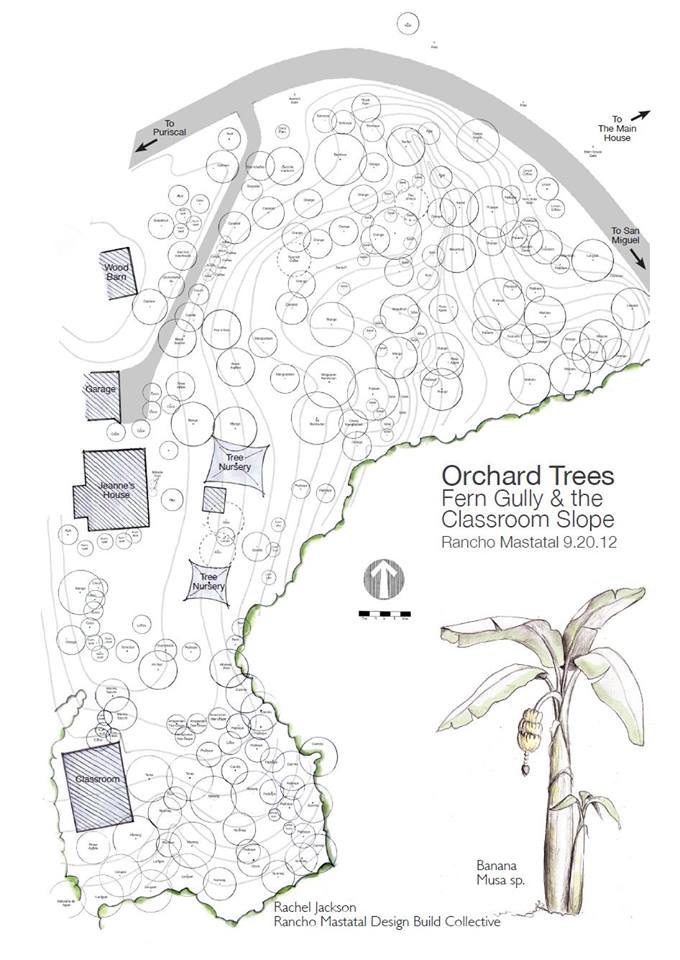
The Rancho Mastatal Design/Build Collective (RMDBC) is a landscape design and natural building consultation service founded by Rachel Jackson, Nic Donati, and myself in 2014. Since then we've slowly been accepting clients and projects around Costa Rica and the globe.
As our website states: We specialize in helping clients find the balance between meeting the needs of the land and accomplishing their own goals. From a quick consultation about edible plants for your home garden, to full scale site analysis and master planning for your property, RMDBC can help you create a productive and beautiful landscape.
Last year we worked in Costa Rica, Panama, and Fiji, providing advice and plans on reforestation efforts, timber plantations, cacao agroforestry, crops for production, and homestead design. We are beginning to accept a limited number of clients for 2016 and are excited about the conversations that are happening already.
We genuinely believe that our work can move projects months if not years ahead by filtering out unnecessary steps and focusing on the strongest leverage points. We treat our services as a farm input that demands a return on investment, and expect that our advice will save our clients money in the medium and long run. In particular we love talking through landscapes and possibilities with clients, and using our experience as a sieve to arrive at that perfect plan between our subjective goals and the objective lay of the land.
RMDBC consultation work helps further the overall mission of the Ranch as an educational facility by broadening our experience and reach. It also supports and is supported by the other Ranch micro-businesses: at the Ranch clients can see and purchase clear examples of high quality products like medicinal salves, spices, teas, coffee, and hand crafted wood products that are all made from plants grown locally or from out own agroforestry systems. This demonstrates the full circle of our work, from design and implementation to final product.

Right Livelihood
Our hope in creating these invisible structures and enterprises, is that all our Core Team members are able to complement and enhance their earnings from the main Rancho Mastatal business. This diversity of economic opportunities is a safety net for our livelihoods. While hardly unique to permaculture, all of the concepts we are exploring fit eloquently with the principals of permaculture: “diversity is dynamic stability;” “support important functions with many elements;” and “creative problem solving” can all be applied to both tangible and intangible challenges. Taking these principals out of the physical realm and into the social and economic domains will be one of the great opportunities for our team as we seek to strengthen our financial livelihoods in the years ahead.
We continue to put permaculture into practice at Rancho Mastatal and if you'd like to learn more about how we do so, consider joining us for our upcoming Permaculture Design Certification course this April 17th, 2016!
Categories
Topics
- Agriculture 6
- Agroforestry 21
- Animals 2
- Apprenticeship 19
- Appropriate Technology 6
- Backpacking 1
- Bananas 1
- Basic Pantry 4
- Biochar 1
- Books 3
- Build Your Own Home 1
- Central America 5
- Chiles 1
- Cinnamon 1
- Clay Carving 1
- Climate 2
- Climate Change 1
- Cob oven 1
- Communication 5
- Community 24
- Compost 2
- Composting Toilets 2
- Condiments 1
- Conservation 2
- Cooking 4
- Costa Rica 18
- Design 10
- Earthen Construction 10
- Eat Local 2
- Ecohome 1
- Education 9
- Environment 3
- Ethics 4
- Farm to Table 12
- Fasting 1
- Fermentation 14
- Food 22
- Food Choices 8
- Food Forest 8
- Food Processing 15
- Food Systems 12
- Gap Year 1
- Gardening 5
- Ginger Beer 1
- Harvest 2
- Health 12
- Healthy living 5
- Homemade 2
- Homestead 8
- Internet 2