

BLOG
Stories, articles, and updates from the Ranch community.
Business Guilds and Micro-Enterprise Niches
No one who works at the Ranch expects this to be a lucrative career--that's not why we get up in the morning. But we do recognize the need to earn a living that provides basic resources. . As a small business that routinely puts people and planet above profits, providing for all our team members financially has been a challenge. So we've looked toward permaculture design to inspire us, turn problems into opportunities, , and use nature as our model to find creative financial solutions.
No one who works at the Ranch expects this to be a lucrative career--that's not why we get up in the morning. But we do recognize the need to earn a living that provides basic resources. . As a small business that routinely puts people and planet above profits, providing for all our team members financially has been a challenge. So we've looked toward permaculture design to inspire us, turn problems into opportunities, , and use nature as our model to find creative financial solutions.
Guilds and Niches
The permaculture concepts of guilds and niches inspired us to create a set of business guilds and niche micro-enterprises. Last year we implemented organizational (invisible) structures that allow and support each Core Team member to pursue their own micro-enterprise. Each of these enterprises is a small business which is independent of the Ranch but still greatly interconnected. This is what Toby Hemenway, in his new book The Permaculture City, refers to as a Business Guild. He defines these “as a set of independent enterprises that are tied together by connections among some of their needs and yields.”
This is a strategy mimicking the plant polyculture guilds we employ in the garden. An intentional grouping of plants can support one another to create better growing conditions or cycling surplus/waste products amongst each other. These enterprises complement and support each other and the existing umbrella organization of the Ranch in this same pattern.
The overall hope is that each micro-enterprise can bring in additional income for Core Team members, while still supporting activities at the Ranch . For instance, if I attract a client (a pollinator) for our design consulting work and they are happy with the outcome (yield), it is highly likely they will visit the Ranch as a guest (positive feedback loop), and perhaps send an employee to get trained in our Permaculture Design Course (yield). All the while I gain more experience as a permaculture designer, and can be a better instructor for our students and apprentices (multiple functions). Everyone wins (supported by multiple elements).
Each of these enterprises fills a niche or opportunity that the larger Ranch organization is unable to take advantage of. In this way, each business shapes the economic micro-climate of the others by attracting more potential clients or customers. In addition, they all share resources, such as our brand and website, store space, farming and workshop tools, and vehicles. These businesses do not compete with each other, but complement and enhance the entire guild by filling different niches.

Current micro-enterprises include:
Forest Fusion Herbal Products
Wood Art, Jewelry, and Cutting Boards
Design Consulting
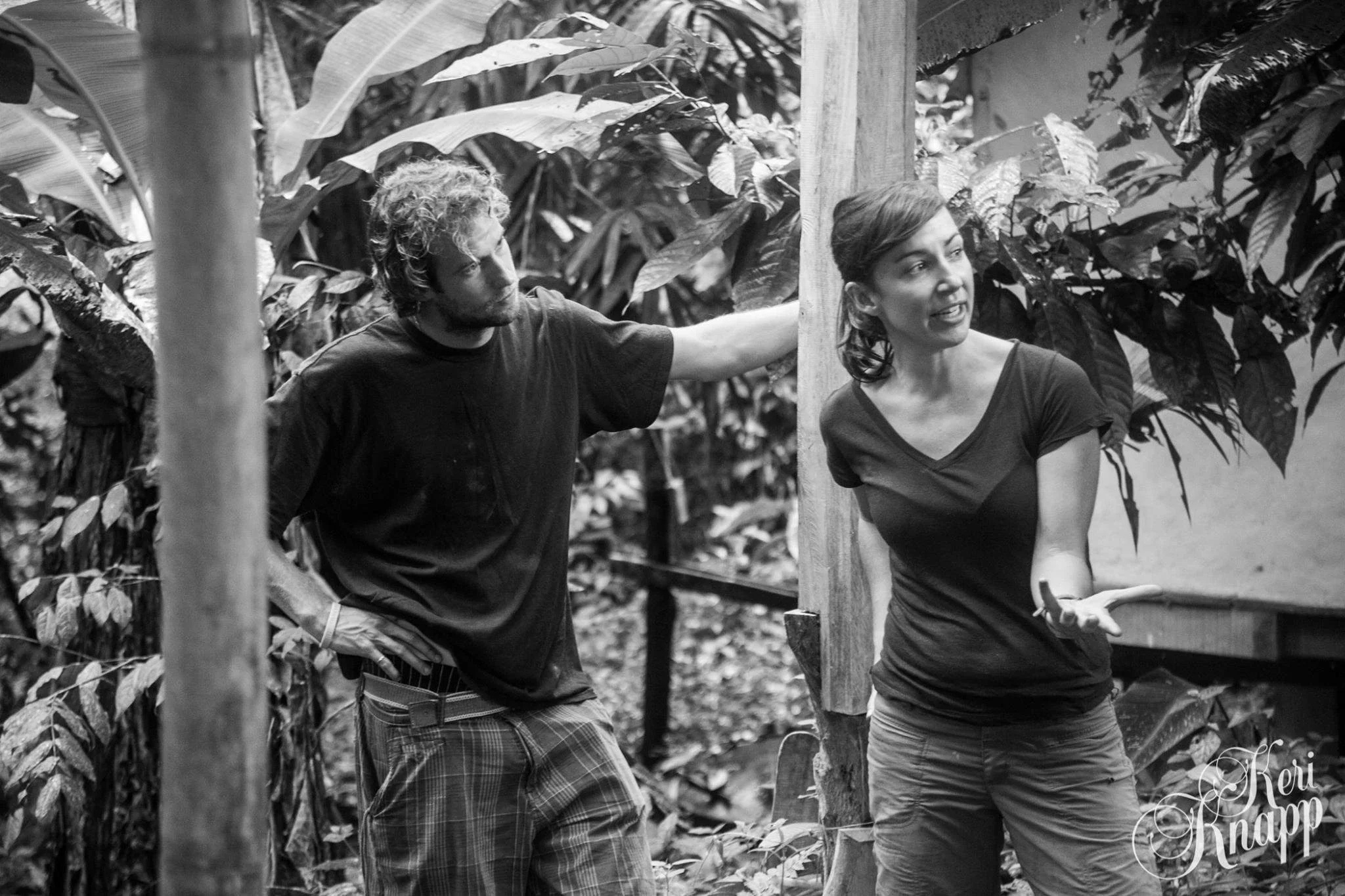
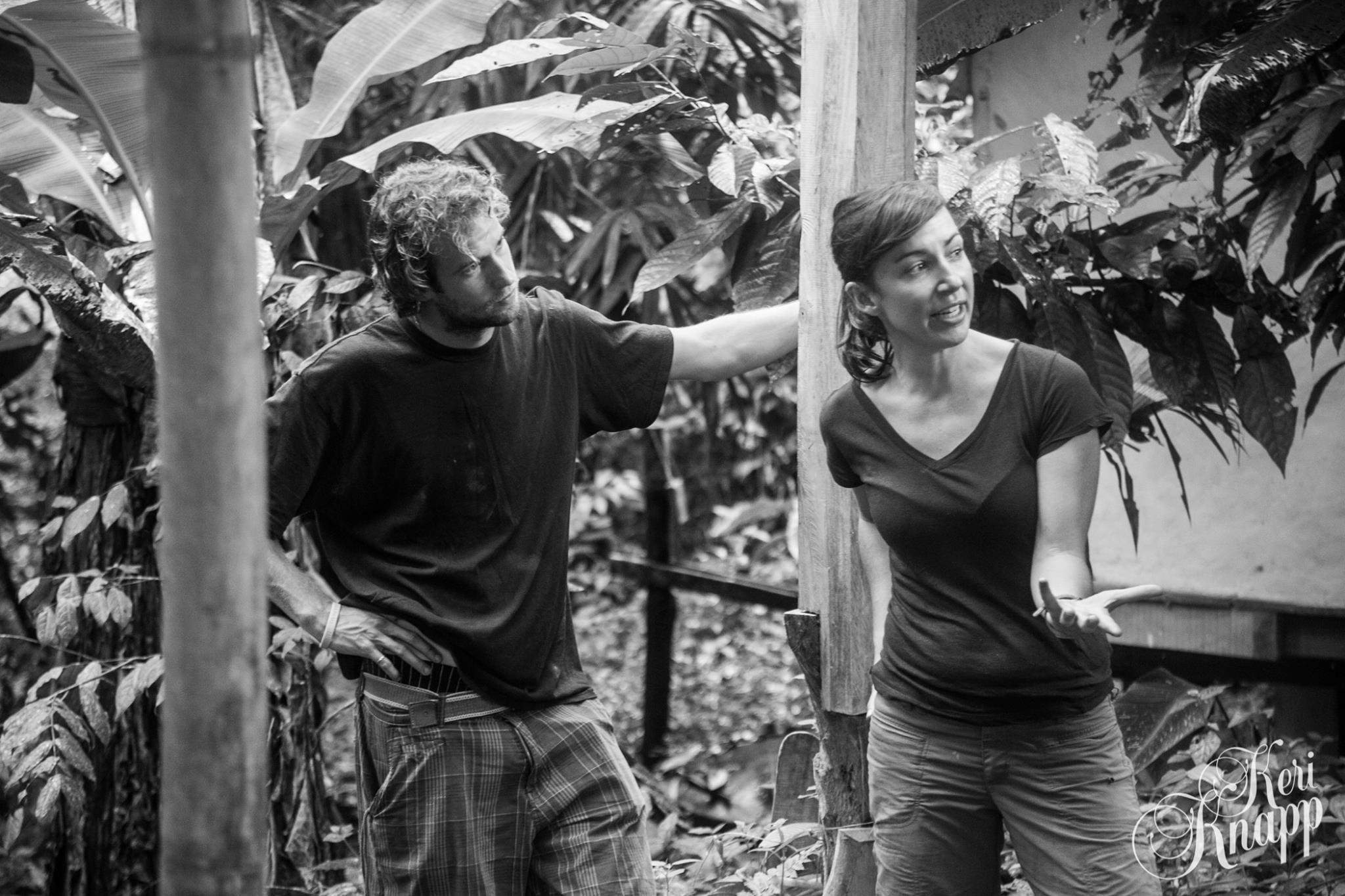
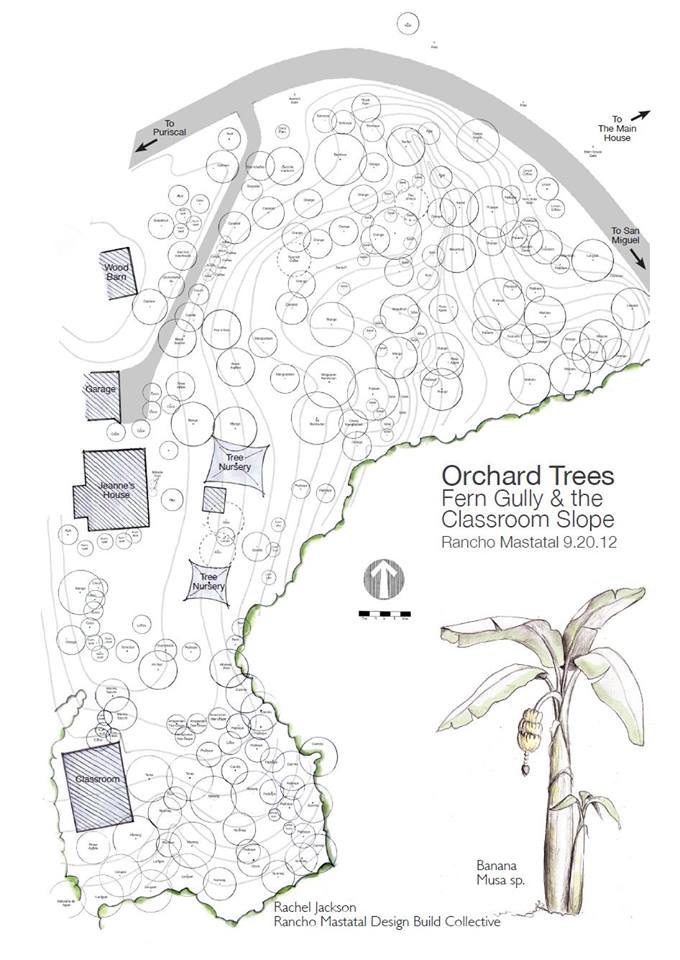
The Rancho Mastatal Design/Build Collective (RMDBC) is a landscape design and natural building consultation service founded by Rachel Jackson, Nic Donati, and myself in 2014. Since then we've slowly been accepting clients and projects around Costa Rica and the globe.
As our website states: We specialize in helping clients find the balance between meeting the needs of the land and accomplishing their own goals. From a quick consultation about edible plants for your home garden, to full scale site analysis and master planning for your property, RMDBC can help you create a productive and beautiful landscape.
Last year we worked in Costa Rica, Panama, and Fiji, providing advice and plans on reforestation efforts, timber plantations, cacao agroforestry, crops for production, and homestead design. We are beginning to accept a limited number of clients for 2016 and are excited about the conversations that are happening already.
We genuinely believe that our work can move projects months if not years ahead by filtering out unnecessary steps and focusing on the strongest leverage points. We treat our services as a farm input that demands a return on investment, and expect that our advice will save our clients money in the medium and long run. In particular we love talking through landscapes and possibilities with clients, and using our experience as a sieve to arrive at that perfect plan between our subjective goals and the objective lay of the land.
RMDBC consultation work helps further the overall mission of the Ranch as an educational facility by broadening our experience and reach. It also supports and is supported by the other Ranch micro-businesses: at the Ranch clients can see and purchase clear examples of high quality products like medicinal salves, spices, teas, coffee, and hand crafted wood products that are all made from plants grown locally or from out own agroforestry systems. This demonstrates the full circle of our work, from design and implementation to final product.

Right Livelihood
Our hope in creating these invisible structures and enterprises, is that all our Core Team members are able to complement and enhance their earnings from the main Rancho Mastatal business. This diversity of economic opportunities is a safety net for our livelihoods. While hardly unique to permaculture, all of the concepts we are exploring fit eloquently with the principals of permaculture: “diversity is dynamic stability;” “support important functions with many elements;” and “creative problem solving” can all be applied to both tangible and intangible challenges. Taking these principals out of the physical realm and into the social and economic domains will be one of the great opportunities for our team as we seek to strengthen our financial livelihoods in the years ahead.
We continue to put permaculture into practice at Rancho Mastatal and if you'd like to learn more about how we do so, consider joining us for our upcoming Permaculture Design Certification course this April 17th, 2016!
Reflections on 15 years of Rancho Mastatal: Third Trimester Newsletter 2015
On November 1, the Ranch celebrated it's 15th birthday. In Costa Rica, and in many parts of Latin America, a girl's “quinceañera” marks her passage to womanhood. In similar ways, our 15th birthday feels like a transition to the next important stage of our existence.
On November 1, the Ranch celebrated it's 15th birthday. In Costa Rica, and in many parts of Latin America, a girl's “quinceañera” marks her passage to womanhood. In similar ways, our 15th birthday feels like a transition to the next important stage of our existence. As for many humans, our first decade and a half was characterized by a lot of experimentation and a sometimes reckless navigation of our environment. We fortunately had people in our community acting as parents and guiding us to decisions that did not lead to our extermination. Now that we have survived this first stage of life, our “crystal anniversary” marks the next phase of our development and one that we hope will be characterized by compassion, intelligence, leadership, determination, empathy, strength, honesty and confidence. Our organizational structure continues to streghthen as our teaching methodologies become more effective and consistent. We are learning how to take better care of our ourselves and everyone that we work with while implementing systems that provide for us in ways that also care for the earth. We are taking confident and measured steps to better share with others what we have learned while working to develop systems that will provide financially for the members of our community. It can all be a delicate balance at times and our talented team gets better each day at moving forward in a way that we hope is fairer and more effective for all involved. We're currently studying the advantages of a goverance structure called Sociocracy or Dynamic Goverance and an associated decision-making stategy called “consent”. We've also been learning about a process named Non-Violent Communication (NVC). We're excited about the possibilities that these new ideas will provide us in the future and would encourage anyone interested in the type of lifestyle that we have chosen to check them out in more depth.
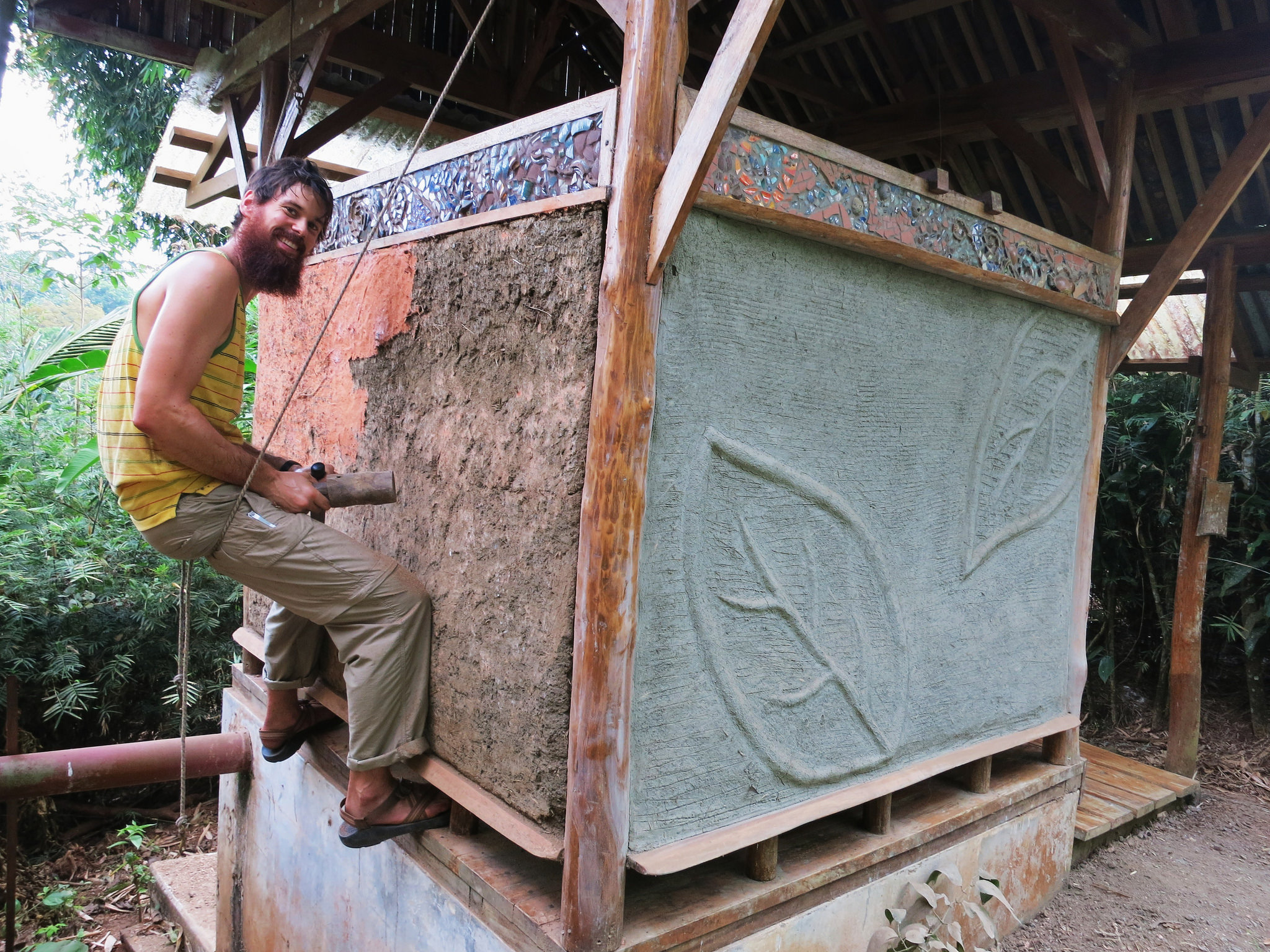
With this year coming to a close, we're gearing up for another busy season in Mastatal. Our calendar and priorities are mostly set with Greenwood College School out of Toronto kicking off the new season once again in early January. Our year-long apprenticeship starts closely on the heels of this high school visit with Aerie returning at the end of the month to run their annual Wilderness Medicine Semester. We'll be busy and engaged with educational programs, work in the orchards and building projects and look forward to our best year yet. I'd like to thank our stateside family and friends for making our visit so special again this year. Without this downtime each fall, it's hard to imagine keeping our energy intact for our work in the rainforest. We look forward to everyone's continued support and wish you all a wonderful holiday season and new year.
This month's update includes:
Program News: Winterline
Building: Natural Building Update for 2016
Farm: Main House/Zone 1 Redesign: Looking at the Spaces Between
Food: Fruit and Vegetable Storage Tips
Community: Folk Music and Resiliency
Apprentice/Guest Contribution: Zen and the Art of Bio-D Maintenance
Kitchen: Cheesy Buttermilk Biscuits
Inspirational Impressions: Compassion
Program News
Winterline
Learning and teaching hard skills, such as sharpening a machete, are increasingly important part of our educational programming. Winterline, an organization with whom we worked together for the first time in November, shares our goal in helping to enpower future generations to deal with the challenges of our times. The group of 16 gap year students engaged in a host of activities while at the Ranch with their two focuses being permaculture design and natural building. Ranch instructors NIC DONATI and SCOTT GALLANT led up the instruction for this group. Following is a wonderful article written by one of the Winterline students about her experience at the Ranch.
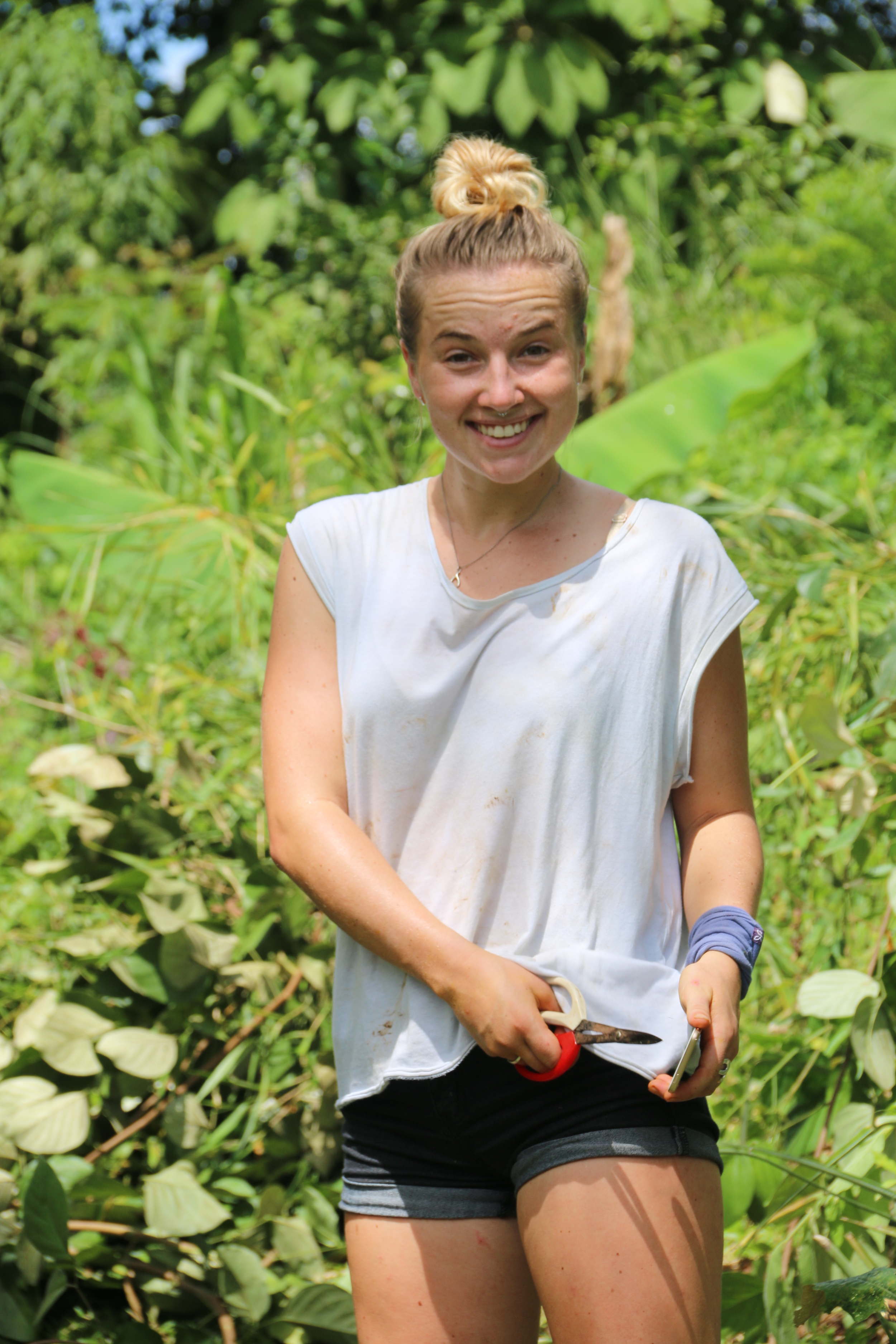
-----
Rancho Mastatal took me by sweet surprise. When we arrived, I can’t remember what I thought. All I knew was we’d be learning about soil and shit like that. I left high expectations behind and prepared myself for another week in the jungle.
Scott, an Ohio native with hair that made me ache for highlights (once a fake blonde always a fake blonde), was the first staff member we met. He introduced us to Jeanne’s Bunk House where we’d be sleeping for the next eleven days and laid out an orientation of sorts. I remember him saying he hoped Rancho Mastatal would be our favorite partner of Winterline, and that, if we let it, it could change our lives. I can remember feeling sort of bad for him for a second. Thinking, hmm. Ya, no.
Good to know my assumptions were not only unjustified but completely off. I’m a lot more interested in soil than I expected. Permaculture to be more specific. And, though I don’t expect to change my livelihood overnight, there’s a lot I learned here that I will take back home with me. The big picture being: caring about our earth matters. And if you allow yourself to sit back and watch people like Scott, Nic, Doro, Jacob (the list goes on) do what they do, you gain a new perspective and appreciation for the sustainability of this planet we share. And how little changes and little impacts truly matter.
Yeah, so I walk away with permaculture. But, I walk with more than that. In one week, the Rancho gave us a home. I read through three books (a love I lost along the way through life in academia, ironically) and wrote a poem that didn’t end in a massive scribble-y blob. I woke up early to milk the goats, not because I had to, but because I actually felt at peace with Fern and Agnus. I felt the difference in energy from getting a full eight hours – if not more – of sleep each night. I ate really good, really healthy food straight from the earth. I fell asleep in hammocks and walked through waterfalls and rivers. I even started to appreciate my bare and dirty feet, and I really hate my feet. I haven’t had make up on in weeks. Mountains of bug bites cover my arms and legs. My hair is always in a bun because I have no idea what else to do with it. But, I feel like myself. An unfamiliar version of myself, but myself nonetheless.
And I like to think I walk away with a friend. Someone who, a year younger than I am, seems wise beyond her years. Someone who brought a lot of experience and value to our conversations, but would genuinely listen as well. A kind of reciprocity you don’t find often. We swapped stories about the music we listen to, talked about group dynamics and living in small communities, and best of all, I thought, we talked about finding the sweet spot. And if she ever reads this she’ll know exactly what I mean. Thanks Jessy.
Nic said that if I applied for an apprenticeship at Rancho Mastatal I would be accepted; he wants me to come back. And that, as Junot Diaz puts it, made the blood do jumping jacks in my head. Because I really fell in love with this place. I would love to come back. I thought, well, what if I do? What if I spend another year outside of the U.S.? That would be incredible, right?
Then I think about my favorite café (yes this is my thought process). I have a lot of favorite cafes. I think about how I always feel a ping of curiosity when I see a “We’re Hiring” sign in the window. I should work here, I say. Why wouldn’t I want to work at my favorite café?
Because it would absolutely ruin every single reason it was your favorite café in the first place.
And part of me feels the same way about Rancho. Right now, it’s perfect just the way I see it. And maybe that’s enough. Chances are I’ll think about it. But, I’ve got a long way to go. My hope is, when I get home in May, I have a million strings pulling me in a million different directions. And, as stressful as that will be, I can choose my fate. I will have options. And that’s the best kind of confusion I could ask for.
Building
Natural Building Update for 2016
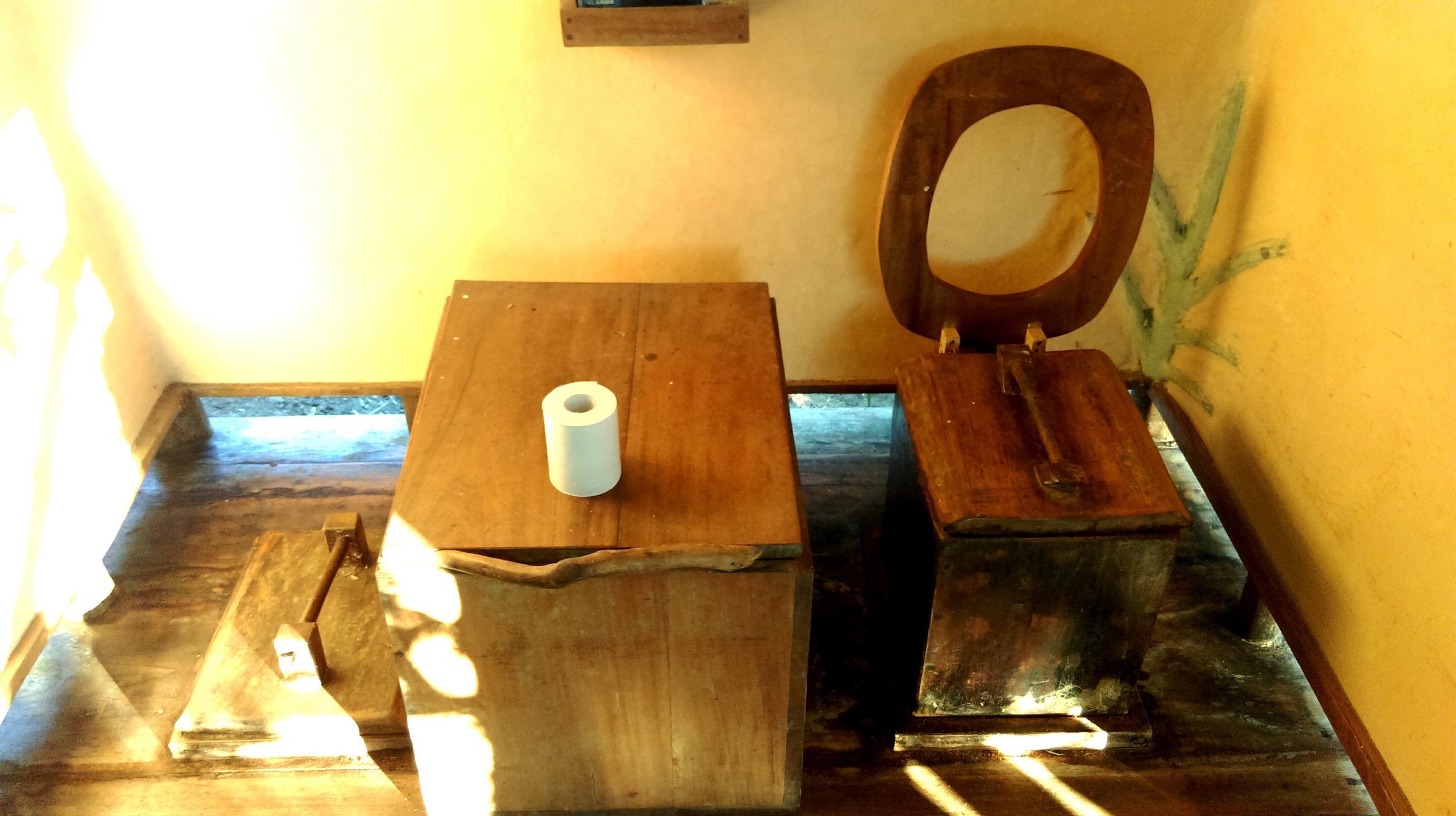
2016 marks an exciting year for Rancho Mastatal in the natural building realm. We hope to run our first ever extended Natural Building Certificate when we will be building a structure in between Jeanne’s Bunkhouse and the classroom. The idea of this new structure is to provide alternative guest accommodations that are more on the conventional style, to allow smaller groups to be housed in this structure (there will be potential room for 12 students), or to be used for teacher accommodations nearer the bigger group in Jeannie’s. This additional structure will give us a bit more flexibility with housing. Currently at the Ranch we have 4 core team members in additional to Timo, Robin and Sole. This has lead to many of the smaller structures being almost permanently occupied. This has meant that despite the vast infrastructure that the Ranch has developed over the last 15 years, in the high season, we still never seem to have enough beds!
With the evolution of the apprenticeship, which is now lasting one year, it is also means that the Hankey is coming under pressure to comfortably house all of the apprentices. Whilst originally the open and spacious Hankey was perfect for people staying less than a few months, it has now gone under several renovations to make it more appealing for people to stay for the longer-term. As we strive for more stability in both the apprenticeship crew and the core team it has become evident that people need a bit more of their own space and privacy. After all, in the high season, we frequently have 40 or more people at the Ranch.
As we try to predict the housing needs of the future, we also have to try to meet the needs of the present! As Sole has gotten older, it has also become increasingly necessary for her to have her own space. As a result, after a few years hiatus, we will be hosting a Timber Frame course in January 2017. The course will build a frame that will adjoin the Choza, providing Sole with her own, overdue bedroom. It will be great to have Lizabeth and Skip back down at the Ranch as it has been too long since since we were able to host them and the TF course!
This year the core team spent a significant amount of time developing our mission, vision, goals and objectives. We identified over 15 building projects that we all wanted to happen and spent time trying to prioritize these buildings for the next few years. It became apparent that with our current capacity (money, labor, skills etc.) we were not really able to finish more than two buildings a year. As a result, some buildings have had to be shelved for at least a few years.
It doesn’t seem that long ago that we talked about how we believed that the Ranch's infrastructure was almost complete and that we could finally slow down on the building front. In a way that is true. The infrastructure that the Ranch has is fantastic and has been developed over such a long time but perhaps there is something inside that always wants more. Perhaps it is one of my greatest flaws or perhaps one of my greatest assets that I continually want to improve things. Yes, it worked having just one kitchen to do everything but it is going to be better with two! Yes, teachers can stay in the Hooch when their students are in Jeanne's, but it may be better for them to be closer by! Sure, the Hankey worked fine with no visual barriers, but it is more comfortable with dividing walls!
As we move forward with the development of the Ranch's infrastructure we have to continually ask, “How does this all fit within our definition of sustainability?” It is definitely not sustainable to keep expanding. Part of the reason that our species is in such a pickle is because of that attitude, continued expansion when our resources are finite. It is something we think about all the time and we try to weigh the positives with the negatives. We also try to build as sustainably as possible but it is still something that we must continue to think about.
By Nic Donati
Farm
Main House/Zone 1 Redesign: Looking at the Spaces Between
Over the years at the Ranch we have designed and built a diverse and amazing array of structures. From the bamboo treehouse-like Hooch to the timber-frame elegance of the Honey Hut, the Ranch has beautiful, creative and useful buildings. While much of our energy goes into our structures, we’ve learned that how a building interacts with and connects to surrounding spaces can be just as important. Inspired by the addition of the Ceiba Lounge, a hybrid processing kitchen and social space located off of the Main House, Laura and I decided to take a closer look at the Main House area and see how we can improve connectivity in an area that is both the physical and social heart of Rancho Mastatal.

The Design Process
We began the process in 2014 by taking a deep look around. What are the activities that happen here? Who uses the space? What works and what doesn’t? We interviewed fellow Ranchers about their use of the site and made a detailed base map of the site that allowed us to see physical relationships between different areas. As the center point and most used space at the Ranch, this complex area needs to serve many roles. We identified our goals for the space looking both at the uses of the Main House area but also the qualities we want it to project. It should be welcoming, beautiful, functional and organized. A thorough site assessment and analysis helped us see the challenges on the site and what changes are possible. Next came the fun part---creating design concepts. Laura and I brainstormed and sketched, coming up with multiple options for redesigning the space, which we presented to the core team. After discussion and revision we were ready to start implementing our working design.
Implementation (Let the digging begin!!!)
So what did we come up with? The new design addresses many of the challenges of the space. Our trusty dry season apprentice crew of Shea, Mariah, Matt, Addie, Jesse and many friends spent weeks shoveling and picking to transform the ranch entranceway, build new planting beds, create raised access paths and dig detention basins and swales. As anyone who has ever emptied the kitchen compost bucket or brought firewood from the garage to the rocket stoves has experienced, Zone 1 lacked dry and direct paths. With the new kitchen slated to bring more activity to the area it was imperative that we make better paths that work in all weather.
Some of the Ranch’s challenges are due to the rainforest climate and steep topography. Rancho Mastatal receives 4-6 meters of rain a year (that’s apx. 13-19 ft)! We want to slow and sink as much water into the ground on-site and safely direct the extra water into areas where it can’t cause erosion, a huge concern with the steep slope directly behind the Main House and Ceiba Lounge. Two new detention basins will help absorb rainfall as well as provide a breeding habitat for some of Mastatal’s many frogs.
Looking Forward
2016 will continue to bring changes to the Main House and Zone 1 Area. We’ll be tackling the back pathway, the composting structure, rebuilding the remaining vegetable beds and most excitingly, finishing construction on the processing kitchen!
Food
Fruit and Vegetable Storage Tips
This article was originally published by Permaculture Magazine here.
Learn how how careful picking, packing and storage can increase the life of your harvest and how each fruit and veg has its ideal storage environment.
I’m not going to lie, post-harvest handling of fruits and vegetables is a rabbit hole that will take you to strange and fascinating places. What happens to plants after they’re picked is not as simple as it appears on the surface. Leaves turn toward the sunlight, sugars transmogrify into new shapes, cells grab at moisture and gases. And all these changes affect harvested plants before we eat them – for better or worse. A basic understanding of the forces at play will help you to maximize the abundance of your harvest in any climate or season.
There’s something alive in my fridge!
Everything lives and dies a little differently. Animals have fixed life spans, which end at a finite point in time. Some microbes, like bacteria, have no programmed death and under the right conditions can divide indefinitely – essentially living forever. Plants, including fruits and vegetables, lie somewhere in between on the scale of life and death. Plants die slowly, over time, through a process called senescence.1
When you eat produce picked fresh from the farm, it is still very much alive. Its cells are actively metabolizing and respiring. Once a fruit or vegetable has been picked, however, it loses its source of nutrients, and its cells slowly begin to die and degrade. As the cells senesce (die slowly) it loses its vibrant appearance and eventually begins to spoil.
You can prolong the life and vibrancy of your living produce by handling and storing them in conditions that slow senescence.
Understanding Post-Harvest Life
All living things, including plants, have a direct and dynamic relationship with the non-living world around them. They take in gases, water, and nutrients and transform them into energy for growth. Although vegetables may appear to move and grow slowly and once picked look completely inert, they are wildly interactive with the world around them.
Respiration and Water Loss
Fruits and vegetables use oxygen to help create the energy they need to build and maintain their cellular structure, develop flavor, and grow and ripen. This is respiration. Once a fruit or vegetable has been picked, its source of nutrients are gone, but its cells continue to respire. Therefore, faster respiration rates in fruits and vegetables result in quicker degradation of the plant, loss of food nutritional value, overall weight loss, poorer flavour, reduced quality, and faster senescence.
Some fruits and vegetables naturally have a lower respiration level than others. Potatoes, apples, and squash are actually reproductive bodies that are well equipped to last for long periods of time under cool conditions – they have very slow respiration rates. Other types of plants, like leaves of lettuce and broccoli florets, have very high respiration rates and must be eaten quickly, no matter how they are stored. (Although proper storage will maximize their lifespan.)
High levels of respiration also contribute to water loss, which is what causes fruits and vegetables to reduce in weight, wilt, shrivel, and lose their crispness.
Temperature
The simplest way of reducing respiration and water loss is by cooling. You can increase the storage life of many fruits and vegetables by cooling them quickly in a refrigerator but not all. Some fruits and vegetables, especially those that have evolved from tropical climates, are cold sensitive. This means they will actually develop irregular ripening and decay faster under refrigeration than at room temperature. Tomatoes, eggplant, and cucumbers are common examples of chilling-sensitive vegetables.
Ethylene Production and Ripening
Another factor that affects post-harvest lifespan is the production of and exposure to ethylene gas. Ethylene is a plant growth regulator that is produced naturally by many fruits. For some fruits, ethylene production is essential for ripening. For others, exposure to ethylene causes a dramatic increase in respiration, leading to faster senescence. Therefore, fruits and vegetables that produce ethylene should never be stored with those that are sensitive to it.
Food Spoilage
Spoilage is caused by two things, often at the same time: physical degradation and microbial transformation. Physical degradation occurs as harvested plants senesce naturally or are damaged. These types of changes are seen as the browning of an apple slice or darkening of a bruised leafy green.
Microbial transformation happens when microbes present on the fruit or vegetable transform its nutrients into energy. As they grow, you may see masses of them and their byproducts in the form of hairy mold or slimy sludge. When harvested items are physically damaged by bruising, crushing, cuts, or excessive moisture, they are particularly susceptible to microbial transformation. Spoilage on one piece of produce quickly affects more. Always eat damaged fruits or vegetables right away before they spoil further.
Soil Quality
Soil quality and mineral composition also greatly affect storage life. Decreased mineral content and excessive applications of nitrogen on large scale commercial farms can produce big vegetables, but generally decreases storability and post-harvest quality. Large commercial operations also often rely on chemicals, waxes, dyes, and synthetic growth regulators to ‘maximize’ fruit and vegetable shelf life. Unfortunately these practices also often minimize the nutritional and health value of these foods. If you don’t grow your own, buying fresh produce from farmers who nurture their soil will always be a the best option.
Five Fruit and Vegetable Storage Tips
You can easily extend the life of your fruits and vegetables by taking some very simple measures to keep them fresh and vibrant.
1. Always eat produce with the shortest natural storage life first.
2. Store produce quickly and at the right temperature.
3. Keep ethylene producers away from ethylene sensitive produce.
4. Eat physically damaged fruits and vegetables right away before they spoil.
5. Grow your own or purchase from small farmers with high quality soil.
By Laura Killingbeck
Community
Folk Music and Resiliency
Music is a big part of life here at Rancho Mastatal. Oftentimes it's one of us apprentices playing classic R&B as we clean the kitchen after breakfast. Other times it's Kattia, our Costa Rican head chef, blasting Latin pop as she cooks up a delicious dinner. Mexican rancheros sound from another local employee – Alex's – pocket, revealing his whereabouts as he works on repairs around the Ranch. And sometimes, when work slows down for a few minutes, or in the evening after a long day and a glass of hooch, we break out the guitars and the songbooks and sit around and make our own music. And of all the music that's a part of life at the Ranch, that's the music that i've found to be most important.
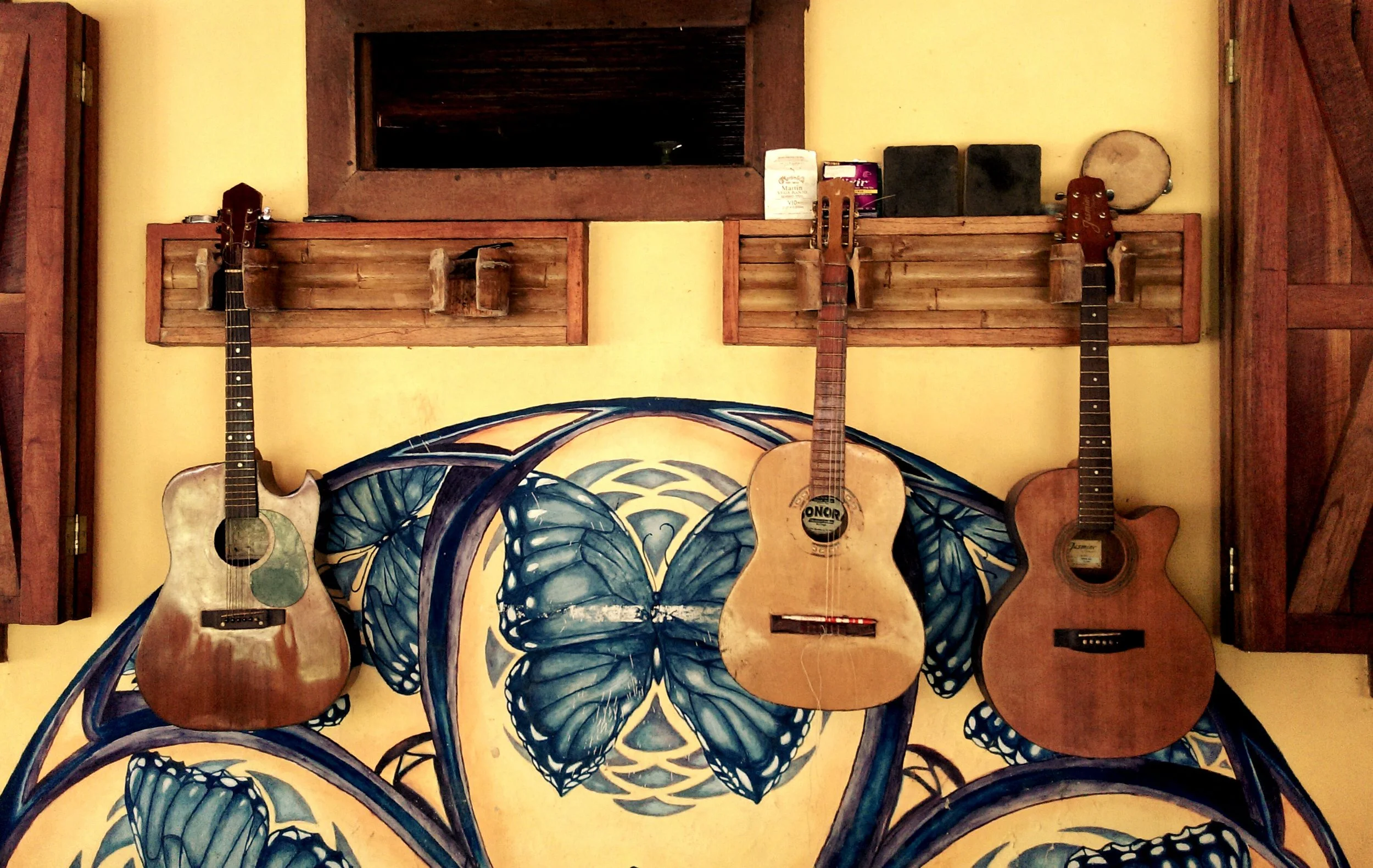
In fact, I've found that my interaction with music at Rancho Mastatal has functioned much the same way as my interaction with food. Much of the food we consume here is purchased from local farmers. Other fruits and vegetables that aren't grown in our immediate surroundings we buy from the Central Valley of Costa Rica. Some luxuries like spices or the occasional bag of flour are imported from other countries, and we buy them at the supermarket. And some of our food we work hard to produce here on the Ranch, and oftentimes that's the food that's most satisfying.
Being discerning about all of the food we eat and where it comes from, whether we grow it ourselves or purchase it, has been a revealing experience for me. I've begun to evaluate the impact of the choices I make in the foods I eat in a way that I didn't do before. I've begun to understand food less as a commodity and more as a product of hard work on healthy land. Food that we grow and cook together is not only delicious, but it fills our days with purpose and our lives with joy, and it becomes central to the culture of the Ranch.
Mulching and weeding in our orchards, harvesting fruit, processing our greens and starches, brining vegetables to make pickles, and using bacterial cultures to make natural sodas have contributed to a paradigm shift for me in how I think about the food I eat. Previously food, in my view, was something grown far away, then packaged and sold by corporations in big chain stores in a process that I knew little about and didn't care to understand better. I only knew that this packaged food was tasty and easy to get, and that there was a seemingly never-ending supply of it. Similarly, we increasingly experience music as something created far away, then packaged and sold by corporations in the same big chain stores that sell our food. Often, like with food, we experience music strictly as consumers, knowing little of the art of making and playing music and lacking the abilities required to be able to sing together. Music corporations inundate our lives with an endless barrage of neatly packaged products, hoping we'll buy what they're selling, become quickly dissatisfied, and then buy more, never pausing to think about alternatives to this pattern of consumption. Because of my experience of being an apprentice at the Ranch, I have come to appreciate food as a cultural artifact, a gift of the land, and a result of good work, not a commodity. Similarly, the times I've shared with my fellow apprentices, with Ranch team members, and with visitors who have spent time with us making music together has led me to a greater appreciation for the value of taking an active role in creating our own entertainment.
Wendell Berry, in his article “The Pleasures of Eating,” writes, “Patrons of the entertainment industry … entertain themselves less and less and have become more and more passively dependent on commercial suppliers.” This is certainly true also of patrons of the food industry, who have tended more and more to be mere consumers – passive, uncritical, and dependent. Indeed, this sort of consumption may be said to be one of the chief goals of industrial production.” I don't believe that sitting in circles, playing acoustic guitars and singing Woody Guthrie is suddenly going to make the problems of the world go away. However, I do believe that one of U.S. society's greatest problems is the way that we've come to understand ourselves as consumers in an industrial economy. We've been conditioned to forget the fact that, as human beings, we are capable of creating our own beautiful works of art, from chocolate cake and sauerkraut to the washtub bass and the twelve-bar blues. Freeing ourselves from capitalist society's consumptive patterns is one important step in creating resilient local communities. And just like building a raised garden bed or keeping a small flock of hens, getting together with friends and neighbors to learn the art of making music together is one way to continue that journey.
Mark Heisey
Apprentice/Guest Contribution
Zen and the Art of Bio-D Maintenance
Most people who have stayed at the Ranch have experienced the awesome power of the biodigestor (aka bio-d). For those who have not, here is just a brief low down. The bio-d is a dynamic living system that both cures manure and provides methane gas to our kitchen. Manure feeds our orchards, methane feeds our stove, and so as in the circle of life, the bio-d feeds us. In this dance of reciprocity, it is necessary then to feed the bio-d. When I arrived at the Ranch, I didn't anticipate the feeling of ecstasy associated with learning from your mistakes and thus needing to go shoulder deep into diluted cow poo. Welcome to my morning ritual: Zen and the art of bio-d maintenance.
During the first few days of my two week long shift, I had difficulty processing what exactly maintenance meant. How quickly could this be achieved? Morning time is precious and peaceful; why suffer longer in the ambiance of poo? It is a lesson at the Ranch that at some point every apprentice must learn.
The bio-d was handed off to me in smooth condition. Each morning, I would shovel out a sac's worth of freshly cured manure from the vermicompost pit. This sac would eventually make it to our tree crops. Next to the pit, there are four barrels in a line connected by PVC pipes. These series of barrels help divert the methane from the solid matter. The first two barrels are primarily where the solid matter accumulates to be collected from the surface. I scoop this solid poo into the empty space in the vermicompost, and in three weeks or so it will be ready for the orchard.
Having lost solids, the four barrels are in need of food. On higher ground, the feeder barrel rests. It contains a greenish brown, goopy medley. I like to call it poop soup. It is one and a half sacs of raw manure and 30 gallons of water. A PVC pipe connects the feeder barrel to the four digesting barrels below, and a valve at the top of the pipe controls the flow of poop soup. It takes tact: open the valve too little and any little chunk of poo might clog the flow, or open the valve too wide and the barrels below will overflow. Open the valve, let the poo flow down, it's that easy! If it works, hooray! But more often for me at first, it did not. And so I would keep the valve open, and I would use the golf balls strung across a line of string to floss between the PVC pipe of two barrels prone to the most amount of clogs, and I would prod and swish a stick between all the other pipes, and I would close the valve and reopen the valve, and I would pray to the bio-d gods that please please please would this living thing please unclog? If not, I may be so honored as to crawl into the feeder barrel half full of poop soup and unclog at ground zero, the mouth of the PVC pipe. So for the first few days, my morning ritual was less maintenance, more clog fixture, and less zen.
That's all fine and wonderful, though, because I would wait for the feeder barrel to empty and eventually it did. If by this time I am not smeared in poo, then by the next step, I will be. The sacs of poo are oh so heavy to lift. A more appropriate word than lift may be manhandle. Yes, you will probably use your whole body to lift the bag, and yes, the poo essence will ooze out through the pores of the sac and onto your clothes. Thankfully I wore my Taylor Swift t-shirt every morning, and in time her promotional portrait for Fearless, the album, became more and more convincing. I would feed the barrel, add water, and finally, no poop soup is complete without a good mixing.
Zen is all in the process of presence. If one is impatient, the soup will be chunky, and chunky soup cannot flow. If one practices the meditation of zen, however, the soup will be as smooth as the Rio Negro. It took time to learn the practice and importance of maintenance because poking, prodding, and unclogging seemed so utterly important. As it turns out, when the system is well maintained, and one takes their time to stir, the poo can flow, and the maintainer can have peace. Feeding the bio-d is not merely the act of providing sustenance as much as summoning ones grace. It as simple as breathing, smiling, and stirring.
Every night before dinner, the Ranch traditionally has circle time. It is a moment to slow down and be grateful, and perhaps vocalize a thought to all others present. There was a group of students a few months ago in which a teenage boy spoke up. As an unmentioned yet important detail, anybody can feed the bio-d because it also serves as a human septic tank. The toilet is both an offering for the bio-d and a front row seat to Costa Rica's tropical rainforest. The boy said he had a moment at the bio-d that day of pure self-awareness: by feeding the bio-d, he was feeding the forest, and all of the beautiful things which it manifests.
The bio-d is just one step, albeit a smelly one, in the circle of life. Like any system, it must be fed and cared for. As accustomed we are to fixing this and that, there is a certain zen in taking a step back and living in the meditation of maintenance. When I learned the deep enjoyment of stirring poop soup to the smooth consistency that it deserved, no matter how much time it took, my whole morning improved. Like spending time to slow roast a good meal, or waiting for a food forest to come to fruition, or waiting for the world to change: it takes patience. Fortunately, it is both love and hunger that make the best sauce.
Buen provecho!
Kitchen
Cheesy Buttermilk Biscuits
We just recently started making these stateside as a little quick, easy treat and boy are they good!! Especially hot, right out of the oven. Eat plain as a treat, on the side of a hearty winter stew, or with eggs for brunch. Enjoy and Buen Provecho!
Cheesy Buttermilk Biscuits
2 cups all-purpose flour
1 tablespoon sugar
1 tablespoon baking powder
2 teaspoons garlic powder
1/2 teaspoon kosher salt
1/4 teaspoon cayenne pepper, optional (but highly recommended!)
1 cup buttermilk
1/2 cup unsalted butter, melted
1 1/2 cups shredded sharp cheddar cheese (I used cheddar and asiago)
For the topping
3 tablespoons unsalted butter, melted
1 tablespoon chopped fresh parsley leaves
1/2 teaspoon garlic powder
Preheat oven to 450 degrees F. Line a baking sheet with parchment paper or a silicone baking mat; set aside.
In a large bowl, combine flour, sugar, baking powder, galic powder, salt and cayenne pepper.
In another bowl, whisk together buttermilk and butter. Pour mixture over dry ingredients and stir using a rubber spatula just until moist. Genlty fold in cheese.
Using a 1/4 cup measuring cup, scoop the batter evenly onto the prepared baking sheet. Place into oven and bake for 10-12 minutes, or until golden brown.
For the topping, whisk together butter, parsley and garlic powder in a small bowl. Working one at a time, brush the tops of the biscuits with the butter mixture.
Serve immediately.
Inspirational Impressions
Compassion
“Be kind, for everyone you meet is fighting a harder battle.”
--- Plato
Abrazos,
The Ranch Crew
Newsletter: Second Trimester 2015
By moving to a trimester format for our newsletter, we're able to take advantage of a faster Internet connection while visiting family and friends in the States to get 2 of our 3 newsletters prepared and sent to everyone. We expect this to reduce a bit of stress while saving time and increasing the quality of this publication. The entire core team currently finds themselves away from the Ranch working in temperate climates and reconnecting with family and friends. SCOTT and NIC will be the first to return to Mastatal in early November to run a large group focused on skills building with a new project called Winterline . This will be our first time working with this organization and we're hoping to develop a long-term relationship as our objectives align quite well
By moving to a trimester format for our newsletter, we're able to take advantage of a faster Internet connection while visiting family and friends in the States to get 2 of our 3 newsletters prepared and sent to everyone. We expect this to reduce a bit of stress while saving time and increasing the quality of this publication. The entire core team currently finds themselves away from the Ranch working in temperate climates and reconnecting with family and friends. SCOTT and NIC will be the first to return to Mastatal in early November to run a large group focused on skills building with a new project called Winterline . This will be our first time working with this organization and we're hoping to develop a long-term relationship as our objectives align quite well. ROBIN, SOLE and I are presently in upstate NY and look forward to connecting with numerous people in our NE network over the next few months. This is an important time for us to catch up on administrative work, spend time with family, and recharge our mental and physical batteries as we plan for another busy year in Costa Rica. Our most recent season was on many fronts our most successful to date. We made some extraordinary improvements to our organizational structure that helped us to achieve a level of economic stability that we haven't experienced to date. Both our built and planted infrastructures continue to get stronger as our ability to make solid and effective decisions improves. We've also been well-served by a more acute willingness to let go of projects that have not been working for us and/or meeting our expectations. This has freed up time and energy to put into the systems that hold the most promise as many of them mature and start paying dividends. Next season will mark the first year that all of our apprentices are committed to our full-year program. We have essentially phased out our volunteer and internship programs in lieu of a more stable and in-depth educational offering. We've been encouraged and a bit surprised by the numbers of people worldwide that are looking for this type of long-term, hands-on, sustainability-oriented training designed to prepare participants for the challenges that they'll confront in the future. As a general rule, we are working to increase the length and depth of many of our educational programs. You can learn more about these efforts below in a great article written by SCOTT. We have hopes that our programs will one day be anchored by a semester long accredited course that we've been developing over the past year and are currently shopping around to various institutions that might be interested in championing such an endeavor. Please let us know if you know of anyone in or outside of academia that might be interested in speaking with us about our semester offering. We have also recently added a 4-month opportunity for natural building enthusiasts. NIC, the Ranch's head of construction, will be working closely with individuals interested in learning how to build a structure from foundation upwards. The Natural Building Certificate (NBC) starts in August, 2016. In stateside news, we continue to explore opportunities with our “Open to Possibilities” group as we think about how we can increase our positive impact in the country where we were born and raised through a food-based initiative in the Northeast. On a more personal note, Robin, Sole and I will have some big decisions to make in the coming years as Sole's educational needs evolve. She thoroughly enjoyed her first year in the elementary school in Mastatal though the timing of Costa Rica's school year may necessitate some changes in how and when we travel. We're also in the midst of taking the first concrete steps in designing and developing a new website. A former Ranch student, JON-PAUL D'AVERSA, is holding our hand as we begin to take the long overdue plunge into this enormous endeavor. We still have a few gaps in our 2016 calendar that we're looking to fill before our return to Mastatal in December. If you know any educators that take students or groups abroad or would like to explore this type of opportunity, please put them in touch with us! Enjoy this edition and keep us abreast of your goings on when you get the chance. Feel the Bern baby.
This month's update includes:
Program News: Hospitality or Hospital?
Building: Lime
Farm: Patterns for Experiential Learning
Food: What Next?
Community: Life as an Ex-Pat
Apprentice/Guest Contribution: 2015 Caretaking Apprentices
Kitchen: Tomato And Pecorino Tarte Tatin
Inspirational Impressions: Wendell
Program News
Hospitality or Hospital?
An important yet often understressed aspect of Rancho Mastatal is hospitality. People from all over the world come to stay in one of our many beautiful structures and enjoy our surroundings. We host several workshops from Natural Building to Wilderness First Responder (you can see more of the classes offered at our websitehere) that attract an eclectic, caring, open-minded clientele. Almost all of our visitors are extremely curious about our system designs as well as our (apprentice) role within the Ranch. I get to meet so many people, I’m loving it!
Due to the fact that we are in the business of hospitality, much of our apprenticeship is taking care of our guests in some way or another. We prepare the meals on the weekends, we answer many questions, we are guides to the waterfall or river, we prep for many of the workshops here, and we harvest much of the food eaten. In exchange we get new perspectives and good company.
Our guests so far have been such a pleasure. We have even had a couple of people help us by digging ditches, building cob walls, and dismantling garden beds.
The last group that we had here came for a workshop run by the company Aerie Backcountry Medicine whose headquarters are in Montana quite close to my home in the Swan Valley. They brought great energy, from youthful silliness to genuine thoughtfulness. The workshop was for their Wilderness EMT certification as well as a handful of other certificates from swift water rescue to national GPS navigation.
During the last week that they were here, Aerie’s medical director, Dr. Greg Moore, and his wife Laurie joined the group. Dr. Moore teaches the students about various aspects of medicine beforethey set up a clinic in our community center and perform house visits in the nearby town of Zapaton. They treat the locals for free. The supplies come from donations. Seeing this generosity given so freely to a community that I am growing to love warms my heart.
I asked Dr. Moore how it all started and he explained, “It was a process of evolution”, originally locals would hear about the doctor being in town and come to the Ranch for medical questions or help. He said, “We were treating people here on the front porch”. Then they came to the decision to do a free clinic in the community each year and have the Aerie students take vitals and do the initial intakes with the patients. That way they could teach as well as give back to the community.
I asked him how it made him feel, doing such a great thing for the community. He responded, “Its gratifying to give back to the community here. The people are so friendly and grateful. Its better than any other reward I can think of.”
I did not have time to interview the owner of the company Dave but I can say that from an outside perspective that his life and that of his family is interesting and I'm hoping that down the line I will have time to interview him.
The training that Aerie provides for First Responder and Wilderness EMTs is very much needed. Anytime someone in the community is hurt, the first call goes to the Ranch and the second to the paramedics (if needed) in the town of Puriscal (about 2 1/2 hours away by bus). Since I have been here we had someone break their ankle at the Ranch playing basket ball, a couple sprains/strains, an incident where a man had a car drop on top of him (he was working underneath it), a bicycle accident, and just a few days ago a local 11 year old boy stepped on a nail which went in very deep. In each instance the Ranch was called first for help. Last year there were two apprentice injuries - a broken leg and someone with a severed artery in their forearm. If it hadn't been for the training Aerie provided to the team at Rancho Mastatal the person who severed their artery might have been in much rougher shape today than he is.
The gravity of my situation as a caretaker here during the rainy season is becoming clear. This Ranch is a large part of this tiny community and provides first aid care, jobs to the locals, contributiions to the economy by hosting small to large groups of visitors, and lastly by buying as many local goods as possible. The fact that the other apprentices and I will be responsible for the running of such an important hub while the core group is gone is both terrifying and exciting.
Here's to good thoughts and energy for the rest of the year. May there be no more accidents or injuries.
By Mariah Albertus
Building
Lime
Lime has been used for centuries as a building material. The Romans used lime as mortar in their stonework and they also used something called hydraulic lime which is harder and sets faster than normal lime. Hydraulic limes can set under water and have a higher compressive strength, however it is more complicated to manufacture. Lime is a great natural material to use as it is made from limestone which is one of the most abundant stones on our planet. In Costa Rica there are several lime kilns that are relatively close to us from which we can source our lime. Lime is considered a more environmentally friendly material than its successor Portland cement.
Portland cement has pretty much replaced lime in a lot of modern applications both as a mortar and a render/plaster. Lime is still the major ingredient in Portland cement along with some other ingredients, however whereas Lime has to be heated to around 800°C, Portland cement needs to be heated to around 1,300°C.
In order to process limestone into a usable material it has to undergo several stages. This is generally referred to as the lime cycle. Lime is heated to around 800°C in the lime kilns. During this process of "burning" the limestone (CaCO3) is converted into quicklime (CaO) and carbon dioxide (CO2). At this stage the quicklime is extremely volatile and has to be slaked (add excess water). This converts it to calcium hydroxide (CaOH) which is now a workable material. At this stage it can be applied to buildings in the form of a plaster. As the plaster sets on the wall it begins to carbonate and re-absorbs the carbon dioxide that was removed in the burning process as it slowly begins to convert back into CaCO3.
At the Ranch we originally bought our lime from a kiln outside of San Jose. At that time TIM and ROBIN bought the lime in its quicklime form and slaked it themselves. This process is dangerous and creates a huge amount of heat as the quicklime reacts with the water. This year we were able to make our first big order of hydrated lime from another lime kiln in the south of the country. As the lime had already been hydrated it was a bit more friendly to work with. However, we still had to spend hours and hours sifting all the sacks to give us a really fine lime that we could then soak in our barrels. With the help of some technology we blended the sifted hydrated lime into the barrel which created a really nice smooth lime putty. We will now leave it to soak for at least six months before using it.
Traditionally in Europe lime was left to sit for a number of years with the workability of the material increasing with age. To this day it is still common to be able to buy lime putty which has been aged, with the older putty commanding higher prices. In the US Type S hydrated lime is sold and we are told by our colleagues up north that it is a fantastic product to work with and has excellent plasticity and workability after only 24 hours soaking.
In 2016 we expect the lime revolution to continue with further re-plastering of old buildings and new additions being added all the time, high on the priority list will be the newly framed Foodsmithery and Scott and Lauras cabin!!
Farm
Patterns for Experiential Learning
How do we learn? When we engage with new information, what enhances or inhibits our ability to move it from our short-term working memory to our long-term reference memory? Each individual learns in different ways: visual, auditory, tactile, etc, but at the heart of all these mechanisms lie a few shared roots. The power to tap into these roots of learning is what makes it possible to turn information into true understanding and wisdom over time.
We have all used a tool - a keyboard, chisel, knife, guitar - until it literally feels like an extension of our body. The understanding of that usage is now built into our reference memory. No one has to remind us how to play an F chord, nor do we have to consider where to place our fingers. This is the sphere of learning we should strive for in our most crucial endeavors, such as growing our own food or constructing our homes.
A Case Study: Rancho Mastatal Sustainability Education Center
It is with these constructs in mind that we reflect on and examine the role of learning within Rancho Mastatal Sustainability Education Center as a successful permaculture education model. Located in rural Costa Rica, and operating since 2001, an overview of the project can be seen here.
Fifteen years ago, Rancho Mastatal began building its infrastructure with the help of short-term volunteers and students who benefited from their experience in an exciting and dynamic community. Today the Ranch's programming has successfully evolved to offer both long and short-term learning opportunities. As this process unfolded, the core team at the Ranch began to pull apart the variations of short and long-term learning by examining the questions: How do we teach so students leave inspired? And how do we teach so students deeply learn?
This evolution and inquiry is not unique to the Ranch. Many of our friends and colleagues with similar education programs have also transitioned or are in the process of transitioning from short-term to long-term or short-long combination models. This progression is a natural evolution for educational programs that grow from the ground up; are small enough to adapt quickly; and have the resilience to adjust to the type of transformation that an adaptive model entails. Understanding what your educational program can provide as well as what it requires from participants is the fulcrum point for forward momentum.
Short and Long Term Learning Opportunities
Early in the project the Ranch was in need of unskilled labor for building initial infrastructure. Mixing cob, hauling wood, and sanding furniture were common simple tasks. Much of the work was self-directed with guidance from outside course instructors. Many of the tasks could be learned and mastered speedily. The Ranch benefited from this labor, and the volunteers benefited from the excitement and spark of being able to participate in something new. It was a conducive surrounding for volunteers staying a minimum of three weeks.
As the campus and systems grew and matured, it became unmistakable that the minimum stay needed to increase. With beautiful infrastructure and interwoven agriculture systems, Ranch instructors were able to engage participants with a much deeper understanding and skill base. However, it also took more time to teach participants the context that would allow them to be good decision makers in their tasks. A three-month internship was defined and the same process continued, until once again there was an acknowledgment that as the Ranch matured it took individuals longer and longer to become part of its ecosystem. Today, in order to furnish our site's needs, our programs are highlighted by a year-long apprenticeship and a four-month Natural Building Certificate.
Short-term learning opportunities can give participants an introduction to new ideas, the experience of a new place and people, and the igniting spark of inspiration. Intensive short-term programs also deliver substantial information and valuable alliances and networks. These are good things, necessary things, and form a foundation for expansion of permaculture as a global design system. And as we move forward with this expansion, there is increasingly room for longer term learning opportunities which give participants the repetition and experience which foster continued deep learning.
A one-week volunteer cannot translate the intricacies of the Ranch's current food system. From the design and layout of orchards to maintenance regimes to harvest and food processing schedules - these are complex systems. They require time to engage with and understand. Yet they all began with humble foundations built in large part by short-term volunteers over many years. This process of transition and the ability to adapt to changing needs as your program grows (and offer new and different opportunities that your program can successfully deliver) is becoming an essential part of permaculture education programs worldwide.
A Pattern Language for Experiential Learning
While much of this has been a natural progression over a decade and a half of growth, some of this change was also due to the inherent limitations of a two-week natural building or permaculture design course. This style of course provides tremendous value through inspiration, information, and introduction to a new topic, but then often ends there, without support for continuing practice. After years of development, the core team at the Ranch found ourselves with an opportunity to give learners an additional focus on practice and understanding of systems building from “foundation to roofing” through experiential practice. We found that practice was the crucial catalyst that transformed our participants' inspiration, idealism, and new skills, into reality.
The Ranch greatly values and adheres to the principles of experiential learning. Reading or learning about how to do something is a useful tool, but unless you practice what you have learned, it remains a tool unused. Our pattern language for experiential learning is based on the concepts below.
1. Build solid foundations. Complex systems are built upon solid foundations of simple, humble, tasks -- you have to learn to sharpen your chisel before you can build a timber framed house. After time you may be surprised when you step away from your “simple” tasks and find you have already built something complex.
2. Recognize learning patterns. Our program is designed to follow a sequential learning pattern of 1) learning; 2) practicing; 3) teaching; and 4) managing. Each stage of this pattern will challenge and enforce the depth of your skill set. Be prepared to transition your skills into new settings and levels of understanding.
3. Own your skills. Learn something deeply enough to take it with you when you go, not just use while you are here. Ask yourself frequently, what skills do I own now? What skills do I want to own by the time I leave?
4. Value direct engagement. The Ranch's experiential education programs are based on direct engagement with the physical world. We believe you can't truly learn how to plant a tree without actually planting it. Remember that the skills you develop will be embedded in direct engagement with the Ranch's functioning systems.
5. Find the teachable moments. Learning is everywhere, and it's often most effective in the field. Your instructors will pass on new skills and information at times when they are not officially “teaching”. Take time each day to reflect on moments when you learned something new.
6. Learn to fail better. Not everything will go right the first time, or the second. Challenge yourself to recognize failures as opportunities to learn. As you practice new skills, practice them well - don't repeat patterns that don't give you the result you want.
7. Create solutions. In the face of any challenge, you have the power to create solutions. Community living and experiential education are sculpted by individuals' and groups' ability to see themselves as solution builders.
8. Be a part of the whole. The Ranch facilities were built by a network of thousands of people who contributed a part of their lives to build something greater than themselves. As an apprentice you become a part of this larger network. What will you leave behind? How will you utilize this network as you move forward?
By focusing on the above in our programs, we invite students to engage and learn deeply.
From Foundation to Roof - Next Steps
The word “apprenticeship” connotes a graduation to a next level such as a journeyman. The end of our year-long apprenticeship and four month Natural Building Certificate is merely the beginning of a participant's journey. They have transplanted vast amounts of information from their working memory to their reference memory, forming the cornerstones of knowledge and understanding. The next step after this is crucial in shaping this opportunity into a career or livelihood.
The Ranch's long-term goal is to render these next steps through our design/build consulting business. Our team offers permaculture design services for clients, such as developing conceptual site plans or providing advice for construction techniques in the humid tropics. We often do not have the capacity to direct the implementation of this work. Our vision is to connect our apprentices with these projects and bring them on board to manage the implementation. This would result in real-world, real-time experience, challenges, and compensation. It would cement the deep learning built upon the groundwork of our programs. Undoubtedly, we are a number of years away from the finalization of this integration, but with the goal in mind and the pattern language of learning in place, this can become reality.
This type of learning and real world experience is required in the permaculture sphere. We must become more than course junkies, forum readers, and facebook friends. We can take these patterns of experiential learning and apply them across disciplines to encourage a profound learning that will transform inspiration and idealism into reality on both a small and large scale.
We need permaculture education programs that engage learners from all perspectives - both short and long-term, and in as many different ways as possible.
Food
What Next?
One of the most frequent questions apprentices and course participants ask as they near the end of their stay at the Ranch is “What next?”. After spending an entire year―or even just a few days―learning new skills in food preservation, recipe creation, brewing, fermenting, spice and oil preparation, butchering, cheese and yogurt making, local flour production, medicine making, and much more, what do you do with your new skills?
The answer: anything you can imagine. Once you learn a skill and practice it, you own it. It’s your skill to have for the rest of your life--yours to keep, to travel with, to share. The best part about it is that no matter how much you use that skill, practice it, share it, and transform it, it will only increase in value. What a good investment!
In this world of Google and YouTube, we have access to exponentially more information than we can use in a lifetime. There is a lot we can learn from reading and accessing two dimensional resources. But it’s not enough to just read and watch. We have to do these skills to bring them to life, to understand them and own them. It is the experience of learning through practice and application that gives the Ranch’s apprentices and course participants true ownership of the skills they learn.
The skills learned at the ranch are yours to have and keep, but just like any investment you need to manage them in order to realize the potential of their return. The following are a few tips about simple ways you can continue to increase the value of the new skills you now own, and help answer the question, “What next?”.
1. Keep practicing.
Knowing about food skills without practicing them won’t do you jack squat when you’re hungry. It will be different practicing your food skills in a new place. You may have to adapt or source new local ingredients. You may need to scour thrift stores or make your own special or simple tools. In the world of fermentation, you will need to rely on your experience to assess temperature differences and how they affect flavor and preservation. But practice, you can! Practice is the crucial catalyst that transforms inspiration and idealism into reality.
2. Connect with others.
One of the best parts of staying at the Ranch is connecting with a wide network of people who are engaged in transforming the world in positive ways. These are people who work or live at the ranch, who teach courses, who came for a class, a visit or an apprenticeship. Each individual brings their own amazing network of people who are building solutions for the challenges we face. You can keep connected in the two dimensional world with the Ranch’s facebook page , or in three dimensions by reuniting with other Ranchers and their networks. Over the past several years, a great place to reconnect has been at Round the Bend Farm: A Center for Restorative Community in Massachusetts, where former Ranch interns DESA and GEOFF work their magic. Round the Bend has attracted cameos from dozens of Ranch Alumni over the years, and has traditionally been the meeting spot for all those heading to the annual Connecting For Change Conference each October.
3. Learn more.
Your skills are a foundation for more learning. Continue to build by reading, watching, and participating in new classes and workshops. Learn from neighbors, professionals, and friends.
4. Teach your friends, including your mom.
Your friends, including your mom, will probably be extremely curious about what you were doing in Costa Rica! Showing and sharing your new skills will not only help them understand more about your experience, but there are added benefits! Last year I taught my mom how to make wild fruit meads, and this year I came home to a selection of mom-made aged meads crafted with wild raspberries and local herbs. (See photo!)
5. Create something new!
Maybe it’s a new recipe. A tool. A farm. A livelihood. A book. A social movement. A puppet show. I don’t know, only you can know what it is you will do with the skills you own. There is no limit to the possibilities for what you can create.
By Laura Killingbeck
Community
Life as an Ex-Pat
Robin and I have lived in Costa Rica as ex-pats for the last 14 years. We also lived and traveled in South America for 3 years in the 90s, mostly in Uruguay where we met and worked as Peace Corps Volunteers. We've spent about 70% of our post-university lives in Latin America. When I looked at that number a while back, I must admit that it caught me a bit offguard as I couldn't pinpoint ever saying to myself, “to hell with life in the States, I'm going to live elsewhere”. Our move from Seattle to Central America (a multiple week trek through the Western States, Mexico, Guatemala, El Salvador, Honduras and Nicaragua in our two Toyotas) all those years ago may have been as much a function of our more spontaneous side winning out in that “moment” as a conscientious need to engage with this world in a meaningful way that would meet our personal and professional goals at the time and in a way that would be within our budget to execute. Regardless of the specifics as to the why or how we set out for a new life outside of our country of birth, since then, the days, months and years have rolled on by. Since Halloween day in 2001, our adopted home has been a small, rural community on the edge of the jungle in Central America. Our living situation in Mastatal has resulted in countless challenges, innumerous inspirations, and a boatload of experiences that have helped to make us into the people that we are today. In many ways, it's been a whirlwind, though in every possible way, I feel more awake, healthy and prepared than before embarking on our eventful, international adventure. Over the past decade and a half we've started a fulfilling and demanding sustainability based business; brought into this world and raised a beautiful little girl; expanded our network of family, supporters and friends tenfold; learned an astounding array of hard and soft skills; and grown as a couple, professionals and family in unimaginable ways. Through all of this, what sticks out the most for me at times, is the level of dedication and energy that we've needed to invest as members of our community to feel fully integrated. Moving to a country where the language, culture and climate are so different to what we experienced up until the move has tested us in a variety of ways both expected and unexpected. Given our relative priveleged situation as visitors from a wealthier nation, I am ever mindful of our impact on our adopted community. Every decision that we make necessitates a process that involves making determinations about how we might affect others in our town. This might not seem out of the ordinary to many, but as North Americans living abroad, each of our actions have been magnified by the reality that we're operating daily on somebody else's turf that we share no prior history with. Even though I participate in local sports; manage a high-profile business that employs a number of locals; willingly engage in the not always pretty everyday political and social life of a tiny, rural community; and provide a plethora of services for the community, the work to fully assimilate is far from complete. There's some metaphorical bridge that I've only been able to partially cross since our move to Costa Rica. At times I feel as if I'm nearing the other side and at other times like I'm just taking my first steps across. Nevertheless, since the birth of Sole 7 years ago, my journey to cross the bridge has taken on a new feel. Babies and kids have a way of breaking down barriers and building bridges that adults don't. Her arrival has been a blessing in so many ways, but her ability to help create a larger sense of home for me in Mastatal has been especially welcomed and embraced. With Sole, Mastatal has become more than just the community that Robin and I decided to call home; it is her home.
Given Costa Rica's long, sometimes complicated history living amongst US born expats, I wonder how being a transplant here might differ than in other parts of the world. It's a question that leads me to sometimes strange and uncomfortable thoughts and has me occassionally questioning where I physically belong in this world. These thoughts increasingly rise to the surface while we're enjoying family, friends and temperate forests up north and making decisions on how best to educate our dual citizen, bilingual daughter, and how to invest our time and energy during these more tranquil months stateside. The reality of having two lives, in two different countries, is a true privelege that has allowed us to gain a unique perspective on this world and how it works. That said, with age and parenthood, arise questions of stability, family connections, long-term health and education, and legacy.
Each year the Ranch becomes a more stable, resilient entity that we hope will continue to positively impact our small community for decades to come. Simultaneously, it increasingly becomes the manifestation of the type of community that we dream can exist elsewhere in this world. With the new organizational structures that we're putting into place, I'm hopeful that our project's evolution can create a positive, lasting impact while demonstrating that this type of business and its associated community are relevant and possible in today's world. With Sole reaching middle school age in 5 years, we'll have an enormous decision to make by 2020. The middle school in Mastatal, in its current state, is not the ideal learning environment for our daughter though sending her to school outside of town elsewhere in-country seems unimaginable to us right now. Homeschooling and middle school in the States are both on the table, and Sole will of course have more to say about this decision as she gets older, wiser and bolder. Our current reality has her splitting time between Mastatal's elementary school and a wonderful homeschool program that Robin's developed and teaches during our stays in the States. How it unfolds moving forward with governmental institutions having more of a say each year how we educate our daughter is a bit of an unknown. It becomes a lot to think about but we're confident that with an improving life and business structure and a little faith that it will all work itself out over time.
Life as an expat has been a blessing on countless levels and our connection to Mastatal will undoubtedly continue to be the centerpiece of our world for years to come. Nevertheless, the specifics on how our expat lives unfold is still a bit difficult for us to predict. In the interim, we'll continue enjoying the benefits of life in Central America and enjoy our lovely visits each year to reconnect with family and friends in the Northeast. Thanks to all of you for taking part in this sometimes wild ride.
Apprentice/Guest Contribution
2015 Caretaking Apprentices
Meet our spectacular grop of 2015 Caretaking Apprentices.
Name: Dorothy Farrell (Doro!)
Where Ya From: Brooklyn NY
Strongest Area Of Interest At The Ranch: Agroforestry, Landscaping, Botany
Any Secret Skills: Handstands, Free Styling
3 Essentials To Bring To The Jungle: Hammock, Nug Net P-Style
Hobbies: Writing, Painting, Hiking
A Title For Your Dream Job:Garden Architect
Favorite Spanish Word: Guacala!- Disgusting!
Name: Mark Ferguson Heisey
Where Ya From: Lancaster, Pennsylvania
Strongest Area Of Interest At The Ranch: Making great soap.
Any Secret Skills: French Braids.
3 Essentials To Bring To The Jungle: Hat, Boots, 2 of everything (because 1 is always wet)
Hobbies: Playing folk music, watching good movies, reading good books
A Title For Your Dream Job: Golden Age Pirate Captain
Favorite Spanish Word: Aguantar
Name: Jamie Neal-Action Jackson
Where Ya From: Massachusetts and Vermont
Strongest Area Of Interest At The Ranch: The BioD and methane cooker, lovin’ those closed loop systems! I also enjoy lifting heavy things and running art class for the local kids at the library every Thursday.
Secret Skills: Eating copious amounts of meat, writing and performing spoken word poetry
3 Essentials To Bring To The Jungle: My P-Style (Thanks Laura K!), Notebooks, High Socks
Hobbies: Sailing, Reading, Learning Spanish, Gardening, Causing Mischief
A Title For Your Dream Job: Ship Builder of and First Mate on a Golden Age Pirate Ship
Favorite Spanish Word: Picante- Spicy
Name: Jake Evans
Where Ya From: UK
Strongest Area Of Interest At The Ranch: Agroforestry, Natural Building
Any Secret Skills: Tying Knots
3 Essentials To Bring To The Jungle: Machete, Long Socks, Buena Onda
Hobbies: Yoga, Rock Climbing, Permaculture, Surfing
A Title For Your Dream Job: Head Agroforester
Favorite Spanish Word: Dale- OK
Name: Carolina Santillan
Where Ya From: El Bolson, Argentina
Strongest Area Of Interest At The Ranch: Food, Natural Building, Speaking English
Any Secret Skills: Dancing, Making Bracelets
3 Essentials To Bring To The Jungle: Hat, Boots, Mate’ To Drink
Hobbies: Dance, Listen To Music, Sew, Biking
A Title For Your Dream Job: That’s the situation, I have no idea!
Favorite Spanish Word: Tengo Fiaca- I’m lazy
Name: Jacob Porter
Where Ya From: Bolivia
Strongest Area Of Interest At The Ranch: Fermentation, and BioD
Any Secret Skills: Reading Fairy Tales Aloud
3 Essentials To Bring To The Jungle: Hammock, Reading Material, Mogi-Net
Hobbies: Reading/learning, walking or biking as a method of exploring wherever I am living.
A Title For Your Dream Job: Loafer
Favorite Spanish Word: lluvia- rain
Name: Willy Rees
Where Ya From: Pilot Mountain, NC
Strongest Area Of Interest At The Ranch: Natural Building, Woodworking
Any Secret Skills: I can see into the future.
3 Essentials To Bring To The Jungle: Stamina, Patience, Gold Bond
Hobbies: Arts & Crafts, Music, Reading, Hiking
A Title For Your Dream Job: Craftsman
Favorite Spanish Word: Despiche- clusterfu*k
Kitchen
Tomato And Pecorino Tarte Tatin
This delectable recipe comes from a fabulous book Forgotten Skills of Cooking by Dariana Allen. Upon coming back to the Northeast we have been swimming in red, ripe, delicious tomatoes. I came across this recipe and had to give it a go. Sole and I made it together and it is simple yet great. It got a double thumbs up from everyone at the table. I served it with a wilted spinach salad, yummmmm...
Tomato And Pecorino Tarte Tatin with Savory Shortcrust Pastry (recipe for pastry follows below)
Ingredients:
- 1 lb. ripe tomatoes, salted and sliced (these are to be arranged in a circle)
- 4 tablespoons butter
- 12 oz. onion, chopped
- red chile
- 2 garlic cloves, crushed
- 2 lb. very ripe tomatoes, peeled, seeded and chopped (I didn't peel mine and it was fine, this is for the filling)
- salt, freshly ground black pepper, and a little sugar (or honey)
- 8 fresh basil leaves, torn
- 1/2 cup (or more!) pecorino cheese, grated
- 9 in. ceramic pie pan
- parchment paper and a little melted butter
Directions:
Preheat the oven to 375 degrees F.
First, make the pastry.
Basic Shortcrust Pastry (Savory)
The aim is to make a crisp, crumbly, but not brittle pastry. Makes enough pastry to line a 9in tart pan.
- 1 1/2 cups all-purpose flour
- 6 tablespoons cold butter
- pinch of salt
- beaten egg or water (to bind)
Sift the flour and salt ino a large bowl. Cut the butter into cubes, toss into the flour, and then rub in with your fingertips (Sole loved doing this). Keep everything as cool as possible; if the fat is allowed to melt, the finished pastry may be tough. When the mixture looks like coarse bread crumbs, stop.
Beat the egg and add some cold water. Using a fork to stir, add just enough liquid to bring the pastry together, then discard the fork and collect it into a ball with your hands, this way you can judge more accurately if you need a few more drops of liquid. Although rather damp pastry is easier to handle and roll out, the resulting crust can be tough and may well shrink out of shape as the water evaporates in the oven. The drier and more difficult-to-handle pastry will give a crisper, shorter crust.
Flatten it into a round, wrap in plastic wrap, and leave to rest in the fridge for at least 15 minutes. This will make the pastry much less elastic and easier to roll.
Peel, seed, and slice the 1lb of tomatoes. Sprinkle with salt and leave to drain in a nylon sieve for 10-15 minutes.
Now back to the filling..
Melt the butter in a wide saute pan, add the onion, chile and garlic. Cook until soft and just beginning to caramelize. Add the chopped tomatoes and season well with salt, freshly ground pepper, and a little sugar (or honey). Simmer until reduced to a thickish paste. Add the torn basil leaves. Taste and correct the seasoning.
Line the base of a ceramic quiche or pie pan with a circle of parchment paper. Brush generously with melted butter. Arrange the drained tomato slices in an overlapping pattern in concentric circles over the base of the pan. Spread the cooked filling evenly over the tomato slices. Scatter with the pecorino cheese. Top with a circle of savory shortcrust pastry.
Bake in the oven (on a cookie sheet to catch drippings) until the pastry is golden brown and cooked through. Remove and leave to cool a little before inverting the pie onto a plate and removing the pie pan and the parchment paper. Serve warm or at room temperature with a good green salad.
Buen Provecho!
Inspirational Impressions
Wendell
“We have lived our lives by the assumption that what was good for us would be good for the world. We have been wrong. We must change our lives so that it will be possible to live by the contrary assumption, that what is good for the world will be good for us. And that requires that we make the effort to know the world and learn what is good for it.”
― Wendell Berry
Abrazos,
The Ranch Crew
Categories
Topics
- Agriculture 6
- Agroforestry 21
- Animals 2
- Apprenticeship 19
- Appropriate Technology 6
- Backpacking 1
- Bananas 1
- Basic Pantry 4
- Biochar 1
- Books 3
- Build Your Own Home 1
- Central America 5
- Chiles 1
- Cinnamon 1
- Clay Carving 1
- Climate 2
- Climate Change 1
- Cob oven 1
- Communication 5
- Community 24
- Compost 2
- Composting Toilets 2
- Condiments 1
- Conservation 2
- Cooking 4
- Costa Rica 18
- Design 10
- Earthen Construction 10
- Eat Local 2
- Ecohome 1
- Education 9
- Environment 3
- Ethics 4
- Farm to Table 12
- Fasting 1
- Fermentation 14
- Food 22
- Food Choices 8
- Food Forest 8
- Food Processing 15
- Food Systems 12
- Gap Year 1
- Gardening 5
- Ginger Beer 1
- Harvest 2
- Health 12
- Healthy living 5
- Homemade 2
- Homestead 8
- Internet 2